Maresa Strano
Deputy Director, Political Reform Program

For generations, direct democracy has offered a means for citizens in the United States and around the world to shape the policy agenda and enact or repeal laws independently of legislatures. These tools typically fall into three categories: opportunities for direct democracy that are required by state or national constitutions (“by law” instruments), those in which government bodies or leaders let citizens ratify or reject their decisions (“top-down” instruments), and those in which citizens themselves can initiate policy change (or “bottom up” instruments).
Over the last century, the use of these direct democracy tools has increased in countries around the world. Between the turn of the twentieth century, when some U.S. states began to adopt direct democracy, and 2010, the worldwide prevalence of direct democracy almost quadrupled. According to the Direct Democracy Navigator, more than 2,000 instruments for direct democracy exist at the national, regional, and local levels in more than 100 countries.
In the United States, “bottom up” direct democracy—also known as ballot initiatives—emerged during the Populist and Progressive movements as a response to political corruption and corporate power. Designed to give ordinary people a direct role in governance, 20 states adopted initiative processes by 1920. But with the onset of the Great Depression, the movement stalled. Today, half of U.S. states, home to the majority of Americans, have no access to statewide direct democracy. And although the U.S. ranks second globally in its aggregate use of direct democracy, it remains one of the only advanced democracies never to have held a national referendum.
Switzerland, by contrast, permits citizens to propose an amendment or addition to the Constitution and call for a referendum on new federal laws and certain international treaties. Citizens can also vote on constitutional amendments approved by Parliament and memberships of some international organizations. Beyond the national level, Switzerland has 36 provisions for direct democracy at the local level, and more than 100 at the regional level. Switzerland’s subnational direct democracy tradition dates back to the early sixteenth century and inspired many of the first American advocates of direct democracy.
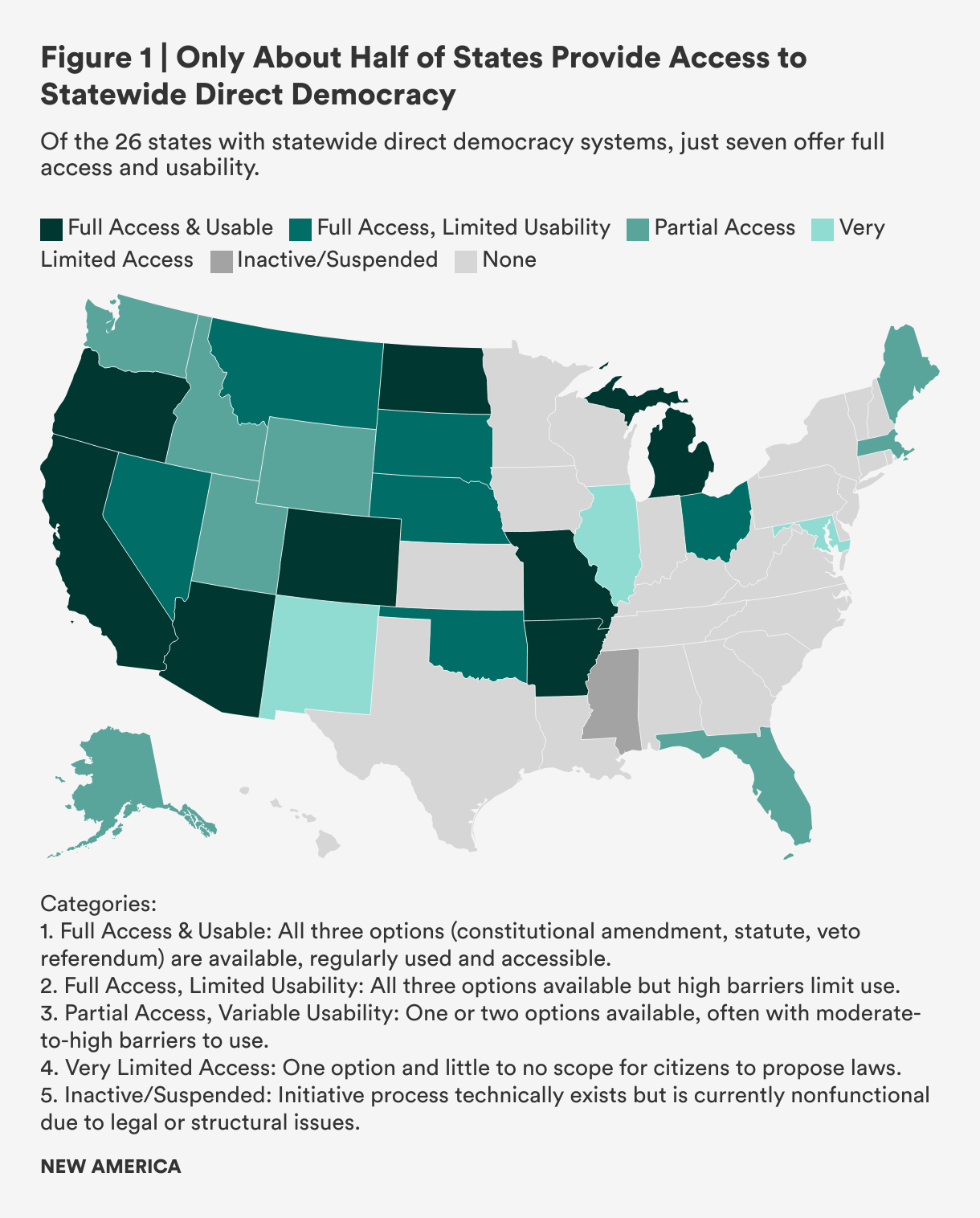
In the United States today, ballot initiatives are popular with voters, used widely, and have the potential to transform policy. Yet only 26 states have laws allowing for some form of initiative, leaving millions of voters without a direct voice in state policymaking. Of those 26 states, only 24 allow citizen-initiated statutes or amendments, and only 21 are currently usable (see Figure 1).
Meanwhile, trust in representative institutions is currently at historic lows. Polls show that Congress is the least trusted of them all, and it has surrendered its powers to an oligarchic and chaotic executive branch. In a statistical analysis, Martin Gilens and Benjamin I. Page find that economic elites and organized interest groups hold substantial influence over U.S. public policy, while the “general public has little or no independent influence.” In their book Levers of Power: How the 1% Rules and What the 99% Can Do About It, Tarun Banerjee, Michael Schwartz, and Kevin A. Young argue that corporations hold an outsized influence over politicians and candidates of both parties.
In state governments, lawmakers face dwindling public accountability due to the outsize influence of money in politics, gerrymandering, geospatial self-sorting, and low electoral competition. As a result, state policy—particularly in Republican-led states—is increasingly at odds with the preferences of majorities of voters on a wide range of policies, a gap that further deepens distrust.
Where available, citizen-led ballot initiatives and referendums have been among the tools helping to bridge this gap between voter beliefs and policy outcomes. But more than half of American residents remain without access.
As we consider expanding initiative access to more states, we must consider how initiatives can help or harm and under what circumstances. What can we learn from America’s long track record with ballot initiatives?
This research brief reviews the benefits and costs of initiatives and referendums. A companion to a forthcoming report from New America on expanding citizen-led policymaking, this brief aims to inform a range of actors in democracy reform and policy about the opportunities and challenges of expanding access to direct democracy to new states.
Below, we summarize studies investigating the most prevalent arguments for and against ballot initiative processes. These include positive claims that initiatives improve policy alignment between lawmakers and promote civic engagement. They also address claims that initiatives depress participation, are too confusing, and give undue influence to wealthy individuals and big business.
Ballot initiatives, while imperfect, produce net positive effects for American democracy. On balance, the empirical record shows that initiatives are a practical and time-tested tool to boost policy congruence, policy innovation, and (albeit more modestly) civic participation. There is also evidence that they can moderate legislative extremism. Meanwhile, claims that initiatives mainly benefit moneyed interests and hurt turnout appear to be overblown. In some cases, there are demonstrable flaws in some states’ processes, particularly those related to excessive signature requirements, confusing ballot language, and legislative interference in the design and implementation process. Still, these can be mitigated or fixed—in some cases, through the initiative process itself.
The good news for those seeking to expand or introduce statewide direct democracy within their state is that we have a pretty good understanding of what works, and especially what doesn’t, across different types of states. There’s no one-size-fits-all initiative process, but experience suggests that, for example, more permissive rules around signature gathering and approval thresholds tend to produce better outcomes, from more responsive and innovative policy to more grassroots organizing. A forthcoming brief will propose a set of principles and best practices for policymakers to inform the design of a system that suits their state.
Initiatives are particularly valuable in ensuring public policy reflects majority preferences, especially in states where gerrymandering or partisan supermajorities insulate lawmakers from electoral accountability. Multiple studies suggest that initiative states are more likely to produce outcomes that majorities support than states without direct democracy. A recent study of ballot initiatives between 2016 and 2022 found that in Republican-led states, where the gap between government policies and public opinion tends to be wider, liberal-leaning ballot initiatives were nearly twice as common as conservative initiatives, and succeeded 67 percent of the time, compared to a 42 percent success rate of Republican policy measures in red states. A study by John Matsusaka found that states with citizen-led ballot measures are 18 percent more likely to enact policies that reflect the median voter’s preferences. Initiatives have shaped fiscal, social, and governance policies in ways that often diverge from legislative agendas. Some examples of issue areas and mechanisms through which initiatives close gaps in representation include:
Notably, direct democracy’s impact appears to depend on the state legislature’s responsiveness to public preferences. When elected officials are already aligned with the median voter, initiatives might not make much of a dent; when their preferences diverge sharply from the public’s, the initiative can fulfill its promise as a democratic corrective. Research shows that the greater the initial gap between policymakers and majority opinion, the more direct democracy helps bring policy into line.
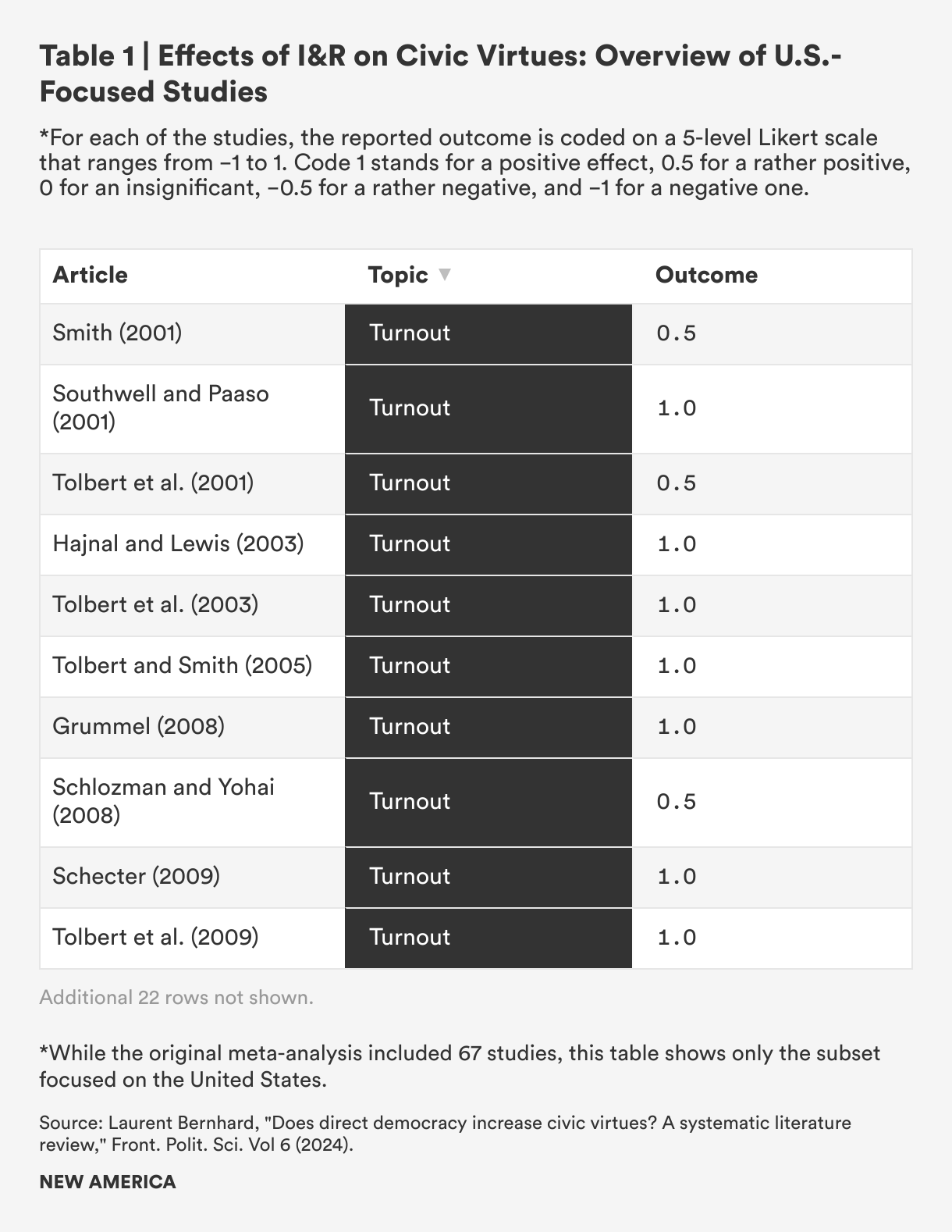
Despite mixed to discouraging results in the international literature on the civic effects of initiatives, a recent meta-analysis concludes that U.S. initiatives produce modest civic benefits across several dimensions (see Table 1 below). We summarize some of those studies here, and others relevant to the voter experience and democratic virtues of direct democracy.
These limitations indicate the need for state-specific polling, focus groups, and well-designed public education campaigns as part of any expansion strategy. Transparent ballot language, nonpartisan explanatory materials, and independent voter guides can help voters make informed decisions and reduce roll-off (undervoting) on ballot questions. When combined with the distribution of quality voter guides, voting by mail may also decrease ballot roll-off and improve voter understanding of ballot questions because it allows voters more time and flexibility to learn about the measures and make informed decisions.
In an age of rising authoritarianism, initiatives provide an institutional mechanism for democratic correction rather than subversion. While not a silver bullet, initiatives have historically served as “pressure valves” for public frustration, offering channels for engagement when representative institutions fall short. As discussed above, empirical research supports several democratic benefits of direct democracy. These findings and anecdotal evidence offer strong indications, but have not yet proven, that direct democracy can also reinforce democratic legitimacy by:
The idea that direct democracy can counter authoritarian populism remains conceptually powerful, but more research is needed to demonstrate causation. Many experts argue that giving people genuine governing power should reduce alienation from democratic institutions. Historical and contemporary episodes demonstrate how dissatisfied U.S. citizens have leveraged direct democracy to correct democratic deficits:
Citizen-initiated reforms often begin at the state level but later shape national attitudes, policy, and legal norms. A recent study found that ballot initiatives allow states to serve as testing grounds for policy innovation, particularly when national politics are deadlocked. They can also catalyze change by demonstrating public support, building momentum for legislation, and attracting national attention and funding. Historical and modern examples include:
While the benefits of direct democracy are compelling, legitimate concerns exist around the quality, equity, and integrity of the initiative process. Expanding access to initiatives must go hand-in-hand with thoughtful design and robust protections to ensure the process remains fair, inclusive, and accountable to the public.
A common complaint about the initiative process is that it’s vulnerable to capture by well-funded special interests. Critics argue that moneyed interests often dominate initiative campaigns through slick advertising and misinformation rather than broad public support. These criticisms are not unfounded. For example, a 2014 study found that a PAC funded by a few large donors in Oregon was able to swing initiative outcomes in the state despite having little grassroots support. Sometimes the problem begins before any campaigning begins. Due in part to California’s short signature gathering window, it costs at least $8 million just to qualify a statewide measure for the ballot. Therefore, only well-funded interests (e.g., tobacco, oil, and rideshare companies) can afford to qualify, let alone promote, initiatives. But the literature overall offers a more complex picture:
To prevent ballot initiatives from being dominated by moneyed interests and enable greater access among traditionally underserved groups, reformers should consider independent fiscal reviews of proposed measures and common-sense disclosure requirements that balance the importance of transparency with donor accessibility—particularly smaller donors. Some states’ campaign finance rules seem intuitively good, but, either by design or as an unintended consequence, exclude certain sectors or smaller organizations from the process. Fair and accessible compliance standards can help prevent this outcome.
Joseph Zimmerman’s 2014 book The Initiative underscores the importance of crafting ballot access rules that facilitate grassroots participation while guarding against elite co-optation. Public financing or signature-gathering support for grassroots campaigns might be helpful. Other steps could be digital signature gathering (overseen by a nonpartisan body) and better language translation support. In addition, advocates should ensure the initiative process incentivizes people to pursue initiated statutes over constitutional amendments unless absolutely necessary. Statutory campaigns are cheaper than amendments, but when states allow legislatures to immediately defang or overturn initiated statutes, initiative organizers lean more heavily on amendments. A model initiative process might require initiated statutes to stand for a certain number of years, or require bipartisan support to modify or overturn them.
Finally, a 2018 Harvard Law Review article suggests integrating deliberative democracy practices, such as Oregon’s Citizens’ Initiative Review Commission and permanent citizens’ assemblies, to guard against special-interest capture and counterbalance the overall influence of campaign spending.
Another criticism is that ballot measures oversimplify complex issues, forcing voters to make binary choices on topics that deserve nuance. Similarly, ballot language manipulation can sometimes lead voters to vote opposite their intent. This concern is particularly acute in states that allow contradictory initiatives on the same ballot, do not impose word limits on ballot measures, and phrase ballot questions as statements—all of which increase information costs and reduce participation. These and related issues for direct democracy expansion advocates to consider include:
To be sure, these problems are not inherent to direct democracy—they’re design issues. While the scope of this brief is limited to the motives and possibilities for ballot initiative expansion, reformers can arm themselves early with proposed solutions to the most prevalent criticisms. Advocates in prospective initiative states can work closely with direct democracy experts, lawyers, and lawmakers to build in language and public education requirements to promote measure clarity and informed participation. They can also imitate and learn from steps already taken or being pursued now to strengthen processes in existing initiative states. Improvements might include:
Of course, winning an initiative campaign does not guarantee smooth implementation. Implementation of initiative-passed policies is often uneven, with legislatures and courts finding ways to delay, modify, or overturn voter-approved measures. This concern has become increasingly relevant in recent years as state lawmakers attempt to override or weaken initiatives through legislative amendments or judicial challenges.
According to a report by the Election Reformers’ Network, between 2010 and 2023, state legislatures amended or repealed more than one in five voter-approved initiatives. Examples include Florida’s 2018 Amendment 4 (felon reenfranchisement), which spurred legislative restrictions requiring repayment of court fines; Utah and Nebraska, where legislatures altered or delayed voter-approved Medicaid expansion; and, of course, Mississippi, where following voters’ approval of medical marijuana, a 2021 state Supreme Court decision suspended the initiative process altogether due to outdated constitutional language. In 2025, Missouri activists are rallying to defend abortion and minimum wage initiatives that voters approved in the election just a few months before.
Many of these trends break down along party lines. A recent Democracy Docket report found that, between 2010 and 2022, both parties attempted to limit the use or implementation of ballot measures to prevent policy changes they opposed. For example, Democrats took steps to prevent conservatives from using direct democracy to end same-sex marriage. However, Republicans have attempted to limit ballot measures far more extensively, particularly in states where they hold trifectas in state governments.
To mitigate such risks, future initiative states could consider constitutional protections that prevent legislative repeal or alteration for a set period, fast-track legal reviews to enforce voter-approved laws, or create nonpartisan implementation commissions to monitor fidelity and compliance. These, in addition to nonpartisan bodies to handle fiscal and ballot language reviews, should help protect the integrity of the process and honor voters’ preferences.
While ballot initiatives can advance democratic reform, they have also been used to restrict or block progress toward securing rights for minority groups. Notable examples include same-sex marriage bans passed via initiatives in the early 2000s and, as recently as 2024, voter ID laws and citizen-only voting requirements, often sold as election integrity measures but politically motivated to dampen turnout. Expansion should be paired with safeguards against majoritarian tyranny, including pre-ballot review of constitutional rights implications by independent bodies and broader efforts to strengthen our political institutions so that citizen-initiated ballot measures are not the only venue for strengthening policy representation. For instance, research suggests that electoral system biases caused by winner-take-all rules and gerrymandering increase demand for direct democracy by undermining the representativeness of legislatures. Multi-member district proportional representation systems are less biased and thus may reduce reliance on alternative policy avenues like direct democracy. Finally, we can shore up our civic health and improve responsiveness through the institutionalization of deliberative democracy processes like citizens’ assemblies that also give people real power in the governing process.
Citizen-initiated ballot measures have helped bridge the gap between public preferences and government policy in half the country. The logical next step is to extend that opportunity to all 50 states. The political challenges are real, but so is the public demand. Americans want a more direct role in policymaking, especially when traditional representative pathways are blocked.
Initiative systems, though flawed, offer a meaningful corrective to legislative drift. They empower citizens to push policy forward on salient issues—from health care and electoral reform to civil rights—often when legislatures cannot or will not act. Initiatives may also foster civic engagement and deter authoritarian overreach by diffusing power and reasserting popular sovereignty.
As reformers consider expanding the map of initiative-eligible states, they should also be mindful of the limitations and downsides of ballot initiatives, particularly the role of billionaires and special interests. The case for expansion will require advocates to persuasively counter the narrative that initiatives serve the narrow interests of the rich and powerful more than they do the majority of voters in any given state. Most importantly, reformers should design accessible and equitable processes to promote greater grassroots participation and voter education around initiative campaigns.
Direct democracy is a complement to representative government, not a substitute. As Teddy Roosevelt said in a speech to the 1912 Ohio Constitutional Convention, “Give the legislature an entirely free hand; and then provide by the initiative and referendum that the people shall have power to reverse or supplement the work of the legislature should it ever become necessary.” Expansion of the initiative process should thus go hand-in-hand with a strategy to advance structural changes that make legislatures themselves more representative and responsive. Over the long term, broader reforms like widely available public financing of campaigns and proportional representation may do more to address the root causes of our democratic dysfunction than simply increasing the use and reliance on direct democracy.
In the near term, however, initiatives remain one of the few tools citizens have to shape policy, including the very policies that could make representative government work better. With thoughtful design and strong guardrails, expanding access to initiatives would be a significant step toward a more responsive, accountable, and resilient U.S. political system.
Deputy Director, Political Reform Program