A Chapter of: Extracting Success in Pre-K Teaching: Approaches to Effective Professional Learning Across Five States
Building a Cohort of Early Childhood Technology Leaders in Chicago, Illinois

The Technology in Early Childhood (TEC) Mentor Program at the Erikson Institute serves pre-K through third grade teachers in parochial schools in Chicago, IL and at Eagle Academy Public Charter School in Washington, DC. The following profile focuses on the program’s work in Chicago. The program selects teachers who have a bachelor’s degree and teacher certification. The Archdiocese Office of Catholic Schools with support from the Big Shoulders Fund serves over 20,000 children in Chicago.41 Sixty-six percent of these children are from low-income households.42
Entering the TEC Playground
On a Thursday evening in January, 25 pre-K through third grade teachers across 25 Catholic schools in the Archdiocese of Chicago gather at the Erikson Institute, a graduate school of education focused on child development. Once the teachers check in, they immediately dive into the professional development workshop by entering what is known as “the TEC playground.” But there are no slides or monkey bars. The teachers freely circulate the room, stopping at tables to engage with hands-on technology activities related to electricity.
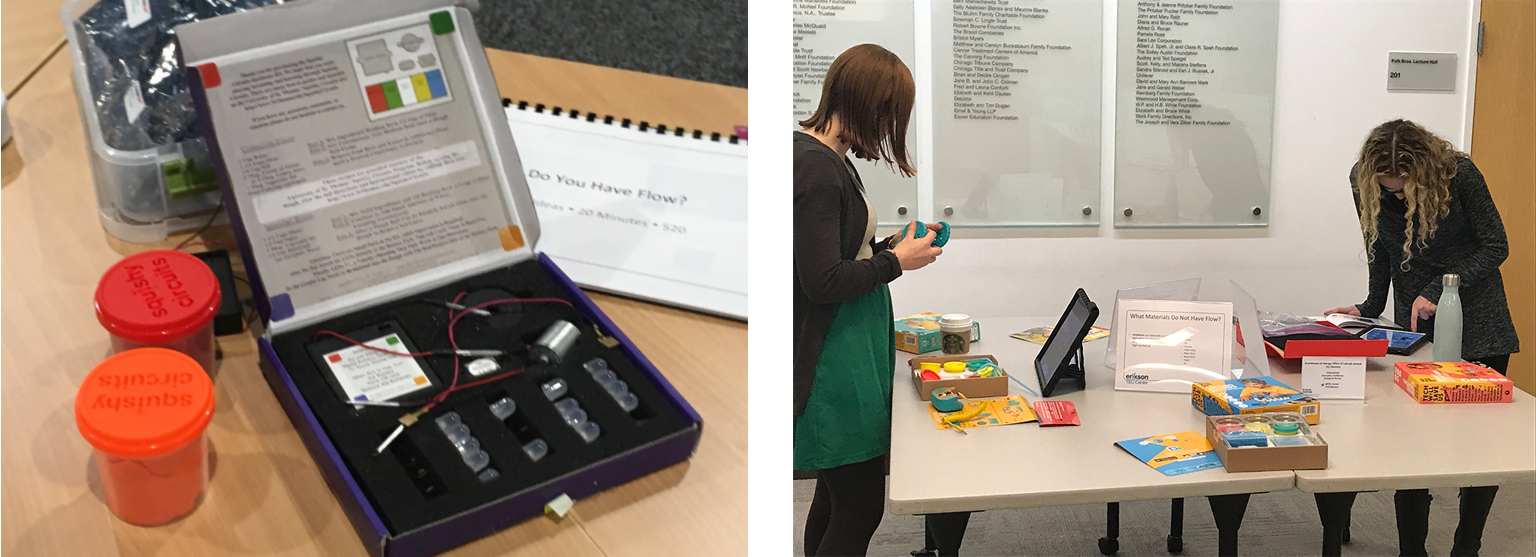
(Left) TEC Mentors Program (Right) Shayna Cook
At one table, there is conductive play dough, little light bulbs, wires, and children’s books on circuits. Two teachers flip through the children’s books and briefly look at the instructions. Then, they begin to play, working independently to build their circuits. One teacher begins by rolling her play dough into two balls. She uses wires to connect the balls with the light bulb. When she closes her circuit, the light bulb lights up. She is pleased and starts working again to build something more complex. As teachers play at this station, they discuss how they could incorporate these tools into their students’ learning. Agnie Szka, a pre-K teacher, says, “when I see a tool here, I try to see how it can be integrated throughout the curriculum, in my writing center or dramatic play center.”
The “playground” is a part of a professional development program called TEC Mentors at the Technology in Early Childhood (TEC) Center at the Erikson Institute. This program is designed to develop a cohort of early childhood educators who can be technology leaders and coaches. The teachers learn how to integrate technology into their early childhood programs, classrooms, and out-of-school initiatives.
Closing the Professional Development Gap in Tech
In Transforming the Workforce, the use of technology for high-quality instruction was identified as a gap in the education system, affecting teachers across grade levels.43 Two institutions—the National Association for the Education of Young Children (NAEYC) and the Fred Rogers Center for Early Learning and Children’s Media at Saint Vincent College—had already recognized this gap and published a joint position statement in 2012 on the use of technology and interactive media in early childhood programs, from birth through age eight.44 It clearly states that educators who are informed, intentional, and reflective in their use of technology and interactive media have additional tools for enriching the learning environment, particularly when their use of technology and media is child-centered, play-oriented, hands-on, relationship-building, and aligned with curriculum goals.
Although the release of this statement has increased early childhood educators’ awareness of this gap in their practice, educators still lack access to high-quality professional development opportunities around effective and developmentally appropriate technology instruction. According to a 2015 study, less than half of early childhood educators have ever had professional development in the use of educational technology,45 so there is a great need for high-quality professional development programs that can empower teachers with new tools that can be integrated into their practice. Chip Donohue, dean of distance learning and continuing education at Erikson and director of the TEC Center, and Tamara Kaldor, associate director of the TEC Center, started the TEC Mentors program in 2016 to fulfill this need.
Building a Cohort of TEC Mentors
Seventy teachers across the archdiocese applied to be a part of the TEC Mentors program and through a rigorous selection process about half were chosen. The teachers entered the year-long professional development program with the goal of building their knowledge and skills around the use of technology with young children. At the end of the program, teachers presented their final project, which consisted of tech- and play-related lesson plans. The teachers’ school leaders came to the first session and were present during the final project presentation. Throughout the year, they were kept abreast of what their staff was learning. The TEC Mentors program has demonstrated that when school leaders are familiar with the content of the professional development, they can create more buy-in from the teachers. In addition, many principals have not been trained in what high-quality technology integration looks like in early childhood. The TEC Mentors program helps them understand how to observe teachers and provide meaningful support and feedback to help create lasting changes in teacher practice.
The TEC Mentors program uses a blended learning model that incorporates in-person, hands- on professional development with online modules and an online professional learning network. Each new concept or idea presented is a way to build teachers’ thinking around technology and provide them with the skills needed for their final projects. Although teachers have dedicated time on workshop days to collaborate, they also use tools, like Facebook, to share ideas between workshops. Kaldor said that their program develops teachers’ foundational knowledge around technology instruction and differentiates to meet individual teacher needs.

The TEC Center at the Erikson Institute
Teachers can contact experts at the Erikson Institute for virtual office hours through Skype for coaching to help them with the development of their lesson plans. Kaldor explains more about the program: “It’s the great equalizer. Some people are high-tech, but don’t have the teaching experience and vice-versa. Partnerships are formed for collaboration and teachers share with one another, fostering a community of practice.” For instance, one teacher, who initially was nervous about using technology with her students, shared a success story. One of her four-year-old students, a DLL, was at home during a power outage. He told his parents, “we need to check the circuit” and helped them get the power back on. He was able to connect what he was learning in school about electricity to a real-life situation.
After teachers visit all of the tables in the TEC playground, they watch a video of a model lesson from one of their cohort members. Teachers are captivated by the authentic lesson and openly share reflections on the video clip and examples from their own lessons. Participation in the TEC playground, model lessons, and reflection activities help teachers develop their teaching skills around the use of technology. Reflecting on her experience in the program, one teacher stated, “I approach teaching from a very developmental early childhood philosophy, and I was very hesitant to add technology. Through this program, I’m starting to feel a lot more comfortable, and I see it as a lot more appropriate.” After each workshop, teachers get to take home some of the technology tools they explored in the playground and integrate these new tools into their practice.
At the end of the program, teachers receive a certificate of completion during the mini-conference where they deliver their final presentation to their school leaders, peers, and sometimes parents and families. In 2016, the program was showcased by the White House at both the Computer Science for All and Early STEM initiatives.

The TEC Center at the Erikson Institute
Empowering Teachers to Lead in Tech
Although the Archdiocese of Chicago provides funding for resources, the TEC Center is looking for more funding to conduct a rigorous evaluation of the program. Currently, the program uses entry and exit surveys to illustrate teacher growth over the course of the year. According to the survey results, the TEC Mentors program has decreased teachers’ anxiety around the use of technology in early childhood settings and has empowered teachers to facilitate tech exploration and creation.
These survey results are promising, particularly since the program’s goal is to build a corps of early childhood technology experts. Throughout the program teachers learn how to integrate technology into their daily classroom practice. They also learn how to share best practices with their colleagues who are not participating in the program and they are empowered to lead in their school communities. Donohue says, “in general, our success is based on a developmentally appropriate approach. When teachers start our program, most of them already know that. Building on this knowledge, we are able to help them integrate technology into their practice.” A future study could measure the effect of the program’s ability to change the attitudes and dispositions of teachers who have not participated in the program, but who are learning from their colleagues who are participants. If successful, this could be another approach to scale up.

Extracting Success in Pre-K Teaching: Approaches to Effective Professional Learning Across Five States
- Introduction
- Pre-K Teachers and In-Service Professional Learning
- Our Approach
- Strengthening STEM Instruction in Passaic, New Jersey
- Building a Cohort of Early Childhood Technology Leaders in Chicago, Illinois
- Partnering to Connect Research to Practice in Nashville, Tennessee
- Explicitly Teaching Social and Emotional Skills in San Jose, California
- Improving Language and Literacy Across Texas
- Five Lessons for Growing Strong Pre-K Teachers
Citations
- Big Shoulders Fund, “Our Mission is Simple,” https://www.bigshouldersfund.org/.
- Big Shoulders Fund, “Our Mission is Simple,” https://www.bigshouldersfund.org/.
- LaRue Allen and Bridget B. Kelly, eds., Transforming the Workforce for Children Birth Through Age 8: A Unifying Foundation (Washington, DC: National Academies Press, 2015), 404, http://www.nap.edu/catalog/19401/transforming-theworkforce-for-children-birth-throughage-8-a.
- National Association for the Education of Young Children, “Technology and Young Children: Online Resources,” https://www.naeyc.org/resources/topics/technology-and-media/resources.
- Technology in the Lives of Educators and Early Childhood Programs: Trends in Access, Use, and (Evanston, IL: Northwestern School of Communication, 2015), http://www.fredrogerscenter.org/wp-content/uploads/2015/07/Blackwell-Wartella-Lauricella-Robb-Tech-in-the-Lives-of-Educators-and-Early-Childhood-Programs.pdf.