A Chapter of: Extracting Success in Pre-K Teaching: Approaches to Effective Professional Learning Across Five States
Our Approach
The following profiles show how communities within New Jersey, Texas, Illinois, Tennessee, and California are strengthening pre-K teachers’ knowledge and competencies to ensure that they are effectively prepared to work with young children. We include a range of models at different stages in their development that are taking different approaches to professional learning and focusing on different content areas. We sought out local models that were being evaluated for their effectiveness, because as Curry School of Education explains, while there are agreed-upon components of high quality professional learning, there is also evidence that many well-designed professional learning programs do not improve teacher practice or child outcomes.30 These five programs, while different from one another, each incorporate multiple aspects of what experts have determined to be high-quality professional learning.
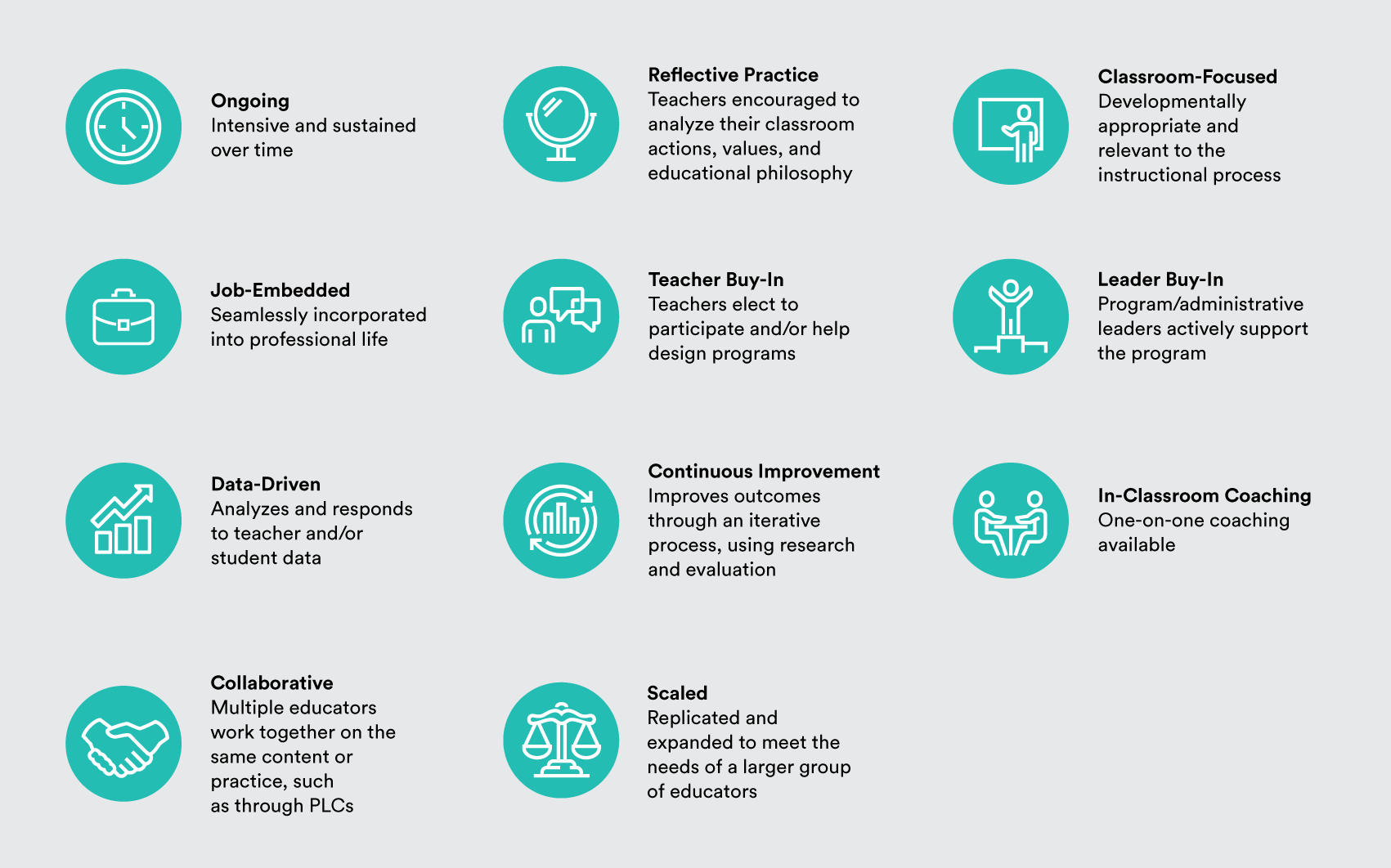
Throughout this report we use iconography to indicate which components of quality are associated with each professional learning program. These icons were chosen based on common components of high-quality professional learning identified in the research. For the icon definitions we borrowed heavily from Frontline Research & Learning Institute’s Bridging the Gap report series:31

Extracting Success in Pre-K Teaching: Approaches to Effective Professional Learning Across Five States
- Introduction
- Pre-K Teachers and In-Service Professional Learning
- Our Approach
- Strengthening STEM Instruction in Passaic, New Jersey
- Building a Cohort of Early Childhood Technology Leaders in Chicago, Illinois
- Partnering to Connect Research to Practice in Nashville, Tennessee
- Explicitly Teaching Social and Emotional Skills in San Jose, California
- Improving Language and Literacy Across Texas
- Five Lessons for Growing Strong Pre-K Teachers
Citations
- Bridget K. Hamre, Ann Partee, and Christina Mulcahy, “Enhancing the Impact of Professional Development in the Context of Preschool Expansion,” American Educational Research Association 3, no. 4 (2017): 1–16, http://journals.sagepub.com/doi/abs/10.1177/2332858417733686.
- Elizabeth Combs and Sarah Silverman, Bridging the Gap, (Malvern, PA: Frontline Research and Learning Institute, 2017), https://www.frontlineinstitute.com/reports/essa-report/.