A Chapter of: The Phase Zero Digital Toolbox
Conflict and State Instability
Some tools address more than one issue, and will be cross-listed.
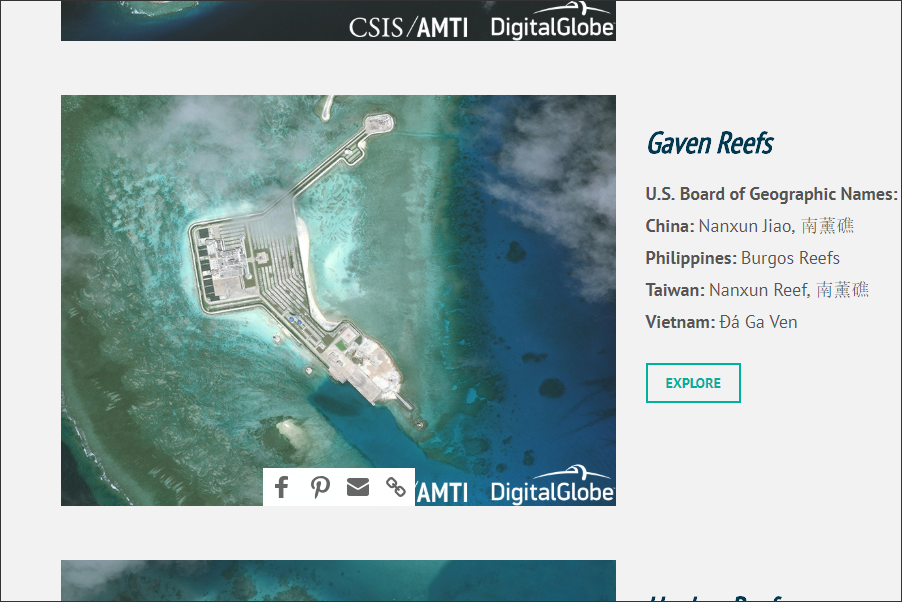
Asia Maritime Transparency Initiative
Center for Strategic and International Studies (CSIS)62
An interactive, objective, regularly-updated source for maps, analyses, and curated satellite imagery. The goal is to promote transparency in the Indo-Pacific in order to dissuade assertive behavior, prevent conflict, and generate opportunities for cooperation and confidence building.
Visit the tool here: amti.csis.org

Corruption Perceptions Index
Transparency International63
An annual composite indicator based on 13 surveys, rankings, indices, and assessments to measure perceptions of public sector corruption in different countries around the world.
Visit the tool here: www.transparency.org

Crisis Watch
International Crisis Group 64
A monthly early warning bulletin designed to provide regular updates on the state of the most significant situations of conflict around the world.
Visit the tool here: www.crisisgroup.org
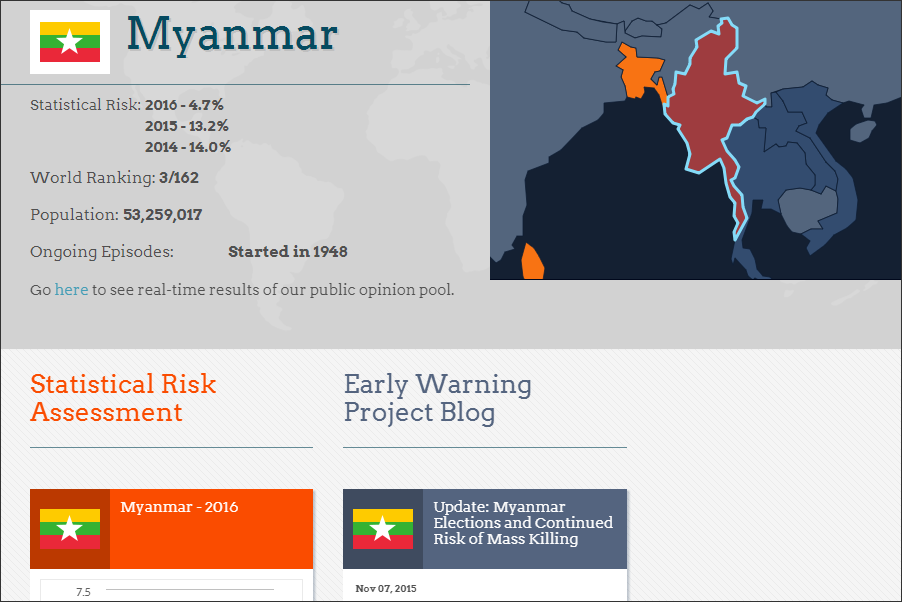
Early Warning Project
Simon-Skjodt Center for the Prevention of Genocide at the United States Holocaust Memorial Museum 65
A tool that estimates whether a country will be susceptible to an onset of state-led mass killing in the next year.
The assessments come from the average of three statistical models that represent key perspectives on how best to anticipate when mass killing will occur. These quantitative models are supplemented with crowd-sourced expert opinions.
Visit the tool here: www.earlywarningproject.com
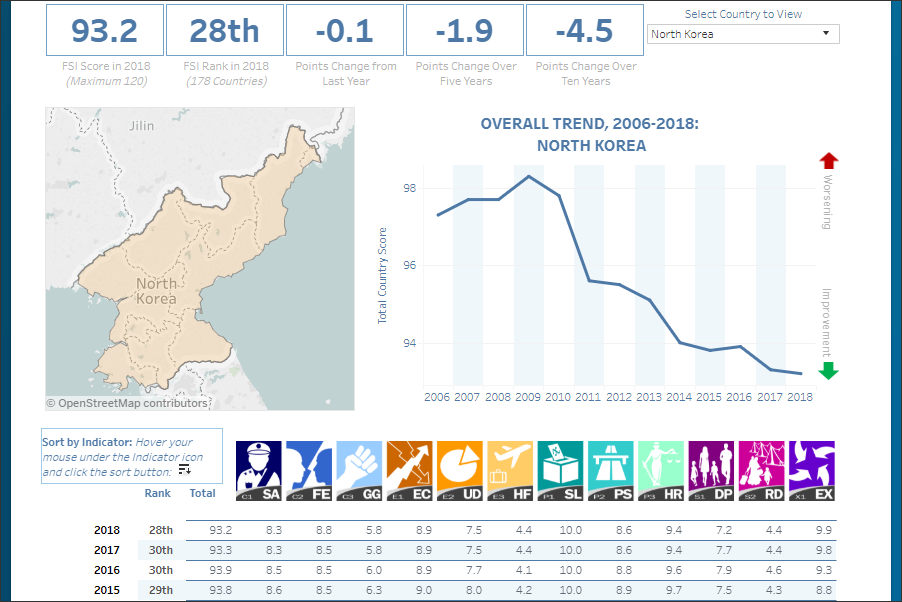
Fragile States Index
The Fund for Peace66
An index of twelve conflict risk indicators that measure the condition of a state over time.
The index uses qualitative and quantitative measures to assess the vulnerability of states to collapse across pre-conflict, active conflict, and post-conflict situations.
Visit the tool here: global.fundforpeace.org/index

Global Conflict Tracker
Center for Preventative Action at the Council on Foreign Relations (CFR) 67
CFR’s Preventive Priorities Survey identifies ongoing conflicts around the world and provides monthly updates with background information and available resources. As of May 2018, there are nearly thirty conflicts on the map.
The visualization denotes both the degree of impact on US interests as well as whether the conflict is worsening or improving.
Visit the tool here: www.cfr.org/interactives/global-conflict-tracker

Global Peace Watch
Vision of Humanity 68
An annual index of 23 qualitative and quantitative indicators that measures the state of peace across three domains: safety and security, ongoing domestic and international conflict, and degree of militarization.
The tool allows the user to view detailed information on each country and indicator.
Visit the tool here: visionofhumanity.org/indexes/global-peace-index
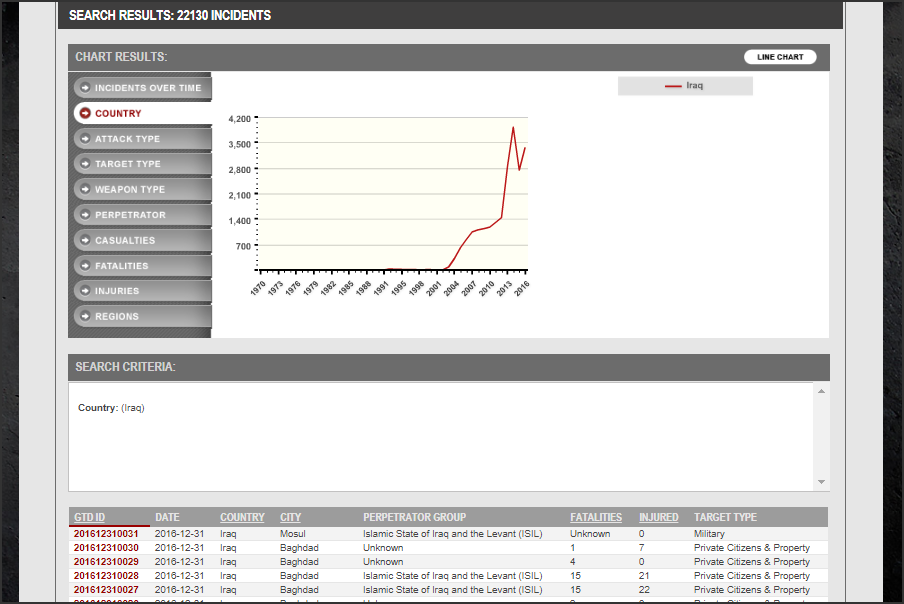
Global Terrorism Database (GTD)
START: The National Consortium for the Study of Terrorism and Responses to Terrorism 69
An open-source, searchable database that catalogs information on terrorist events from 1970-2016 (with annual updates). The GTD includes data on 170,000 cases of domestic and international terrorism with up to 120 variables.
The primary purpose is to support research and analysis on terrorism.
Visit the tool here: www.start.umd.edu/gtd
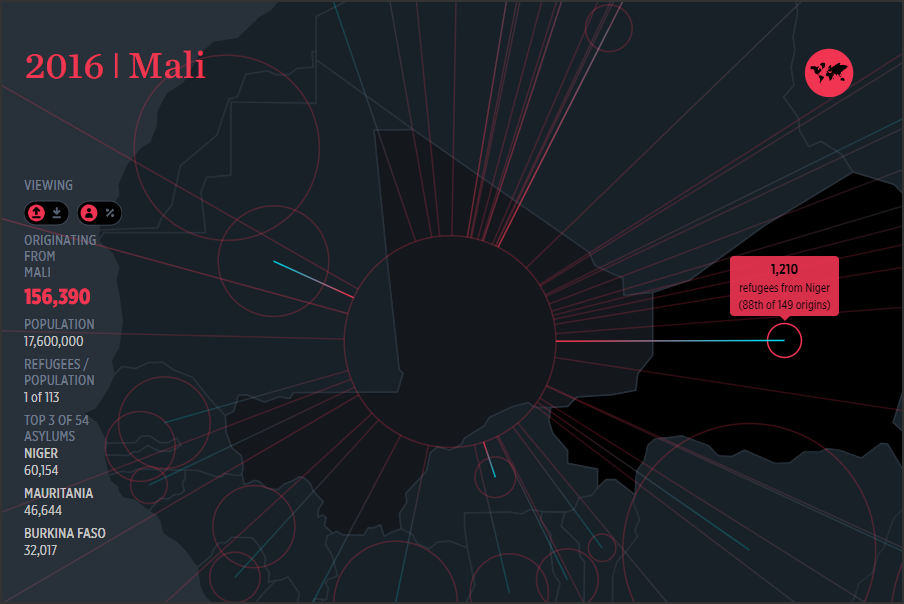
The Refugee Project
Hyperakt 70 and Ekene Ijeoma 71
An interactive map that allows viewers to explore the last 50 years of refugee migrations, from both the perspectives of country of origin and destination. UN data complemented by 100 contextual narrative stories, which detail events triggering each major exodus.
Visit the tool here: www.therefugeeproject.org
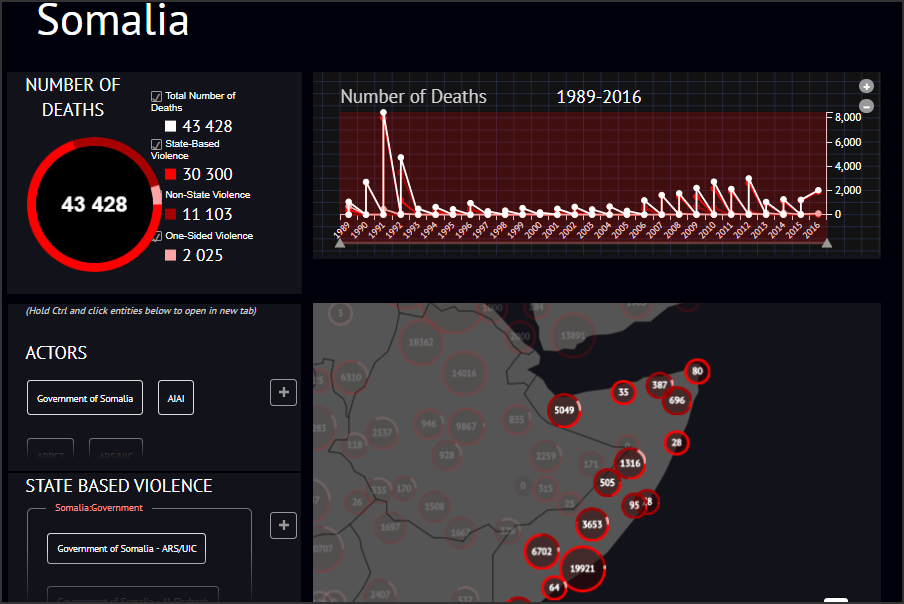
Uppsala Conflict Data Program
Department of Peace and Conflict Research at Uppsala University 72
A conflict database of organized violence and civil war dating back to 1975. The user can visualize, filter, and download the data, which is updated annually.
Visit the tool here: ucdp.uu.se

Worldwide Governance Indicators
The World Bank73
A collection of indicators that ranks six broad dimensions of governance for more than 200 countries and territories over the period 1996-2016.
The six indicators are voice and accountability, political stability and absence of violence, government effectiveness, regulatory quality, rule of law, and control of corruption.
Visit the tool here: info.worldbank.org/governance/wgi
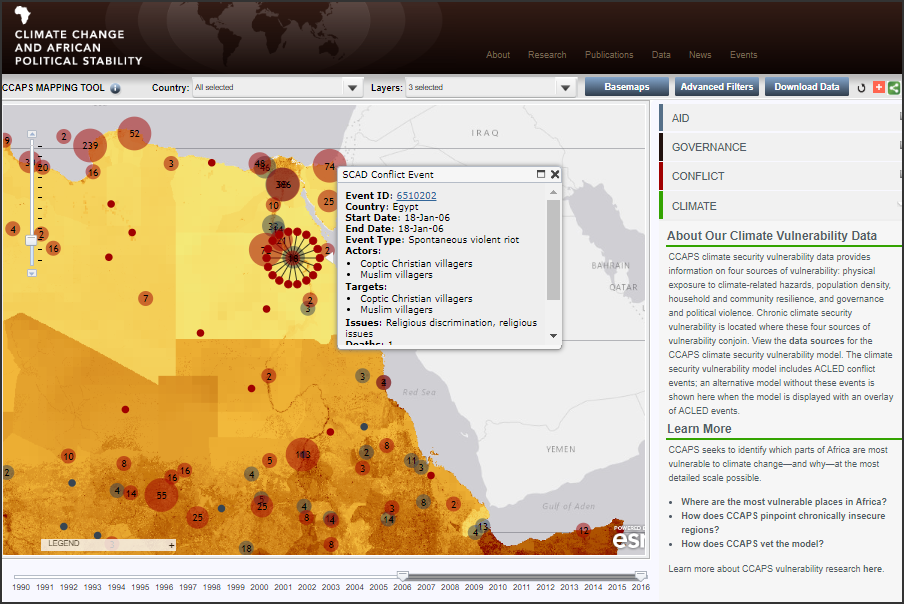
Climate Change and African Political Stability (CCAPS)
Strauss Center at the University of Texas at Austin 74
A mapped display of information on four sources of vulnerability across Africa: physical exposure to climate-related hazards, population density, household and community resilience, and governance and political violence.
The data represented is from 2006 to 2016.
Visit the tool here: ccaps.developmentgateway.org

Drivers of Vulnerability Monitor
Hague Center for Strategic Studies (HCSS) 75
A global map that displays 50 security, economic, social, political, and geographic drivers of state vulnerability to intrastate conflict. It also tracks the change in each country’s vulnerability from 1992 to 2014.
Visit the tool here: projects.hcss.nl/monitor/86
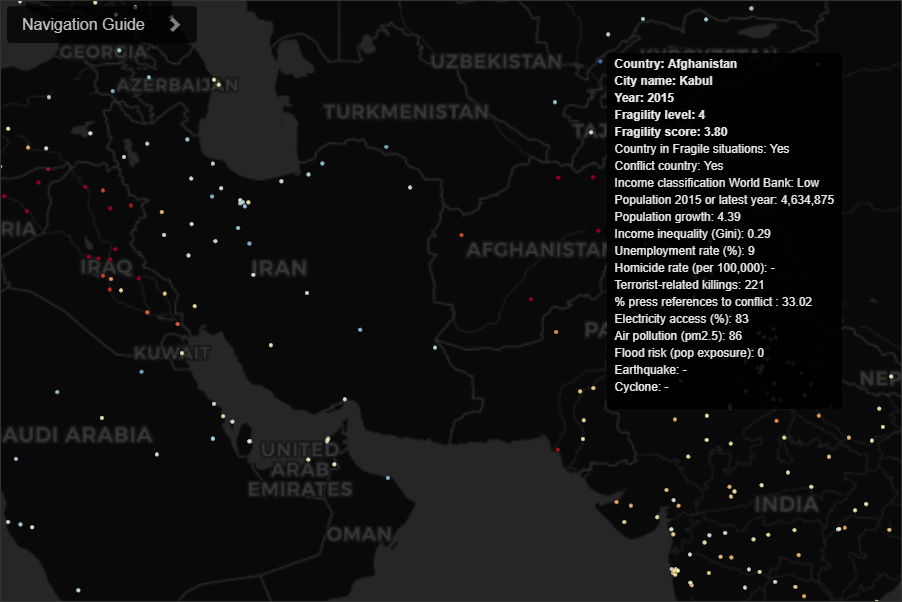
Fragile Cities
Igarape Institute 76 in collaboration with United Nations University, World Economic Forum, and 100 Resilient Cities
A data visualization tool that tracks the distribution and evolution of fragility risk in at least 2,100 cities worldwide since 2000. It features a composite score of city fragility that combines multiple metrics, such as urbanization, inequality, concentrated poverty, youth unemployment, justice deficits, real and perceived insecurity, and natural hazard exposure.
Visit the tool here: fragilecities.igarape.org.br
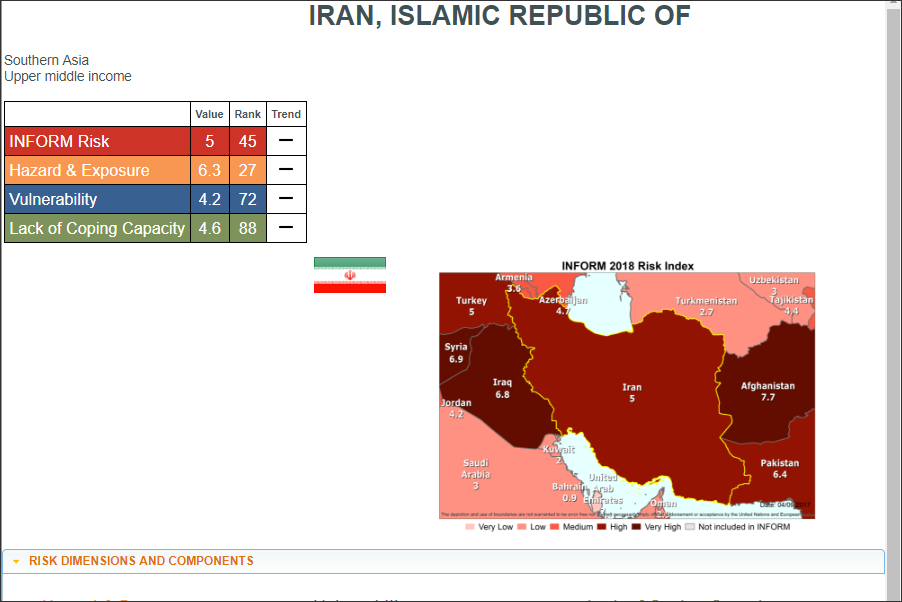
Index for Risk Management (INFORM)
Inter-Agency Standing Committee (IASC) Task Team for Preparedness and Resilience, the European Commission, and others 77
An open-source risk assessment for humanitarian crises and disasters.
The vulnerability rankings are based on 50 indicators across three dimensions of risk: hazards & exposure, vulnerability, and lack of coping capacity.
Visit the tool here: www.inform-index.org

ReliefWeb
UN Office for the Coordination of Humanitarian Affairs (OCHA) 78
The tool curates humanitarian information on global crises and disasters from more than 4,000 vetted sources. It is updated 24/7.
ReliefWeb Labs experiments with ways to improve information-sharing, including mobile apps, APIs, and shared taxonomies.
Visit the tool here: reliefweb.int
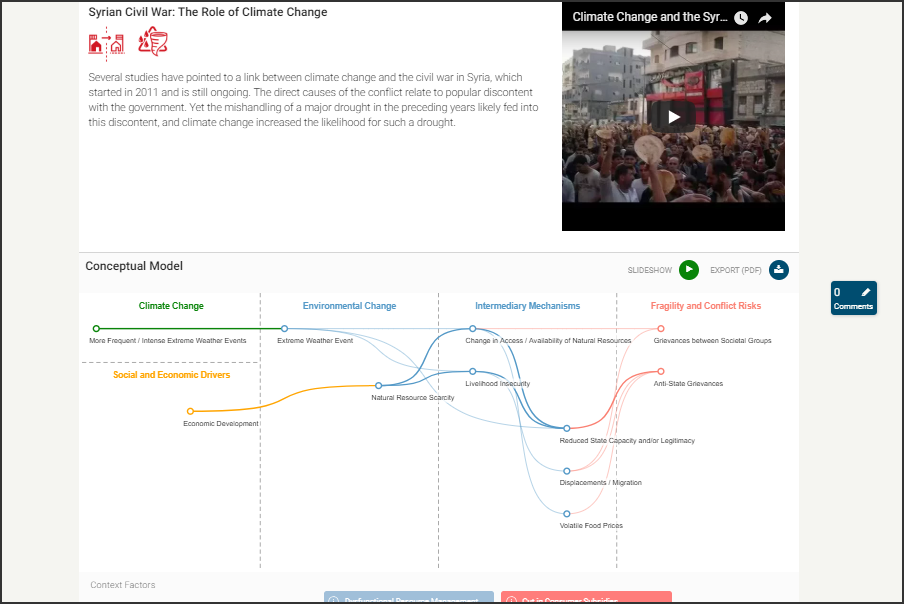
Environment, Conflict, & Cooperation Factbook (ECC Factbook)
adelphi 79
An extensive collection of more than 120 detailed, unique factsheets accessible through both a map and a searchable table.
The goal is for users to better understand the drivers behind environmental conflict and cooperation and to harness the lessons learned from earlier (non-) interventions.
Visit the tool here: factbook.ecc-platform.org
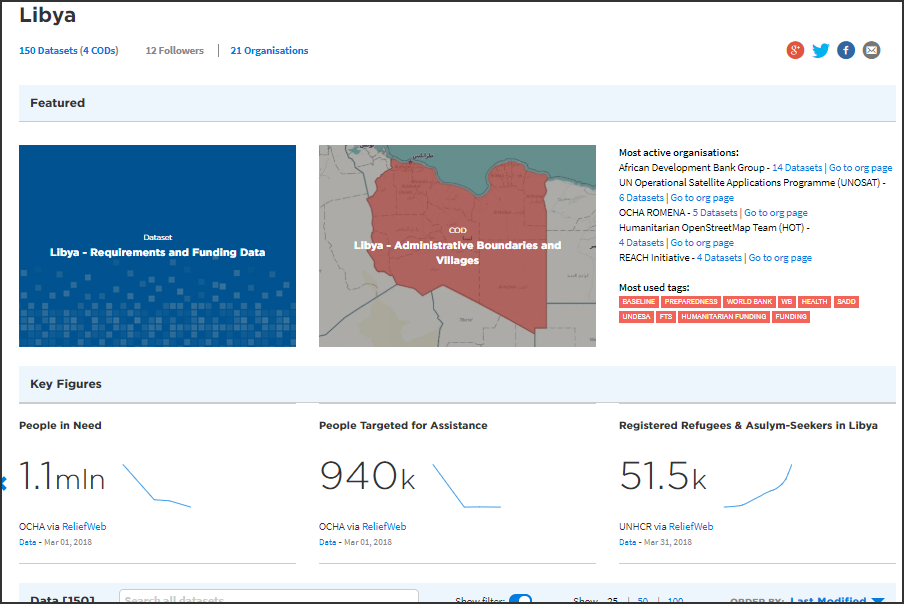
Humanitarian Data Exchange (HDX)
UNOCHA 80
An open source platform with two types of data on humanitarian crises and response.
The first type is approximately 130 curated indicators that are comparable across countries. The second type of data includes more than 6,000 data sets contributed by vetted organizations.
Visit the tool here: data.humdata.org
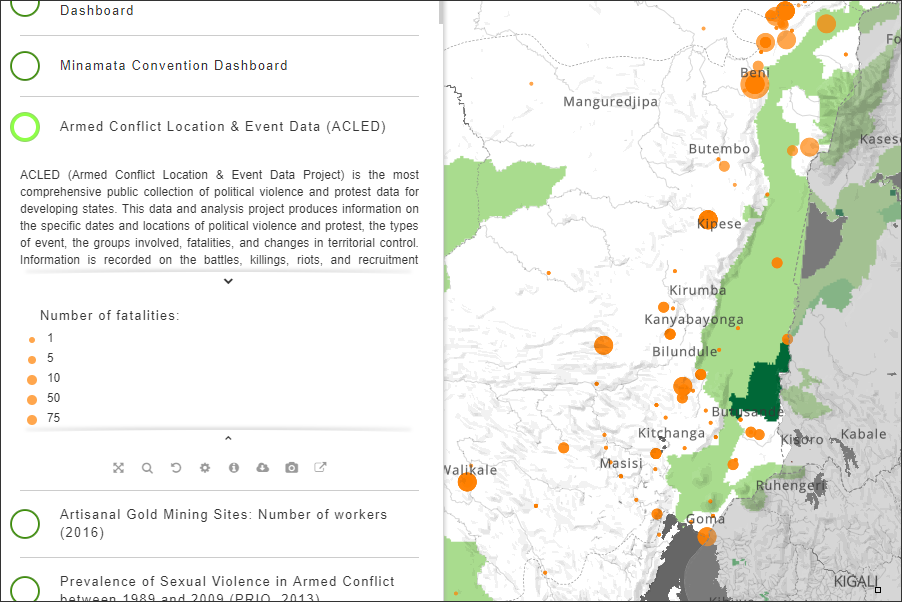
MapX
UN Environment Program, the World Bank, and the Global Resource Information 81
MapX is a decision support tool where stakeholders can build customized applications on a common platform.
The goal is to generate actionable insights from geospatial data to inform dialogue and help all stakeholders understand benefits and risks, manage expectations, and make evidence-based decisions.
Visit the tool here: www.mapx.org

Notre Dame Global Adaptation Initiative (ND-GAIN)
University of Notre Dame 82
A country-level ranking system that captures a country’s vulnerability to climate change and other global challenges , and its readiness to improve resilience. It is updated annually.
Visit the tool here: gain.nd.edu
Partnership for Resilience & Preparedness (PREP)
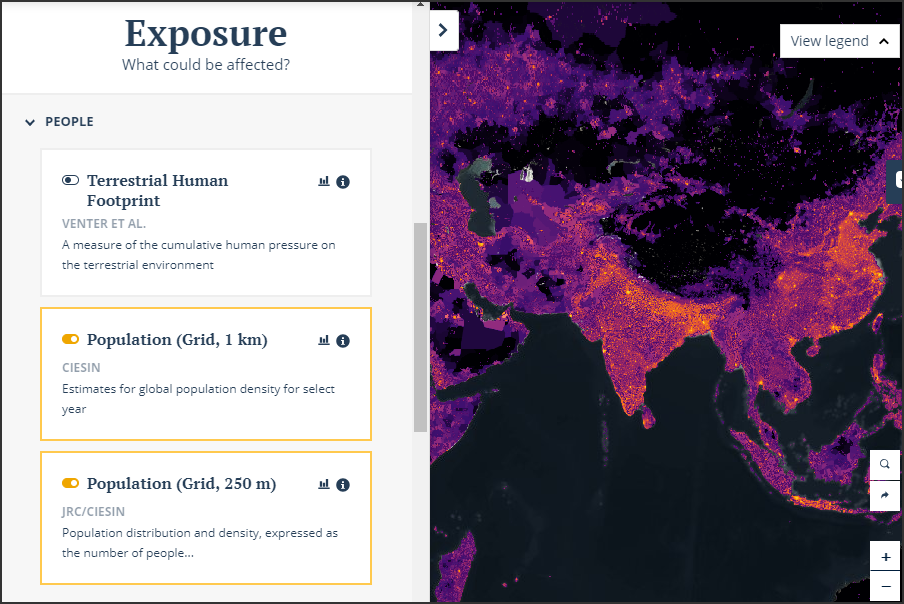
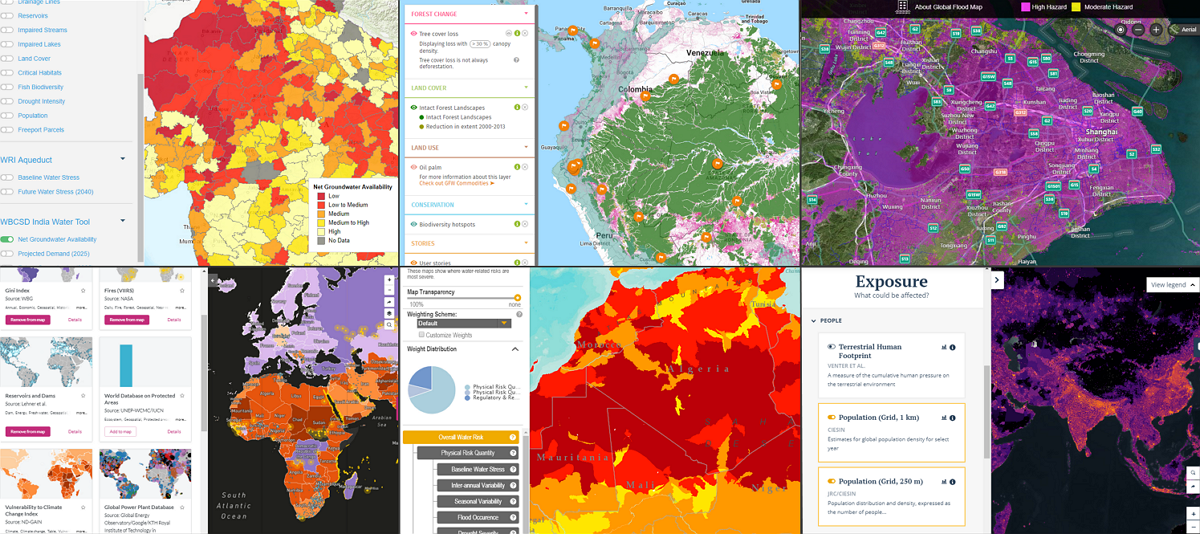
A map-based, open, online data platform that allows users to access and visualize spatial data on past and future climate, as well as physical and socioeconomic data.
The tool is built on the Resource Watch platform and allows organizations to customize dashboards to align local efforts.
Visit the tool here: www.prepdata.org

World Bank Open Data
The World Bank 85
A curated collection of longitudinal data and profiles of countries, for visualization and download.
The data covers a range of topics, including demographics, environment, economy, states and markets, and global links.
Visit the tool here: data.worldbank.org
Citations
- A U.S.-based independent research organization funded by foundations, governments, and corporations.
- An independent anti-corruption organization headquartered in Germany with 100 local chapters worldwide, funded by governments, corporations, foundations, and international organizations.
- An independent peace-building research and advocacy group, funded by foundations, corporations, governments, NGOs, and individuals.
- An independent U.S.-based museum, funded by the U.S. government and private donations.
- An independent U.S.-based research and educational organization focused on conflict prevention funded by corporations, governments, foundations, and individuals.
- An independent U.S.-based research organization funded by governments, corporations, NGOs, and individuals.
- A project of the Institute for Economics and Peace, and Australia-based independent research organization funded by an individual donor.
- A research Center of Excellence at the University of Maryland, funded by the U.S. government.
- An NYC-based social impact design studio that collaborates with philanthropies, government agencies, and social enterprises.
- A Nigerian-American artist, professor, and fellow at the Kennedy Center.
- A public university in Sweden.
- An international financial institution with 189 member countries.
- A public university research collaboration funded by the U.S. Department of Defense.
- An independent Netherlands-based research organization, funded by governments, foundations, and NGOs.
- A Brazil-based independent research organization funded by governments, foundations, NGOs, and individuals.
- A UN organization that coordinates among UN and other international humanitarian groups.
- A UN office that mobilizes and coordinates humanitarian assistance.
- A Berlin-based independent research firm focused on environment and development funded by the German government and diverse clients.
- A UN office that mobilizes and coordinates humanitarian assistance.
- A project of international institutions, funded through fee-for-service.
- A private U.S.-based university.
- An international research organization funded by foundations, governments, and universities.
- A U.S.-based independent environmental research organization funded by foundations, government, corporations, and NGOs.
- An international financial institution with 189 member countries.