A Chapter of: Airstrikes and Civilian Casualties in Libya
The Conflicts in Libya 2011-2018
The NATO Intervention in 2011
The Arab Spring, the wave of rebellion that swept across the Middle East and North Africa in 2011, was met with violent resistance in Libya when protesters began to call for the ouster of Muammar al-Gaddafi, whose despotic reign had extended for more than 40 years. In 2011, a number of Western and Arab nations intervened in Libya to protect Libyan civilians. While ostensibly not taking sides, the actual intervention as it was carried out paved the way for the toppling of Gaddafi.
Within weeks of the uprising against Gaddafi, which began in February 2011, early casualty estimates from the United Nations, the World Health Organization and the International Criminal Court suggested that civilians were at significant risk. On February 26, the U.N. Security Council passed Resolution 1970, which imposed an arms embargo on the country and a travel ban and asset freeze on the Gaddafi family and other Libyan officials involved in the violence against demonstrators.10 This failed to deter Gaddafi, who continued to push from the capital toward rebel-held Benghazi. The Gulf Cooperation Council in early March called for a “no-fly zone” over Libya, which received immediate support from the Arab League.11
Within weeks of the uprising against Gaddafi, early casualty estimates from the United Nations, the World Health Organization and the International Criminal Court suggested that civilians were at significant risk.
As Gaddafi’s forces pushed toward Benghazi, his son Saif al-Islam warned in a speech on state television of an impending slaughter if the uprising continued, announcing on February 21 that “rivers of blood” would flow through Libya.”12 Gaddafi himself compared the rebels to “rats” and said his troops “will show no mercy and no pity to them,” raising fears of an imminent massacre of civilians.13
Meanwhile, on March 10, Nicolas Sarkozy, the French president at the time, met in Paris with Libyan rebel group representatives Mahmoud Jibril and Ali al-Esawi. The same day, France became the first Western nation to recognize a ragtag organization of Libyan rebels—dubbed the National Transitional Council—as the only legitimate government in Libya.14
On March 15, President Barack Obama met with his National Security Council, and intelligence officials warned him that Benghazi would fall to the regime in 24 hours.15 Convinced by his chairman of the Joint Chiefs of Staff, Adm. Michael Mullen, that a no-fly zone would make little difference to this outcome, President Obama directed U.N. Ambassador Susan Rice to strengthen the language of the proposed French-British resolution on Libya at the Security Council, which would give member states latitude to bomb Gaddafi’s forces.16
The Security Council on March 17 authorized Resolution 1973 to protect Libyan civilians and for the first time in history invoked the U.N.’s Responsibility to Protect to authorize military action.17 French aircraft struck Gaddafi’s columns advancing on Benghazi late in the afternoon of March 19, followed by British and American cruise missile attacks on air defense sites and Libyan government targets along the Mediterranean coast.18
Out of a desire not to “own” the Libyan conflict,19 the U.S. strategy was to use air power to cripple Gaddafi’s air defenses. The United States, chastened by the failure of the Iraq occupation, elected to pursue an aerial campaign in Libya without significant political or diplomatic engagement with the rebel factions on the ground. This created gaps in U.S. understanding of the internal dynamics of the rebellion. The relationships between the loose factions of the anti-regime rebels were fraught, even before the uprising, creating the foundations for the predictable postwar power struggle that ensued.
French aircraft, directed by surveillance from U.S. Predator drones, on October 21 struck a convoy of regime vehicles as Gaddafi was spotted trying to flee his hometown of Sirte. He was removed from his vehicle and killed shortly after by rebel fighters on the ground.20 On October 27, the U.N. voted to end foreign intervention in Libya, just a week after the dictator’s death, ignoring a request from the interim government to extend the NATO presence to the year’s end.21 NATO officially ended its mission in Libya on October 31, 2011. Much like after the toppling of Saddam Hussein in Iraq, militant jihadist groups moved into the vacuum left by the fall of the Gaddafi regime.
2011-2018: Revolution Turns to Civil War
Several leaders among the various rebel factions had begun to jockey for control over the direction of the revolution before Gaddafi’s death, so when the regime finally collapsed, the stage was set for bitter disagreements between rebel camps. The artillery and other weapons that had been funneled by Western and Arab states to the rebel coalition that defeated Gaddafi’s forces were now in the possession of a range of competing factions.
Interim government
Immediately following the end of the NATO intervention in October 2011, the National Transitional Council (NTC)—led by provisional prime minister Mahmoud Jibril, whom Secretary of State Hillary Clinton had met with in Paris earlier in the year—appointed itself as the interim government and set out to develop a road map for political transition.22 The NTC had announced in August, when it was apparent that the regime would fall, its plan for an 18-month transition, which would commence promptly at the conflict’s end.23 There were several legislative hurdles to clear—appointing an interim government, establishing election law and an election commission, and holding congressional elections. However, the NTC struggled to maintain the confidence of the public because of a lack of transparency in its appointments and decision-making; a cohort of the NTC leadership that included former Gaddafi regime officials; and an effort to placate disgruntled militia members pushing for representation in the transitional body that included granting them amnesty for war crimes committed during the revolution.
The NTC struggled to maintain the confidence of the public because of a lack of transparency in its appointments and decision-making.
Also, former revolutionaries ignored calls to disarm or be absorbed into the national armed forces, and the NTC had no means to prevent rival militiamen from looting and fighting in violent late-night skirmishes. “We are the ones who are holding the power there—the people with the force on the ground—and we are not going to give that up until we have a legitimate government that will emerge from free and fair elections,” Anwar Fekini, a leader of a coalition of militias in the western mountains, told the New York Times in November 2011, abandoning a previous pledge to disarm.24 Some armed groups took control of state buildings in the aftermath of the revolution, providing leverage over the NTC in negotiations for government jobs. The Zintan militia, which led the final march on the Libyan capital, Tripoli, that had toppled the regime, took over Tripoli International Airport, and other militias controlled Tripoli’s port, in some of the first signs of post-Gaddafi chaos.25
Parliamentary elections
On July 7, 2012, Libya held its first congressional elections since Gaddafi’s 1969 coup, for a body called the General National Congress (GNC), which was supposed to direct the drafting of a national constitution. This legislative body was designed to govern for 18 months, until the implementation of a constitution, after which new parliamentary elections would take place. Ninety-four percent of polling locations opened, despite interference from armed protesters in the east of Libya who anticipated, and feared, the dominance of the west of Libya in the elections.26
The GNC seats were allocated to proportionally represent three main voting blocs: Islamists, which included the Muslim Brotherhood and Salafists who sought to govern by sharia; the National Forces Alliance (NFA), Jibril’s party of moderates, which won the most seats; and independents.27 On August 8, the NTC handed over power to the elected assembly.28
Despite the successful holding of elections, the GNC proved incapable of functioning, falling prey to factional infighting and pressure from militias. This culminated in the passage of the Political Isolation Law in May 2013—a sweeping piece of legislation that excluded broad swaths of Libyans from future government employment on the basis of their affiliation with the Gaddafi regime—as militia power continued to grow through access to state funds. In Benghazi and the east, the sense of marginalization was compounded by growing violence and a radical threat, exemplified most starkly by the 2012 attack on the U.S. diplomatic mission in Benghazi by Ansar al-Sharia.
The first civilian casualty case in our database perhaps stems from this 2012 attack. Several Libyans on Twitter on August 11, 2013, reported hearing explosions that might have been caused by U.S. airstrikes in retaliation against this group. Twitter account “@news_yemen” tweeted (in Arabic) that there was an airstrike targeting Ansar al-Sharia’s headquarters in Al-Dahir, a district in Sirte.29 The tweet also stated that there was “death.” This possible report of casualties was echoed by a Libyan man named Hatem Ben Mussa, who wrote (in Arabic) on his Twitter account that evening, “Urgent…four killed and 15 wounded in the bombing of Sirte.”30
Major Karl Wiest told our researchers that AFRICOM has conducted “post-strike assessments” of all U.S. military actions in the region and after investigating two allegations of civilian casualties in Libya, found both to be not credible.31 Wiest said in an email, “From the Fall of 2016, the command has assessed two (2) recorded CIVCAS allegations related to operations in Libya. After thorough investigations, both claims were deemed not credible.”32 Wiest did not specify which two claims were investigated. However, he also said, “with regards to the specific incidents you highlighted and asked our team to review, they are not assessed as credible with the information currently available.”33 The August 11, 2013 strike was one of the highlighted cases sent to AFRICOM for review by New America and Airwars.
Despite the successful holding of elections, the GNC proved incapable of functioning, falling prey to factional infighting and pressure from militias.
Meanwhile, the GNC continued to clash with armed groups. On January 19, 2014, the GNC reportedly bombed militias at the Qweira al-Mal gate at the northern entrance to Sabha, an oasis city about 400 miles south of Tripoli. A Middle East news blog, World Akhbar, posted to its Twitter account (in Arabic) about an “aerial bombardment” at the site,34 and another local account belonging to “@osama_targam” said three children were killed as a result of the air raid.35 The strike may have killed Ramadan Faraj Khalifa, 14, Ayman Massoud Ali, 17, and Mu’tasim Mohammed, 14, according to the February 17th Martyrs Brigade, a pro-Gaddafi militia that posted the names of the alleged victims to its Facebook page, stating that they were killed.36
(In the course of our research we’ve documented as many as 18 airstrikes that were attributed to the GNC from 2014 to 2015 in media reports and which resulted in four civilian deaths. For the dates and locations of these strikes, see Appendix A.)
The original GNC term was set to conclude on February 7, 2014, but it extended its mandate despite its deep unpopularity in an effort to develop a new constitution.37 The extension sparked protests, and deadlock within the body led to calls for new elections.38
Amid this anger with the GNC’s extension, Gen. Khalifa Haftar of the Libyan National Army (LNA) announced the dissolution of the GNC in February 2014, presaging threats against the elected body. In May 2014, supported by eastern tribes and disaffected military units, Haftar launched Operation Dignity to rid Benghazi of Islamist militias and restore security, as well as to press for elections.39
The result of those elections, held June 25, was unfavorable to Islamist parties.40 The newly elected and Haftar-aligned House of Representatives (HOR) took power, but some members of the old GNC held out in partnership with Libya Dawn, a coalition of Islamist and Misratan militias, along with boycotting HOR members from western Libya who feared for their safety because of the HOR’s relationship with Haftar and its move to the eastern city of Tobruk. The end result was the fracturing of the country into two governments, each with its own parliament, militias and branches of the Central Bank.41
Civil war and airstrikes
Fighting between the two sides spread to southern Libya and, in late 2014 and early 2015, to the oil crescent, where both sides conducted airstrikes. Almost 250 strikes occurred in 2014, according to reports in our database, which were conducted mostly by the LNA (Fig. 1).
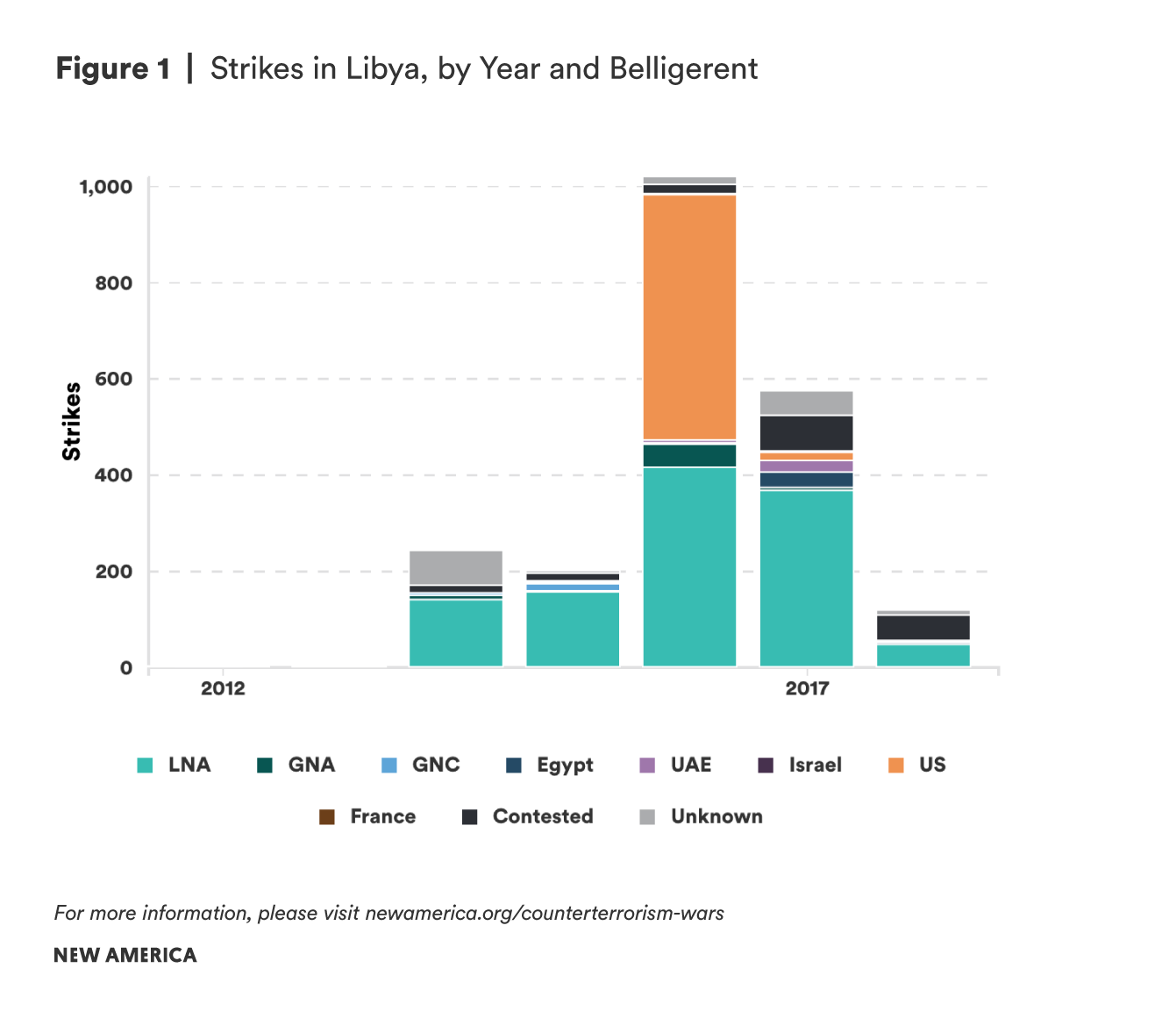
On December 2, 2014, Libyan and other African workers at a food warehouse in Zwara, a city in western Libya, were hit from the air by missiles intended to target Islamist militants.42 Several local and international media outlets, including Reuters, the Associated Press and the Libya Observer, reported between three and eight civilians dead and as many as 15 wounded as a result of the strike, which was attributed to the LNA.
Warehouses such as the one struck on December 2 are targets for the LNA and Haftar’s campaign against Islamist militias, as his group claims they are weapons depots for the rival group, Libya Dawn. LNA spokesman Mohamed Hijazi confirmed the strikes to Reuters and said they targeted Libya Dawn, but did not accept responsibility for the civilian deaths.
A counterstrike by Libya Dawn, allied with the GNC at the time, came on December 28, 2014, and was aimed at Haftar’s group. Libya Dawn reportedly launched an air raid on Ra’s Lanuf, a coastal town on the Gulf of Sidra and home to a major oil terminal.43 Bin Jawad field hospital, which treated wounded civilians, came under fire during the raid, resulting in the deaths of two physicians, Suleiman Hajeeba and Abdul Aziz Aaneibah.44 Memorials to the two doctors were posted to social media sites, including the Facebook page of local media outlet, Al-Manara Media.45
However, it is the LNA that is responsible for the most civilian deaths in the aerial conflict in Libya, accounting for at least 95 and as many as 172 civilians killed, or 40 to 44 percent of total reported civilian deaths since 2012. On May 25, 2015, LNA warplanes struck an oil tanker, the Anwaar Afriqya, while it was anchored near a Sirte power plant and carrying 30,000 metric tons of fuel.46 The explosion, which set the ship aflame, reportedly killed one crewmember and injured several others. “They attacked [the tanker] after we unloaded the first tank and we were preparing to unload the second,” a worker at the port told Al Marsad, a local news website.47
However, it is the LNA that is responsible for the most civilian deaths in the aerial conflict in Libya, accounting for at least 95 and as many as 172 civilians killed, or 40 to 44 percent of total reported civilian deaths since 2012.
According to our data, since 2012, the LNA has reportedly conducted 1,122 airstrikes.
For more information about the LNA strikes, see “Strikes by LNA.”
LNA representatives did not respond to request for comment about airstrikes and potential civilian deaths in Libya.
In December 2015, after a lengthy U.N.-led mediation process, representatives from the GNC and the LNA signed a deal in Skhirat, Morocco, to end their conflict.48 In April 2016, the unity government called the Government of National Accord (GNA) took over in Tripoli.49 However, the GNA remained contested by Haftar and his forces, and the HOR never endorsed the GNA as it was required to do.
This political contest, in conjunction with the expansion of militant-held territory in the country, sparked action from foreign states, which have conducted airstrikes in support of either the LNA or the GNA, and/or have targeted Islamist militants (in many cases, those objectives overlap). Western nations such as the United Kingdom, France and the United States were active in the mediation process that led to the GNA’s formation, and the United States has conducted hundreds of strikes in Libya with the consent of the GNA.
The United States has conducted at least 524 airstrikes in Libya since 2012 which have resulted in at least 10 and potentially as many as 20 publicly reported civilian fatalities. While the United States has declared most of its strikes, the Pentagon has not acknowledged any civilian deaths from its operations.
Box 2
When AFRICOM confirms a “strike” in Libya, this may include one munitions, or multiple bombings on a single objective, based on information from press releases. In releases related to the U.S.-led coalition in Iraq and Syria, AFRICOM defines strikes in each release as the following:
“A strike, as defined in the Coalition release, refers to one or more kinetic engagements that occur in roughly the same geographic location to produce a single, sometimes cumulative effect in that location. For example, a single aircraft delivering a single weapon against a lone Daesh vehicle is one strike, but so is multiple aircraft delivering dozens of weapons against a group of Daesh-held buildings and weapon systems in a compound, having the cumulative effect of making that facility harder or impossible to use. Strike assessments are based on initial reports and may be refined.”
Some strikes in our database are attributed to more than one belligerent, and in these cases that also name the United States as responsible, the United States could potentially be responsible for up to 54 additional civilian deaths.
The United States conducted several airstrikes over Sirte on October 12, 2016, resulting in multiple allegations of possible civilian deaths. Five ISIS fighters were also reported to have died. Twitter user @majdiAshrif posted about a “US aircraft” bombing in progress and uploaded three pictures, one of a man cradling a visibly wounded toddler.50 The two other images show two children dead, trapped under rubble.51 The dead children appeared in two other Twitter posts on October 12, 2016 and a Facebook account, which belonged to the “Great Jamahiriya Channel.”52 This post also included a separate photo of a wounded child slumped against a wall.53
Researchers for our Libya airstrikes monitoring project sent AFRICOM a list of reported civilian harm incidents in Libya, which were linked by at least one source at the time to possible U.S. actions. (The list also included reported airstrikes in Libya conducted by “unknown belligerents”). AFRICOM responded on June 8, 2018, denying all allegations of civilian harm:
“Before responding to the questions you posed to the ambassador, I would like to be clear that U.S. Africa Command has many processes in place to ensure the safety and protection of the local population remains a top priority. These procedures, combined with precision strike capabilities, safeguard civilians and infrastructure in areas of operation. The protection of civilians is fundamentally consistent with the effective, efficient, and decisive use of force in pursuit of U.S. national interests. As a matter of policy, U.S. forces therefore routinely conduct operations under policy standards that are more protective than the requirements of the law of war that relate to the protection of civilians. U.S. forces also protect civilians because it is the moral and ethical thing to do. Although civilian casualties are a tragic and unavoidable part of war, no force in history has been more committed to limiting harm to civilians than the U.S. military.
As for your questions, since 2012 U.S. Africa Command has conducted post-strike assessments of all U.S. Military actions. From the Fall of 2016, the command has assessed two (2) recorded CIVCAS allegations related to operations in Libya. After thorough investigations, both claims were deemed not credible. In fact, the evidence gathered in one of the investigations strongly suggested that our adversaries in the region were simply lying about alleged civilian casualties in order to bolster their public perception. Evidence found at the time of the respective investigation to support this finding included our adversaries publishing photographs from another area of responsibility while claiming they were new CIVCAS incidents in Libya.
Also, with regards to the specific incidents you highlighted and asked our team to review, they are not assessed as credible with the information currently available.
Lastly, U.S. Africa Command does not maintain a list of Host Nation or other Nations' strikes, nor do we track the military engagements of host nations. As such, we are unable to accurately assess the associated credibility of the unknown belligerent incidents on the spreadsheet you provided.”
For more information on American air and drone strikes, see “The U.S. Counterterrorism War and Libya.”
The GNA has also conducted airstrikes, but these are fewer in number. According to the public record, GNA strikes have killed an estimated seven to nine civilians—perhaps a reflection of its limited access to air power. However, some allegations of strikes or civilian casualties are attributed to more than one belligerent, which could mean that a plane was misidentified or that a strike was conducted jointly by, say, both U.S. and GNA warplanes. Considering these contested cases, the GNA might be responsible for 34 to 54 additional civilian deaths.
For more information about GNA strikes, see “Strikes by GNA.”
GNA representatives did not respond to requests for comment on airstrikes and potential civilian deaths in Libya.
France, which was party to the negotiations that produced the GNA, has reportedly conducted five strikes in Libya, which have resulted in four to eight civilian casualties. An additional strike that was attributed to both France and the LNA could make that estimate higher; this strike hit an urban area in Benghazi on August 12, 2016, killing more than two dozen civilians by some reports.
We contacted French officials with the locations and dates of every airstrike in our database that media reports and local social media accounts linked to French aircraft. However, the French did not respond to requests for comment.
For more information on French strikes, see “Strikes by France.”
For its part, the LNA has enlisted the help of Egypt and the United Arab Emirates in its aerial campaign. Egypt has declared or reportedly conducted at least 41 strikes, which according to local Libyan reports have resulted in 13 or 14 civilian deaths.
Egypt’s strikes in Libya aren’t always in the service of the LNA. Some are conducted unilaterally, ostensibly to defend the border between the two countries. However, civilians have been victims on occasion, according to reports, though Egypt hasn’t claimed any unintended casualties. Three civilians were reportedly killed in an Egyptian strike on an unknown date between September 1 and September 16, 2016, near the Egyptian border in the vicinity of the remote desert village of Jaghbub, Libya. Thirty-year-old Salem Khattab Hamad bin Ali Buhajar, the only known survivor of the strike on young men who were on a fishing expedition near Jaghbub, told local news website Alwasat:
“The next morning [after fishing], the battery of the vehicle ran out because the refrigerator was running. We relaxed a bit and started to prepare the breakfast for my friends. In the meantime, a plane came flying around for half an hour. I ran a little away from the car that was blown up by the bombing. In fact, the scene was painful. My friend, Moataz died instantly, while the other two were alive, but one of them suffered severe burns and the other was hit by a bullet.”
Buhajar’s two friends succumbed to their injuries in the days following. Alwasat reported the incident as occurring on the Egyptian side of the border. However, the United Nations Support Mission in Libya, which investigates casualty reports, said that it actually occurred within Libya.
Civilians have been victims on occasion, according to reports, though Egypt hasn’t claimed any unintended casualties.
We contacted Egyptian officials with the locations and dates of every airstrike in our database that media reports and local social media accounts linked to Egyptian aircraft. A public affairs official instructed us to direct our request for comment to Maj. Gen. Khaled Shawky, the Egyptian Defense Attaché to the United States. Maj. Gen. Shawky did not return our request for comment.
For more information about Egyptian strikes, see “Strikes by Egypt.”
The LNA-allied United Arab Emirates reportedly is responsible for at least 35 strikes, resulting in at least 11 reported civilian deaths and, based on maximum estimates, as many as 18 civilian deaths. As many as two civilians were killed and three others wounded in a strike attributed to the UAE in Ganfouda, a residential area, on December 16, 2016. Another strike the following month, on January 2, 2017, in the same residential neighborhood, was also attributed to the UAE and was reportedly conducted by a drone. This strike hit a home, killing three civilians and injuring several more. The UAE operates a drone base about 50 miles outside Benghazi, in Haftar-held territory.54
We reached out on several occasions by phone and email to UAE officials with the locations and dates of every airstrike in our database that media reports and local social media accounts linked to Emirati aircraft. However, they did not return any requests for comment.
For more information about Emirati strikes, see “Strikes by UAE.”
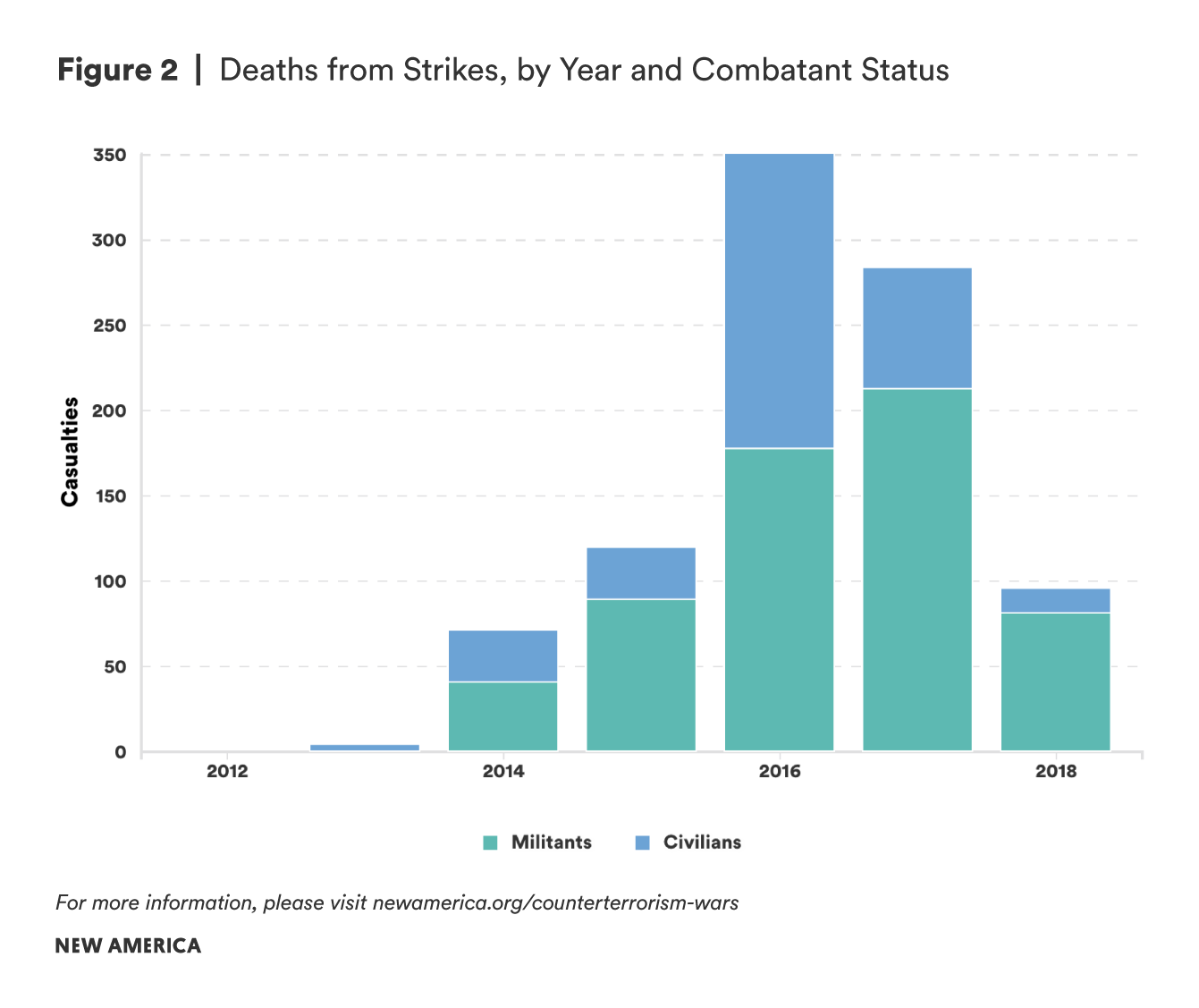
Reported civilian deaths as a result of the air wars in Libya from 2012 to 2018 number at least 242 and potentially as many as 395, based on the minimum and maximum estimates of civilian casualties in our database. These are low estimates compared to Iraq and Syria, similar conflicts in that multiple belligerents are conducting strikes. However, these numbers track with estimates of civilian fatalities resulting from U.S. drone strikes in Pakistan, albeit occurring over a shorter period of time. Of the total 2,158 strikes logged in our database, 81 contain allegations of civilian deaths. Put another way, 4 to 7 percent of the total strikes resulted in civilian fatalities. Across this period of analysis, the majority of allegations of civilian deaths are attributed to the LNA, Egypt and the UAE.
Civilian Deaths from Airstrikes Across Conflicts
| Libya 2012-2018 | Iraq and Syria 2014-2018 | Pakistan 2004-2018 | Somalia 2003-2018 | Yemen 2002-2018 | |
|---|---|---|---|---|---|
| Estimated range of civilian deaths | 242-395 | 6,259 | 245-303 | 42-53 | 111-142 |
| Total strikes | 2158 | 29,641 | 413 | 91 | 253 |
Source: Libya civilian deaths data are based on the Airwars-New America study; Iraq and Syria civilian death estimates are based on figures from Airwars; and Pakistan, Somalia, and Yemen civilian deaths data are based on figures from New America databases as of June 10, 2018. Note: Operations in Somalia and Yemen include a number of ground raids in addition to airstrikes.
Meanwhile in Benghazi, after three-plus years of fighting, Haftar’s efforts succeeded in restoring some degree of normalcy to the eastern city, though it continues to be wracked by car bombs and assassinations. Haftar-aligned militias have committed a number of extra-judicial executions of prisoners. In tandem, Haftar made a number of threats to march on Tripoli and topple the internationally recognized GNA.55 Though the worst of the fighting appears to have passed for now, sporadic clashes continue to erupt over oil terminals at the ports and in the south of the country.
Highest-volume strike locations
Most strikes between 2012 and the present have occurred in Benghazi, Sirte, and Derna, cities that were highly contested during the Libyan rebellion and 2011 intervention. The chaos in these areas enabled militants to take root after the revolution, leading these cities to become hubs for jihadists.
Out of 2,158 reported strikes in our dataset, 725 (34 percent) occurred in Benghazi, which was ground zero for the revolution. Of the total strikes, 672 occurred in Sirte—many of which were conducted during Operation Odyssey Lightning, the U.S. military campaign against the terrorist group, ISIS. And in Derna, where ISIS first established itself before moving its headquarters to Sirte, 247 strikes have been reportedly conducted.
“All they cared about was liberating Sirte,” Salah Mohamed, a taxi driver in Sirte, told the Washington Post in a January 2018 report, referring to the 2016 offensive against ISIS.56 “They didn’t care about the aftermath.” At the time of the report, Sirte still lacked functioning law enforcement and waste disposal services.57
Also, it’s unclear how many site visits have been made to Sirte, Derna and Benghazi to corroborate civilian death allegations. The United Nations Support Mission in Libya offers the following note with every monthly report: “Due to the security situation, UNSMIL has not been able to carry out direct site visits to all relevant locations in Libya to obtain information. Fear of reprisals against sources further hamper information gathering.”58

Airstrikes and Civilian Casualties in Libya
- Key Findings
- Glossary of Belligerents
- Map of Territorial Control in Libya as of May 2018
- An Overview of the Air Campaigns in Libya since 2012
- The Conflicts in Libya 2011-2018
- The Jihadist Environment in Libya Today
- The U.S. Counterterrorism War and Libya
- Strikes by Libyan Belligerents: the GNA and the LNA
- Reported Strikes by France, Egypt and the UAE
- Conclusion
- Appendices
Citations
- U.N. Security Council Resolution 1970 (2011), Feb. 26, 2011, http://www.un.org/en/ga/search/view_doc.asp?symbol=S/RES/1970(2011)
- Reuters Staff, “Arab League calls on U.N. to impose Libya no-fly zone,” Reuters, March 12, 2011, https://www.reuters.com/article/us-libya-arabs/arab-league-calls-on-u-n-to-impose-libya-no-fly-zone-idUSTRE72B1FI20110312
- Vivienne Walt, “Libya: Gaddafi’s Son Warns Against Protests in TV Speech,” Time, Feb. 21, 2011, http://content.time.com/time/world/article/0,8599,2052842,00.html
- Reuters, “Gaddafi Tells Rebel City, Benghazi, ‘We Will Show No Mercy,’” Huffington Post, March 17, 2011, https://www.huffingtonpost.com/2011/03/17/gaddafi-benghazi-libya-news_n_837245.html
- Note: Sometimes referred to as the Transitional National Council.; Alan Cowell and Steven Erlanger, “France Becomes First Country to Recognize Libyan Rebels,” New York Times, March 10, 2011, https://www.nytimes.com/2011/03/11/world/europe/11france.html
- Frederic Wehrey, The Burning Shores (New York: Farrar, Straus and Giroux, 2018).
- Ibid.
- United Nations Security Council Resolution 1973 (2011), March 17, 2011, http://www.un.org/en/ga/search/view_doc.asp?symbol=S/RES/1973(2011)
- Allan Little, “Libya: US, UK and France attack Gaddafi forces,” BBC, March 20, 2011, http://www.bbc.com/news/world-africa-12796972
- Ryan Lizza, “The Consequentialist,” The New Yorker, May 2, 2011, https://www.newyorker.com/magazine/2011/05/02/the-consequentialist
- Tim Gaynor and Taha Zargoun, “Gaddafi caught like ‘rat’ in a drain, humiliated and shot,” Reuters, Oct. 21, 2011, https://www.reuters.com/article/us-libya-gaddafi-finalhours-idUSTRE79K43S20111021
- Rick Gladstone, “U.N. Votes to End Foreign Intervention in Libya,” New York Times, Oct. 27, 2011, https://www.nytimes.com/2011/10/28/world/middleeast/security-council-ends-libya-intervention-mandate.html
- David D. Kirkpatrick, “In Libya, Fighting May Outlast the Revolution,” New York Times, Nov. 1, 2011, https://www.nytimes.com/2011/11/02/world/africa/in-libya-the-fighting-may-outlast-the-revolution.html
- Paul Salem and Amanda Kadlec, “Libya’s Troubled Transition,” Carnegie Middle East Center, June 14, 2012, http://carnegie-mec.org/2012/06/14/libya-s-troubled-transition-pub-48511
- David D. Kirkpatrick, “In Libya, Fighting May Outlast the Revolution.”
- Frederic Wehrey, The Burning Shores (New York: Farrar, Straus and Giroux, 2018).
- David D. Kirkpatrick, “Braving Areas of Violence, Voters Try to Reshape Libya,” New York Times, July 7, 2012, https://www.nytimes.com/2012/07/08/world/africa/libyans-vote-in-first-election-in-more-than-40-years.html
- Ibid.
- Associated Press, “Libya’s transitional rulers hand over power to elected assembly,” The Guardian, Aug. 8, 2012, https://www.theguardian.com/world/2012/aug/09/libya-power-elected-assembley
- ‘@news_yemen’, Twitter post, Aug. 11, 2013, https://twitter.com/news_yemen/status/366751625152442368
- ‘@WissamLY’, Twitter post, Aug. 11, 2013, https://twitter.com/WissamLY/status/366749088248639490
- Researcher email from Major Karl J. Wiest, USAFRICOM/Media Relations, Received: June 8, 2018.
- Ibid.
- Ibid.
- ‘@worldakhbar’, Twitter post, Jan. 19, 2014, https://twitter.com/worldakhbar/status/425161578032693248
- ‘@osama_targam’, Twitter post, Jan. 19, 2014, https://twitter.com/osama_targam/status/424963043374948352
- ‘Against February 17 in Libya and against the attempt to sow discord by the detractors’, Facebook post, January 20, 2014, https://www.facebook.com/against.theday17inLibyan/posts/596055373803428
- Patrick Markey and Ghaith Shennib, “In Standoff, Libyans Protest Over Parliament Extension,” Reuters, Feb. 7, 2014, https://www.reuters.com/article/us-libya-crisis-idUSBREA161MH20140207
- Reuters Staff, “Libya parliament agrees to ‘early’ election amid public anger,” Reuters, Feb. 17, 2014, https://www.reuters.com/article/us-libya-elections/libya-parliament-agrees-to-early-election-amid-public-anger-idUSBREA1G0RA20140217
- Mohamed Eljarh, “Libya’s Islamists Go for Broke,” Foreign Policy, July 22, 2014, http://foreignpolicy.com/2014/07/22/libyas-islamists-go-for-broke/
- Ibid.
- Christopher M. Blanchard, “Libya: Transition and U.S. Policy,” Congressional Research Service, May 2, 2018, https://fas.org/sgp/crs/row/RL33142.pdf
- Associated Press, “Libya official says airstrike hit food warehouse in western Libya, killing 4,” Fox News, Dec. 2, 2014, http://www.foxnews.com/world/2014/12/02/libyan-official-says-airstrike-hits-food-warehouse-in-western-libya-killing-4.html?utm_source=feedburner&utm_medium=feed&utm_campaign=Feed%253A+foxnews%252Fworld+%2528Internal+-+World+Latest+-+Text%2529&utm_content=
- ‘@dovenews’, Twitter post, Dec. 28, 2014, https://twitter.com/dovenews/status/549161173980311552
- Al-Manara Media, Facebook post, Dec. 28, 2014, https://www.facebook.com/permalink.php?story_fbid=912118178828236&id=179449562095105
- Ibid.
- “Libya government planes attack oil tanker docked at Sirte port,” Al Arabiya, May 24, 2015, https://www.alarabiya.net/ar/north-africa/libya/2015/05/24/%D8%B7%D8%A7%D8%A6%D8%B1%D8%A7%D8%AA-%D8%A7%D9%84%D8%AD%D9%83%D9%88%D9%85%D8%A9-%D8%A7%D9%84%D9%84%D9%8A%D8%A8%D9%8A%D8%A9-%D8%AA%D9%87%D8%A7%D8%AC%D9%85-%D8%B3%D9%81%D9%8A%D9%86%D8%A9-%D9%82%D8%B
- Libya government planes attack oil tanker docked at Sirte port,” Al Marsad, May 25, 2015, https://www.marsad.ly/ar/2015/05/25/%D8%B7%D8%A7%D8%A6%D8%B1%D8%A7%D8%AA-%D8%AD%D9%83%D9%88%D9%85%D8%A9-%D9%84%D9%8A%D8%A8%D9%8A%D8%A7-%D8%AA%D9%87%D8%A7%D8%AC%D9%85-%D9%86%D8%A7%D9%82%D9%84%D8%A9-%D9%86%D9%81%D8%B7-%D8%B1%D8%B3%D8%AA/
- Patrick Kingsley, “Libyan politicians sign UN peace deal to unify rival governments,” The Guardian, Dec. 17, 2015, https://www.theguardian.com/world/2015/dec/17/libyan-politicians-sign-un-peace-deal-unify-rival-governments
- Ahmed Elumami, “Libya’s self-declared National Salvation government stepping down,” Reuters, April 5, 2016, https://www.reuters.com/article/us-libya-security-politics-idUSKCN0X22KG
- ‘@majdiAshrif’, Twitter post, Oct. 12, 2016, https://twitter.com/majdiAshrif/status/786334284101496832
- Ibid,
- ‘@finOsBlizcGvhlJ’, Twitter post, Oct. 12, 2016, https://twitter.com/finOsBlizcGvhIJ/status/786367472572174337; ‘@hamedaalkrak’, Twitter post, Oct. 12, 2016, https://twitter.com/hamedaalkrak/status/786320903986671617; ‘Great Jamahiriya Channel’, Facebook post, Oct. 12, 2016, https://www.facebook.com/QnatAljamahiriya/posts/1220406111359125
- Ibid.
- Tyler Rogoway, “Shadowy UAE Base in Libya Hosts Attack Aircraft and Chinese Drones,” The Drive, Oct. 27, 2016, http://www.thedrive.com/the-war-zone/5726/shadowy-uae-base-in-libya-hosts-attack-aircraft-and-chinese-drones
- Ibid.
- Sudarsan Raghavan, “A year after ISIS left, a battered Libyan city struggles to resurrect itself,” Washington Post, Jan. 8, 2018, https://www.washingtonpost.com/news/world/wp/2018/01/08/feature/a-year-after-isis-left-a-battered-libyan-city-struggles-to-resurrect-itself/?utm_term=.d18a1a287d0f
- Ibid.
- Document #1422832,“UNSMIL – United Nations Support Mission in Libya,”Jan. 1, 2018, https://www.ecoi.net/en/document/1422832.html