Family Engagement
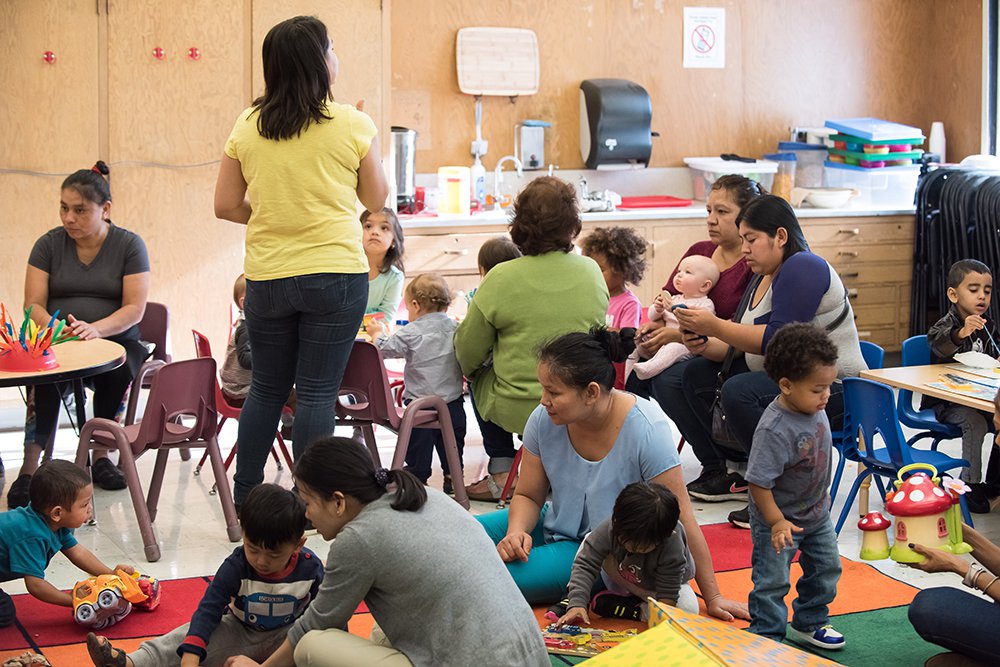
Problem: Adult-child interactions lay the foundation for success in school, yet many parents and caregivers lack the support they need to provide high-quality interactions.
As in many places, historically diverse parent and caregiver communities in California have not seen school districts as resources in the early years of their children’s lives and by and large do not trust a school district as a place to get help. In Oakland, for example, children are likely to begin elementary school with no formal preschool or early learning experience. Fewer than half, or only 43 percent of Oakland kindergarteners arrive at school ready for kindergarten, according to the 2015 Oakland School Readiness Report, which measures such attributes as self-regulation, social expression (skills related to interacting with adults and other children), and kindergarten academics (skills such as writing, counting, and identifying shapes and colors). Similar problems exist in Fresno and San Jose.
Eighty percent of children in California ages birth to two, and approximately 40 percent of children ages birth to five, are cared for by unlicensed or license-exempt family, friends, and neighbors, or informal caregivers.15 There are generally few opportunities for these caregivers to connect with their local schools. Registering a child for public preschool—and many low-income families are eligible for the California State Preschool Program—for example, may require several buses to get to the district’s main office. Providers report that many parents and families still see school districts as bureaucratic monoliths and that many families, especially those from immigrant communities, are hesitant to send their children to public programs or preschool. Child care in these communities is traditionally provided within families, so parents feel more comfortable leaving children with a relative than at an unfamiliar public school or center.16 Families may also not be aware of what preschool options or other services for young children are available to them.
Solution: School districts are working with community organizations and child care centers to provide support and training to parents and informal providers and get families ready for kindergarten.
In Fresno, the Helm Home Play & Learn Center, located inside a public housing building, is a partnership between Fresno Unified School District and the Fresno Housing Authority. This is one of several partnerships the school district has been part of in recent years with the goal of including children from birth to five and strengthening adult-child interactions. The center hosts a book and toy lending library and informational workshops for parents and informal caregivers. It also holds play and learn groups designed to support the parents and family, friends, and neighbors who care for young children and provide opportunities for high-quality adult-child interactions and playful learning.
Jose Zalapa Negrete, the program coordinator at Helm Home, said he finds many caregivers who come to the center are unaware that learning begins at birth and that children learn through play. “I have been hearing ‘why do we need to play with a kid? They are little they don’t understand. An infant. A toddler. A two-year-old. When they get to preschool and kindergarten they will learn,’” Zalapa Negrete told Valley Public Radio News, “and that is just not the case.” The Play & Learn Center has worked with almost 100 parents and their children since it opened in November 2016.
“I have been hearing ‘why do we need to play with a kid? They are little they don’t understand. An infant. A toddler. A two-year-old. When they get to preschool and kindergarten they will learn.’ And that is just not the case.”
School district leaders say that collaborations with community entities like the housing authority can help them expand their reach and better align their systems to support children birth through age eight. Fresno Unified is working to expand the model to provide community play and learn centers in public school buildings.
In San Jose, Educare California at Silicon Valley, which is located on the campus of Santee Elementary School, is working to build the capacity of expectant parents and parents/caregivers of children ages birth to three to support their development. The program will use curriculum supported by Abriendo Puertas, a training program developed by and for Latino parents. Educare also hosts a family resource center, supported by First 5 Santa Clara County, where parents and caregivers can access developmental screenings, referrals for medical, vision, and dental care, and parent education workshops and trainings. The center combines federal, state, and local public funding, as well as significant philanthropic and local business investment, to fund these programs.
In Oakland, the school district is experimenting with partnerships with those who care for children before they enter school to improve kindergarten readiness. Lotus Bloom, a family resource center that operates playgroups, is working with the city to expand opportunities to engage and teach parents and informal caregivers. The playgroups, some of which are in partnership with local elementary schools, provide a welcoming space for low-income families with young children to play and learn.
The Lotus Bloom model emphasizes the importance of building programs in the neighborhoods and places where informal caregivers gather. The organization also provides workshops and support for parents and caregivers, and links to social services and developmental screenings. Their work aims to help build resilience, strengthen social connections, bolster knowledge of parenting and child development, and build children’s socialization skills and emotional competence.
Challenges
An ongoing challenge, however, is how to expand these initiatives to serve more children and families. Programs like Lotus Bloom are only in a handful of elementary schools. Oakland’s Starting Smart and Strong Family Resource Committee is developing a framework for resource centers that provide multiple services in one location and would extend those available at Lotus Bloom to more families across the city.
Box 3
Oakland’s Starting Smart and Strong Task Force
Oakland Unified School District was approached by the Packard Foundation to be the lead on Starting Smart and Strong. But under the leadership of Curtiss Sarikey, the district decided to place the money in its philanthropic arm, the Oakland Public Education Fund, to signal that this was a community-wide effort. Along with community partners, Sarikey created a collaborative structure where leadership is shared between school district officials and those from local community-based nonprofits, local philanthropy, and government. It was important to the district to establish a structure “where there was shared decision-making, shared goal-setting, kind of shared responsibility for outcomes and successes,” Sarikey, now chief of staff to the OUSD superintendent, said. Today, the Oakland Starting Smart and Strong Task Force meets monthly to share resources, make decisions, develop and test solutions, and work toward lasting change. The inclusive structure, leaders say, has been a key part of the initiative’s success so far. “Our goal,” Sarikey said, “is to make sure we’re creating a real system and not just trying to improve one slice of the system.”
Schools are in many ways ideal places for family resource centers or hubs for engagement of young children, but in Oakland, as in many places in California, budgets are a significant barrier to scaling up models like this one. A recent budget crisis and fiscal mismanagement have exacerbated already tight spending in Oakland’s school district. Many districts do not have nurses, social workers, librarians, or other staff members who could be pulled in to help run programs like these, which are not considered essential to K–12 academics. Running family resource centers under these conditions is challenging. Principals who do bring in support programming for parents of young children must be very resourceful. Investments will need to be much larger to support these programs if they are to be scaled up.
Districts are also struggling with how to identify and reach out to families with young children, who traditionally have not fallen within their purview until they turn five years old. In San Jose, the Franklin-McKinley School District embarked on a door knocking project, in collaboration with Catholic Charities, to identify families with young children and learn more about their needs. An evaluation firm worked with Franklin-McKinley to conduct focus groups with some of these families and found that trust was a big issue for families from the Spanish- and Vietnamese-speaking communities. Representatives from both groups expressed concern about leaving their children with non-family caregivers.

Citations
- Informal Child Care in California: Current Arrangements and Future Needs (Los Altos, CA: David and Lucile Packard Foundation, 2015), https://www.packard.org/wp-content/uploads/2015/06/INFORMAL-CHILD-CARE-IN-CALIFORNIA1.pdf.
- This was one of the findings from focus groups Harder + Co Community Research conducted with families in San Jose. Harder + Co Community Research, “Key Findings from S3I Parent Focus Groups,” September 8, 2016.