A Chapter of: The Millennials Initiative 2018
The Context of Tradition: Evolving Challenges in Federal Indian Policy
by Myacah Sampson
“Tradition is not without a political context.”159
– Jennifer Denetdale, Associate Professor of American Studies at the University of New Mexico
In 2014, then-Navajo Nation President Ben Shelly spoke to a crowd of tribal leaders and community members in an annual public acknowledgement of the signing of the 1868 Treaty of Bosque Redondo—the treaty that allowed the Navajo people to return to a reduced portion of their homeland following an attempted genocide led by the government of the United States.160 Shelly offered his reflections on the ways in which the attempted genocide, which involved American military officials deporting and marching Navajo people more than 300 miles and containing the survivors in an internment camp for four years, shaped Navajo identity and their life philosophy. According to the president, prior to the forced removal, the Navajo people lived in accordance with a mindset of t’áá hwó ájít’ éego or “self-reliance,” which then shifted “into one of dependence upon the federal government” following their return.161 Shelly called upon the Navajo people to return to the concept of t’áá hwó ájít’ éego as a principle for Navajo self-determination, and this idea served as a core component of his administration’s State of the Navajo Nation address delivered earlier in the year.162 163
Though Shelly claimed t’áá hwó ájít’ éego was a traditional, non-Western philosophy that Navajo elders had passed down since the attempted genocide, the phrase and philosophy is of more recent origin in the Navajo Nation. It was developed during welfare reform in the 1990s and used as the guiding philosophy for the Navajo Nation’s Temporary Assistance for Needy Families cash transfer program—the Navajo Nation Program for Self-Reliance.164 Both in Shelly’s speech and in the Office for Self-Reliance, t’áá hwó ájít’ éego is deployed as a shared, long-standing value among the Navajo people. In reality, t’áá hwó ájít’ éego is merely a translation of the rhetoric that informed the Personal Responsibility and Work-Opportunity Reconciliation Act (PRWORA) of 1996 and is an example of the ways in which federal Indian policy has embedded the neoliberal value of “personal responsibility” behind a culturally affirming veneer.
According to the president, prior to the forced removal, the Navajo people lived in accordance with a mindset of t’áá hwó ájít’ éego or “self-reliance,” which then shifted “into one of dependence upon the federal government” following their return.
In this paper, I aim to examine how the rhetoric of tradition is deployed in the Navajo Nation Program for Self-Reliance. When exploring the design of the Navajo social safety net programs, I contrast the t’áá hwó ájít’ éego, a contrived, politically motivated idea premised on the pathologization of poverty, with the principle of k’é, a historically verified Navajo value of interdependence. I outline the trajectory of historical and political changes that allowed for the burial of k’é to occur, characterized by the federal government’s shift away from overtly genocidal and assimilative policies to the establishment of federally recognized tribal governments and rhetoric of cultural affirmation set forth by the Meriam Report and the Indian Reorganization Act of 1934. I propose that the Navajo Nation’s social safety net of the future be guided by the Navajo concept of interdependence, or k’é—a component of Navajo philosophy that predates American arrival—rather than the recently developed t’áá hwó ájít’ éego.
Contemporary Economic Conditions of the Navajo Nation and Their Origins in Federal Indian Policy
The Navajo Nation is roughly the size of West Virginia, crossing portions of Utah, New Mexico, and Arizona. It is the second-largest tribe in the country, with a population of 332,129 enrolled members as of the 2010 Census.165 One hundred and forty-five thousand Navajo people reside on the reservation, 80,000 live in towns that border the reservation, and the remainder live in a variety of urban and rural settings in different parts of the United States and abroad.166 Forty-three percent of Navajo people live below the federal government’s official poverty line and the average per-capita income is $7,300.167 Fifty-six percent of Navajo adults over the age of 25 possess a high school diploma or equivalency, and 7 percent have a college degree.168
Unemployment in the Navajo Nation remains over 50 percent, with most employment opportunities being seasonal or associated with tourism.169 Major employers include the Navajo Nation Government, Indian Health Services, and the Bureau of Indian Affairs. Private sector employment includes work in coal mines, power plants, economic development projects, and a handful of small retail businesses. Nearly 51 percent of the Navajo Nation’s annual revenue comes from mining, but many of its mines and power-generating stations are slated to cease operations within the next few years as they have been outpaced by the rapid development of cheaper and more abundant natural gas and oil fracking enterprises.170
Forty-three percent of Navajo people live below the federal government’s official poverty line and the average per-capita income is $7,300.
The current economic condition of the Navajo Nation can be traced directly to the U.S. invasion of Navajo lands in 1846, attempted genocide during 1864 through 1868, and subsequent management of Navajo government affairs since the Indian Reorganization Act of 1934. Navajo historian Jennifer Denetdale has outlined how contemporary ventures to develop natural resources, including naturally occurring uranium, coal, and waterways on Navajo land have “not only physically displaced Navajo people,” but “forcibly removed them from participating in an agricultural and livestock-based economy to a wage economy.”171 After two decades of resistance to U.S. colonial forces in the mid-nineteenth century, being forcibly removed to a reservation nearly 300 miles away from their homeland, and eventually negotiating a return to a significantly diminished homeland base, the Navajo established lifestyles based on raising livestock, primarily sheep, until the 1930s. This economy provided more than half of Navajo people’s cash incomes and structured Navajo society in a manner that created an “elite” group of Navajo, who allocated agricultural resources and sponsored community ceremonies.172
By 1933, near the start of the U.S. recovery from the Great Depression and the height of the Dust Bowl, federal officials reported that Navajos owned more than 1 million head of livestock, prompting concerns about overgrazing and the potential for soil erosion in the Southwest. Bureau of Indian Affairs Commissioner John Collier ordered the Navajo to reduce their herds by 45 percent by the 1950s, overseen by the federal Livestock Reduction Program.173
This program was similar to the crop reduction programs enacted during the Great Depression, but instead was motivated by environmental rather than economic concerns and was carried out in a manner with disparate racial impacts. Though federal officials recognized the economic significance crops bore to white farmers during the Great Depression and provided monetary compensation to them for crop reduction to manage price-depressing surpluses, the Navajo were not given the same consideration. Navajo livestock was as foundational to their wealth as crops were to white farmers; yet, a double standard was applied, and Navajos were not adequately compensated when their livestock was destroyed.174 Range riders often took livestock by force, slaughtered them without notice, and burned carcasses in front of their owners; families were unable to shear the wool that could be woven into rugs and sold.175 Given this, Navajo livestock reduction might be thought of as a federally initiated asset-stripping program, as it destroyed Navajo people’s means of income and provided no adequate compensation.
Since the implementation of the Livestock Reduction Program, Navajo peoples’ primary economic options have been either wage labor in off-reservation border towns—where employment discrimination and harassment by the police and non-Native residents are common—jobs in coal mining, energy production, or tribal government positions, or through public assistance programs. The destruction of sheep herds fundamentally altered the social and political organization of Navajo society. This impacted both subsistence populations and of the influential class of “elite” Navajo, who played pivotal roles in the community’s organization of resources and gatherings.176
The Meriam Report and Indian Reorganization Act of 1934
When this program was implemented on Navajo land, larger shifts in federal approaches to Indian policy that gave little consideration to the economic histories of American Indian communities were already underway. The Meriam Report, commissioned by the Institute for Government Research (later renamed the Brookings Institution) and published in 1928, summarized the ways in which the Bureau of Indian Affairs and federal Indian policy had fostered abject conditions in Native communities across the United States. Yet its analysis grouped all Indian tribes together, citing high English illiteracy rates, rampant abuse at the hands of Christian missionaries in boarding schools, low participation in wage labor, a lack of sanitation infrastructure, and high rates of infectious diseases.177 Despite its lack of analysis of individual tribes—apart from occasionally distinguishing between “more primitive” and “less primitive” tribes—The Meriam Report findings and recommendations were used to guide the Indian Reorganization Act of 1934, colloquially known as President Roosevelt’s “Indian New Deal,” and consequently shaped federal policy toward the Navajo.
Summarized broadly, the report proposed restructuring the Bureau of Indian Affairs to focus less on an abstract goal of “civilizing” Native peoples through Christian missionaries and more on measurable policy goals developed by social scientists to make the transition “from primitive to modern life.”178 Like the Moynihan Report decades later, which sought to explain the persistence of poverty in Black communities using pseudo-sociological and economic explanations, the Meriam Report found the conditions present in Native communities to be the result of U.S. policies and perpetuated by what researchers observed to be dysfunctional family structures.179 Its recommendations included restricting per-capita cash distributions for ordinary living expenses. One section of the report sounds strikingly similar to the motivating ethos behind PRWORA:
The policy of the government should be deliberately directed toward reducing the amount of unearned income available to the able bodied Indian for living expenses. It is a stimulus of idleness and permits of a low standard existence without work. Unearned income should be utilized to increase the economic productivity of the Indians.180
The Meriam Report promoted the notion that American Indian tribes were simultaneously inept, prone to idleness, and primitive—yet capable to some degree of self-governance. This attitude materialized in the final version of the Indian Reorganization Act, which provided a means for tribes to establish their own forms of government that reflected elements of their cultures. For the Navajo Nation specifically, the form of governance that emerged was nearly identical to the U.S. federal government—that of a three-branch system.181 Federal agents introduced chapters, which were similar to counties or townships, with elected officers who followed parliamentary procedures, and Navajo land was separated into geographic jurisdictions similar to that of states, called agencies.182 Each of the five agencies, split into chapters where citizens would participate in parliamentary procedures. In the development of this new government, Navajo ideals and traditions were redefined to suit Western norms, while claiming to operate under traditional Navajo philosophy.183 As political theorist David Wilkins points out, the only traditional elements present in contemporary Navajo political institutions are the peacemaker’s court, a forum for conflict resolution premised on restoring k’é, the mutual respect and kinship between human beings and natural resources, so that hozho, or harmony, can be achieved. It now operates now as a diversion program under the judiciary branch.184
The Meriam Report promoted the notion that American Indian tribes were simultaneously inept, prone to idleness, and primitive—yet capable to some degree of self-governance.
This reorganization of Navajo government has led to contested understandings of Navajo traditions and cultural elements. Navajo historian Jennifer Denetdale offers a useful framework for interpreting Navajo traditions within the context of Navajo governance. She writes, “the Navajo Nation’s claims to practice many of the traditions of their ancestors as they administer government must be seen in the light of transformations under colonialism” and that we should recognize the ways in which tradition is claimed “and for what purposes.”185 Denetdale has extensively examined, for example, the ways gender roles have been reinterpreted through different periods of colonization. She notes that while Native and non-Native scholars alike have noted that Navajo women enjoyed a significant amount of economic and political power prior to Euro-American colonization, when LeNora Fulton announced her candidacy for Navajo Nation president in 1998, she received backlash from Navajo citizens who argued female leadership ran contradictory to Navajo traditions and would lead to chaos in society. She writes that “American notions of gender roles have been integral in the formation of the Navajo Nation where women are symbolized as the culture bearers and mothers of the Nation, yet at the same time, do not have access to all sectors of society, particularly the political realm.” The backlash to Navajo female leadership can be traced back to the Indian Reorganization Act, wherein federal officials looked to Navajo men to fill leadership roles in its new government and to the educational goals outlined in the Meriam Report to train Native women as homemakers.186
Similarly, the meaning of “self-reliance” as a longstanding Navajo tradition should be examined within the context of “transformations under colonialism,” as “tradition is not without a political context.”187
In summary, Meriam Report and the legislation it informed—the Indian Reorganization Act—developed a new federal relationship to Native communities in the United States, one that preserved not also the assumptions that Indigenous peoples were primitive and had grown prone to laziness due to federal paternalism also that they achieve Native self-sufficiency in a culturally-affirmative manner. These practices included establishing Native governments recognizable by federal agencies as a means to encourage Native peoples’ participation in the wage economy. These Native governments were erected with the aim to incorporate Indigenous peoples’ cultural values and practices into governance. However, in the case of the Navajo, the resulting government instead mimicked the structure of the American federal government and helped to redefine Navajo traditions as being similar to prevailing American ones.
The Navajo Nation Office for Self-Reliance
The Navajo Nation Office for Self-Reliance is one of the tribal Temporary Assistance for Needy Families (TANF) programs established after the passage of the Personal Responsibility and Work Opportunity Reconciliation Act (PRWORA) of 1996. Its key characteristics included imposing time limits on how long people are allowed to receive cash assistance and requiring that adults in the program engage in a minimum amount of work activities. The Navajo Nation Program for Self-Reliance requires that all adults in a participating family engage in at least 24 hours of work per week and that no adult can receive assistance for more than “60 countable months, whether or not consecutive.”188 In the 2015 fiscal year, an average of 5,936 Navajo children and adults received assistance through the Program for Self-Reliance.189 These 5,936 children and adults comprised 1,821 family units total.190
A full survey of all 70 tribal TANF programs that includes data on average benefit amounts, client experiences, and fluctuations in enrollments over time has yet to be completed. However, research conducted by Heather Hahn and her colleagues at the Urban Institute demonstrate that tribes can and often do incorporate aspects of their cultures into program administration.191 In their study of the Navajo Nation Program for Self-Reliance (NNPSR), they found that NNPSR was founded on the belief that only a program led by Navajo people could “attempt to reform welfare dependence by establishing a program that gives responsibility, decision making, and self-reliance back to tribal members.”192 According to program administrators, “The weak job market and historical legacy of U.S. government and Navajo Nation support have resulted in multigenerational reliance on welfare for a small portion of the Navajo population.”193 The NNPSR aims to “dismantle this mindset through intensive casework” and the development of personal responsibility. T’áá hwó ájít’éego, the program’s core principle of “self-reliance,” captures the concept of exercising personal discipline and taking responsibility for one’s life.”194
A family seeking cash assistance in the Navajo Nation would have likely heard about the program through a Navajo radio ad or flyer and would have had to find transportation or hitchhike to one of ten offices located on the 27,000-square-mile reservation to fill out a paper TANF application in person.195 Many Navajo TANF clients and applicants lack access to a personal vehicle, making the verification process arduous. In some instances, caseworkers might take personal time to assist their clients with transportation, but this is left to their discretion.196 In focus groups, clients complained that the verification process was difficult given transportation barriers on the Navajo reservation.197
A family seeking cash assistance in the Navajo Nation would have likely heard about the program through a Navajo radio ad or flyer and would have had to find transportation or hitchhike to one of ten offices located on the 27,000-square-mile reservation to fill out a paper TANF application in person.
Families are required to also supply the social security cards of all members of their household, birth certificates, photo I.D., income statements and documents verifying their assets, and school enrollment verification documents for children. If a child in the family is eligible for child support, a parent of that child is responsible for verifying that he/she has made an attempt to solicit child support payments from the absent parent.198 Information about eligibility documents is not clearly displayed on the NNPSR website, and currently there is no way for applicants to submit their documents electronically, so it is likely that some clients would have to make multiple trips to an office to submit a completed application.199
Clients and potential clients of the Office for Self-Reliance might read through a brochure with phrases that translate t’áá hwó ájít’éego to: “It’s up to you;” “Nobody’s going to do it for you;” “Taking responsibility;” “Be a hard worker;” or “Don’t be lazy.”
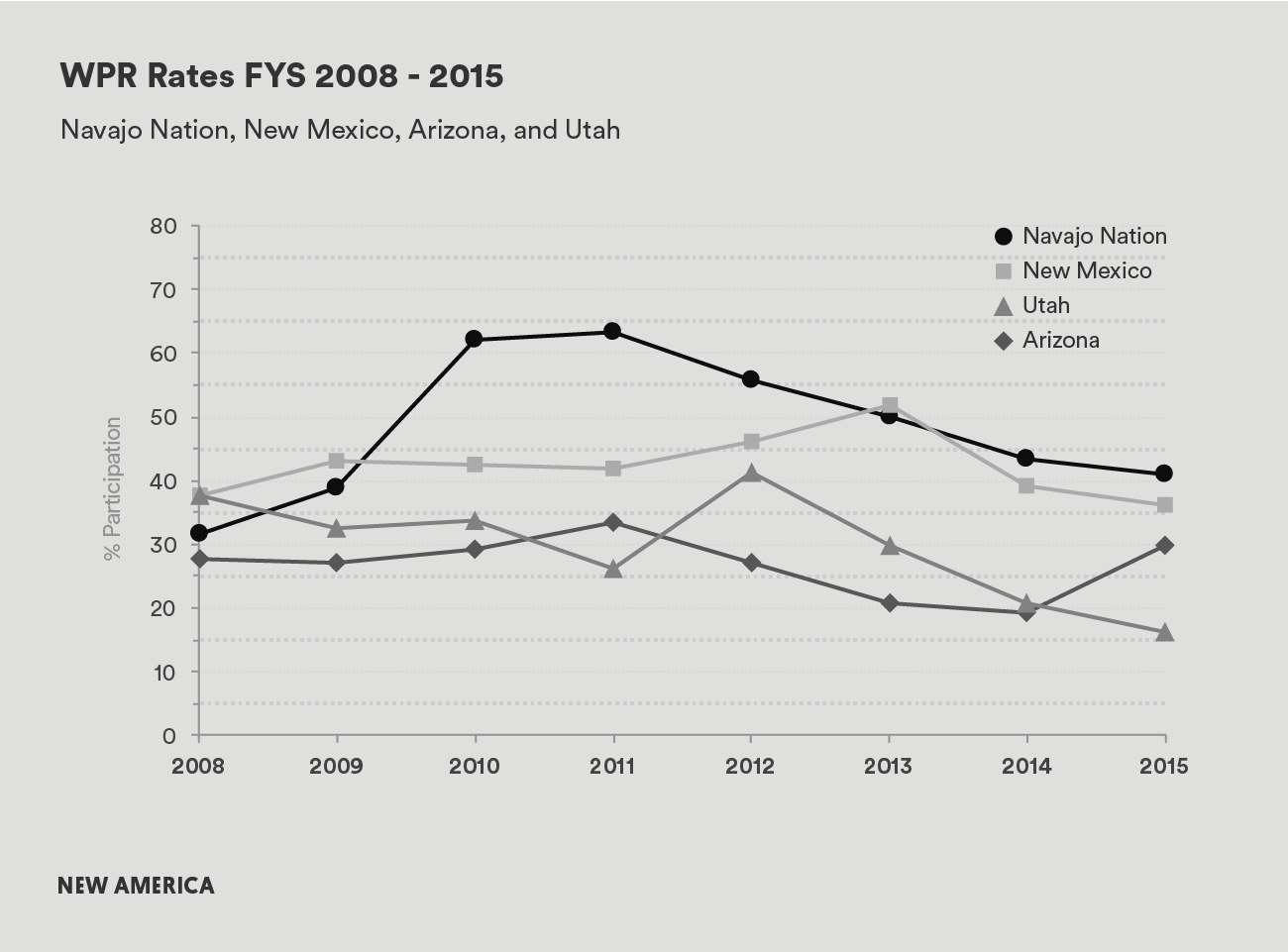
Case managers might introduce themselves to new clients in a traditional Navajo fashion by naming the clans of their parents and grandparents before consulting with a family to develop a personal responsibility plan (PRP).200 Each adult in the household is required to adhere to the PRP and spend at least 24 hours per week on activities the caseworker has decided contribute toward the family’s goals of self-sufficiency. These activities might include education or classes at a community college. Unlike state-administered programs, the Navajo Nation TANF program caseworkers might also allow their clients to count participation in counseling or engaging in traditional subsistence activities as valid work activities.201 Flexibility in determining what qualifies as a valid work activity may be the reason why Navajo tribal TANF clients have consistently outperformed the TANF clients of neighboring states and exceeded their own participation rate goal of 25 percent from the years of 2008 to 2015, as reflected in the accompanying figure.
Navajo TANF client experiences with caseworkers varied in focus groups; some emphasized the significance of developing personal relationships with their caseworkers to give special consideration to their circumstances, whether they were barriers to transportation or domestic abuse. Other focus group participants voiced that they did not have the opportunity to have personal conversations with their caseworkers and instead received “training focused around money management and personal finance.”202
In summary, the Navajo Nation Program for Self-Reliance, relative to other tribal TANF programs, places an emphasis on integrating cultural elements into the implementation of the program. It intends to target a group of people in the Navajo community who are presumed to have become intergenerationally dependent on public assistance programs and aims to restructure their orientation towards work with some supports and considerations granted to clients on a discretionary basis. In the next section of this paper, I will demonstrate that the program exemplifies a mode of tribal policy that has emerged since the 1930s that replaced overt attempts at genocide and assimilation with policies that appear to affirm Indigenous cultural values while advancing assimilative goals.
New Modes of Assimilation
Several defining factors of the Navajo Nation Program for Self-Reliance demonstrate that it carries out long-standing federal goals of Native assimilation while appearing to affirm Navajo culture, but which are premised on notions that Indigenous peoples are primitive and in need to guidance to integrate themselves into American culture. These long-standing federal goals include practices that encourage Native peoples to enter the wage economy as a means to end a cycle of poverty and maladjustment. The Program for Self-Reliance targets a group of Navajo people who have been presumed to intergenerationally rely on public assistance and thus are in need of guidance to break them away from dependent mindsets and toward self-sufficiency. This pathologization of persistent poverty on the Navajo Nation finds fault in individuals for historically and systemically produced issues rather than examining the ways the federal seizure of Navajo lands, livestock, and means of living have produced intergenerational trauma and geographic isolation from economic opportunities. Designing a social assistance program around these assumptions results in a program that presumes the worst of its clients and that fails to take full consideration of the causes of intergenerational poverty.
This pathologization of persistent poverty on the Navajo Nation finds fault in individuals for historically and systemically produced issues rather than examining the ways the federal seizure of Navajo lands, livestock, and means of living have produced intergenerational trauma and geographic isolation from economic opportunities
On the other hand, aspects of the Program for Self-Reliance that assume good intentions from clients and are not directly premised on the notion that poverty is pathological are some of the program’s most effective and culturally affirmative components. Expanded definitions of valid work activities grant families the flexibility to stay enrolled in the program for lengths of time they may otherwise not have been able to through a state-administered program. Expanded definitions of work presume that families do not intend to game the public assistance system to subsidize their lifestyles, but rather that each family has its own timeline and unique needs that may not be met through engaging in strict definitions of “work.” Some clients’ praise for caseworker discretion, especially with regards to overcoming transportation barriers, demonstrates that the delivery of social assistance programs from compassionate social workers rather than strict, automated decisions can more effectively meet clients’ needs.
K’é as a Core Social Assistance Philosophy
The Program for Self-Reliance’s core philosophy of t’áá hwó ájít’ éego, or “self-reliance,” was developed specifically for its tribal TANF program in the 1990s, but is promoted as a culturally relevant, long-standing value among the Navajo. In reality, it is a translation of the guiding rhetoric of welfare reform, which presumed there was a national problem of welfare dependency and a need to encourage parents to move from “welfare to work.”203 A core component of Navajo philosophy that predates American arrival is that of k’é. Roughly translated, k’é is the interdependence between living beings, including that between humans, as well as the natural environment and animals.204
Some aspects of the Program for Self-Reliance affirm principles of k’é, including the program’s expanded definitions of valid work activities. The program’s affirmation that work can take on forms beyond that of wage labor, including counseling or subsistence agricultural activities, allows clients to maintain the interdependent relationships which sustain them personally while materially supporting cultural practices.
Explicitly designing a social safety net in accordance with the Navajo principles of k’é might elevate a different set of policies that emphasize unconditional support programs, like that of universal basic income, paid leave for family and non-family members alike, and universal health care. These policies assume good motivations on the part of the recipients and affirm recipients’ identities as members of the community through their use of the program rather than stigmatizing them for needing assistance. Promoting the goals and philosophies of PRWORA with the Navajo language may seem like a noble attempt at promoting shared cultural values between the United States and the Navajo Nation, but the incommensurability between PRWORA and k’é demonstrate that a more thorough interrogation of our shared histories is needed to develop policy that truly affirms Indigenous cultural values and practices and to bring an end to assimilative policies.
Myacah Sampson is a 2017-18 Millennial Fellow with the Family-Centered Social Policy program at New America. She would like to thank Rachel Black, Melody Frierson, and Reid Cramer for contributing their policy insight and editorial skills to her project. She is also deeply indebted to the ideas and original research conducted by Professor Jennifer Denetdale and Heather Hahn which informs her paper.

The Millennials Initiative 2018
- Introduction
- The Case for Crafting a Millennial Public Policy Agenda
- Part I: Millennial Public Policy Symposium
- Part II: Policy Research Papers
- Independent, Not Alone: Breaking the Poverty Cycle through Transition-Age Foster Care Reform
- Data Sharing as Social Justice: How an Improved Reentry Process Can Smooth the Transition for Formerly Justice-Involved People
- Making the Case for Culturally Responsive Teaching and Supportive Teaching Standards
- The Context of Tradition: Evolving Challenges in Federal Indian Policy
- Public Policy and the Poor People’s Campaign: Reducing Inequality through Political Action
- A Public Interest Test in Merger Review
- Beyond Access: The Future of Voting Rights in the United States
- Solutions for the Health Care Cybersecurity Workforce of the Digital Age
- Taking Down Terrorism: Strategies for Evaluating the Moderation and Removal of Extremist Content and Accounts
- Gridlock: Enhancing Disaster Response Efforts Through Data Transparency in the Electric Utility Sector
- Part III: The Millennial Public Policy Fellows
- Selected Pieces from the Direct Message Blog
Citations
- Jennifer Denetdale, “Chairmen, Presidents, and Princesses: The Navajo Nation, Gender, and the Politics of Tradition,” Wicazo Sa Review 21, no. 1 (2006): 9–28, https://doi.org/10.1353/wic.2006.0004.
- Thompson, Gerald. The Army and the Navajo: The Bosque Redondo Reservation Experiment, 1863-1868. Tucson: University of Arizona Press, 1976.
- Rick Abasta, “President Shelly Contrasts Treaty of 1868 to Present-Day Responsibilities” (Office of the President and Vice President, The Navajo Nation, June 1, 2014), http://www.navajo-nsn.gov/Newspercent20Releases/OPVP/2014/jun/Treatypercent20Daypercent202014.pdf.
- Ibid.
- Ben Shelly Navajo Nation President and Rex Lee Jim Navajo Nation Vice President, “2014 State of the Navajo Nation 22nd NN Council Winter Session,” January 27, 2014, http://www.nnwo.org/sites/default/files/2014%20State%20of%20the%20Navajo%20Nation%2022nd%20NN%20Council%20Winter%20Session.pdf.
- 26. Heather Hahn et al., “A Descriptive Study of Tribal Temporary Assistance for Needy Families (TANF) Programs: (502612014-001)” (American Psychological Association, 2013), https://doi.org/10.1037/e502612014-001.
- 5, Navajo Division of Health and Navajo Epidemiology Center, “Navajo Populaton Profile 2010 Census,” December 2013, http://www.nec.navajo-nsn.gov/Portals/0/Reports/NN2010PopulationProfile.pdf.
- 16, Heather Hahn, Chris Narducci, and Olivia Healy, “A Descriptive Study of Tribal Temporary Assistance For Needy Families” (The Urban Institute, September 2013), https://www.urban.org/sites/default/files/publication/22196/412990-A-Descriptive-Study-of-Tribal-Temporary-Assistance-for-Needy-Families-TANF-Programs.PDF.
- “Fast Facts, Overview of the Navajo Nation,” accessed June 5, 2018, http://navajobusiness.com/fastFacts/Overview.htm.
- Ibid.
- 16, Heather Hahn, Chris Narducci, and Olivia Healy, “A Descriptive Study of Tribal Temporary Assistance For Needy Families” (The Urban Institute, September 2013), https://www.urban.org/sites/default/files/publication/22196/412990-A-Descriptive-Study-of-Tribal-Temporary-Assistance-for-Needy-Families-TANF-Programs.PDF.
- Ibid.
- Colleen O’Neill, “The Making of the Navajo Worker: Navajo Households, the Bureau of Indian Affairs, and Off-Reservation Wage Work, 1948–1960,” New Mexico Historical Review 74, no. 4 (October 1999): 375–403; Jennifer Denetdale, “Chairmen, Presidents, and Princesses: The Navajo Nation, Gender, and the Politics of Tradition,” Wicazo Sa Review 21, no. 1 (2006): 9–28, https://doi.org/10.1353/wic.2006.0004.
- Eric Henderson, “Navajo Livestock Wealth and the Effects of the Stock Reduction Program of the 1930s,” Journal of Anthropological Research 45, no. 4 (1989): 379–403.
- Peter Iverson and Monty Roessel, Diné: A History of the Navajos, 1st ed (Albuquerque: University of New Mexico Press, 2002).
- 149, Peter Iverson and Monty Roessel, Diné: A History of the Navajos, 1st ed (Albuquerque: University of New Mexico Press, 2002).
- Dana E. Powell, Landscapes of Power: Politics of Energy in the Navajo Nation, New Ecologies for the Twenty-First Century (Durham: Duke University Press, 2018).
- Eric Henderson, “Navajo Livestock Wealth and the Effects of the Stock Reduction Program of the 1930s,” Journal of Anthropological Research 45, no. 4 (December 1, 1989): 379–403, https://doi.org/10.1086/jar.45.4.3630516.
- Lewis Meriam et al., “Meriam Report: The Problem of Indian Administration” (Institute for Government Research (Brookings Institution), June 1926).
- 51. Ibid.
- “Other People’s Pathologies - The Atlantic,” accessed June 4, 2018, https://www.theatlantic.com/politics/archive/2014/03/other-peoples-pathologies/359841/.
- 39, Lewis Meriam et al., “Meriam Report: The Problem of Indian Administration” (Institute for Government Research (Brookings Institution), June 1926).
- Moroni Benally et al., “Navajo Nation Government Reform Project” (Diné Policy Institute, September 2, 2008), https://www.dinecollege.edu/wp-content/uploads/2018/04/GovernmentReformDraft.pdf.
- Ibid.
- Ibid.
- “The Navajo Nation Peacemaking Program,” accessed May 26, 2018, http://www.navajocourts.org/indexpeacemaking.htm.
- Jennifer Denetdale, “Chairmen, Presidents, and Princesses: The Navajo Nation, Gender, and the Politics of Tradition,” Wicazo Sa Review 21, no. 1 (2006): 9–28, https://doi.org/10.1353/wic.2006.0004.
- Ibid.
- 21, Ibid.
- “Tribal Family Assistance Plan” (Navajo Nation Department for Reliance), accessed June 7, 2018, http://www.nnpsr.navajo-nsn.gov/Portals/3/docs/TFAP_Approved_Complete.pdf.
- “Tribal TANF Caseload Data - Fiscal Year 2015 Total Recipients Data,” Office of Family Assistance | ACF, accessed June 7, 2018, https://www.acf.hhs.gov/sites/default/files/ofa/2015_tribal_recipient_data.pdf.
- “Tribal TANF Caseload Data - Fiscal Year 2015 Total Recipients Data,” Office of Family Assistance | ACF, accessed June 7, 2018, https://www.acf.hhs.gov/sites/default/files/ofa/2015_tribal_families_data.pdf.
- Heather Hahn, Chris Narducci, and Olivia Healy, “A Descriptive Study of Tribal Temporary Assistance For Needy Families” (The Urban Institute, September 2013), https://www.urban.org/sites/default/files/publication/22196/412990-A-Descriptive-Study-of-Tribal-Temporary-Assistance-for-Needy-Families-TANF-Programs.PDF.
- 24, Ibid.
- 17,Ibid.
- 28, Ibid.
- 42, Ibid.
- 44, Ibid.
- 44, Ibid.
- “Navajo Nation Department for Self Reliance,” Home, accessed June 7, 2018, http://www.nnpsr.navajo-nsn.gov/Default.aspx?tabid=152&error=An%20unexpected%20error%20has%20occurred.
- “Customer Responsibilities,” accessed May 26, 2018, http://www.nnpsr.navajo-nsn.gov/CustomerResponsibilities.aspx.
- 42, Ibid.
- 42, Ibid.
- 45, Ibid.
- “The Real Lessons From Bill Clinton’s Welfare Reform - The Atlantic,” accessed June 5, 2018, https://www.theatlantic.com/politics/archive/2018/02/welfare-reform-tanf-medicaid-food-stamps/552299/.
- “A Conversation About k'é With Radmilla Cody on Moccasin Tracks.Mp3,” PodOmatic, accessed June 5, 2018, https://www.podomatic.com/podcasts/radiowithdeb8/episodes/2017-03-17T11_07_09-07_00.