A Chapter of: The Punjab Example
Additional Financing and Project Expansion (2012-2016)
The World Bank approved a project extension in March 2012, shifting the expected closing date to November 2013. This 20-month extension accommodated the significant delays due to software development.96 Soon after, in September 2012, the World Bank provided an additional credit of US $70 million to extend the project a number of years, expand the project from 18 to 36 districts, and compensate for an additional US $15 million for data entry—the cost of which had been previously underestimated.97
Several modifications during this latter five-year phase were important to project success. First, government support for a change in scale of ARC construction allowed for LRMIS expansion to all 36 provincial districts. Second, as ARCs proliferated throughout Punjab, the project implemented a public awareness campaign.98 Finally, centralization of land administration data reduced the overall cost and increased efficiency.99
Government support for a change in scale of ARC construction allowed for LRMIS expansion to all 36 provincial districts.
Accessible and efficient government services, accompanied by meaningful engagement with rural communities, potentially rectified political alienation and socioeconomic inequality. Recruitment opportunities for jihadist groups may subside as conditions improve. For example, the provincial government in Lahore can increasingly replace the charity wings of radical Islamic organizations utilized to gain support throughout the countryside.100
Diffusion of the Land Record Centers
GoPunjab originally insisted on building ARCs at the kanungo level, which is the second smallest BOR jurisdiction and contains 10 to 15 villages.101 This initial approach introduced additional time, costs, and complexities to the project, as there are over 800 kanungo circles throughout Punjab.102
The provincial government eventually agreed to shift ARC construction to the tehsil level—one administrative level above the kanungo circle—after delays related to software development.103 This accommodation, authorized within the additional financing document, contributed to reduced costs and allowed for accelerated geographic expansion of the project.104 The larger administrative units at the tehsil level—over 140 units across the province—facilitated scalability.
Construction increased, and a total of 26 ARCs were operational by the end of 2012.105 The project eventually expanded to include over 140 land record centers in all 36 districts of Punjab.106 Every district contains, on average, four ARCs, with each center serving approximately 350,000 landholders and 236,000 parcels.107
Expansion to the entire province was meaningful for several reasons. The widespread ARC network provides the BOR—and the broader provincial government—with improved information via data collection. The resulting insights can inform policy planning and other development initiatives. The database potentially allows GoPunjab to monitor revenue and execute tax collection more efficiently and thoroughly, further diminishing corruption and fraud.
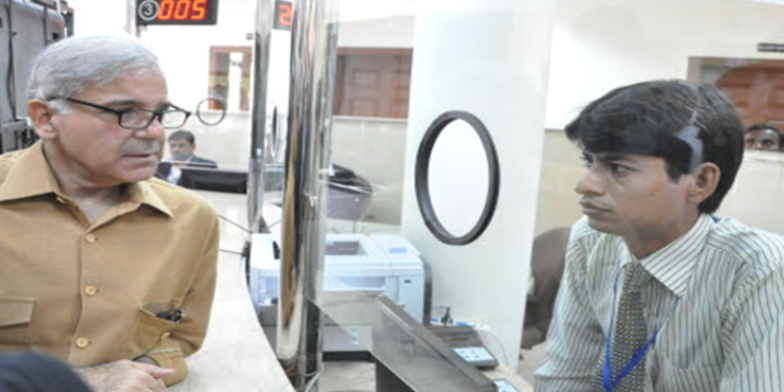
In particular, bribes to the Patwaris have been eliminated and transportation costs have decreased. Each center includes an automated queue system to prevent preferential treatment. General transaction times are now less than 30 minutes.
The ARCs are valuable to the average landowner, too. General service costs have been reduced from approximately PKR 6,241 (US $54) to PKR 2,550 (US $22). In particular, bribes to the Patwaris have been eliminated and transportation costs have decreased.108
Each center includes an automated queue system to prevent preferential treatment. General transaction times are now less than 30 minutes. The issuance of fards less than 10 pages takes 15 minutes on average and the process to record a land purchase or sale at an ARC lasts 165 minutes on average, increasing the ease of land transfers.109
The clean and orderly ARCs are the most visible project result and are potentially emblematic of more responsive governance. These extensive reforms can decrease the appeal of joining a terrorist group through the provision of greater economic opportunities, financial stability, and increased social status.110
Despite this, project leadership did not assume the rural population would rapidly embrace the new system. Data entry activities and ARC construction were dispersed throughout the province. As the ARC network expanded in some districts, the Patwar system continued in others. The two schemes operated in parallel until all 36 districts contained a land record center.111 To mitigate continued reliance on the Patwaris, the project initiated a large public awareness campaign.
The Public Awareness Campaign
The concept of a public awareness campaign is only mentioned briefly in the Project Appraisal Document. Project leaders eventually recognized the need to encourage acceptance of LRMIS at the local level. Enlarged through a near spontaneous process, the campaign transformed into a massive undertaking.
Adoption of the new system in rural Punjab was not inevitable. Many village-level stakeholders were skeptical of the project; some even supported the old system.112 For wealthy landowners, it was expedient to simply bribe a Patwari to obtain services.113
As a center replaced the Patwaris in a particular district, the project initiated public outreach.114 Tactics included street performances juxtaposing Patwar culture with the new system, issuance of free fards to landowners, and gender-specific community workshops.115 Local leaders were encouraged to publicly voice benefits of the project.116
Adoption of the new system in rural Punjab was not inevitable. Many village-level stakeholders were skeptical of the project; some even supported the old system.
Punjabi media outlets were also involved. Project leadership purchased newspaper advertisements, distributed press releases, and participated in interviews. The project ran jingles and spots on the radio and organized television interviews and news reports.117 Chief Minister Sharif was an important participant in this process. Aside from a provincial speaking circuit, Sharif appeared on television and radio in support of the project’s technological reforms.118
Punjab Land Records Authority
The public awareness campaign was influential in generating cultural change and promoting participation in the new administrative system. Education across social classes contributed to the democratic and inclusive character of the project.119 Engagement with the rural poor likely countered perceptions of alienation. Focus on women’s rights to land inheritance and ownership supported socioeconomic inclusion of an additional marginalized group.
The project clearly targeted critical gaps in the human capital of Punjab Province. The ability to produce a more skilled and employable population—with emphasis on women and the young—was important in converting the “youth bulge” challenge into an opportunity.120 It is especially crucial to provide young men with ample economic opportunities to both increase the opportunity costs associated with joining an extremist group and lessen the allure of terrorism.
The public awareness campaign was influential in generating cultural change and promoting participation in the new administrative system.
Through an overarching message that the project aimed to protect individuals’ rights, the campaign helped to curtail Patwari power. Project success—signified by widespread ARC openings and positive public engagement—eventually caused Patwari strikes in 2014 and 2015.121 The Patwaris even attempted to rally public support for their cause.122 By this stage in the project, however, Patwari resistance had weakened; the once unassailable local land administrators were placated through financial and material incentives.123
Data Centralization
Technological optimization continued throughout the project’s second phase. Software was repeatedly modified to meet user needs.124 An LRMIS website in both Urdu and English was created. Most importantly, the project transitioned to an advanced centralized software solution.
The first-generation system was inadequate and costly. Poor communication infrastructure rendered its decentralized software unreliable. The project was unable to upgrade the software simultaneously in all land record centers.125 Local offices were tasked with the maintenance of digital records, which were intermittently copied to a central system.126
Ensuring that an individual ARC system was up to date required tremendous effort, time, and resources. ARCs needed to hire IT professionals with database maintenance experience. Owing to the isolated locations of many centers, and related challenges of security and administration, staffing and financial issues materialized. After identification of these problems, the project recognized the need for a centralized system in 2013.
Project leaders prepared requirements for new software and a local vendor, Systems Limited, was hired to develop a solution based on the Microsoft database management system.127 The Pakistani firm specifically designed the second-generation software as a centralized system throughout 2015 and 2016.128 Primary links were upgraded from a minimum bandwidth of two megabits per second to four megabits per second, improving the bandwidth for communication between ARCs and the central system.129
Data migration to the centralized system continued after 2016 project closure and into 2018.130 Each ARC is now linked via a secure terrestrial connection to the central server in Lahore, and a backup server also exists in Islamabad.131 Front-end service at land record centers was not affected by the transition.132
The successful centralization reflects project flexibility and technical innovation.133 Leadership continuously consolidated learning experiences to create more efficient and cost-effective processes.134 The setup cost for data storage equipment per ARC in the distributed model was PKR 1 million (US $8,637); the approximate annual maintenance cost was PKR 150,000 (US $1,296). The introduction of the centralized system eliminated both costs.135
The new servers allow for more effective control by network administrators, consistent data collection, and easier implementation of software updates. The central data center was established to serve future purposes, too. The system was built with ample storage capacity to potentially incorporate GIS and/or urban land record data and can easily be integrated with GIS technology.136

The Punjab Example
- Executive Summary
- Introduction: An Example for Systemic Land Reform
- The Legacy Land Administration of Punjab
- Project Preparation and Initial Implementation (2005-2012)
- Additional Financing and Project Expansion (2012-2016)
- Post-Project Developments (2017-2018)
- Prospects for the Future
- Conclusion: Balanced Development
- Appendix A
- Appendix B
- Appendix C
Citations
- Proposed Additional Credit and Restructuring, 4.
- Pott, Implementation Completion and Results Report, Table H. Restructuring (if any).
- Second interview with Mary Lisbeth Gonzalez (April 11, 2018).
- Second interview with Igor Popiv (April 6, 2018).
- Pakistan’s Jihadist Heartland, ii-iv.
- Proposed Additional Credit and Restructuring, 2; Zahir Ali and Abdul Nasir, “Land Administration System in Pakistan - Current Situation and Stakeholders Perception,” paper presented at the FIG Congress 2010, Sydney, Australia, April 14, 2010. Please see Appendix B for information on the land administration levels of the BOR.
- “Report on Mouza Census 2008 (Punjab Province),” Pakistan Bureau of Statistics, www.pbs.gov.pk/sites/default/files/aco/publications/pakistan-mouza-census2008/, accessed May 11, 2018.
- Proposed Additional Credit and Restructuring, 2.
- Ibid., 4; Pott, Implementation Completion and Results Report, 5.
- Pott, Implementation Completion and Results Report, 32. Over 800 software issues were also resolved by the end of 2012.
- Ibid., Table F. Results Framework Analysis, (b) Intermediate Outcome Indicator(s); first interview with Mary Lisbeth Gonzalez (March 22, 2018).
- Pott, Implementation Completion and Results Report, Table F. Results Framework Analysis, (b) Intermediate Outcome Indicator(s).
- Ibid., 17-18.
- End of Project Survey of Land Records Management and Information Systems (LRMIS), Islamabad: APEX Consulting, March 1, 2016. The survey states that, on average, the process includes 46 minutes of travel time each way, 41 minutes in queue, 17 minutes at an ARC counter, and 15 minutes at a bank, for a total of 165 minutes.
- Pakistan’s Jihadist Heartland, 8.
- Comment from Igor Popiv (May 4, 2018).
- Second interview with Mary Lisbeth Gonzalez (April 11, 2018).
- First interview with Mary Lisbeth Gonzalez (March 22, 2018).
- Second interview with Igor Popiv (April 6, 2018).
- Interview with Osama Bin Saeed (April 24, 2018); second interview with Igor Popiv (April 6, 2018).
- Second interview with Mary Lisbeth Gonzalez (April 11, 2018).
- Nadia Ahmad, “Stakeholders Outreach: Awareness & Dissemination,” PowerPoint presentation, Punjab Board of Revenue.
- First interview with Igor Popiv (March 19, 2018); first interview with Mary Lisbeth Gonzalez (March 22, 2018); second interview with Mary Lisbeth Gonzalez (April 11, 2018).
- Second interview with Mary Lisbeth Gonzalez (April 11, 2018); first interview with Mary Lisbeth Gonzalez (March 22, 2018); interview with Osama Bin Saeed (April 24, 2018).
- Muhammad Shehbaz Sharif, letter to Jim Yong Kim, May 31, 2018.
- Pott, Implementation Completion and Results Report, 39; interview with Osama Bin Saeed (April 24, 2018).
- First interview with Mary Lisbeth Gonzalez (March 22, 2018).
- Pott, Implementation Completion and Results Report, 39.
- Interview with Osama Bin Saeed (April 24, 2018).
- Pott, Implementation Completion and Results Report, 6, 33, 37.
- Interview with Osama Bin Saeed (April 24, 2018).
- Pott, Implementation Completion and Results Report, 33; comment from Igor Popiv (May 4, 2018); second interview with Igor Popiv (April 6, 2018); comment from Osama Bin Saeed (May 20, 2018).
- The centralized software passed an independent Microsoft review of design, security risks, load and performance testings, and migration testing. This was followed by functional User Acceptance Tests. The software was also subjected to a third party consultant evaluation which cleared the software to become operational (Pott, Implementation Completion and Results Report, 33).
- Comment from Osama Bin Saeed (May 20, 2018).
- Second interview with Igor Popiv (April 6, 2018); Pott, Implementation Completion and Results Report, 33; comment from Igor Popiv (May 4, 2018).
- Second interview with Igor Popiv (April 6, 2018).
- Comment from Igor Popiv (May 4, 2018).
- Pott, Implementation Completion and Results Report, 25.
- Second interview with Igor Popiv (April 11, 2018).
- Comment from Osama Bin Saeed (May 20, 2018).
- Pott, Implementation Completion and Results Report, 15; comment from Osama Bin Saeed (May 20, 2018).