The Punjab Example
Table of Contents
- Executive Summary
- Introduction: An Example for Systemic Land Reform
- The Legacy Land Administration of Punjab
- Project Preparation and Initial Implementation (2005-2012)
- Additional Financing and Project Expansion (2012-2016)
- Post-Project Developments (2017-2018)
- Prospects for the Future
- Conclusion: Balanced Development
- Appendix A
- Appendix B
- Appendix C
Acknowledgments
The authors gratefully thank Mary Lisbeth Gonzalez, Igor Popiv, and Osama Bin Saeed for their time and crucial insights. As invaluable members of the Land Records Management and Information Systems (LRMIS) project in Punjab, Pakistan, their knowledge and advice helped to shape this paper.
Thank you to Chris Mellon of New America, as well. His comments helped to improve the focus and clarity of our writing. Finally, we would like to thank the New America Communications Team for their assistance in the presentation and promotion of this paper.
Downloads
Executive Summary
As a heavily populated and nuclear-armed state straddling South and Central Asia, Pakistan will play a large role in the future of the greater region. The country is nevertheless plagued by domestic issues. Pakistan is subject to repeated natural disasters, economic instability, and open-ended insurgencies.
These challenges seriously affect food security and livelihood opportunities in the Pakistani countryside. Throughout the rural south of Punjab—Pakistan’s richest and most populous province—terrorists often exploit poverty, inequality, corruption, and alienation to win local hearts and minds. This poor provincial sector has long been an operational base for jihadist groups.
There is no direct relationship between these public grievances and extremism, but such troubles are often employed as terrorist recruitment tools and reduce the opportunity costs associated with joining an extremist group.
Conversely, reform promotes economic growth and improves government capacity to craft better policies and provide adequate services to its citizens. Successful development projects can help to disincentivize membership in terrorist organizations by improving people’s livelihoods. Recent land administration reform in rural Punjab therefore has the potential to address various socioeconomic, political, and security challenges.
Throughout the rural south of Punjab—Pakistan’s richest and most populous province—terrorists often exploit poverty, inequality, corruption, and alienation to win local hearts and minds.
The World Bank and the Government of Punjab partnered to confront an inaccessible and corrupted legacy land administration system. The Land Records Management and Information Systems (LRMIS) project digitized a major registry and systemically reformed land administration in the challenging environment of Punjab.
Inherited from the British Raj, the legacy system languished due to unresponsive local administrators known as Patwaris, who elicited bribes, tampered with registries, and marginalized poor farmers and women. The resulting substandard tenure security contributed to difficulties in the transfer of land, unequal access to capital, and wealth disparity.
The LRMIS project learned from previous pilots to utilize flexible software and engage with stakeholders during the implementation process. Digitization of the rural land registry and construction of sophisticated record centers were completed in conjunction with bureaucratic restructuring. In large part due to the political support of Punjabi Chief Minister Muhammad Shehbaz Sharif, the Patwaris’ administrative role was minimized through legislative amendments.
Through an adaptable and scalable project design, provincial land administration ultimately transitioned from a disjointed, and often corrupt, handwritten system to a transparent and computerized one. The project lasted ten years (2007-2016), involved a budget of U.S. $115 million, and altered the socioeconomic fabric of the countryside. Fifty-six million land records were digitized; five million records were corrected during digitization; and over 140 service-based centers—operational in all 36 provincial districts—now serve 20 million landowners.
Digitization of the rural land registry and construction of sophisticated record centers were completed in conjunction with bureaucratic restructuring.
More secure from fraud and corruption, the accessible new system improves tenure security. In turn, land value indirectly increases due to easier loan procurement and investment. Women, in particular, can now reliably assert their land inheritance rights through gender-specific services.
Greater access to capital, services, and the formal economy for previously marginalized groups promotes balanced development and encourages civic inclusion. Such improvements can help to diminish the political and socioeconomic factors that indirectly contribute to extremism.
The collection of more accurate land records also contributes to more effective government planning. Data can be used for tax collection, resource allocation, and disaster management. In the future, the new system can be leveraged for other development initiatives—such as GIS mapping. More responsive governance can confront local alienation in Punjab and may allow for greater political participation. Political injustices contributing to extremism may also subside as a result.
Reform promotes economic growth and improves government capacity to craft better policies and provide adequate services to its citizens. Successful development projects can help to disincentivize membership in terrorist organizations by improving people’s livelihoods.
Despite impressive implementation and results, the project has not received sufficient recognition within the property rights space. In a field crowded with frustrating case studies of inadequate reforms often derailed by bureaucracy and/or corruption, this case offers a clear illustration that tenacity, leadership, and collaboration can achieve significant results.
The lessons learned, best practices, and benefits of the project can help to influence other executives and policymakers to pursue systemic reform and technological modernization in relation to land administration. States and/or subnational units with localized, disjointed, and corrupt legacy land systems, which can engender rural unrest, are particularly well-suited to emulate LRMIS.
Introduction: An Example for Systemic Land Reform
As the fifth most-populated country globally and a nuclear power intersecting South and Central Asia, Pakistan will play an enormous role in the future development and stability of the greater region.1 Islamabad’s involvement in Afghanistan, its continuous tensions with India, and engagement with China are all potential flashpoints with worldwide repercussions.2
Yet domestically, Pakistan is subject to many issues. The country suffers from recurrent natural disasters, including droughts, floods, and earthquakes. These challenges, combined with economic instability, exacerbate food insecurity and livelihood opportunities—especially in rural areas. Open-ended conflict between the government and various militant groups further contributes to lingering underdevelopment.3
Centrally located Punjab Province has long been an operational base for jihadist groups.4 Known as the “Land of Five Rivers,” the province is the agricultural core of Pakistan and is home to 110 million people—54 percent of Pakistan’s total population.5 In southern Punjab, the poorest section of this rich province, terrorists often exploit poverty, inequality, corruption, and political alienation to win local hearts and minds.6
Although there is no direct correlation between political and economic grievances and extremism, these afflictions are often employed as terrorist recruitment tools and reduce the opportunity costs associated with joining a militant group. A holistic and sustainable approach is necessary to counter violent Islamist organizations in Punjab.
There is no direct correlation between political and economic grievances and extremism, but these afflictions are often employed as terrorist recruitment tools and reduce the opportunity costs associated with joining a militant group.
Appropriate reform fosters economic development and improves government capacity to craft better policies and provide adequate services. Successful implementation of large-scale development projects can therefore help to disincentivize membership in terrorist organizations through improvement of livelihoods.7 Notably, recent land administration reform in rural Punjab potentially addresses various socioeconomic, political, and security challenges.
Punjab, along with all of South Asia, was under British colonial rule from the mid-19th century until partition and independence in 1947.8 Following British withdrawal, Punjabi rural land management retained a modified form of the colonial system.9 Inaccessible, corrupt, and frustratingly bureaucratic, this legacy system existed for well over a century. Finally, in 2007, the Government of Punjab (GoPunjab) partnered with the World Bank to reform land administration throughout the provincial countryside.10
The effort demonstrates that utilization of appropriate technology during reform can be a powerful tool for systemic change. Through adaptable implementation of the Land Records Management and Information Systems (LRMIS) project, the partners successfully digitized rural land registries in all 36 provincial districts.11 This accomplishment is notable given that over three-fifths of the Punjabi population lives in the countryside.12 Forty-three percent of the provincial workforce is associated with farming, and agriculture constitutes 19 percent of Punjab’s GDP.13
Inaccessible, corrupt, and frustratingly bureaucratic, this legacy system existed for well over a century. Finally, in 2007, the Government of Punjab partnered with the World Bank to reform land administration throughout the provincial countryside.
The broader transition from a disjointed and localized manual system to a transparent and computerized one was made possible by major political and public support.14 Today, exploitative local bureaucrats—known as Patwaris—are removed from the administrative process. The new system serves over 20 million rural landowners, offering a customer-based service with reduced transaction times and costs.15
Less susceptible to fraud and corruption, the accessible new system helps to improve tenure security. In turn, land value indirectly increases due to easier loan procurement and investment. Women can reliably assert their rights to land inheritance for the first time through gender-specific services.16 Greater access to capital, services, and the formal economy for previously marginalized groups promotes balanced development and encourages political engagement. Such improvements can help to diminish the volatile factors contributing to Punjabi extremism: poverty, inequality, corruption, and alienation.17
The collection of accurate land records can contribute to more efficient and data-based government planning as well. Accumulated data can be used for tax collection, resource allocation, and disaster management. In the future, the new system can be leveraged for other development initiatives—such as GIS mapping. More responsive governance can confront local alienation in Southern Punjab and may allow for greater civic participation.18 Political grievances indirectly contributing to extremism may subside as a result.
The project exemplifies the diverse processes crucial for systemic overhaul of a major land registry within a broader development context. Aside from adopting appropriate technology within a flexible and scalable design, project leadership engaged with numerous stakeholders, ensured widespread public outreach, and created a sustainable governance structure. The strategy employed in Punjab is valuable and worth emulating.19
Greater access to capital, services, and the formal economy for previously marginalized groups promotes balanced development and encourages political engagement, helping to diminish the volatile factors contributing to Punjabi extremism: poverty, inequality, corruption, and alienation.
During June 2017, an international community of development experts and government officials gathered to learn about the LRMIS project and to contemplate its strategy as a potential roadmap for other projects.20 The purpose of this paper is to similarly present the implementation and results of the LRMIS project as a case study. Project success in Punjab can provide an additional impetus for executives, policymakers, and other stakeholders in the property rights space to consider a similar plan of action within their own jurisdictions.
The project is examined below in a loose chronological structure.21 Various critical issues are emphasized within each section. The analysis concludes by discussing future prospects for the project.
Citations
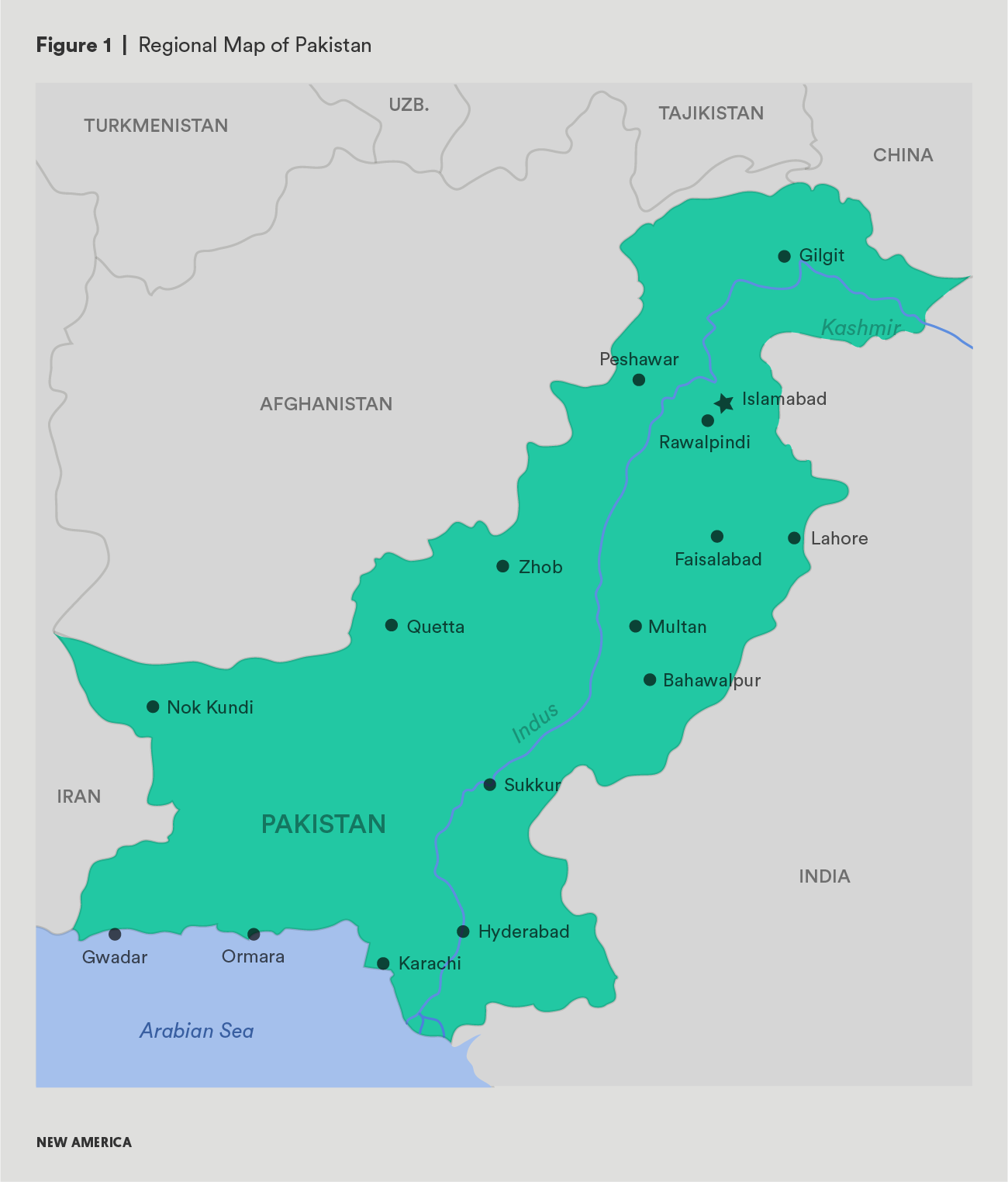
- According to the CIA World Factbook, Pakistan has a population of approximately 205 million people. Please see Appendix C, Map 1 for a regional map of Pakistan.
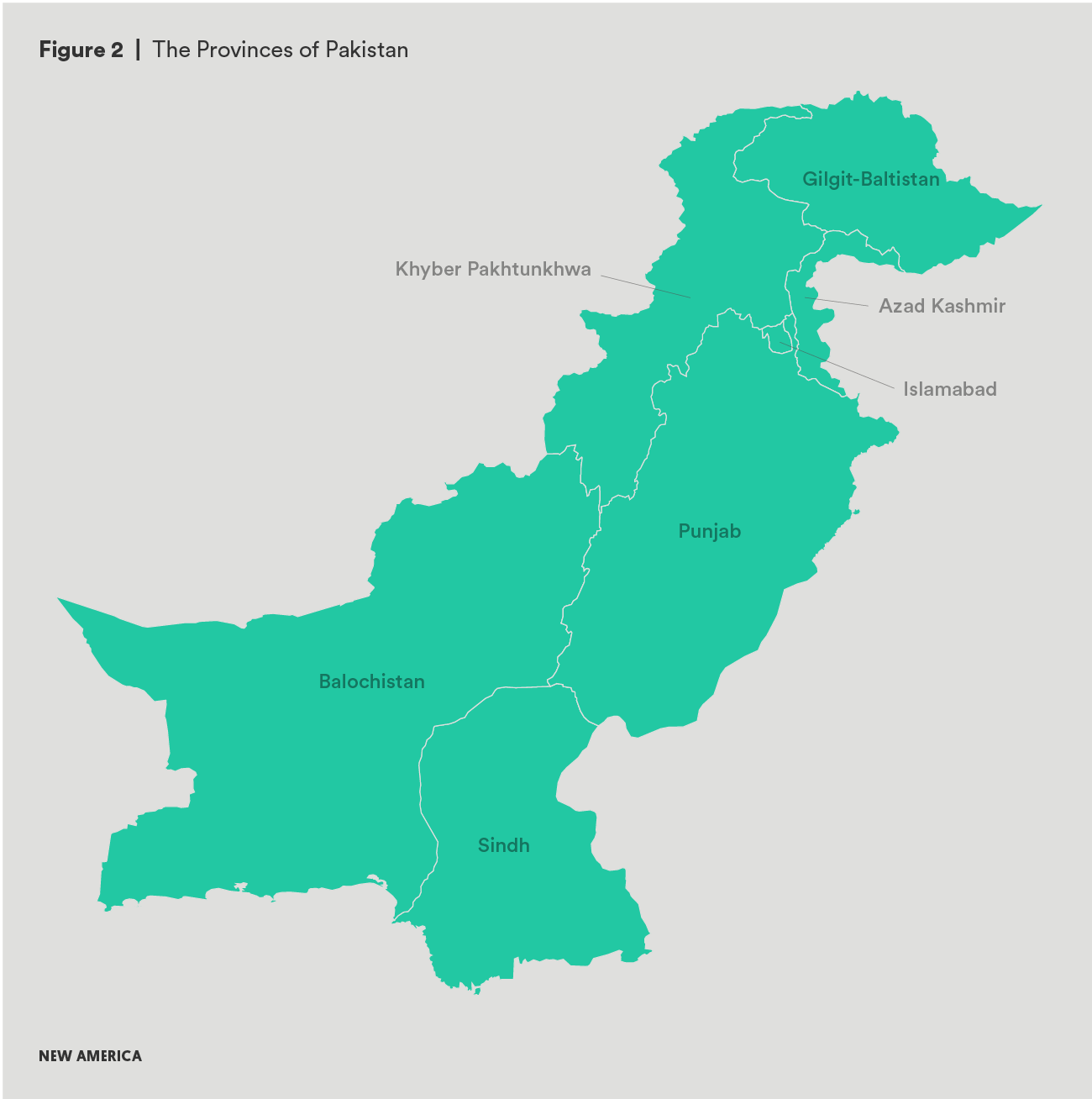
- Joshua Foust, “In Life and in Death, Bin Laden Divides U.S. and Pakistan,” The Atlantic, May 2, 2011, www.theatlantic.com/international/archive/2011/05/in-life-and-in-death-bin-laden-divides-us-and-pakistan/238140/, accessed May 24, 2018. Please see Appendix C, Map 2 for a map of the provinces of Pakistan.
- “Food Assistance Fact Sheet – Pakistan,” USAID, November 30, 2017, www.usaid.gov/pakistan/food-assistance, accessed May 18, 2018.
- Pakistan’s Jihadist Heartland: Southern Punjab (Brussels: International Crisis Group, May 30, 2016), 3, www.crisisgroup.org/asia/south-asia/pakistan/pakistan-s-jihadist-heartland-southern-punjab.
- Muhammad Zafar Iqbal and Faiz-ul-Hassan, “Delivering Land Administration Services at Scale,” PowerPoint presentation, 2017 World Bank Conference on Land and Poverty, Washington, DC, March 21, 2017; “Province Wise Provisional Results of Census – 2017,” Pakistan Bureau of Statistics, www.pbs.gov.pk/sites/default/files/CENSUS_2017.pdf, accessed April 25, 2018.
- Pakistan’s Jihadist Heartland, ii; Manzar Zaidi, “The ‘other Punjab’ is at the heart of Pakistani extremism,” The National, February 4, 2013, www.thenational.ae/the-other-punjab-is-at-the-heart-of-pakistani-extremism-1.296028, accessed May 23, 2018.
- Pakistan’s Jihadist Heartland, 22.
- Chandrika Kaul, “From Empire to Independence: The British Raj in India 1858-1947,” BBC, last updated March 3, 2011, www.bbc.co.uk/history/british/modern/independence1947_01.shtml, accessed April 30, 2018.
- First interview with Igor Popiv (March 19, 2018).
- The project purposefully avoided urban zones due to the lack of a formal land administration system in Punjabi cities. Reforming the complicated network of property ownership in urban areas was deemed by the project as too much of an “uphill battle” (interview with Osama Bin Saeed (April 24, 2018)).
- “Rural Punjab Goes Digital,” World Bank Group, February 6, 2017, www.worldbank.org/en/news/feature/2017/02/06/rural-punjab-goes-digital, accessed April 2, 2018.
- Linus Pott, Implementation Completion and Results Report (IDA-42580 IDA-51510) on a Credit in the Amount of SDR 30.35 Million (US$ 45.65 Million Equivalent) and an Additional Financing of SDR 46.20 Million (US$ 70.00 Million Equivalent) to the Islamic Republic of Pakistan for a Punjab Land Records Management and Information Systems Project (Washington, DC: World Bank Group, June 21, 2017), 1, documents.worldbank.org/curated/en/632241498842804246/pdf/ICR00003719.pdf;
- Muhammad Shehbaz Sharif, letter to Jim Yong Kim, May 31, 2018.
- Pott, Implementation Completion and Results Report, 24.
- Mary Lisbeth Gonzalez, Pakistan – Land Records Management and Information Systems Project (LRMIS-P) Province of Punjab: P090501 – Implementation Status and Results Report: Sequence 21 (Washington, DC: World Bank Group, November 11, 2016), 2, documents.worldbank.org/curated/en/586921478877214613/pdf/ISR-Disclosable-P090501-11-11-2016-1478877202012.pdf; Pott, Implementation Completion and Results Report, 17.
- Pott, Implementation Completion and Results Report, 18.
- Zaidi, “The ‘other Punjab;’” Pakistan’s Jihadist Heartland, 8.
- Pakistan’s Jihadist Heartland, 8.
- While every land administration reform project must be responsive to local technological, political, and socioeconomic conditions, it is nevertheless valuable to examine both the lessons learned and best practices of previous efforts.
- “In Pakistan and Beyond, Land Records Get a Digital Upgrade,” World Bank Group, September 20, 2017, www.worldbank.org/en/news/feature/2017/09/20/in-pakistan-and-beyond-land-records-get-a-digital-upgrade, accessed April 30, 2018.
- Please see Appendix A for a brief overview of the project timeline.
The Legacy Land Administration of Punjab
Punjab Province maintained an anachronistic land administration system before LRMIS project implementation. The bureaucracy was inherited from the British Raj, which governed the Indian subcontinent from the mid-19th century until independence and partition in 1947.22
Under this system, inaccurate handwritten registries were easily damaged or misplaced. Local land administrators—the Patwaris—often elicited bribes, tampered with records, and marginalized groups such as poor farmers and women.23 Wealthy landowners received preferential treatment from rent-seeking Patwaris, and poor tenure security contributed to difficulties in the transfer of land ownership and unequal access to finance.24
In the provincial south, the legacy system exacerbated weak governance, economic neglect, and perceptions of exploitation. Poor locals resentfully describe the industrialized central and north of Punjab as the Takht Lahore, or the “Throne of Lahore.” These grievances have often been manipulated for recruitment purposes by radical Islamist groups that present themselves as challengers to the traditional elite.25
Local land administrators—the Patwaris—often elicited bribes, tampered with records, and marginalized groups such as poor farmers and women.
By the early 21st century, the need for systemic change was increasingly apparent to influential stakeholders within the provincial government—most importantly Chief Minister (CM) Muhammad Shehbaz Sharif.26 Land reform via registry digitization was perceived as a powerful option to improve socioeconomic conditions and streamline government processes.27
Remnants of the British Colonial System
The greater Punjab region has long been coveted for its substantial agricultural yields and its strategic position in South Asia.28 The British annexed the territory in 1849, and successive colonial officials were very attentive to revenue collection from the lucrative farming sector.29 After the Indian Rebellion of 1857, British administrators specifically implemented policies and bureaucratic structures to preserve order and control over the region.30
Three resultant policies markedly contributed to the Patwar system. First, the British formalized the rural land system in order to efficiently collect taxes from the profitable agricultural sector and, in doing so, neglected urban centers.31 Second, because the colonial reaction to the 1857 rebellion prioritized order over socioeconomic transformation, the British Raj restricted land transfers. The British believed that the ‘hidden hand’ of the market imperiled stability by unleashing volatile forces.32 Third, colonial administrators implemented tribal law in place of both British and Sharia law—much to the detriment of female land inheritance rights. Tribal law helped to maintain an indigenous political base and allowed the British to codify and systematize existing legal patterns. This colonial strategy ultimately contributed to political underdevelopment and agricultural stagnation.
The institutional framework created to tax rural landholdings involved multiple agencies and suffered from paternalism, inflexibility, and inconsistent policy implementation.33 Adding to the convoluted nature of the system, colonial court rulings determined that land records were contestable, that revenue records were not documents of title, and that entries could be challenged to determine the title of land.34 These official decrees primarily affected the poor, as many could not afford protracted legal disputes.
Colonial administrators implemented tribal law in place of both British and Sharia law—much to the detriment of female land inheritance rights.
The consequent structure was a non-transparent and disjointed bureaucracy prone to corruption and rent- seeking. Such illegitimate activity was primarily conducted by Patwaris operating in local villages.
Patwar Culture
By the end of the 20th century, the Punjabi land administration system had evolved into three largely independent agencies: the Board of Revenue (BOR); the Excise and Taxation Department; and the Lahore Development Authority. Despite the considerable bureaucracy, no single agency maintained updated land registries, and coordinated record keeping was limited.
The BOR possessed the most significant authority to oversee Punjabi land management. Its administrative structure was loosely organized into multiple levels.35 This framework curbed sufficient oversight at the local level, granting dishonest Patwaris considerable autonomy.
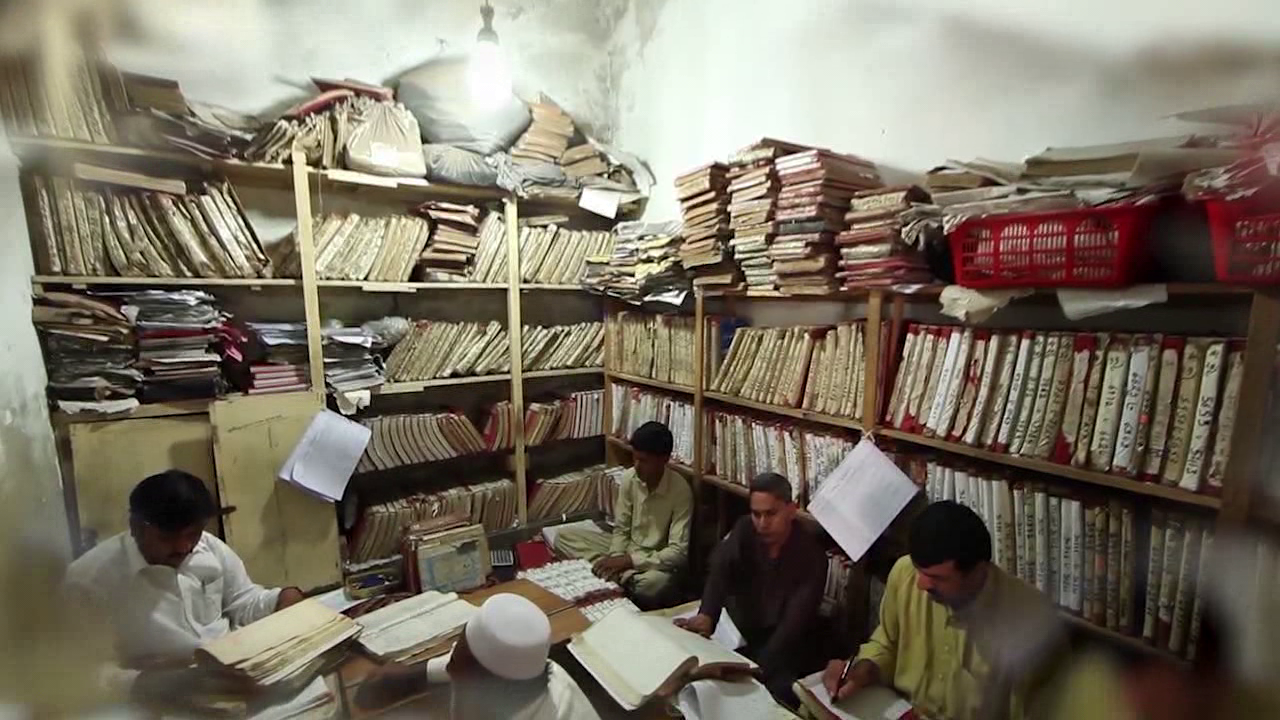
Patwaris were the sole custodians of both public and private land records within rural villages. They were the only officials who could issue copies of property records, or fards.36 All land-related documents were even carried on their person in a cloth bag, or basta.37
Patwaris were the sole custodians of land records within rural villages, but were often unresponsive and very difficult to locate physically despite their importance.
Patwaris were often unresponsive and very difficult to locate physically despite their importance.38 The project’s baseline study indicates that issuance of a fard took one to seven days.39 Additionally, the manual record keeping system resulted in easily lost data, as all information was written onto a single cloth ledger.40 Although a backup system existed, its use was not strictly enforced.41 Pertinent agricultural information was commonly unavailable to various stakeholders—such as women, small farmers, financial institutions, and even high-level provincial officials.42
Punjab Land Records Authority
Beyond these logistical challenges, the legacy system was biased toward large landholders. High transaction costs for land-related services and the prevalence of rent-seeking and corruption favored richer farmers over the poor.43 Bribery allowed the wealthy greater access to the Patwaris, and the influence of large landowners over the local administrators enabled delivery of services to their doorsteps.44
Women were typically barred from formal access to land services under the Patwar system.45 Even though women frequently inherited family land under Sharia law, they were unable to exercise their rights. Male relatives regularly bribed Patwaris in order to seize land originally and rightfully intended for widows, mothers, and sisters.46
High transaction costs for land-related services and the prevalence of rent-seeking and corruption favored richer farmers over the poor.
The legacy system contributed to difficulties in the transfer of land ownership and unequal access to services, capital, and markets. The resulting uneven land distribution and economic disparity disproportionately affected women and small farmers.47 In the agrarian south, particularly, wealth and political clout were concentrated in the hands of large landholding families. This economic deprivation and the absence of fair governance were ultimately exploited by radical Islamist groups for recruitment purposes and public support.48
The average citizen eventually perceived “Patwarism” as a symbol of corruption and oppression. Many within the provincial government, including CM Muhammad Shehbaz Sharif, concurrently aspired to discontinue the outmoded system.49 Comprehensive land administration reform contained the potential to address socioeconomic hardships, unresponsive governance, and security issues.
The Need for Systemic Reform
Twenty-first century political support for Punjabi land administration reform was strong, with a significant level of involvement from CM Muhammad Shehbaz Sharif. Elected to a second term in 2008, CM Sharif personally championed official support after experiencing firsthand the pervasive corruption and tampering in land administration.50 Following the hindrance of investment due to manipulated government records, Sharif recognized the costly and unreliable nature of the manual system. The record keeping scheme was unhelpful, and even damaging, to everyone—from the Chief Minister of Pakistan’s most populated province to the poorest tenant farmer.51
Termination of the Patwar system would potentially improve livelihoods, strengthen governance, and help counter extremism. Sharif aimed to implement a reliable and transparent system with the maximum amount of automation. Despite deficiencies in past projects to reform the provincial land administration system via technology, GoPunjab elected to partner with the World Bank in a renewed effort.52
The record keeping scheme was unhelpful, and even damaging, to everyone—from the Chief Minister of Pakistan’s most populated province to the poorest tenant farmer.
Punjabi support and insight were critical for success. A project should generally be responsive to local technological, political, and socioeconomic conditions. Through prudent measures, secure and formal land rights promote greater prosperity, provide the marginalized with easier access to capital, and are a powerful tool for gender equality.53 Development initiatives also increase the opportunity costs associated with militancy.54
These improvements are reinforced by digitization. Throughout the developing world, digitization can strengthen tenure security and indirectly raise land value by streamlining loan procurement and investment. Computerized data can inform policy planning and be leveraged to improve tax collection, resource allocation, and disaster management.55 Most importantly, digitization helps to modify administrative structures to empower women and the poor, as marginalized groups are accorded more equality in a standardized system that is resistant to both bribery and favoritism.56 A more responsive government—better able to protect and engage with its citizens—can provide nonviolent and legitimate channels to voice grievances.
Citations
- According to the CIA World Factbook, Pakistan has a population of approximately 205 million people. Please see Appendix C, Map 1 for a regional map of Pakistan.
- Joshua Foust, “In Life and in Death, Bin Laden Divides U.S. and Pakistan,” The Atlantic, May 2, 2011, www.theatlantic.com/international/archive/2011/05/in-life-and-in-death-bin-laden-divides-us-and-pakistan/238140/, accessed May 24, 2018. Please see Appendix C, Map 2 for a map of the provinces of Pakistan.
- “Food Assistance Fact Sheet – Pakistan,” USAID, November 30, 2017, www.usaid.gov/pakistan/food-assistance, accessed May 18, 2018.
- Pakistan’s Jihadist Heartland: Southern Punjab (Brussels: International Crisis Group, May 30, 2016), 3, www.crisisgroup.org/asia/south-asia/pakistan/pakistan-s-jihadist-heartland-southern-punjab.
- Muhammad Zafar Iqbal and Faiz-ul-Hassan, “Delivering Land Administration Services at Scale,” PowerPoint presentation, 2017 World Bank Conference on Land and Poverty, Washington, DC, March 21, 2017; “Province Wise Provisional Results of Census – 2017,” Pakistan Bureau of Statistics, www.pbs.gov.pk/sites/default/files/CENSUS_2017.pdf, accessed April 25, 2018.
- Pakistan’s Jihadist Heartland, ii; Manzar Zaidi, “The ‘other Punjab’ is at the heart of Pakistani extremism,” The National, February 4, 2013, www.thenational.ae/the-other-punjab-is-at-the-heart-of-pakistani-extremism-1.296028, accessed May 23, 2018.
- Pakistan’s Jihadist Heartland, 22.
- Chandrika Kaul, “From Empire to Independence: The British Raj in India 1858-1947,” BBC, last updated March 3, 2011, www.bbc.co.uk/history/british/modern/independence1947_01.shtml, accessed April 30, 2018.
- First interview with Igor Popiv (March 19, 2018).
- The project purposefully avoided urban zones due to the lack of a formal land administration system in Punjabi cities. Reforming the complicated network of property ownership in urban areas was deemed by the project as too much of an “uphill battle” (interview with Osama Bin Saeed (April 24, 2018)).
- “Rural Punjab Goes Digital,” World Bank Group, February 6, 2017, www.worldbank.org/en/news/feature/2017/02/06/rural-punjab-goes-digital, accessed April 2, 2018.
- Linus Pott, Implementation Completion and Results Report (IDA-42580 IDA-51510) on a Credit in the Amount of SDR 30.35 Million (US$ 45.65 Million Equivalent) and an Additional Financing of SDR 46.20 Million (US$ 70.00 Million Equivalent) to the Islamic Republic of Pakistan for a Punjab Land Records Management and Information Systems Project (Washington, DC: World Bank Group, June 21, 2017), 1, documents.worldbank.org/curated/en/632241498842804246/pdf/ICR00003719.pdf;
- Muhammad Shehbaz Sharif, letter to Jim Yong Kim, May 31, 2018.
- Pott, Implementation Completion and Results Report, 24.
- Mary Lisbeth Gonzalez, Pakistan – Land Records Management and Information Systems Project (LRMIS-P) Province of Punjab: P090501 – Implementation Status and Results Report: Sequence 21 (Washington, DC: World Bank Group, November 11, 2016), 2, documents.worldbank.org/curated/en/586921478877214613/pdf/ISR-Disclosable-P090501-11-11-2016-1478877202012.pdf; Pott, Implementation Completion and Results Report, 17.
- Pott, Implementation Completion and Results Report, 18.
- Zaidi, “The ‘other Punjab;’” Pakistan’s Jihadist Heartland, 8.
- Pakistan’s Jihadist Heartland, 8.
- While every land administration reform project must be responsive to local technological, political, and socioeconomic conditions, it is nevertheless valuable to examine both the lessons learned and best practices of previous efforts.
- “In Pakistan and Beyond, Land Records Get a Digital Upgrade,” World Bank Group, September 20, 2017, www.worldbank.org/en/news/feature/2017/09/20/in-pakistan-and-beyond-land-records-get-a-digital-upgrade, accessed April 30, 2018.
- Please see Appendix A for a brief overview of the project timeline.
- Kaul, “From Empire to Independence.”
- “Rural Punjab Goes Digital.”
- Pott, Implementation Completion and Results Report, 1-2.
- Pakistan’s Jihadist Heartland, 8-9.
- Interview with Osama Bin Saeed (April 24, 2018).
- Patrick Kelley and Michael Graglia, “Why Property Rights Matter,” FPR Blog (blog), New America, March 10, 2017, www.newamerica.org/international-security/future-property-rights/blog/why-property-rights-matter/, accessed April 30, 2018.
- John Marriott, The Other Empire: Metropolis, India and Progress in the Colonial Imagination (Manchester University Press: Manchester, 2003), 195.
- Ian A. Talbot, “The Punjab Under Colonialism: Order and Transformation in British India,” Journal of Punjab Studies, 14, no. 1 (2007), 3; first interview with Igor Popiv (March 19, 2018).
- Talbot, “The Punjab Under Colonialism,” 3-5.
- First interview with Igor Popiv (March 19, 2018).
- Talbot, “The Punjab Under Colonialism,” 5-6, 9.
- Ibid., 7-9. Relevant colonial land administration agencies included the Board of Revenue (BOR) and the Irrigation Department. However, taxes enforced by the Irrigation Department were physically collected by Patwaris employed by the BOR (comment from Osama Bin Saeed (April 29, 2018)).
- Pott, Implementation Completion and Results Report, 1.
- Please see Appendix B for information on the BOR administrative levels.
- Pott, Implementation Completion and Results Report, 1-2.
- Linus Pott, “From Cloth Bags to Land Record Service Centers – Experiences From a World Bank Funded Project in Punjab, Pakistan,” paper presented at the 2017 World Bank Conference on Land and Poverty, Washington, DC, March 22, 2017; Mary Lisbeth Gonzalez, “Land records go digital in Punjab, Pakistan,” End Poverty in South Asia (blog), World Bank Group, October 26, 2016 blogs.worldbank.org/endpovertyinsouthasia/land-records-go-digital-punjab-pakistan, accessed May 11, 2018.
- “Rural Punjab Goes Digital.”
- Pott, Implementation Completion and Results Report, 16.
- “Rural Punjab Goes Digital.”
- The legacy backup system required creation of two copies of every land record—one stored at the Patwari’s office and the other consigned to an official record room. This scheme was not reliable, however, as the manually-maintained records were produced at the discretion of the individual Patwari. If the Patwari chose not to provide backup copies of land records, the system quickly became outdated (comment from Osama Bin Saeed (April 29, 2018)).
- Interview with Osama Bin Saeed (April 24, 2018).
- Pott, Implementation Completion and Results Report, 1-2.
- Ibid., 20.
- The legacy land administration system was male-dominated. Out of the approximately 25,000 Patwari positions, and almost 8,000 supervisor positions, a woman was never able to secure a vacancy (comment from Osama Bin Saeed (April 29, 2018)).
- First interview with Mary Lisbeth Gonzalez (March 22, 2018).
- Independent Evaluation Group, PK:Land Records Mgmt and Information Syst. (P090501) Implementation Completion Report (ICR) Review (Washington, DC: World Bank Group, September 5, 2017), 4, documents.worldbank.org/curated/en/821101504632525457/pdf/ICRR-Disclosable-P090501-09-05-2017-1504632512156.pdf.
- Pakistan’s Jihadist Heartland, 9.
- Interview with Osama Bin Saeed (April 24, 2018). Muhammad Shehbaz Sharif is brother to Nawaz Sharif, the former Prime Minister of Pakistan.
- “Shahbaz Sharif,” Dawn, April 25, 2013, www.dawn.com/news/1024486, accessed May 11, 2018. Muhammad Shehbaz Sharif first served as Chief Minister of Punjab from 1997 until the 1999 Pakistani military coup.
- Interview with Osama Bin Saeed (April 24, 2018).
- Ibid.
- Kelley and Graglia, “Why Property Rights Matter.”
- Norman Loayza, “How to defeat terrorism: Intelligence, integration, and development,” Future Development (blog), The Brookings Institution, July 25, 2016, www.brookings.edu/blog/future-development/2016/07/25/how-to-defeat-terrorism-intelligence-integration-and-development/, accessed May 31, 2018.
- Pott, Implementation Completion and Results Report, 38.
- “In Pakistan and Beyond, Land Records Get a Digital Upgrade.”
Project Preparation and Initial Implementation (2005-2012)
Previous attempts by GoPunjab to reform its land administration system were unsuccessful. A lack of best practices, along with inconsistent implementation, failed to drastically improve the legacy system. Change also failed because many rural citizens were familiar and comfortable with the Patwaris—the system was anything but defective for wealthy landowners.57 The LRMIS project partners consequently learned from these past pilots, prepared for the utilization of appropriate technology, and engaged with key stakeholders during early implementation.
Lessons from Previous Pilots
The LRMIS project benefited from the lessons of previous BOR pilots —for example, insights from projects in Kasur District, Lahore District, and Rahim Yar Khan/Gujrat Districts dictated the success of the new system.58 The small-scale initiatives informed software development, highlighted the importance of stakeholder and community inclusion, and helped to identify the implications of transitioning from a manual to a digital record system.
First, the 1999-2003 land record computerization pilot in Kasur District illustrated the need for software flexibility.59 Land administration throughout rural Punjab was idiosyncratic; numerous undocumented processes existed and many were not uniformly defined.60 Any software system needed to be flexible in its enforcement of administrative rules and regulations, as not all legacy data was recorded with strict compliance.61
The small-scale initiatives informed software development, highlighted the importance of stakeholder and community inclusion, and helped to identify the implications of transitioning from a manual to a digital record system.
The Kasur District pilot also indicated the cost of data entry per district.62 The complex land records were in poor condition, with many missing crucial information on transactions, landowners, and land itself. Composition of the legacy records in Urdu, a language not widely spoken in Punjab, further contributed to logistical delays.63 The 2006 Project Appraisal Document estimated the cost of data entry per district at US $80,000 to $85,000.64
Second, the 2001 Lahore District computerization pilot demonstrated the importance of public outreach. Any new project could not absolutely erase Patwar culture. Many landowners were familiar with their local Patwari and made use of the legacy system for years—if not decades. A public education campaign to facilitate cultural change was deemed necessary.65
The complex land records were in poor condition, with many missing crucial information on transactions, landowners, and land itself.
The pilot also highlighted the importance of Patwari inclusion in the project. As exclusive caretakers of manual land records and maps, the Patwaris possessed vital knowledge of the legacy system. Yet they were also threatened by the potential loss of power and revenue due to the reforms.66 The project therefore stressed compromise and co-option of the Patwaris.67
Third, the 2005 Rahim Yar Khan District and Gujrat District pilots continued record computerization. The technological solution developed for these pilots strictly enforced prevailing laws and procedures. As previously noted, however, Patwaris often carried out their own undocumented practices in the field, and both pilots soon stagnated.68 Poor management under the Punjabi Information Technology Department was an added issue. GoPunjab subsequently assigned future software implementation to the more accomplished Punjab Information and Technology Board (PITB).69 These bureaucratic shortcomings suggested potential use of a public-private partnership in relation to software development.
Approval, Implementation, and Delay
The World Bank financed two key preparation reports in 2005 and 2006. These studies—conducted by a software company and a consultancy firm, respectively—identified information and communication technology (ICT), as well as an appropriate cultural and social approach, for the project. The analyses resulted in a well-designed and continuous dissemination strategy.70
The LRMIS project was a systemic restructuring of rural Punjabi land administration. The 2007 Financing Agreement allocated US $45 million over a five-year period for two interconnected objectives: 1) to transition from a manual system to a computerized system through the process of digitization; and 2) to transition from the corrupt Patwar system to a transparent and service-based system within newly built Arazi Record Centers (ARCs).71 Initial ARC construction was planned for 18 districts at the kanungo level, an administrative area roughly encompassing a dozen villages.72 Yet, this timeline would prove to be too short.
As the agency responsible for all provincial ICT programs, the PITB initially oversaw development of project software. Following analysis and internal project review, the agency selected a competitive approach for software production.73 Four private firms were selected in 2007 to develop a solution and conduct a pilot within 285 days, which were then evaluated by the PITB.
Based on technical evaluations and User Acceptance Testing, the PITB selected Lahore’s Accountancy Outsourcing Services in 2008 for software development. Early delays related to data entry necessitated a vendor contract extension, and a considerable PITB workload contributed to project neglect. Bureaucratic responsibility for software rollout shifted to the Project Management Unit (PMU)—a subunit of the BOR.74
The LRMIS project was a systemic restructuring of rural Punjabi land administration.
The project was further delayed by 18 months as the software matured and issues related to both data management and manual record errors were addressed.75 Shortcomings in collaboration between project members contributed to the setback. Initial project implementation relied significantly upon land administrators within the BOR, but these stakeholders were not technologically adept. Conversely, the many ICT specialists within Pakistan lacked sufficient knowledge regarding property rights.76
The first half of the project was a pivotal learning experience. Creation of the PMU for operational management helped to provide the necessary attention to detail and resources for successful implementation.77 Prolonged software tests and revisions allowed the technology to mature. Increasing confidence in the computer system to manage and resolve land administration complexities encouraged greater bureaucratic support and propelled the PMU to initiate operations at scale.
This protracted period also demonstrated the need to monitor initial data quality.78 Data entry and verification began in 2010; the effort expanded to 13 districts by the end of 2011.79 Project leadership decided to integrate the Patwaris into the process. Patwaris’ knowledge of the legacy system was unique, as many maintained idiosyncratic records and an abundance of undocumented practices existed. This expertise had to be captured, and there was no other source.
Patwari Engagement and Removal
As the sole custodians of land records for decades, Patwaris enjoyed substantial power within villages. Patwari responsibilities extended beyond land administration, however, to include keeping weather records, collecting harvest information, reporting crimes, and updating voter registries.80 This diverse revenue stream helped to reduce initial Patwari resistance to the project and its resulting changes regarding administrative power dynamics. Early opposition was also reduced by the Patwaris’ expectation that the project would fail.81
The Patwaris increasingly felt threatened as the project progressed. Data entry work continued and brick-and-mortar expansion began in early 2011. By May, the LRMIS software was operational in a Kasur District land record center.82 Other ARCs opened at the kanungo level in the Lahore, Hafizabad, and Lodhran Districts shortly after.83 Project momentum generated significant Patwari resistance and necessitated broad consultations in 2011 and 2012.84
As the sole custodians of land records for decades, Patwaris enjoyed substantial power within villages.
Though they were pressured politically to cooperate, the Patwaris were compensated financially.85 The project trained them to conduct specific tasks, such as the provision of land records, quality assurance of digital data, and the preparation of supporting documents for the correction of errors.86 They were paid PKR 5,000 (US $43) on average per verified and/or corrected mauza, or revenue estate.87
The quality of digitized data was important for the project. Poor data would have damaged public trust in LRMIS. Moreover, abundant errors would have handed the Patwaris an opportunity to publicly criticize the project. Punjabi officials recognized the importance of this process, and CM Sharif received weekly updates on digitization.88 The lengthy double-blind entry process, conducted by increasingly acquiescent Patwaris, ensured ample quality from the start of data entry. Over 90 percent of provincial rural land records were eventually digitized.89
Legal amendments ultimately removed the Patwaris from a position of power within land administration in 2012. Due to continued political support for the project, over 20 combined changes were made to the 1967 Punjab Land Revenue Act and the 1968 Punjab Land Revenue Rules. The legislation prohibited Patwaris from manually issuing fards, simplified issuance and transactions of land records, and established digital administrative procedures. The official Punjab Land Records Manual was changed accordingly.90
This removal process was not planned at the project’s outset. Leadership initially intended to limit the role of Patwaris in land services, but CM Sharif eventually decided to rescind their duties related to property rights. The chief minister based his decision on past experience, convinced that integration of the Patwaris into the new scheme would result in the continuation of the same harmful practices associated with the legacy system.91
Of note, legal removal of the Patwaris can be particularly important for provincial security. Legislation approved by the provincial assembly in Lahore is a strong signal that GoPunjab genuinely attempted to improve governance and confront rural underdevelopment.92 As a result, grievances that have facilitated terrorist recruitment may diminish over time.
For the first time in over 150 years, the Patwaris are not powerful stakeholders in the land system. While many still engage in surveying, the project removed the land administration responsibilities of 8,000 Patwaris—about a third of the workforce.93 Time and logistical costs to locate a Patwari, as well as transaction times, are significantly reduced. Bribes are no longer commonplace or necessary.94 It is not an exaggeration to assert that the socioeconomic power structure within Punjabi villages has drastically changed—CM Sharif even stated that the project revolutionized rural life.95
Citations
- According to the CIA World Factbook, Pakistan has a population of approximately 205 million people. Please see Appendix C, Map 1 for a regional map of Pakistan.
- Joshua Foust, “In Life and in Death, Bin Laden Divides U.S. and Pakistan,” The Atlantic, May 2, 2011, www.theatlantic.com/international/archive/2011/05/in-life-and-in-death-bin-laden-divides-us-and-pakistan/238140/, accessed May 24, 2018. Please see Appendix C, Map 2 for a map of the provinces of Pakistan.
- “Food Assistance Fact Sheet – Pakistan,” USAID, November 30, 2017, www.usaid.gov/pakistan/food-assistance, accessed May 18, 2018.
- Pakistan’s Jihadist Heartland: Southern Punjab (Brussels: International Crisis Group, May 30, 2016), 3, www.crisisgroup.org/asia/south-asia/pakistan/pakistan-s-jihadist-heartland-southern-punjab.
- Muhammad Zafar Iqbal and Faiz-ul-Hassan, “Delivering Land Administration Services at Scale,” PowerPoint presentation, 2017 World Bank Conference on Land and Poverty, Washington, DC, March 21, 2017; “Province Wise Provisional Results of Census – 2017,” Pakistan Bureau of Statistics, www.pbs.gov.pk/sites/default/files/CENSUS_2017.pdf, accessed April 25, 2018.
- Pakistan’s Jihadist Heartland, ii; Manzar Zaidi, “The ‘other Punjab’ is at the heart of Pakistani extremism,” The National, February 4, 2013, www.thenational.ae/the-other-punjab-is-at-the-heart-of-pakistani-extremism-1.296028, accessed May 23, 2018.
- Pakistan’s Jihadist Heartland, 22.
- Chandrika Kaul, “From Empire to Independence: The British Raj in India 1858-1947,” BBC, last updated March 3, 2011, www.bbc.co.uk/history/british/modern/independence1947_01.shtml, accessed April 30, 2018.
- First interview with Igor Popiv (March 19, 2018).
- The project purposefully avoided urban zones due to the lack of a formal land administration system in Punjabi cities. Reforming the complicated network of property ownership in urban areas was deemed by the project as too much of an “uphill battle” (interview with Osama Bin Saeed (April 24, 2018)).
- “Rural Punjab Goes Digital,” World Bank Group, February 6, 2017, www.worldbank.org/en/news/feature/2017/02/06/rural-punjab-goes-digital, accessed April 2, 2018.
- Linus Pott, Implementation Completion and Results Report (IDA-42580 IDA-51510) on a Credit in the Amount of SDR 30.35 Million (US$ 45.65 Million Equivalent) and an Additional Financing of SDR 46.20 Million (US$ 70.00 Million Equivalent) to the Islamic Republic of Pakistan for a Punjab Land Records Management and Information Systems Project (Washington, DC: World Bank Group, June 21, 2017), 1, documents.worldbank.org/curated/en/632241498842804246/pdf/ICR00003719.pdf;
- Muhammad Shehbaz Sharif, letter to Jim Yong Kim, May 31, 2018.
- Pott, Implementation Completion and Results Report, 24.
- Mary Lisbeth Gonzalez, Pakistan – Land Records Management and Information Systems Project (LRMIS-P) Province of Punjab: P090501 – Implementation Status and Results Report: Sequence 21 (Washington, DC: World Bank Group, November 11, 2016), 2, documents.worldbank.org/curated/en/586921478877214613/pdf/ISR-Disclosable-P090501-11-11-2016-1478877202012.pdf; Pott, Implementation Completion and Results Report, 17.
- Pott, Implementation Completion and Results Report, 18.
- Zaidi, “The ‘other Punjab;’” Pakistan’s Jihadist Heartland, 8.
- Pakistan’s Jihadist Heartland, 8.
- While every land administration reform project must be responsive to local technological, political, and socioeconomic conditions, it is nevertheless valuable to examine both the lessons learned and best practices of previous efforts.
- “In Pakistan and Beyond, Land Records Get a Digital Upgrade,” World Bank Group, September 20, 2017, www.worldbank.org/en/news/feature/2017/09/20/in-pakistan-and-beyond-land-records-get-a-digital-upgrade, accessed April 30, 2018.
- Please see Appendix A for a brief overview of the project timeline.
- Kaul, “From Empire to Independence.”
- “Rural Punjab Goes Digital.”
- Pott, Implementation Completion and Results Report, 1-2.
- Pakistan’s Jihadist Heartland, 8-9.
- Interview with Osama Bin Saeed (April 24, 2018).
- Patrick Kelley and Michael Graglia, “Why Property Rights Matter,” FPR Blog (blog), New America, March 10, 2017, www.newamerica.org/international-security/future-property-rights/blog/why-property-rights-matter/, accessed April 30, 2018.
- John Marriott, The Other Empire: Metropolis, India and Progress in the Colonial Imagination (Manchester University Press: Manchester, 2003), 195.
- Ian A. Talbot, “The Punjab Under Colonialism: Order and Transformation in British India,” Journal of Punjab Studies, 14, no. 1 (2007), 3; first interview with Igor Popiv (March 19, 2018).
- Talbot, “The Punjab Under Colonialism,” 3-5.
- First interview with Igor Popiv (March 19, 2018).
- Talbot, “The Punjab Under Colonialism,” 5-6, 9.
- Ibid., 7-9. Relevant colonial land administration agencies included the Board of Revenue (BOR) and the Irrigation Department. However, taxes enforced by the Irrigation Department were physically collected by Patwaris employed by the BOR (comment from Osama Bin Saeed (April 29, 2018)).
- Pott, Implementation Completion and Results Report, 1.
- Please see Appendix B for information on the BOR administrative levels.
- Pott, Implementation Completion and Results Report, 1-2.
- Linus Pott, “From Cloth Bags to Land Record Service Centers – Experiences From a World Bank Funded Project in Punjab, Pakistan,” paper presented at the 2017 World Bank Conference on Land and Poverty, Washington, DC, March 22, 2017; Mary Lisbeth Gonzalez, “Land records go digital in Punjab, Pakistan,” End Poverty in South Asia (blog), World Bank Group, October 26, 2016 blogs.worldbank.org/endpovertyinsouthasia/land-records-go-digital-punjab-pakistan, accessed May 11, 2018.
- “Rural Punjab Goes Digital.”
- Pott, Implementation Completion and Results Report, 16.
- “Rural Punjab Goes Digital.”
- The legacy backup system required creation of two copies of every land record—one stored at the Patwari’s office and the other consigned to an official record room. This scheme was not reliable, however, as the manually-maintained records were produced at the discretion of the individual Patwari. If the Patwari chose not to provide backup copies of land records, the system quickly became outdated (comment from Osama Bin Saeed (April 29, 2018)).
- Interview with Osama Bin Saeed (April 24, 2018).
- Pott, Implementation Completion and Results Report, 1-2.
- Ibid., 20.
- The legacy land administration system was male-dominated. Out of the approximately 25,000 Patwari positions, and almost 8,000 supervisor positions, a woman was never able to secure a vacancy (comment from Osama Bin Saeed (April 29, 2018)).
- First interview with Mary Lisbeth Gonzalez (March 22, 2018).
- Independent Evaluation Group, PK:Land Records Mgmt and Information Syst. (P090501) Implementation Completion Report (ICR) Review (Washington, DC: World Bank Group, September 5, 2017), 4, documents.worldbank.org/curated/en/821101504632525457/pdf/ICRR-Disclosable-P090501-09-05-2017-1504632512156.pdf.
- Pakistan’s Jihadist Heartland, 9.
- Interview with Osama Bin Saeed (April 24, 2018). Muhammad Shehbaz Sharif is brother to Nawaz Sharif, the former Prime Minister of Pakistan.
- “Shahbaz Sharif,” Dawn, April 25, 2013, www.dawn.com/news/1024486, accessed May 11, 2018. Muhammad Shehbaz Sharif first served as Chief Minister of Punjab from 1997 until the 1999 Pakistani military coup.
- Interview with Osama Bin Saeed (April 24, 2018).
- Ibid.
- Kelley and Graglia, “Why Property Rights Matter.”
- Norman Loayza, “How to defeat terrorism: Intelligence, integration, and development,” Future Development (blog), The Brookings Institution, July 25, 2016, www.brookings.edu/blog/future-development/2016/07/25/how-to-defeat-terrorism-intelligence-integration-and-development/, accessed May 31, 2018.
- Pott, Implementation Completion and Results Report, 38.
- “In Pakistan and Beyond, Land Records Get a Digital Upgrade.”
- Interview with Osama Bin Saeed (April 24, 2018).
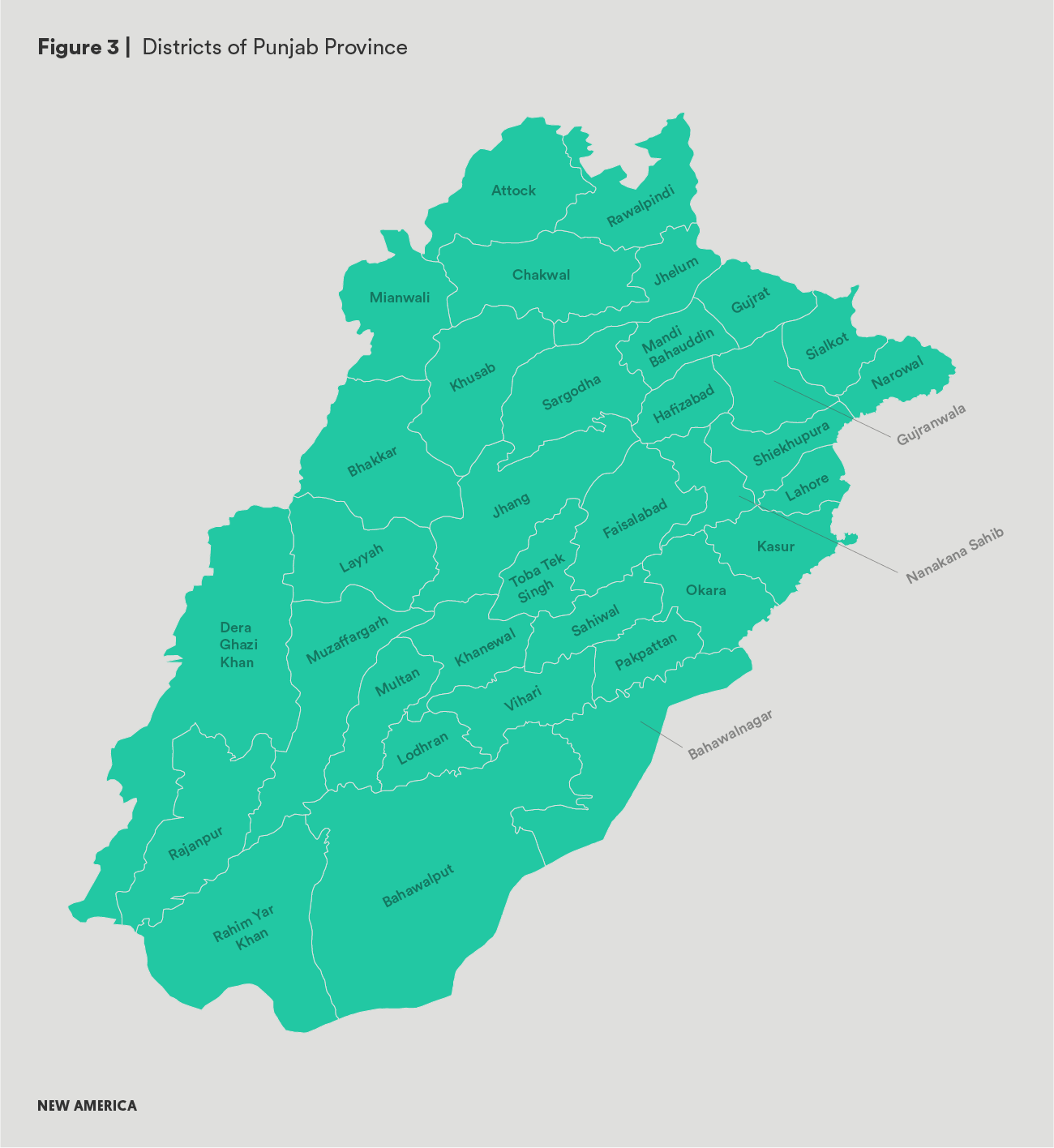
- Comment from Osama Bin Saeed (April 29, 2018). Please see Appendix C, Map 3 for a detailed map of Punjabi districts.
- Pott, Implementation Completion and Results Report, 6-7.
- Interview with Osama Bin Saeed (April 24, 2018).
- Comment from Osama Bin Saeed (April 29, 2018).
- According to the 2017 Census of Pakistan, the average Punjabi district area is 5,882 km², with an average population of 3,055,901.
- Pott, Implementation Completion and Results Report, 34-35; M. Ilyas Khan, “Uncommon tongue: Pakistan’s confusing move to Urdu,” BBC, September 12, 2015, www.bbc.com/news/world-asia-34215293, accessed May 11, 2018. According to the CIA World Factbook, Punjabi is the most widely-spoken first language in Pakistan. Urdu, while an official language, is only spoken by approximately 8% of the total population as a first language.
- World Bank, Project Appraisal Document on a Proposed Credit in the Amount of SDR 30.35 Million (USD 45.65 Million Equivalent) to the Islamic Republic of Pakistan for a Punjab Land Records Management and Information Systems Project (Washington, DC: World Bank Group, December 21, 2006), 62, documents.worldbank.org/curated/en/280181468289824118/pdf/36450.pdf.
- Second interview with Mary Lisbeth Gonzalez (April 11, 2018).
- Second interview with Igor Popiv (April 6, 2018).
- First interview with Mary Lisbeth Gonzalez (March 22, 2018).
- Comment from Osama Bin Saeed (May 20, 2018).
- Project Appraisal Document, 10.
- Pott, Implementation Completion and Results Report, 6.
- Martin M. Serrano, Financing Agreement (Punjab Land Records Management and Information Systems Project) between Islamic Republic of Pakistan and International Development Association (Washington, DC: World Bank Group, February 28, 2007), 1, documents.worldbank.org/curated/en/414891468288597562/pdf/FA0142581CONFORMED1.pdf; first interview with Mary Lisbeth Gonzalez (March 22, 2018); interview with Osama Bin Saeed (April 24, 2018). “Arazi” is Urdu and translates as land (Pott, Implementation Completion and Results Report, footnote 4).
- Pott, Implementation Completion and Results Report, 4; Iqbal and Hassa, “Delivering Land Administration Services at Scale.” Original evaluation of the intended project scope considered complete provincial inclusion as too ambitious due to time and budget constraints. At the time, leaders planned to complete implementation within 18 districts and then decide how to further expand their efforts. The World Bank and the Punjabi Government were considered as sources for additional funding (comment from Igor Popiv (May 4, 2018)).
- The proposal scheme was a single stage Quality and Cost Based Selection process. Four local firms were selected; fixed cost contracts were signed with each. Each company had to develop their own version of software and conduct pilots in different areas—including data entry of a defined size. The call for proposals was announced internationally, but due to specific requirements related to the use of Urdu and required knowledge of local legislation, only Pakistani firms were selected and contracted in 2007 (Pott, Implementation Completion and Results Report, 31).
- The provincial government created the PMU at the beginning of project implementation. Subordinate to the BOR and fully dedicated to the project, the PMU included a director, a deputy director, and a financial manager. Responsibilities involved management, administrative, and financial duties. Following the reassignment of ICT responsibilities, key professionals were transferred to a PMU support team in order to lead technological initiatives (comment from Igor Popiv (May 4, 2018)).
- Pott, Implementation Completion and Results Report, 31-32.
- Interview with Osama Bin Saeed (April 24, 2018).
- World Bank, Project Paper on a Proposed Additional Credit and Restructuring in the Amount of SDR 46.2 Million (US$70 Million Equivalent) to the Islamic Republic of Pakistan for a Punjab Land Record Management and Information Systems Project (Washington, DC: World Bank Group, August 2, 2012), 9, documents.worldbank.org/curated/en/267181468285357558/pdf/697740PJPR0P130Official0Use0Only090.pdf.
- First interview with Igor Popiv (March 19, 2018); second interview with Igor Popiv (April 6, 2018).
- Pott, Implementation Completion and Results Report, 34.
- Gonzalez, “Land records go digital in Punjab, Pakistan.”
- Interview with Osama Bin Saeed (April 24, 2018).
- Pott, Implementation Completion and Results Report, 32.
- Comment from Osama Bin Saeed (April 29, 2018). Please see Appendix B for information on the land administration levels of the BOR.
- Pott, Implementation Completion and Results Report, 9.
- Interview with Osama Bin Salman (April 24, 2018); second interview with Igor Popiv (April 6, 2018).
- Pott, Implementation Completion and Results Report, 9. The number of records requiring correction during the digitization process was fairly large. As a result, the speed for resolution was very slow. Under prevailing laws, changes to the core components of records (replacement of a landowner name, change in the share of a landowner, and change in the area of a parcel) required approval in a “quasi-judicial” court headed by a district leader. Due to the time constraints of the project, the Punjabi government delegated these legal powers to Revenue Officers. Decisions were based on the reports and documentary evidence presented by Patwaris (comment from Osama Bin Saeed (May 20, 2018)).
- Ibid.
- First interview with Igor Popiv (March 19, 2018).
- Comment from Igor Popiv (May 4, 2018).
- Pott, Implementation Completion and Results Report, 29.
- Comment from Osama Bin Saeed (May 20, 2018).
- Pakistan’s Jihadist Heartland, iv.
- Pott, Implementation Completion and Results Report, 21; second interview with Igor Popiv (April 6, 2018).
- Pott, Implementation Completion and Results Report, 44.
- Muhammad Shehbaz Sharif, letter to Jim Yong Kim, May 31, 2018.
Additional Financing and Project Expansion (2012-2016)
The World Bank approved a project extension in March 2012, shifting the expected closing date to November 2013. This 20-month extension accommodated the significant delays due to software development.96 Soon after, in September 2012, the World Bank provided an additional credit of US $70 million to extend the project a number of years, expand the project from 18 to 36 districts, and compensate for an additional US $15 million for data entry—the cost of which had been previously underestimated.97
Several modifications during this latter five-year phase were important to project success. First, government support for a change in scale of ARC construction allowed for LRMIS expansion to all 36 provincial districts. Second, as ARCs proliferated throughout Punjab, the project implemented a public awareness campaign.98 Finally, centralization of land administration data reduced the overall cost and increased efficiency.99
Government support for a change in scale of ARC construction allowed for LRMIS expansion to all 36 provincial districts.
Accessible and efficient government services, accompanied by meaningful engagement with rural communities, potentially rectified political alienation and socioeconomic inequality. Recruitment opportunities for jihadist groups may subside as conditions improve. For example, the provincial government in Lahore can increasingly replace the charity wings of radical Islamic organizations utilized to gain support throughout the countryside.100
Diffusion of the Land Record Centers
GoPunjab originally insisted on building ARCs at the kanungo level, which is the second smallest BOR jurisdiction and contains 10 to 15 villages.101 This initial approach introduced additional time, costs, and complexities to the project, as there are over 800 kanungo circles throughout Punjab.102
The provincial government eventually agreed to shift ARC construction to the tehsil level—one administrative level above the kanungo circle—after delays related to software development.103 This accommodation, authorized within the additional financing document, contributed to reduced costs and allowed for accelerated geographic expansion of the project.104 The larger administrative units at the tehsil level—over 140 units across the province—facilitated scalability.
Construction increased, and a total of 26 ARCs were operational by the end of 2012.105 The project eventually expanded to include over 140 land record centers in all 36 districts of Punjab.106 Every district contains, on average, four ARCs, with each center serving approximately 350,000 landholders and 236,000 parcels.107
Expansion to the entire province was meaningful for several reasons. The widespread ARC network provides the BOR—and the broader provincial government—with improved information via data collection. The resulting insights can inform policy planning and other development initiatives. The database potentially allows GoPunjab to monitor revenue and execute tax collection more efficiently and thoroughly, further diminishing corruption and fraud.
In particular, bribes to the Patwaris have been eliminated and transportation costs have decreased. Each center includes an automated queue system to prevent preferential treatment. General transaction times are now less than 30 minutes.
The ARCs are valuable to the average landowner, too. General service costs have been reduced from approximately PKR 6,241 (US $54) to PKR 2,550 (US $22). In particular, bribes to the Patwaris have been eliminated and transportation costs have decreased.108
Each center includes an automated queue system to prevent preferential treatment. General transaction times are now less than 30 minutes. The issuance of fards less than 10 pages takes 15 minutes on average and the process to record a land purchase or sale at an ARC lasts 165 minutes on average, increasing the ease of land transfers.109
The clean and orderly ARCs are the most visible project result and are potentially emblematic of more responsive governance. These extensive reforms can decrease the appeal of joining a terrorist group through the provision of greater economic opportunities, financial stability, and increased social status.110
Despite this, project leadership did not assume the rural population would rapidly embrace the new system. Data entry activities and ARC construction were dispersed throughout the province. As the ARC network expanded in some districts, the Patwar system continued in others. The two schemes operated in parallel until all 36 districts contained a land record center.111 To mitigate continued reliance on the Patwaris, the project initiated a large public awareness campaign.
The Public Awareness Campaign
The concept of a public awareness campaign is only mentioned briefly in the Project Appraisal Document. Project leaders eventually recognized the need to encourage acceptance of LRMIS at the local level. Enlarged through a near spontaneous process, the campaign transformed into a massive undertaking.
Adoption of the new system in rural Punjab was not inevitable. Many village-level stakeholders were skeptical of the project; some even supported the old system.112 For wealthy landowners, it was expedient to simply bribe a Patwari to obtain services.113
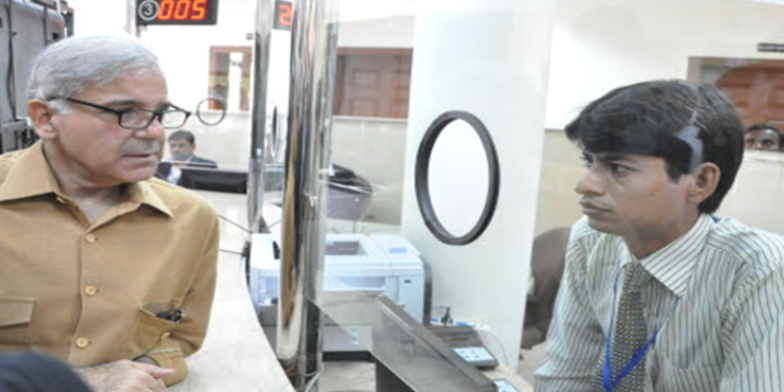
As a center replaced the Patwaris in a particular district, the project initiated public outreach.114 Tactics included street performances juxtaposing Patwar culture with the new system, issuance of free fards to landowners, and gender-specific community workshops.115 Local leaders were encouraged to publicly voice benefits of the project.116
Adoption of the new system in rural Punjab was not inevitable. Many village-level stakeholders were skeptical of the project; some even supported the old system.
Punjabi media outlets were also involved. Project leadership purchased newspaper advertisements, distributed press releases, and participated in interviews. The project ran jingles and spots on the radio and organized television interviews and news reports.117 Chief Minister Sharif was an important participant in this process. Aside from a provincial speaking circuit, Sharif appeared on television and radio in support of the project’s technological reforms.118
Punjab Land Records Authority
The public awareness campaign was influential in generating cultural change and promoting participation in the new administrative system. Education across social classes contributed to the democratic and inclusive character of the project.119 Engagement with the rural poor likely countered perceptions of alienation. Focus on women’s rights to land inheritance and ownership supported socioeconomic inclusion of an additional marginalized group.
The project clearly targeted critical gaps in the human capital of Punjab Province. The ability to produce a more skilled and employable population—with emphasis on women and the young—was important in converting the “youth bulge” challenge into an opportunity.120 It is especially crucial to provide young men with ample economic opportunities to both increase the opportunity costs associated with joining an extremist group and lessen the allure of terrorism.
The public awareness campaign was influential in generating cultural change and promoting participation in the new administrative system.
Through an overarching message that the project aimed to protect individuals’ rights, the campaign helped to curtail Patwari power. Project success—signified by widespread ARC openings and positive public engagement—eventually caused Patwari strikes in 2014 and 2015.121 The Patwaris even attempted to rally public support for their cause.122 By this stage in the project, however, Patwari resistance had weakened; the once unassailable local land administrators were placated through financial and material incentives.123
Data Centralization
Technological optimization continued throughout the project’s second phase. Software was repeatedly modified to meet user needs.124 An LRMIS website in both Urdu and English was created. Most importantly, the project transitioned to an advanced centralized software solution.
The first-generation system was inadequate and costly. Poor communication infrastructure rendered its decentralized software unreliable. The project was unable to upgrade the software simultaneously in all land record centers.125 Local offices were tasked with the maintenance of digital records, which were intermittently copied to a central system.126
Ensuring that an individual ARC system was up to date required tremendous effort, time, and resources. ARCs needed to hire IT professionals with database maintenance experience. Owing to the isolated locations of many centers, and related challenges of security and administration, staffing and financial issues materialized. After identification of these problems, the project recognized the need for a centralized system in 2013.
Project leaders prepared requirements for new software and a local vendor, Systems Limited, was hired to develop a solution based on the Microsoft database management system.127 The Pakistani firm specifically designed the second-generation software as a centralized system throughout 2015 and 2016.128 Primary links were upgraded from a minimum bandwidth of two megabits per second to four megabits per second, improving the bandwidth for communication between ARCs and the central system.129
Data migration to the centralized system continued after 2016 project closure and into 2018.130 Each ARC is now linked via a secure terrestrial connection to the central server in Lahore, and a backup server also exists in Islamabad.131 Front-end service at land record centers was not affected by the transition.132
The successful centralization reflects project flexibility and technical innovation.133 Leadership continuously consolidated learning experiences to create more efficient and cost-effective processes.134 The setup cost for data storage equipment per ARC in the distributed model was PKR 1 million (US $8,637); the approximate annual maintenance cost was PKR 150,000 (US $1,296). The introduction of the centralized system eliminated both costs.135
The new servers allow for more effective control by network administrators, consistent data collection, and easier implementation of software updates. The central data center was established to serve future purposes, too. The system was built with ample storage capacity to potentially incorporate GIS and/or urban land record data and can easily be integrated with GIS technology.136
Citations
- According to the CIA World Factbook, Pakistan has a population of approximately 205 million people. Please see Appendix C, Map 1 for a regional map of Pakistan.
- Joshua Foust, “In Life and in Death, Bin Laden Divides U.S. and Pakistan,” The Atlantic, May 2, 2011, www.theatlantic.com/international/archive/2011/05/in-life-and-in-death-bin-laden-divides-us-and-pakistan/238140/, accessed May 24, 2018. Please see Appendix C, Map 2 for a map of the provinces of Pakistan.
- “Food Assistance Fact Sheet – Pakistan,” USAID, November 30, 2017, www.usaid.gov/pakistan/food-assistance, accessed May 18, 2018.
- Pakistan’s Jihadist Heartland: Southern Punjab (Brussels: International Crisis Group, May 30, 2016), 3, www.crisisgroup.org/asia/south-asia/pakistan/pakistan-s-jihadist-heartland-southern-punjab.
- Muhammad Zafar Iqbal and Faiz-ul-Hassan, “Delivering Land Administration Services at Scale,” PowerPoint presentation, 2017 World Bank Conference on Land and Poverty, Washington, DC, March 21, 2017; “Province Wise Provisional Results of Census – 2017,” Pakistan Bureau of Statistics, www.pbs.gov.pk/sites/default/files/CENSUS_2017.pdf, accessed April 25, 2018.
- Pakistan’s Jihadist Heartland, ii; Manzar Zaidi, “The ‘other Punjab’ is at the heart of Pakistani extremism,” The National, February 4, 2013, www.thenational.ae/the-other-punjab-is-at-the-heart-of-pakistani-extremism-1.296028, accessed May 23, 2018.
- Pakistan’s Jihadist Heartland, 22.
- Chandrika Kaul, “From Empire to Independence: The British Raj in India 1858-1947,” BBC, last updated March 3, 2011, www.bbc.co.uk/history/british/modern/independence1947_01.shtml, accessed April 30, 2018.
- First interview with Igor Popiv (March 19, 2018).
- The project purposefully avoided urban zones due to the lack of a formal land administration system in Punjabi cities. Reforming the complicated network of property ownership in urban areas was deemed by the project as too much of an “uphill battle” (interview with Osama Bin Saeed (April 24, 2018)).
- “Rural Punjab Goes Digital,” World Bank Group, February 6, 2017, www.worldbank.org/en/news/feature/2017/02/06/rural-punjab-goes-digital, accessed April 2, 2018.
- Linus Pott, Implementation Completion and Results Report (IDA-42580 IDA-51510) on a Credit in the Amount of SDR 30.35 Million (US$ 45.65 Million Equivalent) and an Additional Financing of SDR 46.20 Million (US$ 70.00 Million Equivalent) to the Islamic Republic of Pakistan for a Punjab Land Records Management and Information Systems Project (Washington, DC: World Bank Group, June 21, 2017), 1, documents.worldbank.org/curated/en/632241498842804246/pdf/ICR00003719.pdf;
- Muhammad Shehbaz Sharif, letter to Jim Yong Kim, May 31, 2018.
- Pott, Implementation Completion and Results Report, 24.
- Mary Lisbeth Gonzalez, Pakistan – Land Records Management and Information Systems Project (LRMIS-P) Province of Punjab: P090501 – Implementation Status and Results Report: Sequence 21 (Washington, DC: World Bank Group, November 11, 2016), 2, documents.worldbank.org/curated/en/586921478877214613/pdf/ISR-Disclosable-P090501-11-11-2016-1478877202012.pdf; Pott, Implementation Completion and Results Report, 17.
- Pott, Implementation Completion and Results Report, 18.
- Zaidi, “The ‘other Punjab;’” Pakistan’s Jihadist Heartland, 8.
- Pakistan’s Jihadist Heartland, 8.
- While every land administration reform project must be responsive to local technological, political, and socioeconomic conditions, it is nevertheless valuable to examine both the lessons learned and best practices of previous efforts.
- “In Pakistan and Beyond, Land Records Get a Digital Upgrade,” World Bank Group, September 20, 2017, www.worldbank.org/en/news/feature/2017/09/20/in-pakistan-and-beyond-land-records-get-a-digital-upgrade, accessed April 30, 2018.
- Please see Appendix A for a brief overview of the project timeline.
- Kaul, “From Empire to Independence.”
- “Rural Punjab Goes Digital.”
- Pott, Implementation Completion and Results Report, 1-2.
- Pakistan’s Jihadist Heartland, 8-9.
- Interview with Osama Bin Saeed (April 24, 2018).
- Patrick Kelley and Michael Graglia, “Why Property Rights Matter,” FPR Blog (blog), New America, March 10, 2017, www.newamerica.org/international-security/future-property-rights/blog/why-property-rights-matter/, accessed April 30, 2018.
- John Marriott, The Other Empire: Metropolis, India and Progress in the Colonial Imagination (Manchester University Press: Manchester, 2003), 195.
- Ian A. Talbot, “The Punjab Under Colonialism: Order and Transformation in British India,” Journal of Punjab Studies, 14, no. 1 (2007), 3; first interview with Igor Popiv (March 19, 2018).
- Talbot, “The Punjab Under Colonialism,” 3-5.
- First interview with Igor Popiv (March 19, 2018).
- Talbot, “The Punjab Under Colonialism,” 5-6, 9.
- Ibid., 7-9. Relevant colonial land administration agencies included the Board of Revenue (BOR) and the Irrigation Department. However, taxes enforced by the Irrigation Department were physically collected by Patwaris employed by the BOR (comment from Osama Bin Saeed (April 29, 2018)).
- Pott, Implementation Completion and Results Report, 1.
- Please see Appendix B for information on the BOR administrative levels.
- Pott, Implementation Completion and Results Report, 1-2.
- Linus Pott, “From Cloth Bags to Land Record Service Centers – Experiences From a World Bank Funded Project in Punjab, Pakistan,” paper presented at the 2017 World Bank Conference on Land and Poverty, Washington, DC, March 22, 2017; Mary Lisbeth Gonzalez, “Land records go digital in Punjab, Pakistan,” End Poverty in South Asia (blog), World Bank Group, October 26, 2016 blogs.worldbank.org/endpovertyinsouthasia/land-records-go-digital-punjab-pakistan, accessed May 11, 2018.
- “Rural Punjab Goes Digital.”
- Pott, Implementation Completion and Results Report, 16.
- “Rural Punjab Goes Digital.”
- The legacy backup system required creation of two copies of every land record—one stored at the Patwari’s office and the other consigned to an official record room. This scheme was not reliable, however, as the manually-maintained records were produced at the discretion of the individual Patwari. If the Patwari chose not to provide backup copies of land records, the system quickly became outdated (comment from Osama Bin Saeed (April 29, 2018)).
- Interview with Osama Bin Saeed (April 24, 2018).
- Pott, Implementation Completion and Results Report, 1-2.
- Ibid., 20.
- The legacy land administration system was male-dominated. Out of the approximately 25,000 Patwari positions, and almost 8,000 supervisor positions, a woman was never able to secure a vacancy (comment from Osama Bin Saeed (April 29, 2018)).
- First interview with Mary Lisbeth Gonzalez (March 22, 2018).
- Independent Evaluation Group, PK:Land Records Mgmt and Information Syst. (P090501) Implementation Completion Report (ICR) Review (Washington, DC: World Bank Group, September 5, 2017), 4, documents.worldbank.org/curated/en/821101504632525457/pdf/ICRR-Disclosable-P090501-09-05-2017-1504632512156.pdf.
- Pakistan’s Jihadist Heartland, 9.
- Interview with Osama Bin Saeed (April 24, 2018). Muhammad Shehbaz Sharif is brother to Nawaz Sharif, the former Prime Minister of Pakistan.
- “Shahbaz Sharif,” Dawn, April 25, 2013, www.dawn.com/news/1024486, accessed May 11, 2018. Muhammad Shehbaz Sharif first served as Chief Minister of Punjab from 1997 until the 1999 Pakistani military coup.
- Interview with Osama Bin Saeed (April 24, 2018).
- Ibid.
- Kelley and Graglia, “Why Property Rights Matter.”
- Norman Loayza, “How to defeat terrorism: Intelligence, integration, and development,” Future Development (blog), The Brookings Institution, July 25, 2016, www.brookings.edu/blog/future-development/2016/07/25/how-to-defeat-terrorism-intelligence-integration-and-development/, accessed May 31, 2018.
- Pott, Implementation Completion and Results Report, 38.
- “In Pakistan and Beyond, Land Records Get a Digital Upgrade.”
- Interview with Osama Bin Saeed (April 24, 2018).
- Comment from Osama Bin Saeed (April 29, 2018). Please see Appendix C, Map 3 for a detailed map of Punjabi districts.
- Pott, Implementation Completion and Results Report, 6-7.
- Interview with Osama Bin Saeed (April 24, 2018).
- Comment from Osama Bin Saeed (April 29, 2018).
- According to the 2017 Census of Pakistan, the average Punjabi district area is 5,882 km², with an average population of 3,055,901.
- Pott, Implementation Completion and Results Report, 34-35; M. Ilyas Khan, “Uncommon tongue: Pakistan’s confusing move to Urdu,” BBC, September 12, 2015, www.bbc.com/news/world-asia-34215293, accessed May 11, 2018. According to the CIA World Factbook, Punjabi is the most widely-spoken first language in Pakistan. Urdu, while an official language, is only spoken by approximately 8% of the total population as a first language.
- World Bank, Project Appraisal Document on a Proposed Credit in the Amount of SDR 30.35 Million (USD 45.65 Million Equivalent) to the Islamic Republic of Pakistan for a Punjab Land Records Management and Information Systems Project (Washington, DC: World Bank Group, December 21, 2006), 62, documents.worldbank.org/curated/en/280181468289824118/pdf/36450.pdf.
- Second interview with Mary Lisbeth Gonzalez (April 11, 2018).
- Second interview with Igor Popiv (April 6, 2018).
- First interview with Mary Lisbeth Gonzalez (March 22, 2018).
- Comment from Osama Bin Saeed (May 20, 2018).
- Project Appraisal Document, 10.
- Pott, Implementation Completion and Results Report, 6.
- Martin M. Serrano, Financing Agreement (Punjab Land Records Management and Information Systems Project) between Islamic Republic of Pakistan and International Development Association (Washington, DC: World Bank Group, February 28, 2007), 1, documents.worldbank.org/curated/en/414891468288597562/pdf/FA0142581CONFORMED1.pdf; first interview with Mary Lisbeth Gonzalez (March 22, 2018); interview with Osama Bin Saeed (April 24, 2018). “Arazi” is Urdu and translates as land (Pott, Implementation Completion and Results Report, footnote 4).
- Pott, Implementation Completion and Results Report, 4; Iqbal and Hassa, “Delivering Land Administration Services at Scale.” Original evaluation of the intended project scope considered complete provincial inclusion as too ambitious due to time and budget constraints. At the time, leaders planned to complete implementation within 18 districts and then decide how to further expand their efforts. The World Bank and the Punjabi Government were considered as sources for additional funding (comment from Igor Popiv (May 4, 2018)).
- The proposal scheme was a single stage Quality and Cost Based Selection process. Four local firms were selected; fixed cost contracts were signed with each. Each company had to develop their own version of software and conduct pilots in different areas—including data entry of a defined size. The call for proposals was announced internationally, but due to specific requirements related to the use of Urdu and required knowledge of local legislation, only Pakistani firms were selected and contracted in 2007 (Pott, Implementation Completion and Results Report, 31).
- The provincial government created the PMU at the beginning of project implementation. Subordinate to the BOR and fully dedicated to the project, the PMU included a director, a deputy director, and a financial manager. Responsibilities involved management, administrative, and financial duties. Following the reassignment of ICT responsibilities, key professionals were transferred to a PMU support team in order to lead technological initiatives (comment from Igor Popiv (May 4, 2018)).
- Pott, Implementation Completion and Results Report, 31-32.
- Interview with Osama Bin Saeed (April 24, 2018).
- World Bank, Project Paper on a Proposed Additional Credit and Restructuring in the Amount of SDR 46.2 Million (US$70 Million Equivalent) to the Islamic Republic of Pakistan for a Punjab Land Record Management and Information Systems Project (Washington, DC: World Bank Group, August 2, 2012), 9, documents.worldbank.org/curated/en/267181468285357558/pdf/697740PJPR0P130Official0Use0Only090.pdf.
- First interview with Igor Popiv (March 19, 2018); second interview with Igor Popiv (April 6, 2018).
- Pott, Implementation Completion and Results Report, 34.
- Gonzalez, “Land records go digital in Punjab, Pakistan.”
- Interview with Osama Bin Saeed (April 24, 2018).
- Pott, Implementation Completion and Results Report, 32.
- Comment from Osama Bin Saeed (April 29, 2018). Please see Appendix B for information on the land administration levels of the BOR.
- Pott, Implementation Completion and Results Report, 9.
- Interview with Osama Bin Salman (April 24, 2018); second interview with Igor Popiv (April 6, 2018).
- Pott, Implementation Completion and Results Report, 9. The number of records requiring correction during the digitization process was fairly large. As a result, the speed for resolution was very slow. Under prevailing laws, changes to the core components of records (replacement of a landowner name, change in the share of a landowner, and change in the area of a parcel) required approval in a “quasi-judicial” court headed by a district leader. Due to the time constraints of the project, the Punjabi government delegated these legal powers to Revenue Officers. Decisions were based on the reports and documentary evidence presented by Patwaris (comment from Osama Bin Saeed (May 20, 2018)).
- Ibid.
- First interview with Igor Popiv (March 19, 2018).
- Comment from Igor Popiv (May 4, 2018).
- Pott, Implementation Completion and Results Report, 29.
- Comment from Osama Bin Saeed (May 20, 2018).
- Pakistan’s Jihadist Heartland, iv.
- Pott, Implementation Completion and Results Report, 21; second interview with Igor Popiv (April 6, 2018).
- Pott, Implementation Completion and Results Report, 44.
- Muhammad Shehbaz Sharif, letter to Jim Yong Kim, May 31, 2018.
- Proposed Additional Credit and Restructuring, 4.
- Pott, Implementation Completion and Results Report, Table H. Restructuring (if any).
- Second interview with Mary Lisbeth Gonzalez (April 11, 2018).
- Second interview with Igor Popiv (April 6, 2018).
- Pakistan’s Jihadist Heartland, ii-iv.
- Proposed Additional Credit and Restructuring, 2; Zahir Ali and Abdul Nasir, “Land Administration System in Pakistan – Current Situation and Stakeholders Perception,” paper presented at the FIG Congress 2010, Sydney, Australia, April 14, 2010. Please see Appendix B for information on the land administration levels of the BOR.
- “Report on Mouza Census 2008 (Punjab Province),” Pakistan Bureau of Statistics, www.pbs.gov.pk/sites/default/files/aco/publications/pakistan-mouza-census2008/, accessed May 11, 2018.
- Proposed Additional Credit and Restructuring, 2.
- Ibid., 4; Pott, Implementation Completion and Results Report, 5.
- Pott, Implementation Completion and Results Report, 32. Over 800 software issues were also resolved by the end of 2012.
- Ibid., Table F. Results Framework Analysis, (b) Intermediate Outcome Indicator(s); first interview with Mary Lisbeth Gonzalez (March 22, 2018).
- Pott, Implementation Completion and Results Report, Table F. Results Framework Analysis, (b) Intermediate Outcome Indicator(s).
- Ibid., 17-18.
- End of Project Survey of Land Records Management and Information Systems (LRMIS), Islamabad: APEX Consulting, March 1, 2016. The survey states that, on average, the process includes 46 minutes of travel time each way, 41 minutes in queue, 17 minutes at an ARC counter, and 15 minutes at a bank, for a total of 165 minutes.
- Pakistan’s Jihadist Heartland, 8.
- Comment from Igor Popiv (May 4, 2018).
- Second interview with Mary Lisbeth Gonzalez (April 11, 2018).
- First interview with Mary Lisbeth Gonzalez (March 22, 2018).
- Second interview with Igor Popiv (April 6, 2018).
- Interview with Osama Bin Saeed (April 24, 2018); second interview with Igor Popiv (April 6, 2018).
- Second interview with Mary Lisbeth Gonzalez (April 11, 2018).
- Nadia Ahmad, “Stakeholders Outreach: Awareness & Dissemination,” PowerPoint presentation, Punjab Board of Revenue.
- First interview with Igor Popiv (March 19, 2018); first interview with Mary Lisbeth Gonzalez (March 22, 2018); second interview with Mary Lisbeth Gonzalez (April 11, 2018).
- Second interview with Mary Lisbeth Gonzalez (April 11, 2018); first interview with Mary Lisbeth Gonzalez (March 22, 2018); interview with Osama Bin Saeed (April 24, 2018).
- Muhammad Shehbaz Sharif, letter to Jim Yong Kim, May 31, 2018.
- Pott, Implementation Completion and Results Report, 39; interview with Osama Bin Saeed (April 24, 2018).
- First interview with Mary Lisbeth Gonzalez (March 22, 2018).
- Pott, Implementation Completion and Results Report, 39.
- Interview with Osama Bin Saeed (April 24, 2018).
- Pott, Implementation Completion and Results Report, 6, 33, 37.
- Interview with Osama Bin Saeed (April 24, 2018).
- Pott, Implementation Completion and Results Report, 33; comment from Igor Popiv (May 4, 2018); second interview with Igor Popiv (April 6, 2018); comment from Osama Bin Saeed (May 20, 2018).
- The centralized software passed an independent Microsoft review of design, security risks, load and performance testings, and migration testing. This was followed by functional User Acceptance Tests. The software was also subjected to a third party consultant evaluation which cleared the software to become operational (Pott, Implementation Completion and Results Report, 33).
- Comment from Osama Bin Saeed (May 20, 2018).
- Second interview with Igor Popiv (April 6, 2018); Pott, Implementation Completion and Results Report, 33; comment from Igor Popiv (May 4, 2018).
- Second interview with Igor Popiv (April 6, 2018).
- Comment from Igor Popiv (May 4, 2018).
- Pott, Implementation Completion and Results Report, 25.
- Second interview with Igor Popiv (April 11, 2018).
- Comment from Osama Bin Saeed (May 20, 2018).
- Pott, Implementation Completion and Results Report, 15; comment from Osama Bin Saeed (May 20, 2018).
Post-Project Developments (2017-2018)
Upon project closure in December 2016, 56 million land records were digitized, 5 million records were corrected during digitization, and over 140 ARCs were open throughout all 36 provincial districts.137 The transition from a disjointed and manual system to a transparent and computerized structure enhanced land administration and greatly increased tenure security. Aside from improved economic opportunities and governance, the comprehensive system can contribute to provincial security.
The overall transformation is stark, to say the least. The Punjab Land Records Authority (PLRA) sustainably provides efficient services and relatively open access to information. Women, in particular, can now reliably assert their rights to inherited land. Recent integration between the PLRA and the National Database and Registration Authority (NADRA) better connects individuals to their land parcels through biometric data.
The Punjab Land Records Authority
The PLRA was established in early 2017 as a permanent successor to the PMU. Duties include the formulation of strategy, policies, and plans for land records management. This political and bureaucratic restructuring of the Punjabi land authority has sustained administrative capacity beyond project completion.
The ARC network is staffed by over 2,000 trained officials and offers services to 20 million rural Punjabi landowners.138 A cohort of land and IT professionals increasingly possess functional knowledge of the new system. This growing expertise provides the potential to further improve land administration and responsive governance.
This political and bureaucratic restructuring of the Punjabi land authority has sustained administrative capacity beyond project completion.
Officials noted that the ARCs cumulatively assisted 2.3 million customers in 2016-2017.139 A World Bank report reveals high customer satisfaction due to efficient service delivery and an expected increase in tenure security.140 Farmers surely welcome this support from the provincial government. The project is a clear indication that GoPunjab is both responsive to the needs of marginalized citizens and is genuinely addressing political alienation.
Over a year into full operational status, the PLRA reports that record centers are consistently serving large numbers of landowners. Well-established ARCs still help scores of citizens, while newly opened centers attract another, distinctive customer base.141
PLRA data indicates a steady rise in the yearly total of land record copies issued from 2015 to 2017.142 The total number of mutations has roughly increased by 300,000 every year during the same period.143 Due to additional ARC construction and repeated knowledge transfer of the PLRA, it is reasonable to surmise that the volume of both copies issued and recorded transactions will continue to increase over time.
The project is a clear indication that the Government of Punjab is both responsive to the needs of marginalized citizens and is genuinely addressing political alienation.
Increased physical visits to ARCs should result from transparent and accountable access to data.144 Details on landholder name and size of holdings within a particular district are publically available within the online land administration database. As a caveat, landowners are not publically connected to their parcels and exact property locations remain private online. This protection hinders encroachment onto the land of Pakistani expatriates. This guarded information can be legally requested in person at an ARC.145 A customer requesting another individual’s land records must provide specifics, such as a person’s name, their father’s name, their village, and the corresponding administrative unit.146
The PLRA is an important instrument for the sustainability of the restructured Punjabi land administration. As a standalone agency, it solidifies new services, making the modern system less susceptible to neglect and becoming outdated. The PLRA can contribute over time to continuous improvements in governance and provide extensive economic opportunities for the rural poor. The agency therefore possesses an ability to offset many of the grievances obliquely contributing to extremism in Punjab.
Women’s Land Rights
Perhaps most strikingly, project success was an important step for gender equality within rural Punjabi society. Poor rural women are major contributors to agricultural production but often work in harsh conditions, earn poor wages, and are subject to sexual harassment.147 Women complete the majority of field preparation; they perform most duties pertaining to fruits and vegetables; they help during harvest if labor is short. Women prepare meals, provide childcare, secure potable water, collect fuelwood, and manage livestock.
Despite these many responsibilities, a recent report by the United Nations Food and Agriculture Organization noted that Punjabi women’s farm work is usually ignored by men and is not counted as economic activity.148 Female contributions in agriculture are unrecognized, unpaid, and underrated.
Women previously lacked reliable access to land services, agricultural information, and microcredit. They were customarily deprived of land inheritance. Only seven percent of Punjabi women owned land as late as 2015.149
Punjabi women’s farm work is usually ignored by men and is not counted as economic activity. Female contributions in agriculture are unrecognized, unpaid, and underrated.
The project deconstructed this patriarchal structure within land administration. Every ARC contains separate seating for women. There is a designated service counter for female customers, staffed by female officials.150 Surveys indicate that women generally believe they now have reliable access to land record services in a safe and non-corrupt environment.151 They no longer confront issues of intimidation.152
The provincial government even announced legislation in March 2012 to ensure the right of land inheritance for women.153 Through property ownership, women better possess opportunities to achieve financial independence, join the formal sector of the economy, and bolster their social status.
Punjab Land Records Authority
Based on surveys, there is a general belief that women’s tenure security will improve over time. Metrics indicate that over 267,000 women had utilized digital land record services by mid-2017.154 Women were even represented in 35 percent of transaction cases due to inheritance. This percentage is only expected to rise.155
Through property ownership, women better possess opportunities to achieve financial independence, join the formal sector of the economy, and bolster their social status.
For the first time in decades, a formal structure exists that allows rural women to assert their rights to land inheritance. Systemic land administration reform helped to bridge the gender gap in Punjab. Through “Female Dissemination Workshops” especially, women are increasingly aware that they possess a legal right to land inheritance and ownership.156 While women continue to suffer from discrimination and inequality throughout Pakistan, the project conspicuously confronted sexism within the country’s most populous province.
Land and Identity
Disconnect within records between landowner identity and their parcels is a prevalent issue in the developing world. To address this problem, the LRMIS project first partnered with NADRA in 2012. Linkage between digital land records and the NADRA citizens database efficiently connected individuals to their land.157 The project introduced biometric-based authentication, via NADRA’s National Identity Card (NIC) system, in 2015.158
The NIC system was established nationwide in 2000 and assigns a unique 13-digit number to every citizen at birth.159 Upon reaching the age of 18, all citizens are eligible to receive a machine-readable card containing fingerprint and facial biometric data.160 While not mandatory, the recently introduced Computerized National Identity Card (CNIC) is the first requirement for obtaining a driver’s license, National Tax Number, bank account, and passport.161 A CNIC is now necessary for ARC services.162
The PLRA expanded integration with NADRA in 2018 to improve services in the new land administration system. The federal identification agency recently provided data on next of kin, further strengthening women’s assertions to inherited land rights.163 Today, provincial citizens can utilize their CNIC, authenticate Personally Identifiable Information via the NADRA database, and quickly access land registry services.
Punjabi officials also recently initiated a “franchising project.” Through collaboration with NADRA and the Bank of Punjab, the PLRA plans to provide its services at partner locations throughout the province. This expansion will drastically increase access to digital services, as the Bank of Punjab operates 400 branches throughout the territory, while NADRA manages 3,700 e-kiosk platforms in Punjab.164
Linkage between digital land records and the NADRA citizens database efficiently connected individuals to their land.
There is considerable potential to alleviate stress on both human and technological resources through this initiative. If the PLRA can outsource land record issuance tasks, it will eliminate approximately 70 percent of its current workload. This can allow officials to concentrate on new projects, such as the introduction of mobile units, GIS mapping, or urban land reform.165
Specific data regarding record issuance at these franchise locations has yet to be collected, but the partnership can be incredibly beneficial. It offers convenience, scalability, and increased data access, and provides the PLRA with an opportunity to include more citizens within its new structure.
More transparent and certifiable data bolsters tenure security for the average farmer as well. These property rights provide small landowners with the ability to acquire loans and invest in agricultural production. Greater access to both capital and markets can help reduce inequality and bolster socioeconomic development. Extremist promises of influence, prestige, and financial rewards will begin to appear less attractive.166
Citations
- According to the CIA World Factbook, Pakistan has a population of approximately 205 million people. Please see Appendix C, Map 1 for a regional map of Pakistan.
- Joshua Foust, “In Life and in Death, Bin Laden Divides U.S. and Pakistan,” The Atlantic, May 2, 2011, www.theatlantic.com/international/archive/2011/05/in-life-and-in-death-bin-laden-divides-us-and-pakistan/238140/, accessed May 24, 2018. Please see Appendix C, Map 2 for a map of the provinces of Pakistan.
- “Food Assistance Fact Sheet – Pakistan,” USAID, November 30, 2017, www.usaid.gov/pakistan/food-assistance, accessed May 18, 2018.
- Pakistan’s Jihadist Heartland: Southern Punjab (Brussels: International Crisis Group, May 30, 2016), 3, www.crisisgroup.org/asia/south-asia/pakistan/pakistan-s-jihadist-heartland-southern-punjab.
- Muhammad Zafar Iqbal and Faiz-ul-Hassan, “Delivering Land Administration Services at Scale,” PowerPoint presentation, 2017 World Bank Conference on Land and Poverty, Washington, DC, March 21, 2017; “Province Wise Provisional Results of Census – 2017,” Pakistan Bureau of Statistics, www.pbs.gov.pk/sites/default/files/CENSUS_2017.pdf, accessed April 25, 2018.
- Pakistan’s Jihadist Heartland, ii; Manzar Zaidi, “The ‘other Punjab’ is at the heart of Pakistani extremism,” The National, February 4, 2013, www.thenational.ae/the-other-punjab-is-at-the-heart-of-pakistani-extremism-1.296028, accessed May 23, 2018.
- Pakistan’s Jihadist Heartland, 22.
- Chandrika Kaul, “From Empire to Independence: The British Raj in India 1858-1947,” BBC, last updated March 3, 2011, www.bbc.co.uk/history/british/modern/independence1947_01.shtml, accessed April 30, 2018.
- First interview with Igor Popiv (March 19, 2018).
- The project purposefully avoided urban zones due to the lack of a formal land administration system in Punjabi cities. Reforming the complicated network of property ownership in urban areas was deemed by the project as too much of an “uphill battle” (interview with Osama Bin Saeed (April 24, 2018)).
- “Rural Punjab Goes Digital,” World Bank Group, February 6, 2017, www.worldbank.org/en/news/feature/2017/02/06/rural-punjab-goes-digital, accessed April 2, 2018.
- Linus Pott, Implementation Completion and Results Report (IDA-42580 IDA-51510) on a Credit in the Amount of SDR 30.35 Million (US$ 45.65 Million Equivalent) and an Additional Financing of SDR 46.20 Million (US$ 70.00 Million Equivalent) to the Islamic Republic of Pakistan for a Punjab Land Records Management and Information Systems Project (Washington, DC: World Bank Group, June 21, 2017), 1, documents.worldbank.org/curated/en/632241498842804246/pdf/ICR00003719.pdf;
- Muhammad Shehbaz Sharif, letter to Jim Yong Kim, May 31, 2018.
- Pott, Implementation Completion and Results Report, 24.
- Mary Lisbeth Gonzalez, Pakistan – Land Records Management and Information Systems Project (LRMIS-P) Province of Punjab: P090501 – Implementation Status and Results Report: Sequence 21 (Washington, DC: World Bank Group, November 11, 2016), 2, documents.worldbank.org/curated/en/586921478877214613/pdf/ISR-Disclosable-P090501-11-11-2016-1478877202012.pdf; Pott, Implementation Completion and Results Report, 17.
- Pott, Implementation Completion and Results Report, 18.
- Zaidi, “The ‘other Punjab;’” Pakistan’s Jihadist Heartland, 8.
- Pakistan’s Jihadist Heartland, 8.
- While every land administration reform project must be responsive to local technological, political, and socioeconomic conditions, it is nevertheless valuable to examine both the lessons learned and best practices of previous efforts.
- “In Pakistan and Beyond, Land Records Get a Digital Upgrade,” World Bank Group, September 20, 2017, www.worldbank.org/en/news/feature/2017/09/20/in-pakistan-and-beyond-land-records-get-a-digital-upgrade, accessed April 30, 2018.
- Please see Appendix A for a brief overview of the project timeline.
- Kaul, “From Empire to Independence.”
- “Rural Punjab Goes Digital.”
- Pott, Implementation Completion and Results Report, 1-2.
- Pakistan’s Jihadist Heartland, 8-9.
- Interview with Osama Bin Saeed (April 24, 2018).
- Patrick Kelley and Michael Graglia, “Why Property Rights Matter,” FPR Blog (blog), New America, March 10, 2017, www.newamerica.org/international-security/future-property-rights/blog/why-property-rights-matter/, accessed April 30, 2018.
- John Marriott, The Other Empire: Metropolis, India and Progress in the Colonial Imagination (Manchester University Press: Manchester, 2003), 195.
- Ian A. Talbot, “The Punjab Under Colonialism: Order and Transformation in British India,” Journal of Punjab Studies, 14, no. 1 (2007), 3; first interview with Igor Popiv (March 19, 2018).
- Talbot, “The Punjab Under Colonialism,” 3-5.
- First interview with Igor Popiv (March 19, 2018).
- Talbot, “The Punjab Under Colonialism,” 5-6, 9.
- Ibid., 7-9. Relevant colonial land administration agencies included the Board of Revenue (BOR) and the Irrigation Department. However, taxes enforced by the Irrigation Department were physically collected by Patwaris employed by the BOR (comment from Osama Bin Saeed (April 29, 2018)).
- Pott, Implementation Completion and Results Report, 1.
- Please see Appendix B for information on the BOR administrative levels.
- Pott, Implementation Completion and Results Report, 1-2.
- Linus Pott, “From Cloth Bags to Land Record Service Centers – Experiences From a World Bank Funded Project in Punjab, Pakistan,” paper presented at the 2017 World Bank Conference on Land and Poverty, Washington, DC, March 22, 2017; Mary Lisbeth Gonzalez, “Land records go digital in Punjab, Pakistan,” End Poverty in South Asia (blog), World Bank Group, October 26, 2016 blogs.worldbank.org/endpovertyinsouthasia/land-records-go-digital-punjab-pakistan, accessed May 11, 2018.
- “Rural Punjab Goes Digital.”
- Pott, Implementation Completion and Results Report, 16.
- “Rural Punjab Goes Digital.”
- The legacy backup system required creation of two copies of every land record—one stored at the Patwari’s office and the other consigned to an official record room. This scheme was not reliable, however, as the manually-maintained records were produced at the discretion of the individual Patwari. If the Patwari chose not to provide backup copies of land records, the system quickly became outdated (comment from Osama Bin Saeed (April 29, 2018)).
- Interview with Osama Bin Saeed (April 24, 2018).
- Pott, Implementation Completion and Results Report, 1-2.
- Ibid., 20.
- The legacy land administration system was male-dominated. Out of the approximately 25,000 Patwari positions, and almost 8,000 supervisor positions, a woman was never able to secure a vacancy (comment from Osama Bin Saeed (April 29, 2018)).
- First interview with Mary Lisbeth Gonzalez (March 22, 2018).
- Independent Evaluation Group, PK:Land Records Mgmt and Information Syst. (P090501) Implementation Completion Report (ICR) Review (Washington, DC: World Bank Group, September 5, 2017), 4, documents.worldbank.org/curated/en/821101504632525457/pdf/ICRR-Disclosable-P090501-09-05-2017-1504632512156.pdf.
- Pakistan’s Jihadist Heartland, 9.
- Interview with Osama Bin Saeed (April 24, 2018). Muhammad Shehbaz Sharif is brother to Nawaz Sharif, the former Prime Minister of Pakistan.
- “Shahbaz Sharif,” Dawn, April 25, 2013, www.dawn.com/news/1024486, accessed May 11, 2018. Muhammad Shehbaz Sharif first served as Chief Minister of Punjab from 1997 until the 1999 Pakistani military coup.
- Interview with Osama Bin Saeed (April 24, 2018).
- Ibid.
- Kelley and Graglia, “Why Property Rights Matter.”
- Norman Loayza, “How to defeat terrorism: Intelligence, integration, and development,” Future Development (blog), The Brookings Institution, July 25, 2016, www.brookings.edu/blog/future-development/2016/07/25/how-to-defeat-terrorism-intelligence-integration-and-development/, accessed May 31, 2018.
- Pott, Implementation Completion and Results Report, 38.
- “In Pakistan and Beyond, Land Records Get a Digital Upgrade.”
- Interview with Osama Bin Saeed (April 24, 2018).
- Comment from Osama Bin Saeed (April 29, 2018). Please see Appendix C, Map 3 for a detailed map of Punjabi districts.
- Pott, Implementation Completion and Results Report, 6-7.
- Interview with Osama Bin Saeed (April 24, 2018).
- Comment from Osama Bin Saeed (April 29, 2018).
- According to the 2017 Census of Pakistan, the average Punjabi district area is 5,882 km², with an average population of 3,055,901.
- Pott, Implementation Completion and Results Report, 34-35; M. Ilyas Khan, “Uncommon tongue: Pakistan’s confusing move to Urdu,” BBC, September 12, 2015, www.bbc.com/news/world-asia-34215293, accessed May 11, 2018. According to the CIA World Factbook, Punjabi is the most widely-spoken first language in Pakistan. Urdu, while an official language, is only spoken by approximately 8% of the total population as a first language.
- World Bank, Project Appraisal Document on a Proposed Credit in the Amount of SDR 30.35 Million (USD 45.65 Million Equivalent) to the Islamic Republic of Pakistan for a Punjab Land Records Management and Information Systems Project (Washington, DC: World Bank Group, December 21, 2006), 62, documents.worldbank.org/curated/en/280181468289824118/pdf/36450.pdf.
- Second interview with Mary Lisbeth Gonzalez (April 11, 2018).
- Second interview with Igor Popiv (April 6, 2018).
- First interview with Mary Lisbeth Gonzalez (March 22, 2018).
- Comment from Osama Bin Saeed (May 20, 2018).
- Project Appraisal Document, 10.
- Pott, Implementation Completion and Results Report, 6.
- Martin M. Serrano, Financing Agreement (Punjab Land Records Management and Information Systems Project) between Islamic Republic of Pakistan and International Development Association (Washington, DC: World Bank Group, February 28, 2007), 1, documents.worldbank.org/curated/en/414891468288597562/pdf/FA0142581CONFORMED1.pdf; first interview with Mary Lisbeth Gonzalez (March 22, 2018); interview with Osama Bin Saeed (April 24, 2018). “Arazi” is Urdu and translates as land (Pott, Implementation Completion and Results Report, footnote 4).
- Pott, Implementation Completion and Results Report, 4; Iqbal and Hassa, “Delivering Land Administration Services at Scale.” Original evaluation of the intended project scope considered complete provincial inclusion as too ambitious due to time and budget constraints. At the time, leaders planned to complete implementation within 18 districts and then decide how to further expand their efforts. The World Bank and the Punjabi Government were considered as sources for additional funding (comment from Igor Popiv (May 4, 2018)).
- The proposal scheme was a single stage Quality and Cost Based Selection process. Four local firms were selected; fixed cost contracts were signed with each. Each company had to develop their own version of software and conduct pilots in different areas—including data entry of a defined size. The call for proposals was announced internationally, but due to specific requirements related to the use of Urdu and required knowledge of local legislation, only Pakistani firms were selected and contracted in 2007 (Pott, Implementation Completion and Results Report, 31).
- The provincial government created the PMU at the beginning of project implementation. Subordinate to the BOR and fully dedicated to the project, the PMU included a director, a deputy director, and a financial manager. Responsibilities involved management, administrative, and financial duties. Following the reassignment of ICT responsibilities, key professionals were transferred to a PMU support team in order to lead technological initiatives (comment from Igor Popiv (May 4, 2018)).
- Pott, Implementation Completion and Results Report, 31-32.
- Interview with Osama Bin Saeed (April 24, 2018).
- World Bank, Project Paper on a Proposed Additional Credit and Restructuring in the Amount of SDR 46.2 Million (US$70 Million Equivalent) to the Islamic Republic of Pakistan for a Punjab Land Record Management and Information Systems Project (Washington, DC: World Bank Group, August 2, 2012), 9, documents.worldbank.org/curated/en/267181468285357558/pdf/697740PJPR0P130Official0Use0Only090.pdf.
- First interview with Igor Popiv (March 19, 2018); second interview with Igor Popiv (April 6, 2018).
- Pott, Implementation Completion and Results Report, 34.
- Gonzalez, “Land records go digital in Punjab, Pakistan.”
- Interview with Osama Bin Saeed (April 24, 2018).
- Pott, Implementation Completion and Results Report, 32.
- Comment from Osama Bin Saeed (April 29, 2018). Please see Appendix B for information on the land administration levels of the BOR.
- Pott, Implementation Completion and Results Report, 9.
- Interview with Osama Bin Salman (April 24, 2018); second interview with Igor Popiv (April 6, 2018).
- Pott, Implementation Completion and Results Report, 9. The number of records requiring correction during the digitization process was fairly large. As a result, the speed for resolution was very slow. Under prevailing laws, changes to the core components of records (replacement of a landowner name, change in the share of a landowner, and change in the area of a parcel) required approval in a “quasi-judicial” court headed by a district leader. Due to the time constraints of the project, the Punjabi government delegated these legal powers to Revenue Officers. Decisions were based on the reports and documentary evidence presented by Patwaris (comment from Osama Bin Saeed (May 20, 2018)).
- Ibid.
- First interview with Igor Popiv (March 19, 2018).
- Comment from Igor Popiv (May 4, 2018).
- Pott, Implementation Completion and Results Report, 29.
- Comment from Osama Bin Saeed (May 20, 2018).
- Pakistan’s Jihadist Heartland, iv.
- Pott, Implementation Completion and Results Report, 21; second interview with Igor Popiv (April 6, 2018).
- Pott, Implementation Completion and Results Report, 44.
- Muhammad Shehbaz Sharif, letter to Jim Yong Kim, May 31, 2018.
- Proposed Additional Credit and Restructuring, 4.
- Pott, Implementation Completion and Results Report, Table H. Restructuring (if any).
- Second interview with Mary Lisbeth Gonzalez (April 11, 2018).
- Second interview with Igor Popiv (April 6, 2018).
- Pakistan’s Jihadist Heartland, ii-iv.
- Proposed Additional Credit and Restructuring, 2; Zahir Ali and Abdul Nasir, “Land Administration System in Pakistan – Current Situation and Stakeholders Perception,” paper presented at the FIG Congress 2010, Sydney, Australia, April 14, 2010. Please see Appendix B for information on the land administration levels of the BOR.
- “Report on Mouza Census 2008 (Punjab Province),” Pakistan Bureau of Statistics, www.pbs.gov.pk/sites/default/files/aco/publications/pakistan-mouza-census2008/, accessed May 11, 2018.
- Proposed Additional Credit and Restructuring, 2.
- Ibid., 4; Pott, Implementation Completion and Results Report, 5.
- Pott, Implementation Completion and Results Report, 32. Over 800 software issues were also resolved by the end of 2012.
- Ibid., Table F. Results Framework Analysis, (b) Intermediate Outcome Indicator(s); first interview with Mary Lisbeth Gonzalez (March 22, 2018).
- Pott, Implementation Completion and Results Report, Table F. Results Framework Analysis, (b) Intermediate Outcome Indicator(s).
- Ibid., 17-18.
- End of Project Survey of Land Records Management and Information Systems (LRMIS), Islamabad: APEX Consulting, March 1, 2016. The survey states that, on average, the process includes 46 minutes of travel time each way, 41 minutes in queue, 17 minutes at an ARC counter, and 15 minutes at a bank, for a total of 165 minutes.
- Pakistan’s Jihadist Heartland, 8.
- Comment from Igor Popiv (May 4, 2018).
- Second interview with Mary Lisbeth Gonzalez (April 11, 2018).
- First interview with Mary Lisbeth Gonzalez (March 22, 2018).
- Second interview with Igor Popiv (April 6, 2018).
- Interview with Osama Bin Saeed (April 24, 2018); second interview with Igor Popiv (April 6, 2018).
- Second interview with Mary Lisbeth Gonzalez (April 11, 2018).
- Nadia Ahmad, “Stakeholders Outreach: Awareness & Dissemination,” PowerPoint presentation, Punjab Board of Revenue.
- First interview with Igor Popiv (March 19, 2018); first interview with Mary Lisbeth Gonzalez (March 22, 2018); second interview with Mary Lisbeth Gonzalez (April 11, 2018).
- Second interview with Mary Lisbeth Gonzalez (April 11, 2018); first interview with Mary Lisbeth Gonzalez (March 22, 2018); interview with Osama Bin Saeed (April 24, 2018).
- Muhammad Shehbaz Sharif, letter to Jim Yong Kim, May 31, 2018.
- Pott, Implementation Completion and Results Report, 39; interview with Osama Bin Saeed (April 24, 2018).
- First interview with Mary Lisbeth Gonzalez (March 22, 2018).
- Pott, Implementation Completion and Results Report, 39.
- Interview with Osama Bin Saeed (April 24, 2018).
- Pott, Implementation Completion and Results Report, 6, 33, 37.
- Interview with Osama Bin Saeed (April 24, 2018).
- Pott, Implementation Completion and Results Report, 33; comment from Igor Popiv (May 4, 2018); second interview with Igor Popiv (April 6, 2018); comment from Osama Bin Saeed (May 20, 2018).
- The centralized software passed an independent Microsoft review of design, security risks, load and performance testings, and migration testing. This was followed by functional User Acceptance Tests. The software was also subjected to a third party consultant evaluation which cleared the software to become operational (Pott, Implementation Completion and Results Report, 33).
- Comment from Osama Bin Saeed (May 20, 2018).
- Second interview with Igor Popiv (April 6, 2018); Pott, Implementation Completion and Results Report, 33; comment from Igor Popiv (May 4, 2018).
- Second interview with Igor Popiv (April 6, 2018).
- Comment from Igor Popiv (May 4, 2018).
- Pott, Implementation Completion and Results Report, 25.
- Second interview with Igor Popiv (April 11, 2018).
- Comment from Osama Bin Saeed (May 20, 2018).
- Pott, Implementation Completion and Results Report, 15; comment from Osama Bin Saeed (May 20, 2018).
- First interview with Mary Lisbeth Gonzalez (March 19, 2018).
- Pott, Implementation Completion and Results Report, 14, 16, 18.
- Mansoor Ahmad, “Punjab giving banks access to digital land record,” The News International, January 18, 2018, www.thenews.com.pk/print/269796-punjab-giving-banks-access-to-digital-land-record, accessed May 9, 2018.
- Pott, Implementation Completion and Results Report, 16.
- Interview with Osama Bin Saeed (April 24, 2018).
- Punjab Land Records Authority, Copy Issuance [Microsoft Excel spreadsheet], Lahore: Government of Punjab, accessed May 21, 2018. 1,179,855 copies were issued in 2015, 1,950,166 copies were issued in 2016, and 2,277,303 copies were issued in 2017.
- Punjab Land Records Authority, Mutations [Microsoft Excel spreadsheet], Lahore: Government of Punjab, accessed May 21, 2018. There were 387,214 mutations in 2015, 692,890 mutations in 2016, and 913,297 mutations in 2017.
- Land records are considered public documents under current Pakistani law. Anyone can request access to this information in theory. Also, while the project did create a land administration website, a 2012-2013 study indicates that only 1.3% of the rural population in Pakistan has access to the internet. Therefore, physical visits to ARCs are more likely than electronic visits to the website. (Khurram Siddiqui, “87% of Pakistani households own cellphones, only 6.8% have internet connection: survey,” The Express Tribune, February 3, 2014, tribune.com.pk/story/666965/87-of-pakistani-households-own-cellphone-only-6-8-have-internet-connection-survey/, accessed May 11, 2018).
- Interview with Osama Bin Saeed (April 24, 2018).
- Comment from Osama Bin Saeed (May 20, 2018).
- Shiza Malik, “The stooped labour of women rice farmers,” Dawn, August 10, 2017, www.dawn.com/news/1347349, accessed May 29, 2018.
- Durre Samee et al., Women in Agriculture in Pakistan (Islamabad: Food and Agriculture Organization of the United Nations, 2015) 103-104, www.fao.org/3/a-i4330e.pdf.
- Ibid., 110.
- Pott, Implementation Completion and Results Report, 38. 146 women were employed within the ARC network as of December 2016.
- Ibid., 66.
- First interview with Mary Lisbeth Gonzalez (March 22, 2018).
- Samee et al., Women in Agriculture in Pakistan, 102.
- Pott, Implementation Completion and Results Report, 16, 18.
- Ibid., 60.
- Ibid., 62, 66.
- First interview with Mary Lisbeth Gonzalez (March 22, 2018); comment from Osama Bin Saeed (April 29, 2018).
- Comment from Osama Bin Saeed (April 29, 2018); comment from Osama Bin Saeed (May 20, 2018).
- “About Us,” National Database and Registration Authority, accessed April 4, 2018, www.nadra.gov.pk/about-us/.
- Ibid.; “Multi Biometric Identity Management,” National Database and Registration Authority, accessed April 4, 2018, www.nadra.gov.pk/solutions/secure-document-solutions/multi-biometric-identity-management/.
- “National Identity Card (NIC),” National Database and Registration Authority, accessed April 4, 2018, www.nadra.gov.pk/identity/identity-cnic/.
- Pott, Implementation Completion and Results Report, 32.
- Second interview with Mary Lisbeth Gonzalez (April 11, 2018).
- Interview with Osama Bin Saeed (April 24, 2018); Khalid Butt, “Punjab Land Record Authority believes in maximum public facilitation,” Pakistan Observer, January 6, 2018, pakobserver.net/punjab-land-record-authority-believes-maximum-public-facilitation/, accessed May 10, 2018.
- Interview with Osama Bin Saeed (April 24, 2018).
- Pakistan’s Jihadist Heartland, 23.
Prospects for the Future
The project is a strong example of systemic land administration reform through technology, but near-constant adjustments are still necessary in a fluid environment. Punjabi officials are currently exploring additional initiatives in order to further leverage system potential. Prevalent proposals include the implementation of evaluation mechanisms, mobile units to increase access to services, and evolution of the project to incorporate GIS mapping and/or urban land record reform.
Evaluation Mechanisms
The project integrated a performance tracking application into its software in 2015. The online dashboard provides details on ARC activity—specifically overdue or deferred cases, service time, staff attendance and productivity, and revenue.167 The information generated through this tool is now used for two related purposes. Poorly performing individuals and units are penalized, with an official request for an explanation along with disciplinary proceedings. Conversely, the three best-performing units and individuals are issued commendations on a quarterly basis. There is currently a proposal to provide monetary incentives based on monthly performance. This has yet to materialize due to prevailing financial regulations.168
Customers can express feedback through several channels, including questionnaires and phone calls. A closed box for written opinions is available in every land record center. Each ARC customer even receives an SMS after a visit, inviting them to share comments.169
A post-project report confirmed a high degree of customer satisfaction, increased efficiency of land administration, lower service costs, improved perceptions of tenure security, and greater gender equality.
APEX Consulting of Islamabad conducted 65 focus group discussions and over 2,300 interviews within all 36 Punjabi districts following project completion.170 This post-project survey concentrated on the impact of LRMIS on various stakeholders as well as on development and government objectives.171 The report confirmed a high degree of customer satisfaction, increased efficiency of land administration, lower service costs, improved perceptions of tenure security, and greater gender equality.172
Previous efforts notwithstanding, today there is a crucial need to develop a widespread Monitoring and Evaluation (M&E) program for improvement and expansion of the digital system. At minimum, the PLRA should continue to have a positive impact on economic development and civic inclusion throughout rural Punjab. Implementation is projected for next year, although the M&E program and its specifics have yet to be officially proposed.173
Methods to monitor services at “franchise locations” would help to ensure record accuracy and curtail corruption. Precise data on women accessing land records would aid the government in better planning gender equality initiatives.
The design solution should be refined to concentrate on specific metrics and long-term qualitative data. Methods to monitor services at Bank of Punjab and NADRA “franchise locations” would help to ensure record accuracy and curtail corruption. Precise data on women accessing land records would aid GoPunjab in better planning gender equality initiatives.
It is necessary to ensure satisfactory user experience as the land administration software is customer-facing. Appropriate government responsiveness is critical in confronting rural alienation. The PLRA should continuously examine whether its contracted vendors provided adequate software and services, as such information is the basis of evaluation of vendor performance.
Greater Access to Land Administration Services
Improving access to land record services remains a PLRA goal.174 Despite abundant ARC construction, many landowners still travel long distances for a visit.175 Current efforts to abate this drawback include the aforementioned “franchise” effort at NADRA e-kiosks and Bank of Punjab branches. The PLRA aims to include additional functionality for banks by the end of 2018.
The PLRA recently requested funding to incorporate mobile units within its system. Designed to reach isolated localities, the mobile units will be equipped with wireless tablets, allowing for a wide range of remote land administration services.176 The PLRA completed all necessary preparation for vehicle purchase, but is currently in the midst of a sluggish bureaucratic approval process. The initial request is for nine vehicles to station around major Punjabi cities and towns.177
Successful implementation of the mobile unit initiative will likely improve both the scope and quality of land data. Continued collection of standardized and transparent information can produce better policy planning. In the future, the mobile unit scheme may serve as a catalyst for bureaucratic capacity building and lead to other data-collection field projects.
The capacity to provide crucial government services to tenant farmers generates economic inclusion at a considerably low level of society.
Mobile units can help to ensure the rights of tenant farmers without ownership of deed. Roving officials could record personal information, land parcel data, and crop information into the digital system.178 The majority of tenant farmers are underprivileged, with little money and few resources; opportunity costs and the real costs of travel to obtain land services are likely serious concerns. Possession of some claim to their plot through remote data collection could greatly increase tenure security and potentially lead to easier access to loans for Punjabi farmers.
The poorest of society are often most vulnerable to exploitation by extremist groups. Recruitment can occur non-ideologically, with many foot soldiers viewing jihad as a job offering financial stability for themselves and their families. Indoctrination follows recruitment in many cases.179 The capacity to provide crucial government services to tenant farmers generates economic inclusion at a considerably low level of society. Increased opportunities within the formal sector will ultimately reduce the appeal of militancy.
Potential Evolution
The project possesses the potential to extend into related areas. The project may: 1) become an increasingly useful tool for financial services; 2) contribute to provincial planning through development of GIS mapping; and, 3) be used as a catalyst for urban land reform and/or digitization in other Pakistani regions.
First, the land administration database is now utilized to determine landowner eligibility for mortgages and loans pertaining to agricultural production.180 Small farmers often borrow money during cultivation, harvest their crops, and then pay back loans at the end of the cycle. Banks’ access to the digital database has streamlined this common borrowing practice, removing the PLRA as an intermediary and allowing farmers to simply visit a bank. While the Bank of Punjab is the only financial institution with current data access, other banks are pressing to implement the service.181 More accessible financial services can further boost economic development in the countryside.
Second, the PLRA is exploring the incorporation of GIS mapping into its system. The project previously integrated three mapping pilots in 2015. Information was generated by scanning and vectorizing Patwari maps. The resulting digital versions were more persistent and functional, but were not reliable due to a lack of collected spatial and survey data in Punjab.182
The scaling of a GIS mapping initiative—requiring institutional and regulatory development and the strengthening of professional capacity—was far beyond the original project scope. The technology is rudimentary within Pakistan due to strict military control and bureaucratic red tape.183 Issues related to data precision and the potential for subsequent land disputes further discouraged a larger initiative.
Banks’ access to the digital database has streamlined this common borrowing practice, removing the PLRA as an intermediary and allowing farmers to simply visit a bank.
GoPunjab still hopes to incorporate GIS mapping into the new system. Development and inclusion of this data is a long-term PLRA goal, and official deliberation concerning required data collection is ongoing.184 Secure and centralized land record information, tied to georeferenced maps, could become a valuable resource in regard to security and development efforts in Punjab.
Third, there exists potential for further scalability. The PLRA soon intends to broaden land administration reform to metropolitan areas of the province—many of which contain slums.185 The dense, complex webs of property ownership in cities such as Lahore, Faisalabad, and Rawalpindi, coupled with a lack of uniform urban land administration, create substantial challenges.
The PLRA asserts that lessons from other countries’ urban land administration systems might lead to the adoption of an existing solution. This tactic would greatly shorten an arduous development phase not dissimilar to the LRMIS project.186 That said, the lessons learned and best practices created during the implementation of the countryside effort could certainly inform an urban land record digitization project in Punjab.
The prospect of expanding the rural project into other Pakistani provinces and territories should also be given consideration following LRMIS success. World Bank Task Team and Punjabi leaders learned from past attempts and created an impressive development and implementation strategy. The framework can be emulated—and adapted—to secure the land rights of Pakistani citizens in the remaining regions. Most provincial governments have recently expressed their willingness to work with the World Bank to digitize land records.187 With fast approaching general elections in July, however, no substantial talks or initiatives are currently underway.188
Citations
- According to the CIA World Factbook, Pakistan has a population of approximately 205 million people. Please see Appendix C, Map 1 for a regional map of Pakistan.
- Joshua Foust, “In Life and in Death, Bin Laden Divides U.S. and Pakistan,” The Atlantic, May 2, 2011, www.theatlantic.com/international/archive/2011/05/in-life-and-in-death-bin-laden-divides-us-and-pakistan/238140/, accessed May 24, 2018. Please see Appendix C, Map 2 for a map of the provinces of Pakistan.
- “Food Assistance Fact Sheet – Pakistan,” USAID, November 30, 2017, www.usaid.gov/pakistan/food-assistance, accessed May 18, 2018.
- Pakistan’s Jihadist Heartland: Southern Punjab (Brussels: International Crisis Group, May 30, 2016), 3, www.crisisgroup.org/asia/south-asia/pakistan/pakistan-s-jihadist-heartland-southern-punjab.
- Muhammad Zafar Iqbal and Faiz-ul-Hassan, “Delivering Land Administration Services at Scale,” PowerPoint presentation, 2017 World Bank Conference on Land and Poverty, Washington, DC, March 21, 2017; “Province Wise Provisional Results of Census – 2017,” Pakistan Bureau of Statistics, www.pbs.gov.pk/sites/default/files/CENSUS_2017.pdf, accessed April 25, 2018.
- Pakistan’s Jihadist Heartland, ii; Manzar Zaidi, “The ‘other Punjab’ is at the heart of Pakistani extremism,” The National, February 4, 2013, www.thenational.ae/the-other-punjab-is-at-the-heart-of-pakistani-extremism-1.296028, accessed May 23, 2018.
- Pakistan’s Jihadist Heartland, 22.
- Chandrika Kaul, “From Empire to Independence: The British Raj in India 1858-1947,” BBC, last updated March 3, 2011, www.bbc.co.uk/history/british/modern/independence1947_01.shtml, accessed April 30, 2018.
- First interview with Igor Popiv (March 19, 2018).
- The project purposefully avoided urban zones due to the lack of a formal land administration system in Punjabi cities. Reforming the complicated network of property ownership in urban areas was deemed by the project as too much of an “uphill battle” (interview with Osama Bin Saeed (April 24, 2018)).
- “Rural Punjab Goes Digital,” World Bank Group, February 6, 2017, www.worldbank.org/en/news/feature/2017/02/06/rural-punjab-goes-digital, accessed April 2, 2018.
- Linus Pott, Implementation Completion and Results Report (IDA-42580 IDA-51510) on a Credit in the Amount of SDR 30.35 Million (US$ 45.65 Million Equivalent) and an Additional Financing of SDR 46.20 Million (US$ 70.00 Million Equivalent) to the Islamic Republic of Pakistan for a Punjab Land Records Management and Information Systems Project (Washington, DC: World Bank Group, June 21, 2017), 1, documents.worldbank.org/curated/en/632241498842804246/pdf/ICR00003719.pdf;
- Muhammad Shehbaz Sharif, letter to Jim Yong Kim, May 31, 2018.
- Pott, Implementation Completion and Results Report, 24.
- Mary Lisbeth Gonzalez, Pakistan – Land Records Management and Information Systems Project (LRMIS-P) Province of Punjab: P090501 – Implementation Status and Results Report: Sequence 21 (Washington, DC: World Bank Group, November 11, 2016), 2, documents.worldbank.org/curated/en/586921478877214613/pdf/ISR-Disclosable-P090501-11-11-2016-1478877202012.pdf; Pott, Implementation Completion and Results Report, 17.
- Pott, Implementation Completion and Results Report, 18.
- Zaidi, “The ‘other Punjab;’” Pakistan’s Jihadist Heartland, 8.
- Pakistan’s Jihadist Heartland, 8.
- While every land administration reform project must be responsive to local technological, political, and socioeconomic conditions, it is nevertheless valuable to examine both the lessons learned and best practices of previous efforts.
- “In Pakistan and Beyond, Land Records Get a Digital Upgrade,” World Bank Group, September 20, 2017, www.worldbank.org/en/news/feature/2017/09/20/in-pakistan-and-beyond-land-records-get-a-digital-upgrade, accessed April 30, 2018.
- Please see Appendix A for a brief overview of the project timeline.
- Kaul, “From Empire to Independence.”
- “Rural Punjab Goes Digital.”
- Pott, Implementation Completion and Results Report, 1-2.
- Pakistan’s Jihadist Heartland, 8-9.
- Interview with Osama Bin Saeed (April 24, 2018).
- Patrick Kelley and Michael Graglia, “Why Property Rights Matter,” FPR Blog (blog), New America, March 10, 2017, www.newamerica.org/international-security/future-property-rights/blog/why-property-rights-matter/, accessed April 30, 2018.
- John Marriott, The Other Empire: Metropolis, India and Progress in the Colonial Imagination (Manchester University Press: Manchester, 2003), 195.
- Ian A. Talbot, “The Punjab Under Colonialism: Order and Transformation in British India,” Journal of Punjab Studies, 14, no. 1 (2007), 3; first interview with Igor Popiv (March 19, 2018).
- Talbot, “The Punjab Under Colonialism,” 3-5.
- First interview with Igor Popiv (March 19, 2018).
- Talbot, “The Punjab Under Colonialism,” 5-6, 9.
- Ibid., 7-9. Relevant colonial land administration agencies included the Board of Revenue (BOR) and the Irrigation Department. However, taxes enforced by the Irrigation Department were physically collected by Patwaris employed by the BOR (comment from Osama Bin Saeed (April 29, 2018)).
- Pott, Implementation Completion and Results Report, 1.
- Please see Appendix B for information on the BOR administrative levels.
- Pott, Implementation Completion and Results Report, 1-2.
- Linus Pott, “From Cloth Bags to Land Record Service Centers – Experiences From a World Bank Funded Project in Punjab, Pakistan,” paper presented at the 2017 World Bank Conference on Land and Poverty, Washington, DC, March 22, 2017; Mary Lisbeth Gonzalez, “Land records go digital in Punjab, Pakistan,” End Poverty in South Asia (blog), World Bank Group, October 26, 2016 blogs.worldbank.org/endpovertyinsouthasia/land-records-go-digital-punjab-pakistan, accessed May 11, 2018.
- “Rural Punjab Goes Digital.”
- Pott, Implementation Completion and Results Report, 16.
- “Rural Punjab Goes Digital.”
- The legacy backup system required creation of two copies of every land record—one stored at the Patwari’s office and the other consigned to an official record room. This scheme was not reliable, however, as the manually-maintained records were produced at the discretion of the individual Patwari. If the Patwari chose not to provide backup copies of land records, the system quickly became outdated (comment from Osama Bin Saeed (April 29, 2018)).
- Interview with Osama Bin Saeed (April 24, 2018).
- Pott, Implementation Completion and Results Report, 1-2.
- Ibid., 20.
- The legacy land administration system was male-dominated. Out of the approximately 25,000 Patwari positions, and almost 8,000 supervisor positions, a woman was never able to secure a vacancy (comment from Osama Bin Saeed (April 29, 2018)).
- First interview with Mary Lisbeth Gonzalez (March 22, 2018).
- Independent Evaluation Group, PK:Land Records Mgmt and Information Syst. (P090501) Implementation Completion Report (ICR) Review (Washington, DC: World Bank Group, September 5, 2017), 4, documents.worldbank.org/curated/en/821101504632525457/pdf/ICRR-Disclosable-P090501-09-05-2017-1504632512156.pdf.
- Pakistan’s Jihadist Heartland, 9.
- Interview with Osama Bin Saeed (April 24, 2018). Muhammad Shehbaz Sharif is brother to Nawaz Sharif, the former Prime Minister of Pakistan.
- “Shahbaz Sharif,” Dawn, April 25, 2013, www.dawn.com/news/1024486, accessed May 11, 2018. Muhammad Shehbaz Sharif first served as Chief Minister of Punjab from 1997 until the 1999 Pakistani military coup.
- Interview with Osama Bin Saeed (April 24, 2018).
- Ibid.
- Kelley and Graglia, “Why Property Rights Matter.”
- Norman Loayza, “How to defeat terrorism: Intelligence, integration, and development,” Future Development (blog), The Brookings Institution, July 25, 2016, www.brookings.edu/blog/future-development/2016/07/25/how-to-defeat-terrorism-intelligence-integration-and-development/, accessed May 31, 2018.
- Pott, Implementation Completion and Results Report, 38.
- “In Pakistan and Beyond, Land Records Get a Digital Upgrade.”
- Interview with Osama Bin Saeed (April 24, 2018).
- Comment from Osama Bin Saeed (April 29, 2018). Please see Appendix C, Map 3 for a detailed map of Punjabi districts.
- Pott, Implementation Completion and Results Report, 6-7.
- Interview with Osama Bin Saeed (April 24, 2018).
- Comment from Osama Bin Saeed (April 29, 2018).
- According to the 2017 Census of Pakistan, the average Punjabi district area is 5,882 km², with an average population of 3,055,901.
- Pott, Implementation Completion and Results Report, 34-35; M. Ilyas Khan, “Uncommon tongue: Pakistan’s confusing move to Urdu,” BBC, September 12, 2015, www.bbc.com/news/world-asia-34215293, accessed May 11, 2018. According to the CIA World Factbook, Punjabi is the most widely-spoken first language in Pakistan. Urdu, while an official language, is only spoken by approximately 8% of the total population as a first language.
- World Bank, Project Appraisal Document on a Proposed Credit in the Amount of SDR 30.35 Million (USD 45.65 Million Equivalent) to the Islamic Republic of Pakistan for a Punjab Land Records Management and Information Systems Project (Washington, DC: World Bank Group, December 21, 2006), 62, documents.worldbank.org/curated/en/280181468289824118/pdf/36450.pdf.
- Second interview with Mary Lisbeth Gonzalez (April 11, 2018).
- Second interview with Igor Popiv (April 6, 2018).
- First interview with Mary Lisbeth Gonzalez (March 22, 2018).
- Comment from Osama Bin Saeed (May 20, 2018).
- Project Appraisal Document, 10.
- Pott, Implementation Completion and Results Report, 6.
- Martin M. Serrano, Financing Agreement (Punjab Land Records Management and Information Systems Project) between Islamic Republic of Pakistan and International Development Association (Washington, DC: World Bank Group, February 28, 2007), 1, documents.worldbank.org/curated/en/414891468288597562/pdf/FA0142581CONFORMED1.pdf; first interview with Mary Lisbeth Gonzalez (March 22, 2018); interview with Osama Bin Saeed (April 24, 2018). “Arazi” is Urdu and translates as land (Pott, Implementation Completion and Results Report, footnote 4).
- Pott, Implementation Completion and Results Report, 4; Iqbal and Hassa, “Delivering Land Administration Services at Scale.” Original evaluation of the intended project scope considered complete provincial inclusion as too ambitious due to time and budget constraints. At the time, leaders planned to complete implementation within 18 districts and then decide how to further expand their efforts. The World Bank and the Punjabi Government were considered as sources for additional funding (comment from Igor Popiv (May 4, 2018)).
- The proposal scheme was a single stage Quality and Cost Based Selection process. Four local firms were selected; fixed cost contracts were signed with each. Each company had to develop their own version of software and conduct pilots in different areas—including data entry of a defined size. The call for proposals was announced internationally, but due to specific requirements related to the use of Urdu and required knowledge of local legislation, only Pakistani firms were selected and contracted in 2007 (Pott, Implementation Completion and Results Report, 31).
- The provincial government created the PMU at the beginning of project implementation. Subordinate to the BOR and fully dedicated to the project, the PMU included a director, a deputy director, and a financial manager. Responsibilities involved management, administrative, and financial duties. Following the reassignment of ICT responsibilities, key professionals were transferred to a PMU support team in order to lead technological initiatives (comment from Igor Popiv (May 4, 2018)).
- Pott, Implementation Completion and Results Report, 31-32.
- Interview with Osama Bin Saeed (April 24, 2018).
- World Bank, Project Paper on a Proposed Additional Credit and Restructuring in the Amount of SDR 46.2 Million (US$70 Million Equivalent) to the Islamic Republic of Pakistan for a Punjab Land Record Management and Information Systems Project (Washington, DC: World Bank Group, August 2, 2012), 9, documents.worldbank.org/curated/en/267181468285357558/pdf/697740PJPR0P130Official0Use0Only090.pdf.
- First interview with Igor Popiv (March 19, 2018); second interview with Igor Popiv (April 6, 2018).
- Pott, Implementation Completion and Results Report, 34.
- Gonzalez, “Land records go digital in Punjab, Pakistan.”
- Interview with Osama Bin Saeed (April 24, 2018).
- Pott, Implementation Completion and Results Report, 32.
- Comment from Osama Bin Saeed (April 29, 2018). Please see Appendix B for information on the land administration levels of the BOR.
- Pott, Implementation Completion and Results Report, 9.
- Interview with Osama Bin Salman (April 24, 2018); second interview with Igor Popiv (April 6, 2018).
- Pott, Implementation Completion and Results Report, 9. The number of records requiring correction during the digitization process was fairly large. As a result, the speed for resolution was very slow. Under prevailing laws, changes to the core components of records (replacement of a landowner name, change in the share of a landowner, and change in the area of a parcel) required approval in a “quasi-judicial” court headed by a district leader. Due to the time constraints of the project, the Punjabi government delegated these legal powers to Revenue Officers. Decisions were based on the reports and documentary evidence presented by Patwaris (comment from Osama Bin Saeed (May 20, 2018)).
- Ibid.
- First interview with Igor Popiv (March 19, 2018).
- Comment from Igor Popiv (May 4, 2018).
- Pott, Implementation Completion and Results Report, 29.
- Comment from Osama Bin Saeed (May 20, 2018).
- Pakistan’s Jihadist Heartland, iv.
- Pott, Implementation Completion and Results Report, 21; second interview with Igor Popiv (April 6, 2018).
- Pott, Implementation Completion and Results Report, 44.
- Muhammad Shehbaz Sharif, letter to Jim Yong Kim, May 31, 2018.
- Proposed Additional Credit and Restructuring, 4.
- Pott, Implementation Completion and Results Report, Table H. Restructuring (if any).
- Second interview with Mary Lisbeth Gonzalez (April 11, 2018).
- Second interview with Igor Popiv (April 6, 2018).
- Pakistan’s Jihadist Heartland, ii-iv.
- Proposed Additional Credit and Restructuring, 2; Zahir Ali and Abdul Nasir, “Land Administration System in Pakistan – Current Situation and Stakeholders Perception,” paper presented at the FIG Congress 2010, Sydney, Australia, April 14, 2010. Please see Appendix B for information on the land administration levels of the BOR.
- “Report on Mouza Census 2008 (Punjab Province),” Pakistan Bureau of Statistics, www.pbs.gov.pk/sites/default/files/aco/publications/pakistan-mouza-census2008/, accessed May 11, 2018.
- Proposed Additional Credit and Restructuring, 2.
- Ibid., 4; Pott, Implementation Completion and Results Report, 5.
- Pott, Implementation Completion and Results Report, 32. Over 800 software issues were also resolved by the end of 2012.
- Ibid., Table F. Results Framework Analysis, (b) Intermediate Outcome Indicator(s); first interview with Mary Lisbeth Gonzalez (March 22, 2018).
- Pott, Implementation Completion and Results Report, Table F. Results Framework Analysis, (b) Intermediate Outcome Indicator(s).
- Ibid., 17-18.
- End of Project Survey of Land Records Management and Information Systems (LRMIS), Islamabad: APEX Consulting, March 1, 2016. The survey states that, on average, the process includes 46 minutes of travel time each way, 41 minutes in queue, 17 minutes at an ARC counter, and 15 minutes at a bank, for a total of 165 minutes.
- Pakistan’s Jihadist Heartland, 8.
- Comment from Igor Popiv (May 4, 2018).
- Second interview with Mary Lisbeth Gonzalez (April 11, 2018).
- First interview with Mary Lisbeth Gonzalez (March 22, 2018).
- Second interview with Igor Popiv (April 6, 2018).
- Interview with Osama Bin Saeed (April 24, 2018); second interview with Igor Popiv (April 6, 2018).
- Second interview with Mary Lisbeth Gonzalez (April 11, 2018).
- Nadia Ahmad, “Stakeholders Outreach: Awareness & Dissemination,” PowerPoint presentation, Punjab Board of Revenue.
- First interview with Igor Popiv (March 19, 2018); first interview with Mary Lisbeth Gonzalez (March 22, 2018); second interview with Mary Lisbeth Gonzalez (April 11, 2018).
- Second interview with Mary Lisbeth Gonzalez (April 11, 2018); first interview with Mary Lisbeth Gonzalez (March 22, 2018); interview with Osama Bin Saeed (April 24, 2018).
- Muhammad Shehbaz Sharif, letter to Jim Yong Kim, May 31, 2018.
- Pott, Implementation Completion and Results Report, 39; interview with Osama Bin Saeed (April 24, 2018).
- First interview with Mary Lisbeth Gonzalez (March 22, 2018).
- Pott, Implementation Completion and Results Report, 39.
- Interview with Osama Bin Saeed (April 24, 2018).
- Pott, Implementation Completion and Results Report, 6, 33, 37.
- Interview with Osama Bin Saeed (April 24, 2018).
- Pott, Implementation Completion and Results Report, 33; comment from Igor Popiv (May 4, 2018); second interview with Igor Popiv (April 6, 2018); comment from Osama Bin Saeed (May 20, 2018).
- The centralized software passed an independent Microsoft review of design, security risks, load and performance testings, and migration testing. This was followed by functional User Acceptance Tests. The software was also subjected to a third party consultant evaluation which cleared the software to become operational (Pott, Implementation Completion and Results Report, 33).
- Comment from Osama Bin Saeed (May 20, 2018).
- Second interview with Igor Popiv (April 6, 2018); Pott, Implementation Completion and Results Report, 33; comment from Igor Popiv (May 4, 2018).
- Second interview with Igor Popiv (April 6, 2018).
- Comment from Igor Popiv (May 4, 2018).
- Pott, Implementation Completion and Results Report, 25.
- Second interview with Igor Popiv (April 11, 2018).
- Comment from Osama Bin Saeed (May 20, 2018).
- Pott, Implementation Completion and Results Report, 15; comment from Osama Bin Saeed (May 20, 2018).
- First interview with Mary Lisbeth Gonzalez (March 19, 2018).
- Pott, Implementation Completion and Results Report, 14, 16, 18.
- Mansoor Ahmad, “Punjab giving banks access to digital land record,” The News International, January 18, 2018, www.thenews.com.pk/print/269796-punjab-giving-banks-access-to-digital-land-record, accessed May 9, 2018.
- Pott, Implementation Completion and Results Report, 16.
- Interview with Osama Bin Saeed (April 24, 2018).
- Punjab Land Records Authority, Copy Issuance [Microsoft Excel spreadsheet], Lahore: Government of Punjab, accessed May 21, 2018. 1,179,855 copies were issued in 2015, 1,950,166 copies were issued in 2016, and 2,277,303 copies were issued in 2017.
- Punjab Land Records Authority, Mutations [Microsoft Excel spreadsheet], Lahore: Government of Punjab, accessed May 21, 2018. There were 387,214 mutations in 2015, 692,890 mutations in 2016, and 913,297 mutations in 2017.
- Land records are considered public documents under current Pakistani law. Anyone can request access to this information in theory. Also, while the project did create a land administration website, a 2012-2013 study indicates that only 1.3% of the rural population in Pakistan has access to the internet. Therefore, physical visits to ARCs are more likely than electronic visits to the website. (Khurram Siddiqui, “87% of Pakistani households own cellphones, only 6.8% have internet connection: survey,” The Express Tribune, February 3, 2014, tribune.com.pk/story/666965/87-of-pakistani-households-own-cellphone-only-6-8-have-internet-connection-survey/, accessed May 11, 2018).
- Interview with Osama Bin Saeed (April 24, 2018).
- Comment from Osama Bin Saeed (May 20, 2018).
- Shiza Malik, “The stooped labour of women rice farmers,” Dawn, August 10, 2017, www.dawn.com/news/1347349, accessed May 29, 2018.
- Durre Samee et al., Women in Agriculture in Pakistan (Islamabad: Food and Agriculture Organization of the United Nations, 2015) 103-104, www.fao.org/3/a-i4330e.pdf.
- Ibid., 110.
- Pott, Implementation Completion and Results Report, 38. 146 women were employed within the ARC network as of December 2016.
- Ibid., 66.
- First interview with Mary Lisbeth Gonzalez (March 22, 2018).
- Samee et al., Women in Agriculture in Pakistan, 102.
- Pott, Implementation Completion and Results Report, 16, 18.
- Ibid., 60.
- Ibid., 62, 66.
- First interview with Mary Lisbeth Gonzalez (March 22, 2018); comment from Osama Bin Saeed (April 29, 2018).
- Comment from Osama Bin Saeed (April 29, 2018); comment from Osama Bin Saeed (May 20, 2018).
- “About Us,” National Database and Registration Authority, accessed April 4, 2018, www.nadra.gov.pk/about-us/.
- Ibid.; “Multi Biometric Identity Management,” National Database and Registration Authority, accessed April 4, 2018, www.nadra.gov.pk/solutions/secure-document-solutions/multi-biometric-identity-management/.
- “National Identity Card (NIC),” National Database and Registration Authority, accessed April 4, 2018, www.nadra.gov.pk/identity/identity-cnic/.
- Pott, Implementation Completion and Results Report, 32.
- Second interview with Mary Lisbeth Gonzalez (April 11, 2018).
- Interview with Osama Bin Saeed (April 24, 2018); Khalid Butt, “Punjab Land Record Authority believes in maximum public facilitation,” Pakistan Observer, January 6, 2018, pakobserver.net/punjab-land-record-authority-believes-maximum-public-facilitation/, accessed May 10, 2018.
- Interview with Osama Bin Saeed (April 24, 2018).
- Pakistan’s Jihadist Heartland, 23.
- Pott, Implementation Completion and Results Report, 32-33.
- Comment from Osama Bin Saeed (May 20, 2018).
- Pott, Implementation Completion and Results Report, 39.
- Ibid., 17; “End of Project Survey of Land Records Management and Information Systems (LRMIS),” APEX Consulting, accessed May 18, 2018, www.apexconsulting.biz/feature-project/135.
- “End of Project Survey of Land Records Management and Information Systems (LRMIS).”
- Pott, Implementation Completion and Results Report, 59-60.
- Interview with Osama Bin Saeed (April 24, 2018).
- Pakistani embassies and consulates will soon acquire connection to the digital land record system, allowing Pakistani expatriates to reliably access land record services abroad (interview with Osama Bin Saeed (April 24, 2018)).
- Second interview with Igor Popiv (April 6, 2018).
- Interview with Osama Bin Saeed (April 24, 2018).
- Second interview with Igor Popiv (April 6, 2018).
- Interview with Osama Bin Saeed (April 24, 2018).
- Pakistan’s Jihadist Heartland, 8.
- Pott, Implementation Completion and Results Report, 21.
- Interview with Osama Bin Saeed (April 24, 2018).
- Second interview with Igor Popiv (April 6, 2018).
- Comment from Igor Popiv (May 4, 2018).
- Interview with Osama Bin Saeed (April 24, 2018).
- Salman Ali and Abdullah Khan, “Lahore — a city of slums and shanties,” Daily Times, October 27, 2017, dailytimes.com.pk/131048/lahore-city-slums-shanties/, accessed May 9, 2018.
- Interview with Osama Bin Saeed (April 24, 2018). According to the CIA World Factbook, Lahore, the second largest city in Pakistan, contains a population of 8.7 million. Faisalabad, the third largest city in Pakistan, contains a population of 3.6 million. Rawalpindi, the fourth largest city in Pakistan, contains a population of 2.5 million.
- The Sindh Province initiative is notable, as government officials met with World Bank Task Team leaders of the LRMIS project. Unfortunately, the superficial effort only entailed the scanning of land records online—no software system was designed and implemented. A large reason for this failure was political fragmentation within the provincial government (first interview with Mary Lisbeth Gonzalez (March 22, 2018)). This case demonstrates the necessity to adapt project design to local idiosyncrasies, as well as the risk in only partially adopting a successful framework for systemic reform.
- Second interview with Mary Lisbeth Gonzalez (April 11, 2018).
Conclusion: Balanced Development
Rural Punjabi landowners—approximately 20 percent of the population—enjoy better access to land record services today than ever before. The poor are unburdened financially from corruption and rent-seeking and can more easily obtain loans for agricultural development.189 Small landholders and tenant farmers possess better options to improve their lives and contribute to the vitality of the Punjabi agricultural sector and beyond.
Fundamental to provincial agriculture, women now possess an official channel to assert their rights to land inheritance. Through property ownership, women have better opportunities to achieve independence, participate in civil society, and contribute to the formal Punjabi economy.
Flexible and scalable land administration reform through the use of appropriate technology is a key component for comprehensive development. The project bolstered socioeconomic opportunities, created more efficient and responsive governance, and may also redress various issues indirectly contributing to extremism in Punjab.
Small landholders and tenant farmers possess better options to improve their lives and contribute to the vitality of the Punjabi agricultural sector and beyond.
Chief Minister Sharif recently praised the World Bank for its crucial role in successful Punjabi reform projects. He notes that LRMIS is “the best model in the region” and a “matter of great pride for the government.”190 The project is indeed a strong example of institutional reform, public sector modernization, and creation of a vital development tool. The new computerized system is a powerful asset and can be leveraged in other government sectors to increase efficiency and craft improved policies. The project can potentially streamline tax collection, inform financial and development planning, and allow for better allocation of government resources.
The project promotes a “level playing field” for all rural landowners.191 As a trusted development partner, the World Bank assisted GoPunjab in the areas of governance, social and rural resilience, education, and agriculture.192 Moreover, project benefits reflect many components of Islamabad’s Vision 2025 balanced development plan. This strategy prioritizes human and social capital; inclusive growth; institutional reform and modernization; energy, water, and food security; private sector/entrepreneurial growth; a competitive economy; and modern infrastructure.193
The success of the project in the difficult environment of Punjab demonstrates that its lessons and best practices are applicable to jurisdictions with similar challenges.
Land productivity is crucial to the economic vitality of Pakistan.194 Through increased tenure security and greater access to finance, the project potentially contributes to the strengthening of the agricultural sector and national economic growth. Effective investment in agriculture and rural development can improve smallholder productivity, create larger crop yields, and contribute to better food security.195 Enterprising farmers will have increased protection from seasonal fluctuations and unexpected crises. Consistently ample crop production can help to decrease malnutrition and chronic hunger in Pakistan.196
The success of the project in the difficult environment of Punjab demonstrates that its lessons and best practices are applicable to jurisdictions with similar challenges. The collaborative efforts of the World Bank and GoPunjab have created an invaluable roadmap for executives and policymakers in developing countries as well as for members of the international development community. The broader outcomes of LRMIS for a wide array of stakeholders—government officials, farmers, women, the poor, and security forces—should only serve as another reason for other governments to investigate the feasibility of comparable land administration reform.
Citations
- According to the CIA World Factbook, Pakistan has a population of approximately 205 million people. Please see Appendix C, Map 1 for a regional map of Pakistan.
- Joshua Foust, “In Life and in Death, Bin Laden Divides U.S. and Pakistan,” The Atlantic, May 2, 2011, www.theatlantic.com/international/archive/2011/05/in-life-and-in-death-bin-laden-divides-us-and-pakistan/238140/, accessed May 24, 2018. Please see Appendix C, Map 2 for a map of the provinces of Pakistan.
- “Food Assistance Fact Sheet – Pakistan,” USAID, November 30, 2017, www.usaid.gov/pakistan/food-assistance, accessed May 18, 2018.
- Pakistan’s Jihadist Heartland: Southern Punjab (Brussels: International Crisis Group, May 30, 2016), 3, www.crisisgroup.org/asia/south-asia/pakistan/pakistan-s-jihadist-heartland-southern-punjab.
- Muhammad Zafar Iqbal and Faiz-ul-Hassan, “Delivering Land Administration Services at Scale,” PowerPoint presentation, 2017 World Bank Conference on Land and Poverty, Washington, DC, March 21, 2017; “Province Wise Provisional Results of Census – 2017,” Pakistan Bureau of Statistics, www.pbs.gov.pk/sites/default/files/CENSUS_2017.pdf, accessed April 25, 2018.
- Pakistan’s Jihadist Heartland, ii; Manzar Zaidi, “The ‘other Punjab’ is at the heart of Pakistani extremism,” The National, February 4, 2013, www.thenational.ae/the-other-punjab-is-at-the-heart-of-pakistani-extremism-1.296028, accessed May 23, 2018.
- Pakistan’s Jihadist Heartland, 22.
- Chandrika Kaul, “From Empire to Independence: The British Raj in India 1858-1947,” BBC, last updated March 3, 2011, www.bbc.co.uk/history/british/modern/independence1947_01.shtml, accessed April 30, 2018.
- First interview with Igor Popiv (March 19, 2018).
- The project purposefully avoided urban zones due to the lack of a formal land administration system in Punjabi cities. Reforming the complicated network of property ownership in urban areas was deemed by the project as too much of an “uphill battle” (interview with Osama Bin Saeed (April 24, 2018)).
- “Rural Punjab Goes Digital,” World Bank Group, February 6, 2017, www.worldbank.org/en/news/feature/2017/02/06/rural-punjab-goes-digital, accessed April 2, 2018.
- Linus Pott, Implementation Completion and Results Report (IDA-42580 IDA-51510) on a Credit in the Amount of SDR 30.35 Million (US$ 45.65 Million Equivalent) and an Additional Financing of SDR 46.20 Million (US$ 70.00 Million Equivalent) to the Islamic Republic of Pakistan for a Punjab Land Records Management and Information Systems Project (Washington, DC: World Bank Group, June 21, 2017), 1, documents.worldbank.org/curated/en/632241498842804246/pdf/ICR00003719.pdf;
- Muhammad Shehbaz Sharif, letter to Jim Yong Kim, May 31, 2018.
- Pott, Implementation Completion and Results Report, 24.
- Mary Lisbeth Gonzalez, Pakistan – Land Records Management and Information Systems Project (LRMIS-P) Province of Punjab: P090501 – Implementation Status and Results Report: Sequence 21 (Washington, DC: World Bank Group, November 11, 2016), 2, documents.worldbank.org/curated/en/586921478877214613/pdf/ISR-Disclosable-P090501-11-11-2016-1478877202012.pdf; Pott, Implementation Completion and Results Report, 17.
- Pott, Implementation Completion and Results Report, 18.
- Zaidi, “The ‘other Punjab;’” Pakistan’s Jihadist Heartland, 8.
- Pakistan’s Jihadist Heartland, 8.
- While every land administration reform project must be responsive to local technological, political, and socioeconomic conditions, it is nevertheless valuable to examine both the lessons learned and best practices of previous efforts.
- “In Pakistan and Beyond, Land Records Get a Digital Upgrade,” World Bank Group, September 20, 2017, www.worldbank.org/en/news/feature/2017/09/20/in-pakistan-and-beyond-land-records-get-a-digital-upgrade, accessed April 30, 2018.
- Please see Appendix A for a brief overview of the project timeline.
- Kaul, “From Empire to Independence.”
- “Rural Punjab Goes Digital.”
- Pott, Implementation Completion and Results Report, 1-2.
- Pakistan’s Jihadist Heartland, 8-9.
- Interview with Osama Bin Saeed (April 24, 2018).
- Patrick Kelley and Michael Graglia, “Why Property Rights Matter,” FPR Blog (blog), New America, March 10, 2017, www.newamerica.org/international-security/future-property-rights/blog/why-property-rights-matter/, accessed April 30, 2018.
- John Marriott, The Other Empire: Metropolis, India and Progress in the Colonial Imagination (Manchester University Press: Manchester, 2003), 195.
- Ian A. Talbot, “The Punjab Under Colonialism: Order and Transformation in British India,” Journal of Punjab Studies, 14, no. 1 (2007), 3; first interview with Igor Popiv (March 19, 2018).
- Talbot, “The Punjab Under Colonialism,” 3-5.
- First interview with Igor Popiv (March 19, 2018).
- Talbot, “The Punjab Under Colonialism,” 5-6, 9.
- Ibid., 7-9. Relevant colonial land administration agencies included the Board of Revenue (BOR) and the Irrigation Department. However, taxes enforced by the Irrigation Department were physically collected by Patwaris employed by the BOR (comment from Osama Bin Saeed (April 29, 2018)).
- Pott, Implementation Completion and Results Report, 1.
- Please see Appendix B for information on the BOR administrative levels.
- Pott, Implementation Completion and Results Report, 1-2.
- Linus Pott, “From Cloth Bags to Land Record Service Centers – Experiences From a World Bank Funded Project in Punjab, Pakistan,” paper presented at the 2017 World Bank Conference on Land and Poverty, Washington, DC, March 22, 2017; Mary Lisbeth Gonzalez, “Land records go digital in Punjab, Pakistan,” End Poverty in South Asia (blog), World Bank Group, October 26, 2016 blogs.worldbank.org/endpovertyinsouthasia/land-records-go-digital-punjab-pakistan, accessed May 11, 2018.
- “Rural Punjab Goes Digital.”
- Pott, Implementation Completion and Results Report, 16.
- “Rural Punjab Goes Digital.”
- The legacy backup system required creation of two copies of every land record—one stored at the Patwari’s office and the other consigned to an official record room. This scheme was not reliable, however, as the manually-maintained records were produced at the discretion of the individual Patwari. If the Patwari chose not to provide backup copies of land records, the system quickly became outdated (comment from Osama Bin Saeed (April 29, 2018)).
- Interview with Osama Bin Saeed (April 24, 2018).
- Pott, Implementation Completion and Results Report, 1-2.
- Ibid., 20.
- The legacy land administration system was male-dominated. Out of the approximately 25,000 Patwari positions, and almost 8,000 supervisor positions, a woman was never able to secure a vacancy (comment from Osama Bin Saeed (April 29, 2018)).
- First interview with Mary Lisbeth Gonzalez (March 22, 2018).
- Independent Evaluation Group, PK:Land Records Mgmt and Information Syst. (P090501) Implementation Completion Report (ICR) Review (Washington, DC: World Bank Group, September 5, 2017), 4, documents.worldbank.org/curated/en/821101504632525457/pdf/ICRR-Disclosable-P090501-09-05-2017-1504632512156.pdf.
- Pakistan’s Jihadist Heartland, 9.
- Interview with Osama Bin Saeed (April 24, 2018). Muhammad Shehbaz Sharif is brother to Nawaz Sharif, the former Prime Minister of Pakistan.
- “Shahbaz Sharif,” Dawn, April 25, 2013, www.dawn.com/news/1024486, accessed May 11, 2018. Muhammad Shehbaz Sharif first served as Chief Minister of Punjab from 1997 until the 1999 Pakistani military coup.
- Interview with Osama Bin Saeed (April 24, 2018).
- Ibid.
- Kelley and Graglia, “Why Property Rights Matter.”
- Norman Loayza, “How to defeat terrorism: Intelligence, integration, and development,” Future Development (blog), The Brookings Institution, July 25, 2016, www.brookings.edu/blog/future-development/2016/07/25/how-to-defeat-terrorism-intelligence-integration-and-development/, accessed May 31, 2018.
- Pott, Implementation Completion and Results Report, 38.
- “In Pakistan and Beyond, Land Records Get a Digital Upgrade.”
- Interview with Osama Bin Saeed (April 24, 2018).
- Comment from Osama Bin Saeed (April 29, 2018). Please see Appendix C, Map 3 for a detailed map of Punjabi districts.
- Pott, Implementation Completion and Results Report, 6-7.
- Interview with Osama Bin Saeed (April 24, 2018).
- Comment from Osama Bin Saeed (April 29, 2018).
- According to the 2017 Census of Pakistan, the average Punjabi district area is 5,882 km², with an average population of 3,055,901.
- Pott, Implementation Completion and Results Report, 34-35; M. Ilyas Khan, “Uncommon tongue: Pakistan’s confusing move to Urdu,” BBC, September 12, 2015, www.bbc.com/news/world-asia-34215293, accessed May 11, 2018. According to the CIA World Factbook, Punjabi is the most widely-spoken first language in Pakistan. Urdu, while an official language, is only spoken by approximately 8% of the total population as a first language.
- World Bank, Project Appraisal Document on a Proposed Credit in the Amount of SDR 30.35 Million (USD 45.65 Million Equivalent) to the Islamic Republic of Pakistan for a Punjab Land Records Management and Information Systems Project (Washington, DC: World Bank Group, December 21, 2006), 62, documents.worldbank.org/curated/en/280181468289824118/pdf/36450.pdf.
- Second interview with Mary Lisbeth Gonzalez (April 11, 2018).
- Second interview with Igor Popiv (April 6, 2018).
- First interview with Mary Lisbeth Gonzalez (March 22, 2018).
- Comment from Osama Bin Saeed (May 20, 2018).
- Project Appraisal Document, 10.
- Pott, Implementation Completion and Results Report, 6.
- Martin M. Serrano, Financing Agreement (Punjab Land Records Management and Information Systems Project) between Islamic Republic of Pakistan and International Development Association (Washington, DC: World Bank Group, February 28, 2007), 1, documents.worldbank.org/curated/en/414891468288597562/pdf/FA0142581CONFORMED1.pdf; first interview with Mary Lisbeth Gonzalez (March 22, 2018); interview with Osama Bin Saeed (April 24, 2018). “Arazi” is Urdu and translates as land (Pott, Implementation Completion and Results Report, footnote 4).
- Pott, Implementation Completion and Results Report, 4; Iqbal and Hassa, “Delivering Land Administration Services at Scale.” Original evaluation of the intended project scope considered complete provincial inclusion as too ambitious due to time and budget constraints. At the time, leaders planned to complete implementation within 18 districts and then decide how to further expand their efforts. The World Bank and the Punjabi Government were considered as sources for additional funding (comment from Igor Popiv (May 4, 2018)).
- The proposal scheme was a single stage Quality and Cost Based Selection process. Four local firms were selected; fixed cost contracts were signed with each. Each company had to develop their own version of software and conduct pilots in different areas—including data entry of a defined size. The call for proposals was announced internationally, but due to specific requirements related to the use of Urdu and required knowledge of local legislation, only Pakistani firms were selected and contracted in 2007 (Pott, Implementation Completion and Results Report, 31).
- The provincial government created the PMU at the beginning of project implementation. Subordinate to the BOR and fully dedicated to the project, the PMU included a director, a deputy director, and a financial manager. Responsibilities involved management, administrative, and financial duties. Following the reassignment of ICT responsibilities, key professionals were transferred to a PMU support team in order to lead technological initiatives (comment from Igor Popiv (May 4, 2018)).
- Pott, Implementation Completion and Results Report, 31-32.
- Interview with Osama Bin Saeed (April 24, 2018).
- World Bank, Project Paper on a Proposed Additional Credit and Restructuring in the Amount of SDR 46.2 Million (US$70 Million Equivalent) to the Islamic Republic of Pakistan for a Punjab Land Record Management and Information Systems Project (Washington, DC: World Bank Group, August 2, 2012), 9, documents.worldbank.org/curated/en/267181468285357558/pdf/697740PJPR0P130Official0Use0Only090.pdf.
- First interview with Igor Popiv (March 19, 2018); second interview with Igor Popiv (April 6, 2018).
- Pott, Implementation Completion and Results Report, 34.
- Gonzalez, “Land records go digital in Punjab, Pakistan.”
- Interview with Osama Bin Saeed (April 24, 2018).
- Pott, Implementation Completion and Results Report, 32.
- Comment from Osama Bin Saeed (April 29, 2018). Please see Appendix B for information on the land administration levels of the BOR.
- Pott, Implementation Completion and Results Report, 9.
- Interview with Osama Bin Salman (April 24, 2018); second interview with Igor Popiv (April 6, 2018).
- Pott, Implementation Completion and Results Report, 9. The number of records requiring correction during the digitization process was fairly large. As a result, the speed for resolution was very slow. Under prevailing laws, changes to the core components of records (replacement of a landowner name, change in the share of a landowner, and change in the area of a parcel) required approval in a “quasi-judicial” court headed by a district leader. Due to the time constraints of the project, the Punjabi government delegated these legal powers to Revenue Officers. Decisions were based on the reports and documentary evidence presented by Patwaris (comment from Osama Bin Saeed (May 20, 2018)).
- Ibid.
- First interview with Igor Popiv (March 19, 2018).
- Comment from Igor Popiv (May 4, 2018).
- Pott, Implementation Completion and Results Report, 29.
- Comment from Osama Bin Saeed (May 20, 2018).
- Pakistan’s Jihadist Heartland, iv.
- Pott, Implementation Completion and Results Report, 21; second interview with Igor Popiv (April 6, 2018).
- Pott, Implementation Completion and Results Report, 44.
- Muhammad Shehbaz Sharif, letter to Jim Yong Kim, May 31, 2018.
- Proposed Additional Credit and Restructuring, 4.
- Pott, Implementation Completion and Results Report, Table H. Restructuring (if any).
- Second interview with Mary Lisbeth Gonzalez (April 11, 2018).
- Second interview with Igor Popiv (April 6, 2018).
- Pakistan’s Jihadist Heartland, ii-iv.
- Proposed Additional Credit and Restructuring, 2; Zahir Ali and Abdul Nasir, “Land Administration System in Pakistan – Current Situation and Stakeholders Perception,” paper presented at the FIG Congress 2010, Sydney, Australia, April 14, 2010. Please see Appendix B for information on the land administration levels of the BOR.
- “Report on Mouza Census 2008 (Punjab Province),” Pakistan Bureau of Statistics, www.pbs.gov.pk/sites/default/files/aco/publications/pakistan-mouza-census2008/, accessed May 11, 2018.
- Proposed Additional Credit and Restructuring, 2.
- Ibid., 4; Pott, Implementation Completion and Results Report, 5.
- Pott, Implementation Completion and Results Report, 32. Over 800 software issues were also resolved by the end of 2012.
- Ibid., Table F. Results Framework Analysis, (b) Intermediate Outcome Indicator(s); first interview with Mary Lisbeth Gonzalez (March 22, 2018).
- Pott, Implementation Completion and Results Report, Table F. Results Framework Analysis, (b) Intermediate Outcome Indicator(s).
- Ibid., 17-18.
- End of Project Survey of Land Records Management and Information Systems (LRMIS), Islamabad: APEX Consulting, March 1, 2016. The survey states that, on average, the process includes 46 minutes of travel time each way, 41 minutes in queue, 17 minutes at an ARC counter, and 15 minutes at a bank, for a total of 165 minutes.
- Pakistan’s Jihadist Heartland, 8.
- Comment from Igor Popiv (May 4, 2018).
- Second interview with Mary Lisbeth Gonzalez (April 11, 2018).
- First interview with Mary Lisbeth Gonzalez (March 22, 2018).
- Second interview with Igor Popiv (April 6, 2018).
- Interview with Osama Bin Saeed (April 24, 2018); second interview with Igor Popiv (April 6, 2018).
- Second interview with Mary Lisbeth Gonzalez (April 11, 2018).
- Nadia Ahmad, “Stakeholders Outreach: Awareness & Dissemination,” PowerPoint presentation, Punjab Board of Revenue.
- First interview with Igor Popiv (March 19, 2018); first interview with Mary Lisbeth Gonzalez (March 22, 2018); second interview with Mary Lisbeth Gonzalez (April 11, 2018).
- Second interview with Mary Lisbeth Gonzalez (April 11, 2018); first interview with Mary Lisbeth Gonzalez (March 22, 2018); interview with Osama Bin Saeed (April 24, 2018).
- Muhammad Shehbaz Sharif, letter to Jim Yong Kim, May 31, 2018.
- Pott, Implementation Completion and Results Report, 39; interview with Osama Bin Saeed (April 24, 2018).
- First interview with Mary Lisbeth Gonzalez (March 22, 2018).
- Pott, Implementation Completion and Results Report, 39.
- Interview with Osama Bin Saeed (April 24, 2018).
- Pott, Implementation Completion and Results Report, 6, 33, 37.
- Interview with Osama Bin Saeed (April 24, 2018).
- Pott, Implementation Completion and Results Report, 33; comment from Igor Popiv (May 4, 2018); second interview with Igor Popiv (April 6, 2018); comment from Osama Bin Saeed (May 20, 2018).
- The centralized software passed an independent Microsoft review of design, security risks, load and performance testings, and migration testing. This was followed by functional User Acceptance Tests. The software was also subjected to a third party consultant evaluation which cleared the software to become operational (Pott, Implementation Completion and Results Report, 33).
- Comment from Osama Bin Saeed (May 20, 2018).
- Second interview with Igor Popiv (April 6, 2018); Pott, Implementation Completion and Results Report, 33; comment from Igor Popiv (May 4, 2018).
- Second interview with Igor Popiv (April 6, 2018).
- Comment from Igor Popiv (May 4, 2018).
- Pott, Implementation Completion and Results Report, 25.
- Second interview with Igor Popiv (April 11, 2018).
- Comment from Osama Bin Saeed (May 20, 2018).
- Pott, Implementation Completion and Results Report, 15; comment from Osama Bin Saeed (May 20, 2018).
- First interview with Mary Lisbeth Gonzalez (March 19, 2018).
- Pott, Implementation Completion and Results Report, 14, 16, 18.
- Mansoor Ahmad, “Punjab giving banks access to digital land record,” The News International, January 18, 2018, www.thenews.com.pk/print/269796-punjab-giving-banks-access-to-digital-land-record, accessed May 9, 2018.
- Pott, Implementation Completion and Results Report, 16.
- Interview with Osama Bin Saeed (April 24, 2018).
- Punjab Land Records Authority, Copy Issuance [Microsoft Excel spreadsheet], Lahore: Government of Punjab, accessed May 21, 2018. 1,179,855 copies were issued in 2015, 1,950,166 copies were issued in 2016, and 2,277,303 copies were issued in 2017.
- Punjab Land Records Authority, Mutations [Microsoft Excel spreadsheet], Lahore: Government of Punjab, accessed May 21, 2018. There were 387,214 mutations in 2015, 692,890 mutations in 2016, and 913,297 mutations in 2017.
- Land records are considered public documents under current Pakistani law. Anyone can request access to this information in theory. Also, while the project did create a land administration website, a 2012-2013 study indicates that only 1.3% of the rural population in Pakistan has access to the internet. Therefore, physical visits to ARCs are more likely than electronic visits to the website. (Khurram Siddiqui, “87% of Pakistani households own cellphones, only 6.8% have internet connection: survey,” The Express Tribune, February 3, 2014, tribune.com.pk/story/666965/87-of-pakistani-households-own-cellphone-only-6-8-have-internet-connection-survey/, accessed May 11, 2018).
- Interview with Osama Bin Saeed (April 24, 2018).
- Comment from Osama Bin Saeed (May 20, 2018).
- Shiza Malik, “The stooped labour of women rice farmers,” Dawn, August 10, 2017, www.dawn.com/news/1347349, accessed May 29, 2018.
- Durre Samee et al., Women in Agriculture in Pakistan (Islamabad: Food and Agriculture Organization of the United Nations, 2015) 103-104, www.fao.org/3/a-i4330e.pdf.
- Ibid., 110.
- Pott, Implementation Completion and Results Report, 38. 146 women were employed within the ARC network as of December 2016.
- Ibid., 66.
- First interview with Mary Lisbeth Gonzalez (March 22, 2018).
- Samee et al., Women in Agriculture in Pakistan, 102.
- Pott, Implementation Completion and Results Report, 16, 18.
- Ibid., 60.
- Ibid., 62, 66.
- First interview with Mary Lisbeth Gonzalez (March 22, 2018); comment from Osama Bin Saeed (April 29, 2018).
- Comment from Osama Bin Saeed (April 29, 2018); comment from Osama Bin Saeed (May 20, 2018).
- “About Us,” National Database and Registration Authority, accessed April 4, 2018, www.nadra.gov.pk/about-us/.
- Ibid.; “Multi Biometric Identity Management,” National Database and Registration Authority, accessed April 4, 2018, www.nadra.gov.pk/solutions/secure-document-solutions/multi-biometric-identity-management/.
- “National Identity Card (NIC),” National Database and Registration Authority, accessed April 4, 2018, www.nadra.gov.pk/identity/identity-cnic/.
- Pott, Implementation Completion and Results Report, 32.
- Second interview with Mary Lisbeth Gonzalez (April 11, 2018).
- Interview with Osama Bin Saeed (April 24, 2018); Khalid Butt, “Punjab Land Record Authority believes in maximum public facilitation,” Pakistan Observer, January 6, 2018, pakobserver.net/punjab-land-record-authority-believes-maximum-public-facilitation/, accessed May 10, 2018.
- Interview with Osama Bin Saeed (April 24, 2018).
- Pakistan’s Jihadist Heartland, 23.
- Pott, Implementation Completion and Results Report, 32-33.
- Comment from Osama Bin Saeed (May 20, 2018).
- Pott, Implementation Completion and Results Report, 39.
- Ibid., 17; “End of Project Survey of Land Records Management and Information Systems (LRMIS),” APEX Consulting, accessed May 18, 2018, www.apexconsulting.biz/feature-project/135.
- “End of Project Survey of Land Records Management and Information Systems (LRMIS).”
- Pott, Implementation Completion and Results Report, 59-60.
- Interview with Osama Bin Saeed (April 24, 2018).
- Pakistani embassies and consulates will soon acquire connection to the digital land record system, allowing Pakistani expatriates to reliably access land record services abroad (interview with Osama Bin Saeed (April 24, 2018)).
- Second interview with Igor Popiv (April 6, 2018).
- Interview with Osama Bin Saeed (April 24, 2018).
- Second interview with Igor Popiv (April 6, 2018).
- Interview with Osama Bin Saeed (April 24, 2018).
- Pakistan’s Jihadist Heartland, 8.
- Pott, Implementation Completion and Results Report, 21.
- Interview with Osama Bin Saeed (April 24, 2018).
- Second interview with Igor Popiv (April 6, 2018).
- Comment from Igor Popiv (May 4, 2018).
- Interview with Osama Bin Saeed (April 24, 2018).
- Salman Ali and Abdullah Khan, “Lahore — a city of slums and shanties,” Daily Times, October 27, 2017, dailytimes.com.pk/131048/lahore-city-slums-shanties/, accessed May 9, 2018.
- Interview with Osama Bin Saeed (April 24, 2018). According to the CIA World Factbook, Lahore, the second largest city in Pakistan, contains a population of 8.7 million. Faisalabad, the third largest city in Pakistan, contains a population of 3.6 million. Rawalpindi, the fourth largest city in Pakistan, contains a population of 2.5 million.
- The Sindh Province initiative is notable, as government officials met with World Bank Task Team leaders of the LRMIS project. Unfortunately, the superficial effort only entailed the scanning of land records online—no software system was designed and implemented. A large reason for this failure was political fragmentation within the provincial government (first interview with Mary Lisbeth Gonzalez (March 22, 2018)). This case demonstrates the necessity to adapt project design to local idiosyncrasies, as well as the risk in only partially adopting a successful framework for systemic reform.
- Second interview with Mary Lisbeth Gonzalez (April 11, 2018).
- Gonzalez, Implementation Status and Results Report: Sequence 21, 2; Pott, Implementation Completion and Results Report, 21.
- Muhammad Shehbaz Sharif, letter to Jim Yong Kim, May 31, 2018.
- Interview with Osama Bin Saeed (April 24, 2018).
- Muhammad Shehbaz Sharif, letter to Jim Yong Kim, May 31, 2018.
- “Vision 2025 Pillars,” Pakistan Ministry of Planning Development and Reform, accessed May 10, 2018, pc.gov.pk/vision/pillers.
- Samee et al., Women in Agriculture in Pakistan, 2-3. The agricultural sector provides raw materials for the country’s exports—textiles and agro-food products constitute 70% of Pakistani export earnings.
- Agricultural and Consumer Protection Department, Investing in Food Security (Rome: Food and Agriculture Organization of the United Nations, 2009), 3, www.fao.org/3/a-i1230e.pdf.
- Approximately 60% of the Pakistani population faces food insecurity (“Food Assistance Fact Sheet – Pakistan,” USAID, November 30, 2017, www.usaid.gov/pakistan/food-assistance, accessed May 18, 2018).
Appendix A
Table 1: Punjab Land Administration and the LRMIS Project
| Time | Phase of LRMIS Project |
|---|---|
| ~1849-2007 | Legacy Land Administration System |
| 2005-2007 | LRMIS Project Preparation |
| 2007-2012 | Initial Project Implementation |
| 2012 | Project Extension(s) and Additional Financing |
| 2012-2016 | Geographic Expansion of Project Implementation |
| 2017-2018 | Post-Project Developments |
| 2018 + | Future Opportunities to Explore |
Citations
- According to the CIA World Factbook, Pakistan has a population of approximately 205 million people. Please see Appendix C, Map 1 for a regional map of Pakistan.
- Joshua Foust, “In Life and in Death, Bin Laden Divides U.S. and Pakistan,” The Atlantic, May 2, 2011, www.theatlantic.com/international/archive/2011/05/in-life-and-in-death-bin-laden-divides-us-and-pakistan/238140/, accessed May 24, 2018. Please see Appendix C, Map 2 for a map of the provinces of Pakistan.
- “Food Assistance Fact Sheet – Pakistan,” USAID, November 30, 2017, www.usaid.gov/pakistan/food-assistance, accessed May 18, 2018.
- Pakistan’s Jihadist Heartland: Southern Punjab (Brussels: International Crisis Group, May 30, 2016), 3, www.crisisgroup.org/asia/south-asia/pakistan/pakistan-s-jihadist-heartland-southern-punjab.
- Muhammad Zafar Iqbal and Faiz-ul-Hassan, “Delivering Land Administration Services at Scale,” PowerPoint presentation, 2017 World Bank Conference on Land and Poverty, Washington, DC, March 21, 2017; “Province Wise Provisional Results of Census – 2017,” Pakistan Bureau of Statistics, www.pbs.gov.pk/sites/default/files/CENSUS_2017.pdf, accessed April 25, 2018.
- Pakistan’s Jihadist Heartland, ii; Manzar Zaidi, “The ‘other Punjab’ is at the heart of Pakistani extremism,” The National, February 4, 2013, www.thenational.ae/the-other-punjab-is-at-the-heart-of-pakistani-extremism-1.296028, accessed May 23, 2018.
- Pakistan’s Jihadist Heartland, 22.
- Chandrika Kaul, “From Empire to Independence: The British Raj in India 1858-1947,” BBC, last updated March 3, 2011, www.bbc.co.uk/history/british/modern/independence1947_01.shtml, accessed April 30, 2018.
- First interview with Igor Popiv (March 19, 2018).
- The project purposefully avoided urban zones due to the lack of a formal land administration system in Punjabi cities. Reforming the complicated network of property ownership in urban areas was deemed by the project as too much of an “uphill battle” (interview with Osama Bin Saeed (April 24, 2018)).
- “Rural Punjab Goes Digital,” World Bank Group, February 6, 2017, www.worldbank.org/en/news/feature/2017/02/06/rural-punjab-goes-digital, accessed April 2, 2018.
- Linus Pott, Implementation Completion and Results Report (IDA-42580 IDA-51510) on a Credit in the Amount of SDR 30.35 Million (US$ 45.65 Million Equivalent) and an Additional Financing of SDR 46.20 Million (US$ 70.00 Million Equivalent) to the Islamic Republic of Pakistan for a Punjab Land Records Management and Information Systems Project (Washington, DC: World Bank Group, June 21, 2017), 1, documents.worldbank.org/curated/en/632241498842804246/pdf/ICR00003719.pdf;
- Muhammad Shehbaz Sharif, letter to Jim Yong Kim, May 31, 2018.
- Pott, Implementation Completion and Results Report, 24.
- Mary Lisbeth Gonzalez, Pakistan – Land Records Management and Information Systems Project (LRMIS-P) Province of Punjab: P090501 – Implementation Status and Results Report: Sequence 21 (Washington, DC: World Bank Group, November 11, 2016), 2, documents.worldbank.org/curated/en/586921478877214613/pdf/ISR-Disclosable-P090501-11-11-2016-1478877202012.pdf; Pott, Implementation Completion and Results Report, 17.
- Pott, Implementation Completion and Results Report, 18.
- Zaidi, “The ‘other Punjab;’” Pakistan’s Jihadist Heartland, 8.
- Pakistan’s Jihadist Heartland, 8.
- While every land administration reform project must be responsive to local technological, political, and socioeconomic conditions, it is nevertheless valuable to examine both the lessons learned and best practices of previous efforts.
- “In Pakistan and Beyond, Land Records Get a Digital Upgrade,” World Bank Group, September 20, 2017, www.worldbank.org/en/news/feature/2017/09/20/in-pakistan-and-beyond-land-records-get-a-digital-upgrade, accessed April 30, 2018.
- Please see Appendix A for a brief overview of the project timeline.
- Kaul, “From Empire to Independence.”
- “Rural Punjab Goes Digital.”
- Pott, Implementation Completion and Results Report, 1-2.
- Pakistan’s Jihadist Heartland, 8-9.
- Interview with Osama Bin Saeed (April 24, 2018).
- Patrick Kelley and Michael Graglia, “Why Property Rights Matter,” FPR Blog (blog), New America, March 10, 2017, www.newamerica.org/international-security/future-property-rights/blog/why-property-rights-matter/, accessed April 30, 2018.
- John Marriott, The Other Empire: Metropolis, India and Progress in the Colonial Imagination (Manchester University Press: Manchester, 2003), 195.
- Ian A. Talbot, “The Punjab Under Colonialism: Order and Transformation in British India,” Journal of Punjab Studies, 14, no. 1 (2007), 3; first interview with Igor Popiv (March 19, 2018).
- Talbot, “The Punjab Under Colonialism,” 3-5.
- First interview with Igor Popiv (March 19, 2018).
- Talbot, “The Punjab Under Colonialism,” 5-6, 9.
- Ibid., 7-9. Relevant colonial land administration agencies included the Board of Revenue (BOR) and the Irrigation Department. However, taxes enforced by the Irrigation Department were physically collected by Patwaris employed by the BOR (comment from Osama Bin Saeed (April 29, 2018)).
- Pott, Implementation Completion and Results Report, 1.
- Please see Appendix B for information on the BOR administrative levels.
- Pott, Implementation Completion and Results Report, 1-2.
- Linus Pott, “From Cloth Bags to Land Record Service Centers – Experiences From a World Bank Funded Project in Punjab, Pakistan,” paper presented at the 2017 World Bank Conference on Land and Poverty, Washington, DC, March 22, 2017; Mary Lisbeth Gonzalez, “Land records go digital in Punjab, Pakistan,” End Poverty in South Asia (blog), World Bank Group, October 26, 2016 blogs.worldbank.org/endpovertyinsouthasia/land-records-go-digital-punjab-pakistan, accessed May 11, 2018.
- “Rural Punjab Goes Digital.”
- Pott, Implementation Completion and Results Report, 16.
- “Rural Punjab Goes Digital.”
- The legacy backup system required creation of two copies of every land record—one stored at the Patwari’s office and the other consigned to an official record room. This scheme was not reliable, however, as the manually-maintained records were produced at the discretion of the individual Patwari. If the Patwari chose not to provide backup copies of land records, the system quickly became outdated (comment from Osama Bin Saeed (April 29, 2018)).
- Interview with Osama Bin Saeed (April 24, 2018).
- Pott, Implementation Completion and Results Report, 1-2.
- Ibid., 20.
- The legacy land administration system was male-dominated. Out of the approximately 25,000 Patwari positions, and almost 8,000 supervisor positions, a woman was never able to secure a vacancy (comment from Osama Bin Saeed (April 29, 2018)).
- First interview with Mary Lisbeth Gonzalez (March 22, 2018).
- Independent Evaluation Group, PK:Land Records Mgmt and Information Syst. (P090501) Implementation Completion Report (ICR) Review (Washington, DC: World Bank Group, September 5, 2017), 4, documents.worldbank.org/curated/en/821101504632525457/pdf/ICRR-Disclosable-P090501-09-05-2017-1504632512156.pdf.
- Pakistan’s Jihadist Heartland, 9.
- Interview with Osama Bin Saeed (April 24, 2018). Muhammad Shehbaz Sharif is brother to Nawaz Sharif, the former Prime Minister of Pakistan.
- “Shahbaz Sharif,” Dawn, April 25, 2013, www.dawn.com/news/1024486, accessed May 11, 2018. Muhammad Shehbaz Sharif first served as Chief Minister of Punjab from 1997 until the 1999 Pakistani military coup.
- Interview with Osama Bin Saeed (April 24, 2018).
- Ibid.
- Kelley and Graglia, “Why Property Rights Matter.”
- Norman Loayza, “How to defeat terrorism: Intelligence, integration, and development,” Future Development (blog), The Brookings Institution, July 25, 2016, www.brookings.edu/blog/future-development/2016/07/25/how-to-defeat-terrorism-intelligence-integration-and-development/, accessed May 31, 2018.
- Pott, Implementation Completion and Results Report, 38.
- “In Pakistan and Beyond, Land Records Get a Digital Upgrade.”
- Interview with Osama Bin Saeed (April 24, 2018).
- Comment from Osama Bin Saeed (April 29, 2018). Please see Appendix C, Map 3 for a detailed map of Punjabi districts.
- Pott, Implementation Completion and Results Report, 6-7.
- Interview with Osama Bin Saeed (April 24, 2018).
- Comment from Osama Bin Saeed (April 29, 2018).
- According to the 2017 Census of Pakistan, the average Punjabi district area is 5,882 km², with an average population of 3,055,901.
- Pott, Implementation Completion and Results Report, 34-35; M. Ilyas Khan, “Uncommon tongue: Pakistan’s confusing move to Urdu,” BBC, September 12, 2015, www.bbc.com/news/world-asia-34215293, accessed May 11, 2018. According to the CIA World Factbook, Punjabi is the most widely-spoken first language in Pakistan. Urdu, while an official language, is only spoken by approximately 8% of the total population as a first language.
- World Bank, Project Appraisal Document on a Proposed Credit in the Amount of SDR 30.35 Million (USD 45.65 Million Equivalent) to the Islamic Republic of Pakistan for a Punjab Land Records Management and Information Systems Project (Washington, DC: World Bank Group, December 21, 2006), 62, documents.worldbank.org/curated/en/280181468289824118/pdf/36450.pdf.
- Second interview with Mary Lisbeth Gonzalez (April 11, 2018).
- Second interview with Igor Popiv (April 6, 2018).
- First interview with Mary Lisbeth Gonzalez (March 22, 2018).
- Comment from Osama Bin Saeed (May 20, 2018).
- Project Appraisal Document, 10.
- Pott, Implementation Completion and Results Report, 6.
- Martin M. Serrano, Financing Agreement (Punjab Land Records Management and Information Systems Project) between Islamic Republic of Pakistan and International Development Association (Washington, DC: World Bank Group, February 28, 2007), 1, documents.worldbank.org/curated/en/414891468288597562/pdf/FA0142581CONFORMED1.pdf; first interview with Mary Lisbeth Gonzalez (March 22, 2018); interview with Osama Bin Saeed (April 24, 2018). “Arazi” is Urdu and translates as land (Pott, Implementation Completion and Results Report, footnote 4).
- Pott, Implementation Completion and Results Report, 4; Iqbal and Hassa, “Delivering Land Administration Services at Scale.” Original evaluation of the intended project scope considered complete provincial inclusion as too ambitious due to time and budget constraints. At the time, leaders planned to complete implementation within 18 districts and then decide how to further expand their efforts. The World Bank and the Punjabi Government were considered as sources for additional funding (comment from Igor Popiv (May 4, 2018)).
- The proposal scheme was a single stage Quality and Cost Based Selection process. Four local firms were selected; fixed cost contracts were signed with each. Each company had to develop their own version of software and conduct pilots in different areas—including data entry of a defined size. The call for proposals was announced internationally, but due to specific requirements related to the use of Urdu and required knowledge of local legislation, only Pakistani firms were selected and contracted in 2007 (Pott, Implementation Completion and Results Report, 31).
- The provincial government created the PMU at the beginning of project implementation. Subordinate to the BOR and fully dedicated to the project, the PMU included a director, a deputy director, and a financial manager. Responsibilities involved management, administrative, and financial duties. Following the reassignment of ICT responsibilities, key professionals were transferred to a PMU support team in order to lead technological initiatives (comment from Igor Popiv (May 4, 2018)).
- Pott, Implementation Completion and Results Report, 31-32.
- Interview with Osama Bin Saeed (April 24, 2018).
- World Bank, Project Paper on a Proposed Additional Credit and Restructuring in the Amount of SDR 46.2 Million (US$70 Million Equivalent) to the Islamic Republic of Pakistan for a Punjab Land Record Management and Information Systems Project (Washington, DC: World Bank Group, August 2, 2012), 9, documents.worldbank.org/curated/en/267181468285357558/pdf/697740PJPR0P130Official0Use0Only090.pdf.
- First interview with Igor Popiv (March 19, 2018); second interview with Igor Popiv (April 6, 2018).
- Pott, Implementation Completion and Results Report, 34.
- Gonzalez, “Land records go digital in Punjab, Pakistan.”
- Interview with Osama Bin Saeed (April 24, 2018).
- Pott, Implementation Completion and Results Report, 32.
- Comment from Osama Bin Saeed (April 29, 2018). Please see Appendix B for information on the land administration levels of the BOR.
- Pott, Implementation Completion and Results Report, 9.
- Interview with Osama Bin Salman (April 24, 2018); second interview with Igor Popiv (April 6, 2018).
- Pott, Implementation Completion and Results Report, 9. The number of records requiring correction during the digitization process was fairly large. As a result, the speed for resolution was very slow. Under prevailing laws, changes to the core components of records (replacement of a landowner name, change in the share of a landowner, and change in the area of a parcel) required approval in a “quasi-judicial” court headed by a district leader. Due to the time constraints of the project, the Punjabi government delegated these legal powers to Revenue Officers. Decisions were based on the reports and documentary evidence presented by Patwaris (comment from Osama Bin Saeed (May 20, 2018)).
- Ibid.
- First interview with Igor Popiv (March 19, 2018).
- Comment from Igor Popiv (May 4, 2018).
- Pott, Implementation Completion and Results Report, 29.
- Comment from Osama Bin Saeed (May 20, 2018).
- Pakistan’s Jihadist Heartland, iv.
- Pott, Implementation Completion and Results Report, 21; second interview with Igor Popiv (April 6, 2018).
- Pott, Implementation Completion and Results Report, 44.
- Muhammad Shehbaz Sharif, letter to Jim Yong Kim, May 31, 2018.
- Proposed Additional Credit and Restructuring, 4.
- Pott, Implementation Completion and Results Report, Table H. Restructuring (if any).
- Second interview with Mary Lisbeth Gonzalez (April 11, 2018).
- Second interview with Igor Popiv (April 6, 2018).
- Pakistan’s Jihadist Heartland, ii-iv.
- Proposed Additional Credit and Restructuring, 2; Zahir Ali and Abdul Nasir, “Land Administration System in Pakistan – Current Situation and Stakeholders Perception,” paper presented at the FIG Congress 2010, Sydney, Australia, April 14, 2010. Please see Appendix B for information on the land administration levels of the BOR.
- “Report on Mouza Census 2008 (Punjab Province),” Pakistan Bureau of Statistics, www.pbs.gov.pk/sites/default/files/aco/publications/pakistan-mouza-census2008/, accessed May 11, 2018.
- Proposed Additional Credit and Restructuring, 2.
- Ibid., 4; Pott, Implementation Completion and Results Report, 5.
- Pott, Implementation Completion and Results Report, 32. Over 800 software issues were also resolved by the end of 2012.
- Ibid., Table F. Results Framework Analysis, (b) Intermediate Outcome Indicator(s); first interview with Mary Lisbeth Gonzalez (March 22, 2018).
- Pott, Implementation Completion and Results Report, Table F. Results Framework Analysis, (b) Intermediate Outcome Indicator(s).
- Ibid., 17-18.
- End of Project Survey of Land Records Management and Information Systems (LRMIS), Islamabad: APEX Consulting, March 1, 2016. The survey states that, on average, the process includes 46 minutes of travel time each way, 41 minutes in queue, 17 minutes at an ARC counter, and 15 minutes at a bank, for a total of 165 minutes.
- Pakistan’s Jihadist Heartland, 8.
- Comment from Igor Popiv (May 4, 2018).
- Second interview with Mary Lisbeth Gonzalez (April 11, 2018).
- First interview with Mary Lisbeth Gonzalez (March 22, 2018).
- Second interview with Igor Popiv (April 6, 2018).
- Interview with Osama Bin Saeed (April 24, 2018); second interview with Igor Popiv (April 6, 2018).
- Second interview with Mary Lisbeth Gonzalez (April 11, 2018).
- Nadia Ahmad, “Stakeholders Outreach: Awareness & Dissemination,” PowerPoint presentation, Punjab Board of Revenue.
- First interview with Igor Popiv (March 19, 2018); first interview with Mary Lisbeth Gonzalez (March 22, 2018); second interview with Mary Lisbeth Gonzalez (April 11, 2018).
- Second interview with Mary Lisbeth Gonzalez (April 11, 2018); first interview with Mary Lisbeth Gonzalez (March 22, 2018); interview with Osama Bin Saeed (April 24, 2018).
- Muhammad Shehbaz Sharif, letter to Jim Yong Kim, May 31, 2018.
- Pott, Implementation Completion and Results Report, 39; interview with Osama Bin Saeed (April 24, 2018).
- First interview with Mary Lisbeth Gonzalez (March 22, 2018).
- Pott, Implementation Completion and Results Report, 39.
- Interview with Osama Bin Saeed (April 24, 2018).
- Pott, Implementation Completion and Results Report, 6, 33, 37.
- Interview with Osama Bin Saeed (April 24, 2018).
- Pott, Implementation Completion and Results Report, 33; comment from Igor Popiv (May 4, 2018); second interview with Igor Popiv (April 6, 2018); comment from Osama Bin Saeed (May 20, 2018).
- The centralized software passed an independent Microsoft review of design, security risks, load and performance testings, and migration testing. This was followed by functional User Acceptance Tests. The software was also subjected to a third party consultant evaluation which cleared the software to become operational (Pott, Implementation Completion and Results Report, 33).
- Comment from Osama Bin Saeed (May 20, 2018).
- Second interview with Igor Popiv (April 6, 2018); Pott, Implementation Completion and Results Report, 33; comment from Igor Popiv (May 4, 2018).
- Second interview with Igor Popiv (April 6, 2018).
- Comment from Igor Popiv (May 4, 2018).
- Pott, Implementation Completion and Results Report, 25.
- Second interview with Igor Popiv (April 11, 2018).
- Comment from Osama Bin Saeed (May 20, 2018).
- Pott, Implementation Completion and Results Report, 15; comment from Osama Bin Saeed (May 20, 2018).
- First interview with Mary Lisbeth Gonzalez (March 19, 2018).
- Pott, Implementation Completion and Results Report, 14, 16, 18.
- Mansoor Ahmad, “Punjab giving banks access to digital land record,” The News International, January 18, 2018, www.thenews.com.pk/print/269796-punjab-giving-banks-access-to-digital-land-record, accessed May 9, 2018.
- Pott, Implementation Completion and Results Report, 16.
- Interview with Osama Bin Saeed (April 24, 2018).
- Punjab Land Records Authority, Copy Issuance [Microsoft Excel spreadsheet], Lahore: Government of Punjab, accessed May 21, 2018. 1,179,855 copies were issued in 2015, 1,950,166 copies were issued in 2016, and 2,277,303 copies were issued in 2017.
- Punjab Land Records Authority, Mutations [Microsoft Excel spreadsheet], Lahore: Government of Punjab, accessed May 21, 2018. There were 387,214 mutations in 2015, 692,890 mutations in 2016, and 913,297 mutations in 2017.
- Land records are considered public documents under current Pakistani law. Anyone can request access to this information in theory. Also, while the project did create a land administration website, a 2012-2013 study indicates that only 1.3% of the rural population in Pakistan has access to the internet. Therefore, physical visits to ARCs are more likely than electronic visits to the website. (Khurram Siddiqui, “87% of Pakistani households own cellphones, only 6.8% have internet connection: survey,” The Express Tribune, February 3, 2014, tribune.com.pk/story/666965/87-of-pakistani-households-own-cellphone-only-6-8-have-internet-connection-survey/, accessed May 11, 2018).
- Interview with Osama Bin Saeed (April 24, 2018).
- Comment from Osama Bin Saeed (May 20, 2018).
- Shiza Malik, “The stooped labour of women rice farmers,” Dawn, August 10, 2017, www.dawn.com/news/1347349, accessed May 29, 2018.
- Durre Samee et al., Women in Agriculture in Pakistan (Islamabad: Food and Agriculture Organization of the United Nations, 2015) 103-104, www.fao.org/3/a-i4330e.pdf.
- Ibid., 110.
- Pott, Implementation Completion and Results Report, 38. 146 women were employed within the ARC network as of December 2016.
- Ibid., 66.
- First interview with Mary Lisbeth Gonzalez (March 22, 2018).
- Samee et al., Women in Agriculture in Pakistan, 102.
- Pott, Implementation Completion and Results Report, 16, 18.
- Ibid., 60.
- Ibid., 62, 66.
- First interview with Mary Lisbeth Gonzalez (March 22, 2018); comment from Osama Bin Saeed (April 29, 2018).
- Comment from Osama Bin Saeed (April 29, 2018); comment from Osama Bin Saeed (May 20, 2018).
- “About Us,” National Database and Registration Authority, accessed April 4, 2018, www.nadra.gov.pk/about-us/.
- Ibid.; “Multi Biometric Identity Management,” National Database and Registration Authority, accessed April 4, 2018, www.nadra.gov.pk/solutions/secure-document-solutions/multi-biometric-identity-management/.
- “National Identity Card (NIC),” National Database and Registration Authority, accessed April 4, 2018, www.nadra.gov.pk/identity/identity-cnic/.
- Pott, Implementation Completion and Results Report, 32.
- Second interview with Mary Lisbeth Gonzalez (April 11, 2018).
- Interview with Osama Bin Saeed (April 24, 2018); Khalid Butt, “Punjab Land Record Authority believes in maximum public facilitation,” Pakistan Observer, January 6, 2018, pakobserver.net/punjab-land-record-authority-believes-maximum-public-facilitation/, accessed May 10, 2018.
- Interview with Osama Bin Saeed (April 24, 2018).
- Pakistan’s Jihadist Heartland, 23.
- Pott, Implementation Completion and Results Report, 32-33.
- Comment from Osama Bin Saeed (May 20, 2018).
- Pott, Implementation Completion and Results Report, 39.
- Ibid., 17; “End of Project Survey of Land Records Management and Information Systems (LRMIS),” APEX Consulting, accessed May 18, 2018, www.apexconsulting.biz/feature-project/135.
- “End of Project Survey of Land Records Management and Information Systems (LRMIS).”
- Pott, Implementation Completion and Results Report, 59-60.
- Interview with Osama Bin Saeed (April 24, 2018).
- Pakistani embassies and consulates will soon acquire connection to the digital land record system, allowing Pakistani expatriates to reliably access land record services abroad (interview with Osama Bin Saeed (April 24, 2018)).
- Second interview with Igor Popiv (April 6, 2018).
- Interview with Osama Bin Saeed (April 24, 2018).
- Second interview with Igor Popiv (April 6, 2018).
- Interview with Osama Bin Saeed (April 24, 2018).
- Pakistan’s Jihadist Heartland, 8.
- Pott, Implementation Completion and Results Report, 21.
- Interview with Osama Bin Saeed (April 24, 2018).
- Second interview with Igor Popiv (April 6, 2018).
- Comment from Igor Popiv (May 4, 2018).
- Interview with Osama Bin Saeed (April 24, 2018).
- Salman Ali and Abdullah Khan, “Lahore — a city of slums and shanties,” Daily Times, October 27, 2017, dailytimes.com.pk/131048/lahore-city-slums-shanties/, accessed May 9, 2018.
- Interview with Osama Bin Saeed (April 24, 2018). According to the CIA World Factbook, Lahore, the second largest city in Pakistan, contains a population of 8.7 million. Faisalabad, the third largest city in Pakistan, contains a population of 3.6 million. Rawalpindi, the fourth largest city in Pakistan, contains a population of 2.5 million.
- The Sindh Province initiative is notable, as government officials met with World Bank Task Team leaders of the LRMIS project. Unfortunately, the superficial effort only entailed the scanning of land records online—no software system was designed and implemented. A large reason for this failure was political fragmentation within the provincial government (first interview with Mary Lisbeth Gonzalez (March 22, 2018)). This case demonstrates the necessity to adapt project design to local idiosyncrasies, as well as the risk in only partially adopting a successful framework for systemic reform.
- Second interview with Mary Lisbeth Gonzalez (April 11, 2018).
- Gonzalez, Implementation Status and Results Report: Sequence 21, 2; Pott, Implementation Completion and Results Report, 21.
- Muhammad Shehbaz Sharif, letter to Jim Yong Kim, May 31, 2018.
- Interview with Osama Bin Saeed (April 24, 2018).
- Muhammad Shehbaz Sharif, letter to Jim Yong Kim, May 31, 2018.
- “Vision 2025 Pillars,” Pakistan Ministry of Planning Development and Reform, accessed May 10, 2018, pc.gov.pk/vision/pillers.
- Samee et al., Women in Agriculture in Pakistan, 2-3. The agricultural sector provides raw materials for the country’s exports—textiles and agro-food products constitute 70% of Pakistani export earnings.
- Agricultural and Consumer Protection Department, Investing in Food Security (Rome: Food and Agriculture Organization of the United Nations, 2009), 3, www.fao.org/3/a-i1230e.pdf.
- Approximately 60% of the Pakistani population faces food insecurity (“Food Assistance Fact Sheet – Pakistan,” USAID, November 30, 2017, www.usaid.gov/pakistan/food-assistance, accessed May 18, 2018).
Appendix B
Table 2: Administrative Levels of the Punjabi Board of Revenue (BOR)
| Scale | Administrative Level | Relevant Information |
|---|---|---|
| Provincial | Government of Punjab | Includes the Board of Revenue |
| District | District Level | 36 Districts in Punjab Province |
| Municipal | Tehsil Level | ARCs (2012- ) |
| 10-15 Villages | Kanungo Circle | ARCs (2007-2012) |
| Village | Patwar Circle | Traditional Patwari Duties: Land Administration Weather Recordkeeping Collect Harvest Information Crime Reporting Update Voter Registries |
Citations
- According to the CIA World Factbook, Pakistan has a population of approximately 205 million people. Please see Appendix C, Map 1 for a regional map of Pakistan.
- Joshua Foust, “In Life and in Death, Bin Laden Divides U.S. and Pakistan,” The Atlantic, May 2, 2011, www.theatlantic.com/international/archive/2011/05/in-life-and-in-death-bin-laden-divides-us-and-pakistan/238140/, accessed May 24, 2018. Please see Appendix C, Map 2 for a map of the provinces of Pakistan.
- “Food Assistance Fact Sheet – Pakistan,” USAID, November 30, 2017, www.usaid.gov/pakistan/food-assistance, accessed May 18, 2018.
- Pakistan’s Jihadist Heartland: Southern Punjab (Brussels: International Crisis Group, May 30, 2016), 3, www.crisisgroup.org/asia/south-asia/pakistan/pakistan-s-jihadist-heartland-southern-punjab.
- Muhammad Zafar Iqbal and Faiz-ul-Hassan, “Delivering Land Administration Services at Scale,” PowerPoint presentation, 2017 World Bank Conference on Land and Poverty, Washington, DC, March 21, 2017; “Province Wise Provisional Results of Census – 2017,” Pakistan Bureau of Statistics, www.pbs.gov.pk/sites/default/files/CENSUS_2017.pdf, accessed April 25, 2018.
- Pakistan’s Jihadist Heartland, ii; Manzar Zaidi, “The ‘other Punjab’ is at the heart of Pakistani extremism,” The National, February 4, 2013, www.thenational.ae/the-other-punjab-is-at-the-heart-of-pakistani-extremism-1.296028, accessed May 23, 2018.
- Pakistan’s Jihadist Heartland, 22.
- Chandrika Kaul, “From Empire to Independence: The British Raj in India 1858-1947,” BBC, last updated March 3, 2011, www.bbc.co.uk/history/british/modern/independence1947_01.shtml, accessed April 30, 2018.
- First interview with Igor Popiv (March 19, 2018).
- The project purposefully avoided urban zones due to the lack of a formal land administration system in Punjabi cities. Reforming the complicated network of property ownership in urban areas was deemed by the project as too much of an “uphill battle” (interview with Osama Bin Saeed (April 24, 2018)).
- “Rural Punjab Goes Digital,” World Bank Group, February 6, 2017, www.worldbank.org/en/news/feature/2017/02/06/rural-punjab-goes-digital, accessed April 2, 2018.
- Linus Pott, Implementation Completion and Results Report (IDA-42580 IDA-51510) on a Credit in the Amount of SDR 30.35 Million (US$ 45.65 Million Equivalent) and an Additional Financing of SDR 46.20 Million (US$ 70.00 Million Equivalent) to the Islamic Republic of Pakistan for a Punjab Land Records Management and Information Systems Project (Washington, DC: World Bank Group, June 21, 2017), 1, documents.worldbank.org/curated/en/632241498842804246/pdf/ICR00003719.pdf;
- Muhammad Shehbaz Sharif, letter to Jim Yong Kim, May 31, 2018.
- Pott, Implementation Completion and Results Report, 24.
- Mary Lisbeth Gonzalez, Pakistan – Land Records Management and Information Systems Project (LRMIS-P) Province of Punjab: P090501 – Implementation Status and Results Report: Sequence 21 (Washington, DC: World Bank Group, November 11, 2016), 2, documents.worldbank.org/curated/en/586921478877214613/pdf/ISR-Disclosable-P090501-11-11-2016-1478877202012.pdf; Pott, Implementation Completion and Results Report, 17.
- Pott, Implementation Completion and Results Report, 18.
- Zaidi, “The ‘other Punjab;’” Pakistan’s Jihadist Heartland, 8.
- Pakistan’s Jihadist Heartland, 8.
- While every land administration reform project must be responsive to local technological, political, and socioeconomic conditions, it is nevertheless valuable to examine both the lessons learned and best practices of previous efforts.
- “In Pakistan and Beyond, Land Records Get a Digital Upgrade,” World Bank Group, September 20, 2017, www.worldbank.org/en/news/feature/2017/09/20/in-pakistan-and-beyond-land-records-get-a-digital-upgrade, accessed April 30, 2018.
- Please see Appendix A for a brief overview of the project timeline.
- Kaul, “From Empire to Independence.”
- “Rural Punjab Goes Digital.”
- Pott, Implementation Completion and Results Report, 1-2.
- Pakistan’s Jihadist Heartland, 8-9.
- Interview with Osama Bin Saeed (April 24, 2018).
- Patrick Kelley and Michael Graglia, “Why Property Rights Matter,” FPR Blog (blog), New America, March 10, 2017, www.newamerica.org/international-security/future-property-rights/blog/why-property-rights-matter/, accessed April 30, 2018.
- John Marriott, The Other Empire: Metropolis, India and Progress in the Colonial Imagination (Manchester University Press: Manchester, 2003), 195.
- Ian A. Talbot, “The Punjab Under Colonialism: Order and Transformation in British India,” Journal of Punjab Studies, 14, no. 1 (2007), 3; first interview with Igor Popiv (March 19, 2018).
- Talbot, “The Punjab Under Colonialism,” 3-5.
- First interview with Igor Popiv (March 19, 2018).
- Talbot, “The Punjab Under Colonialism,” 5-6, 9.
- Ibid., 7-9. Relevant colonial land administration agencies included the Board of Revenue (BOR) and the Irrigation Department. However, taxes enforced by the Irrigation Department were physically collected by Patwaris employed by the BOR (comment from Osama Bin Saeed (April 29, 2018)).
- Pott, Implementation Completion and Results Report, 1.
- Please see Appendix B for information on the BOR administrative levels.
- Pott, Implementation Completion and Results Report, 1-2.
- Linus Pott, “From Cloth Bags to Land Record Service Centers – Experiences From a World Bank Funded Project in Punjab, Pakistan,” paper presented at the 2017 World Bank Conference on Land and Poverty, Washington, DC, March 22, 2017; Mary Lisbeth Gonzalez, “Land records go digital in Punjab, Pakistan,” End Poverty in South Asia (blog), World Bank Group, October 26, 2016 blogs.worldbank.org/endpovertyinsouthasia/land-records-go-digital-punjab-pakistan, accessed May 11, 2018.
- “Rural Punjab Goes Digital.”
- Pott, Implementation Completion and Results Report, 16.
- “Rural Punjab Goes Digital.”
- The legacy backup system required creation of two copies of every land record—one stored at the Patwari’s office and the other consigned to an official record room. This scheme was not reliable, however, as the manually-maintained records were produced at the discretion of the individual Patwari. If the Patwari chose not to provide backup copies of land records, the system quickly became outdated (comment from Osama Bin Saeed (April 29, 2018)).
- Interview with Osama Bin Saeed (April 24, 2018).
- Pott, Implementation Completion and Results Report, 1-2.
- Ibid., 20.
- The legacy land administration system was male-dominated. Out of the approximately 25,000 Patwari positions, and almost 8,000 supervisor positions, a woman was never able to secure a vacancy (comment from Osama Bin Saeed (April 29, 2018)).
- First interview with Mary Lisbeth Gonzalez (March 22, 2018).
- Independent Evaluation Group, PK:Land Records Mgmt and Information Syst. (P090501) Implementation Completion Report (ICR) Review (Washington, DC: World Bank Group, September 5, 2017), 4, documents.worldbank.org/curated/en/821101504632525457/pdf/ICRR-Disclosable-P090501-09-05-2017-1504632512156.pdf.
- Pakistan’s Jihadist Heartland, 9.
- Interview with Osama Bin Saeed (April 24, 2018). Muhammad Shehbaz Sharif is brother to Nawaz Sharif, the former Prime Minister of Pakistan.
- “Shahbaz Sharif,” Dawn, April 25, 2013, www.dawn.com/news/1024486, accessed May 11, 2018. Muhammad Shehbaz Sharif first served as Chief Minister of Punjab from 1997 until the 1999 Pakistani military coup.
- Interview with Osama Bin Saeed (April 24, 2018).
- Ibid.
- Kelley and Graglia, “Why Property Rights Matter.”
- Norman Loayza, “How to defeat terrorism: Intelligence, integration, and development,” Future Development (blog), The Brookings Institution, July 25, 2016, www.brookings.edu/blog/future-development/2016/07/25/how-to-defeat-terrorism-intelligence-integration-and-development/, accessed May 31, 2018.
- Pott, Implementation Completion and Results Report, 38.
- “In Pakistan and Beyond, Land Records Get a Digital Upgrade.”
- Interview with Osama Bin Saeed (April 24, 2018).
- Comment from Osama Bin Saeed (April 29, 2018). Please see Appendix C, Map 3 for a detailed map of Punjabi districts.
- Pott, Implementation Completion and Results Report, 6-7.
- Interview with Osama Bin Saeed (April 24, 2018).
- Comment from Osama Bin Saeed (April 29, 2018).
- According to the 2017 Census of Pakistan, the average Punjabi district area is 5,882 km², with an average population of 3,055,901.
- Pott, Implementation Completion and Results Report, 34-35; M. Ilyas Khan, “Uncommon tongue: Pakistan’s confusing move to Urdu,” BBC, September 12, 2015, www.bbc.com/news/world-asia-34215293, accessed May 11, 2018. According to the CIA World Factbook, Punjabi is the most widely-spoken first language in Pakistan. Urdu, while an official language, is only spoken by approximately 8% of the total population as a first language.
- World Bank, Project Appraisal Document on a Proposed Credit in the Amount of SDR 30.35 Million (USD 45.65 Million Equivalent) to the Islamic Republic of Pakistan for a Punjab Land Records Management and Information Systems Project (Washington, DC: World Bank Group, December 21, 2006), 62, documents.worldbank.org/curated/en/280181468289824118/pdf/36450.pdf.
- Second interview with Mary Lisbeth Gonzalez (April 11, 2018).
- Second interview with Igor Popiv (April 6, 2018).
- First interview with Mary Lisbeth Gonzalez (March 22, 2018).
- Comment from Osama Bin Saeed (May 20, 2018).
- Project Appraisal Document, 10.
- Pott, Implementation Completion and Results Report, 6.
- Martin M. Serrano, Financing Agreement (Punjab Land Records Management and Information Systems Project) between Islamic Republic of Pakistan and International Development Association (Washington, DC: World Bank Group, February 28, 2007), 1, documents.worldbank.org/curated/en/414891468288597562/pdf/FA0142581CONFORMED1.pdf; first interview with Mary Lisbeth Gonzalez (March 22, 2018); interview with Osama Bin Saeed (April 24, 2018). “Arazi” is Urdu and translates as land (Pott, Implementation Completion and Results Report, footnote 4).
- Pott, Implementation Completion and Results Report, 4; Iqbal and Hassa, “Delivering Land Administration Services at Scale.” Original evaluation of the intended project scope considered complete provincial inclusion as too ambitious due to time and budget constraints. At the time, leaders planned to complete implementation within 18 districts and then decide how to further expand their efforts. The World Bank and the Punjabi Government were considered as sources for additional funding (comment from Igor Popiv (May 4, 2018)).
- The proposal scheme was a single stage Quality and Cost Based Selection process. Four local firms were selected; fixed cost contracts were signed with each. Each company had to develop their own version of software and conduct pilots in different areas—including data entry of a defined size. The call for proposals was announced internationally, but due to specific requirements related to the use of Urdu and required knowledge of local legislation, only Pakistani firms were selected and contracted in 2007 (Pott, Implementation Completion and Results Report, 31).
- The provincial government created the PMU at the beginning of project implementation. Subordinate to the BOR and fully dedicated to the project, the PMU included a director, a deputy director, and a financial manager. Responsibilities involved management, administrative, and financial duties. Following the reassignment of ICT responsibilities, key professionals were transferred to a PMU support team in order to lead technological initiatives (comment from Igor Popiv (May 4, 2018)).
- Pott, Implementation Completion and Results Report, 31-32.
- Interview with Osama Bin Saeed (April 24, 2018).
- World Bank, Project Paper on a Proposed Additional Credit and Restructuring in the Amount of SDR 46.2 Million (US$70 Million Equivalent) to the Islamic Republic of Pakistan for a Punjab Land Record Management and Information Systems Project (Washington, DC: World Bank Group, August 2, 2012), 9, documents.worldbank.org/curated/en/267181468285357558/pdf/697740PJPR0P130Official0Use0Only090.pdf.
- First interview with Igor Popiv (March 19, 2018); second interview with Igor Popiv (April 6, 2018).
- Pott, Implementation Completion and Results Report, 34.
- Gonzalez, “Land records go digital in Punjab, Pakistan.”
- Interview with Osama Bin Saeed (April 24, 2018).
- Pott, Implementation Completion and Results Report, 32.
- Comment from Osama Bin Saeed (April 29, 2018). Please see Appendix B for information on the land administration levels of the BOR.
- Pott, Implementation Completion and Results Report, 9.
- Interview with Osama Bin Salman (April 24, 2018); second interview with Igor Popiv (April 6, 2018).
- Pott, Implementation Completion and Results Report, 9. The number of records requiring correction during the digitization process was fairly large. As a result, the speed for resolution was very slow. Under prevailing laws, changes to the core components of records (replacement of a landowner name, change in the share of a landowner, and change in the area of a parcel) required approval in a “quasi-judicial” court headed by a district leader. Due to the time constraints of the project, the Punjabi government delegated these legal powers to Revenue Officers. Decisions were based on the reports and documentary evidence presented by Patwaris (comment from Osama Bin Saeed (May 20, 2018)).
- Ibid.
- First interview with Igor Popiv (March 19, 2018).
- Comment from Igor Popiv (May 4, 2018).
- Pott, Implementation Completion and Results Report, 29.
- Comment from Osama Bin Saeed (May 20, 2018).
- Pakistan’s Jihadist Heartland, iv.
- Pott, Implementation Completion and Results Report, 21; second interview with Igor Popiv (April 6, 2018).
- Pott, Implementation Completion and Results Report, 44.
- Muhammad Shehbaz Sharif, letter to Jim Yong Kim, May 31, 2018.
- Proposed Additional Credit and Restructuring, 4.
- Pott, Implementation Completion and Results Report, Table H. Restructuring (if any).
- Second interview with Mary Lisbeth Gonzalez (April 11, 2018).
- Second interview with Igor Popiv (April 6, 2018).
- Pakistan’s Jihadist Heartland, ii-iv.
- Proposed Additional Credit and Restructuring, 2; Zahir Ali and Abdul Nasir, “Land Administration System in Pakistan – Current Situation and Stakeholders Perception,” paper presented at the FIG Congress 2010, Sydney, Australia, April 14, 2010. Please see Appendix B for information on the land administration levels of the BOR.
- “Report on Mouza Census 2008 (Punjab Province),” Pakistan Bureau of Statistics, www.pbs.gov.pk/sites/default/files/aco/publications/pakistan-mouza-census2008/, accessed May 11, 2018.
- Proposed Additional Credit and Restructuring, 2.
- Ibid., 4; Pott, Implementation Completion and Results Report, 5.
- Pott, Implementation Completion and Results Report, 32. Over 800 software issues were also resolved by the end of 2012.
- Ibid., Table F. Results Framework Analysis, (b) Intermediate Outcome Indicator(s); first interview with Mary Lisbeth Gonzalez (March 22, 2018).
- Pott, Implementation Completion and Results Report, Table F. Results Framework Analysis, (b) Intermediate Outcome Indicator(s).
- Ibid., 17-18.
- End of Project Survey of Land Records Management and Information Systems (LRMIS), Islamabad: APEX Consulting, March 1, 2016. The survey states that, on average, the process includes 46 minutes of travel time each way, 41 minutes in queue, 17 minutes at an ARC counter, and 15 minutes at a bank, for a total of 165 minutes.
- Pakistan’s Jihadist Heartland, 8.
- Comment from Igor Popiv (May 4, 2018).
- Second interview with Mary Lisbeth Gonzalez (April 11, 2018).
- First interview with Mary Lisbeth Gonzalez (March 22, 2018).
- Second interview with Igor Popiv (April 6, 2018).
- Interview with Osama Bin Saeed (April 24, 2018); second interview with Igor Popiv (April 6, 2018).
- Second interview with Mary Lisbeth Gonzalez (April 11, 2018).
- Nadia Ahmad, “Stakeholders Outreach: Awareness & Dissemination,” PowerPoint presentation, Punjab Board of Revenue.
- First interview with Igor Popiv (March 19, 2018); first interview with Mary Lisbeth Gonzalez (March 22, 2018); second interview with Mary Lisbeth Gonzalez (April 11, 2018).
- Second interview with Mary Lisbeth Gonzalez (April 11, 2018); first interview with Mary Lisbeth Gonzalez (March 22, 2018); interview with Osama Bin Saeed (April 24, 2018).
- Muhammad Shehbaz Sharif, letter to Jim Yong Kim, May 31, 2018.
- Pott, Implementation Completion and Results Report, 39; interview with Osama Bin Saeed (April 24, 2018).
- First interview with Mary Lisbeth Gonzalez (March 22, 2018).
- Pott, Implementation Completion and Results Report, 39.
- Interview with Osama Bin Saeed (April 24, 2018).
- Pott, Implementation Completion and Results Report, 6, 33, 37.
- Interview with Osama Bin Saeed (April 24, 2018).
- Pott, Implementation Completion and Results Report, 33; comment from Igor Popiv (May 4, 2018); second interview with Igor Popiv (April 6, 2018); comment from Osama Bin Saeed (May 20, 2018).
- The centralized software passed an independent Microsoft review of design, security risks, load and performance testings, and migration testing. This was followed by functional User Acceptance Tests. The software was also subjected to a third party consultant evaluation which cleared the software to become operational (Pott, Implementation Completion and Results Report, 33).
- Comment from Osama Bin Saeed (May 20, 2018).
- Second interview with Igor Popiv (April 6, 2018); Pott, Implementation Completion and Results Report, 33; comment from Igor Popiv (May 4, 2018).
- Second interview with Igor Popiv (April 6, 2018).
- Comment from Igor Popiv (May 4, 2018).
- Pott, Implementation Completion and Results Report, 25.
- Second interview with Igor Popiv (April 11, 2018).
- Comment from Osama Bin Saeed (May 20, 2018).
- Pott, Implementation Completion and Results Report, 15; comment from Osama Bin Saeed (May 20, 2018).
- First interview with Mary Lisbeth Gonzalez (March 19, 2018).
- Pott, Implementation Completion and Results Report, 14, 16, 18.
- Mansoor Ahmad, “Punjab giving banks access to digital land record,” The News International, January 18, 2018, www.thenews.com.pk/print/269796-punjab-giving-banks-access-to-digital-land-record, accessed May 9, 2018.
- Pott, Implementation Completion and Results Report, 16.
- Interview with Osama Bin Saeed (April 24, 2018).
- Punjab Land Records Authority, Copy Issuance [Microsoft Excel spreadsheet], Lahore: Government of Punjab, accessed May 21, 2018. 1,179,855 copies were issued in 2015, 1,950,166 copies were issued in 2016, and 2,277,303 copies were issued in 2017.
- Punjab Land Records Authority, Mutations [Microsoft Excel spreadsheet], Lahore: Government of Punjab, accessed May 21, 2018. There were 387,214 mutations in 2015, 692,890 mutations in 2016, and 913,297 mutations in 2017.
- Land records are considered public documents under current Pakistani law. Anyone can request access to this information in theory. Also, while the project did create a land administration website, a 2012-2013 study indicates that only 1.3% of the rural population in Pakistan has access to the internet. Therefore, physical visits to ARCs are more likely than electronic visits to the website. (Khurram Siddiqui, “87% of Pakistani households own cellphones, only 6.8% have internet connection: survey,” The Express Tribune, February 3, 2014, tribune.com.pk/story/666965/87-of-pakistani-households-own-cellphone-only-6-8-have-internet-connection-survey/, accessed May 11, 2018).
- Interview with Osama Bin Saeed (April 24, 2018).
- Comment from Osama Bin Saeed (May 20, 2018).
- Shiza Malik, “The stooped labour of women rice farmers,” Dawn, August 10, 2017, www.dawn.com/news/1347349, accessed May 29, 2018.
- Durre Samee et al., Women in Agriculture in Pakistan (Islamabad: Food and Agriculture Organization of the United Nations, 2015) 103-104, www.fao.org/3/a-i4330e.pdf.
- Ibid., 110.
- Pott, Implementation Completion and Results Report, 38. 146 women were employed within the ARC network as of December 2016.
- Ibid., 66.
- First interview with Mary Lisbeth Gonzalez (March 22, 2018).
- Samee et al., Women in Agriculture in Pakistan, 102.
- Pott, Implementation Completion and Results Report, 16, 18.
- Ibid., 60.
- Ibid., 62, 66.
- First interview with Mary Lisbeth Gonzalez (March 22, 2018); comment from Osama Bin Saeed (April 29, 2018).
- Comment from Osama Bin Saeed (April 29, 2018); comment from Osama Bin Saeed (May 20, 2018).
- “About Us,” National Database and Registration Authority, accessed April 4, 2018, www.nadra.gov.pk/about-us/.
- Ibid.; “Multi Biometric Identity Management,” National Database and Registration Authority, accessed April 4, 2018, www.nadra.gov.pk/solutions/secure-document-solutions/multi-biometric-identity-management/.
- “National Identity Card (NIC),” National Database and Registration Authority, accessed April 4, 2018, www.nadra.gov.pk/identity/identity-cnic/.
- Pott, Implementation Completion and Results Report, 32.
- Second interview with Mary Lisbeth Gonzalez (April 11, 2018).
- Interview with Osama Bin Saeed (April 24, 2018); Khalid Butt, “Punjab Land Record Authority believes in maximum public facilitation,” Pakistan Observer, January 6, 2018, pakobserver.net/punjab-land-record-authority-believes-maximum-public-facilitation/, accessed May 10, 2018.
- Interview with Osama Bin Saeed (April 24, 2018).
- Pakistan’s Jihadist Heartland, 23.
- Pott, Implementation Completion and Results Report, 32-33.
- Comment from Osama Bin Saeed (May 20, 2018).
- Pott, Implementation Completion and Results Report, 39.
- Ibid., 17; “End of Project Survey of Land Records Management and Information Systems (LRMIS),” APEX Consulting, accessed May 18, 2018, www.apexconsulting.biz/feature-project/135.
- “End of Project Survey of Land Records Management and Information Systems (LRMIS).”
- Pott, Implementation Completion and Results Report, 59-60.
- Interview with Osama Bin Saeed (April 24, 2018).
- Pakistani embassies and consulates will soon acquire connection to the digital land record system, allowing Pakistani expatriates to reliably access land record services abroad (interview with Osama Bin Saeed (April 24, 2018)).
- Second interview with Igor Popiv (April 6, 2018).
- Interview with Osama Bin Saeed (April 24, 2018).
- Second interview with Igor Popiv (April 6, 2018).
- Interview with Osama Bin Saeed (April 24, 2018).
- Pakistan’s Jihadist Heartland, 8.
- Pott, Implementation Completion and Results Report, 21.
- Interview with Osama Bin Saeed (April 24, 2018).
- Second interview with Igor Popiv (April 6, 2018).
- Comment from Igor Popiv (May 4, 2018).
- Interview with Osama Bin Saeed (April 24, 2018).
- Salman Ali and Abdullah Khan, “Lahore — a city of slums and shanties,” Daily Times, October 27, 2017, dailytimes.com.pk/131048/lahore-city-slums-shanties/, accessed May 9, 2018.
- Interview with Osama Bin Saeed (April 24, 2018). According to the CIA World Factbook, Lahore, the second largest city in Pakistan, contains a population of 8.7 million. Faisalabad, the third largest city in Pakistan, contains a population of 3.6 million. Rawalpindi, the fourth largest city in Pakistan, contains a population of 2.5 million.
- The Sindh Province initiative is notable, as government officials met with World Bank Task Team leaders of the LRMIS project. Unfortunately, the superficial effort only entailed the scanning of land records online—no software system was designed and implemented. A large reason for this failure was political fragmentation within the provincial government (first interview with Mary Lisbeth Gonzalez (March 22, 2018)). This case demonstrates the necessity to adapt project design to local idiosyncrasies, as well as the risk in only partially adopting a successful framework for systemic reform.
- Second interview with Mary Lisbeth Gonzalez (April 11, 2018).
- Gonzalez, Implementation Status and Results Report: Sequence 21, 2; Pott, Implementation Completion and Results Report, 21.
- Muhammad Shehbaz Sharif, letter to Jim Yong Kim, May 31, 2018.
- Interview with Osama Bin Saeed (April 24, 2018).
- Muhammad Shehbaz Sharif, letter to Jim Yong Kim, May 31, 2018.
- “Vision 2025 Pillars,” Pakistan Ministry of Planning Development and Reform, accessed May 10, 2018, pc.gov.pk/vision/pillers.
- Samee et al., Women in Agriculture in Pakistan, 2-3. The agricultural sector provides raw materials for the country’s exports—textiles and agro-food products constitute 70% of Pakistani export earnings.
- Agricultural and Consumer Protection Department, Investing in Food Security (Rome: Food and Agriculture Organization of the United Nations, 2009), 3, www.fao.org/3/a-i1230e.pdf.
- Approximately 60% of the Pakistani population faces food insecurity (“Food Assistance Fact Sheet – Pakistan,” USAID, November 30, 2017, www.usaid.gov/pakistan/food-assistance, accessed May 18, 2018).
Appendix C
Citations
- According to the CIA World Factbook, Pakistan has a population of approximately 205 million people. Please see Appendix C, Map 1 for a regional map of Pakistan.
- Joshua Foust, “In Life and in Death, Bin Laden Divides U.S. and Pakistan,” The Atlantic, May 2, 2011, www.theatlantic.com/international/archive/2011/05/in-life-and-in-death-bin-laden-divides-us-and-pakistan/238140/, accessed May 24, 2018. Please see Appendix C, Map 2 for a map of the provinces of Pakistan.
- “Food Assistance Fact Sheet – Pakistan,” USAID, November 30, 2017, www.usaid.gov/pakistan/food-assistance, accessed May 18, 2018.
- Pakistan’s Jihadist Heartland: Southern Punjab (Brussels: International Crisis Group, May 30, 2016), 3, www.crisisgroup.org/asia/south-asia/pakistan/pakistan-s-jihadist-heartland-southern-punjab.
- Muhammad Zafar Iqbal and Faiz-ul-Hassan, “Delivering Land Administration Services at Scale,” PowerPoint presentation, 2017 World Bank Conference on Land and Poverty, Washington, DC, March 21, 2017; “Province Wise Provisional Results of Census – 2017,” Pakistan Bureau of Statistics, www.pbs.gov.pk/sites/default/files/CENSUS_2017.pdf, accessed April 25, 2018.
- Pakistan’s Jihadist Heartland, ii; Manzar Zaidi, “The ‘other Punjab’ is at the heart of Pakistani extremism,” The National, February 4, 2013, www.thenational.ae/the-other-punjab-is-at-the-heart-of-pakistani-extremism-1.296028, accessed May 23, 2018.
- Pakistan’s Jihadist Heartland, 22.
- Chandrika Kaul, “From Empire to Independence: The British Raj in India 1858-1947,” BBC, last updated March 3, 2011, www.bbc.co.uk/history/british/modern/independence1947_01.shtml, accessed April 30, 2018.
- First interview with Igor Popiv (March 19, 2018).
- The project purposefully avoided urban zones due to the lack of a formal land administration system in Punjabi cities. Reforming the complicated network of property ownership in urban areas was deemed by the project as too much of an “uphill battle” (interview with Osama Bin Saeed (April 24, 2018)).
- “Rural Punjab Goes Digital,” World Bank Group, February 6, 2017, www.worldbank.org/en/news/feature/2017/02/06/rural-punjab-goes-digital, accessed April 2, 2018.
- Linus Pott, Implementation Completion and Results Report (IDA-42580 IDA-51510) on a Credit in the Amount of SDR 30.35 Million (US$ 45.65 Million Equivalent) and an Additional Financing of SDR 46.20 Million (US$ 70.00 Million Equivalent) to the Islamic Republic of Pakistan for a Punjab Land Records Management and Information Systems Project (Washington, DC: World Bank Group, June 21, 2017), 1, documents.worldbank.org/curated/en/632241498842804246/pdf/ICR00003719.pdf;
- Muhammad Shehbaz Sharif, letter to Jim Yong Kim, May 31, 2018.
- Pott, Implementation Completion and Results Report, 24.
- Mary Lisbeth Gonzalez, Pakistan – Land Records Management and Information Systems Project (LRMIS-P) Province of Punjab: P090501 – Implementation Status and Results Report: Sequence 21 (Washington, DC: World Bank Group, November 11, 2016), 2, documents.worldbank.org/curated/en/586921478877214613/pdf/ISR-Disclosable-P090501-11-11-2016-1478877202012.pdf; Pott, Implementation Completion and Results Report, 17.
- Pott, Implementation Completion and Results Report, 18.
- Zaidi, “The ‘other Punjab;’” Pakistan’s Jihadist Heartland, 8.
- Pakistan’s Jihadist Heartland, 8.
- While every land administration reform project must be responsive to local technological, political, and socioeconomic conditions, it is nevertheless valuable to examine both the lessons learned and best practices of previous efforts.
- “In Pakistan and Beyond, Land Records Get a Digital Upgrade,” World Bank Group, September 20, 2017, www.worldbank.org/en/news/feature/2017/09/20/in-pakistan-and-beyond-land-records-get-a-digital-upgrade, accessed April 30, 2018.
- Please see Appendix A for a brief overview of the project timeline.
- Kaul, “From Empire to Independence.”
- “Rural Punjab Goes Digital.”
- Pott, Implementation Completion and Results Report, 1-2.
- Pakistan’s Jihadist Heartland, 8-9.
- Interview with Osama Bin Saeed (April 24, 2018).
- Patrick Kelley and Michael Graglia, “Why Property Rights Matter,” FPR Blog (blog), New America, March 10, 2017, www.newamerica.org/international-security/future-property-rights/blog/why-property-rights-matter/, accessed April 30, 2018.
- John Marriott, The Other Empire: Metropolis, India and Progress in the Colonial Imagination (Manchester University Press: Manchester, 2003), 195.
- Ian A. Talbot, “The Punjab Under Colonialism: Order and Transformation in British India,” Journal of Punjab Studies, 14, no. 1 (2007), 3; first interview with Igor Popiv (March 19, 2018).
- Talbot, “The Punjab Under Colonialism,” 3-5.
- First interview with Igor Popiv (March 19, 2018).
- Talbot, “The Punjab Under Colonialism,” 5-6, 9.
- Ibid., 7-9. Relevant colonial land administration agencies included the Board of Revenue (BOR) and the Irrigation Department. However, taxes enforced by the Irrigation Department were physically collected by Patwaris employed by the BOR (comment from Osama Bin Saeed (April 29, 2018)).
- Pott, Implementation Completion and Results Report, 1.
- Please see Appendix B for information on the BOR administrative levels.
- Pott, Implementation Completion and Results Report, 1-2.
- Linus Pott, “From Cloth Bags to Land Record Service Centers – Experiences From a World Bank Funded Project in Punjab, Pakistan,” paper presented at the 2017 World Bank Conference on Land and Poverty, Washington, DC, March 22, 2017; Mary Lisbeth Gonzalez, “Land records go digital in Punjab, Pakistan,” End Poverty in South Asia (blog), World Bank Group, October 26, 2016 blogs.worldbank.org/endpovertyinsouthasia/land-records-go-digital-punjab-pakistan, accessed May 11, 2018.
- “Rural Punjab Goes Digital.”
- Pott, Implementation Completion and Results Report, 16.
- “Rural Punjab Goes Digital.”
- The legacy backup system required creation of two copies of every land record—one stored at the Patwari’s office and the other consigned to an official record room. This scheme was not reliable, however, as the manually-maintained records were produced at the discretion of the individual Patwari. If the Patwari chose not to provide backup copies of land records, the system quickly became outdated (comment from Osama Bin Saeed (April 29, 2018)).
- Interview with Osama Bin Saeed (April 24, 2018).
- Pott, Implementation Completion and Results Report, 1-2.
- Ibid., 20.
- The legacy land administration system was male-dominated. Out of the approximately 25,000 Patwari positions, and almost 8,000 supervisor positions, a woman was never able to secure a vacancy (comment from Osama Bin Saeed (April 29, 2018)).
- First interview with Mary Lisbeth Gonzalez (March 22, 2018).
- Independent Evaluation Group, PK:Land Records Mgmt and Information Syst. (P090501) Implementation Completion Report (ICR) Review (Washington, DC: World Bank Group, September 5, 2017), 4, documents.worldbank.org/curated/en/821101504632525457/pdf/ICRR-Disclosable-P090501-09-05-2017-1504632512156.pdf.
- Pakistan’s Jihadist Heartland, 9.
- Interview with Osama Bin Saeed (April 24, 2018). Muhammad Shehbaz Sharif is brother to Nawaz Sharif, the former Prime Minister of Pakistan.
- “Shahbaz Sharif,” Dawn, April 25, 2013, www.dawn.com/news/1024486, accessed May 11, 2018. Muhammad Shehbaz Sharif first served as Chief Minister of Punjab from 1997 until the 1999 Pakistani military coup.
- Interview with Osama Bin Saeed (April 24, 2018).
- Ibid.
- Kelley and Graglia, “Why Property Rights Matter.”
- Norman Loayza, “How to defeat terrorism: Intelligence, integration, and development,” Future Development (blog), The Brookings Institution, July 25, 2016, www.brookings.edu/blog/future-development/2016/07/25/how-to-defeat-terrorism-intelligence-integration-and-development/, accessed May 31, 2018.
- Pott, Implementation Completion and Results Report, 38.
- “In Pakistan and Beyond, Land Records Get a Digital Upgrade.”
- Interview with Osama Bin Saeed (April 24, 2018).
- Comment from Osama Bin Saeed (April 29, 2018). Please see Appendix C, Map 3 for a detailed map of Punjabi districts.
- Pott, Implementation Completion and Results Report, 6-7.
- Interview with Osama Bin Saeed (April 24, 2018).
- Comment from Osama Bin Saeed (April 29, 2018).
- According to the 2017 Census of Pakistan, the average Punjabi district area is 5,882 km², with an average population of 3,055,901.
- Pott, Implementation Completion and Results Report, 34-35; M. Ilyas Khan, “Uncommon tongue: Pakistan’s confusing move to Urdu,” BBC, September 12, 2015, www.bbc.com/news/world-asia-34215293, accessed May 11, 2018. According to the CIA World Factbook, Punjabi is the most widely-spoken first language in Pakistan. Urdu, while an official language, is only spoken by approximately 8% of the total population as a first language.
- World Bank, Project Appraisal Document on a Proposed Credit in the Amount of SDR 30.35 Million (USD 45.65 Million Equivalent) to the Islamic Republic of Pakistan for a Punjab Land Records Management and Information Systems Project (Washington, DC: World Bank Group, December 21, 2006), 62, documents.worldbank.org/curated/en/280181468289824118/pdf/36450.pdf.
- Second interview with Mary Lisbeth Gonzalez (April 11, 2018).
- Second interview with Igor Popiv (April 6, 2018).
- First interview with Mary Lisbeth Gonzalez (March 22, 2018).
- Comment from Osama Bin Saeed (May 20, 2018).
- Project Appraisal Document, 10.
- Pott, Implementation Completion and Results Report, 6.
- Martin M. Serrano, Financing Agreement (Punjab Land Records Management and Information Systems Project) between Islamic Republic of Pakistan and International Development Association (Washington, DC: World Bank Group, February 28, 2007), 1, documents.worldbank.org/curated/en/414891468288597562/pdf/FA0142581CONFORMED1.pdf; first interview with Mary Lisbeth Gonzalez (March 22, 2018); interview with Osama Bin Saeed (April 24, 2018). “Arazi” is Urdu and translates as land (Pott, Implementation Completion and Results Report, footnote 4).
- Pott, Implementation Completion and Results Report, 4; Iqbal and Hassa, “Delivering Land Administration Services at Scale.” Original evaluation of the intended project scope considered complete provincial inclusion as too ambitious due to time and budget constraints. At the time, leaders planned to complete implementation within 18 districts and then decide how to further expand their efforts. The World Bank and the Punjabi Government were considered as sources for additional funding (comment from Igor Popiv (May 4, 2018)).
- The proposal scheme was a single stage Quality and Cost Based Selection process. Four local firms were selected; fixed cost contracts were signed with each. Each company had to develop their own version of software and conduct pilots in different areas—including data entry of a defined size. The call for proposals was announced internationally, but due to specific requirements related to the use of Urdu and required knowledge of local legislation, only Pakistani firms were selected and contracted in 2007 (Pott, Implementation Completion and Results Report, 31).
- The provincial government created the PMU at the beginning of project implementation. Subordinate to the BOR and fully dedicated to the project, the PMU included a director, a deputy director, and a financial manager. Responsibilities involved management, administrative, and financial duties. Following the reassignment of ICT responsibilities, key professionals were transferred to a PMU support team in order to lead technological initiatives (comment from Igor Popiv (May 4, 2018)).
- Pott, Implementation Completion and Results Report, 31-32.
- Interview with Osama Bin Saeed (April 24, 2018).
- World Bank, Project Paper on a Proposed Additional Credit and Restructuring in the Amount of SDR 46.2 Million (US$70 Million Equivalent) to the Islamic Republic of Pakistan for a Punjab Land Record Management and Information Systems Project (Washington, DC: World Bank Group, August 2, 2012), 9, documents.worldbank.org/curated/en/267181468285357558/pdf/697740PJPR0P130Official0Use0Only090.pdf.
- First interview with Igor Popiv (March 19, 2018); second interview with Igor Popiv (April 6, 2018).
- Pott, Implementation Completion and Results Report, 34.
- Gonzalez, “Land records go digital in Punjab, Pakistan.”
- Interview with Osama Bin Saeed (April 24, 2018).
- Pott, Implementation Completion and Results Report, 32.
- Comment from Osama Bin Saeed (April 29, 2018). Please see Appendix B for information on the land administration levels of the BOR.
- Pott, Implementation Completion and Results Report, 9.
- Interview with Osama Bin Salman (April 24, 2018); second interview with Igor Popiv (April 6, 2018).
- Pott, Implementation Completion and Results Report, 9. The number of records requiring correction during the digitization process was fairly large. As a result, the speed for resolution was very slow. Under prevailing laws, changes to the core components of records (replacement of a landowner name, change in the share of a landowner, and change in the area of a parcel) required approval in a “quasi-judicial” court headed by a district leader. Due to the time constraints of the project, the Punjabi government delegated these legal powers to Revenue Officers. Decisions were based on the reports and documentary evidence presented by Patwaris (comment from Osama Bin Saeed (May 20, 2018)).
- Ibid.
- First interview with Igor Popiv (March 19, 2018).
- Comment from Igor Popiv (May 4, 2018).
- Pott, Implementation Completion and Results Report, 29.
- Comment from Osama Bin Saeed (May 20, 2018).
- Pakistan’s Jihadist Heartland, iv.
- Pott, Implementation Completion and Results Report, 21; second interview with Igor Popiv (April 6, 2018).
- Pott, Implementation Completion and Results Report, 44.
- Muhammad Shehbaz Sharif, letter to Jim Yong Kim, May 31, 2018.
- Proposed Additional Credit and Restructuring, 4.
- Pott, Implementation Completion and Results Report, Table H. Restructuring (if any).
- Second interview with Mary Lisbeth Gonzalez (April 11, 2018).
- Second interview with Igor Popiv (April 6, 2018).
- Pakistan’s Jihadist Heartland, ii-iv.
- Proposed Additional Credit and Restructuring, 2; Zahir Ali and Abdul Nasir, “Land Administration System in Pakistan – Current Situation and Stakeholders Perception,” paper presented at the FIG Congress 2010, Sydney, Australia, April 14, 2010. Please see Appendix B for information on the land administration levels of the BOR.
- “Report on Mouza Census 2008 (Punjab Province),” Pakistan Bureau of Statistics, www.pbs.gov.pk/sites/default/files/aco/publications/pakistan-mouza-census2008/, accessed May 11, 2018.
- Proposed Additional Credit and Restructuring, 2.
- Ibid., 4; Pott, Implementation Completion and Results Report, 5.
- Pott, Implementation Completion and Results Report, 32. Over 800 software issues were also resolved by the end of 2012.
- Ibid., Table F. Results Framework Analysis, (b) Intermediate Outcome Indicator(s); first interview with Mary Lisbeth Gonzalez (March 22, 2018).
- Pott, Implementation Completion and Results Report, Table F. Results Framework Analysis, (b) Intermediate Outcome Indicator(s).
- Ibid., 17-18.
- End of Project Survey of Land Records Management and Information Systems (LRMIS), Islamabad: APEX Consulting, March 1, 2016. The survey states that, on average, the process includes 46 minutes of travel time each way, 41 minutes in queue, 17 minutes at an ARC counter, and 15 minutes at a bank, for a total of 165 minutes.
- Pakistan’s Jihadist Heartland, 8.
- Comment from Igor Popiv (May 4, 2018).
- Second interview with Mary Lisbeth Gonzalez (April 11, 2018).
- First interview with Mary Lisbeth Gonzalez (March 22, 2018).
- Second interview with Igor Popiv (April 6, 2018).
- Interview with Osama Bin Saeed (April 24, 2018); second interview with Igor Popiv (April 6, 2018).
- Second interview with Mary Lisbeth Gonzalez (April 11, 2018).
- Nadia Ahmad, “Stakeholders Outreach: Awareness & Dissemination,” PowerPoint presentation, Punjab Board of Revenue.
- First interview with Igor Popiv (March 19, 2018); first interview with Mary Lisbeth Gonzalez (March 22, 2018); second interview with Mary Lisbeth Gonzalez (April 11, 2018).
- Second interview with Mary Lisbeth Gonzalez (April 11, 2018); first interview with Mary Lisbeth Gonzalez (March 22, 2018); interview with Osama Bin Saeed (April 24, 2018).
- Muhammad Shehbaz Sharif, letter to Jim Yong Kim, May 31, 2018.
- Pott, Implementation Completion and Results Report, 39; interview with Osama Bin Saeed (April 24, 2018).
- First interview with Mary Lisbeth Gonzalez (March 22, 2018).
- Pott, Implementation Completion and Results Report, 39.
- Interview with Osama Bin Saeed (April 24, 2018).
- Pott, Implementation Completion and Results Report, 6, 33, 37.
- Interview with Osama Bin Saeed (April 24, 2018).
- Pott, Implementation Completion and Results Report, 33; comment from Igor Popiv (May 4, 2018); second interview with Igor Popiv (April 6, 2018); comment from Osama Bin Saeed (May 20, 2018).
- The centralized software passed an independent Microsoft review of design, security risks, load and performance testings, and migration testing. This was followed by functional User Acceptance Tests. The software was also subjected to a third party consultant evaluation which cleared the software to become operational (Pott, Implementation Completion and Results Report, 33).
- Comment from Osama Bin Saeed (May 20, 2018).
- Second interview with Igor Popiv (April 6, 2018); Pott, Implementation Completion and Results Report, 33; comment from Igor Popiv (May 4, 2018).
- Second interview with Igor Popiv (April 6, 2018).
- Comment from Igor Popiv (May 4, 2018).
- Pott, Implementation Completion and Results Report, 25.
- Second interview with Igor Popiv (April 11, 2018).
- Comment from Osama Bin Saeed (May 20, 2018).
- Pott, Implementation Completion and Results Report, 15; comment from Osama Bin Saeed (May 20, 2018).
- First interview with Mary Lisbeth Gonzalez (March 19, 2018).
- Pott, Implementation Completion and Results Report, 14, 16, 18.
- Mansoor Ahmad, “Punjab giving banks access to digital land record,” The News International, January 18, 2018, www.thenews.com.pk/print/269796-punjab-giving-banks-access-to-digital-land-record, accessed May 9, 2018.
- Pott, Implementation Completion and Results Report, 16.
- Interview with Osama Bin Saeed (April 24, 2018).
- Punjab Land Records Authority, Copy Issuance [Microsoft Excel spreadsheet], Lahore: Government of Punjab, accessed May 21, 2018. 1,179,855 copies were issued in 2015, 1,950,166 copies were issued in 2016, and 2,277,303 copies were issued in 2017.
- Punjab Land Records Authority, Mutations [Microsoft Excel spreadsheet], Lahore: Government of Punjab, accessed May 21, 2018. There were 387,214 mutations in 2015, 692,890 mutations in 2016, and 913,297 mutations in 2017.
- Land records are considered public documents under current Pakistani law. Anyone can request access to this information in theory. Also, while the project did create a land administration website, a 2012-2013 study indicates that only 1.3% of the rural population in Pakistan has access to the internet. Therefore, physical visits to ARCs are more likely than electronic visits to the website. (Khurram Siddiqui, “87% of Pakistani households own cellphones, only 6.8% have internet connection: survey,” The Express Tribune, February 3, 2014, tribune.com.pk/story/666965/87-of-pakistani-households-own-cellphone-only-6-8-have-internet-connection-survey/, accessed May 11, 2018).
- Interview with Osama Bin Saeed (April 24, 2018).
- Comment from Osama Bin Saeed (May 20, 2018).
- Shiza Malik, “The stooped labour of women rice farmers,” Dawn, August 10, 2017, www.dawn.com/news/1347349, accessed May 29, 2018.
- Durre Samee et al., Women in Agriculture in Pakistan (Islamabad: Food and Agriculture Organization of the United Nations, 2015) 103-104, www.fao.org/3/a-i4330e.pdf.
- Ibid., 110.
- Pott, Implementation Completion and Results Report, 38. 146 women were employed within the ARC network as of December 2016.
- Ibid., 66.
- First interview with Mary Lisbeth Gonzalez (March 22, 2018).
- Samee et al., Women in Agriculture in Pakistan, 102.
- Pott, Implementation Completion and Results Report, 16, 18.
- Ibid., 60.
- Ibid., 62, 66.
- First interview with Mary Lisbeth Gonzalez (March 22, 2018); comment from Osama Bin Saeed (April 29, 2018).
- Comment from Osama Bin Saeed (April 29, 2018); comment from Osama Bin Saeed (May 20, 2018).
- “About Us,” National Database and Registration Authority, accessed April 4, 2018, www.nadra.gov.pk/about-us/.
- Ibid.; “Multi Biometric Identity Management,” National Database and Registration Authority, accessed April 4, 2018, www.nadra.gov.pk/solutions/secure-document-solutions/multi-biometric-identity-management/.
- “National Identity Card (NIC),” National Database and Registration Authority, accessed April 4, 2018, www.nadra.gov.pk/identity/identity-cnic/.
- Pott, Implementation Completion and Results Report, 32.
- Second interview with Mary Lisbeth Gonzalez (April 11, 2018).
- Interview with Osama Bin Saeed (April 24, 2018); Khalid Butt, “Punjab Land Record Authority believes in maximum public facilitation,” Pakistan Observer, January 6, 2018, pakobserver.net/punjab-land-record-authority-believes-maximum-public-facilitation/, accessed May 10, 2018.
- Interview with Osama Bin Saeed (April 24, 2018).
- Pakistan’s Jihadist Heartland, 23.
- Pott, Implementation Completion and Results Report, 32-33.
- Comment from Osama Bin Saeed (May 20, 2018).
- Pott, Implementation Completion and Results Report, 39.
- Ibid., 17; “End of Project Survey of Land Records Management and Information Systems (LRMIS),” APEX Consulting, accessed May 18, 2018, www.apexconsulting.biz/feature-project/135.
- “End of Project Survey of Land Records Management and Information Systems (LRMIS).”
- Pott, Implementation Completion and Results Report, 59-60.
- Interview with Osama Bin Saeed (April 24, 2018).
- Pakistani embassies and consulates will soon acquire connection to the digital land record system, allowing Pakistani expatriates to reliably access land record services abroad (interview with Osama Bin Saeed (April 24, 2018)).
- Second interview with Igor Popiv (April 6, 2018).
- Interview with Osama Bin Saeed (April 24, 2018).
- Second interview with Igor Popiv (April 6, 2018).
- Interview with Osama Bin Saeed (April 24, 2018).
- Pakistan’s Jihadist Heartland, 8.
- Pott, Implementation Completion and Results Report, 21.
- Interview with Osama Bin Saeed (April 24, 2018).
- Second interview with Igor Popiv (April 6, 2018).
- Comment from Igor Popiv (May 4, 2018).
- Interview with Osama Bin Saeed (April 24, 2018).
- Salman Ali and Abdullah Khan, “Lahore — a city of slums and shanties,” Daily Times, October 27, 2017, dailytimes.com.pk/131048/lahore-city-slums-shanties/, accessed May 9, 2018.
- Interview with Osama Bin Saeed (April 24, 2018). According to the CIA World Factbook, Lahore, the second largest city in Pakistan, contains a population of 8.7 million. Faisalabad, the third largest city in Pakistan, contains a population of 3.6 million. Rawalpindi, the fourth largest city in Pakistan, contains a population of 2.5 million.
- The Sindh Province initiative is notable, as government officials met with World Bank Task Team leaders of the LRMIS project. Unfortunately, the superficial effort only entailed the scanning of land records online—no software system was designed and implemented. A large reason for this failure was political fragmentation within the provincial government (first interview with Mary Lisbeth Gonzalez (March 22, 2018)). This case demonstrates the necessity to adapt project design to local idiosyncrasies, as well as the risk in only partially adopting a successful framework for systemic reform.
- Second interview with Mary Lisbeth Gonzalez (April 11, 2018).
- Gonzalez, Implementation Status and Results Report: Sequence 21, 2; Pott, Implementation Completion and Results Report, 21.
- Muhammad Shehbaz Sharif, letter to Jim Yong Kim, May 31, 2018.
- Interview with Osama Bin Saeed (April 24, 2018).
- Muhammad Shehbaz Sharif, letter to Jim Yong Kim, May 31, 2018.
- “Vision 2025 Pillars,” Pakistan Ministry of Planning Development and Reform, accessed May 10, 2018, pc.gov.pk/vision/pillers.
- Samee et al., Women in Agriculture in Pakistan, 2-3. The agricultural sector provides raw materials for the country’s exports—textiles and agro-food products constitute 70% of Pakistani export earnings.
- Agricultural and Consumer Protection Department, Investing in Food Security (Rome: Food and Agriculture Organization of the United Nations, 2009), 3, www.fao.org/3/a-i1230e.pdf.
- Approximately 60% of the Pakistani population faces food insecurity (“Food Assistance Fact Sheet – Pakistan,” USAID, November 30, 2017, www.usaid.gov/pakistan/food-assistance, accessed May 18, 2018).