
Paying More and Getting Less
Introduction
In February 2018, the National Center for Education Statistics released the results of the Adult Training and Education Survey (ATES), a nationally representative survey conducted in 2016 that measured the distribution of “nondegree credentials” across the U.S. adult population. Nondegree credentials include educational certificates, professional and industry certifications, and occupational licenses.1 (See Box 1 below for definitions of nondegree credentials). The supply of nondegree credentials has been steadily increasing. For example, since 2003, the number of sub-baccalaureate certificates awarded by postsecondary institutions has increased by nearly 50 percent.2 Over the same period, the share of occupations requiring licenses has grown and industry certifications have become more common.3 The U.S. Department of Labor lists over 5,000 active certifications, issued by more than a thousand certifying bodies.4 Despite this growth in the number and types of work-related credentials, little is known about how they are distributed across the population, their labor market value, or how people acquire them.
Box 1
Types of Nondegree Credentials5
Educational certificate: A credential awarded by an educational institution based on completion of all requirements for a program of study, including coursework and a test or other performance evaluations. Certificates are typically awarded for life (like a degree). Certificates of attendance or participation in a short-term training (e.g., one day) are not in the definitional scope for educational certificates.
Certification: A credential awarded by a certification body based on an individual demonstrating through an examination process that he or she has acquired the designated knowledge, skills, and abilities to perform a specific job. The examination can be either written, oral, or performance-based. Certification is a time-limited credential that is renewed through a recertification process. Examples include information technology certifications and project management professional certifications.
License: A credential awarded by a government agency that constitutes legal authority to do a specific job. Licenses are based on some combination of degree or certificate attainment, certifications, assessments, or work experience; are time-limited; and must be renewed periodically. Examples include cosmetology licenses and teacher’s licenses.
The 2016 ATES data reveal that 27 percent of adults in the United States held at least one certificate, certification, or license. These adults were more likely to be employed and earned more money than adults who did not hold a nondegree credential.6 These findings are consistent with a 2014 report from the U.S. Census Bureau that also found an earnings advantage among nondegree credential holders at all levels of education.7 New America recently analyzed the ATES data and found that these top-level findings mask significant differences in the value of nondegree credentials when broken out by gender and occupational area, especially for adults without a bachelor’s degree, on whom our analysis is focused. Our findings suggest the following:
- Among nondegree credential holders, men are more likely to be employed than women who hold the same credential type. In 2016, this trend held true for each type of nondegree credential (certificate, certification, and license). However, employment rates differed most between men and women with certificates. For instance: 74 percent of men with a certificate and no bachelor's degree were employed, compared with 67 percent of women with a certificate and no bachelor's degree.
- Consistent with past studies, men often earn substantially more than women who hold the same credential type. On one hand, 46 percent of women holding a nondegree credential but no bachelor's degree made less than $30,000, compared with 25 percent of men. On the other hand, 17 percent of men with a nondegree credential but no bachelor's degree earned more than $75,000, compared with just five percent of women.
- Nondegree credential holders in male-dominated occupations earn more—sometimes a lot more. Certificates, certifications, and licenses earned by individuals working in male-dominated occupational areas, where men comprise at least 70 percent of the workers in a sector (e.g. construction and computer occupations), were associated with a larger earnings increase than the same credentials earned by individuals working in female-dominated occupational areas (e.g. education and healthcare occupations).
- Men tend to pay less to obtain the nondegree credentials required for their careers. Men were more likely than women to have accessed employer-funded training when pursuing their highest nondegree credential. Women were more likely than men to have enrolled in a postsecondary institution, technical school, or trade school to earn their highest nondegree credentials. As such, women are more likely than men to have paid for the education and/or examination required for their credential.
The Adult Training and Education Survey
The ATES was first administered as part of the 2016 National Household Education Surveys and provides nationally representative information on both formal and informal education and training opportunities. Unlike most other education surveys, the ATES includes information not just on degree attainment, but also on work experience programs and nondegree credentials such as certificates, certifications, and licenses for adults ages 16 to 65 not enrolled in high school. This allows for an in-depth analysis of how non-traditional education and training opportunities are related to personal characteristics of participants, as well as their employment and earnings outcomes. However, because the data available through the ATES are relatively new, few researchers have conducted in-depth explorations of these relationships to date.
Our Methodology
To conduct our analysis we accessed the public-use data file of the 2016 survey, made available through the National Center for Education Statistics.8 Our analysis of the ATES data does not attempt to establish the causes of particular relationships, instead it illustrates how nondegree credentials are related to various outcomes of interest, with much of our analysis consisting of sample mean comparisons. In order to produce estimates representing the national population as opposed to the population sampled, we weighted our analysis.9 Sample weights incorporate probabilities of selection for each person in the sample and other adjustments to account for nonresponse and coverage bias.
Our analytical sample consists of adults below the bachelor’s degree level (i.e., adults with an associate degree, some college education, a high school diploma or equivalent, or less than a high school education), who represent more than 60 percent of the U.S. population. Through our analysis, we sought to examine how nondegree credentials correlate with employment and earnings for this significant subset of the population, with particular attention to any differences in these relationships for men and women. Our goal is to deepen understanding of employment and earnings patterns among men and women and across occupational areas to better inform policies that impact their access to high-quality education, training, and employment.
To facilitate our analysis, we grouped respondents into 16 categories based on their reported occupations, which were coded in the public-use data file to align with American Community Survey (ACS) occupation codes. These occupational groupings are derived from those used in the National Center on Education Statistics analysis of the ATES data. We then sorted the occupational areas according to the concentration of men and women and grouped them into three categories: male-dominated occupations for those with 70 percent or more men, female-dominated for those with 70 percent or more women, and gender neutral occupations for those in which the representation of either gender did not exceed 70 percent.
To streamline the analysis, we consolidated employment outcomes into two categories: employed or unemployed. Adults who identified as “underemployed” (working part-time but would prefer full-time employment or working in a temporary job but would prefer a permanent job) were included in the “employed” category, which could slightly overstate the rate of full employment associated with different credentials.
Many adults possess more than one type of nondegree credential, often as a condition of employment. Unfortunately, sample size limitations prohibited us from constructing unique estimates for each available credential combination. For instance, if an individual has more than one type of nondegree credential (such as both a certificate and a license), his or her employment outcomes would be reflected in analyses of both types of credential, potentially diluting differences in the outcomes associated with particular nondegree credential types. The relatively small sample also limited our ability to analyze any interactive effects among different types of nondegree credentials.
Findings
Our analysis of the ATES data indicates that there are no substantial differences in the attainment of nondegree credentials by gender; women and men without bachelor’s degrees were equally as likely to have earned a certificate, certification, or license. But our analysis also reveals substantial differences in the occupational distribution of women and men and in their earnings by credential type and occupational area.
Occupational Gender Segregation
Adults without a bachelor’s degree demonstrated high levels of occupational segregation by gender. In 10 of 16 occupational areas, more than 70 percent of workers without a bachelor’s degree were of a single gender, either male or female. By comparison, only seven of the 16 occupational areas we examined were gender segregated for adults with a bachelor’s degree or higher. (See Figure 1 below for a breakdown of gender representation by occupation for adults with less than a bachelor’s degree).
Source: New America analysis of the National Center for Education Statistics 2016 Adult Training and Education Survey. Values pertain to adults with less than a bachelor’s degree.
In 2016, men made up nearly all (96 percent) workers in construction, installation, and repair occupations and a majority in high-earning fields like computer occupations (71 percent). Alternatively, women were overrepresented in healthcare (84 percent), financial occupations (82 percent) and education and library occupations (82 percent). This finding is significant since, as we discuss later, differential employment rates and earnings for nondegree credential holders appear to be correlated with one’s occupational area.
Employment
Our research reveals that adults who lack a bachelor’s degree but have a certificate, certification, or license were more likely to be employed than their counterparts without those credentials. Among both men and women, those with a license or certification typically had the highest employment rate (82 percent) followed by those with a certificate (70 percent), while those without a nondegree credential had the lowest employment rate (68 percent).
Among adults with no bachelor’s degree, men were more likely to be employed than women for every category of nondegree credential when all occupational areas were combined. The largest difference in employment rates was among those without a nondegree credential, though similar gaps were found among those who held certificates; 66 percent of men without a nondegree credential were employed compared with 58 percent of women and 74 percent of men with a certificate were employed compared with 67 percent of women. Men and women with certifications and/or licenses had the highest rates of employment compared with other adults without a bachelor’s degree, and women with these nondegree credentials were employed at comparable rates as men with similar credentials. (See Figure 2 below for employment rates broken out by gender and nondegree credential type).
Source: New America analysis of the National Center for Education Statistics 2016 Adult Training and Education Survey. Values pertain to adults with less than a bachelor’s degree.
The relationship between nondegree credentials and employment rates differed across male- versus female-dominated occupational areas and was slightly weaker for those in female-dominated occupations. Employment rates among certificate holders were the weakest across all 16 occupational areas. For example, in healthcare occupations, adults with no nondegree credential were almost as likely to be employed as adults with a certificate. A similar pattern was true for adults in computer occupations, where certificate holders were unemployed at twice the rate of workers without a nondegree credential. Both findings suggest that healthcare and computer certificates on their own are often not meaningful for employment.
Earnings by Credential Type
The differences in earnings between men and women without a bachelor’s degree were much more pronounced than differences in employment rates. Among nondegree credential holders, a substantially higher percentage of men earned more than $50,000. Specifically, one-third of men who held certificates earned more than $50,000 per year, compared with just 10 percent of women who held certificates. Likewise, among all adults who held certifications, nearly half of men (47 percent) earned more than $50,000 per year, compared with just 19 percent of women. The numbers were similar for men and women who held licenses; nearly one out of every two men earned more than $50,000 year compared with around one in five women. Men were also dramatically more likely than women to have earned more than $75,000, regardless of the type of nondegree credential held. (See Table 1 below for a summary of earnings by nondegree credential type and gender).
Table 1 | Earnings by Nondegree Credential Type and Gender
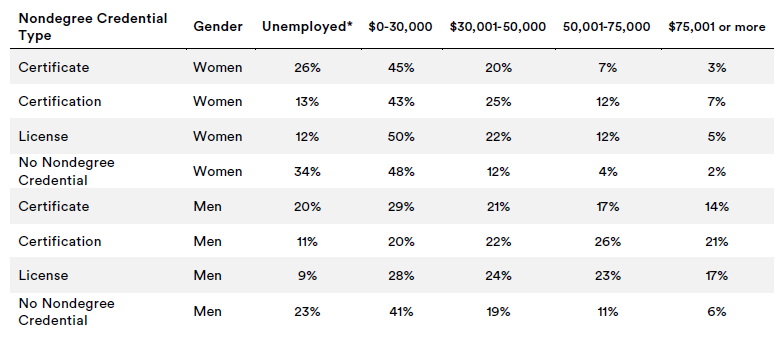
*Figures include adults who are not in the labor force.
Source: New America analysis of the National Center for Education Statistics 2016 Adult Training and Education Survey. Values pertain to adults with less than a bachelor’s degree.
Earnings by Occupational Area
The different earnings for male and female credential holders may be explained in part by occupational choice. We looked closely at earnings for workers in three male-dominated occupational areas – computers; construction, installation, and repair; and science, architecture, and engineering – and three female-dominated areas – education and library; administrative support, and healthcare. Together, these six occupational areas employed 41 percent of all adults. (See Figure 3 below for a breakdown of earnings by credential type for select gender segregated occupations).
The earnings associated with all types of nondegree credentials were substantially higher for individuals in male-dominated than female-dominated occupations. The data also suggest that male-dominated professions require fewer qualifications for entry or advancement. Specifically, 24 percent of workers in computer occupations who held a certificate but not a bachelor's degree made more than $75,000 per year compared with five percent of workers in healthcare occupations and two percent of workers in administrative support occupations. Similarly, 78 percent of workers who held a certificate but no bachelor's degree in education and library occupations earned less than $30,000, compared with just 4 percent of workers who held a certificate but no bachelor's degree in the male-dominated areas of science, architecture, and engineering.
Figure 3 | Earnings by Nondegree Credential Type and Select Gender Segregated Occupations
Source: New America analysis of the National Center for Education Statistics 2016 Adult Training and Education Survey. Values pertain to adults with less than a bachelor’s degree. Data for additional occupational fields available here.
For those with a certification or license, a similar story plays out. For instance, four and a half times as many workers in computer occupations than in healthcare who held a license or certification but not a bachelor’s degree earned more than $75,000 a year (36 percent and 8 percent, respectively). Similarly, three out of every four adults working in education and library occupations who held a certification or license but no bachelor's degree earned less than $30,000, compared with nine percent of workers in computer occupations with comparable credentials.
Similar patterns appear in other male-dominated occupations, such as construction and other skilled trades, where 42 percent of workers who held a certification or license but not a bachelor's degree earned more than $50,000 a year. For female-dominated occupations like healthcare, administrative support, and education and library, a much smaller share saw earnings this high (just 24 percent, 17 percent, and eight percent, respectively).
How Men and Women Prepare for Nondegree Credentials
The economic value of a credential is not determined solely by its effect on employment and earnings. It also depends crucially on its cost to the person who earned it. For example, for an individual’s educational investment to “pay off” the employment and earnings return needs to be higher than the cost of the education or training. These considerations are particularly important given the amount and frequency with which students are taking on debt for their education. Poor employment outcomes make it more difficult to repay educational loans, which can actually leave students worse off than before they enrolled in school.
Source: New America analysis of the National Center for Education Statistics 2016 Adult Training and Education Survey. Values pertain to adults with less than a Bachelor’s degree. Totals do not sum to 100 since some individuals use more than one method of preparation.
Our analysis underscores how these questions of nondegree credential value may be particularly important for women. More than two-thirds (69 percent) of women at the sub-baccalaureate level prepared for their most important nondegree credential by enrolling in a college, technical school, or trade school program – all potentially costly methods of preparation. In contrast, more than half of men at the sub-baccalaureate level had access to classes or training from a company, association, union, or private instructor to prepare for their most important nondegree credential. Education provided by a company, association or union is more likely to be provided free of cost to the student compared with education provided by a postsecondary institution. Only 37 percent of women with similar education and credentials accessed these forms of preparation (See Figure 5 above for a breakdown of how men and women prepare for their nondegree credential).
When viewed in combination with other research on postsecondary enrollment, cost, and financing strategies, the data strongly suggest that women pay more to obtain their nondegree credentials than men. In fact, nationally representative data from the U.S. Department of Education indicate that among students who completed a certificate program in the 2015-16 school year and did not already have a bachelor’s degree, 73 percent of women took out student loans to pay for their studies, compared with 56 percent of men.10
Other research by New America indicates that, on an annual basis, women pay higher tuition after grant and scholarship aid is accounted for: On average, undergraduate women in certificate programs pay $5,927 in tuition and fees each year, while men pay just $4,508.11 The difference is likely due in part to the fact that women are far more likely to enroll in private for-profit institutions that tend to charge more for tuition than public two-year colleges. According to the National Center for Education Statistics, in 2016, twice as many women enrolled in private, for-profit institutions as did men, and three times as many women enrolled in private, for-profit nondegree-granting institutions. Private for-profit colleges charge, on average, $22,000 more in annual tuition than comparable public institutions.12
Conclusion and Discussion
Gender inequality in the labor market has been well-documented. Most recently a study by the Pew Research Center of median hourly earnings of both full- and part-time workers in the United States found that women earned 82 percent of what men earned.13 While the degree of inequality declines as workers obtain bachelor’s degrees and beyond, it exists at all educational levels.14 The earnings associated with nondegree credentials reflect patterns of wage inequality in male- versus female-dominated occupations. Although nondegree credential holders make, on average, more than individuals without these credentials, the earnings difference is significantly less for credentials held by women and workers in female-dominated occupations. Women appear to pay more for – and get less from – nondegree credentials, particularly if they do not have a bachelor’s degree.
Our analysis has implications for policy and practice at the federal, state, and local levels. For one, it points to the clear need for more data collection on nondegree credentials. While the ATES provides new data on adults with nondegree credentials, it is a point-in-time survey, which limits our ability to assess the long-term return on investment of nondegree credentials. Our analysis also raises the following considerations:
Student Financial Aid Programs May Contribute to the Supply of Low-Quality Certificates
The ATES data show that holders of many sub-baccalaureate certificates make poverty-level wages, and women are over-represented among the low-earners. As policymakers consider whether to extend eligibility for federal student financial aid (grants and loans) to short-term certificate programs, they should consider whether they can adequately protect students from providers of certificates that have little or no labor market value.
Consumers Need Robust Information on Postsecondary Institutions that Award Certificates
The ATES data are also relevant to current efforts to renegotiate the gainful employment rule and roll back regulations on career preparation programs that receive federal student aid. The ATES data, when considered in conjunction with data on postsecondary enrollment and borrowing patterns, strongly suggest that women are the most likely to overpay for certificates that provide little labor market return.
Credential Requirements Can Reinforce Labor Market Inequality
The ATES data raise important questions about the impact of occupational licensing, particularly in female-dominated professions in which earning are very low. In the education sector, three-quarters of adults with a license or certification made less than $30,000 a year. The same was true for more than 40 percent of adults working in healthcare. States, cities, and professional bodies should consider the impact of credential requirements on workers in skilled but low-wage occupations and develop professional development strategies that are affordable and equitable for all workers.
States Should Collect Longitudinal Data on Nondegree Credentials
A number of states have added or are considering adding nondegree credentials to their postsecondary attainment goals. States need to develop strategies for including nondegree credentials in their longitudinal data systems to monitor whether nondegree credentials are, in fact, improving the employment and earnings of residents, and adjust accordingly.
Additional Research is Necessary
Our analysis of earnings did not take into account one’s age as a proxy for years of work experience, which could explain significant disparities in earnings. Additionally, we did not look at the differential earnings of comparable men and women within individual occupational areas, which could shed more light on structural inequities within our labor market. These are areas we hope to explore further in future analysis.
Acknowledgments
We would like to thank Lumina Foundation for its generous support of this work. The views expressed in this report are those of its authors and do not necessarily represent the views of Lumina Foundation, its officers, or employees. This research brief also benefited from the support and insight of many New America colleagues including Clare McCann, Amy Laitinen, Michael Prebil, Elena Silva, and Taylor White. Riker Pasterkiewicz, Maria Elkin, and Loren Riesenfeld provided communications support.
Downloads
Citations
- The ATES data includes information about certificates earned through employer training, vocational high school, GED or high school equivalency, and postsecondary training programs. For the purposes of our analysis, we focused exclusively on postsecondary certificates.
- National Center for Education Statistics, Table P167. Number and percentage distribution of sub-baccalaureate certificates awarded by Title IV postsecondary institutions, by field of study: United States, selected years 2003 to 2015, https://nces.ed.gov/surveys/ctes/tables/P167.asp
- Morris M. Kleiner, and Alan B. Krueger, “Analyzing the Extent and Influence of Occupational Licensing on the Labor Market,” Journal of Labor Economics 31(2), S173–202 (2013); also see Bureau of Labor Statistics, “Certification and licensing status of the civilian noninstitutional population 16 years and over by employment status, 2017 annual averages,” https://www.bls.gov/cps/cpsaat49.htm
- U.S. Department of Labor, Career Onestop, Certification Finder, https://www.careeronestop.org/Toolkit/Training/find-certifications.aspx
- The Interagency Working Group on Expanded Measures of Enrollment and Attainment (GEMEnA), which developed and validated national measures of the participation in and credentialing of education and training for work, defined nondegree credentials for the purposes of federal data collections, including ATES. The definitions of nondegree credentials used in this report align with GEMEnA’s definitions, found here: https://nces.ed.gov/surveys/GEMEnA/definitions.asp
- National Center for Education Statistics, “Adult Training and Education: Results from the National Household Education Surveys Program of 2016,” February 2018, https://nces.ed.gov/pubs2017/2017103rev.pdf
- Stephanie Ewert and Robert Kominski, “Measuring Alternative Educational Credentials: 2012,” January 2014, https://www.census.gov/prod/2014pubs/p70-138.pdf U.S. Census Bureau report was based on data from a series of 2012 interviews of the 2008 panel of the Survey of Income and Program Participation (SIPP), which produced the first national estimates of the number and characteristics of noninstitutionalized adults with certificates awarded training providers and educational institutions, professional certification and licenses.
- Adult Training and Education Survey public-use data file, https://nces.ed.gov/nhes/dataproducts.asp#2016dp
- Analysis weighted using the variable FAWT in the ATES public-use data file.
- Author’s calculations of the 2015-16 National Postsecondary Student Aid Study, a nationally representative survey of undergraduate students conducted by the U.S. Department of Education.
- Authors’ calculations of 2015-16 National Postsecondary Student Aid Study data.
- National Center for Education Statistics, “Fast Facts, Tuition Costs of Colleges and Universities,” https://nces.ed.gov/fastfacts/display.asp?id=76
- Nikki Graf, Anna Brown, and Eileen Patten, “The Narrowing, but Persistent, Gender Gap in Pay,” April 9, 2018, http://www.pewresearch.org/fact-tank/2018/04/09/gender-pay-gap-facts/
- Kevin Miller, “The Simple Truth about the Gender Pay Gap,” Spring 2018, https://www.aauw.org/resource/the-simple-truth-about-the-gender-pay-gap/
More About the Authors
Mary Alice McCarthy
Senior Director, Center on Education & Labor

Lul Tesfai
Senior Policy Advisor, Center on Education & Labor