A Chapter of: The Nail Finds a Hammer
Registries and Self-Sovereign Identity
Self-sovereign identity could have a significant catalytic effect on registries. Before explaining further, it is useful to review the nature of registries and their importance in society.
Registries and Society
Registries are key components of any functional society. Without shared, verifiable information about people and assets, collaboration, trade, and finance would all be all but impossible. A registry is a list of people, organizations, or things accompanied by information about them which is relevant to the purpose for which the registry was established. This information is endorsed and made credible by its inclusion in a trusted public ledger. Registries of people serve many purposes, from securing citizens’ access to services to helping researchers understand rare diseases. Asset registries allow for documentation of who has which rights to what assets. These records create value and serve as “market-enabling institutions,” for the various actors in different sectors of social and economic life who use registries on a daily basis.37
Examples and typology of registries follow, although this list is far from comprehensive:
Entity registries capture essential information about people or organizations.38
- Natural persons are individual human beings, as opposed to a legal person, which may be a private (business entity or non-governmental organization) or public (i.e., government) organization.
- Vital records describe the group of birth, death, marriage, and divorce registries. In some jurisdictions, civil unions or domestic partnerships will also be included. A birth registry –complete with names, parents, time, date, and location– may be used for the purposes of citizenship or identity. The UNDP notes that in almost all societies a birth certificate automatically grants a number of rights, such as the right to health care, schooling, a passport, property ownership, voting, formal employment, and access to banking services.39
- Patient registries allow patients and researchers to collaborate, further disease understanding, and enable rapid decision making.40 Similarly, a clinical quality registry is established with the purpose of monitoring quality of care for patients, providing feedback, benchmarking performance, describing patterns of treatment, and as a research tool. According to a 2017 study published by the University of South Australia, these registries play an increasingly important role in improving health outcomes and reducing health care costs. 41
- Legal persons are organizations or companies.
- Company registries are usually managed either by a government or a chamber of commerce. Any company that wishes to be constituted legally must register with the managing entity, and may be placed within an industry-specific registry. Company registries improve the functioning of the private sector and facilitate tax collection, to name only a few key functions. 42
- Organizational registries list any other kind of organization from NGOs to churches. TechSoup’s NGOSource is one of the largest such registries that we are aware of. The registry and its impact are described in the following box.
Box 2
TechSoup and NGOSource.org
TechSoup has developed an organizational registry, NGOSource.org. At first, this tool allowed tech firms to efficiently distribute software to NGOs. Then members were eligible for cloud-based storage and compute. It did not take long for non-U.S. NGOs to request access to the digital treasure trove. But granting to foreign NGOs is not a simple matter. In order to protect their tax-exempt status, philanthropic funds and charitable organizations in the U.S. must only donate to other tax-exempt organizations. If a donor organization wishes to donate outside of the U.S., regulations require a process called an equivalency determination, or ED.
In the absence of a registry, each donor would need to incur this cost every time they gave to a new organization. By including foreign organizations in NGOSource, TechSoup has made it possible for U.S. donor organizations to reduce the time and cost of this process. Once a donor includes a new grantee, all subsequent donors can benefit from the ED. A description of the organization and its registry follows, as provided by TechSoup.43 The purpose of including this here is to illustrate the ways a credible registry creates value.
TechSoup, launched in 1987, has grown around its core technology donation program as a social enterprise into the world's largest NGO data repository. Currently, TechSoup counts 1.1 million registered nonprofit, nongovernmental, social benefit organizations. Of these, roughly 400,000 are in the United States and the remainders are across all non-U.S. embargoed states. To date, TechSoup has served at least one organization in each country where American organizations are allowed to work, and an additional 600 to 800 organizations register each day.
TechSoup's work establishing the frameworks for validating organizations through its global network of partners has further led to a variety of additional, non-technology specific, civil society identity partnerships. The most developed of these is NGOSource.org, which, in partnership with the Council on Foundations, established a US 501(c)(3) equivalency determination process that has become the “go-to” solution for U.S. foundations using equivalency determinations to support their international grant making. More than 250 foundations use NGOSource.org, representing some 90 percent of international grant making.
Asset registries at their core, identify unique assets and then describe who has which rights to those specific assets.
- Real assets are physical things with intrinsic value.
- Immovable registries describe parcels of land, from urban plots to sections of forests, as well as discrete buildings, apartments, etc. Broadly, the rights that an organization or person may have to these assets include, but are not limited to, ownership, occupancy, logging, mining, flyover, etc. A property registry helps to ensure strong land tenure security and enables mobility, security, financial inclusion, gender equality, and many other elements of socioeconomic development.44 Land registries also help facilitate efficient tax collection and help identify property owner(s) during a transaction such as the purchasing or renting of land.
- Movable registries describe objects which are not fixed in place, such as vehicles, boats, livestock, and mechanical equipment. Rights vary from ownership, to possession, to liens. A car may be owned by a dealership, possessed by the lessor, but have a lien held by a financing agency or bank. The FAO highlights how a registry can be used to levy taxes or to confirm ownership before a sale in the case of shipping,45 but this is also true of automobiles and other vehicles.
- Movable asset collateral registries record various assets that borrowers offer lenders to secure a loan.46 While it may seem duplicative to list it here, the category is important enough to be distinctly labeled. These registries allow lenders to “perfect” a security interest,47 provide recourse in case of loan default, and ensure an asset cannot be fraudulently used as a security for multiple loans. Collateral registries facilitate lending to businesses, with land and buildings widely accepted as collateral for loans.48 Many banks in the developing world are beginning to accept movable assets as collateral, increasing financial inclusion for small- and medium-sized enterprises that lack immovable resources.49 For example, a 2013 International Finance Corporation study found that access to bank finance increased by almost 8 percent on average across seven countries after collateral registries and related lending practices were established.50
- Non-physical assets, are valuable but intangible things.
- Financial assets are stocks, bonds, fiat or cryptographic currency, or debts owed by someone. Sometimes, financial assets can be included in the collateral registries described above.51
- Digital assets range from rights to everything from music files, to satellite imagery, to parts of virtual worlds. They would also include utility tokens that are ostensibly non-financial in nature.
In all these cases, registries connect assets and/or related information with people or a group of people. Registry managers essentially perform four key tasks:
- Verifying individual identity: Confirming the identity of the person or the group in question.
- Identifying objects: Identifying the unique object in question, such as a boat or land parcel, where applicable.
- Gathering data: Validating associated information, where applicable.
- Managing the registry: Managing the process of adding, amending, and/or referencing information in the registry.
The occupation of these managers generally depends on the specific registry. A collateral registry will be staffed with financial experts, such as bankers and underwriters; a property registry will be staffed with property experts, such as surveyors and assessors; and a clinical quality registry will be staffed by medical experts, such doctors and researchers. Although establishing the identities of the people who interact with these registries is fundamental to their successful operation, this process usually relies on legacy systems and regulations. This often entails cumbersome and costly in-person identification, for example a lawyer or notary witnessing the seller’s signature on a property transfer document.
Box 3
Corporate Registries: An Example from British Columbia52
While our report primarily focuses on self-sovereign identity for individuals, other use cases do exist. An ongoing and experimental effort by the Government of British Columbia, known as the Verifiable Organizations Network, provides self-sovereign digital identity for businesses throughout the province.53 Project leadership aims “to create a trusted digital network of verifiable data about organizations which is globally connected, interoperable, secure, and easy to join.”54
Foundational information about an organization is derived from British Columbia’s Corporate Registry. This data, supplemented by various other “verifiable credentials,” is issued to TheOrgBook. This public-facing repository aims to enable web- and API-based searches of registrations, licenses, and permits which are cryptographically signed by provincial and municipal authorities. The platform, based on Hyperledger Indy,55 increases efficiency through consolidation and exhibition of trusted information without demanding that a company possess its own digital wallet.56
Canadian officials currently aim to verifiably connect individual digital identities with organizational identities based on ownership. Scaling of the project to at least one other province (Ontario) is underway.57 Public Services and Procurement Canada, a federal department, is co-developing the technology for use within the context of supplier registration.58
This success and expansion of the Verifiable Organizations Network and TheOrgBook demonstrates that the creation and roll out of complex organizational identities is possible. We believe that the concept can be effectively translated to encompass real assets, including land parcel data, which is arguably less complicated than organizational data. While we are arguing in this report that SSI for individuals can help registries to evolve in many domains, we are also making the point that the technology can also be used for non-human entities like companies or properties. The creation of digital property identity provides a compelling opportunity to improve land tenure and create opportunities around real estate.
The Challenge of Identity Within Registries
Our current identity systems are increasingly challenging, complex, and congested. People are more mobile and more connected than ever before. In the developed world, technology allows individuals to complete myriad tasks remotely—from renewing a license to buying a house; from selling shares to moving money between bank accounts. With such activities now possible online, there are also increased opportunities for fraud, as many basic checks on identity, namely completing a transaction in person, are eliminated. According to Javelin, a California-based advisory firm, “it is no coincidence then that adoption of digital channels and devices have grown in tandem with fraud.”59 The number of identity fraud victims in the U.S. reached 16.7 million in 2017, a record high since Javelin began tracking identity fraud in 2003. These crimes continued to shift online and away from physical stores.60
Within emerging markets, large groups of people are beginning to take part in digital financing. Societies that have used physical money for generations are now utilizing mobile phone applications, such as M-Pesa, to transact in refugee camps, town markets, capital cities, and remote villages.61 A 2016 report by McKinsey Global Institute asserts that the continued spread of digital financing in the developing world could be “transformative.” Provision of basic financial services via mobile devices can reduce costs for providers, while increasing convenience and opening access to capital for individuals; businesses can ease inefficiencies and generate significant productivity gains.62 As a result:
- The GDP of all emerging economies could increase by 6 percent, or $3.7 trillion, by 2025.
- This additional GDP could create up to 95 million jobs across all economic sectors.
- 1.6 billion “unbanked” people could gain access to formal financial services; more than half of this total would be women.
- An additional $2.l trillion of loans could be made to individuals and small businesses.
The report also warns that this trend is not without risks, including the creation of new transaction costs, as well as potential for fraud and abuse of technological newcomers. Secure digital identity is critical for combating fraud, which is the predominant risk that comes with increasing digitization of financial services. This risk extends to registries, which, as we discussed above, must be secure and reliable in order to support a wide range of critical economic activities. SSI could become a common solution to these growing problems. There will be both push and pull in the market:
- Push from registries: We expect registries to recognize both the increasing importance of digital identity and the complexity involved in managing identity for any given registry. We expect them to move from using existing government issued foundational identities (where, and if, available) to self-sovereign identity platforms for their registries.
- Pull from users: As the general population increasingly understands the value of personal information, people will demand the best available tools to protect their data. Also, as the foundational nature of SSI becomes clear, it will be preferable to use one SSI instead of creating a new functional identity (a service specific profile often managed with a username and password).
Self-Sovereign Identity and Asset Registries
As self-sovereign identity platforms go into production and gain wider adoption, registries will have the opportunity to evolve. As the British Columbia example illustrates, transitioning to decentralized identity is possible for an established registry.63
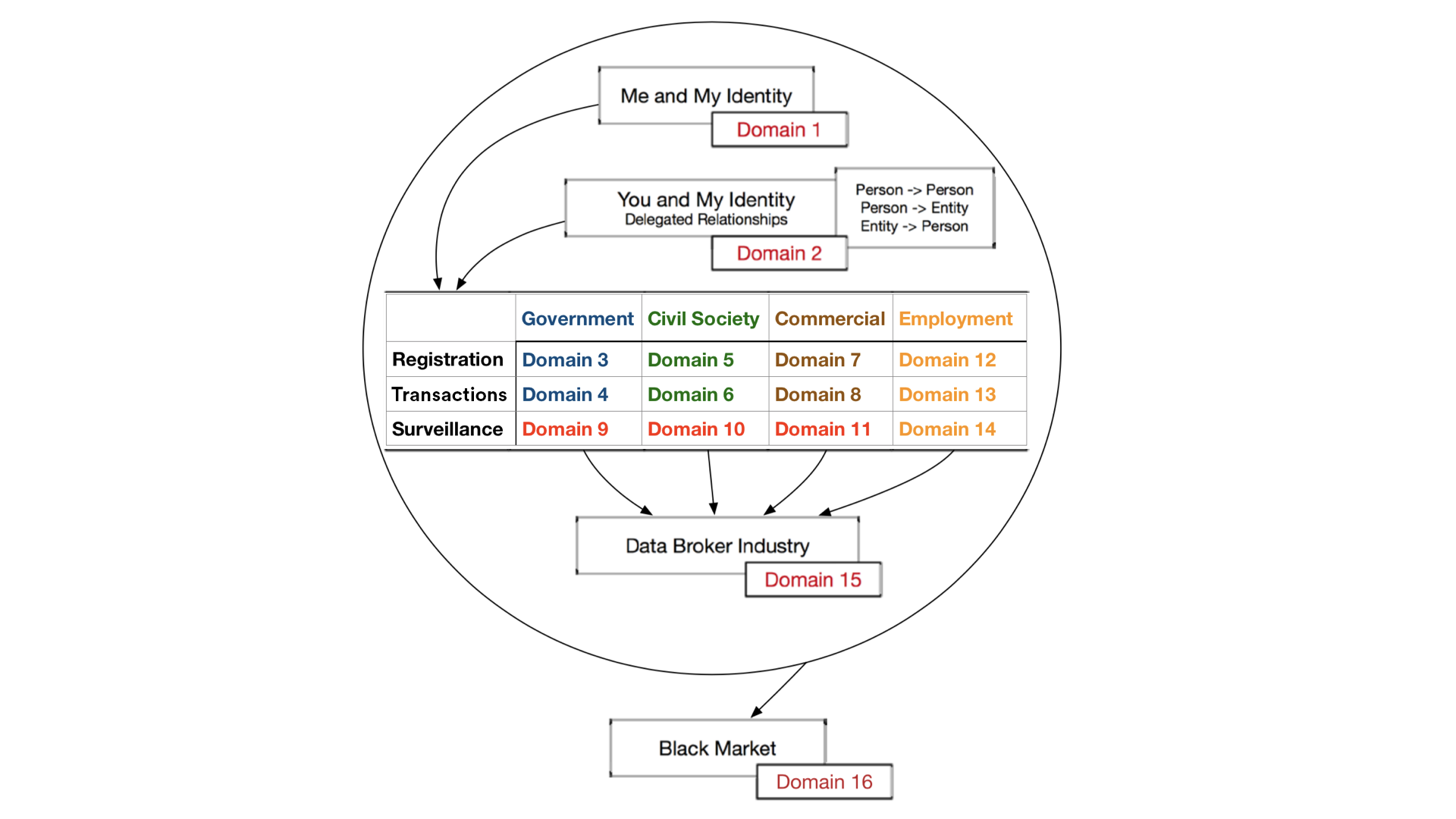
Kaliya Young, the “Identity Woman,” emphasizes the myriad interactions between individuals and institutional contexts where personally identifiable information ends up in databases; many, but not all of these, involve various types of registries. In The Domains of Identity, she describes 16 such identity interactions in detail (See Figure 1 below).64 Aside from registration at birth, a person completes a number of secondary registrations and transactions over the course of a lifetime. Events include professional licensing, tax payments, and the purchase of land.65 Many of these identity-based transactions suffer from inefficiency or “bottlenecks” variously caused by the requirement for a notary’s signature, the mailing of documents, or the need for an escrow agent.
Current registry infrastructure is usually centralized, with a government or private authority hosting and controlling the data. Numerous stakeholders are involved in administering these systems and jurisdictions adhere to different rules and regulations—especially as it relates to identity issues. As a result, individuals can experience difficulty in accessing relevant data, or can become entangled in protracted bureaucratic processes.
Self-sovereign identity solutions—through cryptographically-signed attestations, pairwise connections, and digital identities—put the information about the user under the control of the user. Individuals or groups can be explicitly linked to their assets via SSI. Registry functionality and scope will evolve as a result, and the challenges of verifying identity and sharing information will evolve to issuing verified credentials and managing the other components of a registry that are not benefiting from SSI.
To be clear, the role of government in registry management will not disappear. SSI should relieve government registrars of the tasks of validating identities and providing ad hoc reports, which would instead be offered by the owner of the relevant SSI. But governments still need to control a registry and manage the other critical data in the registry, as well as issue verifiable credentials.
Through this forward-looking model, it is possible to imagine the utility of asset registries depending on SSI for their identity function, especially in developing countries. Resource-constrained governments with limited technological and infrastructural resources can avoid the repetitive work of building identity into system after system. A state may also continue to arbitrate disputes, but if the integrity of information within identities—and by extension asset registries—improves over time, the need for arbitration or policing should diminish.
Eventually, SSI-based asset registries could also help to generate more accurate, trusted information regarding potential loan borrowers in the developing world. Juan Antonio Ketterer and Gabriela Andrade, both financial market specialists at the Inter-American Development Bank, assert that “more transparent and more efficient registries of assets as collateral could diminish constraints rooted in information asymmetries and thus facilitate access to finance.”66 As shown by recent initiatives in Latin America and the Caribbean, the expanded use of movable assets as collateral can have a significant impact on economic growth for small- and medium-sized companies, female business owners, and young entrepreneurs.67
Figure 1: Domains of Identity by Kaliya Young

The Nail Finds a Hammer
- Introduction
- Why We Wrote This Report
- Section 1: SSI, Registries, and Land Use Cases
- The Case for Self-Sovereign Identity
- Registries and Self-Sovereign Identity
- Digital Identity and Land Use Cases
- Section 2: Three Solutions Through Ten Principles
- The Principles of Self-Sovereign Identity
- Three Self-Sovereign Identity Platforms to Watch
- Exploring Three Platforms Through the Principles
Citations
- Benito Arruñada, “Registries,” Man and the Economy 1, no. 2 (2014), 209.
- “Natural Person,” Wikipedia, last updated February 6, 2018, en.wikipedia.org/wiki/Natural_person, accessed October 1, 2018.
- Lene Mikkelsen, Alan Lopez, David Phillips, “Why birth and death registration really are “vital” statistics for development,” HDialogue (blog), United Nations Development Programme, April 14, 2015, hdr.undp.org/en/content/why-birth-and-death-registration-really-are-%E2%80%9Cvital%E2%80%9D-statistics-development, accessed September 17, 2018.
- Matthew I. Bellgard, Lee Render, Maciej Radochonski, and Adam Hunter, “Second generation registry framework,” Source Code for Biology and Medicine 9, no. 14 (June 20, 2014).
- Dewan Hoque et al., “Impact of clinical registries on quality of patient care and clinical outcomes: A systematic review,” PLOS One 12, no. 9 (September 8, 2017).
- Tim Robustelli, “High-Tech Solutions in Colombia,” FPR Blog (blog), New America, September 6, 2018, http://www.newamerica.org/future-property-rights/blog/high-tech-solutions-colombia/, accessed October 2, 2018.
- The information below was provided by Chris Worman, Vice President, Alliances and Program Development, TechSoup, in an email to Michael Graglia on October 1, 2018.
- See Patrick Kelley and Michael Graglia, “Why Property Rights Matter,” FPR Blog (blog), New America, March 10, 2017, http://www.newamerica.org/future-property-rights/blog/why-property-rights-matter/, accessed July 23 2018.
- “III. Rationale for the Operation of Open Registers,” Food and Agriculture Organization of the United Nations, accessed September 17, 2018, http://www.fao.org/docrep/005/y3824e/y3824e06.htm.
- “Collateral,” Investopedia, accessed September 17, 2018, http://www.investopedia.com/terms/c/collateral.asp.
- See also, Inessa Love, Martínez Pería, María Soledad, and Sandeep Singh, Collateral Registries for Movable Assets: Does Their Introduction Spur Firm’s Access to Bank Finance? (Policy Research Working Paper No. 6477), International Finance Corporation, World Bank Group, 2013, openknowledge.worldbank.org/handle/10986/15839, accessed September 17, 2018.
- International Finance Corporation “Secured Transactions and Collateral Registries,” World Bank Group, accessed September 17, 2018, http://www.ifc.org/wps/wcm/connect/793e79804ac10fff9ea69e4220e715ad/Secured+Transactions+and+Collateral+Registries+Brochure-English.pdf?MOD=AJPERES.
- International Finance Corporation, “Collateral Registries: A Smart Way to Expand Access to Finance,” Stories of Impact (blog), World Bank Group, October 2016, http://www.ifc.org/wps/wcm/connect/news_ext_content/ifc_external_corporate_site/news+and+events/news/impact-stories/collateral-registries-smart-way-to-expand-a2f, accessed September 17, 2018. See also, Love, Pería, Soledad, and Singh, Collateral Registries for Movable Assets.
- Love, Pería, Soledad, Singh, Collateral Registries for Movable Assets, 4.
- Alejandro Alvarez de la Campa, “Secured Transactions and Collateral Registries Program,” Presentation at International Finance Corporation, Amman, Jordan, June 25, 2013, http://www.smefinanceforum.org/sites/default/files/post/files/459816_s1_-_secured_transactions_and_collateral_registries_program.pdf, accessed September 23, 2018.
- Within this box, we examine the Verifiable Organizations Network (VON) and TheOrgBook. The two are related, but different. The VON is the overall initiative, while TheOrgBook is a tangible data repository used within the project (comment from John Jordan, Executive Director of Services Strategy, Government of British Columbia (July 17, 2018)).
- “Home,” Verifiable Organizations Network, accessed July 16, 2018, von.pathfinder.gov.bc.ca/.
- “About VON,” Verifiable Organization Network, accessed July 16, 2018, von.pathfinder.gov.bc.ca/aboutvon/.
- Hyperledger Indy is a distributed ledger, purpose-built for decentralized identity. It provides tools, libraries, and reusable components for creating and using independent digital identities based on blockchain technology (“Hyperledger Indy,” The Linux Foundation, accessed June 26, 2018, http://www.hyperledger.org/projects/hyperledger-indy/).
- “About VON,” Verifiable Organizations Network.
- Interview with John Jordan, (July 13, 2018).
- Comment from John Jordan, (July 16, 2018).
- Al Pascual, “The Fraud Implications of the Digital Identity Revolution,” Javelin, April 12, 2017, http://www.javelinstrategy.com/blog/fraud-implications-digital-revolution, accessed September 24, 2018.
- “Identity Fraud Hits All Time High With 16.7 Million U.S. Victims in 2017, According to New Javelin Strategy & Research Study,” Javelin, February 6, 2018, http://www.javelinstrategy.com/press-release/identity-fraud-hits-all-time-high-167-million-us-victims-2017-according-new-javelin, accessed September 24, 2018.
- See Staesser, “The Emergence of Mobile Apps in Developing Countries.”
- James Manyika, Susan Lund, Marc Singer, Olivia White, and Chris Berry, Digital Finance For All: Powering Inclusive Growth In Emerging Economies (Executive Summary), McKinsey Global Institute, September 2016, http://www.mckinsey.com/featured-insights/employment-and-growth/how-digital-finance-could-boost-growth-in-emerging-economies, accessed September 26, 2018.
- See Juan Antonio Ketterer and Gabriela Andrade, “Blockchain Asset Registries: Approaching Enlightenment?,” CoinDesk, December 30, 2017, http://www.coindesk.com/blockchain-asset-registries-entering-slope-enlightenment/, accessed September 18, 2018.
- Kaliya Young, The Domains of Identity, 2018, identitywoman.net/domains-of-identity/.
- Ibid., 3-4.
- Ketterer and Andrade, “Blockchain Asset Registries.”
- International Finance Corporation, “Collateral Registries.”