A Chapter of: Where Residents, Politics, and Government Meet
Why Philadelphia?
Courtesy of the Philadelphia Parks and Recreation Department
Philadelphia is what professor and urban studies theorist Richard Florida calls a “Patchwork Metropolis,” where the city and the wider metropolis have an inner more privileged “creative class” with a working-class outer rim. The result is one of the highest levels of inequality in the county, with 26 percent of the population living below the poverty line. Philadelphia is also one of only five American cities to be classified as “hyper segregated” between 1970 and 2010, according to Princeton sociologist Douglas Massey. The result is that a majority of the city’s black residents live in areas that are isolated from most white residents.5 In Philadelphia, as in Baltimore and Chicago, there is a 20-year gap in life expectancy between parts of the city’s poor, largely black neighborhoods, and its wealthier, whiter areas. This disparity can be seen in neighborhoods as close as five miles apart.
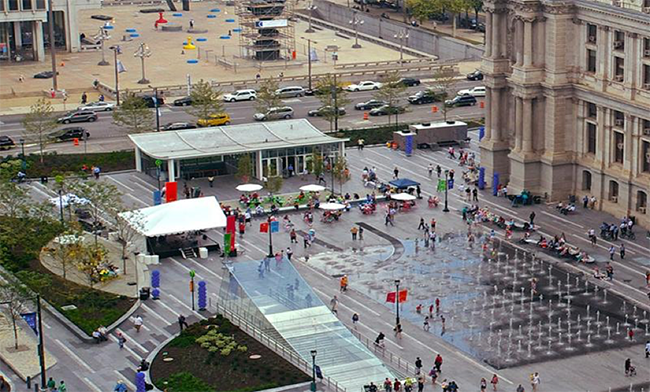
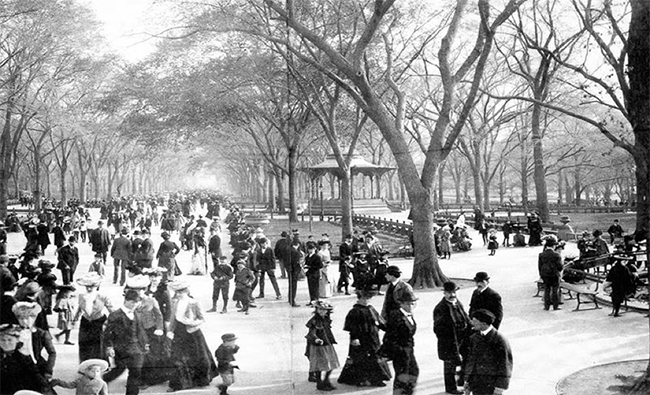
But Philadelphia also boasts a civic infrastructure with many entry points for experimentation.6 The city has one of the largest and oldest park systems in the U.S., with more than 100 parks encompassing 10,000 acres. In addition, Philadelphia has a large network of recreation centers that complement these historic parks, and a well-established library system.
These public spaces offer meeting places for residents to interact and forge new connections. Community anchor institutions such as parks and recreation centers can strengthen the fabric of civic, social, and political life. However, these spaces must be accessible, clean, safe, and equitable, which is not always the case. Deterioration in Philadelphia is severe, and public engagement is low.
Courtesy of the Philadelphia Parks and Recreation Department
But fresh thinking about civic engagement does not require dramatic solutions. The best approaches often go back to the basics, ask the right questions, and focus on people and communities. Bringing together residents and government employees to work on solutions to city problems together is a simple way to bridge lived experience and technical expertise. Another approach is making the idea of civic engagement more concrete by helping connect people and their relationships to one another, and their city to physical spaces. For this model to work, there ought to be solid human and physical infrastructures in place.
Citations
- See Douglas Massey’s research as part of Princeton’s Office of Population Research: Douglas Massey, Office of Population Research, http://opr.princeton.edu/.
- William Penn, the founder of the English North American colony the Province of Pennsylvania, played a central role in making the Philadelphia public space infrastructure one of the most robust in the United States. Penn’s Quaker ideals of religious, racial, and gender equality were the foundation on which the city was built. Following in Penn’s footsteps, the Haas family created the William Penn Foundation, with the goal of “protecting open green space, historic preservation, and arts and cultural institutions” and it to be “primarily focused on efforts to improve the quality of life for children and families, especially in disadvantaged communities.” William Penn Foundation, 2018. https://www.williampennfoundation.org/history-and-heritage.