A Chapter of: Lessons from the Bayou State
Early Care and Education in the Bayou State
Similar to other states, Louisiana has a lot of room for improvement when it comes to supporting the healthy development of children.7 On the 2017 National Assessment of Educational Progress (NAEP), referred to as the Nation’s Report card, only 26 percent of its fourth graders scored proficient in reading. In math, its fourth graders came in dead last, behind all other states and Washington, DC.8 Nearly one-third of children in Louisiana under age five live in poverty, and achievement gaps based on family income, race, disability status, and English proficiency are substantial.9
In Louisiana, families struggle to get the early care and education they need. The state is only providing publicly funded early care and education to 15 percent of its at-risk children between birth and age three.10 As Melanie Bronfin, executive director of the Louisiana Policy Institute for Children, wrote in a recent article, “there are 140,000 children birth through age three from low income families who cannot access ANY publicly funded [child care] slot.”11 Louisiana’s Child Care Assistance Program (CCAP), funded largely through the federal Child Care and Development Block Grant (CCDBG), provides parents with subsidies to cover all or a portion of child care costs. While the reimbursement rate has increased in recent years, a decrease in state investment has led to more than a 50 percent decline in the number of children served since 2008.12
Louisiana is only providing publicly funded early care and education to 15 percent of its at-risk children between birth and age three.
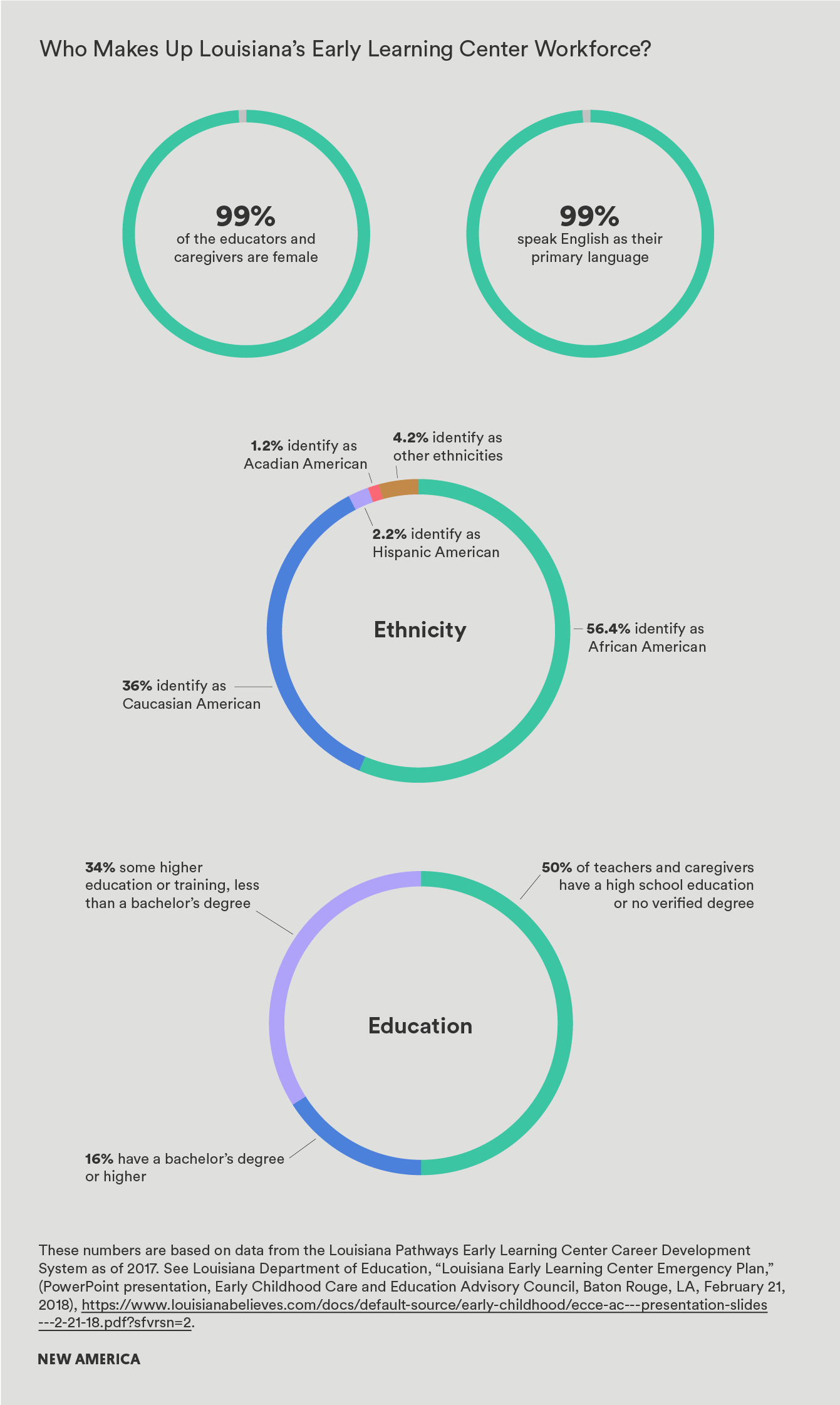
Achievement as well as cognitive gaps start early. More than 40 percent of Louisiana children enter kindergarten already behind.13 Child care quality in the state has historically been poor, and there have been minimal requirements for the workforce. Teaching in an early learning center has not traditionally required even a high school diploma, and compensation has reflected these low standards. Child care workers earn only $8.95 per hour on average and usually do not have access to benefits.14 Bronfin told New America, “we are dealing with a state that is ranked between 45th and 50th on almost every indicator involving children. We are dealing with a huge level of poverty and multiple systems that are broken. Policy change is very difficult.”
As soon as Louisiana’s children reach age four, however, they have more opportunities for quality early learning experiences, because the Bayou State has been ahead of the curve in publicly funded pre-K. Louisiana has multiple pre-K programs and funding streams to serve four-year-olds, and these state-level programs prioritize serving those whose families are at or below 200 percent of the federal poverty line.
Louisiana Pre-K Programs and Enrollment Levels
| Program/Funding Stream | 2016–17 School Year Enrollment{{15}} |
|---|---|
| Cecil J. Picard LA 4 Early Childhood Program (LA 4) | 16,221 four-year-olds |
| 8(g) Student Enhancement Block Grant Program | 2,153 four-year-olds |
| Nonpublic Schools Early Childhood Development Program | 1,413 four-year-olds |
| Federal ESSA Title I Dollars | 8,076 four-year-olds |
| Federal Preschool Development Grant | 1,405 four-year-olds |
Source: Louisiana Department of Education, “Updates on Early Childhood Teacher Preparation: Preparing for 2018 Program Approval Requirements” (PowerPoint presentation, Baton Rouge, LA, July 2017); National Institute for Early Education Research. The State of Preschool: State Preschool Yearbook. Louisiana, 2017.
Between the funding streams outlined above and the federal Head Start program, the state estimates that 93 percent of four-year-olds who qualify for public programs have access.15 Louisiana’s pre-K programs meet eight out of 10 of the National Institute for Early Education Research’s quality benchmarks.16 This includes requiring lead pre-K teachers to have a bachelor’s degree and teaching certificate with specialized training in pre-K.17 On the whole, pre-K teachers in Louisiana earn around twice as much as child care workers, at an average of $17.07 per hour.18 Pre-K teachers in LA 4 and the Nonpublic Schools Early Childhood Development Program have salary parity with kindergarten teachers, earning significantly more, at around $45,650 per year.19
Quality and Systems Reforms
While Louisiana’s ECE reforms began as early as 2001 with the creation of public pre-K, the effort to reform the entire system was launched by the 2012 Early Childhood Education Act, commonly referred to as Act 3.
Act 3 “calls for the creation of a statewide, integrated early-childhood care and education network which will establish uniform standards of readiness for kindergarten and, through coordination with other state agencies, align all standards for quality early-child education,” according to the Louisiana Department of Education (LDE).20 Act 3 gave LDE authority over all early childhood education, moving the entire responsibility for child care out of the Department of Children & Family Services. Few state agencies have full administrative and governance control over all care and education opportunities for children birth to adulthood.21 The number of staff members in LDE’s Office of Early Childhood has “increased almost tenfold to administer and oversee these increased departmental responsibilities” according to a recent report by RAND Corporation.22
This kind of change presents opportunity for alignment, effectiveness, and continuity across the education continuum and lawmakers hoped that unifying the system would improve kindergarten readiness. Better coordination of standards, data, and systems can ease the transitions from one year or program to the next, ensuring that children continue to build on gains instead of falling through the cracks. Before Act 3, all of the pre-K programs had different eligibility requirements. Under Act 3, LDE created three types of licenses for early learning centers:23
- Type I centers are operated by religious organizations and do not take public funding.
- Type II centers either take no public funding or only take food and nutrition funding.
- Type III centers are early learning centers that are authorized to take public funds. Type III centers must participate in the state’s quality rating and improvement system (QRIS). This includes Head Start and centers receiving Child Care and Development Block Grant funds. It does not include public or nonpublic elementary schools, which do not need to be licensed unless they serve three-year-olds.
The policies discussed in this paper refer mainly to Type III centers.24
Policy Milestones to Improve Louisiana Early Education Program Quality
| 2001 | Cecil J. Picard LA 4 Early Childhood Program founded to serve eligible 4-year-olds in public schools, Louisiana’s first publicly funded pre-K program |
| 2001 | Nonpublic Schools Early Childhood Development program (NSECD) created to reimburse participating nonpublic schools for providing pre-kindergarten classes |
| 2007 | School Readiness Tax Credits package passed, which includes tax credits to supplement early childhood workforce wages{{26}} |
| 2007 | Quality Start launched, the quality rating and improvement system (QRIS) for licensed early learning centers that rated programs based on a series of inputs |
| 2012 | Early Childhood Care and Education Act (known as Act 3) passed by state legislature to unify the early care and education (ECE) system and bring all programs under the Louisiana Department of Education (LDE) |
| 2014 | Early Childhood Care and Education Advisory Council created to provide advice to the Board of Elementary and Secondary Education (BESE) and LDE on all early learning programs, including Type I and Type II licensing regulations.”{{27}} |
| 2014 | Preschool Development Grant won, $32 million in federal funds to expand access to high-quality pre-K for 4-year-olds in six underserved communities{{28}} |
| 2015 | Multiple policies to unify the ECE system established by BESE: - All Type III programs need to participate in the new early childhood care and education accountability system - All lead early childhood educators will need to earn at least an Early Childhood Ancillary Certificate by 2019 - Birth to Kindergarten field of study and teaching license designed |
| 2017 | School Readiness Tax Credits reformed by BESE to align with the Early Childhood Ancillary Certificate and recognize teachers who have worked in the child care industry for multiple years |
| 2018 | Early Childhood Care and Education Commission set up, which will “make recommendations prior to the 2019 Legislative Session for a Master Plan for Early Care and Education for the state” and set up pilot programs{{29}} |
| 2019 | Ancillary Certificate requirement for lead teachers{{30}} set in Type III centers; new hires must earn one within 2 years |

Lessons from the Bayou State
- Introduction
- Obstacles to Developing a Strong Workforce
- Early Care and Education in the Bayou State
- Reform #1: Measuring Quality Through Teacher-Child Interactions Alone
- Reform #2: Raising Requirements for Early Childhood Educators
- Reform #3: Supplementing Wages with Tax Credits
- Connecting ECE to Kindergarten and the Early Grades
- Concluding Thoughts, Lessons, and Policy Considerations
- Appendix: Interviews Conducted
Citations
- KIDS COUNT Data Center (website), “KIDS COUNT Overall Rank,” updated June 2018, https://bit.ly/2OBaKSN
- The Nation’s Report Card (website), “State Performance Compared to the Nation,” 2015, https://bit.ly/2AXFNVs
- Louisiana Department of Education (website), “Louisiana Students Maintain Stable Performance on LEAP Assessments,” July 12, 2017, https://www.louisianabelieves.com/newsroom/news-releases/2017/07/12/louisiana-students-maintain-stable-performance-on-leap-assessments; U.S. Census Bureau (website), “Children Characteristics: 2017 American Community Survey 1-Year Estimates,” https://bit.ly/2yWnMp1
- Louisiana Policy Institute for Children (website), “Louisiana Early Childhood Basics: Louisiana's Early Care and Education Programs,” 2014, http://www.policyinstitutela.org/care--education-programs
- Melanie Bronfin, “The Good and the Bad: Early Care and Education in Louisiana So Far in 2018,” Alliance for Early Success (website), August 23, 2018, http://www.earlysuccess.org/blog/good-and-bad-early-care-and-education-louisiana-so-far-2018
- Email with Melanie Bronfin, October 18, 2018.
- Louisiana Policy Institute for Children, “Early Care and Education in Louisiana: 2018,” http://docs.wixstatic.com/ugd/43cca3_24e064c9362449b7b5ab43f2d590f497.pdf
- “LOUISIANA,” in Marcy Whitebook, Caitlin Mclean, Lea J. E. Austin, and Bethany Edwards, The Early Childhood Workforce Index 2018 (Berkeley, CA: Center for the Study of Child Care Employment, 2018), http://cscce.berkeley.edu/files/2018/06/2018-Index-Louisiana.pdf; Louisiana Department of Education, “Louisiana Early Learning Center Emergency Plan,” (PowerPoint presentation, Early Childhood Care and Education Advisory Council, Baton Rouge, LA, February 21, 2018), https://www.louisianabelieves.com/docs/default-source/early-childhood/ecce-ac---presentation-slides---2-21-18.pdf?sfvrsn=2
- Louisiana Department of Education, “Louisiana Early Learning Center Emergency Plan,” (PowerPoint presentation, Early Childhood Care and Education Advisory Council, Baton Rouge, LA, February 21, 2018), https://www.louisianabelieves.com/docs/default-source/early-childhood/ecce-ac---presentation-slides---2-21-18.pdf?sfvrsn=2
- Louisiana state overview in Allison H. Friedman-Krauss, W. Steven Barnett, G. G. Weisenfeld, Richard Kasmin, Nicole DiCrecchio, and Michelle Horowitz, The State of Preschool 2017 (New Brunswick, NJ: National Institute of Early Childhood Research, 2018), 90–94, http://nieer.org/wp-content/uploads/2018/04/Louisiana_YB2017.pdf
- “Early Childhood Teaching Policies” (PowerPoint presentation, Louisiana Department of Education, Baton Rouge, LA, 2017), https://www.louisianabelieves.com/docs/default-source/early-childhood/ecce-ac---12-8-presentation-on-proposed-teacher-policies.pdf?sfvrsn=2
- “LOUISIANA,” in Marcy Whitebook, Caitlin Mclean, Lea J. E. Austin, and Bethany Edwards, The Early Childhood Workforce Index 2018 (Berkeley, CA: Center for the Study of Child Care Employment, 2018), http://cscce.berkeley.edu/files/2018/06/2018-Index-Louisiana.pdf
- W. Steven Barnett and Richard Kasmin, Teacher Compensation Parity Policies and State-Funded Pre-K Programs (New Brunswick, NJ: NIEER and Berkeley, CA: Center for the Study of Child Care Employment, 2017), http://nieer.org/wp-content/uploads/2017/04/Pre-K-Parity-Report_Final.pdf
- Louisiana Board of Elementary and Secondary Education (website), “Early Childhood Education (Act 3),” http://bese.louisiana.gov/current-initiatives/act-3-early-childhood-education
- Elliot Regenstein and Katherine Lipper, A Framework for Choosing a State-level Early Childhood Governance System (Boston, MA: BUILD Initiative, 2013), http://www.buildinitiative.org/Portals/0/Uploads/Documents/Early%20Childhood%20Governance%20for%20Web.pdf
- Julia H. Kaufman, Jill S. Cannon, Shelly Culbertson, Margaret Hannan, Laura S. Hamilton, and Sophie Meyers, Raising the Bar: Louisiana’s Strategies for Improving Student Outcomes (Santa Monica, CA: RAND Corporation, 2018), https://www.rand.org/pubs/research_reports/RR2303.html
- Senate Bill No. 524, https://bit.ly/2QxgkaL
- As of December 2017, there were 295 Type I centers, 184 Type II centers, and 1,007 Type III centers in Louisiana.