Lessons from the Bayou State
Acknowledgments
This paper benefited from the insights of many, including the interviewees listed in the Appendix. I am especially grateful for the participation and support of Erin Carroll and Jenna Conway at the Louisiana Department of Education, Melanie Bronfin at the Louisiana Policy Institute for Children, Falicia Coleman at Children First, Grace Reef at the Early Learning Policy Group, and Cindy Cisneros at the Committee for Economic Development. Thank you to the teachers, instructional coaches, and leaders in Lake Charles, Louisiana who shared their professional journeys. Thanks to New America colleagues Laura Bornfreund, Lisa Guernsey, Elena Silva, Cara Sklar, and Sabrina Detlef for editorial insight and guidance. Thank you to Anisha Ford for research support. Maria Elkin and Riker Pasterkiewicz provided layout and communications support.
This work would not have been possible without the generous support of the Foundation for Child Development. The views expressed in this paper are of the author alone.
Introduction
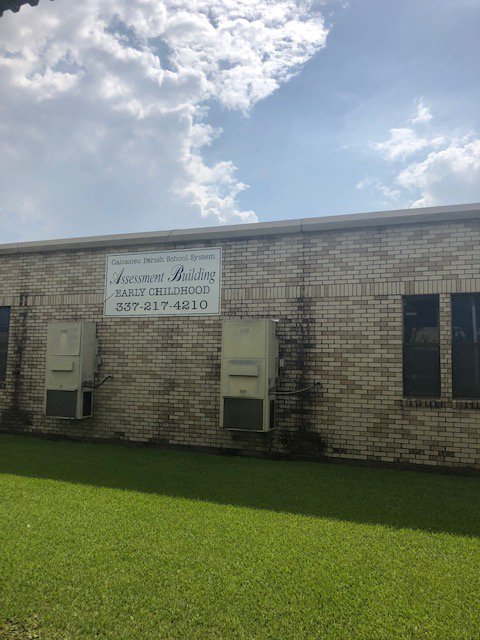
It’s a hot and muggy Tuesday evening in between summer thunderstorms in Lake Charles, Louisiana. From the unassuming look of the Calcasieu Parish School System Assessment Building, it would be hard to guess the excitement taking place inside, though the completely packed parking lot might be a clue. Inside the building’s gymnasium, over 200 families are gathered with balloons, flowers, and posters. Even though 200 chairs have been set up, it is standing room only. This audience, ranging from infants to great-grandparents, is there to see their loved ones graduate.
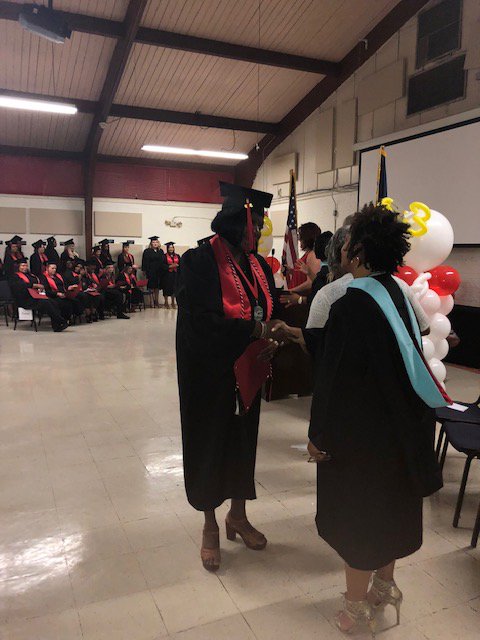
Falicia Coleman and her team have spent the entire day setting up. Wearing a cap and gown with the graduate level distinction, Coleman, executive director of Children First Professional Development Center, quiets the room and welcomes everyone. She introduces the graduating class of 2018 in from a side door and 33 women and one man file in wearing black caps and gowns with red honors stoles. Two valedictorians take seats up in the front next to the other speakers.
Jenny Cowan from Louisiana Pathways, the state’s workforce registry, is the keynote speaker. She asks, “What is more important than playing a role in the development of young people’s minds?” The question is met with a few “amens.” She tells the graduates, “you are providing the opportunities for learning that give children foundations for the rest of their lives….you are all making a difference in the world and I’m proud of each and every one of you.”
Courtesy of author
The graduation has more pomp than some college graduation ceremonies. But the graduates are not earning their bachelor’s degrees or associate degrees. They are earning what the state of Louisiana has termed the Early Childhood Ancillary Certificate. Cowan drove over four hours to get to Lake Charles for the graduation. Erin Carroll, director of Classroom and Workforce Improvement in the state’s Office of Early Childhood, is also present. Carroll has attended more than a handful of Early Childhood Ancillary Certificate program graduations across the state over the past year, but none quite like this.
The Ancillary Certificate is what the state describes as an “enhanced CDA” or Child Development Associate credential. By 2019, all lead teachers working in early childhood education classrooms serving children birth to age five that receive any type of public funding will need to have a certificate, at a minimum. The credential requirement is one of three major policy changes in Louisiana meant to strengthen the early education workforce.
Transforming this workforce is no easy feat, but it is something that many states are working toward. The moving graduation ceremony in Lake Charles described above is the result of years of thoughtful policy implementation. This paper explores the policy changes in Louisiana that led to it and offers important lessons for other states grappling with how to prepare and support their early childhood educators to better serve young children. Louisiana has implemented policies that aim to strengthen early educator qualifications, evaluate and improve the quality of teaching, and increase wages to help retain talented educators.
Obstacles to Developing a Strong Workforce
A growing body of research shows that access to quality early care and education (ECE) can impact children’s long-term success. Children’s brains are developing rapidly during the first eight years of life and their experiences during this formative time determine how prepared they are to succeed in school and beyond. For instance, children who do not read on grade level by the end of third grade are more likely to be held back a grade and less likely to graduate from high school.1 High-quality education and care during the early years is essential to set children on a path for success, and yet in reality most children’s experiences are low-quality and disjointed. The risks are especially great for children from low-income families, dual language learners, children with disabilities, and children of color, who are less likely to have access to high-quality programs.
The cornerstones to any strong ECE program are caregivers and educators (both teachers and administrators) who understand early learning and child development and who can support the needs of young children. The seminal report, Transforming the Workforce for Children from Birth through Age 8: A Unifying Foundation, published in 2015 by the National Institute of Medicine and the National Research Council, lays out what knowledge and skills are needed to effectively work with young children and offers recommendations for how to change the way professionals are prepared, credentialed, and supported.2 The report also explains the obstacles to strengthening the preparation of this particular workforce. With varying qualification requirements across programs, states, and age groups, many educators enter the field unprepared to work with young children. Infant and toddler teachers might not have any formal education or training in ECE. While kindergarten through third grade teachers usually need at least a bachelor’s degree and teaching credential, their preparation might not be specific to working with young children.3 And the qualification requirements for pre-K teachers vary significantly among states and from one program to another. Transforming the Workforce recommends that the field gradually moves toward requiring all lead educators of children birth through age eight to earn a bachelor’s degree and specialized knowledge and competencies.
But improving the workforce is much more complex than simply raising qualifications. Because of the mixed quality of preparation programs and professional learning opportunities, a credential or degree in and of itself does not ensure better practice. Research finds that many preparation programs fail to ensure that educators develop knowledge and competencies they need to work with young children.4 For example, children at ages three and four should be able to develop skills in early literacy and numeracy, but they need teachers who are attuned to their abilities and can design activities that are aligned with their learning trajectories and can help them progress to new levels. Educators need programs that include relevant content on child development and early learning as well as support to translate that knowledge to practice.
With varying qualification requirements across programs, states, and age groups, many educators enter the field unprepared to work with young children.
Another key obstacle to strengthening the workforce is the current level of compensation. According to the University of California Berkeley’s Center for the Study of Child Care Employment, the average child care worker, a job description that can include one who is in charge of classrooms, still makes just over $10 per hour.5 And those caring for the youngest children usually earn the least. Early education teachers working outside of the public school system tend to not only have lower salaries, but also limited access to benefits like health care or paid sick leave. Poor pay and benefits discourage individuals from joining the field, make it difficult for those in ECE to pursue further education since they may be struggling to make ends meet. This contributes to high turnover, which also occurs when those who do go on to earn higher qualifications leave to work with older children and in other settings where the compensation is better.6
Citations
- Laura Bornfreund, Shayna Cook, Abbie Lieberman, and Aaron Loewenberg, From Crawling To Walking: Ranking States on Birth–3rd Grade Policies That Support Strong Readers (Washington, DC: New America, 2015), https://static.newamerica.org/attachments/11902-from-crawling-to-walking/50-State-Scan.fe1ae7082db6418dabeb3eee29cea669.pdf; Leila Feister, Early Warning! Why Reading by the End of Third Grade Matters (Baltimore, MD: Annie E. Casey Foundation, 2010), https://www.aecf.org/resources/early-warning-why-reading-by-the-end-of-third-grade-matters/.
- LaRue Allen and Bridget B. Kelly, eds., Transforming the Workforce for Children Birth Through Age 8: A Unifying Foundation (Washington, DC: National Academies Press, 2015), https://www.nap.edu/catalog/19401/transforming-the-workforce-for-children-birth-through-age-8-a
- Laura A. Bornfreund, Getting in Sync: Revamping Licensing and Preparation for Teachers in Pre-K, Kindergarten, and the Early Grades (Washington, DC: New America, 2011),https://static.newamerica.org/attachments/2348-getting-in-sync/Getting%20in%20Sync-%20Revamping%20Licensing%20and%20Preparation%20for%20Teachers%20in%20Pre-K%20Kindergarten%20and%20the%20Early%20Grades.e9be94a875084fa5b66a76f858d51a8c.pdf
- Hannah Putman, Amber Moorer, and Kate Walsh, Some Assembly Required: Piecing Together the Preparation Preschool Teachers Need (Washington, DC: National Center for Teacher Quality), https://www.nctq.org/dmsView/Preschool; Marcy Whitebook and Lea J. E. Austin, Early Childhood Higher Education: Taking Stock Across the States (Berkeley, CA: Center for the Study of Child Care Employment, November 2015), http://cscce.berkeley.edu/files/2016/Cross-state-Brief-Final.pdf
- Marcy Whitebook, Caitlin Mclean, Lea J. E. Austin, and Bethany Edwards, The Early Childhood Workforce Index 2018 (Berkeley, CA: Center for the Study of Child Care Employment, 2018), http://cscce.berkeley.edu/early-childhood-workforce-2018-index/
- Marcy Whitebook, Caitlin Mclean, Lea J. E. Austin, and Bethany Edwards, The Early Childhood Workforce Index 2018 (Berkeley, CA: Center for the Study of Child Care Employment, 2018), http://cscce.berkeley.edu/early-childhood-workforce-2018-index/
Early Care and Education in the Bayou State
Similar to other states, Louisiana has a lot of room for improvement when it comes to supporting the healthy development of children.7 On the 2017 National Assessment of Educational Progress (NAEP), referred to as the Nation’s Report card, only 26 percent of its fourth graders scored proficient in reading. In math, its fourth graders came in dead last, behind all other states and Washington, DC.8 Nearly one-third of children in Louisiana under age five live in poverty, and achievement gaps based on family income, race, disability status, and English proficiency are substantial.9
In Louisiana, families struggle to get the early care and education they need. The state is only providing publicly funded early care and education to 15 percent of its at-risk children between birth and age three.10 As Melanie Bronfin, executive director of the Louisiana Policy Institute for Children, wrote in a recent article, “there are 140,000 children birth through age three from low income families who cannot access ANY publicly funded [child care] slot.”11 Louisiana’s Child Care Assistance Program (CCAP), funded largely through the federal Child Care and Development Block Grant (CCDBG), provides parents with subsidies to cover all or a portion of child care costs. While the reimbursement rate has increased in recent years, a decrease in state investment has led to more than a 50 percent decline in the number of children served since 2008.12
Louisiana is only providing publicly funded early care and education to 15 percent of its at-risk children between birth and age three.
Achievement as well as cognitive gaps start early. More than 40 percent of Louisiana children enter kindergarten already behind.13 Child care quality in the state has historically been poor, and there have been minimal requirements for the workforce. Teaching in an early learning center has not traditionally required even a high school diploma, and compensation has reflected these low standards. Child care workers earn only $8.95 per hour on average and usually do not have access to benefits.14 Bronfin told New America, “we are dealing with a state that is ranked between 45th and 50th on almost every indicator involving children. We are dealing with a huge level of poverty and multiple systems that are broken. Policy change is very difficult.”
As soon as Louisiana’s children reach age four, however, they have more opportunities for quality early learning experiences, because the Bayou State has been ahead of the curve in publicly funded pre-K. Louisiana has multiple pre-K programs and funding streams to serve four-year-olds, and these state-level programs prioritize serving those whose families are at or below 200 percent of the federal poverty line.
Louisiana Pre-K Programs and Enrollment Levels
| Program/Funding Stream | 2016–17 School Year Enrollment{{15}} |
|---|---|
| Cecil J. Picard LA 4 Early Childhood Program (LA 4) | 16,221 four-year-olds |
| 8(g) Student Enhancement Block Grant Program | 2,153 four-year-olds |
| Nonpublic Schools Early Childhood Development Program | 1,413 four-year-olds |
| Federal ESSA Title I Dollars | 8,076 four-year-olds |
| Federal Preschool Development Grant | 1,405 four-year-olds |
Source: Louisiana Department of Education, “Updates on Early Childhood Teacher Preparation: Preparing for 2018 Program Approval Requirements” (PowerPoint presentation, Baton Rouge, LA, July 2017); National Institute for Early Education Research. The State of Preschool: State Preschool Yearbook. Louisiana, 2017.
Between the funding streams outlined above and the federal Head Start program, the state estimates that 93 percent of four-year-olds who qualify for public programs have access.15 Louisiana’s pre-K programs meet eight out of 10 of the National Institute for Early Education Research’s quality benchmarks.16 This includes requiring lead pre-K teachers to have a bachelor’s degree and teaching certificate with specialized training in pre-K.17 On the whole, pre-K teachers in Louisiana earn around twice as much as child care workers, at an average of $17.07 per hour.18 Pre-K teachers in LA 4 and the Nonpublic Schools Early Childhood Development Program have salary parity with kindergarten teachers, earning significantly more, at around $45,650 per year.19
Quality and Systems Reforms
While Louisiana’s ECE reforms began as early as 2001 with the creation of public pre-K, the effort to reform the entire system was launched by the 2012 Early Childhood Education Act, commonly referred to as Act 3.
Act 3 “calls for the creation of a statewide, integrated early-childhood care and education network which will establish uniform standards of readiness for kindergarten and, through coordination with other state agencies, align all standards for quality early-child education,” according to the Louisiana Department of Education (LDE).20 Act 3 gave LDE authority over all early childhood education, moving the entire responsibility for child care out of the Department of Children & Family Services. Few state agencies have full administrative and governance control over all care and education opportunities for children birth to adulthood.21 The number of staff members in LDE’s Office of Early Childhood has “increased almost tenfold to administer and oversee these increased departmental responsibilities” according to a recent report by RAND Corporation.22
This kind of change presents opportunity for alignment, effectiveness, and continuity across the education continuum and lawmakers hoped that unifying the system would improve kindergarten readiness. Better coordination of standards, data, and systems can ease the transitions from one year or program to the next, ensuring that children continue to build on gains instead of falling through the cracks. Before Act 3, all of the pre-K programs had different eligibility requirements. Under Act 3, LDE created three types of licenses for early learning centers:23
- Type I centers are operated by religious organizations and do not take public funding.
- Type II centers either take no public funding or only take food and nutrition funding.
- Type III centers are early learning centers that are authorized to take public funds. Type III centers must participate in the state’s quality rating and improvement system (QRIS). This includes Head Start and centers receiving Child Care and Development Block Grant funds. It does not include public or nonpublic elementary schools, which do not need to be licensed unless they serve three-year-olds.
The policies discussed in this paper refer mainly to Type III centers.24
Policy Milestones to Improve Louisiana Early Education Program Quality
| 2001 | Cecil J. Picard LA 4 Early Childhood Program founded to serve eligible 4-year-olds in public schools, Louisiana’s first publicly funded pre-K program |
| 2001 | Nonpublic Schools Early Childhood Development program (NSECD) created to reimburse participating nonpublic schools for providing pre-kindergarten classes |
| 2007 | School Readiness Tax Credits package passed, which includes tax credits to supplement early childhood workforce wages{{26}} |
| 2007 | Quality Start launched, the quality rating and improvement system (QRIS) for licensed early learning centers that rated programs based on a series of inputs |
| 2012 | Early Childhood Care and Education Act (known as Act 3) passed by state legislature to unify the early care and education (ECE) system and bring all programs under the Louisiana Department of Education (LDE) |
| 2014 | Early Childhood Care and Education Advisory Council created to provide advice to the Board of Elementary and Secondary Education (BESE) and LDE on all early learning programs, including Type I and Type II licensing regulations.”{{27}} |
| 2014 | Preschool Development Grant won, $32 million in federal funds to expand access to high-quality pre-K for 4-year-olds in six underserved communities{{28}} |
| 2015 | Multiple policies to unify the ECE system established by BESE: - All Type III programs need to participate in the new early childhood care and education accountability system - All lead early childhood educators will need to earn at least an Early Childhood Ancillary Certificate by 2019 - Birth to Kindergarten field of study and teaching license designed |
| 2017 | School Readiness Tax Credits reformed by BESE to align with the Early Childhood Ancillary Certificate and recognize teachers who have worked in the child care industry for multiple years |
| 2018 | Early Childhood Care and Education Commission set up, which will “make recommendations prior to the 2019 Legislative Session for a Master Plan for Early Care and Education for the state” and set up pilot programs{{29}} |
| 2019 | Ancillary Certificate requirement for lead teachers{{30}} set in Type III centers; new hires must earn one within 2 years |
Citations
- KIDS COUNT Data Center (website), “KIDS COUNT Overall Rank,” updated June 2018, https://bit.ly/2OBaKSN
- The Nation’s Report Card (website), “State Performance Compared to the Nation,” 2015, https://bit.ly/2AXFNVs
- Louisiana Department of Education (website), “Louisiana Students Maintain Stable Performance on LEAP Assessments,” July 12, 2017, https://www.louisianabelieves.com/newsroom/news-releases/2017/07/12/louisiana-students-maintain-stable-performance-on-leap-assessments; U.S. Census Bureau (website), “Children Characteristics: 2017 American Community Survey 1-Year Estimates,” https://bit.ly/2yWnMp1
- Louisiana Policy Institute for Children (website), “Louisiana Early Childhood Basics: Louisiana's Early Care and Education Programs,” 2014, http://www.policyinstitutela.org/care--education-programs
- Melanie Bronfin, “The Good and the Bad: Early Care and Education in Louisiana So Far in 2018,” Alliance for Early Success (website), August 23, 2018, http://www.earlysuccess.org/blog/good-and-bad-early-care-and-education-louisiana-so-far-2018
- Email with Melanie Bronfin, October 18, 2018.
- Louisiana Policy Institute for Children, “Early Care and Education in Louisiana: 2018,” http://docs.wixstatic.com/ugd/43cca3_24e064c9362449b7b5ab43f2d590f497.pdf
- “LOUISIANA,” in Marcy Whitebook, Caitlin Mclean, Lea J. E. Austin, and Bethany Edwards, The Early Childhood Workforce Index 2018 (Berkeley, CA: Center for the Study of Child Care Employment, 2018), http://cscce.berkeley.edu/files/2018/06/2018-Index-Louisiana.pdf; Louisiana Department of Education, “Louisiana Early Learning Center Emergency Plan,” (PowerPoint presentation, Early Childhood Care and Education Advisory Council, Baton Rouge, LA, February 21, 2018), https://www.louisianabelieves.com/docs/default-source/early-childhood/ecce-ac---presentation-slides---2-21-18.pdf?sfvrsn=2
- Louisiana Department of Education, “Louisiana Early Learning Center Emergency Plan,” (PowerPoint presentation, Early Childhood Care and Education Advisory Council, Baton Rouge, LA, February 21, 2018), https://www.louisianabelieves.com/docs/default-source/early-childhood/ecce-ac---presentation-slides---2-21-18.pdf?sfvrsn=2
- Louisiana state overview in Allison H. Friedman-Krauss, W. Steven Barnett, G. G. Weisenfeld, Richard Kasmin, Nicole DiCrecchio, and Michelle Horowitz, The State of Preschool 2017 (New Brunswick, NJ: National Institute of Early Childhood Research, 2018), 90–94, http://nieer.org/wp-content/uploads/2018/04/Louisiana_YB2017.pdf
- “Early Childhood Teaching Policies” (PowerPoint presentation, Louisiana Department of Education, Baton Rouge, LA, 2017), https://www.louisianabelieves.com/docs/default-source/early-childhood/ecce-ac---12-8-presentation-on-proposed-teacher-policies.pdf?sfvrsn=2
- “LOUISIANA,” in Marcy Whitebook, Caitlin Mclean, Lea J. E. Austin, and Bethany Edwards, The Early Childhood Workforce Index 2018 (Berkeley, CA: Center for the Study of Child Care Employment, 2018), http://cscce.berkeley.edu/files/2018/06/2018-Index-Louisiana.pdf
- W. Steven Barnett and Richard Kasmin, Teacher Compensation Parity Policies and State-Funded Pre-K Programs (New Brunswick, NJ: NIEER and Berkeley, CA: Center for the Study of Child Care Employment, 2017), http://nieer.org/wp-content/uploads/2017/04/Pre-K-Parity-Report_Final.pdf
- Louisiana Board of Elementary and Secondary Education (website), “Early Childhood Education (Act 3),” http://bese.louisiana.gov/current-initiatives/act-3-early-childhood-education
- Elliot Regenstein and Katherine Lipper, A Framework for Choosing a State-level Early Childhood Governance System (Boston, MA: BUILD Initiative, 2013), http://www.buildinitiative.org/Portals/0/Uploads/Documents/Early%20Childhood%20Governance%20for%20Web.pdf
- Julia H. Kaufman, Jill S. Cannon, Shelly Culbertson, Margaret Hannan, Laura S. Hamilton, and Sophie Meyers, Raising the Bar: Louisiana’s Strategies for Improving Student Outcomes (Santa Monica, CA: RAND Corporation, 2018), https://www.rand.org/pubs/research_reports/RR2303.html
- Senate Bill No. 524, https://bit.ly/2QxgkaL
- As of December 2017, there were 295 Type I centers, 184 Type II centers, and 1,007 Type III centers in Louisiana.
Reform #1: Measuring Quality Through Teacher-Child Interactions Alone
With Act 3 in place and a reform-oriented Department of Education taking the reins, state officials set out to bring consistency and alignment to early learning. A first step was determining whether programs were preparing children for kindergarten. In 2015, LDE rolled out a mandatory quality rating and improvement system (QRIS) for all publicly funded birth-to-five programs, aptly referred to as the Unified Rating System. The 2015–16 school year was the first year that all Type III ECE programs had to participate.
Like most states, Louisiana had a statewide QRIS called Quality Start in place for multiple years that rated programs on a series of inputs like teacher qualifications and staff-to-child-ratios.25 Jenna Conway, former Louisiana assistant superintendent of Early Childhood and the brains behind many of the state’s early education reforms, told New America that under Quality Start there was a disconnect between programs scoring well and actually producing better outcomes for children. She said, “we had a good understanding of what the inputs were but still kids were not kindergarten-ready.” LDE decided to create a new QRIS unlike any other state’s—“a system that is indicative of outcomes, is equitable, and is consistent and scalable statewide,” according to Conway.
“We had a good understanding of what the inputs were but still kids were not kindergarten-ready.”
Based on the research and several years of piloting and gathering statewide data, LDE determined that the Classroom Assessment Scoring System (CLASS), a well-known tool for measuring the quality of child-adult interactions that is already used in Head Start programs across the country, would be the best way to meaningfully differentiate programs and encourage improvement.26 Children’s learning depends on the quality of interactions and the relationships they form with their caregivers. As displayed below, CLASS measures the quality of interactions between adults and pre-K children in three domains: Emotional Support, Classroom Organization, and Instructional Support. CLASS is most commonly used in pre-K classrooms, but Louisiana also uses it in toddler classrooms statewide. It will begin piloting in infant classrooms statewide in 2020.

Source: Sara Diamond, “Transitioning CLASS from Pre-K to Infant and Toddler Classrooms,” Teachstone (website), December 29, 2015.
While CLASS is a factor in numerous quality rating systems throughout the country, Louisiana is the first state to rely on CLASS scores as the sole indicator of program quality. A 2017 report by RAND Corporation analyzing the validity of seven state QRISs recommended that states “Streamline QRIS rating rubrics to focus on fewer but most relevant aspects of quality.” The researchers argued that rating should focus on “fewer but more challenging criteria.”27
Research shows that a teacher’s interactions with children are a core determinant of whether children develop the social-emotional and cognitive skills that help them succeed in school, so it follows that they should be the ultimate focus. But should these interactions be the only focus? In other states, quality is measured by environmental factors, such as whether books are displayed at eye level or whether enough supplies are available.
One Lake Charles center director thinks that the sole focus on teacher interactions is the way to go. “I prefer the way it is now with the CLASS scores,” she said. “For me as a director, just seeing the differences, a teacher can really focus on social-emotional, communications, interactions, not on how many books we have, or the kinds of books. That was taking away from the importance of why we are really there—the interactions that build the foundations.” She said under Quality Start, “the teachers were so worried about the way we were changing a diaper, how many wipes we used, etc. instead of the way we were interacting with the children.”28
LDE officials also feel confident that CLASS is the right measure. “The focus and the specificity of the CLASS has led to the biggest transformation in Louisiana. It measures the things that matter most in a consistent and reliable way and provides really specific feedback to teachers and measures progress to decimal points,” said Jenna Conway. Erin Carroll, director of Classroom and Workforce Improvement in Louisiana’s Office of Early Childhood, agrees. She says having a system based solely on CLASS “really simplifies it for teachers and directors. It’s not a simple tool, but it’s one thing you can really sink your teeth into.”
Participation in the new QRIS is a condition of Type III licensure. Program participation is not optional as it is in most states, where only the stronger or more ambitious programs may choose to participate. CLASS scores place programs into one of four levels, and programs that score at the lowest level for two out of three years risk losing their funding. All classrooms receive a minimum of two CLASS observations conducted by local observers.29 At least half of the classrooms at every site must be observed by an external third party observer. When there is a significant discrepancy between the local observer’s score and the third party, the third party score prevails.30 Local observers can also be suspended temporarily when scores are consistently different from the third party. Conway acknowledged that this is a work in progress.31
The QRIS has created incentives to focus on teacher child-interactions and the classroom environment. The state has been providing free trainings over the last few years to get the workforce, both teachers and program administrators, up to speed on the CLASS tool. With state support, communities now have over 1,200 reliable CLASS observers.32 State funding allows staff members in every early learning center and elementary school with publicly funded ECE to access CLASS training and the supports that come with CLASS. While localities are responsible for offering professional learning, having a unified system has made it easy to share resources throughout the state. As Carroll told New America, “people can work with each other throughout the state now because we are all speaking the same language….It’s easy for school districts to share their PD [professional development] with others and collaborate. We do a big conference every spring in New Orleans with about 600 ECE professionals and over 60 ECE sessions. All are tied to CLASS. We picked the highest-performing sites to come and give trainings. Half of the teachers are from elementary schools, half are from child care.”
The QRIS has created incentives to focus on teacher child-interactions and the classroom environment.
Implications of a Single Measure System
If CLASS is going to be the only measure determining program quality, it needs to be an accurate one. Fortunately, the state is committed to using data to inform policy and has been open to bringing researchers on board. Daphna Bassok is part of a team at the University of Virginia33 that has been studying Louisiana’s QRIS to determine whether a state can accurately collect CLASS data from every single classroom. One goal of the study was to assess whether CLASS scores collected by local raters were similar to those collected by trained researchers, and to determine whether CLASS scores were predictive of children’s learning gains.
Bassok’s team collected CLASS data from classrooms serving four-year-olds in early learning centers, Head Start, and state-funded pre-K four times over a one-year period. When comparing researcher CLASS scores to the scores given by local observers, they found that “local raters gave programs systematically higher ratings on Instructional Support, and in turn the overall scores from the local raters were somewhat higher and more variable.” In the Emotional Support and Classroom Organization domains, the researchers found no difference in scores across reporter types.
They also found that “the CLASS total score, which is oftentimes the relevant measure in monitoring and accountability systems, was associated with children’s learning gains” for both groups. “For the local raters, this measure was positively linked to math, literacy, and average achievement gains. For the researcher group, the total score was significantly related to math and executive function gains.”34 This matters because research has shown limited or no correlation between state QRIS ratings and child outcomes. The aforementioned RAND report found “a modestly positive relationship between QRIS ratings and children’s developmental gains” at best and no relationship at worst.35
Having this CLASS data across all ECE classrooms also allowed University of Virginia researchers to study early childhood teacher turnover in an unprecedented way. They found potentially promising trends when examining the relationship between teacher turnover and their classroom’s CLASS scores. As displayed below, the teachers who stayed at their centers had higher CLASS scores than those who left. And newly-hired teachers were performing better than those leaving their centers.36
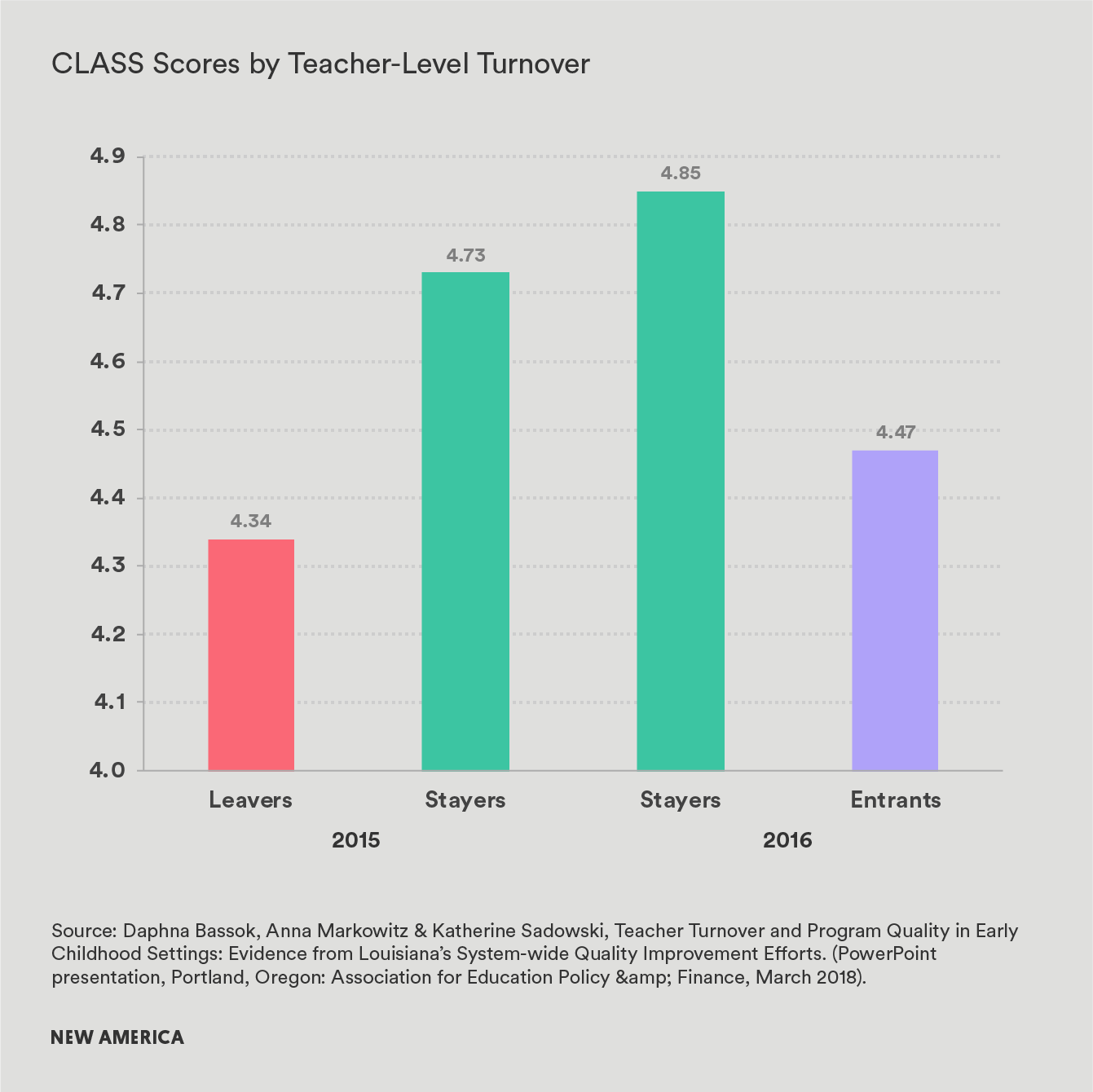
Because this information is limited to CLASS scores, it is difficult to draw conclusions. But these findings suggest that quality is improving over time, with those staying in the field improving their CLASS scores and those who are not performing as well choosing to leave. In addition to helping policymakers understand trends in the workforce, CLASS scores can also be useful to help identify areas for improvement in teacher practice and inform professional learning.
Bassok told New America that transitioning to CLASS was challenging for teachers in child care programs, for which these types of observations were totally new. And even though pre-K teachers in public schools were already accustomed to classroom observations, they had been using the state’s observation system designed for kindergarten through fifth grades, so switching to CLASS was a big change. Because CLASS is working so well in pre-K, Bassok says the state sees this as an opportunity to expand the use of CLASS into kindergarten and possibly beyond. Some Louisiana elementary schools are already piloting CLASS in kindergarten. According to Bassok, the state is “low on resources, but is doing a lot to create systems. A lot of this is expensive and takes resources and time. It's hard to ask this workforce to do certain things when their resources are so low.”
While CLASS is popular among state policymakers and some practitioners, and implementation appears to be going well, it is not a perfect measure. The University of Virginia researchers admit in their report that “the associations between CLASS scores and child outcomes tend to be modest.”37 CLASS was originally designed to be a professional development tool, and not intended to be used in a high-stakes way. But according to Bassok, “what’s always super striking during these visits [to Louisiana] is just how focused the directors and leaders are on providing professional development in support of the CLASS. It is true they are using CLASS as an accountability tool, but it’s also true that there is a lot of focus on CLASS as a formative tool.”38
CLASS scores can also be useful to help identify areas for improvement in teacher practice and inform professional learning.
Implementation of this new system has been challenging. Familiarizing the workforce with CLASS and training local observers has been both expensive and time consuming. One Lake Charles center director said, “we don’t have the manpower to go in and score every single center. It takes a lot of time to give feedback and conduct the observations.” And one child care teacher shared her mixed feelings in a focus group: “once they explained it more to us and showed us exactly what they are looking for in each section it made it easier. Some aspects I still think are unrealistic. If you have a special needs child, it makes things a lot more difficult.” LDE acknowledges the importance of educator buy-in to make this system work, which was part of the rationale behind having local raters conduct the observations.39
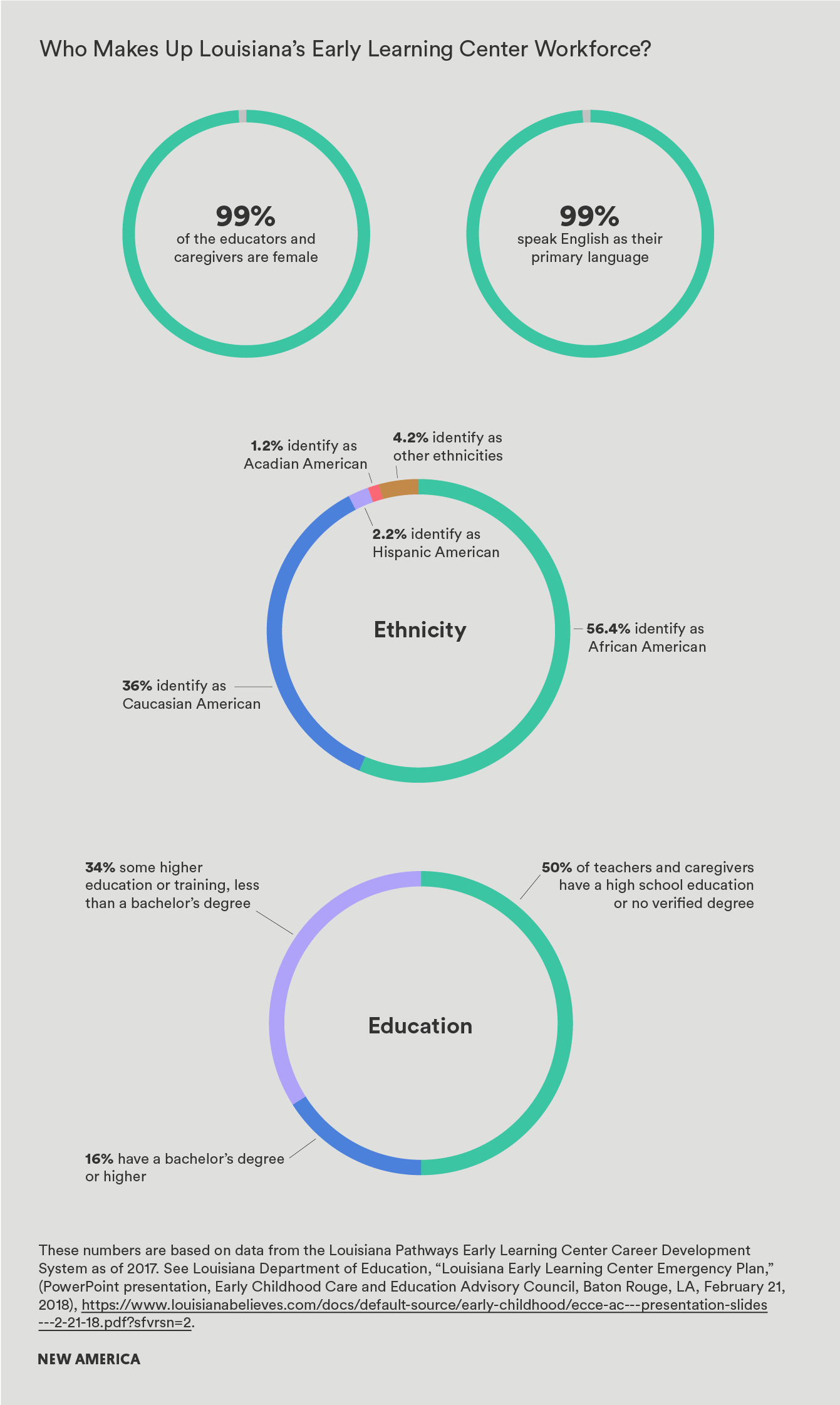
Part of the challenge is that much of the ECE workforce in Louisiana (and in other states as well) does not have a strong background in child development and early learning and may be learning about how to engage in high-quality interactions for the first time with the CLASS training. Until recently, expectations for the quality and education of caregivers and teachers in early learning centers were low.
Citations
- Current Status of QRIS in States [map]. Scale not given. QRIS National Learning Network. January 2017, https://www.qrisnetwork.org/sites/all/files/maps/QRISMap_0.pdf
- Jenna Conway (former assistant superintendent, Louisiana Department of Education), interview with author, April 3, 2018.
- Jill S. Cannon, Gail L. Zellman, Lynn A. Karoly, and Heather L. Schwartz, Quality Rating and Improvement Systems for Early Care and Education Programs: Making the Second Generation Better (Santa Monica: RAND Corporation, 2017), https://www.rand.org/pubs/perspectives/PE235.html
- On July 9, 2018, the author met with approximately 12 center directors, teacher coaches, and local leaders associated with the Children First Ancillary Certificate program in Lake Charles, LA for a focus group-style conversation to discuss how recent state policy changes have impacted their work locally.
- Each lead agency determines who the local observers will be. Lead agencies are continuing to figure out how to staff local observations. They can be center directors, school principals, people from the Child Care Resource & Referral Agency, or someone the lead agency has contracted with, to name a few. The state does not collect these data but provides the money to lead agencies for observer trainings and observations.
- Louisiana Policy Institute for Children (website), “2016 Early Education Policy Updates,” http://www.policyinstitutela.org/2016-early-education-policy-updates.
- For more information on how tools like the CLASS are used to improve teacher-child interactions, see Lisa Guernsey and Susan Ochshorn, Watching Teachers Work: Using Observation Tools to Promote Effective Teaching in the Early Years and Early Grades (Washington, DC: New America, 2011).
- Louisiana Department of Education, “The Early Childhood Care and Education Commission: Ensuring Access to Quality for Louisiana’s Youngest,” (PowerPoint presentation, August 1, 2018), https://bit.ly/2DDxb8W
- CLASS was developed at the Curry School Center for Advanced Study of Teaching and Learning at the University of Virginia.
- Virginia E. Vitiello, Daphna Bassok, Bridget K. Hamre, Daniel Player, and Amanda P. Williford, “Measuring the Quality of Teacher–Child Interactions at Scale: Comparing Research-Based and State Observation Approaches,” Early Childhood Research Quarterly 44 (2018): 161–169.
- Jill S. Cannon, Gail L. Zellman, Lynn A. Karoly, and Heather L. Schwartz, Quality Rating and Improvement Systems for Early Care and Education Programs: Making the Second Generation Better (Santa Monica, CA: RAND Corporation, 2017), https://www.rand.org/pubs/perspectives/PE235.html
- Daphna Bassok, Anna Markowitz, & Katherine Sadowski, Teacher Turnover and Program Quality in Early Childhood Settings: Evidence from Louisiana’s System-wide Quality Improvement Efforts. ((PowerPoint presentation, Portland, Oregon: Association for Education Policy & Finance, March 2018).
- Virginia E. Vitiello, Daphna Bassok, Bridget K. Hamre, Daniel Player, and Amanda P. Williford, “Measuring the Quality of Teacher–Child Interactions at Scale: Comparing Research-Based and State Observation Approaches,” Early Childhood Research Quarterly 44 (2018): 161–169.
- Email with Daphna Bassok (associate professor of Education and Public Policy, University of Virginia), October 11, 2018.
- Email with Daphna Bassok (associate professor of Education and Public Policy, University of Virginia), October 11, 2018.
Reform #2: Raising Requirements for Early Childhood Educators
Starting in July 2019, all lead teachers in Louisiana early learning centers will be required to have formal education and training. LDE will require at least an Ancillary Certificate, or “enhanced CDA,” which is unique to Louisiana and must be completed through a Louisiana Board of Elementary and Secondary Education (BESE)-approved preparation program. The CDA requires 120 hours of professional education and 480 hours of field experience working with young children. And just like a CDA, the coursework covered in Ancillary Certificate programs must include things like supporting children’s social-emotional development and building relationships with families. LDE explains that the Ancillary Certificate “consists of sequential coursework that is connected to practice in an ECE classroom” and is aligned with the CLASS tool.40
The Council for Professional Recognition, which administers the CDA, has branded it the “best first step” for early childhood educators. Nine states currently require child care teachers to have a CDA, and 39 states require less than that.41
What makes the Ancillary Certificate “enhanced” is that it has a mentoring and coaching component to help cultivate changes in teacher practice. CLASS is also incorporated throughout the program’s coursework and practicum to ensure teachers are familiar with the tool. According to LDE’s website, Ancillary Certificate candidates must undergo CLASS observations by program instructors or coaches, which are used solely to inform coaching and instruction.42
Louisiana’s requirement for an Ancillary Certificate might sound minimal to the leaders in the field who are calling for all teachers to have a bachelor’s degree with specialization in ECE, as recommended by the National Academies of Science, Engineering, and Medicine. But Louisiana policymakers say they are being realistic about the starting point for their workforce, the limits of existing resources, and the fiscally conservative political climate. As Falicia Coleman said, “we have to meet individuals where they are. The reason we [Children First] have the slogan ‘We have your back’ is because sometimes these candidates cannot read well. Or read very little. We’re not going to laugh at that. We want to get them to the next level.”
State officials hope that requiring all teachers to have this knowledge foundation will improve the quality of care and education, which will set children up to be ready for kindergarten. Jenna Conway feels there is now “incredibly tight alignment between what we think is most important for kids and what we think teachers need for that.” While the Ancillary Certificate requirement goes into effect next summer, stakeholders have had five years to get on board.
Since the policy was enacted, BESE has approved 21 programs to offer the certificate. Using federal CCDBG dollars, the state created a competitive grant program called Believe and Prepare Early Childhood that gave programs start-up funding of up to $50,000.43 Just like K–12 teacher preparation programs, all Ancillary Certificate providers go to the state board for approval. The Believe and Prepare grants brought new providers to the table and also encouraged existing CDA programs across the state to meet requirements that go above and beyond their traditional programming. Believe and Prepare grants also included extensive coaching and support for programs while they were developing their new coursework. Community colleges, nonprofits, child care resource and referral agencies, and four-year institutions of higher education are now approved to prepare child care teachers. LDE is currently working with an online vendor to improve access statewide, especially for those in rural areas. Since 2014, the state has invested over $3 million in scholarships for preparation programs, Believe and Prepare start-up grants, and CDA assessment fees.
Community colleges, nonprofits, child care resource and referral agencies, and four-year institutions of higher education are now approved to prepare child care teachers.
Not only has Louisiana worked to make sure teachers have physical access to the Ancillary Certificate programs, but it has also prioritized financial accessibility, committing $5 million to scholarships so teachers can attend approved programs at no cost. When reflecting on the recent policy changes, one Lake Charles teacher who recently earned her Ancillary Certificate shared, “I thought it was good because we were able to get scholarships. Otherwise we wouldn’t have been able to go. I wouldn’t have been able to afford it.”
Overcoming Hurdles to Higher Qualifications
Even with free tuition and local or online programs, there is still the challenge of finding time for further education while working full time. A teacher who also recently completed her Ancillary Certificate said, “I didn’t think I was going be able to do it. I have so much going on with my kids. We are each trying to do school stuff. I was getting married. I had to fit all that in my schedule. Plus, I had to go back to get my high school diploma. I took some Saturdays and did it. Since I was also taking the college classes, it was a lot.”
State leaders knew that these policy changes could worsen turnover, which is at a rate of approximately 30 percent among child care centers nationally.44 While there are those who leave child care because they do not want to fulfill the higher qualification requirements, it is also a common problem in ECE for teachers to leave their current jobs once they earn more credentials that would allow them to pursue higher pay. Melanie Bronfin explained that LDE “thought CDA was the sweet spot to encourage people to have more education, but hopefully without having people leave for Head Start or the K–12 system.”
It is a common problem in ECE for teachers to leave their current jobs once they earn more credentials that would allow them to pursue higher pay.
Some teachers who have completed their Ancillary Certificate can already see how it is professionalizing the field. One teacher enrolled in Children First said she thinks the requirement “shows that we can do stuff. Some people think it’s only daycare, but we do teach. We are just like teachers. [This requirement] makes us look better.” Directors in Lake Charles had positive feedback too. One Children First director observed, “I’ve noticed changes in the directors, teachers, and kids. There is more unity among directors than ever before….I have quite a few teachers wanting to further their education….They’ll be in our office until 8:30 at night. I’m all about scripture, and it’s in unity where the blessings are. And all of this trickles down to our kids, the negative and the positive. And props to the directors too, because one of the biggest things is completion. The directors communicate with them and make sure they do their work.”
Since public pre-K teachers in Louisiana need to have a bachelor’s degree, the Ancillary Certificate programs are geared instead towards teachers in early learning centers outside of the public pre-K system. Teachers in those centers who already hold a CDA do not need to earn an Ancillary Certificate, but going forward, they will have to attend a state-approved program. Starting in 2019, teachers coming into the field will have two years from their date of hire to get an Ancillary Certificate. As of August 2018, 4,500 individuals had earned one.45
Naturally, not everyone is on board with the new reforms. One man who has owned an early learning center in Lake Charles for more than a decade said, “one thing you have to understand is that hires were usually people from the community. When you start implementing mandatory degrees, you start to alienate a lot of people. We’ve had three to four centers in the area decide that they would go completely private as a result.”
Conway explained to New America that “Louisiana is trying to transform an industry and has tried to be extremely thoughtful of the bottom line impact and how the state can support them [ECE programs] to be more effective.” When asked about pushback, she admitted that “there has been a lot of change and there are very real tensions around equity,” but said the state has “piloted all of its big moves to learn from the field and has tried to course correct when things didn't go as planned.” She said that the state is working on a system of accountability to measure the effectiveness of teacher preparation programs using a combination of data review and onsite review.
"Some people think it’s only daycare, but we do teach. We are just like teachers. [This requirement] makes us look better."
While the Ancillary Certificate is the current requirement for lead teachers, the state does not want it to be a dead end. About half of the Ancillary Certificate programs that are run by an institute of higher education or partnering with one ensure graduates leave with nine college credits. Louisiana has created a career pathway to enable Ancillary Certificate holders to pursue further education. Starting in 2015, LDE and the Board of Regents brought together a workgroup of over 50 professionals to identify “stackable courses for birth-to-kindergarten pathways that would lead to a certificate (such as a CDA), then associate degree, and then baccalaureate degree.”46 The state is still in the process of designing syllabi and developing courses for the Birth to Kindergarten field of study and will start by piloting them at selected higher education institutions.47 The next step is to ensure that this pathway is truly accessible to teachers.
Lake Charles Case Study: A Local Take on the State's Credentialing Policy
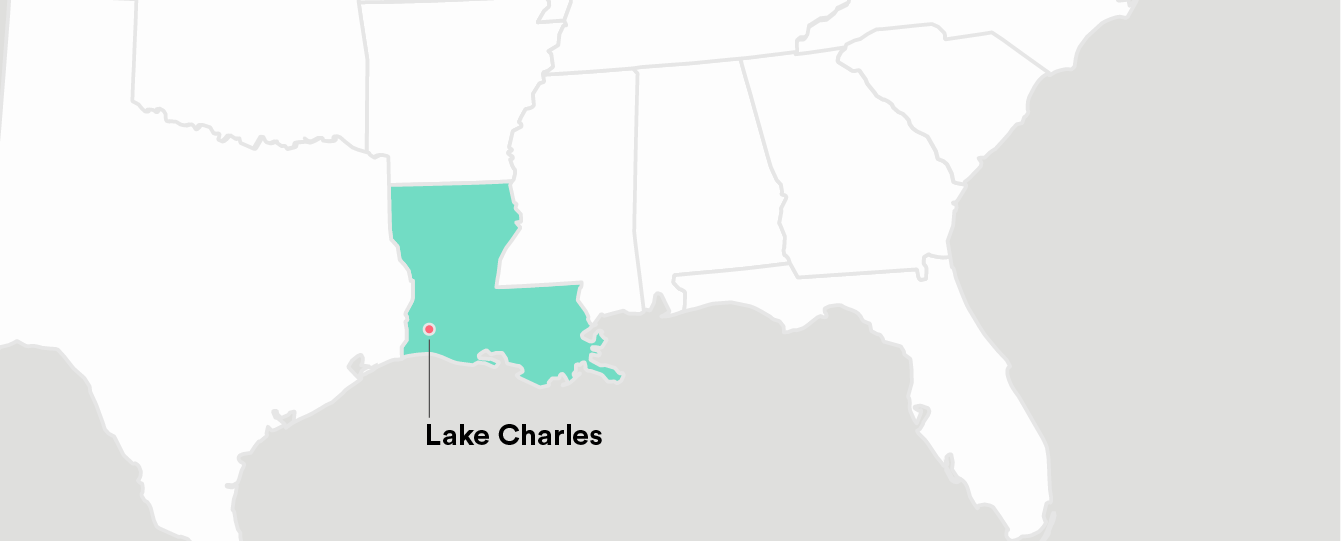
Getting the Ancillary Certificate students to the graduation ceremony in Lake Charles took multiple years of concerted effort.
Falicia Coleman has been directing her early learning center, All About Kids Preschool, for 18 years. About five years ago she saw the need for her teachers to improve their practice and thought the Child Development Associate (CDA) credential was a good starting point. She worked with other local center directors to start the professional learning center, Children First, and offer the CDA. “Our teachers had nowhere else to get the CDA if we didn’t provide it,” she recalls. “They would have to drive over an hour to get any type of program.” She said, “I told my teachers, we’re giving up our breaks, we are gonna get this CDA….Then I called different child cares and asked if they wanted their girls [teachers] to get their CDA too. We created a network with all the directors because we really needed to get our teachers credentials.”
As LDE has worked to change the field that Coleman has long known and loved, she has largely been on board. When the state decided that all child care teachers would need the Ancillary Certificate from an approved program, Coleman knew she was at risk of having to close Children First if it did not adapt. She had to complete the rigorous application process multiple times before Children First was approved to provide the Ancillary Certificate.48 Despite the adjustment, Coleman says of the state’s move to house all early care and education under LDE: “when the school system took over child care, that helped.”
Children First is the only Ancillary Certificate program run by center directors. They have a partnership with the Lastinger Center at the University of Florida. Students take courses online and then engage with peers face-to-face each week. Unfortunately, the courses are not yet eligible for college credit. University of Florida’s Lara Glaser said, “this is a population with generally low confidence in their abilities and Coleman's team has made a huge difference in the success of this program.”
Numerous people credit Children First’s success to Coleman and her team. One Lake Charles director said, “you can tell the teachers to get their CDA and they don’t care…but they meet Falicia and the coaches and then they feel differently.” She is widely admired for being a great motivator and her dedication to this issue is clear to state officials, directors, and teachers alike. As another center director explained, “a lot of people who go to work in child care centers, their heart is there, but they don’t have the confidence to further their education…they are great nurturers but need to be great educators also.” Coleman’s enthusiasm and support helps them get there.
Coleman sends out regular emails to local and state leaders with pictures of what Children First students are accomplishing on a regular basis. She cares deeply about helping the ECE workforce in Lake Charles and has her whole family involved in the process—her husband regularly delivers home-cooked meals for the students during late night classes, and she encourages them to take leftovers home to their own families. Coleman has a master’s degree and leads her own center, but she understands some of the barriers that her students face to access higher education: “my mom never had a high school diploma. My dad didn’t either. I tell the girls, you need to help your sisters. My background is casino manager. These ladies are uneducated; they might not have cars.”
Children First found technology to be a significant hurdle for some students—whether it was slow wifi or only having phones or tablets to complete their coursework. So directors encourage their teachers to use the center computers during breaks, after hours, or even on weekends. Teachers say they feel that the center directors are invested in their success and some said that they had received texts of encouragement or reminders if they were behind in their assignments. One teacher said, “I used to look forward to Tuesdays [when we met in person], so we could get together to discuss our lesson.”
Even with this support, teachers in Lake Charles said some of their colleagues decided it was easier to just leave ECE than to go back to school since they can earn comparable wages at a job with no higher education requirements. The 2017–18 cohort of Ancillary Certificate students started the year with 55 people and graduated 34. Some teachers felt the requirement effectively encouraged those who were not passionate about working with children to leave the field.
Citations
- Louisiana Department of Education in correspondence with the author, October 19, 2018.
- Early Childhood Workforce Index 2018: 4: Early Childhood Workforce Policies (Berkeley, CA: Center for the Study of Child Care Employment, 2018), http://cscce.berkeley.edu/files/2018/06/4-ECE-Policies.pdf
- Louisiana Department of Education (website), “Early Childhood Ancillary Certificate Program Applicants: Frequently Asked Questions for Applying Programs,” updated June 2018, https://www.louisianabelieves.com/docs/default-source/early-childhood/early-childhood-ancillary-certificate-program--applicant-faqs.pdf?sfvrsn=12
- Julia H. Kaufman, Jill S. Cannon, Shelly Culbertson, Margaret Hannan, Laura S. Hamilton, and Sophie Meyers, Raising the Bar: Louisiana’s Strategies for Improving Student Outcomes (Santa Monica, CA: RAND Corporation, 2018), https://www.rand.org/pubs/research_reports/RR2303.html; Louisiana Department of Education correspondence with the author, October 24, 2018.
- Marcy Whitebook and Laura Sakai, Turnover Begets Turnover: An Examination of Job and Occupational Instability Among Child Care Center Staff (Berkeley, CA: Center for Study of Child Care Employment, 2003), http://cscce.berkeley.edu/files/2003/turnoverchildcare.pdf
- Louisiana Department of Education, “The Early Childhood Care and Education Commission: Ensuring Access to Quality for Louisiana’s Youngest,” (PowerPoint presentation, August 1, 2018), https://www.louisianabelieves.com/docs/default-source/early-childhood/ecce-commission---presentation-slides---8-1-18.pdf?sfvrsn=4
- Louisiana Policy Institute for Children (website), “The New World of Early Learning in Louisiana: Career Pathways for Teachers,” http://www.policyinstitutela.org/career-pathways
- Louisiana Board of Regents (website), “Birth to Kindergarten Pathway,” https://regents.la.gov/divisions/planning-research-and-academic-affairs/academic-affairs/teacher-education-initiatives/birth-to-kindergarten-pathway/
- Louisiana Department of Education, “Updates on Early Childhood Teacher Preparation: Preparing for 2018 Program Approval Requirements” (PowerPoint presentation, Baton Rouge, LA, July 2017), https://www.louisianabelieves.com/docs/default-source/early-childhood/updates-for-cda-and-technical-diploma-programs-considering-bese-approval---july-2017.pdf?sfvrsn=4
Reform #3: Supplementing Wages with Tax Credits
One of the primary barriers to attracting and retaining a high-quality workforce is the abysmally low compensation, especially for those working with infants and toddlers. This is a challenge that states are struggling with nationwide, but, according to the 2018 Early Childhood Workforce Index, Louisiana child care workers are some of the lowest paid in the country, even when adjusting for cost of living.49 The economic insecurity these teachers experience can affect their ability to engage and have high-quality interactions with children.
For good reason, the field has been wary of raising qualification requirements without also addressing the poverty-level wages and often nonexistent employee benefits. Teachers working in early learning centers should not be expected to invest their limited time and money in more education and training without the guarantee of significantly better compensation. Many infant and toddler teachers who do earn higher credentials leave their early learning centers to work in Head Start or in the public school system where pay is higher. With limited federal and district-level oversight and funding, individual early learning centers, which are usually running on tight budgets, have little room to increase teacher pay.
Over a decade ago, Louisiana came up with a way to address these issues. The state’s School Readiness Tax Credits (SRTC) are directed at teachers, center directors, parents, and the business community to encourage quality early learning. They have been updated recently to align with the reforms to the ECE system. Teachers in child care centers can now earn a refundable tax credit, referred to as the Teacher SRTC, ranging from $1,630 to $3,358 depending on their education level and how many years they have worked in child care.50 Teachers are eligible for the full SRTC if they earn the Ancillary Certificate and stay in the child care sector for more than two years, or if they earn higher levels of education, such as a bachelor’s degree. Teachers do not have to remain at the same child care center during that time period to remain eligible for the full credit. Center directors can also earn tax credits based on educational attainment or their site performance as determined by CLASS scores.
Teachers in child care centers can now earn a refundable tax credit, referred to as the Teacher SRTC, ranging from $1,630 to $3,358.
Back in 2007, the tax credits started as a way to encourage early learning centers to participate in and support the state’s QRIS.51 In a deeply Republican state like Louisiana, tax credits tend to be more politically viable than other forms of government spending. Also aligning with conservative policy ideals, the tax credit is earned as opposed to an entitlement; teachers must attain a credential to get it. Like other tax credits, the money comes from Louisiana’s Department of Revenue, not LDE. According to LDE, the “School Readiness Tax Credits are a $16 million investment annually in quality child care.”52 The Teacher and Director SRTC (they are grouped together as one in the budget) is the most popular of them; a total of 4,044 individuals claimed the credit in 2016 for a total of over $8.7 million. When the tax credits first went into effect in 2008, only 874 educators claimed the credit, for a total of $1.5 million.53 There has since been a substantial increase in the percentage of teachers pursuing higher levels of education.54
Only Type III centers are eligible for the various tax credits in the SRTC package. LDE believes this has encouraged centers to stay or become Type III centers and serve children receiving subsidies.55 One Lake Charles director said, “with the new requirements we got nervous about losing teachers. But the tax credits came along and helped. They supplemented pay.” In a recent presentation, LDE said, “child care directors and teachers indicate that they rely on the credits to make essential purchases, retain teachers, and invest in quality improvement, which is especially important with the 2019 requirement that lead teachers have an ancillary certificate.”56
Louisiana’s early childhood career development registry, known as Louisiana Pathways, monitors education standing and is responsible for making sure eligible teachers receive their tax credits. Joining the registry is free and people who earn their Ancillary Certificate are automatically enrolled. The Pathways team has been expanding in recent years to accommodate the huge increase in active registry members—there are now over 16,000—and to coordinate the Ancillary Certificate scholarships and tax credits.
The Viability of Tax Credits
As the Committee for Economic Development (CED), a national nonpartisan research organization focused on finding solutions to important public policy issues, explains in a recent analysis of the Teacher SRTC, there are key features that make it successful.57 Because the tax credit is refundable, it is able to raise wages for even the lowest earners who may not owe income tax. CED also discusses the importance of indexing the tax credit to inflation, which Louisiana does, so that the real value does not decrease over time. And while $3,358 might seem like a modest increase in wages for a workforce that is grossly underpaid, CED points out that it is more than a 10 percent increase in wages for the average Louisiana child care worker.
While tax credits are one way to lessen the economic burden on the early childhood workforce, there are downsides to this approach. One major drawback is that the credit comes in full, one time per year. Families living in poverty, as much of the ECE workforce is,58 may benefit from higher wages or benefits on a regular basis instead of waiting all year for the credit. This workforce often does not earn enough to have sufficient savings and might need money available for day-to-day expenses or an emergency. And from the Louisiana Pathways perspective, communication is still a hurdle. Jenny Cowan, Louisiana Pathways Scholarship Coordinator, noted that “a lot of people are aware of the credit and know the expectations and know they need to enroll in Pathways. But there are still a lot that don’t. They need to see the full picture and understand all the puzzle pieces and how it all works.”
Unlike a wage increase that would automatically go into someone’s paycheck, receiving the tax credit does take an extra step, and some eligible teachers might not fully understand the process or take the time to do it. While any wage supplement is better than no wage supplement, are the tax credits more of a Band-Aid than a cure? Are they a cheaper and potentially temporary replacement for higher wages?
While $3,358 might seem like a modest increase for a workforce that is grossly underpaid, it is more than a 10 percent increase in wages for the average Louisiana child care worker.
Advocates for the refundable tax credits argue that they can be part of an overall strategy to link wages with educational achievements, which makes it more likely that compensation increases will occur, particularly in more conservative states that are less likely to increase the minimum wage. Others believe a totally new approach is needed to finance the currently under-resourced child care system as a whole, rather than address each type of challenge separately (e.g., low compensation, no benefits, lack of economic incentive for professional development, etc.).
Citations
- Early Childhood Workforce Index 2018: 3: Earnings & Economic Security (Berkeley, CA: Center for the Study of Child Care Employment, 2018), http://cscce.berkeley.edu/files/2018/06/3-Earnings-Economic-Security.pdf
- Louisiana Department of Education, “Updates to School Readiness Tax Credits for 2018” (PowerPoint presentation, Baton Rouge, LA: Louisiana Department of Education, December 2017), https://www.louisianabelieves.com/docs/default-source/early-childhood/srtc-webinar---reviewing-changes-for-the-2018-tax-year.pdf?sfvrsn=5; Louisiana Department of Education, “School Readiness Tax Credits (SRTC) Guidance,” December 2017, https://www.louisianabelieves.com/docs/default-source/early-childhood/school-readiness-tax-credits-(srtc)-guidance.pdf?sfvrsn=3; Louisiana Department of Revenue (website), “School Readiness Tax Credit,” http://revenue.louisiana.gov/IndividualIncomeTax/SchoolReadinessTaxCredit
- Melanie Bronfin (executive director, Louisiana Policy Institute for Children), interview with author, March 29, 2018.
- Updates to School Readiness Tax Credits for 2018 (Baton Rouge, LA: Louisiana Department of Education, December 2017), https://www.louisianabelieves.com/docs/default-source/early-childhood/srtc-webinar---reviewing-changes-for-the-2018-tax-year.pdf?sfvrsn=5
- Louisiana Department of Revenue data shared with New America by Melanie Bronfin.
- Louise Stoney, Melanie Bronfin, and Monica Candal Rahim, Giving Credit Where It’s Due: School Readiness Tax Credits Benefit Louisiana Families and Communities (New Orleans, LA: Louisiana Policy Institute for Children, October 2016), http://media.wix.com/ugd/43cca3_5dd38dfb258f476b81b2432d9ee6c356.pdf
- Louisiana Department of Education, “Updates to School Readiness Tax Credits for 2018” (PowerPoint presentation, Baton Rouge, LA: Louisiana Department of Education, December 2017), https://www.louisianabelieves.com/docs/default-source/early-childhood/srtc-webinar---reviewing-changes-for-the-2018-tax-year.pdf?sfvrsn=5
- Louisiana Department of Education, “Updates to School Readiness Tax Credits for 2018” (PowerPoint presentation, Baton Rouge, LA: Louisiana Department of Education, December 2017), https://www.louisianabelieves.com/docs/default-source/early-childhood/srtc-webinar---reviewing-changes-for-the-2018-tax-year.pdf?sfvrsn=5
- Anne Mitchell and Louise Stoney, Pathways to High Quality Child Care: The Workforce Investment Credit (Arlington, VA: Committee for Economic Development, 2017), https://www.ced.org/pdf/PathwaysToHighQualityChildCare.pdf
- Nationwide, 53 percent of child care workers were on at least one public assistance program between 2014 and 2016. See Marcy Whitebook, Caitlin McLean, Lea J. E. Austin, and Bethany Edwards, Early Childhood Workforce Index 2018 (Berkeley, CA: Center for the Study of Child Care Employment, 2018), http://cscce.berkeley.edu/files/2018/06/Early-Childhood-Workforce-Index-2018.pdf
Connecting ECE to Kindergarten and the Early Grades
Louisiana has taken on multiple policies in a short amount of time to try to bring consistency and quality to the birth-to-five arena. But just as important is ensuring that children continue to have access to developmentally appropriate, high-quality education in kindergarten and elementary school. Only then will they be able to sustain the gains made in the early years.
The state can take steps to ensure that not only are children ready for kindergarten, but also that kindergartens are ready for their incoming students. As New America policy analyst Aaron Loewenberg explains, the transition to kindergarten “is fraught with stress and uncertainty for many children and their parents. It is up to the educators in both elementary school and pre-K settings to ease the transition into formal education.”59 And while kindergarten, first, and second grade teachers do not face the acute challenges of low qualifications and minimal compensation, they are often not prepared to serve young children in the best ways.
Licensure policy is one way to address this, since educator preparation programs are usually designed based on what states require for licensure. There are basic knowledge and skills teachers should attain in preparation programs before managing a classroom of young children. There are currently three overlapping licenses in Louisiana for educators of kindergarten through third grade students:
- Birth to Kindergarten
- Early Childhood PK–3
- Grades 1–5 (Elementary)
According to officials at LDE, “a clear distinction between the two licenses [Early Childhood PK–3 and Grades 1–5] is that there are different competencies that must be demonstrated. In addition, there are different principles of learning and teaching licensing exams required for these two certifications.” They explained to New America that the PK–3 license is focused on early childhood development while the Grades 1–5 license is focused on content.
This distinction between early childhood licenses and elementary licenses is common across states. As New America wrote in From Crawling to Walking: Ranking States on Birth–3rd Grade Policies that Support Strong Readers, “elementary licenses tend to focus on subject-area content and strategies more appropriate for older children, while early childhood licenses tend to focus more on how to teach new and emerging readers, how to incorporate play, child-directed activities, and exploration into learning, and how to engage families. Early childhood licenses also have a strong focus on child development.”60 The Birth to Kindergarten degree and certification is new, and higher education institutions and teacher preparation programs around the state are still developing their program proposals to offer it.
One positive aspect of Louisiana’s licensing structure is that kindergarten teachers need to have either the Birth to Kindergarten or the Early Childhood PK–3 license. As of 2015, only 13 states had a similar requirement. While all pre-K through third grade teachers need early childhood competencies, this is especially important in kindergarten.61 Louisiana does offer teachers the option to earn endorsements in any of the three licenses usually through a combination of coursework and/or scores on the Praxis exam, depending on their existing license.62
Louisiana can take steps to ensure that not only are children ready for kindergarten, but also that kindergartens are ready for their incoming students.
The state has also started expanding the use of the CLASS tool into some kindergarten and early grade classrooms, which could translate to better instruction in these years as teachers improve the quality of interactions with their young students. Many elementary school principals that have pre-K classrooms in their building have already been receiving CLASS training.63 Some principals serve as their pre-K classrooms’ internal CLASS observer. Conway said that this is “transforming the way elementary school principals think about their pre-K classrooms.” Anecdotally, she says it has encouraged them to think differently about who they are hiring and how they are supporting pre-K classrooms.
With greater consistency in pre-K quality as a result of the reforms outlined in this paper, the hope is that more children will be prepared for kindergarten. Connecting the work happening in the birth-to-five space will be key to ensuring that gains are sustained in kindergarten and beyond. Officials at LDE admitted to New America that they have been focusing their attention on the Ancillary Certificate program and noted that the “K–2 grade span has the most work in progress compared to other grades.”
Citations
- Aaron Lowenberg, Out Today: Connecting the Steps, State Strategies to Ease the Transition from Pre-K to Kindergarten (Washington, DC: New America, July 2017), https://www.newamerica.org/education-policy/edcentral/out-today-connecting-steps/
- Laura Bornfreund, Shayna Cook, Abbie Lieberman, and Aaron Loewenberg, From Crawling To Walking: Ranking States on Birth–3rd Grade Policies That Support Strong Readers (Washington, DC: New America, 2015), https://static.newamerica.org/attachments/11902-from-crawling-to-walking/50-State-Scan.fe1ae7082db6418dabeb3eee29cea669.pdf
- Laura Bornfreund, Shayna Cook, Abbie Lieberman, and Aaron Loewenberg, From Crawling To Walking: Ranking States on Birth–3rd Grade Policies That Support Strong Readers (Washington, DC: New America, 2015), https://static.newamerica.org/attachments/11902-from-crawling-to-walking/50-State-Scan.fe1ae7082db6418dabeb3eee29cea669.pdf
- Louisiana Department of Education (website), “Preparation: Policies/Bulletins,” https://www.teachlouisiana.net/Prospect.aspx?PageID=501
- Erin Carroll (director of Classroom and Workforce Improvement in LDE’s Office of Early Childhood), Erin Bendily (assistant superintendent of Policy and Governmental Affairs at LDE), Hannah Dietsch (assistant superintendent of Talent at LDE), Jessica Baghian (assistant superintendent of Early Childhood at LDE), interview with author. June 1, 2018.
Concluding Thoughts, Lessons, and Policy Considerations
Louisiana policymakers have enacted multiple reforms to strengthen the state’s ECE workforce, with a strong focus on infant and toddler teachers. Their goals have been ambitious while remaining realistic about available resources and the starting place of the workforce. Their efforts are coordinated toward creating more consistent high-quality ECE experiences for all children from birth to age five. The policies discussed in this paper are just a fraction of the changes the Bayou State has made to its early education system in recent years. Other promising policies that are not specifically related to the ECE workforce are also underway, such as creating accessible performance profiles for each program to help parents choose the best center for their children.64 This paper has focused on the workforce and how state policies have played out in one specific community, Lake Charles. Systems reform is difficult. Only time will tell whether Louisiana’s efforts lead to better quality and more equitable ECE.
Four Lessons for Other States
While several states are already ahead of Louisiana in terms of early childhood educator qualifications and wages, many are not. Louisiana offers several lessons that other states can draw on when taking steps to strengthen their own ECE workforce.
- Ensure that further education and training is accessible. Higher education and professional learning are key methods for building a knowledgeable and skilled workforce. But before a state requires or incentivizes educators to earn higher qualifications, it must put supports in place so that this workforce can better access programs or opportunities. There is a large body of research detailing the barriers to higher education that early educators, and nontraditional and low-income students more broadly, commonly face.65 Limited time and money, low education level, and lack of reliable technology, are just some. When Louisiana added the Ancillary Certificate requirement, it not only gave the workforce multiple years to earn it, but also provided start-up funds to local preparation programs so that classes were offered throughout the state, and it offered full scholarships to attendees. It also automatically enrolled graduates in the state workforce registry, making it easy for them to receive the tax credit to supplement their wages, when eligible.
- Prioritize collecting, using, and sharing data. A key advantage of having a unified ECE system is the ability to collect data on all centers participating in the QRIS. Louisiana now has multiple years of CLASS data measuring teacher-child interactions for every classroom in every center receiving public funding. All teachers, including child care teachers, receive feedback. These data have allowed the state to analyze its early education system in new ways. As Daphna Bassok at University of Virginia said, “the state’s data is unprecedented both in its scope and in its richness. For the first time a state can really look carefully at quality improvements over time, across all sectors, at the program and even at the classroom level.” The data are used to inform professional development. And Louisiana plans to use data to hold Ancillary Certificate programs accountable.
Interviews with LDE officials attest that they are committed to continuous improvement, and having data to measure what is working and what is not is key to making that a reality. CLASS might not be the right tool for every state but having a way to measure teacher-child interactions, a cornerstone of high-quality, especially when it can be linked to child outcomes, is important.
- Consider using new CCDBG funding to improve quality. Louisiana has devoted federal Child Care and Development Block Grant (CCDBG) dollars to quality improvements, including scholarships for Ancillary Certificate program attendees and start-up grants for preparation programs. Less than half of states use CCDBG dollars for early educator scholarships.66 To be sure, Louisiana has made a trade-off: it has implemented a policy to ensure that children who receive public subsidies are in quality care in lieu of any type of care. At the same time, the waitlist for child care assistance is very long and Louisiana has invested little of its own money to improve access. Finding the right balance of where to invest in quality versus access is something that other states should think strategically about.
- Be strategic about implementation. Passing legislation or creating new regulations is often the first step to policy change, but the key to success lies in implementation. While Louisiana has made numerous changes over the last five years, Jenna Conway says the state “piloted all of [its] big moves to learn from the field and [has] tried to course correct when things didn't go as planned.” State policy changes have largely been implemented at the local level, with community networks leading the work. And the state has provided local support, financial assistance, and time to make changes. To meet the Ancillary Certificate requirement, officials “gave us the plan ahead of time. They spent hours around the table figuring out how to roll it out. Two to three years ago they said to accomplish it by 2019; this was the expectation. In the process they gave us resources and scholarships,” Sheryl Piper, retired early childhood director and senior board member for Children First in Lake Charles, said.
A recent analysis by RAND Corporation of Louisiana’s education reforms identified “close involvement with educators to gather feedback and promote buy-in” as a theme of the state’s reform efforts.67 RAND wrote that “state leaders have developed a variety of communication approaches, both formal and informal, and many of them focus on seeking feedback from teachers and other educators.”68 Interviews with state policymakers demonstrate a cohesive vision for reform, and interviews with local leaders in Lake Charles suggest that this vision has been clearly communicated and understood.
State policy changes have largely been implemented at the local level, with community networks leading the work.
Four Policy Considerations for Louisiana
Louisiana should consider the following recommendations to enhance its ECE work:
- Increase state investment in child care. According to Melanie Bronfin, CCAP has gone from serving approximately 40,000 children in 2012 to only 15,000 children today. While federal funding for child care subsidies has grown, the Louisiana Policy Institute for Children finds that the state “has substantially decreased its spending on early care and education in the last eight years—to the point that we now appropriate less than ½ of 1% of our state general funds on early care and education.”69 State funding for pre-K has also been reduced in recent years, but not as dramatically. Per child funding levels in child care and state pre-K are significantly lower than those for Head Start and grades K-12 .70 The low funding levels per child are especially worrisome in child care programs, which usually operate year-round with extended hours to accommodate parent work schedules. While the recent federal increase in Child Care and Development Block Grant dollars will help get thousands of children off the waiting list for subsidies in Louisiana, federal funds should not supplant state investment, given the small percentage of children birth through age three in Louisiana who can access any publicly funded program, even with the federal increase in funds.71
- Start thinking more comprehensively about K–3. While the challenges facing the child care workforce, particularly those working with infants and toddlers, are most acute, the state should also take steps to ensure that kindergarten, first, second, and third grade teachers and administrators are prepared to serve young children. All teaching licenses that certify educators to work with children from birth to age eight should have a strong foundation in child development and early learning. State and local districts should also create programs to ease the transition from early education programs into kindergarten; these are key to ensuring that children sustain the gains made in child care and pre-K. Louisiana is piloting aligned tools, including CLASS, in the K–3 space.
- Continue to think beyond the Ancillary Certificate. According to LDE, there is no official plan to raise qualification requirements past the Ancillary Certificate for child care teachers. The National Academy of Medicine recommends all lead teachers working with children birth through age eight have a bachelor’s degree with specialized training in early childhood education.72 Louisiana is wisely taking this work one step at a time. LDE’s Erin Carroll says that the “next move is to focus on the Birth to Kindergarten pathway. We’ve established the Birth to Kindergarten AA and BA. The Ancillary Certificate is the first three courses of that degree pathway.” It is logical to prioritize the Ancillary Certificate now based on where the workforce is now, but in the future the state should also provide scholarships for teachers to pursue the associate degree and then the bachelor’s degree. It must also ensure that the Ancillary Certificate is truly stackable. For instance, many of the existing Ancillary Certificate programs do not actually lead to college credit.
- Strengthen investments in early education leaders. Research shows that school leader quality greatly impacts child outcomes, as leaders are often responsible for hiring, supporting, and evaluating teachers. Thus, setting low expectations for both center directors and elementary school principals can jeopardize the quality of children’s learning experiences. Louisiana center directors with work experience in child care are only required to have minimal coursework or professional learning in child development or early childhood education, and management/administration education.73 The National Academy of Medicine recommends that center directors have at least a bachelor’s degree with specialized knowledge in early education.74 Louisiana does encourage directors to earn higher education by offering them a School Readiness Tax Credit, similar to what teachers can receive.75 However, the state should take a further step and increase center director qualification requirements to reflect child development research and implement a bachelor’s degree requirement over time. Any mandate to pursue higher education should be coupled with funding for scholarships.
While Louisiana elementary school principals need to have a bachelor’s degree and teaching experience, they do not need to have taught elementary school. Principal preparation programs in Louisiana are required to offer coursework on child development but not early learning.76 It is common for elementary school principals to lack a clear understanding of how young children learn best. Louisiana should require elementary school principals to have teaching experience or clinical experience specifically in elementary schools, and ideally in early childhood education.
Both principals and center directors could benefit from additional professional learning opportunities, or joint opportunities. Requiring all early learning programs to participate in the state’s QRIS, and thus requiring all leaders to be familiar with the CLASS tool, is an important step. According to a presentation for the Early Childhood Care and Education Advisory Council in February 2018, LDE has been researching and planning how to better support center directors.77 LDE is also developing an Early Childhood Leadership Academy for child care directors with funding from Harvard University’s Zaentz Early Ed Innovation Challenge that is expected to be piloted in 2019.78
Citations
- See “Welcome to the Louisiana School Finder,” www.louisianaschools.com to view the performance profiles.
- Emily Workman, Lisa Guernsey, and Sara Mead, Pre-K Teachers and Bachelor’s Degrees: Envisioning Equitable Access to High-Quality Preparation Programs (Washington, DC: New America, February 2018), http://na-production.s3.amazonaws.com/documents/PreK-Teachers-Bachelors-Degrees.pdf; Marnie Kaplan, It Takes a Community: Leveraging Community College Capacity to Transform the Early Childhood Workforce (Washington, DC: Bellwether Education Partners, January 2018), https://bellwethereducation.org/publication/it-takescommunity-leveraging-community-college-capacitytransform-early-childhood
- According to Sue Russell (executive director, T.E.A.C.H. Early Childhood National Center), 18 states (including Washington, D.C.) use CCDBG dollars for T.E.A.C.H. early childhood scholarships.
- Julia H. Kaufman, Jill S. Cannon, Shelly Culbertson, Margaret Hannan, Laura S. Hamilton, and Sophie Meyers, Raising the Bar: Louisiana’s Strategies for Improving Student Outcomes (Santa Monica: RAND Corporation, 2018), https://www.rand.org/pubs/research_reports/RR2303.html
- Julia H. Kaufman, Jill S. Cannon, Shelly Culbertson, Margaret Hannan, Laura S. Hamilton, and Sophie Meyers, Raising the Bar: Louisiana’s Strategies for Improving Student Outcomes (Santa Monica, CA: RAND Corporation, 2018), https://www.rand.org/pubs/research_reports/RR2303.html
- Louisiana Policy Institute for Children (website), “Early Care and Education in Louisiana: 2018,” http://docs.wixstatic.com/ugd/43cca3_24e064c9362449b7b5ab43f2d590f497.pdf
- National Institute for Early Education Research. The State of Preschool: State Preschool Yearbook. Louisiana, 2017 http://nieer.org/wp-content/uploads/2018/04/Louisiana_YB2017.pdf
- Melanie Bronfin, “The Good and the Bad: Early Care and Education in Louisiana So Far in 2018,” Alliance for Early Success (website), August 23, 2018, http://www.earlysuccess.org/blog/good-and-bad-early-care-and-education-louisiana-so-far-2018
- LaRue Allen and Bridget B. Kelly, eds., Transforming the Workforce for Children Birth Through Age 8: A Unifying Foundation (Washington, DC: National Academies Press, 2015), https://www.nap.edu/catalog/19401/transforming-the-workforce-for-children-birth-through-age-8-a
- Louisiana State Board of Elementary and Secondary Education (BESE), Part CLXI. BULLETIN 137—LOUISIANA EARLY LEARNING CENTER LICENSING REGULATIONS, http://docs.wixstatic.com/ugd/43cca3_9df5a2fbadca49019f65c603e09960a3.pdf
- LaRue Allen and Bridget B. Kelly, eds., Transforming the Workforce for Children Birth Through Age 8: A Unifying Foundation (Washington, DC: National Academies Press, 2015), https://www.nap.edu/catalog/19401/transforming-the-workforce-for-children-birth-through-age-8-a
- Louisiana Pathways, “Louisiana Pathways Career Development System Administrator Certificate,” April 3, 2018, http://pathways.nsula.edu/assets/Uploads/Admin-ladder-2018-final.pdf
- Abbie Lieberman, A Tale of Two Pre-K Leaders: How State Policies for Center Directors and Principals Leading Pre-K Programs Differ, and Why They Shouldn’t (Washington, DC: New America, May 2017), http://na-production.s3.amazonaws.com/documents/Tale-Two-PreK-Leaders.pdf
- Louisiana Pathways, “Career Development System Administrator Certificate,” April 3, 2018, http://pathways.nsula.edu/assets/Uploads/Admin-ladder-2018-final.pdf
- Louisiana Department of Education, “Early Childhood Care and Education Advisory Council” (PowerPoint presentation, September 12, 2018), https://www.louisianabelieves.com/docs/default-source/early-childhood/ecce-ac---presentation-slides---9-12-18.pdf?sfvrsn=bf93911f_2
Appendix: Interviews Conducted
- Jessica Baghian, assistant superintendent of Early Childhood, Louisiana Department of Education
- Daphna Bassok, associate professor of Education and Public Policy, University of Virginia and associate director of EdPolicyWorks
- Erin Bendily, assistant superintendent of Policy and Governmental Affairs, Louisiana Department of Education
- Melanie Bronfin, executive director, Louisiana Policy Institute for Children
- Jill Cannon, senior policy researcher, RAND Corporation and faculty member, Pardee RAND Graduate School
- Erin Carroll, director of Classroom and Workforce Improvement, Louisiana Department of Education’s Office of Early Childhood
- Falicia Coleman, executive director, Children First
- Jenna Conway, former assistant superintendent of Early Childhood, Louisiana Department of Education
- Jenny Cowan, Louisiana Pathways Scholarship Coordinator, NSU Child and Family Network
- Grace Reef, president, Early Learning Policy Group, LLC
- Cindy Cisneros, vice president of Education Programs, Committee for Economic Development (CED)
- Hannah Dietsch, assistant superintendent of Talent, Louisiana Department of Education
- Bridget Hamre, associate research professor and associate director, University of Virginia Center for Advanced Study of Teaching and Learning (CASTL)
- Sheryl Piper, retired early childhood director and senior board member, Children First
- Focus group with center directors and community leaders in Lake Charles:
- Linda Bordelon, Veronica Broussard, Brenda Certeuro, Tammy Cormier, Kimberly Dellafosse, Nic Hunter (mayor), Michelle Joubert, Melissa Kiffe, Darol King, Rosalyn King, Jennifer Li Vest, Stephanie Smith, Travonna Smith, Katie Stewart, and Lois Welch
- Focus group with Child First teachers:
- Derrick Beizeard, Ashley Edwards, Brittany Fontenot, Donna Guillory, Savannah Godeaux, Pamela Jack, Jessica Meche, Kiara Rosetti, Shelly Sipphy, and Trophosia Tanner
- Introduction
- Obstacles to Developing a Strong Workforce
- Early Care and Education in the Bayou State
- Reform #1: Measuring Quality Through Teacher-Child Interactions Alone
- Reform #2: Raising Requirements for Early Childhood Educators
- Reform #3: Supplementing Wages with Tax Credits
- Connecting ECE to Kindergarten and the Early Grades
- Concluding Thoughts, Lessons, and Policy Considerations
- Appendix: Interviews Conducted
More About the Author

Abbie Lieberman
Senior Policy Analyst, Early & Elementary Education