A Focus on Improving Teacher Instruction and Learning Environments
Laura Bornfreund / New America
In addition to the coaching that is tied to the accreditation process, there are a number of professional development opportunities focused on implementing the curriculum, observing children’s learning, and using instructional strategies to better support children’s learning.
Professional Development Before the School Year Begins
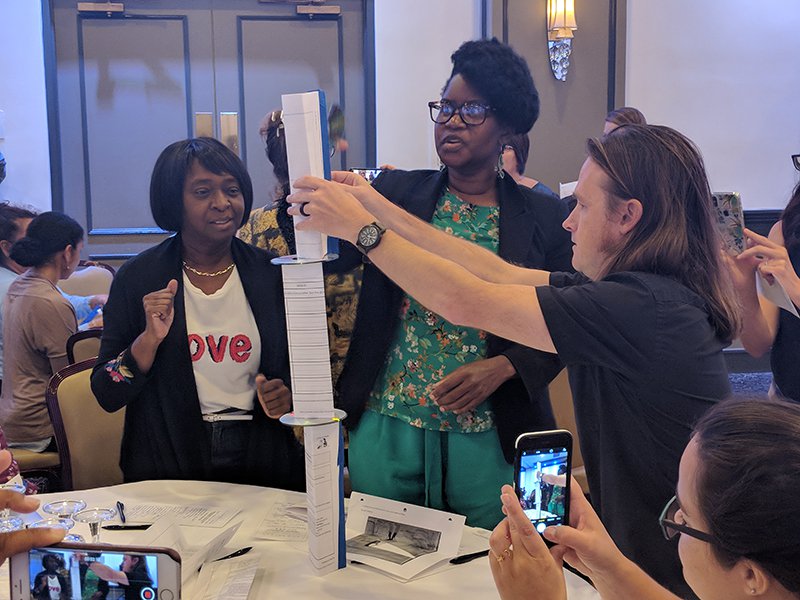
All teachers new to a grade level or teachers new to BPS attend the three-day Teacher Summer Institute in August where they learn about topics ranging from NAEYC accreditation to facilitating civic engagement to grade-specific curricula. During this summer’s institute, Tonachel described the essential elements of Focus on First and Focus on Second: standards-aligned, ample time to learn in centers, daily read-alouds, frequent opportunities for rich conversation among students, and, perhaps most importantly, an emphasis on learning as an active experience rather than a passive one. Later in the day, the first and second grade teachers separated to focus on their specific grade. Teachers in each grade received multiple large binders that contained all the information they needed to become better acquainted with the curriculum and get the school year off to a strong start.
According to first-year K2 teacher Kelly Garcelon, the training she received was time well spent. “I felt like I was really well-prepared by the district,” she said. “I spent three days doing the New Teacher Institute last summer. It was three full workdays of just Focus on K2…so I was lucky enough to start the school year knowing what the curriculum is, how to go about it, what our pacing plan was, and I had all the materials I needed.”
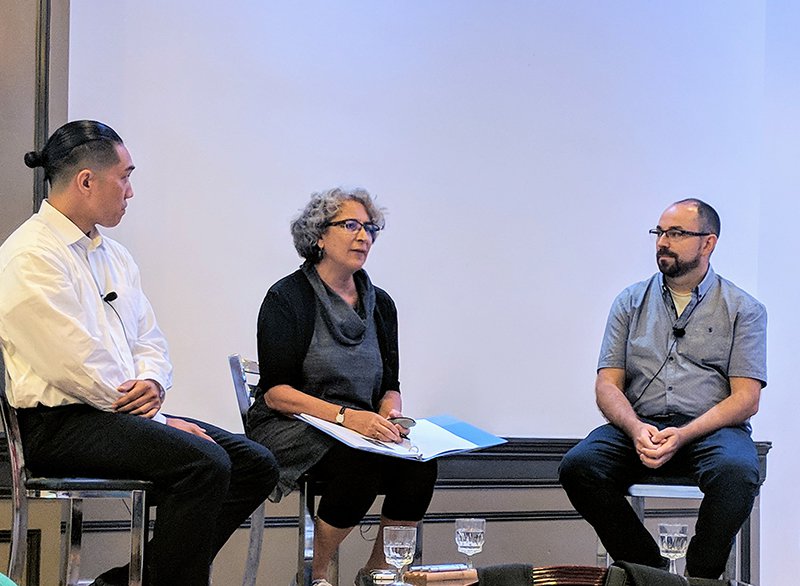
Each year, DEC also holds a kindergarten conference bringing K1 and K2 teachers and paraprofessionals together for joint learning. In the past, BPS has used the conference to emphasize the importance of opportunities for open-ended play, family engagement, and culturally sustaining teaching practices.50 This year built on the 2017 conference and focused on observation and documentation to inform instruction. Hundreds of teachers and paraprofessionals filled a conference room at Lombardo’s, south of Boston, to hear the plenary session which included Stephanie Cox Suarez, the founding director of the Documentation Studio at Boston University Wheelock College of Education & Human Development; Cliff Kwong, a K1 teacher at Nurtury Learning Lab (a BPS community partner); and Jerry Pisani, a K2 teacher— all speaking to the value of observation and documentation in guiding instruction.
Laura Bornfreund / New America
K1 teacher Kwong shared a powerful story about using observation to shift instruction and employ culturally sustaining practices. Mid-year, looking at student work, he noticed a child’s self-portrait was “off.” Kwong asked the little girl why she had drawn herself in such a sad way. She told him another student was making fun of how dark her skin was. Kwong made a change to his lesson: he read the book Color of Us to the class and engaged the children in a conversation about skin color. His goal was to provide an opportunity for the girl to feel positive about herself. Toward the end of the lesson, she said “this world needs my color.”
Suarez told a story and showed a video observation she did in a teacher’s classroom of a mostly non-verbal kindergartener named “James.” She watched James at a table working on his own with clay and heard him narrate what he was doing with single words. “Cut,” he said as he cut the line of clay into pieces. “Circle,” he said as he shaped the pieces. This went on for a period of time, and slowly, James began opening up to Suarez. She posted the photos with the words he used on the wall. James saw his photos and began sounding out the words that described what he was doing. His teacher reported that this was a turning point for James and later that year he became the first reader in the classroom. Sharing documentation with children can be a strong way of deepening their learning, Suarez said.
Some K1 and K2 teachers in BPS told us that there is a bit of hesitance about the time required for meaningful documentation. And this is a valid concern—watching children as they work and play, taking photos or video of them, and writing notes about that learning is time-consuming. But it is an important part of assessment, especially for young children in the early elementary grades who “don’t always show what they know when you want them to,” as Suarez noted during her talk. For the teachers in the room, listening to the story about James and other children spurred some “ah ha’s” about students they had in previous years. One shared reflections about a student similar to James and what she could have done differently to help him demonstrate his learning. “I could have acknowledged the value of non-verbal expression and recognized it as a place to start and build, giving him different materials to work with, providing opportunities to engage one-on-one, and being more attuned to and celebratory of small steps of progress,” she reflected.
At one of the breakout sessions following the plenary, teachers went around the room sharing what the day’s discussions had inspired them to do differently. Some offered thoughts such as, “I’m inspired to slow down my teaching and observe the process of learning;” “it’s up to us to figure out what children bring to the classroom and help them grow as learners;” and “to show documentation to my children so they have a role in their own learning.” One teacher said it would be valuable to have principals at the session.
Sharing documentation with children can be a strong way of deepening their learning
Because of a scheduling change this school year, the BPS early childhood team had the opportunity for a second day at the kindergarten conference. Boston is one of the Early Learning Network sites51 and the Boston research team is completing its third year of data collection. The Boston project includes multiple components, one of which is curriculum implementation. Sachs asked the researchers to look at the data they had collected and help him figure out the instructional practices within the Focus curriculum with which teachers struggled and the ones that correlated with gains in student outcomes. This exercise led the early childhood team to structure the second day of the conference around four instructional practices:
- extending and building children’s learning by posing questions that lead to critical thinking
- personalizing instruction so that every child is able to actively engage in learning
- making connections within and across learning domains (such as reading, math, science, social-emotional) to help deepen and broaden children’s understanding
- using vocabulary that is rich and complex52
A coach with the early childhood team mentioned at the conference that the focus on improving documentation will continue throughout the year with monthly PD opportunities by DEC coaches for all interested teachers from pre-K to second grade.
Professional Development Throughout the Year
New teachers also take part in one-on-one coaching sessions about twice a month during their first year in BPS. The instructional coaches work to build trusting relationships with teachers, so they are viewed as allies of the teacher and school rather than evaluators checking for compliance. A written contract agreed to by the coach, teacher, and school principal sets clear expectations and helps the collaboration stay strong over time.53 Kelly Garcelon described the relationship with her instructional coach this way: “I probably see her two hours a week and that’s been huge because I can only ask so many questions at common planning time.” She added, “the new teacher developer is something I’ll be saddest about not having next year… Can I have a coach every year, please?"
Once a strong relationship is established, coaches deliver feedback to teachers that is specific, actionable, and discussed during shared observations. Teachers then develop a specific implementation plan to guide them as they work on discrete skills over the next weeks or months of instruction.54 The exact coaching ratios have changed over time, with some schools with a ratio of as low as one coach per 10 classrooms.55 According to Morales, a lot of coaching is about helping teachers build good habits: “You may hate running, but if I make you go outside and run every day after six weeks you’re better,” Morales said. “Six weeks is what you need to build a habit. I usually figure if I can get you through Unit One reading out of the book then by Unit 2 you won’t even have to look at it.”
Once teachers are familiar with the curriculum, they attend targeted PD sessions on specific instructional practices, such as guided reading, the thinking and feedback protocol, and storytelling and story acting. For teachers located in schools going through the accreditation process, coaches observe and assist for an average of three years, helping the school successfully navigate the accreditation process. About 20 percent of teachers each year are new to BPS and those teachers take part in several days of curriculum training which helps to ensure schools stay faithful to the prescribed curriculum.56
Using Data to Drive Improvement
The BPS early childhood team takes pride in how much stock it puts in data collection and analysis. Data are collected for a variety of purposes, such as assessing teacher and parent satisfaction, informing decisions related to resource allocation, informing conversations about project change, planning professional development, and evaluating specific elements of the early childhood program. Evaluation, research, and regular data collection are all built into DEC’s five-year strategic plan. The BPS early childhood team views data as a tool to help build and change the program rather than simply for measuring it.57
Teacher feedback, observations from instructional coaches, and observations of curriculum fidelity are all used to inform and change the content and frequency of professional development. Since its inception 13 years ago, DEC has contracted with researchers from the Wellesley Centers for Women and Abt Associates to conduct periodic needs assessments of specific grade levels. Once completed, these needs assessments are reviewed, and next steps are identified by the early childhood staff.
The BPS early childhood team views data as a tool to help build and change the program rather than simply for measuring it.
This commitment to data is also exemplified by the early childhood team’s collaboration with a multi-year, longitudinal study being led by MDRC in partnership with the University of Michigan and the Harvard Graduate School of Education. The study, formally known as the Expanding Children’s Early Learning study (ExCEL P–3) will examine, among other things, whether gains in student skills by the end of K1 are sustained through the end of third grade and the factors that best support lasting impacts of K1. While final results will not be available for several years, BPS staff members are already using initial findings to inform professional development and help set priorities. At the Kindergarten Conference, for example, district staff provided teachers with their specific data resulting from the curriculum fidelity data analysis to help them improve.
Challenges
Since teachers new to the curriculum receive only one year of coaching, fidelity to the curriculum after coaching is completed can be an issue, but Sachs describes the accreditation process as “a built-in maintenance process” for encouraging curriculum fidelity. Not surprisingly, the early childhood team has found coaching to be most effective with those teachers who are willing participants, those who want to be coached. For teachers implementing Focus, coaching is voluntary unless they are in a school going through the NAEYC accreditation process.
While the early childhood team has made headway with some principals, Jason Sachs acknowledges there is much work to do. The team knows principals are essential for establishing the conditions that enable teachers to use the strategies and practices discussed above. Building greater principal understanding of early education will be a stronger priority for the team in the coming years. A tension exists between principal autonomy and the establishment of district-wide guidelines for curriculum and instruction. At times, the early childhood team has attempted to work around resistant principals and work directly with teachers instead. The hope is that the teachers will then act as ambassadors to their principals and help convince them of the importance of the work being done to improve the early elementary years.
Citations
- Culturally sustaining practice seeks to sustain linguistic, literate, and cultural pluralism as part of schooling for positive social transformation and revitalization. For more, see Django Paris and H. Samy Alim, Culturally Sustaining Pedagogies: Teaching and Learning for Justice in a Changing World. (New York: Teachers College Press, 2017).
- Funded by the Institute for Education Sciences, the Early Learning Network consists of five research teams conducting in-depth research in areas that provide pre-K access to children from disadvantaged backgrounds.
- Boston Public Schools, Department of Early Childhood (website), “Kindergarten Conference,” https://www.bpsearlylearning.org/kindergarten-conference/
- Bardige, Baker, and Mardell, Children at the Center, 142.
- Bardige, Baker, and Mardell, Children at the Center, 144.
- Educational Alignment for Young Children: Profiles of Local Innovation (Washington, DC: National League of Cities: Institute for Youth, Education and Families, 2012), 13, https://www.nlc.org/sites/default/files/users/user75/educational-alignment-for-young-children-case-studies-april-2012.pdf
- Jason Sach, interview with authors, July 19, 2018.
- Christina Weiland and Jason Sachs, “Appendix: The Role of Data, Research, and Evaluation in the Process of Change,” in Children at the Center: Transforming Early Childhood Education in the Boston Public Schools by Betty Bardige, Megina Baker, and Ben Mardell (Cambridge, MA: Harvard Education Press, 2018), 195–210.