History of Boston’s Department of Early Childhood
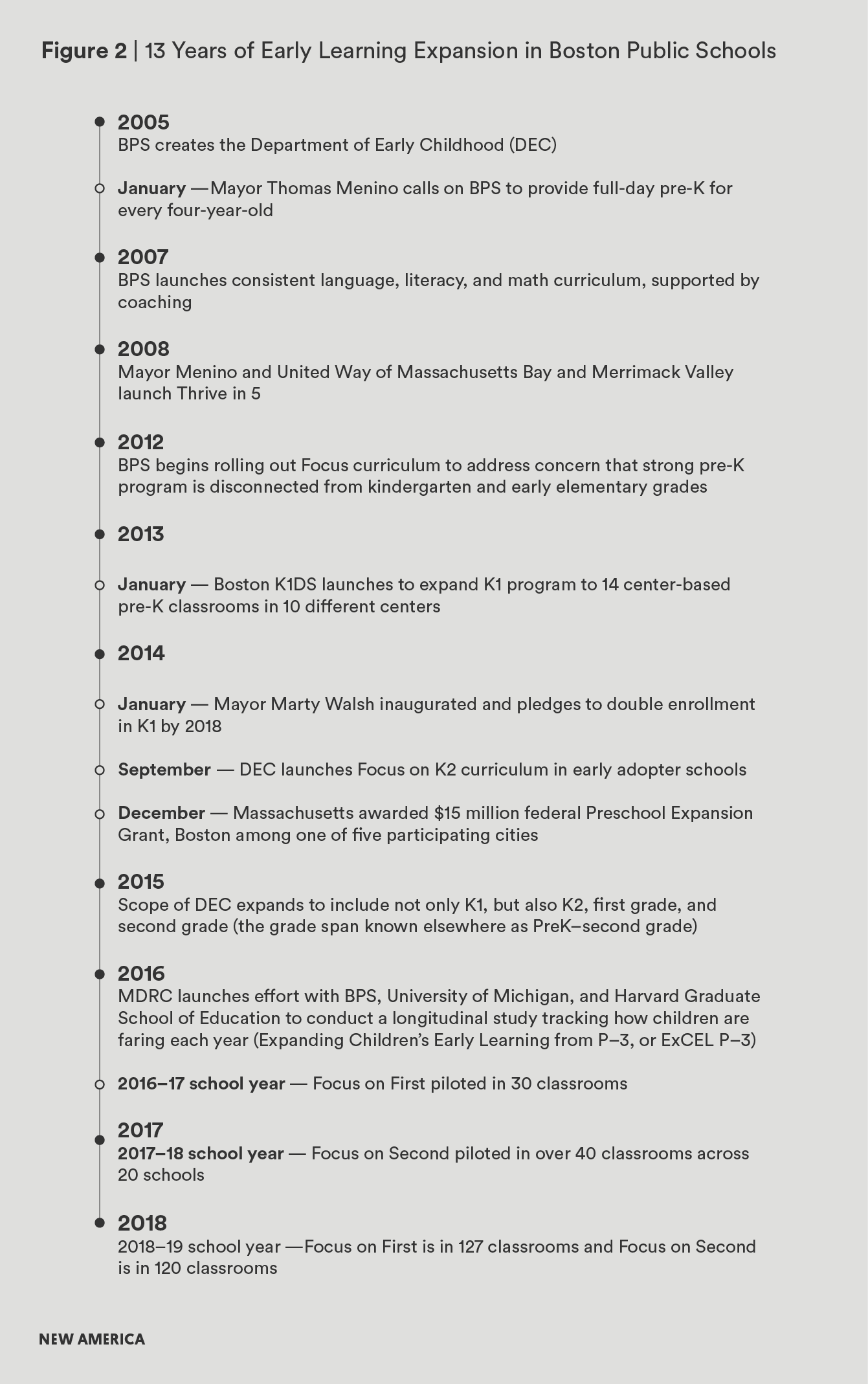
In his State of the City Address on January 11, 2005, Mayor Tom Menino declared that he would “direct the Boston Public Schools to provide all four-year-olds in the city with full-day school within five years. Boston will be the first city in the nation to achieve this.”3 Prior to Menino’s announcement, the city had already made some strides in offering early education to its four-year-old population. In 1998, Boston opened three public early education centers and eventually added three more, serving a total of about 350 three- to five-year-olds from low-income families. A handful of the city’s elementary schools offered half-day programs for four-year-olds, serving about 400 children in all.4 But Mayor Menino’s pledge to provide universal pre-K by dramatically expanding the number of pre-K classrooms across the city within five years was a bold call since Boston is home to approximately 6,000 four-year-olds.5
Later that same year, under the leadership of Superintendent Thomas Payzant, Boston Public Schools took an important step toward expanding K1 access by creating the Department of Early Childhood. The early childhood team started with a staff of only three people and jurisdiction over only K1 programs. Jason Sachs, the department’s executive director, was its first official hire.6
One of Sachs’s first tasks was acquiring funding to support the growth of K1 throughout the city. While Menino strongly supported the growth and improvement of K1, Sachs knew he would need outside money to supplement city funds to build up his staff and make the kind of wide-ranging reforms he envisioned. Sachs turned to the Barr Foundation, a private, Boston-based foundation for support. The Barr Foundation agreed to contribute $3 million over three years to allow the early childhood department to purchase research-backed, domain-specific curricula, pay for coaches to mentor teachers, and open more K1 classrooms as long as the district matched its investment.
The Barr investment was one of several that made it possible for K1 to expand rapidly across the city, going from serving 750 children in 38 classrooms in 2005 to more than 2,000 children across 110 classrooms in 2010.7 The city helped create Countdown to Kindergarten in 1999, an effort that includes 28 local organizations working together to support children’s transition to kindergarten. In 2008, Mayor Menino and the United Way of Massachusetts Bay and Merrimack Valley launched Thrive in 5, a sustained, citywide movement to ensure all children are ready for school success.8 Since its launch, Thrive in 5 has generated $23 million in new resources for Boston’s early childhood community, the vast majority of which has gone to local organizations working with families.9 Some of the money helped establish weekly play to learn groups in BPS schools to support children between the ages of birth to three.
Working with Center-based Pre-K Providers
In December 2014, Massachusetts was one of 18 states awarded a federal grant to build or expand high-quality pre-K programs. The state received the maximum award of $15 million in four grant cycles which it distributed to communities across Massachusetts.10 The Bay State was one of 13 states to receive a grant to expand high-quality pre-K programs in high-need communities (referred to as Preschool Expansion Grants, or PEG). Boston received just over $4 million of the grant money and used it to work with center-based pre-K programs — i.e., private programs that are not part of the school system, such as independent early learning centers and Head Start — to implement the Focus on K1 curriculum throughout the programs by providing curricular materials, professional development (PD), and coaching to PEG sites.11
The PEG work was a continuation of Boston K1 in Diverse Settings (K1DS), a 2013 pilot program that expanded the BPS K1 program to 14 center-based K1 classrooms, targeting neighborhoods with the highest concentrations of poverty.12 Evaluators found a correlation between classrooms that faithfully implemented the BPS curricula and higher overall classroom quality.13 “Through Boston K1DS we were able to give community programs our very same curriculum, coaching, and PD, believing we could get the same results, and we did,” said Abby Morales, a program director at the DEC.
An evaluation of the first year of PEG implementation in the summer of 2016 found that PEG students statewide demonstrated levels of early math skills, early literacy skills, and vocabulary comprehension that would be expected of them once they begin kindergarten.14
Implementing the BPS curricula and PD in center-based pre-K programs is not without its challenges. Currently, K1 students enrolled in public schools are guaranteed a spot in the same school for K2, and BPS is working to establish a connector system that guarantees admission into a specific elementary school for K2 following completion of K1 at a center-based pre-K provider. However, the current lack of a connector system is mediated, in part, by the work the district has been doing to align the K1-second grade curricula.
Morales explained that the DEC’s main challenge in working with these centers is the need to shift the way the programs see themselves: “You’re changing the way you speak to a three-year-old, assuming and believing they’re capable of discourse.” The organizations have to view their teachers as true educators and provide them with weekly time away from children to plan instruction and evaluate student data. These changes do not happen quickly, but DEC has worked with the programs in order to shift teaching practices through coaching and PD. Another challenge is that teachers in center-based pre-K programs will sometimes decide to leave for BPS after they have earned a degree and worked with the BPS early childhood team. Morales explained that, “you increase their salaries, you give them this PD, and unfortunately what ends up happening is they say, ‘Now that I have the training, capability, and knowledge, I’m going to go to BPS and be a teacher.’” This is a challenge for the early education community across the country since there is typically a lack of pay parity across the various settings in which children attend pre-K.
K1 continued to expand and improve in quality over the years. A 2013 Harvard study of the impacts of the K1 program found students made improvements in language, literacy, math, executive function, and emotional development skills. Some of the study’s impacts were the largest found to date in evaluations of large public pre-K programs.15 But the BPS early childhood team knew there was still work to be done to improve the quality of K2 and first and second grade. A 2006 evaluation that showed promising improvements in the K1 program found that the same positive results were not evident in K2 classrooms across the city.16 A 2012 needs assessment found that the quality of BPS first-, second-, and third-grade classrooms was much lower than that of K2.17
In order to sustain the gains students achieved as a result of a strong K1 program, real work had to be done to improve the quality of the grades following K1.
These findings convinced DEC that, in order to sustain the gains students achieved as a result of a strong K1 program, real work had to be done to improve the quality of the grades following K1. “There was a realization that doing universal pre-K meant you then needed to change kindergarten, then first grade, and so on to sustain those gains,” Morales said.18 K1 expansion had proceeded at an impressive pace, growing from 750 students in 2005 to more than 2,800 students in the 2017–18 school year19 with a waitlist of almost 1,000 children.20 And the BPS early childhood staff had grown rapidly as well, from a team of only three to a staff of 26, made up of curriculum writers, coaches, and project leaders.21
In 2015, DEC was given the opportunity to fulfill its vision of improving not only K1 and K2, but also the early elementary grades. This expansion would have important implications for sustaining the gains children were making in their earliest school years. The staff fought for reorganization that would allow for bottom-up alignment, spanning K1 to second grade, arguing that their success in K1 and K2 proved its methods worked and that DEC needed control of first and second grade to continue to build off that success. When Tommy Chang came on as the new superintendent in March 2015, he agreed to allow K1 through second grade curriculum decisions to be made by the early childhood team.22
Despite the fact that there have been two different mayors and six different BPS superintendents since the early childhood team was established in 2005, one constant has been Sachs as the Executive Director. His continuous, steady leadership over the past 13 years has a lot to do with DEC’s success in fulfilling the goals Sachs set out at the outset of his tenure. Since its inception, there has been a clear vision for BPS early childhood rather than a series of priorities that shift every few years based on changes in district leadership.
While passionate and focused leadership by Sachs and a committed DEC team have certainly been important to BPS’s progress so far, these are not the only important elements. Below we discuss how the BPS early childhood team has transformed what and how children learn, the classroom environments in which children spend their days, and how teachers interact with and engage children in rich learning opportunities.
Since its inception, there has been a clear vision for BPS early childhood rather than a series of priorities that shift every few years based on changes in district leadership.
Citations
- “2005 State of the City Address: Remarks of Mayor Thomas M. Menino,” Boston.com, January 11, 2005, http://archive.boston.com/news/local/massachusetts/articles/2005/01/11/2005_state_of_the_city_address?pg=full
- Betty Bardige, Megina Baker, and Ben Mardell, Children at the Center: Transforming Early Childhood Education in the Boston Public Schools (Cambridge: Harvard Education Press, 2018), 36.
- The Mayor’s Advisory Committee on Universal Pre-Kindergarten (UPK), “Investing in Our Future: Recommendations to Inform City Planning for High-Quality Universal Pre-Kindergarten in Boston,” April 2016, https://www.cityofboston.gov/images_documents/Boston%20UPK%20Advisory%20Committee%20Report%20April%202016%20FINAL_tcm3-53557.pdf
- Sachs came from the Massachusetts Department of Education where he worked in the Division of Early Learning Services helping communities gather and use data to improve the quality of early education programs.
- Bardige, Baker, and Mardell, Children at the Center, 41.
- Every Child Given Every Opportunity to Thrive: Advancing School Readiness in Boston (Boston: Thrive in 5, 2016), http://thrivein5boston.org/wp-content/uploads/2016/08/T5_Impact-Report_082516.pdf
- Educational Alignment for Young Children: Profiles of Local Innovation (Washington, DC: National League of Cities: Institute for Youth, Education and Families, 2012), https://www.nlc.org/sites/default/files/users/user75/educational-alignment-for-young-children-case-studies-april-2012.pdf
- U.S. Department of Education (website), “Preschool Development Grants: Awards,” last modified August 29, 2017, https://www2.ed.gov/programs/preschooldevelopmentgrants/awards.html
- Report on the Federal Preschool Expansion Grant–Year One (Boston: Massachusetts Department of Early Education and Care, January 2017), https://www.mass.gov/files/documents/2018/07/02/fy17-Report%20on%20the%20Federal%20Preschool%20Expansion%20Grant-Year%20One.pdf
- Every Child Given Every Opportunity to Thrive: Advancing School Readiness in Boston (Boston: Thrive in 5, 2016), http://thrivein5boston.org/wp-content/uploads/2016/08/T5_Impact-Report_082516.pdf
- BPS K1DS: Piloting the Boston Public Schools’ Prekindergarten Model in Community-Based Organizations (Boston: Boston Public Schools, February 2016), https://drive.google.com/file/d/0B3qKorUGb2mHc29LaXFtWm5SRlU/view
- Year 1 Massachusetts Preschool Expansion Grant (PEG) Evaluation Report (Cambridge: Abt Associates, December 5, 2016), https://www.abtassociates.com/sites/default/files/migrated_files/46815c0c-dc78-4795-be68-c2fbade76509.pdf
- Christina Weiland and Hirokazu Yoshikawa, “Impacts of a Prekindergarten Program on Children's Mathematics, Language, Literacy, Executive Function, and Emotional Skills,” Child Development 84, no. 6 (November/December 2013): 2112–2130, https://onlinelibrary.wiley.com/doi/abs/10.1111/cdev.12099
- Educational Alignment for Young Children: Profiles of Local Innovation (Washington, DC: National League of Cities: Institute for Youth, Education and Families, 2012),12, https://www.nlc.org/sites/default/files/users/user75/educational-alignment-for-young-children-case-studies-april-2012.pdf
- Jason Sachs, “New P-2 Early Childhood Strategic Plan & Update on Boston Universal Preschool,” (presentation to the BPS School Committee, April 26, 2017), https://www.bostonpublicschools.org/cms/lib/MA01906464/Centricity/Domain/162/Early%20Childhood%20Strategic%20Plan%2020172022School%20Committee%20presentation.pdf
- Abby Morales (program director, DEC), interview with authors, April 24, 2018.
- Jason Sachs, “New P-2 Early Childhood Strategic Plan & Update on Boston Universal Preschool,” (presentation to the BPS School Committee, April 26, 2017), https://www.bostonpublicschools.org/cms/lib/MA01906464/Centricity/Domain/162/Early%20Childhood%20Strategic%20Plan%2020172022School%20Committee%20presentation.pdf
- Carrie Jung, “Making Elementary School A Lot More Fun: Like Preschool!” NPR, March 6, 2018, https://www.npr.org/sections/ed/2018/03/06/589478490/making-elementary-school-a-lot-more-fun-like-preschool
- Bardige, Baker, and Mardell, Children at the Center, 34.
- Bardige, Baker, and Mardell, Children at the Center, 174.