A Chapter of: Networks and American Renewal
Appendix: Technical Documentation
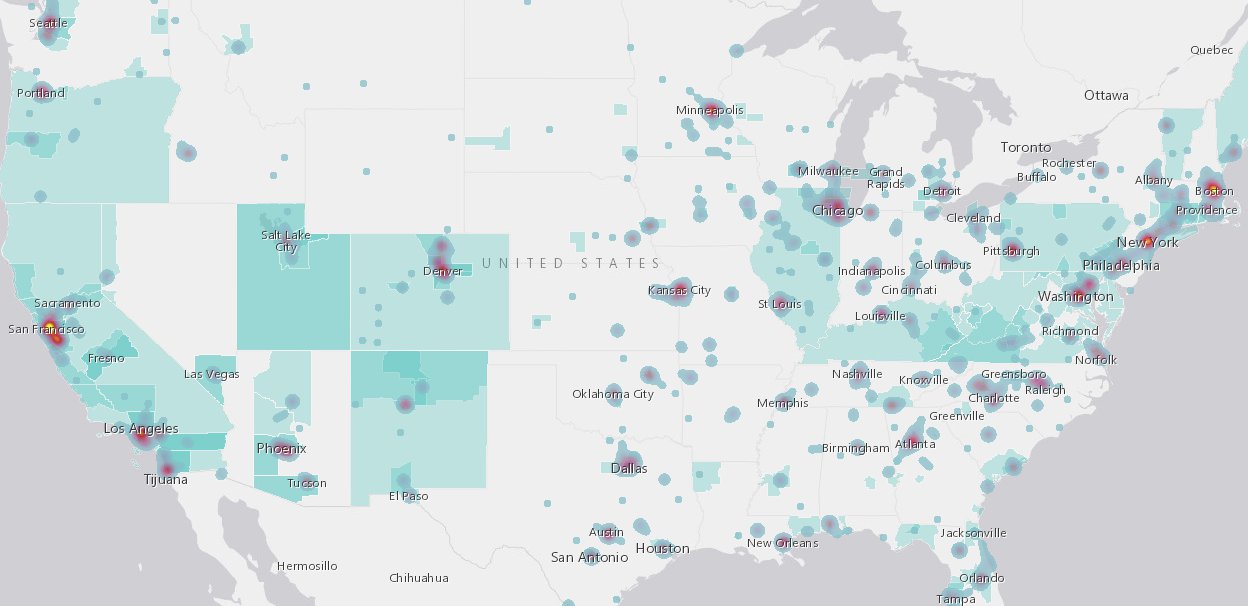
Our methodology was to 1) evaluate if the network met our inclusion criteria (below), 2) learn as much as possible from their web site and other public sources, 3) conduct a structured interview with the person who actively manages the network, 4) put the member-places from each network into an Esri StoryMap, 5) standardize the content about each network for the map, 6) summarize interview findings to inform the design of future networks.
Although there are many more than 25 place-based networks, we aimed for diversity of domains, network size, and geographic areas. We stopped interviewing when we reached theoretical saturation, that is, the same concepts kept appearing in our interviews.
We also interviewed points of contact in a super-networked city (New Orleans) to understand more about the on-the-ground experience.
To be included in our research, a network had to be:
- Place-based – Participants focus their work in a specific town, city, county, or region.
- Minimum scale – Networks must operate in at least 10 places to participate, and the geographies must be distributed (e.g., not all in one state or region).
- Role-based – A place's participation outlasts individual participants (e.g., if a sustainability director moves on to the new job, the next director will participate in the network).
- Shared domain of interest – These networks identify a problem being worked across communities (e.g., reducing homelessness, using data analytics better in local government, increasing resilience to climate change).
- Composed of practitioners – People actually doing work in this domain are the ones who participate.
- Peer-to-peer learning – More than a top-down dissemination of best practices, these are innovation networks where members learn from each other.
- Sustained interaction – Although most networks have in-person meetings, sustained interaction (such as webinars, Slack channels, listservs, etc.) is a key element to maintaining momentum.
- Shared repertoire of resources – Common challenges are addressed with centrally located resources such as toolkits, how-to guides, sample contracts, software tools, and case studies.
- Formal process to join – The network has a defined process for becoming a member, perhaps through an application process, a commitment, or payment of dues.
This research does not include:
- Professional associations where individuals, not places, are the members.
- Initiatives where a best practice is propagated top-down; there must be significant opportunity for local innovation and leadership.
- Grant programs that fund in a variety of places.
- Initiatives that do not have a list of “member” places.
Currency of data:
This research relies on data collected primarily in summer of 2018. Network members are subject to change, so please refer to the network web sites for current listing of participating places. Network methodologies also change over time (as they should!). The descriptions in the map represent the network’s approach in summer of 2018.