A Chapter of: Networks and American Renewal
Chicago: Profile of a Networked City
By Hana Passen
Introduction
Networks are everywhere you look. From General McChrystal’s Team of Teams approach to the war against Al Qaeda in Iraq to the Sustainable Brands Corporate Member Network’s commitment to sustainability, investors and practitioners alike have turned to networks to solve the kinds of intractable problems that can only be tackled by large numbers of people in many places working in a coordinated fashion. In recent years, the world has explicitly begun to focus on networks as a way to make change happen on a large scale.
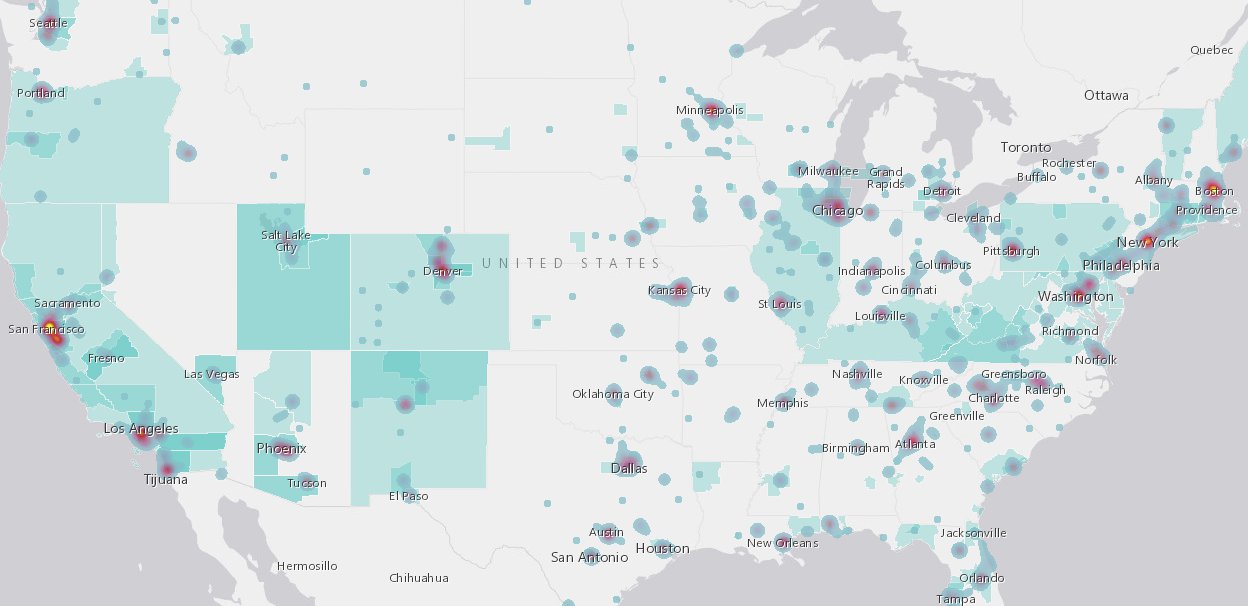
New America has released a map (as of September 2018) of innovation networks across American communities. We interviewed leaders of 25 place-based, outcome-oriented networks of various sizes and designs that connect over 270 locations with nearly 2,000 connections. We have highlighted a number of lessons about intentional network design and the characteristics of highly networked cities, and identified trends in nationwide equity (you can find more information about the project methodology here).
We found that participating in well-designed networks can help cities punch above their weight nationally. Participation also reduced political risk for the city and gave leverage at the local level to prioritize innovative projects. Network participation energized city innovators with support from peers across the country, and emboldened local communities to ramp up their innovation and creative problem solving. Here, we explore the ways a city that participates in a large number of place-based networks can benefit from some of these effects through its connections to a broad coalition of cities working towards the same goals.
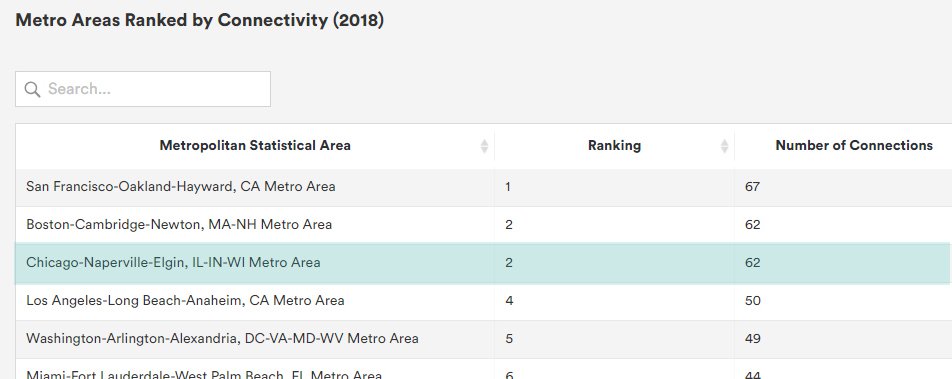
Chicago, Illinois, is what we call a “highly-networked city.” It is well-linked to other cities and resources across the country: Chicago and its metropolitan area are connected to 20 of the 25 networks we sampled, and account for 62 of the nearly 2,000 connections in our research. The networks focus on issue areas as varied as resilience, innovation, sustainability, and homelessness, and provide resources like technical assistance and peer learning.
Chicago is, generally speaking, a well-resourced and civically-engaged city. Chicago is often described as “city of neighborhoods.” It is home to a number of powerful philanthropies with either a Chicago-specific or regionally-based funding portfolio, and institutions across Chicago host highly-respected leadership programs. In 2017, WalletHub ranked Chicago the 15th most caring city in the country based on a number of workforce and community indicators, and there are over two dozen college and universities that call Chicago home. Voter turnout in presidential elections in Chicago’s Cook County regularly exceeds the national average of around 60 percent. The Chicagoan civic technology community is active, and the city was an early adopter of many open government innovations like participatory budgeting, open data, and the creation of the chief data officer position. Chicago is also home to innovative organizations and practitioners doing cutting edge work on community organizing, housing finance, artificial intelligence, public health, and public interest technology, to name a few sectors.
Chicago: Networked for Impact
The City of Chicago is highly networked with other communities around the country, participating in 12 of the 25 networks we examined. When we consider the larger metro area, its inter-city connectedness is even more pronounced: Chicago’s metro area is tied with Boston as the second most networked metro in the country, behind only the San Francisco metro area.
By participating in these networks, Chicago not only inspires communities nationwide with its leadership in civic innovation, it also gains access to the wisdom of other places in fields ranging from homelessness and sustainability to education, resilience, and government innovation.
One example of how networks have improved Chicago’s capacity to address big challenges is the way Chicago leveraged its connections in the Civic Analytics Network (which connects municipal chief data officers) to build a municipal ID program called CityKey. After Chicago passed a Welcoming City Ordinance to emphasize the city’s commitment to its population of undocumented immigrants, city officials needed to develop a system of identification for these Chicago residents. Tom Schenk, former Chief Data Officer of the City of Chicago, explained how he leaned on experiences from his peer in New York City to help build an ID program that would protect Chicago’s undocumented population:
“At the time, for context, NYC was fighting a lawsuit because [the Department of Homeland Security] had subpoenaed all records of anyone holding New York City’s municipal ID. We wanted to avoid that, so in our approach, our CityKey is your bus pass or library card, but we don’t have a database centralized anywhere. So we integrate into existing infrastructure, and we don’t have to worry about being subpoenaed for records … We’ve had 20,000 of those cards issued across the city of Chicago. And by having it as a card that’s a bus pass, library card, discounts at museums, etc, you make it convenient enough to make sure that it’s not just undocumented folks holding onto the card as a scarlet letter.”
In this case, the connection to other cities through the Civic Analytics Network helped Chicago improve upon the New York City model to better serve their residents.
Chicago’s participation in the i-team network (a Bloomberg Philanthropies-funded network which brings innovation teams and a common playbook to execute on a city’s mayoral priorities) has had a different type of lasting effect due to the influx of talent and the shared experience with i-teams in other cities. Many of the Chicago i-team members ended up infusing the network’s innovation focus in other areas of local government, such as the police department and policy team in the mayor’s office. Schenk noted that the i-team “helped the City of Chicago as an institution, that brought people together to work on innovation … A lot of today’s senior [city] leadership really maps to the original i-team.” With the i-team members hired on as staff in the City of Chicago, their innovation-focused approach remained a key part of Chicago’s executive team.
Chicago has demonstrated many of the learnings about what happens to cities when they participate in networks. Chicago’s high levels of connectedness allowed it to learn—and create—best practices on project implementation and staff up city government to address resident needs.
Connecting Within Chicago
Though it is one of the most networked cities across the nation based on the sample of networks we surveyed, opportunities remain to connect within the city. Various actors in Chicago are seeking to build connectivity to address issues like the racial wealth gap and community disinvestment.
It is impossible to consider disconnection in Chicago without also considering historic racial segregation and its long-term effects. Chicago is one of the most segregated cities in the country, with historical redlining and predatory housing practices forming the basis of lasting social and community segregation. Today, the racial wealth gap in Chicago is wider than the already-wide national average. The median income for white Chicagoans is more than twice that of African American Chicagoans, and slightly less than twice that of Latinx Chicagoans. The average white-owned business is worth more than twelve times the average African American-owned business, and the unemployment rate for workers of color in Chicago is three times that of white workers. It is against this backdrop that we consider the lack of connection within Chicago.
Chicago is rich in research on its community networks. There are robust network analysis studies examining climate networks, media habits, and community resources within Chicago neighborhoods. For example, the research organization MDRC produced a very detailed analysis of networks at play in nine Chicago neighborhoods, while the Science of Networks in Communities (SONIC) lab at Northwestern studied community knowledge hubs that might be leveraged to execute on Chicago’s Climate Action Plan in two neighborhoods. The studies showed that strong community networks exist within neighborhoods, that different kinds of organizations play key roles in different neighborhood networks, and that different neighborhood networks are structured in different ways rather than in unified structures across the city.
While a cadre of actors solving a problem in a city may be able to learn from people addressing a similar challenge in other cities—like in the impressive work that All Chicago is doing with Built for Zero to address homelessness in Chicago—connection across places should not be equated with connection within a place. As Tom Schenk explained:
“There were times when it was easier for me to talk to other cities than talk to other institutions within Chicago … With tech and data, it’s easy to reach out to tech and data people in other cities, because we spoke the same language. In reaching out to community organizations, we may not speak the same language. The bond is ‘we want to improve the city of Chicago’, but sometimes the premises of the conversation aren’t enough to build a clean path forwards. And these are not new challenges—tech and data are new, but the things you need to get the job done are classic things: relationship development, getting incentives to align across multiple partners. Tech and data don’t magically solve those.”
Chicago has a vibrant civic tech community, informal structures that connect tech and data work across the city, and an open data portal, and has led pioneering work in civic tech ahead of many other cities in America. Chicago does not participate in the more formal leading national network in city-wide data collaboratives, the National Neighborhood Indicators Partnership (NNIP)*. A 2013 Urban Institute report on Chicago’s community information infrastructure identified two major findings: first, that Chicago was early to adopt open data frameworks and has a wealth of institutions using data for the public good, and second, that no single organization takes responsibility for “the recurrent assembly and dissemination of neighborhood-level national and local data across multiple issue areas.” Existing efforts to use and share data for the public good are at work on a variety of singular projects but opportunities remain to advance data sharing across issues with shared infrastructure.
Conclusion
Chicago is the picture of a highly networked city, in the national context. With twenty networks at play in the metro area, Chicago has been able to learn from its peers, contribute meaningfully on the national stage, collaborate across issue areas, and build the city’s capacity. Chicago also demonstrates that a high level of connectivity across cities does not necessarily mitigate historic differences between neighborhoods within a city. Chicago, like many places, faces ongoing challenges in building across the starkly differently resourced neighborhoods of the city, and the legacy of racial and wealth inequality that spans generations. The “city of neighborhoods” has a large number of community resources that, if connected intentionally, might be brought to bear to address some of the city’s longstanding challenges.
*This article is based on data collected as of September 2018. On November 29, 2018, the National Neighborhood Indicators Partnership (NNIP) welcomed the Institute of Housing Studies at DePaul University in Chicago as a new member of the network.