Table of Contents
- Introduction
- National Naloxone Access Map
- National Prescription Drop-off Map
- Celebrating Lost Loved Ones Map
- Case Study: Northern Kentucky
- Case Study: Tri-County, Colorado
- Case Study: DuPage County, Illinois
- Case Study: Cook County, Illinois
- Case Study: Alameda County, California
- Case Study: Tempe, Arizona
- Case study: Northeastern University
- Getting Started With Local Opioid Work
Case Study: Tempe, Arizona

“Getting support to share this data from city leaders and our Fire Medical Rescue Department felt easy because they were already bringing together stakeholders to find ways to fight this epidemic and raise awareness.”
Dr. Stephanie Dietrick, Enterprise GIS Manager, City of Tempe
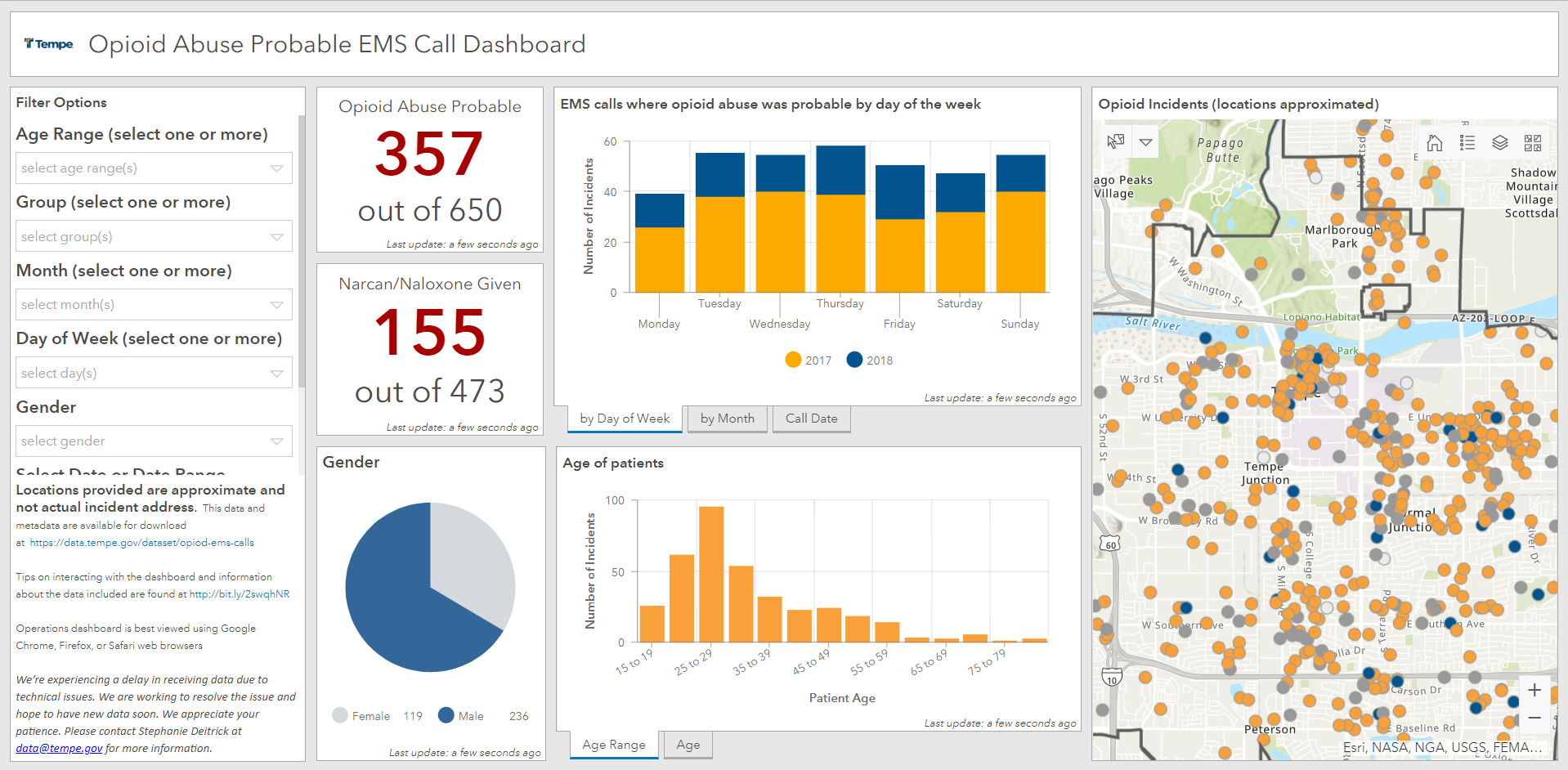
Tempe, Ariz. is ahead of the curve with innovative approaches to combat the opioid epidemic. Before their live data dashboard that shows all opioid-related emergency response calls, their Fire Department was already convening local community stakeholders in order to source new ideas for the problems they saw regularly through emergency responses.
Because Tempe has become so comfortable using data, they have been able to customize their maps to the city’s unique demographic profile. Now, one can navigate through the data to see whether emergency responders were called to help an Arizona State University student or a homeless person—understanding when these two different patient profiles appear more often helps them target better responses.
Through the Opioid Mapping Initiative, Tempe has been able to provide advice to other local governments and replicate alternative strategies. For example, the Tempe City Council recently published a story map with the data in order educate the community about the crisis and provide links to helpful resources like treatment centers and naloxone distribution locations.
The city has also taken advantage of their proximity to ASU in order to track experimental datasets. One such example, which monitors wastewater for opioids, may provide new insights into opioid usage trends.