Part 3: How Women Affect the Field
Interviewees reported that gender, and more specifically the presence of women in decision-making, did affect policy outcomes in the nuclear arena, citing improved processes, more emphasis on collaboration, and increased innovation. However, many were quick to push back on the essentialist notion that women are inherently more peaceful and therefore likely to tip the scale to disarmament or “softer” outcomes. As one respondent bluntly put it, “we don’t soften policy by adding estrogen.”
Nevertheless, women did report that they sometimes confronted harmful stereotypes about the association between women and peacefulness that undermines their authority. As one respondent noted, “I do not think women are more peaceful. And it irritates me to no end, that kind of line of thinking. In part because just in a very practical way, I think it undercuts us being taken seriously by the hard security side of the house, which has mainly been lived in by men.”
The “Consensual Straitjacket”
We heard over and over from respondents that there is a stark division between two communities that fall under the larger umbrella of nuclear policy: the arms control/nonproliferation community, which was more welcoming to women, diverse perspectives, and innovative ideas; and the deterrence/nuclear posture community, which was more closed-off and hierarchical.
Participants told us that members of the nuclear priesthood see deep experience in the field and insider knowledge as important qualities for inclusion in the community. The priesthood uses highly theoretical and abstract logic, specialized jargon, and the highly technical nature of nuclear policymaking to keep newcomers, especially those who are younger and female, out. According to Flournoy, “you have no opinions until you can master, demonstrate that you’ve mastered the technical pieces. And then that extended to what I call the orthodoxy, which is understanding all of the theoretical literature behind key concepts like nuclear deterrents, MAD, crisis stability, strategic stability. And mastering Herman Kahn and Tom Schelling, and all of this.”
Though most women faced obstacles as they sought to move ahead, the challenge was even more daunting as women entered government for the first time. One participant noted that the government is “more of a ceremonial, procedural kind of place. There’s a choreography in the government, that either you’re dancing or you’re not dancing. But it’s not a natural one that….You learn it as you’re in government, about when to say what and to who to say what and how to move things behind the scenes.”
"Women are socialized to sort of think outside the box to solve problems, and to make connections, and to work horizontally … and that just was not welcomed very much in the nuclear conversation."
This insulated, hierarchical structure was described by interviewees as leading to narrow thinking that in turn limited policy outcomes and invited groupthink. Policy discussions often proceeded according to predetermined scripts among officials who share similar experiences and outlooks. In this environment, outside-the-box approaches were not welcomed and could be dismissed by insiders as naive or uninformed. Furthermore, because the nuclear priesthood tends to control access to senior policymakers through its agenda-setting power, its members are often able to prevent new ideas or approaches from even reaching consideration at the senior level.
The emphasis on the nuclear orthodoxy saw many women struggle to fit themselves into a stereotypical image of what a nuclear official should look and sound like in order to be accepted and deemed authoritative. Participants described working very hard to learn the theory and technical details of nuclear policy and master the jargon used by this community. But they also described how they attempted to fit in to conventional modes of thinking, even as these conventions felt constraining.
Flournoy described this struggle as like a “consensual straitjacket.” She told us:
I think women are socialized to sort of think outside the box to solve problems, and to make connections, and to work horizontally to build networks and relationships, and to sometimes solve a problem by reexamining the basic assumptions and looking at it differently. And that just was not welcomed very much in the nuclear conversation.
Diversity Strengthens Processes and Outcomes
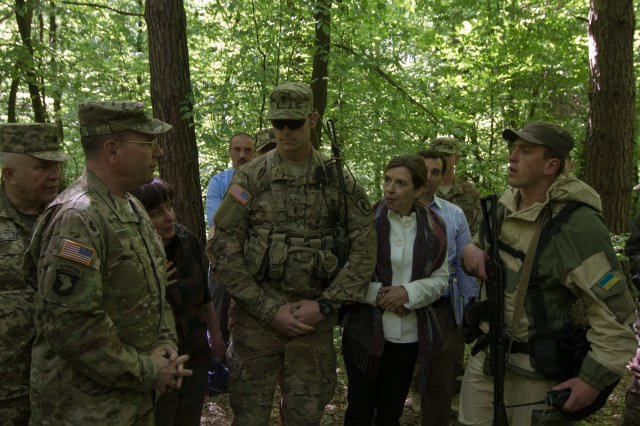
Participants in our conversation reported that having more women present in policy roles and discussions changed the dynamic. We heard that having more women in these conversations made the discussions more collegial and created an environment that was less competitive and more collaborative. When more women were at the table, individual women felt less pressure to prove that they belonged there or to speak on behalf of all women. Evelyn Farkas, former deputy assistant secretary of defense for Russia/Ukraine/Eurasia, told us that having more women colleagues around meant that “it wasn’t like we had to prove our knowledge….That’s a key thing, not feel like you have to prove yourself just because you're a woman or to try to get heard above the men, try to not get interrupted.”
Sgt. Alexander Skripnichuk / U.S. Army
Having a critical mass of women involved also made it easier to build the social relationships and networks that facilitate decision-making. Kennedy noted that in negotiations under the auspice of international organizations, while delegates give formal statements on the floor, “when you’re really going to find out, what are the possibilities? What’s on people's minds? It’s off the floor and in private settings, and so if you don’t have sort of access, it’s a big burden, and so it got easier as I got older, and there was more critical mass. It wasn’t okay to sort of treat women as the secretaries or the interpreters, as was the case in the Soviet Union early in my career.”
In other words, much of the work of negotiations occurred through informal social and networking interactions. When they were the only or one of a few women present, women found that they were often shut out of gatherings where their male colleagues were building these social relationships. Where they were included in these gatherings, they were sometimes made to feel uncomfortable by their male colleagues’ behavior.
Several participants mentioned the importance of seeing other women in leadership roles in terms of representation. Respondents also reported that having more women present makes it less acceptable for men to make inappropriate comments or harass their female colleagues, behaviors that were identified as pushing women out of the field.
Those of our interviewees who had held leadership positions in government saw how work environment could affect policy outcomes as well as employee experience, and some sought to implement such human capital strategies. Flournoy told us about implementing a policy called “predictable time off,” where each employee identifies his or her priority for time off and the whole office plans to work flexibly to cross-cover for one another.38 This allows employees to take pre-planned time off to drop kids off at school, provide care to an aging parent, or spend time on a fulfilling activity. Additionally, the team began investing in mentoring, training, and providing productive feedback.
The effect on performance was noticeable to cabinet-level officials, Flournoy told us. After reviewing the organization’s improved work, her superior asked if she had fired everybody in the office and hired new people.
And I said, 'No….We launched this human capital strategy. We started investing in people. We started giving them feedback. We started giving them coaching and mentoring. We started giving them training again.'
Perhaps most importantly, interviewees said that having more women present leads to more innovative thinking and therefore better policy outcomes. Women were able to offer a broader range of perspectives and challenge assumptions that others accepted as a given. Participants also pointed out that women are more likely to advance creative ideas or solutions to problems that have not been considered before. While this kind of outside-the-box thinking was more likely to be dismissed by established officials, it could also lead to better, more well-informed policy decisions under the right circumstances. Those circumstances included serving under leadership that was open to discussing new ideas, having the tenacity to continue to advocate for a creative idea, or being on a team that contains a critical mass of diverse perspectives, allowing for more openness and fearless communication.
When they were the only or one of a few women present, women found that they were often shut out of gatherings where their male colleagues were building these social relationships.
Even when a more diverse array of perspectives at the table did not necessarily lead to more creative policy outcomes, participants pointed out that this wide range of perspectives was still important to the policy process and strengthened policy outcomes: It allowed the group to interrogate its assumptions or consider second-order effects that might not have been considered otherwise. Smith told us:
You could feel the impact of diversity on the nature of the conversation. It was a breath of fresh air when you had people of color, you had women, you had young people, you had older people around the table; it was always a richer set of discussions in terms of looking at your options, questioning your core assumptions, asking the hard questions, getting outside of group think. Whatever the subject was, it was always a much more constructive, better conversation with a diverse set of players around the table.
Several interviewees, when asked to identify a policy outcome where gender diversity had made a difference, described the challenge of destroying Syrian chemical weapons in 2014. When the idea of destroying Syria’s chemical weapons stockpile at sea rather than by land was first raised, it was dismissed by Pentagon colleagues as too outside-the-box. The United States had never attempted to destroy chemical weapons at sea before. Nevertheless, a small group of well-placed women took up the idea and championed it through the Pentagon and the inter-agency process.
Though all were modest about their own contributions and noted that the original individual who had the idea was male, interviewees insisted that the tenacity of one leader who championed the idea, and the willingness of other female colleagues to support her, produced an outcome that was otherwise unimaginable. The Defense Department announced in August 2014 that a crew aboard the U.S. container ship MV Cape Ray had completed the destruction of Syria’s declared chemical weapons stockpile several weeks ahead of the scheduled conclusion date.

Citations
- Leslie A. Perlow and Jessica L. Porter, “Making Time Off Predictable—and Required,” Harvard Business Review, October 2009, https://hbr.org/2009/10/making-time-off-predictable-and-required.