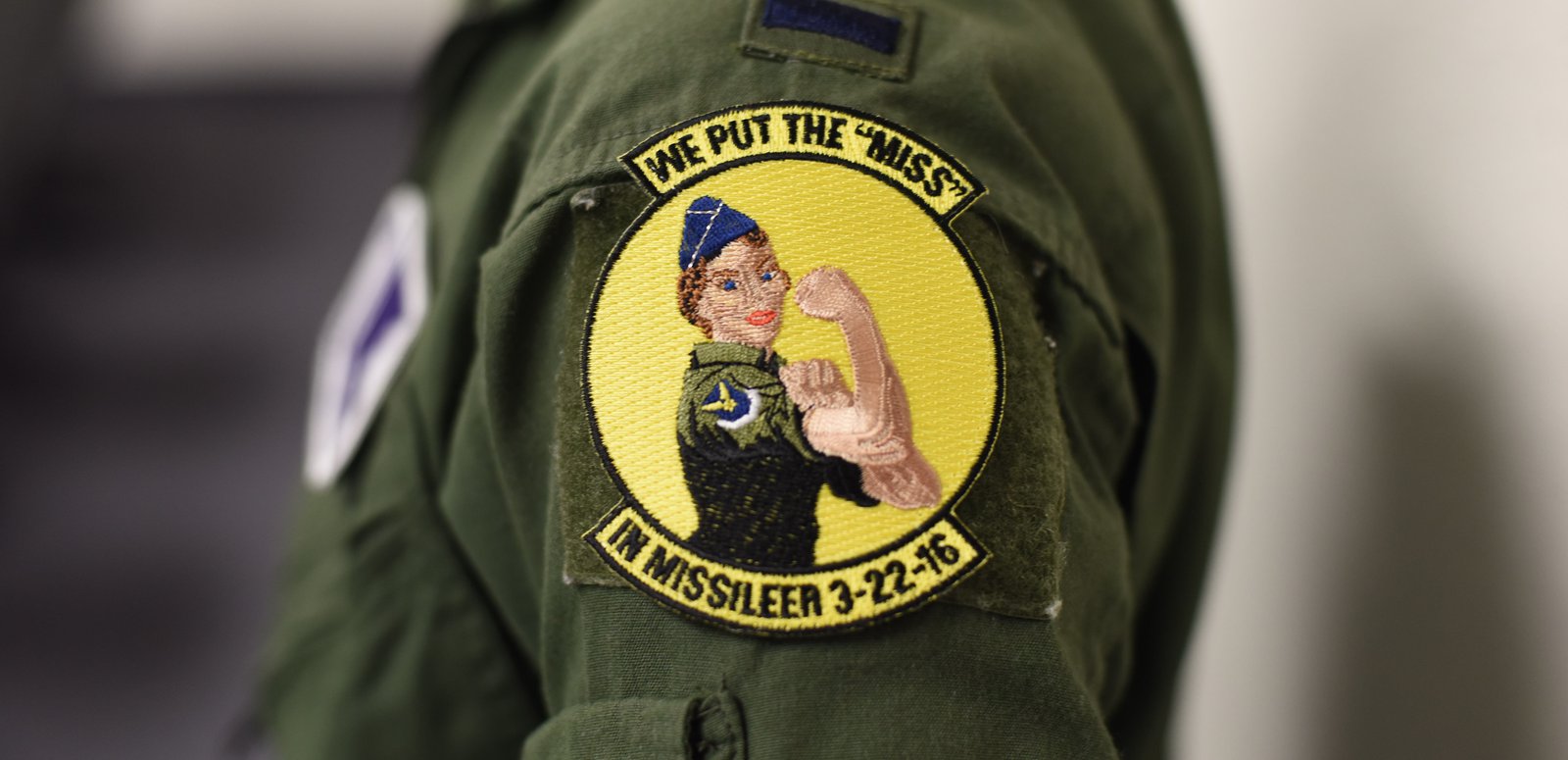
The “Consensual Straitjacket”: Four Decades of Women in Nuclear Security
Abstract
While women have been working in the nuclear policy field at leadership levels for decades, the space is still overwhelmingly white and male. For this study, we interviewed 23 women who have worked at senior levels in the nuclear, arms control, and non-proliferation fields, their careers ranging from the 1970s to the present day. In this report, we explore the gender dynamics surrounding hierarchy, language, and ideology, and how women working in these fields responded personally and professionally. We document and analyze the “gender tax” facing women in nuclear policy, consider how gender diversity affects policymaking, and explore the ways in which the more hyper-traditional subfields respond to new ideas—creating what former Under Secretary of Defense Michèle Flournoy calls a “consensual straitjacket” in which gender and substantive taxes combine to restrict innovation.
Acknowledgments
We would like to thank Maria Elkin, Laura Pratt, Joanne Zalatoris, Alison Yost, and Brandon Tensley for their communication work, Sabrina Detlef for copyediting, and Loren Riesenfeld and Samantha Webster for data visualization and graphics. Many thanks also to Katie McKinney for helping compile historical staffing data. We’re enormously grateful to Professors Marie Berry, Carol Cohn, and Valerie Hudson for discussing early ideas for this project with us. This work is unthinkable without the generous and open response of our interviewees, named and unnamed, and other pioneers in the nuclear field whom we did not interview. Responsibility for the content, and any errors or omissions, is ours alone.
This project is supported by Ploughshares Fund.
Downloads
Executive Summary
This study tells the stories of nearly two dozen women with decades of experience in nuclear, arms control, and non-proliferation policy. They have much to teach us, not just about the history of the field but about its future—how to keep it thriving, fill it with vital and innovative talent, and connect it with the best thinking about security, from which it has been too often cut off.
In short, the story of gender diversity in nuclear security is the story of how the field improves and innovates—or fails to do so.
While women have been working in the field at leadership levels for decades, this policy space is still overwhelmingly white and male. For this study, we interviewed 23 women who have worked in the nuclear, arms control, and non-proliferation fields, their careers ranging from the 1970s to the present day. These women have held positions in the Departments of State, Energy, and Defense, the former Arms Control Disarmament Agency, and within the White House, for both Republican and Democratic administrations. They have represented the United States both at home and in international delegations across the globe.
To contextualize these conversations, we considered the history of the nuclear, arms control, and non-proliferation fields; tracked how many women held senior positions in the U.S. government since the 1970s, as well as how many women were included in key American nuclear delegations; and analyzed how those numbers compared to international counterparts.
In Part 1 of this report, we explore the cultures of different nuclear subfields—the gender dynamics surrounding hierarchy, language, and ideology, and explore how women working in these fields responded personally and professionally. We consider how women enter the field and move through it, including what keeps them in and what pushes them out. In Part 2, we document and analyze the “gender tax” facing women in nuclear policy—how experiences of sexism, harassment, and gendered expectations translate into constant mental and emotional weight. We explore how these dynamics affected women and the strategies they adopted to push back. In Part 3, we consider how gender diversity affects policymaking, the ways that some of the more hyper-traditional subfields respond to new ideas, creating what former Under Secretary of Defense Michèle Flournoy calls a “consensual straitjacket” in which these gender and substantive taxes combine to restrict innovation. Finally, Part 4 addresses approaches to increasing both women’s participation and the diversity of intellectual approaches in the field as a mechanism to boost overall innovation and effective outcomes in nuclear security, arms control, and non-proliferation.
Part 1. Women in Nuclear Security
What does it look like when women occupy leadership roles in nuclear and weapons policy, and when the process is opened to diverse perspectives? Research from business, banking, peacekeeping, and other fields says it should lead to more innovation and more durable outcomes. But the idea that gender diversity and gender analysis could have an impact on nuclear policy has been left in the academy, and the women who pioneered in the field have been largely invisible.
We interviewed 23 women who have held significant roles in setting and implementing U.S. government policy on nuclear weapons, arms control, and non-proliferation policy about their experiences in the field—how they influenced it, and how it influenced them.
The History and Structure of Nuclear Security
The nuclear policy field emerged from the clandestine world after World War II. What had begun as a small band of political theorists working alongside scientists, recruited from top universities and the RAND Corporation, broadened into positions at the Departments of Defense, Energy, and State, as well as the newly-formed National Security Council. The field’s heavy tilt toward the theoretical and military began to alter in the 1960s, however, as successive administrations committed to international processes limiting how nuclear weapons and technology could be held and used by the United States and other nations. Thus, the sub-fields of nuclear arms control and non-proliferation were born, spawning new bureaucratic entities. In later decades, those fields would grow further to encompass chemical and biological weapons of mass destruction, and a web of international treaties and arrangements aimed at controlling all of them.
As these nuclear subfields grew up, close to the core of security policy yet specialized and separate, another major dynamic was occurring: the removal of many of the formal barriers that had limited women’s participation in national security policymaking and their access to the elite channels through which policymakers entered the field. Married women were finally permitted to remain in the Foreign Service in 1972; women were admitted to the military service academies in 1976; and the Ivy League and other elite all-male colleges opened their doors to women through the 1970s and 1980s. Women’s numbers in relevant courses of study surged, providing a significant pipeline of talent just as these newer fields were staffing up.
Even so, the public image of national security professionals remains highly-masculinized to this day, with dramatic under-representation1 of female professionals, to say nothing of women’s perspectives, in media narratives and scholarly publications, at top think tanks, and in the ranks of university chairs.
The story of gender diversity in nuclear security is the story of how the field improves and innovates—or fails to do so.
While female professionals have been largely omitted from the public policymaker discourse, an alternative discourse developed that characterized opposition to nuclear weapons as feminine—and thus reinforced the idea that the policy space was exclusively masculine. Nuclear weapons and deterrence theory—and the language around them—have been the subjects of rich and extensive feminist analysis.2 Similarly, peace and disarmament studies, as well as activism, have long been not just fields where women were well-represented, but actively gendered female, often times by activists themselves as well as their opponents.
Perhaps it is this combination of belief about the masculinity of nuclear policymaking, combined with the invisibility of female policymakers, that has led many scholars to believe that women are not present in nuclear security. But they have been, from its earliest days.3 Women were more than 20 percent of the CIA’s professional staff by 1953, for example.4 In the policy field, while our earliest interviewees entered the field in the 1970s, they found women already working there in professional roles, whom they revere as pathfinders. The field has much to learn from the histories of women like Rozanne Ridgway, for example, the first woman to lead a regional bureau at the Department of State and lead negotiator at all five Reagan-Gorbachev summits.
This study aims to be a first draft of a correction, documenting the experience of nearly two dozen women with decades of experience in nuclear, arms control, and non-proliferation policy. They have much to teach us not just about the history of the field but about its future—how to keep it thriving, fill it with vital and innovative talent, and connect it with the best thinking about security, from which it has been too often cut off. In short, the story of gender diversity in nuclear security is the story of how the field improves and innovates—or fails to do so.
This study uses a very broad definition of nuclear policymaking, encompassing experience in the Defense, Energy, and State Departments, as well as the National Security Council, in both civilian and uniformed military roles. We consider positions that dealt with the posture and deployment of U.S. nuclear forces, as well as those focused on arms control negotiations concerning our own weapons systems and preventing or countering the proliferation of weapons of mass destruction elsewhere. Within this broad field, our respondents highlighted what they saw as a stark division between two communities.
The sub-field of nuclear posture and deterrence policy, and, on the military side, the people who actually handle the weapons, was described by respondents as closed-off and highly hierarchical, tending to value long experience and insider knowledge above innovation. Respondents described this field as insulated, male-dominated, and unwelcoming, with a small group of long-time insiders controlling what new ideas and individuals would be considered. Its discourse, they said, is characterized by highly abstract logic.
Several respondents contrasted it with newer security subfields where they felt innovation was more prized and new voices more welcome. Loren DeJonge Schulman, the Center for New American Security’s Deputy Director of Studies, saw relative openness in cybersecurity. The nuclear field, in comparison, “was much more, ‘You don't even get to stand up and debate your crazy policy idea. You have to have 20, 25 years of experience to even raise your hand.’”
Some respondents also perceived that their interest as individuals, if not women generally, in considering the ethical implications of decisions was unwelcome on the deterrence side. As one Pentagon professional told us, her days thinking about how to use nuclear weapons for the Nuclear Posture Review were draining, because she saw her work as the opposite: to stop nuclear weapons from being used.
The field’s jargon is infamous for being not only dense but sexualized. The feminist scholar Carol Cohn recalls thinking that the classic “missile envy” posited by feminist theorists and disarmament advocates was “uncomfortably reductionist.” One summer in the field convinced her otherwise:
Lectures were filled with discussion of vertical erector launchers, thrust-to-weight ratios, soft lay downs, deep penetration, and the comparative advantages of protracted versus spasm attacks—what one military adviser to the National Security Council has called 'releasing 70 to 80 percent of our megatonnage in one orgasmic whump.'5
The field itself also has gendered nicknames for its small elite group of nuclear experts and leaders. As one interviewee said:
Let’s talk about the gender language that drives elitism in that community. What is a nuclear expert? It is one of three things. A nuclear policy expert, they’re either a priest, from the nuclear priesthood; they are a graybeard, which is the other favorite term; and the third favorite term is silverback.
A number of interviewees described working with the priesthood as especially draining or restricting, and they changed their careers in order to move forward. At the same time, some women saw gaining expertise in this subfield, and the respect of their male colleagues, as an important challenge. As former Under Secretary of Defense for Policy Michèle Flournoy described the process, “there are some very clear rites of passage. You had to master the orthodoxy. And you had to master the technical details before you could have an opinion.” Many also showered praise on the very few women who had succeeded in this sector. As former Deputy Assistant Secretary of Defense for Nuclear and Missile Defense Policy Elaine Bunn described:
So there was the soft, fuzzy arms control side and then there was the real military side, the deployment side, and I felt like I had to prove my bonafides on the other side… [a mentor said to me] 'if you're going to stay in Defense Department, you need to do the nuclear, the targeting, the hard side of this, not just the arms control side or you're not going to be taken seriously.'
By contrast, the arms control and non-proliferation community was described as more open to new ideas and new people, as well as to women generally. Many women pointed to the threat reduction and non-proliferation fields as very open to women if not actually “women-dominated” in recent years. According to Deborah Rosenblum, whose years at the Pentagon included a stint of nuclear negotiations with North Korea, “the offices that had arms control going on, now that I think about this, were more likely the ones that the women…would gravitate to.”
“There are some very clear rites of passage. You had to master the orthodoxy. And you had to master the technical details before you could have an opinion."
Several women pointed to what they saw as the fundamentally different nature of the arms control and non-proliferation fields, involving negotiation or cooperation with other countries, and suggested that they rewarded a different set of skills around diplomacy and empathy which, perhaps, the core nuclear policy community had neglected. Janne Nolan, a veteran of the State and Defense Departments and several blue-ribbon security commissions, described a habit of “putting technical precision above understanding the severe challenges of effective diplomatic strategy. To the degree it has a gender component, I don’t know. But it’s not good training in terms of what I would prefer to see as an approach to understanding nuclear security.” This notion is supported by a growing body of research that finds that including women in peace negotiations makes the outcomes more durable and comprehensive.6 While this research has not yet explicitly addressed the role of women in international arms control and nonproliferation negotiations, it has clear applications to this area that future research could fruitfully build on.
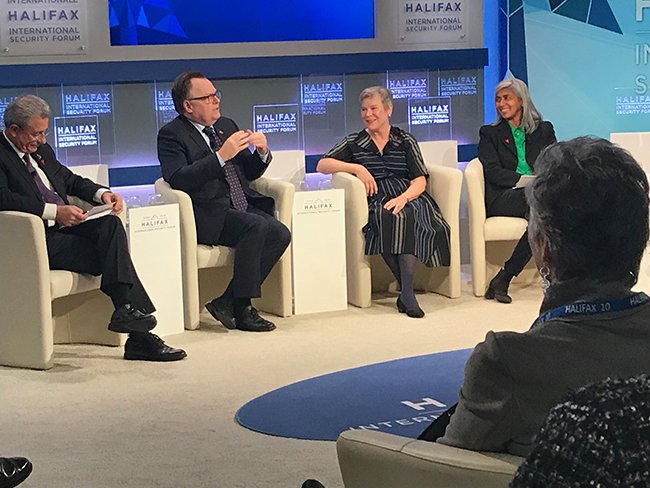
Heather Hurlburt
In addition, several women mentioned the perception, held by them or others, that women were more welcome in the non-governmental advocacy sector, and more likely to favor significant weapons cuts or disarmament. This perception was a double-edged sword; on the one hand, it demonstrated that, in the words of NATO Deputy Secretary General Rose Gottemoeller, “women aren’t afraid of nuclear weapons…as advocates for sound nuclear policy, including disarmament, they don’t shy away from working nuclear issues.” On the other hand, women reported it being used against them to undermine their seriousness inside government. (The actual views of women interviewed were complex, nuanced, and varied, underlining anecdotal findings that gender is not determinative of views on the issue.)
Women’s Career Paths
The composition of the foreign affairs and national security field as a whole has changed dramatically over the last half-century, yet it has not caught up with either women’s representation in the population or their apparent desire for such careers (as evidenced by women’s majority representation in international affairs undergraduate degree programs). Moreover, representation differs dramatically across the field and from junior to senior levels: Women are about 40 percent of all Foreign Service officers, but that number declines dramatically at the most senior levels, according to the American Foreign Service Association.7
A study of the national security workforce by the think tank Center for a New American Security (CNAS) found that “while women’s representation throughout the GS [General Schedule, i.e. career] workforce has increased, they are either leaving government service earlier than their male counterparts, or not being promoted at the same rates.”8
In the military, where all roles were opened to women only in 2014—a decision which continues to be debated—women make up 16 percent of enlisted personnel and 18 percent of the officer corps. At senior levels, women have approached 40 percent of assistant secretary and above positions at the State Department in recent years, while at the Defense Department that number hovers closer to 20 percent.9
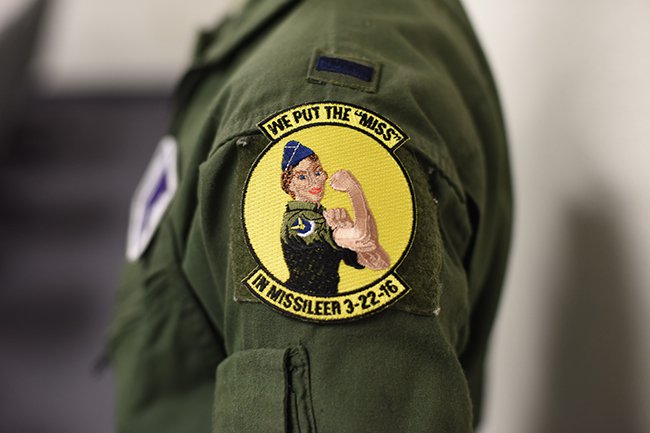
U.S. Air Force photo/Airman Collin Schmidt
As slow and incomplete as this progress has been, it should be noted that it is superior to the dismal rates of representation of non-white Americans in the policymaking process. Sexual minorities and gender non-conforming individuals—all of whom would have faced denials of security clearances and discrimination into the 2000s (and in the case of transgender servicemembers, to this day)—also remain underrepresented. We hope that our methodology and results will spur others to investigate and document the status and stories of those communities.
CNAS and others who have attempted to document firm numbers on women’s participation in national security policymaking over time have noted the difficulties in tracking National Security Council staffing as well as debates about counting military and civilian personnel and various government departments and the nuclear laboratories.
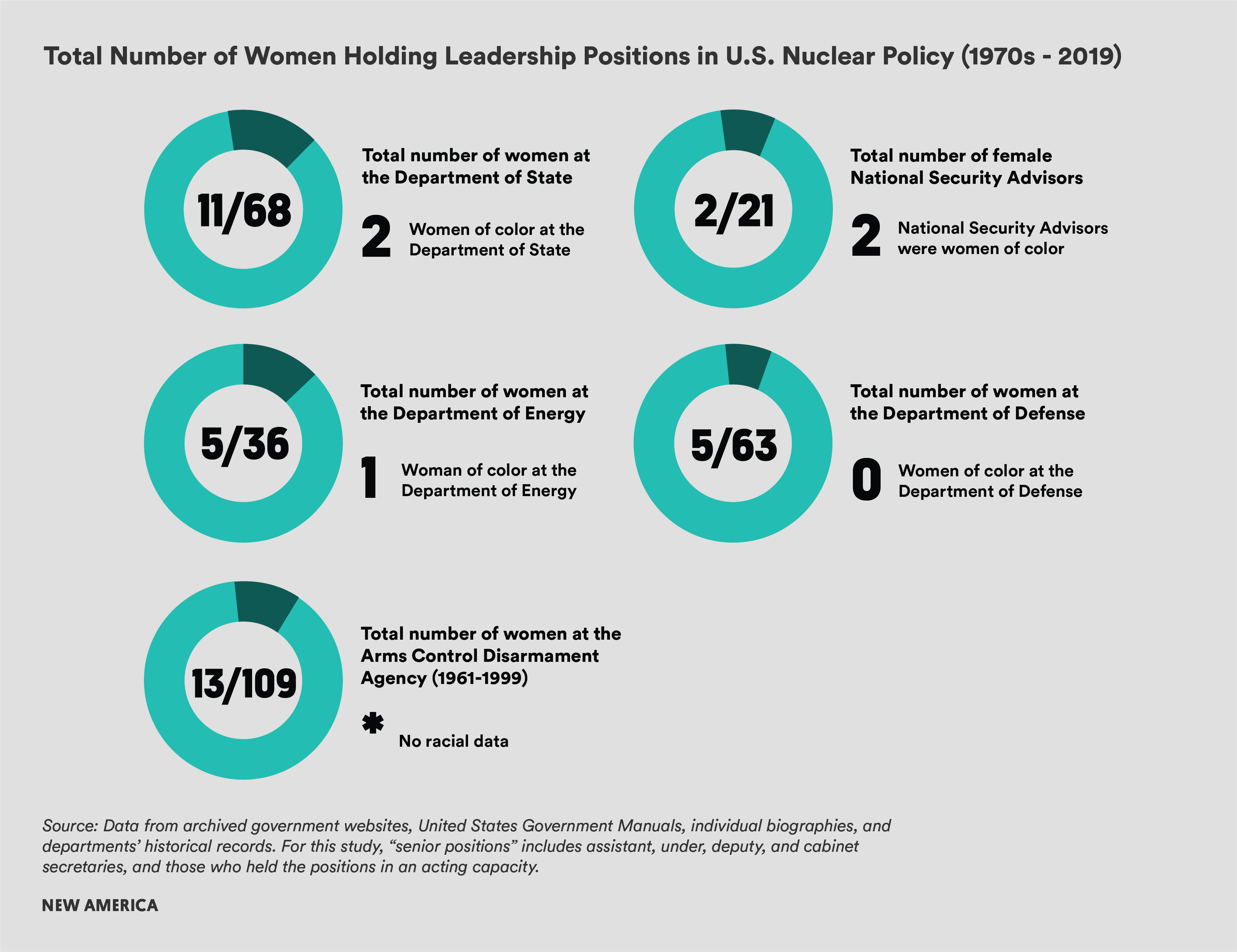
As a rough proxy for women’s participation in nuclear policymaking, we tracked the number of women in leadership roles in certain executive branch jobs starting in the 1970s, when our interviewees first entered the field, until the present day. These data include positions in the Departments of State, Defense, Energy, and within the White House. We also considered the Arms Control Disarmament Agency separately, which operated from 1961 to 1999, when it was folded into the State Department. In examining the leadership in nuclear and arms control-related positions, we tracked how many people had ever held those positions, including in an acting capacity, how many were women, and how many were women of color.
For international comparative purposes, we also considered data developed by the International Law and Policy Institute (ILPI) and the United Nations Institute for Disarmament Research (UNIDIR), reporting how many women were present at two international negotiations: the United Nations General Assembly First Committee (Disarmament and International Security) and Treaty on the Non-Proliferation of Nuclear Weapons (NPT) Review Conferences, both in five year intervals from 1980 to 2015. We have compared how many women were included in delegations from the five nuclear-weapons states, the United States, Russia, the United Kingdom, China, and France, as well as states that held nuclear weapons after the Soviet Union’s collapse—Kazakhstan, Belarus, and Ukraine—and two countries which were key to policy and negotiations over the period we consider, Iran and South Korea.10
Error: Data visualization bundle URL missing.
Error: Data visualization bundle URL missing.
The career paths of nuclear experts have not been studied, regardless of gender. At a time when the field is asking questions about attracting a new generation of experts, our subjects provide valuable data about the shape of careers for everyone, even as more research is needed to understand how experiences differ.
While some interviewees mentioned childhood experiences or idealism as important motivation for entering the field, others described it as more a matter of chance—taking a particular course, or having a particular job or fellowship become available. Many mentioned undergraduate or graduate coursework and the availability of fellowships to work in government, highlighting the importance of making nuclear policy study appealing to students from diverse backgrounds, and of keeping fellowships and other entry-level pipelines open and attainable.
A theme that ran across women’s experiences was the desire to make a difference, and the appeal of the nuclear and non-proliferation fields, at various times across the last four decades, as places where hard work would result in visible payoffs for U.S. and global security. Additionally, many women had combined nuclear experience with work in other security fields. They came or returned to the field for career advancement and moved elsewhere when advancement seemed blocked. These two factors suggest that the field should not depend only on attracting “lifers,” but needs to see itself as competing with other security topics for diverse talent.
As is discussed at greater length in Part 4, women who stayed in or returned to the field over decades also took on jobs of different intensity levels in order to manage the demands of family life. In order to attract and retain talent, the field needs to create jobs that allow flexibility for parenting, for example, without family responsibilities being perceived as career-ending.
While the field as a whole has done little research into how to retain its best talent, our interviewees had important insights around the factors that kept them in the field or caused them to move subfields or shift out entirely. In addition, as will be seen later, our subjects perceived that the field demanded and rewarded a specific set of attributes for all genders; thus, individuals whose strengths lay elsewhere fell by the wayside (and are thus not likely to have been included among our interviewees). Interviewees cited three main reasons why they, or women they knew, had left nuclear policymaking entirely or chose to move subfields: seeking improved leadership, shifting the balance of technical detail in their work, and escaping harassment.
Among women who stayed in the field, several mentioned love of the work and of the community as reasons to stay. Opportunities for promotion and mobility were key, as were mentoring and networking.
The Role of Mentoring and Sponsorship
Mentoring played a strong and omnipresent role in our respondents’ careers, from getting the first job in the nuclear field to choosing to stay, from building their own careers to supporting younger women and more diverse entrants. Relationships were central to finding out about jobs, being considered qualified for jobs, understanding how to succeed in particular positions and progress on to higher-ranking ones.
Additionally, the majority of women interviewed mentioned, without prompting, their desire to mentor and support younger women entering the field, with some citing existing resources for younger women, such as the Project on Nuclear Issues (PONI) or groups supporting women in the field, such as Women in International Security (WIIS) and Women of Color Advancing Peace and Security (WCAPS).
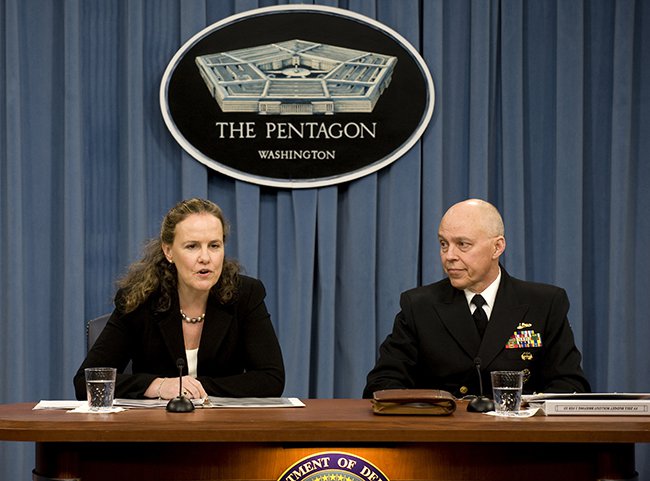
Notably, many of the women perceived themselves as part of an extended genealogy of mentors and mentees who had in turn gone on to mentor others. Flournoy, for example, was frequently cited as an inspiration based on her own career, her willingness to advise others, and her efforts to set up a woman- and family-friendly shop in the Defense Department. But Flournoy herself cited her own mentors—and like many, noted that both women and men had been key to her progress. Respondents often cited a male boss or colleague whom they perceived as committed to advancing women.
DoD / Cherie Cullen
At a time when gender and security issues have become deeply politicized, it is worth noting that women with decades of government experience reported having supportive male bosses and mentors in both Republican and Democratic administrations; some of the women whose success in the field is strongly associated with the Obama administration, for example, made key advances as career civil servants working with Republican political appointees during GOP administrations.
But Flournoy also noted a problem with relying on mentorship to come from the system as it is. She called it “the mini-me approach to mentoring, which is a senior person, say a senior man, says, ‘Ah, that young man over there. He reminds me of my younger self when I was 25, he's just like me. So, I'm going to take an interest him and promote him and put him forward,’ and so forth….That's going to be a self-perpetuating system.”
Our interviewees, especially those who had enjoyed multi-decade careers in the field and risen to senior positions, described mentor relationships that endured over time. Mentors gave advice, warded off sexual harassment, took junior colleagues along to new jobs and might even call years later to propose a new job for a mentee. Expectations might be heavy in return, from the boss who expected all-night work to the ones who had to be explained and managed by their subordinates.
Mentorship thus provided women a key avenue to succeed in the field—and to help other women follow them, which many enthusiastically described doing.
However, in some instances, mentorships replicate many of the field’s more problematic dynamics for women and men, which we take up in the next section.
Citations
- For data on gender imbalance in op-eds and mainstream media coverage, see New America Foundation Weekly Wonk, “The Underrepresentation of Women in Foreign Policy is a Huge Problem,” Vox, February 16, 2015, https://www.vox.com/2015/2/16/8039675/foreign-policy-interrupted.
- Kyle Harvey, American Anti-Nuclear Activism, 1975–1990: The Challenge of Peace (New York: Palgrave MacMillan, 2014); and Benjamin Redekop, "‘Physicians to a Dying Planet’: Helen Caldicott, Randall Forsberg, and the Anti-Nuclear Weapons Movement of the Early 1980s," Leadership Quarterly 21, no. 2 (2010): 278–291.
- Karen Piper, A Girl’s Guide to Missiles: Growing Up in America’s Secret Desert (New York: Viking, 2018), https://books.google.com/books/about/A_Girl_s_Guide_to_Missiles.html?id=VV4_DwAAQBAJ. Liza Munday, Code Girls: The Untold Story of the American Women Code Breakers of World War II (Hachette Books, 2017), https://books.google.com/books/about/Code_Girls.html?id=LaaMtAEACAAJ. Clive Thompson, Coders: The Making of a New Tribe and the Remaking of the World. (Penguin Press, 2019). https://books.google.com/books?id=mjFeDwAAQBAJ&printsec=frontcover&source=gbs_ge_summary_r&cad=0.
- Memorandum from John N. McMahon, CIA deputy director, December 19, 1983 as cited in CNAS From College to Cabinet, http://www.foia.cia.gov/sites/default/files/document_conversions/1820853/1983-12-15.pdf.
- Carol Cohn, “Sex and Death in the Rational World of Defense Intellectuals,” Signs 12, no. 4, (summer 1987): 687–718, https://people.ucsc.edu/~rlipsch/migrated/pol179/Cohn.pdf. Note that Cohn asserts that the field is “all male, except for their secretaries” in 1987, at a time when more than a quarter of our sample women were already in government, Rozanne Ridgway was leading nuclear negotiations with the Soviet Union, and another quarter were studying to enter the field. How many women were, and continue to be, deterred from entering the field by the mistaken belief that women are absent—or by their relative absence in academia?
- Patty Chang, Mayesha Alam, Roslyn Warren, Rukmani Bhatia, and Rebecca Turkington, Women Leading Peace (Washington, DC: Georgetown Institute for Women, Peace and Security, 2015), https://giwps.georgetown.edu/resource/women-leading-peace/; Thania Paffenholz, Nick Ross, Steven Dixon, Anna-Lena Schluchter, and Jacqui True, Making Women Count-Not Just Counting Women: Assessing Women’s Inclusion and Influence on Peace Negotiations (Geneva: Inclusive Peace & Transition Initiative and UN Women, 2016), https://www.inclusivepeace.org/sites/default/files/IPTI-UN-Women-Report-Making-Women-Count-60-Pages.pdf; Marie O’Reilly, Andrea Ó Súilleabháin, and Thania Paffenholz, Reimagining Peacemaking: Women’s Roles in Peace Processes (New York: International Peace Institute, June 2015), https://www.ipinst.org/wp-content/uploads/2015/06/IPI-E-pub-Reimagining-Peacemaking.pdf.
- Post-2016 statistics are difficult to come by. Up to 2016, see Andrea Strano, “Foreign Service Women Today: The Palmer Case and Beyond,” Foreign Service Journal, March 2016, http://www.afsa.org/foreign-service-women-today-palmer-case-and-beyond.
- Katherine Kidder, Amy Schafer, Philip Carter, and Andrew Swick, From College to Cabinet: Women in National Security (Washington, DC: Center for a New American Security, 2017), 8, https://s3.amazonaws.com/files.cnas.org/documents/CNASReport-WomeninNatSec-Final.pdf?mtime=20170403112013.
- Heather Hurlburt, Elizabeth Weingarten, and Elena Souris, National Security: What We Talk About When We Talk About Gender (Washington, DC: New America, 2018), https://www.newamerica.org/political-reform/reports/national-security-what-we-talk-about-when-we-talk-about-gender/.
- John Borrie, Anne Guro Dimmen, Torbjørn Graff Hugo, Camilla Waszink, and Kjølv Egeland, Gender, Development and Nuclear Weapons: Shared Goals, Shared Concerns (Geneva, Switzerland: United Nations Institute for Disarmament Research (UNIDIR) and International Law and Policy Institute (ILPI), October 2016), http://www.unidir.org/files/publications/pdfs/gender-development-and-nuclear-weapons-en-659.pdf.
Part 2. Gender Tax: The Experience of Being a Female Nuclear Policy Professional
Women who worked for years or decades in nuclear policy—and had the opportunity to compare across sectors and subspecialties—described a consistent, challenging set of expectations they needed to meet and experiences they were forced to navigate. Some, like harassment, assault, and discrimination, were explicitly gendered. Others seemed gender-neutral on their face but intersected in problematic ways with societal norms around femininity. Interviewees had much positive news to share about their own experiences surmounting prejudice, supporting other women, seeing norms change over time, and gaining the power to lead in changing norms and practices for the field. But few doubted the persistence of problems that drive some people out of the field, limit innovation, and impose extra burdens on those who remain—the “gender tax.”
Ultimately, to be successful in the field, women had to pay a “gender tax”11 in varying forms. In other words, on top of the job’s inherent complications and high stress, women also had to perform the constant mental and emotional calculus that comes with implicit sexism; explicit sexism and discrimination; gender and sexual harassment; and gendered expectations.
Traits Expected and Rewarded
Our interviewees consistently cited the same traits as necessary to succeed in the field, including specific kinds of knowledge, professional skills, and personal qualities. Of these, “technical expertise” was the most common trait mentioned. Respondents noted the exact knowledge required differed over time and by administration—for example, the 1990s saw a specific emphasis on denuclearization. Examples encapsulated everything from historical knowledge to regional knowledge to the particulars of different weapons systems and thrust-to-weight ratios. While many of our interviewees had successfully used technical expertise to enter or advance in the field, some noted that this high demand for technical knowledge was also used to exclude people from the nuclear elite. As former Under Secretary of Defense for Policy Christine Wormuth said, “it’s harder for people who have good ideas about those kinds of issues who don't have the technical fluency to have their voices heard, I think.”
Lt. Kristine Volk, Resolute Support Public Affairs
Women also referenced specific skills as crucial, including being able to summarize complex information, speak to a broad audience and to a particular decision-maker, and work quickly and effectively under pressure. Spending a lot of time at work was also commonly cited as an expected, and rewarded, behavior.
Other answers, however, featured characteristics that social science research has defined as being stereotypically gendered. These included having a warm but firm demeanor, being a strong negotiator, and consistently speaking up in meetings. Other respondents told us that adopting stereotypically masculine traits was crucial to success.
Some interviewees emphasized other traits that were more stereotypically “female”: having strong emotional intelligence (EQ), building relationships with foreign counterparts, being a team player, and being able to get buy-in from all relevant stakeholders. One practitioner suggested that, because women are often socialized to prioritize and develop EQ, it can provide them with an important industry skill. Negotiators, in particular, need to be sensitive and able to read their foreign counterparts. As one interviewee told us:
Maybe there’s a certain word that in your language seems perfectly appropriate but in their language through a translator it’s not going to work, or it’s more politically charged for them than it is in your own culture. We have found situations where women have both the IQ and EQ to succeed in those environments, not to belittle their male counterparts who can also have the EQ and IQ, but women sometimes can bring a very nuanced understanding and can pick up on things that are occasionally missed by the men around the table.
Many interviewees noted that this duality was extremely complicated to balance. Appearing too feminine in the national security world was a problem, because some might think you were not serious enough for the subject matter. Acting too masculine could be interpreted as “bossy” or “bitchy.”
On top of the job’s inherent complications and high stress, women also had to perform the constant mental and emotional calculus that comes with implicit sexism; explicit sexism and discrimination; gender and sexual harassment; and gendered expectations.
Participants’ observations aligned strikingly with how social science defines two baskets of characteristics with associated gender stereotypes. Agentic characteristics are commonly seen as masculine—being assertive, independent, decisive, competent, and strong.12 In contrast, social scientists describe stereotypically feminine characteristics as communal; these traits include being patient, kind, helpful, and sensitive.
Importantly, while individuals’ personalities do not exist in a gendered binary and can possess both agentic and communal characteristics, these traits carry different values in the workplace, and can affect an individual’s ascendance and position regardless of his or her gender. Role congruity theory, which describes the tension that is created when an individual is perceived to be violating gender role expectations, predicts significant challenges for women in leadership positions. If others perceive a “mismatch between the agentic traits ascribed to the prototypical leader and the communal traits associated with the female gender,”13 the response is likely to be a host of behaviors intended to put women back in their place, including sexism and harassment, gendered expectations, and the “gender tax.”
Implicit Sexism
Even within the supposed meritocracy, female policymakers could not help but notice implicit sexism in the field throughout their careers. Men would interrupt women more. They would take ideas that a woman had raised earlier in the meeting without giving credit. Women were asked to make copies or get coffee, regardless of their organizational status. While many women noted that their original solution was to work extremely hard, develop their expertise, and become hyper-competent, some felt over time that their differential experiences could not be explained away by rank, age, or lack of experience. One woman explained, “as I grew more senior, just frankly there were many fewer people who could have plausible alternative explanations as you grew in competence to exceed that of many other people—men, meaning.”
Many women described experiencing intimidation, along with the sense that they did not belong or had gotten to their position by some kind of a fluke—also known as imposter syndrome. They were also more likely to censor themselves. As the only woman in the room, one respondent said, “I have to pick my timing and what I would say carefully, and I do feel that expectation. I have to be right and say something right and pretty interesting and insightful straight away, because I don't get a second chance.” Ambassador Bonnie Jenkins, the coordinator for threat reduction programs in the State Department’s Bureau of International Security and Nonproliferation from 2009 to 2017, remembers being concerned early in her career about making mistakes because she felt she was “carrying the entire gender on her shoulders” when she spoke.
Explicit Sexism and Discrimination
The history of sexism in the security field, though little-known, is extreme. For example, a recent history of the Vietnam War depicts military-strategist-turned-peace-activist and Pentagon Papers leaker Daniel Ellsberg as a rising professional, “passing around the RAND office nude photos of the women he had slept with.”14
Explicit sexism and discrimination shape the work experience for women in nuclear security domestically and abroad, across departments and time periods. According to one woman working in the Pentagon in recent decades, “it was routine” to be discriminated against. One policymaker said, “it’s so endemic that the whole town would fall down if people actually reported their experiences at this point.”
Women reported enduring sexist comments from male colleagues about themselves, other women, or being forced to view inappropriate photos. They became accustomed to outsiders assuming they were secretaries or assistants, rather than key policymakers. Women with children heard offensive comments, especially about whether they would come back to work, and, in some cases, saw others with children re-assigned to less prestigious desks. Julianne Smith, who served as the deputy national security advisor to the vice president between 2012 and 2013 and as the principal director for European and NATO policy in the Office of the Secretary of Defense from 2010 to 2013, noted that, though it is illegal, some women are still asked during the hiring process whether they are planning to have children.
Women also faced egregious sexism from foreign counterparts. Although some women said representing the United States offered some protection and gravitas, overt sexism, bordering on harassment, was still extremely common. Wormuth noted that in international situations, “in the early years, I certainly had lots of the whole kind of ‘are you the administrative assistant or are you the mistress?’ [Because] certainly you couldn't be there for substantive reasons.” Staying in hotels with other delegations sometimes meant men trying to get into women’s rooms. Men would kiss hands, talk about women’s attractiveness, and proposition female staff. In heavy-drinking cultures, men pushing women to drink more took on a different tone. Another woman remembered a banquet she attended where a man giving a speech noted that having women present “was really helpful because we all know that women help the men to perform at their best.”
On top of doing their jobs, these women had the extra tax and mental calculation of navigating these situations safely and tactfully. Wormuth recounted her reaction to being asked out to dinner by a high-ranking foreign representative:
I remember having a mini panic attack thinking, ‘Oh my gosh, how do I handle this?’ I don’t want to embarrass my boss….I don’t want to cause a diplomatic incident. I was young. And then I remember thinking, ‘How do I politely turn this man down?’ It was so deflating because I realized, oh, he wasn't paying any attention to what I was saying, he was paying attention to how I looked. And it was just really deflating.
These kinds of situations are an extra stressor—a tax—that women in all industries face on a daily basis. But for women in the nuclear and arms control fields, getting it wrong—“missteps” like saying no too clearly (or not clearly enough), offending a high-powered man, or landing in a bad photo-op—could create an international incident or unravel weeks or years of work.
Sexual and Gender Harassment
It is no surprise, then, that almost every woman interviewed said they had either experienced harassment or had seen it happen to others. Experiences of harassment ranged from what Wormuth described as “low-grade elevator eyes,” to incidents where other interviewees remembered women quitting their jobs. One interviewee remembered a man who was an expert at walking the line of sexual harassment without legally crossing it.
Women also struggled with whether to report incidents or handle them alone. Jennifer Miller said that in the #MeToo era, there is extra pressure knowing that reporting could end an offender’s career, so she prefers to address interpersonal problems herself. At the same time, she also said she has encountered more “ignorant” and “asinine” comments than ones she would define as sexual harassment.
Race and Intersectionality
As social science predicts, these negative experiences were amplified for women of color.
Eric Bridiers / United States Mission Geneva
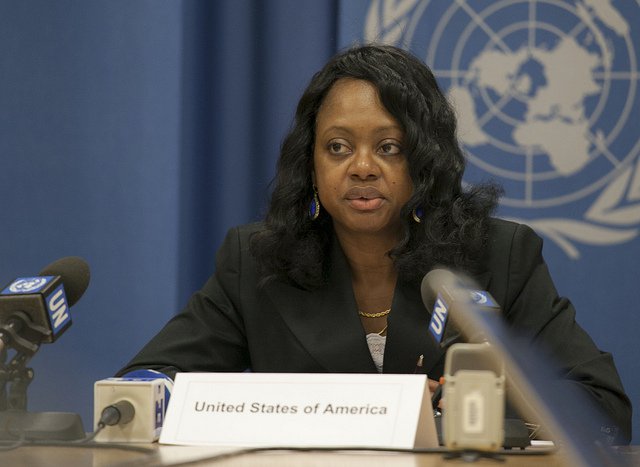
Jenkins reported that she often dealt with specific acts of discrimination, whether from her age, race, and/or gender. She also stressed the structural discrimination, found in organizational culture, she saw as she watched people of color, and women of color, leave because there are not many opportunities for advancement. When she was working at the Arms Control Disarmament Agency, she was one of the youngest, if not the youngest, professional staff members in her division, and the only woman of color. She remains one of a small number of women of color. Jenkins noted that:
You have two things that you have on your mind when you are part of policy discussions and you are one of a few, if not the only person representing your gender or racial group: that I might not adequately represent women and that I might not adequately represent people of color? And also, did I do a good job representing African Americans? These issues do not concern me much anymore since I choose not to carry on my shoulders someone else’s stereotypes. I have a job to do and that is what gets my focus.
In addition to this pressure, social science has shown that women of color in other fields are more likely to experience discrimination, and sexual, racial,15 and gender harassment.16 As a result, there are extra pressures placed on women of color that white women do not experience. We do not deal at all with the pressures experienced by LGBT and gender non-conforming individuals, because until recent years those identities were grounds for denial of employment and security clearances.
Consequences of Sexual Harassment and Hostile Work Environments
One of the first cases to bring workplace sexual harassment into the legal spotlight originated in the nuclear field. In 1974, Carmita Wood, an administrative assistant to a nuclear physicist at Cornell University, quit her job because of her boss’s repeated sexual harassment and the university’s refusal to transfer her. When she applied for unemployment, the Department of Labor denied her on the grounds that she resigned for “personal non-compelling reasons.”17
"It was so deflating because I realized, oh, he wasn't paying any attention to what I was saying, he was paying attention to how I looked."
Forty years later, the RAND Corporation reported in 2014 that 26 percent of active-duty women, compared to 7 percent of active-duty men, experienced sexual harassment or gender discrimination.18 More broadly, hostile work environments—the term used to describe an environment that becomes difficult or impossible to work in, due to discriminatory or harassing behavior—are common, affecting one in five Americans.19 Such environments come at a high cost20 to both employees and employers, for whom consequences include higher absenteeism, increased alienation between leaders and staff,21 lower morale and self-esteem, and decreased productivity overall.22 Employees in hostile work environments are more likely to feel embarrassment, shame, and guilt, and are more likely to experience depression, anxiety, confusion, sleep problems, and even to commit suicide.23
Even in a work environment that may not qualify as hostile, working as a woman in a male-dominated field comes with its own stressors. One recent study measured higher levels of cortisol, the body’s stress hormone, in women working in such industries.24 Women often feel more stigmatized and less satisfied at work,25 are more likely to have higher turnover intentions, and experience more gender discrimination and harassment.26 And, of course, the competing and gendered expectations for how a woman should act can also lead to lower perceptions of her performance.27 Studies have also found that high-performing women are less likely to choose to participate in competitive environments than their male colleagues, highlighting this self-censorship dynamic.28
Such conditions have an unavoidable impact on the work itself: one study found that 50 percent of targets lost productive time worrying about the individual who instigated harassment or discriminatory behavior, and 25 percent spent time avoiding the instigator.29
Interpersonally, teams are less cohesive and the relationship between leader and employees is corroded. In some cases, bad workplace relationships can escalate to workplace violence. These consequences can have high costs for any workplace, but within the nuclear field, there are extremely high stakes and little room for error.
Impacts of Gendered Expectations
Beyond sexism and harassment, some interviewees also mentioned being unsure of how to adopt successful traits in the field because of their gendered implications and their position as a minority in a male-dominated space. Some were hyperaware of the gender disparity. Others said they did not notice.
Yet meeting these gendered expectations can and does have a cost for women. Research suggests that if women in male-dominated leadership roles adopt “too many” masculine traits, they are more likely to get negative performance evaluations.30 We also know that women who are seen as power-seeking in politics often evoke negative emotional reactions in voters.31
Women were not always clear whether this forced choreography and balancing act was because of gender, or some other factor. Many discussed other overlapping identities, such as being more junior, or civilian, or a person of color.32 Flournoy explained that in her first government role as an office director in the Pentagon, she was “29 years old, a civilian female, and a Democratic appointee. That's about as many strikes against you [that] you can have walking into the Pentagon.”
Another woman recalled that rank made a big difference. As a member of the military with a doctorate, she was not yet a major, and therefore her views were not valued the same way as an officer with a higher ranking and more experience would be. To her, that had nothing to do with gender. Nevertheless, because there were relatively few women at senior levels across the civilian and military sectors of the nuclear policy world, this dynamic raises important questions around the long-term impact of intersectional identities on career progression.
The same woman identified a division between civilian theorists on the one hand, and military “implementers” on the other. In her experience, the only way to become a member of the priesthood was to have experience as an implementer, someone who actually worked around nuclear weapons earlier in his or her career. To her, the gap between implementers and theorists reflected a civilian-military divide, rather than a senior-junior divide.33
Of course, the military itself is also male-dominated, partially due to the previous ban on women in combat roles. (The preference for veterans in federal hiring, then, unintentionally prefers men and reinforces unequal gender ratios.34) However, women often felt that the military’s focus on rank and meritocracy actually helped them, even if they had not served. For some women, however, this belief changed dramatically over time.
The Gender Tax
The elements of a gender tax, then, range from identity performance, to slights, to sustained undermining and major harassment. These burdens made it more difficult to enter the field and rise up the ranks. Terminology like “graybeards” and “silverbacks” may intimidate and exclude, and also act as barriers to new and diverse practitioners.
Sometimes these practices are unintentional, but sometimes they are intentionally weaponized. One woman cited one case where the harassment was a “team effort,” where “a number of men collaborated together to create this unwelcoming environment” until their target quit. She explained, “it wasn’t so much that [the instigator] was interested in her as that he was weaponizing sexual harassment as a distractor from what she needed to do.”
“…it wasn’t so much that [the instigator] was interested in her as that he was weaponizing sexual harassment as a distractor from what she needed to do.”
In this way, colleagues can make it clear they believe individual women are not welcome in their positions or, perhaps, in the field itself. That highlights a broader phenomenon known to researchers as gender harassment, which need not be sexual in nature, but consists of behavior that conveys hostile and derogatory attitudes about one’s gender, and may create a hostile work environment.35 As Drezner commented when we first wrote about the national security gender tax in 2017, “I can only imagine just how less productive I would have been coping with this additional layer of challenges.”36
The Field’s Impact on Women
Tactics and Coping Mechanisms
In response to these challenges, women developed a long list of tactics, ones that they had very consciously adopted, seen others use, or discussed with other women. The most commonly cited coping mechanism in the interviews was still based in the meritocracy mythology: to work extremely hard and be hyper-competent. Ambassador Laura Kennedy, who was U.S. permanent representative to the Conference on Disarmament in Geneva from 2010 to 2013 as well as Deputy Assistant Secretary of State for European and Eurasian Affairs with responsibility for southern Europe, the Caucasus and Central Asia under Defense Secretary Colin Powell, cited this strategy as one of her approaches. Kennedy said that when she was beginning her career in arms control, she met a notoriously demanding boss’s standards by staying up until 4:00 a.m. while on foreign trips to write out longhand copies of her notes from that day to slip under his door. That way, he would have them when he woke up at 6:00 a.m.
Other reported ways of working around sexism included laughing off insults, adopting technical vernacular, choosing more masculine clothes and hairstyles, ignoring interpersonal issues, and making sure not to convey weakness. While some women reported turning down positions that felt like “quota hires,” others saw tokenism and stereotyping as opportunities they could exploit.
Other tactics included asking for help, reclaiming their points and adamantly noting when they hadn’t finished talking, cursing strategically, “giving” attitude “back,” using Twitter as a means of self-expression, and both getting a PhD and deliberately pointing to that degree to reassert their status.
Changes in Personality and Society
Women also noticed changes in themselves over time, whether from their own age, or increased expertise. Many said that now in senior positions, they were more confident and willing to be assertive when they would not have before. They worried less about how others perceived them and were more willing to openly challenge sexism.
Interviewees noted that the culture and industry, though still very conservative in some places, have loosened. New accommodations, like the Family and Medical Leave Act, and technical innovations like teleworking have made it easier to balance work-life demands. And now, where the old model was to avoid calling out sexism, society has placed more attention on gender issues, and younger women are less willing to accommodate the current system, or outdated and sexist practices.
Over the decades and as individual women advanced in their careers, fears around personal appearance tended to decline. Many senior women recalled the shapeless suits of the 1980s, like “cardboard boxes,” as if to “completely disguise our gender” and look as masculine as possible. Over time, many said that they decided to simply dress like themselves. In general, self-expression at work has become more permissible in recent decades, and this field is no exception. As Schulman put it, dressing in “turquoise silk vintage suits and crazy shoes” was a way of “keeping ownership of [her] own soul.” She noticed other women did the same, as well. For them, it was a way to say, “you can make me work 20 hours a day, but I am still myself.”
Lastly, some women cited specific tactics aimed at not just surviving in the system but changing it. They specifically mentioned lifting up other women by mentoring them, putting others on panels and citing them, planning ahead to amplify colleagues in meetings,37 creating a positive leadership climate, and supporting a good work-life balance.
Citations
- The “gender tax” concept has economic origins, as many everyday products, such as razors, are more expensive when marketed to women instead of marketed to men. See Sapna Maheshwari, “’The "Gender Tax’ Study Shows Women Are Charged More for Being Women,” BuzzFeed News, December 22, 2015, https://www.buzzfeednews.com/article/sapna/study-shows-women-are-charged-more-for-being-women. Tufts University professor Daniel W. Drezner extended this idea to his writing on the extra pressures and obstacles that women in the national security world face. See “The Tax on Women in National Security,” Washington Post, November 9, 2017, https://www.washingtonpost.com/news/posteverything/wp/2017/11/09/the-tax-on-women-in-national-security/.
- Ashleigh Shelby Rosette and Leigh Plunkett Tost, “Agentic Women and Communal Leadership: How Role Prescriptions Confer Advantage to Top Women Leaders,” Journal of Applied Psychology 93, no. 2 (2010): 221–235,https://msbfile03.usc.edu/digitalmeasures/tost/intellcont/Rosette%20and%20Tost%202010%20JAP-1.pdf.
- Ibid
- Max Boot, The Road Not Taken: Edward Lansdale and the Tragedy of Vietnam (New York: W.W. Norton, 2018). Quoted in Heather Hurlburt, “The Still-Ugly American,” Washington Monthly, January–March 2018, https://washingtonmonthly.com/magazine/january-february-march-2018/the-still-ugly-american/.
- NiCole T. Buchanan and Louise F. Fitzgerald, “Effects of Racial and Sexual Harassment on Work and the Psychological Well-Being of African American Women,” Journal of Occupational Health Psychology 13, no. 2 (2008): 137–151, https://vaw.msu.edu/wp-content/uploads/2013/10/Buchanan-Fitzgerald-2008-Racial_Sexual-Harassment-on-work-and-psych-of-Af-Amer-women.pdf.
- Emily A. Leskinen, Veronica Caridad Rabelo, Lilia M. Cortina. “Gender stereotyping and harassment: A ‘catch-22’ for women in the workplace.” Psychology, Public Policy, and Law 21, no. 2 (May 2015): 192-204. https://psycnet.apa.org/buy/2015-19192-004.
- Alieza Durana, Amanda Lenhart, Roselyn Miller, Brigid Schulte, and Elizabeth Weingarten, Sexual Harassment: A Severe and Pervasive Problem (Washington, DC: New America, September 2018), https://d1y8sb8igg2f8e.cloudfront.net/documents/Sexual_Harassment_A_Severe_and_Pervasive_Problem_2018-10-10_190248.pdf.
- National Defense Research Institute, Sexual Assault and Sexual Harassment in the U.S. Military: Top-Line Estimates for Active-Duty Service Members from the 2014 RAND Military Workplace Study (Santa Monica, CA: RAND Corporation, 2014), https://www.rand.org/pubs/research_reports/RR870.html.
- Jana Kasperkevic, “One in Five U.S. Workers Are Exposed to a Hostile Work Environment,” Marketplace, August 17, 2017, https://www.marketplace.org/2017/08/16/business/one-five-us-workers-are-exposed-hostile-work-environment.
- ElyseShaw, Ariane Hegewisch, and Cynthia Hess, Sexual Harassment and Assault at Work: Understanding the Costs (Washington, DC: Institute for Women’s Policy Research, October 2018), https://iwpr.org/wp-content/uploads/2018/10/IWPR-sexual-harassment-brief_FINAL.pdf; and Lilia M. Cortina and Jennifer L. Berdahl, “Sexual Harassment in Organizations: A Decade of Research in Review,” chapter 25 in Julian Barling, Cary L. Cooper, Stewart R. Clegg, and Cary L. Cooper, eds., The SAGE Handbook of Organizational Behavior (Thousand Oaks, CA: SAGE, 2009), https://lsa.umich.edu/psych/lilia-cortina-lab/Cortina&Berdahl.2008.pdf.
- Ali Abdulhassan Abbas, Adel Abbas, and Hussein Huraija Khali, “The Effect of Hostile Work Environment on Organizational Alienation: The Mediation Role of the Relationship between the Leader and Followers,” Asian Social Science 13, no. 2 (January 2017): 140–158, https://www.researchgate.net/publication/312531137_The_Effect_of_Hostile_Work_Environment_on_Organizational_Alienation_The_Mediation_Role_of_the_Relationship_between_the_Leader_and_Followers
- Amna Anjum, Xu Ming, Ahmed Faisal Siddiqi, and Samma Faiz Rasool, “An Empirical Study Analyzing Job Productivity in Toxic Workplace Environments,” International Journal of Environmental Research and Public Health 15, no. 5 (May 2018): 1035, https://www.ncbi.nlm.nih.gov/pmc/articles/PMC5982074/.
- Brad Estes and Jia Wang, “Integrative Literature Review: Workplace Incivility: Impacts on Individual and Organizational Performance,” Human Resource Development Review 7, no. 2 (2008): 218–240,https://journals.sagepub.com/doi/abs/10.1177/1534484308315565.
- Alexandra Sifferlin, “Women in Male-Dominated Jobs Have More Stress,” TIME, August 25, 2015, http://time.com/4008343/women-male-jobs/.
- Deborah Hicks-Clarke and Paul Iles, “Climate for Diversity and Its Effects on Career and Organisational Attitudes And Perceptions,” Personnel Review 29, no. 3 (June 2000): 324–345, https://www.researchgate.net/publication/247615601_Climate_for_diversity_and_its_effects_on_career_and_organisational_attitudes_and_perceptions.
- Phyllis Kernoff Mansfield, Patricia Barthalow Koch, Julie Henderson, Judith R. Vicary, Margaret Cohn, and Elaine W. Young, “The Job Climate For Women In Traditionally Male Blue-Collar Occupations,” Sex Roles 25, no. 1–2 (July 1991): 63–79, https://link.springer.com/article/10.1007/BF00289317.
- Alice H. Eagly, Mona G. Makhijani, and Bruce G. Klonsky, “Gender and the Evaluation of Leaders: A Meta-Analysis,” Psychological Bulletin 111, no. 1 (January 1992): 3–22, https://www.scholars.northwestern.edu/en/publications/gender-and-the-evaluation-of-leaders-a-meta-analysis.
- Muriel Niederle, Carmit Segal, and Lise Vesterlund, “How Costly is Diversity? Affirmative Action in Light of Gender Differences in Competitiveness,” Management Science 59, no. 1 (2013): 1–16, http://gap.hks.harvard.edu/how-costly-diversity-affirmative-action-light-gender-differences-competitiveness.
- Christine M. Pearson, Lynne M. Andersson, Christine L. Porath, “Assessing and attacking workplace incivility,” Organizational Dynamics 29 (2000). 123-137.
- Alice H. Eagly, Mona G. Makhijani, and Bruce G. Klonsky, “Gender and the Evaluation of Leaders: A Meta-Analysis,” Psychological Bulletin 111, no. 1 (January 1992): 3–22, https://www.scholars.northwestern.edu/en/publications/gender-and-the-evaluation-of-leaders-a-meta-analysis.
- Tyler G. Okimoto and Victoria L. Brescoll, “The Price of Power: Power Seeking and Backlash Against Female Politicians,” Personality and Social Psychology Bulletin 36, no. 7 (June 2010): 923–936, http://gap.hks.harvard.edu/price-power-power-seeking-and-backlash-against-female-politicians.
- Our 2018 New America study, National Security: What We Talk About When We Talk About Gender, found that female national security practitioners were highly ambivalent about naming behavior as sexist and saw the likeliest causes of workplace conflicts as first personality, then age, then gender. That uncertainty over which part of their identity was prompting differential treatment was particularly salient when women recalled their experiences in junior roles. Find the report at https://www.newamerica.org/political-reform/reports/national-security-what-we-talk-about-when-we-talk-about-gender/.
- Anecdotally, a number of women have told interviewers that they found mixed or all-civilian security environments more sexist than fully military ones. See Drezner, “The Tax on Women in National Security,” Washington Post, November 9, 2017, for example.
- Katherine Kidder, Amy Schafer, Philip Carter, and Andrew Swick, From College to Cabinet: Women in National Security (Washington, DC: Center for a New American Security, 2017).
- See a discussion of harassment definitions and categories in “Introduction” of Alieza Durana, Amanda Lenhart, Roselyn Miller, Brigid Schulte, and Elizabeth Weingarten, Sexual Harassment: A Severe and Pervasive Problem (Washington, DC: New America, September 2018), https://www.newamerica.org/better-life-lab/reports/sexual-harassment-severe-and-pervasive-problem/introduction/.
- Daniel W. Drezner, “The Tax on Women in National Security,” Washington Post, November 9, 2017, https://www.washingtonpost.com/news/posteverything/wp/2017/11/09/the-tax-on-women-in-national-security/?utm_term=.3823f6bfb1fe.
- Juliet Eilperin, “White House Women Want to Be in the Room Where it Happens,” Washington Post,September 13, 2016, https://www.washingtonpost.com/news/powerpost/wp/2016/09/13/white-house-women-are-now-in-the-room-where-it-happens/.
Part 3: How Women Affect the Field
Interviewees reported that gender, and more specifically the presence of women in decision-making, did affect policy outcomes in the nuclear arena, citing improved processes, more emphasis on collaboration, and increased innovation. However, many were quick to push back on the essentialist notion that women are inherently more peaceful and therefore likely to tip the scale to disarmament or “softer” outcomes. As one respondent bluntly put it, “we don’t soften policy by adding estrogen.”
Nevertheless, women did report that they sometimes confronted harmful stereotypes about the association between women and peacefulness that undermines their authority. As one respondent noted, “I do not think women are more peaceful. And it irritates me to no end, that kind of line of thinking. In part because just in a very practical way, I think it undercuts us being taken seriously by the hard security side of the house, which has mainly been lived in by men.”
The “Consensual Straitjacket”
We heard over and over from respondents that there is a stark division between two communities that fall under the larger umbrella of nuclear policy: the arms control/nonproliferation community, which was more welcoming to women, diverse perspectives, and innovative ideas; and the deterrence/nuclear posture community, which was more closed-off and hierarchical.
Participants told us that members of the nuclear priesthood see deep experience in the field and insider knowledge as important qualities for inclusion in the community. The priesthood uses highly theoretical and abstract logic, specialized jargon, and the highly technical nature of nuclear policymaking to keep newcomers, especially those who are younger and female, out. According to Flournoy, “you have no opinions until you can master, demonstrate that you’ve mastered the technical pieces. And then that extended to what I call the orthodoxy, which is understanding all of the theoretical literature behind key concepts like nuclear deterrents, MAD, crisis stability, strategic stability. And mastering Herman Kahn and Tom Schelling, and all of this.”
Though most women faced obstacles as they sought to move ahead, the challenge was even more daunting as women entered government for the first time. One participant noted that the government is “more of a ceremonial, procedural kind of place. There’s a choreography in the government, that either you’re dancing or you’re not dancing. But it’s not a natural one that….You learn it as you’re in government, about when to say what and to who to say what and how to move things behind the scenes.”
"Women are socialized to sort of think outside the box to solve problems, and to make connections, and to work horizontally … and that just was not welcomed very much in the nuclear conversation."
This insulated, hierarchical structure was described by interviewees as leading to narrow thinking that in turn limited policy outcomes and invited groupthink. Policy discussions often proceeded according to predetermined scripts among officials who share similar experiences and outlooks. In this environment, outside-the-box approaches were not welcomed and could be dismissed by insiders as naive or uninformed. Furthermore, because the nuclear priesthood tends to control access to senior policymakers through its agenda-setting power, its members are often able to prevent new ideas or approaches from even reaching consideration at the senior level.
The emphasis on the nuclear orthodoxy saw many women struggle to fit themselves into a stereotypical image of what a nuclear official should look and sound like in order to be accepted and deemed authoritative. Participants described working very hard to learn the theory and technical details of nuclear policy and master the jargon used by this community. But they also described how they attempted to fit in to conventional modes of thinking, even as these conventions felt constraining.
Flournoy described this struggle as like a “consensual straitjacket.” She told us:
I think women are socialized to sort of think outside the box to solve problems, and to make connections, and to work horizontally to build networks and relationships, and to sometimes solve a problem by reexamining the basic assumptions and looking at it differently. And that just was not welcomed very much in the nuclear conversation.
Diversity Strengthens Processes and Outcomes
Participants in our conversation reported that having more women present in policy roles and discussions changed the dynamic. We heard that having more women in these conversations made the discussions more collegial and created an environment that was less competitive and more collaborative. When more women were at the table, individual women felt less pressure to prove that they belonged there or to speak on behalf of all women. Evelyn Farkas, former deputy assistant secretary of defense for Russia/Ukraine/Eurasia, told us that having more women colleagues around meant that “it wasn’t like we had to prove our knowledge….That’s a key thing, not feel like you have to prove yourself just because you're a woman or to try to get heard above the men, try to not get interrupted.”
Sgt. Alexander Skripnichuk / U.S. Army
Having a critical mass of women involved also made it easier to build the social relationships and networks that facilitate decision-making. Kennedy noted that in negotiations under the auspice of international organizations, while delegates give formal statements on the floor, “when you’re really going to find out, what are the possibilities? What’s on people's minds? It’s off the floor and in private settings, and so if you don’t have sort of access, it’s a big burden, and so it got easier as I got older, and there was more critical mass. It wasn’t okay to sort of treat women as the secretaries or the interpreters, as was the case in the Soviet Union early in my career.”
In other words, much of the work of negotiations occurred through informal social and networking interactions. When they were the only or one of a few women present, women found that they were often shut out of gatherings where their male colleagues were building these social relationships. Where they were included in these gatherings, they were sometimes made to feel uncomfortable by their male colleagues’ behavior.
Several participants mentioned the importance of seeing other women in leadership roles in terms of representation. Respondents also reported that having more women present makes it less acceptable for men to make inappropriate comments or harass their female colleagues, behaviors that were identified as pushing women out of the field.
Those of our interviewees who had held leadership positions in government saw how work environment could affect policy outcomes as well as employee experience, and some sought to implement such human capital strategies. Flournoy told us about implementing a policy called “predictable time off,” where each employee identifies his or her priority for time off and the whole office plans to work flexibly to cross-cover for one another.38 This allows employees to take pre-planned time off to drop kids off at school, provide care to an aging parent, or spend time on a fulfilling activity. Additionally, the team began investing in mentoring, training, and providing productive feedback.
The effect on performance was noticeable to cabinet-level officials, Flournoy told us. After reviewing the organization’s improved work, her superior asked if she had fired everybody in the office and hired new people.
And I said, 'No….We launched this human capital strategy. We started investing in people. We started giving them feedback. We started giving them coaching and mentoring. We started giving them training again.'
Perhaps most importantly, interviewees said that having more women present leads to more innovative thinking and therefore better policy outcomes. Women were able to offer a broader range of perspectives and challenge assumptions that others accepted as a given. Participants also pointed out that women are more likely to advance creative ideas or solutions to problems that have not been considered before. While this kind of outside-the-box thinking was more likely to be dismissed by established officials, it could also lead to better, more well-informed policy decisions under the right circumstances. Those circumstances included serving under leadership that was open to discussing new ideas, having the tenacity to continue to advocate for a creative idea, or being on a team that contains a critical mass of diverse perspectives, allowing for more openness and fearless communication.
When they were the only or one of a few women present, women found that they were often shut out of gatherings where their male colleagues were building these social relationships.
Even when a more diverse array of perspectives at the table did not necessarily lead to more creative policy outcomes, participants pointed out that this wide range of perspectives was still important to the policy process and strengthened policy outcomes: It allowed the group to interrogate its assumptions or consider second-order effects that might not have been considered otherwise. Smith told us:
You could feel the impact of diversity on the nature of the conversation. It was a breath of fresh air when you had people of color, you had women, you had young people, you had older people around the table; it was always a richer set of discussions in terms of looking at your options, questioning your core assumptions, asking the hard questions, getting outside of group think. Whatever the subject was, it was always a much more constructive, better conversation with a diverse set of players around the table.
Several interviewees, when asked to identify a policy outcome where gender diversity had made a difference, described the challenge of destroying Syrian chemical weapons in 2014. When the idea of destroying Syria’s chemical weapons stockpile at sea rather than by land was first raised, it was dismissed by Pentagon colleagues as too outside-the-box. The United States had never attempted to destroy chemical weapons at sea before. Nevertheless, a small group of well-placed women took up the idea and championed it through the Pentagon and the inter-agency process.
Though all were modest about their own contributions and noted that the original individual who had the idea was male, interviewees insisted that the tenacity of one leader who championed the idea, and the willingness of other female colleagues to support her, produced an outcome that was otherwise unimaginable. The Defense Department announced in August 2014 that a crew aboard the U.S. container ship MV Cape Ray had completed the destruction of Syria’s declared chemical weapons stockpile several weeks ahead of the scheduled conclusion date.
Citations
- Leslie A. Perlow and Jessica L. Porter, “Making Time Off Predictable—and Required,” Harvard Business Review, October 2009, https://hbr.org/2009/10/making-time-off-predictable-and-required.
Part 4: Unbuckling the Straitjacket
It’s time for the straitjacket, which has for too long constrained the nuclear field, to be removed. Diverse perspectives have a history of sparking innovation in the field and are what the field needs more of now. And yet, interviewees told us that individuals with new, nontraditional perspectives are not rare in the nuclear security field, but often are not heard if they do enter.
“The nuclear field is not one that values change,” Wormuth told us. “And maybe that’s part of the reason why it seemed harder to bring young people into the field, because I think it’s just sort of same old, same old, more of the same. You’re more likely to be taken seriously in my experience if you can rattle off things like the B61 Life Extension Program and the arguments for why we should or shouldn’t invest in the tail kit on this that and the other thing.”
Beyond the experience of sexism, discrimination, and harassment, women discussed another obstacle to moving into and up through the nuclear security field: the 24/7 nature of the job, and its impact on their personal lives.
The Work-Life Challenge
Women identified several overlapping dynamics—the long hours, the classified nature of the work, the need to be physically present in the office, unpredictable schedules, frequent international travel, and discriminatory attitudes towards women with family obligations—as contributing to decisions to find new work, go part time, or devote oneself full-time to the work and not get married and have kids. Notably, the persistent cultural expectation that women will be the primary caregivers seemed to go unchallenged from all sides.39
One woman recalled, while pregnant, her Pentagon boss at the time suggesting strongly that she should be home with her child and leave her job. She did not. Later, at the former Arms Control and Disarmament Agency (1961-1999), a senior official called her into his office, she thought, to go over a briefing book for an upcoming trip. “He wanted to know if I was married and if I had children,” she said. “When I [answered] affirmatively to both, he said, ‘who’s taking care of your children while you’re away?’” She told him that her husband was. “He then proceeded to tell me that when his daughter had children, she’d decided to quit her job to be home with them.” In the early 1980s, this interviewee saw another woman who went on maternity leave and was “read out”40 of, or told to surrender, her security clearances in the Office of the Secretary of Defense because she was not expected to return.
Travel, too, can pose major challenges while providing significant career development opportunities. “There’s a lot of international travel, and the men don’t have the same constraints about meeting, about making time, about having to balance family,” Farkas said. “Now, I don’t have a family and maybe that’s in part because I was always so impassioned about my work….But I will say it’s harder for women to get away for consecutive days.”
It is harder, too, for women to work in an environment, and plan for things like child care, when they are unable to predict their schedules. “There’s no ability to predict day in, day out whether you’re actually going to get off of work at five or six or seven or later,” Senior Vice President and Director of the International Security Program at the Center for Strategic and International Studies Kath Hicks said, noting the challenges that posed for her in managing child care with her husband. “The choices I’ve made in terms of coming to a think tank were driven by desire for more balanced lifestyle,” she said.
"The nuclear field is not one that values change."
In such a turbulent work environment, many women mentioned the importance of a supportive spouse in enabling their careers, acknowledging that even the strongest relationships could feel the strain of the long hours required by many nuclear jobs. “I’ve often reflected on how lucky I was to have a husband who was very supportive of my career,” Gottemoeller said. And yet, she said:
When I was in government, I did work very long and hard hours and that was not so good for family life. It was a difficult time, particularly in the early ‘90s when I worked for President Clinton in the White House. That was not an easy time for my family because the children were still pretty small and everything fell on my husband’s shoulders. Luckily, he bore up well and he was very supportive of me doing that job. But I always joke, we’ve had a very good marriage over 40 years, but that was the point when we came closest to divorce.
Women emphasized that the flexibility and culture of a work environment—and by extension the ability to combine work responsibilities with personal ones—is set by leadership at the top. Some also told us about their role in creating those environments and how it attracted top female talent.
“My first big lesson was if you want to be competitive to get the best talent, you have to create opportunities for people to see themselves,” Hersman told us.
They might not mind working for men, but they don’t want to work in male isolated environments….If you want to win, create the alternative environment. I had a higher proportion of women in my office. I had some of the best women in policy in my office. I had an extraordinary number of babies in my office. I had an office, where in many cases, we worked very, very hard, but work-life balance was better than it was in other policy offices. And so it became an attractive place for top female talent in the organization. And that was good for me and my mission space.
Sometimes, work needs to be done at odd hours, in the office or internationally, and there is no way around it. Although this reality is often cited to justify the status quo, the experience of Hersman, Flournoy, and others suggests that building more flexibility and balance in challenging environments will benefit staff, managers, and policy outcomes.
The observations of our interviewees point toward two tracks of actions that will increase innovative thought and practice in nuclear security and draw in and retain new voices. First, adopt research-backed strategies and policies that help women and other non-traditional entrants thrive and inspire them to stay in the field. Second, encourage practitioners and experts to engage with theoretical frameworks that are sparking innovation in other sectors of security policy.
Strategies and Policies that Support Diverse Teams
Just as there is no single cause for the dearth of women in nuclear security, there is no single solution that will bring more women into and up through the field. Indeed, improving gender parity is a complex challenge that the private sector has wrestled with for years, experimenting with a variety of different policies and practices and in some cases, tracking their impacts. As a result, a growing trove of research from public and private sector contexts has illuminated a set of policies and cultural practices that enable women and underrepresented groups to thrive in the workplace.
Crucially, the best workplaces combine new policies with changes in processes and systems in order to drive real behavior change, not just in theory but also in practice. Below are some of the most important policy and practice changes that a workplace can introduce. Though all of these policies and practices will take hard work to implement and introduce, they need not be implemented all at the same time, or in the same way for each agency, organization, or context. At the same time, none of them can be ignored or dismissed; they are each imperative to creating an equitable system for all, and a workplace experience that is less contingent on the variables of an individual’s gender, race, age, manager, or rank.
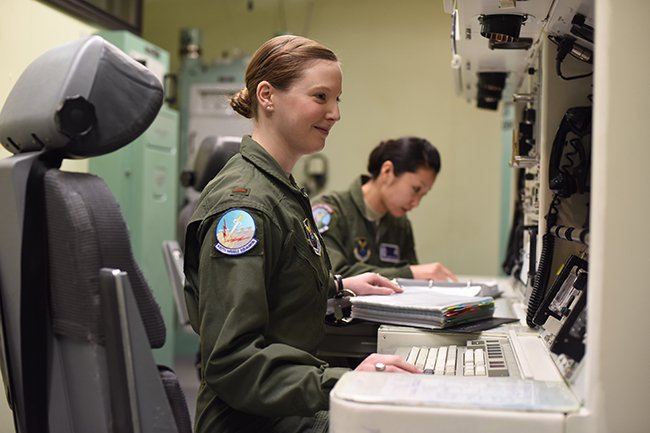
U.S. Air Force / Airman Collin Schmidt
In many cases, these policies already technically apply to federal government agencies and the military, and the topic of introducing or creating them anew may be more relevant to think tanks or other institutions that employ women in nuclear security. Some leaders have already made significant progress in introducing reforms. During Flournoy’s tenure in the Pentagon, for example, she launched a human capital initiative41 intended to give all employees greater access to a variety of flexible scheduling options and found it improved performance and work quality.
The prospect of overhauling federal workplace policies is daunting—so much so that many cabinet leaders make little or no effort to do so. The Obama White House only initiated a diversity in national security initiative in its second term. We heard from our interviewees and experts on personnel policies inside government that even when a policy is part of official Office of Personnel Management guidance, it is not necessarily implemented, or implemented properly. There is often a disconnect between the policy guidance and what behaviors are enforced or incentivized in practice.
This suggests there is enormous scope for leaders to make changes at the level at which they work and for advocates to insist that a plan for workplace improvement is central to any future leaders of nuclear security policy. The policies below offer a starting place for future conversation.
1) Provide paid family leave for all employees, regardless of gender.
Paid leave policies allow employees who need to take time off to care for new children or sick or aging relatives to do so without losing their jobs or having to take unpaid time. Currently, most federal employees have access to unpaid leave under the Family and Medical Leave Act. As one exception, the Department of Defense developed a 12-week paid maternity leave policy (for active-duty military and certain reservists, excluding civilians) in 2016, and the Navy recently introduced more flexibility into its policy, allowing couples to decide which individual in a couple receives “primary caregiver” versus “secondary caregiver” leave.42 Many agencies enable federal employees to donate their unused paid time off to other colleagues through Voluntary Leave Banks.43
Though these policies are a start, they can be significantly improved. New America’s Better Life Lab has done research to assess the optimum length of paid family leave,44 the state of paid leave domestically and around the world, and the impacts of paid leave policies on gender equality and economic metrics.45 One big change should come from expanding maternity leave into parental leave that can be used by both parents. Policies specifically oriented towards mothers can reproduce domestic inequality, re-enforcing the idea that women should have the bulk of caregiving responsibilities.
Our interviews bore out the observation that while these policies benefit all employees, they tend to particularly benefit women, who still bear the brunt of domestic caregiving responsibilities. Paid leave policies can improve retention rates, productivity, and well-being, and make it more likely that a woman will return to work if she leaves to care for a newborn. Leaders must make it clear that women and men will not be penalized for taking this time, since a policy on the books is relatively meaningless if employees feel that they cannot take advantage of it. Leaders, especially male supervisors, can begin to shift this paradigm by taking more leave themselves, helping to establish a new norm of what amount of leave is “acceptable” for employees.
2) Implement a flexible work policy.
Many flexible and alternative work schedules are already suggested in OPM guidelines.46 But our sources suggest that whether or not these flexible scheduling options are accessible depends largely on an individual’s manager, and that they are very limited and seen as career-harming in the security agencies.
In government, “there’s a culture of you’re only doing well if you’re on your butt in the desk,” Farkas told us. Research suggests this is a flawed heuristic to measure productivity and overall effectiveness. While cultural norms and security practices are deeply ingrained, employers who want to attract and retain younger workers, who expect flexibility in a way older workers do not always expect it, will want to reevaluate what a realistic balance between office and home time ought to look like and explore setting up secure access to email servers outside of the office.
3) Revamp performance reviews.
Research shows that performance reviews can be biased, reduce gender equality, and are an often ineffective way of evaluating employees. Negative performance reviews can make it harder for individuals to get promoted and can therefore be a contributing factor to still anemic numbers of women at the top of organizations. In one recent example, researchers analyzed the language being used in evaluations in the military and found that while performance metrics between men and women remained largely the same, what changed was the number of negative performance attributes versus positive ones they were assigned. As one might expect from other research, like the role congruity theory we discussed in the second section of this report, women received far more negative ones than men, and the ones they received (temperamental, inept, gossipy, for instance) send a pretty clear message: They are not leaders and should not be promoted.
As shifting the entire federal workforce review culture is not on the horizon, managers should try to adopt these evidence-based tips for changing performance reviews: Make sure that more than one person is conducting the evaluation, do not show reviewers previous ratings (especially how the individual has rated herself), and enforce the need for concrete, measurable examples of performance, rather than simply, “she’s abrasive” or “not a team player.”
4) Make promotion processes more transparent.
Although many promotion processes within government are transparent and standard, some could be improved, particularly those connected with mid-level managerial positions and political appointees. The practice of handpicking favorite colleagues and rewarding political loyalty may have the effect of ensuring talented women are not looked at, or are seen as token “diversity hires.” In some contexts, particularly for temporary and political appointees, it may be useful to make more clear and transparent the steps, certifications, and milestones necessary to reach the next step in a career progression. And it is always useful for hiring committees to challenge themselves to make criteria broader and less traditional.
5) Take steps to change behavior, not just beliefs.
Behavioral science research suggests that adjustments to processes and systems change outcomes more than attempts to change beliefs, such as unconscious bias training, do.47 For instance, creating incentives for managers to mentor or sponsor promising female talent, to promote women, or to take more vacation time, can encourage that behavior change more than simply encouraging those behaviors. So, too, can changing hiring processes so that hiring managers do not see gender information when reviewing resumes or standardizing interview questions so applicants have a fairer shot. Other social science research suggests that changing the environments that individuals work in—even the photos or posters on the walls—can have a significant impact on employees’ sense of belonging and behavior.
6) Create strong anti-sexual harassment policies and training programs.
Unfortunately, this is one area where the federal experience seems to be going in the wrong direction, given continued increases in rape and assault faced by military women, a series of accusations leveled at State Department officials and at the Department itself for mishandling reports, and a letter calling for improvement signed by more than 200 national security professionals.48 New America’s Better Life Lab recently published an assessment of sexual harassment across industries and a toolkit of sexual harassment solutions,49 laying out the elements of strong anti-sexual harassment policy and training programs. Counter-intuitively, some strategies—including zero tolerance policies and some anti-sexual harassment trainings—can sometimes have deleterious effects, and spark backlash.50 What can work are trainings that integrate cognitive insights about to best teach individuals about sensitive, controversial subject matter; a deep appreciation for and understanding of how contexts and environments can encourage harassing behavior; policies that are transparent and written without jargon; tiered, proportionate responses to harassing behaviors; and clear, swift consequences for perpetrators.
7) Develop a program that goes beyond mentorship to teach characteristics of sponsorship.
Many of the women interviewed reflected on the importance of their mentorship relationships to their ultimate career success, but some described experiences that were more suggestive of a sponsorship rather than a mentorship relationship. Whereas a mentorship relationship tends to be one-sided, the sponsorship relationship is mutually beneficial.51 A sponsor and protégé are professional allies who actively promote each others’ careers. Women especially have much to gain from these relationships, but often do not know that this kind of dynamic can exist in the first place. The burgeoning organizations offering professional support and mentoring outside government can do more along these lines—and transfer the experience to government as feasible.
8) Get past “tokenism” to ensure that all members of a team feel comfortable speaking up.
According to research, women and minorities feel more comfortable speaking up in a group when they make up at least 30 percent of that group, what is known as a critical mass.52 As our interviewees eloquently told us, in smaller numbers women sense (often correctly) that when they speak, they are speaking on behalf of their entire group; and if they blunder, they will hurt the chances for other individuals from their group to be able to participate in the future.
9) Subsidize child care and/or provide access to resources for other forms of caregiving support.
We heard from many of our interviewees that scheduling child care could be challenging, given unpredictable meeting scheduling and overseas travel. Often, women take on the task in a family of finding elder care options as well.53
While some government agencies offer emergency backup care options through a contract with Federal Occupational Health, some also subsidize or provide a limited amount of on-site child care. Families in the U.S. military can also access subsidized child care through Child Care Aware of America.54 These benefits vary greatly, and often make only a small dent in improving the affordability, quality, and availability of care. The landscape for care support in the private sector is similarly patchy:55 according to the Society for Human Resource Management, only 2 percent of American organizations help employees pay for child care with subsidies or vouchers, and only 5 percent offer emergency backup care.
And yet, investments in these services can have a crucial impact on productivity and stress reduction in both the public and private sector. According to Child Care Aware of America, the days that working parents miss due to child care breakdowns costs businesses $4.4 billion per year in lost productivity.56 One survey of a government agency found that providing such services improves productivity at work by over 86 percent and decreases stress by over 82 percent.57 The room for improvement here is vast, and again, the expectations of younger workers are high.
Updates to the Intellectual Status Quo
Over the past decade, the national security community has increasingly become aware of the ways in which gender influences and intersects with security outcomes. Since UN Security Council Resolution 1325 on women, peace, and security58 was passed in 2000, there have been significant research and proposed theoretical frameworks on the impact of gender equality and gender norms on national security that have influenced areas such as peacekeeping and countering violent extremism. Still, our interviews suggest that this body of work has not reached the nuclear security field. We asked interviewees about an influential body of research on the connection between gender equality indicators and security outcomes to gauge whether they saw it as relevant to nuclear security policymaking.
Only about one-third of interviewees said they were familiar with gender analysis,59 which is the process of assessing the possible impact of a policy or program on all genders. Persistent gender inequality around the world means that women, men, and gender non-conforming individuals still have unequal access to economic, political, social, and health resources and opportunities, and can therefore be affected differently by certain policies and programs. Research suggests these differential impacts can have an impact on overall policy effectiveness. This means that implementing a gender analysis can both contribute to a more egalitarian and secure society while also improving policy outcomes on the whole.
Though only a few of our interviewees were familiar with gender analysis, most seemed interested in thinking about its relevance and thought aloud about what that might look like. Inquiring about gendered policy impacts “would be an interesting question to ask,” said Mareena Snowden, a graduate fellow at the National Nuclear Security Administration from 2017 to 2018. “For me, it’s a question of uniqueness,” she said. “Are there unique effects that women experience from certain nuclear security policies, or national security policies? And if so, then what? I’m not sure I have the answer yet. But I think that, to me, would be what the key takeaway would be. What about this is uniquely affecting this subgroup or not?”
What is more clear, Snowden pointed out, is the answer to another question: What differential impact are nuclear policies having on indigenous communities and communities of color? Citing the example of the Pacific Proving Grounds tests, and mining for uranium in the Southwest, she asked:
Whose land was that? How much notice did we give these people about what was actually happening in their countries? It’s always struck me, as a person of color, that it’s often brown people and black people that are on the negative receiving end of a lot of our national security policies….We detonated some of our strongest weapons in Bikini Atoll and in Micronesia and the Marshall Islands. It wasn’t the suburbs of Montana that we were doing that in. Whether it’s criminal justice policy or national security policy, when we talk about who is a valuable life, black and brown people are the last in the line of that list.
Others emphasized the clearly differential health impact of weapons on women, noting that radiation impacts men and women differently, and that those changes can be passed on genetically to children. And yet, one interviewee noted, the “biggest tranche of research that was ever done on all of that” after the Hiroshima and Nagasaki bombings is largely still classified,60 in part because of fears that that research could arm those affected with the data to demand reparations.
Others expressed ambivalence as to the utility of this framework in the nuclear context, emphasizing that the consideration of differential group affects is often dismissed by policymakers who do not consider civilian impacts to be important or useful. Those who questioned the relevance of gender analysis to nuclear security suggested that the field is too theoretical to be used to talk about civilian impacts, and that the analysis of leadership and decision-making in nuclear proliferating states is more relevant to questions of impact. A couple of respondents characterized nukes as “equal-opportunity weapons” that impact all people equally. One woman said, half-jokingly, that policymakers might consider our nuclear policies to date as having had a positive impact on women because of the number of women that they have saved (because we haven’t had a nuclear war).
We also asked interviewees to comment on their knowledge of research linking gender equality indicators with the overall security and stability of states, which includes its GDP and propensity towards intrastate violence. This research, conducted by scholars like Valerie Hudson and Mary Caprioli,61 suggests that the greatest predictor of state stability and security is its level of gender equality, and that states with lower levels of gender equality are more likely to face instability, conflict, and violence.62 Only about one-third of respondents were familiar with this research. Though many were interested in considering how this research and theoretical framing could be relevant to nuclear security, most concluded that they could not quite see how it would be relevant, aside from considerations of women’s representation in nuclear security or arms control negotiations. This particular line of questioning brought up what social scientists would characterize as essentialist attitudes about women in security, with many interviewees sharing that they thought women’s participation was important in part because women tended to be more peace-oriented and suited to diplomatic negotiations.
Still others said that nuclear negotiations and decision-making were so specialized as to defy a simple gendered analysis. “It seems to me that each individual decision in the nuclear policy area is kind of sui generis, and why that decision was made has such diverse inputs that the gender of the people involved in the decision making seems to be not the most meaningful,” Laura Holgate, a former senior government official, said.
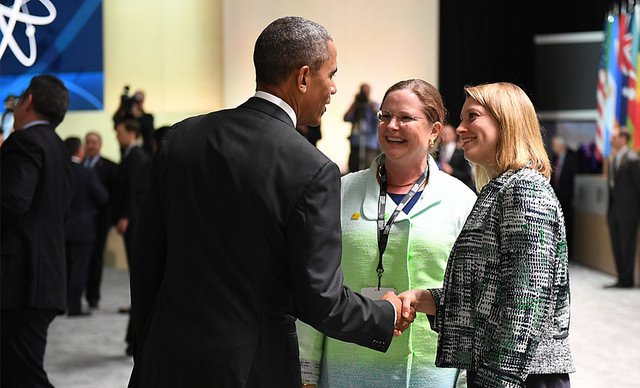
Flickr / Penn State
Snowden, however, thought that this research related back to a critical question for nuclear security policymakers who may feel threatened not only by new ideas but by new people who could possibly usurp some of their power and influence. She asked:
How much do [new policies proposed] maintain the status quo versus really challenge and move us forward? Are they serving the status quo in terms of the power dynamic, or are they really in the best interest of stability and global growth?
Removing the consensual straitjacket requires creating the space for these discussions and questions, not just around gender analysis and research but all kinds of new ideas, approaches, and perspectives. The strategy of stasis has never worked for any field that seeks to stay alive and relevant well into the future. For nuclear security practitioners, future growth and progress requires unbuckling the straitjacket, and moving freely into the future.
Citations
- Heather Hurlburt, Elizabeth Weingarten, and Elena Souris, National Security: What We Talk About When We Talk About Gender (Washington, DC: New America, 2018), https://www.newamerica.org/political-reform/reports/national-security-what-we-talk-about-when-we-talk-about-gender/.
- The process of cutting off access to security clearances and reminding you of what you know that you cannot share.
- Council on Foreign Relations (website), “A Conversation with Michele Flournoy,” April 17, 2013, https://www.cfr.org/event/conversation-michele-flournoy.
- William Howard, “Navy Adds Flexibility to Parental Leave Policy,” Stars and Stripes, June 22, 2018, https://www.stripes.com/news/navy-adds-flexibility-to-parental-leave-policy-1.534199.
- OPM.gov (website), “Pay & Leave: Leave Administration,” https://www.opm.gov/policy-data-oversight/pay-leave/leave-administration/fact-sheets/voluntary-leave-bank-program/.
- Brigid Schulte, Alieza Durana, Brian Stout, and Jonathan Moyer, Paid Family Leave: How Much Time Is Enough? (Washington, DC: New America, June 2017), https://www.newamerica.org/better-life-lab/reports/paid-family-leave-how-much-time-enough/.
- “Economic Impact,” in Brigid Schulte, Alieza Durana, Brian Stout, and Jonathan Moyer, Paid Family Leave: How Much Time Is Enough? (Washington, DC: New America, June 2017), https://www.newamerica.org/better-life-lab/reports/paid-family-leave-how-much-time-enough/economic-impact.
- OPM.gov (website), “Pay & Leave: Work Schedules,” https://www.opm.gov/policy-data-oversight/pay-leave/work-schedules/fact-sheets/alternative-flexible-work-schedules/.
- Iris Bohnet, What Works: Gender Equality by Design (Cambridge, MA: Harvard Univ. Press, 2016), http://www.hup.harvard.edu/catalog.php?isbn=9780674089037.
- See Robbie Gramer and Emily Tamkin, “State Department Watchdog Reviewing Sexual Harassment, Assault Policies,” Foreign Policy, April 13, 2018, https://foreignpolicy.com/2018/04/13/state-department-watchdog-reviewing-sexual-harassment-assault-policies/.
- Alieza Durana, Amanda Lenhart, Roselyn Miller, Brigid Schulte, and Elizabeth Weingarten, #NowWhat: The Sexual Harassment Solutions Toolkit (Washington, DC: New America, 2018), https://www.newamerica.org/better-life-lab/reports/nowwhat-sexual-harassment-solutions-toolkit/.
- “Breaking into the Blue-Collar Boys’ Club: Male-Dominated, Low- and Middle-Wage Sectors,” in Alieza Durana, Amanda Lenhart, Roselyn Miller, Brigid Schulte, and Elizabeth Weingarten, Sexual Harassment: A Severe and Pervasive Problem (Washington, DC: New America, September 2018), https://www.newamerica.org/better-life-lab/reports/sexual-harassment-severe-and-pervasive-problem/breaking-into-the-blue-collar-boys-club-male-dominated-low-and-middle-wage-sectors.
- Sylvia Ann Hewlett, Melinda Marshall, Laura Sherbin, and Barbara Adachi, Sponsor Effect 2.0: Road Maps for Sponsors and Protégés (New York: Center for Talent Innovation, 2012), http://www.talentinnovation.org/publication.cfm?publication=1330.
- Alison M. Konrad, Sumru Erkut, and Vicki Kramer. “Critical Mass: The Impact of Three or More WOmen on Corporate Boards.” Organizational Dynamics, 37 (April 2008): 145-164. University of Massachusetts Amherst (website). “Teams with a Critical Mass of Women Let Them ‘Lean in,’ Speak Up, and Aim for Science Careers,” April 6, 2015. https://www.umass.edu/newsoffice/article/teams-critical-mass-women-let-them-%E2%80%98lean.
- Liz O’Donnell, “The Crisis Facing America's Working Daughters,” The Atlantic, February 9, 2016, https://www.theatlantic.com/business/archive/2016/02/working-daughters-eldercare/459249/.
- ChildCare.gov (website), “Military Child Care Fee Assistance Programs,” https://childcare.gov/consumer-education/military-child-care-fee-assistance-programs
- Brigid Schulte, “The Corporate Case for Child Care,” SLATE, February 8, 2018, https://slate.com/human-interest/2018/02/the-corporate-case-for-childcare.html.
- Parents and the High Cost of Child Care: 2017 Report (Arlington, VA: Child Care Aware of America, 2017), https://usa.childcareaware.org/wp-content/uploads/2017/12/2017_CCA_High_Cost_Report_FINAL.pdf.
- Off-the-record interview and data.
- OSAGI (website), “Landmark Resolution on Women, Peace and Security,” http://www.un.org/womenwatch/osagi/wps/.
- European Institute for Gender Equality (website), “What is Gender Impact Assessment,” https://eige.europa.eu/gender-mainstreaming/toolkits/gender-impact-assessment/what-gender-impact-assessment.
- Susan Southard, Nagasaki: Life After Nuclear War (New York: Penguin, 2015).
- Valerie M. Hudson, Bonnie Ballif-Spanvill, Mary Caprioli, and Chad F. Emmett, Sex & World Peace (New York: Columbia Univ. Press, 2014), https://cup.columbia.edu/book/sex-and-world-peace/9780231131827.
- Caprioli, Mary, “Primed For Violence: The Role of Gender Inequality in Predicting Internal Conflict,” International Studies Quarterly, 49 (2005): 161-178.
Appendix
List of Participants
Interviewees participated in their individual capacities, and their comments do not reflect the views of affiliated organizations. Not all chose to be named, but participants (in alphabetical order) included:
Alexandra Bell
M. Elaine Bunn
Susan Burk
Evelyn Farkas
Michèle Flournoy
Rose Gottemoeller
Rebecca Hersman
Kathleen Hicks
Laura Holgate
Bonnie Jenkins
Laura Kennedy
Jen Miller
Janne Nolan
Christine Parthemore
Deborah Rosenblum
Loren DeJonge Schulman
Julianne Smith
Mareena Robinson Snowden
Christine Wormuth
Andrea Yaffe
Methodology
We interviewed 23 women who have worked in the nuclear security, arms control, and non-proliferation fields within the Departments of State, Energy, and Defense (military and civilian), the former Arms Control Disarmament Agency, and the White House. Interviewees had experience working in both Republican and Democratic administrations. They included retired practitioners, mid-career professionals, and senior title-holders; women whose experience ranges from the 1970s to present day. Some women are named in the report and in the appendix, others requested to remain anonymous.
The women were identified using a snowball sample method, where interviewees suggested other potential candidates, and the interviews were conducted in a structured format. We used content analysis methods to code the interview transcripts, and fact-checked all quotes before publishing.
Because of a limited sample and the lack of historical data, this study focused only on cis, or female-identifying, women. Though gender should not be equated with women, this study did not focus on men or gender non-conforming policymakers.
The data represented in the graphs were collected by two teams. The data analyzing how many women held senior positions within the Departments of State, Energy, and Defense, the former Arms Control Disarmament Agency, and the White House were collected based on United States Government Manuals, archived department websites, individual biographies, and departments’ historical records. For this study, “senior positions” includes assistant, under, deputy, and cabinet secretaries, and those who held the positions in an acting capacity. Within the White House, we only considered the National Security Advisor, as other titles fluctuate inconsistently across administrations. In the one case where we could not confirm the race of one female senior official, she was not included in the total number of women of color for her department. Because USG Manuals from 1961–1999 do not specify racial demographics for individual leaders, no such data were available for the Arms Control and Disarmament Agency (ACDA, since folded into the State Department).
Data for the percentage of women in delegations to the United Nations General Assembly First Committee (Disarmament and International Security) and the Nuclear Non-Proliferation Treaty Review Conferences come from the International Law and Policy Institute (ILPI) and United Nations Institute for Disarmament Research (UNIDIR). Many thanks to the authors of the 2016 report “Gender, Development and Nuclear Weapons,” John Borrie, Anne Guro Dimmen, Torbjørn Graff Hugo, Camilla Waszink, and Kjølv Egeland, for sharing their data. The graphs in this study considered data from the five NPT nuclear states (the United States, Russia, France, China, and the United Kingdom), as well as former Soviet Union states that inherited nuclear weapons after the collapse of the Soviet Union (Kazakhstan, Belarus, and Ukraine), and states reflecting current nuclear threats (Iran and South Korea). Their methodology states:
When coding the participant lists, the number of men and women in each delegation was counted, and we also checked if the head of delegation was a man or a woman (determined by the prefix used (Mr or Ms)). In participant lists where several individuals were named as head of delegation (or “representative”), the person listed first is the one used. Note that the lists do not purport to reflect the actual presence of that person in the room at a given meeting, nor do they necessarily contain the names of all the individuals that attended. Some delegates may have participated without having been registered, and some states seem to routinely register more participants in the list than others (or do not register at all), a difference that is not necessarily visible in the meeting room.
Despite these data limitations, the lists of participants provide open and accessible sources for identifying patterns over time. While there may be some systematic imbalances in the observations (e.g., due to some states registering more consistently for meetings than others), there is little reason to believe that this tendency should be correlated with the gender balance variable, which would thus render the results invalid. In total, the dataset contains 15,366 unique observations (197 states and 26 meetings).
More About the Authors

Heather Hurlburt
Director, New Models of Policy Change

Elena Souris

Alexandra Stark
Fellow, Future Security

Elizabeth Weingarten
Senior Fellow, Better Life Lab