A Chapter of: Prospects for Climate Change Policy Reform
Section 2: Data and Polling on the Current Support for Climate Change
Key Takeaways
- More conservatives support climate change solutions—more than 50 percent in some subcategories—than are willing to say that climate change is real and man-made, indicating that a solutions-based approach, rather than a belief-based approach, is more effective for this target audience.
- Advocates for climate change solutions must communicate differently with conservatives than with liberals in order to identify and organize them around cross-partisan solutions. Current data indicate that the most effective communication for identifying and organizing conservative support relies on values-based, conservative frameworks such as purity, messages that hearken to the past, and solutions such as renewable energy.
- Though some conservative groups and elites are focused on a carbon tax as a policy solution, public opinion research shows conservatives are more likely to support renewable energy policies (understanding that the two are not interchangeable).
- Effective targeting of efforts to identify and organize conservative support for climate change solutions requires an ability to look at subgroups of conservative voters with more nuance than party affiliation or voting history typically provide.
In this section, we examine how conservatives in America feel about climate change by investigating publicly available research and polling. It is worth noting that researchers draw wildly different conclusions based on the existing data. For example, ClearPath Polling asserts that 68 percent of Republican voters support accelerating development and use of clean energy,5 and that organizing conservatives around this issue is a key element of mitigating climate change. While David Roberts argues that persuading conservatives to support action on climate change is impossible and cannot be part of the solution at all,6 early polling from Yale suggests that 81 percent of registered voters support Green New Deal goals, including 64 percent of Republicans and 57 percent of conservative Republicans—at least when the study was framed in positives and did not discuss which politicians support the deal.7
In spite of several deficits in the existing data and the differing conclusions drawn from the data in the community of climate change advocates, journalists, and researchers, we were able to glean key takeaways about conservative public opinion that may help light the path toward conservative engagement on climate change solutions. We also offer a roadmap for filling in gaps in the research to further illuminate that path.
Landscape of Existing Research
Climate change is a complex issue. We have organized the existing research into three categories. These are:
- Belief and Intensity: This category encompasses the degree to which respondents believe climate change is real or man-made, the level of concern about the issue, and the degree to which they prioritize climate change relative to other public policy issues.
- Messages and Messengers: Research on the impact of particular words, message frames, and types of people delivering climate change messages on the public’s support for action on climate change.
- Solutions: Assessment of support for particular policy responses to the problem of climate change.
We first present results from existing research within these three categories. Then we move to a discussion of typology, specifically the emergent practice of looking at subcategories that are more narrow than “conservative” or “Republican” in order to better understand conservative opinion on climate change and identify pockets of support for reform.
Climate change polling has approximately a 35-year history. During this time, consistent use of polling questions within four thematic areas has allowed for the longitudinal study of the American electorate broadly (i.e., without respect to political ideology) across large increments of time (years and decades). However, the thematic areas that have been used consistently by researchers are disproportionately focused within the belief and solutions categories, with the majority in the belief category. In fact, three of the thematic areas that have been used consistently fall within the belief category. The four thematic areas are:
- Awareness and knowledge of climate change
- The extent to which respondents believe it is occurring
- Level of concern about the problem and the priority of climate change
- Support for specific types of policy response.8
What We Know About Conservative Opinion

Belief
A majority of registered voters believe that global warming is happening.9 But polarization among conservatives is significant:
- 98 percent of liberal Democrats
- 85 percent of moderate/conservative Democrats
- 70 percent of liberal/moderate Republicans
- 42 percent of conservative Republicans10
Voters have become more polarized since 2008, with the belief that global warming is happening decreasing more sharply among both liberal/moderate Republicans and conservative Republicans—though this trend has begun to reverse since 2017.
This continues a 30-year trend of polarization.
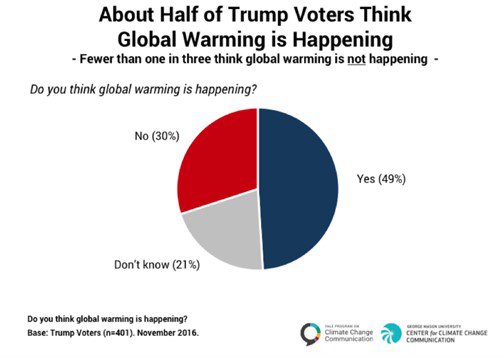
A separate study by Yale and George Mason University focused on Trump voters found that 49 percent of Trump voters believe that “global warming is happening,” and 30 percent disagree.11
In a post-election study, the University of New Hampshire’s Carsey School of Public Policy took a deeper look at candidate choice and belief.12 The difference between Trump voters and Clinton voters is stark when the belief question is expanded to include two elements: that climate change is both real and that it is caused by humans. Only 25 percent of Trump voters responded that they believe climate change is both real and human-caused, in contrast to 90 percent of Clinton voters.

However, as we will see in the solutions section, we should not confuse belief or lack thereof with support for climate action.
Intensity
The proportion of Americans who are strongly concerned about climate change is rising, but important partisan differences and questions about voting behavior remain.13 During the 2018 midterms, Gallup found that Democrats ranked climate fifth among issue priorities, while Republicans ranked climate 11th.14 AEI’s 2017 Public Opinion Study found that neither the environment nor climate change were top-tier issues in the public’s priorities for the President and Congress, without regard to party affiliation or political ideology.15 In 2007 and 2015, 38 percent of Americans felt “dealing with global warming” should be a top priority, while only 25 percent believed that in 2012.16 A 2017 Gallup poll found that only 18 percent of Republicans worry about climate change a great deal.17
Messages and Messengers
The task of working against key conservative validators to change opinion on the sources of climate change is a daunting one, particularly in the electoral context, as political scientists David Broockman and Joshua Kalla found. Moreover, advocates have made erroneous assumptions about messaging to conservatives, yielding the opposite of the intended effect. In 2015, Pope Francis released an encyclical calling for climate change action. Both Pope Francis’ climate change-focused encyclical, which many advocates saw as a key tool for conservative outreach, and scientific consensus messaging have been found to carry the backlash effect associated with many persuasion treatments among some conservative voters.18 For example, conservatives who saw the encyclical were less likely to support some of its ideas19—like the concept that lower-income populations will suffer from climate change—than conservatives who had not. In response, conservative Catholics, non-Catholics, and pundits questioned whether the Pope was qualified to speak on the issue, as well as the reliability of the science he cited.20 It is possible that endorsements from leaders already perceived as ideological allies may be more likely to contribute to polarization, instead of productively shifting thinking on the message itself.
Given these limitations, researchers advocate communications that focus on policy solutions—in particular, renewable energy—rather than communicating that climate change is real and man-made. Others have advocated for re-thinking climate communication to root the dialogue in values that speak most deeply to conservatives.
Messaging to Core Conservative Values
A 2016 study conducted by researchers from Cornell University indicates that moral foundations theory may offer viable frameworks to use for mitigating political polarization around climate change.21 Moral foundations theory (MFT) posits five different classes of moral values: care/harm (compassion/harming); fairness/cheating; in group loyalty/betrayal; authority/subversion; and sanctity/degradation (purity), which suggests that conservatives and liberals operate from different moral frames. The Cornell study points to compassion and fairness as the relevant moral foundation for liberals who support action on climate change and points to the moral foundation of purity (sanctity/degradation) as a potentially useful frame for conservatives.
Additionally, researchers at the University of Cologne found in a 2016 study that conservatives are more responsive to climate messages rooted in the past, while liberals were more responsive to forward-looking climate change messages.22
A growing body of research focused primarily on belief, as opposed to solutions, finds that the electorate is responsive to elite cues. In a November 2017 study, Michael Tesler found that political interest significantly predicts both conservatives’ skepticism about, and liberals’ belief in, climate change.23
Messaging for Solutions
A study published in June of 2017 by Graham Dixon, Jay Hmielowski, and Yanni Ma found that popular “scientific consensus messaging” (e.g., 97 percent of scientists agree that climate change is real and man-made) did not produce significant effects among U.S. conservatives.24 Free market solutions to climate change were found to be more effective at improving conservatives’ climate change acceptance.
In 2016, the Pew Research Center found bipartisan support for expanding wind and solar power, as reflected in the graph below.25

In 2018 and 2019, polling found conservative support for many (though not all) of the policy goals that the left has united in “Green New Deal” proposals. For example, this paragraph won approval from 64 percent of Republicans, including 57 percent of conservative Republicans:
"Some members of Congress are proposing a “Green New Deal” for the U.S. They say that a Green New Deal will produce jobs and strengthen America’s economy by accelerating the transition from fossil fuels to clean, renewable energy. The Deal would generate 100% of the nation’s electricity from clean, renewable sources within the next 10 years; upgrade the nation’s energy grid, buildings, and transportation infrastructure; increase energy efficiency; invest in green technology research and development; and provide training for jobs in the new green economy."26
Crucially, these outcomes do not translate into conservative support for the Green New Deal, about which voters hear partisan messages through partisan channels. In their 2017 meta-analysis of 49 field experiments, including nine original studies, Broockman and Kalla find zero persuasive effect from campaign contact and advertising designed to persuade voters on Americans’ candidate choices in general elections.27 However, recent polling suggests that, at least around the GND, media consumption does have an impact on conservative views of the policies. The overwhelming majority of voters (82 percent) hadn’t heard of the GND as of December 2018,28 but Fox News viewers are more likely to have a strong reaction. Among registered voters who watch Fox, 74 percent oppose it, with 64 percent opposing strongly and only 21 percent have no opinion, as opposed to voters who don’t watch the channel, of whom 22 percent support the policy, 29 percent are opposed, and 49 percent are unsure.29

This fits a longstanding pattern—renewable energy solutions poll high among conservatives. Though some conservatives advocate a carbon tax, it doesn’t poll as well—coming in at just under 50 percent. When it comes to renewables, however, a variety of options poll relatively well. A December 2018 Yale report30 on politics and global warming found that:
- 81 percent of Republicans support funding more research on renewable energy
- 71 percent of Republicans support providing tax rebates to people who purchase energy-efficient vehicles or solar panels
- 60 percent of Republicans support regulating carbon dioxide as a pollutant
- 48 percent of Republicans support setting strict carbon dioxide emission limits on existing coal-fired power plants to reduce global warming and improve public health, even if the cost of electricity to consumers and companies would likely increase
- 49 percent of Republicans support requiring fossil fuel companies to pay a carbon tax and using the money to reduce other taxes (such as income tax) by an equal amount
Typology: Simple analysis along party lines or based on voting behavior obscures important nuances within broad categories such as “Republican” or “Trump voter.” A more nuanced look at voter characteristics is required in order to assess the potential for action on climate change among conservatives. For example, in response to the Fourth National Climate Assessment,31 a 2017 article32 cited this 2015 Gallup Poll33 demonstrating that the more education conservatives have, the less likely they are to believe that climate change is real. Egan and Mullins’ 2017 review of research findings and polling data about Americans’ attitudes on climate change found that, after controlling for partisanship, gender and religiosity were the strongest predictors of climate change attitudes.34 Some studies divide liberals and conservatives into two categories, but they still rely on a fairly limited and linear range that considers only liberal-ness and conservative-ness as differentiating characteristics without considering other characteristics that might influence attitudes on climate change.
Pew’s 2017 Political Typology35 is more useful than party or voting behavior for understanding where the potential lies for climate action within the spectrum of conservative voters because, while it still yields a scale from most to least conservative, it does a strong job of classifying voters into categories. It breaks those on the political right and the political left into four categories each, with bystanders occupying middle ground. In descending order from most to least conservative, the nine categories are:
- Core Conservative
- Country First Conservative
- Market Skeptic Republicans
- New Era Enterprisers
- Bystanders
- Devout and Diverse
- Disaffected Democrats
- Opportunity Democrats
- Solid Liberals.
By digging into these categories, we can find support for action on climate change among conservatives in a more targeted way. This support is most heavily concentrated among New Era Enterprisers and Market Skeptic Republicans, with a majority of both categories indicating support for stricter environmental laws. Importantly, support for stricter environmental laws did not correlate strongly with belief, indicating that belief questions may not be helpful in identifying conservative support for climate action.
Fifty-one percent of New Era Enterprisers and 41 percent of Market Skeptic Republicans say that protecting the environment is so important to them that they do things in their own lives to help the environment. Sixty percent of New Era Enterprisers and 57 percent of Market Skeptic Republicans say that stricter environmental laws are worth the cost. Yet, only 36 percent of New Era Enterprisers and 41 percent of Market Skeptic Republicans say that the Earth is getting warmer because of human activity.
We see here, then, that a focus on solutions exposes more support than a focus on belief. Taken together with data on support for solutions from the Yale study discussed above (see Figure 6),36 which demonstrates that a plurality of voters support action on climate change, the path to identifying those conservatives who may support action on climate change within that voter group becomes more clear. By looking at Pew’s subgroups, we see that conservatives are not a monolithic group, and looking at them as such obscures key pockets of support. The Yale report on global warming also illuminates a key gap between support and action—and the need for more research on the subject.37 Only 6 percent of registered Republican voters reported that they had urged an elected official to take action on global warming in the last 12 months.

Further research is required, then, to understand more about conservative subgroups and which methods and messages might move them to action.
Opportunities for Further Research
No one entity or organization has organized the vast amount of data that exists through the lens of getting a full and actionable picture of conservative opinion on climate change. Our initial goal was to present a month-by-month analysis of trends in conservative public opinion on climate change for the 15-month period between October 2016 and January 2018. This exercise proved impossible based on several gaps in the research.
Creating consistent and actionable data could have a significant impact on the ability of stakeholders to approach conservatives strategically on climate change. In undertaking an investment to fill this research gap, the following areas should be prioritized:
- Identify an owner for a longitudinal study that clearly defines the term “conservative,” uses it consistently, and uses a consistent solutions-focused set of questions at regular intervals. Within that, identify and consistently define and break out conservative subgroups. Frequent inquiry into a standardized set of solutions-based questions should be tied to a standardized set of subgroups.
- Conduct more research that includes behavioral measures (e.g., randomized, controlled experiments to validate polling results on belief with observations on how it actually impacts one’s behavior).
- Ensure that the above two steps include both a broad overview of the electorate and large enough samples of working-class white voters and other key demographics that have been traditionally left out of current polling.
- Develop a “persuadable climate conservative” model. Within that, identify conservative characteristics that aggregate to persuadability on climate and allow the user to identify various types of climate conservatives (e.g., conservation voter). Develop a set of micro-targeting models focused on characteristics of conservation climate action voters (e.g., education, religiosity).
The existing data indicate that there is a path forward for organizing conservative support for bipartisan solutions to climate change. However, new research must be conducted in order to define and target conservative subgroups more clearly. We already know that there is significant support for climate change solutions—particularly renewable energy—among key conservative subgroups. The data indicate that, with the right strategy and resources in this reform sector, there exists a great deal of potential for connecting to conservative voters.
Citations
- Kristen Soltis Anderson, Whit Ayres, Glen Bolger, Conservative Republicans open to clean energy, 2015. https://assets.clearpath.org/2016/09/clearpath_pollster_memo.pdf.
- David Roberts, “Conservatives probably can’t be persuaded on climate change. So now what?” Vox, November 10, 2017. https://www.vox.com/energy-and-environment/2017/11/10/16627256/conservatives-climate-change-persuasion.
- Abel Gustafson, Seth Rosenthal, Anthony Leiserowitz, Edward Maibach, John Kotcher, Matthew Ballew, and Matthew Goldberg, The Green New Deal has Strong Bipartisan Support (New Haven, CT: Yale Program on Climate Change Communication, 2018), http://climatecommunication.yale.edu/publications/the-green-new-deal-has-strong-bipartisan-support/.
- Anthony Leiserowitz, Edward Maibach, Connie Roser-Renouf, Matthew Cutler, and Seth Rosenthal. Trump Voters & Global Warming (New Haven, CT: Yale Program on Climate Change Communication, 2017).
- Anthony Leiserowitz, Edward Maibach, Seth Rosenthal, John Kotcher, Matthew Goldberg, Matthew Ballew, Abel Gustafson, Parrish Bergquist, Politics & Global Warming, December 2018 (New Haven, CT: Yale Program on Climate Change Communication, 2019). http://climatecommunication.yale.edu/publications/politics-global-warming-december-2018/.
- Ibid
- Anthony Leiserowitz, et. al., Trump Voters, 2017, http://climatecommunication.yale.edu/publications/trump-voters-global-warming/4/
- Lawrence C. Hamilton, “On Renewable Energy and Climate, Trump Voters Stand Apart,” Carsey Research 113 2017): https://scholars.unh.edu/cgi/viewcontent.cgi?referer&httpsredir=1&article=1292&context=carsey.
- Abel Gustafson, Anthony Leiserowitz, and Edward Maibach, Americans are Increasingly “Alarmed” About Global Warming, (New Haven, CT: Yale Program on Climate Change Communication), http://climatecommunication.yale.edu/publications/americans-are-increasingly-alarmed-about-global-warming/.
- Frank Newport, Top Issues for Voters: Healthcare, Economy, Immigration, (Gallup, 2018) https://news.gallup.com/poll/244367/top-issues-voters-healthcare-economy-immigration.aspx.
- Karlyn Bowman and Eleanor O’Neil, AEI Public Opinion Study: Polls on the environment, energy, global warming, and nuclear power (Washington, D.C.: American Enterprise Institute, 2017) http://www.aei.org/publication/aei-public-opinion-study-polls-on-the-environment-energy-global-warming-and-nuclear-power-2017/.
- Ibid
- Jim Norman, Democrats Drive Rise in Concern About Global Warming (Gallup, 2017) https://news.gallup.com/poll/206513/democrats-drive-rise-concern-global-warming.aspx.
- John Cook and Stephan Lewandowsky, “Rational Irrationality: Modeling Climate Change Belief Polarization Using Bayesian Networks,” Topics in Cognitive Science 8, no. 1 (2016): 160-179, https://onlinelibrary.wiley.com/doi/full/10.1111/tops.12186.
- Nan Li, Joseph Hilgard, Dietram A. Scheufele, Kenneth M. Winneg, Kathleen Hall Jamieson, “Cross-pressuring conservative Catholics? Effects of Pope Francis’ encyclical on the U.S. public opinion on climate change,” Climate Change (2016), https://www.eenews.net/assets/2016/10/25/document_gw_09.pdf.
- Ibid.
- Janis L. Dickinson, Poppy McLeod, Robert Bloomfield, Shorna Allred, “Which Moral Foundations Predict Willingness to Make Lifestyle Changes to Avert Climate Change in the USA?” PLOS ONE (2016): https://journals.plos.org/plosone/article?id=10.1371/journal.pone.0163852.
- Matthew Baldwin and Joris Lammers, “Past-focused environmental comparisons promote proenvironmental outcomes for conservatives,” Proceedings of the National Academy of Sciences of the United States of America 113, no. 52 (2016):
- Michael Tesler, “Elite Domination of Public Doubts About Climate Change (Not Evolution),” Political Communication 35, no. 2 (2017): 306-326, https://www.tandfonline.com/doi/abs/10.1080/10584609.2017.1380092
- Graham Dixon, Jay Hmielowski, Yanni Ma, “Improving Climate Change Acceptance Among U.S. Conservatives Through Value-Based Message Targeting,” Science Communication 39, no. 4 (2017): https://journals.sagepub.com/doi/10.1177/1075547017715473
- Pew Research Center, The Politics of Climate (Washington, D.C.: 2016) https://www.pewinternet.org/2016/10/04/the-politics-of-climate/ps_2016-10-04_politics-of-climate_0-09/.
- Abel Gustafson, et. al., Green New Deal, 2018.
- Joshua Kalla and David E. Broockman, “The Minimal Persuasive Effects of Campaign Contact in General Elections: Evidence from 49 Field Experiments,” American Political Science Review (forthcoming), (2017), https://papers.ssrn.com/sol3/papers.cfm?abstract_id=3042867.
- Ibid
- Sean McElwee, “People Actually Like the Green New Deal,” New York Times, March 27, 2019. https://www.nytimes.com/2019/03/27/opinion/sunday/green-new-deal-mcconnell.html.
- Anthony Leiserowitz, et. al., Politics & Global Warming, 2019.
- Donald J. Wuebbles, David W. Fahey, Kathy A. Hibbard, et. al. Climate Science Special Report: Fourth National Climate Assessment, Volume 1, (Washington, D.C.: U.S. Global Change Research Program, 2017) https://science2017.globalchange.gov/.
- Kevin Quealy, “The More Education Republicans Have, the Less They Tend to Believe in Climate Change,” New York Times, November 14, 2017. https://www.nytimes.com/interactive/2017/11/14/upshot/climate-change-by-education.html.
- Frank Newport and Andrew Dugan, College-Educated Republicans Most Skeptical of Global Warming (Gallup: 2015) https://news.gallup.com/poll/182159/college-educated-republicans-skeptical-global-warming.aspx.
- Patrick J. Egan and Megan Mullin, “Climate Change: US Public Opinion,” Annual Review of Political Science 20 (2017): 209-227, https://www.annualreviews.org/doi/10.1146/annurev-polisci-051215-022857.
- Pew, Political Typology, 2017 https://www.people-press.org/2017/10/24/political-typology-reveals-deep-fissures-on-the-right-and-left/0_1-4/.
- Anthony Leiserowitz, et. al., Politics & Global Warming, 2018.
- Ibid