A Chapter of: Automation Nation
Indianapolis: The Crossroads of Change
Overview
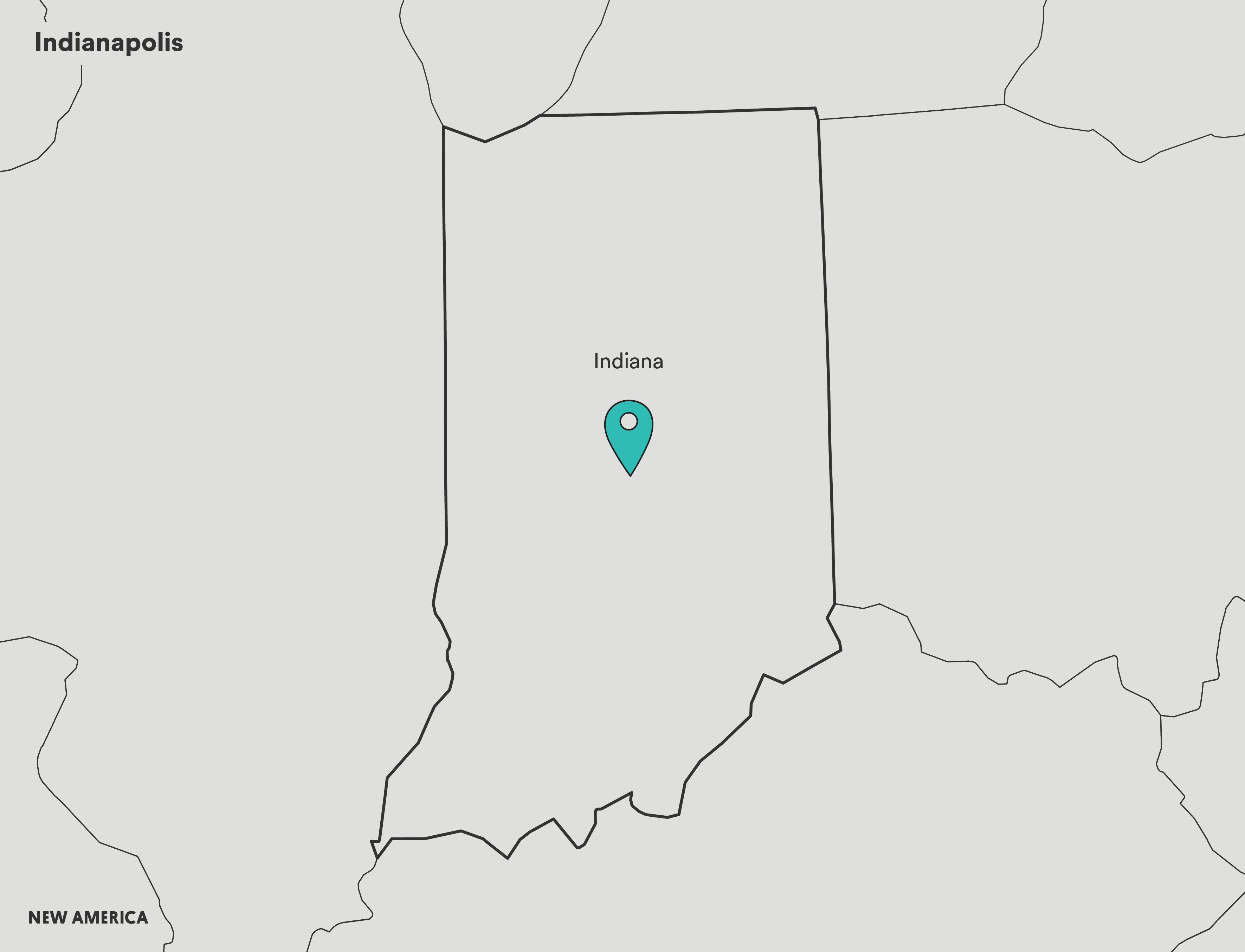
Indianapolis is at a crossroads. In Indianapolis, unlike in Phoenix, labor upheaval and technological disruption are wholly familiar. Previous decades of automation in Indiana’s manufacturing sector have raised residents’ consciousness about technology’s capacity to dramatically change the nature of work. Hoosiers understand what it looks and feels like when a factory closes. Indianapolis’s labor history reveals the origins of its strong, deep-seated bipartisan will to tackle workforce development issues.32
At the same time, the region is moving toward the future. Indianapolis has emerged among cities in the country with the greatest growth in technology jobs and was shortlisted for Amazon’s second headquarters. The recent expansion of Salesforce, its acquisition of local company ExactTarget, and its move into the biggest building in the state, ignited a new sense of possibility of Indianapolis as a tech hub.33 Salesforce’s expansion was followed by the arrival of international tech company Infosys and its subsequent takeover of a large corporate space in downtown Indianapolis.34 Together, the companies added thousands of tech-centric jobs to the Indianapolis economy.
For some workers, especially those with advanced skills and a higher education, technology will create a superhighway to the jobs of the future at companies like Salesforce and Infosys. But who will be able to access this path? Will there be a bridge for more vulnerable workers to get a foothold on opportunity and support their families?
The growth in the regional tech industry has raised concerns about the current talent pipeline and whether Indianapolis has the right skills profile to meet labor demands. Like many neighboring Midwestern cities, Indianapolis has struggled to retain talent. Overall, the state is a net out-migration state. Indiana also falls behind the national average on many educational metrics, including per-pupil spending, associate’s degree attainment, and bachelor’s degree attainment.35
What the Data Say: Automation Risk in Indianapolis
In 2018, New America published a first-of-its-kind analysis of automation’s potential impact in the Indianapolis region.36 Four key points we identified were:
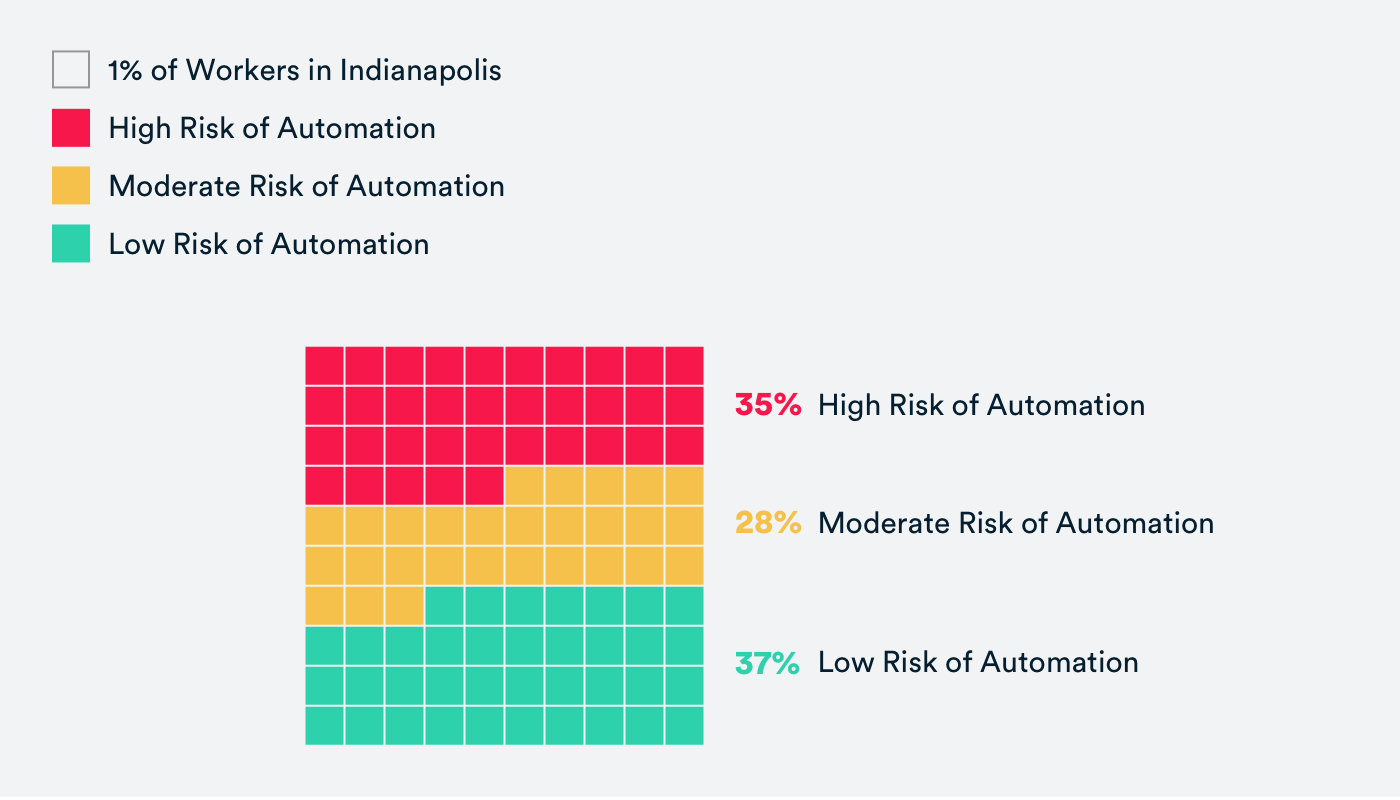
1) Just over one in three jobs in the Indianapolis metro are at high risk of automation—the same as the United States overall. Indianapolis’s automation risk exactly mirrors the national average. In the Indianapolis-Carmel-Anderson metro area, 337,900 people are employed in occupations that are at high risk of automation—35 percent of total jobs. Another 272,760 jobs (28 percent of total jobs) are at moderate risk of automation. Only a little more than a third (37 percent) are at low risk.37
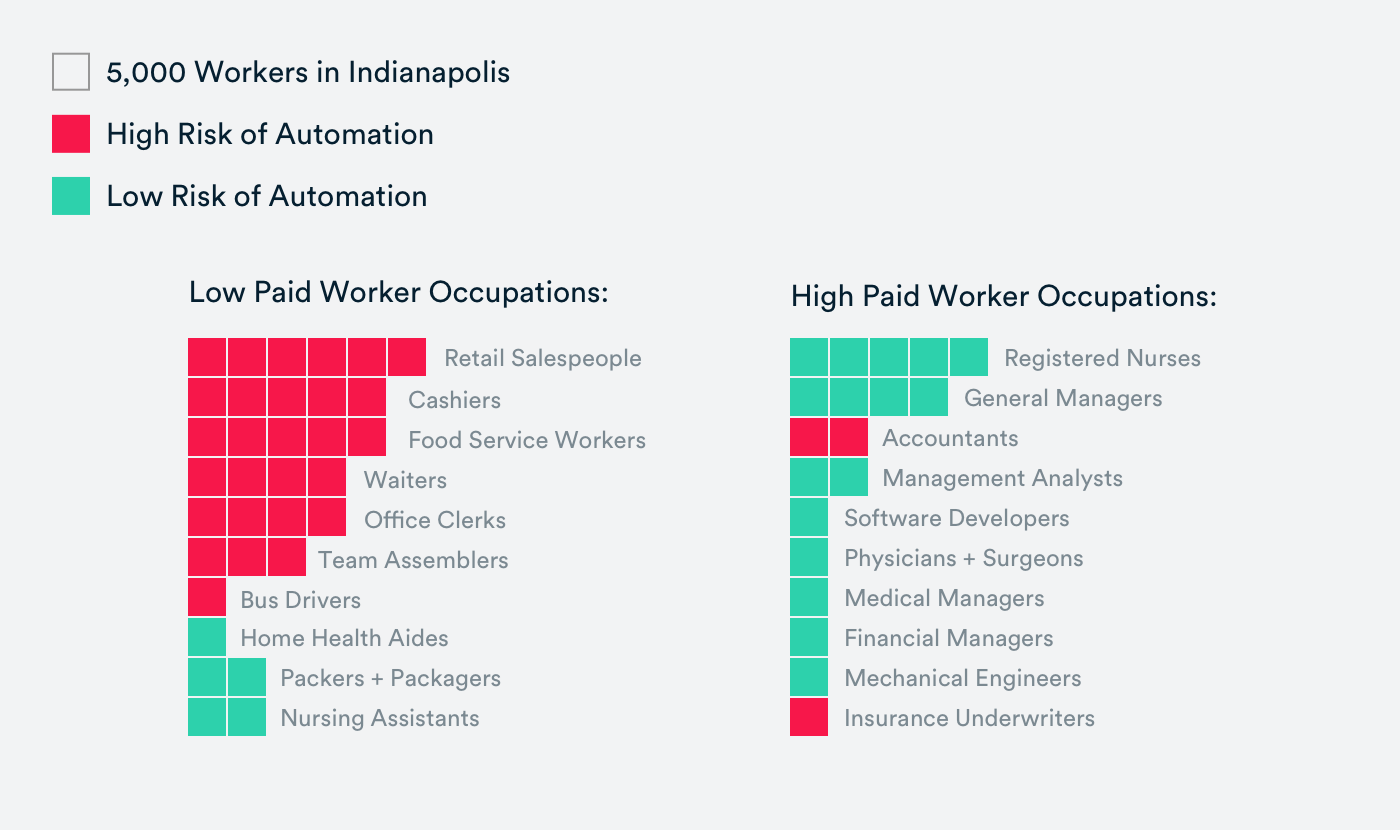
2) Tomorrow’s automation looks different from the automation of Indiana’s past. Although local manufacturing jobs (e.g., assembly work) continue to face a high risk of automation as they have in previous decades, the majority of workers at highest risk of automation in the future are employed in a much broader range of low-paid, frontline service jobs and clerical positions that employ more Indianapolis workers than production jobs alone. These high-risk jobs include retail salespeople, cashiers, fast food workers, and office clerks.
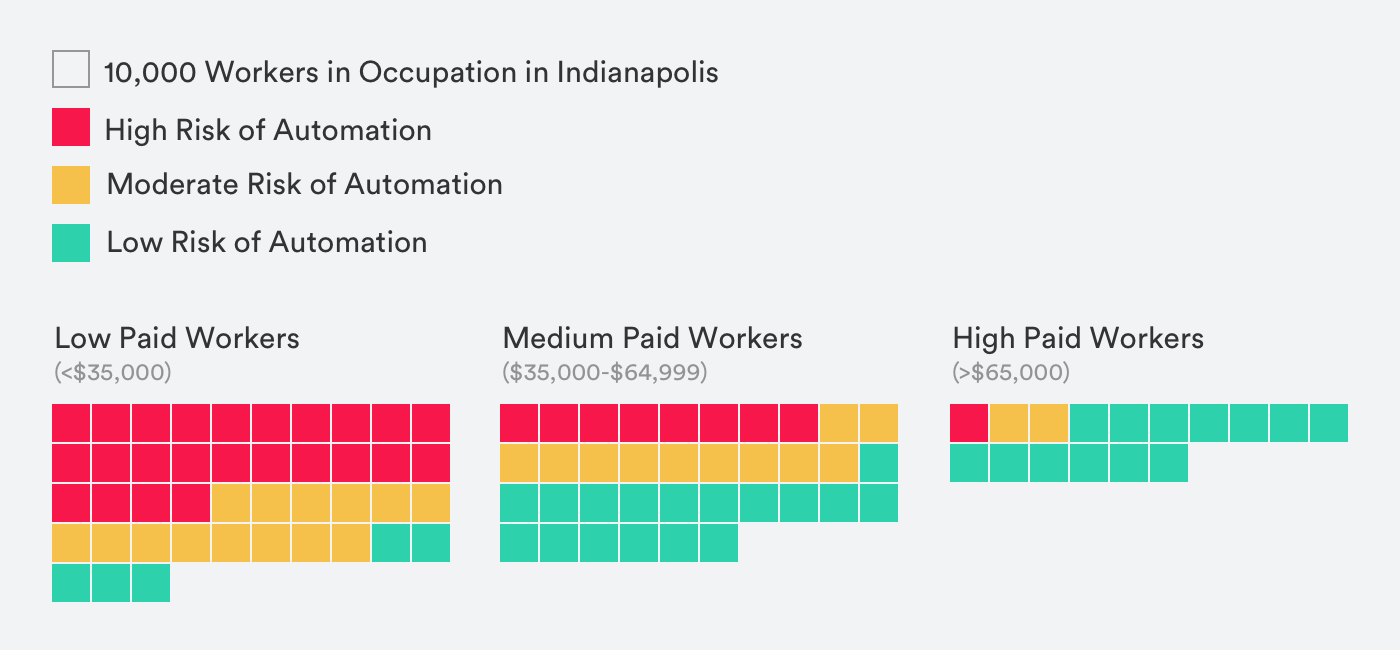
3) Low pay is associated with higher risk of automation. In Indianapolis, as in the United States overall, the burden of automation risk falls heaviest on workers making the least pay. Workers making less than $35,000, and especially those earning minimum wage, are at highest risk. High-paid workers earning over $65,000 face little risk in comparison.
4) Contrary to popular perception, women are at higher risk of automation than men. Despite the association of Indianapolis with male-dominated jobs in manufacturing, transportation, and material moving, our data found that women in Indianapolis have a slightly higher risk of losing their jobs to automation than men. Women constitute 55 percent of workers in high-risk occupations. This concentration stems from occupational segregation; women constitute at least 70 percent of the workforce in many high-risk jobs that are abundant in Indianapolis, including cashiers, office clerks, and waiters and waitresses.
How Indianapolis Is Preparing for Technological Change and Automation
The Indianapolis region is pursuing four approaches to prepare for the future of work: embracing innovation and building a tech talent pipeline, reskilling, increasing postsecondary educational attainment, and confronting issues of race and equity. In these efforts, Indianapolis is leveraging its strong culture of collaboration. As a midsize city with a “flat” hierarchy, interested stakeholders can more easily access influencers and gather collaborators and decision-makers than in a larger city, which theoretically helps them address tough issues like the future of work.
Embracing Innovation and Building a Tech Talent Pipeline
A top priority for leaders in Indianapolis is growing the technology ecosystem. This approach includes efforts to attract new technology companies and startups to the region, grow the number of high-skilled jobs, and retain and attract talent. Indianapolis has leveraged low corporate tax rates and a business-friendly regulatory atmosphere to help attract Salesforce and Infosys to the city and to be competitive in Amazon’s HQ2 search. The city has invested more than $75 million in infrastructure spending on the 16 Tech innovation district in northwest Indianapolis, which it hopes will become a hub for the life science and information technology sectors.38 Situated near the region's largest research institution, Indiana University – Purdue University Indianapolis (IUPUI), 16 Tech will look to tap into the local talent pipeline to reach its 3,000-job target. Already, the newly created Indiana Biosciences Research Institute has chosen to set up its home base on the 16 Tech campus. Construction broke ground in December 2018.
Indianapolis is also investing public dollars to bolster quality of life as part of the effort to attract high-skilled labor to the area. For example, the Central Indiana Transit Task Force has long sought to actualize a regional transit initiative to remedy some of Indianapolis’s mobility concerns, organizing roughly 200 public meetings on the topic. The project, which features a rapid transit bus line called the “Red Line,” connects the University of Indianapolis to the Broad Ripple neighborhood along a 28-stop route. The line was finally greenlit in 2018 and began construction in February 2019. The local development authority also recently recommended capital investments in outdoor recreation, bikeways, and trails.39
Reskilling and Tech Education
Perhaps the greatest shared energy and understanding among key Indianapolis stakeholders around the future of work is in the K–12 education, reskilling, and tech training spaces.
- Coding academies like Kenzie Academy, which include apprenticeship, immersive training, and income-based repayment programs that partner with leading tech firms to both develop talent and attract new tech firms to Indianapolis, have enjoyed high levels of local buy-in.40
- Techpoint Foundation for Youth focuses on the city’s most underserved students, working with partners to provide in-school and afterschool immersive exposure to robotics education, focusing on future-proof skills like communication, problem-solving, project management, and collaboration. The program also explicitly encourages students to pursue careers in STEM (science, technology, engineering, and mathematics) fields.41
- Purdue Polytechnic High School adds to Indianapolis’s history of public charter schools focusing on immersive STEM education. The school has expanded to two locations in the city and operates with a special attention to design thinking.42
- Ivy Tech Community College and the Indiana National Guard have together launched an immersive, one-of-a-kind cybersecurity program at the Muscatatuck Urban Training Facility just south of Indianapolis. The program offers associate’s degrees and certifications and caters to returning adult students and first-time, full-time students.43
It is important to note that “tech” is a term understood with nuance in Indianapolis, and that reskilling, lifelong learning, and future workforce preparation programming is not limited to careers centered in the “tech sector,” strictly constituted. Indiana is the most manufacturing-intensive state in the country, and job growth—and job change—in advanced manufacturing is top of mind.
- Conexus Indiana tackles the issue through a variety of initiatives, including its dual-enrollment Hire Tech experiential learning program for high school students, where students wrestle with innovations changing manufacturing and logistics from 3D printing to drone delivery.44
- Project Indy, an effort by EmployIndy and the City of Indianapolis, partners with employers to make youth employment more productive and accessible, focusing on the career-ready skills that will make future workers more flexible and adaptable across multiple industries.45
- Several local employers work with local education providers like Ivy Tech Community College and Western Governors Indiana to co-create certification programs or inform program design.
- A state program making local impact on adults looking to reskill or reenter the workforce in advanced manufacturing—and also in other high-need fields like healthcare or construction trades—is Indiana’s NextLevel jobs program. NextLevel provides free statewide training in high-paying, in-demand industries, and provides employers with reimbursements of up to $50,000 to train their employees in select high-growth fields.46
In general, the lifelong learning and reskilling conversation is fairly sophisticated in Indianapolis and has local leadership. There is shared ownership from the community college system, IUPUI, Marian University, University of Indianapolis, Butler University, several major employers, Lumina Foundation, the IndyChamber, IndyAchieves, and the Indiana Commission for Higher Education.
Reskilling, lifelong learning, and future workforce preparation programming is not limited to careers centered in the “tech sector.”
Increasing Postsecondary Educational Attainment
A signature initiative of Indianapolis Mayor Joe Hogsett is the launch of IndyAchieves, which has the ambitious goal of increasing the proportion of Indianapolis adults with high-quality postsecondary credentials to 65 percent by 2027, up from 42 percent today. Mayor Hogsett aims to reach this goal by providing additional funding and programmatic support to the existing Indiana Higher Education Award and 21st Century Scholars program, which provides last-dollar scholarships and completion grants to cover all unmet financial need for eligible students. IndyAchieves also plans to improve postsecondary completion rates by tying financial aid to easily enforceable eligibility requirements, in partnership with recipient institutions. The program launched in 2018 with $2 million newly available to low-income residents.
A Focus on Economic Inclusion and Race
Indianapolis is a city that struggles with economic and racial inclusion—and those focused on workforce and economic development are keenly aware of the need for tough conversations on the subject. One in five residents live in poverty in the city overall (with higher rates in the city center) and Indianapolis experienced one of the nation’s largest growth rates of both children living in poverty and in overall economic inequality.47 It is also a city that, while being home to a rich history of African American entrepreneurialism and culture, has a history of explicit and implicit segregation, followed by decades of inequitable educational and economic outcomes. Many organizations have openly called for workforce development and postsecondary attainment initiatives as a tool for dismantling racial inequity, but design efforts still need to involve more residents and leaders who represent communities currently left behind by economic development. Many key leaders also tacitly agree that automation preparation goals must explicitly name and address racial inequity.
Time vs. Need
Indianapolis is not lacking in innovation or options for workforce and economic development activity. However, practitioners do not have sufficient space, time, or resources to focus on how swiftly automation is affecting and will affect residents’ ability to earn income and maintain social and economic mobility. One of the major reasons for this mismatch is the dire economic need faced by so many Central Indiana residents facing multiple barriers to employment. Providers need to place impoverished residents in work that provides income as quickly as possible; likewise, many residents understandably prioritize finding income quickly to meet their daily needs. The city will need to set aside time, resources, and capacity to future-proof vulnerable residents’ pathways to income rather than disrupt their pathway to immediate stability.
The Unfinished Agenda in Indianapolis: Challenges Ahead
In Indianapolis, the level of discourse around workforce development, automation, and reskilling is advanced, and programs proliferate. However, important challenges and gaps remain. We identify four missing pieces of a comprehensive approach to automation.
Recognizing the Shifting Paradigm of Automation and the New Workers It Will Impact, Including Women
Indianapolis’s history of manufacturing-based job disruption and widespread awareness of the issue can be a double-edged sword. People may be familiar with mechanical automation, but they are also more susceptible to a cognitive lock about who and what is implicated in a labor crisis. The next waves of automation will affect not only blue-collar, male, manual laborers, but also an even greater number of workers in the service sector, clerical roles, and even some professional roles. Women, people of color, and young workers will be disproportionately impacted. Although the historical context of the region and previous experience with automation in the manufacturing sector have primed Indianapolis leaders and residents to be more open to the possibility of change, a “we-have-been-there-before” mentality may also create overconfidence in the region’s readiness for the next changes, which will look different than the past.
Thus, a big challenge in Indianapolis is raising awareness that the future challenge does not look only like the past pain of factory jobs leaving, but rather is a much larger wave of automation that puts a greater cross-section of jobs at risk than any previous disruption. A state that is so proud of and invested in manufacturing certainly grasps the need for new talent pipelines, but there is still work to be done to help translate the need and inspire program design into more layman’s spaces. More visible activity or pressure should focus on designing programs to help workers in less obviously vulnerable roles, such as insurance adjusting, administrative roles in financial services, and fast food. The region also could use this massive opportunity to help lead a conversation about how AI and automation could drive transitions to meet a need for a larger workforce in some less automation-vulnerable spaces in Indiana, such as early childhood development.
The next waves of automation will affect not only blue-collar, male, manual laborers, but also an even greater number of workers in the service sector, clerical roles, and even some professional roles.
Even though women face a disproportionately high risk of automation nationally and in Indianapolis, programming to support women in lower-paid middle-skill jobs, such as office clerks and waitresses, is severely underdeveloped in the city. General programs like IndyAchieves are a good start, but few programs focus on the specific challenges of working women. Those that do, like The Last Mile, enjoy very limited funding.
Balancing the Urgency of Now with the Challenges Looming Ahead
A key challenge for Indianapolis is managing the tension between addressing urgent social and economic challenges today and preparing for longer-term challenges that automation will present to vulnerable populations. In Indianapolis, the strong focus from partners on the urgency of addressing today’s challenges related to economic mobility, racial equity, and workforce development risks clashing with a parallel focus on preparing for future-oriented challenges, even within these same vulnerable communities.
This tension mirrors the long-standing gulf between economic development and workforce development initiatives in the city. Indianapolis has a long history of racial segregation and severe inequality, featuring some of the most segregated schools in the country. Today, Indianapolis youth born in poverty are far more likely than the national average to remain in poverty.48 The Martindale-Brightwood ZIP code has a 40 percent poverty rate, as well as almost a 10-year difference in life expectancy than the richest areas in the city.49 Against this backdrop of racial inequities and economic inequality, city leaders have long put Indianapolis’s long-term workforce development agenda on the backburner as they attempted to deal with these more immediate economic disparities.50
The urgency of the challenges today has spurred a lengthy list of immediate priorities, limiting the space for newly emergent priorities like the future of work. For instance, Indianapolis has prioritized improving public transportation access issues, which limit the ability of many to get to work. Although such initiatives are important for addressing short-term problems, failure to resolve the tensions between today’s priorities and tomorrow’s challenges risks setting back the city’s ambitions for addressing the stark poverty rate and breaking multigenerational cycles. It also sets up vulnerable workers to be ill-suited for the changing economy and demand for skills. For instance, traditional workforce development programs typically place more vulnerable workers in currently-in-demand jobs, such as commercial driving and fast food service, but these same positions face a high risk of automation and change.
Putting Worker Constraints and Social Barriers at the Center of Program Design
Despite the existence of workforce and training resources, more needs to be done to make these programs and subsidies more user-friendly to the workers that need them most. To ensure that programs are accessible, program designers must take into account the very real constraints and often tricky circumstances that vulnerable workers face. For instance, many vulnerable workers are unable to take advantage of evening classes outside of work hours, or to pay for training upfront and wait for reimbursement. To ease the accessibility of offerings, training programs might be improved by being made available on-the-job and/or paid for by a worker’s current employer.
In addition, the social barriers that workers face are an important component of any future solutions to an equitable future of work. Greater government support for workers and families in transition will be crucial when automation hits. Indianapolis is in need of high-quality, affordable, flexible childcare options, especially ones that suit workers who have alternative or third-shift work schedules. In Indiana, children are not required to attend a school until they reach age seven, deepening the demand for daytime care beyond most metro areas.
Creating Entry Points and Diversifying Funding
One downside to the fact that Indianapolis is home to so much workforce activity is that it can be hard for new funders, organizations, or entrepreneurs to understand the best point of entry for action. It can be hard to know which lever to pull or who the ultimate authority is on some issues, and it can be hard to be bold and effective if one cannot get a sense of how to add value or where to invest time or money. And, perhaps as a function of “Indiana nice,” there is little appetite for telling someone that new action or investment is simply not needed.
As for spurring new social enterprise to solve workforce development issues; success will rely heavily on social capital. There is not as much capital—social or otherwise—in rotation in a market the size of Indianapolis, and culturally, investors or “idea-backers” can be risk averse. People tend to back “the guy who knows the guy who backed the last idea”—in essence, someone who is new on the scene may find it difficult to advance in Indianapolis. Innovators may be welcomed, but may be shut out of certain spaces, and this aspect of local life may discourage new founders.
Another concern is that, despite the spirit of collaboration, people will be unable to consolidate—after all, the various organizations already working in the region need to operate and raise money as well. They are competing for limited resources in a small pool and they need to maintain ownership of some of the work in order to maintain operation support. But right now, there is so much activity that it can be hard to tell where funders, volunteers, and national partners should invest their time and money. Sometimes, this murky environment results in people building solutions on top of existing solutions.
In the long run, Indianapolis must diversify away from its reliance on philanthropic support to fund many of the successful pilots mentioned above. This need may not be immediate, but the reality is that private philanthropic support has been a huge lynchpin, and few in Indianapolis are talking about how to support and drive the preparation for automation without philanthropic dollars.
Conclusion
The density of workforce development efforts in Indianapolis indicates that city leaders understand that the economic winds are changing. At the same time, most of these initiatives focus on fostering a technology sector that will only be able to accommodate a fraction of the residents whose jobs will be altered by automation. Deciding how best to serve the lowest-skilled Hoosiers is the next step in Indianapolis’s evolution and the true indicator of whether Indianapolis can overcome the automation challenge in the long run.
Indianapolis is home to many programs at the nexus of workforce development and automation
| [Indy Achieves](https://www.indyachieves.org/) | A cross-sector, cross-population focus on preparing a future workforce and helping residents navigate and resource postsecondary options. |
| [Ascend Indiana](http://ascendindiana.com/) | A deliberate and intentional talent development pipeline with high-demand employers who are focused on high-growth markets for the state |
| [Purdue Polytechnic High School](https://pphs.purdue.edu/) | An innovative class experiential learning model |
| [The Last Mile](https://thelastmile.org/) | A reentry program that begins with coding instruction during incarceration |
| [Project Lia](https://www.projectlia.org/) | A program to help women who are reentering society postincarceration develop employability, maker, and entrepreneurial skills |
| [Muscatatuck Cyber Academy](https://www.in.gov/ago/cyber-academy.htm) | An innovative partnership across the National Guard and Ivy Tech Community College to develop associate’s level cybersecurity talent and also provide training and simulation services for organizations across the world |
| [Next Level Jobs](https://www.nextleveljobs.org/) | A system to connect Indiana residents with free state-wide training in high-paying, in-demand industries. NextLevel Jobs also provides Indiana employers with reimbursements of up to $50,000 to train their employees in these high-growth fields |
| [LISC Indianapolis](http://liscindianapolis.org/opportunity/) | A local office of a national organization that, among others things, provides leadership and direct service in neighborhood-based workforce development leadership |
| [Indy Chamber of Commerce](https://indychamber.com/entrepreneurship/) | The city Chamber of Commerce supports inclusive economic growth, entrepreneurial training, and place-based initiatives that locate residents closer to opportunities. |
| [Indy Black Chamber of Commerce](http://indybcc.org/) | A membership and advocacy organization that provides entrepreneurial training, support, and advocacy |
| [EmployIndy](https://employindy.org/youth-services/job-ready-indy/) | The director of the local workforce ecosystem, providing—among other services—the Job Ready Indy online badging system (which validates the attainment of job skills by participants, signaling value to the market), Project Indy (a job, soft-skill, and work-readiness training program provided by local employers to in- and out-of-school youth in Marion County), and career advising services to adults throughout the city |
| [TechPoint Foundation for Youth](https://www.techpointyouth.org/) | An organization providing guidance and direct service to inspire more underserved central Indiana youth to pursue STEM careers |
| [Conexus Indiana](https://www.conexusindiana.com/) | A partnership to promote the state’s manufacturing economy that offers several talent development efforts in advanced manufacturing |

Citations
- Dan Carden, “Governor's Workforce Cabinet Begins Big Task of Aligning Indiana's Education and Job Training Programs,” Times of Northwest Indiana, May 2, 2018, https://www.nwitimes.com/news/local/govt-and-politics/governor-s-workforce-cabinet-begins-big-task-of-aligning-indiana/article_3c5646fd-dc0e-56ed-a324-692644a121a4.html; and Indiana Commission for Higher Education, “Frank O’Bannon Grant”, n.d., https://www.in.gov/che/4506.htm.
- James Briggs, “Salesforce to Rename Chase Tower, Hire 800,” Indianapolis Star, May 6, 2016. https://www.indystar.com/story/money/2016/05/06/salesforce-expected-rename-chase-tower-hire-800/83973780.
- “First Phase of Infosys’ $245M Airport Campus Will Be $35M Training Center,” Indianapolis Business Journal, April 26, 2018, https://www.ibj.com/articles/68581-first-phase-of-infosys-245m-airport-campus-will-be-35m-125000-square-foot-training-center.
- United States Census Bureau “2016 Annual Survey of School System Finances,” 2018, https://www.census.gov/data/tables/2016/econ/school-finances/secondary-education-finance.html.
- Kinder, Automation Potential for Jobs in Indianapolis.
- Ibid.
- Central Indiana Regional Development Authority, “Indy’s Metro Momentum Agenda – Regional Development Plan,” August 2015, https://iedc.in.gov/materials/downloads/Download/390f259c-34ce-6748-857a-ff0000c19905/.
- Ibid.
- Kenzie Academy, https://www.kenzie.academy/.
- Techpoint Foundation for Youth, https://www.techpointyouth.org/.
- Purdue Polytechnic High School, https://pphs.purdue.edu/.
- “Muscatatuck Cyberacademy,” Adjutant General’s Office, Indiana National Guard, n.d., https://www.in.gov/ago/cyber-academy.htm.
- Conexus Indiana, https://www.conexusindiana.com/.
- Project Indy, http://projectindy.net/.
- NextLevel Jobs, https://www.nextleveljobs.org/.
- Ryan Donahue, Brad McDearman, and Rachel Barker, Committing to Inclusive Growth: Lessons for Metro Areas from the Inclusive Economic Development Lab (Washington, D.C.: Brookings Metropolitan Policy Program, September 2017), https://www.brookings.edu/wp-content/uploads/2017/09/metro_20170927_committing-to-inclusive-growth-iedl-report.pdf.
- Ibid.
- Hayleigh Colombo, “1 in 5 Indianapolis Residents Lives in Poverty. And Many Areas Are Getting Worse,” Indianapolis Business Journal, May 11, 2018, https://www.ibj.com/articles/68785-in-5-indianapolis-residents-lives-in-poverty-and-many-areas-are-getting-worse.
- Jodi Moon and Lauren Krull, Examining the Cross-Roads School Segregation in Indiana (Bloomington, Ind. Indiana University Center for Evaluation & Education Policy, May 2017), https://www.civilrightsproject.ucla.edu/research/k-12-education/integration-and-diversity/examining-the-crossroads-school-segregation-in-indiana/Summary_School_Segregation_in_Indiana.pdf.