Blockchain and Property Rights
Abstract
New and emerging technologies can greatly simplify the process of mapping, recording, and defending property rights at scale. While technology alone is insufficient to solve pernicious property rights challenges, it can be harnessed by policymakers, lawyers, surveyors, families, and communities to help deliver structural reforms.
The purpose of this primer series is to introduce a number of new and emerging technologies to professionals working within the property rights space. The primers are by no means an exhaustive guide, but rather a starting point to explore and understand disruptive new tools for reform.
For more information, please either consult FPR’s own work or contact us directly at [email protected].
Produced in partnership with Esri.
Acknowledgments
The authors would like to thank Brad Witteman, Brent Jones, Lyndon Estes, Hamed Alemohammed, Yonah Gaber, Todd Miller, and Sonja Betschart for reviewing these primers.
Blockchain and Property Rights

An Introduction to Blockchain
Blockchain, at its most basic, is database technology. It is a type of distributed ledger, that can be concurrently accessed and updated by multiple users. Members of a blockchain network collectively validate new data through consensus algorithms and add the information to “blocks,” which are linked cryptographically into a “chain” (hence the term blockchain). As a result, this decentralized network creates an agreed-upon record of the time and origin of every data input, stored on many independent computers. For these reasons, it is virtually impossible to hack it, cheat it, or manipulate it. And since blockchain is not confined to, or reliant on, a single server, but many “nodes,” no single entity controls it.
Increasingly sophisticated blockchains, which incorporate self-executing “smart contracts,” allow programmers to code applications for various uses, including digital identity and automatic asset exchange.1
Why Blockchain is Important for Property Rights
Blockchain can potentially improve the efficiency, security, and transparency of land administration and real estate—two commonly cited use cases. Incorporation of blockchain into a land registry’s database system architecture can help alleviate issues related to corruption, lack of trust, inefficient services, insecure data, and vulnerability to cyberattacks.
Within more advanced economies, blockchain promises to streamline real estate transactions, as data replication across numerous computers facilitates data access, helping to smooth workflows and reduce processing delays. Blockchain also offers greater security for certain land registry data and e-conveyancing processes. Although not invulnerable to hacks, a blockchain-based solution is more difficult to attack or exploit because it lacks a sensitive central point to target.
Because a blockchain-based solution is not controlled by a single party in an opaque manner, but cross-checked by many users, it may lower chances of record tampering and land grabbing. And while blockchain cannot help with the problem of “garbage in, garbage out”—the initial entry of poor-quality data—anyone attempting to delete or change records leaves a visible trail. Use of a distributed ledger can also allow land registries to publish certain data transparently and securely, helping customers better track property-related legal and bureaucratic processes.
The Strengths and Limitations of Blockchain
Similar to other emerging technologies, blockchain possesses both strengths and limitations for property rights:
Strengths
As distributed ledger technology, blockchain offers benefits that centralized systems do not. Because the same database is replicated by many computers in a blockchain-based system, for example, management and maintenance is dispersed across the network. A blockchain is not everlasting, but any distributed system is less likely to fail as it usually relies on many redundant and independent components.
It is also difficult to tamper with data on a blockchain, for three reasons: control is distributed among many users; all users work together to verify new data through consensus; and all data is paired with a unique “fingerprint” to ensure integrity.
The distributed architecture and related data entry protocols can additionally allow network participants to view the same data and/or track processes in real time. This transparency can hinder data tampering, fraud, and information asymmetries. Given widespread adoption of blockchain-based tools and solution compatibility, a blockchain-for-land ecosystem can eventually boost land administration efficiency, lowering costs for registries, intermediaries, and customers.
Finally, a blockchain-based solution is difficult to attack, in part, because it lacks a central point to easily target. This feature stands in contrast to centralized systems that store all or most data in one place, and are consequently at risk of security breaches.
Limitations
Blockchain is a powerful tool for property rights, but it is not a cure-all. In fact, many poorly functioning land registries will find it tough to implement a blockchain-based solution. Various prerequisites, including a functional identity system, accurate and digitized records, and a trained professional community that interacts with the registry, are necessary for successful adoption.
Bureaucratically, blockchain is poorly understood by many government stakeholders, making it difficult for a land registry to identify issues that the technology can help to solve. Furthermore, a blockchain requires many users for the network to be transparent and more secure against manipulation by bad actors. But registries are often hesitant to widely share data, creating a barrier to adoption.
Blockchain is also inherently political, as the technology offers to decentralize and/or democratize both governance and socioeconomic structures. Sufficient political will or public support may not always exist to allow for innovation. In particular, buy-in from entrenched stakeholders profiting from the current system can be difficult and is not always possible.
Technologically, most blockchains cannot store large files, such as cadastral maps. Many blockchains require significant time and energy to validate data, as well. As a result, network throughput is slow and input costs are high on several prominent blockchain platforms—notably Bitcoin and Ethereum—especially in comparison to legacy systems.
Use Cases of Blockchain for Property Rights
Blockchain technology is increasingly utilized by land registries globally. Below are a few use cases:
- Property records: The country of Georgia placed hashes—“a unique string of letters and numbers that represents any unique piece of data”2—of 1.5 million land records on the Bitcoin blockchain. This process ensures the security and immutability of the information, as any change to underlying data completely changes its hash.3 The project helped fight corruption, significantly improved the efficiency of land administration services, and bolstered public trust in government institutions.4
- Land administration services: In 2018, the Colombian National Land Agency launched a blockchain-based pilot to increase the transparency and efficiency of land formalization processes following decades of civil war. Using Ethereum, the agency is streamlining workflow among various stakeholders via smart contracts; enabling process tracking in real time; and publicly displaying judicial decisions related to formalization and disputes in a tamper-resistant and transparent manner, fighting both corruption and a lack of trust.5
Citations
- Adam Piore, “Can Blockchain Finally Give Us The Digital Privacy We Deserve?,” Newsweek, February 22, 2019, https://www.newsweek.com/2019/03/08/can-blockchain-finally-give-us-digital-privacy-we-deserve-1340689.html
- Tomicah Tillemann, Allison Price, Glorianna Tillemann-Dick, and Alex Knight, The Blueprint for Blockchain and Social Innovation, Washington, D.C.: Blockchain Trust Accelerator, last updated January 22, 2019, https://www.newamerica.org/bretton-woods-ii/blockchain-trust-accelerator/reports/blueprint-blockchain-and-social-innovation/
- Ibid.
- Qiuyun Shang and Allison Price, “A Blockchain-Based Land Titling Project in the Republic of Georgia: Rebuilding Public Trust and Lessons for Future Projects,” Innovations 12, no. 3-4 (Winter-Spring 2019): 77.
- Olivier Acuña, “Colombia launches time-saving blockchain land registry pilot project,” Coin Rivet, August 2, 2018, https://coinrivet.com/colombia-launches-a-time-saving-blockchain-land-registry-pilot-project/; for more, see: Tim Robustelli, “High-Tech Solutions in Colombia,” FPR Blog (blog), New America, September 6, 2018, https://www.newamerica.org/future-property-rights/blog/high-tech-solutions-colombia/
Drones and Property Rights

An Introduction to Drones
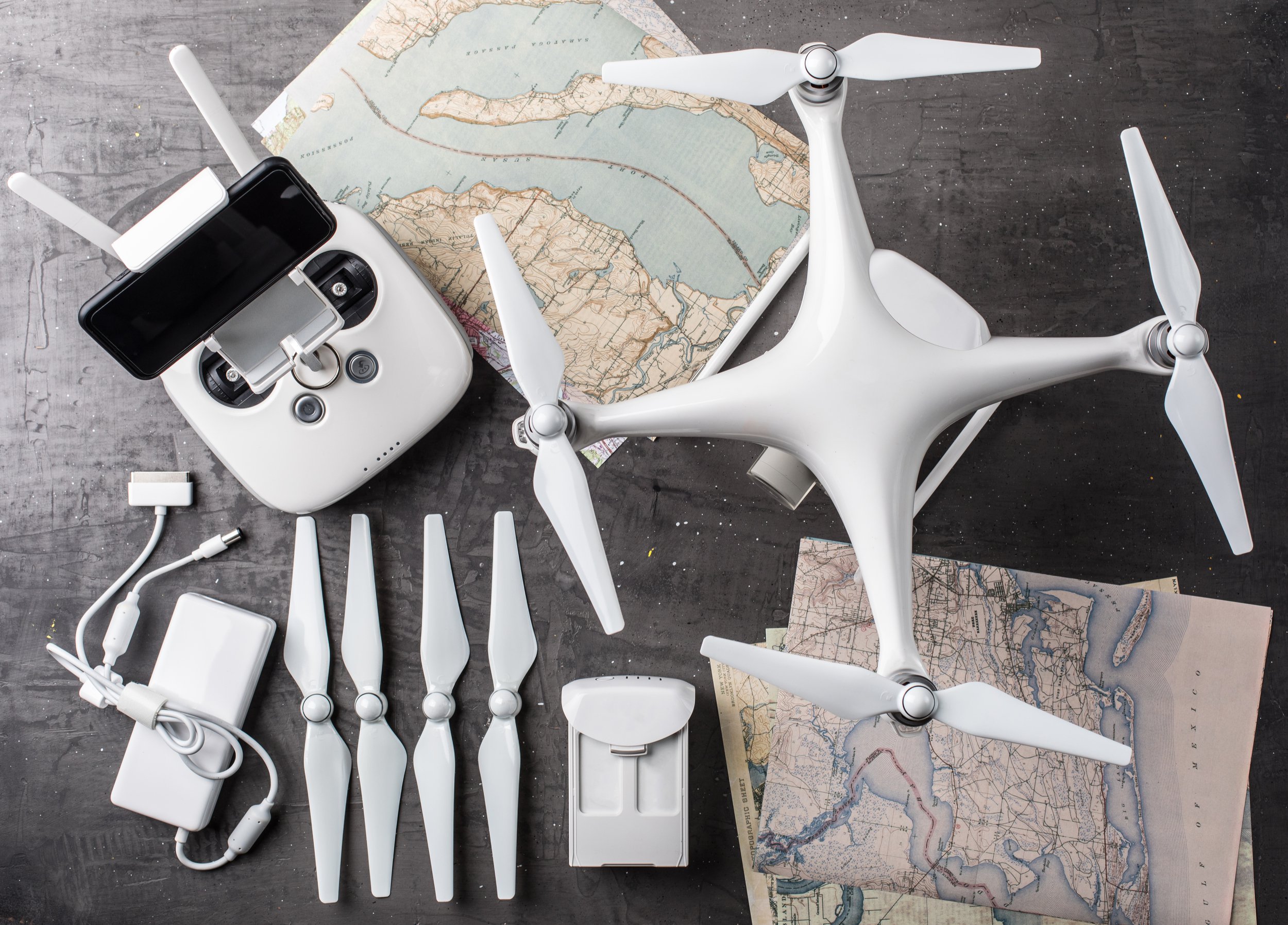
Land surveying and mapping are evolving rapidly due to advances in unmanned aerial system, or drone, technology. A drone is a flying machine—either fixed-wing or rotary—that is remotely controlled or flies autonomously through software-controlled flight plans. Because they are unmanned, drones are cheaper and smaller than manned aircraft, and can perform tasks too expensive or dangerous with a pilot on board. A single drone system is comprised of an aircraft and a ground control station, which operators use to control the drone. The key innovation of drones is the suite of sensors, software, and communications equipment that allows these comparably small and light-weight vehicles to be operated remotely.
Drones are often associated with military surveillance and missile strikes, but there are myriad non-military use cases. For example, drones facilitate the delivery of blood and vaccines to patients across Rwanda,6 help fight dengue on Fiji,7 and crop dust fields in El Salvador.8 Civilian drones also provide sophisticated yet relatively inexpensive platforms for aerial photography and map making.
Why Drones are Important for Property Rights
Many governments are interested in leveraging drone technology to help solve persistent land administration problems. And practitioners around the world are already incorporating this new variety of aerial imagery into their work.
The time, cost, and complexity of conventional land surveying is a significant obstacle to property formalization. The traditional process often takes years, and is sometimes too expensive for a government to complete. For citizens, professional survey costs can make up more than 50 percent of the total expense to receive a land title.9
Drones directly tackle this barrier to formalization by lowering the cost and complexity of surveying. A modestly priced drone—under $600 USD—can produce high-quality and cloud-free imagery in real time. This data can then generate maps to define land and property rights for a fraction of the cost of a traditional survey.
With low maintenance costs and quick deployment, drones can basically map anywhere at any time, weather allowing. Use of drones at the local level, through community mapping initiatives, diminishes reliance on central mapping authorities, while empowering citizens, NGOs, and small, informal networks. Drone imagery can create a basis for formal land documentation, or be a tool for generating maps that communities can use to govern their land and resources. Additionally, indigenous groups and other marginalized populations have used drone imagery to document illegal land grabbing and resource extraction.
The Strengths and Limitations of Drones
Similar to other emerging technologies, drones possess both strengths and limitations for property rights:
Strengths
Drones help to make property mapping faster, cheaper, and more efficient. Small, portable, and relatively inexpensive drones capture high-resolution images using light-weight cameras. Complementary software can process large quantities of data to create a variety of maps, including two-dimensional maps (similar to satellite imagery), elevation models, thermal maps, and 3D maps or models. Often, this drone imagery is as accurate as data produced by traditional methods. Finally, drones allow surveyors to complete difficult projects—in challenging terrain, neighborhoods with crumbling structures, and in areas affected by natural disasters or otherwise dangerous to access on foot.
Limitations
Drones are not the exclusive tool for mapping, but complement other technologies and help fill in any imaging gaps left by satellites and traditional surveying. And the current generation of commercial drones suffers from technical and regulatory limitations.
While models differ slightly, commercial drones are generally hampered by limited battery life, the need for accurate ground control, and high data processing costs for larger mapping projects. Given limited autonomy, as well as speed restrictions, drones can only provide limited territorial coverage during a single flight. Adverse weather, such as strong winds and rain, may also limit a drone's functionality.
Another challenge stifling development of drone technology is the absence of adequate regulatory frameworks. Drone mapping is still a relatively new practice, and many countries, especially in the developing world, lack explicit laws governing drones. Conversely, other governments have enacted knee-jerk laws that severely limit drone use, either explicitly or by making the barrier to entry too high through bureaucratic red tape. The regulatory environment is changing quickly, however. Many governments are actively outlining drone regulations, and international working groups are drafting recommendations to facilitate the implementation of national laws.
Use Cases of Drones for Property Rights
Drones are increasingly deployed for a variety of mapping projects worldwide. Below are a few use cases:
- Slum mapping: In 2017, the Indian state of Odisha passed the Land Rights to Slum Dwellers Act, initiating a program to map and issue titles for land parcels in 2,000 slums that house 1 million people. The project uses drones to capture high-resolution imagery of slums, with the resulting maps utilized to draw property boundaries and assign plot numbers. Following additional, door-to-door data collection and a review of claims, formalized land records are transferred to the state, and occupancy certificates are delivered to homeowners. Over 24,000 certificates were distributed by February 2019.10
- Updating cadastres: In 2013, drone mapping company Micro Aerial Projects completed a World Bank-funded initiative to map both rural and urban land parcels in Albania, where as many as 80 percent of private properties were inaccurately mapped. The drone mapping project provided high-resolution and up-to-date imagery of dozens of parcels, used to revise out-of-date maps. The mapping process itself did not last many hours, but processing the imagery and creating a map took several days.11 Of note, data processing times have improved over the past few years, dependent upon computer power and the software used.
Citations
- Tom Jackson and Devin Hance, “How Delivery Drones Are Saving Lives in Rwanda,” Fortune, January 7, 2019, http://fortune.com/2019/01/07/delivery-drones-rwanda/
- “How Local Drone Pilots Are Helping to Reduce Dengue in Fiji,” WeRobotics Blog (blog), WeRobotics, December 13, 2018, https://blog.werobotics.org/2018/12/13/how-local-drone-pilots-are-helping-to-reduce-dengue-in-fiji/
- Chris Baraniuk, “The crop-spraying drones that go where tractors can’t,” BBC, August 3, 2018, https://www.bbc.com/news/business-45020853
- Lesley Wynn and Jaime Faustino, “This Land Is Our Land: How Drones Can Advance Property Rights in the Philippines,” The Asia Foundation, November 7, 2018, https://asiafoundation.org/2018/11/07/this-land-is-our-land-how-drones-can-advance-property-rights-in-the-philippines/
- Brent Jones, “How One Million People in India’s Odisha Slums Gain Land Rights,” Esri Blog (blog), Esri, February 11, 2019, https://www.esri.com/about/newsroom/blog/how-one-million-people-in-indias-odisha-slums-gain-land-rights/.
- Faine Greenwood, “Chapter 5: Mapping in Practice,” in Drones and Aerial Observation: New Technologies for Property Rights, Human Rights, and Urban Development, by Konstantin Kakaes et al., 51-52, Washington, D.C.: New America, July 2015, http://drones.newamerica.org/primer/DronesAndAerialObservation.pdf
Dual-Band GNSS and Property Rights

An Introduction to Dual-Band GNSS
The vast majority of Global Navigation Satellite Systems (GNSS)-enabled consumer devices—like phones, tablets, smart watches, and car navigation systems—use single-frequency receivers, which are only accurate to about five meters, in good conditions.12 By contrast, dual-band satellite receivers use two different frequencies of signals to calculate positions. By making use of a second signal frequency, dual-band receivers can correct for interference caused by electrical activity in the upper atmosphere, which is the greatest single source of positioning errors. Using a second frequency also provides greater signal redundancy, allowing for better error-correction and improved performance in tree cover and urban canyons.
In recent years, the growing market for location-based services arising from the ubiquity of smartphones has in turn spurred demand for inexpensive, high-accuracy GNSS receivers.
Dual-band chips are now being produced for mobile phones for the first time. As this technology appears in more consumer devices, the average person will be able to collect much more accurate and reliable location data. In 2018, the first dual-band smartphone, the Xiaomi Mi-8, was released. The Mi-8 achieved sub-meter static positioning accuracy in testing conducted by the European Space Agency, and researchers from Trimble were able to demonstrate centimeter level performance in a laboratory setting using the Broadcom chip found in the Xiaomi and a cell-phone antenna.13
Why Dual-Band GNSS is Important for Property Rights
Dual-band GNSS is already widely used for property rights because it is one of the primary tools of land surveyors. Errors on the scale of meters are not good enough for survey work, for which local standards often mandate accuracy to the one to ten centimeter range.
But dual-band hardware has historically been very expensive specialist equipment. Dual-band smartphones have great potential to augment pro-poor and fit-for-purpose land administration with greatly increased accuracy. As the accuracy of ordinary smartphones and tablets converges to survey standards, communities will have a powerful new tool for demarcating their own land. In areas where the nature of customary ownership or usage does not translate easily into a formal cadastral system (as with shared lands with communal rights or lands used by different parties according to an annual cycle) land use arrangements decided at the local level are preferable. Cheaper data collection should allow for the reduction of property registration fees, which currently discourage many small landowners from participating in formalization programs. According to the World Bank, registering property in sub-Saharan Africa costs, on average, 8 percent of the value of the registered property. For professional surveyors, documenting informal property is time consuming and not especially profitable. When the task of data collection is community-sourced, they will be free to focus on more demanding work which requires expertise in managing and analyzing geospatial data. This will include designing and supervising crowdsourced data collection projects.
The Strengths and Limitations of Dual-Band GNSS
Similar to other emerging technologies, dual-band GNSS possesses both strengths and limitations for property rights:
Strengths
Dual frequency provides superior accuracy, both inherently and by enabling post-processing of data. It also allows positions to be calculated more quickly, and is more resistant to interference, especially in urban canyons and under tree cover. Better performance in urban environments is crucial for surveying in urban and peri-urban areas, where the built environment often creates greater interference and crowded conditions demand stricter accuracy requirements than are found in rural areas.
Limitations
Historically, there have been a number of obstacles to the use of dual-band GNSS. One is the cost of the receivers, which were produced in relatively small numbers as specialized tools for applications like surveying and military navigation systems. Another was the lack of satellites broadcasting a second navigation signal. Now, the cost of the hardware is falling dramatically and multiple satellite constellations broadcasting on two or more frequencies are nearing completion.
Dual-band is in most respects superior to single-frequency GNSS in smartphones and tablets, but it remains uncommon in such devices and is more expensive than single frequency in specialized surveying devices. It should also be noted that a dual-band receiver alone is not sufficient to accurately demarcate land parcels. Accuracy is dependent on many factors beyond the use of multiple frequencies, including the quality of the antenna, access to correction data, and the signal processing software. Concurrent advancements must be made in these areas in order for dual-band in smartphones to reach its full potential.
Significant steps have been made in this direction. The open-source Android operating system now gives developers access to raw signal data, enabling advanced processing techniques to be used. Organizations betting on expansion of location services are helping to promote their growth and development. In June 2017 the EU launched a GNSS Raw Measurements Task Force to “boost innovation around this new feature” and “share knowledge and expertise on Android raw measurements and its use, including its potential for high accuracy positioning techniques.”
Use Cases of Dual-Band GNSS for Property Rights
The introduction of dual-band GNSS into consumer devices is too recent to furnish examples of property rights implementations. However, potential use cases include:
- Land regularization: When cheap consumer devices can be used to collect high-accuracy location data, some of the most time-consuming and expensive parts of the formalization process can be completed more quickly and cheaply at a local level through community mapping. Dual-band smartphones and tablets are a particularly attractive tool for community mapping because they allow geospatial and land tenure data to be collected with the same device.14 Inexpensive dual-band receivers can also increase the cost-efficiency of other surveying tools, such as drones.
- Location-based credentials: Smartphone penetration and internet access are increasing rapidly in the developing world. A growing number of people will be generating location data trails that, in combination with a digital identity solution like self-sovereign identity, can be used as evidence of property rights.15 Taken together, this data can be used to create a tapestry of new evidence that property holders could use to obtain documentation of their property rights. With dual-band smartphones, that data will become more accurate and trustworthy, especially in highly urban areas.
Citations
- National Coordination Office for Space-Based Positioning, Navigation, and Timing, “GPS Accuracy,” 2017, https://www.gps.gov/systems/gps/performance/accuracy/
- Stuart Riley, Herbert Landau, Victor Gomez, Nataliya Mishukova, Will Lentz, and Adam Clare, “Positioning with Android: GNSS observables,” GPS World, January 17, 2018, https://www.gpsworld.com/positioning-with-android-gnss-observables/
- For more, see our report: Christopher Mellon and Michael Graglia, Accuracy for All: Community Land Mapping and the Navigation Satellite Revolution, Washington, D.C.: New America, last updated December 5, 2018, https://www.newamerica.org/future-property-rights/reports/accuracy-all/
- For more, see our report: Yuliya Panfil and Christopher Mellon, The Credential Highway: How Self-Sovereign Identity Unlocks Property Rights for the Bottom Billion, Washington, D.C.: New America, last updated May 15, 2019, https://www.newamerica.org/future-property-rights/reports/ssi-credential-highway/
Machine Learning and Property Rights

An Introduction to Machine Learning
Machine learning is an application of artificial intelligence (AI) that enables systems to programmatically “learn” and improve from past experience. Computers use algorithms and statistical models to “learn” patterns and insights from sample sets of data (often called “training data sets”), and apply those insights to make intelligent predictions and decisions about much larger sets of data.
Applications of machine learning have proliferated over the last several years. For example: GPS navigation apps like Google Maps and Waze use machine learning to better predict traffic patterns, and social media services like Facebook and LinkedIn use machine learning to tailor the content of a user’s news feed.
In the realm of property rights, the most commonly used data sets include imagery from satellites, low flying aircraft, drones, and even cameras on cars. Here’s how a typical process of developing an imagery-based machine learning model works:
- First, a computer ingests a collection of sample images.
- Then, each image is manually classified into a category (for example, vegetation, water, or soil) or broken into pixels, and then manually classified. The computer then attempts to predict the classes that are manually assigned to each image through an iterative process of generating a “prediction class” and then checking it against the manual “label.” If the prediction and label match, the computer learns the pattern; if not, the computer tries to change its prediction to match the label. This iterative process continues until the computer reaches an acceptable accuracy in predicting the classes. This process is called “training.”
- Next, a new set of images with labels is used to validate the model accuracy. These images are similar to the ones used in the training phase, but the model has not been exposed to them before. This process enables the developer to assess the model’s ability to extend beyond its training data. If the model fails on the new data, the training phase is repeated. The output of this phase is a trained model.
- Finally, the trained model is used to predict classes or to segment the input to different classes using new imagery and scale the prediction to larger areas.16
Why Machine Learning is Important for Property Rights
By automating multiple components of the property mapping, documentation, and transaction process, machine learning can vastly increase the scale and speed of property rights delivery, resource management, and land use planning. Machine learning replicates existing knowledge at scale, driving down the cost and time associated with labor intensive tasks like surveying, filing biographical information, and conducting background and financial checks.
For example: machine learning promises to lower the cost and time associated with mapping by predicting the boundaries of land parcels based on common property boundary features (for example, a lack of vegetation, the existence of a fence or a path, etc.) detected from a training set. Until recently, this sort of machine learning application was impossible; however, the recent proliferation of high-resolution satellite imagery puts it within reach. This capability has already been applied in slum mapping.17
As another example: machine learning has been used to assist with property valuation, both in established markets and in thin real estate markets where comparable sales data is hard to come by. Not only can machine learning be used to predict a property’s value, but it can predict market demand based on the type of property.
Machine learning can help automate registration processes by using natural language processing to scan documents for key terms or identify red flags. And within the land use and zoning use case, machine learning can use Google Street View and other street-level imagery sets to map gentrification and identify vulnerable housing.
The Strengths and Limitations of Machine Learning
Similar to other emerging technologies, machine learning possesses both strengths and limitations for property rights:
Strengths
Perhaps the biggest strength of machine learning is its potential for scale. By automating otherwise labor-intensive processes, machine learning can save time and money, and achieve new levels of efficiency throughout the property rights cycle.
Not only that—machine learning has the potential to take a certain degree of human subjectivity and error out of mapping and valuation efforts.18
Limitations
Accuracy: While machine learning-based parcel mapping is a big step forward, its outputs are not yet 100 percent conclusive. As a result, the parcel maps must be thoroughly vetted by the parcel occupants to which they pertain.
Acceptance: Because it is abstract and remote, the process of machine learning-based mapping may be hard for both communities and governments to accept. Practitioners will likely need to do significant up-front work to socialize machine learning concepts prior to implementation.
Drawbacks of being remote: While it is possible to establish a parcel’s location and attributes from the sky, it is more difficult to remotely link that parcel to the parcel holder, and to document the relationship that exists between the parcel and the occupant (e.g., ownership, rental, etc.). Therefore, machine learning is limited in the amount of data it is able to provide about a property right. For purposes of property registration, it must be paired with other methods.
Bias: Because machine learning models learn from training data, and their predictions are only as good as the quality of the training data, it is possible to introduce bias into machine learning-based predictions, if the original data set is not carefully selected.
Use Cases of Machine Learning for Property Rights
Machine learning is starting to be deployed for a variety of projects worldwide. Below are a few use cases:
- Slum mapping: A Duke University study released in 2018 used machine learning to map slums in Bangaluru, India. The study revealed the existence of 2,000 slums, almost four times the number officially recognized. 19
- Property valuation: Chilean researchers have used machine learning algorithms to predict housing values in Santiago, Chile.20 GIS company Esri has used forest-based classification and regression models to predict home values in California.21
- Agricultural parcel identification: Researchers at Clark University are currently using a combination of machine learning algorithms and crowdsourced verification in an effort to map every agricultural parcel in Ghana in a seven-day period. The research builds on prior successful uses of machine learning to map agricultural parcels in South Africa, demonstrating the potential of machine learning for mapping heterogeneous land parcels.22
Citations
- Courtesy of Radiant Earth Foundation.
- Gina Leonita, Monika Kuffer, Richard Sliuzas, and Claudio Persello, "Machine Learning-Based Slum Mapping in Support of Slum Upgrading Programs: The Case of Bandung City, Indonesia," Remote Sensing 10, no. 10 (September 2018), https://www.mdpi.com/2072-4292/10/10/1522
- That said, artificial intelligence is vulnerable to its own sets of biases, which implementers must protect against when designing machine learning-based solutions.
- Harichandan Arakali, "Ground reality: Mapping urban slums," Forbes India, July 31, 2018, http://www.forbesindia.com/article/leaderboard/ground-reality-mapping-urban-slums/50903/1
- Victor Hugo Masias, Mauricio Valle, Fernando Crespo, Ricardo Crespo, Augusto Vargas Schuler, and Sigifredo Laengle, "Property Valuation using Machine Learning Algorithms: A Study in Metropolitan-Area of Chile," paper presented at the AMSE Conference, Santiago, Chile, January 2016.
- Alberto Nieto, "Using Forest-based Classification and Regression to Model and Estimate House Values," ArcGIS Blog (blog), Esri, October 29, 2018, https://www.esri.com/arcgis-blog/products/arcgis-pro/analytics/using-forest-based-classification-and-regression-to-model-and-estimate-house-values/
- Stephanie R. Debats, Dee Luo, Lyndon D. Estes, Thomas J. Fuchs, and Kelly K. Caylor, "A generalized computer vision approach to mapping crop fields in heterogeneous agricultural landscapes," Remote Sensing Environment 179 (June 2016): 210-221.
Self-Sovereign Identity and Property Rights

An Introduction to Self-Sovereign Identity
Self-sovereign identity (SSI) is a new paradigm for creating digital identity systems that function more like identity does in the physical world, where every person has a unique and persistent identity which is represented to others by means of a collection of credentials. SSI allows people to collect digital “credentials”—pieces of evidence about their identity—attested to by various external sources of authority. Crucially, when “credentials” are issued by third parties, they come with a cryptographic signature that makes them virtually impossible to fake, but easy to verify without contacting the issuer. These credentials are stored and controlled by the identity holder—typically in a digital wallet on their smartphone and/or in the cloud—and can be presented to different people for different purposes at the identity holder’s discretion. The identity holder controls what information to present based on the environment, trust level, and type of interaction. Moreover, even if a user’s credentials change over time, their fundamental identity, once created, cannot be deleted by anyone except the user.23
SSI has been used for a variety of purposes including alternative credit scores for financial inclusion, distribution of food aid, and issuing educational credentials.
Here’s an example of how SSI works:
A user, let’s call him Bob, creates a self-sovereign identity on a platform of his choice through a process known as enrollment. To be precise, he is creating a public identifier that he controls via a public/private key pair. Bob’s identity is enriched over time as credentials are added to it by credible third parties. Data input may include basic demographic and contact information, like a full name, phone number, and email address.
Bob wants to open a bank account, and the bank asks for Bob’s proof of address as part of its due diligence process. Bob does not have a formal street address, however he does have a mobile phone. Bob asks his telecom company to issue him a proof of address based on his location history as a signed credential that he can present to the bank (and to whoever else may need it in the future). Bob stores this credential in his digital wallet, along with various other credentials, and the bank can request access to this credential to verify Bob’s address.
In this example, the verifiable credential is provided by a known and trusted entity (the telecom) and stored by Bob in a tamper-resistant location—his digital wallet. Furthermore, because the location credential is cryptographically signed by the issuer, the bank doesn’t need to contact the telecom to verify the information; checking the credential against the telecom’s public key is proof enough.
Why SSI is Important for Property Rights
The most basic application of SSI for property rights is to provide people with identities that they can use to interact with land administration services. 1 billion people around the world lack identity documentation. In the absence of a state-issued identity document, SSI provides a way to build a progressively more trustworthy identity through the accumulation of credentials issued by trusted third parties like NGOs and financial institutions.
SSI can also help people build evidence of their property holding in the absence of formal documentation like a signed survey plan or a notarized will. SSI credentials are extremely flexible and need not be limited to digital versions of traditional paper documents. With the proliferation of smartphones, satellites, and social media platforms, more and more of our daily activities are creating a data trail. This is increasingly true even in the developing world, where access to the internet and smartphones is growing rapidly. Taken together, this new data can be used to create a tapestry of evidence that property holders could use to document their rights. SSI can provide a system for turning data into credentials that administrative agencies can trust. For example, a person could combine their verified location history from their mobile phone provider, transaction history from the power company serving the property, financial transaction records of improvements, and an attestation from an NGO as collective evidence of a property ownership claim.
In addition, a verifiable claim of land ownership issued to an SSI holder could be used to access other services, like banking, credit, and government benefits. A farmer could present a digital title to receive agricultural subsidies, or to apply for a loan. This document would also constitute a permanent record that the property holder’s rights were acknowledged by the government agency that issued the credential at a given point in time. If government records were destroyed or the property holder were displaced, that record would still remain.
The Strengths and Limitations of SSI
Similar to other emerging technologies, SSI possesses both strengths and limitations for property rights:
Strengths
SSI combines the flexibility and security of digital identity systems with the best features of paper documents—that they can be stored by the identity subject, are easily portable, and can be used for many different purposes.
It is also built to maximize user privacy and control over personal information, giving users a digital identity that is anonymous where appropriate and allowing them to assert their legal identities when necessary. Identity data is stored by the identity holders on their smartphones or in decentralized cloud storage. This means there is no central repository of identity data under the control of a third party. Moreover, different identifiers can be used for different relationships to prevent observers from being able to piece together information about the user. For example, an identity holder would use one identifier with the bank, a different one with their phone provider, and a third with the land agency. However, all credentials gathered through these interactions are linked to the user’s core identity in such a way that they can be verified when used in new relationships.
Limitations
The largest current drawback is the degree to which SSI depends on access to technology. It is possible for people to be enrolled in cloud-based SSI that they access through devices owned by third parties, but in order to receive the full benefit of SSI users should have their own smartphones. Without regular access to a smartphone, the identity holder will have fewer opportunities to collect and use credentials, especially credentials derived from user data like social networks and location history.
The value of the SSI model also depends upon the number of participants issuing, presenting, and verifying credentials. With respect to property rights there must be buy-in from administrative agencies in accepting credentials gathered through SSI. In order for that ecosystem to emerge, there must be interoperable standards as well as a shared public infrastructure for registering and verifying identities.
Use Cases of SSI for Property Rights
SSI is an emerging technology, and although it has been employed for purposes like distributing food and energy aid, and establishing economic identity for refugees, it has not yet been used for land and property rights. However, there are several promising use cases, including:
- Property rights in post-conflict environments: The legal return of property to refugees and internally displaced persons (IDPs) is critical for rebuilding in post-conflict situations. But the process of restitution is complex, as many of the displaced lack important land-related documents and/or fear persecution for asserting their claims. A self-sovereign identity solution could enable these vulnerable individuals to securely store property ownership documents or to receive verifiable credentials from an NGO in order to better record a claim in the absence of a functioning registry.
- Natural disaster resilience: As vulnerable communities confront natural disasters, land administration is increasingly recognized as a critical part of the emergency planning and recovery process. In the aftermath of a natural disaster, SSI could provide individuals with more agency and opportunities to assert their property rights. Due to decentralization, a self-sovereign identity solution will be more resistant to infrastructure failure, more accessible to vulnerable populations, and will allow for improved data management. In situations where formal documentation is missing, SSI can allow new evidence of property rights to be used.24 For example, a person’s verified location history, derived from their location history, rideshare trips, and package deliveries, could serve as proof of address.
Citations
- For more, see our report: Michael Graglia, Christopher Mellon, and Tim Robustelli, The Nail Finds a Hammer: Self-Sovereign Identity, Design Principles, and Property Rights in the Developing World, Washington, D.C.: New America, last updated October 18, 2018, https://www.newamerica.org/future-property-rights/reports/nail-finds-hammer/
- For more, see our report: Panfil and Mellon, The Credential Highway, https://www.newamerica.org/future-property-rights/reports/ssi-credential-highway/
3D Cadastre and Property Rights

An Introduction to 3D Cadastre
Over the last half century the world has seen rapid urbanization, which is anticipated to increase over the foreseeable future. According to the United Nations Population Division, only 30 percent of the world’s population lived in urban areas in 1950. As of 2018, that has increased to 55 percent with urbanization rates rising faster in some less developed regions.25 With the rise of urbanization, more people are living in multi-story buildings with shared services and facilities. Land use pressure (both surface and subsurface) is also increasing to accommodate for housing, commerce, transportation, tunnels, utilities, and pipelines.
The cadastre is the traditional parcel-based system used to record interests in land (e.g., rights, restrictions, and responsibilities). It includes a geometric description of the land parcel, a unique identifier, and linkages to other record systems that describe the nature of interests in the property and its value. It can be established for fiscal (e.g., taxation) or legal objectives or can be multipurpose, supporting land use planning and management decisions.
The concept of a 3-dimensional (3D) cadastre has emerged to more adequately capture the 3-dimensional nature and dynamic characteristics of mixed land use and real property both above and below ground. Whereas the 2D parcel, including its boundaries and area, is the basic property unit within a traditional cadastre, a 3D cadastre is more oriented around a property unit’s volume, which is bounded in three dimensions and represented in a digital format. This not only supports a more accurate and realistic visualization of the interests in different property types but also lends itself to improved query, spatial data analysis, and more efficient and accurate public and private decision-making, particularly in the context of "smart city" development.
Although an emerging concept and still not widely adopted, the use of 3D cadastre is a growing trend that is likely to be increasingly applied in dense, urban environments where the benefits justify the investment. Jurisdictions who are adopting 3D cadastre are doing so along a continuum of approaches and levels of sophistication, from simple visualization to more complex analytics, based on their needs and requirements.
Why 3D Cadastre is Important for Property Rights
The need for 3D cadastre is growing in importance due to the increasing overlap of property rights in densifying urban environments and due to the increase in property values globally. As property values rise, property owners increasingly want to ensure the legal status of their property is accurately recorded; as more of these property owners inhabit portions of multi-level dwelling structures, the appeal of a 3D cadastre becomes apparent.
By more accurately representing and modeling the real-world environment, 3D cadastre can provide multiple benefits. Using a 3D cadastre, urban planners can leverage visualization and modeling tools to improve the siting of buildings, determine height or depth restrictions, impose noise limitations, and plan for disaster risk reduction. Property assessors can use a 3D cadastre to calculate the volume of a property unit or to analyze viewsheds or line of sight for more accurate valuations and tax assessment. Private sector actors, including utility and telecom providers, will benefit from knowing more precisely where they can dig or place related infrastructure, limiting both damage and disruptions to service, whereas insurance providers can more accurately model hazard risk and related premiums.
Beyond providing greater clarity of rights and boundaries in an increasingly urban context, the delivery of a 3D cadastre offers benefits in line with that of a twenty-first century multipurpose cadastre or spatial data infrastructure. In many ways, it can serve as a foundation data set that can be leveraged by other government departments (e.g., valuation, planning) and the private sector to improve both the efficiency and quality of services.
The Strengths and Limitations of 3D Cadastre
Similar to other emerging technologies, 3D cadastre possesses both strengths and limitations for property rights:
Strengths
Accurate representation: A 3D cadastre is able to more accurately represent the reality of urban living, where many live in multi-story buildings that cannot be adequately represented with a traditional cadastre. A 3D cadastre provides a way for stakeholders to better visualize the rights and uses between various levels of a built structure: for example, ground floor commercial space and upper floor residential space.
New information: A 3D cadastre puts more information into the hands of planners, land valuation specialists, and others, allowing them to construct better models and make better decisions. For example, a 3D cadastre allows an assessor to "stand" inside a building at any given altitude and see the view, which provides insight into the property’s valuation.26
Subsurface spaces and rights: A 3D cadastre also provides a way for cities to visualize and assign rights, restrictions, and responsibilities for underground spaces, including subterranean transportation systems, utility lines, and underground retail and residential complexes. This allows for more accurate infrastructure planning, spatial management, rights registration, and valuation.
Limitations
Legislative framework: Most legal frameworks continue to treat cities as flat, and fail to make provisions for 3D real property, and for a 3D cadastre. Country laws and regulations must be updated to allow 3D cadastre to be deployed successfully.
Administrative capacity: The adoption of a 3D cadastre requires land agencies and other organizations to have sufficient capacity and technical knowledge to verify and validate the data being submitted for registration, and to administer the system. Because the development of 3D cadastral systems is still relatively new, many land administration professionals do not have this skill set and would need to be trained.
Use Cases of 3D Cadastre for Property Rights
3D cadastres are starting to be deployed for a variety of projects worldwide. Below are a few use cases:
- Mapping a 3D city: The city of Shenzhen, China has developed a 3D cadastre to manage its limited urban space. The cadastre is able to visualize individual properties within multi-story buildings, as well as underground spaces, allowing for better urban planning and management.27
- Assigning rights, responsibilities, and restrictions: In 2016, the Netherlands completed a 3D cadastre visualization of a railway station in Delft. The visualization of the railway station has helped to clarify the rights, responsibilities, and restrictions among different tenants of the space: the city of Delft, a real estate company that owns the commercial space, and the Dutch railroad company.28
- Data integration: The government of Queensland, Australia has had an operational 3D cadastre since 1997. A recent study found that the 3D cadastre can serve as the basis for the integration of government data with private data, and can improve decision making throughout the property cycle. The study found that data integration could deliver economic benefits in the realm of $520 million to $2.2 billion, largely in the form of cost savings to construction, surveying, and facilities management industries.29
Citations
- Department of Economic and Social Affairs, Population Division, Population Facts: The speed of urbanization around the world, New York: United Nations, December 2018, https://www.un.org/en/development/desa/population/publications/pdf/popfacts/PopFacts_2018-1.pdf
- Diego Alfonso Erba, “Application of 3D Cadastres as a Land Policy Tool,” Land Lines (April 2012): 8-14, https://www.lincolninst.edu/sites/default/files/pubfiles/2021_1345_Application_of_3D_Cadastres.pdf
- Renzhong Guo et al., “3D Cadastre in China - a Case Study in Shenzhen City,” paper presented at the 2nd International Workshop on 3D Cadastres, Delft, The Netherlands, November 17, 2011.
- Jantien Stoter et al., “Registration of Multi-Level Property Rights in 3D in The Netherlands: Two Cases and Next Steps in Further Implementation,” International Journal of Geo-Information 6, no. 6 (May 31, 2017), https://www.mdpi.com/2220-9964/6/6/158
- 3D QLD Road Map Preliminary Findings: Interim Report Addressing Part A, Brisbane: Acil Allen Consulting, February 2017.
More About the Authors

Tim Robustelli
Deputy Director of Housing and Climate, Future of Land and Housing

Yuliya Panfil
Senior Fellow and Director, Future of Land and Housing

Christopher Mellon

Tim Fella
Global Business Development Manager for Land Administration, Esri