A Chapter of: Punching Down
Part Two: How to Address Preemption?
Though preemption presents a formidable obstacle, local officials and community advocates should not be deterred from pursuing policy solutions in the face of state opposition. City champions like mayors, county commissioners, social movement leaders, and policy advocates have multiple tools at their disposal to fight preemption—if they have the will to fight back. Legal challenges are part of this toolkit, but in most cases, cities are at a steep disadvantage fighting preemption in the courts. Even while pursuing a legal challenge to preemption, it is important for advocates to also organize outside the legal system. In addition to (1) pursuing legal strategies, advocates can (2) build coalitions for local democracy across issue silos, (3) educate public officials, judges, and city attorneys about preemption, (4) bring the fight against preemption into the public square, (5) engage voters around the impacts of preemption to hold elected officials accountable or use the ballot initiative process, and (6) reform home rule. Below, we summarize the diverse tactics available to champions of local democracy.
1. Pursue Legal Remedies
Legal experts on preemption have identified substantive and procedural grounds for local public officials and city attorneys to fight against state interference.62 The most straightforward way is to claim constitutional home rule immunity: that is, to argue that the state’s constitution grants the city the right not to have local legislation struck down by the state legislature. However, this option is only available for states and cities that have a form of home rule that grants cities immunity, or protection from interference by the state. Most cities are unlikely to prevail with this basic kind of claim, but there are other substantive claims they can make. A second straightforward line of defense is to make claims based on generality or state constitutional bans on “special legislation,” i.e., arguing that preemption impermissibly targets a specific city rather than legislating on a truly statewide issue. This might work in states like Ohio, which have a strong definition of general law.
Other cities have made claims based on the Federal Constitution, using one of the three related legal theories that have been developed so far. One option is to claim that a preemption statute intentionally discriminates against a protected class, impinges on a fundamental right, or is motivated by animus or a “bare desire to harm” a group, rather than a legitimate or rational basis. A more challenging direction is to make an equal protection argument based on political process; i.e., that a particular structural action places a special burden on the ability of minorities to achieve their policy goals in the political process. Political process claims carry weight in the court of public opinion, but seem unlikely to advance given the current Supreme Court.
For example, after the City of Birmingham raised the minimum wage to $10.10 in 2015, the Alabama Legislature hastily passed a preemption bill. Affected workers sued the state of Alabama on equal protection grounds, alleging that the Minimum Wage Act purposely discriminated against Birmingham’s black citizens by denying them economic opportunity on account of their race, and that the Act violated the political-process doctrine by transferring control from the majority-black Birmingham City Council to the majority-white Alabama Legislature. After the lawsuit was dismissed, a unanimous panel of the Eleventh Circuit reversed the dismissal, finding that the lawsuit could proceed on the “plausible claim that the Minimum Wage Act had the purpose and effect of depriving Birmingham’s black citizens of equal economic opportunities on the basis of race, in violation of the Equal Protection Clause of the Fourteenth Amendment.” While the Eleventh Circuit affirmed the dismissal of political process claims, the court did consider the “rushed, reactionary, and racially polarized nature of the legislative process; and Alabama’s historical use of state power to deny local black majorities authority over economic decision-making.” That panel opinion was subsequently vacated and the case is now pending before the full Eleventh Circuit en banc.63
A third, untested theory is to raise Establishment Clause concerns by arguing that a preemptive state law seeks to achieve religious objectives, even with purported secular purposes. This claim might be used, for example, in the case of state laws striking down local non-discrimination ordinances that protect LGBTQ+ people. Though most advocates have focused on federal constitutional claims, it may also be possible to make civil rights or equal protection claims based on a state’s constitution. This direction may become more attractive as President Trump fills the federal courts—at least in the minority of state courts that can be expected to be sympathetic.
Another option is to attack punitive preemption, when the state threatens financial penalties against local governments or local officials face civil or criminal liability. For example, if a preemption law creates personal liability for officials who pass or fail to repeal targeted policies (like the 2011 NRA-backed Florida law that exposes local government officials to penalties for enforcing preempted gun regulations),64 it might create Fourteenth Amendment due process vagueness concerns. For many punitive preemption laws, there is a lack of clarity about what policy or action triggers criminal liability for local officials. Though untested in the state preemption context, preemption laws that impose civil or criminal sanctions on elected officials may also violate legislative immunity, a common law principle extended to local officials for certain legal claims in Bogan v. Scott-Harris. Imposing liability, or the threat of expensive litigation, could also amount to an unconstitutional restriction on local officials’ free speech. This kind of gun-to-the-head coercion of cities by states may also violate structure of home rule in states that have established it in their constitutions.
In addition to these substantive arguments against preemption, cities can also make procedural claims. A common example is when preemption is smuggled in as an amendment to an unrelated bill in violation of single-subject rules. The limitation of procedural claims is that they are easily corrected by the opposition.
In conclusion, the law offers some tools to oppose preemption—for advocates who are willing and able to put up a fight. But in many cases, defenders of local democracy are at a disadvantage in the courts. Opposing preemptions requires building civic and electoral power to defend local democracy.
2. Build Alliances for Local Democracy across Issue Silos
Outside the courts, the first step to defending local democracy is to build bridges between the different interest groups, social movement constituencies, and advocates affected by state preemption. Until recent years, most policy advocates addressed preemption only as it affected their issue priority or core constituency. For example, a public health advocacy group might oppose preemption of soda taxes, but stay silent on a bill stripping cities of other powers. This means that special interests have been free to pick off vulnerable communities one by one. By contrast, the Local Solutions Support Center—a national hub that coordinates and creates opportunities to counter the abuse of preemption—encourages disparate issue groups to recognize preemption as a block to advancing a growing list of policies at the local level. For Kim Haddow of LSSC, “[o]ur whole goal is to break down the issue silos and get communities to recognize the aggregate effect: that cities are constantly losing power to act on the needs and values of their residents.”65
In recent years, policy advocates have started developing a shared analysis of preemption as a barrier to racial, gender, and economic equity. According to Lauren Jacobs, executive director of the Partnership for Working Families, “[t]he leadership and activism of women of color has been central to many of the recent progressive victories.” For the Partnership for Working Families, the new preemption is driven by corporations and overwhelmingly white, male legislators, who use state power to block a critical path for women and communities of color to create policies that benefit all working people.66 The American Heart Association has also made a similar move to oppose preemption that threatens health equity after seeing their preferred policies like soda taxes struck down by preemption.
Local Solutions Support Center reports variation across states in how much groups come together to fight preemption across issue priorities. For example, Florida has a mature, well-functioning coalition against preemption that organizes across issue areas. The coalition has taken on super-preemption bills that target economic justice priorities and a highly punitive law targeting local officials who target gun rights. In other states, like Arizona, cross-issue alliances against preemption are starting to solidify. Building alliances for local democracy across issue silos is a critical step to win legislative fights against preemption.
Organizing in advance of a legislative session is key so that groups with different policy priorities are prepared for divide and conquer tactics. For example, the Texas Legislature failed to preempt city-paid sick time ordinances during the 2019 session, even though killing paid sick time was a priority of the governor and conservative interest groups. During House hearings for the paid sick time preemption bill, a major question was whether preemption would also strike down non-discrimination ordinances that protected LGBTQ+ people.
Early in the 2019 Texas Legislative Session, protecting paid sick time seemed that it could unite economic justice and LGBTQ+ advocates in opposition. But preempting paid sick time could have also become a bargaining chip for advocates who wanted to protect non-discrimination ordinances (NDOs). Members of the Committee on State Affairs repeatedly asked LGBTQ+ advocates if they would drop their opposition to the preemption bill if NDOs were explicitly exempted. Some LGBTQ+ advocates stood strong and opposed preemption with or without exemption for NDOs, while others expressed indifference to paid sick time preemption that left NDOs in place. This moment tested over a year of organizing across issue areas to link economic justice and LGBTQ+ equality. Fortunately for champions of paid sick time, Lieutenant Governor Dan Patrick refused to compromise on striking out non-discrimination ordinances, which doomed the preemption bill in the Texas House. In this case, social and economic conservatives fractured over preemption, while social and economic progressives remained relatively more unified. Organizing against preemption as a shared threat across issue silos can allow advocates to “punch above their weight” in a difficult legislative climate.67
A broader coalition also strengthens legal strategies, particularly when preemption laws ban cities from using city resources to fight preemption, as Florida did in its super-preemption of gun laws. As discussed above, when former Tallahassee Mayor Andrew Gillum testified against preemption in Florida’s First District Court of Appeal in January 2017, he had to recruit a pro bono legal team and use donated resources from the national movement to defend local democracy. Alongside the legal fight, Mayor Gillum launched the Campaign to Defend Local Solutions, a nonpartisan coalition of mayors, commissioners, council members, and community organizations working to protect local democracy from state legislatures.68
3. Educate Elected Officials, Judges, and City Attorneys about Preemption
In addition to educating the advocacy community, it is also essential to educate elected officials, judges, and city attorneys about preemption. Preemption is a low salience, complicated issue. Both Republican and Democratic state legislators are unlikely to have had a fixed opinion about it before encountering their first preemption bill. As discussed above, ALEC has had dramatic success in moving their priorities through Democratic and divided state governments, as well as Republican trifecta states, because state legislators often serve part-time, with limited staff support for research and policy. ALEC fills those gaps.
Despite the fact that conservatives have historically championed local control, Republican state legislators rarely feel conflicted about using preemption to strike down policies with which they disagree, and easily brush off charges of hypocrisy. More surprising is how many Democratic state legislators vote for industry-backed preemption bills. For example, in 2018, Democrats in the California State Assembly were strong-armed by Big Soda lobbyists into preempting all local soda and food taxes, striking down local ordinances that sought to curb childhood obesity by disincentivizing sugary drinks. In other cases, Democratic state legislators readily support preemption as a bargaining chip with Republicans—for example, trying to build support for a statewide measure by offering to strike down local ordinances that exceed the statewide standard.
For these reasons, there is great value in educating legislators about the value of local democracy and the dangers of overzealous preemption. For example, in 2019, Democrats in the Maryland General Assembly overrode Republican Governor Larry Hogan’s veto to raise the statewide minimum wage. Because of the work of local democracy advocates, they did so without preempting cities from setting a higher minimum wage. This was in contrast to a statewide paid sick time law passed in 2017, when Maryland Democrats preempted local paid sick time ordinances as a bargaining chip with Republicans. In between the two legislative sessions, Voices for Healthy Kids worked hard to educate allies and legislators on the importance of protecting the rights of cities to pursue health equity.
The fate of preemption bills is not wholly determined by the partisan balance of the state legislature; educating legislators about preemption can even bear fruit in Republican trifecta states. In Texas and Florida in the 2019 legislative session, local democracy advocates helped kill multiple preemption bills in committee—and in behind-the-scenes negotiations between House Democratic and Republican leadership—which would have likely passed had they gone to a floor vote. These victories for local democracy testified to the value of organizing and educating that had happened years in advance.
Local officials and city attorneys can also benefit from education on preemption. Unlike state legislators, local leadership are keenly aware of the threat of state interference but sometimes wrongly assume that there is nothing they can do to challenge preemption. Most city attorneys have little autonomy to pursue an aggressive legal strategy against preemption without support from city council members, mayors, or county commissioners. Many city attorney’s offices are one- or two-person shops with limited staff capacity to research legal options. Often, city attorneys work on a contract basis, giving them little autonomy to advise the city on more proactive measures against preemption. In this climate, there is great benefit to educating local officials and city attorneys on how to fight preemption, both legally and in the public square. Hearing about the experiences of other cities and learning from legal and policy experts can provide much-needed encouragement for cities to pursue legal action or go public with their fight against state interference. The National League of Cities—often in partnership with the Local Solutions Support Center—is the most prominent institution convening city officials to respond to state interference, as well as state-based organizations like the Maryland Municipal League.
Finally, it is also possible to educate judges about preemption, state constitutions, home rule, and intergovernmental relations—all topics that are neglected in law school curricula. Just as the Federalist Society has made an impact by offering legal training that promotes conservative legal ideas, it is possible to fill a gap in legal training about the relationship between cities and states. Organizations like the American Constitution Society and the American Judges Association are potential partners for this work.
4. Bring the Fight against Preemption into the Public Square
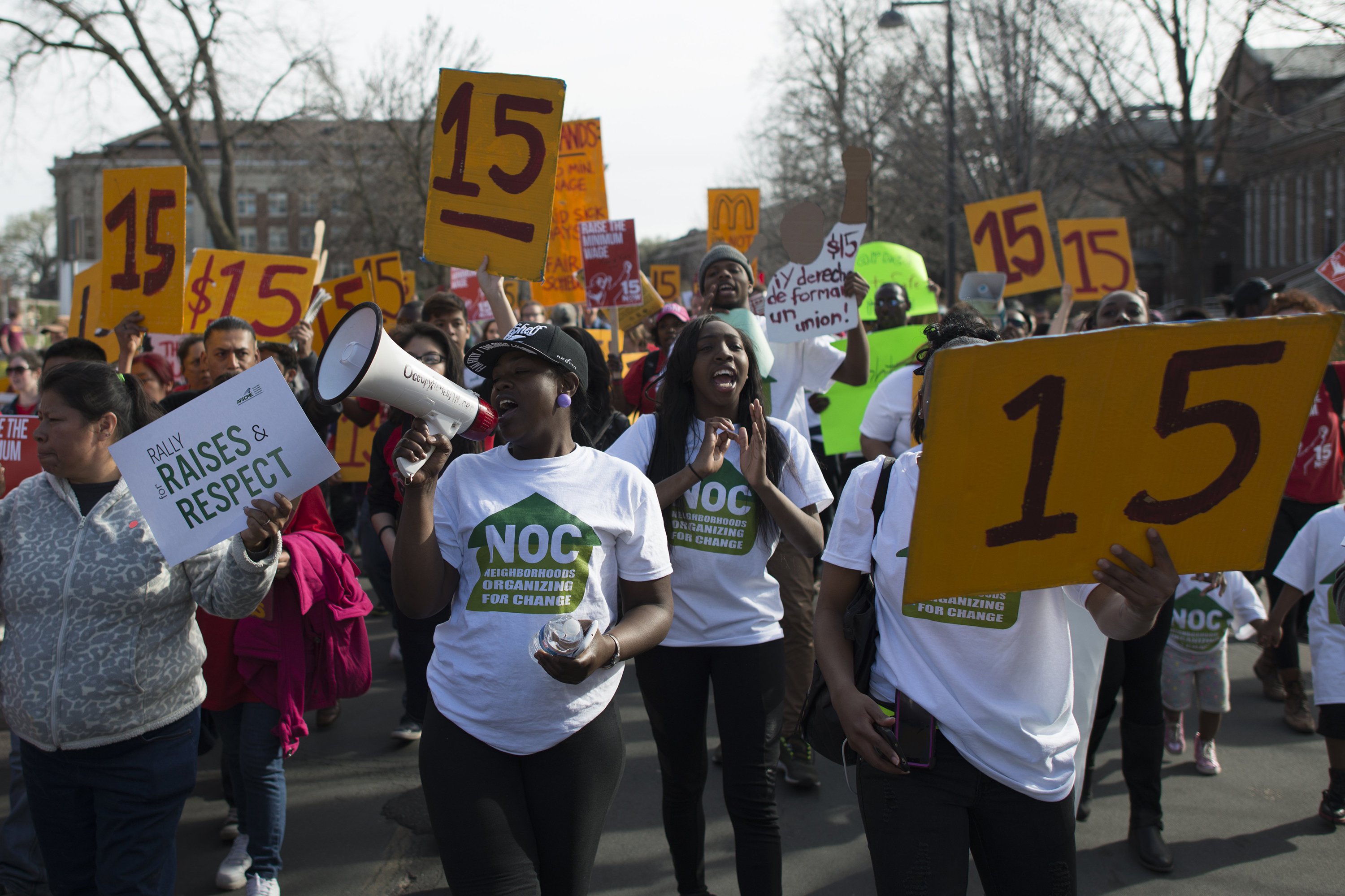
Much of the fight against preemption involves a fairly narrow set of elites: interest groups, city officials, formally organized social movement organizations, and so on. But it can also be valuable to educate the general public about preemption. In the experience of local democracy advocates, preemption is rarely an issue that voters care about as an end in itself. Very few people have strongly held beliefs about abstract home rule or the proper balance between local, state, and federal government powers. But local democracy advocates have found ways to communicate about preemption and local democracy that connect with rank-and-file voters.
First, advocates educate voters about the real-world consequences of preemption for policies and people that they already care about. For example, the Working Texans for Paid Sick Time coalition has stressed that preemption would take away earned paid sick time from hundreds of thousands of working people in Dallas, San Antonio, and Austin. Even for more politically informed activists, opposition to preemption generally develops through concerns about its impact, not through a pre-existing commitment to a certain view of intergovernmental relations. Hence, groups like Partnership for Working Families have gone to great lengths to educate their partners about how preemption threatens economic, racial, and gender equity, and the American Heart Association has done the same for health equity.
Second, local democracy advocates stress that preemption is a disruption of democratic norms, just like voter suppression or restricting access to the ballot. Like Voter ID, preemption works to restrict the number and type of people whose voices are being heard. In particular, the new preemption silences the voices of people of color, working-class people, and LGBTQ+ people and their allies. State interference also nullifies the results of local elections, and it even threatens the ability of localities to administer their own elections, as when the Arizona Legislature preempted Tempe’s ordinance regulating dark money in local politics.
Third, local democracy advocates have exposed the villain: the corporate interests behind preemption. The new preemption is often used by business interests to overturn policies with bipartisan popularity, like paid sick time or regulation of the payday loan industry. It is easier to engage voters in the preemption issue when it is connected to the bigger fight of ordinary people versus corporate power and ideological extremists.
Fourth, advocates are learning to articulate the values at stake in preemption. Though preemption is not an issue that inspires rank-and-file conservatives, Republican politicians and interest groups have worked to frame state interference as the protection of individual rights and liberties against oppressive, big-city liberalism. Opponents of state interference have found it essential to articulate the values at stake in local democracy, which include responsive government that is closest to people’s everyday problems and greater opportunity for grassroots participation. Preemption also thwarts democratic norms of equal representation and majority rule, since it takes power away from the majority of Americans who live in cities. For ideological liberals, opposing preemption might first require re-examining a historical assumption that higher levels of government are always superior to local government. Heather Gerken has advocated for a progressive federalism that embraces local democracy and recognizes the need for cooperation between local, state, and federal government to administer social policy.69
Going public also opens up new opportunities for local public officials who face steep odds in opposing state interference through the courts. Lori Riverstone-Newell describes a turn toward activism among local governments in response to growing state interference.70 While local public officials have historically interacted with the state government as “insiders,” many have started behaving more like social movement “outsiders”: going public with their grievances against the state or federal government instead of operating within the button-down norms of intergovernmental relations. For local officials, standing up against state or federal power may not put them on strong legal footing, but it offers the opportunity to try their case in the court of public opinion. This approach was exemplified by former San Francisco Mayor Gavin Newsom in 2004, when he directed the city-county clerk to issue marriage licenses to same-sex couples. Though this move was on shaky legal footing, the dramatic story of couples getting married arguably shaped the public debate about marriage equality in ways that laid the groundwork for future legal and political victories, including the Obergefell vs. Hodges Supreme Court ruling that legalized same-sex marriage in 2015.
5. Engage Voters to Hold Elected Officials Accountable or Use the Ballot Initiative Process
One extension of going public is bringing preemption into elections. In all states, voters can hold their state legislators accountable for using preemption to kill unpopular local policies like paid sick time. In some states, voters also have the power to repeal preemption or pass statewide policies through ballot initiatives.
Although preemption is not by itself a salient issue for any meaningful segment of voters, there are examples of legislators having to answer for state interference on the campaign trail. For example, Texas House Representative Paul Workman (R-District 47) positioned himself as a leading opponent of paid sick time in Austin, and boasted in 2018 that he would champion a preemption bill in the 2019 Legislative Session. Workman’s opposition to paid sick time won him statewide media attention, but it also drew attention from the Austin labor groups who had championed paid sick time, like the Workers Defense Project. Workers Defense Action Fund PAC then made Workman’s threat to preempt paid sick time into an election issue through paid advertising and door-to-door canvassing. In November 2018, Workman lost his seat to a Democrat—likely cooling the enthusiasm of some Republican representatives to preempt paid sick time in the 2019 legislative session. Workman was not the first Texas legislator to fall over preemption; Texas House Representative Kenneth Sheets (R-Dist. 107) similarly lost to Victoria Neave (D-Dist. 107) in 2016 after trying to preempt construction labor protections, making him a target for labor groups.
Advocates have also used social media to engage voters around preemption during the election season. For example, in September and October 2018, the Local Solutions Support Center facilitated two parallel digital advertising efforts in Minnesota and Missouri—with TakeAction Minnesota and Missouri Jobs with Justice.
Although an untested tactic, it is also conceivable that advocates for local democracy might intervene in state supreme court races in states where judges are elected rather than appointed. In many states, the same special interests pushing preemption are also active in the appointment or election of state supreme court justices.
6. Reform Home Rule
The last frontier for local democracy advocates is to reform home rule itself: to amend state constitutions, clarify their interpretation, or create new laws that renegotiate the relationship between states and cities for a new era. West Virginia is a recent success story that shows how home rule can even be reformed in more conservative environments. In March 2019, the West Virginia Municipal League celebrated a new law that established a permanent home rule program, creating a path for more cities to join the 34 out of 231 West Virginia cities that operate under home rule. Though the governorship, state house, and state senate of West Virginia are controlled by Republicans, the state was able to rise above partisan polarization to create a better working relationship between states and cities. In most states, home rule reform is still at a conceptual stage, since state constitutions and intergovernmental relations have been neglected areas of law. A small but growing community of legal experts is beginning to sketch out what home rule reform could and should look like in different states, focusing on affirming broad initiative authority for local governments, enhancing local fiscal stability, protecting local officials in their governance duties, and establishing a higher threshold for states to displace local democracy.
Ultimately, rebuilding a sustainable working relationship between state and local government is an important part of renewing American democratic institutions that deserves broader attention.
Citations
- Richard Briffault et al., “The Troubling Turn in State Preemption: The Assault on Progressive Cities and How Cities Can Respond,” American Constitution Society for Law and Policy, ACS Issue Briefs, no. 3 (September 2017): 20.
- Keith Anderson, “Take Two: Alabama’s City Versus State Minimum Wage Dispute to Get Full Appellate Review,” Lexology, February 12, 2019, https://www.lexology.com/library/detail.aspx?g=e9616c3f-d33a-4c51-8dbd-4d3856f99b4a.
- “Local Authority to Regulate Firearms in Florida,” Giffords Law Center to Prevent Gun Violence (blog), September 17, 2018, https://lawcenter.giffords.org/local-authority-to-regulate-firearms-in-florida/.
- Author interview with Kim Haddow, May 22, 2019.
- Heather Appel, “State Interference Prevents Gender and Racial Equality,” Press release (The Partnership For Working Families, May 7, 2019), http://www.forworkingfamilies.org/article/state-interference-prevents-gender-and-racial-equality.
- Author observation during Texas Legislative Session
- Kriston Capps, “Florida’s ‘Super Preemption’ Law Lands a Mayor in Court,” City Lab, January 6, 2017, http://www.citylab.com/politics/2017/01/a-florida-mayor-fights-the-gun-lobby/512345/.
- Gerken, “Distinguished Scholar in Residence Lecture: A User’s Guide to Progressive Federalism.”
- Riverstone-Newell, “Rise of State Preemption.”