Challenges and Strategies for Accurate Identification
IDEA mandates that states identify all children with disabilities who qualify for additional supports and services, including English learner (EL) students. However, identifying ELs with disabilities accurately and reliably has proven difficult within PreK–12 education systems. Often, educators overlook or discount the presence of a disability, believing that issues stem from a student’s limited English skills. Other times, the opposite occurs: educators falsely conclude that difficulties in language learning indicate a need for special education.
In part, complications result from the fact that several features of language learning mimic those associated with certain disabilities. For example, as highlighted by the U.S. Department of Education’s English Learner Tool Kit, ambiguous learning behaviors for EL students may include: delays or no response to questions and directions from a teacher; the inability to decode English words correctly when reading; spelling words incorrectly and sequencing them out of order within sentences; difficulty completing word problems in math; and appearing inattentive, easily distracted, or unmotivated (in the context of a curriculum delivered only in English).34
The root cause of these and other behaviors may validly reflect language development, disability, some combination of the two, or other factors.35 Therefore, correctly identifying EL students for special education presents an ongoing challenge for school systems needing to make determinations carefully and consistently.
A Two-Pronged Issue: Trends of Under- and Over-Identification
Schools across the nation both over- and under-identify ELs with disabilities, as emphasized in a recent consensus report on ELs by the National Academies of Sciences, Engineering, and Medicine.36 Overall, at the national level, EL students are underrepresented in special education.37 But looking deeper, other trends appear.
First, the data indicate a high degree of state and district variability. For example, in contrast to the national pattern, some states with the largest EL populations—such as Nevada, New Mexico, New York, and California—have historically over-identified ELs students for special education.38 In California, ELs make up around 23 percent of the total student population but represent 31 percent of students with disabilities.39 And yet, researchers have found ELs to be both over- and under-represented by district, grade level, and by EL status when they first enter school.40
Second, trends in identification vary by age or grade level. In the years before third grade, ELs are generally under-identified. By the secondary school years, however, ELs tend to be over-identified in special education.41 For instance, in grades 6 through 12, ELs are more than 3.5 times more likely to qualify for special education than non-EL peers. While this could be the result of ineffective EL instruction in earlier grades, it likely reflects variation in how and when ELs are reclassified as English proficient. 42
Most notably, school systems over- and under-identify students based on the type of disability. For instance, the most common category for all students with IEPs is specific learning disability (SLD), which covers 34 percent of students who qualify for special education services.43 Speech/language impairment is second at 19 percent.
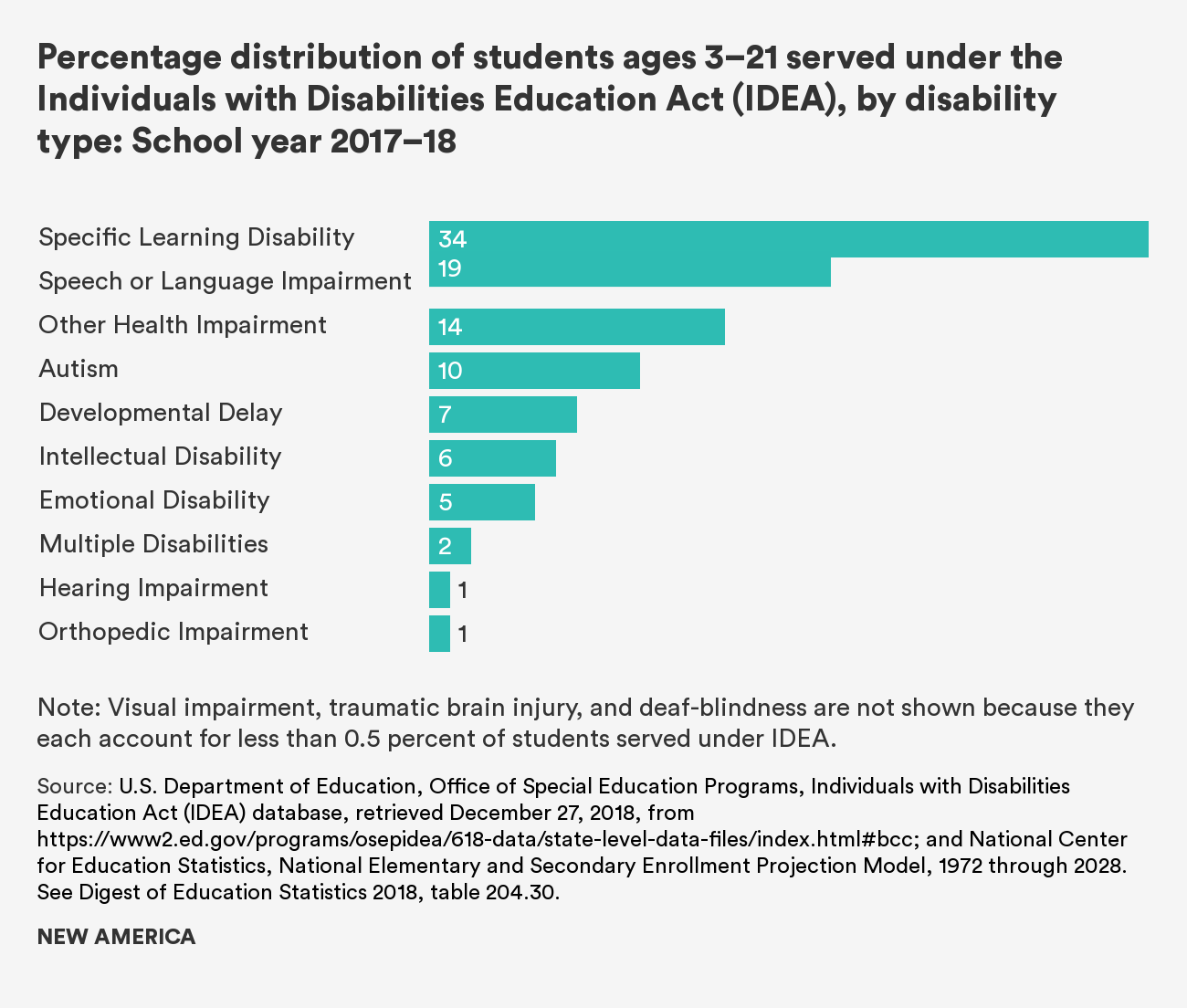
SLD is defined under IDEA as “a disorder in one or more of the basic psychological processes involved in understanding or in using language that is spoken or written, that may manifest itself in the imperfect ability to listen, think, speak, read, write, spell, or to do mathematical calculations.”44 The category includes a range of “perceptual disabilities,” including dyslexia, dyscalculia, and dysgraphia.
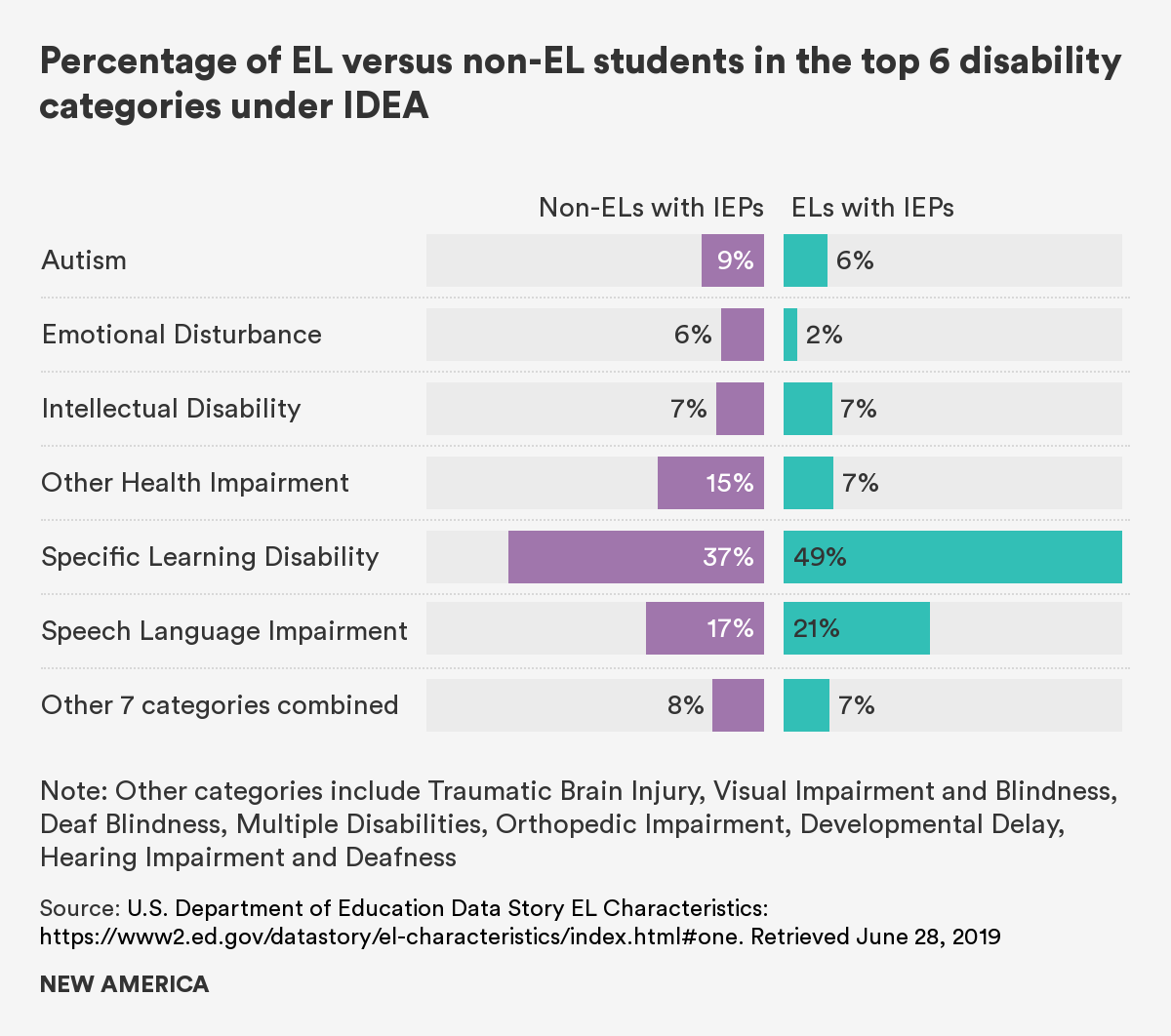
National research indicates that the categories of SLD and hearing impairment have higher proportions of students also identified as ELs, while other disability categories such as autism and emotional disability have lower proportions of students who are also identified as ELs.45 According to the U.S. Department of Education, "Among ELs with disabilities, nearly 50 percent had a specific learning disability, compared to nearly 38 percent of students with disabilities who are not ELs. Similarly, 21 percent of ELs with a disability, compared to 17 percent of non-ELs with a disability, were identified as having a speech or language impairment."46
Certain parameters around eligibility also impact trends of over- and under-identification. For example, IDEA includes a special rule referred to as the “Exclusionary Clause,” which stipulates that children cannot be deemed eligible for special education services if limited English proficiency is “the determinant factor” impacting such a decision.47 IDEA further excludes eligibility from the specific learning disability category if the disability results from “visual, hearing or motor disabilities”; “mental retardation”; “emotional disturbance”; or “environmental, cultural, or economic disadvantage.” These factors must be ruled out as the primary cause of a student’s academic and learning difficulties to determine and maintain eligibility for special education services. The underlying principle is that a child should not be regarded as having a disability if (1) he or she has not been given sufficient and appropriate learning opportunities, or (2) the child’s academic struggles are primarily due to other factors. However, while intended to protect ELs from inappropriate over-identification, these exclusionary clauses can lead to confusion and improper diagnosis.48 There is, for example, no shared definition of what it means for a child to be “environmentally or culturally” disadvantaged.49 The ambiguity of these clauses further contributes to inconsistent identification patterns overall.
This dual nature of misidentification—the risk of over- or under-representing ELs—is important to remember when analyzing data and monitoring representation, which IDEA requires states and the federal government to do. For example, the U.S. Department of Education recently led a multiyear analysis of special education representation, but only flagged measures of overrepresentation (i.e., districts with risk ratios above the national median). 50 By omitting measures of underrepresentation, the analysis obscures the extent of misidentification for ELs.

Citations
- “Chapter 6: Tools and Resources for Addressing English Learners with Disabilities,” in The English Learner Toolkit (Washington, DC: U.S. Department of Education, 2015), 6–10.
- “Chapter 6: Tools and Resources for Addressing English Learners with Disabilities,” 2; and Elizabeth Burr, Eric Haas, and Karen Ferriere, Identifying and Supporting English Learner Students with Learning Disabilities: Key Issues in the Literature and State Practice (Washington, DC: U.S. Department of Education, Institute of Education Sciences, July 2015).
- Takanishi and Menestrel, “Dual Language Learners and English Learners with Disabilities,” in Promoting the Educational Success of Children and Youth, 359.
- Takanishi and Menestrel, 362.
- Takanishi and Menestrel, 371; and Identifying ELLs with Specific Learning Disabilities: Facts, Advice, and Resources for School Teams (Madison: WIDA, Wisconsin Center for Education Research, May 2017).
- English Learners and Students from Low-Income Families (Washington, DC: National Council on Disability, February 7, 2018), 20.
- Ilana M. Umansky, Karen D. Thompson, and Guadalupe Díaz, “Using an Ever-EL Framework to Examine Special Education Disproportionality Among English Learner Students,” Exceptional Children, 84, no.1 (2017): 76–96. Also see Alfredo J. Artiles, Robert Rueda, Jesús José Salazar, and Ignacio Higareda, “Within-Group Diversity in Minority Disproportionate Representation: English Language Learners in Urban School Districts,” Council for Exceptional Children 71, no. 3 (Spring 2005): 283–300.
- Takanishi and Menestrel, “Dual Language Learners and English Learners with Disabilities,” in Promoting the Educational Success of Children and Youth, 362.
- For more about why ELs may be under-represented in early years and over-represented in later years, see Ilana M. Umansky, Karen D. Thompson, and Guadalupe Díaz, “Using an Ever-EL Framework to Examine Special Education Disproportionality among English Learner Students,”Exceptional Children, 84, no.1 (2017): 76–96. https://files.eric.ed.gov/fulltext/EJ1158181.pdf.
- U.S. Department of Education, National Center for Education Statistics, Digest of Education Statistics 2018, Table 204.30, https://nces.ed.gov/programs/digest/d18/tables/dt18_204.30.asp; The National Council on Learning Disabilities has a host of accessible resources on SLD and other learning and attention issues at its site Understood.org.
- See IDEA Sec 300.8 https://sites.ed.gov/idea/regs/b/a/300.8/c/10
- English Learners and Students from Low-Income Families, 17.
- U.S. Department of Education, "Number and percent of children ages 3 through 5 and students ages 6 through 21 served under IDEA, Part B, by LEP status and state," 2014–15. https://www2.ed.gov/datastory/el-characteristics/index.html#one.
- See 20 U.S. Code § 1414, Evaluations, eligibility determinations, individualized education programs, and educational placements, https://www.law.cornell.edu/uscode/text/20/1414
- Takanishi and Menestrel, “Dual Language Learners and English Learners with Disabilities,” in Promoting the Educational Success of Children and Youth, 364.
- Experts also question whether a disability can be entirely disassociated from these factors. See, for example, James E. Ryan, “Poverty as Disability and the Future of Special Education Law,” Georgetown Law Journal 101 (2013), https://papers.ssrn.com/sol3/papers.cfm?abstract_id=2152557
- Takanishi and Menestrel, “Dual Language Learners and English Learners with Disabilities,” in Promoting the Educational Success of Children and Youth, 363.