A Chapter of: How Raqqa Became the Capital of ISIS
Raqqa’s Reluctant Revolution (March 2011-March 2013)
Raqqa at the Outset of the Revolution
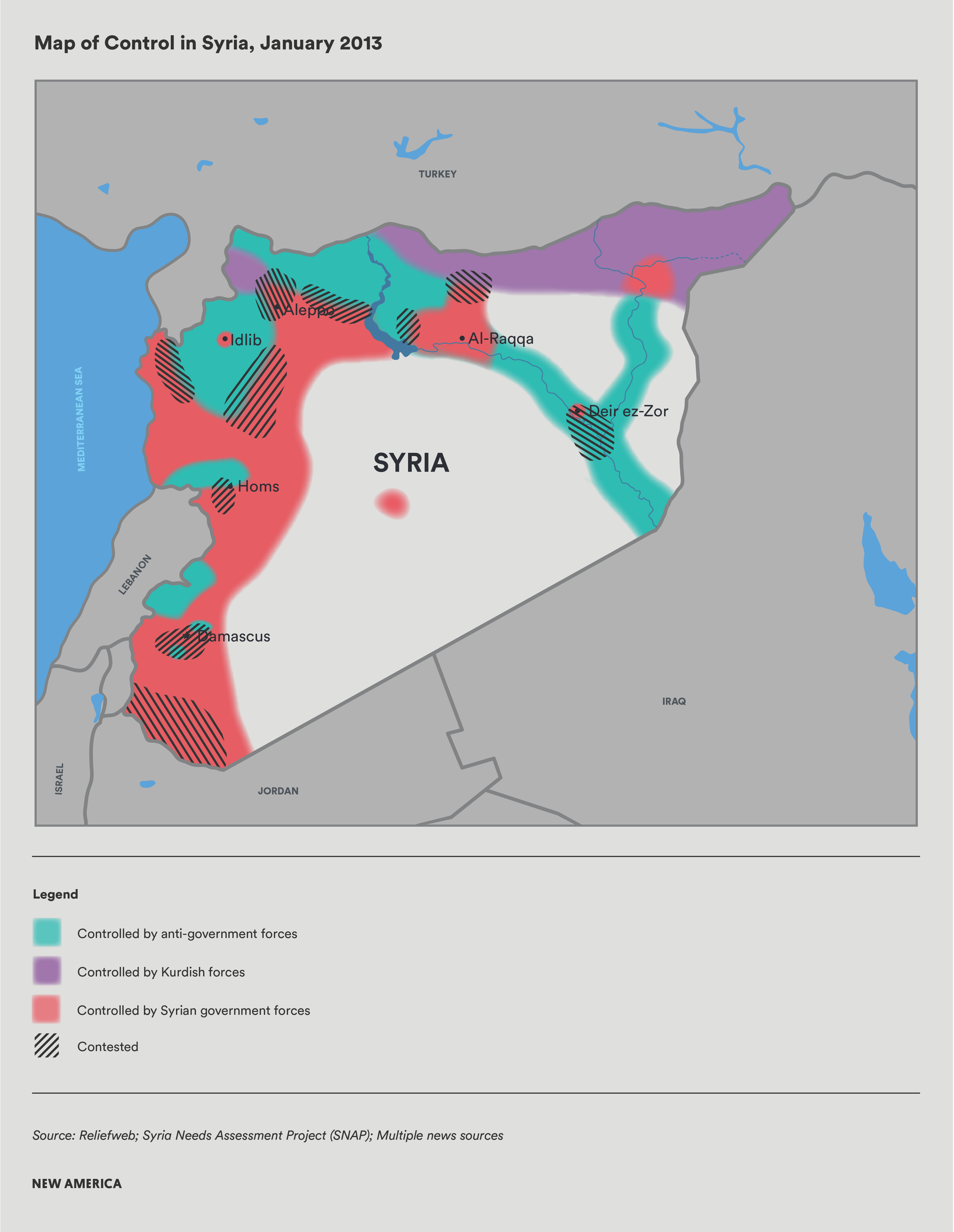
For nearly the first year of Syria’s uprising, Raqqa was thought of as too loyal to the regime to be a locus of opposition support. But it would turn out that the regime had invested only in the political quiescence of Raqqawis (residents of Raqqa), not their active military or political support. The tribes of Raqqa could tamp down dissent in peacetime, but were not ready to fight for the regime when Syrian opposition forces bore down on the city in early 2013. The Assad government took its control of Raqqa for granted because the city was peripheral to the regime’s core interests: at the time, SARG forces were busy fighting on far more important fronts in Damascus and Aleppo. The Syrian regime had neither the attention nor the resources to bolster its defenses in March 2013. The same tribes that had pledged allegiance to President Bashar al-Assad in person eight months after the revolution began in March 2011 did little to stop opposition militias from capturing their city.7 Raqqa City fell in a matter of days in March 2013.8
In November 2011, eight months after demonstrations started against the Syrian regime, President Bashar al-Assad still felt comfortable enough among Raqqawis to celebrate the Eid al-Adha festival with them.9 Assad led the Eid prayer, then listened to a sermon by Sheikh Abdul Azim Shekho at Raqqa’s Rehab al-Nour mosque. Shekho delivered a political sermon exhorting Assad and the people of Syria to resist the same international intervention that had “destroyed” Iraq, “burned” Libya, and split Sudan into two states. He then turned to Assad: “The secret is to go forward with all the people behind you,” he urged. “God will guide your footsteps.”10 Shekho, a Sufi, would be murdered by ISIS in Raqqa two and a half years after those remarks.11
Following Imam Shekho’s sermon, Assad spent an hour in the mosque shaking hands with local notables and receiving sometimes comically embellished pledges of support from the sheikhs of the area’s fourteen major clans.12 These sheikhs were justifiably excited. Besides meeting Assad (likely for the first time), they were paid 3-5 million Syrian liras ($60,000-100,000) each, depending on the size of their tribe.13 This payoff would be enough for the Syrian government to buy passive support but was insufficient to earn local loyalty in the face of an imminent takeover by opposition forces. (These same tribes would quickly “flip,” pledging allegiance to ISIS in another contrived ceremony two years later,14 this time receiving $5,000-10,000 in exchange for similar promises of loyalty.)15 Afterwards, Assad walked into the wide boulevard fronting the mosque, shaking hands with the crowd that had gathered out front. SANA, the regime’s news agency, quoted Assad as saying he had “no choice left but to win every battle.”16 The war for Syria had already begun, but Raqqa was far from its frontlines.
The Battle for Raqqa: March 2013
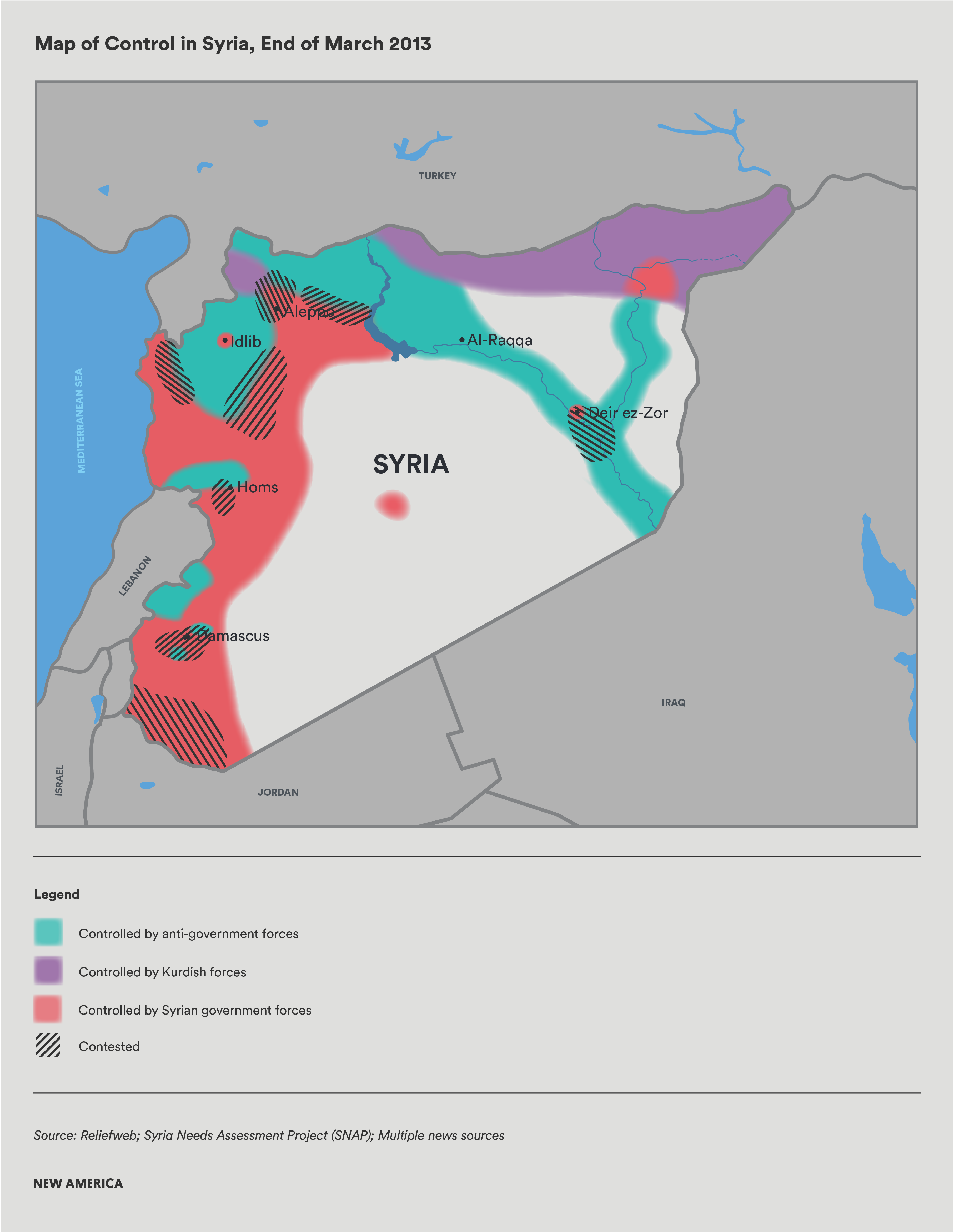
The Syrian armed opposition factions that captured Raqqa in March 2013 were splintered from the beginning. They had different sources of sponsorship and different geographic and ideological roots. Their battle for Syria’s sixth-largest city, although brief, epitomized their approach: opportunistic, uncoordinated, and ill-prepared. Ahrar al-Sham (AS) and Jabhat al-Nusrah (JAN) led the battle and were supported by two separate coalitions of small brigades. The first was a loose collection of militant Salafists and the second was an even more disparate hodgepodge of militias who were either independent, affiliated with the Muslim Brotherhood, or connected to the nominally secular Free Syrian Army’s (FSA) Supreme Military Council (SMC).17 These fighters approached from the city’s west and took Raqqa, then a city of about 220,000 people, over three days of fighting. AS captured government buildings as the city fell and, more or less by default, assumed the task of maintaining order.18
With battles raging on critical fronts like Damascus and Aleppo, the regime had neither the attention nor the resources to bolster its defenses in Raqqa by March 2013.
The war for Raqqa city ended quickly: SARG forces retreated from Raqqa to military bases and airfields outside the urban core, and the Syrian Observatory for Human Rights declared anti-Assad militants in complete control of the city on March 6, 2013.19 The Syrian government did not appear to want to fight for the city. This was a matter of prioritization on the part of Assad’s overstretched professional military: with battles raging on critical fronts like Damascus and Aleppo, the regime had neither the attention nor the resources to bolster its defenses in Raqqa by March 2013. Suddenly, a loose coalition of rebels had captured their first provincial capital. Taking refuge in Raqqa before its capture were hundreds of thousands20—possibly up to one million21—internally displaced persons (IDPs) from western Syria. That these refugees chose Raqqa indicated how few believed the city would fall to the opposition or would even be targeted in the fighting at all. Now that Raqqa had fallen, many displaced Syrians fled further east. Meanwhile, those who actively opposed Bashar al-Assad, in Raqqa and everywhere else, turned their eyes to the city to see what would happen next.
Citations
- In this paper, the use of the term “militia” carries no pejorative implication—it simply denotes a part-time, irregular military force, drawn from a local community (or part thereof) that operates mainly in its own area. Militias may or may not be ideologically motivated, and may or may not have links to external actors.
- Firas Al-Hikar, “Raqqa: Syria’s New Kandahar (Ar.),” Al-Akhbar, November 7, 2013, https://al-akhbar.com/Syria/60045.
- This trip to Raqqa was unusual—normally Assad observed the Eid al-Adha prayers in Damascus. “Protests, Gunfire in Syria as Eid Al-Adha Begins,” AP, November 6, 2011, https://www.ctvnews.ca/protests-gunfire-in-syria-as-eid-al-adha-begins-1.722106.
- “President Al-Assad Performs the Eid Al-Adha Prayer in Al-Nour Mosque in Al-Raqqa (Ar.),” SANA, November 7, 2011, https://web.archive.org/web/20111108235534/http://www.sana.sy:80/ara/2/2011/11/07/380162.htm.
- “Militant Groups Surveil Syrian Sufis, Accusing Them of Bias Against the Regime (Ar.),” Asharq Al-Aswat, January 6, 2014.
- The Events of the Eid Al-Adha Prayer Performed by President Bashar Al-Assad (Ar.), 2011, https://www.youtube.com/watch?v=CPgLh0--Atg.
- Ahmed Ibrahim, “The Clan between the Time of Assad and Daesh (Ar.),” Aljumhuriya, June 27, 2015, https://www.aljumhuriya.net/33481.
- Christoph Günther and Tom Kaden, “The Authority of the Islamic State,” Working Paper, Social Anthropology Working Papers (Munich: Max Planck Institute, 2016), https://www.eth.mpg.de/pubs/wps/pdf/mpi-eth-working-paper-0169.
- Ibrahim, “The Clan between the Time of Assad and Daesh (Ar.).”
- “President Al-Assad: Syria Strong Thanks to Its People, National Choices and Free Decision...Determined to Restore National Rights,” SANA, November 7, 2011, https://web.archive.org/web/20111108225430/https:/www.sana.sy/eng/337/2011/11/07/380231.htm.
- These two coalitions were: The Islamic Front for Unity and Liberation and the Front for the Liberation of Raqqa. Matthew Barber, “The Raqqa Story: Rebel Structure, Planning, and Possible War Crimes,” Syria Comment, April 4, 2013, https://www.joshualandis.com/blog/the-raqqa-story-rebel-structure-planning-and-possible-war-crimes/;Rania Abouzeid, “How Islamist Rebels in Syria Are Ruling a Fallen Provincial Capital,” Time, March 23, 2013, http://world.time.com/2013/03/23/how-islamist-rebels-in-syria-are-ruling-a-fallen-provincial-capital/#ixzz2OV67FjZE; Aymenn Jawad Al-Tamimi, “Liwa Thuwar Al-Raqqa: History, Analysis & Interview,” Syria Comment, September 14, 2015, https://www.joshualandis.com/blog/liwa-thuwar-al-raqqa-history-analysis-interview/.
- Abouzeid, “How Islamist Rebels in Syria Are Ruling a Fallen Provincial Capital.”
- “Syrian Activists Say Rebels Seize Security Buildings in Raqqa, Declare It 1st ‘Liberated’ City,” AP, March 6, 2013, https://www.foxnews.com/world/syrian-activists-say-rebels-seize-security-buildings-in-raqqa-declare-it-1st-liberated-city.
- Ziad Haydar, “Syria: Raqqa Lies in Ruins,” Al-Monitor, March 7, 2013, https://www.al-monitor.com/pulse/security/2013/03/raqqa-syria-destruction.html.
- Abouzeid, “How Islamist Rebels in Syria Are Ruling a Fallen Provincial Capital.”