A Chapter of: How Raqqa Became the Capital of ISIS
Executive Summary
Syria’s northern city of Raqqa served as the seat of power for the Islamic State of Iraq and al-Sham (ISIS) for four years, marking it as the center of one of the most bloody and complex proxy wars of the 21st century. During that time, multiple state sponsors, including Russia, Iran, Qatar, Saudi Arabia, Turkey, and the United States, lent support to armed groups seeking to wrest the ancient city from the Caliphate’s control. Yet, to understand the war against ISIS in Raqqa, one has to understand how ISIS came to control the city in the first place. In 2013, Raqqa changed hands three times: it was first controlled by forces loyal to Syrian President Bashar al-Assad, then it became the first provincial capital captured by the Syrian opposition, and finally, it was seized by ISIS, which made it the capital of their short-lived Caliphate. This dramatic year illustrates key elements of the complexity of Syria’s ongoing proxy conflict.
The opposition’s success in seizing Raqqa from Assad’s authoritarian regime offered the promise of democratic reform, but it also contained the seeds of its demise. Multiple local groups with different social bases, varied ties to transnational social movements, and shifting allegiances to external patrons struggled to govern Raqqa. Leaders wanted to make Raqqa, as the first liberated provincial capital in Syria, a model for the rest of the country, and some external patrons tried to establish a model for regional politics. However, competing sponsors and local armed groups were unable to work cooperatively, laying the ground work for the rise of ISIS in the city.
Data drawn from field research conducted in Syria from 2012 to 2015 indicates that Raqqa was vulnerable to ISIS in part because none of the local armed groups were able to offer adequate protection for civilians. And by the time these organizations tried to unify against ISIS, it was too late. The competing proxies and patrons gave ISIS an opportunity to divide and conquer the city.
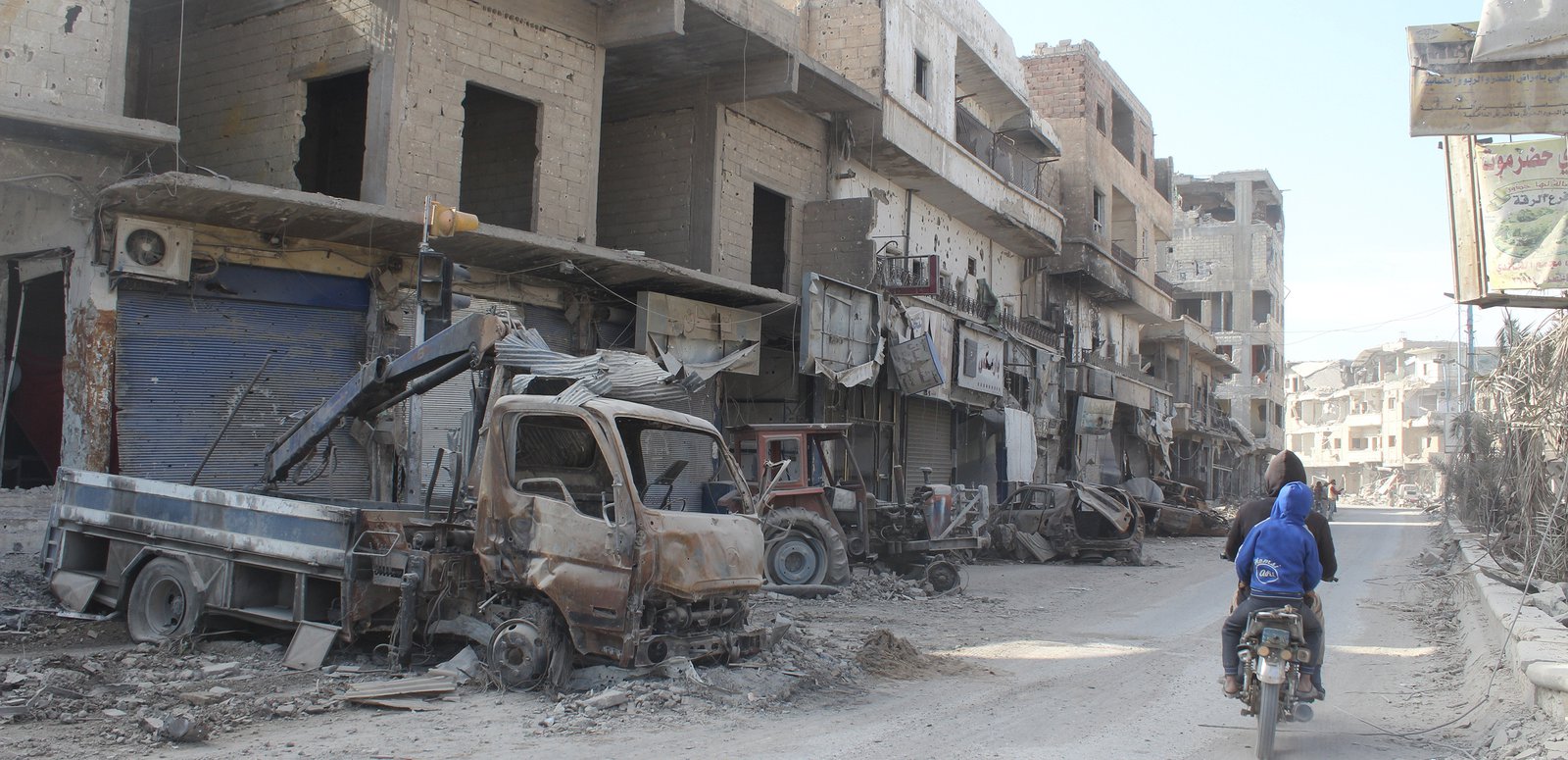
Many of the same conditions that made Raqqa vulnerable to an ISIS takeover in 2013 still exist in the city today. Governance is tentative and there are minimal basic security protections. Kidnapping for ransom, looting, and attacks are common across the city, and residents rarely know which groups are responsible for the violence.
Many of the same conditions that made Raqqa vulnerable to an ISIS takeover in 2013 still exist in the city today.
The battle for Raqqa represents how proxy competition shaped the war in Syria. It also illustrates the potential risks entailed in proxy strategies that fail to recognize the centrality of local governance to success.
Key Findings:
- Proxy warfare may be an effective method of seizing and holding territory in the short-term. But it faces substantial long-term challenges in stabilizing governance and security.
- In Raqqa, sponsors succeeded in supporting proxy forces’ efforts to seize the city from the Syrian government in March 2013. But competition between sponsors and poor coordination among local forces prevented these groups from consolidating their gains.
- In Raqqa, proxy forces turned out to be unreliable governors due to rivalries among the various sponsors, making their control over the city brittle and short-lived.
- Support for ISIS in Raqqa was based more on its ability to exploit the security vacuum created by the proxy war and broader civil war than its capacity to address local grievances.
- Initially, ISIS’ takeover of Raqqa coincided with a decline in the level of violence. The roots of this decline may have come from ISIS’ reliance on highly targeted violence, but it also may have been a product of a decline in Syrian government air strikes. Regardless of the cause, ISIS was able to use the relative quiet to bolster its claim to be able to provide security in contrast to its competition under the opposition.
- ISIS proved to be better at seizing territory where its opponents were weak than at governing that territory after it was captured.
- While in control of Raqqa, ISIS failed to effectively govern the city and deliver relief from oft-cited grievances. Instead, conditions in Raqqa deteriorated consistently following ISIS’ takeover, according to surveys.
- Perceptions of security among residents of Raqqa consistently declined under ISIS rule while remaining relatively stable in the rest of Syria over the same time period.
- Access to electricity declined under ISIS, with Raqqa residents going from having very good access to electricity compared to Syria overall to having similarly poor access.
- Always spotty across Syria, access to bread declined in Raqqa under ISIS rule. This occurred despite Raqqa being the traditional breadbasket for Syria—providing food not just for its own residents but for all Syrians.
- ISIS captured Raqqa with a pre-planned strategy predicated on dividing and conquering local competitors. This is now part of ISIS’ institutional memory and could re-emerge under present conditions in Raqqa and eastern Syria.
- ISIS carefully mapped local social networks using individualized targeted violence to prevent opponents from unifying. Once opponents were isolated, ISIS could defeat them one by one.
- Security and governance vacuums remain a challenge today in Raqqa despite the group’s loss of the city to U.S.-backed Syrian Democratic Forces (SDF). Should the SDF leave Raqqa abruptly, ISIS could re-deploy the strategy it used to capture Raqqa in 2013.