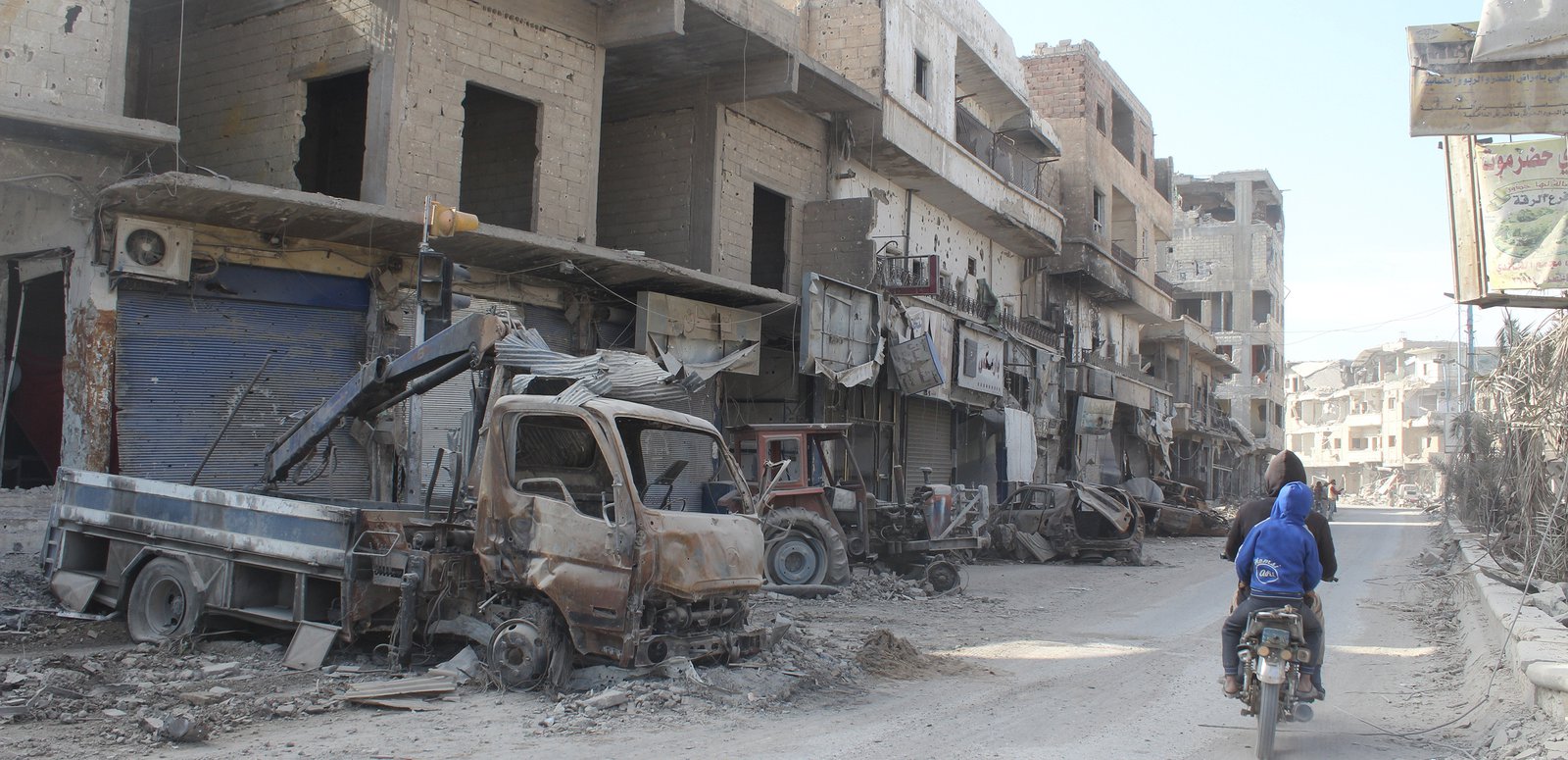
How Raqqa Became the Capital of ISIS
Abstract
This research paper is the product of a joint New America and ASU Center on the Future of War initiative.
Syria’s northern city of Raqqa served as the seat of power for the Islamic State of Iraq and al-Sham (ISIS) for four years, marking it as the center of one of the most bloody and complex proxy wars of the 21st century. During that time, multiple state sponsors, including Russia, Iran, Qatar, Saudi Arabia, Turkey, and the United States, lent support to armed groups seeking to wrest the ancient city from the Caliphate’s control.
Yet, to understand the war against ISIS in Raqqa, one has to understand how ISIS came to control the city in the first place. Based on field observations and hundreds of interviews conducted, we describe how Raqqa changed hands three times in 2013. First, it was controlled by forces loyal to Syrian President Bashar al-Assad, then it became the first provincial capital captured by the Syrian opposition, and finally, it was seized by ISIS, which made it the capital of their short-lived Caliphate. This dramatic year illustrates key elements of the complexity of Syria’s ongoing proxy conflict.
Many of the same conditions that made Raqqa vulnerable to an ISIS takeover in 2013 still exist in the city today. Governance is tentative and there are minimal basic security protections. Kidnapping for ransom, looting, and attacks are common across the city, and residents rarely know which groups are responsible for the violence. The battle for Raqqa represents how proxy competition shaped the war in Syria. It also illustrates the potential risks entailed in proxy strategies that fail to recognize the centrality of local governance to success.
Acknowledgments
The author's first debt of gratitude is to those Syrians who supported this research but must remain anonymous for security reasons. As Aleksandr Solzhenitsyn once wrote, “may they please forgive me for not having seen it all nor remembered it all, for not having divined all of it.” The authors would also like to thank everyone at Caerus Associates who helped design, manage, and analyze the research cited in this paper. Finally, the authors would like to thank David Sterman, Candace Rondeaux, Daniel Rothenberg, and two reviewers of this paper, Abdalaziz Hamza and Anand Gopal, for their excellent improvements. Any remaining errors are the fault of the authors alone.
Downloads
Executive Summary
Syria’s northern city of Raqqa served as the seat of power for the Islamic State of Iraq and al-Sham (ISIS) for four years, marking it as the center of one of the most bloody and complex proxy wars of the 21st century. During that time, multiple state sponsors, including Russia, Iran, Qatar, Saudi Arabia, Turkey, and the United States, lent support to armed groups seeking to wrest the ancient city from the Caliphate’s control. Yet, to understand the war against ISIS in Raqqa, one has to understand how ISIS came to control the city in the first place. In 2013, Raqqa changed hands three times: it was first controlled by forces loyal to Syrian President Bashar al-Assad, then it became the first provincial capital captured by the Syrian opposition, and finally, it was seized by ISIS, which made it the capital of their short-lived Caliphate. This dramatic year illustrates key elements of the complexity of Syria’s ongoing proxy conflict.
The opposition’s success in seizing Raqqa from Assad’s authoritarian regime offered the promise of democratic reform, but it also contained the seeds of its demise. Multiple local groups with different social bases, varied ties to transnational social movements, and shifting allegiances to external patrons struggled to govern Raqqa. Leaders wanted to make Raqqa, as the first liberated provincial capital in Syria, a model for the rest of the country, and some external patrons tried to establish a model for regional politics. However, competing sponsors and local armed groups were unable to work cooperatively, laying the ground work for the rise of ISIS in the city.
Data drawn from field research conducted in Syria from 2012 to 2015 indicates that Raqqa was vulnerable to ISIS in part because none of the local armed groups were able to offer adequate protection for civilians. And by the time these organizations tried to unify against ISIS, it was too late. The competing proxies and patrons gave ISIS an opportunity to divide and conquer the city.
Many of the same conditions that made Raqqa vulnerable to an ISIS takeover in 2013 still exist in the city today. Governance is tentative and there are minimal basic security protections. Kidnapping for ransom, looting, and attacks are common across the city, and residents rarely know which groups are responsible for the violence.
Many of the same conditions that made Raqqa vulnerable to an ISIS takeover in 2013 still exist in the city today.
The battle for Raqqa represents how proxy competition shaped the war in Syria. It also illustrates the potential risks entailed in proxy strategies that fail to recognize the centrality of local governance to success.
Key Findings:
- Proxy warfare may be an effective method of seizing and holding territory in the short-term. But it faces substantial long-term challenges in stabilizing governance and security.
- In Raqqa, sponsors succeeded in supporting proxy forces’ efforts to seize the city from the Syrian government in March 2013. But competition between sponsors and poor coordination among local forces prevented these groups from consolidating their gains.
- In Raqqa, proxy forces turned out to be unreliable governors due to rivalries among the various sponsors, making their control over the city brittle and short-lived.
- Support for ISIS in Raqqa was based more on its ability to exploit the security vacuum created by the proxy war and broader civil war than its capacity to address local grievances.
- Initially, ISIS’ takeover of Raqqa coincided with a decline in the level of violence. The roots of this decline may have come from ISIS’ reliance on highly targeted violence, but it also may have been a product of a decline in Syrian government air strikes. Regardless of the cause, ISIS was able to use the relative quiet to bolster its claim to be able to provide security in contrast to its competition under the opposition.
- ISIS proved to be better at seizing territory where its opponents were weak than at governing that territory after it was captured.
- While in control of Raqqa, ISIS failed to effectively govern the city and deliver relief from oft-cited grievances. Instead, conditions in Raqqa deteriorated consistently following ISIS’ takeover, according to surveys.
- Perceptions of security among residents of Raqqa consistently declined under ISIS rule while remaining relatively stable in the rest of Syria over the same time period.
- Access to electricity declined under ISIS, with Raqqa residents going from having very good access to electricity compared to Syria overall to having similarly poor access.
- Always spotty across Syria, access to bread declined in Raqqa under ISIS rule. This occurred despite Raqqa being the traditional breadbasket for Syria—providing food not just for its own residents but for all Syrians.
- ISIS captured Raqqa with a pre-planned strategy predicated on dividing and conquering local competitors. This is now part of ISIS’ institutional memory and could re-emerge under present conditions in Raqqa and eastern Syria.
- ISIS carefully mapped local social networks using individualized targeted violence to prevent opponents from unifying. Once opponents were isolated, ISIS could defeat them one by one.
- Security and governance vacuums remain a challenge today in Raqqa despite the group’s loss of the city to U.S.-backed Syrian Democratic Forces (SDF). Should the SDF leave Raqqa abruptly, ISIS could re-deploy the strategy it used to capture Raqqa in 2013.
Introduction
On March 6, 2013, Syria’s armed opposition liberated the city of Raqqa from the Assad regime in a matter of days, taking control of what had been, before the war, Syria’s sixth-largest city. Raqqa was the first provincial capital to be seized from government control, and many observers initially saw its fall as a good omen for the opposition’s victory. But by November that year, Raqqa had fallen to the Islamic State of Iraq and al-Sham (ISIS) and would become the capital of the organization’s soon-to-be-declared Caliphate.1 It took four years and an international intervention for U.S.-backed Syrian Democratic Forces (SDF) to recapture the city.
In many ways, Raqqa was a microcosm of Syria’s war—both the initial promise and the tragic shortcomings of the country’s anti-Assad uprising were laid bare in the city. Violence and instability in Raqqa drove hundreds of thousands out of the urban center, shrinking the city’s estimated peak population of 500,000 inhabitants by 25 percent only a couple of years after ISIS took control.2 More broadly, what happened in Raqqa is an example of the consequences of 21st century proxy wars. The failure of the Syrian opposition—proxies of bitterly divided patrons of even more localized political forces—led to the rise of ISIS in the city.
The failure of the Syrian opposition—proxies of bitterly divided patrons of even more localized political forces—led to the rise of ISIS in the city.
Raqqa reveals flaws in the classic approach to understanding proxy warfare, which often takes as its starting point an analysis of how great powers create and support proxies in multiple locations on a global chess board. This Cold War era realist model insufficiently addresses the role played by transnational movements and the local and international social networks that support them.3 Some analysts have argued that the Syrian war not only stretches the bounds of traditional views of proxy warfare—given the range and complexity of principal sponsors and proxy agents involved—but also tests plausible deniability in the digital age and norms around the lethal use of force.4 These dynamics are far from restricted to Syria, although the country’s conflict is a central example of what early 21st century proxy warfare looks like.
As a way of making sense of some of this complexity, this paper will focus on describing in detail what happened in Raqqa. Despite the Syrian city’s importance, few have thus far studied it in depth, most likely because reporting from the city went from difficult to near impossible once it became the capital of ISIS. The group used brutal violence and extensive surveillance to restrict the flow of information. They intimidated the population and abducted or murdered journalists, but some braved these threats and reported on what happened to their city anyway. This paper is possible because of their work.
This study draws on data on economic conditions, population attitudes, and local atmospherics collected in Syria from 2012 to 2015, as well as information gathered through interviews and social media archives, to address the question of what happened in Raqqa. Research materials have been carefully anonymized and edited to remove any personally identifiable information. We supplement these data with interviews, conducted both by the authors and local researchers, to capture the experiences of those living in the city from 2011 to the present.5 We also compared results from these surveys conducted in Raqqa to surveys conducted in other parts of Syria during the timeframe of December 2013 to November 2014.6
The paper begins chronologically—by tracing the evolution of the conflict in the city in four phases—and concludes with analytic reflections on larger lessons drawn from the Raqqa case. The first section describes conditions in Raqqa at the start of the revolution, exploring how and why armed groups captured the city from Syrian Arab Republic Government (SARG) forces in March 2013. The second describes how the rebels struggled and eventually failed to coalesce into something powerful enough to resist the ISIS takeover of November 2013. The third examines ISIS governance, demonstrating that the group was not administering a complex state but rather was quite incompetent at governing. The fourth examines conditions in Raqqa after its recapture by the SDF, and finds that acute insecurity in the city continues, making it ripe for ISIS resurgence. The conclusion examines the relevance of Raqqa’s experiences for the understanding of the conflict in Syria as both a civil war and proxy war.
Citations
- This paper uses the name “Islamic State of Iraq and al-Sham” (ISIS) because ISIS was the name of the group during the period of greatest focus in this paper (2013). The group changed its name to the “Islamic State” (IS) in July 2014 after it captured Mosul in Iraq.
- Eric Robinson, Daniel Egel, et. al., “Raqqah Capital of the Caliphate,” in When ISIS Comes to Town, (Santa Monica, CA: RAND, 2017), https://www.rand.org/nsrd/projects/when-isil-comes-to-town/case-studies/raqqah.html.
- Candace Rondeaux and David Sterman, Twenty-First Century Proxy Warfare: Confronting Strategic Innovation in a Multipolar World, (Washington, D.C.: New America, 2019), https://www.newamerica.org/international-security/reports/twenty-first-century-proxy-warfare-confronting-strategic-innovation-multipolar-world/.
- R. Kim Cragin, “Semi-Proxy Wars and U.S. Counterterrorism Strategy,” Studies in Conflict & Terrorism 38, no. 5 (May 4, 2015): 311-27, https://doi.org/10.1080/1057610X.2015.1018024.
- Interviews conducted as part of the field research are referred to as “Caerus Interviews” while later interviews conducted by the authors of this paper are referenced as “Author’s Interviews.” Caerus interviews were conducted, whenever possible, in person in Raqqa from 2012-2015. These interviews ranged from semi-structured surveys collected in a snowball sampling method to fully structured surveys with subjects selected for diversity of gender and profession. Author’s interviews were conducted by the first author via Skype, and took place between January and June 2019.
- Surveys asked questions across Syria related to local conditions, such as perceptions of security and accessibility of basic goods and services. From December 2013 until November 2014, Caerus conducted 5,651 surveys in Raqqa, Damascus, Idlib, Hassakeh, Aleppo, Hama, Latakia, Dar'a, Deir Ezzor, Rif Damascus, and Homs. For the purposes of this paper, we compare survey results over this period in Raqqa (n=796) to the rest of Syria (n=4,855). While we did not survey each governorate previously listed across all four survey periods, each period included a sample of locations that reflected diverse conditions in Syria (i.e., opposition-controlled areas, SARG-controlled areas, contested or active conflict areas). This is why we believe it is reasonable to compare Raqqa to other places in Syria, despite the fact that the conflict was highly localized, and the locus of fighting shifted over the course of the war. Surveys were conducted by enumerators who selected respondents for each report through chain-referral sampling, modified to ensure minimum requirements for diversity in gender, socioeconomic status, and ethno-sectarian identities. Interviews were conducted in-person by local enumerators to ensure high-fidelity responses from interviewees.
Raqqa’s Reluctant Revolution (March 2011-March 2013)
Raqqa at the Outset of the Revolution
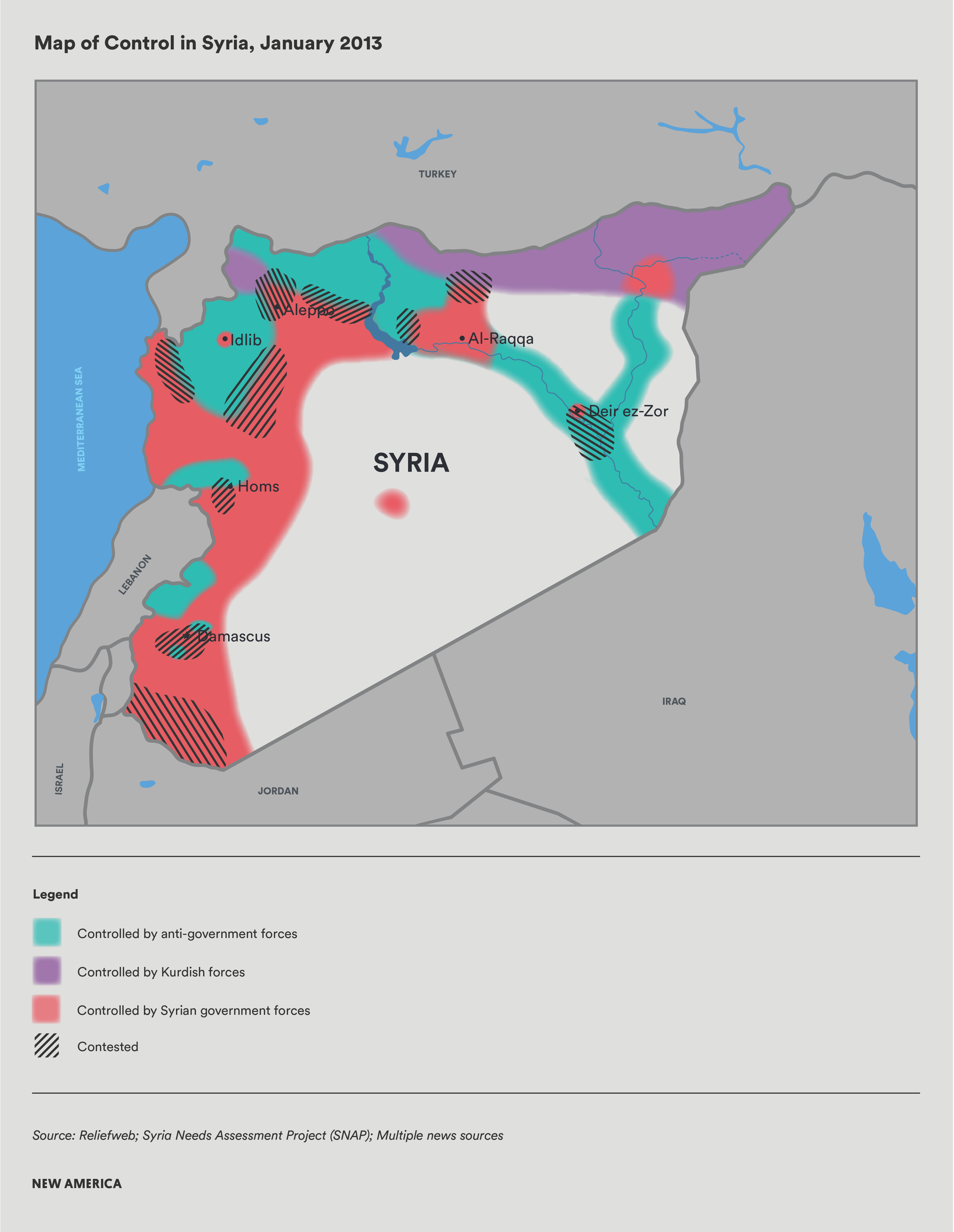
For nearly the first year of Syria’s uprising, Raqqa was thought of as too loyal to the regime to be a locus of opposition support. But it would turn out that the regime had invested only in the political quiescence of Raqqawis (residents of Raqqa), not their active military or political support. The tribes of Raqqa could tamp down dissent in peacetime, but were not ready to fight for the regime when Syrian opposition forces bore down on the city in early 2013. The Assad government took its control of Raqqa for granted because the city was peripheral to the regime’s core interests: at the time, SARG forces were busy fighting on far more important fronts in Damascus and Aleppo. The Syrian regime had neither the attention nor the resources to bolster its defenses in March 2013. The same tribes that had pledged allegiance to President Bashar al-Assad in person eight months after the revolution began in March 2011 did little to stop opposition militias from capturing their city.7 Raqqa City fell in a matter of days in March 2013.8
In November 2011, eight months after demonstrations started against the Syrian regime, President Bashar al-Assad still felt comfortable enough among Raqqawis to celebrate the Eid al-Adha festival with them.9 Assad led the Eid prayer, then listened to a sermon by Sheikh Abdul Azim Shekho at Raqqa’s Rehab al-Nour mosque. Shekho delivered a political sermon exhorting Assad and the people of Syria to resist the same international intervention that had “destroyed” Iraq, “burned” Libya, and split Sudan into two states. He then turned to Assad: “The secret is to go forward with all the people behind you,” he urged. “God will guide your footsteps.”10 Shekho, a Sufi, would be murdered by ISIS in Raqqa two and a half years after those remarks.11
Following Imam Shekho’s sermon, Assad spent an hour in the mosque shaking hands with local notables and receiving sometimes comically embellished pledges of support from the sheikhs of the area’s fourteen major clans.12 These sheikhs were justifiably excited. Besides meeting Assad (likely for the first time), they were paid 3-5 million Syrian liras ($60,000-100,000) each, depending on the size of their tribe.13 This payoff would be enough for the Syrian government to buy passive support but was insufficient to earn local loyalty in the face of an imminent takeover by opposition forces. (These same tribes would quickly “flip,” pledging allegiance to ISIS in another contrived ceremony two years later,14 this time receiving $5,000-10,000 in exchange for similar promises of loyalty.)15 Afterwards, Assad walked into the wide boulevard fronting the mosque, shaking hands with the crowd that had gathered out front. SANA, the regime’s news agency, quoted Assad as saying he had “no choice left but to win every battle.”16 The war for Syria had already begun, but Raqqa was far from its frontlines.
The Battle for Raqqa: March 2013
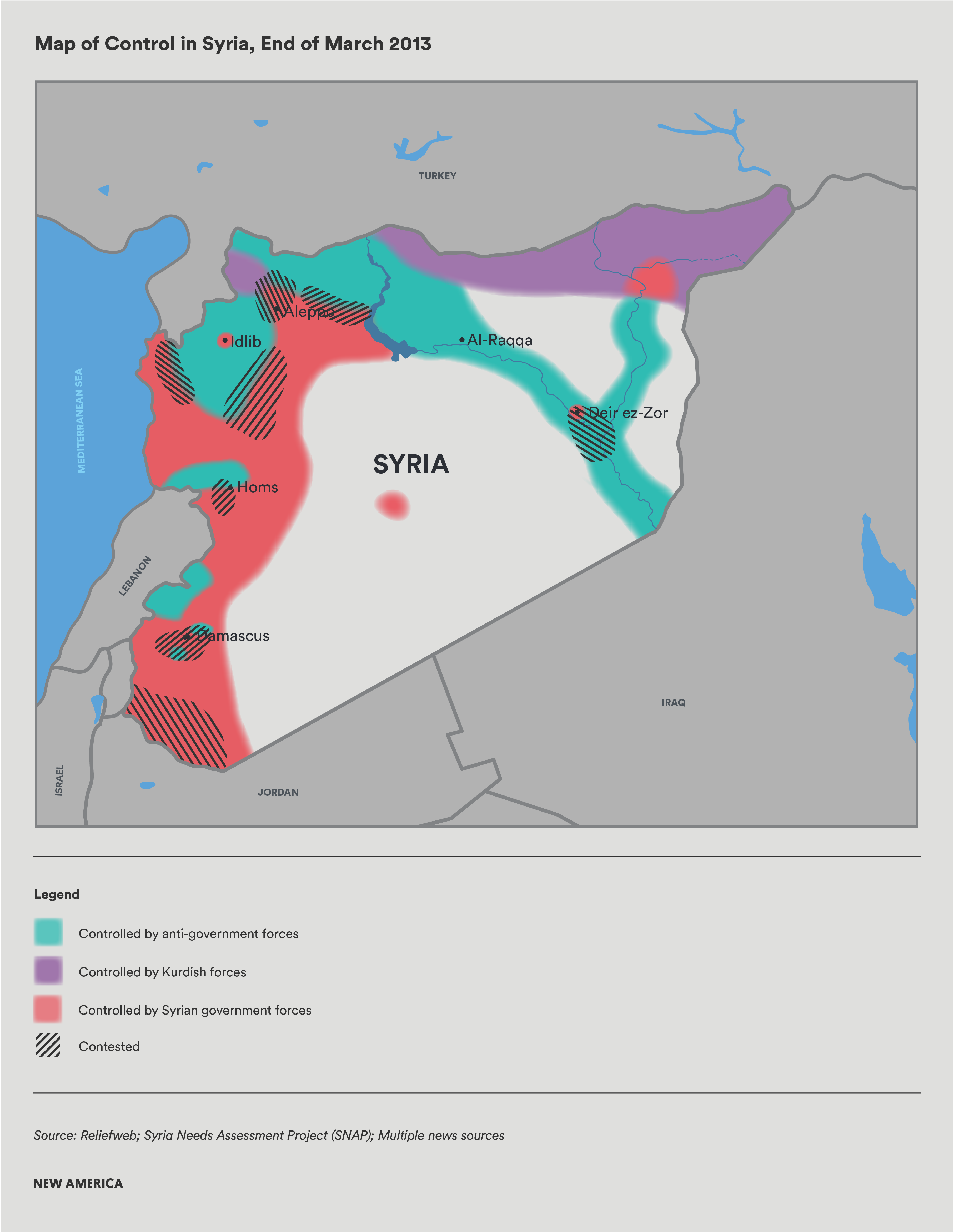
The Syrian armed opposition factions that captured Raqqa in March 2013 were splintered from the beginning. They had different sources of sponsorship and different geographic and ideological roots. Their battle for Syria’s sixth-largest city, although brief, epitomized their approach: opportunistic, uncoordinated, and ill-prepared. Ahrar al-Sham (AS) and Jabhat al-Nusrah (JAN) led the battle and were supported by two separate coalitions of small brigades. The first was a loose collection of militant Salafists and the second was an even more disparate hodgepodge of militias who were either independent, affiliated with the Muslim Brotherhood, or connected to the nominally secular Free Syrian Army’s (FSA) Supreme Military Council (SMC).17 These fighters approached from the city’s west and took Raqqa, then a city of about 220,000 people, over three days of fighting. AS captured government buildings as the city fell and, more or less by default, assumed the task of maintaining order.18
With battles raging on critical fronts like Damascus and Aleppo, the regime had neither the attention nor the resources to bolster its defenses in Raqqa by March 2013.
The war for Raqqa city ended quickly: SARG forces retreated from Raqqa to military bases and airfields outside the urban core, and the Syrian Observatory for Human Rights declared anti-Assad militants in complete control of the city on March 6, 2013.19 The Syrian government did not appear to want to fight for the city. This was a matter of prioritization on the part of Assad’s overstretched professional military: with battles raging on critical fronts like Damascus and Aleppo, the regime had neither the attention nor the resources to bolster its defenses in Raqqa by March 2013. Suddenly, a loose coalition of rebels had captured their first provincial capital. Taking refuge in Raqqa before its capture were hundreds of thousands20—possibly up to one million21—internally displaced persons (IDPs) from western Syria. That these refugees chose Raqqa indicated how few believed the city would fall to the opposition or would even be targeted in the fighting at all. Now that Raqqa had fallen, many displaced Syrians fled further east. Meanwhile, those who actively opposed Bashar al-Assad, in Raqqa and everywhere else, turned their eyes to the city to see what would happen next.
Citations
- In this paper, the use of the term “militia” carries no pejorative implication—it simply denotes a part-time, irregular military force, drawn from a local community (or part thereof) that operates mainly in its own area. Militias may or may not be ideologically motivated, and may or may not have links to external actors.
- Firas Al-Hikar, “Raqqa: Syria’s New Kandahar (Ar.),” Al-Akhbar, November 7, 2013, https://al-akhbar.com/Syria/60045.
- This trip to Raqqa was unusual—normally Assad observed the Eid al-Adha prayers in Damascus. “Protests, Gunfire in Syria as Eid Al-Adha Begins,” AP, November 6, 2011, https://www.ctvnews.ca/protests-gunfire-in-syria-as-eid-al-adha-begins-1.722106.
- “President Al-Assad Performs the Eid Al-Adha Prayer in Al-Nour Mosque in Al-Raqqa (Ar.),” SANA, November 7, 2011, https://web.archive.org/web/20111108235534/http://www.sana.sy:80/ara/2/2011/11/07/380162.htm.
- “Militant Groups Surveil Syrian Sufis, Accusing Them of Bias Against the Regime (Ar.),” Asharq Al-Aswat, January 6, 2014.
- The Events of the Eid Al-Adha Prayer Performed by President Bashar Al-Assad (Ar.), 2011, https://www.youtube.com/watch?v=CPgLh0--Atg.
- Ahmed Ibrahim, “The Clan between the Time of Assad and Daesh (Ar.),” Aljumhuriya, June 27, 2015, https://www.aljumhuriya.net/33481.
- Christoph Günther and Tom Kaden, “The Authority of the Islamic State,” Working Paper, Social Anthropology Working Papers (Munich: Max Planck Institute, 2016), https://www.eth.mpg.de/pubs/wps/pdf/mpi-eth-working-paper-0169.
- Ibrahim, “The Clan between the Time of Assad and Daesh (Ar.).”
- “President Al-Assad: Syria Strong Thanks to Its People, National Choices and Free Decision...Determined to Restore National Rights,” SANA, November 7, 2011, https://web.archive.org/web/20111108225430/https:/www.sana.sy/eng/337/2011/11/07/380231.htm.
- These two coalitions were: The Islamic Front for Unity and Liberation and the Front for the Liberation of Raqqa. Matthew Barber, “The Raqqa Story: Rebel Structure, Planning, and Possible War Crimes,” Syria Comment, April 4, 2013, https://www.joshualandis.com/blog/the-raqqa-story-rebel-structure-planning-and-possible-war-crimes/;Rania Abouzeid, “How Islamist Rebels in Syria Are Ruling a Fallen Provincial Capital,” Time, March 23, 2013, http://world.time.com/2013/03/23/how-islamist-rebels-in-syria-are-ruling-a-fallen-provincial-capital/#ixzz2OV67FjZE; Aymenn Jawad Al-Tamimi, “Liwa Thuwar Al-Raqqa: History, Analysis & Interview,” Syria Comment, September 14, 2015, https://www.joshualandis.com/blog/liwa-thuwar-al-raqqa-history-analysis-interview/.
- Abouzeid, “How Islamist Rebels in Syria Are Ruling a Fallen Provincial Capital.”
- “Syrian Activists Say Rebels Seize Security Buildings in Raqqa, Declare It 1st ‘Liberated’ City,” AP, March 6, 2013, https://www.foxnews.com/world/syrian-activists-say-rebels-seize-security-buildings-in-raqqa-declare-it-1st-liberated-city.
- Ziad Haydar, “Syria: Raqqa Lies in Ruins,” Al-Monitor, March 7, 2013, https://www.al-monitor.com/pulse/security/2013/03/raqqa-syria-destruction.html.
- Abouzeid, “How Islamist Rebels in Syria Are Ruling a Fallen Provincial Capital.”
Revolutionary Rule in Raqqa (March 2013-November 2013)
For a time, Raqqa represented all that was exhilarating about Syria’s revolution: governance in the city was so democratic that no one appeared to be the leader. The revolutionary environment—typical of newly liberated cities in civil war22—meant that anyone could, and initially did, have a say. But the same characteristics that gave the movement so much democratic promise also contained the seeds of its demise: since everyone was in charge, no one was. The range of actors with different social bases, ties to transnational social movements, and external patrons posed deep challenges as local groups grappled with the act of governing. Everyone wanted to make the first liberated provincial capital in Syria a model for the rest of the country, but neither those in Raqqa nor those who supported them from afar were able to work together to make this a reality. The consequences of that failure would be devastating.
Raqqa: A “Test Lab for the Revolution”
The spontaneity and democratic spirit that so excited Syrians who had previously lived under a totalitarian government, with its reliance on rigid control and brutal repression, inspired many to risk their lives to protest Assad. The mood in Raqqa at the time was optimistic, as was evident in discussions with locals: “We didn’t fight and protest Assad to then have these fanatics,” explained a secular activist, already aware of religious hardline militias. He continued, “one thing that keeps us activists hopeful is our society. Although Raqqa is a tribal area, people are open and tolerant. Even those who are a bit conservative, are very open-minded compared to Jabhat al-Nusrah or ISIS. So, our society will resist [their] imposed regime.”23
The militants who seized Raqqa seemed astounded at the speed of their own success. While they may have had some plans to capture the city, it did not appear that they had plans to govern it. Residents exhibited a certain “learned helplessness,” evident also in other places where people habituated by long exposure to authoritarian government expected the regime to decide the smallest issues, and where showing individual initiative had for decades been a great way to get killed. This meant that, even if they had been prepared, local civil society leaders often lacked the necessary management knowledge and experience to run the city.
The result was chaos. Each of the various factions (described below) that had been involved in the city’s capture fought the others for control of parts of Raqqa while the Syrian government launched punitive airstrikes on the city. “Security is controlled by [armed] battalions. Each battalion has its own policy,” explained one resident, reflecting comments that were common at the time. “There is no policing system,” explained another, and a third rated security conditions as extremely bad, simply saying, “There are so many armed battalions!”24
Alongside maintaining control, the factions quickly learned that procuring basic goods and delivering crucial services were as important as military aspects of the conflict. For a while, the thrill of liberation papered over perceptions of insecurity and the lack of reliable services. In interviews during this time, there was a common, positive attitude of making do with what was available. “They evaluate the essential needs and try to secure them based on priorities and available resources,” explained one resident of the local governing council in May 2013. But communities can only tolerate chaos and uncertainty for so long.
For a while, the thrill of liberation papered over perceptions of insecurity and the lack of reliable services.
Militants from Ahrar al-Sham became the de facto leaders of Raqqa after it was liberated because they were the largest, best-organized, and most powerful armed group in the city. When Raqqa first fell in March 2013, Ahrar al-Sham fighters captured the central bank, the post office, and municipal offices that held personal information about local residents. This gave them an enormous advantage as governors of the city. But Ahrar al-Sham, like SARG before it, was over-stretched. “They were foreigners to Raqqa,” explained Mutasem Syoufi, executive director of the civil society group The Day After. Many “were from Hama and Idlib. I think Ahrar al-Sham saw [the fall of Raqqa] as an opportunity to be the strongest group in the area and they took it.”25
While Ahrar al-Sham played a key role in capturing Raqqa, they were neither prepared nor necessarily interested in governing. “They came, they took the money, and they promised to give it to the city; and they did not,” explained Syoufi.26 Ahrar al-Sham fighters generally stayed at their headquarters and did not come out to engage the population. For a while, they gave a weekly allowance to the local council to provide basic services in the city, but these funds were widely viewed as inadequate.27 Abdalaziz Alhamza, a Raqqa activist and founder of the group Raqqa is Being Slaughtered Silently, noted that AS mostly kept the money and assets it seized for itself, transferring them back to its base of operations in the Idlib and Hama provinces of northwestern Syria.28
In some ways, Ahrar al-Sham adopted a strategy of control not entirely dissimilar from Assad’s: making payments to local tribes in exchange for loyalty—the very strategy that had failed in the lead up to the city’s takeover. Aside from their Shari’a courts, Ahrar al-Sham’s main service was escorting aid deliveries to Raqqa. As one member of the local council explained, “As the Raqqa Local Council (LC), we are always escorted by members of Ahrar al-Sham when we try to get aid from the Turkish border crossing at Tal Abyad. When other armed groups see an Ahrar al-Sham flag on the car, they wouldn’t attack us.”29
But residents expected more from Ahrar al-Sham. They wanted effective administration of the city and economic support. And when ISIS started kidnapping prominent civilian activists, the ineffectual response of Ahrar al-Sham’s fighters engendered tremendous resentment among Raqqawis. All expected the group to protect them. By failing to keep the population safe, in effect Ahrar al-Sham failed to deliver the only service it had ever really provided, and its credibility suffered accordingly. As explained by Stathis Kalyvas in On the Logic of Violence in Civil War, and as observed directly by the authors in other war zones, popular collaboration with any particular group in Raqqa rested on that group’s ability to deliver safety and predictability for the population via control of territory.30 Political support followed effective presence, rather than vice versa—something that became increasingly evident as Ahrar al-Sham’s control, always halfhearted, eventually collapsed under pressure from ISIS.
Civil Society Mobilization in Raqqa’s “Test Lab of Revolution”
Raqqa presented a tremendous opportunity for Syrians to demonstrate that they could shape their post-Assad future. The revolutionary movement may have appeared weak in Raqqa before its capture—evidenced by the lack of protests during the Syrian revolution’s first two years. But its activists were “some of the most active and creative” in Syria’s revolutionary movement, according to Assad al-Achi, executive director for a nationwide organization that helped coordinate civil society. After Raqqa was captured by opposition forces, dozens of civil society organizations were established, including youth movements, aid delivery organizations, and a variety of local coordination groups that tried to ensure that basic services were available. Still, Raqqa’s activists were “completely unprepared for this liberation,” according to al-Achi. In fact, the loss of the regime’s control of the city revealed the groups’ lack of coordination and common mission; al-Achi explained that “their liberation gave them the first chance to realize how diverse they were.”31
But regional and international factionalism and poor planning undermined unity of purpose among political groups working in Raqqa. Syria was not only a battleground between those trying to protect or depose the government, it was also a place where regional powers fought wars that would be too costly to wage on their own soil. Saudi Arabia and Iran fought a war in Syria—with Iran supporting the government and Saudi Arabia seeking to depose it in favor of giving rule to the country’s opposition, which was mostly based in Syria’s Sunni Muslim majority. But within this Sunni Muslim community, there was a perhaps equally bitter ideological struggle fought between religious nationalists, mostly supported by Saudi Arabia and the United Arab Emirates, and those who supported the Muslim Brotherhood’s brand of political Islam—mainly Turkey and Qatar.32 These competing interests, along with others, waged war against each other on Syrian soil. But while their attention was focused on a chain of Syrian cities from Damascus in the south to Aleppo in the north, they ignored Raqqa’s place within these conflicts.
Within Syrian opposition groups, none faced a more important test than the Syrian National Coalition (the “Etilaf”). The Etilaf, founded in November 2012 in Doha, Qatar, was a grand Syrian opposition government-in-exile. At the time, it appeared that the Saudi and Qatari governments—both among the Etilaf’s key patrons—had reconciled their differences when the Etilaf formed. But other events in the region, particularly the July 2013 ouster of Egypt’s Muslim Brotherhood President Mohammed Morsi, who had been brought to power in the wake of the Arab Spring protests, would quickly reopen divisions and contribute to disunity in the Etilaf.33
Meanwhile, the United States was unprepared for how Syria’s uprising unfolded. American diplomats lacked the necessary leverage or support from the Obama administration, which remained wary of involvement in Syria, to influence regional actors to make compromises in the name of unifying the Syrian opposition.34 This was a product of the Obama administration’s attempt to learn the lessons of the Iraq war and not intervene in complicated Middle Eastern conflicts.35 As a result, neither the Etilaf nor its backers could unify in a meaningful way.
This became critical in the contest for control of Raqqa. As soon as the city was liberated, the Etilaf came under immediate pressure to show that it was a government and not just an advocacy group. Mutasem Syoufi, who worked for the Etilaf at the time, lobbied its leaders to establish an official branch in Raqqa to help residents develop a viable government. “Raqqa was the test lab for the whole revolution,” Syoufi explained. “It was the first capital that was liberated from the regime. It was not highly populated…there were high hopes for the [Etilaf] at the time.”36 Syoufi decided to go to Raqqa just after it was liberated on an impromptu fact-finding mission.
When Syoufi arrived in Raqqa, he found utter chaos. “People looked at me and asked me what they should do,” he explained. “I told them to establish a representative committee—a ‘provincial congress’—of 1,000 people that would then elect a provincial council to help get life back on track.” Syoufi promised to support this council with connections to the Etilaf and donors. He returned to Turkey to report on his findings.
At the same time, even though the Etilaf was widely seen as a successful reconciliation effort bringing together diverse elements in Syria’s opposition, its flaws were apparent mere months into its existence. Its first president was Moaz al-Khatib, the former imam of Damascus’ 1,300-year-old Ummayad mosque. Khatib was inspiring but not diplomatic, and he struggled to build consensus in an organization that, at the time, was better described as a loose collection of individuals with foreign backers rather than an institutionalized opposition.37 For example, Khatib did not want the Etilaf’s leadership to accept a salary for fear of the political consequences of their receiving foreign government support. Despite Khatib’s opposition, members of the Etilaf did accept salaries from the foreign governments who supported them.38 This meant that they rarely worked together, but instead pursued different (sponsor-influenced) agendas while nominally maintaining the same institutional affiliation.
Syoufi met with Khatib after he returned from Raqqa and set up a meeting between Khatib and local organizers from Raqqa in April 2013. “They told him to visit,” Syoufi explained of the meeting. But Khatib never went to Raqqa and never gave Syoufi an explanation for his decision. Khatib kept his own counsel and rarely shared his reasons for making one decision or another, which alienated potential supporters.39 Qutaiba Idlbi, a volunteer member of Khatib’s staff, did not disagree with this characterization of Khatib as a leader. But he emphasized that the Etilaf could not have had much influence on Raqqa even if Khatib wanted it to do more work there. “There was no institution to support him,” he said. “[The members of the Etilaf] wanted him to be the face of the Etilaf but with no authority. The first four months of the Etilaf was basically a fight for who would control it.”40
Syoufi suggested that Khatib and the Etilaf decided against establishing a headquarters in Raqqa because “their focus was on a different place—the politics of the Etilaf and on other parts of Syria. There was a dismissal of Raqqa as an important place in Syria; they wanted to know what was going on in Aleppo or Damascus instead.”41 Idlbi, a member of Khatib’s staff, agreed. “The opposition mostly came from metropolitan cities,” he explained. “The way they understand politics is that the only two important cities in Syria are Aleppo and Damascus and that’s it.” Raqqa was a poor and largely ignored region, and it received little attention from the Syrian opposition leadership.42 This would expose the fundamental flaws that crippled the Etilaf: its internal political divisions, exacerbated by foreign donors, and its inability to form connections inside the country.
The flaws and internal struggles of Syria’s opposition were embodied in its representative for Raqqa.
In its parliamentary-style governing body, the Etilaf designated one seat for each of Syria’s 14 main regions. Individuals were appointed as representatives for each province, serving as the Etilaf’s liaison with local communities. The flaws and internal struggles of Syria’s opposition were embodied in its representative for Raqqa, a man named Mustafa Ali al-Nawaf.43 Nawaf was born in Turaif, a Saudi town on the Jordanian border. While nominally representing Raqqa in the Etilaf, Nawaf spent little time there. At the outbreak of the revolution, reports suggested he hadn’t visited the town for about 15 years.44 Nawaf did not know many people in Raqqa and had little understanding of the city’s political terrain. And, like many Syrians who grew up in Saudi Arabia, he was considered close to the Muslim Brotherhood faction of the opposition—led by Mustafa Sabbagh, Etilaf’s secretary-general at the time. This not only made him disconnected from events in Raqqa, but also brought suspicion that he was using Etilaf resources to purchase support from specific individuals in Raqqa on behalf of the Syrian Muslim Brotherhood. As a result, in the first few months after March 2013, Raqqawis demanded that al-Nawaf be replaced with someone who knew their city better and could help them. The Etilaf refused.45
By the end of April 2013, militants controlled Raqqa’s administrative buildings. But they did little to help manage the city’s affairs. In turn, dozens of local community organizations were formed to provide services, but they lacked leadership. Raqqawis struggled to build a functioning municipality in the absence of clarity as to who was in charge. As one resident summarized at the time, “The problem is that the local council is very polarized. They have been divided over minor differences…this is one problem of many. The local council can’t confront ISIS, JAN, or other Islamist armed groups; therefore, it tries to compromise with them. I don’t know whether that’s a good thing.”46
Raqqa Starts Working Again
While various external actors—not only the Etilaf, but also regional and international governments and networks of wealthy donors—sought to influence or control Raqqa from the outside, so-called Local Councils emerged from the bottom up. These self-organized groups quickly emerged in many liberated areas, forming the backbone of a structure of municipal governance in towns captured from the SARG across Syria. On the whole, the councils were locally representative and responsible for coordinating and managing assistance and service provision in their communities. The councils were, as the name suggests, local responses—akin to a self-help initiative for governance—to specific municipal problems. As such, they tended to work best in small-scale situations. Because they lacked broad representative structures or administrative reach, they were unable to address the needs of large cities. Furthermore, local councils lacked a unifying umbrella structure that would have enabled them to work together to form a larger governance network. This was partly due to the complexity of the coordination involved, as well as to a failure on the part of the Etilaf to provide top-down support for these spontaneously-formed, bottom-up institutions, which some Etilaf members saw as rivals.
In the absence of clear leadership, the community created two distinct councils. One formed around a lawyer named Abdullah Khalil, who led the Etilaf’s council. Meanwhile, a group of activists elected by their peers formed another council modeled on other local councils in opposition-held Syria. After some early disputes, the two groups joined together several months later to form a single council to manage the affairs of the entire province of Raqqa.47 Under pressure, the activists agreed that the Etilaf’s council would govern the Raqqa Province under Khalil. This gave the Etilaf a critical inroad to build ties to Raqqa activists.48
Because there were so many armed groups in Raqqa, and especially so many armed groups with fighters from outside the area, lawlessness and inconsistent policing were frequent concerns for residents, according to interviews we conducted at the time.49 This was where Khalil was indispensable, since he had good relationships with local armed groups as well as with the political opposition abroad.
Because there were so many armed groups in Raqqa…lawlessness and inconsistent policing were frequent concerns for residents.
In a broader, proxy warfare sense, it seems that intermediaries, or brokers, of this kind—individuals with strong connections both to local groups and external sponsors—are both critical players and are likely to rise to personal prominence. In Khalil’s case, his overseas connections and working relationship with JAN and Ahrar al-Sham were critical. Even though JAN and Ahrar al-Sham were beginning to establish a court system of their own, Khalil was able to balance municipal responsibilities with his relationship to these militant groups because he was universally well-liked and respected. A lawyer who had defended opponents of the Syrian government before the 2011 uprising, Khalil had been a vigorous supporter of the revolution and had been arrested several times before Raqqa was liberated.50
Meanwhile, the militant groups in Raqqa maintained an uneasy peace. Ahrar al-Sham’s forces were ensconced in the city’s main administrative buildings until the summer of 2013, while the FSA had headquarters locations dotted throughout the city. The main Salafist militant group, JAN, was based on the outskirts of the city and did not interrupt the work of the local council or impose its strict interpretation of Islamic law on residents.
Despite (or perhaps because of) its tendency to emphasize persuasion rather than coercion at this time, JAN made the most substantial inroads into Raqqa’s society. Rania Abouzeid, a journalist reporting from the city at the time, covered JAN’s political outreach to other militant factions in the city. She recounted how JAN instigated, for a time, a “battle of flags,” replacing the green Syrian revolutionary flag in the city’s main square with its own black flag with white letters depicting the shahada.51 JAN also penetrated Raqqa’s society in a more significant way: by recruiting Raqqa’s native sons via Islamist ties and the network of cross-border tribal connections that links eastern Syria with western Iraq. According to Hassan Hassan, an expert on ISIS from eastern Syria, around 35 of the most notable members of JAN came from rural Raqqa. These members of JAN were recruited by their relatives in Iraq through the active, extended kinship networks that are common in tribal societies.52 This process took months, and during this time JAN—in Raqqa, as elsewhere—generally avoided confrontation. The group also accepted thousands of defectors from FSA groups across Syria.53
Meanwhile, the foreign-backed Supreme Military Council, a body once envisioned as the “defense ministry” of the Etilaf, failed to receive substantive international support, in part because its patrons were divided—in the Saudi-Qatari split noted earlier, and in regional competition between Arab powers and Turkey—and in part because of a lack of energetic engagement by the United States, one of the few actors that could have initially mustered the leverage to unify them.
Still, despite building strong links into Raqqa, JAN did not appear to want to enforce its rule over the city’s residents. Protests against JAN’s activities went unpunished.54 And, during this time, “Nusrah never stopped the local council from working or imposed their order” explained Syoufi. “My conclusion [at the time] was that they didn’t have a project to govern Raqqa either.”55
Raqqa Falls Apart
One month after Raqqa was liberated, Abu Bakr al-Baghdadi released an audio statement announcing that JAN would be folded into a new creation called the Islamic State of Iraq and al-Sham (ISIS). Baghdadi, who had headed both groups’ forerunner in Iraq, the Islamic State of Iraq (ISI), claimed authority to issue the declaration, but quickly clashed with Al Qaeda core leadership. Ayman al-Zawahiri opposed the announcement, as did JAN leader Abu Mohammed al-Jolani, a Syrian who himself had served as a regional leader of ISI, responsible for Iraq’s Nineveh province. For the first few months, this dispute made little difference to the fighters and residents of Raqqa: people seemed to see ISIS and JAN as interchangeable.56 Even the internal documents of ISIS did not appear to draw an important distinction.57 But by July, a clear break in the leadership appeared: Mohammed Saeed al-Abdullah (“Abu Sa’ad al-Hadrami”), JAN governor in Raqqa, opposed ISIS’ manipulations and detentions of other armed groups. The former blacksmith from Raqqa reaffirmed his support for JAN as a separate entity from ISIS.58 Hadrami, with his supporters, fled to a town outside of Raqqa, where they would form the last resistance to ISIS’ control of the region.59 But on September 12, 2013, al-Hadrami was kidnapped and found murdered—his body was recovered 150 kilometers outside Raqqa—and the JAN resistance soon dispersed.60
Meanwhile, the majority of fighters who had originally pledged allegiance to JAN remained part of the newly formed ISIS under Ali Moussa al-Shawakh (“Abu Luqman”), the JAN deputy governor for Raqqa. Abu Luqman, formerly in the business of smuggling jihadists to fight Americans in Iraq,61 and one of hundreds of suspected jihadists released by the Assad government in 2011, was a member of one of the four largest clans in Raqqa. His local prominence, combined with committed recruits from anti-Kurdish and Islamist elements of allied tribes, gave ISIS deep tribal ties in Raqqa. Luqman, who personally killed his former boss al-Hadrami as a testament to his loyalty to ISIS, therefore performed a similar intermediary role—connecting external sponsors with local groups—as noted earlier for Khalil. Luqman would become crucial for ISIS in Raqqa, including serving as its governor there. His current whereabouts are unknown.62
By the summer of 2013, ISIS had absorbed most of JAN and was growing increasingly brazen in confronting and regularly detaining militia commanders and civil society activists, with local ISIS commanders either acting on their own initiative or through a so-called legal “process,” established by the Shari’a courts they created. These detentions resulted in clashes between ISIS and other militant groups, which finally registered concerns from the FSA’s Supreme Military Council (SMC).63 Although the SMC formed a so-called Eastern Front group to address internecine conflicts in Raqqa, Deir Ez Zour, and al-Hasakeh, few SMC commanders knew Raqqa well.64 “In general, people—moderate Muslims and even some non-ISIS affiliated extremists—are afraid to even talk about what’s happening in Raqqa,” explained J.S., a Christian in Raqqa. He continued, “There were small protests by civil society organizations but what can these guys do? They can’t do anything about a problem [like ISIS].”65
ISIS kidnapped (and almost certainly murdered) many local residents who played critical roles in the delicate peace needed to govern the city. One of the most devastating kidnappings of all was that of Abdullah Khalil, the aforementioned head of the Raqqa Local Council. Khalil was traveling to his home in eastern Raqqa on May 19, 2013, when five armed men in a black Kia Rio stopped his car and demanded that he step out. Accusing him of being an Alawite and collaborating with the Syrian regime, the men grabbed Khalil and took him away. The three other men traveling with Khalil either managed to escape or were allowed to flee. This was a turning point, according to al-Achi, as Khalil was “the only respected middle man by everyone.”66
While Khalil’s whereabouts remain unknown and no group has claimed responsibility for his kidnapping, sources indicate the operation was planned and conducted by ISIS.67 In 2017, a Syrian media outlet obtained the notes of ISIS militants who were tracking Khalil in 2013, implicating ISIS in his abduction and likely murder, though the group did not take credit for his disappearance. The notes confirm what many believed at the time: that Khalil was the linchpin of civil society efforts in Raqqa. ISIS saw him as a significant threat; their notes about Khalil were meticulous. Describing him as a “civil society commander,” ISIS militants noted who Khalil met with and where, his office location, the guards stationed there, and what cars were most commonly parked outside. ISIS believed that Khalil had “unlimited” foreign contacts and had advocated for the “absurd idea” of a civil state influenced by Islamic law.68 In effect—while not necessarily putting it in these terms—the militants had recognized Khalil’s critical intermediary role connecting external sponsors with locally credible actors, and they moved to eliminate him as a threat.
A separate set of leaked documents, first recovered by Christoph Reuter in the Syrian town of Tel Rifaat and described in an article for the German publication Der Spiegel in 2015, offered proof that Khalil’s kidnapping was not unique to Raqqa. Rather, it formed part of a general ISIS strategy of assassinating influential local leaders to capture and govern towns and cities everywhere.69 These efforts appear linked to an ISIS strategy for infiltrating and capturing new territory. The strategy was developed by an Iraqi who went by the nom de guerre Haji Bakr, and whose given name is Samir Abd Muhammad al-Khlifawi. Haji Bakr was a colonel in Iraqi intelligence under Saddam Hussein, a regime that invested enormous resources over decades in linking detailed surveillance with brutal acts of repression. He lost his position due to the 2003 de-Ba’athification law imposed by the Coalition Provisional Authority in the early days of the American-led occupation of Iraq and was jailed together with some of those who later became senior planners of ISIS in Camp Bucca. After his release in 2008, Bakr gained enough influence in the group to help Abu Bakr al-Baghdadi become the next leader of the Islamic State of Iraq, ISIS’ forerunner, after the group’s previous leaders were killed in a raid in 2010.70
Bakr, according to the files reported by Reuter, not only developed an organizational chart for the entire ISIS state, but also made careful plans for seizing new territory with as little actual violence as possible. The newly announced ISIS, formed just as Raqqa was liberated, would expose the fault-lines within Syria’s opposition and enact Bakr’s plan in Raqqa to devastating effect.
The newly announced ISIS, formed just as Raqqa was liberated, would expose the fault-lines within Syria’s opposition.
The first step in Bakr’s plan was to establish a Da’wah office—an Islamic outreach center. Centers of this type appeared innocuous and ubiquitous and therefore drew little scrutiny. Of those who attended the center’s initial lectures on religious life, several were recruited to serve as the group’s spies. They would be asked to “list the powerful families and the powerful individuals in those families, find out their sources of income, name the powerful rebel groups in the area and who controls them, find out their illegal activities (according to Shari’a law), which could be used to blackmail them if necessary.”71 Using this information, ISIS then designed a strategy to penetrate the power structure of any village. ISIS also arrested and detained rival militants and local notables on trumped-up charges, bribing those for whom ISIS found incriminating evidence, and kidnapping and murdering the others. And, to cement its connections to local social networks, ISIS arranged marriages between its fighters and the daughters of influential households.
This is precisely the strategy that ISIS used to capture Raqqa. And, from that city, the group systematically implemented the same practices throughout the country. “ISIS has large operation rooms inside Syria,” explained a local source in October 2013. “They are mainly located in Raqqa. They are linked to high profile figures in Iraq. These guys are well organized. They have a comprehensive structure of how their future Islamic state would be. They don’t act based on reactions, because they have well-prepared plans.”72
As Reuter’s notes on Bakr’s strategy indicate, and as confirmed by our fieldwork, ISIS cells commonly killed opponents when they were unable to control them through bribes, threats, or blackmail.73 They would especially target activists working in media, according to Abdalaziz Alhamza, offering them money, equipment, cameras, and other opportunities.74 If their targets were popular, ISIS sought to co-opt their base of support. And, where this was impossible, the group kidnaped and killed both leaders and supporters, as in the case of Abdullah Khalil.
In Raqqa, ISIS’ strategy was both devastating and effective. By assassinating Khalil and other local leaders, the militants quickly dismantled a delicate peace that had just begun to work. Through brutal use of strategic violence to target and silence opponents and the intricate work of mapping the key individuals and networks—including the civil society networks — involved in efforts to control Raqqa, ISIS successfully disrupted the city’s emerging system of governance. In the absence of unified and powerful leadership among its opponents, ISIS achieved first-mover advantage in a social and political context of chaos and uncertainty.
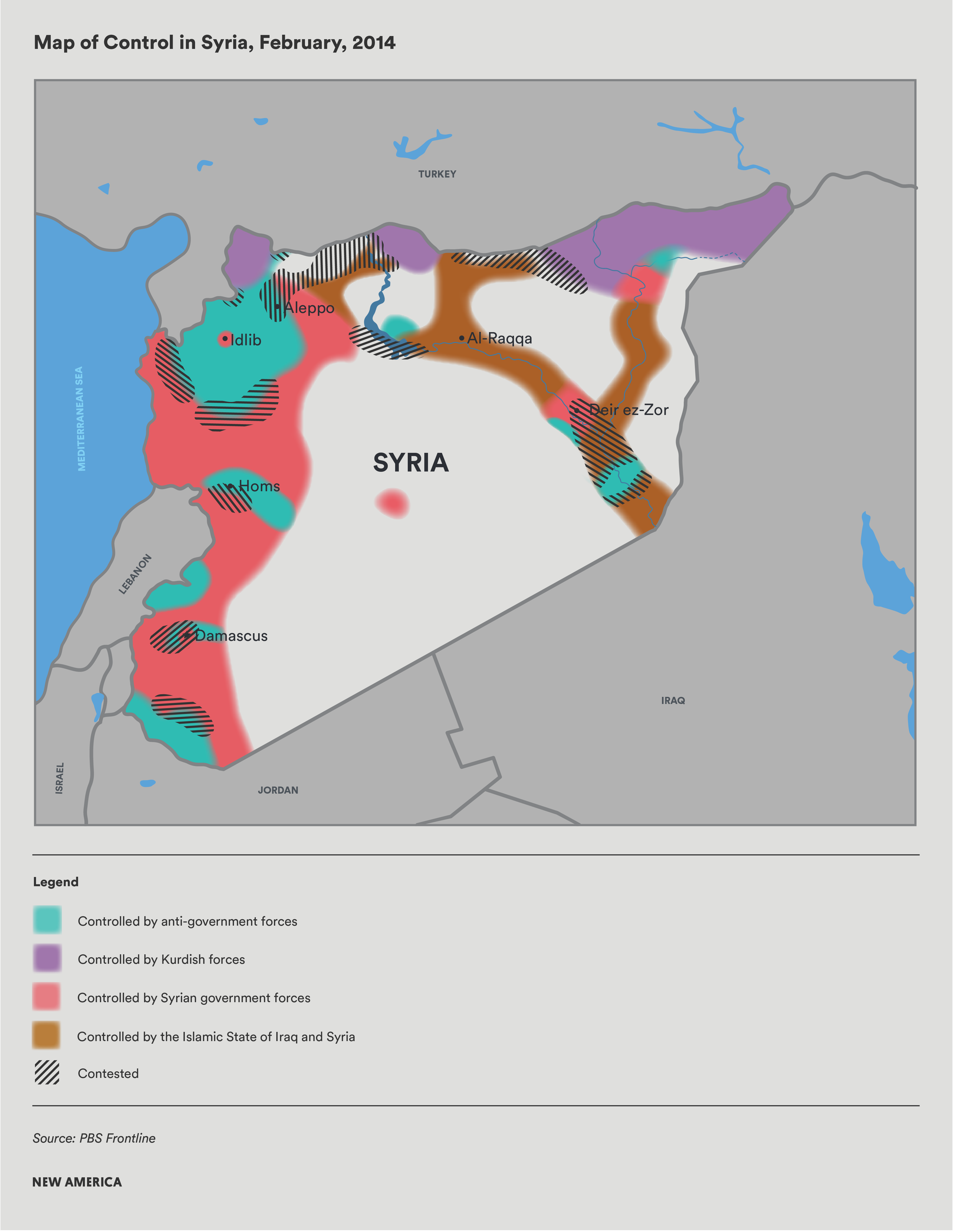
One of the last armed groups to confront ISIS in Raqqa was a militia known as Ahfad al-Rasul. On the night of August 13, 2013, an ISIS suicide bomber detonated a car full of explosives at the Ahfad al-Rasul headquarters, killing the group’s commander and at least five other fighters.75 This attack was significant for two reasons. First, it was ISIS’ first suicide bombing against another rebel group in Syria.76 Second, it killed key members of the only remaining group with ties to the SMC, the Free Syrian Army’s military council discussed earlier.77 ISIS then arrested survivors of the attack. In response, the group’s remaining fighters joined JAN. As an FSA-affiliated rebel commander stated at the time, “half of the FSA has been devoured by ISIS and the other half joined JAN.”78 On September 15, 2013 ISIS forced all remaining FSA fighters out of Raqqa and placed placards at every entrance to the city welcoming outsiders to the “Islamic State of Iraq and al-Sham: Raqqa Province.”79
At this point, it may be useful to ask why Raqqa became the launchpad for ISIS. ISIS took the city when it seemed that every armed group was taking Raqqa for granted. The Syrian regime believed the city would remain loyal, but did not expend the military resources necessary to protect it. Once liberated, Raqqa was also not a focus for the national Syrian opposition, who in 2013 were more interested in Damascus and Aleppo. Meanwhile, JAN had scouted and built strong links to Raqqa’s tribes, but had not committed its own senior leadership to that place. When Abu Bakr al-Baghdadi sent a deputy to test JAN’s loyalty in 2013, he found that JAN’s leader, Abu Mohammed al-Jolani, was in Idlib and his deputy, Abu Maria al-Qahtani, was in Deir Ezzor. That meant JAN had assets in Raqqa that were well developed but were not being overseen by a senior leader. While the extent to which ISIS leadership recognized this gap and deliberately exploited it is a matter of speculation, but what is clear is that Raqqa was a major city left unclaimed by other militias (JAN, Ahrar al-Sham, SARG, or FSA) who were more interested in larger prizes.
By November 2013, it was clear that ISIS controlled the city. To celebrate, the group convened a meeting of local notables and chiefs from the fourteen largest clans in the area. The elders duly pledged allegiance to ISIS in exchange for payment, just as they had done for Assad almost exactly two years earlier.80
Citations
- See, for example, George Orwell’s description of Barcelona immediately after its fall to the revolutionary forces during the Spanish Civil War. George Orwell, Adam Hochschild, and Lionel Trilling, Homage to Catalonia, First Mariner Books edition (Boston: Mariner Books/Houghton Mifflin Harcourt, 2015): 546-547.
- Caerus interview with M.J., September 23, 2013.
- Caerus conducted 53 semi-structured interviews with residents in Raqqa in April and May, 2013. Those interviews inform this assessment.
- Author’s interview with Mutasem Syoufi, January 11, 2019.
- Ibid.
- Caerus interview with T.H.O., September 23, 2013.
- Author’s email exchange with Abdalaziz Alhamza, June 29, 2019.
- Caerus interview with M.M., November 1, 2013.
- Stathis N. Kalyvas, The Logic of Violence in Civil War, Reprinted, Cambridge Studies in Comparative Politics (Cambridge: Cambridge Univ. Press, 2009): 12-13.
- Author’s interview with Assaad al-Achi, January 10, 2019.
- There are many accounts of the ideological war between those governments in the region who supported Muslim Brotherhood factions in Syria and those who opposed them during the first four years of the war (2011-2015 ). One of the first was by Hassan Hassan, “How the Muslim Brotherhood Hijacked Syria’s Revolution,” Foreign Policy, March 3, 2013, https://foreignpolicy.com/2013/03/13/how-the-muslim-brotherhood-hijacked-syrias-revolution/; also see a later summary of the effects of this ideological war on the Syrian uprising during this year by Raphael Lefevre, “Saudi Arabia and the Syrian Brotherhood,” Middle East Institute, September 27, 2013, https://www.mei.edu/publications/saudi-arabia-and-syrian-brotherhood.
- Qatar and Turkey support Muslim Brotherhood-backed groups across the region. Saudi Arabia and the United Arab Emirates oppose these groups, fearing they could form the basis of an organized internal challenge. This division forms the basis of an ongoing region-wide dispute. In Syria, that wider regional dispute divided these groups, with Kuwait, Bahrain, and others in the region supporting nationalist and Islamist opposition groups as well.
- President Barack Obama, who promised not to intervene in other countries’ affairs during his 2009 Cairo speech, called the Libya intervention “the worst decision” of his presidency. Jeffrey Goldberg, “The Obama Doctrine,” The Atlantic, April 2016, https://www.theatlantic.com/magazine/archive/2016/04/the-obama-doctrine/471525/. His administration was not about to get seriously involved in Syria—and the countries of the Middle East knew that.
- Dorothy Wickenden, “Ben Rhodes Talks To David Remnick About America’s Role in Syria,” The New Yorker, October 31, 2016, https://www.newyorker.com/podcast/political-scene/ben-rhodes-talks-to-david-remnick-about-americas-role-in-syria.
- Author’s interview with Mutasem Syoufi, January 11, 2019
- Author’s interview with Qutaiba Idlbi, May 23, 2019
- Ibid.
- Author’s interview with Mutasem Syoufi, January 11, 2019
- Author’s interview with Qutaiba Idlbi, May 23, 2019
- Author’s interview with Mutasem Syoufi, January 11, 2019.
- Author’s email exchange with Abdalaziz Alhamza, June 29, 2019.
- The Etilaf’s political structure set aside one seat for each of Syria’s fourteen governorates. “Official Page for Mustafa Ali Nawaf,” The National Coalition for the Syrian Revolution and Opposition, Retrieved from: http://www.etilaf.org/%D9%87%D9%8A%D9%83%D9%84%D9%8A%D8%A9-%D8%A7%D9%84%D8%A7%D8%A6%D8%AA%D9%84%D8%A7%D9%81/%D8%A3%D8%B9%D8%B6%D8%A7%D8%A1-%D8%A7%D9%84%D8%A5%D8%A6%D8%AA%D9%84%D8%A7%D9%81/%D9%85%D8%B5%D8%B7%D9%81%D9%89-%D9%86%D9%88%D8%A7%D9%81-%D8%A7%D9%84%D8%B9%D9%84%D9%8A.html
- Caerus eye-witness notes on conditions in Raqqa Local Councils, April 19, 2013.
- Author’s interview with Mutasem Syoufi, January 11, 2019.
- Caerus interview with M.J., September 23, 2013.
- Caerus eye-witness reporting, April 19, 2013.
- Meanwhile, the activists in Raqqa would retain their grassroots organization led by long-time opposition activist Nabil Fawaz, who had been in prison under former president, Hafez al-Assad, for 15 years. That council would continue to manage issues in the city of Raqqa. “Raqqa’s social, political, and administrative transformations are coming (Ar.),” Ayn al-Medina, March 5, 2017, https://ayn-almadina.com/details/%D8%A7%D9%84%D8%B1%D9%82%D8%A9%20%D9%88%D8%AA%D8%AD%D9%88%D9%84%D8%A7%D8%AA%D9%87%D8%A7..%20%D9%85%D8%AC%D8%AA%D9%85%D8%B9%D8%A7%D9%8B%20%D9%88%D8%B3%D9%8A%D8%A7%D8%B3%D8%A9%20%D9%88%D8%A5%D8%AF%D8%A7%D8%B1%D8%A9%20%D8%A2%D8%AA%D9%8A%D8%A9/4054/en.
- Caerus interviewed 53 residents of Raqqa in April and May 2013. These interviews lasted 1-1.5 hours and interviewees were asked questions regarding perceptions of safety, aid requirements, and local assessments of the municipal services they were receiving from the local council.
- “Urgent Action: Fears for Syrian Human Rights Lawyer,” (Amnesty International, March 22, 2012), https://www.amnesty.org/en/documents/mde24/028/2012/en/.
- The shahada is the Muslim profession of faith (“There is no God but God”) that has been coopted by Al Qaeda and is generally set in white letters over a black background. For reporting on the so-called battle of flags, see: Rania Abouzeid, “A Black Flag in Raqqa,” The New Yorker, April 2, 2013, https://www.newyorker.com/news/news-desk/a-black-flag-in-raqqa.
- Hassan Hassan, “The Battle for Raqqa and the Challenges after Liberation,” CTC Sentinel 10, no. 6 (July 2017), https://ctc.usma.edu/the-battle-for-raqqa-and-the-challenges-after-liberation/.
- Mona Mahmood and Ian Black, “Free Syrian Army Rebels Defect to Islamist Group Jabhat Al-Nusra,” The Guardian, May 8, 2013, https://www.theguardian.com/world/2013/may/08/free-syrian-army-rebels-defect-islamist-group.
- As Aymenn al-Tamimi writes of the time: “operation and accommodation rather than mutual hostility remain the norm at demonstrations.” Aymenn Jawad Al-Tamimi, “Jabhat Al-Nusrah and the Islamic State of Iraq and Ash-Sham: Raqqah Governorate,” Jihadology (blog), July 4, 2013, https://jihadology.net/2013/06/04/guest-post-jabhat-al-Nusrah-and-the-islamic-state-of-iraq-and-ash-sham-raqqah-governorate.
- Author’s interview with Mutasem Syoufi, January 11, 2019
- Al-Tamimi, “Jabhat Al-Nusrah and the Islamic State of Iraq and Ash-Sham: Raqqah Governorate.”
- “Raqqa Docs Reveal How ISIS Tracked and Killed Prominent Civil Activist and Lawyer,” Zaman Al-Wasl, January 31, 2017, https://en.zamanalwsl.net/news/article/22823.
- Al-Hikar, “Raqqa: Syria’s New Kandahar (Ar.).”
- Aymenn Jawad Al-Tamimi, “The Islamic State of Iraq and Ash-Sham Billboards in Raqqa,” Jihadology (blog), October 22, 2013, https://jihadology.net/2013/10/22/musings-of-an-iraqi-brasenostril-on-jihad-the-islamic-state-of-iraq-and-ash-sham-billboards-in-raqqa/.
- Al-Hikar, “Raqqa: Syria’s New Kandahar (Ar.).”
- Kyle Orton, “Raqqa Doesn’t Want to Be Liberated by the West’s Partners,” Kyle Orton’s Blog, May 30, 2017, https://kyleorton1991.wordpress.com/2017/05/30/raqqa-doesnt-want-to-be-liberated-by-the-wests-partners/#more-4982.
- Andrew Tabler, “Eyeing Raqqa: A Tale of Four Tribes” (Washington Institute for Near East Policy, 2017), https://www.washingtoninstitute.org/uploads/Documents/pubs/PolicyNote39-Raqqa.pdf.
- Alison Tahmizian Meuse, “In Raqqa, Islamist Rebels Form a New Regime,” Syria Deeply, August 16, 2013, https://www.newsdeeply.com/syria/articles/2013/08/16/in-raqqa-islamist-rebels-form-a-new-regime.
- Author’s interview with Hassan Hassan, February 6, 2019.
- Caerus Interview with J.S., October 2, 2013.
- Author’s interview with Assaad al-Achi, January 10, 2019.
- Interviews by Caerus with members of the Raqqa City media office, May 19, 2013.
- “Raqqa Docs Reveal How ISIS Tracked and Killed Prominent Civil Activist and Lawyer.”
- Christoph Reuter, “Secret Files Reveal the Structure of the Islamic State,” Der Spiegel Online, April 18, 2015, https://www.spiegel.de/international/world/islamic-state-files-show-structure-of-islamist-terror-group-a-1029274.html.
- “The Islamic State of Iraq and Greater Syria: A Primer,” TSG IntelBrief (The Soufan Group, June 13, 2014), http://www.soufangroup.com/tsg-intelbrief-the-islamic-state-of-iraq-and-greater-syria-a-primer/.
- Reuter, “Secret Files Reveal the Structure of the Islamic State.”
- Caerus Interview with J.S., October 2, 2013.
- Reuter, “Secret Files Reveal the Structure of the Islamic State.”
- Author’s email exchange with Abdalaziz Alhamza, June 29, 2019.
- Al-Hikar, “Raqqa: Syria’s New Kandahar (Ar.)”; Meuse, “In Raqqa, Islamist Rebels Form a New Regime.”
- Meuse, “In Raqqa, Islamist Rebels Form a New Regime.”
- Jeffrey White, Andrew J. Tabler, and Aaron Y. Zelin, “Syria’s Military Opposition: How Effective, United, or Extremist,” (Washington Institute for Near East Policy, September 2013), https://www.washingtoninstitute.org/uploads/Documents/pubs/PF128_Syria_WEB.pdf.
- Meuse, “In Raqqa, Islamist Rebels Form a New Regime.”
- Al-Hikar, “Raqqa: Syria’s New Kandahar (Ar.).”
- Hassan, “The Battle for Raqqa and the Challenges after Liberation.”
Raqqa: ISIS Capital
ISIS’ rule initially offered relief from the chaos and violence of Raqqa’s contested politics. Still, much of the cruelty Raqqawis suffered before ISIS took the city was generated by the group’s own deliberate strategy of provoking exactly that kind of violent uncertainty, allowing it to sweep in and rescue communities from the very fear it had itself created. Likewise, once in charge, ISIS maintained control through brutal repression, intimidation, and fear. That said, some locals held on to their initial hopes that ISIS might resolve Raqqa’s political and governance challenges.
ISIS Consolidates Control
Having pushed out challengers for control of Raqqa, ISIS began consolidating its rule from November 2013 onward. This process was enabled both by ISIS’ soon-to-be-proven false promise of bringing security and a rest from violence, and by ISIS’ fueling of that very violence and its application of brutal, coercive measures.
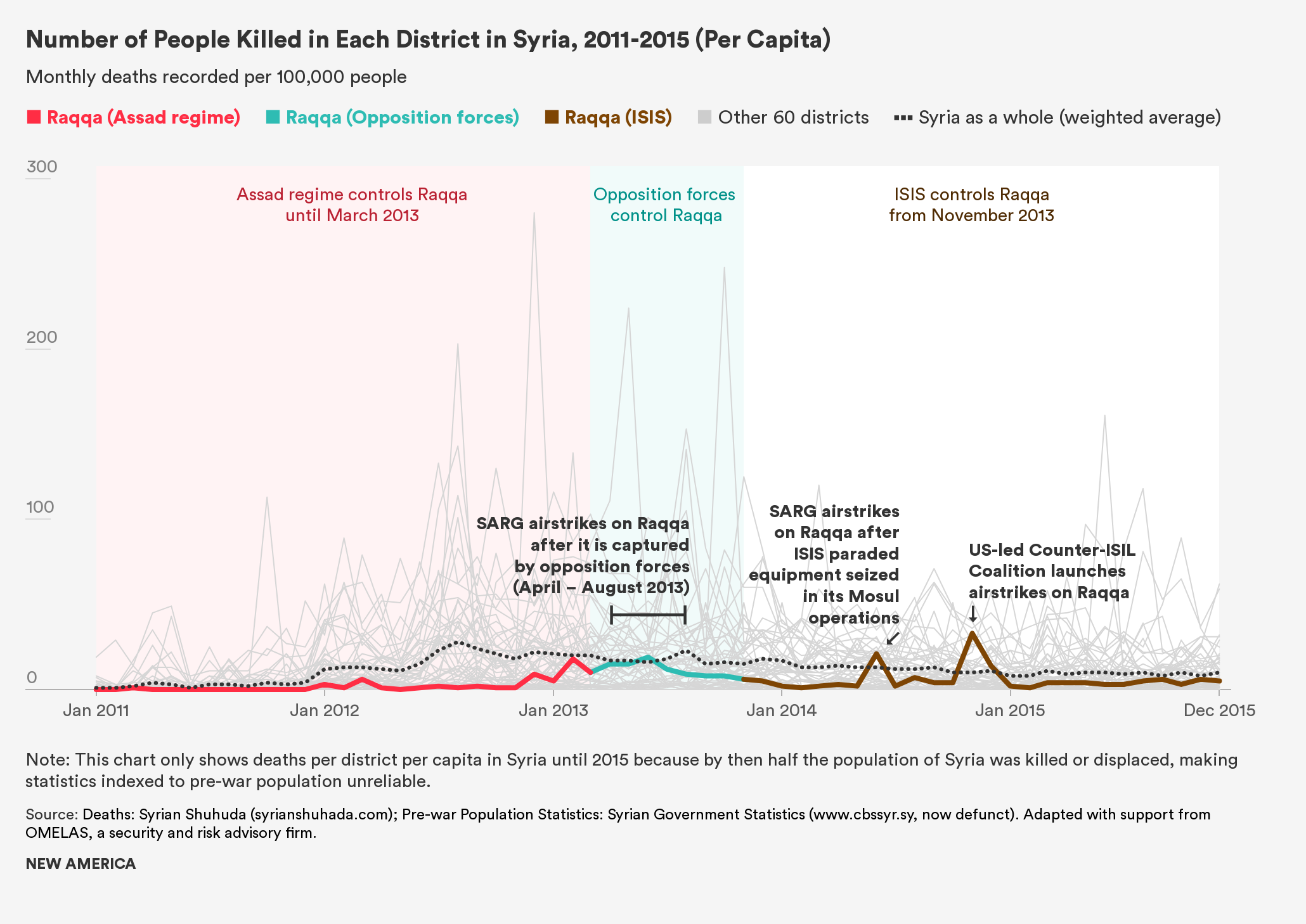
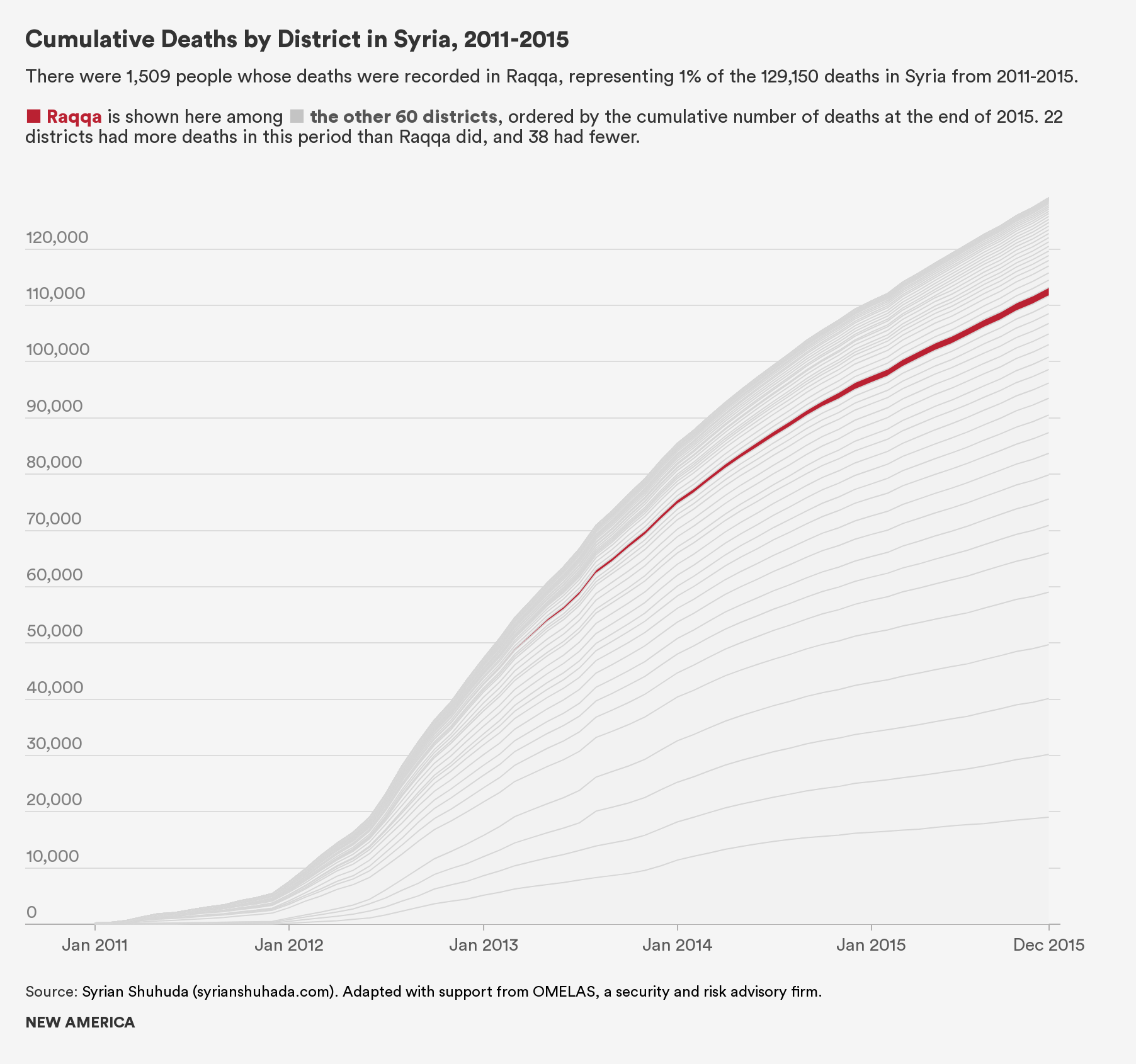
When ISIS began to consolidate its control over Raqqa, it gained support from people relieved by a reduction in violence in the city. As explained below, it is not easy to determine the reasons for this decline even as it provided a contrast with the dangers that preceded ISIS’ takeover. In writing this paper, we worked with Omelas, a security and risk advisory firm, to gather and analyze data on all deaths in Syria from 2011 to 2015 in all of Syria’s 61 districts.81 While deaths are an imperfect proxy for military confrontation, we can identify time periods in the data when violence spiked in Raqqa relative to other regions in the country.
The chart above shows that lethal violence first spiked when Raqqa was captured by the opposition at the beginning of March 2013. While Raqqa was under opposition control, there was a sustained period of several months during which the death toll was high for Raqqa but average relative to the rate of deaths across Syria. Some of this may be attributed to chaotic conditions in the city, but we suspect most deaths during this period were due to a sustained bombing campaign by SARG. As the International Crisis Group reported at the time, civilians “fled in droves” in March and April 2013 because they feared “regime retaliation and in particular ballistic missile attacks.”82 The chart also shows that deaths in Raqqa plummeted in the same period that ISIS gained total control of Raqqa. From January-May 2014, there were an average of 11 deaths per month, among the lowest death rate of any district in Syria (excluding pro-Assad Alawite regions). By contrast, during the period when opposition forces tried to govern Raqqa, March-July 2013, there had been an average of 77 deaths per month, a dramatically higher number.
Why did deaths initially decline so precipitously under ISIS? Our research, as well as mass graves discovered around Raqqa after ISIS was defeated in the city in 2017,83 demonstrates that the group did engage in systematic killing of opponents during this time. Part of the decline might be explained by the fact that ISIS deployed highly public acts of violence as a means of demonstrating its brutal monopoly on the use of force—as evidenced by videos of public executions—and thereby deterred other violent actors.84 Yet, there were also fewer deaths because other forms of killing—such as regime airstrikes—did not occur in Raqqa during this period. Many analysts at the time argued that the lack of Syrian government airstrikes was a sign that the two groups were, if not working together, at least working toward related goals of fighting the opposition. Our own observation suggests that allowing ISIS to grow in Syria supported a general regime narrative, whereby President Bashar al-Assad sought to paint all rebels as jihadists in an attempt to gain international credibility; at the same time, we found nothing beyond circumstantial evidence for direct regime-ISIS collaboration. In effect, Assad may have tolerated ISIS because it served his broader narrative (and because he lacked the troops or resources to do much about it), though he stopped short of directly collaborating with them.
Local Reactions and the Limits of ISIS Governance
Since ISIS operatives had been in Raqqa for months and had captured the city through careful strategy using subversion and intimidation, they were familiar with the community and its needs, and were thus better prepared to govern than their predecessors. As the dominant local armed actor, ISIS applied a combination of brutal repression, persuasive measures, and administrative services to create a system of competitive control—corralling the population and ensuring collaboration.85 Nevertheless, ISIS leaders turned out to be incompetent governors of Raqqa. Their failures were linked in part to over-emphasis on coercion and minimal commitment to substantive governance, rendering their control both fear-based and brittle. The initial promise of security appeared real, but was quickly lost as locals experienced ISIS’ predation and gang-like rule.
At first, ISIS’ control over Raqqa proved to be a boon for residents. ISIS fighters flooded the local economy with cash by overpaying at restaurants, spending extravagant amounts on basic goods from local markets, and purchasing equipment, mobile phones, and cars from local suppliers.86 They reopened flour mills in the countryside north of Raqqa, stabilizing bread prices in the area.87 They replaced imams at local mosques in most of Raqqa and issued four decrees demanding strict adherence to Islamic law—with a Shari’a court system to mete out harsh punishment.88 Yet, interestingly, they let the local council in Raqqa continue to operate and provide services to residents providing it did not challenge ISIS’ rule.89
ISIS’ control of Raqqa thus—at least initially—brought some measure of stability. This is important because, in war, civilian populations aim to maximize predictability and profit, broadly defined, while minimizing risk and uncertainty.90 As noted, there were also very few Syrian government airstrikes at the time, which made things much easier for residents than in March and April 2013, when the newly liberated city was subjected to regular aerial bombardment.
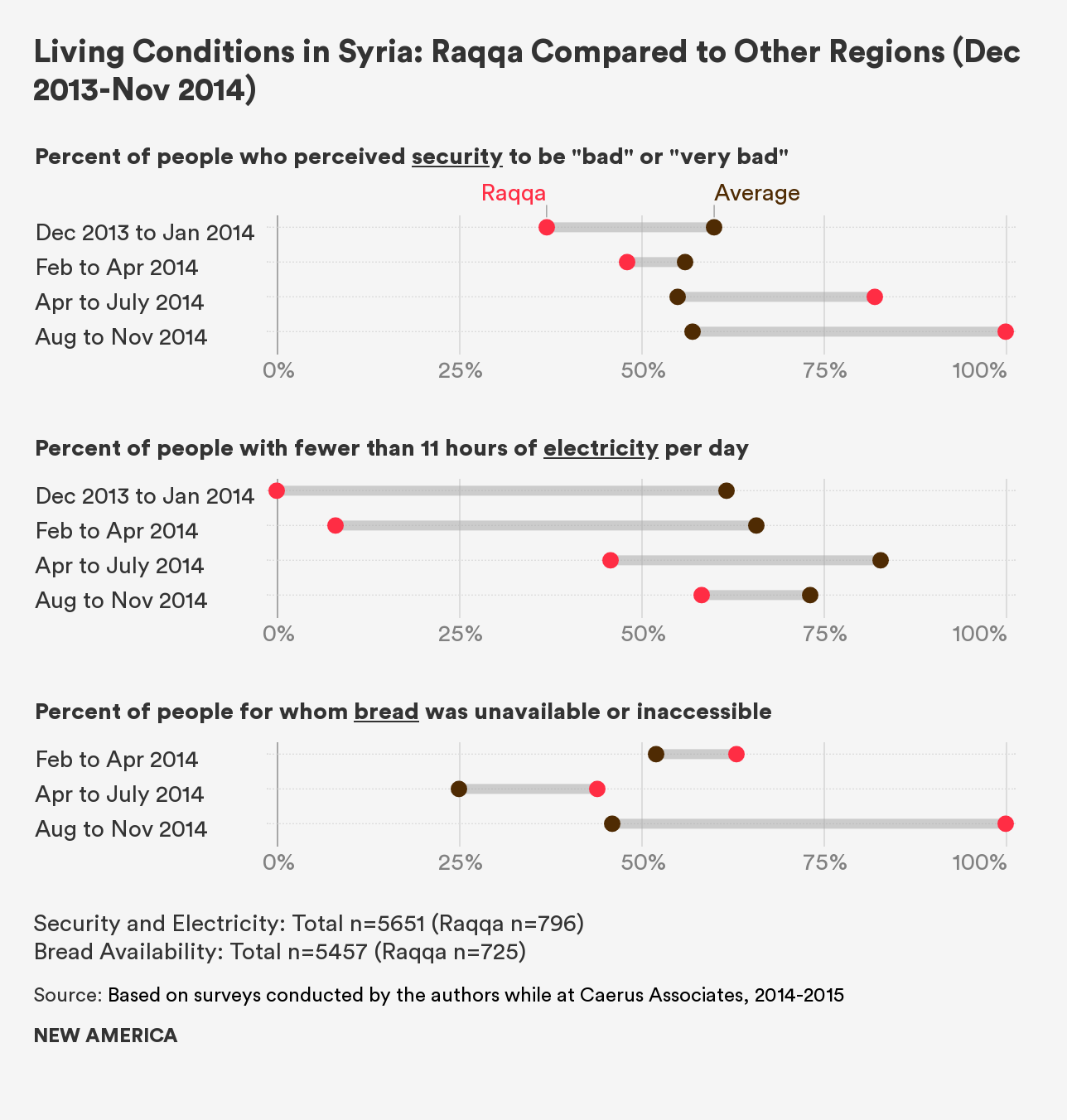
But the honeymoon period under ISIS did not last. According to surveys conducted by Caerus Associates from December 2013 until November 2014, the majority of residents in Raqqa said security was at least “moderate,” and nearly everyone had over 15 hours of electricity. (The three percent of survey respondents who did not have 15 or more hours per day had more than 11 hours per day.) By spring 2014, ISIS had started to stabilize bread distribution, yet most people said bread was inaccessible or unavailable. Meanwhile, electricity access had declined and perceptions of insecurity had started to rise, from 37 percent saying security was “very bad” or “bad” in January 2014 to 48 percent by April.
In July 2014, when Abu Bakr al-Baghdadi declared the ISIS Caliphate in Mosul, 82 percent of Raqqawis described security conditions as “very bad” or “bad,” the highest of any region surveyed at the time. In addition, 76 percent of residents surveyed feared crimes or kidnapping on a daily basis. In the same survey, none of the respondents from Raqqa trusted militia commanders in their city—a surrogate indicator for local support to ISIS since this was the only militia in the area—whereas 32 percent of residents in other parts of Syria did trust militia leaders. It is notable that 93 percent of Raqqa residents reported that Islamic groups “don’t protect or help me” or “don’t fight for the revolution.” In the other communities surveyed, only 20 percent of people reported that Islamic groups failed to protect them or advance the cause of the revolution.91
It is notable that 93 percent of Raqqa residents reported that Islamic groups “don’t protect or help me” or “don’t fight for the revolution.”
By the end of 2014, living conditions in Raqqa had plummeted, becoming some of the worst in all of Syria. Only 8 percent of residents in Raqqa reported more than 15 hours per day of electricity (down from 97 percent at the beginning of the year).92 The percentage of Raqqawis reporting fewer than 11 hours of electricity per day increased from zero percent at the beginning of the year to 58 percent. Everyone surveyed in the city reported that bread was unavailable or inaccessible. And every respondent expressed acute insecurity, not because of a lack of enforcement of security, but because, as conditions in Raqqa worsened, ISIS’ rule became more capricious.
ISIS controlled Raqqa for another three years. It remained the dominant armed group in the city until October 2017, when an offensive by U.S.-backed forces defeated the group and forced its last remnants from Raqqa. While some have argued that ISIS ran a “complex system of government,”93 in reality, our fieldwork—and our surveys of local opinion, which we continued to conduct in Raqqa even under ISIS rule—showed that the group governed poorly by creating a set of administrative mechanisms that, within the first half of 2014, largely failed to provide basic services to the city’s population.
ISIS controlled Raqqa for another three years. It remained the dominant armed group in the city until October 2017.
Raqqa has been historically known as Syria’s breadbasket.94 It is located on the Euphrates River and benefits from a nearby reservoir and hydroelectric dam, which has long provided residents easy access to clean drinking water and electricity. The areas around the city produce large amounts of crops, and Raqqa was the site of massive grain silos. Yet, despite ISIS’ complex bureaucracy, the group had few people with the technical skills to manage electrical and water systems or make necessary repairs. ISIS leaders became “desperate” when things broke down. As a U.S. official explained in December 2015, “[they don’t] have a whole lot of engineers and staff to run the cities.” A Syrian aid worker added, “They’re not smart, and they’re not capable. They have no expertise.”95 ISIS could capitalize on the chaos of Syria’s fragmented battlefield, but it was, in effect, little more than an organized criminal group trying to manage a state.
Citations
- This chart was built using Syrian government pre-war population statistics from 2004 via the Central Bureau of Statistics in Syria: http://cbssyr.sy/indicator/hp-m.htm (not accessible from the United States). Data on deaths in Syria from “Syria Shuhuda” (the most reliable database of deaths in Syria from 2011-2015). The chart only shows per capita deaths until 2015, because, by that time, pre-war population statistics would not be a reliable measurement of the number of people in a given area. By the beginning of 2015, approximately 50% of Syrians were deceased, internally displaced, or had fled as refugees, see: “Syria Emergency,” United National High Commissioner for Refugees (UNHCR), https://www.unhcr.org/en-us/syria-emergency.html.
- “Syria’s Metastasising Conflicts,” Middle East and North Africa (International Crisis Group, June 17, 2013): 7, https://www.crisisgroup.org/middle-east-north-africa/eastern-mediterranean/syria/syria-s-metastasising-conflicts.
- There have been eight mass graves (burial sites containing three or more victims of execution) found thus far in Raqqa. The largest contained approximately 2,500 bodies. Maya Gebeily, “Largest ISIS Mass Grave Found Outside Syria’s Raqqa,” AFP, February 21, 2019, http://www.rudaw.net/english/middleeast/syria/21022019.
- Public Execution of Three Syrians by Jihadist Group in Raqqa, 2013, https://www.youtube.com/watch?v=orIID6SGZR8.
- For a detailed description of this theoretical framework, see: David Kilcullen, Out of the Mountains: The Coming Age of the Urban Guerrilla, (New York: Oxford University Press, 2013): 114.
- Nate Rosenblatt, “ISIS’ Plan to Govern Syria - and What the US Should Do About It,” War on the Rocks, October 31, 2013, https://warontherocks.com/2013/10/isis-plan-to-govern-syria-and-what-the-us-should-do-about-it/.
- Emma Beals, “Wheat as a Weapon of War in Syria,” Vice, June 23, 2016, https://www.vice.com/en_us/article/jpka5k/wheat-as-a-weapon-of-war-in-syria.
- Al-Tamimi, “The Islamic State of Iraq and Ash-Sham Billboards in Raqqa.”
- Author’s interview with Assaad al-Achi, January 10, 2019.
- Kilcullen, Out of the Mountains.
- Caerus surveys (n=2282) in Aleppo, Rif Damascus, Deir Ezzor, Deraa, Hama, Hassakeh, Idlib, and Raqqa: April-July, 2014.
- A RAND-sponsored analysis of satellite imagery over Raqqa concluded that, by the end of the year, the abundant electricity which residents in Raqqa enjoyed in January 2014 had declined by almost 75 percent. Eric Robinson et al., When the Islamic State Comes to Town, (Santa Monica, CA: RAND, 2017), https://www.rand.org/nsrd/projects/when-isil-comes-to-town.html.
- Rukmini Callimachi, “The ISIS Files,” New York Times, April 4, 2018, https://www.nytimes.com/interactive/2018/04/04/world/middleeast/isis-documents-mosul-iraq.html.
- Robert F. Worth, “Earth Is Parched Where Syrian Farms Thrived,” New York Times, October 13, 2010, https://www.nytimes.com/2010/10/14/world/middleeast/14syria.html.
- Liz Sly, “The Islamic State Is Failing at Being a State,” Washington Post, December 25, 2014, https://www.washingtonpost.com/world/middle_east/the-islamic-state-is-failing-at-being-a-state/2014/12/24/bfbf8962-8092-11e4-b936-f3afab0155a7_story.html?noredirect=on&utm_term=.dacde2a4dd0c.
Raqqa Today: 2013 Redux?
The situation in Raqqa today dangerously resembles that of 2013, when Raqqa went from opposition rule to ISIS control in a matter of months. Before the city fell to opposition forces, it was largely ignored by the regime, which assumed that Raqqawis would remain loyal and not support the insurgents. When Raqqa came under attack, SARG forces retreated, in effect acknowledging that Raqqa was not as important as bigger cities like Aleppo. Likewise, when the rebels captured Raqqa, they were no more committed to competently serving the local population’s needs than the regime had been. Ahrar al-Sham, the lead militia to capture the city, largely ignored its responsibilities to guarantee local security and help municipal services operate. While it is unclear whether Ahrar al-Sham leaders lacked the capacity or interest to govern, they certainly did not see themselves as responsible for governing Raqqa. The Syrian political opposition also did not put in sufficient effort to govern Raqqa. Like the regime, the Etilaf leadership was more interested in bigger cities like Aleppo and Damascus.
A “Power-Locked” Conflict?
As of mid-2019, the situation in Raqqa may seem to be an incipient (or resurgent) but low-level campaign being carried out by remnants of ISIS against a security force—drawn primarily from the U.S.-backed SDF—that has broad popular support but lacks the numbers, resources, and international support to ensure it can continue to keep the peace. This interpretation has been challenged by some observers, who see the SDF as an occupying force, ethnically and regionally foreign to the population of Raqqa, and lacking the capability or support to achieve long-term stability.96
We believe a more persuasive interpretation is that the conflict in Raqqa is, to draw on a concept from conflict transformation theory, “power-locked,” or temporarily frozen due to a large power imbalance among potential combatants.97 In Raqqa today, disparities of military and political power among parties to the conflict are so pronounced—and so locally skewed in favor of the SDF—that none of the SDF’s rivals are in a position to restart the conflict. This power disparity-induced appearance of calm is very far from the true reconciliation and resolution needed to end the conflict. This means that a shift in the power dynamic—for example, the removal of U.S. forces from Syria or a broader loss of support for the SDF—would likely presage a rapid resumption of conflict as the deterrent effect of SDF's currently dominant position erodes. The al-Na’im tribe, for example, has had an ongoing land dispute with Kurdish communities living nearby. While the Kurdish-dominated SDF currently controls the region, SDF’s military power hardly means that they have resolved this dispute.98 Consequently, should SDF’s ability to control the territory decline before substantive steps to resolve the land dispute occur, we would expect violence in that region to spike promptly.
Without an enduring American-led presence, especially to try to mediate disputes in this region, there is no clear guarantor of security. This is a side-effect of the proxy-actor status of SDF, in that its ability to dominate the region—and hence to pacify unresolved conflicts by deterring rival armed groups—depends more on the actions of its U.S. sponsor than on the proxy group’s inherent actions or capabilities. As a result, according to the former Deputy Head of the Counter-ISIL Coalition, Lieutenant General Terry Wolff, in the event of a change in U.S. posture, ISIS may well return and Raqqa may become a site of a renewed insurgency. Lt. Gen. Wolff explained that ISIS elements remain in Raqqa and that they are likely to compete for control of the population along with tribal leaders, the SARG, Russian forces, mainly Kurdish SDF forces and, possibly, Iranian proxies. All of these sponsors of Syria’s proxy conflict have been buying up tribes in this area, meaning Raqqa will remain unstable for some time.99
A journalist based in Iraq (who for personal safety reasons prefers to remain anonymous) who visited the city in February 2019 corroborated this assessment. “Security was on the tip of everyone’s tongue when we would get out on the street and talk to people,” she explained. “The first thing [people] would say is that the city is not safe.” And, she emphasized, the uncertainty came from robberies, muggings and kidnappings—not airstrikes. People she met were still trying to figure out the logic of violence in their city. When someone was kidnapped, people did not just try to figure out what had happened to them, but also why they had been targeted. “So far, it did not appear to me that people could distinguish between random kidnappings and targeted kidnappings,” she explained. There were, of course, a lot of complaints about the local (SDF) security forces.100
Rebuilding Raqqa
Instability in Raqqa will complicate the city’s acute reconstruction needs. The first author interviewed an analyst who conducted a recent damage assessment in Raqqa. She revealed that 10 out of Raqqa City's 23 neighborhoods have suffered at least 20 percent infrastructure damage. These neighborhoods were mainly clustered in the densely-populated city center: over half the buildings were damaged in two central neighborhoods.101 And, although tens of thousands of residents have returned to Raqqa, the city’s current population is roughly just 15 percent of its pre-war size.102 Raqqa was the breadbasket of Syria, but its agricultural output cratered during the war: one estimate found that it would cost half a billion dollars to bring Raqqa’s agriculture back to pre-war levels.103
One might argue that Raqqa’s relatively small current population—down to under 100,000 from a pre-war population of 500,000—should ease pressure on its agricultural production, but the United Nations estimated in 2018 that up to 95 percent of Raqqa City’s residents were food-insecure.104 Most income earned by residents came from fuel sales or remittances, yet more than half of Raqqawis are unable to meet basic needs through household income alone.105 In one disturbing report published in October 2018, residents reported ISIS sleeper cells in the city and felt that living conditions after liberation were harsher than under ISIS.106
There is little question that the conditions that allowed ISIS to capture Raqqa in 2013 are also present today.
There is little question that the conditions that allowed ISIS to capture Raqqa in 2013 are also present today. As ISIS no longer controls territory in the conventional sense, many emphasize the importance of addressing the causes that gave rise to the group in the first place.107 But Raqqa today is a perfect example of why “root causes” are inadequate in describing the processes through which insurgents like ISIS emerge. In Raqqa—as in other areas affected by civil wars and insurgencies—whichever local armed actor can create order and provide basic necessities is most likely to end up in control of population and territory, regardless of ideology or whether it addresses, for example, people’s identity-based grievances.
ISIS took advantage of chaotic conditions to make Raqqa the capital of its caliphate and the launch pad for its insurgency. This was not because residents of Raqqa had latent grievances that they needed ISIS to help them express. On the contrary, it was because ISIS deliberately created, and then took advantage of, chaotic conditions—allowing it to impose order by solving the very problem of chaos that its own actions had helped create. ISIS militants may not be capable governors, but they are adept insurgents and highly skilled at manipulating local power structures. Absent a serious plan to continue suppressing ISIS, the group thus enjoys favorable conditions for reemergence in Raqqa.
Citations
- Author’s email exchange with Abdalaziz Alhamza, June 29, 2019.
- For discussion of this concept, see: Neil Stammers, “Social Movements, Human Rights, and the Challenge to Power,” in Proceedings of the ASIL General Meeting 97 (2003): 299-301; and Patrick G. Coy, “Conflict Resolution, Conflict Transformation, and Peacebuilding” in Peace, Justice and Security Studies, eds. Timothy McAlwee, B. Welling Hall, Joseph Liechty, and Julie Garber (New York: Lynne Rienner Publishers, 2009): 63-78.
- Andrew Tabler, “Eyeing Raqqa: A Tale of Four Tribes” (Washington Institute for Near East Policy, 2017), https://www.washingtoninstitute.org/uploads/Documents/pubs/PolicyNote39-Raqqa.pdf.
- Author’s interview with Lieutenant General Terry Wolff, February 16, 2019.
- Author’s interview with a journalist, March 1, 2019.
- Author’s interview with an analyst, March 1, 2019.
- Current estimates of Raqqa’s population are between 100,000-150,000, down from a pre-war population of 503,960. Population figures from UN-OCHA, July 2018 and UN-IA Mission, April 2018.
- “Situation Overview: Area-Based Assessment of Ar-Raqqa City” (REACH, October 2018), https://reliefweb.int/sites/reliefweb.int/files/resources/reach_syr_situationoverview_raqqacityaba_oct2018.pdf.
- U.N. Internal Inter-Agency Mission Report. al-Raqqa City. April 2018
- Hamoud AlMousa, “The Economic Situation in Raqqa, from Neglect to Exploitation,” Raqqa Is Being Slaughtered Silently, February 28, 2017, https://www.raqqa-sl.com/en/?p=2127./en/?p=2127.
- Ruth Sherlock and Lama Al-Arian, “‘This Is Not Liberation’: Life in the Rubble of Raqqa, Syria,” NPR, October 26, 2018, https://www.npr.org/2018/10/26/658142688/u-s-plan-to-stabilize-raqqa-and-stop-return-of-isis-doesnt-appear-to-be-working.
- Arguments about so-called Sunni grievances abound as explaining the reason for the rise of ISIS and other Sunni Muslim non-state militants. See, for example: Emily Anagnostos, Jessica Lewis McFate, Jennifer Cafarella, and Alexandra Gutowski, “Anticipating Iraq’s Next Sunni Insurgency,” Institute for the Study of War, November 30, 2016, http://www.understandingwar.org/backgrounder/anticipating-iraq%E2%80%99s-next-sunni-insurgency.
Conclusion
Raqqa’s experience offers lessons that extend beyond the city as a case study and beyond specific issues related to Syria. The chaotic proxy war conditions in Raqqa created an opening for ISIS to capture its first city. The absence of unified leadership among groups trying to govern Raqqa was representative of the dysfunction of those leading the Syrian opposition: the national opposition (the “Etilaf”) and the FSA. These groups’ internal divisions were exacerbated by regional patrons who were unwilling to compromise with each other. The international community, though increasingly involved in Syria, either lacked or failed to employ meaningful tools to force regional actors to work together and thereby to help their Syrian proxies unify.
Meanwhile, ISIS focused on hyperlocal mapping of the human terrain and individual-level targeting in order to infiltrate groups present in Raqqa and turn them on each other. It built links with the community and used those connections for social and political support. It embedded itself into Raqqa’s tribal system and established a logic of violence that supported its campaign for competitive control. This, and not superior firepower, allowed ISIS to take over Raqqa. Later, as ISIS grew, it added a large arsenal to its tactics for taking over new territory.
ISIS’ hyperlocal strategy highlights the tendency of traditional conceptions of proxy warfare to ignore or downplay the complex mesh of individuals, social networks, and movements at work in civil wars. Actors ranging from the Syrian government, to Ahrar al-Sham, to the Etilaf and its varied state sponsors repeatedly viewed Raqqa as a peripheral or economy-of-force area, governable with limited investment in local influence. ISIS demonstrated that, far from being a peripheral site into which armed forces could be moved like chess pieces with a little bit of foreign backing, Raqqa was a complex region alive with local politics that could rapidly shift given changes in a delicate balance of power.
ISIS’ hyperlocal strategy highlights the tendency of traditional conceptions of proxy warfare to ignore or downplay the complex mesh of individuals, social networks, and movements at work in civil wars.
ISIS was perhaps the only fighting force in Raqqa, with the possible exception of JAN, that was neither a proxy nor a patron. The Syrian regime was a patron who paid tribal proxies to monitor the situation in Raqqa. Once threatened, SARG withdrew its troops to bases outside of the city and the tribes capitulated. Meanwhile, the Syrian opposition was both a sponsor and a proxy. As a proxy, it was unable to maintain unity under pressure from competition among its international donors, mainly from the Muslim Brotherhood-supporting faction in Qatar and Turkey, other conservatives supported by Saudi Arabia, and liberal secularists supported—albeit extremely half-heartedly—by western powers. The opposition’s reliance on external patrons resulted in key figures being promoted for their external political connections, rather than their local ties, like Etilaf’s representative for Raqqa, al-Nawaf. This crippled the Etilaf’s own utility as a patron in Raqqa, a utility already at risk due to its general predisposition to treat Raqqa as peripheral.
Raqqa’s experience suggests that proxy warfare is unlikely to be useful as a strategy for stabilization or state building operations, especially when multiple patrons or sponsors compete with each other, encouraging proxies to “patron-shop” and promoting disunity among forces in the field. Proxy forces may be able to take territory temporarily, but they often are focused more on maintaining ties to their foreign patrons than on governing effectively.
This conclusion has resonance for other conflict zones. In Yemen and Libya, warring factions inside the country—the proxies—profit from foreign funding. Meanwhile, it is unclear whether the foreign patrons providing most of the funds that fuel these conflicts have a realistic end-game strategy or whether they are simply content fighting their real opponents (other sponsors) in another country’s battlefield. In all three theaters, jihadist insurgents with a focus on providing local services, rather than exclusively soliciting international funds, found safe havens.
Raqqa experienced rapid shifts of control between armed groups in 2013. This was partly because the Syrian regime and its opponents took the city for granted, believing they could buy local support with minimal commitment. Meanwhile, ISIS executed its plan to play warring factions off one another in Raqqa and destroyed the nascent effort to govern the city by locals. ISIS’ plan was well designed, but it was easier to execute because local power brokers in Raqqa, and their patrons, could not agree to unify in the face of a common threat.
In places like Raqqa, sponsors did not understand what was happening and therefore paid little attention to events on the ground. This meant that their proxies either did not care, or were not supported enough to deal with threats like ISIS. This gap in knowledge and interest gave ISIS the opportunity to capture its first town and launch its own conflict-changing insurgency.
Raqqa’s critical lesson is about the Syrian war in general: the United States, and others, can no longer take for granted an understanding of proxy warfare based on knowledge developed during the Cold War. Syria’s intractability underscores that the international system is not bipolar, as it was during the Cold War, nor unipolar, as it was during America’s brief window of global dominance in the immediate post-Cold War era. Today’s multi-polar international system means that regional powers have greater freedom to project power and influence events in their own regions because they can appeal to multiple global powers for support. In turn, local proxies also have the freedom to appeal to a range of regional actors, patron-shopping among a larger selection of sponsors while exploiting greater ease of access to technologies and capabilities of warfare.
Raqqa’s place within these conflicts was forgotten by nearly everyone in Syria except one group, ISIS, which recognized this weakness and exploited it—with devastating consequences.
That is why Syria was not only a battleground between global powers, but also a place where regional conflicts were fought. Saudi Arabia and Iran fought a regional proxy war in Syria, along with the ideological war between Sunni Arab nations who either supported or opposed the Muslim Brotherhood. Proxy warfare is sometimes characterized as moving pieces on a chessboard.108 Syria’s conflict was a multi-dimensional mesh of networks with competing interests. As these competing interests fought their wars across Syria, Raqqa’s place within these conflicts was forgotten by nearly everyone in Syria except one group, ISIS, which recognized this weakness and exploited it—with devastating consequences.
Citations
- Rondeaux and Sterman, “Twenty-First Century Proxy Warfare."
Appendix A: Glossary of Armed Factions
This appendix provides a short glossary of the names, abbreviations, and descriptions of armed and political groups referenced in this paper.
Ahrar al-Sham (AS) or Harakat Ahrar al-Sham al-Islamiyya:
A hardline Islamist militia based in northwest Syria, included some former fighters with Al Qaeda in 2013.
Jabhat al-Nusra (JAN):
Al Qaeda’s affiliate in Syria. The group would eventually change its name twice: to Jabhat Fatah al-Sham in 2016 and to Hay’at Tahrir al-Sham in 2017 as part of a merger with other insurgents in Syria.
Islamic State of Iraq and al-Sham (ISIS):
The Al Qaeda offshoot that would declare the formation of an Islamic “Caliphate” in Syria and Iraq in 2013, and would change its name to the Islamic State (IS) after its capture of Mosul in 2014.
Syrian Democratic Forces (SDF):
A coalition of mostly Syrian Kurdish forces supported by the United States-led Global Coalition to Defeat ISIS, which was founded in 2015.
Free Syrian Army (FSA):
A loose coalition of Syrian militias fighting President Bashar al-Assad, founded in 2011.
Syrian National Coalition (Etilaf), or The National Coalition for Syrian Revolution and Opposition Forces:
The internationally recognized Syrian opposition government in exile, founded in 2012.
Supreme Military Council (SMC):
The military leadership of the FSA, founded in 2012 and disbanded in 2014.
Syrian Arab Republican Government (SARG):
The Syrian government led by President Bashar al-Assad.
More About the Authors

David Kilcullen
Professor of War Studies, University of New South Wales; Professor of Practice, ASU; Author, The Ledger: Accounting for Failure in Afghanistan