Moving into Kindergarten
Abstract
There are many actions schools and districts can take to help ensure a child’s transition into kindergarten is smooth and stress-free for her and her family. This report highlights innovative efforts schools and districts across the country are taking to ease the transition into kindergarten for families and students, including students who did not have access to pre-K prior to kindergarten. We include a range of models at different stages of development that are taking innovative approaches to ensuring a smooth transition to kindergarten. These schools and districts, while different from one another, are taking important steps to ensure the kindergarten year is a successful one for children and families.
Acknowledgments
Thank you to the multiple school and district individuals who made time to speak with me about their work, including Brooke Chilton Timmons, Adelyn Hall, Alexandria Lubans-Otto, Alpacino Beauchamp, Amy Hoffert, Angela Farwig, Antonio Fernandez, April Mueller, Darlene Kamine, Emily Powers, Erin Bartsch, Jami Luggen, Jeff Campbell, Kate Eisenpress, Maria Rivera, Mary Guy, Michelle McGehee, Patricia Gleason, Susannah Levine, Tracy Power, and Valerie Jerome. Thank you to Carrie Gillispie and Hedy Chang for their assistance and feedback. Thanks also to New America colleagues Laura Bornfreund, Abbie Lieberman, Roxanne Garza, Martha Schull, Elise Franchino, and Sabrina Detlef for their expertise and editorial insight; and Maria Elkin, Riker Pasterkiewicz, Julie Brosnan, and Samantha Webster for their help in the production of this project.
This report was funded by the Heising-Simons Foundation. New America thanks the foundation for its support. The views expressed in this paper are those of the author alone.
Downloads
Introduction
When classes begin for the 2019–2020 school year, approximately 4 million children will start kindergarten.1 What these young learners experience over the next year could have profound implications for their futures: Research suggests that students who attend a high-quality classroom in kindergarten and the early elementary grades that follow are more likely to attend college, save more for retirement, and even live in wealthier neighborhoods.2 What steps can be taken to ensure that children, especially those in under-resourced communities, have high-quality kindergarten experiences?
Research suggests that many schools take a haphazard approach to the transition into kindergarten. To the extent that kindergarten transition activities take place, they are frequently low-intensity practices, such as sending brochures about kindergarten home to families, rather than more effective, high-intensity activities that involve individualized contact with parents that occur prior to the first day of school. Schools serving large numbers of students from low-income families are less likely to provide kindergarten transition activities than wealthier schools, meaning that students and families likely to benefit most from these activities are the least likely to receive them.3 For this reason, improving the transition to kindergarten is a necessary component of the work to provide equitable opportunities for children no matter the socioeconomic status of their parents. Improving transitions, including the better connection of instruction, learning environments, discipline, curriculum, data, professional development, and family engagement, and building cross-sector relationships can make a big difference for the quality of children’s kindergarten experiences.
In the 2017 report Connecting the Steps we highlighted the work four states were doing to ease the transition into kindergarten.4 But while states can encourage intentional, local efforts to smooth transitions to kindergarten, the planning of a stable, well connected transition between early education and kindergarten falls largely within the purview of individual school districts and schools.
In an ideal scenario, a student entering her classroom on the first day of kindergarten will be met by a teacher who is already familiar with her and her family. If the student—call her Marilyn—attended a pre-K program, the kindergarten teacher had a chance to speak with that teacher to discuss her strengths and areas of growth and was given access to assessments or observational notes about Marilyn, including information about her attendance in pre-K. Marilyn’s pre-K and kindergarten teachers will have had opportunities to attend professional development sessions together in order to ensure alignment and coherence in expectations and curricula as students move from one to the other.
Even if Marilyn did not attend pre-K prior to kindergarten, ideally her parents will already be familiar with Marilyn’s kindergarten teacher and the elementary school itself due to their involvement in parent education and engagement sessions. Perhaps Marilyn’s kindergarten teacher visited her home during the summer to learn more about her background and her parents’ goals and expectations for the upcoming school year.
And, hopefully, Marilyn herself is familiar with her kindergarten teacher, classroom, and new school. She might have made numerous visits to the school over the last few months to eat in the cafeteria, observe a kindergarten classroom in action, and become less intimidated by the idea of entering elementary school. Perhaps she even had the opportunity to attend a two-week summer program at the school to become familiar with school routines and expectations. Ideally, Marilyn and her family have even had a chance to map out and practice a safe route to school. When all is said and done, this “new” experience for Marilyn should not feel that new at all.
Citations
- National Center for Education Statistics (website), “Table 203.10 Enrollment in Public elementary and secondary schools, by level and grade: Selected years, fall 1980 through fall 2023,” https://nces.ed.gov/programs/digest/d13/tables/dt13_203.10.asp
- Raj Chetty, John Friedman, Nathaniel Hilger, Emmanuel Saez, Diane Whitmore Schanzenbach, and Danny Yagan, How Does Your Kindergarten Classroom Affect Your Earnings? Evidence from Project STAR, Working Paper No. 16381 (Cambridge, MA: National Bureau of Economic Research, March 2011), http://www.equality-of-opportunity.org/assets/documents/star_paper.pdf
- Michael H. Little, Lora Cohen-Vogel, and F. Chris Curran. "Facilitating the Transition to Kindergarten." AERA Open 2, no. 3 (2016), https://journals.sagepub.com/doi/full/10.1177/2332858416655766
- Colorado, Oregon, Washington, and West Virginia. See Aaron Loewenberg, Connecting the Steps: States Strategies to Ease the Transition to Kindergarten (Washington, DC: New America, July 2017), https://www.newamerica.org/education-policy/policy-papers/connecting-steps/
Methods
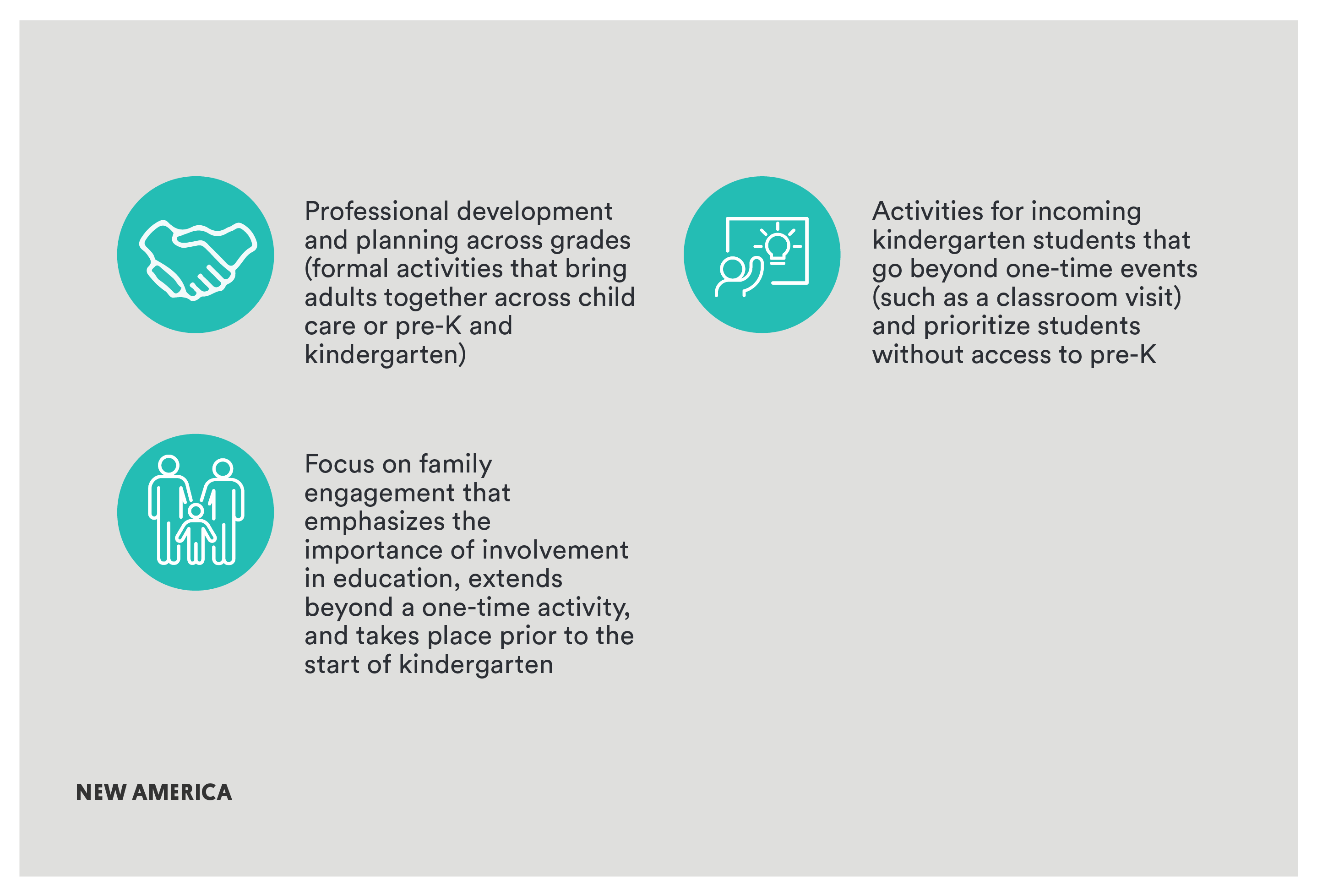
There are many actions schools and districts can take to help ensure a child’s transition into kindergarten is smooth and stress-free for her and her family. This report highlights innovative efforts schools and districts across the country are taking to ease the transition into kindergarten for families and students, including students who did not have access to pre-K prior to kindergarten. We include a range of models at different stages of development that are taking innovative approaches to ensuring a smooth transition to kindergarten. These schools and districts, while different from one another, are taking important steps to ensure the kindergarten year is a successful one for children and families. When searching for schools and districts to highlight we looked for places that are addressing one or more of the following priorities:
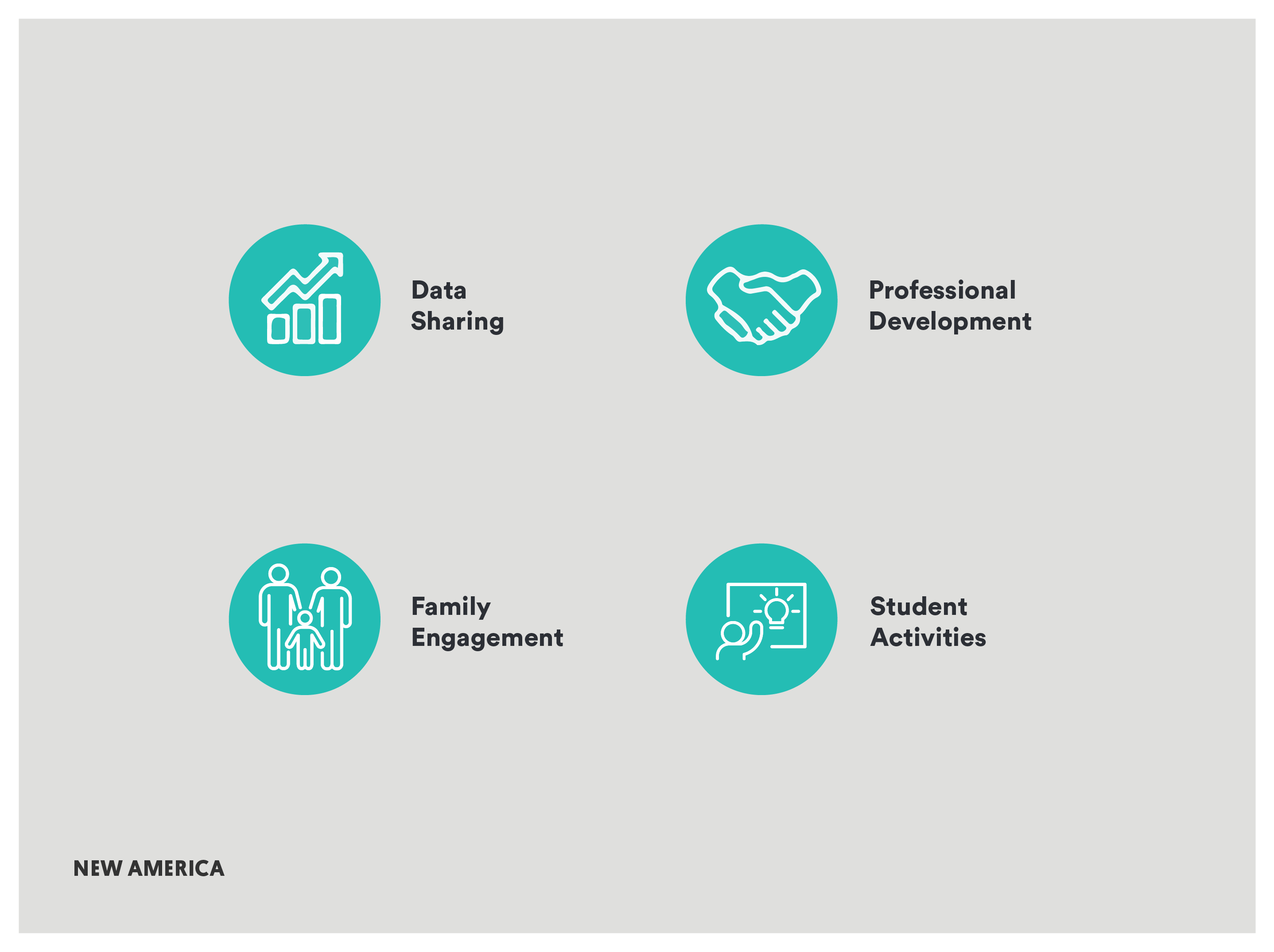
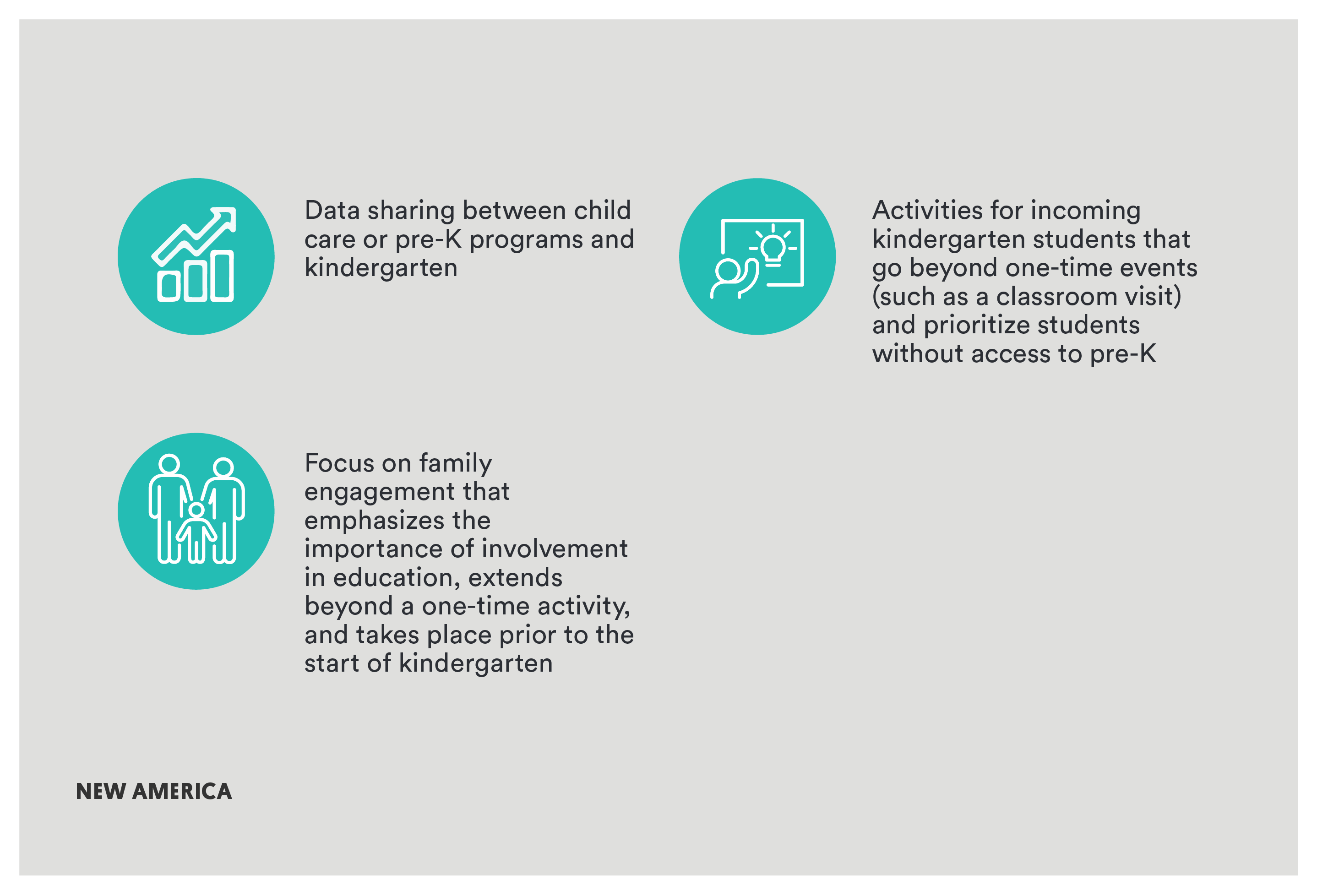
- Data sharing between child care or pre-K programs and kindergarten
- Professional development and planning across grades (formal activities that bring adults together across child care or pre-K and kindergarten)
- Focus on family engagement that emphasizes the importance of involvement in education, extends beyond a one-time activity, and takes place prior to the start of kindergarten
- Activities for incoming kindergarten students that go beyond one-time events (such as a classroom visit) and prioritize students without access to pre-K
Citations
- National Center for Education Statistics (website), “Table 203.10 Enrollment in Public elementary and secondary schools, by level and grade: Selected years, fall 1980 through fall 2023,” https://nces.ed.gov/programs/digest/d13/tables/dt13_203.10.asp
- Raj Chetty, John Friedman, Nathaniel Hilger, Emmanuel Saez, Diane Whitmore Schanzenbach, and Danny Yagan, How Does Your Kindergarten Classroom Affect Your Earnings? Evidence from Project STAR, Working Paper No. 16381 (Cambridge, MA: National Bureau of Economic Research, March 2011), http://www.equality-of-opportunity.org/assets/documents/star_paper.pdf
- Michael H. Little, Lora Cohen-Vogel, and F. Chris Curran. "Facilitating the Transition to Kindergarten." AERA Open 2, no. 3 (2016), https://journals.sagepub.com/doi/full/10.1177/2332858416655766
- Colorado, Oregon, Washington, and West Virginia. See Aaron Loewenberg, Connecting the Steps: States Strategies to Ease the Transition to Kindergarten (Washington, DC: New America, July 2017), https://www.newamerica.org/education-policy/policy-papers/connecting-steps/
Blue Mountain Early Learning Hub (Northeast Oregon)
The Blue Mountain Early Learning Hub covers an area of rural northeast Oregon that is approximately 7,300 square miles in size. The hub consists of 23 separate communities and 18 school districts. Its mission is to ensure collaboration and coordination between early learning and early childhood programs in the area to promote kindergarten readiness and overall well-being for the 10,000 children in the region. Of those 10,000 children, only about 60 percent receive some kind of early childhood service prior to kindergarten.5
Since 2014, the hub has used money from the state’s Kindergarten Readiness Partnership and Innovation funding stream to implement professional learning teams (PLTs) across the three rural counties that make up the hub. The PLTs include staff from Head Start programs, community child care programs, and K-third grade teachers. Initial meetings consisted of relationship-building among staff and then evolved into monthly shared professional learning sessions focused on implementing the Conscious Discipline model for supporting self-regulation and social-emotional development across early education settings.
The main goals of the PLTs are to (1) support the use of the Conscious Discipline model for behavior management; (2) provide professional development and support to both early learning providers and elementary school teachers; and (3) increase the alignment of pre-K and kindergarten practices to support continuity in learning for young children. While the use of a shared behavior management model across ages has been the main focus of the PLTs, one of the major goals of the PLTs is to improve alignment between the grades in a variety of areas.6
Portland State University studied the PLTs and found that both early learning providers and kindergarten teachers who participated felt that children in their classrooms improved in several areas as a result of what was learned in the PLTs, with the greatest improvement evident in social-emotional areas of development. Early learning providers described developing a greater understanding of kindergarten expectations and have altered their own teaching to better prepare students for kindergarten. One early learning provider spoke of the benefit of talking with kindergarten teachers about expectations for students: “I remember they brought posters in that had a list of…what kindergarteners need. It was helpful to see…It was so simple, but now we have a focus. A lot of them are definitely doable; it’s just nice to know.” And a kindergarten teacher spoke of the benefit of hearing from early learning providers: “The early childhood people have asked how we teach numbers, handwriting; we’ve provided them with some things that we’re using and vice versa.”7
Facilitating cross-grade professional development in a large, rural region comes with a unique set of challenges. The PLTs need to be located so educators are able to attend. “We have mountains in between communities and sometimes have a lot of snowfall so things get cancelled. The distance and mileage can be long for teachers to get to the meetings,” said Hub Operations Coordinator Amy Hoffert. Hub staff attempts to overcome this obstacle by strategically placing the PLTs in communities across the region so educators are more easily able to attend. Staff members also use Zoom or Skype conferencing when necessary to help overcome the geographic difficulties and ensure more educators are able to attend the PLTs.
Priorities Addressed by Blue Mountain Early Learning Hub: Professional Development
Citations
- National Center for Education Statistics (website), “Table 203.10 Enrollment in Public elementary and secondary schools, by level and grade: Selected years, fall 1980 through fall 2023,” https://nces.ed.gov/programs/digest/d13/tables/dt13_203.10.asp
- Raj Chetty, John Friedman, Nathaniel Hilger, Emmanuel Saez, Diane Whitmore Schanzenbach, and Danny Yagan, How Does Your Kindergarten Classroom Affect Your Earnings? Evidence from Project STAR, Working Paper No. 16381 (Cambridge, MA: National Bureau of Economic Research, March 2011), http://www.equality-of-opportunity.org/assets/documents/star_paper.pdf
- Michael H. Little, Lora Cohen-Vogel, and F. Chris Curran. "Facilitating the Transition to Kindergarten." AERA Open 2, no. 3 (2016), https://journals.sagepub.com/doi/full/10.1177/2332858416655766
- Colorado, Oregon, Washington, and West Virginia. See Aaron Loewenberg, Connecting the Steps: States Strategies to Ease the Transition to Kindergarten (Washington, DC: New America, July 2017), https://www.newamerica.org/education-policy/policy-papers/connecting-steps/
- Blue Mountain Early Learning Hub (website), “About Us,” https://bluemountainearlylearninghub.org/about-us
- The PLTs meet approximately six times per school year. In the first half of the 2017–18 school year, over 143 teachers attended at least one meeting. In 2018, the Blue Mountain Early Learning Hub implemented its first PLT focused on child care providers and home visitors who work primarily with infants and toddlers. In the first year of its existence, this infant and toddler PLT has met to focus on practices that promote healthy child-provider attachment as well as best practices for assessing child development.
- Lorelei Mitchell, Mackenzie Burton, Beth Green, and Lindsey Patterson, Center for Improvement of Child & Family Services, Portland State University, “Research Focus Brief: Building Early Learning–K3 Professional Learning Teams in the Blue Mountain Early Learning Hub,” September 12, 2017, https://www.pdx.edu/ccf/sites/www.pdx.edu.ccf/files/Blue%20Mountain%20Case%20Study_Research%20Brief_9-25-17_final.pdf
Multnomah County (Portland, Ore.)
Multnomah County, home to the city of Portland, has taken several steps to ease the transition to kindergarten by making early connections to children and their families. Early Learning Multnomah, the early learning hub for the area, has used a portion of funds received through the state’s Early Learning Kindergarten Readiness Partnership and Innovation grant program to fund P–3 coordinators at eight high-need schools across the county. Since 2016, the coordinators have offered Play and Learn groups at neighborhood elementary schools to serve parents and families of children from birth to age five prior to formal kindergarten entry. The groups were created as a way to link young children and families to the school and allow an opportunity for parents to connect with each other, with a focus on families who may feel less welcome and comfortable in the school. Each of the schools offers two Play and Learn groups per week and one of the groups must be culturally specific or held in a language other than English. Outreach efforts include developing relationships with community leaders, posting flyers in the community, connecting with faith communities, and working with partner agencies to spread information about the groups. The coordinators plan interactive group activities for parents and children focused on early learning, social-emotional development, getting comfortable with a school setting, and how to support child development.8
An evaluation of the Play and Learn groups performed by Portland State University found that parents and staff experienced multiple benefits from the creation of the groups, with the primary benefit revolving around kindergarten readiness. “This is a good place for them to interact with other kids in a fun and informal setting. They gain valuable kinder readiness skills and can establish social/emotional [skills] in a learning environment,” said one coordinator. Involvement with the groups also helps kids and families gain familiarity with a formal school setting and start to build a trusting relationship with the school. “It makes them familiar to the space. It’s an opportunity to build trust,” said another coordinator.9
Staff members who participate in the groups draw a direct link to involvement in Play and Learn and a smooth transition to kindergarten. “Kids are all about pattern and structure. If they’ve already been coming to the school for two years, kinder is an easy transition,” said a P–3 coordinator. The Play and Learn groups are seen as an important component of the work of aligning the early learning and K–12 systems. “Just having a coordinator in the building has and will probably continue to create more communication between K-1-2-3 grade teachers around following kids through different grades and making connections between younger preschool age children and their older siblings,” said one staff member.10
In addition to leading Play and Learn groups, the P–3 coordinators help organize and staff the Early Kindergarten Transition (EKT) Program, a two- or three-week program during late summer in which incoming kindergarteners become familiar with their new school and parents learn about ways to support learning at home. First piloted in two schools in 2010, EKT now reaches about 700 incoming kindergarten students each summer and takes place in 45 elementary schools.11 The program is based around two components: class time for students in classrooms that are led by a kindergarten teacher and family engagement activities designed to promote positive family-school relationships. There are three broad goals for EKT: (1) increase parental involvement in learning, (2) reduce chronic absenteeism in kindergarten, and (3) promote children’s success in school.12
Over the two- or three-week program, students attend school every morning for a total of 36 hours of classroom time; parents are offered at least 10 hours of group sessions. The parent sessions cover a range of topics, including gaining familiarity with the school facilities and staff, the importance of consistent attendance, how to read interactively with children, and the importance of establishing routines for bedtime and completing homework. Parents have the opportunity to visit their child’s classroom to observe and learn more about what happens in kindergarten.13 The students spend time practicing classroom routines and participating in activities to improve early math and literacy skills. Access to EKT is prioritized for children who did not have access to pre-K, children of color, children from low-income families, children who speak a language other than English, and children with special needs.14
An evaluation of EKT in 14 elementary schools within the Portland Public School District found promising results as a result of involvement in the program. Students who participated in EKT had higher attendance rates in kindergarten compared to students who did not participate. This pattern continued to hold through the second grade for these students before leveling out in third grade. Additionally, students participating in EKT were more likely than non-EKT students to meet early literacy benchmarks and less likely to require intensive support to improve early literacy skills.15
EKT and other similar summer programs are not a substitute for a full year of high-quality pre-K instruction, but they do accomplish several important goals. Most importantly, they facilitate relationship-building between the elementary school and children and families. Parents and children whose first interaction with elementary school staff is through a fun, helpful summer program are more likely to view the school in positive terms in the year that follows. The summer programs are also essential for helping both parents and children develop familiarity with the expectations of the kindergarten year to come.
In order to capture as much data as possible about incoming kindergarten students prior to the first day of school, Portland Public Schools has created a form for families to complete with the assistance of their child’s pre-K teacher or by themselves if their child did not attend pre-K. The Child Centered Plan explains student interests, strengths, and challenges. Once completed the form is shared by parents with the kindergarten teacher before the first day of school, providing valuable information about the needs of each student.16 While it would be even more beneficial to establish an electronic data sharing system that does not rely on parents hand-delivering a paper form, this is a good alternative, given issues of student privacy and software compatibility inherent in establishing a formal data sharing agreement.
Priorities Addressed by Multnomah County: Data Sharing, Family Engagement, Student Activities
Citations
- National Center for Education Statistics (website), “Table 203.10 Enrollment in Public elementary and secondary schools, by level and grade: Selected years, fall 1980 through fall 2023,” https://nces.ed.gov/programs/digest/d13/tables/dt13_203.10.asp
- Raj Chetty, John Friedman, Nathaniel Hilger, Emmanuel Saez, Diane Whitmore Schanzenbach, and Danny Yagan, How Does Your Kindergarten Classroom Affect Your Earnings? Evidence from Project STAR, Working Paper No. 16381 (Cambridge, MA: National Bureau of Economic Research, March 2011), http://www.equality-of-opportunity.org/assets/documents/star_paper.pdf
- Michael H. Little, Lora Cohen-Vogel, and F. Chris Curran. "Facilitating the Transition to Kindergarten." AERA Open 2, no. 3 (2016), https://journals.sagepub.com/doi/full/10.1177/2332858416655766
- Colorado, Oregon, Washington, and West Virginia. See Aaron Loewenberg, Connecting the Steps: States Strategies to Ease the Transition to Kindergarten (Washington, DC: New America, July 2017), https://www.newamerica.org/education-policy/policy-papers/connecting-steps/
- Blue Mountain Early Learning Hub (website), “About Us,” https://bluemountainearlylearninghub.org/about-us
- The PLTs meet approximately six times per school year. In the first half of the 2017–18 school year, over 143 teachers attended at least one meeting. In 2018, the Blue Mountain Early Learning Hub implemented its first PLT focused on child care providers and home visitors who work primarily with infants and toddlers. In the first year of its existence, this infant and toddler PLT has met to focus on practices that promote healthy child-provider attachment as well as best practices for assessing child development.
- Lorelei Mitchell, Mackenzie Burton, Beth Green, and Lindsey Patterson, Center for Improvement of Child & Family Services, Portland State University, “Research Focus Brief: Building Early Learning–K3 Professional Learning Teams in the Blue Mountain Early Learning Hub,” September 12, 2017, https://www.pdx.edu/ccf/sites/www.pdx.edu.ccf/files/Blue%20Mountain%20Case%20Study_Research%20Brief_9-25-17_final.pdf
- Center for Improvement of Child & Family Services, Portland State University, “Play and Learn Groups: A Bridge Between Schools & Families,” October 25, 2017, https://www.pdx.edu/ccf/sites/www.pdx.edu.ccf/files/KPI%20ELM%20Case%20Study%20PnL%20Report%202017-10-26-FINAL.pdf
- Ibid.
- Ibid.
- Brooke Chilton Timmons (early learning coordinator, SUN Service System, Multnomah County), interview with author, March 12, 2019.
- Portland Public Schools, “Program at a Glance: Early Kindergarten Transition,” December 2015, https://www.pps.net/cms/lib/OR01913224/Centricity/Domain/183/EKTresearchbrief.pdf
- Brooke Chilton Timmons (early learning coordinator, SUN Service System, Multnomah County), interview with author, March 12, 2019.
- Ibid.
- Beth Tarasawa, Nicole C. Ralson, and Jacqueline Waggoner, “Leveraging University-School District Research Partnerships: Exploring the Longitudinal Effects of an Early Kindergarten Transition Program,” Journal of Applied Research on Children: Informing Policy for Children at Risk 7, no. 1, Article 6, https://www.pps.net/cms/lib/OR01913224/Centricity/Domain/183/Tarasawa%20Ralston%20and%20Waggoner.pdf
- Portland Public Schools (website), “Child Centered Plan,” http://pps.net/page/12433.
Oyler School and Roberts Academy (Cincinnati, Ohio)
Two schools in Cincinnati, Oyler School and Roberts Academy, have recently begun working to improve the transition to kindergarten for students and families. Like all Cincinnati Public Schools, Oyler and Roberts Academy are Community Learning Centers, commonly referred to as community schools.17 Oyler and Roberts offer a variety of services that can be used by students and community members, including health, dental, and vision centers as well as housing and employment assistance. These partnerships are managed by an on-site resource coordinator at each school, employed by the Community Learning Center Institute (CLCI), a local nonprofit that leads the development of community learning centers in the Greater Cincinnati area. Several years ago, with support from the W. K. Kellogg Foundation, CLCI began exploring how best to support young children and their families and ensure they had access to community learning center services. CLCI partnered with Cincinnati Early Learning Centers (CELC), a local center-based early childhood provider, to add an early childhood resource coordinator (ECRC) to both Oyler and Roberts Academy.18
The ECRC at each school is tasked with conducting outreach in the community and connecting with families of children ages zero to five to make them aware of the broad array of resources available to families at the school. Valerie Jerome, the ECRC at Oyler School, is steadfast in her efforts to connect with families prior to formal school entry, saying, “I go to all the community activities I can find. When the water park is up and running I’ll go there and talk to the families. It’s all about building a relationship early and figuring out what they need.”19
At Roberts Academy, Maria Rivera, the bilingual ECRC, helps facilitate a class several times a week for parents and their children ages zero to five. The classes, called Learning Together, take place in a mobile classroom that parks at the school and at an apartment complex where many Roberts Academy families reside.20 The classes allow the school to make early connections with families and make them aware of all the services offered by the school. There is no packaged curriculum for the program. Instead, classes focus on helping parents understand child development and learning activities to enhance kindergarten readiness. On a recent Thursday afternoon, the Learning Together van was stationed in the Roberts Academy parking lot. Inside, four mothers were watching as their children, ranging in age from 18 months to three years, were enthusiastically exploring the recently updated play area. Earlier, Rivera had read The Very Hungry Caterpillar to the group and helped the mothers and children create their own caterpillars out of paper towel rolls and tissue paper. As the children played, the mothers conversed in Spanish. “It’s an opportunity for the parents and kids to learn, but it also allows the families to build relationships with each other,” said Rivera.
The ECRCs at both Oyler and Roberts take part in another recent development that has helped the schools break down traditional barriers between early learning and elementary school: the establishment of an early childhood committee that meets monthly at each school. Currently led by CLCI’s director of early childhood, the meetings also include pre-K and kindergarten teachers, a representative from the schools’ mental health partner, and representatives from the early childhood programs that feed the school. The committee meetings help drive the work of supporting kindergarten transitions by planning a variety of activities prior to kindergarten entry and strengthening communication and instructional alignment between early childhood providers and kindergarten teachers.21 “It’s a way to communicate with early learning providers and plan events like early literacy nights,” said Jeff Campbell, a pre-K teacher at Roberts. “The biggest change I’ve seen is our ability now to communicate with the kindergarten teachers and talk about all of our students.”22
As the lead agency at Oyler and Roberts, CLCI has taken a leadership role in breaking down the silos that historically exist between the worlds of early learning and elementary school by serving as a convener for cross-grade and cross-school meetings, educating teaching staff about best practices when it comes to early learning, and working to build buy-in from early learning and elementary school staff. Despite the fact that only one grade separates them, it is relatively rare to have pre-K and kindergarten teachers regularly meet to plan joint activities and ensure instructional alignment between the two grades. This sort of cross-grade, cross-school meeting is key for breaking down the traditional barriers that exist between the formal K–12 school system and early learning providers.
At Roberts, pre-K teachers and the two primary early childhood feeder programs to Roberts now make time to meet either in person or via phone with the kindergarten teachers to discuss how to support children transitioning into kindergarten. Additionally, in the summer of 2018 all elementary school staff, including the early childhood team, attended a four-day Responsive Classroom course that was provided through CLCI’s support to ensure that there is a similar approach to classroom management across all grade levels.23 Professional development that includes both pre-K and kindergarten teachers can be difficult to arrange due to the logistical challenges that arise from each grade having its own schedule for professional development and planning time.
The early childhood teams at both schools have begun to implement other new approaches to ensure a smooth transition to kindergarten. For example, the Oyler team has made it a priority to encourage timely kindergarten registration for families, since historically almost half of the incoming kindergarten class enrolled after the first day of school. The ECRC has employed various strategies to encourage families to enroll in kindergarten, including a “kindergarten enrollment week.” Oyler held its first kindergarten enrollment week in April 2018. Families were invited to attend an enrollment kickoff cookout and the ECRC held a kindergarten round-up where she assisted families with enrollment paperwork. Last year, these efforts led to a 16 percent increase in the number of kindergarten children enrolled prior to the first day of school.24 This year, the results are even more promising, with a 25 percent increase in the number of kindergartners enrolled prior to the end of the previous school year.25
Oyler also holds a kindergarten open house in the spring to allow families of incoming kindergarten students to visit classrooms, ask questions, and meet the teaching team. Building on a pilot offered last summer, CELC has partnered with Oyler to offer a six-week kindergarten bridge program in the summer of 2019 to allow incoming students to become familiar with classroom routines, their teacher, and their new school. Priority for this program was given to students without pre-K experience. The result of the spring and summer activities at Oyler is that “families come in on the first day and they’re not meeting strangers, but instead they feel comfortable and safe,” said April Mueller, director of Family Outreach at Cincinnati Early Learning Centers.26
Many similar programs are currently being implemented by the team at Roberts Academy. The ECRC collaborates with early childhood feeder programs to arrange for incoming students to visit kindergarten classrooms and other key parts of the school as well as meet teachers and staff. CELC has also partnered with Roberts to offer a six-week kindergarten bridge program this summer.27
Roberts Academy Principal Alpacino Beauchamp has taken the initiative to visit early childhood programs in the area to help parents learn more about his school and answer questions about what to expect in kindergarten. When asked why he took time out of his busy schedule of overseeing a school of approximately 800 students to visit early childhood providers, Beauchamp replied, “I say yes to their invitations because it matters. If you want students who are ready to learn then you need to go to the environment where they were previously and align your work with theirs.”28
Acquiring this level of principal buy-in is key for schools and districts focused on smoothing the transition to kindergarten.29 Since principals typically have a high degree of autonomy when it comes to the schools they oversee, it is difficult to make systemic changes to the kindergarten transition process without their support and their understanding of its importance. Principals who have a solid grasp of the importance of early education are more likely to understand the role the transition process plays in helping to ensure a successful kindergarten year for students and families. Currently, however, Illinois is the only state that has a principal licensure law that requires that early education is incorporated throughout coursework and field placements for prospective principals.30
Priorities Addressed by Oyler School and Roberts Academy: Professional Development, Family Engagement, Student Activities
Emphasizing Attendance During Transition Activities
An important element of the transition to kindergarten is an emphasis on consistent attendance. “The message we send during our Early Kindergarten Transition Program is that kindergarten attendance is important and a few days of absence can really hurt a child’s academic progress,” says Brooke Chilton Timmons, the early learning coordinator for the SUN Service System in Multnomah County.31 At least 10 percent of kindergarteners nationwide are chronically absent from school, missing at least 18 days per year. Kindergarteners from low-income families are four times more likely to be chronically absent than their more affluent peers.32 In California, kindergarten students are the most likely of any elementary school students to be chronically absent.33 Chronic absenteeism in the early grades is correlated with poor academic outcomes and continued attendance problems in later grades. A California study found that only 17 percent of students chronically absent in kindergarten and first grade were reading proficiently by third grade compared with 64 percent of students with consistent attendance.34
Attendance Works, a national and state initiative focusing on advancing student success and closing equity gaps by reducing chronic absence, recently released a toolkit titled Early Matters: Integrating Attendance into Kindergarten Transition. The toolkit offers ideas, resources, and examples of how to emphasize the importance of consistent attendance to students and families as part of the kindergarten transition process.35 The toolkit recommends a number of strategies during the transition to kindergarten, such as distributing information about the importance of attendance during school registration activities, making attendance messaging visible in classrooms and hallways, showing a video about the importance of consistent attendance during family workshops at the start of the school year, and offering supports to reduce health-related absences.
Citations
- National Center for Education Statistics (website), “Table 203.10 Enrollment in Public elementary and secondary schools, by level and grade: Selected years, fall 1980 through fall 2023,” https://nces.ed.gov/programs/digest/d13/tables/dt13_203.10.asp
- Raj Chetty, John Friedman, Nathaniel Hilger, Emmanuel Saez, Diane Whitmore Schanzenbach, and Danny Yagan, How Does Your Kindergarten Classroom Affect Your Earnings? Evidence from Project STAR, Working Paper No. 16381 (Cambridge, MA: National Bureau of Economic Research, March 2011), http://www.equality-of-opportunity.org/assets/documents/star_paper.pdf
- Michael H. Little, Lora Cohen-Vogel, and F. Chris Curran. "Facilitating the Transition to Kindergarten." AERA Open 2, no. 3 (2016), https://journals.sagepub.com/doi/full/10.1177/2332858416655766
- Colorado, Oregon, Washington, and West Virginia. See Aaron Loewenberg, Connecting the Steps: States Strategies to Ease the Transition to Kindergarten (Washington, DC: New America, July 2017), https://www.newamerica.org/education-policy/policy-papers/connecting-steps/
- Blue Mountain Early Learning Hub (website), “About Us,” https://bluemountainearlylearninghub.org/about-us
- The PLTs meet approximately six times per school year. In the first half of the 2017–18 school year, over 143 teachers attended at least one meeting. In 2018, the Blue Mountain Early Learning Hub implemented its first PLT focused on child care providers and home visitors who work primarily with infants and toddlers. In the first year of its existence, this infant and toddler PLT has met to focus on practices that promote healthy child-provider attachment as well as best practices for assessing child development.
- Lorelei Mitchell, Mackenzie Burton, Beth Green, and Lindsey Patterson, Center for Improvement of Child & Family Services, Portland State University, “Research Focus Brief: Building Early Learning–K3 Professional Learning Teams in the Blue Mountain Early Learning Hub,” September 12, 2017, https://www.pdx.edu/ccf/sites/www.pdx.edu.ccf/files/Blue%20Mountain%20Case%20Study_Research%20Brief_9-25-17_final.pdf
- Center for Improvement of Child & Family Services, Portland State University, “Play and Learn Groups: A Bridge Between Schools & Families,” October 25, 2017, https://www.pdx.edu/ccf/sites/www.pdx.edu.ccf/files/KPI%20ELM%20Case%20Study%20PnL%20Report%202017-10-26-FINAL.pdf
- Ibid.
- Ibid.
- Brooke Chilton Timmons (early learning coordinator, SUN Service System, Multnomah County), interview with author, March 12, 2019.
- Portland Public Schools, “Program at a Glance: Early Kindergarten Transition,” December 2015, https://www.pps.net/cms/lib/OR01913224/Centricity/Domain/183/EKTresearchbrief.pdf
- Brooke Chilton Timmons (early learning coordinator, SUN Service System, Multnomah County), interview with author, March 12, 2019.
- Ibid.
- Beth Tarasawa, Nicole C. Ralson, and Jacqueline Waggoner, “Leveraging University-School District Research Partnerships: Exploring the Longitudinal Effects of an Early Kindergarten Transition Program,” Journal of Applied Research on Children: Informing Policy for Children at Risk 7, no. 1, Article 6, https://www.pps.net/cms/lib/OR01913224/Centricity/Domain/183/Tarasawa%20Ralston%20and%20Waggoner.pdf
- Portland Public Schools (website), “Child Centered Plan,” http://pps.net/page/12433.
- Community schools bring together a group of partners to offer a range of supports for children and families, often including health and social services.
- Angela Farwig, “Supporting Kindergarten Transitions in Cincinnati’s Community Learning Centers,” August 17, 2018.
- Valerie Jerome (early childhood resource coordinator, Oyler School), interview with author, May 2, 2019.
- Angela Farwig (director of early childhood, Community Learning Center Institute), interview with author, April 1, 2019.
- Angela Farwig, “Supporting Kindergarten Transitions in Cincinnati’s Community Learning Centers,” August 17, 2018.
- Jeff Campbell (pre-K teacher, Roberts Academy), interview with author, May 2, 2019.
- Angela Farwig, “Supporting Kindergarten Transitions in Cincinnati’s Community Learning Centers,” August 17, 2018.
- Angela Farwig, “Supporting Kindergarten Transitions in Cincinnati’s Community Learning Centers: Oyler Community Learning Center,” August 31, 2018.
- Angela Farwig (director of early childhood, Community Learning Center Institute), interview with author, June 26, 2019.
- April Mueller (director of Family Outreach, Cincinnati Early Learning Centers), interview with author, May 2, 2019.
- Ibid.
- Alpacino Beauchamp (principal, Roberts Academy), interview with author, May 2, 2019.
- For information about programs that are building principals’ knowledge of early learning, see Abbie Lieberman and Laura Bornfreund, Building Early Education Leaders: A Closer Look at How States and Districts are Equipping Principals to Support Young Learners (Washington, DC: New America, June 2019), https://www.newamerica.org/education-policy/reports/building-early-education-leaders/
- Abbie Lieberman, A Tale of Two Pre-K Leaders: How State Policies for Center Directors and Principals Leading Pre-K Programs Differ, and Why They Shouldn’t (Washington, DC: New America, May 2017), https://www.newamerica.org/education-policy/policy-papers/tale-two-pre-k-leaders/
- Brooke Chilton Timmons (early learning coordinator, SUN Service System, Multnomah County,) interview with author, March 12, 2019.
- “Mapping the Early Attendance Gap: Charting A Course for School Success,” Attendance Works and Healthy Schools Campaign, September 2015, https://www.attendanceworks.org/wp-content/uploads/2017/05/Mapping-the-Early-Attendance-Gap_Final-4.pdf
- Erin Brownfield, “Kindergartners: The most ‘truant’ students?” EdSource, October 5, 2015, http://edsource.org/2015/kindergarteners-the-most-truant-students/88392
- Attendance Works and The Campaign for Grade-Level Reading, “Attendance in the Early Grades: Why it Matters for Reading,” research brief, February 2014, https://www.attendanceworks.org/wp-content/uploads/2017/06/Attendance-in-the-Early-Grades.pdf
- Attendance Works (website), “Early Matters: Integrating Attendance Into Kindergarten Transition,” February 2019, https://www.attendanceworks.org/resources/toolkits/integrating-attendance-into-kindergarten-transition/
Altgeld-Riverdale Neighborhood (Chicago, Ill.)
The Altgeld-Riverdale community, located on Chicago’s South Side, is taking a community-wide approach to addressing the transition to kindergarten for students and families. Over 60 percent of the approximately 7,000 people residing in the neighborhood live below the poverty line. Over 95 percent of the residents are African American. There are historical divisions within the community that made it seem like the ideal locale to launch a community-wide effort to promote a greater degree of overall cohesion. The community is home to four elementary schools and two early childhood centers.36
The Pre-Kindergarten to Kindergarten Transitions Project (PKTP) was launched in Altgeld-Riverdale in 2015 by BPI, a Chicago-based public interest and law and policy center, after a community needs assessment and work group identified the transition from pre-K to kindergarten as a top priority. PKTP was piloted during the 2015–16 school year with the first full year of implementation taking place during the 2016–17 school year. There are three main components to PKTP: a cross-grade, cross-school professional learning community for educators; common classroom practices across pre-K and kindergarten; and family learning activities.37
The professional learning community consists of monthly 90-minute meetings between pre-K and kindergarten teachers from the various elementary schools and early childhood centers in the neighborhood. The goal of the meetings is to reduce differences in teaching methods and philosophies between grades and schools. The meetings, facilitated by BPI staff, consist of discussions of common classroom practices, planning for upcoming family activities, and professional development sessions on topics such as trauma-informed teaching practices. An evaluation of PKTP found that a majority of participants found the monthly meetings to be valuable and helped them to learn about new strategies for improving student outcomes in their classrooms.38 “If not for PKTP I don’t think these teachers from different schools would be talking to each other. It’s been an incredibly helpful opportunity for teachers to interact with their peers from across the neighborhood,” said Emily Powers, project director of the PreK–K Transitions Program at BPI.39
An important part of the monthly, cross-school meetings is discussion of three common classroom practices that teachers selected as the most important: self-regulation practices, trauma-sensitive practices, and dramatic play. Teachers decided to implement self-regulation and trauma-sensitive practices by having their students identify their feelings three times a day. All pre-K and kindergarten classrooms in the neighborhood schools now use “Tucker the Turtle,” a storybook and puppet to help children learn how to stay calm when they are upset and how to think of a solution to the problem upsetting them. Since all pre-K students in the neighborhood are familiar with the Tucker puppet, when they transition into kindergarten they have a sense of continuity in managing their emotions when they see him. The teachers’ focus on dramatic play resulted in common, cross-school objectives: changing the focus of the dramatic play centers at least twice a month and making sure the focus is related to the current curricular unit.40
In order to increase interactions between teachers and families and to model learning activities that parents can implement at home, PKTP organizes several “Family Fun Hours” each school year. These events, hosted at elementary schools, are open to pre-K and kindergarten students and families from all elementary schools and learning centers in the neighborhood. For example, a science-themed Family Fun Hour consisted of several experiments for students to take part in that could be easily replicated at home. About two-thirds of parents who completed a survey in spring 2017 reported participating in one or more of the Family Fun Hours.41 To encourage student, family, and teacher interaction across grades and schools, PKTP also supports fields trips across the city that bring together pre-K and kindergarten students. The cross-grade, cross-school field trips allow kindergarten teachers to gain familiarity with pre-K students and families who might be entering their classroom during the next school year.
“Now all the teachers and families feel more like a part of the community and are working on a common project together,” said Powers, summing up the achievements of PKTP after three school years of implementation. An evaluation of PKTP provides support for this belief. Pre-K and kindergarten teachers reported feeling a greater sense of connection to each other across grades and schools. Parents also felt more connected to each other as a result of participation in PKTP. Chicago Public Schools has expressed interest in scaling up PKTP’s community-wide approach to supporting the transition to kindergarten, but there is currently no set timeline for doing so.42 That being said, the work of PKTP in the Altgeld-Riverdale neighborhood is still in its early stages and the team is working to strengthen the program based on lessons learned from the first years of implementation.
Currently, there is no formal data sharing arrangement in place between pre-K and kindergarten teachers in the neighborhood. The sharing of data is made difficult by the fact that the pre-K and kindergarten classrooms use two different assessment systems, so there is no simple way to electronically share student records. The development of a formal plan for sharing student assessment data has been identified by BPI as a major need to be addressed in the future.43 Additionally, BPI staff members are aware of challenges that have emerged in implementing common classroom practices between pre-K and kindergarten due to differences in expectations for each grade. Kindergarten generally allots less time for the kind of dramatic play activities encouraged by PKTP, making it more difficult to implement common practices for dramatic play in a way that clearly aligns with each grade’s curricula. BPI plans to continue working with teachers and leaders of the neighborhood schools to provide the tools and skills necessary to help implement classroom practices in a way that is compatible with each grade’s curricula.
Priorities Addressed by Altgeld-Riverdale Neighborhood: Professional Development, Family Engagement, Student Activities
Citations
- National Center for Education Statistics (website), “Table 203.10 Enrollment in Public elementary and secondary schools, by level and grade: Selected years, fall 1980 through fall 2023,” https://nces.ed.gov/programs/digest/d13/tables/dt13_203.10.asp
- Raj Chetty, John Friedman, Nathaniel Hilger, Emmanuel Saez, Diane Whitmore Schanzenbach, and Danny Yagan, How Does Your Kindergarten Classroom Affect Your Earnings? Evidence from Project STAR, Working Paper No. 16381 (Cambridge, MA: National Bureau of Economic Research, March 2011), http://www.equality-of-opportunity.org/assets/documents/star_paper.pdf
- Michael H. Little, Lora Cohen-Vogel, and F. Chris Curran. "Facilitating the Transition to Kindergarten." AERA Open 2, no. 3 (2016), https://journals.sagepub.com/doi/full/10.1177/2332858416655766
- Colorado, Oregon, Washington, and West Virginia. See Aaron Loewenberg, Connecting the Steps: States Strategies to Ease the Transition to Kindergarten (Washington, DC: New America, July 2017), https://www.newamerica.org/education-policy/policy-papers/connecting-steps/
- Blue Mountain Early Learning Hub (website), “About Us,” https://bluemountainearlylearninghub.org/about-us
- The PLTs meet approximately six times per school year. In the first half of the 2017–18 school year, over 143 teachers attended at least one meeting. In 2018, the Blue Mountain Early Learning Hub implemented its first PLT focused on child care providers and home visitors who work primarily with infants and toddlers. In the first year of its existence, this infant and toddler PLT has met to focus on practices that promote healthy child-provider attachment as well as best practices for assessing child development.
- Lorelei Mitchell, Mackenzie Burton, Beth Green, and Lindsey Patterson, Center for Improvement of Child & Family Services, Portland State University, “Research Focus Brief: Building Early Learning–K3 Professional Learning Teams in the Blue Mountain Early Learning Hub,” September 12, 2017, https://www.pdx.edu/ccf/sites/www.pdx.edu.ccf/files/Blue%20Mountain%20Case%20Study_Research%20Brief_9-25-17_final.pdf
- Center for Improvement of Child & Family Services, Portland State University, “Play and Learn Groups: A Bridge Between Schools & Families,” October 25, 2017, https://www.pdx.edu/ccf/sites/www.pdx.edu.ccf/files/KPI%20ELM%20Case%20Study%20PnL%20Report%202017-10-26-FINAL.pdf
- Ibid.
- Ibid.
- Brooke Chilton Timmons (early learning coordinator, SUN Service System, Multnomah County), interview with author, March 12, 2019.
- Portland Public Schools, “Program at a Glance: Early Kindergarten Transition,” December 2015, https://www.pps.net/cms/lib/OR01913224/Centricity/Domain/183/EKTresearchbrief.pdf
- Brooke Chilton Timmons (early learning coordinator, SUN Service System, Multnomah County), interview with author, March 12, 2019.
- Ibid.
- Beth Tarasawa, Nicole C. Ralson, and Jacqueline Waggoner, “Leveraging University-School District Research Partnerships: Exploring the Longitudinal Effects of an Early Kindergarten Transition Program,” Journal of Applied Research on Children: Informing Policy for Children at Risk 7, no. 1, Article 6, https://www.pps.net/cms/lib/OR01913224/Centricity/Domain/183/Tarasawa%20Ralston%20and%20Waggoner.pdf
- Portland Public Schools (website), “Child Centered Plan,” http://pps.net/page/12433.
- Community schools bring together a group of partners to offer a range of supports for children and families, often including health and social services.
- Angela Farwig, “Supporting Kindergarten Transitions in Cincinnati’s Community Learning Centers,” August 17, 2018.
- Valerie Jerome (early childhood resource coordinator, Oyler School), interview with author, May 2, 2019.
- Angela Farwig (director of early childhood, Community Learning Center Institute), interview with author, April 1, 2019.
- Angela Farwig, “Supporting Kindergarten Transitions in Cincinnati’s Community Learning Centers,” August 17, 2018.
- Jeff Campbell (pre-K teacher, Roberts Academy), interview with author, May 2, 2019.
- Angela Farwig, “Supporting Kindergarten Transitions in Cincinnati’s Community Learning Centers,” August 17, 2018.
- Angela Farwig, “Supporting Kindergarten Transitions in Cincinnati’s Community Learning Centers: Oyler Community Learning Center,” August 31, 2018.
- Angela Farwig (director of early childhood, Community Learning Center Institute), interview with author, June 26, 2019.
- April Mueller (director of Family Outreach, Cincinnati Early Learning Centers), interview with author, May 2, 2019.
- Ibid.
- Alpacino Beauchamp (principal, Roberts Academy), interview with author, May 2, 2019.
- For information about programs that are building principals’ knowledge of early learning, see Abbie Lieberman and Laura Bornfreund, Building Early Education Leaders: A Closer Look at How States and Districts are Equipping Principals to Support Young Learners (Washington, DC: New America, June 2019), https://www.newamerica.org/education-policy/reports/building-early-education-leaders/
- Abbie Lieberman, A Tale of Two Pre-K Leaders: How State Policies for Center Directors and Principals Leading Pre-K Programs Differ, and Why They Shouldn’t (Washington, DC: New America, May 2017), https://www.newamerica.org/education-policy/policy-papers/tale-two-pre-k-leaders/
- Brooke Chilton Timmons (early learning coordinator, SUN Service System, Multnomah County,) interview with author, March 12, 2019.
- “Mapping the Early Attendance Gap: Charting A Course for School Success,” Attendance Works and Healthy Schools Campaign, September 2015, https://www.attendanceworks.org/wp-content/uploads/2017/05/Mapping-the-Early-Attendance-Gap_Final-4.pdf
- Erin Brownfield, “Kindergartners: The most ‘truant’ students?” EdSource, October 5, 2015, http://edsource.org/2015/kindergarteners-the-most-truant-students/88392
- Attendance Works and The Campaign for Grade-Level Reading, “Attendance in the Early Grades: Why it Matters for Reading,” research brief, February 2014, https://www.attendanceworks.org/wp-content/uploads/2017/06/Attendance-in-the-Early-Grades.pdf
- Attendance Works (website), “Early Matters: Integrating Attendance Into Kindergarten Transition,” February 2019, https://www.attendanceworks.org/resources/toolkits/integrating-attendance-into-kindergarten-transition/
- Angeline K. Spain, Stacy B. Ehrlich, Jennifer R. Cowhy, Denali K. Dasgupta, and Tracey Lockaby, A Community Effort to Support the Transition from Pre-K to Kindergarten (Chicago, IL: University of Chicago Consortium on School Research and Chapin Hall at the University of Chicago, 2018), .https://consortium.uchicago.edu/sites/default/files/2018-10/A%20Community%20Effort%20to%20Support-July2018-Consortium_0.pdf
- Emily Powers (project director, PreK–K Transitions Program, BPI) and Susannah Levine (director of Education and Early Learning, BPI), interview with author, March 20, 2019.
- Spain et al., A Community Effort.
- Emily Powers (project director, PreK–K Transitions Program, BPI) and Susannah Levine (director of Education and Early Learning, BPI), interview with author, March 20, 2019.
- Spain et al., A Community Effort.
- Ibid.
- Ibid.
- Emily Powers (project director, PreK-K Transitions Program, BPI) and Susannah Levine (director of Education and Early Learning, BPI), interview with author, March 20, 2019.
Conclusion
The schools and districts profiled in the four communities in this report have taken different steps to help smooth the transition to kindergarten for children and families, with a particular emphasis on promoting equity by focusing on better serving children from low-income families. Because of the historic divide between early learning and the formal K–12 school system, it will require years of dedicated effort to truly establish a system that ensures students and families a transition into a kindergarten classroom that is prepared to receive them and provide them with a high-quality learning experience starting on the very first day of school. While the practices highlighted here are focused on different components of the transition to kindergarten, they all represent promising approaches for helping students begin kindergarten with the greatest chance of success possible, both in kindergarten and in the grades that follow.
Citations
- National Center for Education Statistics (website), “Table 203.10 Enrollment in Public elementary and secondary schools, by level and grade: Selected years, fall 1980 through fall 2023,” https://nces.ed.gov/programs/digest/d13/tables/dt13_203.10.asp
- Raj Chetty, John Friedman, Nathaniel Hilger, Emmanuel Saez, Diane Whitmore Schanzenbach, and Danny Yagan, How Does Your Kindergarten Classroom Affect Your Earnings? Evidence from Project STAR, Working Paper No. 16381 (Cambridge, MA: National Bureau of Economic Research, March 2011), http://www.equality-of-opportunity.org/assets/documents/star_paper.pdf
- Michael H. Little, Lora Cohen-Vogel, and F. Chris Curran. "Facilitating the Transition to Kindergarten." AERA Open 2, no. 3 (2016), https://journals.sagepub.com/doi/full/10.1177/2332858416655766
- Colorado, Oregon, Washington, and West Virginia. See Aaron Loewenberg, Connecting the Steps: States Strategies to Ease the Transition to Kindergarten (Washington, DC: New America, July 2017), https://www.newamerica.org/education-policy/policy-papers/connecting-steps/
- Blue Mountain Early Learning Hub (website), “About Us,” https://bluemountainearlylearninghub.org/about-us
- The PLTs meet approximately six times per school year. In the first half of the 2017–18 school year, over 143 teachers attended at least one meeting. In 2018, the Blue Mountain Early Learning Hub implemented its first PLT focused on child care providers and home visitors who work primarily with infants and toddlers. In the first year of its existence, this infant and toddler PLT has met to focus on practices that promote healthy child-provider attachment as well as best practices for assessing child development.
- Lorelei Mitchell, Mackenzie Burton, Beth Green, and Lindsey Patterson, Center for Improvement of Child & Family Services, Portland State University, “Research Focus Brief: Building Early Learning–K3 Professional Learning Teams in the Blue Mountain Early Learning Hub,” September 12, 2017, https://www.pdx.edu/ccf/sites/www.pdx.edu.ccf/files/Blue%20Mountain%20Case%20Study_Research%20Brief_9-25-17_final.pdf
- Center for Improvement of Child & Family Services, Portland State University, “Play and Learn Groups: A Bridge Between Schools & Families,” October 25, 2017, https://www.pdx.edu/ccf/sites/www.pdx.edu.ccf/files/KPI%20ELM%20Case%20Study%20PnL%20Report%202017-10-26-FINAL.pdf
- Ibid.
- Ibid.
- Brooke Chilton Timmons (early learning coordinator, SUN Service System, Multnomah County), interview with author, March 12, 2019.
- Portland Public Schools, “Program at a Glance: Early Kindergarten Transition,” December 2015, https://www.pps.net/cms/lib/OR01913224/Centricity/Domain/183/EKTresearchbrief.pdf
- Brooke Chilton Timmons (early learning coordinator, SUN Service System, Multnomah County), interview with author, March 12, 2019.
- Ibid.
- Beth Tarasawa, Nicole C. Ralson, and Jacqueline Waggoner, “Leveraging University-School District Research Partnerships: Exploring the Longitudinal Effects of an Early Kindergarten Transition Program,” Journal of Applied Research on Children: Informing Policy for Children at Risk 7, no. 1, Article 6, https://www.pps.net/cms/lib/OR01913224/Centricity/Domain/183/Tarasawa%20Ralston%20and%20Waggoner.pdf
- Portland Public Schools (website), “Child Centered Plan,” http://pps.net/page/12433.
- Community schools bring together a group of partners to offer a range of supports for children and families, often including health and social services.
- Angela Farwig, “Supporting Kindergarten Transitions in Cincinnati’s Community Learning Centers,” August 17, 2018.
- Valerie Jerome (early childhood resource coordinator, Oyler School), interview with author, May 2, 2019.
- Angela Farwig (director of early childhood, Community Learning Center Institute), interview with author, April 1, 2019.
- Angela Farwig, “Supporting Kindergarten Transitions in Cincinnati’s Community Learning Centers,” August 17, 2018.
- Jeff Campbell (pre-K teacher, Roberts Academy), interview with author, May 2, 2019.
- Angela Farwig, “Supporting Kindergarten Transitions in Cincinnati’s Community Learning Centers,” August 17, 2018.
- Angela Farwig, “Supporting Kindergarten Transitions in Cincinnati’s Community Learning Centers: Oyler Community Learning Center,” August 31, 2018.
- Angela Farwig (director of early childhood, Community Learning Center Institute), interview with author, June 26, 2019.
- April Mueller (director of Family Outreach, Cincinnati Early Learning Centers), interview with author, May 2, 2019.
- Ibid.
- Alpacino Beauchamp (principal, Roberts Academy), interview with author, May 2, 2019.
- For information about programs that are building principals’ knowledge of early learning, see Abbie Lieberman and Laura Bornfreund, Building Early Education Leaders: A Closer Look at How States and Districts are Equipping Principals to Support Young Learners (Washington, DC: New America, June 2019), https://www.newamerica.org/education-policy/reports/building-early-education-leaders/
- Abbie Lieberman, A Tale of Two Pre-K Leaders: How State Policies for Center Directors and Principals Leading Pre-K Programs Differ, and Why They Shouldn’t (Washington, DC: New America, May 2017), https://www.newamerica.org/education-policy/policy-papers/tale-two-pre-k-leaders/
- Brooke Chilton Timmons (early learning coordinator, SUN Service System, Multnomah County,) interview with author, March 12, 2019.
- “Mapping the Early Attendance Gap: Charting A Course for School Success,” Attendance Works and Healthy Schools Campaign, September 2015, https://www.attendanceworks.org/wp-content/uploads/2017/05/Mapping-the-Early-Attendance-Gap_Final-4.pdf
- Erin Brownfield, “Kindergartners: The most ‘truant’ students?” EdSource, October 5, 2015, http://edsource.org/2015/kindergarteners-the-most-truant-students/88392
- Attendance Works and The Campaign for Grade-Level Reading, “Attendance in the Early Grades: Why it Matters for Reading,” research brief, February 2014, https://www.attendanceworks.org/wp-content/uploads/2017/06/Attendance-in-the-Early-Grades.pdf
- Attendance Works (website), “Early Matters: Integrating Attendance Into Kindergarten Transition,” February 2019, https://www.attendanceworks.org/resources/toolkits/integrating-attendance-into-kindergarten-transition/
- Angeline K. Spain, Stacy B. Ehrlich, Jennifer R. Cowhy, Denali K. Dasgupta, and Tracey Lockaby, A Community Effort to Support the Transition from Pre-K to Kindergarten (Chicago, IL: University of Chicago Consortium on School Research and Chapin Hall at the University of Chicago, 2018), .https://consortium.uchicago.edu/sites/default/files/2018-10/A%20Community%20Effort%20to%20Support-July2018-Consortium_0.pdf
- Emily Powers (project director, PreK–K Transitions Program, BPI) and Susannah Levine (director of Education and Early Learning, BPI), interview with author, March 20, 2019.
- Spain et al., A Community Effort.
- Emily Powers (project director, PreK–K Transitions Program, BPI) and Susannah Levine (director of Education and Early Learning, BPI), interview with author, March 20, 2019.
- Spain et al., A Community Effort.
- Ibid.
- Ibid.
- Emily Powers (project director, PreK-K Transitions Program, BPI) and Susannah Levine (director of Education and Early Learning, BPI), interview with author, March 20, 2019.
Recommendations for Schools and Districts
Take a proactive approach to reaching students ages zero to five and their families
A key theme that emerged from the schools and districts studied in this report is the importance of forming relationships with children and families as early as possible, preferably several years before kindergarten entry. Building a trusting relationship between families and schools is something that takes time and starting that work as early as possible makes it more likely that such a relationship will become a reality. When financially possible, schools and districts should make it a priority to hire staff whose primary responsibility is finding and connecting with families with children under the age of five and helping them access needed services. This is the job of the P–3 coordinators in Portland as well as the Early Childhood Resource Coordinators in Multnomah County, Oregon. These staff members also make it a priority to establish relationships with early learning providers throughout the community to learn more about possibilities for collaboration.
Establish cross-grade, cross-school learning communities
Breaking down the historic barriers that have existed between early learning providers and the formal elementary school system is difficult work that takes time. Traditionally these two areas of education have existed in separate silos with little communication between them and changing this requires overcoming several challenges, including distrust between the two groups of educators and the difficulty of finding a regular meeting time that works for all parties involved. But both Cincinnati and Chicago offer examples of the benefits that are possible when time is regularly set aside for educators from different grades and schools to become more familiar with each other and discuss the alignment of instruction and curricula. For example, the early childhood committees established in several Cincinnati schools have helped to strengthen communication and instructional alignment between early childhood providers and kindergarten teachers, resulting in a smoother transition to kindergarten for students and families. Even a cross-grade, cross-school group that is only able to meet sporadically throughout the year would help to establish helpful lines of communication between early learning providers and elementary school educators.
Use ESSA dollars to fund transition activities
With the passage of ESSA, states and districts now have greater flexibility to invest in early learning. Under Title I of ESSA, federal funds can be used to assist pre-K students in the transition from early childhood education programs to elementary school programs. Title I plans must specifically include a description of how local education agencies will “support, coordinate, and integrate” Head Start services to enable smooth transitions between Head Start and elementary school programs. ESSA requires that districts reach agreements with Head Start programs and encourages districts to also include other early education programs. These agreements should include plans to organize joint transition-related training between child care providers and kindergarten teachers and specific instructions regarding the transfer of student records.
Establish a local system for sharing student data between pre-K and kindergarten
While the schools and districts studied in this report are taking innovative approaches to ensuring a smooth transition to kindergarten, many people we spoke to noted that there is still work to do when it comes to establishing a clear system for sharing student data between pre-K and kindergarten. There are several challenges involved in accomplishing the seemingly simple task of passing data from a student’s current school and grade to her next school/grade, including privacy issues and different data systems between grades and schools. Schools, districts, and community-based child care providers should dedicate the time and resources necessary to overcome these obstacles since an effective system for sharing student data would enable kindergarten teachers to begin the school year with a much clearer idea of the unique needs of each student. States can also play an important role here by working to build early childhood data systems that connect early learning to K–12 longitudinal data.
Citations
- National Center for Education Statistics (website), “Table 203.10 Enrollment in Public elementary and secondary schools, by level and grade: Selected years, fall 1980 through fall 2023,” https://nces.ed.gov/programs/digest/d13/tables/dt13_203.10.asp
- Raj Chetty, John Friedman, Nathaniel Hilger, Emmanuel Saez, Diane Whitmore Schanzenbach, and Danny Yagan, How Does Your Kindergarten Classroom Affect Your Earnings? Evidence from Project STAR, Working Paper No. 16381 (Cambridge, MA: National Bureau of Economic Research, March 2011), http://www.equality-of-opportunity.org/assets/documents/star_paper.pdf
- Michael H. Little, Lora Cohen-Vogel, and F. Chris Curran. "Facilitating the Transition to Kindergarten." AERA Open 2, no. 3 (2016), https://journals.sagepub.com/doi/full/10.1177/2332858416655766
- Colorado, Oregon, Washington, and West Virginia. See Aaron Loewenberg, Connecting the Steps: States Strategies to Ease the Transition to Kindergarten (Washington, DC: New America, July 2017), https://www.newamerica.org/education-policy/policy-papers/connecting-steps/
- Blue Mountain Early Learning Hub (website), “About Us,” https://bluemountainearlylearninghub.org/about-us
- The PLTs meet approximately six times per school year. In the first half of the 2017–18 school year, over 143 teachers attended at least one meeting. In 2018, the Blue Mountain Early Learning Hub implemented its first PLT focused on child care providers and home visitors who work primarily with infants and toddlers. In the first year of its existence, this infant and toddler PLT has met to focus on practices that promote healthy child-provider attachment as well as best practices for assessing child development.
- Lorelei Mitchell, Mackenzie Burton, Beth Green, and Lindsey Patterson, Center for Improvement of Child & Family Services, Portland State University, “Research Focus Brief: Building Early Learning–K3 Professional Learning Teams in the Blue Mountain Early Learning Hub,” September 12, 2017, https://www.pdx.edu/ccf/sites/www.pdx.edu.ccf/files/Blue%20Mountain%20Case%20Study_Research%20Brief_9-25-17_final.pdf
- Center for Improvement of Child & Family Services, Portland State University, “Play and Learn Groups: A Bridge Between Schools & Families,” October 25, 2017, https://www.pdx.edu/ccf/sites/www.pdx.edu.ccf/files/KPI%20ELM%20Case%20Study%20PnL%20Report%202017-10-26-FINAL.pdf
- Ibid.
- Ibid.
- Brooke Chilton Timmons (early learning coordinator, SUN Service System, Multnomah County), interview with author, March 12, 2019.
- Portland Public Schools, “Program at a Glance: Early Kindergarten Transition,” December 2015, https://www.pps.net/cms/lib/OR01913224/Centricity/Domain/183/EKTresearchbrief.pdf
- Brooke Chilton Timmons (early learning coordinator, SUN Service System, Multnomah County), interview with author, March 12, 2019.
- Ibid.
- Beth Tarasawa, Nicole C. Ralson, and Jacqueline Waggoner, “Leveraging University-School District Research Partnerships: Exploring the Longitudinal Effects of an Early Kindergarten Transition Program,” Journal of Applied Research on Children: Informing Policy for Children at Risk 7, no. 1, Article 6, https://www.pps.net/cms/lib/OR01913224/Centricity/Domain/183/Tarasawa%20Ralston%20and%20Waggoner.pdf
- Portland Public Schools (website), “Child Centered Plan,” http://pps.net/page/12433.
- Community schools bring together a group of partners to offer a range of supports for children and families, often including health and social services.
- Angela Farwig, “Supporting Kindergarten Transitions in Cincinnati’s Community Learning Centers,” August 17, 2018.
- Valerie Jerome (early childhood resource coordinator, Oyler School), interview with author, May 2, 2019.
- Angela Farwig (director of early childhood, Community Learning Center Institute), interview with author, April 1, 2019.
- Angela Farwig, “Supporting Kindergarten Transitions in Cincinnati’s Community Learning Centers,” August 17, 2018.
- Jeff Campbell (pre-K teacher, Roberts Academy), interview with author, May 2, 2019.
- Angela Farwig, “Supporting Kindergarten Transitions in Cincinnati’s Community Learning Centers,” August 17, 2018.
- Angela Farwig, “Supporting Kindergarten Transitions in Cincinnati’s Community Learning Centers: Oyler Community Learning Center,” August 31, 2018.
- Angela Farwig (director of early childhood, Community Learning Center Institute), interview with author, June 26, 2019.
- April Mueller (director of Family Outreach, Cincinnati Early Learning Centers), interview with author, May 2, 2019.
- Ibid.
- Alpacino Beauchamp (principal, Roberts Academy), interview with author, May 2, 2019.
- For information about programs that are building principals’ knowledge of early learning, see Abbie Lieberman and Laura Bornfreund, Building Early Education Leaders: A Closer Look at How States and Districts are Equipping Principals to Support Young Learners (Washington, DC: New America, June 2019), https://www.newamerica.org/education-policy/reports/building-early-education-leaders/
- Abbie Lieberman, A Tale of Two Pre-K Leaders: How State Policies for Center Directors and Principals Leading Pre-K Programs Differ, and Why They Shouldn’t (Washington, DC: New America, May 2017), https://www.newamerica.org/education-policy/policy-papers/tale-two-pre-k-leaders/
- Brooke Chilton Timmons (early learning coordinator, SUN Service System, Multnomah County,) interview with author, March 12, 2019.
- “Mapping the Early Attendance Gap: Charting A Course for School Success,” Attendance Works and Healthy Schools Campaign, September 2015, https://www.attendanceworks.org/wp-content/uploads/2017/05/Mapping-the-Early-Attendance-Gap_Final-4.pdf
- Erin Brownfield, “Kindergartners: The most ‘truant’ students?” EdSource, October 5, 2015, http://edsource.org/2015/kindergarteners-the-most-truant-students/88392
- Attendance Works and The Campaign for Grade-Level Reading, “Attendance in the Early Grades: Why it Matters for Reading,” research brief, February 2014, https://www.attendanceworks.org/wp-content/uploads/2017/06/Attendance-in-the-Early-Grades.pdf
- Attendance Works (website), “Early Matters: Integrating Attendance Into Kindergarten Transition,” February 2019, https://www.attendanceworks.org/resources/toolkits/integrating-attendance-into-kindergarten-transition/
- Angeline K. Spain, Stacy B. Ehrlich, Jennifer R. Cowhy, Denali K. Dasgupta, and Tracey Lockaby, A Community Effort to Support the Transition from Pre-K to Kindergarten (Chicago, IL: University of Chicago Consortium on School Research and Chapin Hall at the University of Chicago, 2018), .https://consortium.uchicago.edu/sites/default/files/2018-10/A%20Community%20Effort%20to%20Support-July2018-Consortium_0.pdf
- Emily Powers (project director, PreK–K Transitions Program, BPI) and Susannah Levine (director of Education and Early Learning, BPI), interview with author, March 20, 2019.
- Spain et al., A Community Effort.
- Emily Powers (project director, PreK–K Transitions Program, BPI) and Susannah Levine (director of Education and Early Learning, BPI), interview with author, March 20, 2019.
- Spain et al., A Community Effort.
- Ibid.
- Ibid.
- Emily Powers (project director, PreK-K Transitions Program, BPI) and Susannah Levine (director of Education and Early Learning, BPI), interview with author, March 20, 2019.
More About the Author

Aaron Loewenberg
Senior Policy Analyst, Early & Elementary Education
Issues
Programs/Projects/Initiatives
Related