A Chapter of: Solid Foundations: Four State Policy Approaches for Supporting College-Connected Apprenticeships
Tuition Waivers: North Carolina, and Unintended Consequences in Washington and Florida
The large, well-established funding systems that support apprentice tuition in Texas and California take time and significant investment to build, and many states may have to start smaller. North Carolina’s youth apprenticeship waiver, which incorporates some characteristics of a reimbursement system, provides a valuable example of how to do it.
Until recently, North Carolina provided no state support for any apprentice’s tuition. For a time, in fact, the state charged employers an apprenticeship participation fee. After the fee was eliminated in 2014, state policymakers and apprenticeship advocates worked to advance a tax credit to encourage new employers to develop apprenticeships. When the tax credit initiative failed in the state legislature, they opted to try a new strategy: a tuition waiver for youth apprentices.
North Carolina’s youth apprentice tuition waiver, which became law in 2016,23 is available to apprentices who begin their program within 120 days of graduation from high school. The waiver fills an important funding gap in the state’s college and career readiness pipeline: The well-funded Career & College Promise (CCP) dual enrollment program is available only to current high school students, meaning that recent high school graduates could be on the hook for apprenticeship tuition that would have been covered only a few months prior. High school students are able to access either program; students who are awarded the CCP tuition benefit can simply transition to the youth apprentice tuition waiver upon graduation, with no lapse in tuition coverage. Colleges that provide classroom instruction do not lose any money by participating either, as they are reimbursed for waived tuition out of the yearly budget of the state’s apprenticeship agency, ApprenticeshipNC.
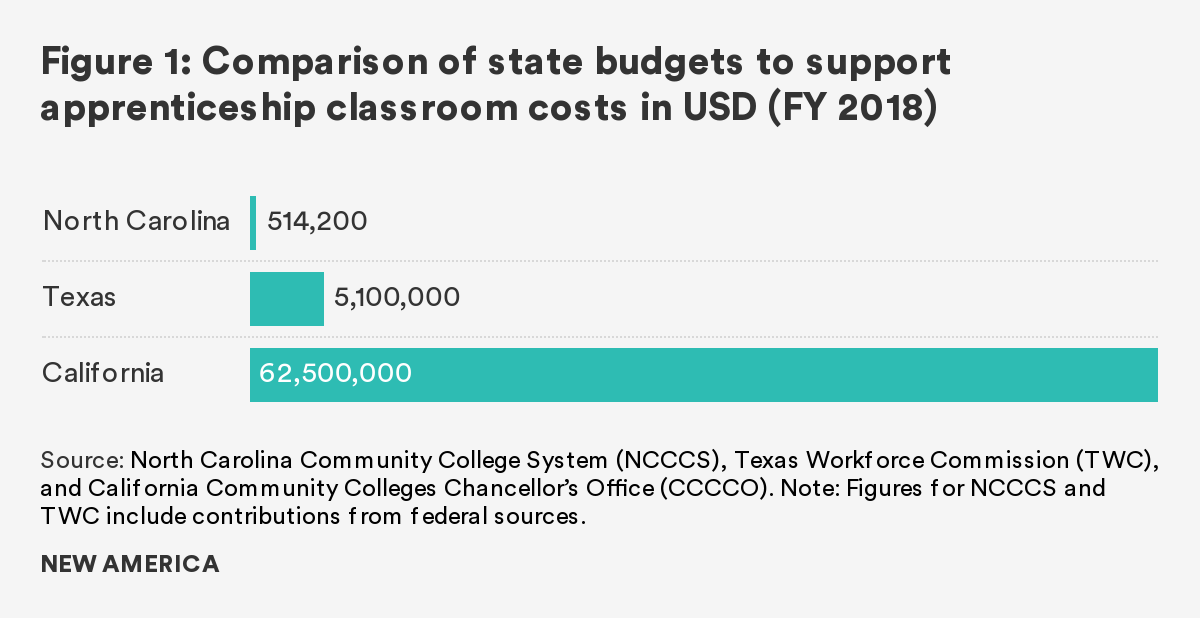
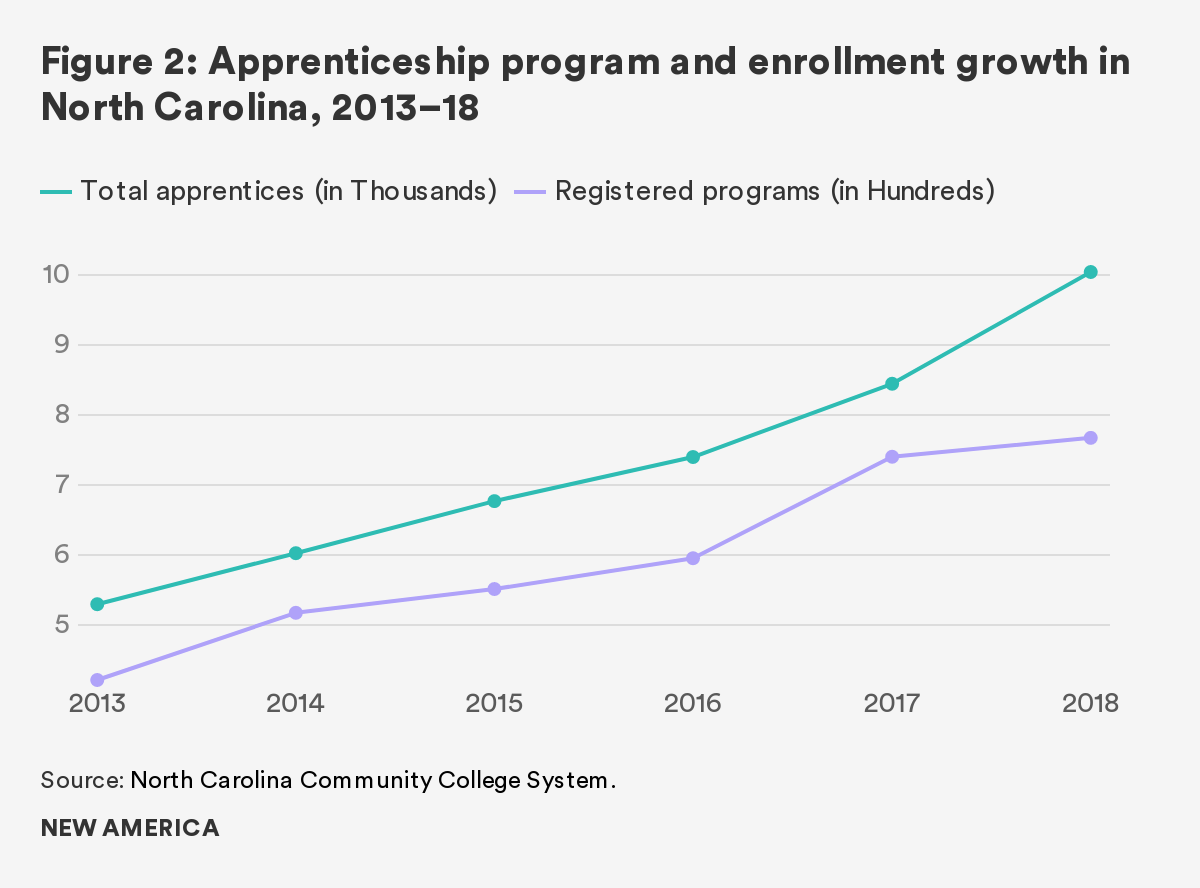
Apprentice tuition supports in North Carolina focus on youth, and as a result do not fund nearly as many students as incentives in Texas and California (see Figure 1), where a majority of apprenticeships benefit from one of each state’s two reimbursement options. But alongside other ambitious state initiatives, including the use of grant funding from the U.S. Department of Labor to defray instructional expenses for adult apprentices, the youth apprenticeship waiver has raised apprenticeship’s profile in North Carolina, propelling the state past its goal of 10,000 apprentices statewide by 2018 (see Figure 2).
Christopher and Hana: North Carolina
Hana graduates from high school in May and starts her nursing apprenticeship in September. In North Carolina, she would be eligible for the state’s youth apprenticeship waiver, and would pay no tuition or fees at the community college where she takes her classroom instruction. As Christopher graduated from high school years ago, he would not qualify for the tuition waiver in North Carolina, and would pay for his tuition and fees through a combination of savings, support from his employer, and federal financial aid.
When Hana enrolls in apprenticeship coursework at her community college, her entry in the school’s data system is flagged as a youth apprentice enrollment. She counts as a regular student under the state’s formula funding system, and for as long as she continues in her apprenticeship coursework, her college receives yearly reimbursements from ApprenticeshipNC for her waived tuition and fees.
Though North Carolina’s state-funded youth apprenticeship waiver and DOL-supported adult waivers have helped make apprenticeship affordable for more employers, learners, and institutions, states should beware of waiver policies that may unintentionally stifle new program development. Tuition exemptions, which currently exist in Florida and Washington, replace one disincentive for employers—the high initial costs of apprentice instruction—with another for colleges: the requirement that they provide instruction at a deep discount, or for free. In effect, colleges in these states are penalized for providing credit coursework for apprentices.
Colleges are less likely to serve as effective partners in degree-connected apprenticeships if they receive less funding for an apprentice than they would for an ordinary student in credit coursework.
In Washington, technical and community colleges must waive 50 percent of standard tuition and fees charged for apprentices’ coursework.24 Although most of the state’s apprenticeship programs articulate into degree pathways after apprenticeship completion, the unfunded partial tuition waiver discourages colleges from partnering with employers and intermediaries to build their coursework and credentials into apprenticeship programs. “A tuition waiver sounds great, but for colleges it creates a disincentive to work on apprenticeships, especially when the economy tanks and they’re flooded with people looking to upskill or retrain,” says Jody Robbins, the state’s apprenticeship director, “When we’re in a boom economy, registered apprenticeships at colleges are an employer’s best friend. When it’s bust, it’s really perilous for the colleges.”
In Florida, the disincentive is even more pronounced. The state’s public colleges are statutorily prohibited from charging any tuition or fees for students enrolled in coursework as part of an apprenticeship;25 and until it was rescinded in June, another state law forbade apprenticeship in sales or managerial fields, or for “professional and scientific vocations for which entrance requirements customarily require an academic degree.”26 Such laws make building college-connected apprenticeships extremely difficult, according to staff at Miami Dade College, the state’s largest two-year institution and the first to serve as an apprenticeship sponsor. Though Florida is twice the size of North Carolina, its overall apprentice population is only 50 percent larger, and growth in the number of apprentices affiliated with the college system over the past five years has been slow.27
Promising work is afoot in both states,28 but college-connected apprenticeship programs will continue to lag in Florida and Washington unless colleges receive consistent incentives to participate. North Carolina has provided such an incentive with its funded youth apprenticeship waiver, which supports colleges delivering credit coursework to apprenticeship programs, reduces overhead for apprentice employers, and avoids shifting tuition costs to apprentices themselves. In connection with its college promise, dual enrollment, and competitive grant initiatives, the state has become a national leader in apprenticeship innovation.

Solid Foundations: Four State Policy Approaches for Supporting College-Connected Apprenticeships
- Introduction
- Instructional Costs of Apprenticeship
- Four State Approaches to Supporting Instructional Costs
- Student Financial Aid: Kentucky’s Educational Excellence Scholarship
- Startup Grants: New Jersey’s PACE and GAINS initiatives
- Reimbursement Systems: Texas and California
- Tuition Waivers: North Carolina, and Unintended Consequences in Washington and Florida
- Recommendations
- Appendix: Methodology and Interviewees
Citations
- General Assembly of North Carolina, SL 2016-94 (HB 1030), Session 2015.
- Washington State Board for Community and Technical Colleges (website), “Apprenticeship Waiver,” https://www.sbctc.edu/colleges-staff/programs-services/tuition-fees/tuition-waivers/apprenticeship-waiver.aspx.
- Florida Statutes §1009.25.
- The section of Florida Statutes §446.092 that prohibited apprenticeship in traditionally academic fields was removed by amendments through FL House Bill 7071, which was signed into law on June 24, 2019.
- According to data from the Florida Department of Education, apprentice enrollments connected with the Florida College System grew from 1,839 in 2013–14 to 2,825 in 2017–18.
- In Florida, Miami Dade College became the state’s first Registered Apprenticeship sponsor in April 2018, allowing it to develop multi-employer programs built around college curricula, and in March 2019, Governor Ron DeSantis announced $1.75 million in startup funding to support apprenticeship expansion. HB 7071 (2019-119) also created startup grant funding (FL Statutes §1011.82), though this cannot currently be used for “recurring instructional costs.” In April 2019, Washington’s state legislature passed HB 2158, a bill establishing the Washington College Grant Program, a financial aid initiative that would cover full tuition and fees for students demonstrating financial need, including apprentices taking college coursework part-time.