Lessons from PLA Implementation
Why did colleges have so much trouble putting the programs into place and getting students to take advantage of them? There are a number of possible explanations. Judging from the evaluations, the three most common hurdles were: lack of guidance connecting students to PLA opportunities, mismatch between how PLA was administered and program design, and continued wariness about accepting learning outside of the classroom.
Connecting Students to PLA
Many of the grantees put all of their energy into developing PLA policies rather than connecting students to these programs. As a result, students at many of the participating institutions did not know the PLA option was available or how to make use of it.
Take Colorado Helps Advanced Manufacturing Program (CHAMP), for instance, a project run out of the community college system that included seven community colleges, one four-year university, and one technical college. The state community college system used its TAACCCT grant to develop a PLA manual and a unified procedure.22 This was hard work at the system office, and each individual community college also engaged in putting these policies in place. Work is still being done, but only 3 percent of students at these colleges earned PLA credit during the grant period.23
According to the state’s evaluation, “the majority of students were not familiar with PLA, including those coming from the military.”24 Those students who were aware that these options were available seemed confused and believed their skills did not translate into credits. As one student said, “I looked into it…but none of mine correlated…which is weird because I was in the Army for welder/machinist so none of those carried over.”25 Whether or not this student was eligible to receive credits for skills he obtained in the military is unclear, but students need enough high-quality guidance so there is not this type of confusion.
One of the biggest problems that Colorado ran into was that community college advisors “did not fully understand how to advise on it,” the evaluation says.26 And many of the administrators were not able to make advising on PLA a priority. “Discussing options with students and fully understanding their prior learning experience(s) required a significant amount of time and discussion,” according to the evaluation. Devoting that much time was “something general advisors do not always have time to do, especially during high-priority registration periods.”27
While providing quality advising may demand a lot of time and effort, the most successful projects focused on finding ways to make students aware that they could get credit for prior learning and walked them through how to do so. The evaluations clearly show that it is not enough to alert students about the option in brochures and on websites. Connecting students to the information they need requires personalized advising to guide them towards the forms of PLA that fit their experience and their desired program of study. Some projects achieved this by strengthening their advising and others went a step further by embedding the PLA for credit option into their academic programs.
Automating How PLA is Granted
Certain types of PLAs were easier to carry out than others. The more aligned the type of PLA was to the goal of the program, the better it worked. For instance, the Oregon CASE project, which included all 17 of Oregon’s community colleges as well as the statewide workforce and higher education agencies, focused on integrating portfolio assessment into short-term programs, which was not a good fit. Students create a portfolio by assembling a written narrative and a collection of evidence that support their knowledge and background. As the evaluation states, “portfolios that take a couple of quarters to develop may not be well suited for unemployed workers interested in getting trained and back into the labor market as soon as possible.”28 By the time a portfolio is completed, the entire program might be over. In contrast, grants like the AME Alliance and the Minnesota Advanced Manufacturing Program (MnAMP), a consortium of 12 community and technical colleges and two university centers of excellence, integrated credit for industry-recognized credentials into their programs and experienced more success.
As the AME and MnAMP examples outlined below show, the more automatic the process was for granting credit for prior learning, the more likely students were to make use of it. In Colorado, Casey Sacks, who led two TAACCCT grants, including one in Colorado, told us that if the TAACCCT project had already evaluated something those credits could be granted automatically and “the things that were actually happening were the things that were automatic.” Standardized exams like CLEP, AP, and IB and credit for industry-recognized credentials were some of the simplest to fit into this automatic structure. Colleges were able to decide on a standard score that made students eligible for credit and agree on the general education classes they counted for.
Integrating Automation and Advising for PLA Success
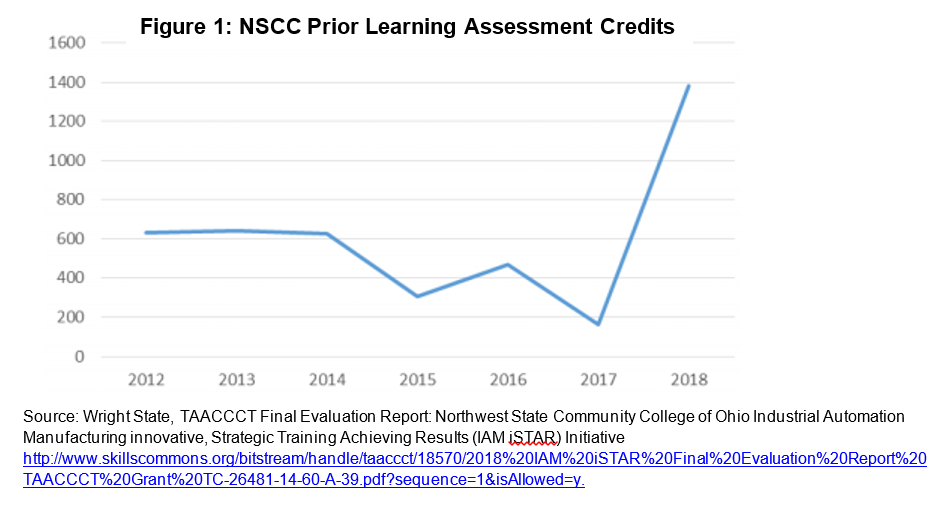
The Northwest State Community College of Ohio Industrial Automation Manufacturing innovative Strategic Training Achieving Results (IAM iSTAR) Initiative, a single community college project, was especially successful because it both strengthened PLA advising and made it as automatic as possible.
The college alerted students to the option of PLA credit when they first met with their academic advisers. The advisers then referred likely students to a coach, who was hired to guide students through the process of obtaining PLA credits. Military veterans were particularly encouraged to work with the coach to evaluate their experience. The coach worked with each student to determine the level of their college-equivalent learning and helped them prove it to faculty. For example, a military veteran who worked in computer-based anti-terrorism for four years was able to get credit for a cybersecurity course. This strategy of having an administrator dedicated to helping students obtain credits through PLA appears to have worked, as credits awarded this way more than doubled (see Figure 1) during the grant period.
The school also built automatic PLA into its degree and certificate programs for incumbent workers. According to the initiative’s final evaluation, the college “institutionalized a competency-based PLA policy for the industrial technology division.” For example, students who have worked on the manufacturing floor at local employers for a designated amount of time are granted credit for the industrial safety course. Instead of going through a formal portfolio review process, students receive the credits as long as the company’s human resource department certifies that they have worked there for a certain amount of time.
Another school that did both was Jordan Schoener’s college, South Central, which built an online credit for prior learning tracking and assessment tool that helps students list learning and experience that might count for college credit.29 That information is then sent to the dedicated PLA and transfer adviser, who connects the student with the right faculty member to assess their learning. This tool will soon be scaled up systemwide.
The college also built automatic credit for industry-recognized credentials into programs in advanced manufacturing and healthcare. The faculty looked at the competencies included in these industry-recognized credentials and aligned them with their programs. Now, after students earn industry-recognized credentials, they automatically get credit for classes, just like Schoener did. The faculty, at South Central College and across its TAACCCT consortium, also created credit equivalencies for military experience that now appear in the statewide Veterans Education Transfer System (VETS) designed to communicate the credit veterans can get for their learning and training.30 When veterans enter their information into the VETS, it shows the number of credits they will receive at any given Minnesota state college, and a career pathway the credits align with. This effort seems to have paid off. While the number of CPL credits granted per year is still small, it has doubled since these innovations were put in place.
Changing College Culture
Higher education has long had a culture that students get credit for material covered only in the context of a classroom course. The community colleges with the most effective PLA projects, such as Blue Ridge Community and Technical College in West Virginia, South Central College and Pine Technical and Community College in Minnesota, and Northwest State Community College in Ohio, have strong leaders and faculty members who were more flexible in their view of learning. They also recognized the recruiting value of effective PLA policy, which created a financial incentive to continue investing in their schools’ PLA process.
Leadership
We found that the strength of the leadership at participating community colleges made a tremendous difference in how PLA was implemented. Over and over, people we interviewed talked about how, even within the same consortium, schools with strong leaders committed to alternative approaches to education made more progress than others within the same group. At South Central College, where Jordan Schoener attended, the TAACCCT grant coincided with the president of the college being put in charge of a statewide credit for prior learning initiative. “PLA was among the reforms in the TAACCCT grant that required the highest level of leadership in order to achieve the goals,” said Michelle Van Noy, the evaluator for the New Jersey Health Professions Pathways to Regional Excellence Project, a consortium of 12 community colleges. She added, “Implementation depended on the level of leadership buy-in the different colleges were able to bring to bear.” This leadership took time and effort to build, leading implementation to lag if it did not already exist at the college.
Faculty
The faculty culture at many colleges can also pose a challenge to implementation. For instance, Colorado’s statewide PLA redesign of its CHAMP project had difficulty changing faculty attitudes.31 Some professors were concerned that providing credits for prior learning would lead to lost class enrollment. Others were concerned that moving in this direction would cheapen the education they were providing and turn the school into a “diploma mill.” Still others were on board with providing credit for prior learning through standardized exams, like CLEP, but were reluctant to take on the additional burden of reviewing portfolios. While the evaluations revealed that some colleges were able to shift these attitudes over time, addressing them required substantial and sustained efforts. These types of challenges with faculty were common across the interviews we conducted.
Financial Incentives
Colleges were also wary of giving students credit for classes without requiring them to sit through class or pay tuition. This is because they view the lost tuition and accompanying state funding as a financial hit. These misaligned financial incentives created an environment that made cultural change even more difficult to achieve. Heather McKay, an evaluator on the Colorado CHAMPS grant, told us, “there needs to be an awareness around PLA and FTE [full time equivalent enrollment], because people are afraid PLA is taking FTE away.” Colleges want to charge students and get state per-student reimbursement for all of the credits they award. Programs within colleges are under pressure to fill their classes. These misaligned incentives were a barrier to getting cultural buy-in at many colleges.

Connecting Adults to College with Credit for Prior Learning
- Introduction
- Jumpstarting the Economy: The Trade Adjustment Assistance Community College and Career Training Program
- Credit Where It's Due: Prior Learning Assessment
- Methodology
- Harmonizing Policy: PLA Grant Activities
- Challenges with PLA Implementation
- Lessons from PLA Implementation
- Recommendations
- Conclusion
- Appendix
Citations
- See Colorado Community College System. Prior Learning Assessment Credit Manual http://internal.cccs.edu/wp-content/uploads/documents/PLAManual.pdf and Colorado Community College System. System Procedure Prior Learning Assessment Credit. https://www.cccs.edu/policies-and-procedures/system-presidents-procedures/sp-9-42-prior-learning-assessment-credit/
- See Heather McKay, Renee Edwards, Suzanne Michael, and Li Kuang, Colorado Helps Advanced Manufacturing Program: Final Report (Piscataway, NJ: Rutgers Education and Employment Research Center, September 2017), https://www.skillscommons.org/bitstream/handle/taaccct/15673/CHAMP%20FINAL%20REPORT%20_EERC.pdf?sequence=1&isAllowed=y.
- Ibid
- Ibid
- Ibid
- Ibid
- See Bob Watrus, Heather Fercho. Oregon Credentials, Acceleration and Support for Employment (CASE) Evaluation Report: Results, Key Issues and Implications for Policy, Practice and Systems. (September 2015) https://www.skillscommons.org/bitstream/handle/taaccct/5575/CASE%20final%20evaluation%20report_Final.pdf?sequence=3&isAllowed=y
- See Central College, Credit for Prior Learning Wizard, https://www.minnesotacpl.com/landing
- See Minnesota State. Veterans Education Transfer System. https://eservices.minnstate.edu/college-search/public/military/
- See Heather McKay, Renee Edwards, Suzanne Michael, and Li Kuang, Colorado Helps Advanced Manufacturing Program: Final Report (Piscataway, NJ: Rutgers Education and Employment Research Center, September 2017), https://www.skillscommons.org/bitstream/handle/taaccct/15673/CHAMP%20FINAL%20REPORT%20_EERC.pdf?sequence=1&isAllowed=y.