A Chapter of: Chicago’s Bilingual Teacher Residency
Introduction
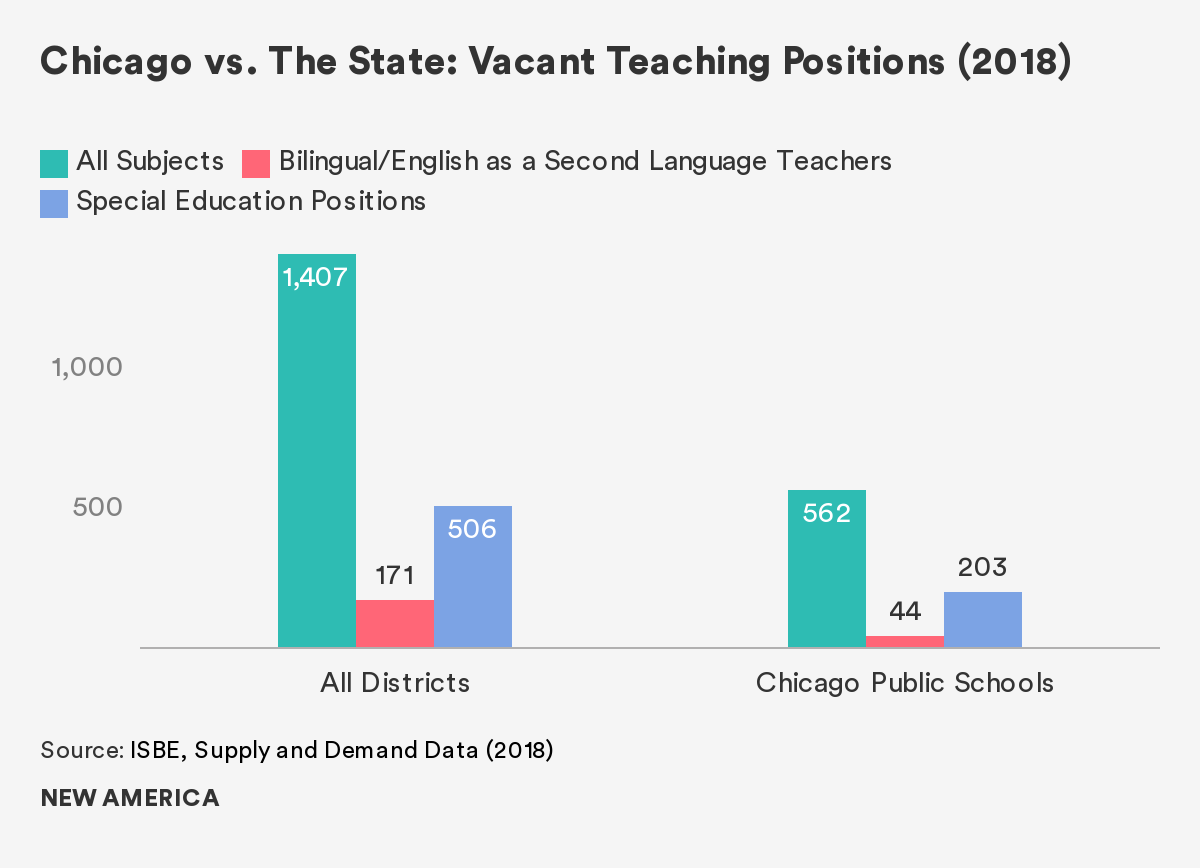
Illinois is facing teacher shortages across the state, but these shortages are most pronounced in Chicago, the largest district in the state and the third largest school district in the country. A 2018 report by the Illinois State Board of Education (ISBE) notes that 40 percent of the state’s teacher vacancies are in Chicago Public Schools (CPS), highlighting the district’s need for a variety of approaches to address this challenge. At the start of the 2019 school year, CPS had an overall vacancy rate of just over 3 percent (669 positions), including 64 vacant bilingual teaching positions. At the same time, CPS is trying to address a racial and linguistic mismatch between students and teachers. While the district has made strides in closing these staffing gaps, it is still in need of innovative programs to help attract new teachers to the profession and to the school system.
A new bilingual teacher residency program is attempting to help close these gaps and ease current shortages.
In the summer of 2018, with support from the National Center for Teacher Residencies (NCTR), CPS launched this teacher residency program in partnership with National Louis University (NLU) to both help address current shortages in bilingual elementary and early childhood teachers and increase the diversity of its teacher workforce.1 As Felicia Butts, director of teacher residencies at CPS, shared with us, the program is designed to supply more bilingual teachers to develop and prepare teachers who share the experiences and backgrounds of students but also to serve the needs of English learners,2 who benefit from bilingual programs that help them maintain their home languages and that foster their English language development and academic growth.3
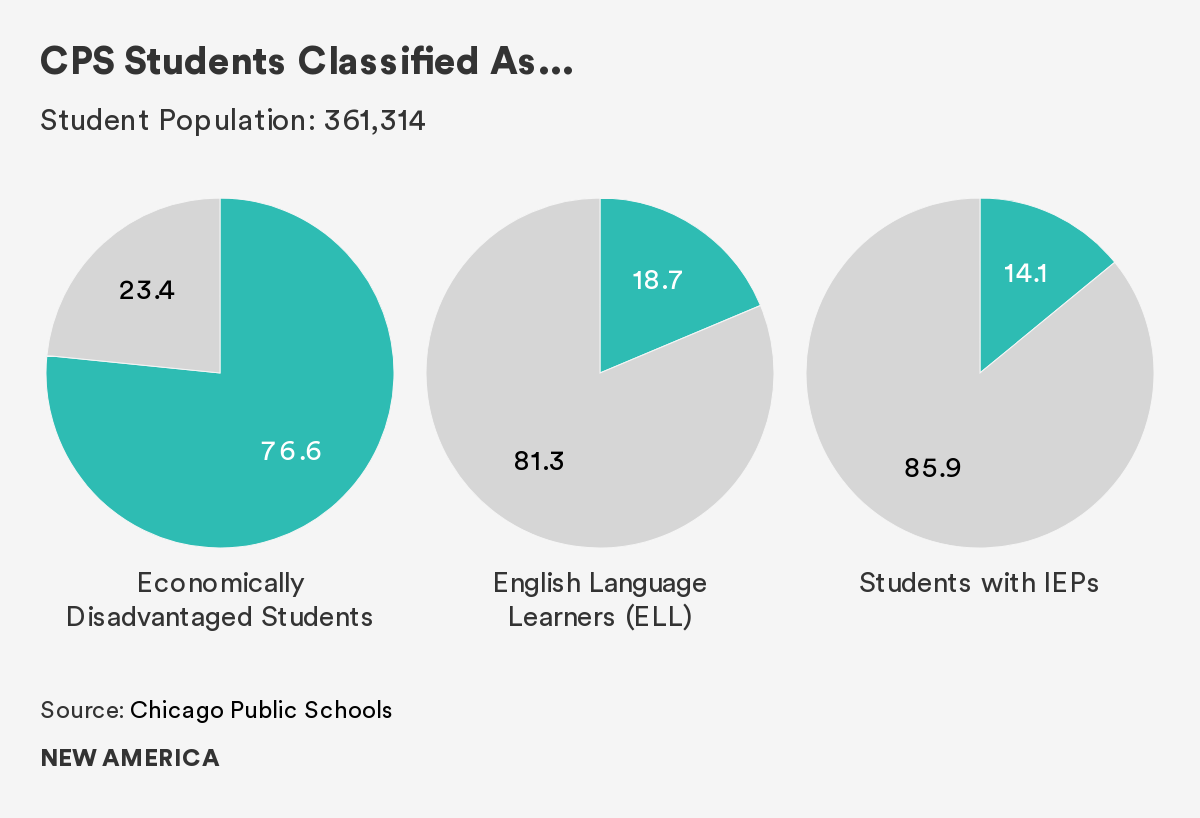
Nearly one in five students in CPS is an EL and teachers that speak Spanish are most in need for bilingual programs across the district. In addition, the city’s schools predominantly educate students of color, with Latinx students making up almost half of the student population (46.7 percent) and African American students representing nearly 37 percent of enrollment. By contrast, 50 percent of teachers are white, while 21 percent of teachers are Latinx and 21 percent of teachers are African American.
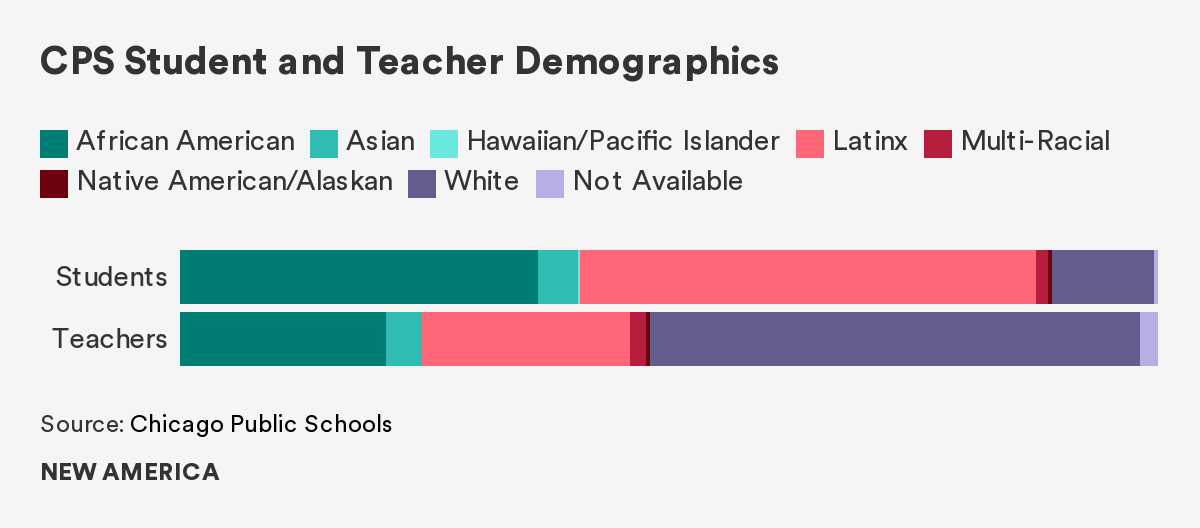
Chicago’s bilingual teacher residency program is helping fill the need for more linguistically and racially diverse teachers by recruiting from within and tapping paraeducators4 who show promise and interest in becoming licensed teachers. Similar to national trends5, the paraeducator workforce in CPS more closely matches the demographics of the student population. The program model mirrors efforts across the country to develop and prepare non-certified school staff (e.g., paraeducators, office administrators, bus drivers) to earn their teacher credential.
Often called Grow Your Own (GYO), these programs are partnerships between educator preparation programs, school districts, and community organizations that recruit and prepare local community members to teach in their communities.6 GYO programs take different forms7, but are typically designed to meet local workforce needs and to remove common barriers to earning a teaching degree for non-traditional candidates.8 GYO programs have a long history in Illinois9 and began as a grassroots effort in Chicago’s Logan Square neighborhood to prepare bilingual community members, including parents, to become teachers for the local schools.10
Indeed, the city has been at the forefront of innovations to help attract and prepare teachers to work in urban settings. The first urban teacher residency program was started in Chicago in 2001 to help place well-prepared teachers in struggling schools, and established the foundational elements that are present in the majority of urban teacher residencies today.11 Residencies provide teacher candidates with the opportunity to get hands-on experience and mentorship by working in a classroom alongside a more experienced teacher before they take on responsibility for leading their own classroom. This approach to teacher preparation typically lasts for an entire school year and is paired with coursework that will result in a graduate degree in education and a teaching license.12 Part of this model’s appeal is that the needs of the school district are central to the residency design and implementation process, which requires preparation programs to tailor content and instruction to meet those needs. Residencies can be designed to offer comprehensive supports to encourage program persistence, completion, and retention.13 Moreover, residencies, in general, tend to attract a higher percentage of racially diverse candidates. Across the 36 residency programs supported by NCTR, over 50 percent of residents are people of color14 compared to 25 percent of individuals enrolled in a traditional teacher preparation program.15
Chicago’s bilingual teacher residency program is a promising example of how school districts are leveraging partnerships with teacher education programs to recruit, prepare, and retain bilingual teacher talent from within the district and local community. As more districts begin experimenting with new approaches to developing teacher talent, they can look to Chicago and other cities on how residency programs can be designed to meet local needs and to provide residents with layers of support to help them feel well-prepared to take their spot at the head of the classroom.
Factors Influencing the Teacher Shortage
The current teacher shortages in Chicago are in part influenced by state policy and district-level initiatives that have raised requirements for teachers and by overall declines in teacher preparation program enrollment. First, Illinois has a bilingual mandate that specifies that any school enrolling more than 20 EL students who speak the same language must offer a bilingual education program.16 In 2009, this mandate was expanded to include state-funded pre-K programs—a shift that had significant implications for the early educator workforce. As reported by New America in 2012, pre-K teachers working in state-funded programs must hold a bachelor's degree and an early childhood teaching certificate. Those who work in an ESL (English as a second language) or bilingual program must also have those credentials.17
In 2018, the city launched an ambitious plan to provide universal pre-K to all four-year-olds in the city by 2021.18 To reach this goal, an estimated 1,500 additional teachers will be needed across both public schools and community-based organizations. Rebecca Vonderlack-Navarro, manager of education research and policy at the Latino Policy Forum, told us that 400 of these teachers will need a bilingual/ESL endorsement. CPS alone will need to add 500 pre-K classrooms, and recruit and hire the teachers to lead those classrooms.19 Currently, just over half of teacher preparation programs in the state offer a bilingual endorsement and around one-third of programs offer both a bilingual endorsement and early childhood education certification (birth to grade 2).
State testing requirements have also complicated state and district efforts to increase the racial and linguistic diversity of the teacher workforce. State-level data revealed disproportionate outcomes on the basic skills exam (known as the Test of Academic Proficiency or TAP) with 35 percent of white candidates, 14 percent of Latinx, and 12 percent of African American candidates receiving a passing score.20 In August 2019, Illinois Governor J. B. Pritzker signed legislation eliminating the state’s basic skills exam as a requirement for teacher licensure—a big win for advocates who had long argued that the TAP served as a barrier for teacher candidates of color.21 By removing this barrier, the state hopes to ease a long-standing teacher shortage and increase the diversity of the educator workforce.
This legislative change will also have an impact on the bilingual residency program: This year, one-third of CPS teacher residents were provisionally accepted based on the expectation that the basic skills test requirement would be eliminated. This marked a big change from the year prior, when residents were not given this opportunity and could only participate if they passed the TAP (or had an equivalent passing score on the ACT or SAT). Several residents from the 2018 cohort characterized the basic skills test as a barrier that kept prospective candidates out of the program.
Teacher education programs across Illinois have also seen sharp declines in enrollment and completion. According to the ISBE, there was a 53 percent decrease in teacher candidate enrollment and completion between 2010 to 2016.22 Other state-level data indicate that the pipeline of diverse teacher candidates is constricted. A 2013 study by the Illinois Education Research Consortium tracked two cohorts of high school students through college and into the workforce to examine trends in the pipeline.23 First, the study revealed that initial interest in becoming a teacher varied, with 10.5 percent of white, 6.5 percent of Latinx, and 5 percent of African American high school students aspiring to major in education in college. As students progressed through the pipeline, large numbers fell out and in the end the percentage of students who actually earned teacher licensure was quite small. Over 4 percent (6,104) of white students went on to earn their certification and were hired as full time teachers, compared to 1.5 percent (356) of Latinx students, and less than 1 percent (241) of African American students.24
These trends are also part of why district leaders see teacher residencies as one promising “lever to change the diversity and the demographics of the incoming teachers,” as Benjamin Felton, executive director of teacher recruitment and equity strategy at CPS, put it.25 And early evidence shows that the strategy is working: A full 95 percent of elementary education bilingual residents are people of color, as are 100 percent of the early childhood bilingual residents.

Citations
- The residency program also includes a track for early childhood special education teachers who will teach in English-speaking classrooms. Special education is the biggest shortage area in Chicago Public Schools, with 284 vacant positions at the start of the 2019 school year.
- Interview with authors, Chicago, July 17, 2019.
- Sandra A. Alvear, “The Additive Advantage and Bilingual Programs in a Large Urban District,” American Educational Research Journal 56, no 2 (2019): 477–513; Ilana M. Umansky and Sean F. Reardon, “Reclassification Patterns Among Latino English Learner Students in Bilingual, Dual Immersion, and English Immersion Classrooms,” American Educational Research Journal 51, no. 5 (2014): 879–912; and Rachel A. Valentino and Sean F. Reardon, “Effectiveness of Four Instructional Programs Designed to Serve English Learners: Variation by Ethnicity and Initial English Proficiency,” Educational Evaluation and Policy Analysis 37, no. 4 (2015): 612–637.
- Paraeducators (also known as paraprofessionals, teaching assistants, instructional aides) usually support instruction in special education, early education, and/or bilingual classrooms. Their responsibilities often include providing one-on-one tutoring, assisting with classroom management, instructing small groups of students, and translating between students, students’ families, and the lead teacher.
- Conor P. Williams, Amaya Garcia, Kaylan Connally, Shayna Cook and Kim Dancy, Multilingual Paraprofessionals: An Untapped Resource for Supporting American Pluralism (Washington, DC: New America, 2016), https://newamerica.org/documents/1517/DLLWH_ParasBrief6.1.pdf
- New America, Grow Your Own Programs for Bilingual Educators: Essential Policies and Practices (Washington, DC: New America, 2019), https://s3.amazonaws.com/newamericadotorg/documents/Grow_Your_Own_PP_FINAL.pdf
- Angela Valenzuela, Grow Your Own Educator Programs: A Review of the Literature with an Emphasis on Equity-based Approaches (San Antonio, TX: Intercultural Development Research Association, 2017), https://files.eric.ed.gov/fulltext/ED582731.pdf
- Conra Gist, Margarita Bianco, and Marvin Lynn, “Examining Grow Your Own Programs Across the Teacher Development Continuum: Mining Research on Teachers of Color and Nontraditional Educator Pipelines,” Journal of Teacher Education 70, no. 1 (2019): 13–25.
- Today, GYO programs receive funding from the state legislature and are overseen by the organization GYO Illinois. Chicago’s residency program is not part of the statewide GYO program. For more see: Kate Van Winkle, “Grow Your Own IL – Supporting the Teachers Our Students and Schools Need,” EdCentral (blog) New America, April 4, 2019 https://www.newamerica.org/education-policy/edcentral/grow-your-own-il-supporting-the-teachers-our-students-and-schools-need/; Amy Perona, Robin LaSota, and Lynne Haeffele, Illinois Grow Your Own Teacher Education Initiative 2014 Policy and Program Recommendations (Normal , IL: Illinois State University, Center for the Study of Education Policy, 2015) https://www.ibhe.org/assets/files/GYO_AnnualReport_2014.pdf
- Elizabeth A. Skinner, “Project "Nueva Generacion" and Grow Your Own Teachers: Transforming Schools and Teacher Education from the Inside Out,” Teacher Education Quarterly 37, no. 3 (2010): 155–167.
- Roneeta Guha, Maria E. Hyler, and Linda Darling Hammond, "The Power and Potential of Teacher Residencies," Phi Delta Kappan 98, no. 8 (2017): 31-37, https://www.kappanonline.org/guha-hyler-darling-hammond-teacher-residency-residencies/; Tim Silva, Allison McKie, Virginia Knechtel, Philip Gleason, and Libby Makowsky, Teaching Residency Programs: A Multisite Look at a New Model to Prepare Teachers for High-Need Schools (Washington, DC: National Center for Education Evaluation and Regional Assistance, Institute of Education Sciences, U.S. Department of Education, 2014), https://files.eric.ed.gov/fulltext/ED548234.pdf
- National Center for Teacher Residencies (website), “About: The Residency Model,” https://nctresidencies.org/about/residency-model-teacher-mentor-programs/
- Amaya Garcia, Building a Bilingual Teacher Pipeline: Bilingual Teacher Fellows at Highline Public Schools (Washington, DC: New America, 2017), https://na-production.s3.amazonaws.com/documents/FINAL_EnglishLearners_Washington.pdf
- Who We Are (Chicago, IL: National Center for Teacher Residencies, 2018), https://nctresidencies.org/wp-content/uploads/2018/08/NCTR-Collateral-All.pdf
- U.S. Department of Education, The State of Racial Diversity in the Educator Workforce (Washington, DC: Office of Planning, Evaluation and Policy Development, 2016), https://www2.ed.gov/rschstat/eval/highered/racial-diversity/state-racial-diversity-workforce.pdf
- Illinois General Assembly, School Code 105 ICLS 5, Article 14C. Transitional Bilingual Education, http://ilga.gov/legislation/ilcs/ilcs4.asp?DocName=010500050HArt%2E+14C&ActID=1005&ChapterID=17&SeqStart=121800000&SeqEnd=123300000
- Maggie Severns, Starting Early with English Language Learners: Lessons from Illinois (Washington, DC: New America, 2012), https://static.newamerica.org/attachments/7424-growing-research-consensus-on-effective-strategies-for-dual-language-instruction-in-early-childhood/Starting_Early_With_English_Language_Learners.b6f98ba325b349de9326081842d8af75.pdf
- Chicago’s Roadmap for Implementing Universal Pre-K: A Plan for Investment in Chicago’s Early Learning System (Chicago: City of Chicago, March 2019), https://drive.google.com/file/d/1HsCE7fCOWYXoyYLlxKbK-lq0nQSF7oAL/view
- Chicago’s Roadmap.
- Illinois State Board of Education, “Illinois Licensure Testing System Best Attempt Pass Rate by Test of Academic Proficiency Subtest January 1, 2019 and March 31, 2019,” https://www.isbe.net/Documents/tap-2019-quarter-1.pdf
- Yana Kunichoff, “Illinois Says Goodbye to the Basic Skills Test, Long a Barrier for Teacher Candidates of Color,” Chalkbeat, August 8, 2019,https://www.chalkbeat.org/posts/chicago/2019/08/08/illinois-says-goodbye-to-the-basic-skills-test-long-a-barrier-for-teacher-candidates-of-color/
- Teach Illinois: Strong Teachers, Strong Classrooms: Policy Solutions to Alleviate Teacher Shortages in Illinois (Springfield: Illinois State Board of Education, September 2018), https://www.isbe.net/Documents/Teach-Illinois-Memo.pdf
- Bradford R. White, Karen J. DeAngelis, and Eric J. Lichtenberger, The Student Has Become the Teacher: Tracking the Racial Diversity and Academic Composition of the Teacher Supply Pipeline (Edwardsville: Illinois Education Research Council at Southern Illinois University Edwardsville, 2013), https://files.eric.ed.gov/fulltext/ED555440.pdf
- These data include all students who went on to earn a teaching certificate, regardless of whether they indicated an interest in becoming a teacher previously. The report notes on page 15 that “students who aspired to teach while in high school became IPS teachers at nearly seven times the rate (13.1%) of those who did not do so (1.9%).”
- Interview with authors, Chicago, July 17, 2019.