A Chapter of: Great Power Resource Competition in a Changing Climate
Introduction

Grigvovan / Shutterstock
Natural security, or having enough energy, food, minerals, and water, is essential to supporting stable and prosperous societies. A growing global population, however, needs more resources to meet rising standards of living, even as the industrial age’s bill is coming due in the form of sweeping environmental degradation. Climate change is reshaping global natural security, affecting water availability, weather patterns, agricultural productivity, the energy trade, and the demand for critical minerals. Put simply: natural security is under threat around the world.
China and the United States, the two biggest global economies, are also the biggest polluters and consumers of the world’s resources. Their natural security affects everyone else’s, both in terms of meeting demand and dealing with the consequences of high consumption. Moreover, the United States has declared a new era of “great power competition” and singled out China. Natural security will be a key part of the rivalry, especially as these two countries already rely on some of the same suppliers for key resources—including each other, for now.
New America’s Natural Security Index compares the natural security of China and the United States and identifies their top resource allies and trade partners. By comparing the countries’ resources, production, imports, and exports, the index finds that the United States has a comparative natural security advantage over China, though China has a more diversified resource trade and investment portfolio, according to our analysis. Altogether, this project suggests that natural resources will help shape the competition between the United States and China for geopolitical influence and investments—and that competition will, in turn, shape global natural security.
Key findings
- The United States has inherent natural security, an advantage in global great power competition, though private sector and market forces largely shape the patterns of U.S. global natural resource engagement. National power investments (diplomacy, economic engagement, military cooperation) sometimes coincide with key resource trade partners, but not always.
- China has significant natural resources, including agriculture and critical minerals, but not enough to meet the demands of such a large population. The government meets this challenge with a diversified, centrally-controlled global trade and investment strategy. National power investments (diplomacy, economic engagement, military cooperation) generally are consistent with these resource relationships.
- The United States’ strongest resource relationships are with its closest neighbors. While China has a more diversified mix (i.e., Brazil and Indonesia are equally important to China), Russia is a top partner.
- Australia may be a point of contention or convergence, as a top natural security partner for China and a key strategic ally for the United States.
- In the future, as the United States and China jockey for the competitive edge in high tech industries and renewable energy technology, that will increasingly drive competition over critical mineral resources and major producing countries, such as Australia, Brazil, Chile, Indonesia, South Africa, and the Democratic Republic of the Congo.
- Global climate change is already affecting natural resources, especially agriculture, a trend that will worsen over the course of the century. Although China is positioning to maintain its natural security, that may be at the expense of global markets, which the United States counts on for its own natural security.
- Even in a worst-case climate change scenario, the United States should remain a major agricultural producer by mid-century, though growing regions may shift northward and there may be fewer exports. These shifts have the potential to be economically and socially disruptive. The Chinese may have to increase their dependence on agricultural imports, particularly for corn and wheat. Russia and Canada may be relative winners, with increases in arable land, though many uncertainties remain about the effects of drought and more volatile weather worldwide.
- Although natural security could become a sore point in the relationship between the United States and China, it could also be a source of cooperation and confidence building. In particular, these competitors could work together on critical minerals, including research and development on less destructive ways to mine and refine these materials. Moreover, as climate change challenges agricultural productivity worldwide, international cooperation and trade will play an important part in adapting to changing conditions.
Methodology
The goal of the Natural Security Index is to quantify the importance of bilateral trade relationships to the national security of the United States and China, with a focus on key natural resources. It provides a contemporaneous snapshot of countries’ natural resources, military, diplomatic, and soft-power relationships, and functions as a means of comparison between states’ military alignments, their international objectives as represented through formal posturing, and organic relationships of their citizenry and economies.
The Natural Security Index aggregates thousands of data points for resources that are of significant value to the world economy or are considered “strategic” by the Chinese and American governments. We also looked specifically at how climate change may affect key resources and cross-referenced natural security with national power indicators, such as number of combined military exercises, commercial activity, and cultural engagement. The goal was to look at how well resources lined up with other investments of national power. Across the board, we selected indicators based on their relevance to U.S. and Chinese national security, data availability, coverage and consistency.
Table 1 summarizes the indicators in the Natural Security Index. See this technical note for more detail on how the New America team calculated the Index.
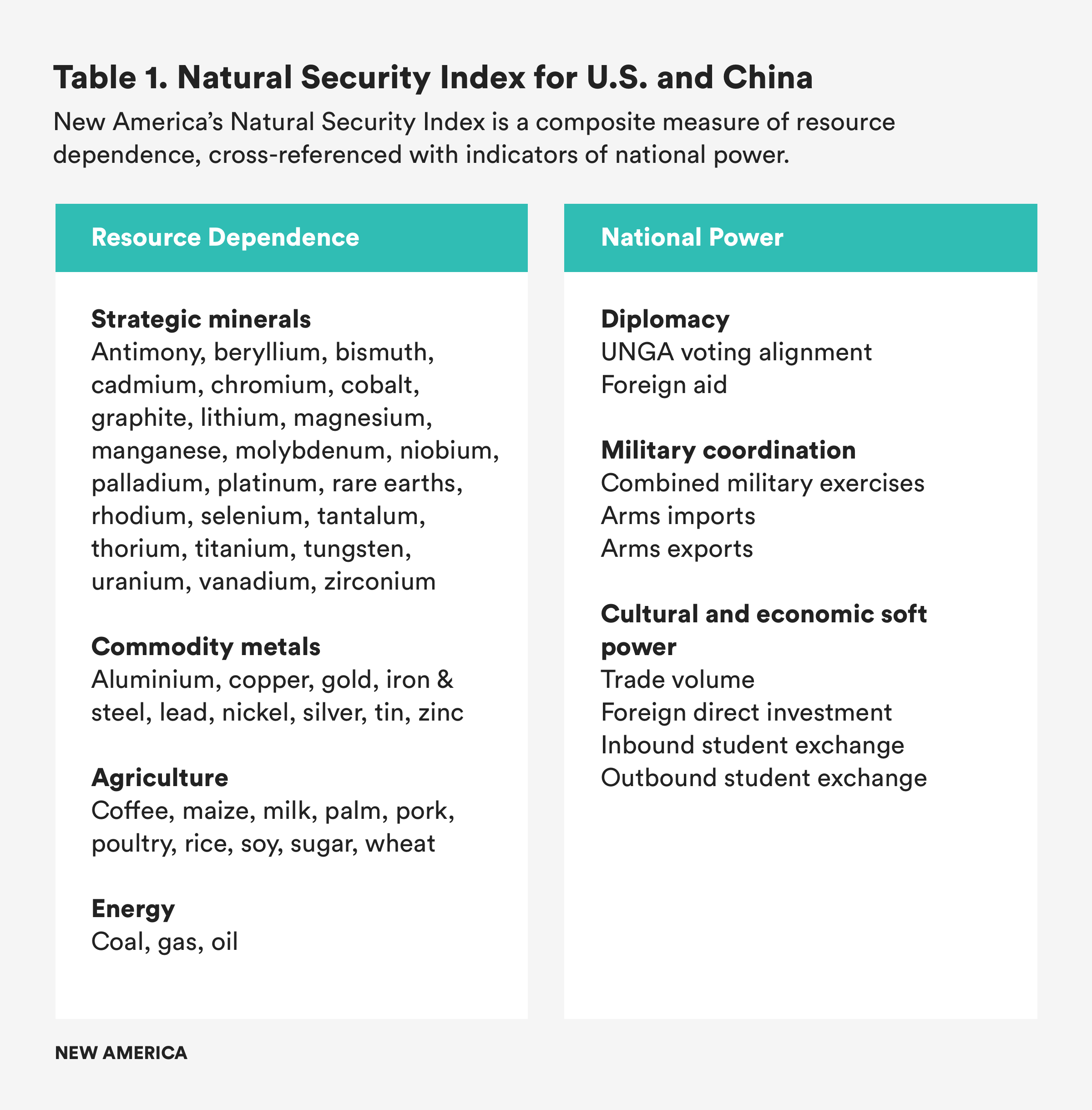
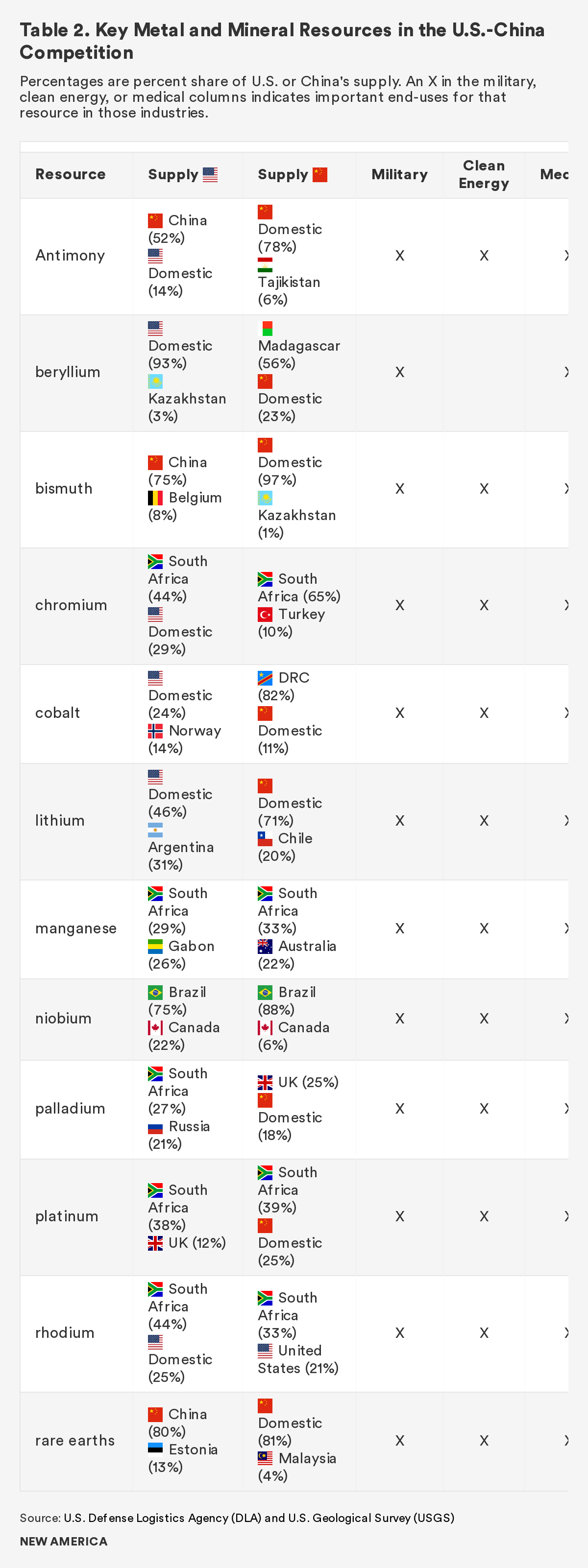
Table 2 displays the key metal and mineral resources referenced throughout this report, as well as the countries that provide the largest share of the United States’ and China’s supply and the key industries that utilize each resource. For more details on each resource in Table 2 see Appendix A in the technical note.