A Chapter of: Paving the Way for Latinx Teachers
Profile: San Antonio’s P–20 Partnerships

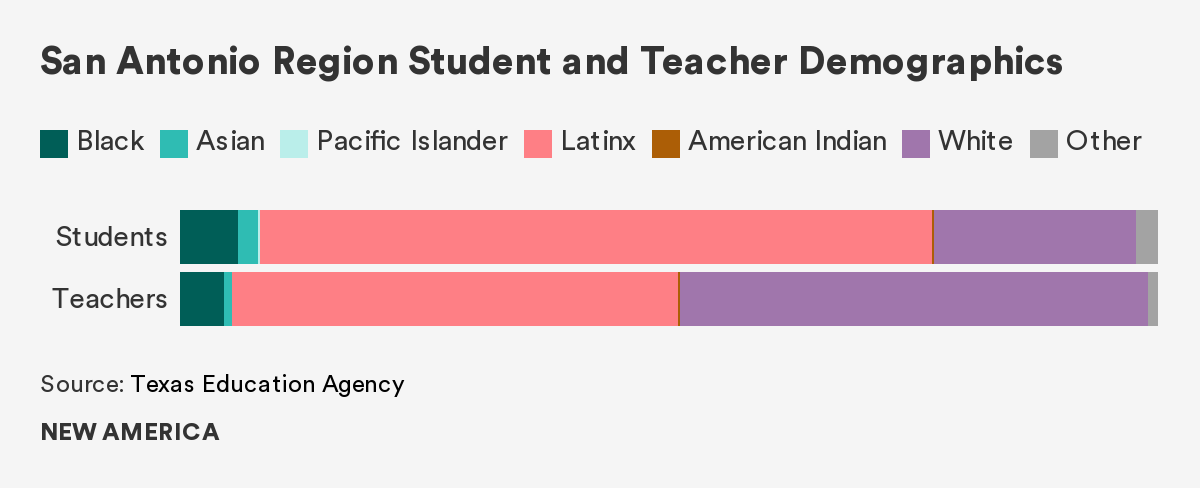
Even in areas with a historically large Latinx population, like San Antonio, gaps exist between the proportion of Latinx teachers and students. In the San Antonio region, 69 percent of public school students are Latinx, compared to 46 percent of their teachers.89 Across the state, where 17 percent of students are English Learners (ELs), there is also a shortage of bilingual English-Spanish teachers.90 The mandate in Texas for districts to offer a bilingual program to all ELs—PreK to 12th grade—when there are more than 20 students who speak the same home language in a given school adds to the demand for bilingual teachers in the region.91

The University of Texas as San Antonio’s College of Education and Human Development (UTSA)—one of the largest producers of teachers in Texas, and a Hispanic-Serving Institution (HSI)92—is working to help districts in the region narrow the demographic gap and meet the need for teachers in areas of shortage. In 2018, UTSA’s teacher preparation program enrolled 873 students, 45 percent of which were Latinx. But Belinda Bustos Flores, professor and associate dean of professional preparation, assessment, and accreditation at UTSA, felt it was important to recruit and prepare even more Latinx teachers in critical areas, such as bilingual education and ESL, who can support the needs of students in the state and across the country.
Community colleges are a critical part of UTSA’s teacher pathway: roughly 55 percent of students in its teacher preparation program transfer from community colleges.93 Given this fact, Flores founded the Academy for Teacher Excellence (ATE) in 2003 to serve as a center for research and implementation of partnerships between UTSA and local school districts, community colleges, and the private sector that could improve students’ preparedness and transitions.94
Part of ATE is the Teacher Academy Learning Community (TALC)—established with support from a U.S. Department of Education grant aimed at developing capacity within HSIs95—to facilitate smooth transitions for aspiring teachers to and through UTSA’s education program. TALC was created to provide teacher candidates with the academic, personal, and professional support needed in order to successfully enroll, complete a bachelor’s degree, and obtain teacher certification.96
In 2018, UTSA partnered with Northwest Vista College (NVC), a local community college, to create an offshoot of the TALC program. The Latino-Teacher Academy Learning Community (L-TALC) expands the work of the TALC program by recruiting Latinx students into teaching shortage areas such as bilingual education, mathematics, science, and special education, and supporting them through the steps necessary to become a teacher.97 Students must be enrolled at either NVC or UTSA, or be high school students interested in enrolling at either institution, to be eligible to participate.
For each of the next five years, the partnership plans to enroll 250 Latinx undergraduate students at NVC or UTSA.
Recruitment: High School Outreach and Community College Partnerships
In order to deepen the pool of teachers who are Latinx and also bilingual, UTSA is working with NVC and school districts to recruit potential Latinx teacher candidates at different points along the pathway: high school students, incoming freshmen, students with undeclared majors or majors in other disciplines, and transfer students from community colleges.98
Starting Early: High School Partnerships
“Part of recruitment is making [students] aware of [teacher] pathways, and the critical shortage areas, so that they can make informed decisions,” said Flores.99 To do so, UTSA began working with high schools in San Antonio, North East, and Northside Independent school districts to help their students explore pathways into teaching, and offering guidance on how to get there. This type of guidance is critical, as many of the students UTSA is trying to recruit will be the first in their family to attend college. UTSA is also preparing to offer dual-credit courses which will count towards a bachelor’s degree and teacher certification in an effort to increase the likelihood of students enrolling in and completing college.100
In San Antonio Independent School District (SAISD), UTSA is working with the district to address two key goals: supporting their EL students' academic achievement and attainment, and growing their own diverse, bilingual teachers. In SAISD, approximately 19 percent of students are ELs,101 and among these students, the home language most commonly spoken is Spanish, which is not surprising, given that roughly 90 percent of students in the district are Latinx.
In 2016, SAISD decided to transition to a dual-language model that would continue to develop students' Spanish while also developing their English skills.102 Two years later, the district started its first high school dual-language program at Brackenridge High School. But Esmeralda Alday, senior coordinator for secondary bilingual education at the district, explained that because there was not a natural feeder pattern of students in dual language programs coming into the high school, the school and district decided to identify incoming freshmen who indicated on a home language survey that the language spoken most often at home was Spanish. The students were given a Spanish screening exam and if they scored above a certain level, they were invited into the dual-language program.
SAISD already had a shortage of English-Spanish bilingual teachers and the new dual language program further increased that need. Alday said that, for now, the high school program is relying on teachers from Spain to fill these positions, but the district would prefer to start growing its own bilingual teachers from within local high schools so that teachers and students have shared cultural experiences in addition to shared language. This goal led the district to approach UTSA about creating a partnership where, as part of the dual language program, students could get exposure to the teaching profession and could take dual-credit courses starting their junior year that would transfer to UTSA. Since the university was seeking bilingual students to enter the teaching profession, the match made sense, and a partnership was born.
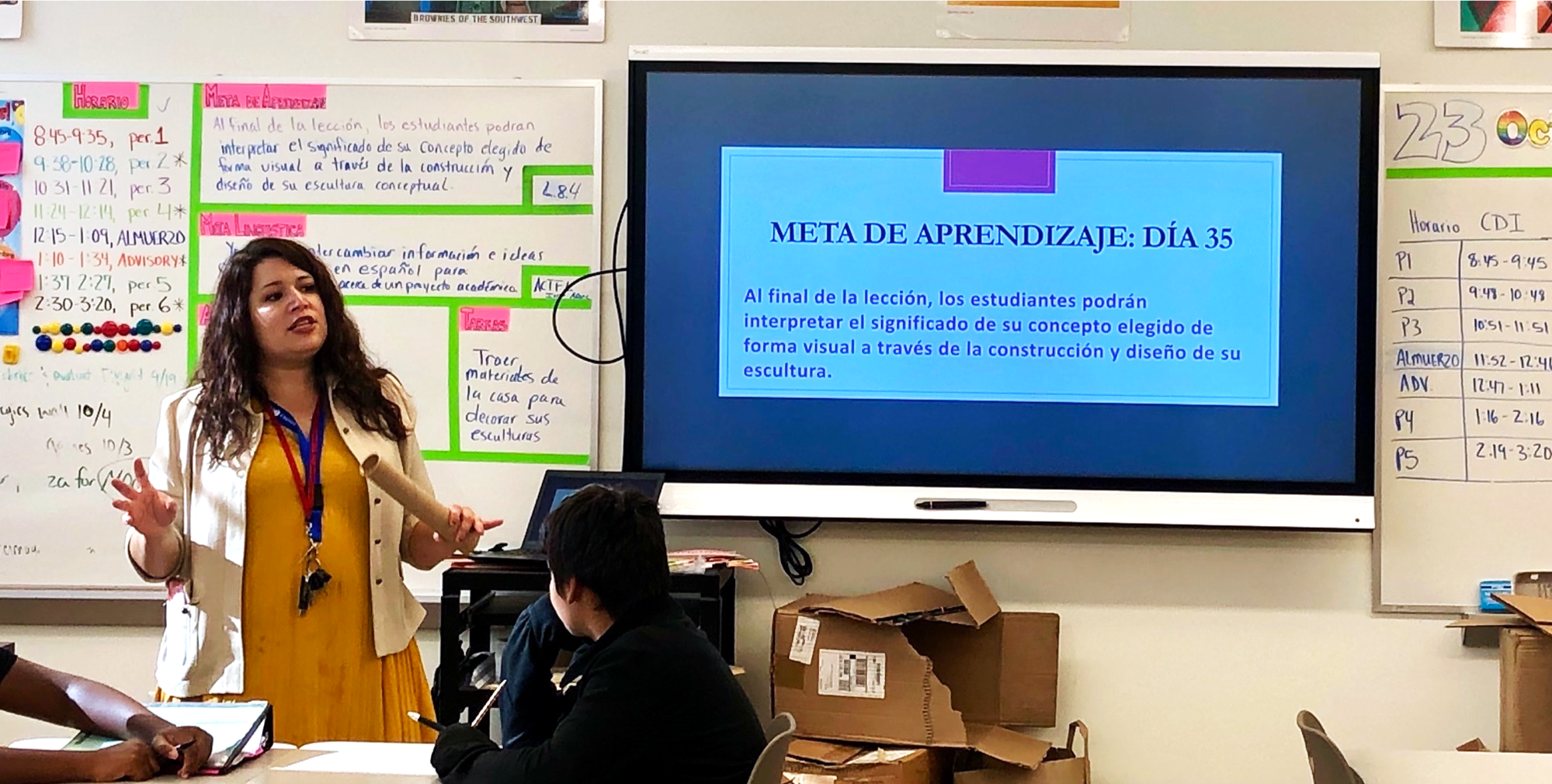
The district now has three dual-language high school programs—one starting its second year and two that started their first year in the fall of 2019—serving approximately 200 students. As part of the program, students take a principles of education course their freshman year that is focused on the foundations of being a teacher. Alday stressed the need to be strategic about putting model teachers in front of students that can inspire them to be proud of their bilingualism, while also inspiring them to be teachers. She said, “A teacher can make or break the love for her discipline,” and “we hire people that have shared experience with the kids, or can push them with language, culture, and identity even if their Spanish is not perfect.”103
Alday explained that the work the district has to do around identity is one of the biggest challenges to building students’ bilingual skills. “Despite the fact that we have so many English learners and so many immigrants,” she said, speaking Spanish “is actually very stigmatized [in San Antonio] and that stigma trickles down to our kids. Our students still aren't owning the fact that they have this gift. If anything, they're dismissing it or they're hiding it.” So, much of the work the district is trying to do through the bilingual program centers around strengthening students’ language and cultural identity.
Alday added that a master teacher in SAISD can make over $70,000 a year, and if you are a bilingual master teacher, there is an additional stipend. “You can make a very comfortable living being a bilingual teacher. So we're trying to sell that vision to freshmen, but it’s not easy. That's our hiccup.”
In 2019, the district’s bilingual department funded a variety of summer activities with the students in the dual-language program geared towards making them proud and elevating their stories. One of those activities is hosted by UTSA—a one-day program called the Future Bilingual Leaders Institute. The day-long programming was focused on getting the 37 SAISD bilingual students who participated to see themselves as leaders and acknowledge the gifts that they possess and how they would be valuable to the education profession.
One way the institute does this is by bringing in motivational speakers, such as Adriana Abundis, SAISD’s distinguished master teacher of the year. Abundis shared her own story of being Latinx and bilingual, and told the students “only 50 percent of us graduate high school. It's not because we're unintelligent; it's because the system isn't supporting us. And all the beauty and gifts that we bring [are] taken away from us. … So I said, ‘I need to be a teacher. I need to be a teacher because my younger sisters never had anyone to tell them to go to college.’”104 Students attended other sessions where they engaged in self-reflection and goal setting, and they were also able to tour the UTSA campus.
“I considered what we did at UTSA a huge success because the kids went to the university and now they know that UTSA is interested in them,” said Alday. “We want the kids to identify with the campus. We want them to know that UTSA is attainable. A lot of the kids that we selected to be in this program are long-term English learners and they wouldn't have otherwise been on a college track.”105
Recognizing the importance of identity and school culture for high school students' success, UTSA is focusing on developing these skills in current and prospective teachers. It is incorporating biliteracy courses and culturally relevant pedagogy into course offerings as a way to improve teacher quality. “It's not just a matter of being Latino, or Black, or Asian, or Native American,” Flores said. “You have to have quality preparation to ensure the success of the teacher candidate as a future teacher, but also importantly, of his or her prospective students. If your teacher preparation program is making a difference, you should see that impact in the school districts.”106
As a result, Olivia Hernández, assistant superintendent for the Bilingual, ESL & Migrant Department at SAISD, has seen a change in the teachers that come out of the UTSA teacher preparation program and come to teach at SAISD. UTSA “is teaching a biliteracy course, which is very much aligned to the biliteracy model that we use in our dual-language program,” she said. “The culturally relevant pedagogy also, I'm seeing that come through.”107 This is likely to lead to better school experiences and academic outcomes for students, in addition to providing a model of what it looks like to engage students in a culturally relevant way.
Helping Students Through the Pathway into Teaching: Community College Partnership
When discussing the different pathways for teachers, Flores said, “Growing your own from the high school is one path. The other path is looking at community colleges because we know that the majority of Latinos [who go to college start at] community college because of cost, and sometimes proximity to home.” Northwest Vista College (NVC) is a feeder school for UTSA and its proximity is a big asset—the schools are about 15 minutes from each other. The partnership with NVC also provides UTSA the opportunity to reach students at high schools in the Northside Independent School District (ISD), the largest school district in San Antonio.
Claudia Verdin, mathematics professor and L-TALC program director at NVC, has spent the last semester planning and recruiting for the ramp-up of the L-TALC program at the community college, which will launch in fall 2019. She teaches math courses for STEM majors, such as college algebra and calculus, so she sees that as a surefire way to inform students of the L-TALC program and encourage them to consider teaching as a career. All incoming NVC students also take required development courses that cover topics like time management, transfer strategies, career exploration, college requirements, and financial resources.108 These courses are another way that Verdin plans to raise incoming students’ awareness of L-TALC.
Verdin’s team will also be going to high schools in Northside ISD to talk to juniors and seniors about careers in education, and the option to enroll at NVC to complete their core requirements and then transfer to UTSA to finish their teaching degree. To further enable transfers from community college to four-year colleges, Texas’s state policy allows students who complete their associate of arts in teaching (AAT) at a community college to transfer all of their credits over to a state university.109 Between 2012 and 2018, 25 students completed an AAT at NVC and transferred all of their credits to UTSA, where they were majoring in education.
According to Verdin, many of those who attend NVC are first-generation college students. Enrolling in the L-TALC program gives them the opportunity to participate in sessions on topics such as exploring what it takes to become a teacher, navigating higher education, and managing stress.
When asked about some of the other key challenges that students face at the community college, Verdin said financial barriers are a big issue. One student who just completed his AAT said that accessibility and cost played a big role in his choice of school: “I went to Northwest Vista and I fell in love with it. It was like ‘oh my gosh, it's so small, I can find my way here.’ I'm a first-generation student so college is a scary place for me. It was that [and the cost].”110
Verdin expects the cost barriers to diminish with the new AlamoPROMISE program. Starting in 2020, the Alamo Colleges District—a network of five community colleges serving the San Antonio area—will provide a “last-dollar” scholarship to fill the gap between a student’s financial aid award and the cost of tuition and fees in order to offer two years of no-cost community college for students seeking an associate degree, to transfer, or a certification.111
Transition and Persistence at UTSA
Flores explained that despite the AAT transfer policy, “our experience has been that a lot of candidates finish the two years” of credit as part of their associate degree, “but they don't continue [to our four-year institution].”
Flores recognizes that UTSA’s large urban campus—with enrollment at approximately 30,000 undergraduate and graduate students—can be intimidating for transfer students from small community colleges, especially if they are first-generation college enrollees. One way ATE works to address this is by hosting a summer bridging institute for transfer students, the Transfer Academy for Future Teachers (TAFT), a four-week, non-credit bearing course.112 TAFT is free and open to transfer students from any of the Alamo community colleges who are interested in completing their bachelor’s degree at UTSA and earning a teacher certification in English as a Second Language, special education, and/or bilingual education, as these are teacher shortage areas in San Antonio area public schools. This past summer, eight transfer students from NVC—all Latinx—attended TAFT.
Students have to submit an application to be considered, and they receive a $500 scholarship toward UTSA tuition upon completion of the program. In order to recruit students for TAFT, ATE staff teamed up with staff from the Institute of P–20 Initiatives—an office within UTSA that enables partnerships between PreK–12 and postsecondary institutions to support student success113—to extend outreach. They attended courses at community colleges to share information and they reached out to students who had been accepted to UTSA. Faculty at community colleges also promote TAFT to their students.
Latinx students who attended the 2019 TAFT institute told us it helped them learn how to navigate within the university to achieve their bachelor’s degree and teacher certification and strengthened their commitment to becoming a teacher. One said, “I had no idea that I had to go through many steps to [become a teacher]. I'm admitted to the university [and] … I just thought I was going to get a degree and then get a job. But [the TAFT advisors] helped me plan. It's not just a degree, there are steps to that degree.”114 The same student said that TAFT not only helped him learn about the education program, but also about himself. “It helped me reflect on who I am, what my identity is, what I'm bringing into the classroom. It also helped me form connections with the professors that are going to be teaching me in the fall,” he said. He added, “now … I'm not going to be as scared and lost.”
UTSA does not see its job as complete once it has successfully recruited and transitioned Latinx candidates into its educator preparation program. ATE understands that many of its teacher candidates, particularly students of color and/or first-generation students, need support structures that can help minimize the barriers that get in the way of persistence and completion, such as college and living expenses and how to find assistance with preparing for certification exams. But UTSA recognizes that it must go beyond reducing barriers to improve how the teacher candidates are prepared. “It’s also about curricula. Preparing teachers who are not just ready for teaching on day one but are adaptable to change. We're preparing culturally efficacious agents of change who are knowledgeable, community-based, and professional,” said Flores.
Students in the L-TALC program can participate in social and academic activities such as tutoring workshops and assessment-taking support; access a lending library of textbooks to alleviate financial burden; share in the eCommunity of Practice, an online community where teacher candidates, as well as novice and veteran teachers, collaborate, network, and share resources; and attend a speaker series on how to navigate the UTSA system and excel in their academics.115 Teacher candidates also have the opportunity to explore their ethnic identity and cultural competence through cultural seminars. Even after graduating, students have access to professional support, such as mentoring and coaching, as they transition into the classroom.
According to Flores, the long-term goal of L-TALC is to develop a research-based blueprint for other educator preparation programs that will help increase degree completion and certification rates for Latinx teacher candidates. While the L-TALC program at UTSA and NVC is new, the conceptual framework and support structures that undergird the program are not. UTSA has been doing this work with students through the TALC program for several years and has studied the impact of the program. For example, a 2006 study of first-year cohorts found that the education program’s retention rate for Latinx freshman participating in UTSA’s learning communities, including the TALC program, was 12 percent higher than for non-participating Latinx freshman, and their GPAs were 0.33 points higher.116 Another 2006 study found that TALC participants’ GPAs were higher than those of a randomly selected group of non-participants. UTSA plans to complete an updated study of these outcomes after the grant period ends.
Challenges
When asked to talk about some of the challenges in doing this work, Flores said that financial resources are always high on the list, particularly when it comes to sustaining programs over time with the proper personnel. Flores explained that part of her job is to figure out how to pay for this work, but that the college of education leadership at UTSA has been highly supportive and helped to prioritize funding. While the federal HSI grant provides funding to develop and implement strategies to ensure candidates’ academic, personal, and professional success, such as the summer bridging institute, transfer academy, and professional learning seminars, the college has invested for additional personnel, such as Lorena Claeys’s role as executive director of ATE.
Doing this work in partnership also means that each partner needs to invest sufficient time and resources, and that partners need to be regularly communicating and designing systems together. Flores stressed the importance, and also the challenges, of the relationship work involved between the various institutions (high schools, community colleges, and UTSA) by saying: “It takes a lot of investment, it takes a lot of listening. And it takes a lot of give and take.” And as UTSA seeks to expand their reach to more high schools across the San Antonio region, partnerships will continue to require more intensive capacity.
Paving the Way for Latinx Teachers
- Introduction
- Pathways Into the Teaching Profession
- Barriers Along the Pathway into Teaching
- Profile: Skagit Valley’s Supported Teacher Pathway
- Profile: San Antonio’s P–20 Partnerships
- Profile: Chicago’s Bilingual Teacher Residency Program
- Key Findings
- Policy Recommendations to Strengthen Pathways into Teaching
- Appendix A: List of Profile Interviews
Citations
- Texas Education Agency (website), “2017–2018 Texas Academic Performance Report,” Region 20: San Antonio, https://rptsvr1.tea.texas.gov/perfreport/tapr/2018/srch.html?srch=S
- Texas Education Agency (website), “Educator Initiatives: Teacher Shortage Areas,” reports for 2019–2020, https://tea.texas.gov/Texas_Educators/Educator_Initiatives_and_Performance/Student_Loan_Forgiveness_for_Teachers
- For more on Texas’ bilingual mandate, see “Chapter 89. Adaptations for Special Populations:Subchapter BB. Commissioner's Rules Concerning State Plan for Educating English Learners,” http://ritter.tea.state.tx.us/rules/tac/chapter089/ch089bb.html
- When Congress reauthorized the Higher Education Act in 1994, it created a new designation for Hispanic-Serving Institutions, institutions of higher education with a full-time equivalent enrollment of 25 percent or more Hispanic students, in order to provide additional financial support to these IHEs. In 2017–18, there were 523 HSIs, representing 17 percent of IHEs. For more on HSIs, see Hispanic-Serving Institutions (HSIs): 2017-2018 section of Deborah A. Santiago, Julie Laurel, Janette Martinez, Claudia Bonilla, and Emily Labandera, Latinos in Higher Education: Compilation of Fast Facts (Washington, DC: Excelencia for Education, April 2019), https://www.edexcelencia.org/research/publications/latinos-higher-education-compilation-fast-facts. For number of teachers produced at the institutional level, see Higher Education Act Title II (website), “Academic Year 2016–17 Data,” https://title2.ed.gov/Public/Report/Providers/Providers.aspx?p=4_05&
- Roughly half of the transfer students come from the Alamo Colleges District, a network of five community colleges serving the San Antonio area.
- ATE was funded by a U.S. Department of Education Higher Education Act Title V (Developing Hispanic Serving Institutions Program) cooperative development grant. For more, see University of Texas at San Antonio, College of Education and Human Development (website), “Academy for Teacher Excellence Research Center,” http://ate.utsa.edu/about
- Title V of the Higher Education Act—the Developing Hispanic Serving Institutions Program—is a federal competitive grant program awarded to HSIs to build capacity, enhance quality, and improve educational outcomes for their students. In 2017, the application for new grants had a focus on the teacher preparation pipeline and to develop articulation agreements and/or student support systems that would facilitate the successful transfer from two-year community colleges to four-year colleges. See U.S. Department of Education (website), “Developing Hispanic-Serving Institutions Program—Title V,” https://www2.ed.gov/programs/idueshsi/index.html
- For more on the TALC program see University of Texas at San Antonio, College of Education and Human Development (website), “Academy for Teacher Excellence Research Center,” http://ate.utsa.edu/about
- UTSA and NVC applied for and were awarded a Higher Education Act Title V grant of $3.75 million for the establishment of the Latino Teacher Academy Learning Community. For the list of abstracts submitted by grantees, See U.S. Department of Education, “2018 Developing Hispanic-Serving Institutions Program New Award Abstracts,” https://www2.ed.gov/programs/idueshsi/dhsi2018awardeeabstracts.pdf
- In order to inform students of the program and its benefits, ATE staff visit undergraduate courses; hold campus fairs; and share information via email, social media, and word of mouth. While the program is open to anyone who wants to participate, students who are interested submit an online application that collects information about the student, including their academic major.
- Interview with author, San Antonio, July 19, 2019.
- UTSA is already offering dual credit at North East ISD.
- The Texas Tribune (website), “San Antonio ISD,” https://schools.texastribune.org/districts/san-antonio-isd/
- SAISD made the decision to transition out of a late-exit model for English learners. The district has gone from having only two dual language programs in elementary schools to having 49 dual language programs for the 2019–20 academic year. For more on bilingual education program models, see “Chapter 89. Adaptations for Special Populations: Subchapter BB. Commissioner's Rules Concerning State Plan for Educating English Learners,” http://ritter.tea.state.tx.us/rules/tac/chapter089/ch089bb.html
- Phone interview with author, July 31, 2019.
- Author site visit, July 10, 2019.
- Long-term ELs are students who have attended U.S. schools for six or more years and have not yet attained English language proficiency.
- Interview with author, San Antonio, July 15, 2019.
- Phone interview with author, September 16, 2019.
- Alamo Colleges District (website), Northwest Vista College, “Student Development,” archived course catalog, https://mynvccatalog.alamo.edu/preview_entity.php?catoid=121&ent_oid=3083&returnto=6678
- Texas Higher Education Coordinating Board, “Overview: Texas Transfer Initiatives,” February 3, 2017, http://www.thecb.state.tx.us/reports/PDF/9148.PDF?CFID=75314517&CFTOKEN=13839274; Alamo Colleges District (website), Northwest Vista College, “Associate of Arts in Teaching,” archived course catalog, http://mynvccatalog.alamo.edu/preview_program.php?catoid=90&poid=6077&returnto=3430
- Phone interview with author, July 30, 2019.
- For more on this program, see Alamo Colleges District (website), AlamoPROMISE, https://www.alamo.edu/news--events/alamopromise/
- The University of Texas San Antonio, UTSA P–20 Initiatives: TAFT and TAPP Programs, https://p20.utsa.edu/programs/transferprograms/
- For more on the institute, see The University of Texas at San Antonio, UTSA P–20 Initiatives (website), “About,” https://p20.utsa.edu/about/
- Phone interview with author, July 30, 2019.
- University of Texas at San Antonio, College of Education and Human Development (website), “Teacher Academy Learning Community,” http://ate.utsa.edu/TALC
- Belinda Bustos Flores, Ellen Riojas Clark, Lorena Claeys, and Abelardo Villarreal, “Academy for Teacher Excellence: Recruiting, Preparing, and Retaining Latino Teachers Through Learning Communities,” Teacher Education Quarterly 34, no. 4 (Fall 2007): 53–69, https://files.eric.ed.gov/fulltext/EJ795187.pdf