A Chapter of: Equipping Individuals for Life Beyond Bars
Mass Incarceration in the U.S.
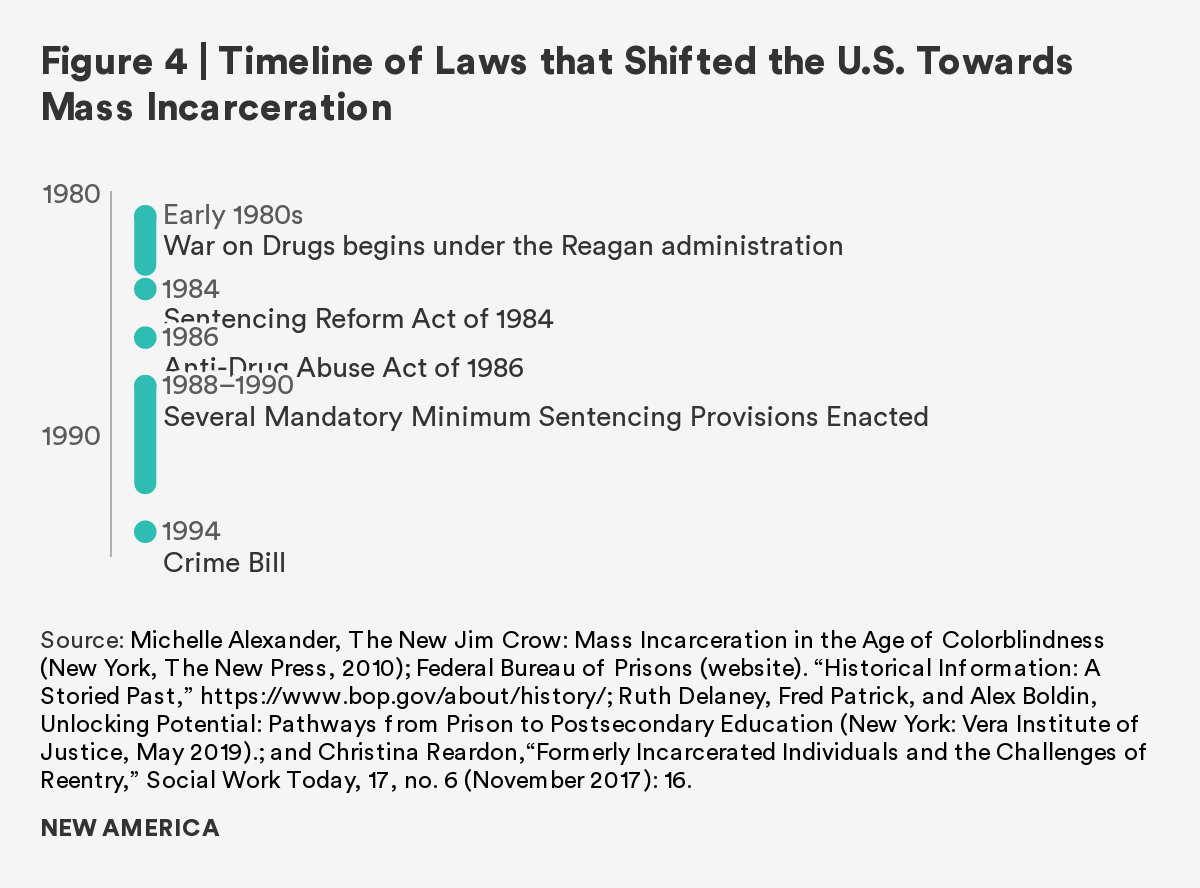
The U.S. has the largest population of incarcerated individuals and the highest imprisonment rate in the world. 26 By the end of 2015, approximately 7 million individuals were under supervision of the U.S. adult correctional system (including federal and state prisons, local and county jails, and probation or parole). 27 The shift towards mass incarceration in our country began with the Reagan administration’s War on Drugs in the early 1980s and intensified when the Clinton administration imposed longer sentences and tougher sentencing standards for drug offenders.28 As a result, the majority of those incarcerated were and still are charged with non-violent drug convictions. During this era, appropriations for federal law enforcement agencies increased, while funding for federal and state agencies responsible for drug rehabilitation, prevention, education, and economic investments in impoverished communities drastically declined.29
Tougher sentencing laws coupled with a decrease of investments in community rehabilitative services escalated the incarceration rates in America. The 1980s witnessed rising crime rates, racial tensions, and the emergence of cocaine and crack parallel to both federal and state adoption of “tough-on-crime” laws.30 For example, the Sentencing Reform Act of 1984 established consistency for federal offenses with determinate sentencing that narrowed the broad discretion of federal judges, abolished the option for parole for those in federal prisons, and reduced opportunities to earn time off a sentence in exchange for good behavior.31
Congress approved several mandatory minimum sentencing laws during the Reagan and George H. W. Bush administrations.32 The most consequential legislation during the War on Drugs era was the Anti-Drug Abuse Act of 1986, which established minimum sentences for the distribution of cocaine and severe sentences for the distribution of prohibited controlled substances related to marijuana and crack. Legislation in 1988 birthed the substantial lifelong punitive justice system that continues today, enforcing civil penalties for those with drug offenses. In addition, the revisions removed access to federal financial aid for higher education, such as student loans for those convicted of a drug offense.33
A few years later, the crime bill signed by former President Bill Clinton in 1994 maintained the momentum of increased incarceration rates and solidified correctional facilities as punitive institutions by neglecting opportunities for rehabilitation within prisons. This bill also removed incarcerated adults’ eligibility to receive federal financial need-based aid for college.34
In response, funding for construction of new federal and state prisons skyrocketed,35 with more than $16 billion going toward state prison grants and the expansion of state and local police agencies. The Clinton administration witnessed the largest increase of incarceration within federal and state prisons in our nation’s history. Harsh political rhetoric and sentencing laws of “three strikes and you’re out” significantly contributed to this prison explosion.36
The federal laws of the 1980s and 1990s drastically altered sentencing, increasing the number of those in both federal and state prisons to the irreversible result of mass incarceration that we now know today. From 1970 to 2008, the number of people behind bars grew an unprecedented 700 percent.37 Because of these laws, minor low-level infractions were criminalized, resulting in mandatory prison sentences38 with very little correctional programming being offered to rehabilitate individuals.
Mass incarceration has had a devastating economic impact on individuals, especially for racial and ethnic minorities and their families. It has, in fact, been a significant contributor to the racial wealth gap within the U.S.39 People of color have been disproportionately affected by mass incarceration, as the leading demographic imprisoned primarily for drug convictions.40 In some states, incarceration rates for Black men are 20 to 50 times greater than for white men.41 Black males are five to seven times more likely to be convicted compared to white males.42 Within our nation’s capital, research indicates that three out of every four young Black men will serve some time in prison and the data are even worse in DC’s poorest communities.43
Research shows that white men convicted of felonies have less difficulty receiving job offers compared to Black men without a criminal record. And the impact of mass incarceration on future job employment compounds those challenges; formerly incarcerated Black men are the least likely of any other formerly incarcerated demographic to gain employment. Job prospects for formerly incarcerated Black men are even worse when looking for jobs in suburban areas.44
These glaring racial disparities cannot be understood without acknowledging racial prejudices within our country’s criminal justice system. Research shows that all racial/ethnic groups distribute and use prohibited illegal drugs at remarkably similar rates, yet U.S. federal and state prisons are oversaturated with Black and brown drug offenders.45
The devastation of mass incarceration follows justice-involved individuals for the rest of their lives. Federal, state, and local laws confine formerly incarcerated individuals to the margins of society. Finding employment is particularly challenging, from checking the box on employment applications to being denied access for licensure for a range of professions and trades.46 For example, some states prohibit formerly incarcerated individuals from obtaining a professional/trade license in health care or becoming a barber. Because of the difficulties these laws make to successful reentry, many formerly incarcerated individuals are permanently excluded from society, with limited access to participate in the economy. These laws function as an invisible punishment, where their debt to society is never paid.47
“I hope [a college degree] helps getting a job easier. I am sure it helps employers look at us in a different way. I’ve never had a real job, so I hope it helps.”
—currently incarcerated student, June 2019

Equipping Individuals for Life Beyond Bars
- Executive Summary
- Introduction
- Mass Incarceration in the U.S.
- Congress Weighs In: Higher Education in Prison
- Research on Correctional Education
- Current Landscape of Higher Education & Job Training in Prison
- Study
- Results
- Discussion
- Policy Implications/Recommendations
- Conclusion
- Appendix A: Methodology
- Appendix B: Description of PIAAC Proficiency Levels on the Literacy Scale
- Appendix C: Description of PIAAC Proficiency Levels on the Numeracy Scale
Citations
- Nation Behind Bars: A Human Rights Solution (New York: Human Rights Watch, 2014), https://www.hrw.org/sites/default/files/related_material/2014_US_Nation_Behind_Bars_0.pdf
- Christina Reardon, “Formerly Incarcerated Individuals and the Challenges of Reentry,” Social Work Today 17, no. 6 (November 2017): 16.
- Michelle Alexander, The New Jim Crow: Mass Incarceration in the Age of Colorblindness (New York: The New Press, 2010); and Christina Reardon, “Formerly Incarcerated Individuals and the Challenges of Reentry,” Social Work Today 17, no. 6 (November 2017): 16.
- Michelle Alexander, The New Jim Crow: Mass Incarceration in the Age of Colorblindness (New York: The New Press, 2010).
- Nation Behind Bars: A Human Rights Solution (New York: Human Rights Watch, 2014), https://www.hrw.org/sites/default/files/related_material/2014_US_Nation_Behind_Bars_0.pdf
- Federal Bureau of Prisons (website), “Historical Information: A Storied Past,” https://www.bop.gov/about/history/
- Federal Bureau of Prisons (website), “Historical Information: A Storied Past,” https://www.bop.gov/about/history/
- Michelle Alexander, The New Jim Crow: Mass Incarceration in the Age of Colorblindness (New York: The New Press, 2010).
- Ruth Delaney, Fred Patrick, and Alex Boldin, Unlocking Potential: Pathways from Prison to Postsecondary Education (New York: Vera Institute of Justice, May 2019).
- Ruth Delaney, Fred Patrick, and Alex Boldin, Unlocking Potential: Pathways from Prison to Postsecondary Education (New York: Vera Institute of Justice, May 2019).
- Michelle Alexander, The New Jim Crow: Mass Incarceration in the Age of Colorblindness (New York: The New Press, 2010).
- Ruth Delaney, Fred Patrick, and Alex Boldin, Unlocking Potential: Pathways from Prison to Postsecondary Education (New York: Vera Institute of Justice, May 2019). pp. 2.
- Nation Behind Bars: A Human Rights Solution (New York: Human Rights Watch, 2014), https://www.hrw.org/sites/default/files/related_material/2014_US_Nation_Behind_Bars_0.pdf
- Abigail Strait and Susan Eaton, Post-Secondary Education for People in Prison, Social Justice Funders Opportunity Brief no. 1 (Waltham, MA: Sillerman Center, 2017), 1–8, https://heller.brandeis.edu/sillerman/pdfs/opportunity-briefs/post-secondary-education-people-in-prison.pdf
- Christina Reardon, “Formerly Incarcerated Individuals and the Challenges of Reentry,” Social Work Today 17, no. 6 (November 2017): 16; and Beyond the Box: Increasing Access to Higher Education for Justice-Involved Individuals (Washington, DC: U.S. Department of Education, 2016), https://www2.ed.gov/documents/beyond-the-box/guidance.pdf
- Jamie Fellner, Punishment and Prejudice: Racial Disparities in the War on Drugs (New York: Human Rights Watch, May 2000)
- E. Ann Carson and William J. Sabol, “Prisoners in 2011,” Bulletin, U.S. Department of Justice, Bureau of Justice Statistics, December 2012, https://www.bjs.gov/content/pub/pdf/p11.pdf
- Donald Braman, Doing Time on the Outside: Incarceration and Family Life in Urban America (Ann Arbor: University of Michigan Press, 2004), 3, citing D.C. Department of Corrections data for 2000.
- Michelle Alexander, The New Jim Crow: Mass Incarceration in the Age of Colorblindness (New York: The New Press, 2010).
- Michelle Alexander, The New Jim Crow: Mass Incarceration in the Age of Colorblindness (New York: The New Press, 2010).
- Michelle Alexander, The New Jim Crow: Mass Incarceration in the Age of Colorblindness (New York: The New Press, 2010).
- Michelle Alexander, The New Jim Crow: Mass Incarceration in the Age of Colorblindness (New York: The New Press, 2010).