A Chapter of: Equipping Individuals for Life Beyond Bars
Executive Summary
“I am a former inmate with the state system. Man, I wish they had this [college-in-prison program] back in ‘93. They just threw us out there and made us fend for ourselves. But this is good they have this now. I managed to make it, but this would have been helpful to get my degree while I was in.”
—formerly incarcerated individual, June 2019
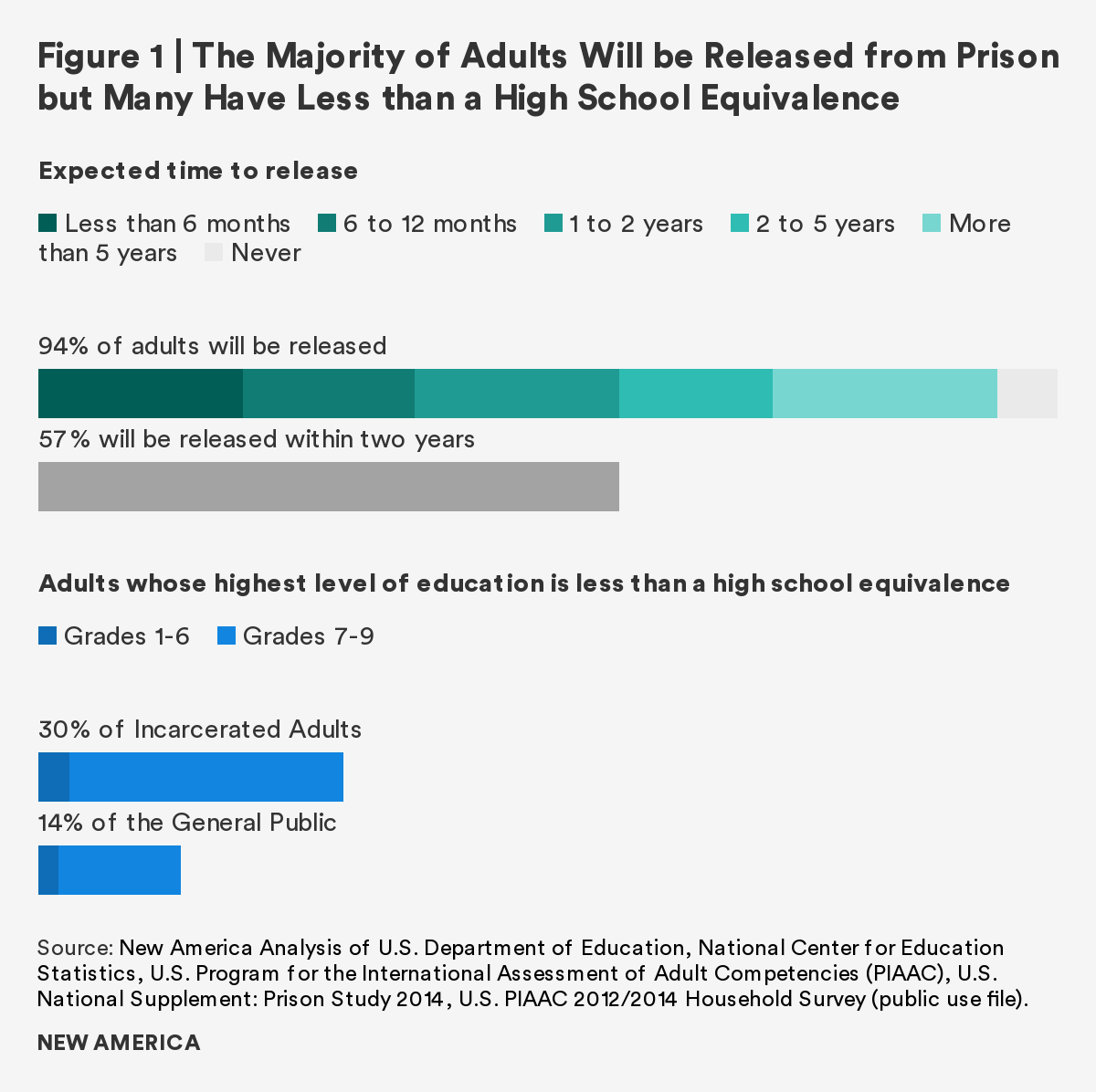
Our findings reveal almost all incarcerated adults (94 percent) in U.S. federal and state prisons will be released, with over half (57 percent) anticipating release within less than two years. Yet a larger proportion of incarcerated adults’ highest level of education is less than a high school equivalence (30 percent) compared with the general public (14 percent).1 This puts their ability to secure stable employment and/or pursue higher education at risk, leaving them less likely to succeed in life beyond bars.
Approximately 700,000 individuals are released each year from federal and state prisons.2 Research shows the importance of education on successful reentry for justice-involved individuals, where postsecondary education is proven to be meaningful to both reentry and labor market success.3 Nonetheless, opportunities to pursue postsecondary education in federal and state prisons are extremely limited. While federal and state prisons prioritize General Educational Development (GED) courses, traditional college courses are rare, with the onus to pay for these courses resting with incarcerated individuals and their families.4
However, this was not always so. The Pell Grant program, the federal government’s primary source of grant aid for low-income college students, did not initially exclude incarcerated adults. This was pivotal in expanding access to postsecondary education in prisons. Hundreds of college-in-prison programs emerged across the nation,5 financed primarily with Pell Grant dollars.6 By 1993, about 23,000 students in federal and state prisons received Pell Grants to pay for college courses.7 But those gains came to a grinding halt in 1994, when former President Bill Clinton signed the Violent Crime Control and Law Enforcement Act of 1994, also called the “crime bill.” Among other provisions, the legislation disqualified incarcerated adults in federal and state prisons from receiving Pell Grants. The withdrawal of federal funding led to the drastic decline of college-in-prison programs across the country,8 and within a year, participation in college-in-prison programs decreased by 44 percent.9
Since then, many U.S. correctional facilities have moved away from providing postsecondary education to incarcerated individuals primarily due to financial constraints.10 These financial constraints have had a domino effect of eliminating funds for some correctional rehabilitative programs, especially higher education.
In recent years, policymakers have had a change of heart and have become increasingly interested in expanding college access to incarcerated populations. In the words of former President Barack Obama, “Our prisons should be a place where we can train people for skills that can help them find a job.” President Obama called for a political shift, placing a higher priority on education and job training for incarcerated individuals than at any time in our nation’s history.11 In 2016, the Obama administration reignited the idea of college-in-prison programs with the launch of the Second Chance Pell experiment to be overseen by the U.S. Department of Education. The pilot program selected 69 U.S. colleges and universities to provide Pell Grants for postsecondary education to incarcerated adults.12 With increased bipartisan support for legislative efforts to remove the Pell ban and increased interest in empirical studies to inform the policy making process around college-in-prison programs, this report provides timely empirical knowledge.
Given renewed interest in preparing individuals for reentry, it is important to understand whether those who are currently incarcerated have the necessary education and skills to obtain employment and what types of correctional programming could help them achieve economic success upon reentry. This report analyzes the 2012/2014 U.S. PIAAC Household Survey and Prison Survey, which are the only existing representative data on adults’ skills in relationship to educational attainment and job training while incarcerated. Our purpose is to determine whether educational and job training correctional programs are meaningful to both reentry and labor market preparation.
This report seeks to facilitate conversations around the potential of correctional postsecondary education and/or job training programs as tools to mitigate the gap in skills and employment challenges for justice-involved individuals. This report aims to:
1) Identify the range of literacy and numeracy skills of incarcerated adults.
2) Identify whether a statistically significant gap in literacy and numeracy skills exists between incarcerated adults and the general public.
3) Identify whether participating in/completing postsecondary education and/or job training while incarcerated affects literacy and numeracy skill levels.
4) Identify the availability of, participation and interest in, and barriers and challenges to postsecondary education and job training programs for incarcerated adults.
Here are our key findings:
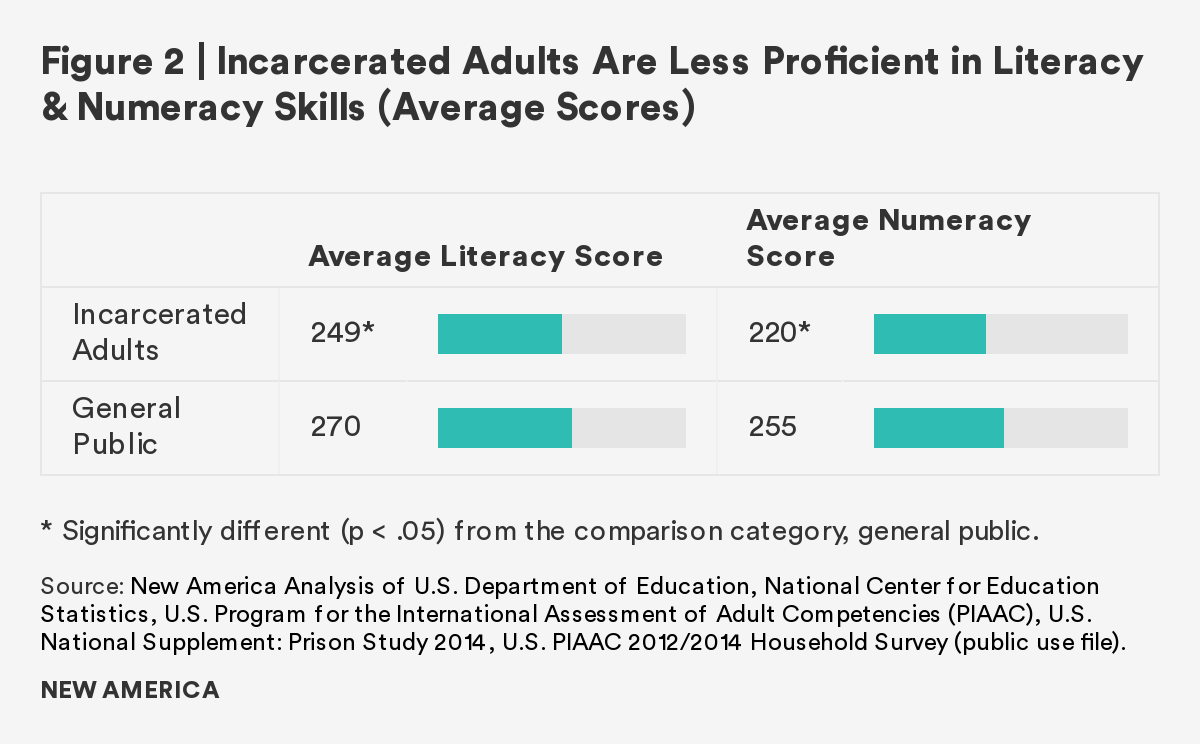
1) A substantial gap in literacy and numeracy skills exists between incarcerated adults and the general public. On average, incarcerated adults tend to be significantly less proficient in literacy and numeracy skills than the general public. As one formerly incarcerated student said, “You have guys with an educational literacy on the elementary level. They are now the ones going into the system with no high school diploma.”
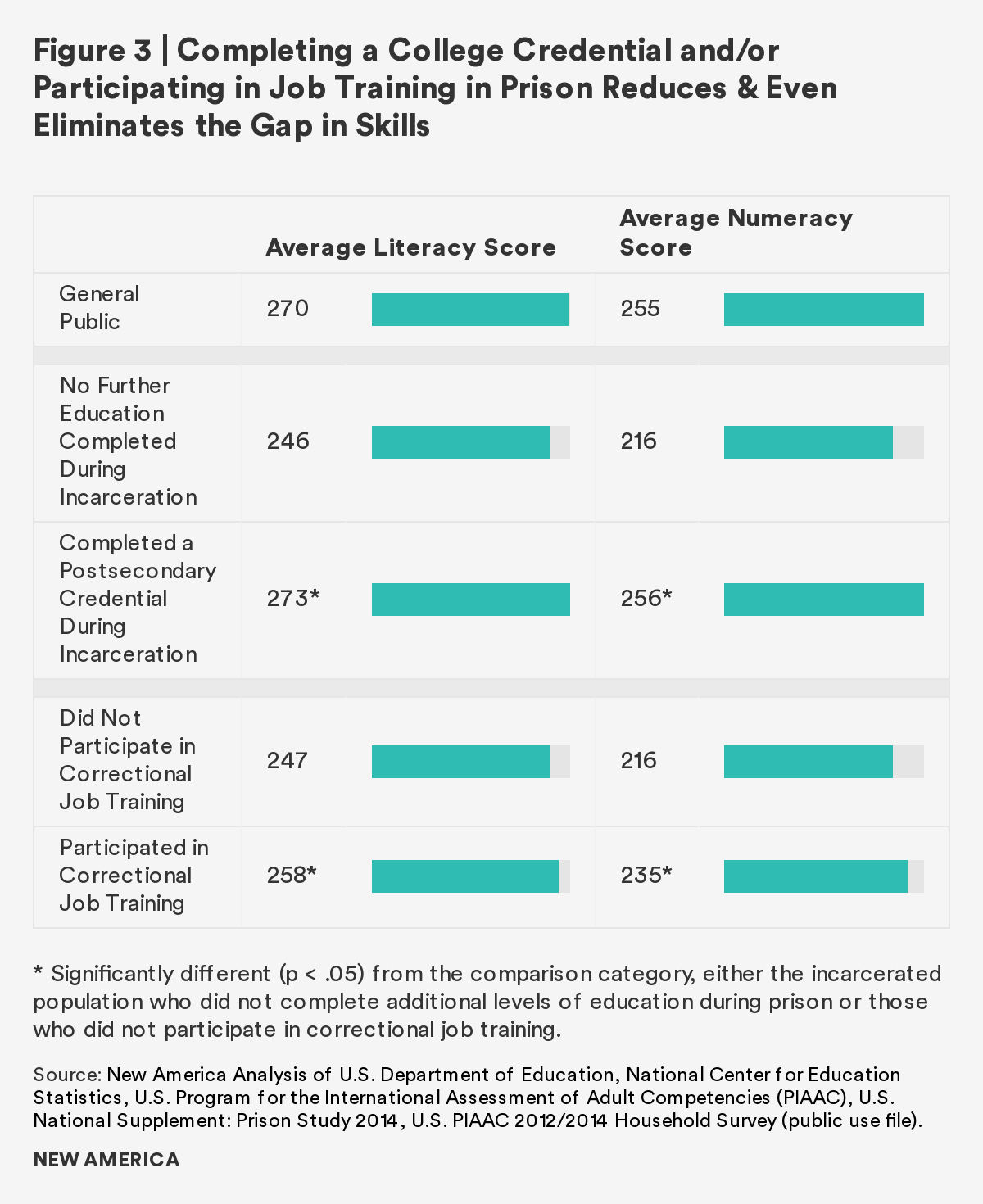
2) Completing a postsecondary degree or certificate while incarcerated has a positive effect on the literacy and numeracy proficiency skill levels of incarcerated adults, significantly reducing and even eliminating the gap in skills. Those in federal and state prisons who complete a postsecondary degree or certificate are statistically significantly more likely to score higher in both literacy and numeracy proficiency skill levels compared to those who do not. On average, students who complete a college degree or certificate score 26 points higher in literacy and 38 points higher in numeracy than incarcerated adults who do not.
3) Job training has a positive effect on the literacy and numeracy proficiency skill levels of incarcerated adults, significantly reducing the gap in skills. On average, those in federal and state prisons who participate in job training while incarcerated are statistically significantly more likely to score higher in both literacy and numeracy proficiency skill levels than those who do not. Incarcerated adults who participate in job training, on average, score 12 points higher in literacy and 18 points higher in numeracy than individuals who do not.
4) There is no relationship between the amount of time incarcerated individuals have left to serve and whether they are interested in, participate in, and/or complete postsecondary education and job training programs. Policymakers should be careful about potentially limiting access to Pell Grants for individuals within a specific window of time to reentry. One state correctional administrator we spoke with noted that there are “two populations that are in the gap from participating in either the job training or the college program. Those with long and indeterminate sentences and those with less than six months left of their sentence.” Federal investments in these two correctional programs should not limit eligibility to individuals nearing release. All incarcerated adults show interest in, participate in, and complete these programs at similar rates. Regardless of time to reentry, postsecondary education and job training have comparable positive effects on incarcerated adults’ proficiency skills.
“I have a fear that if Pell is made permanent, they will try to implement limits. That is not good. Regardless of the crime committed or the time you have, you should be able to take college classes.”
—currently incarcerated student, June 2019
Our prison site visits showed that there is variation in the curricula of postsecondary education and job training programs. Further research is necessary to understand the curricula and intent of correctional postsecondary education and job training programs to ensure the programs are high-quality and impart the skills necessary for labor market success.
Our five recommendations with federal, state, and local policy implications suggest a new, smarter approach to reentry, one that begins while individuals are serving their time, and that prioritizes postsecondary education and job training opportunities:
1) Increase the availability of quality postsecondary education and meaningful job training opportunities.
2) Increase the choice of educational providers to incarcerated populations.
3) Provide opportunities to ensure correctional postsecondary programs lead to pathways to earn formal degrees.
4) Make postsecondary education and job training programs a part of the reentry process.
5) Recommendations for reinstating Pell Grants to incarcerated populations.
Methodology
This paper analyzes the 2012/2014 U.S. PIAAC data because literacy and numeracy skills are designated as the key cognitive and workplace skills necessary for individuals to successfully participate in both the economy and society.13 Research suggests that adults who have difficulty reading and using mathematics are at a loss in trying to obtain employment in the 21st century workforce.14 With the existing gap in skills between incarcerated adults and the general public, currently incarcerated adults are at a compounding deficit in obtaining employment post-release. Therefore, it is critical to prepare incarcerated adults for reentry with effective rehabilitative programs.
To evaluate the gap in skills and identify the effect of a postsecondary degree/certificate and/or job training on skill level, we used a combination of descriptive estimates, t-Tests, correlations, and linear and logistic regression.
While the U.S. PIAAC data are an invaluable source of information on the skills of incarcerated adults in relationship to educational attainment and job training while in prison, there are limits to what the quantitative data can tell us. For example, the PIAAC survey does not describe the content of courses taught in job training sessions nor expound on the challenges of participating in postsecondary education for incarcerated populations. To address those limitations and include the human aspect to provide context to some of the unexplainable nuances observed in the data, we observed, interviewed, and led focus groups at selected federal and state prisons. We collected qualitative data from over 200 individuals, including formerly and currently incarcerated students, federal and state correctional administrators, college and job training programming staff, instructors, college presidents, and family members of currently incarcerated students.
Equipping Individuals for Life Beyond Bars
- Executive Summary
- Introduction
- Mass Incarceration in the U.S.
- Congress Weighs In: Higher Education in Prison
- Research on Correctional Education
- Current Landscape of Higher Education & Job Training in Prison
- Study
- Results
- Discussion
- Policy Implications/Recommendations
- Conclusion
- Appendix A: Methodology
- Appendix B: Description of PIAAC Proficiency Levels on the Literacy Scale
- Appendix C: Description of PIAAC Proficiency Levels on the Numeracy Scale
Citations
- New America Analysis of U.S. Department of Education, National Center for Education Statistics, U.S. Program for the International Assessment of Adult Competencies (PIAAC), U.S. National Supplement: Prison Study 2014, U.S. PIAAC 2012/2014 Household Survey (public use file).
- Zaid Jilani, “How Congress Killed One of the Few Lifelines for Former Prisoners and Why It’s Time to Bring It Back,” June 3, 2015, https://www.alternet.org/2015/06/how-congress-killed-one-few-lifelines-former-prisoners-and-why-its-time-bring-it-back/; and Abigail Strait and Susan Eaton, Post-Secondary Education for People in Prison, Social Justice Funders Opportunity Brief no. 1 (Waltham, MA: Sillerman Center, 2017), 1–8, https://heller.brandeis.edu/sillerman/pdfs/opportunity-briefs/post-secondary-education-people-in-prison.pdf
- Beyond the Box: Increasing Access to Higher Education for Justice-Involved Individuals (Washington, DC: U.S. Department of Education, 2016), https://www2.ed.gov/documents/beyond-the-box/guidance.pdf
- Federal Bureau of Prisons (website), “Inmate Custody & Care,” https://www.bop.gov/inmates/custody_and_care/
- Kritika Agarwal, “Inside Higher Education: College-in-Prison Programs Flourish but for How Long?” Perspectives on History, American Historical Association, January 1, 2018, https://www.historians.org/publications-and-directories/perspectives-on-history/january-2018/inside-higher-ed-college-in-prison-programs-flourish-but-for-how-long
- Nation Behind Bars: A Human Rights Solution (New York: Human Rights Watch, 2014), https://www.hrw.org/sites/default/files/related_material/2014_US_Nation_Behind_Bars_0.pdf
- Diana Ali, “Pell Grants for Prisoners: Considerations in the New Administration,” NASPA Student Affairs Administrators in Higher Education (website), September 22, 2017, https://www.naspa.org/rpi/posts/pell-grants-for-prisoners-considerations-in-the-new-administration
- Kritika Agarwal, “Inside Higher Education: College-in-Prison Programs Flourish but for How Long?” Perspectives on History, American Historical Association, January 1, 2018, https://www.historians.org/publications-and-directories/perspectives-on-history/january-2018/inside-higher-ed-college-in-prison-programs-flourish-but-for-how-long
- Lois M. Davis, Jennifer L. Steele, Robert Bozick, Malcolm V. Williams, Susan Turner, Jeremy N. V. Miles, Jessica Saunders, and Paul S. Steinberg, How Effective is Correctional Education, and Where Do We Go from Here? The Results of a Comprehensive Evaluation (Santa Monica, CA: RAND Corporation, 2014), https://www.rand.org/pubs/research_reports/RR564.html
- Nation Behind Bars: A Human Rights Solution (New York: Human Rights Watch, 2014), https://www.hrw.org/sites/default/files/related_material/2014_US_Nation_Behind_Bars_0.pdf
- Department of Justice Archives, Federal Bureau of Prisons, Federal Bureau of Prisons Education Program Assessment (Chicago, IL: Bronner Group, November 29, 2016), pp.i, https://www.justice.gov/archives/dag/page/file/914026/download
- Kritika Agarwal, “Inside Higher Education: College-in-Prison Programs Flourish but for How Long?” Perspectives on History, American Historical Association, January 1, 2018, https://www.historians.org/publications-and-directories/perspectives-on-history/january-2018/inside-higher-ed-college-in-prison-programs-flourish-but-for-how-long
- Jacquie Hogan, Nina Thornton, Lillian Diaz-Hoffmann, Leyla Mohadjer, Tom Krenzke, Jianzhu Li, Wendy VanDeKerckhove, Kentaro Yamamoto, and Lale Khorramdel, U.S. Program for the International Assessment of Adult Competencies (PIAAC) 2012/2014: Main Study and National Supplement Technical Report (Washington, DC: U.S. Department of Education, National Center for Education Statistics, September 2016), https://nces.ed.gov/pubs2016/2016036_rev.pdf
- John Sabatini, Understanding the Basic Reading Skills of U.S. Adults: Reading Components in the PIAAC Literacy Survey (Princeton, NJ: Educational Testing Service, 2015), https://www.ets.org/s/research/report/reading-skills/ets-adult-reading-skills-2015.pdf