Report – Equipping Individuals for Life Beyond Bars
Abstract
As the overwhelming majority of those in U.S. prisons will rejoin society, it is imperative to prepare individuals to transition with effective rehabilitative programs. This report finds that although there is a gap between incarcerated adults and the general public in both literacy and numeracy skills, completion of a postsecondary credential and participation in job training ameliorates the gap. Those who participate in and/or complete these correctional programs have comparable literacy and numeracy scores to the general public. Furthermore, regardless of time to reentry, all incarcerated adults show interest in, participate in, and complete these programs at similar rates.
Please click to download PDF versions of the full report, research brief, higher education in prison infographic, and job training in prison infographic.
Acknowledgments
New America would like to thank Lumina Foundation as well as the Bill & Melinda Gates Foundation for its generous support of our work. The views expressed in this report are those of its author and do not necessarily represent the views of the foundations, their officers, or their employees.
The author would also like to thank the American Institutes for Research (AIR) for its assistance with the project, Dr. Eugenio Gonzalez for serving as an external reviewer, the correctional facilities that welcomed her for observation, formerly and currently incarcerated students, instructors, federal and state correctional administrators, program facilitators, and experts in the field who committed their time and shared their insights.
Executive Summary
“I am a former inmate with the state system. Man, I wish they had this [college-in-prison program] back in ‘93. They just threw us out there and made us fend for ourselves. But this is good they have this now. I managed to make it, but this would have been helpful to get my degree while I was in.”
—formerly incarcerated individual, June 2019
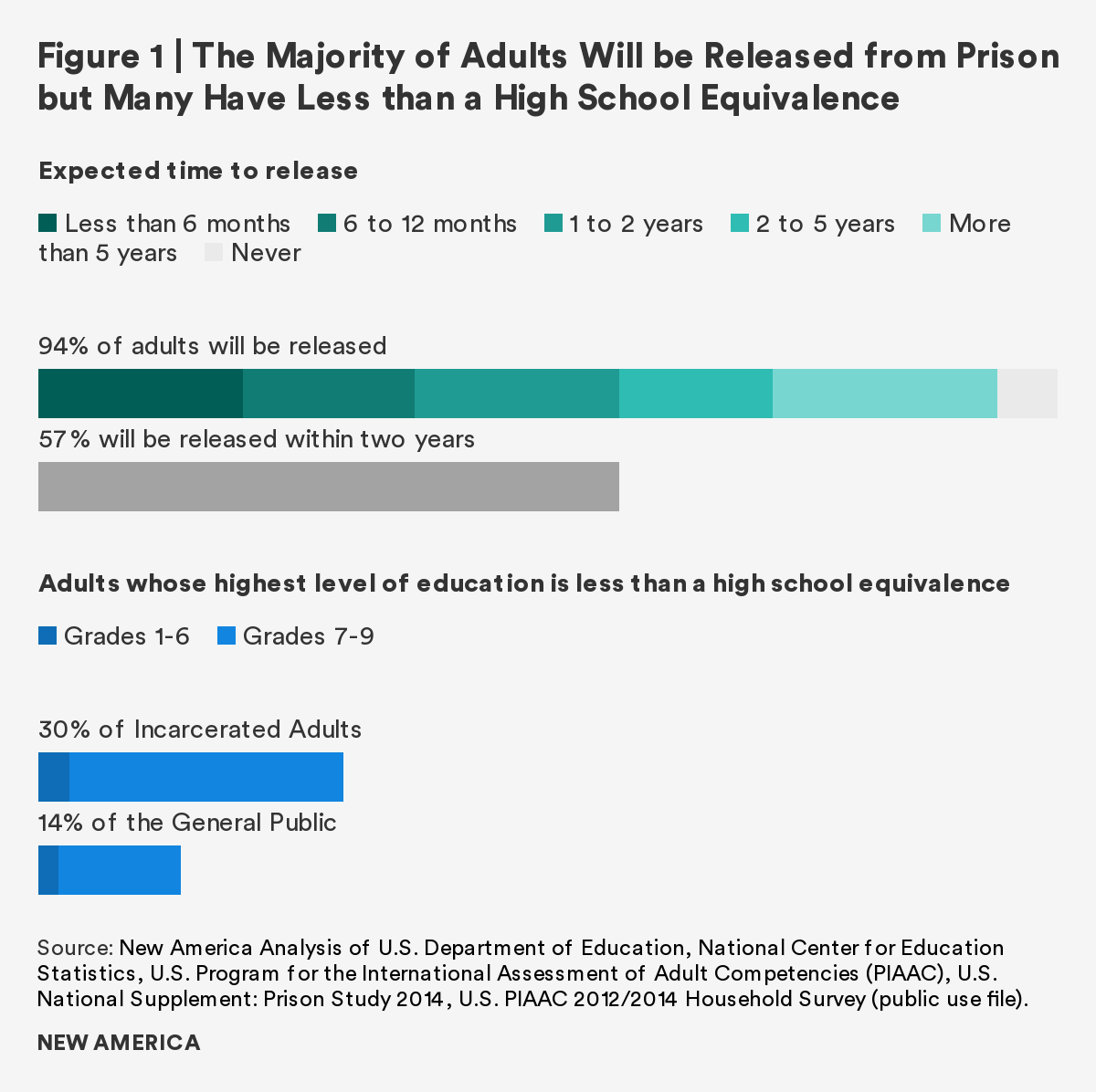
Our findings reveal almost all incarcerated adults (94 percent) in U.S. federal and state prisons will be released, with over half (57 percent) anticipating release within less than two years. Yet a larger proportion of incarcerated adults’ highest level of education is less than a high school equivalence (30 percent) compared with the general public (14 percent).1 This puts their ability to secure stable employment and/or pursue higher education at risk, leaving them less likely to succeed in life beyond bars.
Approximately 700,000 individuals are released each year from federal and state prisons.2 Research shows the importance of education on successful reentry for justice-involved individuals, where postsecondary education is proven to be meaningful to both reentry and labor market success.3 Nonetheless, opportunities to pursue postsecondary education in federal and state prisons are extremely limited. While federal and state prisons prioritize General Educational Development (GED) courses, traditional college courses are rare, with the onus to pay for these courses resting with incarcerated individuals and their families.4
However, this was not always so. The Pell Grant program, the federal government’s primary source of grant aid for low-income college students, did not initially exclude incarcerated adults. This was pivotal in expanding access to postsecondary education in prisons. Hundreds of college-in-prison programs emerged across the nation,5 financed primarily with Pell Grant dollars.6 By 1993, about 23,000 students in federal and state prisons received Pell Grants to pay for college courses.7 But those gains came to a grinding halt in 1994, when former President Bill Clinton signed the Violent Crime Control and Law Enforcement Act of 1994, also called the “crime bill.” Among other provisions, the legislation disqualified incarcerated adults in federal and state prisons from receiving Pell Grants. The withdrawal of federal funding led to the drastic decline of college-in-prison programs across the country,8 and within a year, participation in college-in-prison programs decreased by 44 percent.9
Since then, many U.S. correctional facilities have moved away from providing postsecondary education to incarcerated individuals primarily due to financial constraints.10 These financial constraints have had a domino effect of eliminating funds for some correctional rehabilitative programs, especially higher education.
In recent years, policymakers have had a change of heart and have become increasingly interested in expanding college access to incarcerated populations. In the words of former President Barack Obama, “Our prisons should be a place where we can train people for skills that can help them find a job.” President Obama called for a political shift, placing a higher priority on education and job training for incarcerated individuals than at any time in our nation’s history.11 In 2016, the Obama administration reignited the idea of college-in-prison programs with the launch of the Second Chance Pell experiment to be overseen by the U.S. Department of Education. The pilot program selected 69 U.S. colleges and universities to provide Pell Grants for postsecondary education to incarcerated adults.12 With increased bipartisan support for legislative efforts to remove the Pell ban and increased interest in empirical studies to inform the policy making process around college-in-prison programs, this report provides timely empirical knowledge.
Given renewed interest in preparing individuals for reentry, it is important to understand whether those who are currently incarcerated have the necessary education and skills to obtain employment and what types of correctional programming could help them achieve economic success upon reentry. This report analyzes the 2012/2014 U.S. PIAAC Household Survey and Prison Survey, which are the only existing representative data on adults’ skills in relationship to educational attainment and job training while incarcerated. Our purpose is to determine whether educational and job training correctional programs are meaningful to both reentry and labor market preparation.
This report seeks to facilitate conversations around the potential of correctional postsecondary education and/or job training programs as tools to mitigate the gap in skills and employment challenges for justice-involved individuals. This report aims to:
1) Identify the range of literacy and numeracy skills of incarcerated adults.
2) Identify whether a statistically significant gap in literacy and numeracy skills exists between incarcerated adults and the general public.
3) Identify whether participating in/completing postsecondary education and/or job training while incarcerated affects literacy and numeracy skill levels.
4) Identify the availability of, participation and interest in, and barriers and challenges to postsecondary education and job training programs for incarcerated adults.
Here are our key findings:
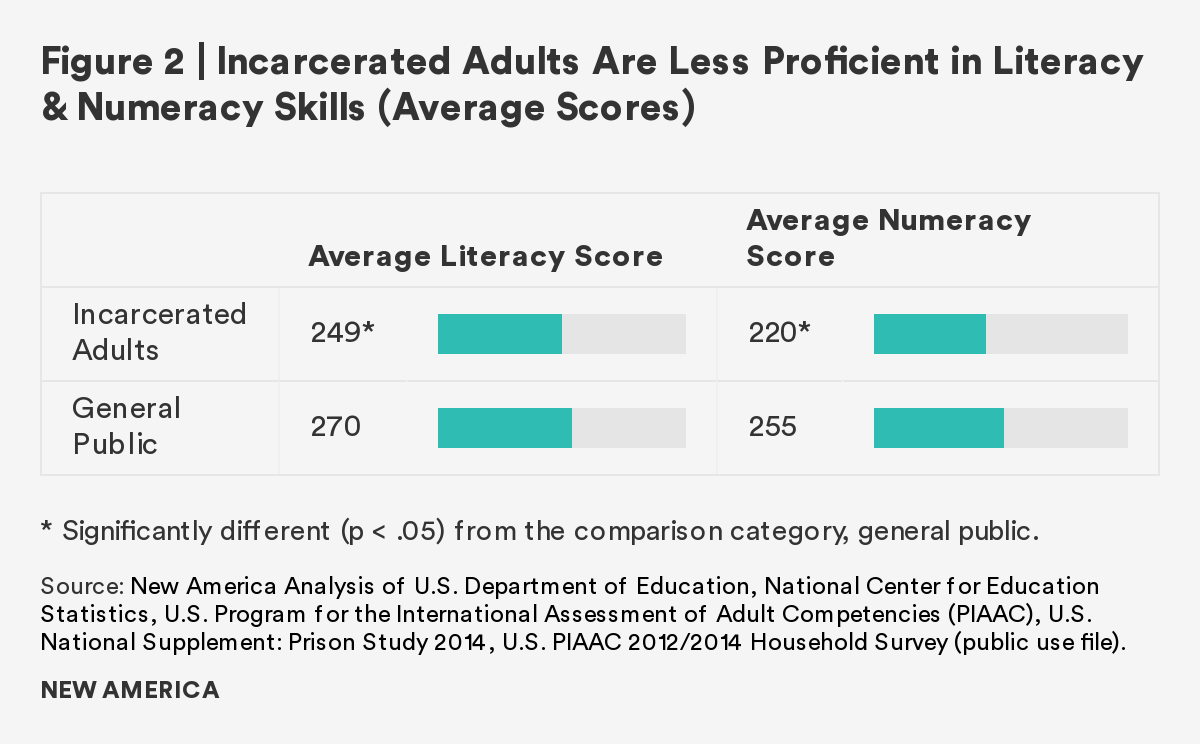
1) A substantial gap in literacy and numeracy skills exists between incarcerated adults and the general public. On average, incarcerated adults tend to be significantly less proficient in literacy and numeracy skills than the general public. As one formerly incarcerated student said, “You have guys with an educational literacy on the elementary level. They are now the ones going into the system with no high school diploma.”
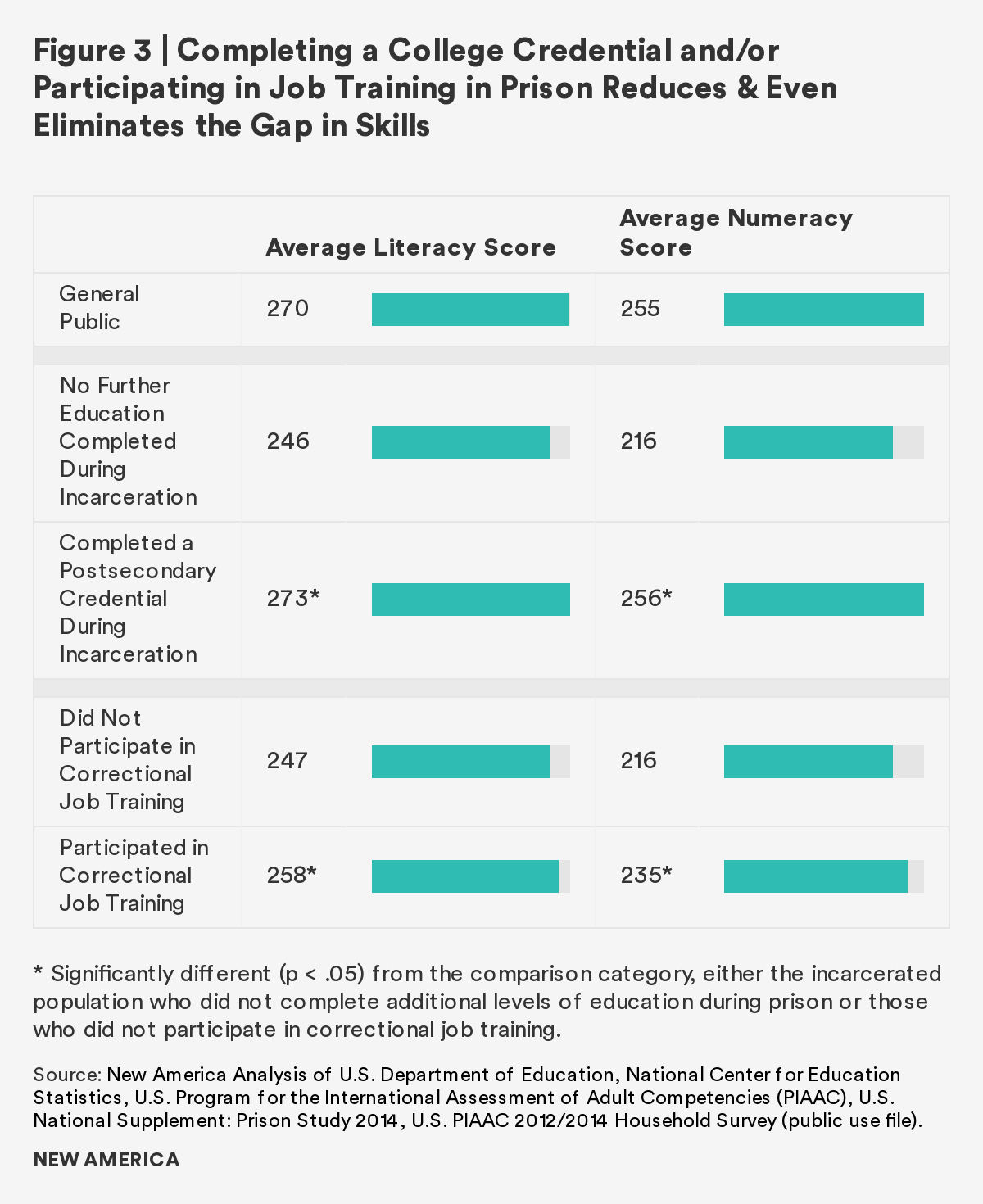
2) Completing a postsecondary degree or certificate while incarcerated has a positive effect on the literacy and numeracy proficiency skill levels of incarcerated adults, significantly reducing and even eliminating the gap in skills. Those in federal and state prisons who complete a postsecondary degree or certificate are statistically significantly more likely to score higher in both literacy and numeracy proficiency skill levels compared to those who do not. On average, students who complete a college degree or certificate score 26 points higher in literacy and 38 points higher in numeracy than incarcerated adults who do not.
3) Job training has a positive effect on the literacy and numeracy proficiency skill levels of incarcerated adults, significantly reducing the gap in skills. On average, those in federal and state prisons who participate in job training while incarcerated are statistically significantly more likely to score higher in both literacy and numeracy proficiency skill levels than those who do not. Incarcerated adults who participate in job training, on average, score 12 points higher in literacy and 18 points higher in numeracy than individuals who do not.
4) There is no relationship between the amount of time incarcerated individuals have left to serve and whether they are interested in, participate in, and/or complete postsecondary education and job training programs. Policymakers should be careful about potentially limiting access to Pell Grants for individuals within a specific window of time to reentry. One state correctional administrator we spoke with noted that there are “two populations that are in the gap from participating in either the job training or the college program. Those with long and indeterminate sentences and those with less than six months left of their sentence.” Federal investments in these two correctional programs should not limit eligibility to individuals nearing release. All incarcerated adults show interest in, participate in, and complete these programs at similar rates. Regardless of time to reentry, postsecondary education and job training have comparable positive effects on incarcerated adults’ proficiency skills.
“I have a fear that if Pell is made permanent, they will try to implement limits. That is not good. Regardless of the crime committed or the time you have, you should be able to take college classes.”
—currently incarcerated student, June 2019
Our prison site visits showed that there is variation in the curricula of postsecondary education and job training programs. Further research is necessary to understand the curricula and intent of correctional postsecondary education and job training programs to ensure the programs are high-quality and impart the skills necessary for labor market success.
Our five recommendations with federal, state, and local policy implications suggest a new, smarter approach to reentry, one that begins while individuals are serving their time, and that prioritizes postsecondary education and job training opportunities:
1) Increase the availability of quality postsecondary education and meaningful job training opportunities.
2) Increase the choice of educational providers to incarcerated populations.
3) Provide opportunities to ensure correctional postsecondary programs lead to pathways to earn formal degrees.
4) Make postsecondary education and job training programs a part of the reentry process.
5) Recommendations for reinstating Pell Grants to incarcerated populations.
Methodology
This paper analyzes the 2012/2014 U.S. PIAAC data because literacy and numeracy skills are designated as the key cognitive and workplace skills necessary for individuals to successfully participate in both the economy and society.13 Research suggests that adults who have difficulty reading and using mathematics are at a loss in trying to obtain employment in the 21st century workforce.14 With the existing gap in skills between incarcerated adults and the general public, currently incarcerated adults are at a compounding deficit in obtaining employment post-release. Therefore, it is critical to prepare incarcerated adults for reentry with effective rehabilitative programs.
To evaluate the gap in skills and identify the effect of a postsecondary degree/certificate and/or job training on skill level, we used a combination of descriptive estimates, t-Tests, correlations, and linear and logistic regression.
While the U.S. PIAAC data are an invaluable source of information on the skills of incarcerated adults in relationship to educational attainment and job training while in prison, there are limits to what the quantitative data can tell us. For example, the PIAAC survey does not describe the content of courses taught in job training sessions nor expound on the challenges of participating in postsecondary education for incarcerated populations. To address those limitations and include the human aspect to provide context to some of the unexplainable nuances observed in the data, we observed, interviewed, and led focus groups at selected federal and state prisons. We collected qualitative data from over 200 individuals, including formerly and currently incarcerated students, federal and state correctional administrators, college and job training programming staff, instructors, college presidents, and family members of currently incarcerated students.
Citations
- New America Analysis of U.S. Department of Education, National Center for Education Statistics, U.S. Program for the International Assessment of Adult Competencies (PIAAC), U.S. National Supplement: Prison Study 2014, U.S. PIAAC 2012/2014 Household Survey (public use file).
- Zaid Jilani, “How Congress Killed One of the Few Lifelines for Former Prisoners and Why It’s Time to Bring It Back,” June 3, 2015, https://www.alternet.org/2015/06/how-congress-killed-one-few-lifelines-former-prisoners-and-why-its-time-bring-it-back/; and Abigail Strait and Susan Eaton, Post-Secondary Education for People in Prison, Social Justice Funders Opportunity Brief no. 1 (Waltham, MA: Sillerman Center, 2017), 1–8, https://heller.brandeis.edu/sillerman/pdfs/opportunity-briefs/post-secondary-education-people-in-prison.pdf
- Beyond the Box: Increasing Access to Higher Education for Justice-Involved Individuals (Washington, DC: U.S. Department of Education, 2016), https://www2.ed.gov/documents/beyond-the-box/guidance.pdf
- Federal Bureau of Prisons (website), “Inmate Custody & Care,” https://www.bop.gov/inmates/custody_and_care/
- Kritika Agarwal, “Inside Higher Education: College-in-Prison Programs Flourish but for How Long?” Perspectives on History, American Historical Association, January 1, 2018, https://www.historians.org/publications-and-directories/perspectives-on-history/january-2018/inside-higher-ed-college-in-prison-programs-flourish-but-for-how-long
- Nation Behind Bars: A Human Rights Solution (New York: Human Rights Watch, 2014), https://www.hrw.org/sites/default/files/related_material/2014_US_Nation_Behind_Bars_0.pdf
- Diana Ali, “Pell Grants for Prisoners: Considerations in the New Administration,” NASPA Student Affairs Administrators in Higher Education (website), September 22, 2017, https://www.naspa.org/rpi/posts/pell-grants-for-prisoners-considerations-in-the-new-administration
- Kritika Agarwal, “Inside Higher Education: College-in-Prison Programs Flourish but for How Long?” Perspectives on History, American Historical Association, January 1, 2018, https://www.historians.org/publications-and-directories/perspectives-on-history/january-2018/inside-higher-ed-college-in-prison-programs-flourish-but-for-how-long
- Lois M. Davis, Jennifer L. Steele, Robert Bozick, Malcolm V. Williams, Susan Turner, Jeremy N. V. Miles, Jessica Saunders, and Paul S. Steinberg, How Effective is Correctional Education, and Where Do We Go from Here? The Results of a Comprehensive Evaluation (Santa Monica, CA: RAND Corporation, 2014), https://www.rand.org/pubs/research_reports/RR564.html
- Nation Behind Bars: A Human Rights Solution (New York: Human Rights Watch, 2014), https://www.hrw.org/sites/default/files/related_material/2014_US_Nation_Behind_Bars_0.pdf
- Department of Justice Archives, Federal Bureau of Prisons, Federal Bureau of Prisons Education Program Assessment (Chicago, IL: Bronner Group, November 29, 2016), pp.i, https://www.justice.gov/archives/dag/page/file/914026/download
- Kritika Agarwal, “Inside Higher Education: College-in-Prison Programs Flourish but for How Long?” Perspectives on History, American Historical Association, January 1, 2018, https://www.historians.org/publications-and-directories/perspectives-on-history/january-2018/inside-higher-ed-college-in-prison-programs-flourish-but-for-how-long
- Jacquie Hogan, Nina Thornton, Lillian Diaz-Hoffmann, Leyla Mohadjer, Tom Krenzke, Jianzhu Li, Wendy VanDeKerckhove, Kentaro Yamamoto, and Lale Khorramdel, U.S. Program for the International Assessment of Adult Competencies (PIAAC) 2012/2014: Main Study and National Supplement Technical Report (Washington, DC: U.S. Department of Education, National Center for Education Statistics, September 2016), https://nces.ed.gov/pubs2016/2016036_rev.pdf
- John Sabatini, Understanding the Basic Reading Skills of U.S. Adults: Reading Components in the PIAAC Literacy Survey (Princeton, NJ: Educational Testing Service, 2015), https://www.ets.org/s/research/report/reading-skills/ets-adult-reading-skills-2015.pdf
Introduction
Over the past 40 years, the prison population in the United States has ballooned, with one in every 100 American adults currently incarcerated, equating to 2.3 million people behind bars.15 While approximately 700,000 individuals are released yearly from federal and state prisons, most leave without the necessary education and job skills to obtain employment upon reentry.16 According to the Manpower Demonstration Research Corporation (MDRC), almost 60 percent of those released from prison are within the prime working-age population of 18 to 39 but are unemployed. 17 Without providing access to effective correctional rehabilitative programming to equip individuals with the necessary skills to actively participate in the labor market, the reentry process to obtain employment for returning citizens will continue to be an endless pursuit.
Research shows the importance of postsecondary education to successful reentry and labor market success for justice-involved individuals.18 However, opportunities to pursue postsecondary education in federal and state prisons are limited. While facilities typically provide programming for the most basic educational levels, General Educational Development (GED) and Adult Basic Education (ABE), traditional college courses are few and far between, with the costs largely falling to incarcerated individuals. The meager earnings from federal and some state prison jobs range from $0.12 to $1.15 per hour, which typically shifts the burden of the cost of college to incarcerated students’ family members.19 In the words of one formerly incarcerated student we spoke with, “I paid for all of the degrees I received [during incarceration] but I had family support and not everyone has that.”
In today’s economy, the pathway to stable, financially secure jobs require some sort of education beyond high school. By 2025, approximately 60 percent of the nation’s new jobs will require some level of postsecondary education.20 Unfortunately, many U.S. correctional facilities have moved away from providing postsecondary education due to financial constraints, which leaves many justice-involved individuals ill-prepared to successfully integrate back into society.21 As one currently incarcerated student we spoke with confirmed, “getting my degree helps a lot. Just having a prison job isn’t enough.”
Formerly incarcerated adults encounter a plethora of challenges, including but not limited to reuniting with family, finding housing, gaining employment, obtaining public benefits, losing the right to exercise privileges of citizenship, managing the stigma of being an ex-offender, and facing other personal issues such as depression or substance abuse.22 Finding living-wage employment is especially challenging. The label of previous incarceration follows individuals long after release, making it a challenge to reintegrate. In addition, moving from an environment where one makes very few decisions to an environment where one is responsible for making all daily decisions makes it extremely difficult to reintegrate.23
Unfortunately, the success rate for reentry is relatively low.24 The low success rate can partially be attributed to the fact that the majority of spending on corrections is directed to detainment, with fewer resources directed to help individuals when they are released.25 If the narrative of prisons do not shift from being a holding institution to a rehabilitative institution, incarcerated adults will continue to be released into society ill-equipped for life beyond bars.
“Postsecondary educational enrollments are low because correctional facilities were built to hold people; they were not intended for classroom space to educate people.”
—federal correctional administrator, May 2019
Citations
- New America Analysis of U.S. Department of Education, National Center for Education Statistics, U.S. Program for the International Assessment of Adult Competencies (PIAAC), U.S. National Supplement: Prison Study 2014, U.S. PIAAC 2012/2014 Household Survey (public use file).
- Zaid Jilani, “How Congress Killed One of the Few Lifelines for Former Prisoners and Why It’s Time to Bring It Back,” June 3, 2015, https://www.alternet.org/2015/06/how-congress-killed-one-few-lifelines-former-prisoners-and-why-its-time-bring-it-back/; and Abigail Strait and Susan Eaton, Post-Secondary Education for People in Prison, Social Justice Funders Opportunity Brief no. 1 (Waltham, MA: Sillerman Center, 2017), 1–8, https://heller.brandeis.edu/sillerman/pdfs/opportunity-briefs/post-secondary-education-people-in-prison.pdf
- Beyond the Box: Increasing Access to Higher Education for Justice-Involved Individuals (Washington, DC: U.S. Department of Education, 2016), https://www2.ed.gov/documents/beyond-the-box/guidance.pdf
- Federal Bureau of Prisons (website), “Inmate Custody & Care,” https://www.bop.gov/inmates/custody_and_care/
- Kritika Agarwal, “Inside Higher Education: College-in-Prison Programs Flourish but for How Long?” Perspectives on History, American Historical Association, January 1, 2018, https://www.historians.org/publications-and-directories/perspectives-on-history/january-2018/inside-higher-ed-college-in-prison-programs-flourish-but-for-how-long
- Nation Behind Bars: A Human Rights Solution (New York: Human Rights Watch, 2014), https://www.hrw.org/sites/default/files/related_material/2014_US_Nation_Behind_Bars_0.pdf
- Diana Ali, “Pell Grants for Prisoners: Considerations in the New Administration,” NASPA Student Affairs Administrators in Higher Education (website), September 22, 2017, https://www.naspa.org/rpi/posts/pell-grants-for-prisoners-considerations-in-the-new-administration
- Kritika Agarwal, “Inside Higher Education: College-in-Prison Programs Flourish but for How Long?” Perspectives on History, American Historical Association, January 1, 2018, https://www.historians.org/publications-and-directories/perspectives-on-history/january-2018/inside-higher-ed-college-in-prison-programs-flourish-but-for-how-long
- Lois M. Davis, Jennifer L. Steele, Robert Bozick, Malcolm V. Williams, Susan Turner, Jeremy N. V. Miles, Jessica Saunders, and Paul S. Steinberg, How Effective is Correctional Education, and Where Do We Go from Here? The Results of a Comprehensive Evaluation (Santa Monica, CA: RAND Corporation, 2014), https://www.rand.org/pubs/research_reports/RR564.html
- Nation Behind Bars: A Human Rights Solution (New York: Human Rights Watch, 2014), https://www.hrw.org/sites/default/files/related_material/2014_US_Nation_Behind_Bars_0.pdf
- Department of Justice Archives, Federal Bureau of Prisons, Federal Bureau of Prisons Education Program Assessment (Chicago, IL: Bronner Group, November 29, 2016), pp.i, https://www.justice.gov/archives/dag/page/file/914026/download
- Kritika Agarwal, “Inside Higher Education: College-in-Prison Programs Flourish but for How Long?” Perspectives on History, American Historical Association, January 1, 2018, https://www.historians.org/publications-and-directories/perspectives-on-history/january-2018/inside-higher-ed-college-in-prison-programs-flourish-but-for-how-long
- Jacquie Hogan, Nina Thornton, Lillian Diaz-Hoffmann, Leyla Mohadjer, Tom Krenzke, Jianzhu Li, Wendy VanDeKerckhove, Kentaro Yamamoto, and Lale Khorramdel, U.S. Program for the International Assessment of Adult Competencies (PIAAC) 2012/2014: Main Study and National Supplement Technical Report (Washington, DC: U.S. Department of Education, National Center for Education Statistics, September 2016), https://nces.ed.gov/pubs2016/2016036_rev.pdf
- John Sabatini, Understanding the Basic Reading Skills of U.S. Adults: Reading Components in the PIAAC Literacy Survey (Princeton, NJ: Educational Testing Service, 2015), https://www.ets.org/s/research/report/reading-skills/ets-adult-reading-skills-2015.pdf
- Nation Behind Bars: A Human Rights Solution (New York: Human Rights Watch, 2014), https://www.hrw.org/sites/default/files/related_material/2014_US_Nation_Behind_Bars_0.pdf ; and Abigail Strait and Susan Eaton, Post-Secondary Education for People in Prison, Social Justice Funders Opportunity Brief no. 1 (Waltham, MA: Sillerman Center, 2017), 1–8, https://heller.brandeis.edu/sillerman/pdfs/opportunity-briefs/post-secondary-education-people-in-prison.pdf
- Christina Reardon, “Formerly Incarcerated Individuals and the Challenges of Reentry,” Social Work Today 17, no. 6 (November 2017): 16; and Abigail Strait and Susan Eaton, Post-Secondary Education for People in Prison, Social Justice Funders Opportunity Brief no. 1 (Waltham, MA: Sillerman Center, 2017), 1–8, https://heller.brandeis.edu/sillerman/pdfs/opportunity-briefs/post-secondary-education-people-in-prison.pdf
- Department of Justice Archives, Federal Bureau of Prisons, Federal Bureau of Prisons Education Program Assessment (Chicago, IL: Bronner Group, November 29, 2016), pp.iii, https://www.justice.gov/archives/dag/page/file/914026/download
- Beyond the Box: Increasing Access to Higher Education for Justice-Involved Individuals (Washington, DC: U.S. Department of Education, 2016), https://www2.ed.gov/documents/beyond-the-box/guidance.pdf
- Federal Bureau of Prisons (website), “Inmate custody and care,” https://www.bop.gov/inmates/custody_and_care/
- Roger Jarjoura, “How Can We Slow Down Prison's Revolving Door?” Policy Center (blog), American Institutes for Research, July 2, 2019, https://www.air.org/resource/how-can-we-slow-down-prison-s-revolving-door
- Nation Behind Bars: A Human Rights Solution (New York: Human Rights Watch, 2014), https://www.hrw.org/sites/default/files/related_material/2014_US_Nation_Behind_Bars_0.pdf
- Michelle Alexander, The New Jim Crow: Mass Incarceration in the Age of Colorblindness (New York: The New Press, 2010); Lois M. Davis, Michelle A. Tolbert, and Mathew Mizel, Higher Education in Prison: Results from a National and Regional Landscape Scan, working paper (Santa Monica, CA: RAND, June 2017); and Christina Reardon, “Formerly Incarcerated Individuals and the Challenges of Reentry,” Social Work Today 17, no. 6 (November 2017): 16.
- Christina Reardon, “Formerly Incarcerated Individuals and the Challenges of Reentry,” Social Work Today 17, no. 6 (November 2017): 16.
- Grant Duwe, The Use and Impact of Correctional Programming for Inmates on Pre- and Post-Release Outcomes (Washington, DC: U.S. Department of Justice, June 2017).
- Christina Reardon, “Formerly Incarcerated Individuals and the Challenges of Reentry,” Social Work Today 17, no. 6 (November 2017): 16.
Mass Incarceration in the U.S.
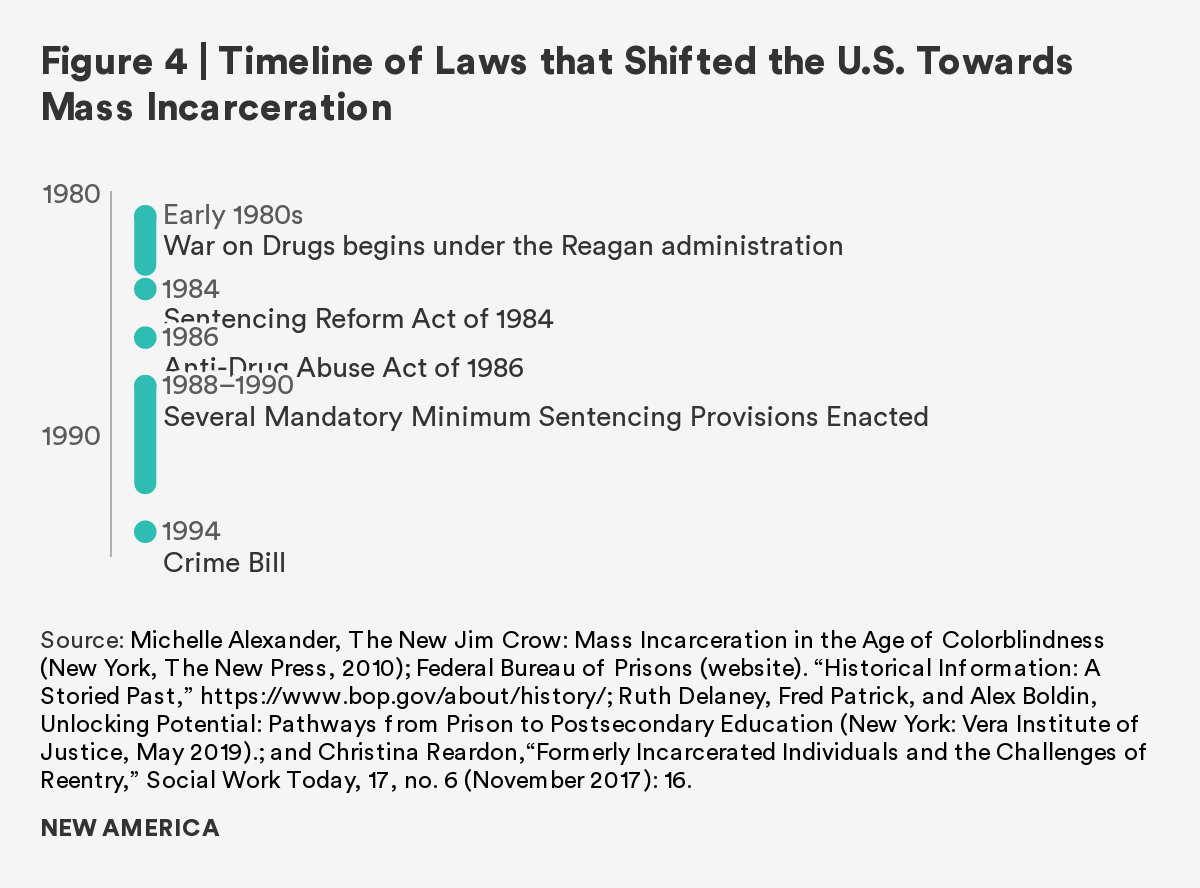
The U.S. has the largest population of incarcerated individuals and the highest imprisonment rate in the world. 26 By the end of 2015, approximately 7 million individuals were under supervision of the U.S. adult correctional system (including federal and state prisons, local and county jails, and probation or parole). 27 The shift towards mass incarceration in our country began with the Reagan administration’s War on Drugs in the early 1980s and intensified when the Clinton administration imposed longer sentences and tougher sentencing standards for drug offenders.28 As a result, the majority of those incarcerated were and still are charged with non-violent drug convictions. During this era, appropriations for federal law enforcement agencies increased, while funding for federal and state agencies responsible for drug rehabilitation, prevention, education, and economic investments in impoverished communities drastically declined.29
Tougher sentencing laws coupled with a decrease of investments in community rehabilitative services escalated the incarceration rates in America. The 1980s witnessed rising crime rates, racial tensions, and the emergence of cocaine and crack parallel to both federal and state adoption of “tough-on-crime” laws.30 For example, the Sentencing Reform Act of 1984 established consistency for federal offenses with determinate sentencing that narrowed the broad discretion of federal judges, abolished the option for parole for those in federal prisons, and reduced opportunities to earn time off a sentence in exchange for good behavior.31
Congress approved several mandatory minimum sentencing laws during the Reagan and George H. W. Bush administrations.32 The most consequential legislation during the War on Drugs era was the Anti-Drug Abuse Act of 1986, which established minimum sentences for the distribution of cocaine and severe sentences for the distribution of prohibited controlled substances related to marijuana and crack. Legislation in 1988 birthed the substantial lifelong punitive justice system that continues today, enforcing civil penalties for those with drug offenses. In addition, the revisions removed access to federal financial aid for higher education, such as student loans for those convicted of a drug offense.33
A few years later, the crime bill signed by former President Bill Clinton in 1994 maintained the momentum of increased incarceration rates and solidified correctional facilities as punitive institutions by neglecting opportunities for rehabilitation within prisons. This bill also removed incarcerated adults’ eligibility to receive federal financial need-based aid for college.34
In response, funding for construction of new federal and state prisons skyrocketed,35 with more than $16 billion going toward state prison grants and the expansion of state and local police agencies. The Clinton administration witnessed the largest increase of incarceration within federal and state prisons in our nation’s history. Harsh political rhetoric and sentencing laws of “three strikes and you’re out” significantly contributed to this prison explosion.36
The federal laws of the 1980s and 1990s drastically altered sentencing, increasing the number of those in both federal and state prisons to the irreversible result of mass incarceration that we now know today. From 1970 to 2008, the number of people behind bars grew an unprecedented 700 percent.37 Because of these laws, minor low-level infractions were criminalized, resulting in mandatory prison sentences38 with very little correctional programming being offered to rehabilitate individuals.
Mass incarceration has had a devastating economic impact on individuals, especially for racial and ethnic minorities and their families. It has, in fact, been a significant contributor to the racial wealth gap within the U.S.39 People of color have been disproportionately affected by mass incarceration, as the leading demographic imprisoned primarily for drug convictions.40 In some states, incarceration rates for Black men are 20 to 50 times greater than for white men.41 Black males are five to seven times more likely to be convicted compared to white males.42 Within our nation’s capital, research indicates that three out of every four young Black men will serve some time in prison and the data are even worse in DC’s poorest communities.43
Research shows that white men convicted of felonies have less difficulty receiving job offers compared to Black men without a criminal record. And the impact of mass incarceration on future job employment compounds those challenges; formerly incarcerated Black men are the least likely of any other formerly incarcerated demographic to gain employment. Job prospects for formerly incarcerated Black men are even worse when looking for jobs in suburban areas.44
These glaring racial disparities cannot be understood without acknowledging racial prejudices within our country’s criminal justice system. Research shows that all racial/ethnic groups distribute and use prohibited illegal drugs at remarkably similar rates, yet U.S. federal and state prisons are oversaturated with Black and brown drug offenders.45
The devastation of mass incarceration follows justice-involved individuals for the rest of their lives. Federal, state, and local laws confine formerly incarcerated individuals to the margins of society. Finding employment is particularly challenging, from checking the box on employment applications to being denied access for licensure for a range of professions and trades.46 For example, some states prohibit formerly incarcerated individuals from obtaining a professional/trade license in health care or becoming a barber. Because of the difficulties these laws make to successful reentry, many formerly incarcerated individuals are permanently excluded from society, with limited access to participate in the economy. These laws function as an invisible punishment, where their debt to society is never paid.47
“I hope [a college degree] helps getting a job easier. I am sure it helps employers look at us in a different way. I’ve never had a real job, so I hope it helps.”
—currently incarcerated student, June 2019
Citations
- New America Analysis of U.S. Department of Education, National Center for Education Statistics, U.S. Program for the International Assessment of Adult Competencies (PIAAC), U.S. National Supplement: Prison Study 2014, U.S. PIAAC 2012/2014 Household Survey (public use file).
- Zaid Jilani, “How Congress Killed One of the Few Lifelines for Former Prisoners and Why It’s Time to Bring It Back,” June 3, 2015, https://www.alternet.org/2015/06/how-congress-killed-one-few-lifelines-former-prisoners-and-why-its-time-bring-it-back/; and Abigail Strait and Susan Eaton, Post-Secondary Education for People in Prison, Social Justice Funders Opportunity Brief no. 1 (Waltham, MA: Sillerman Center, 2017), 1–8, https://heller.brandeis.edu/sillerman/pdfs/opportunity-briefs/post-secondary-education-people-in-prison.pdf
- Beyond the Box: Increasing Access to Higher Education for Justice-Involved Individuals (Washington, DC: U.S. Department of Education, 2016), https://www2.ed.gov/documents/beyond-the-box/guidance.pdf
- Federal Bureau of Prisons (website), “Inmate Custody & Care,” https://www.bop.gov/inmates/custody_and_care/
- Kritika Agarwal, “Inside Higher Education: College-in-Prison Programs Flourish but for How Long?” Perspectives on History, American Historical Association, January 1, 2018, https://www.historians.org/publications-and-directories/perspectives-on-history/january-2018/inside-higher-ed-college-in-prison-programs-flourish-but-for-how-long
- Nation Behind Bars: A Human Rights Solution (New York: Human Rights Watch, 2014), https://www.hrw.org/sites/default/files/related_material/2014_US_Nation_Behind_Bars_0.pdf
- Diana Ali, “Pell Grants for Prisoners: Considerations in the New Administration,” NASPA Student Affairs Administrators in Higher Education (website), September 22, 2017, https://www.naspa.org/rpi/posts/pell-grants-for-prisoners-considerations-in-the-new-administration
- Kritika Agarwal, “Inside Higher Education: College-in-Prison Programs Flourish but for How Long?” Perspectives on History, American Historical Association, January 1, 2018, https://www.historians.org/publications-and-directories/perspectives-on-history/january-2018/inside-higher-ed-college-in-prison-programs-flourish-but-for-how-long
- Lois M. Davis, Jennifer L. Steele, Robert Bozick, Malcolm V. Williams, Susan Turner, Jeremy N. V. Miles, Jessica Saunders, and Paul S. Steinberg, How Effective is Correctional Education, and Where Do We Go from Here? The Results of a Comprehensive Evaluation (Santa Monica, CA: RAND Corporation, 2014), https://www.rand.org/pubs/research_reports/RR564.html
- Nation Behind Bars: A Human Rights Solution (New York: Human Rights Watch, 2014), https://www.hrw.org/sites/default/files/related_material/2014_US_Nation_Behind_Bars_0.pdf
- Department of Justice Archives, Federal Bureau of Prisons, Federal Bureau of Prisons Education Program Assessment (Chicago, IL: Bronner Group, November 29, 2016), pp.i, https://www.justice.gov/archives/dag/page/file/914026/download
- Kritika Agarwal, “Inside Higher Education: College-in-Prison Programs Flourish but for How Long?” Perspectives on History, American Historical Association, January 1, 2018, https://www.historians.org/publications-and-directories/perspectives-on-history/january-2018/inside-higher-ed-college-in-prison-programs-flourish-but-for-how-long
- Jacquie Hogan, Nina Thornton, Lillian Diaz-Hoffmann, Leyla Mohadjer, Tom Krenzke, Jianzhu Li, Wendy VanDeKerckhove, Kentaro Yamamoto, and Lale Khorramdel, U.S. Program for the International Assessment of Adult Competencies (PIAAC) 2012/2014: Main Study and National Supplement Technical Report (Washington, DC: U.S. Department of Education, National Center for Education Statistics, September 2016), https://nces.ed.gov/pubs2016/2016036_rev.pdf
- John Sabatini, Understanding the Basic Reading Skills of U.S. Adults: Reading Components in the PIAAC Literacy Survey (Princeton, NJ: Educational Testing Service, 2015), https://www.ets.org/s/research/report/reading-skills/ets-adult-reading-skills-2015.pdf
- Nation Behind Bars: A Human Rights Solution (New York: Human Rights Watch, 2014), https://www.hrw.org/sites/default/files/related_material/2014_US_Nation_Behind_Bars_0.pdf ; and Abigail Strait and Susan Eaton, Post-Secondary Education for People in Prison, Social Justice Funders Opportunity Brief no. 1 (Waltham, MA: Sillerman Center, 2017), 1–8, https://heller.brandeis.edu/sillerman/pdfs/opportunity-briefs/post-secondary-education-people-in-prison.pdf
- Christina Reardon, “Formerly Incarcerated Individuals and the Challenges of Reentry,” Social Work Today 17, no. 6 (November 2017): 16; and Abigail Strait and Susan Eaton, Post-Secondary Education for People in Prison, Social Justice Funders Opportunity Brief no. 1 (Waltham, MA: Sillerman Center, 2017), 1–8, https://heller.brandeis.edu/sillerman/pdfs/opportunity-briefs/post-secondary-education-people-in-prison.pdf
- Department of Justice Archives, Federal Bureau of Prisons, Federal Bureau of Prisons Education Program Assessment (Chicago, IL: Bronner Group, November 29, 2016), pp.iii, https://www.justice.gov/archives/dag/page/file/914026/download
- Beyond the Box: Increasing Access to Higher Education for Justice-Involved Individuals (Washington, DC: U.S. Department of Education, 2016), https://www2.ed.gov/documents/beyond-the-box/guidance.pdf
- Federal Bureau of Prisons (website), “Inmate custody and care,” https://www.bop.gov/inmates/custody_and_care/
- Roger Jarjoura, “How Can We Slow Down Prison's Revolving Door?” Policy Center (blog), American Institutes for Research, July 2, 2019, https://www.air.org/resource/how-can-we-slow-down-prison-s-revolving-door
- Nation Behind Bars: A Human Rights Solution (New York: Human Rights Watch, 2014), https://www.hrw.org/sites/default/files/related_material/2014_US_Nation_Behind_Bars_0.pdf
- Michelle Alexander, The New Jim Crow: Mass Incarceration in the Age of Colorblindness (New York: The New Press, 2010); Lois M. Davis, Michelle A. Tolbert, and Mathew Mizel, Higher Education in Prison: Results from a National and Regional Landscape Scan, working paper (Santa Monica, CA: RAND, June 2017); and Christina Reardon, “Formerly Incarcerated Individuals and the Challenges of Reentry,” Social Work Today 17, no. 6 (November 2017): 16.
- Christina Reardon, “Formerly Incarcerated Individuals and the Challenges of Reentry,” Social Work Today 17, no. 6 (November 2017): 16.
- Grant Duwe, The Use and Impact of Correctional Programming for Inmates on Pre- and Post-Release Outcomes (Washington, DC: U.S. Department of Justice, June 2017).
- Christina Reardon, “Formerly Incarcerated Individuals and the Challenges of Reentry,” Social Work Today 17, no. 6 (November 2017): 16.
- Nation Behind Bars: A Human Rights Solution (New York: Human Rights Watch, 2014), https://www.hrw.org/sites/default/files/related_material/2014_US_Nation_Behind_Bars_0.pdf
- Christina Reardon, “Formerly Incarcerated Individuals and the Challenges of Reentry,” Social Work Today 17, no. 6 (November 2017): 16.
- Michelle Alexander, The New Jim Crow: Mass Incarceration in the Age of Colorblindness (New York: The New Press, 2010); and Christina Reardon, “Formerly Incarcerated Individuals and the Challenges of Reentry,” Social Work Today 17, no. 6 (November 2017): 16.
- Michelle Alexander, The New Jim Crow: Mass Incarceration in the Age of Colorblindness (New York: The New Press, 2010).
- Nation Behind Bars: A Human Rights Solution (New York: Human Rights Watch, 2014), https://www.hrw.org/sites/default/files/related_material/2014_US_Nation_Behind_Bars_0.pdf
- Federal Bureau of Prisons (website), “Historical Information: A Storied Past,” https://www.bop.gov/about/history/
- Federal Bureau of Prisons (website), “Historical Information: A Storied Past,” https://www.bop.gov/about/history/
- Michelle Alexander, The New Jim Crow: Mass Incarceration in the Age of Colorblindness (New York: The New Press, 2010).
- Ruth Delaney, Fred Patrick, and Alex Boldin, Unlocking Potential: Pathways from Prison to Postsecondary Education (New York: Vera Institute of Justice, May 2019).
- Ruth Delaney, Fred Patrick, and Alex Boldin, Unlocking Potential: Pathways from Prison to Postsecondary Education (New York: Vera Institute of Justice, May 2019).
- Michelle Alexander, The New Jim Crow: Mass Incarceration in the Age of Colorblindness (New York: The New Press, 2010).
- Ruth Delaney, Fred Patrick, and Alex Boldin, Unlocking Potential: Pathways from Prison to Postsecondary Education (New York: Vera Institute of Justice, May 2019). pp. 2.
- Nation Behind Bars: A Human Rights Solution (New York: Human Rights Watch, 2014), https://www.hrw.org/sites/default/files/related_material/2014_US_Nation_Behind_Bars_0.pdf
- Abigail Strait and Susan Eaton, Post-Secondary Education for People in Prison, Social Justice Funders Opportunity Brief no. 1 (Waltham, MA: Sillerman Center, 2017), 1–8, https://heller.brandeis.edu/sillerman/pdfs/opportunity-briefs/post-secondary-education-people-in-prison.pdf
- Christina Reardon, “Formerly Incarcerated Individuals and the Challenges of Reentry,” Social Work Today 17, no. 6 (November 2017): 16; and Beyond the Box: Increasing Access to Higher Education for Justice-Involved Individuals (Washington, DC: U.S. Department of Education, 2016), https://www2.ed.gov/documents/beyond-the-box/guidance.pdf
- Jamie Fellner, Punishment and Prejudice: Racial Disparities in the War on Drugs (New York: Human Rights Watch, May 2000)
- E. Ann Carson and William J. Sabol, “Prisoners in 2011,” Bulletin, U.S. Department of Justice, Bureau of Justice Statistics, December 2012, https://www.bjs.gov/content/pub/pdf/p11.pdf
- Donald Braman, Doing Time on the Outside: Incarceration and Family Life in Urban America (Ann Arbor: University of Michigan Press, 2004), 3, citing D.C. Department of Corrections data for 2000.
- Michelle Alexander, The New Jim Crow: Mass Incarceration in the Age of Colorblindness (New York: The New Press, 2010).
- Michelle Alexander, The New Jim Crow: Mass Incarceration in the Age of Colorblindness (New York: The New Press, 2010).
- Michelle Alexander, The New Jim Crow: Mass Incarceration in the Age of Colorblindness (New York: The New Press, 2010).
- Michelle Alexander, The New Jim Crow: Mass Incarceration in the Age of Colorblindness (New York: The New Press, 2010).
Congress Weighs In: Higher Education in Prison
The systemic disparities within our nation reproduce inequities as to who can access higher education. For example, racial and ethnic minorities are more likely to be involved with the criminal justice system. This is partially due to punitive K–12 school disciplinary policies that disproportionately punish students of color, deterring them from higher education pathways.48 In addition, inequities of access to quality K–12 educational and economic opportunities49 act as sorting and sifting mechanisms to determine who is granted access to postsecondary education. In the context of prisons, a combination of limited funding, limited space, bureaucratic resistance to modernizing technology, outdated facilities, distant location from educational providers, and political resistance function as powerful socializing forces that exclude incarcerated populations from higher education.
However, the Higher Education Act initially allowed incarcerated adults to be eligible for Pell Grants, the federal government’s primary source of need-based aid for low-income college students. As a result, hundreds of college-in-prison programs emerged across the nation. Some states (like New York, for example) had a college-in-prison program in just about every state correctional facility by the early 1990s.50 By 1993, about 23,000 students in federal and state prisons were supported by the Pell Grant.51 Although these grants impacted a substantial incarcerated population, spending on incarcerated adults eligible for Pell Grants made up less than 1 percent of the financial aid program’s total annual budget.52
Despite the fact that a minute fraction of Pell dollars supported those in prison, a false narrative began to pick up momentum: the Pell Grant for incarcerated individuals was taking away funds from students at traditional college campuses.53 This intense debate led to legislation in 1992, where Pell Grant eligibility was removed for individuals on death row or serving a life sentence without parole.54 Two years later, then-President Clinton signed the Violent Crime Control & Law Enforcement Act of 1994, which prohibited all incarcerated adults in federal and state prisons from receiving Pell Grants.55 The crime bill, short for the Violent Crime Control & Law Enforcement Act of 1994, was the catalyst for dismantling college-in-prison programs, since it removed the main funding source for these programs.56
Violent Crime Control & Law Enforcement Act of 1994
“No basic grant shall be awarded under this subpart to any individual who is incarcerated in any Federal or State penal institution.”
– Section 401(b)(8) of the Higher Education Act of 1965 (20 U.S.C. 1070a(b)(8))
The 1994 crime bill amended the Higher Education Act to ban incarcerated adults from receiving Pell Grants to pay for college programs starting on September 13, 1994.57 Furthermore, the bill enforced additional limitations on the amount of federal adult education and vocational funds available for correctional education programs.58 This legislation reinforced the idea of prison as a place of punishment rather than rehabilitation.
Within a year of the crime bill’s passage, participation in college-in-prison programs decreased by 44 percent.59 Part of the reason that the decline was so drastic was that many states quickly followed the federal government’s lead by reducing state funding for correctional postsecondary education.60 Low state appropriations for correctional postsecondary education persist today. A recent review of federal policies and state laws found that many states explicitly prohibit incarcerated adults in state prisons from receiving state financial aid.61 The limited access to college in prisons leave incarcerated adults vulnerable to low-quality, non-credit bearing, and/or non-transferable education from predatory external providers.
“This program was through correspondence education, paper-based. I go through the program [i.e. graduate] but find out the school was not accredited. Before starting this program, there was no process available to us to ensure the school was accredited or the transferability of the degree. …Without internal vigor or family resources to do the research for you, access to this information was nonexistent.”
—formerly incarcerated student, May 2019
Citations
- New America Analysis of U.S. Department of Education, National Center for Education Statistics, U.S. Program for the International Assessment of Adult Competencies (PIAAC), U.S. National Supplement: Prison Study 2014, U.S. PIAAC 2012/2014 Household Survey (public use file).
- Zaid Jilani, “How Congress Killed One of the Few Lifelines for Former Prisoners and Why It’s Time to Bring It Back,” June 3, 2015, https://www.alternet.org/2015/06/how-congress-killed-one-few-lifelines-former-prisoners-and-why-its-time-bring-it-back/; and Abigail Strait and Susan Eaton, Post-Secondary Education for People in Prison, Social Justice Funders Opportunity Brief no. 1 (Waltham, MA: Sillerman Center, 2017), 1–8, https://heller.brandeis.edu/sillerman/pdfs/opportunity-briefs/post-secondary-education-people-in-prison.pdf
- Beyond the Box: Increasing Access to Higher Education for Justice-Involved Individuals (Washington, DC: U.S. Department of Education, 2016), https://www2.ed.gov/documents/beyond-the-box/guidance.pdf
- Federal Bureau of Prisons (website), “Inmate Custody & Care,” https://www.bop.gov/inmates/custody_and_care/
- Kritika Agarwal, “Inside Higher Education: College-in-Prison Programs Flourish but for How Long?” Perspectives on History, American Historical Association, January 1, 2018, https://www.historians.org/publications-and-directories/perspectives-on-history/january-2018/inside-higher-ed-college-in-prison-programs-flourish-but-for-how-long
- Nation Behind Bars: A Human Rights Solution (New York: Human Rights Watch, 2014), https://www.hrw.org/sites/default/files/related_material/2014_US_Nation_Behind_Bars_0.pdf
- Diana Ali, “Pell Grants for Prisoners: Considerations in the New Administration,” NASPA Student Affairs Administrators in Higher Education (website), September 22, 2017, https://www.naspa.org/rpi/posts/pell-grants-for-prisoners-considerations-in-the-new-administration
- Kritika Agarwal, “Inside Higher Education: College-in-Prison Programs Flourish but for How Long?” Perspectives on History, American Historical Association, January 1, 2018, https://www.historians.org/publications-and-directories/perspectives-on-history/january-2018/inside-higher-ed-college-in-prison-programs-flourish-but-for-how-long
- Lois M. Davis, Jennifer L. Steele, Robert Bozick, Malcolm V. Williams, Susan Turner, Jeremy N. V. Miles, Jessica Saunders, and Paul S. Steinberg, How Effective is Correctional Education, and Where Do We Go from Here? The Results of a Comprehensive Evaluation (Santa Monica, CA: RAND Corporation, 2014), https://www.rand.org/pubs/research_reports/RR564.html
- Nation Behind Bars: A Human Rights Solution (New York: Human Rights Watch, 2014), https://www.hrw.org/sites/default/files/related_material/2014_US_Nation_Behind_Bars_0.pdf
- Department of Justice Archives, Federal Bureau of Prisons, Federal Bureau of Prisons Education Program Assessment (Chicago, IL: Bronner Group, November 29, 2016), pp.i, https://www.justice.gov/archives/dag/page/file/914026/download
- Kritika Agarwal, “Inside Higher Education: College-in-Prison Programs Flourish but for How Long?” Perspectives on History, American Historical Association, January 1, 2018, https://www.historians.org/publications-and-directories/perspectives-on-history/january-2018/inside-higher-ed-college-in-prison-programs-flourish-but-for-how-long
- Jacquie Hogan, Nina Thornton, Lillian Diaz-Hoffmann, Leyla Mohadjer, Tom Krenzke, Jianzhu Li, Wendy VanDeKerckhove, Kentaro Yamamoto, and Lale Khorramdel, U.S. Program for the International Assessment of Adult Competencies (PIAAC) 2012/2014: Main Study and National Supplement Technical Report (Washington, DC: U.S. Department of Education, National Center for Education Statistics, September 2016), https://nces.ed.gov/pubs2016/2016036_rev.pdf
- John Sabatini, Understanding the Basic Reading Skills of U.S. Adults: Reading Components in the PIAAC Literacy Survey (Princeton, NJ: Educational Testing Service, 2015), https://www.ets.org/s/research/report/reading-skills/ets-adult-reading-skills-2015.pdf
- Nation Behind Bars: A Human Rights Solution (New York: Human Rights Watch, 2014), https://www.hrw.org/sites/default/files/related_material/2014_US_Nation_Behind_Bars_0.pdf ; and Abigail Strait and Susan Eaton, Post-Secondary Education for People in Prison, Social Justice Funders Opportunity Brief no. 1 (Waltham, MA: Sillerman Center, 2017), 1–8, https://heller.brandeis.edu/sillerman/pdfs/opportunity-briefs/post-secondary-education-people-in-prison.pdf
- Christina Reardon, “Formerly Incarcerated Individuals and the Challenges of Reentry,” Social Work Today 17, no. 6 (November 2017): 16; and Abigail Strait and Susan Eaton, Post-Secondary Education for People in Prison, Social Justice Funders Opportunity Brief no. 1 (Waltham, MA: Sillerman Center, 2017), 1–8, https://heller.brandeis.edu/sillerman/pdfs/opportunity-briefs/post-secondary-education-people-in-prison.pdf
- Department of Justice Archives, Federal Bureau of Prisons, Federal Bureau of Prisons Education Program Assessment (Chicago, IL: Bronner Group, November 29, 2016), pp.iii, https://www.justice.gov/archives/dag/page/file/914026/download
- Beyond the Box: Increasing Access to Higher Education for Justice-Involved Individuals (Washington, DC: U.S. Department of Education, 2016), https://www2.ed.gov/documents/beyond-the-box/guidance.pdf
- Federal Bureau of Prisons (website), “Inmate custody and care,” https://www.bop.gov/inmates/custody_and_care/
- Roger Jarjoura, “How Can We Slow Down Prison's Revolving Door?” Policy Center (blog), American Institutes for Research, July 2, 2019, https://www.air.org/resource/how-can-we-slow-down-prison-s-revolving-door
- Nation Behind Bars: A Human Rights Solution (New York: Human Rights Watch, 2014), https://www.hrw.org/sites/default/files/related_material/2014_US_Nation_Behind_Bars_0.pdf
- Michelle Alexander, The New Jim Crow: Mass Incarceration in the Age of Colorblindness (New York: The New Press, 2010); Lois M. Davis, Michelle A. Tolbert, and Mathew Mizel, Higher Education in Prison: Results from a National and Regional Landscape Scan, working paper (Santa Monica, CA: RAND, June 2017); and Christina Reardon, “Formerly Incarcerated Individuals and the Challenges of Reentry,” Social Work Today 17, no. 6 (November 2017): 16.
- Christina Reardon, “Formerly Incarcerated Individuals and the Challenges of Reentry,” Social Work Today 17, no. 6 (November 2017): 16.
- Grant Duwe, The Use and Impact of Correctional Programming for Inmates on Pre- and Post-Release Outcomes (Washington, DC: U.S. Department of Justice, June 2017).
- Christina Reardon, “Formerly Incarcerated Individuals and the Challenges of Reentry,” Social Work Today 17, no. 6 (November 2017): 16.
- Nation Behind Bars: A Human Rights Solution (New York: Human Rights Watch, 2014), https://www.hrw.org/sites/default/files/related_material/2014_US_Nation_Behind_Bars_0.pdf
- Christina Reardon, “Formerly Incarcerated Individuals and the Challenges of Reentry,” Social Work Today 17, no. 6 (November 2017): 16.
- Michelle Alexander, The New Jim Crow: Mass Incarceration in the Age of Colorblindness (New York: The New Press, 2010); and Christina Reardon, “Formerly Incarcerated Individuals and the Challenges of Reentry,” Social Work Today 17, no. 6 (November 2017): 16.
- Michelle Alexander, The New Jim Crow: Mass Incarceration in the Age of Colorblindness (New York: The New Press, 2010).
- Nation Behind Bars: A Human Rights Solution (New York: Human Rights Watch, 2014), https://www.hrw.org/sites/default/files/related_material/2014_US_Nation_Behind_Bars_0.pdf
- Federal Bureau of Prisons (website), “Historical Information: A Storied Past,” https://www.bop.gov/about/history/
- Federal Bureau of Prisons (website), “Historical Information: A Storied Past,” https://www.bop.gov/about/history/
- Michelle Alexander, The New Jim Crow: Mass Incarceration in the Age of Colorblindness (New York: The New Press, 2010).
- Ruth Delaney, Fred Patrick, and Alex Boldin, Unlocking Potential: Pathways from Prison to Postsecondary Education (New York: Vera Institute of Justice, May 2019).
- Ruth Delaney, Fred Patrick, and Alex Boldin, Unlocking Potential: Pathways from Prison to Postsecondary Education (New York: Vera Institute of Justice, May 2019).
- Michelle Alexander, The New Jim Crow: Mass Incarceration in the Age of Colorblindness (New York: The New Press, 2010).
- Ruth Delaney, Fred Patrick, and Alex Boldin, Unlocking Potential: Pathways from Prison to Postsecondary Education (New York: Vera Institute of Justice, May 2019). pp. 2.
- Nation Behind Bars: A Human Rights Solution (New York: Human Rights Watch, 2014), https://www.hrw.org/sites/default/files/related_material/2014_US_Nation_Behind_Bars_0.pdf
- Abigail Strait and Susan Eaton, Post-Secondary Education for People in Prison, Social Justice Funders Opportunity Brief no. 1 (Waltham, MA: Sillerman Center, 2017), 1–8, https://heller.brandeis.edu/sillerman/pdfs/opportunity-briefs/post-secondary-education-people-in-prison.pdf
- Christina Reardon, “Formerly Incarcerated Individuals and the Challenges of Reentry,” Social Work Today 17, no. 6 (November 2017): 16; and Beyond the Box: Increasing Access to Higher Education for Justice-Involved Individuals (Washington, DC: U.S. Department of Education, 2016), https://www2.ed.gov/documents/beyond-the-box/guidance.pdf
- Jamie Fellner, Punishment and Prejudice: Racial Disparities in the War on Drugs (New York: Human Rights Watch, May 2000)
- E. Ann Carson and William J. Sabol, “Prisoners in 2011,” Bulletin, U.S. Department of Justice, Bureau of Justice Statistics, December 2012, https://www.bjs.gov/content/pub/pdf/p11.pdf
- Donald Braman, Doing Time on the Outside: Incarceration and Family Life in Urban America (Ann Arbor: University of Michigan Press, 2004), 3, citing D.C. Department of Corrections data for 2000.
- Michelle Alexander, The New Jim Crow: Mass Incarceration in the Age of Colorblindness (New York: The New Press, 2010).
- Michelle Alexander, The New Jim Crow: Mass Incarceration in the Age of Colorblindness (New York: The New Press, 2010).
- Michelle Alexander, The New Jim Crow: Mass Incarceration in the Age of Colorblindness (New York: The New Press, 2010).
- Michelle Alexander, The New Jim Crow: Mass Incarceration in the Age of Colorblindness (New York: The New Press, 2010).
- Beyond the Box: Increasing Access to Higher Education for Justice-Involved Individuals (Washington, DC: U.S. Department of Education, 2016), https://www2.ed.gov/documents/beyond-the-box/guidance.pdf
- Abigail Strait and Susan Eaton, Post-Secondary Education for People in Prison, Social Justice Funders Opportunity Brief no. 1 (Waltham, MA: Sillerman Center, 2017), 1–8, https://heller.brandeis.edu/sillerman/pdfs/opportunity-briefs/post-secondary-education-people-in-prison.pdf
- Kritika Agarwal, “Inside Higher Education: College-in-Prison Programs Flourish but for How Long?” Perspectives on History, American Historical Association, January 1, 2018, https://www.historians.org/publications-and-directories/perspectives-on-history/january-2018/inside-higher-ed-college-in-prison-programs-flourish-but-for-how-long
- Diana Ali, “Pell Grants for Prisoners: Considerations in the New Administration,” NASPA Student Affairs Administrators in Higher Education (website), September 22, 2017, https://www.naspa.org/rpi/posts/pell-grants-for-prisoners-considerations-in-the-new-administration
- Institute for Higher Education Policy, “Pell Grants: Are Prisoners the Program’s Biggest Problem?” Policy Steps 1, no. 1 (Spring 1994).
- Gerard Robinson and Elizabeth English, The Second Chance Pell Pilot Program: A Historical Overview (Washington, DC: American Enterprise Institute, September 2017), https://www.aei.org/research-products/report/the-second-chance-pell-pilot-program-a-historical-overview/
- Institute for Higher Education Policy, “Pell Grants: Are Prisoners the Program’s Biggest Problem?” Policy Steps 1, no. 1 (Spring 1994).
- Kritika Agarwal, “Inside Higher Education: College-in-Prison Programs Flourish but for How Long?” Perspectives on History, American Historical Association, January 1, 2018, https://www.historians.org/publications-and-directories/perspectives-on-history/january-2018/inside-higher-ed-college-in-prison-programs-flourish-but-for-how-long
- Institute for Higher Education Policy, “Pell Grants: Are Prisoners the Program’s Biggest Problem?” Policy Steps 1, no. 1 (Spring 1994).
- Violent Crime Control and Law Enforcement Act of 1994, U.S. House, 103rd Congress, 2nd Session, H.R. 3355, http://www.congress.gov/bill/103rd
- Lois M. Davis, Jennifer L. Steele, Robert Bozick, Malcolm V. Williams, Susan Turner, Jeremy N. V. Miles, Jessica Saunders, and Paul S. Steinberg, How Effective is Correctional Education, and Where Do We Go from Here? The Results of a Comprehensive Evaluation (Santa Monica, CA: RAND Corporation, 2014), https://www.rand.org/pubs/research_reports/RR564.html
- Lois M. Davis, Jennifer L. Steele, Robert Bozick, Malcolm V. Williams, Susan Turner, Jeremy N. V. Miles, Jessica Saunders, and Paul S. Steinberg, How Effective is Correctional Education, and Where Do We Go from Here? The Results of a Comprehensive Evaluation (Santa Monica, CA: RAND Corporation, 2014), https://www.rand.org/pubs/research_reports/RR564.html
- Ruth Delaney, Fred Patrick, and Alex Boldin, Unlocking Potential: Pathways from Prison to Postsecondary Education (New York: Vera Institute of Justice, May 2019).
- Bradley D. Custer, “States—Not Just Congress—Should Unlock Student Financial Aid for People in Prison,” The Conversation, May 17, 2019, http://theconversation.com/states-not-just-congress-should-unlock-student-financial-aid-for-people-in-prison-117068
Research on Correctional Education
Beyond recidivism (the tendency to reoffend), there are limited data on the value of correctional education, especially in terms of return on investment.62 The laser focus on recidivism is problematic, given that re-offenses cannot capture metrics of educational success used for traditional college populations, such as retention rates, graduation rates, and post-college employment. Still, federal and state prisons’ evaluation of correctional programming is limited to the outcome data they have traditionally collected, which is recidivism.
In 2013, an extensive literature review and meta-analysis published by RAND found that correctional education significantly reduces recidivism and improves employment outcomes upon release.63 Other studies focus on societal and individual economic benefits to prison education programs, such as reduction in crime, improved prison culture, psychological well-being, and an increased sense of purpose.64 Nonetheless, there remains a gap in the literature on how higher education affects reentry via increasing incarcerated adults’ skills. A 2013 meta-analysis of studies on correctional educational programs found that only 4 of the 58 existing studies evaluated math and reading skills to measure the effectiveness of correctional educational programming.65
Research suggests that successful reentry for formerly incarcerated adults benefits not only the individuals, but also their families and their communities.66 These studies show that when parents, including incarcerated parents, obtain a postsecondary degree, their children are more likely to complete a college degree as well.67 As one incarcerated student told us:
“I’m the first in my family to graduate from high school. But since I’ve been locked up, my daughter dropped out of high school. But now that I have been part of the college [program], now she is telling me she wants to get her GED and then go into nursing. It’s like my second chance is becoming her second chance!”
From both empirical research and anecdotal evidence, educational attainment of parents is predictive of the educational attainment of children.
A 2011 report by the Institute for Higher Education Policy (IHEP) of a 50-state survey in 2009–2010 found that only 6 percent of incarcerated individuals were enrolled in postsecondary education at the time and that these programs had extremely low completion rates.68 In speaking with currently and formerly incarcerated students during our prison site visits, we found that low completions were typically attributable to a number of factors. Among other things, some students were released before they could complete their degrees, while others were transferred to other facilities before finishing. Some took a break for personal reasons such as to prepare for parole; and some experienced difficulty managing their college courses with the scheduling of their prison job and/or mandatory programming that some state department of corrections prioritize. Unfortunately, college programming has not fully translated as a rehabilitative program into the culture of prisons and is often not highly prioritized for those with less than a year to reentry.
Although there are many reasons to explain why some formerly incarcerated adults successfully transition back into society and others do not, limited education and limited skills are key factors. A meta-analysis of a systematic review conducted by RAND (2014) found that correctional education may increase post-release employment for formerly incarcerated adults. The RAND (2014) study found that for those who completed either academic or vocational programs, the odds of obtaining employment were 13 percent higher compared to those who did not.69 A study this year by the Vera Institute of Justice complemented RAND’s work: it predicted that if 50 percent of incarcerated adults who are academically eligible to enroll in postsecondary education actually enrolled, post-release employment for incarcerated adults would increase, on average, by 10 percent.70
Citations
- New America Analysis of U.S. Department of Education, National Center for Education Statistics, U.S. Program for the International Assessment of Adult Competencies (PIAAC), U.S. National Supplement: Prison Study 2014, U.S. PIAAC 2012/2014 Household Survey (public use file).
- Zaid Jilani, “How Congress Killed One of the Few Lifelines for Former Prisoners and Why It’s Time to Bring It Back,” June 3, 2015, https://www.alternet.org/2015/06/how-congress-killed-one-few-lifelines-former-prisoners-and-why-its-time-bring-it-back/; and Abigail Strait and Susan Eaton, Post-Secondary Education for People in Prison, Social Justice Funders Opportunity Brief no. 1 (Waltham, MA: Sillerman Center, 2017), 1–8, https://heller.brandeis.edu/sillerman/pdfs/opportunity-briefs/post-secondary-education-people-in-prison.pdf
- Beyond the Box: Increasing Access to Higher Education for Justice-Involved Individuals (Washington, DC: U.S. Department of Education, 2016), https://www2.ed.gov/documents/beyond-the-box/guidance.pdf
- Federal Bureau of Prisons (website), “Inmate Custody & Care,” https://www.bop.gov/inmates/custody_and_care/
- Kritika Agarwal, “Inside Higher Education: College-in-Prison Programs Flourish but for How Long?” Perspectives on History, American Historical Association, January 1, 2018, https://www.historians.org/publications-and-directories/perspectives-on-history/january-2018/inside-higher-ed-college-in-prison-programs-flourish-but-for-how-long
- Nation Behind Bars: A Human Rights Solution (New York: Human Rights Watch, 2014), https://www.hrw.org/sites/default/files/related_material/2014_US_Nation_Behind_Bars_0.pdf
- Diana Ali, “Pell Grants for Prisoners: Considerations in the New Administration,” NASPA Student Affairs Administrators in Higher Education (website), September 22, 2017, https://www.naspa.org/rpi/posts/pell-grants-for-prisoners-considerations-in-the-new-administration
- Kritika Agarwal, “Inside Higher Education: College-in-Prison Programs Flourish but for How Long?” Perspectives on History, American Historical Association, January 1, 2018, https://www.historians.org/publications-and-directories/perspectives-on-history/january-2018/inside-higher-ed-college-in-prison-programs-flourish-but-for-how-long
- Lois M. Davis, Jennifer L. Steele, Robert Bozick, Malcolm V. Williams, Susan Turner, Jeremy N. V. Miles, Jessica Saunders, and Paul S. Steinberg, How Effective is Correctional Education, and Where Do We Go from Here? The Results of a Comprehensive Evaluation (Santa Monica, CA: RAND Corporation, 2014), https://www.rand.org/pubs/research_reports/RR564.html
- Nation Behind Bars: A Human Rights Solution (New York: Human Rights Watch, 2014), https://www.hrw.org/sites/default/files/related_material/2014_US_Nation_Behind_Bars_0.pdf
- Department of Justice Archives, Federal Bureau of Prisons, Federal Bureau of Prisons Education Program Assessment (Chicago, IL: Bronner Group, November 29, 2016), pp.i, https://www.justice.gov/archives/dag/page/file/914026/download
- Kritika Agarwal, “Inside Higher Education: College-in-Prison Programs Flourish but for How Long?” Perspectives on History, American Historical Association, January 1, 2018, https://www.historians.org/publications-and-directories/perspectives-on-history/january-2018/inside-higher-ed-college-in-prison-programs-flourish-but-for-how-long
- Jacquie Hogan, Nina Thornton, Lillian Diaz-Hoffmann, Leyla Mohadjer, Tom Krenzke, Jianzhu Li, Wendy VanDeKerckhove, Kentaro Yamamoto, and Lale Khorramdel, U.S. Program for the International Assessment of Adult Competencies (PIAAC) 2012/2014: Main Study and National Supplement Technical Report (Washington, DC: U.S. Department of Education, National Center for Education Statistics, September 2016), https://nces.ed.gov/pubs2016/2016036_rev.pdf
- John Sabatini, Understanding the Basic Reading Skills of U.S. Adults: Reading Components in the PIAAC Literacy Survey (Princeton, NJ: Educational Testing Service, 2015), https://www.ets.org/s/research/report/reading-skills/ets-adult-reading-skills-2015.pdf
- Nation Behind Bars: A Human Rights Solution (New York: Human Rights Watch, 2014), https://www.hrw.org/sites/default/files/related_material/2014_US_Nation_Behind_Bars_0.pdf ; and Abigail Strait and Susan Eaton, Post-Secondary Education for People in Prison, Social Justice Funders Opportunity Brief no. 1 (Waltham, MA: Sillerman Center, 2017), 1–8, https://heller.brandeis.edu/sillerman/pdfs/opportunity-briefs/post-secondary-education-people-in-prison.pdf
- Christina Reardon, “Formerly Incarcerated Individuals and the Challenges of Reentry,” Social Work Today 17, no. 6 (November 2017): 16; and Abigail Strait and Susan Eaton, Post-Secondary Education for People in Prison, Social Justice Funders Opportunity Brief no. 1 (Waltham, MA: Sillerman Center, 2017), 1–8, https://heller.brandeis.edu/sillerman/pdfs/opportunity-briefs/post-secondary-education-people-in-prison.pdf
- Department of Justice Archives, Federal Bureau of Prisons, Federal Bureau of Prisons Education Program Assessment (Chicago, IL: Bronner Group, November 29, 2016), pp.iii, https://www.justice.gov/archives/dag/page/file/914026/download
- Beyond the Box: Increasing Access to Higher Education for Justice-Involved Individuals (Washington, DC: U.S. Department of Education, 2016), https://www2.ed.gov/documents/beyond-the-box/guidance.pdf
- Federal Bureau of Prisons (website), “Inmate custody and care,” https://www.bop.gov/inmates/custody_and_care/
- Roger Jarjoura, “How Can We Slow Down Prison's Revolving Door?” Policy Center (blog), American Institutes for Research, July 2, 2019, https://www.air.org/resource/how-can-we-slow-down-prison-s-revolving-door
- Nation Behind Bars: A Human Rights Solution (New York: Human Rights Watch, 2014), https://www.hrw.org/sites/default/files/related_material/2014_US_Nation_Behind_Bars_0.pdf
- Michelle Alexander, The New Jim Crow: Mass Incarceration in the Age of Colorblindness (New York: The New Press, 2010); Lois M. Davis, Michelle A. Tolbert, and Mathew Mizel, Higher Education in Prison: Results from a National and Regional Landscape Scan, working paper (Santa Monica, CA: RAND, June 2017); and Christina Reardon, “Formerly Incarcerated Individuals and the Challenges of Reentry,” Social Work Today 17, no. 6 (November 2017): 16.
- Christina Reardon, “Formerly Incarcerated Individuals and the Challenges of Reentry,” Social Work Today 17, no. 6 (November 2017): 16.
- Grant Duwe, The Use and Impact of Correctional Programming for Inmates on Pre- and Post-Release Outcomes (Washington, DC: U.S. Department of Justice, June 2017).
- Christina Reardon, “Formerly Incarcerated Individuals and the Challenges of Reentry,” Social Work Today 17, no. 6 (November 2017): 16.
- Nation Behind Bars: A Human Rights Solution (New York: Human Rights Watch, 2014), https://www.hrw.org/sites/default/files/related_material/2014_US_Nation_Behind_Bars_0.pdf
- Christina Reardon, “Formerly Incarcerated Individuals and the Challenges of Reentry,” Social Work Today 17, no. 6 (November 2017): 16.
- Michelle Alexander, The New Jim Crow: Mass Incarceration in the Age of Colorblindness (New York: The New Press, 2010); and Christina Reardon, “Formerly Incarcerated Individuals and the Challenges of Reentry,” Social Work Today 17, no. 6 (November 2017): 16.
- Michelle Alexander, The New Jim Crow: Mass Incarceration in the Age of Colorblindness (New York: The New Press, 2010).
- Nation Behind Bars: A Human Rights Solution (New York: Human Rights Watch, 2014), https://www.hrw.org/sites/default/files/related_material/2014_US_Nation_Behind_Bars_0.pdf
- Federal Bureau of Prisons (website), “Historical Information: A Storied Past,” https://www.bop.gov/about/history/
- Federal Bureau of Prisons (website), “Historical Information: A Storied Past,” https://www.bop.gov/about/history/
- Michelle Alexander, The New Jim Crow: Mass Incarceration in the Age of Colorblindness (New York: The New Press, 2010).
- Ruth Delaney, Fred Patrick, and Alex Boldin, Unlocking Potential: Pathways from Prison to Postsecondary Education (New York: Vera Institute of Justice, May 2019).
- Ruth Delaney, Fred Patrick, and Alex Boldin, Unlocking Potential: Pathways from Prison to Postsecondary Education (New York: Vera Institute of Justice, May 2019).
- Michelle Alexander, The New Jim Crow: Mass Incarceration in the Age of Colorblindness (New York: The New Press, 2010).
- Ruth Delaney, Fred Patrick, and Alex Boldin, Unlocking Potential: Pathways from Prison to Postsecondary Education (New York: Vera Institute of Justice, May 2019). pp. 2.
- Nation Behind Bars: A Human Rights Solution (New York: Human Rights Watch, 2014), https://www.hrw.org/sites/default/files/related_material/2014_US_Nation_Behind_Bars_0.pdf
- Abigail Strait and Susan Eaton, Post-Secondary Education for People in Prison, Social Justice Funders Opportunity Brief no. 1 (Waltham, MA: Sillerman Center, 2017), 1–8, https://heller.brandeis.edu/sillerman/pdfs/opportunity-briefs/post-secondary-education-people-in-prison.pdf
- Christina Reardon, “Formerly Incarcerated Individuals and the Challenges of Reentry,” Social Work Today 17, no. 6 (November 2017): 16; and Beyond the Box: Increasing Access to Higher Education for Justice-Involved Individuals (Washington, DC: U.S. Department of Education, 2016), https://www2.ed.gov/documents/beyond-the-box/guidance.pdf
- Jamie Fellner, Punishment and Prejudice: Racial Disparities in the War on Drugs (New York: Human Rights Watch, May 2000)
- E. Ann Carson and William J. Sabol, “Prisoners in 2011,” Bulletin, U.S. Department of Justice, Bureau of Justice Statistics, December 2012, https://www.bjs.gov/content/pub/pdf/p11.pdf
- Donald Braman, Doing Time on the Outside: Incarceration and Family Life in Urban America (Ann Arbor: University of Michigan Press, 2004), 3, citing D.C. Department of Corrections data for 2000.
- Michelle Alexander, The New Jim Crow: Mass Incarceration in the Age of Colorblindness (New York: The New Press, 2010).
- Michelle Alexander, The New Jim Crow: Mass Incarceration in the Age of Colorblindness (New York: The New Press, 2010).
- Michelle Alexander, The New Jim Crow: Mass Incarceration in the Age of Colorblindness (New York: The New Press, 2010).
- Michelle Alexander, The New Jim Crow: Mass Incarceration in the Age of Colorblindness (New York: The New Press, 2010).
- Beyond the Box: Increasing Access to Higher Education for Justice-Involved Individuals (Washington, DC: U.S. Department of Education, 2016), https://www2.ed.gov/documents/beyond-the-box/guidance.pdf
- Abigail Strait and Susan Eaton, Post-Secondary Education for People in Prison, Social Justice Funders Opportunity Brief no. 1 (Waltham, MA: Sillerman Center, 2017), 1–8, https://heller.brandeis.edu/sillerman/pdfs/opportunity-briefs/post-secondary-education-people-in-prison.pdf
- Kritika Agarwal, “Inside Higher Education: College-in-Prison Programs Flourish but for How Long?” Perspectives on History, American Historical Association, January 1, 2018, https://www.historians.org/publications-and-directories/perspectives-on-history/january-2018/inside-higher-ed-college-in-prison-programs-flourish-but-for-how-long
- Diana Ali, “Pell Grants for Prisoners: Considerations in the New Administration,” NASPA Student Affairs Administrators in Higher Education (website), September 22, 2017, https://www.naspa.org/rpi/posts/pell-grants-for-prisoners-considerations-in-the-new-administration
- Institute for Higher Education Policy, “Pell Grants: Are Prisoners the Program’s Biggest Problem?” Policy Steps 1, no. 1 (Spring 1994).
- Gerard Robinson and Elizabeth English, The Second Chance Pell Pilot Program: A Historical Overview (Washington, DC: American Enterprise Institute, September 2017), https://www.aei.org/research-products/report/the-second-chance-pell-pilot-program-a-historical-overview/
- Institute for Higher Education Policy, “Pell Grants: Are Prisoners the Program’s Biggest Problem?” Policy Steps 1, no. 1 (Spring 1994).
- Kritika Agarwal, “Inside Higher Education: College-in-Prison Programs Flourish but for How Long?” Perspectives on History, American Historical Association, January 1, 2018, https://www.historians.org/publications-and-directories/perspectives-on-history/january-2018/inside-higher-ed-college-in-prison-programs-flourish-but-for-how-long
- Institute for Higher Education Policy, “Pell Grants: Are Prisoners the Program’s Biggest Problem?” Policy Steps 1, no. 1 (Spring 1994).
- Violent Crime Control and Law Enforcement Act of 1994, U.S. House, 103rd Congress, 2nd Session, H.R. 3355, http://www.congress.gov/bill/103rd
- Lois M. Davis, Jennifer L. Steele, Robert Bozick, Malcolm V. Williams, Susan Turner, Jeremy N. V. Miles, Jessica Saunders, and Paul S. Steinberg, How Effective is Correctional Education, and Where Do We Go from Here? The Results of a Comprehensive Evaluation (Santa Monica, CA: RAND Corporation, 2014), https://www.rand.org/pubs/research_reports/RR564.html
- Lois M. Davis, Jennifer L. Steele, Robert Bozick, Malcolm V. Williams, Susan Turner, Jeremy N. V. Miles, Jessica Saunders, and Paul S. Steinberg, How Effective is Correctional Education, and Where Do We Go from Here? The Results of a Comprehensive Evaluation (Santa Monica, CA: RAND Corporation, 2014), https://www.rand.org/pubs/research_reports/RR564.html
- Ruth Delaney, Fred Patrick, and Alex Boldin, Unlocking Potential: Pathways from Prison to Postsecondary Education (New York: Vera Institute of Justice, May 2019).
- Bradley D. Custer, “States—Not Just Congress—Should Unlock Student Financial Aid for People in Prison,” The Conversation, May 17, 2019, http://theconversation.com/states-not-just-congress-should-unlock-student-financial-aid-for-people-in-prison-117068
- Lois M. Davis, Michelle A. Tolbert, and Mathew Mizel, Higher Education in Prison: Results from a National and Regional Landscape Scan, working paper (Santa Monica, CA: RAND Corporation, June 2017).
- Lois M. Davis, Robert Bozick, Jennifer L. Steele, Jessica Saunders, and Jeremy N. V. Miles, Evaluating the Effectiveness of Correctional Education: A Meta-Analysis of Programs That Provide Education to Incarcerated Adults (Santa Monica, CA: RAND Corporation, 2013), https://www.rand.org/pubs/research_reports/RR266.html
- Kritika Agarwal, “Inside Higher Education: College-in-Prison Programs Flourish but for How Long?” Perspectives on History, American Historical Association, January 1, 2018, https://www.historians.org/publications-and-directories/perspectives-on-history/january-2018/inside-higher-ed-college-in-prison-programs-flourish-but-for-how-long ; Ellen C. Lagemann, Liberating Minds: The Case for College in Prison (New York: The New Press, 2016); and Abigail Strait and Susan Eaton, Post-Secondary Education for People in Prison, Social Justice Funders Opportunity Brief no. 1 (Waltham, MA: Sillerman Center, 2017), 1–8, https://heller.brandeis.edu/sillerman/pdfs/opportunity-briefs/post-secondary-education-people-in-prison.pdf
- Jinghong Cai, Anirudh V. S. Ruhil, and Dianne M. Gut, Prison-Based Education: Programs, Participation and Proficiency in Literacy/Numeracy (Washington, DC: American Institutes for Research, February 2019). pp.15,
- Beyond the Box: Increasing Access to Higher Education for Justice-Involved Individuals (Washington, DC: U.S. Department of Education, 2016), https://www2.ed.gov/documents/beyond-the-box/guidance.pdf
- Vera Institute of Justice, “Expanding Access to Postsecondary Education in Prison,” Fact Sheet, January 2017, https://www.vera.org/downloads/publications/postsecondary-education-in-prisonfactsheet-for-corrections-leaders.pdf
- Lois M. Davis, Michelle A. Tolbert, and Mathew Mizel, Higher Education in Prison: Results from a National and Regional Landscape Scan, working paper (Santa Monica, CA: RAND Corporation, June 2017).
- Lois M. Davis, Jennifer L. Steele, Robert Bozick, Malcolm V. Williams, Susan Turner, Jeremy N. V. Miles, Jessica Saunders, and Paul S. Steinberg, How Effective is Correctional Education, and Where Do We Go from Here? The Results of a Comprehensive Evaluation (Santa Monica, CA: RAND Corporation, 2014), https://www.rand.org/pubs/research_reports/RR564.html
- Patrick Oakford, Cara Brumfield, Casey Goldvale, Laura Tatum, Margaret diZerega, and Fred Patrick, Investing in futures: Economic & Fiscal Benefits of Postsecondary Education in Prison (New York: Vera Institute of Justice, January, 2019), https://www.vera.org/downloads/publications/investing-in-futures.pdf
Current Landscape of Higher Education & Job Training in Prison
Currently, there is no comprehensive understanding about postsecondary education within U.S. prisons. This is partly due to the dynamic nature of college-in-prison programs and the absence of standardization for implementing correctional college programs. The most recent attempt to document the number of in-prison credit-bearing postsecondary education programs offered by a college or university was conducted by Erin Castro and colleagues in 2018. Their analysis found that a little more than one-third of college-in-prison programs are located in the West, with the remaining programs evenly distributed among the other three regions in the country. They also found that only 4 percent (202) of nearly 5,000 degree-granting institutions within the country provided credit-bearing college courses to at least one U.S. prison. Over half (55 percent) of the existing programs were offered by public two-year colleges.71
Policymakers have become increasingly interested in college access for incarcerated populations. In 2016, the Obama administration reignited the idea of college-in-prison programs with the launch of the Second Chance Pell pilot by selecting 69 U.S. colleges and universities to provide a college education to incarcerated adults through use of the Pell Grant.72 Defined by the pilot program, these experiments were created “to test whether participation in high quality education programs increases after expanding access to financial aid for incarcerated individuals,” with a “goal of helping them get jobs and support their families when they are released.” Under the direction of the U.S. Department of Education, the experiment has been extended for an additional fourth year, for the current 2019–2020 academic year.73 With increased bipartisan support of Second Chance Pell, the likelihood of a legislative solution is growing, with bipartisan legislation recently introduced in both the House and Senate.74
Despite the ban on federal funding and restricted state funding for college programs in correctional facilities, there are college-in-prison programs across the country, about 202 credit-bearing programs as documented by Castro and colleagues. However, there is a wide variation in the type of postsecondary education provided to incarcerated populations. Postsecondary education opportunities may be vocational programming or apprenticeships that could lead to industry-recognized credentials; some others may include credit-bearing courses that lead to a formal degree. Results from the 2013 RAND survey found that 32 states reported that they offered some form of postsecondary education within prisons. These programs include access to college correspondence courses, college-in-prison programs, or online courses. However, many states only fund vocational programs or apprenticeships, with no opportunities to earn an associate degree or beyond.75
Due to the limited access to earn a formal postsecondary degree while incarcerated, many students turn to correspondence education. However, incarcerated students are responsible for paying the costs, and some have raised concerns about the quality of the education.76
“I was taking correspondence classes before and it was just a memory test and I would just forget everything I memorized after I took the test. But with this program [college-in-prison program], I get to interact with teachers and my peers.”
—currently incarcerated student, July 2019
Although correspondence education is an option to access and even go beyond the associate degree for many incarcerated individuals, the programs are not always of high quality or accredited. Correspondence education typically relies on a paper-based curriculum where the school will mail students lessons and students complete course exams from prison.77 However, the qualitative field work we collected for the enclosed report found that when we asked over 50 incarcerated students about their preference for either correspondence or in-person modalities, an overwhelming majority preferred in-person college instruction. One currently incarcerated student we spoke with noted:
“Why do correspondence education when every other aspect of our lives is correspondence? We do correspondence with our family and everyone else. I’d rather a teacher come in and take interest in us because it changes our outlook.”
Aside from the Second Chance Pell experiment, incarcerated adults who aspire to pursue higher education are limited to very few options other than paying out of pocket for correspondence courses or being one of the lucky few to be housed in a prison with a privately funded college program (from foundations or donations, state funding, and/or college funds).78 Furthermore, the availability of postsecondary education programs varies between federal and state prisons, as well as within a given state’s prison system based on proximity to educational providers and other factors.
“The amount of programming we have here is an anomaly. Not every state prison has this [college] program. If you visit other prisons in the state, it looks very different.”
—currently incarcerated student, July 2019
Across states, there is variation in state financing programs to fund postsecondary education in prisons. For example, the state of California enables community colleges to provide in-person credit and non-credit courses in both prisons and jails at no expense to incarcerated students. North Carolina allocates state appropriations towards funding credit-bearing programs in prisons, but limits institutions to programs that result in an associate of applied science (AAS) degree.79 And many states fund only vocational programs80 with federal funding as a result of the 1994 crime bill, which withdrew Pell Grant eligibility but continued to fund correctional job training programs.81 A federal corrections administrator we spoke with confirmed this paradox, noting that “there is resistance in political will to provide traditional higher education to incarcerated individuals. However, the political will is more so willing to give them an opportunity to take up a trade and become a mechanic as opposed to a lawyer or sociologist.”
For students, practitioners, and government constituents, there are concerns that an associate degree is becoming the final destination in correctional postsecondary education, referred to by currently incarcerated students we spoke with as a glass ceiling.
“From my perspective, it’s furthering my education past an associates… The negative part is that it’s a “glass ceiling” in the education program. I can’t obtain a bachelor’s degree. That’s the reason I have three associates. That’s the biggest negative about this program.”
—currently incarcerated student, June 2019
Our prison site visits revealed that there is a vast difference in the implementation of correctional job training programs between prisons. Some of the job training programs are affiliated with external vocational education providers and others function as part of the correctional programming. While some correctional job training programs follow the vocational curricula of a community college or trade school, other facilities do not measure comparable learning outcomes or hold programs accountable for their results.
Due to the lack of a standard understanding of correctional job training across federal and state prisons, it is difficult to evaluate its effectiveness on incarcerated populations. Nonetheless a study by RAND (2013) found that participating in vocational/job training programs while incarcerated increased the odds of post-release employment by 28 percent.82 Additional research shows employment after release is 13 percent higher for individuals who participated in either academic or job training programs while incarcerated.83
In spite of the benefits of postsecondary education and job training for incarcerated populations, the majority of those who are released into society are more likely to not have participated in either type of program during incarceration.84
However, across the U.S., states, higher education institutions, and communities are now reimagining the traditional boundaries to higher education for incarcerated adults and rethinking innovative ways to expand access. These conversations include questions like: How do we better prepare individuals for reentry? What educational opportunities do they need? And how do we keep the educational continuum advancing post-release?85 These questions are important because the majority of incarcerated adults will be released back into the community and will need skills to successfully transition.
Citations
- New America Analysis of U.S. Department of Education, National Center for Education Statistics, U.S. Program for the International Assessment of Adult Competencies (PIAAC), U.S. National Supplement: Prison Study 2014, U.S. PIAAC 2012/2014 Household Survey (public use file).
- Zaid Jilani, “How Congress Killed One of the Few Lifelines for Former Prisoners and Why It’s Time to Bring It Back,” June 3, 2015, https://www.alternet.org/2015/06/how-congress-killed-one-few-lifelines-former-prisoners-and-why-its-time-bring-it-back/; and Abigail Strait and Susan Eaton, Post-Secondary Education for People in Prison, Social Justice Funders Opportunity Brief no. 1 (Waltham, MA: Sillerman Center, 2017), 1–8, https://heller.brandeis.edu/sillerman/pdfs/opportunity-briefs/post-secondary-education-people-in-prison.pdf
- Beyond the Box: Increasing Access to Higher Education for Justice-Involved Individuals (Washington, DC: U.S. Department of Education, 2016), https://www2.ed.gov/documents/beyond-the-box/guidance.pdf
- Federal Bureau of Prisons (website), “Inmate Custody & Care,” https://www.bop.gov/inmates/custody_and_care/
- Kritika Agarwal, “Inside Higher Education: College-in-Prison Programs Flourish but for How Long?” Perspectives on History, American Historical Association, January 1, 2018, https://www.historians.org/publications-and-directories/perspectives-on-history/january-2018/inside-higher-ed-college-in-prison-programs-flourish-but-for-how-long
- Nation Behind Bars: A Human Rights Solution (New York: Human Rights Watch, 2014), https://www.hrw.org/sites/default/files/related_material/2014_US_Nation_Behind_Bars_0.pdf
- Diana Ali, “Pell Grants for Prisoners: Considerations in the New Administration,” NASPA Student Affairs Administrators in Higher Education (website), September 22, 2017, https://www.naspa.org/rpi/posts/pell-grants-for-prisoners-considerations-in-the-new-administration
- Kritika Agarwal, “Inside Higher Education: College-in-Prison Programs Flourish but for How Long?” Perspectives on History, American Historical Association, January 1, 2018, https://www.historians.org/publications-and-directories/perspectives-on-history/january-2018/inside-higher-ed-college-in-prison-programs-flourish-but-for-how-long
- Lois M. Davis, Jennifer L. Steele, Robert Bozick, Malcolm V. Williams, Susan Turner, Jeremy N. V. Miles, Jessica Saunders, and Paul S. Steinberg, How Effective is Correctional Education, and Where Do We Go from Here? The Results of a Comprehensive Evaluation (Santa Monica, CA: RAND Corporation, 2014), https://www.rand.org/pubs/research_reports/RR564.html
- Nation Behind Bars: A Human Rights Solution (New York: Human Rights Watch, 2014), https://www.hrw.org/sites/default/files/related_material/2014_US_Nation_Behind_Bars_0.pdf
- Department of Justice Archives, Federal Bureau of Prisons, Federal Bureau of Prisons Education Program Assessment (Chicago, IL: Bronner Group, November 29, 2016), pp.i, https://www.justice.gov/archives/dag/page/file/914026/download
- Kritika Agarwal, “Inside Higher Education: College-in-Prison Programs Flourish but for How Long?” Perspectives on History, American Historical Association, January 1, 2018, https://www.historians.org/publications-and-directories/perspectives-on-history/january-2018/inside-higher-ed-college-in-prison-programs-flourish-but-for-how-long
- Jacquie Hogan, Nina Thornton, Lillian Diaz-Hoffmann, Leyla Mohadjer, Tom Krenzke, Jianzhu Li, Wendy VanDeKerckhove, Kentaro Yamamoto, and Lale Khorramdel, U.S. Program for the International Assessment of Adult Competencies (PIAAC) 2012/2014: Main Study and National Supplement Technical Report (Washington, DC: U.S. Department of Education, National Center for Education Statistics, September 2016), https://nces.ed.gov/pubs2016/2016036_rev.pdf
- John Sabatini, Understanding the Basic Reading Skills of U.S. Adults: Reading Components in the PIAAC Literacy Survey (Princeton, NJ: Educational Testing Service, 2015), https://www.ets.org/s/research/report/reading-skills/ets-adult-reading-skills-2015.pdf
- Nation Behind Bars: A Human Rights Solution (New York: Human Rights Watch, 2014), https://www.hrw.org/sites/default/files/related_material/2014_US_Nation_Behind_Bars_0.pdf ; and Abigail Strait and Susan Eaton, Post-Secondary Education for People in Prison, Social Justice Funders Opportunity Brief no. 1 (Waltham, MA: Sillerman Center, 2017), 1–8, https://heller.brandeis.edu/sillerman/pdfs/opportunity-briefs/post-secondary-education-people-in-prison.pdf
- Christina Reardon, “Formerly Incarcerated Individuals and the Challenges of Reentry,” Social Work Today 17, no. 6 (November 2017): 16; and Abigail Strait and Susan Eaton, Post-Secondary Education for People in Prison, Social Justice Funders Opportunity Brief no. 1 (Waltham, MA: Sillerman Center, 2017), 1–8, https://heller.brandeis.edu/sillerman/pdfs/opportunity-briefs/post-secondary-education-people-in-prison.pdf
- Department of Justice Archives, Federal Bureau of Prisons, Federal Bureau of Prisons Education Program Assessment (Chicago, IL: Bronner Group, November 29, 2016), pp.iii, https://www.justice.gov/archives/dag/page/file/914026/download
- Beyond the Box: Increasing Access to Higher Education for Justice-Involved Individuals (Washington, DC: U.S. Department of Education, 2016), https://www2.ed.gov/documents/beyond-the-box/guidance.pdf
- Federal Bureau of Prisons (website), “Inmate custody and care,” https://www.bop.gov/inmates/custody_and_care/
- Roger Jarjoura, “How Can We Slow Down Prison's Revolving Door?” Policy Center (blog), American Institutes for Research, July 2, 2019, https://www.air.org/resource/how-can-we-slow-down-prison-s-revolving-door
- Nation Behind Bars: A Human Rights Solution (New York: Human Rights Watch, 2014), https://www.hrw.org/sites/default/files/related_material/2014_US_Nation_Behind_Bars_0.pdf
- Michelle Alexander, The New Jim Crow: Mass Incarceration in the Age of Colorblindness (New York: The New Press, 2010); Lois M. Davis, Michelle A. Tolbert, and Mathew Mizel, Higher Education in Prison: Results from a National and Regional Landscape Scan, working paper (Santa Monica, CA: RAND, June 2017); and Christina Reardon, “Formerly Incarcerated Individuals and the Challenges of Reentry,” Social Work Today 17, no. 6 (November 2017): 16.
- Christina Reardon, “Formerly Incarcerated Individuals and the Challenges of Reentry,” Social Work Today 17, no. 6 (November 2017): 16.
- Grant Duwe, The Use and Impact of Correctional Programming for Inmates on Pre- and Post-Release Outcomes (Washington, DC: U.S. Department of Justice, June 2017).
- Christina Reardon, “Formerly Incarcerated Individuals and the Challenges of Reentry,” Social Work Today 17, no. 6 (November 2017): 16.
- Nation Behind Bars: A Human Rights Solution (New York: Human Rights Watch, 2014), https://www.hrw.org/sites/default/files/related_material/2014_US_Nation_Behind_Bars_0.pdf
- Christina Reardon, “Formerly Incarcerated Individuals and the Challenges of Reentry,” Social Work Today 17, no. 6 (November 2017): 16.
- Michelle Alexander, The New Jim Crow: Mass Incarceration in the Age of Colorblindness (New York: The New Press, 2010); and Christina Reardon, “Formerly Incarcerated Individuals and the Challenges of Reentry,” Social Work Today 17, no. 6 (November 2017): 16.
- Michelle Alexander, The New Jim Crow: Mass Incarceration in the Age of Colorblindness (New York: The New Press, 2010).
- Nation Behind Bars: A Human Rights Solution (New York: Human Rights Watch, 2014), https://www.hrw.org/sites/default/files/related_material/2014_US_Nation_Behind_Bars_0.pdf
- Federal Bureau of Prisons (website), “Historical Information: A Storied Past,” https://www.bop.gov/about/history/
- Federal Bureau of Prisons (website), “Historical Information: A Storied Past,” https://www.bop.gov/about/history/
- Michelle Alexander, The New Jim Crow: Mass Incarceration in the Age of Colorblindness (New York: The New Press, 2010).
- Ruth Delaney, Fred Patrick, and Alex Boldin, Unlocking Potential: Pathways from Prison to Postsecondary Education (New York: Vera Institute of Justice, May 2019).
- Ruth Delaney, Fred Patrick, and Alex Boldin, Unlocking Potential: Pathways from Prison to Postsecondary Education (New York: Vera Institute of Justice, May 2019).
- Michelle Alexander, The New Jim Crow: Mass Incarceration in the Age of Colorblindness (New York: The New Press, 2010).
- Ruth Delaney, Fred Patrick, and Alex Boldin, Unlocking Potential: Pathways from Prison to Postsecondary Education (New York: Vera Institute of Justice, May 2019). pp. 2.
- Nation Behind Bars: A Human Rights Solution (New York: Human Rights Watch, 2014), https://www.hrw.org/sites/default/files/related_material/2014_US_Nation_Behind_Bars_0.pdf
- Abigail Strait and Susan Eaton, Post-Secondary Education for People in Prison, Social Justice Funders Opportunity Brief no. 1 (Waltham, MA: Sillerman Center, 2017), 1–8, https://heller.brandeis.edu/sillerman/pdfs/opportunity-briefs/post-secondary-education-people-in-prison.pdf
- Christina Reardon, “Formerly Incarcerated Individuals and the Challenges of Reentry,” Social Work Today 17, no. 6 (November 2017): 16; and Beyond the Box: Increasing Access to Higher Education for Justice-Involved Individuals (Washington, DC: U.S. Department of Education, 2016), https://www2.ed.gov/documents/beyond-the-box/guidance.pdf
- Jamie Fellner, Punishment and Prejudice: Racial Disparities in the War on Drugs (New York: Human Rights Watch, May 2000)
- E. Ann Carson and William J. Sabol, “Prisoners in 2011,” Bulletin, U.S. Department of Justice, Bureau of Justice Statistics, December 2012, https://www.bjs.gov/content/pub/pdf/p11.pdf
- Donald Braman, Doing Time on the Outside: Incarceration and Family Life in Urban America (Ann Arbor: University of Michigan Press, 2004), 3, citing D.C. Department of Corrections data for 2000.
- Michelle Alexander, The New Jim Crow: Mass Incarceration in the Age of Colorblindness (New York: The New Press, 2010).
- Michelle Alexander, The New Jim Crow: Mass Incarceration in the Age of Colorblindness (New York: The New Press, 2010).
- Michelle Alexander, The New Jim Crow: Mass Incarceration in the Age of Colorblindness (New York: The New Press, 2010).
- Michelle Alexander, The New Jim Crow: Mass Incarceration in the Age of Colorblindness (New York: The New Press, 2010).
- Beyond the Box: Increasing Access to Higher Education for Justice-Involved Individuals (Washington, DC: U.S. Department of Education, 2016), https://www2.ed.gov/documents/beyond-the-box/guidance.pdf
- Abigail Strait and Susan Eaton, Post-Secondary Education for People in Prison, Social Justice Funders Opportunity Brief no. 1 (Waltham, MA: Sillerman Center, 2017), 1–8, https://heller.brandeis.edu/sillerman/pdfs/opportunity-briefs/post-secondary-education-people-in-prison.pdf
- Kritika Agarwal, “Inside Higher Education: College-in-Prison Programs Flourish but for How Long?” Perspectives on History, American Historical Association, January 1, 2018, https://www.historians.org/publications-and-directories/perspectives-on-history/january-2018/inside-higher-ed-college-in-prison-programs-flourish-but-for-how-long
- Diana Ali, “Pell Grants for Prisoners: Considerations in the New Administration,” NASPA Student Affairs Administrators in Higher Education (website), September 22, 2017, https://www.naspa.org/rpi/posts/pell-grants-for-prisoners-considerations-in-the-new-administration
- Institute for Higher Education Policy, “Pell Grants: Are Prisoners the Program’s Biggest Problem?” Policy Steps 1, no. 1 (Spring 1994).
- Gerard Robinson and Elizabeth English, The Second Chance Pell Pilot Program: A Historical Overview (Washington, DC: American Enterprise Institute, September 2017), https://www.aei.org/research-products/report/the-second-chance-pell-pilot-program-a-historical-overview/
- Institute for Higher Education Policy, “Pell Grants: Are Prisoners the Program’s Biggest Problem?” Policy Steps 1, no. 1 (Spring 1994).
- Kritika Agarwal, “Inside Higher Education: College-in-Prison Programs Flourish but for How Long?” Perspectives on History, American Historical Association, January 1, 2018, https://www.historians.org/publications-and-directories/perspectives-on-history/january-2018/inside-higher-ed-college-in-prison-programs-flourish-but-for-how-long
- Institute for Higher Education Policy, “Pell Grants: Are Prisoners the Program’s Biggest Problem?” Policy Steps 1, no. 1 (Spring 1994).
- Violent Crime Control and Law Enforcement Act of 1994, U.S. House, 103rd Congress, 2nd Session, H.R. 3355, http://www.congress.gov/bill/103rd
- Lois M. Davis, Jennifer L. Steele, Robert Bozick, Malcolm V. Williams, Susan Turner, Jeremy N. V. Miles, Jessica Saunders, and Paul S. Steinberg, How Effective is Correctional Education, and Where Do We Go from Here? The Results of a Comprehensive Evaluation (Santa Monica, CA: RAND Corporation, 2014), https://www.rand.org/pubs/research_reports/RR564.html
- Lois M. Davis, Jennifer L. Steele, Robert Bozick, Malcolm V. Williams, Susan Turner, Jeremy N. V. Miles, Jessica Saunders, and Paul S. Steinberg, How Effective is Correctional Education, and Where Do We Go from Here? The Results of a Comprehensive Evaluation (Santa Monica, CA: RAND Corporation, 2014), https://www.rand.org/pubs/research_reports/RR564.html
- Ruth Delaney, Fred Patrick, and Alex Boldin, Unlocking Potential: Pathways from Prison to Postsecondary Education (New York: Vera Institute of Justice, May 2019).
- Bradley D. Custer, “States—Not Just Congress—Should Unlock Student Financial Aid for People in Prison,” The Conversation, May 17, 2019, http://theconversation.com/states-not-just-congress-should-unlock-student-financial-aid-for-people-in-prison-117068
- Lois M. Davis, Michelle A. Tolbert, and Mathew Mizel, Higher Education in Prison: Results from a National and Regional Landscape Scan, working paper (Santa Monica, CA: RAND Corporation, June 2017).
- Lois M. Davis, Robert Bozick, Jennifer L. Steele, Jessica Saunders, and Jeremy N. V. Miles, Evaluating the Effectiveness of Correctional Education: A Meta-Analysis of Programs That Provide Education to Incarcerated Adults (Santa Monica, CA: RAND Corporation, 2013), https://www.rand.org/pubs/research_reports/RR266.html
- Kritika Agarwal, “Inside Higher Education: College-in-Prison Programs Flourish but for How Long?” Perspectives on History, American Historical Association, January 1, 2018, https://www.historians.org/publications-and-directories/perspectives-on-history/january-2018/inside-higher-ed-college-in-prison-programs-flourish-but-for-how-long ; Ellen C. Lagemann, Liberating Minds: The Case for College in Prison (New York: The New Press, 2016); and Abigail Strait and Susan Eaton, Post-Secondary Education for People in Prison, Social Justice Funders Opportunity Brief no. 1 (Waltham, MA: Sillerman Center, 2017), 1–8, https://heller.brandeis.edu/sillerman/pdfs/opportunity-briefs/post-secondary-education-people-in-prison.pdf
- Jinghong Cai, Anirudh V. S. Ruhil, and Dianne M. Gut, Prison-Based Education: Programs, Participation and Proficiency in Literacy/Numeracy (Washington, DC: American Institutes for Research, February 2019). pp.15,
- Beyond the Box: Increasing Access to Higher Education for Justice-Involved Individuals (Washington, DC: U.S. Department of Education, 2016), https://www2.ed.gov/documents/beyond-the-box/guidance.pdf
- Vera Institute of Justice, “Expanding Access to Postsecondary Education in Prison,” Fact Sheet, January 2017, https://www.vera.org/downloads/publications/postsecondary-education-in-prisonfactsheet-for-corrections-leaders.pdf
- Lois M. Davis, Michelle A. Tolbert, and Mathew Mizel, Higher Education in Prison: Results from a National and Regional Landscape Scan, working paper (Santa Monica, CA: RAND Corporation, June 2017).
- Lois M. Davis, Jennifer L. Steele, Robert Bozick, Malcolm V. Williams, Susan Turner, Jeremy N. V. Miles, Jessica Saunders, and Paul S. Steinberg, How Effective is Correctional Education, and Where Do We Go from Here? The Results of a Comprehensive Evaluation (Santa Monica, CA: RAND Corporation, 2014), https://www.rand.org/pubs/research_reports/RR564.html
- Patrick Oakford, Cara Brumfield, Casey Goldvale, Laura Tatum, Margaret diZerega, and Fred Patrick, Investing in futures: Economic & Fiscal Benefits of Postsecondary Education in Prison (New York: Vera Institute of Justice, January, 2019), https://www.vera.org/downloads/publications/investing-in-futures.pdf
- Erin L. Castro, Rebecca K. Hunter, Tara Hardison, Vanessa Johnson-Ojeda, and H. Suzuki, “The Landscape of Postsecondary Education in U.S. Prisons,” Research Collaborative on Higher Education in Prison, University of Utah, June, 2018, https://daqy2hvnfszx3.cloudfront.net/wp-content/uploads/sites/20/2018/02/15201351/RCHEP_June-2018_Research-Brief.pdf
- Kritika Agarwal, “Inside Higher Education: College-in-Prison Programs Flourish but for How Long?” Perspectives on History, American Historical Association, January 1, 2018, https://www.historians.org/publications-and-directories/perspectives-on-history/january-2018/inside-higher-ed-college-in-prison-programs-flourish-but-for-how-long
- Meagan Wilson, Rayane Alamuddin, and Danielle Cooper, Unbarring Access: A Landscape Review of Postsecondary Education in Prison and Its Pedagogical Supports (New York: Ithaka S+R, May 30, 2019), pp.8-9, https://sr.ithaka.org/publications/landscape-review-postsecondary-education-in-prison/
- See, for instance, the REAL Act of 2019 and the Expanding Educational Opportunities for Justice-Impacted Communities Act of 2019 (U.S. House. 116th Congress. 1st Session. H.R. 2168, REAL Act of 2019).
- Lois M. Davis, Michelle A. Tolbert, and Mathew Mizel, Higher Education in Prison: Results from a National and Regional Landscape Scan, working paper (Santa Monica, CA: RAND Corporation, June 2017).
- See David Whitman, The Cautionary Tale of Correspondence Schools (Washington, DC: New America, December 2018), https://www.newamerica.org/education-policy/reports/cautionary-tale-correspondence-schools/
- David A. Tomar, “Prison Education: Guide to College Degrees for Inmates and Ex-Offenders,” The Quad, https://thebestschools.org/magazine/prison-inmate-education-guide/
- Abigail Strait and Susan Eaton, Post-Secondary Education for People in Prison, Social Justice Funders Opportunity Brief no. 1 (Waltham, MA: Sillerman Center, 2017), 1–8, https://heller.brandeis.edu/sillerman/pdfs/opportunity-briefs/post-secondary-education-people-in-prison.pdf ; and Lois M. Davis, Michelle A. Tolbert, and Mathew Mizel, Higher Education in Prison: Results from a National and Regional Landscape Scan, working paper (Santa Monica, CA: RAND Corporation, June 2017).
- Lois M. Davis, Michelle A. Tolbert, and Mathew Mizel, Higher Education in Prison: Results from a National and Regional Landscape Scan, working paper (Santa Monica, CA: RAND Corporation, June 2017).
- Lois M. Davis, Michelle A. Tolbert, and Mathew Mizel, Higher Education in Prison: Results from a National and Regional Landscape Scan, working paper (Santa Monica, CA: RAND Corporation, June 2017); and National Institute of Corrections (website), “Provide Post Release Employment Services,” https://info.nicic.gov/cirs/node/40
- National Institute of Corrections (website), “Provide Post Release Employment Services,” https://info.nicic.gov/cirs/node/40
- Lois M. Davis, Robert Bozick, Jennifer L. Steele, Jessica Saunders, and Jeremy N. V. Miles, “Serving Time or Wasting Time? Correctional Education Programs Improve Job Prospects, Reduce Recidivism, and Save Taxpayer Dollars,” infographic, RAND Corporation, 2013, https://www.rand.org/pubs/infographics/IG113.html
- Department of Justice Archives, Federal Bureau of Prisons, Federal Bureau of Prisons Education Program Assessment (Chicago, IL: Bronner Group, November 29, 2016), https://www.justice.gov/archives/dag/page/file/914026/download
- James P. Lynch and William J. Sabol, Prisoner Reentry in Perspective, Crime Policy Report no. 3 (Washington, DC: The Urban Institute, September 2001).
- Michelle Tolbert, A Reentry Education Model: Supporting Education and Career Advancement for Low-Skill Individuals in Corrections (Washington, DC: U.S. Department of Education, 2012), https://www2.ed.gov/about/offices/list/ovae/pi/AdultEd/reentry-model.pdf
Study
This report advances the research of the existing published literature on the 2014 PIAAC Prison Survey by exploring complex interactions and relationships, that as of yet, have not been evaluated.86 With the almost nonexistent literature measuring the effect of correctional education on literacy and numeracy skills for incarcerated populations, this report is a novel approach of understanding how higher education and/or job training can equip incarcerated adults for life beyond the barriers of incarceration.
Given the dearth of data on a representative U.S. prison population and increased interest in college-in-prison programs and job training to those in prison, this evaluation looks at the wide range of skills for a representative sample of individuals in U.S. federal and state prisons to identify how they compare to skills of the general public. We also take a closer look at the skills for those close to reentry (fewer than two years) compared with other incarcerated individuals and with the general public. From there, we evaluate participation and completion patterns of incarcerated adults in postsecondary education and job training programs; identify the interest and participation in, availability of, and barriers to participating in postsecondary education and/or job training programs; and gather inferences on incarcerated adults’ skill level in relation to participating in and/or completing these correctional programs. To address these inquiries, we asked a series of research questions.
Research Questions:
• What is the participation and completion rates in postsecondary education and/or job training for incarcerated adults?
• Does approaching reentry increase the likelihood of incarcerated adults enrolling in/completing postsecondary programs and/or participating in job training?
• What are the reasons for participating in postsecondary education programs and/or job training?
• What are the barriers to participating in academic classes and/or job training programs for incarcerated adults?
• What is the range of skills that incarcerated adults possess?
• Is there a statistically significant literacy and numeracy proficiency gap between incarcerated adults and the general public?
• How does the skill level of incarcerated adults approaching reentry (fewer than two years) compare to the general public?
• Does participating in/completing postsecondary education and/or job training in prison have an effect on adults’ skills?
A key outcome for successful reentry is post-release employment. However, post-release employment has not been heavily explored in the literature on reentry. Due to limitations of data on incarcerated populations, we cannot answer the employment question directly, but this report seeks to understand two factors that are foundational to gainful employment: literacy and numeracy skills. These are key cognitive and workplace skills necessary for individuals to successfully obtain employment in the 21st century.87 The report evaluates how well-equipped incarcerated adults are to reintegrate into society and identifies effective rehabilitative programming to assist with the reentry and employment process. This report also adds to the conversation about outcomes of those who were enrolled in postsecondary education at the time of the survey.
Data Source
We use the 2012/2014 U.S. Program for International Assessment of Adult Competencies (PIAAC) National Household Survey and Prison Survey to answer the research questions. Due to the rigorous survey methods, the results are representative of the U.S. population and can be generalized to the general public and incarcerated adults within federal and state prisons. Also, due to the rigorous survey methods and sampling weights used in the analysis, the results of the skills of incarcerated adults can be compared with the skills of the general public.88 For additional information on the data source, see Appendix A.
Sample
Just under 10,000 individuals (9,989) participated in the PIAAC Household and Prison Surveys. Of those participants, 8,670 respondents consisted of the household sample,89 also referred to in this report as the general public (16–74 years), and 1,319 respondents90 consisted of incarcerated adults (18–74 years). The sample of incarcerated adults were surveyed from 98 federal and state prisons (80 male-only or co-ed prisons and 18 female-only prisons). In order to make gender comparisons, the female-only prisons were oversampled.91
Variables
Both the U.S. PIAAC Household and Prison Surveys collected data on the outcomes of literacy, numeracy, and problem solving in technology rich-environments. Both surveys have similar variables, but the Prison Survey has additional background variables about various prison activities.92 The outcomes of focus for this report are literacy93 and numeracy skills.94 The literacy assessment evaluates a range of skills from decoding written words and sentences to the comprehension, interpretation, and evaluation of complex text. However, the literacy domain does not assess the ability to write. The numeracy domain includes managing a situation or problem solving in a real context, by responding to mathematical content, information, and ideas.95 For more information on the variables and methodology, see Appendix A.
Citations
- New America Analysis of U.S. Department of Education, National Center for Education Statistics, U.S. Program for the International Assessment of Adult Competencies (PIAAC), U.S. National Supplement: Prison Study 2014, U.S. PIAAC 2012/2014 Household Survey (public use file).
- Zaid Jilani, “How Congress Killed One of the Few Lifelines for Former Prisoners and Why It’s Time to Bring It Back,” June 3, 2015, https://www.alternet.org/2015/06/how-congress-killed-one-few-lifelines-former-prisoners-and-why-its-time-bring-it-back/; and Abigail Strait and Susan Eaton, Post-Secondary Education for People in Prison, Social Justice Funders Opportunity Brief no. 1 (Waltham, MA: Sillerman Center, 2017), 1–8, https://heller.brandeis.edu/sillerman/pdfs/opportunity-briefs/post-secondary-education-people-in-prison.pdf
- Beyond the Box: Increasing Access to Higher Education for Justice-Involved Individuals (Washington, DC: U.S. Department of Education, 2016), https://www2.ed.gov/documents/beyond-the-box/guidance.pdf
- Federal Bureau of Prisons (website), “Inmate Custody & Care,” https://www.bop.gov/inmates/custody_and_care/
- Kritika Agarwal, “Inside Higher Education: College-in-Prison Programs Flourish but for How Long?” Perspectives on History, American Historical Association, January 1, 2018, https://www.historians.org/publications-and-directories/perspectives-on-history/january-2018/inside-higher-ed-college-in-prison-programs-flourish-but-for-how-long
- Nation Behind Bars: A Human Rights Solution (New York: Human Rights Watch, 2014), https://www.hrw.org/sites/default/files/related_material/2014_US_Nation_Behind_Bars_0.pdf
- Diana Ali, “Pell Grants for Prisoners: Considerations in the New Administration,” NASPA Student Affairs Administrators in Higher Education (website), September 22, 2017, https://www.naspa.org/rpi/posts/pell-grants-for-prisoners-considerations-in-the-new-administration
- Kritika Agarwal, “Inside Higher Education: College-in-Prison Programs Flourish but for How Long?” Perspectives on History, American Historical Association, January 1, 2018, https://www.historians.org/publications-and-directories/perspectives-on-history/january-2018/inside-higher-ed-college-in-prison-programs-flourish-but-for-how-long
- Lois M. Davis, Jennifer L. Steele, Robert Bozick, Malcolm V. Williams, Susan Turner, Jeremy N. V. Miles, Jessica Saunders, and Paul S. Steinberg, How Effective is Correctional Education, and Where Do We Go from Here? The Results of a Comprehensive Evaluation (Santa Monica, CA: RAND Corporation, 2014), https://www.rand.org/pubs/research_reports/RR564.html
- Nation Behind Bars: A Human Rights Solution (New York: Human Rights Watch, 2014), https://www.hrw.org/sites/default/files/related_material/2014_US_Nation_Behind_Bars_0.pdf
- Department of Justice Archives, Federal Bureau of Prisons, Federal Bureau of Prisons Education Program Assessment (Chicago, IL: Bronner Group, November 29, 2016), pp.i, https://www.justice.gov/archives/dag/page/file/914026/download
- Kritika Agarwal, “Inside Higher Education: College-in-Prison Programs Flourish but for How Long?” Perspectives on History, American Historical Association, January 1, 2018, https://www.historians.org/publications-and-directories/perspectives-on-history/january-2018/inside-higher-ed-college-in-prison-programs-flourish-but-for-how-long
- Jacquie Hogan, Nina Thornton, Lillian Diaz-Hoffmann, Leyla Mohadjer, Tom Krenzke, Jianzhu Li, Wendy VanDeKerckhove, Kentaro Yamamoto, and Lale Khorramdel, U.S. Program for the International Assessment of Adult Competencies (PIAAC) 2012/2014: Main Study and National Supplement Technical Report (Washington, DC: U.S. Department of Education, National Center for Education Statistics, September 2016), https://nces.ed.gov/pubs2016/2016036_rev.pdf
- John Sabatini, Understanding the Basic Reading Skills of U.S. Adults: Reading Components in the PIAAC Literacy Survey (Princeton, NJ: Educational Testing Service, 2015), https://www.ets.org/s/research/report/reading-skills/ets-adult-reading-skills-2015.pdf
- Nation Behind Bars: A Human Rights Solution (New York: Human Rights Watch, 2014), https://www.hrw.org/sites/default/files/related_material/2014_US_Nation_Behind_Bars_0.pdf ; and Abigail Strait and Susan Eaton, Post-Secondary Education for People in Prison, Social Justice Funders Opportunity Brief no. 1 (Waltham, MA: Sillerman Center, 2017), 1–8, https://heller.brandeis.edu/sillerman/pdfs/opportunity-briefs/post-secondary-education-people-in-prison.pdf
- Christina Reardon, “Formerly Incarcerated Individuals and the Challenges of Reentry,” Social Work Today 17, no. 6 (November 2017): 16; and Abigail Strait and Susan Eaton, Post-Secondary Education for People in Prison, Social Justice Funders Opportunity Brief no. 1 (Waltham, MA: Sillerman Center, 2017), 1–8, https://heller.brandeis.edu/sillerman/pdfs/opportunity-briefs/post-secondary-education-people-in-prison.pdf
- Department of Justice Archives, Federal Bureau of Prisons, Federal Bureau of Prisons Education Program Assessment (Chicago, IL: Bronner Group, November 29, 2016), pp.iii, https://www.justice.gov/archives/dag/page/file/914026/download
- Beyond the Box: Increasing Access to Higher Education for Justice-Involved Individuals (Washington, DC: U.S. Department of Education, 2016), https://www2.ed.gov/documents/beyond-the-box/guidance.pdf
- Federal Bureau of Prisons (website), “Inmate custody and care,” https://www.bop.gov/inmates/custody_and_care/
- Roger Jarjoura, “How Can We Slow Down Prison's Revolving Door?” Policy Center (blog), American Institutes for Research, July 2, 2019, https://www.air.org/resource/how-can-we-slow-down-prison-s-revolving-door
- Nation Behind Bars: A Human Rights Solution (New York: Human Rights Watch, 2014), https://www.hrw.org/sites/default/files/related_material/2014_US_Nation_Behind_Bars_0.pdf
- Michelle Alexander, The New Jim Crow: Mass Incarceration in the Age of Colorblindness (New York: The New Press, 2010); Lois M. Davis, Michelle A. Tolbert, and Mathew Mizel, Higher Education in Prison: Results from a National and Regional Landscape Scan, working paper (Santa Monica, CA: RAND, June 2017); and Christina Reardon, “Formerly Incarcerated Individuals and the Challenges of Reentry,” Social Work Today 17, no. 6 (November 2017): 16.
- Christina Reardon, “Formerly Incarcerated Individuals and the Challenges of Reentry,” Social Work Today 17, no. 6 (November 2017): 16.
- Grant Duwe, The Use and Impact of Correctional Programming for Inmates on Pre- and Post-Release Outcomes (Washington, DC: U.S. Department of Justice, June 2017).
- Christina Reardon, “Formerly Incarcerated Individuals and the Challenges of Reentry,” Social Work Today 17, no. 6 (November 2017): 16.
- Nation Behind Bars: A Human Rights Solution (New York: Human Rights Watch, 2014), https://www.hrw.org/sites/default/files/related_material/2014_US_Nation_Behind_Bars_0.pdf
- Christina Reardon, “Formerly Incarcerated Individuals and the Challenges of Reentry,” Social Work Today 17, no. 6 (November 2017): 16.
- Michelle Alexander, The New Jim Crow: Mass Incarceration in the Age of Colorblindness (New York: The New Press, 2010); and Christina Reardon, “Formerly Incarcerated Individuals and the Challenges of Reentry,” Social Work Today 17, no. 6 (November 2017): 16.
- Michelle Alexander, The New Jim Crow: Mass Incarceration in the Age of Colorblindness (New York: The New Press, 2010).
- Nation Behind Bars: A Human Rights Solution (New York: Human Rights Watch, 2014), https://www.hrw.org/sites/default/files/related_material/2014_US_Nation_Behind_Bars_0.pdf
- Federal Bureau of Prisons (website), “Historical Information: A Storied Past,” https://www.bop.gov/about/history/
- Federal Bureau of Prisons (website), “Historical Information: A Storied Past,” https://www.bop.gov/about/history/
- Michelle Alexander, The New Jim Crow: Mass Incarceration in the Age of Colorblindness (New York: The New Press, 2010).
- Ruth Delaney, Fred Patrick, and Alex Boldin, Unlocking Potential: Pathways from Prison to Postsecondary Education (New York: Vera Institute of Justice, May 2019).
- Ruth Delaney, Fred Patrick, and Alex Boldin, Unlocking Potential: Pathways from Prison to Postsecondary Education (New York: Vera Institute of Justice, May 2019).
- Michelle Alexander, The New Jim Crow: Mass Incarceration in the Age of Colorblindness (New York: The New Press, 2010).
- Ruth Delaney, Fred Patrick, and Alex Boldin, Unlocking Potential: Pathways from Prison to Postsecondary Education (New York: Vera Institute of Justice, May 2019). pp. 2.
- Nation Behind Bars: A Human Rights Solution (New York: Human Rights Watch, 2014), https://www.hrw.org/sites/default/files/related_material/2014_US_Nation_Behind_Bars_0.pdf
- Abigail Strait and Susan Eaton, Post-Secondary Education for People in Prison, Social Justice Funders Opportunity Brief no. 1 (Waltham, MA: Sillerman Center, 2017), 1–8, https://heller.brandeis.edu/sillerman/pdfs/opportunity-briefs/post-secondary-education-people-in-prison.pdf
- Christina Reardon, “Formerly Incarcerated Individuals and the Challenges of Reentry,” Social Work Today 17, no. 6 (November 2017): 16; and Beyond the Box: Increasing Access to Higher Education for Justice-Involved Individuals (Washington, DC: U.S. Department of Education, 2016), https://www2.ed.gov/documents/beyond-the-box/guidance.pdf
- Jamie Fellner, Punishment and Prejudice: Racial Disparities in the War on Drugs (New York: Human Rights Watch, May 2000)
- E. Ann Carson and William J. Sabol, “Prisoners in 2011,” Bulletin, U.S. Department of Justice, Bureau of Justice Statistics, December 2012, https://www.bjs.gov/content/pub/pdf/p11.pdf
- Donald Braman, Doing Time on the Outside: Incarceration and Family Life in Urban America (Ann Arbor: University of Michigan Press, 2004), 3, citing D.C. Department of Corrections data for 2000.
- Michelle Alexander, The New Jim Crow: Mass Incarceration in the Age of Colorblindness (New York: The New Press, 2010).
- Michelle Alexander, The New Jim Crow: Mass Incarceration in the Age of Colorblindness (New York: The New Press, 2010).
- Michelle Alexander, The New Jim Crow: Mass Incarceration in the Age of Colorblindness (New York: The New Press, 2010).
- Michelle Alexander, The New Jim Crow: Mass Incarceration in the Age of Colorblindness (New York: The New Press, 2010).
- Beyond the Box: Increasing Access to Higher Education for Justice-Involved Individuals (Washington, DC: U.S. Department of Education, 2016), https://www2.ed.gov/documents/beyond-the-box/guidance.pdf
- Abigail Strait and Susan Eaton, Post-Secondary Education for People in Prison, Social Justice Funders Opportunity Brief no. 1 (Waltham, MA: Sillerman Center, 2017), 1–8, https://heller.brandeis.edu/sillerman/pdfs/opportunity-briefs/post-secondary-education-people-in-prison.pdf
- Kritika Agarwal, “Inside Higher Education: College-in-Prison Programs Flourish but for How Long?” Perspectives on History, American Historical Association, January 1, 2018, https://www.historians.org/publications-and-directories/perspectives-on-history/january-2018/inside-higher-ed-college-in-prison-programs-flourish-but-for-how-long
- Diana Ali, “Pell Grants for Prisoners: Considerations in the New Administration,” NASPA Student Affairs Administrators in Higher Education (website), September 22, 2017, https://www.naspa.org/rpi/posts/pell-grants-for-prisoners-considerations-in-the-new-administration
- Institute for Higher Education Policy, “Pell Grants: Are Prisoners the Program’s Biggest Problem?” Policy Steps 1, no. 1 (Spring 1994).
- Gerard Robinson and Elizabeth English, The Second Chance Pell Pilot Program: A Historical Overview (Washington, DC: American Enterprise Institute, September 2017), https://www.aei.org/research-products/report/the-second-chance-pell-pilot-program-a-historical-overview/
- Institute for Higher Education Policy, “Pell Grants: Are Prisoners the Program’s Biggest Problem?” Policy Steps 1, no. 1 (Spring 1994).
- Kritika Agarwal, “Inside Higher Education: College-in-Prison Programs Flourish but for How Long?” Perspectives on History, American Historical Association, January 1, 2018, https://www.historians.org/publications-and-directories/perspectives-on-history/january-2018/inside-higher-ed-college-in-prison-programs-flourish-but-for-how-long
- Institute for Higher Education Policy, “Pell Grants: Are Prisoners the Program’s Biggest Problem?” Policy Steps 1, no. 1 (Spring 1994).
- Violent Crime Control and Law Enforcement Act of 1994, U.S. House, 103rd Congress, 2nd Session, H.R. 3355, http://www.congress.gov/bill/103rd
- Lois M. Davis, Jennifer L. Steele, Robert Bozick, Malcolm V. Williams, Susan Turner, Jeremy N. V. Miles, Jessica Saunders, and Paul S. Steinberg, How Effective is Correctional Education, and Where Do We Go from Here? The Results of a Comprehensive Evaluation (Santa Monica, CA: RAND Corporation, 2014), https://www.rand.org/pubs/research_reports/RR564.html
- Lois M. Davis, Jennifer L. Steele, Robert Bozick, Malcolm V. Williams, Susan Turner, Jeremy N. V. Miles, Jessica Saunders, and Paul S. Steinberg, How Effective is Correctional Education, and Where Do We Go from Here? The Results of a Comprehensive Evaluation (Santa Monica, CA: RAND Corporation, 2014), https://www.rand.org/pubs/research_reports/RR564.html
- Ruth Delaney, Fred Patrick, and Alex Boldin, Unlocking Potential: Pathways from Prison to Postsecondary Education (New York: Vera Institute of Justice, May 2019).
- Bradley D. Custer, “States—Not Just Congress—Should Unlock Student Financial Aid for People in Prison,” The Conversation, May 17, 2019, http://theconversation.com/states-not-just-congress-should-unlock-student-financial-aid-for-people-in-prison-117068
- Lois M. Davis, Michelle A. Tolbert, and Mathew Mizel, Higher Education in Prison: Results from a National and Regional Landscape Scan, working paper (Santa Monica, CA: RAND Corporation, June 2017).
- Lois M. Davis, Robert Bozick, Jennifer L. Steele, Jessica Saunders, and Jeremy N. V. Miles, Evaluating the Effectiveness of Correctional Education: A Meta-Analysis of Programs That Provide Education to Incarcerated Adults (Santa Monica, CA: RAND Corporation, 2013), https://www.rand.org/pubs/research_reports/RR266.html
- Kritika Agarwal, “Inside Higher Education: College-in-Prison Programs Flourish but for How Long?” Perspectives on History, American Historical Association, January 1, 2018, https://www.historians.org/publications-and-directories/perspectives-on-history/january-2018/inside-higher-ed-college-in-prison-programs-flourish-but-for-how-long ; Ellen C. Lagemann, Liberating Minds: The Case for College in Prison (New York: The New Press, 2016); and Abigail Strait and Susan Eaton, Post-Secondary Education for People in Prison, Social Justice Funders Opportunity Brief no. 1 (Waltham, MA: Sillerman Center, 2017), 1–8, https://heller.brandeis.edu/sillerman/pdfs/opportunity-briefs/post-secondary-education-people-in-prison.pdf
- Jinghong Cai, Anirudh V. S. Ruhil, and Dianne M. Gut, Prison-Based Education: Programs, Participation and Proficiency in Literacy/Numeracy (Washington, DC: American Institutes for Research, February 2019). pp.15,
- Beyond the Box: Increasing Access to Higher Education for Justice-Involved Individuals (Washington, DC: U.S. Department of Education, 2016), https://www2.ed.gov/documents/beyond-the-box/guidance.pdf
- Vera Institute of Justice, “Expanding Access to Postsecondary Education in Prison,” Fact Sheet, January 2017, https://www.vera.org/downloads/publications/postsecondary-education-in-prisonfactsheet-for-corrections-leaders.pdf
- Lois M. Davis, Michelle A. Tolbert, and Mathew Mizel, Higher Education in Prison: Results from a National and Regional Landscape Scan, working paper (Santa Monica, CA: RAND Corporation, June 2017).
- Lois M. Davis, Jennifer L. Steele, Robert Bozick, Malcolm V. Williams, Susan Turner, Jeremy N. V. Miles, Jessica Saunders, and Paul S. Steinberg, How Effective is Correctional Education, and Where Do We Go from Here? The Results of a Comprehensive Evaluation (Santa Monica, CA: RAND Corporation, 2014), https://www.rand.org/pubs/research_reports/RR564.html
- Patrick Oakford, Cara Brumfield, Casey Goldvale, Laura Tatum, Margaret diZerega, and Fred Patrick, Investing in futures: Economic & Fiscal Benefits of Postsecondary Education in Prison (New York: Vera Institute of Justice, January, 2019), https://www.vera.org/downloads/publications/investing-in-futures.pdf
- Erin L. Castro, Rebecca K. Hunter, Tara Hardison, Vanessa Johnson-Ojeda, and H. Suzuki, “The Landscape of Postsecondary Education in U.S. Prisons,” Research Collaborative on Higher Education in Prison, University of Utah, June, 2018, https://daqy2hvnfszx3.cloudfront.net/wp-content/uploads/sites/20/2018/02/15201351/RCHEP_June-2018_Research-Brief.pdf
- Kritika Agarwal, “Inside Higher Education: College-in-Prison Programs Flourish but for How Long?” Perspectives on History, American Historical Association, January 1, 2018, https://www.historians.org/publications-and-directories/perspectives-on-history/january-2018/inside-higher-ed-college-in-prison-programs-flourish-but-for-how-long
- Meagan Wilson, Rayane Alamuddin, and Danielle Cooper, Unbarring Access: A Landscape Review of Postsecondary Education in Prison and Its Pedagogical Supports (New York: Ithaka S+R, May 30, 2019), pp.8-9, https://sr.ithaka.org/publications/landscape-review-postsecondary-education-in-prison/
- See, for instance, the REAL Act of 2019 and the Expanding Educational Opportunities for Justice-Impacted Communities Act of 2019 (U.S. House. 116th Congress. 1st Session. H.R. 2168, REAL Act of 2019).
- Lois M. Davis, Michelle A. Tolbert, and Mathew Mizel, Higher Education in Prison: Results from a National and Regional Landscape Scan, working paper (Santa Monica, CA: RAND Corporation, June 2017).
- See David Whitman, The Cautionary Tale of Correspondence Schools (Washington, DC: New America, December 2018), https://www.newamerica.org/education-policy/reports/cautionary-tale-correspondence-schools/
- David A. Tomar, “Prison Education: Guide to College Degrees for Inmates and Ex-Offenders,” The Quad, https://thebestschools.org/magazine/prison-inmate-education-guide/
- Abigail Strait and Susan Eaton, Post-Secondary Education for People in Prison, Social Justice Funders Opportunity Brief no. 1 (Waltham, MA: Sillerman Center, 2017), 1–8, https://heller.brandeis.edu/sillerman/pdfs/opportunity-briefs/post-secondary-education-people-in-prison.pdf ; and Lois M. Davis, Michelle A. Tolbert, and Mathew Mizel, Higher Education in Prison: Results from a National and Regional Landscape Scan, working paper (Santa Monica, CA: RAND Corporation, June 2017).
- Lois M. Davis, Michelle A. Tolbert, and Mathew Mizel, Higher Education in Prison: Results from a National and Regional Landscape Scan, working paper (Santa Monica, CA: RAND Corporation, June 2017).
- Lois M. Davis, Michelle A. Tolbert, and Mathew Mizel, Higher Education in Prison: Results from a National and Regional Landscape Scan, working paper (Santa Monica, CA: RAND Corporation, June 2017); and National Institute of Corrections (website), “Provide Post Release Employment Services,” https://info.nicic.gov/cirs/node/40
- National Institute of Corrections (website), “Provide Post Release Employment Services,” https://info.nicic.gov/cirs/node/40
- Lois M. Davis, Robert Bozick, Jennifer L. Steele, Jessica Saunders, and Jeremy N. V. Miles, “Serving Time or Wasting Time? Correctional Education Programs Improve Job Prospects, Reduce Recidivism, and Save Taxpayer Dollars,” infographic, RAND Corporation, 2013, https://www.rand.org/pubs/infographics/IG113.html
- Department of Justice Archives, Federal Bureau of Prisons, Federal Bureau of Prisons Education Program Assessment (Chicago, IL: Bronner Group, November 29, 2016), https://www.justice.gov/archives/dag/page/file/914026/download
- James P. Lynch and William J. Sabol, Prisoner Reentry in Perspective, Crime Policy Report no. 3 (Washington, DC: The Urban Institute, September 2001).
- Michelle Tolbert, A Reentry Education Model: Supporting Education and Career Advancement for Low-Skill Individuals in Corrections (Washington, DC: U.S. Department of Education, 2012), https://www2.ed.gov/about/offices/list/ovae/pi/AdultEd/reentry-model.pdf
- Jinghong Cai, Anirudh V. S. Ruhil, and Dianne M. Gut, Prison-Based Education: Programs, Participation and Proficiency in Literacy/Numeracy (Washington, DC: American Institutes for Research, February 2019); Katie Landeros, “Incarcerated Adults in the United States,” infographic, American Institutes for Research, April 6, 2017, https://www.air.org/resource/infographic-incarcerated-adults-united-states ; Margaret Becker Patterson, Incarcerated Adults with Low Skills: Findings from the 2014 PIAAC Prison Study (Vienna, VA: Research Allies for Lifelong Learning, August 2018), https://static1.squarespace.com/static/51bb74b8e4b0139570ddf020/t/5babc9ea419202c3b360e221/1537985002744/2018_Patterson_Incarcerated%2bAdults%2bwith%2bLow%2bSkills_Final.pdf ;Bobby D. Rampey, Shelley Keiper, Leyla Mohadjer, Tom Krenzke, Jianzhu Li, Nina Thornton, and Jacquie Hogan, Highlights from the U.S. PIAAC Survey of Incarcerated Adults: Their Skills, Work Experience, Education, and Training: Program for the International Assessment of Adult Competencies: 2014 (NCES 2016-040) (Washington, DC: U.S. Department of Education, National Center for Education Statistics, November 2016), https://nces.ed.gov/pubs2016/2016040.pdf ; and John Sabatini, Understanding the Basic Reading Skills of U.S. Adults: Reading Components in the PIAAC Literacy Survey (Princeton, NJ: Educational Testing Service, 2015), https://www.ets.org/s/research/report/reading-skills/ets-adult-reading-skills-2015.pdf
- Jacquie Hogan, Nina Thornton, Lillian Diaz-Hoffmann, Leyla Mohadjer, Tom Krenzke, Jianzhu Li, Wendy VanDeKerckhove, Kentaro Yamamoto, and Lale Khorramdel, U.S. Program for the International Assessment of Adult Competencies (PIAAC) 2012/2014: Main Study and National Supplement Technical Report (Washington, DC: U.S. Department of Education, National Center for Education Statistics, September 2016), https://nces.ed.gov/pubs2016/2016036_rev.pdf
- Jacquie Hogan, Nina Thornton, Lillian Diaz-Hoffmann, Leyla Mohadjer, Tom Krenzke, Jianzhu Li, Wendy VanDeKerckhove, Kentaro Yamamoto, and Lale Khorramdel, U.S. Program for the International Assessment of Adult Competencies (PIAAC) 2012/2014: Main Study and National Supplement Technical Report (Washington, DC: U.S. Department of Education, National Center for Education Statistics, September 2016), https://nces.ed.gov/pubs2016/2016036_rev.pdf
- Refers to individuals who completed the survey that live in a household.
- Of the 1,319 incarcerated respondents, only 1,315 respondents of the incarcerated population completed the background questions. Four incarcerated adults were unable to complete the background questions because of an inability to communicate in English or Spanish or a mental disability. See Highlights from the U.S. PIAAC Survey of Incarcerated Adults: Their Skills, Work Experience, Education, and Training: Program for the International Assessment of Adult Competencies: 2014 (NCES 2016-040).
- Institute of Education Sciences, National Center for Education Statistics (website), “Program for the International Assessment of Adult Competencies (PIAAC): Prison Study Data Collection,” database,https://nces.ed.gov/surveys/piaac/prison.asp
- Institute of Education Sciences, National Center for Education Statistics (website), “Program for the International Assessment of Adult Competencies (PIAAC): What is PIAAC?” https://nces.ed.gov/surveys/piaac/
- The PIAAC survey defines literacy as the “ability to understand, evaluate, use, and engage with written text to participate in society, to achieve one’s goals and to develop one’s knowledge and potential.” See Institute of Education Sciences, National Center for Education Statistics (website), “Program for the International Assessment of Adult Competencies (PIAAC): Prison Study Data Collection,” database, https://nces.ed.gov/surveys/piaac/prison.asp
- Numeracy is defined as the “ability to access, use, interpret, and communicate” mathematically.” See Institute of Education Sciences, National Center for Education Statistics (website), “Program for the International Assessment of Adult Competencies (PIAAC): Prison Study Data Collection,” database, https://nces.ed.gov/surveys/piaac/prison.asp
- Institute of Education Sciences, National Center for Education Statistics (website), “Program for the International Assessment of Adult Competencies (PIAAC): Prison Study Data Collection,” database,https://nces.ed.gov/surveys/piaac/prison.asp
Results
The results of this study provide an understanding of the skills of the U.S. general population and the incarcerated population within federal and state prisons. The results in this section often compare the skills of the general public and incarcerated adults across the demographics of age, race/ethnicity, gender, educational attainment, and reentry status (only for the incarcerated population).
The survey respondents included 8,670 individuals of the household sample, also referred to in this report as the general public. There were 1,319 incarcerated adults who participated in the survey. Due to the rigorous survey methods, these results are representative of the U.S. population, in which the findings can be generalized to the general public and those in federal and state prisons and also compared across the two populations.
Demographics of the Sample
Category 1: Gender, Age, Race/Ethnicity
As figure 5 below shows, young men of color (Black and Hispanic) are extremely overrepresented in the incarcerated adult population. Among other findings:
- Most (93 percent) incarcerated adults are men. In comparison, men make up just about half (49 percent) of the general public.
- The majority (72 percent) of incarcerated adults are 44 years of age or younger. Comparatively, this age group represents about 54 percent of the general public.
- About 60 percent of the federal and state prison population are individuals of color (Black and Hispanic), even though individuals of color make up only about a quarter (26 percent) of the country’s total population.
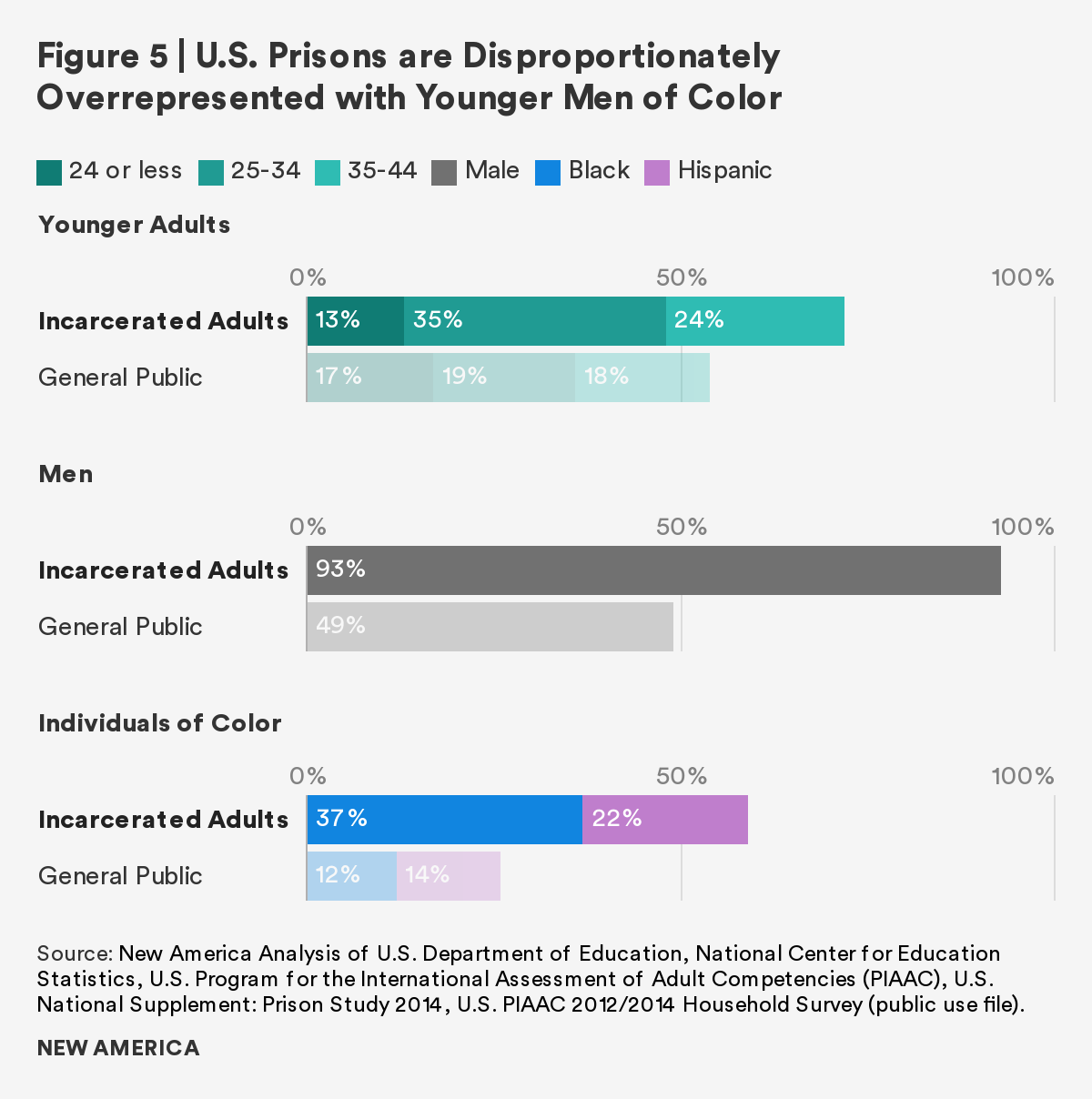
Category 2: Educational Attainment
The education gap between the incarcerated population and the general public is incredibly large.
- About 1 in 3 of incarcerated adults have less than a high school equivalence, either prior to or during incarceration, while only 14 percent of the general public has less than a high school equivalence.
- Only 15 percent of incarcerated adults earn a postsecondary degree or certificate either prior to or during incarceration, while almost half (45 percent) of the general public have completed some form of postsecondary education. See figure 6.
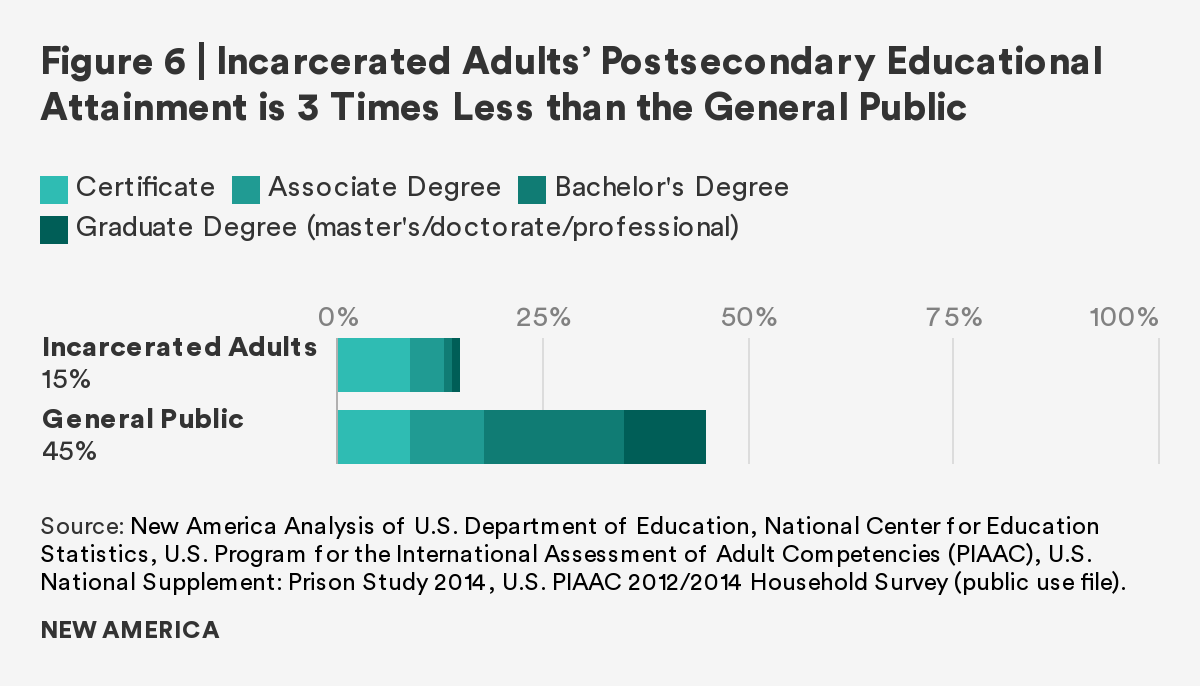
Of particular interest to policymakers, a little more than half of incarcerated adults’ highest level of education is equivalent to a high school diploma/GED either prior to or during incarceration. In essence, 55 percent of the country’s federal and state prison population is academically eligible to enroll in a postsecondary education program. See Table 1 below.
Category 3: Reentry Status of Incarcerated Adults
- More than half (57 percent) of incarcerated adults currently in federal and state correctional facilities expect to be released from prison in fewer than two years.
- Most (94 percent) incarcerated adults in federal and state prisons will be released, while only 6 percent of the population will never come home. See Table 1 below.
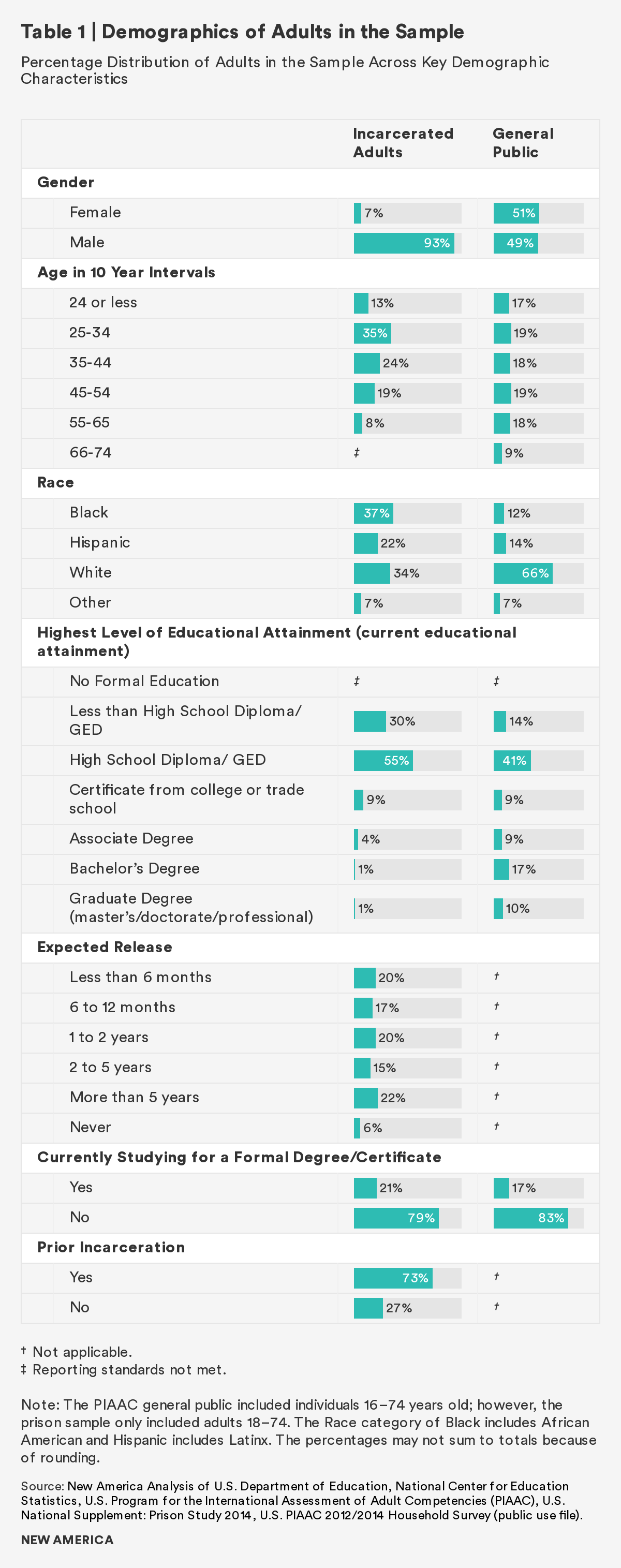
Category 4: Highest Level of Educational Attainment During Incarceration
We spoke with federal and state correctional administrators, professionals of nonprofit organizations within the field, college-in-prison facilitators, and job training instructors, who said that a high school equivalence and vocational education take precedence in correctional education. Leaders in the field confirm that obtaining a high school equivalence or some form of Career and Technical Education (CTE) certificate or license while incarcerated is unfortunately the typical terminal degree within correctional education.
Figure 7 below looks at the levels of education individuals complete while incarcerated.
- Only 42 percent of adults in federal and state prisons complete additional level(s) of education while incarcerated,96 with the greatest percentage of incarcerated students (21 percent) completing a high school equivalence or GED.
- Just 7 percent of incarcerated adults complete a certificate, 2 percent complete an associate degree, and fewer than 1 percent of adults (nearly zero) complete a bachelor’s degree or beyond.
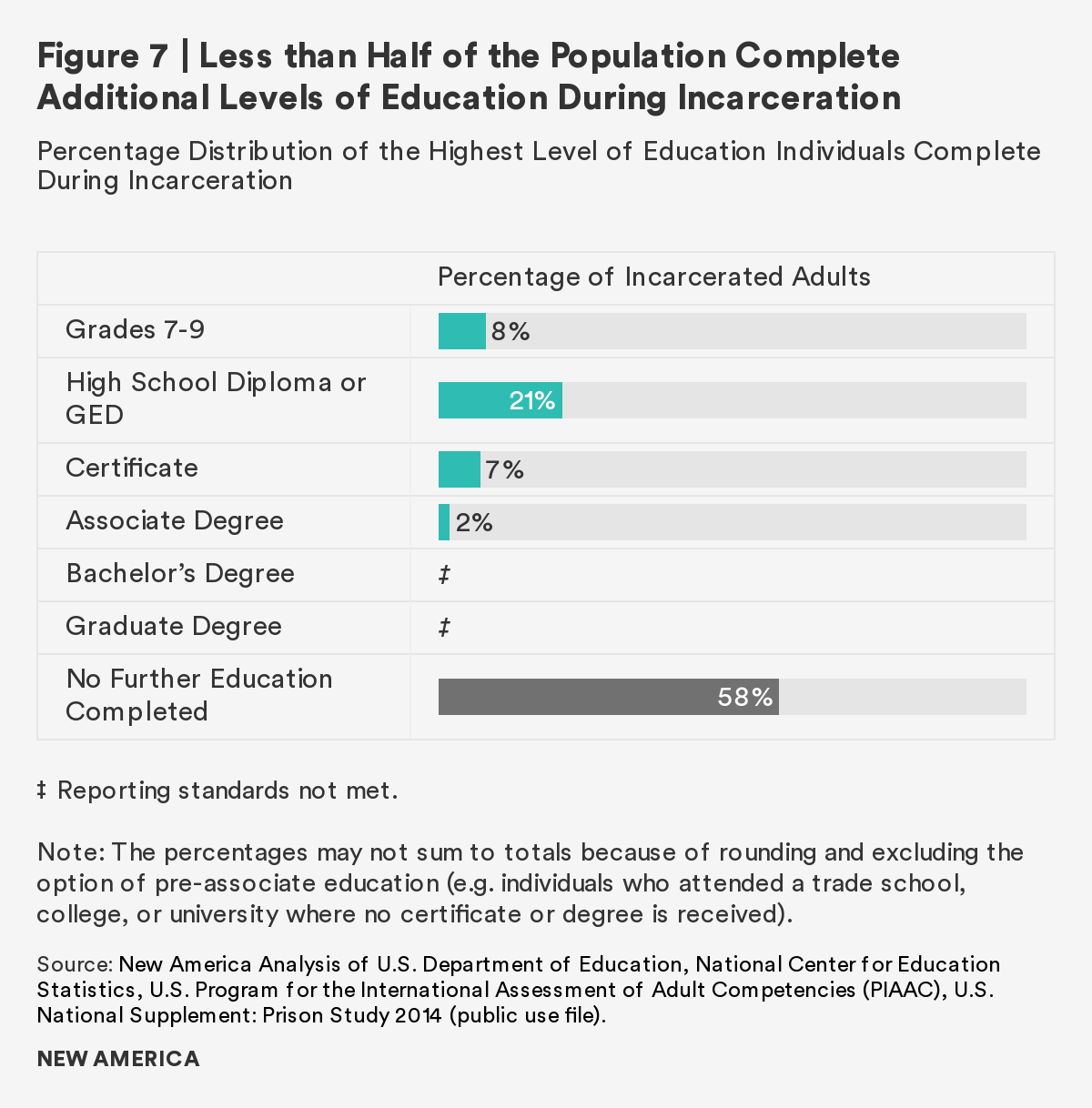
Category 5: Educational Aspirations of Incarcerated Adults
Despite the lower levels of education completed during incarceration, the educational aspirations of incarcerated students do not end with a high school equivalency. As figure 8 below shows, an overwhelming majority of those both close to release (fewer than two years) and with two or more years until release97 are comparably interested in enrolling in these postsecondary educational opportunities.
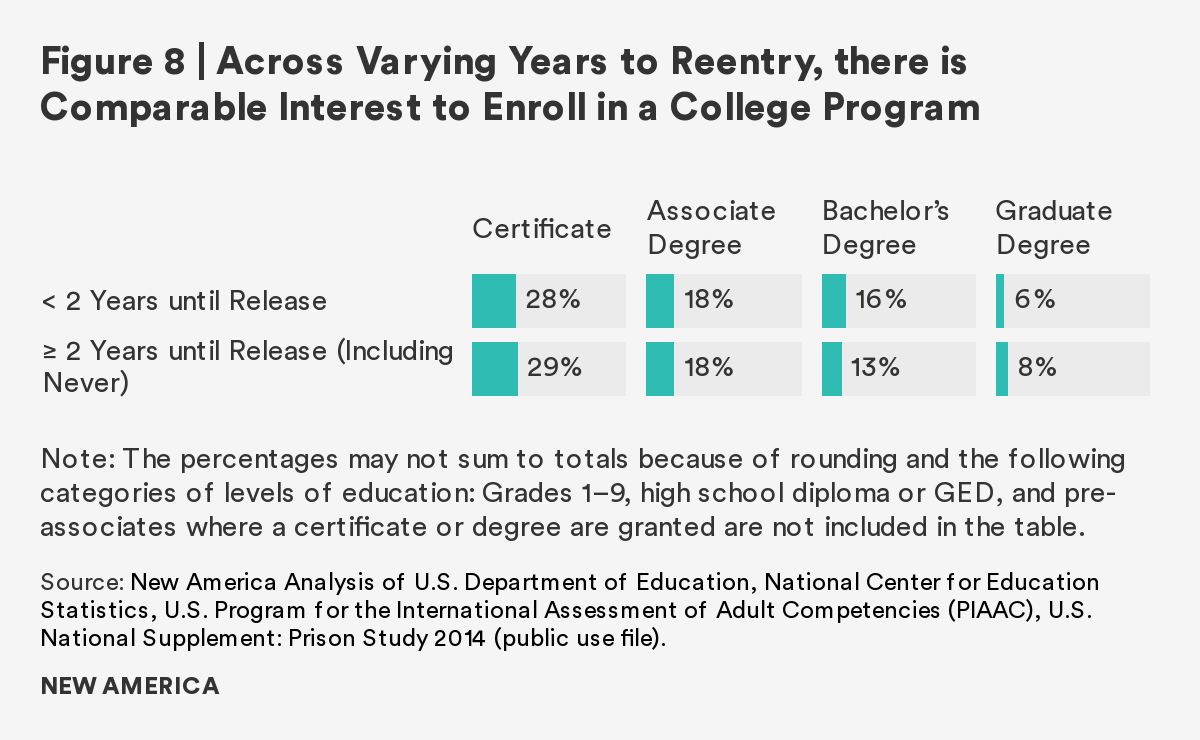
Overall, about 7 in 10 (69 percent) incarcerated adults in federal and state prisons are interested in enrolling in a postsecondary degree or certificate (see figure 9). One currently incarcerated student we spoke with confirmed this, noting that “there is a wealth of interest in bachelors degrees but we are limited by the milestone of only getting an associates. There are not enough opportunities to go beyond associates while we are in here.”
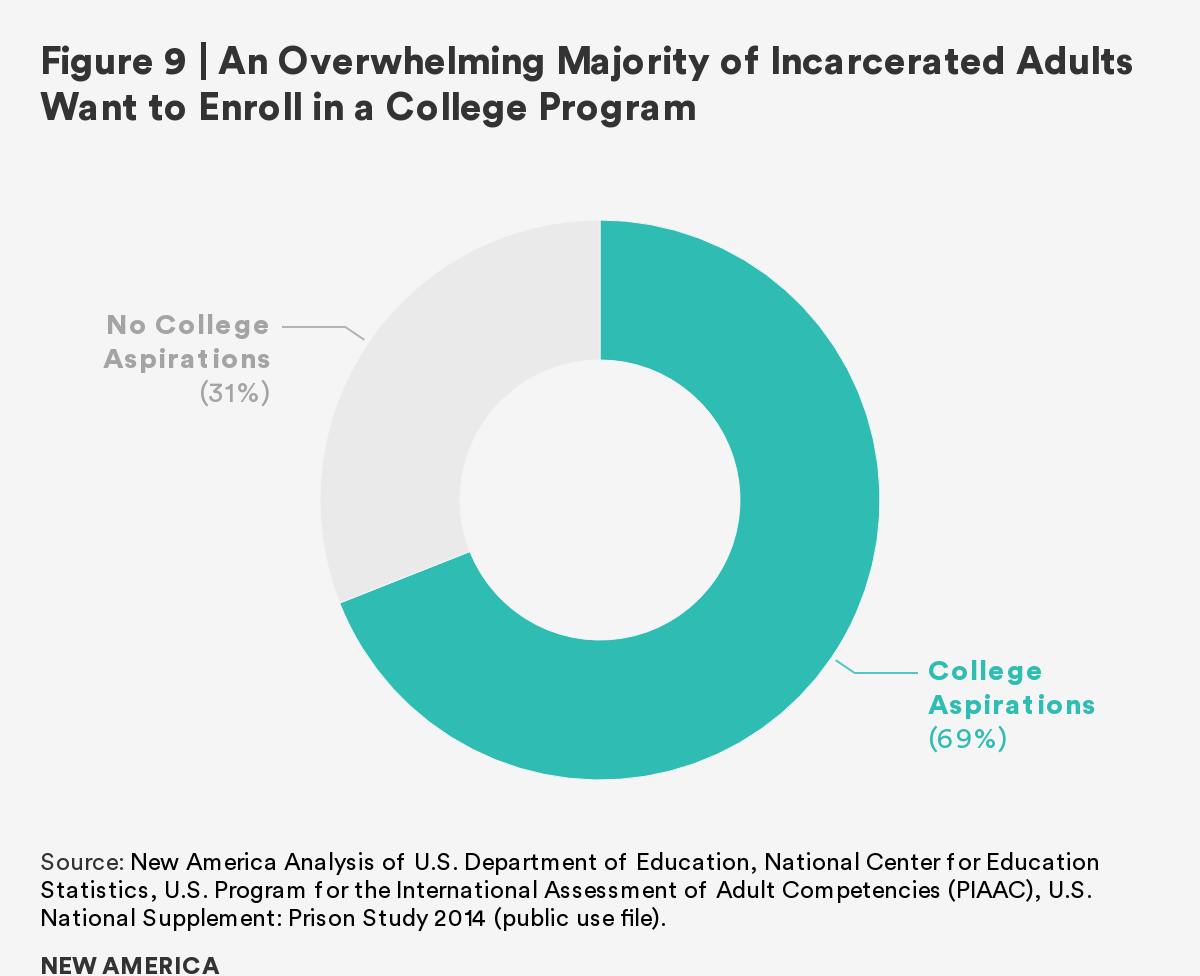
Non-Skills Related Results
Research Question 1: What is the participation and completion rates in postsecondary education and/or job training for incarcerated adults?
Postsecondary Education
About 2 in 10 (21 percent) adults in federal and state prisons, at the time of the survey, were enrolled in postsecondary education. See figure 10 below.
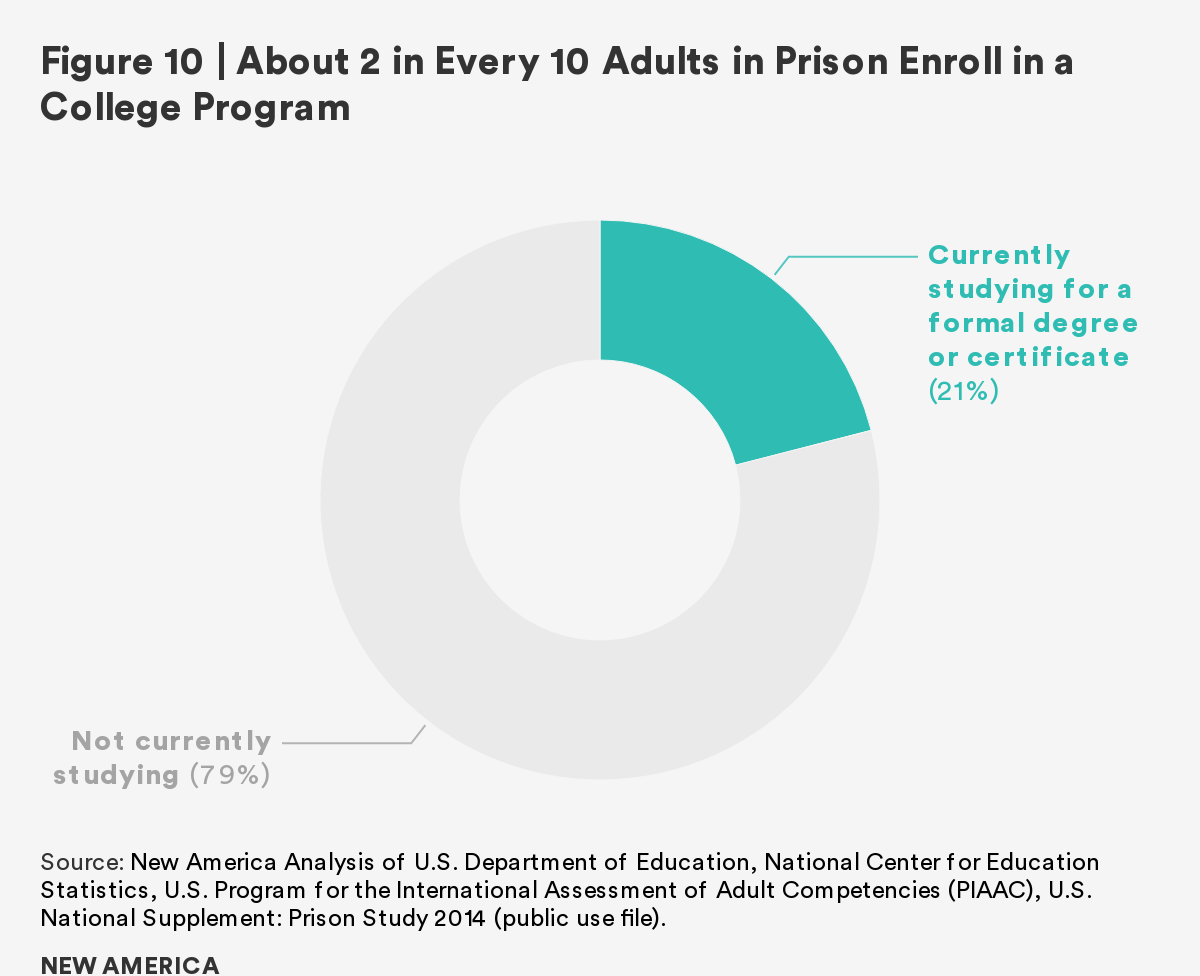
Table 2 below compares the percentage of incarcerated students who are currently enrolled in a postsecondary education program to those who completed a postsecondary program by key demographic characteristics. Among other findings, below are the demographics of incarcerated students who were enrolled in a college program at the time of the survey.
- Race/Ethnicity: The racial/ethnic make-up of adults who enroll in college programs in prison are relatively comparable, where 36 percent are Black compared with 30 percent white and 26 percent Hispanic.
- Age: The majority (60 percent) of incarcerated students who enroll in postsecondary education programs are between the ages of 25 to 44.
- Reentry Status: A little more than half (56 percent) of incarcerated students who are currently studying for a formal degree or certificate will be released from prison in fewer than two years.
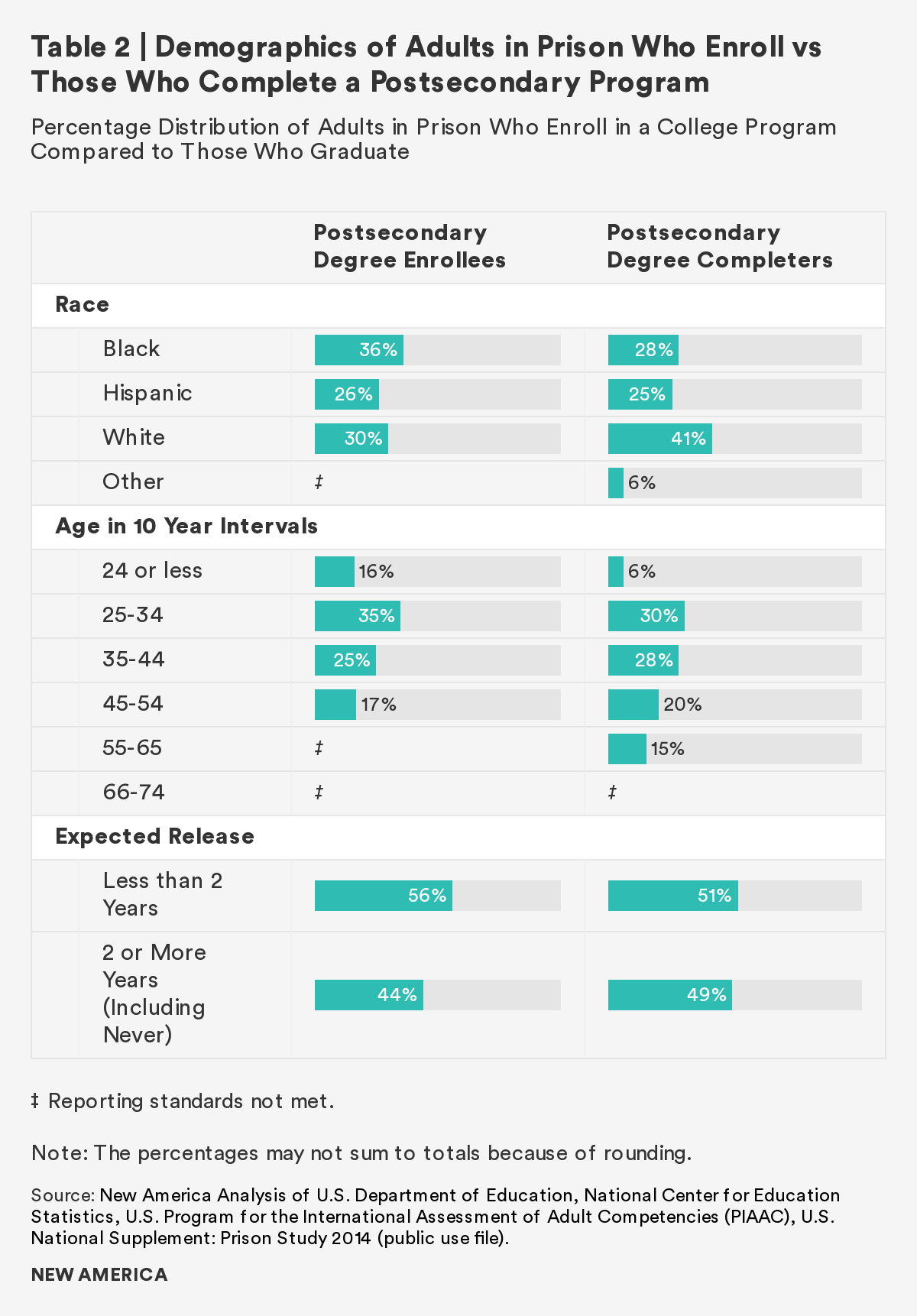
While almost a quarter of students in prison enroll in a college program, less than 10 percent of adults complete a postsecondary degree or certificate while in prison. See figure 11 below.
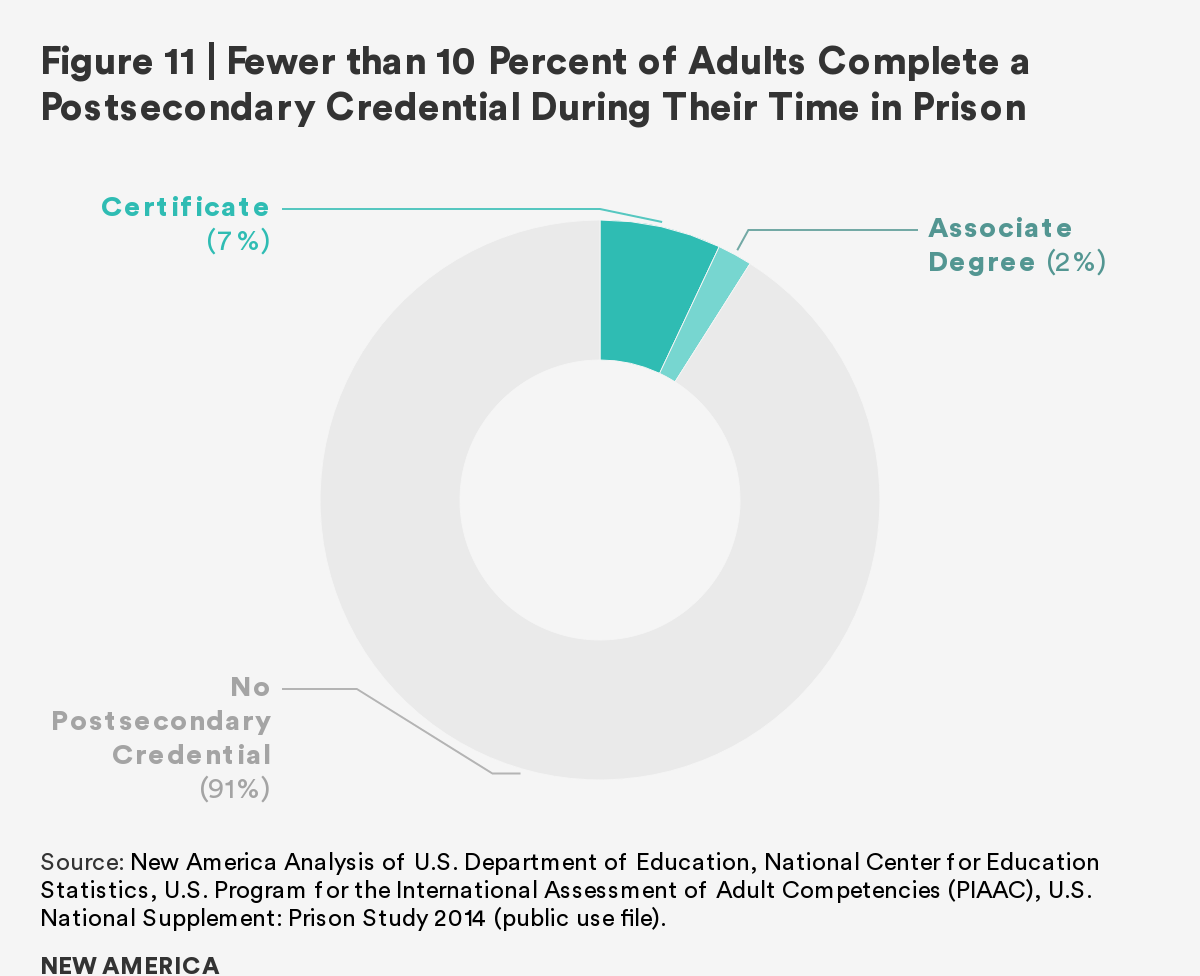
Table 2 above breaks down the share of incarcerated adults who complete a postsecondary degree or certificate by key demographic characteristics.
- Race/Ethnicity: Compared to the racial/ethnic demographics of those who enroll in college programs in prison, a racial disparity is apparent among those who graduate. The majority of incarcerated students who complete a postsecondary degree or certificate are white adults (41 percent), compared with 28 percent are Black adults and 25 percent are Hispanic adults. We saw this racial disparity in postsecondary completers during site visits to graduation ceremonies within correctional facilities, where the majority of those receiving associate degrees and/or certificates were white. The racial disparity among completers suggests Black and Hispanic incarcerated students enroll in college courses as often as white incarcerated students but complete at lower rates.98
- Age: The majority of incarcerated students who complete a postsecondary degree or certificate are between the ages of 25 and 54. In contrast to the age of those who enroll, a greater proportion of older adults are completing a postsecondary credential(s), which makes sense, since it takes time to complete a program.
- Reentry Status: Similar to those who enroll in college programs, a little more than half (51 percent) of incarcerated students who complete a postsecondary degree or certificate will be released in fewer than two years.
Job Training
About a quarter (23 percent) of adults in federal and state prisons participate in job training programs.99 These programs are vocational in nature and do not lead to any transferable postsecondary credits (see figure 12).
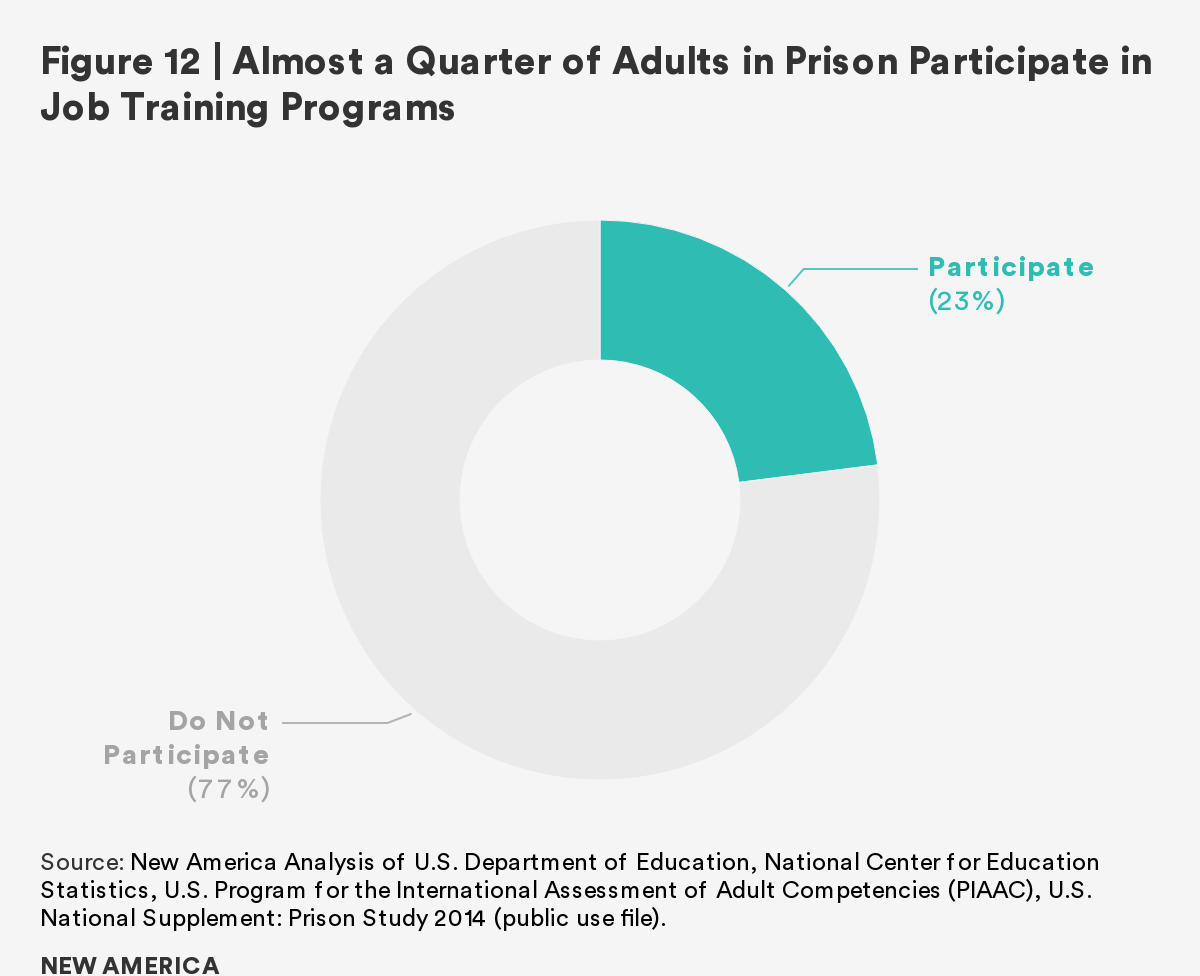
Table 3 below shows the distribution of participation100 in job training across key demographic characteristics.
- Reentry Status: Half (51 percent) of incarcerated students participating in job training programs will be released from prison in fewer than two years.
- Overlap with Postsecondary Education: Twenty-nine percent of incarcerated adults participate simultaneously in job training and postsecondary education.101 One college-in-prison instructor told us this was common, noting that “they will also do vocational training to have two sets of skills, both academic and vocational. They will do this in addition to the other adult programming available.”
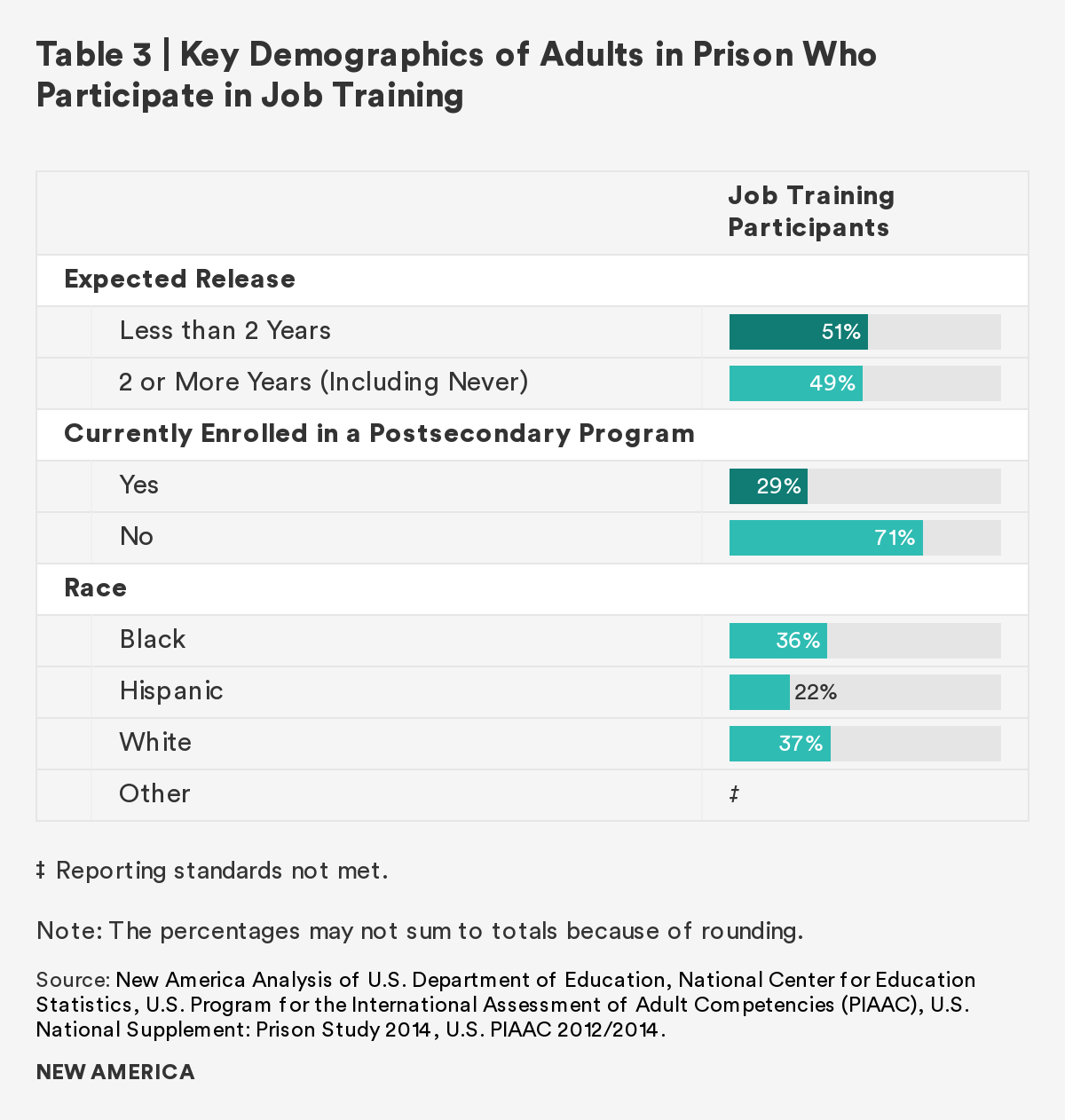
Research Question 2: Does approaching reentry increase the likelihood of incarcerated adults enrolling in/completing postsecondary programs and/or participating in job training?
Individuals who are close to reentry (fewer than two years) are not more or less likely to enroll in correctional postsecondary education programs than those with more time remaining to their sentence.102 Similarly, those with fewer than two years to release are not more or less likely to complete a postsecondary credential than those with two or more years to release.103 And job training programs also showed no relationship between participation and the number of years remaining to reentry.104
Research Question 3: What are the reasons for participating in postsecondary education programs and/or job training?
Postsecondary Education
The top two reasons that students gave for wanting to enroll in a postsecondary program while in prison were to increase their knowledge and increase their possibility of getting a job upon release. See Table 4 below.
- About one-third (31 percent) of students who want to be enrolled in a postsecondary program in federal and state prisons, enroll to increase their knowledge or skills in a subject area that is of interest to them. One currently incarcerated student shared that “before I came to prison, I didn’t care about school or getting my education. But now that I have experienced this, I can’t wait to go to class. As soon as I leave class, my next thought is that I can’t wait to go to my next class. I just want to learn more.”
- A slightly smaller share of students (27 percent) who enroll in a postsecondary degree or certificate while incarcerated enroll to increase their possibilities of getting a job upon release. Another currently incarcerated student told us, "I know that as a felon I have two strikes against me, so going to college makes me more marketable and can take one strike away.”
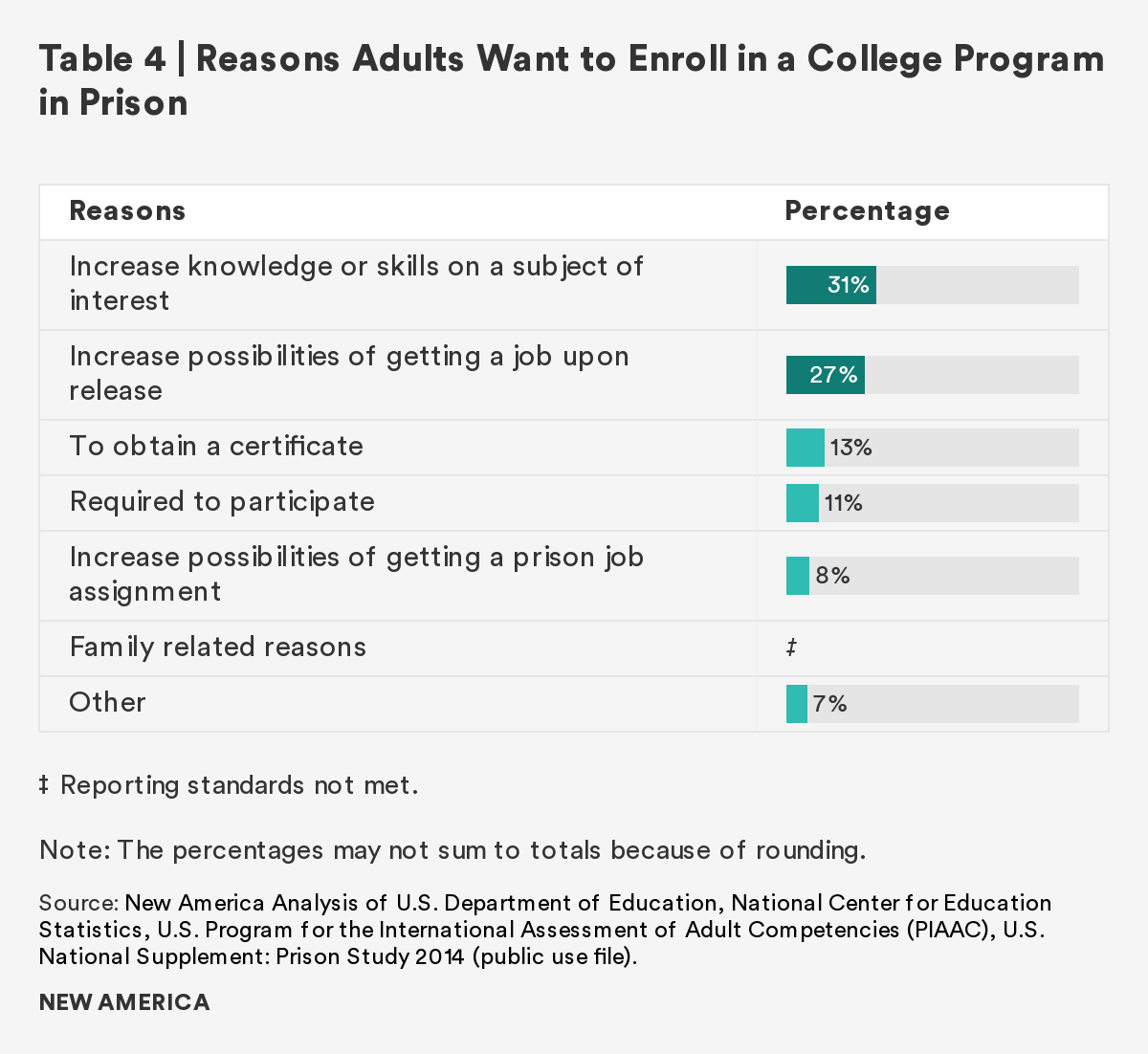
From most of our prison site visits, we learned that an associate degree often functions as the final destination for postsecondary education. However, a combination of interest in educational courses and a deep desire to buffer the negative stigma associated with previous incarceration on labor market participation leads many of the students we spoke with to earn more than one associate degree while in prison. This occurred at many of the Second Chance Pell experimental sites we visited, where students are using their limited Pell funds to earn multiple associate degrees.
Job Training
Similar to the top two reasons for enrolling in postsecondary programs:
- The primary reason for participating in job training is for self-improvement (63 percent).
- The second most common reason is to increase the probability of getting a job upon release (43 percent). See Table 5 below.
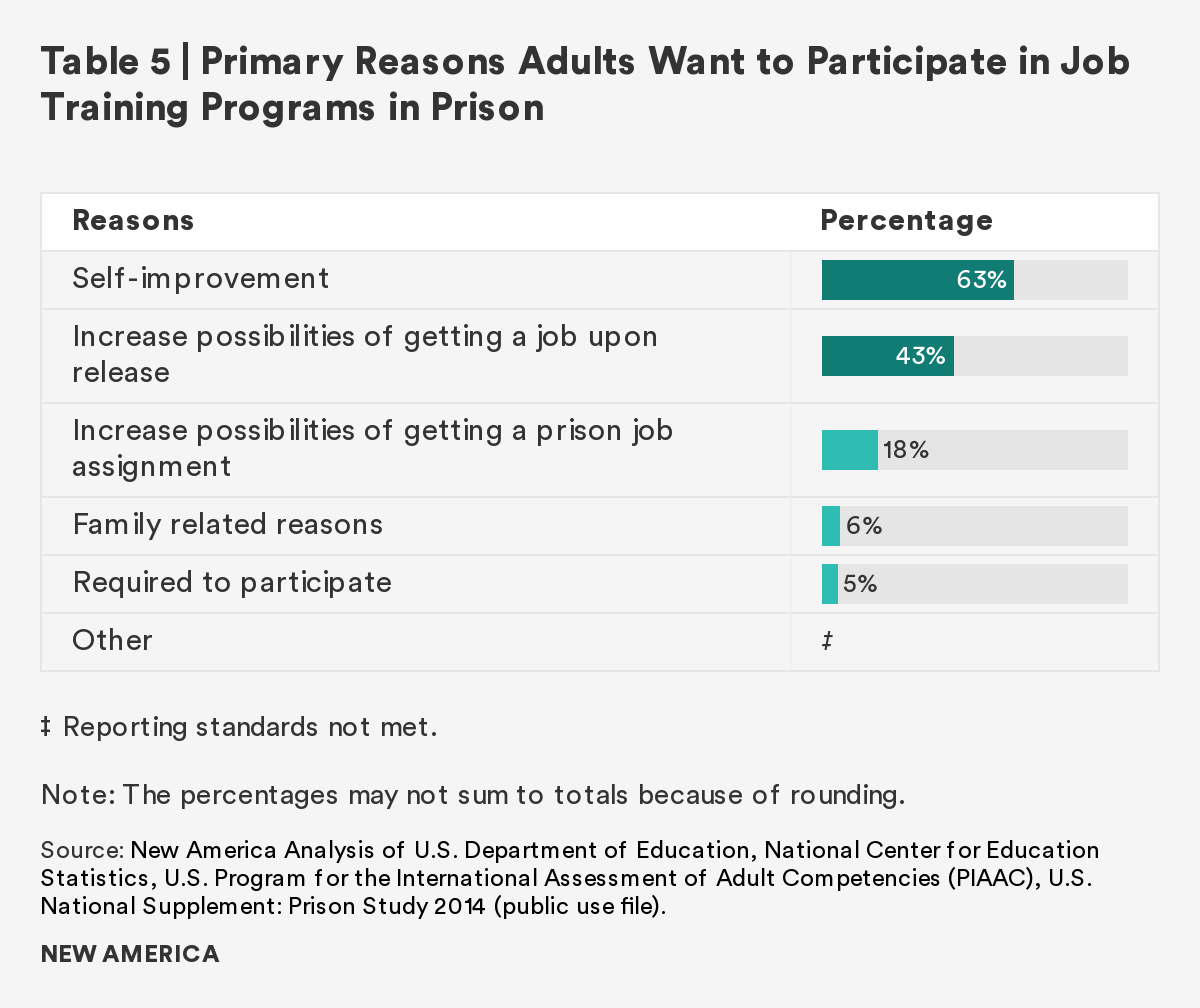
Research Question 4: What are the barriers to participating in academic classes and/or job training programs for incarcerated adults?
Academic Classes
The barriers to participating in an academic program105 while incarcerated include being in prison, waiting lists, and more. One in five adults who stopped their formal education prior to incarceration say that their reason for stopping was because of being sent to a correctional facility. A quarter (25 percent) of adults in federal and state prisons are unable to enroll in an academic class or program of study because they are currently on a waiting list (see figure 13). Additional barriers to participating in academic programs for incarcerated adults are in Table 6 below.
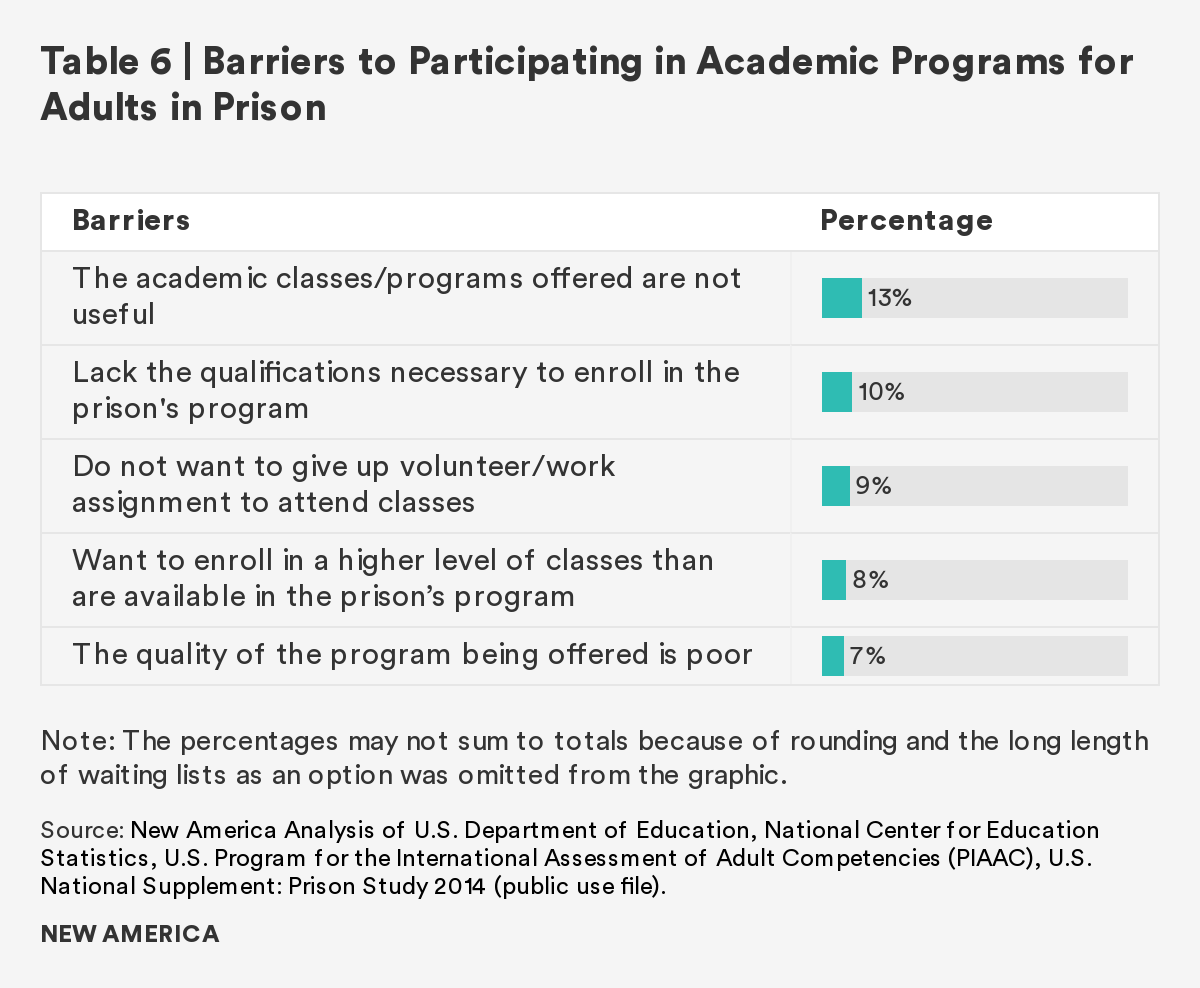
Job Training
Barriers to participating in job training while incarcerated similarly include waiting lists, lacking educational qualification, and more. About 14 percent of adults in federal and state prisons are currently on a waiting list for job skills or a job training course (see figure 13).
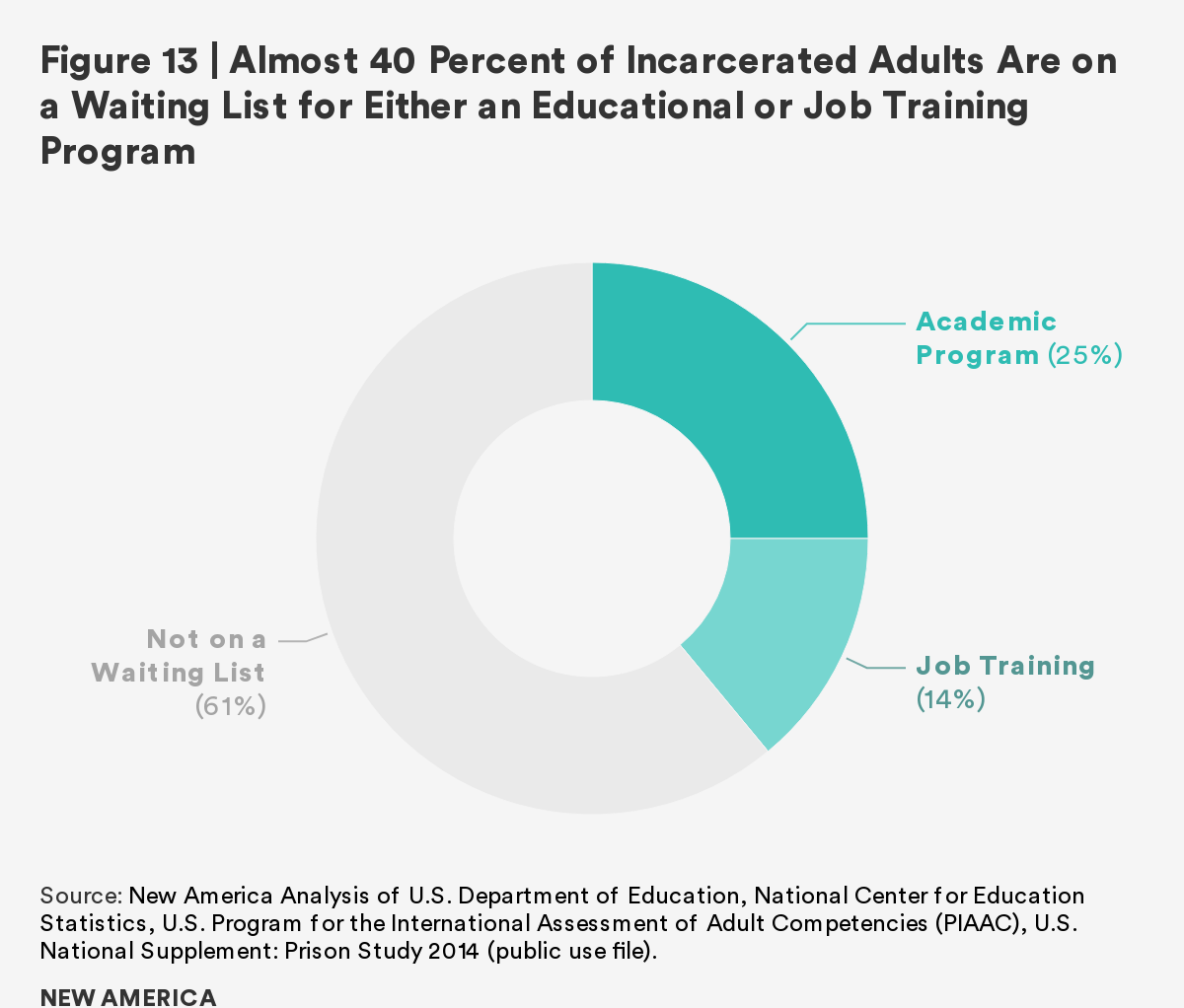
When incarcerated adults are asked the reason for not attending a course or program to learn job skills or job training, a third (30 percent) of incarcerated adults said they were not eligible to attend. See Table 7 below.
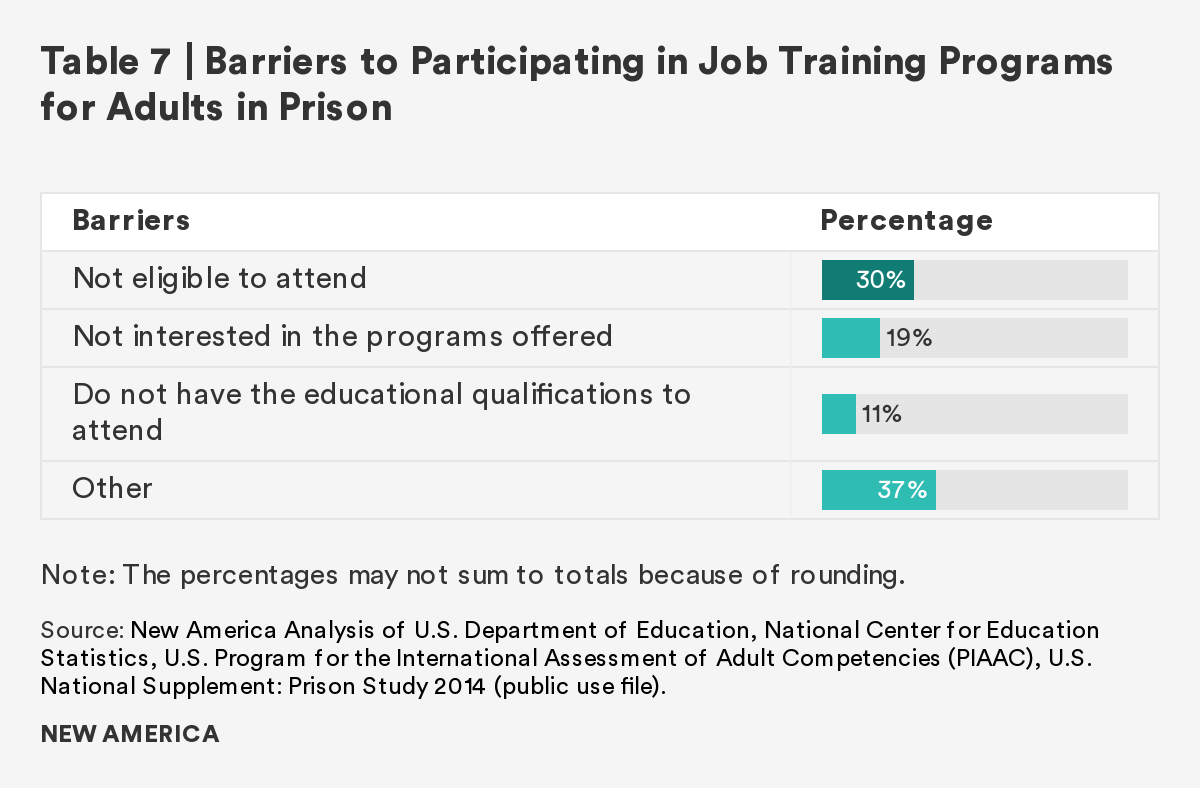
Skills-Related Results
Research Question 1: What is the range of skills that incarcerated adults possess?
The range of possible literacy and numeracy scores on the PIAAC assessment is from 0 to 500. The average range of literacy scores for incarcerated adults extend from 76 to 458,106 while the average range of numeracy scores for incarcerated adults are from 10 to 378.107 See figure 14 below.
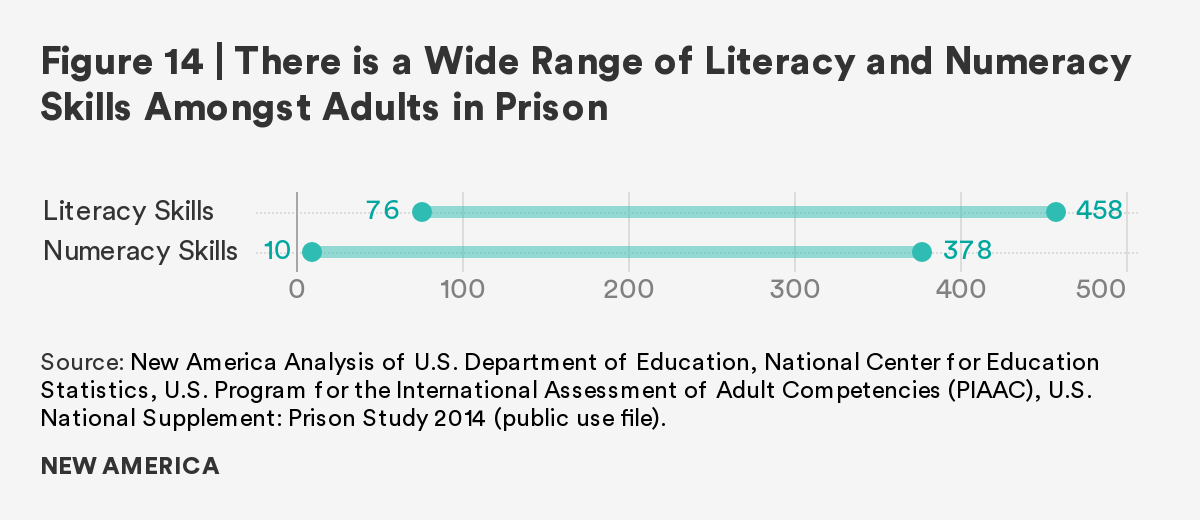
Research Question 2: Does a statistically significant gap in literacy and numeracy skills exist between incarcerated adults and the general public?
Literacy Skills
There is a statistically significant gap in literacy skills between the U.S. general public and adults in U.S. federal and state prisons.108
- With the exception of the lowest literacy proficiency level (Below Level 1), there is a significantly higher proportion of incarcerated adults in the lower literacy proficiency levels, while there is a greater proportion of the general public towards the higher proficiency levels.
- The average literacy score for incarcerated adults (249) is statistically significantly lower than the average literacy score of the general public (270).109 See Table 8 below.
- For both incarcerated adults and the general public, the average literacy proficiency level is a Level 2 (basic), indicating that, on average, Americans have a foundational level of literacy skills.
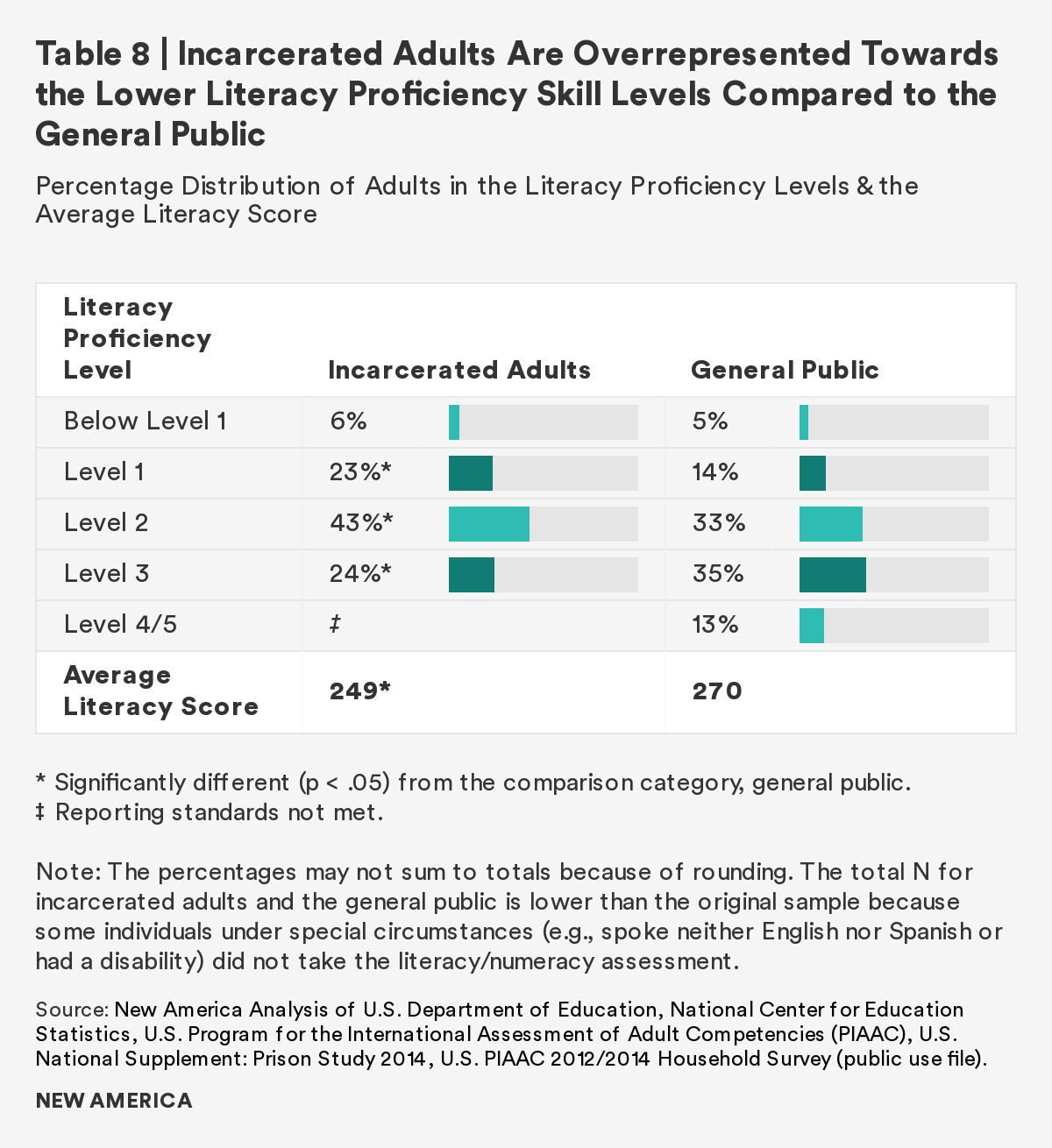
Table 9 describes the activities individuals can perform at each of the literacy proficiency levels.110
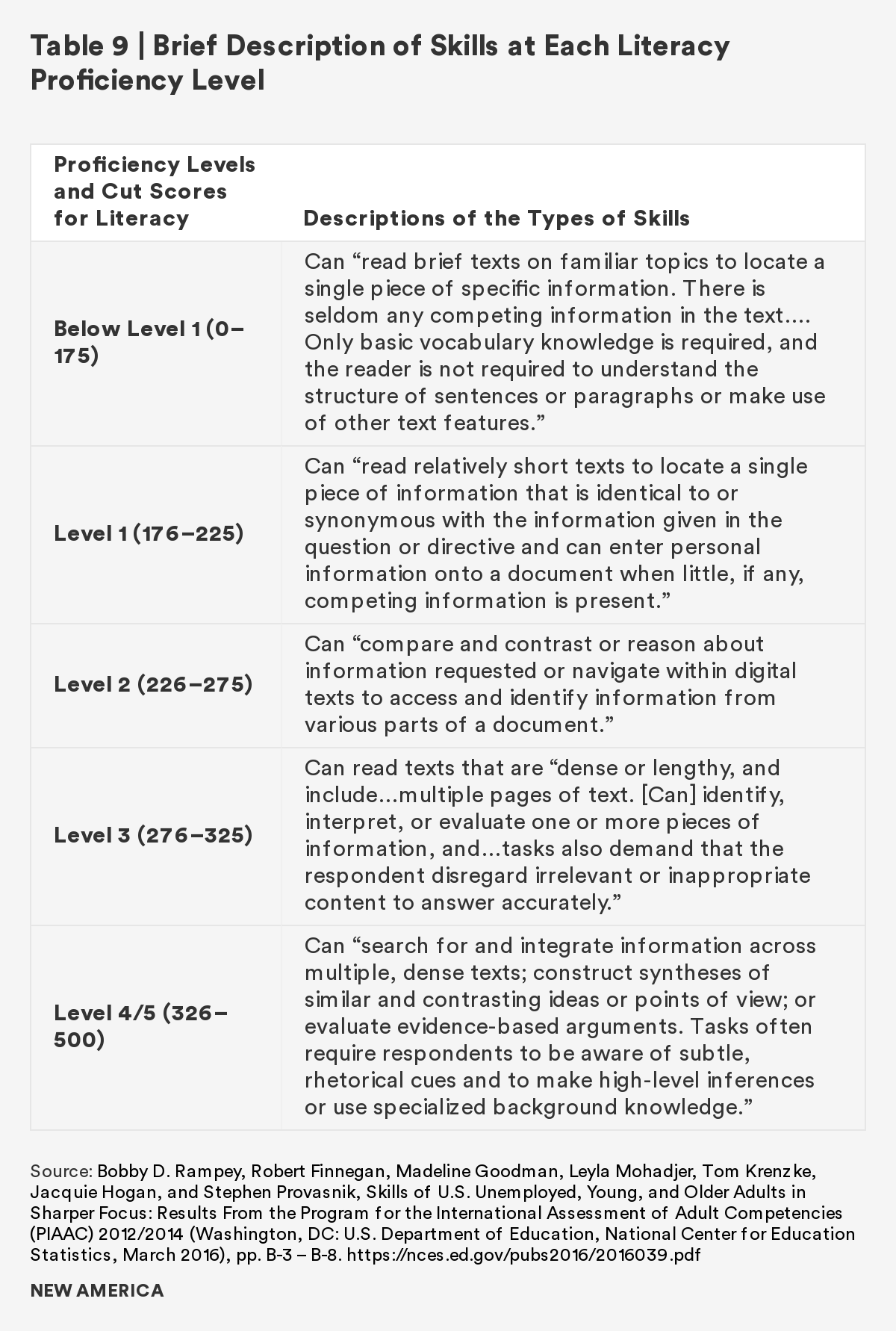
Table 10111 below shows the percentages of adults in literacy proficiency levels across race/ethnicity for both the general public and incarcerated adults. Across both populations, the majority of those at the lower literacy levels consist of individuals of color, while the higher literacy levels consist of primarily white individuals. There is a statistically significant gap in skills across racial/ethnic categories within both populations,112 but it is more pronounced among the general public, especially towards the higher literacy proficiency levels, where 93 percent of the general public at a Level 4/5 proficiency are white compared with 3 percent are Black.
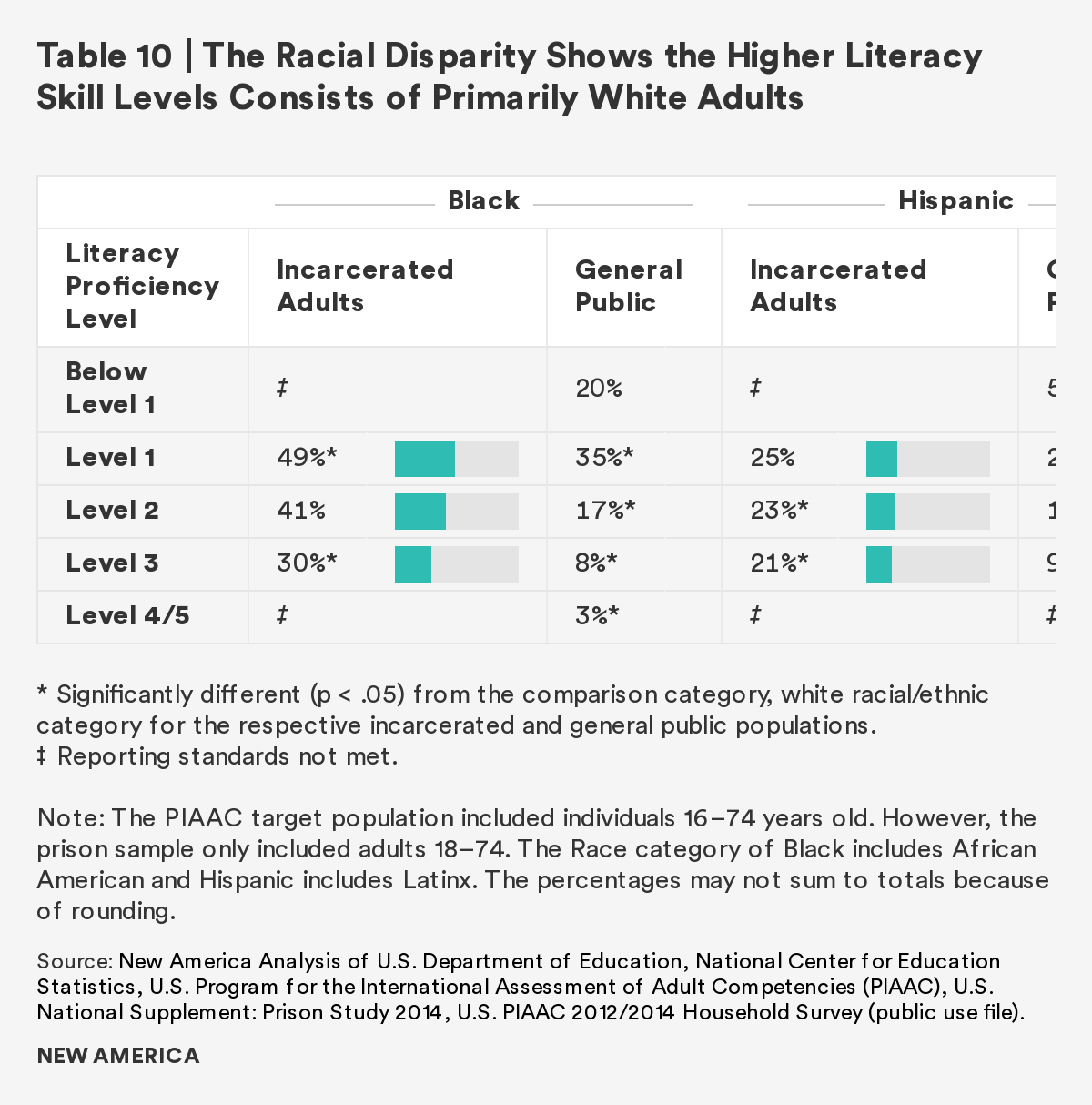
Numeracy Skills
Similar to the literacy gap analysis, there is a statistically significant gap in numeracy skills between the U.S. general public and adults in U.S. federal and state prisons.113
- With the exception of Level 2 (where both populations have equal proportions scoring at the basic level), incarcerated adults are overrepresented in the lower numeracy proficiency levels, while the general public is overrepresented towards the higher proficiency levels.
- The average numeracy score for incarcerated adults (220) is statistically significantly lower than the average numeracy score for the general public (255).114 Table 11 below shows the gap in the numeracy skill outcomes between the two groups.
- For the general public, the average numeracy proficiency level is Level 2, while the average numeracy proficiency level is Level 1 for those who are incarcerated.
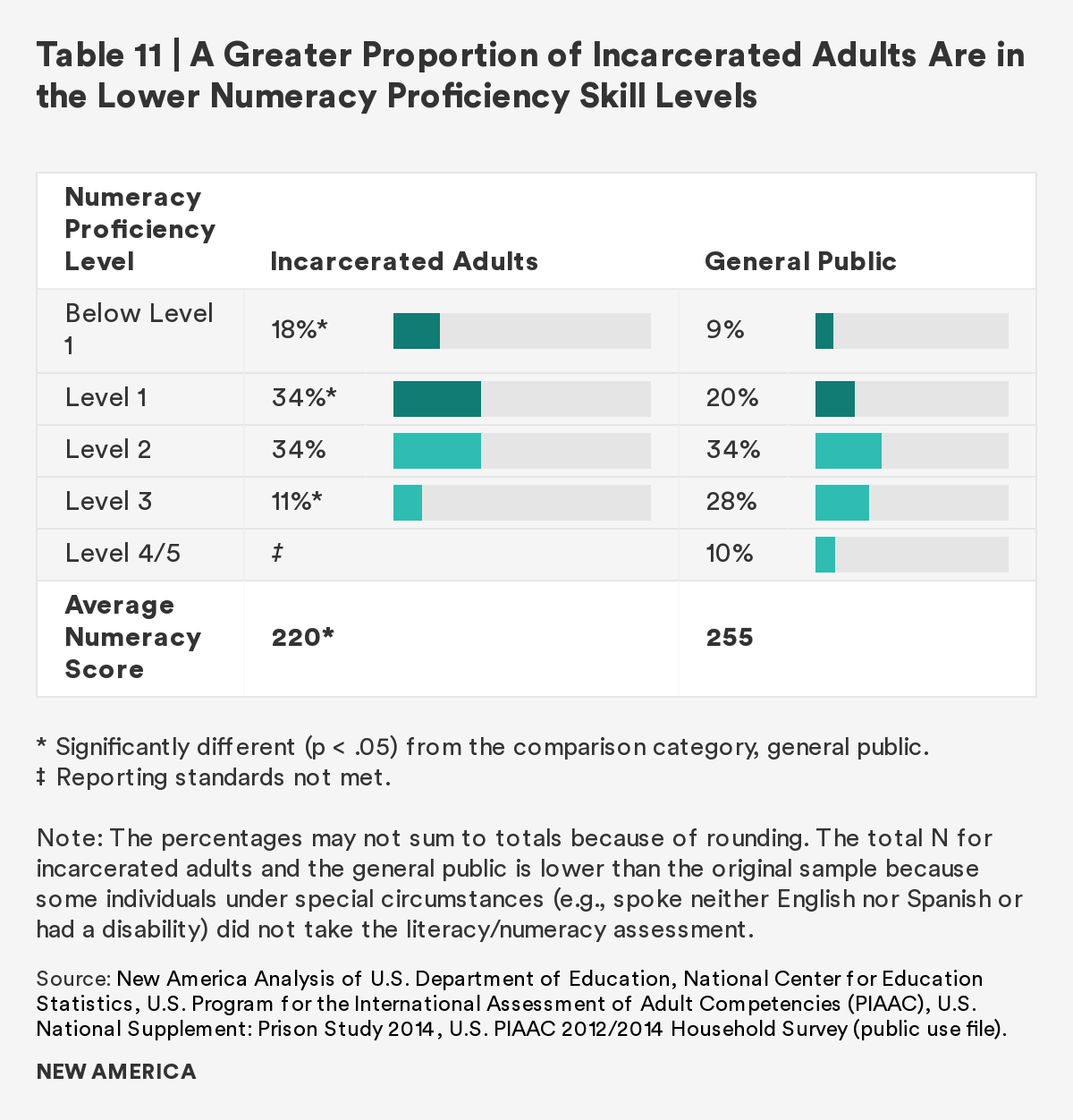
Table 12 describes the activities individuals can perform at each of the proficiency levels.115
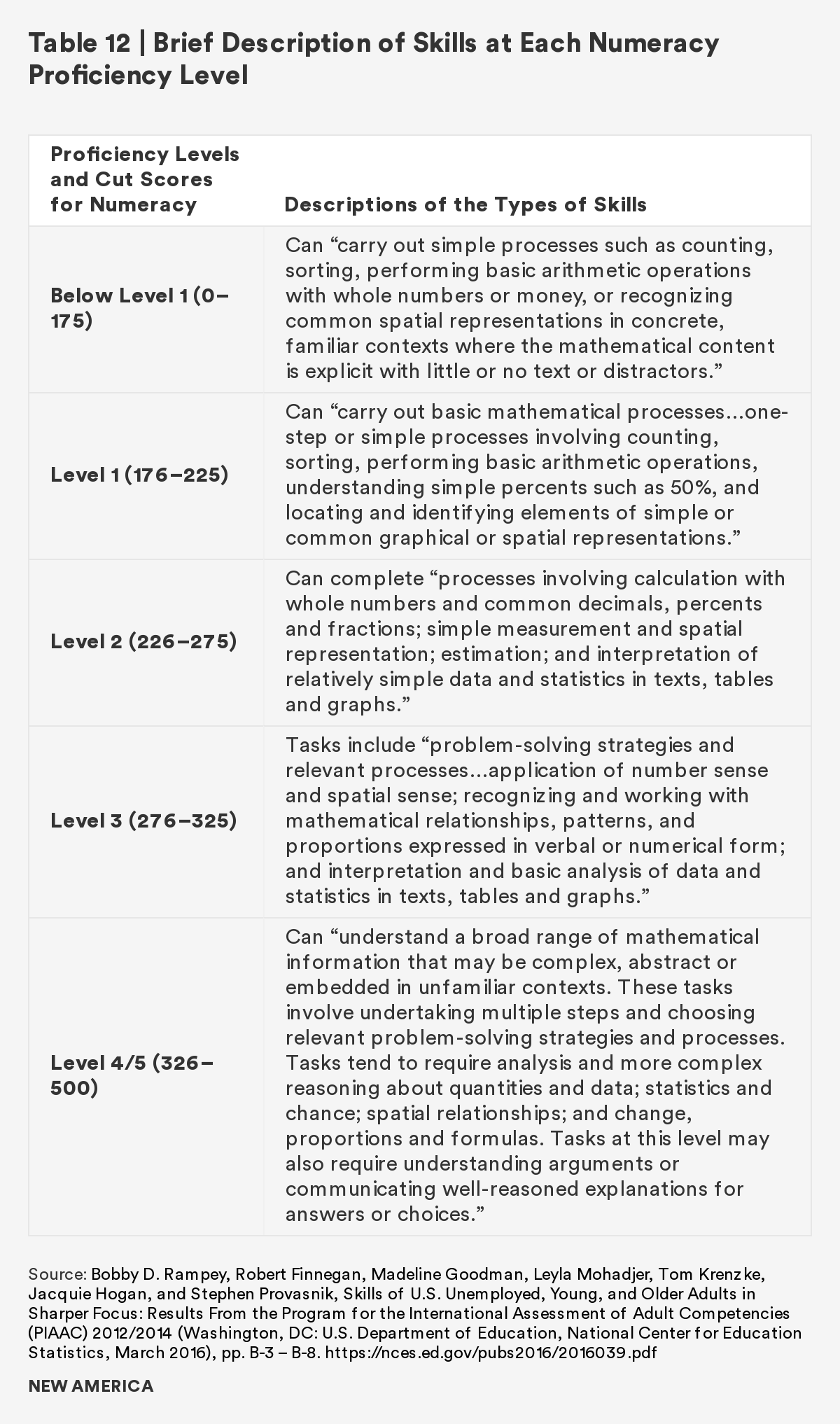
Table 13116 below shows the percentage of adults at the numeracy proficiency levels across race/ethnicity for both the general public and incarcerated adults. Similar to the results of the literacy domain, across both populations, there is a statistically significant gap in numeracy skills across racial/ethnic categories,117 where the higher numeracy proficiency levels consist of white individuals. The gap in skills across racial/ethnic categories is more pronounced among the general public, with 87 percent of adults at Level 3 are white compared to 8 percent are Hispanic and 5 percent are Black (see Table 13).
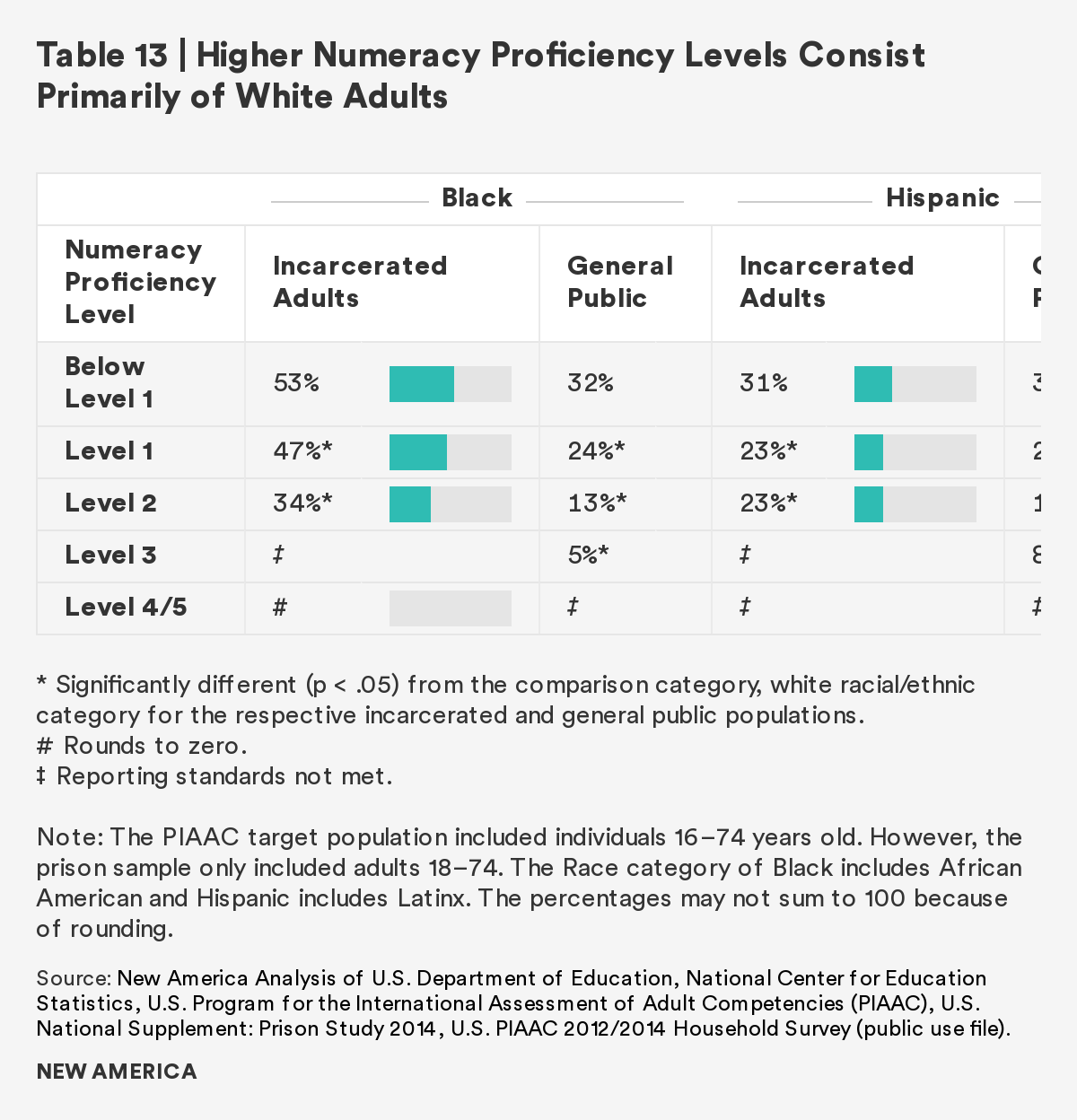
Research Question 3: How does the skill level of incarcerated individuals approaching reentry (fewer than two years) compare with the general public?
Literacy Skills
- Similar to the literacy proficiency gap observed between the entire incarcerated population and the general public, the average literacy score of those close to reentry (247) is statistically significantly lower than the average literacy score for the general public (270).118
Numeracy Skills
- Similar to the literacy skill domain, the average numeracy score of those close to reentry (219) is statistically significantly lower than the average numeracy score for the general public (255).119
These results should be important to policymakers because those closest to reentry (fewer than two years) do not have comparable skills to the general public. This gap could pose significant challenges for formerly incarcerated individuals as they try to integrate into the workforce upon release.
Research Question 4: Does participating in/completing postsecondary education and/or job training in prison have an effect on adults’ skills?
Literacy Skills
Although there is a statistically significant gap in skills between incarcerated individuals and the general public, completing a postsecondary degree or certificate and/or participating in job training mitigates the literacy proficiency gap.
Postsecondary Education
- There is a statistically significant positive relationship between literacy proficiency skill levels and completion of a postsecondary degree or certificate during incarceration. Those who complete a postsecondary credential are more likely to attain higher literacy proficiency levels compared to incarcerated adults who do not.120
- On average, those who complete a postsecondary degree or certificate while incarcerated score 26 points higher in literacy scores compared with adults who do not complete additional levels of education while incarcerated.121 See figure 15.
Job Training
- Those who participate in job training programs while incarcerated are more likely to have higher literacy proficiency skill levels compared to incarcerated adults who do not.122
- On average, individuals who participate in job training while incarcerated score 12 points higher in literacy compared with individuals who do not.123 See figure 15.
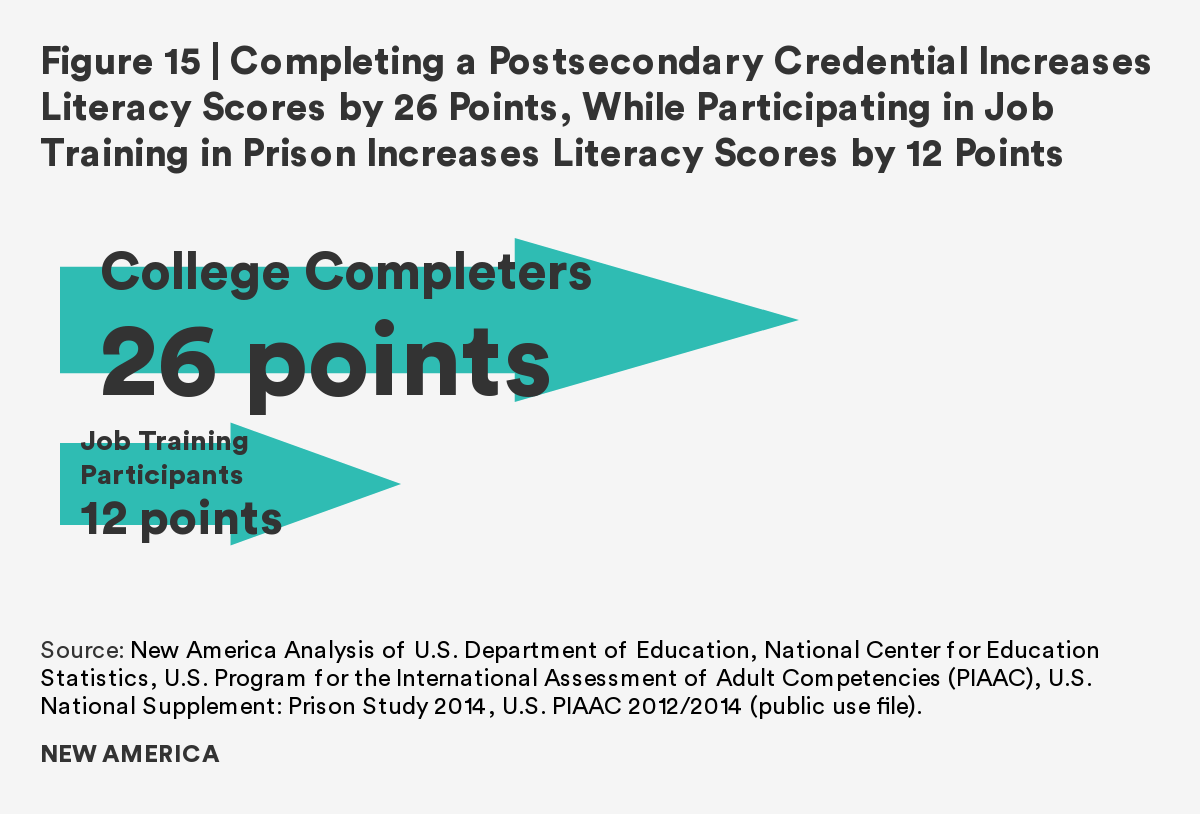
Figure 16 below shows the literacy scores along the 10th, 25th, 50th, 75th, and 90th percentiles for both the general public and incarcerated adults. The figure also shows the median literacy scores for the two groups (incarcerated and general public) juxtaposed with the median literacy scores for adults who complete a postsecondary degree or certificate and/or participate in job training while incarcerated.
Figure 16 shows the median literacy score for individuals who complete a postsecondary degree or certificate while incarcerated (272) score in the 50th percentile of literacy scores for the general public and is comparable to the median literacy score of the general public (274).
Figure 16 also shows that for individuals who participate in job training while incarcerated, the median literacy score (263) exceeds that of the incarcerated population (252) and is positioned at the 50th percentile of literacy scores for the general public.
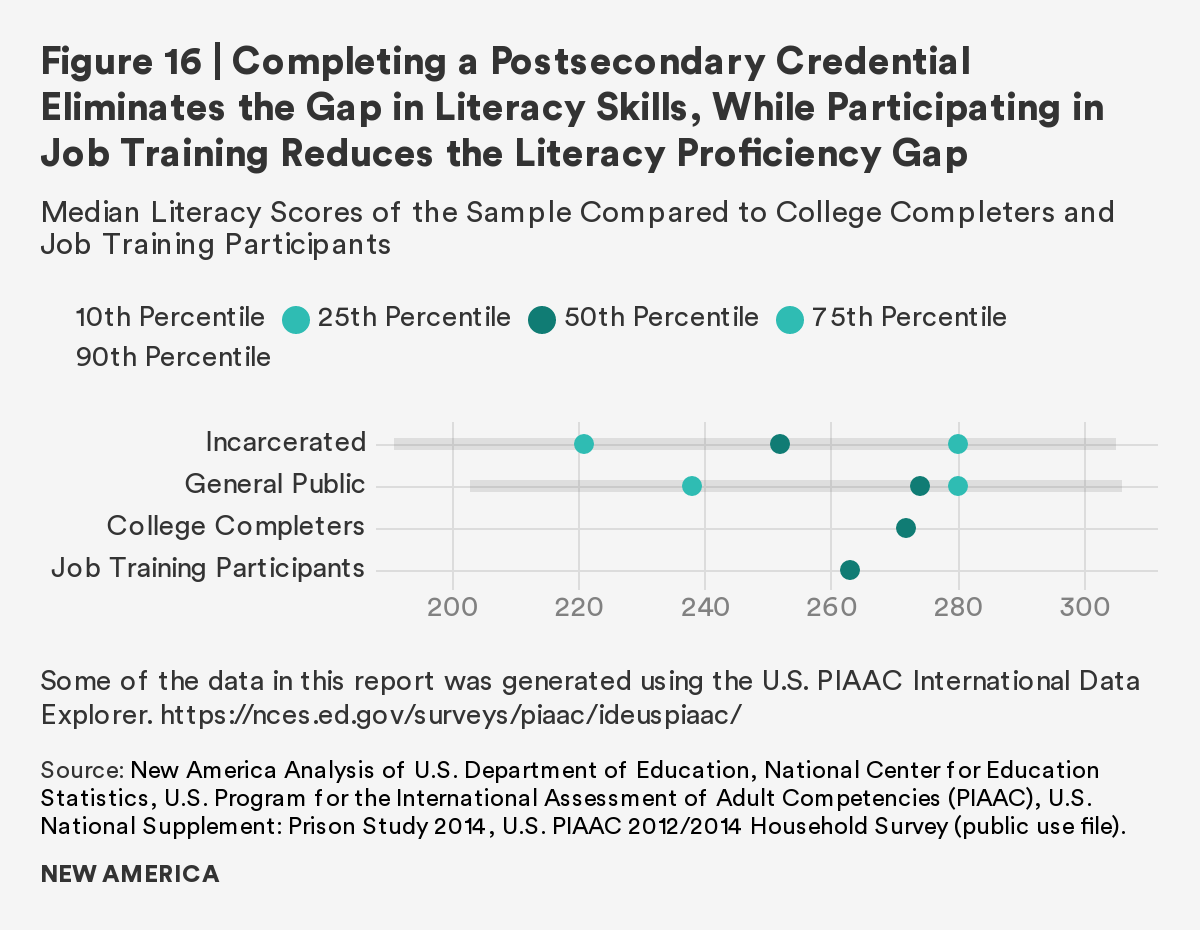
Numeracy Skills
Similar to the literacy domain results, there is a statistically significant positive relationship between the numeracy proficiency skill levels and completion of a postsecondary credential and participation in job training during incarceration.
Postsecondary Education
- Individuals who complete a postsecondary degree or certificate while incarcerated are more likely to reach higher numeracy proficiency levels than individuals who do not.124
- Those who complete a postsecondary credential during incarceration, on average, score 38 points higher in numeracy compared to adults who do not complete additional levels of education during incarceration.125 See figure 17.
Job Training
- Those who participate in job training programs while incarcerated are more likely to have higher numeracy proficiency skill levels compared with incarcerated adults who do not.126
- On average, those incarcerated individuals in job training programs score 18 points higher in numeracy than incarcerated adults who do not.127 See figure 17 below.
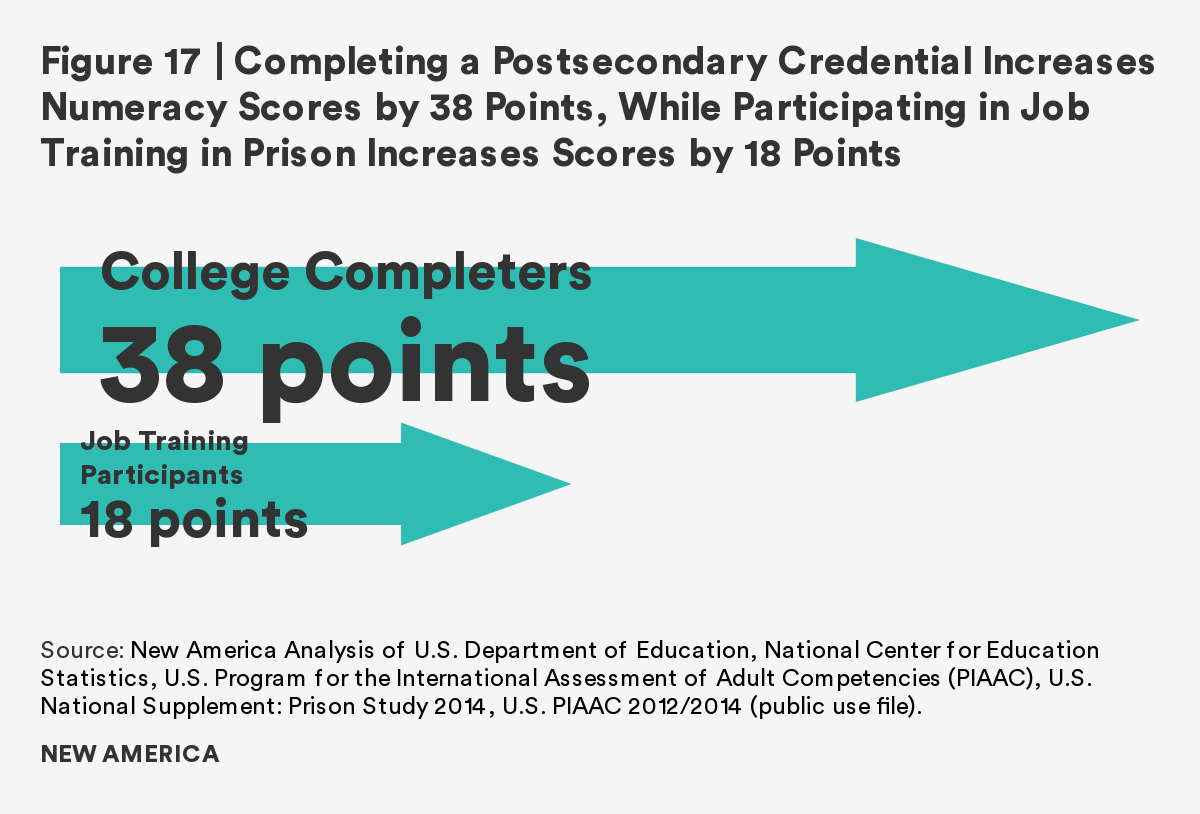
Figure 18 below shows that the median numeracy score for individuals who complete a postsecondary degree or certificate while incarcerated (253) is in the 50th percentile of numeracy scores for the general public and substantially exceeds the median numeracy score of the overall incarcerated population (223).
The figure below also shows that the median numeracy score for individuals who participate in job training (235) while incarcerated exceeds the median numeracy score of the overall incarcerated population (223) and is positioned at the 50th percentile of numeracy scores for the general public.
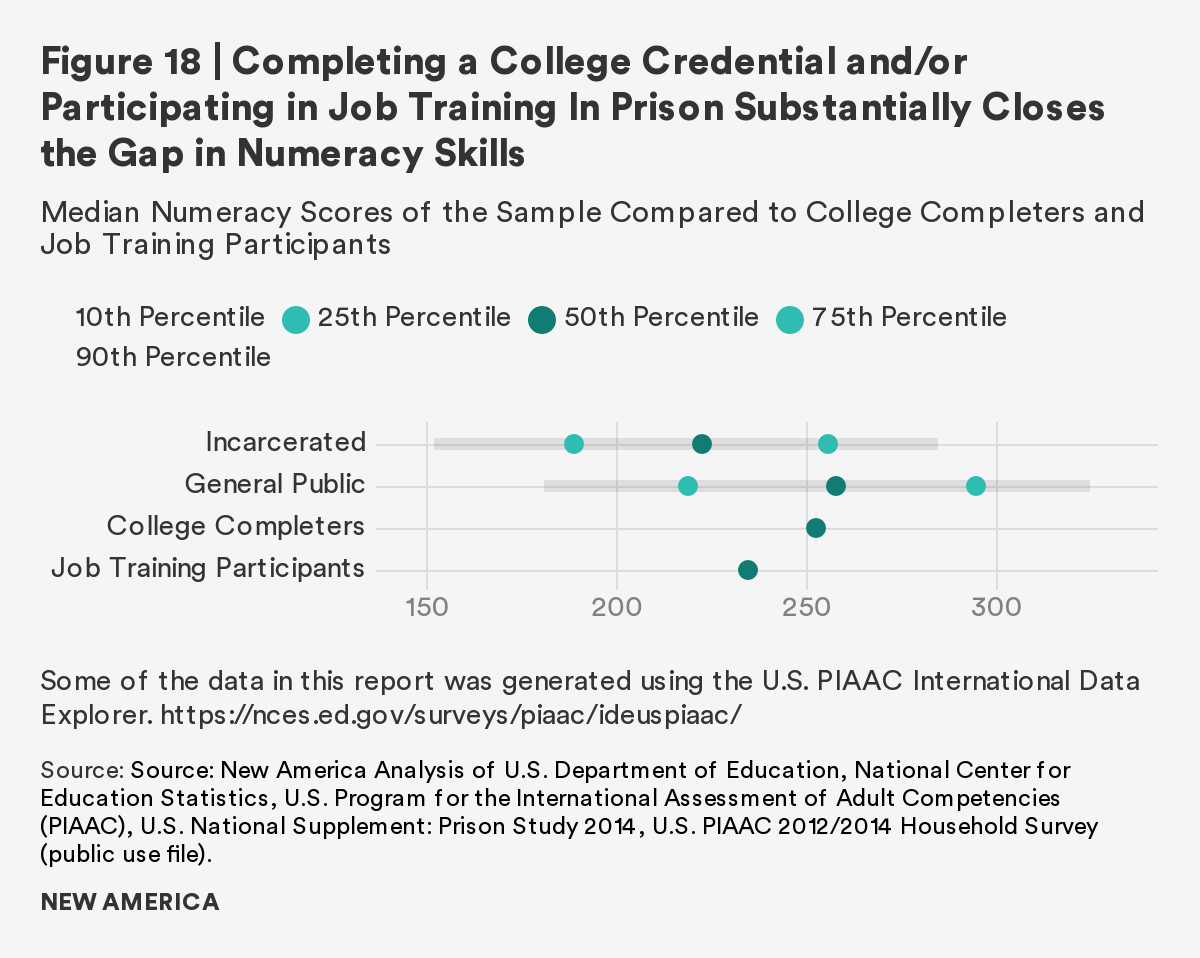
The literacy and numeracy medians displayed in figures 16 and 18 provide compelling evidence that completing postsecondary education and participating in job training while in prison closes the gaps in literacy and numeracy skills between the incarcerated population and the general public.
Citations
- New America Analysis of U.S. Department of Education, National Center for Education Statistics, U.S. Program for the International Assessment of Adult Competencies (PIAAC), U.S. National Supplement: Prison Study 2014, U.S. PIAAC 2012/2014 Household Survey (public use file).
- Zaid Jilani, “How Congress Killed One of the Few Lifelines for Former Prisoners and Why It’s Time to Bring It Back,” June 3, 2015, https://www.alternet.org/2015/06/how-congress-killed-one-few-lifelines-former-prisoners-and-why-its-time-bring-it-back/; and Abigail Strait and Susan Eaton, Post-Secondary Education for People in Prison, Social Justice Funders Opportunity Brief no. 1 (Waltham, MA: Sillerman Center, 2017), 1–8, https://heller.brandeis.edu/sillerman/pdfs/opportunity-briefs/post-secondary-education-people-in-prison.pdf
- Beyond the Box: Increasing Access to Higher Education for Justice-Involved Individuals (Washington, DC: U.S. Department of Education, 2016), https://www2.ed.gov/documents/beyond-the-box/guidance.pdf
- Federal Bureau of Prisons (website), “Inmate Custody & Care,” https://www.bop.gov/inmates/custody_and_care/
- Kritika Agarwal, “Inside Higher Education: College-in-Prison Programs Flourish but for How Long?” Perspectives on History, American Historical Association, January 1, 2018, https://www.historians.org/publications-and-directories/perspectives-on-history/january-2018/inside-higher-ed-college-in-prison-programs-flourish-but-for-how-long
- Nation Behind Bars: A Human Rights Solution (New York: Human Rights Watch, 2014), https://www.hrw.org/sites/default/files/related_material/2014_US_Nation_Behind_Bars_0.pdf
- Diana Ali, “Pell Grants for Prisoners: Considerations in the New Administration,” NASPA Student Affairs Administrators in Higher Education (website), September 22, 2017, https://www.naspa.org/rpi/posts/pell-grants-for-prisoners-considerations-in-the-new-administration
- Kritika Agarwal, “Inside Higher Education: College-in-Prison Programs Flourish but for How Long?” Perspectives on History, American Historical Association, January 1, 2018, https://www.historians.org/publications-and-directories/perspectives-on-history/january-2018/inside-higher-ed-college-in-prison-programs-flourish-but-for-how-long
- Lois M. Davis, Jennifer L. Steele, Robert Bozick, Malcolm V. Williams, Susan Turner, Jeremy N. V. Miles, Jessica Saunders, and Paul S. Steinberg, How Effective is Correctional Education, and Where Do We Go from Here? The Results of a Comprehensive Evaluation (Santa Monica, CA: RAND Corporation, 2014), https://www.rand.org/pubs/research_reports/RR564.html
- Nation Behind Bars: A Human Rights Solution (New York: Human Rights Watch, 2014), https://www.hrw.org/sites/default/files/related_material/2014_US_Nation_Behind_Bars_0.pdf
- Department of Justice Archives, Federal Bureau of Prisons, Federal Bureau of Prisons Education Program Assessment (Chicago, IL: Bronner Group, November 29, 2016), pp.i, https://www.justice.gov/archives/dag/page/file/914026/download
- Kritika Agarwal, “Inside Higher Education: College-in-Prison Programs Flourish but for How Long?” Perspectives on History, American Historical Association, January 1, 2018, https://www.historians.org/publications-and-directories/perspectives-on-history/january-2018/inside-higher-ed-college-in-prison-programs-flourish-but-for-how-long
- Jacquie Hogan, Nina Thornton, Lillian Diaz-Hoffmann, Leyla Mohadjer, Tom Krenzke, Jianzhu Li, Wendy VanDeKerckhove, Kentaro Yamamoto, and Lale Khorramdel, U.S. Program for the International Assessment of Adult Competencies (PIAAC) 2012/2014: Main Study and National Supplement Technical Report (Washington, DC: U.S. Department of Education, National Center for Education Statistics, September 2016), https://nces.ed.gov/pubs2016/2016036_rev.pdf
- John Sabatini, Understanding the Basic Reading Skills of U.S. Adults: Reading Components in the PIAAC Literacy Survey (Princeton, NJ: Educational Testing Service, 2015), https://www.ets.org/s/research/report/reading-skills/ets-adult-reading-skills-2015.pdf
- Nation Behind Bars: A Human Rights Solution (New York: Human Rights Watch, 2014), https://www.hrw.org/sites/default/files/related_material/2014_US_Nation_Behind_Bars_0.pdf ; and Abigail Strait and Susan Eaton, Post-Secondary Education for People in Prison, Social Justice Funders Opportunity Brief no. 1 (Waltham, MA: Sillerman Center, 2017), 1–8, https://heller.brandeis.edu/sillerman/pdfs/opportunity-briefs/post-secondary-education-people-in-prison.pdf
- Christina Reardon, “Formerly Incarcerated Individuals and the Challenges of Reentry,” Social Work Today 17, no. 6 (November 2017): 16; and Abigail Strait and Susan Eaton, Post-Secondary Education for People in Prison, Social Justice Funders Opportunity Brief no. 1 (Waltham, MA: Sillerman Center, 2017), 1–8, https://heller.brandeis.edu/sillerman/pdfs/opportunity-briefs/post-secondary-education-people-in-prison.pdf
- Department of Justice Archives, Federal Bureau of Prisons, Federal Bureau of Prisons Education Program Assessment (Chicago, IL: Bronner Group, November 29, 2016), pp.iii, https://www.justice.gov/archives/dag/page/file/914026/download
- Beyond the Box: Increasing Access to Higher Education for Justice-Involved Individuals (Washington, DC: U.S. Department of Education, 2016), https://www2.ed.gov/documents/beyond-the-box/guidance.pdf
- Federal Bureau of Prisons (website), “Inmate custody and care,” https://www.bop.gov/inmates/custody_and_care/
- Roger Jarjoura, “How Can We Slow Down Prison's Revolving Door?” Policy Center (blog), American Institutes for Research, July 2, 2019, https://www.air.org/resource/how-can-we-slow-down-prison-s-revolving-door
- Nation Behind Bars: A Human Rights Solution (New York: Human Rights Watch, 2014), https://www.hrw.org/sites/default/files/related_material/2014_US_Nation_Behind_Bars_0.pdf
- Michelle Alexander, The New Jim Crow: Mass Incarceration in the Age of Colorblindness (New York: The New Press, 2010); Lois M. Davis, Michelle A. Tolbert, and Mathew Mizel, Higher Education in Prison: Results from a National and Regional Landscape Scan, working paper (Santa Monica, CA: RAND, June 2017); and Christina Reardon, “Formerly Incarcerated Individuals and the Challenges of Reentry,” Social Work Today 17, no. 6 (November 2017): 16.
- Christina Reardon, “Formerly Incarcerated Individuals and the Challenges of Reentry,” Social Work Today 17, no. 6 (November 2017): 16.
- Grant Duwe, The Use and Impact of Correctional Programming for Inmates on Pre- and Post-Release Outcomes (Washington, DC: U.S. Department of Justice, June 2017).
- Christina Reardon, “Formerly Incarcerated Individuals and the Challenges of Reentry,” Social Work Today 17, no. 6 (November 2017): 16.
- Nation Behind Bars: A Human Rights Solution (New York: Human Rights Watch, 2014), https://www.hrw.org/sites/default/files/related_material/2014_US_Nation_Behind_Bars_0.pdf
- Christina Reardon, “Formerly Incarcerated Individuals and the Challenges of Reentry,” Social Work Today 17, no. 6 (November 2017): 16.
- Michelle Alexander, The New Jim Crow: Mass Incarceration in the Age of Colorblindness (New York: The New Press, 2010); and Christina Reardon, “Formerly Incarcerated Individuals and the Challenges of Reentry,” Social Work Today 17, no. 6 (November 2017): 16.
- Michelle Alexander, The New Jim Crow: Mass Incarceration in the Age of Colorblindness (New York: The New Press, 2010).
- Nation Behind Bars: A Human Rights Solution (New York: Human Rights Watch, 2014), https://www.hrw.org/sites/default/files/related_material/2014_US_Nation_Behind_Bars_0.pdf
- Federal Bureau of Prisons (website), “Historical Information: A Storied Past,” https://www.bop.gov/about/history/
- Federal Bureau of Prisons (website), “Historical Information: A Storied Past,” https://www.bop.gov/about/history/
- Michelle Alexander, The New Jim Crow: Mass Incarceration in the Age of Colorblindness (New York: The New Press, 2010).
- Ruth Delaney, Fred Patrick, and Alex Boldin, Unlocking Potential: Pathways from Prison to Postsecondary Education (New York: Vera Institute of Justice, May 2019).
- Ruth Delaney, Fred Patrick, and Alex Boldin, Unlocking Potential: Pathways from Prison to Postsecondary Education (New York: Vera Institute of Justice, May 2019).
- Michelle Alexander, The New Jim Crow: Mass Incarceration in the Age of Colorblindness (New York: The New Press, 2010).
- Ruth Delaney, Fred Patrick, and Alex Boldin, Unlocking Potential: Pathways from Prison to Postsecondary Education (New York: Vera Institute of Justice, May 2019). pp. 2.
- Nation Behind Bars: A Human Rights Solution (New York: Human Rights Watch, 2014), https://www.hrw.org/sites/default/files/related_material/2014_US_Nation_Behind_Bars_0.pdf
- Abigail Strait and Susan Eaton, Post-Secondary Education for People in Prison, Social Justice Funders Opportunity Brief no. 1 (Waltham, MA: Sillerman Center, 2017), 1–8, https://heller.brandeis.edu/sillerman/pdfs/opportunity-briefs/post-secondary-education-people-in-prison.pdf
- Christina Reardon, “Formerly Incarcerated Individuals and the Challenges of Reentry,” Social Work Today 17, no. 6 (November 2017): 16; and Beyond the Box: Increasing Access to Higher Education for Justice-Involved Individuals (Washington, DC: U.S. Department of Education, 2016), https://www2.ed.gov/documents/beyond-the-box/guidance.pdf
- Jamie Fellner, Punishment and Prejudice: Racial Disparities in the War on Drugs (New York: Human Rights Watch, May 2000)
- E. Ann Carson and William J. Sabol, “Prisoners in 2011,” Bulletin, U.S. Department of Justice, Bureau of Justice Statistics, December 2012, https://www.bjs.gov/content/pub/pdf/p11.pdf
- Donald Braman, Doing Time on the Outside: Incarceration and Family Life in Urban America (Ann Arbor: University of Michigan Press, 2004), 3, citing D.C. Department of Corrections data for 2000.
- Michelle Alexander, The New Jim Crow: Mass Incarceration in the Age of Colorblindness (New York: The New Press, 2010).
- Michelle Alexander, The New Jim Crow: Mass Incarceration in the Age of Colorblindness (New York: The New Press, 2010).
- Michelle Alexander, The New Jim Crow: Mass Incarceration in the Age of Colorblindness (New York: The New Press, 2010).
- Michelle Alexander, The New Jim Crow: Mass Incarceration in the Age of Colorblindness (New York: The New Press, 2010).
- Beyond the Box: Increasing Access to Higher Education for Justice-Involved Individuals (Washington, DC: U.S. Department of Education, 2016), https://www2.ed.gov/documents/beyond-the-box/guidance.pdf
- Abigail Strait and Susan Eaton, Post-Secondary Education for People in Prison, Social Justice Funders Opportunity Brief no. 1 (Waltham, MA: Sillerman Center, 2017), 1–8, https://heller.brandeis.edu/sillerman/pdfs/opportunity-briefs/post-secondary-education-people-in-prison.pdf
- Kritika Agarwal, “Inside Higher Education: College-in-Prison Programs Flourish but for How Long?” Perspectives on History, American Historical Association, January 1, 2018, https://www.historians.org/publications-and-directories/perspectives-on-history/january-2018/inside-higher-ed-college-in-prison-programs-flourish-but-for-how-long
- Diana Ali, “Pell Grants for Prisoners: Considerations in the New Administration,” NASPA Student Affairs Administrators in Higher Education (website), September 22, 2017, https://www.naspa.org/rpi/posts/pell-grants-for-prisoners-considerations-in-the-new-administration
- Institute for Higher Education Policy, “Pell Grants: Are Prisoners the Program’s Biggest Problem?” Policy Steps 1, no. 1 (Spring 1994).
- Gerard Robinson and Elizabeth English, The Second Chance Pell Pilot Program: A Historical Overview (Washington, DC: American Enterprise Institute, September 2017), https://www.aei.org/research-products/report/the-second-chance-pell-pilot-program-a-historical-overview/
- Institute for Higher Education Policy, “Pell Grants: Are Prisoners the Program’s Biggest Problem?” Policy Steps 1, no. 1 (Spring 1994).
- Kritika Agarwal, “Inside Higher Education: College-in-Prison Programs Flourish but for How Long?” Perspectives on History, American Historical Association, January 1, 2018, https://www.historians.org/publications-and-directories/perspectives-on-history/january-2018/inside-higher-ed-college-in-prison-programs-flourish-but-for-how-long
- Institute for Higher Education Policy, “Pell Grants: Are Prisoners the Program’s Biggest Problem?” Policy Steps 1, no. 1 (Spring 1994).
- Violent Crime Control and Law Enforcement Act of 1994, U.S. House, 103rd Congress, 2nd Session, H.R. 3355, http://www.congress.gov/bill/103rd
- Lois M. Davis, Jennifer L. Steele, Robert Bozick, Malcolm V. Williams, Susan Turner, Jeremy N. V. Miles, Jessica Saunders, and Paul S. Steinberg, How Effective is Correctional Education, and Where Do We Go from Here? The Results of a Comprehensive Evaluation (Santa Monica, CA: RAND Corporation, 2014), https://www.rand.org/pubs/research_reports/RR564.html
- Lois M. Davis, Jennifer L. Steele, Robert Bozick, Malcolm V. Williams, Susan Turner, Jeremy N. V. Miles, Jessica Saunders, and Paul S. Steinberg, How Effective is Correctional Education, and Where Do We Go from Here? The Results of a Comprehensive Evaluation (Santa Monica, CA: RAND Corporation, 2014), https://www.rand.org/pubs/research_reports/RR564.html
- Ruth Delaney, Fred Patrick, and Alex Boldin, Unlocking Potential: Pathways from Prison to Postsecondary Education (New York: Vera Institute of Justice, May 2019).
- Bradley D. Custer, “States—Not Just Congress—Should Unlock Student Financial Aid for People in Prison,” The Conversation, May 17, 2019, http://theconversation.com/states-not-just-congress-should-unlock-student-financial-aid-for-people-in-prison-117068
- Lois M. Davis, Michelle A. Tolbert, and Mathew Mizel, Higher Education in Prison: Results from a National and Regional Landscape Scan, working paper (Santa Monica, CA: RAND Corporation, June 2017).
- Lois M. Davis, Robert Bozick, Jennifer L. Steele, Jessica Saunders, and Jeremy N. V. Miles, Evaluating the Effectiveness of Correctional Education: A Meta-Analysis of Programs That Provide Education to Incarcerated Adults (Santa Monica, CA: RAND Corporation, 2013), https://www.rand.org/pubs/research_reports/RR266.html
- Kritika Agarwal, “Inside Higher Education: College-in-Prison Programs Flourish but for How Long?” Perspectives on History, American Historical Association, January 1, 2018, https://www.historians.org/publications-and-directories/perspectives-on-history/january-2018/inside-higher-ed-college-in-prison-programs-flourish-but-for-how-long ; Ellen C. Lagemann, Liberating Minds: The Case for College in Prison (New York: The New Press, 2016); and Abigail Strait and Susan Eaton, Post-Secondary Education for People in Prison, Social Justice Funders Opportunity Brief no. 1 (Waltham, MA: Sillerman Center, 2017), 1–8, https://heller.brandeis.edu/sillerman/pdfs/opportunity-briefs/post-secondary-education-people-in-prison.pdf
- Jinghong Cai, Anirudh V. S. Ruhil, and Dianne M. Gut, Prison-Based Education: Programs, Participation and Proficiency in Literacy/Numeracy (Washington, DC: American Institutes for Research, February 2019). pp.15,
- Beyond the Box: Increasing Access to Higher Education for Justice-Involved Individuals (Washington, DC: U.S. Department of Education, 2016), https://www2.ed.gov/documents/beyond-the-box/guidance.pdf
- Vera Institute of Justice, “Expanding Access to Postsecondary Education in Prison,” Fact Sheet, January 2017, https://www.vera.org/downloads/publications/postsecondary-education-in-prisonfactsheet-for-corrections-leaders.pdf
- Lois M. Davis, Michelle A. Tolbert, and Mathew Mizel, Higher Education in Prison: Results from a National and Regional Landscape Scan, working paper (Santa Monica, CA: RAND Corporation, June 2017).
- Lois M. Davis, Jennifer L. Steele, Robert Bozick, Malcolm V. Williams, Susan Turner, Jeremy N. V. Miles, Jessica Saunders, and Paul S. Steinberg, How Effective is Correctional Education, and Where Do We Go from Here? The Results of a Comprehensive Evaluation (Santa Monica, CA: RAND Corporation, 2014), https://www.rand.org/pubs/research_reports/RR564.html
- Patrick Oakford, Cara Brumfield, Casey Goldvale, Laura Tatum, Margaret diZerega, and Fred Patrick, Investing in futures: Economic & Fiscal Benefits of Postsecondary Education in Prison (New York: Vera Institute of Justice, January, 2019), https://www.vera.org/downloads/publications/investing-in-futures.pdf
- Erin L. Castro, Rebecca K. Hunter, Tara Hardison, Vanessa Johnson-Ojeda, and H. Suzuki, “The Landscape of Postsecondary Education in U.S. Prisons,” Research Collaborative on Higher Education in Prison, University of Utah, June, 2018, https://daqy2hvnfszx3.cloudfront.net/wp-content/uploads/sites/20/2018/02/15201351/RCHEP_June-2018_Research-Brief.pdf
- Kritika Agarwal, “Inside Higher Education: College-in-Prison Programs Flourish but for How Long?” Perspectives on History, American Historical Association, January 1, 2018, https://www.historians.org/publications-and-directories/perspectives-on-history/january-2018/inside-higher-ed-college-in-prison-programs-flourish-but-for-how-long
- Meagan Wilson, Rayane Alamuddin, and Danielle Cooper, Unbarring Access: A Landscape Review of Postsecondary Education in Prison and Its Pedagogical Supports (New York: Ithaka S+R, May 30, 2019), pp.8-9, https://sr.ithaka.org/publications/landscape-review-postsecondary-education-in-prison/
- See, for instance, the REAL Act of 2019 and the Expanding Educational Opportunities for Justice-Impacted Communities Act of 2019 (U.S. House. 116th Congress. 1st Session. H.R. 2168, REAL Act of 2019).
- Lois M. Davis, Michelle A. Tolbert, and Mathew Mizel, Higher Education in Prison: Results from a National and Regional Landscape Scan, working paper (Santa Monica, CA: RAND Corporation, June 2017).
- See David Whitman, The Cautionary Tale of Correspondence Schools (Washington, DC: New America, December 2018), https://www.newamerica.org/education-policy/reports/cautionary-tale-correspondence-schools/
- David A. Tomar, “Prison Education: Guide to College Degrees for Inmates and Ex-Offenders,” The Quad, https://thebestschools.org/magazine/prison-inmate-education-guide/
- Abigail Strait and Susan Eaton, Post-Secondary Education for People in Prison, Social Justice Funders Opportunity Brief no. 1 (Waltham, MA: Sillerman Center, 2017), 1–8, https://heller.brandeis.edu/sillerman/pdfs/opportunity-briefs/post-secondary-education-people-in-prison.pdf ; and Lois M. Davis, Michelle A. Tolbert, and Mathew Mizel, Higher Education in Prison: Results from a National and Regional Landscape Scan, working paper (Santa Monica, CA: RAND Corporation, June 2017).
- Lois M. Davis, Michelle A. Tolbert, and Mathew Mizel, Higher Education in Prison: Results from a National and Regional Landscape Scan, working paper (Santa Monica, CA: RAND Corporation, June 2017).
- Lois M. Davis, Michelle A. Tolbert, and Mathew Mizel, Higher Education in Prison: Results from a National and Regional Landscape Scan, working paper (Santa Monica, CA: RAND Corporation, June 2017); and National Institute of Corrections (website), “Provide Post Release Employment Services,” https://info.nicic.gov/cirs/node/40
- National Institute of Corrections (website), “Provide Post Release Employment Services,” https://info.nicic.gov/cirs/node/40
- Lois M. Davis, Robert Bozick, Jennifer L. Steele, Jessica Saunders, and Jeremy N. V. Miles, “Serving Time or Wasting Time? Correctional Education Programs Improve Job Prospects, Reduce Recidivism, and Save Taxpayer Dollars,” infographic, RAND Corporation, 2013, https://www.rand.org/pubs/infographics/IG113.html
- Department of Justice Archives, Federal Bureau of Prisons, Federal Bureau of Prisons Education Program Assessment (Chicago, IL: Bronner Group, November 29, 2016), https://www.justice.gov/archives/dag/page/file/914026/download
- James P. Lynch and William J. Sabol, Prisoner Reentry in Perspective, Crime Policy Report no. 3 (Washington, DC: The Urban Institute, September 2001).
- Michelle Tolbert, A Reentry Education Model: Supporting Education and Career Advancement for Low-Skill Individuals in Corrections (Washington, DC: U.S. Department of Education, 2012), https://www2.ed.gov/about/offices/list/ovae/pi/AdultEd/reentry-model.pdf
- Jinghong Cai, Anirudh V. S. Ruhil, and Dianne M. Gut, Prison-Based Education: Programs, Participation and Proficiency in Literacy/Numeracy (Washington, DC: American Institutes for Research, February 2019); Katie Landeros, “Incarcerated Adults in the United States,” infographic, American Institutes for Research, April 6, 2017, https://www.air.org/resource/infographic-incarcerated-adults-united-states ; Margaret Becker Patterson, Incarcerated Adults with Low Skills: Findings from the 2014 PIAAC Prison Study (Vienna, VA: Research Allies for Lifelong Learning, August 2018), https://static1.squarespace.com/static/51bb74b8e4b0139570ddf020/t/5babc9ea419202c3b360e221/1537985002744/2018_Patterson_Incarcerated%2bAdults%2bwith%2bLow%2bSkills_Final.pdf ;Bobby D. Rampey, Shelley Keiper, Leyla Mohadjer, Tom Krenzke, Jianzhu Li, Nina Thornton, and Jacquie Hogan, Highlights from the U.S. PIAAC Survey of Incarcerated Adults: Their Skills, Work Experience, Education, and Training: Program for the International Assessment of Adult Competencies: 2014 (NCES 2016-040) (Washington, DC: U.S. Department of Education, National Center for Education Statistics, November 2016), https://nces.ed.gov/pubs2016/2016040.pdf ; and John Sabatini, Understanding the Basic Reading Skills of U.S. Adults: Reading Components in the PIAAC Literacy Survey (Princeton, NJ: Educational Testing Service, 2015), https://www.ets.org/s/research/report/reading-skills/ets-adult-reading-skills-2015.pdf
- Jacquie Hogan, Nina Thornton, Lillian Diaz-Hoffmann, Leyla Mohadjer, Tom Krenzke, Jianzhu Li, Wendy VanDeKerckhove, Kentaro Yamamoto, and Lale Khorramdel, U.S. Program for the International Assessment of Adult Competencies (PIAAC) 2012/2014: Main Study and National Supplement Technical Report (Washington, DC: U.S. Department of Education, National Center for Education Statistics, September 2016), https://nces.ed.gov/pubs2016/2016036_rev.pdf
- Jacquie Hogan, Nina Thornton, Lillian Diaz-Hoffmann, Leyla Mohadjer, Tom Krenzke, Jianzhu Li, Wendy VanDeKerckhove, Kentaro Yamamoto, and Lale Khorramdel, U.S. Program for the International Assessment of Adult Competencies (PIAAC) 2012/2014: Main Study and National Supplement Technical Report (Washington, DC: U.S. Department of Education, National Center for Education Statistics, September 2016), https://nces.ed.gov/pubs2016/2016036_rev.pdf
- Refers to individuals who completed the survey that live in a household.
- Of the 1,319 incarcerated respondents, only 1,315 respondents of the incarcerated population completed the background questions. Four incarcerated adults were unable to complete the background questions because of an inability to communicate in English or Spanish or a mental disability. See Highlights from the U.S. PIAAC Survey of Incarcerated Adults: Their Skills, Work Experience, Education, and Training: Program for the International Assessment of Adult Competencies: 2014 (NCES 2016-040).
- Institute of Education Sciences, National Center for Education Statistics (website), “Program for the International Assessment of Adult Competencies (PIAAC): Prison Study Data Collection,” database,https://nces.ed.gov/surveys/piaac/prison.asp
- Institute of Education Sciences, National Center for Education Statistics (website), “Program for the International Assessment of Adult Competencies (PIAAC): What is PIAAC?” https://nces.ed.gov/surveys/piaac/
- The PIAAC survey defines literacy as the “ability to understand, evaluate, use, and engage with written text to participate in society, to achieve one’s goals and to develop one’s knowledge and potential.” See Institute of Education Sciences, National Center for Education Statistics (website), “Program for the International Assessment of Adult Competencies (PIAAC): Prison Study Data Collection,” database, https://nces.ed.gov/surveys/piaac/prison.asp
- Numeracy is defined as the “ability to access, use, interpret, and communicate” mathematically.” See Institute of Education Sciences, National Center for Education Statistics (website), “Program for the International Assessment of Adult Competencies (PIAAC): Prison Study Data Collection,” database, https://nces.ed.gov/surveys/piaac/prison.asp
- Institute of Education Sciences, National Center for Education Statistics (website), “Program for the International Assessment of Adult Competencies (PIAAC): Prison Study Data Collection,” database,https://nces.ed.gov/surveys/piaac/prison.asp
- Adults who did not complete additional education while incarcerated potentially include those who may have less than a high school equivalence, as well as adults who already completed a graduate degree prior to incarceration. See Highlights from the U.S. PIAAC Survey of Incarcerated Adults: Their Skills, Work Experience, Education, and Training: Program for the International Assessment of Adult Competencies: 2014 (NCES 2016-040).
- Due to the small sample size of adults completing additional education while incarcerated, the reentry status variable is collapsed into two categories for the remainder of the report.
- The analysis of this report does not attempt to explain why there is a difference in enrollment and completion rates across racial/ethnic groups.
- The job-training outlets available to incarcerated adults focus on providing specific workplace skills, such as learning Microsoft Word. The job-training outlets exclude prison jobs.
- The 2014 PIAAC Prison data only includes data on incarcerated adults who participate in job training. The data does not explicitly detail information on incarcerated adults’ who complete job training.
- A correlation analysis found that enrolling into a postsecondary degree or certificate program while incarcerated is statistically significantly associated with job-training participation.
- New America analysis with a bivariate logistic regression.
- New America analysis with a bivariate logistic regression.
- New America analysis with a bivariate logistic regression.
- Within the 2014 PIAAC Prison Survey, the variable to explain the barriers to enrolling in educational programs includes all correctional education programs (e.g., ABE, GED, certificates, etc.).
- The range excludes the 54 incarcerated adults who failed the core comprehension assessment. Those who fail the core comprehension assessment lack the basic cognitive skills to complete the literacy/numeracy skills assessment and were directed to the reading comprehension. These individuals were omitted from the range to avoid a skewed range of literacy scores.
- The range excludes the 54 incarcerated adults who failed the core comprehension assessment.
- New America analysis with an independent samples t-Test.
- New America analysis with an independent samples t-Test.
- Bobby D. Rampey, Robert Finnegan, Madeline Goodman, Leyla Mohadjer, Tom Krenzke, Jacquie Hogan, and Stephen Provasnik, Skills of U.S. Unemployed, Young, and Older Adults in Sharper Focus: Results From the Program for the International Assessment of Adult Competencies (PIAAC) 2012/2014 (Washington, DC: U.S. Department of Education, National Center for Education Statistics, March 2016), pp. B-3 – B-8. https://nces.ed.gov/pubs2016/2016039.pdf
- The table compares the distribution of Black and Hispanic respondents to the distribution of white individuals in each of the proficiency levels.
- New America analysis with an independent samples t-Test.
- New America analysis with an independent samples t-Test.
- New America analysis with an independent samples t-Test.
- Bobby D. Rampey, Robert Finnegan, Madeline Goodman, Leyla Mohadjer, Tom Krenzke, Jacquie Hogan, and Stephen Provasnik, Skills of U.S. Unemployed, Young, and Older Adults in Sharper Focus: Results From the Program for the International Assessment of Adult Competencies (PIAAC) 2012/2014 (Washington, DC: U.S. Department of Education, National Center for Education Statistics, March 2016), pp. B-3 – B-8. https://nces.ed.gov/pubs2016/2016039.pdf
- The table compares the distribution of Black and Hispanic respondents to the distribution of white individuals in each of the proficiency levels.
- New America analysis with an independent samples t-Test.
- New America analysis with an independent samples t-Test.
- New America analysis with an independent samples t-Test.
- New America analysis with logistic regression, holding race and age constant.
- New America analysis with linear regression, holding race and age constant.
- New America analysis with logistic regression, holding race and age constant.
- New America analysis with linear regression, holding race and age constant.
- New American analysis with logistic regression, holding race and age constant.
- New America analysis with linear regression, holding race and age constant.
- New American analysis with logistic regression, holding race and age constant.
- New America analysis with linear regression, holding race and age constant.
Discussion
We attended a college graduation during a prison site visit in June, and the tangible excitement and pride from the graduates, family members, and instructors were contagious. Upon leaving the graduation, one of the family members, with a wide grin and a gleam of hope in her eyes said, “My son graduated today and I am right proud of him! Usually I leave here feeling sad and down. But not today! I am leaving with so much joy and happiness.” Unfortunately, this mother’s sense of pride is rarely experienced by family members with loved ones who are in prison, as this report reveals that fewer than 10 percent of incarcerated adults complete a postsecondary education during their sentence.
But while fewer than 10 percent of incarcerated adults in U.S. federal and state prisons complete a postsecondary credential, nearly 7 in 10 (69 percent) say they want to continue their education post-high school, whether or not they expect to be released soon. As this report finds, although there is a significant gap between incarcerated adults and the general public in both literacy and numeracy skills, participation in and completion of postsecondary education and job training programs mitigate the proficiency gap. Those who participate in and/or complete these correctional programs have comparable literacy and numeracy scores to the general public, closing the gap considerably. Individuals who complete and participate in either college or job training during their time in prison have median scores in the 50th percentile of the general public for literacy and numeracy.
As the overwhelming majority of those in federal and state prisons will rejoin society, it is imperative to prepare individuals to transition with effective rehabilitative programs. The culture of prisons as a place of continuous punishment, with few opportunities to rehabilitate, must be reformed. The very nature of isolation and confinement; limited communication with family, friends, and the outside world; and the challenges of navigating unspoken norms of prison culture leave many individuals ill-equipped to transition back into the fast-paced, technologically advanced 21st century environment. Missing the opportunity to maximize time during incarceration with meaningful rehabilitative programs that will help individuals integrate back into society further disadvantages justice-involved individuals.
This report shows that postsecondary education and job training programs are effective rehabilitative programs to equip individuals with the critical skills necessary for employment post-release. Yet our findings also reveal that 79 percent of adults in federal and state prisons are released with absolutely no exposure to a postsecondary education, 77 percent leave without participation in a job training program, and 58 percent leave with no exposure to any type of correctional educational programming (e.g. ABE, GED, etc.).
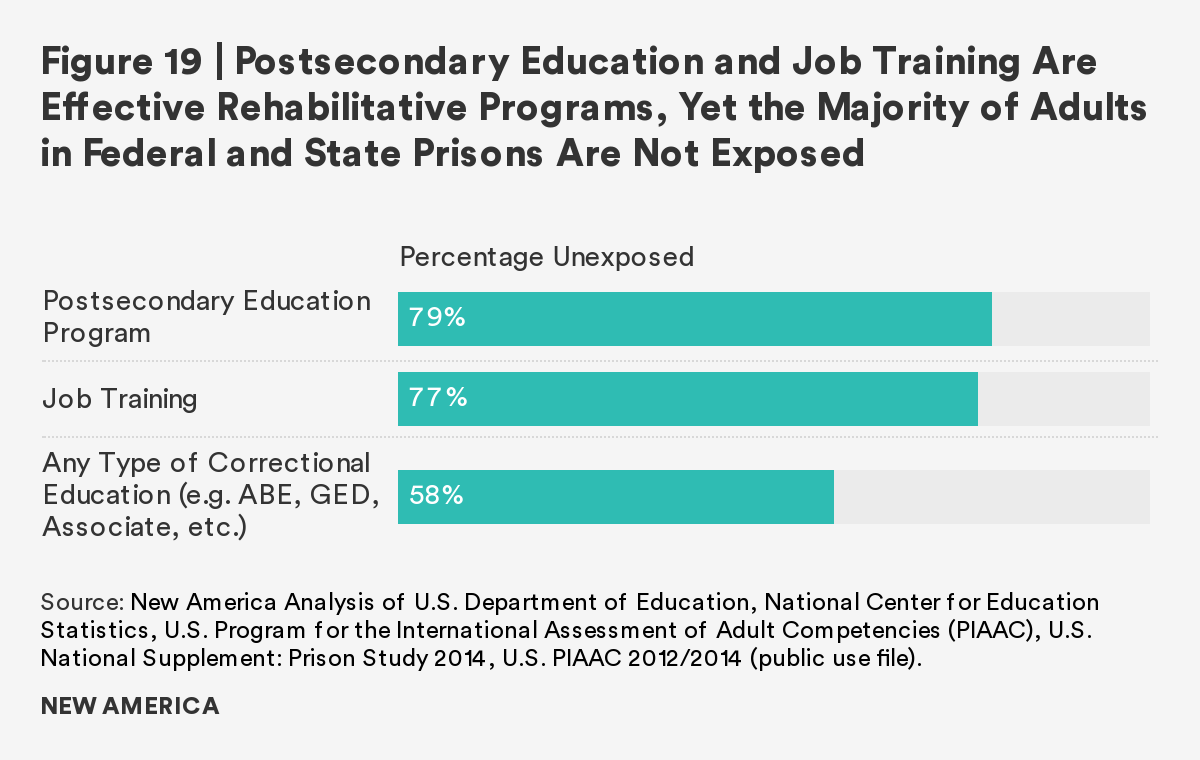
We spoke with students in various prisons and learned that many currently incarcerated adults in federal and state prisons were never employed prior to serving their time. That makes preparing individuals with skills for employment even more critical. If the infrastructure, correctional staff buy-in, political will, and resources are not invested to shift prisons to rehabilitation, individuals will continue to be released from prison unprepared and less likely to succeed in their efforts to reenter society.
Citations
- New America Analysis of U.S. Department of Education, National Center for Education Statistics, U.S. Program for the International Assessment of Adult Competencies (PIAAC), U.S. National Supplement: Prison Study 2014, U.S. PIAAC 2012/2014 Household Survey (public use file).
- Zaid Jilani, “How Congress Killed One of the Few Lifelines for Former Prisoners and Why It’s Time to Bring It Back,” June 3, 2015, https://www.alternet.org/2015/06/how-congress-killed-one-few-lifelines-former-prisoners-and-why-its-time-bring-it-back/; and Abigail Strait and Susan Eaton, Post-Secondary Education for People in Prison, Social Justice Funders Opportunity Brief no. 1 (Waltham, MA: Sillerman Center, 2017), 1–8, https://heller.brandeis.edu/sillerman/pdfs/opportunity-briefs/post-secondary-education-people-in-prison.pdf
- Beyond the Box: Increasing Access to Higher Education for Justice-Involved Individuals (Washington, DC: U.S. Department of Education, 2016), https://www2.ed.gov/documents/beyond-the-box/guidance.pdf
- Federal Bureau of Prisons (website), “Inmate Custody & Care,” https://www.bop.gov/inmates/custody_and_care/
- Kritika Agarwal, “Inside Higher Education: College-in-Prison Programs Flourish but for How Long?” Perspectives on History, American Historical Association, January 1, 2018, https://www.historians.org/publications-and-directories/perspectives-on-history/january-2018/inside-higher-ed-college-in-prison-programs-flourish-but-for-how-long
- Nation Behind Bars: A Human Rights Solution (New York: Human Rights Watch, 2014), https://www.hrw.org/sites/default/files/related_material/2014_US_Nation_Behind_Bars_0.pdf
- Diana Ali, “Pell Grants for Prisoners: Considerations in the New Administration,” NASPA Student Affairs Administrators in Higher Education (website), September 22, 2017, https://www.naspa.org/rpi/posts/pell-grants-for-prisoners-considerations-in-the-new-administration
- Kritika Agarwal, “Inside Higher Education: College-in-Prison Programs Flourish but for How Long?” Perspectives on History, American Historical Association, January 1, 2018, https://www.historians.org/publications-and-directories/perspectives-on-history/january-2018/inside-higher-ed-college-in-prison-programs-flourish-but-for-how-long
- Lois M. Davis, Jennifer L. Steele, Robert Bozick, Malcolm V. Williams, Susan Turner, Jeremy N. V. Miles, Jessica Saunders, and Paul S. Steinberg, How Effective is Correctional Education, and Where Do We Go from Here? The Results of a Comprehensive Evaluation (Santa Monica, CA: RAND Corporation, 2014), https://www.rand.org/pubs/research_reports/RR564.html
- Nation Behind Bars: A Human Rights Solution (New York: Human Rights Watch, 2014), https://www.hrw.org/sites/default/files/related_material/2014_US_Nation_Behind_Bars_0.pdf
- Department of Justice Archives, Federal Bureau of Prisons, Federal Bureau of Prisons Education Program Assessment (Chicago, IL: Bronner Group, November 29, 2016), pp.i, https://www.justice.gov/archives/dag/page/file/914026/download
- Kritika Agarwal, “Inside Higher Education: College-in-Prison Programs Flourish but for How Long?” Perspectives on History, American Historical Association, January 1, 2018, https://www.historians.org/publications-and-directories/perspectives-on-history/january-2018/inside-higher-ed-college-in-prison-programs-flourish-but-for-how-long
- Jacquie Hogan, Nina Thornton, Lillian Diaz-Hoffmann, Leyla Mohadjer, Tom Krenzke, Jianzhu Li, Wendy VanDeKerckhove, Kentaro Yamamoto, and Lale Khorramdel, U.S. Program for the International Assessment of Adult Competencies (PIAAC) 2012/2014: Main Study and National Supplement Technical Report (Washington, DC: U.S. Department of Education, National Center for Education Statistics, September 2016), https://nces.ed.gov/pubs2016/2016036_rev.pdf
- John Sabatini, Understanding the Basic Reading Skills of U.S. Adults: Reading Components in the PIAAC Literacy Survey (Princeton, NJ: Educational Testing Service, 2015), https://www.ets.org/s/research/report/reading-skills/ets-adult-reading-skills-2015.pdf
- Nation Behind Bars: A Human Rights Solution (New York: Human Rights Watch, 2014), https://www.hrw.org/sites/default/files/related_material/2014_US_Nation_Behind_Bars_0.pdf ; and Abigail Strait and Susan Eaton, Post-Secondary Education for People in Prison, Social Justice Funders Opportunity Brief no. 1 (Waltham, MA: Sillerman Center, 2017), 1–8, https://heller.brandeis.edu/sillerman/pdfs/opportunity-briefs/post-secondary-education-people-in-prison.pdf
- Christina Reardon, “Formerly Incarcerated Individuals and the Challenges of Reentry,” Social Work Today 17, no. 6 (November 2017): 16; and Abigail Strait and Susan Eaton, Post-Secondary Education for People in Prison, Social Justice Funders Opportunity Brief no. 1 (Waltham, MA: Sillerman Center, 2017), 1–8, https://heller.brandeis.edu/sillerman/pdfs/opportunity-briefs/post-secondary-education-people-in-prison.pdf
- Department of Justice Archives, Federal Bureau of Prisons, Federal Bureau of Prisons Education Program Assessment (Chicago, IL: Bronner Group, November 29, 2016), pp.iii, https://www.justice.gov/archives/dag/page/file/914026/download
- Beyond the Box: Increasing Access to Higher Education for Justice-Involved Individuals (Washington, DC: U.S. Department of Education, 2016), https://www2.ed.gov/documents/beyond-the-box/guidance.pdf
- Federal Bureau of Prisons (website), “Inmate custody and care,” https://www.bop.gov/inmates/custody_and_care/
- Roger Jarjoura, “How Can We Slow Down Prison's Revolving Door?” Policy Center (blog), American Institutes for Research, July 2, 2019, https://www.air.org/resource/how-can-we-slow-down-prison-s-revolving-door
- Nation Behind Bars: A Human Rights Solution (New York: Human Rights Watch, 2014), https://www.hrw.org/sites/default/files/related_material/2014_US_Nation_Behind_Bars_0.pdf
- Michelle Alexander, The New Jim Crow: Mass Incarceration in the Age of Colorblindness (New York: The New Press, 2010); Lois M. Davis, Michelle A. Tolbert, and Mathew Mizel, Higher Education in Prison: Results from a National and Regional Landscape Scan, working paper (Santa Monica, CA: RAND, June 2017); and Christina Reardon, “Formerly Incarcerated Individuals and the Challenges of Reentry,” Social Work Today 17, no. 6 (November 2017): 16.
- Christina Reardon, “Formerly Incarcerated Individuals and the Challenges of Reentry,” Social Work Today 17, no. 6 (November 2017): 16.
- Grant Duwe, The Use and Impact of Correctional Programming for Inmates on Pre- and Post-Release Outcomes (Washington, DC: U.S. Department of Justice, June 2017).
- Christina Reardon, “Formerly Incarcerated Individuals and the Challenges of Reentry,” Social Work Today 17, no. 6 (November 2017): 16.
- Nation Behind Bars: A Human Rights Solution (New York: Human Rights Watch, 2014), https://www.hrw.org/sites/default/files/related_material/2014_US_Nation_Behind_Bars_0.pdf
- Christina Reardon, “Formerly Incarcerated Individuals and the Challenges of Reentry,” Social Work Today 17, no. 6 (November 2017): 16.
- Michelle Alexander, The New Jim Crow: Mass Incarceration in the Age of Colorblindness (New York: The New Press, 2010); and Christina Reardon, “Formerly Incarcerated Individuals and the Challenges of Reentry,” Social Work Today 17, no. 6 (November 2017): 16.
- Michelle Alexander, The New Jim Crow: Mass Incarceration in the Age of Colorblindness (New York: The New Press, 2010).
- Nation Behind Bars: A Human Rights Solution (New York: Human Rights Watch, 2014), https://www.hrw.org/sites/default/files/related_material/2014_US_Nation_Behind_Bars_0.pdf
- Federal Bureau of Prisons (website), “Historical Information: A Storied Past,” https://www.bop.gov/about/history/
- Federal Bureau of Prisons (website), “Historical Information: A Storied Past,” https://www.bop.gov/about/history/
- Michelle Alexander, The New Jim Crow: Mass Incarceration in the Age of Colorblindness (New York: The New Press, 2010).
- Ruth Delaney, Fred Patrick, and Alex Boldin, Unlocking Potential: Pathways from Prison to Postsecondary Education (New York: Vera Institute of Justice, May 2019).
- Ruth Delaney, Fred Patrick, and Alex Boldin, Unlocking Potential: Pathways from Prison to Postsecondary Education (New York: Vera Institute of Justice, May 2019).
- Michelle Alexander, The New Jim Crow: Mass Incarceration in the Age of Colorblindness (New York: The New Press, 2010).
- Ruth Delaney, Fred Patrick, and Alex Boldin, Unlocking Potential: Pathways from Prison to Postsecondary Education (New York: Vera Institute of Justice, May 2019). pp. 2.
- Nation Behind Bars: A Human Rights Solution (New York: Human Rights Watch, 2014), https://www.hrw.org/sites/default/files/related_material/2014_US_Nation_Behind_Bars_0.pdf
- Abigail Strait and Susan Eaton, Post-Secondary Education for People in Prison, Social Justice Funders Opportunity Brief no. 1 (Waltham, MA: Sillerman Center, 2017), 1–8, https://heller.brandeis.edu/sillerman/pdfs/opportunity-briefs/post-secondary-education-people-in-prison.pdf
- Christina Reardon, “Formerly Incarcerated Individuals and the Challenges of Reentry,” Social Work Today 17, no. 6 (November 2017): 16; and Beyond the Box: Increasing Access to Higher Education for Justice-Involved Individuals (Washington, DC: U.S. Department of Education, 2016), https://www2.ed.gov/documents/beyond-the-box/guidance.pdf
- Jamie Fellner, Punishment and Prejudice: Racial Disparities in the War on Drugs (New York: Human Rights Watch, May 2000)
- E. Ann Carson and William J. Sabol, “Prisoners in 2011,” Bulletin, U.S. Department of Justice, Bureau of Justice Statistics, December 2012, https://www.bjs.gov/content/pub/pdf/p11.pdf
- Donald Braman, Doing Time on the Outside: Incarceration and Family Life in Urban America (Ann Arbor: University of Michigan Press, 2004), 3, citing D.C. Department of Corrections data for 2000.
- Michelle Alexander, The New Jim Crow: Mass Incarceration in the Age of Colorblindness (New York: The New Press, 2010).
- Michelle Alexander, The New Jim Crow: Mass Incarceration in the Age of Colorblindness (New York: The New Press, 2010).
- Michelle Alexander, The New Jim Crow: Mass Incarceration in the Age of Colorblindness (New York: The New Press, 2010).
- Michelle Alexander, The New Jim Crow: Mass Incarceration in the Age of Colorblindness (New York: The New Press, 2010).
- Beyond the Box: Increasing Access to Higher Education for Justice-Involved Individuals (Washington, DC: U.S. Department of Education, 2016), https://www2.ed.gov/documents/beyond-the-box/guidance.pdf
- Abigail Strait and Susan Eaton, Post-Secondary Education for People in Prison, Social Justice Funders Opportunity Brief no. 1 (Waltham, MA: Sillerman Center, 2017), 1–8, https://heller.brandeis.edu/sillerman/pdfs/opportunity-briefs/post-secondary-education-people-in-prison.pdf
- Kritika Agarwal, “Inside Higher Education: College-in-Prison Programs Flourish but for How Long?” Perspectives on History, American Historical Association, January 1, 2018, https://www.historians.org/publications-and-directories/perspectives-on-history/january-2018/inside-higher-ed-college-in-prison-programs-flourish-but-for-how-long
- Diana Ali, “Pell Grants for Prisoners: Considerations in the New Administration,” NASPA Student Affairs Administrators in Higher Education (website), September 22, 2017, https://www.naspa.org/rpi/posts/pell-grants-for-prisoners-considerations-in-the-new-administration
- Institute for Higher Education Policy, “Pell Grants: Are Prisoners the Program’s Biggest Problem?” Policy Steps 1, no. 1 (Spring 1994).
- Gerard Robinson and Elizabeth English, The Second Chance Pell Pilot Program: A Historical Overview (Washington, DC: American Enterprise Institute, September 2017), https://www.aei.org/research-products/report/the-second-chance-pell-pilot-program-a-historical-overview/
- Institute for Higher Education Policy, “Pell Grants: Are Prisoners the Program’s Biggest Problem?” Policy Steps 1, no. 1 (Spring 1994).
- Kritika Agarwal, “Inside Higher Education: College-in-Prison Programs Flourish but for How Long?” Perspectives on History, American Historical Association, January 1, 2018, https://www.historians.org/publications-and-directories/perspectives-on-history/january-2018/inside-higher-ed-college-in-prison-programs-flourish-but-for-how-long
- Institute for Higher Education Policy, “Pell Grants: Are Prisoners the Program’s Biggest Problem?” Policy Steps 1, no. 1 (Spring 1994).
- Violent Crime Control and Law Enforcement Act of 1994, U.S. House, 103rd Congress, 2nd Session, H.R. 3355, http://www.congress.gov/bill/103rd
- Lois M. Davis, Jennifer L. Steele, Robert Bozick, Malcolm V. Williams, Susan Turner, Jeremy N. V. Miles, Jessica Saunders, and Paul S. Steinberg, How Effective is Correctional Education, and Where Do We Go from Here? The Results of a Comprehensive Evaluation (Santa Monica, CA: RAND Corporation, 2014), https://www.rand.org/pubs/research_reports/RR564.html
- Lois M. Davis, Jennifer L. Steele, Robert Bozick, Malcolm V. Williams, Susan Turner, Jeremy N. V. Miles, Jessica Saunders, and Paul S. Steinberg, How Effective is Correctional Education, and Where Do We Go from Here? The Results of a Comprehensive Evaluation (Santa Monica, CA: RAND Corporation, 2014), https://www.rand.org/pubs/research_reports/RR564.html
- Ruth Delaney, Fred Patrick, and Alex Boldin, Unlocking Potential: Pathways from Prison to Postsecondary Education (New York: Vera Institute of Justice, May 2019).
- Bradley D. Custer, “States—Not Just Congress—Should Unlock Student Financial Aid for People in Prison,” The Conversation, May 17, 2019, http://theconversation.com/states-not-just-congress-should-unlock-student-financial-aid-for-people-in-prison-117068
- Lois M. Davis, Michelle A. Tolbert, and Mathew Mizel, Higher Education in Prison: Results from a National and Regional Landscape Scan, working paper (Santa Monica, CA: RAND Corporation, June 2017).
- Lois M. Davis, Robert Bozick, Jennifer L. Steele, Jessica Saunders, and Jeremy N. V. Miles, Evaluating the Effectiveness of Correctional Education: A Meta-Analysis of Programs That Provide Education to Incarcerated Adults (Santa Monica, CA: RAND Corporation, 2013), https://www.rand.org/pubs/research_reports/RR266.html
- Kritika Agarwal, “Inside Higher Education: College-in-Prison Programs Flourish but for How Long?” Perspectives on History, American Historical Association, January 1, 2018, https://www.historians.org/publications-and-directories/perspectives-on-history/january-2018/inside-higher-ed-college-in-prison-programs-flourish-but-for-how-long ; Ellen C. Lagemann, Liberating Minds: The Case for College in Prison (New York: The New Press, 2016); and Abigail Strait and Susan Eaton, Post-Secondary Education for People in Prison, Social Justice Funders Opportunity Brief no. 1 (Waltham, MA: Sillerman Center, 2017), 1–8, https://heller.brandeis.edu/sillerman/pdfs/opportunity-briefs/post-secondary-education-people-in-prison.pdf
- Jinghong Cai, Anirudh V. S. Ruhil, and Dianne M. Gut, Prison-Based Education: Programs, Participation and Proficiency in Literacy/Numeracy (Washington, DC: American Institutes for Research, February 2019). pp.15,
- Beyond the Box: Increasing Access to Higher Education for Justice-Involved Individuals (Washington, DC: U.S. Department of Education, 2016), https://www2.ed.gov/documents/beyond-the-box/guidance.pdf
- Vera Institute of Justice, “Expanding Access to Postsecondary Education in Prison,” Fact Sheet, January 2017, https://www.vera.org/downloads/publications/postsecondary-education-in-prisonfactsheet-for-corrections-leaders.pdf
- Lois M. Davis, Michelle A. Tolbert, and Mathew Mizel, Higher Education in Prison: Results from a National and Regional Landscape Scan, working paper (Santa Monica, CA: RAND Corporation, June 2017).
- Lois M. Davis, Jennifer L. Steele, Robert Bozick, Malcolm V. Williams, Susan Turner, Jeremy N. V. Miles, Jessica Saunders, and Paul S. Steinberg, How Effective is Correctional Education, and Where Do We Go from Here? The Results of a Comprehensive Evaluation (Santa Monica, CA: RAND Corporation, 2014), https://www.rand.org/pubs/research_reports/RR564.html
- Patrick Oakford, Cara Brumfield, Casey Goldvale, Laura Tatum, Margaret diZerega, and Fred Patrick, Investing in futures: Economic & Fiscal Benefits of Postsecondary Education in Prison (New York: Vera Institute of Justice, January, 2019), https://www.vera.org/downloads/publications/investing-in-futures.pdf
- Erin L. Castro, Rebecca K. Hunter, Tara Hardison, Vanessa Johnson-Ojeda, and H. Suzuki, “The Landscape of Postsecondary Education in U.S. Prisons,” Research Collaborative on Higher Education in Prison, University of Utah, June, 2018, https://daqy2hvnfszx3.cloudfront.net/wp-content/uploads/sites/20/2018/02/15201351/RCHEP_June-2018_Research-Brief.pdf
- Kritika Agarwal, “Inside Higher Education: College-in-Prison Programs Flourish but for How Long?” Perspectives on History, American Historical Association, January 1, 2018, https://www.historians.org/publications-and-directories/perspectives-on-history/january-2018/inside-higher-ed-college-in-prison-programs-flourish-but-for-how-long
- Meagan Wilson, Rayane Alamuddin, and Danielle Cooper, Unbarring Access: A Landscape Review of Postsecondary Education in Prison and Its Pedagogical Supports (New York: Ithaka S+R, May 30, 2019), pp.8-9, https://sr.ithaka.org/publications/landscape-review-postsecondary-education-in-prison/
- See, for instance, the REAL Act of 2019 and the Expanding Educational Opportunities for Justice-Impacted Communities Act of 2019 (U.S. House. 116th Congress. 1st Session. H.R. 2168, REAL Act of 2019).
- Lois M. Davis, Michelle A. Tolbert, and Mathew Mizel, Higher Education in Prison: Results from a National and Regional Landscape Scan, working paper (Santa Monica, CA: RAND Corporation, June 2017).
- See David Whitman, The Cautionary Tale of Correspondence Schools (Washington, DC: New America, December 2018), https://www.newamerica.org/education-policy/reports/cautionary-tale-correspondence-schools/
- David A. Tomar, “Prison Education: Guide to College Degrees for Inmates and Ex-Offenders,” The Quad, https://thebestschools.org/magazine/prison-inmate-education-guide/
- Abigail Strait and Susan Eaton, Post-Secondary Education for People in Prison, Social Justice Funders Opportunity Brief no. 1 (Waltham, MA: Sillerman Center, 2017), 1–8, https://heller.brandeis.edu/sillerman/pdfs/opportunity-briefs/post-secondary-education-people-in-prison.pdf ; and Lois M. Davis, Michelle A. Tolbert, and Mathew Mizel, Higher Education in Prison: Results from a National and Regional Landscape Scan, working paper (Santa Monica, CA: RAND Corporation, June 2017).
- Lois M. Davis, Michelle A. Tolbert, and Mathew Mizel, Higher Education in Prison: Results from a National and Regional Landscape Scan, working paper (Santa Monica, CA: RAND Corporation, June 2017).
- Lois M. Davis, Michelle A. Tolbert, and Mathew Mizel, Higher Education in Prison: Results from a National and Regional Landscape Scan, working paper (Santa Monica, CA: RAND Corporation, June 2017); and National Institute of Corrections (website), “Provide Post Release Employment Services,” https://info.nicic.gov/cirs/node/40
- National Institute of Corrections (website), “Provide Post Release Employment Services,” https://info.nicic.gov/cirs/node/40
- Lois M. Davis, Robert Bozick, Jennifer L. Steele, Jessica Saunders, and Jeremy N. V. Miles, “Serving Time or Wasting Time? Correctional Education Programs Improve Job Prospects, Reduce Recidivism, and Save Taxpayer Dollars,” infographic, RAND Corporation, 2013, https://www.rand.org/pubs/infographics/IG113.html
- Department of Justice Archives, Federal Bureau of Prisons, Federal Bureau of Prisons Education Program Assessment (Chicago, IL: Bronner Group, November 29, 2016), https://www.justice.gov/archives/dag/page/file/914026/download
- James P. Lynch and William J. Sabol, Prisoner Reentry in Perspective, Crime Policy Report no. 3 (Washington, DC: The Urban Institute, September 2001).
- Michelle Tolbert, A Reentry Education Model: Supporting Education and Career Advancement for Low-Skill Individuals in Corrections (Washington, DC: U.S. Department of Education, 2012), https://www2.ed.gov/about/offices/list/ovae/pi/AdultEd/reentry-model.pdf
- Jinghong Cai, Anirudh V. S. Ruhil, and Dianne M. Gut, Prison-Based Education: Programs, Participation and Proficiency in Literacy/Numeracy (Washington, DC: American Institutes for Research, February 2019); Katie Landeros, “Incarcerated Adults in the United States,” infographic, American Institutes for Research, April 6, 2017, https://www.air.org/resource/infographic-incarcerated-adults-united-states ; Margaret Becker Patterson, Incarcerated Adults with Low Skills: Findings from the 2014 PIAAC Prison Study (Vienna, VA: Research Allies for Lifelong Learning, August 2018), https://static1.squarespace.com/static/51bb74b8e4b0139570ddf020/t/5babc9ea419202c3b360e221/1537985002744/2018_Patterson_Incarcerated%2bAdults%2bwith%2bLow%2bSkills_Final.pdf ;Bobby D. Rampey, Shelley Keiper, Leyla Mohadjer, Tom Krenzke, Jianzhu Li, Nina Thornton, and Jacquie Hogan, Highlights from the U.S. PIAAC Survey of Incarcerated Adults: Their Skills, Work Experience, Education, and Training: Program for the International Assessment of Adult Competencies: 2014 (NCES 2016-040) (Washington, DC: U.S. Department of Education, National Center for Education Statistics, November 2016), https://nces.ed.gov/pubs2016/2016040.pdf ; and John Sabatini, Understanding the Basic Reading Skills of U.S. Adults: Reading Components in the PIAAC Literacy Survey (Princeton, NJ: Educational Testing Service, 2015), https://www.ets.org/s/research/report/reading-skills/ets-adult-reading-skills-2015.pdf
- Jacquie Hogan, Nina Thornton, Lillian Diaz-Hoffmann, Leyla Mohadjer, Tom Krenzke, Jianzhu Li, Wendy VanDeKerckhove, Kentaro Yamamoto, and Lale Khorramdel, U.S. Program for the International Assessment of Adult Competencies (PIAAC) 2012/2014: Main Study and National Supplement Technical Report (Washington, DC: U.S. Department of Education, National Center for Education Statistics, September 2016), https://nces.ed.gov/pubs2016/2016036_rev.pdf
- Jacquie Hogan, Nina Thornton, Lillian Diaz-Hoffmann, Leyla Mohadjer, Tom Krenzke, Jianzhu Li, Wendy VanDeKerckhove, Kentaro Yamamoto, and Lale Khorramdel, U.S. Program for the International Assessment of Adult Competencies (PIAAC) 2012/2014: Main Study and National Supplement Technical Report (Washington, DC: U.S. Department of Education, National Center for Education Statistics, September 2016), https://nces.ed.gov/pubs2016/2016036_rev.pdf
- Refers to individuals who completed the survey that live in a household.
- Of the 1,319 incarcerated respondents, only 1,315 respondents of the incarcerated population completed the background questions. Four incarcerated adults were unable to complete the background questions because of an inability to communicate in English or Spanish or a mental disability. See Highlights from the U.S. PIAAC Survey of Incarcerated Adults: Their Skills, Work Experience, Education, and Training: Program for the International Assessment of Adult Competencies: 2014 (NCES 2016-040).
- Institute of Education Sciences, National Center for Education Statistics (website), “Program for the International Assessment of Adult Competencies (PIAAC): Prison Study Data Collection,” database,https://nces.ed.gov/surveys/piaac/prison.asp
- Institute of Education Sciences, National Center for Education Statistics (website), “Program for the International Assessment of Adult Competencies (PIAAC): What is PIAAC?” https://nces.ed.gov/surveys/piaac/
- The PIAAC survey defines literacy as the “ability to understand, evaluate, use, and engage with written text to participate in society, to achieve one’s goals and to develop one’s knowledge and potential.” See Institute of Education Sciences, National Center for Education Statistics (website), “Program for the International Assessment of Adult Competencies (PIAAC): Prison Study Data Collection,” database, https://nces.ed.gov/surveys/piaac/prison.asp
- Numeracy is defined as the “ability to access, use, interpret, and communicate” mathematically.” See Institute of Education Sciences, National Center for Education Statistics (website), “Program for the International Assessment of Adult Competencies (PIAAC): Prison Study Data Collection,” database, https://nces.ed.gov/surveys/piaac/prison.asp
- Institute of Education Sciences, National Center for Education Statistics (website), “Program for the International Assessment of Adult Competencies (PIAAC): Prison Study Data Collection,” database,https://nces.ed.gov/surveys/piaac/prison.asp
- Adults who did not complete additional education while incarcerated potentially include those who may have less than a high school equivalence, as well as adults who already completed a graduate degree prior to incarceration. See Highlights from the U.S. PIAAC Survey of Incarcerated Adults: Their Skills, Work Experience, Education, and Training: Program for the International Assessment of Adult Competencies: 2014 (NCES 2016-040).
- Due to the small sample size of adults completing additional education while incarcerated, the reentry status variable is collapsed into two categories for the remainder of the report.
- The analysis of this report does not attempt to explain why there is a difference in enrollment and completion rates across racial/ethnic groups.
- The job-training outlets available to incarcerated adults focus on providing specific workplace skills, such as learning Microsoft Word. The job-training outlets exclude prison jobs.
- The 2014 PIAAC Prison data only includes data on incarcerated adults who participate in job training. The data does not explicitly detail information on incarcerated adults’ who complete job training.
- A correlation analysis found that enrolling into a postsecondary degree or certificate program while incarcerated is statistically significantly associated with job-training participation.
- New America analysis with a bivariate logistic regression.
- New America analysis with a bivariate logistic regression.
- New America analysis with a bivariate logistic regression.
- Within the 2014 PIAAC Prison Survey, the variable to explain the barriers to enrolling in educational programs includes all correctional education programs (e.g., ABE, GED, certificates, etc.).
- The range excludes the 54 incarcerated adults who failed the core comprehension assessment. Those who fail the core comprehension assessment lack the basic cognitive skills to complete the literacy/numeracy skills assessment and were directed to the reading comprehension. These individuals were omitted from the range to avoid a skewed range of literacy scores.
- The range excludes the 54 incarcerated adults who failed the core comprehension assessment.
- New America analysis with an independent samples t-Test.
- New America analysis with an independent samples t-Test.
- Bobby D. Rampey, Robert Finnegan, Madeline Goodman, Leyla Mohadjer, Tom Krenzke, Jacquie Hogan, and Stephen Provasnik, Skills of U.S. Unemployed, Young, and Older Adults in Sharper Focus: Results From the Program for the International Assessment of Adult Competencies (PIAAC) 2012/2014 (Washington, DC: U.S. Department of Education, National Center for Education Statistics, March 2016), pp. B-3 – B-8. https://nces.ed.gov/pubs2016/2016039.pdf
- The table compares the distribution of Black and Hispanic respondents to the distribution of white individuals in each of the proficiency levels.
- New America analysis with an independent samples t-Test.
- New America analysis with an independent samples t-Test.
- New America analysis with an independent samples t-Test.
- Bobby D. Rampey, Robert Finnegan, Madeline Goodman, Leyla Mohadjer, Tom Krenzke, Jacquie Hogan, and Stephen Provasnik, Skills of U.S. Unemployed, Young, and Older Adults in Sharper Focus: Results From the Program for the International Assessment of Adult Competencies (PIAAC) 2012/2014 (Washington, DC: U.S. Department of Education, National Center for Education Statistics, March 2016), pp. B-3 – B-8. https://nces.ed.gov/pubs2016/2016039.pdf
- The table compares the distribution of Black and Hispanic respondents to the distribution of white individuals in each of the proficiency levels.
- New America analysis with an independent samples t-Test.
- New America analysis with an independent samples t-Test.
- New America analysis with an independent samples t-Test.
- New America analysis with logistic regression, holding race and age constant.
- New America analysis with linear regression, holding race and age constant.
- New America analysis with logistic regression, holding race and age constant.
- New America analysis with linear regression, holding race and age constant.
- New American analysis with logistic regression, holding race and age constant.
- New America analysis with linear regression, holding race and age constant.
- New American analysis with logistic regression, holding race and age constant.
- New America analysis with linear regression, holding race and age constant.
Policy Implications/Recommendations
Here are five recommendations with federal, state, and local policy implications to suggest a new, smarter approach to reentry, one that begins while individuals are serving their time, and that prioritizes postsecondary education and job training opportunities:
Increase Access
Increase the availability of quality postsecondary education and meaningful job training opportunities. As an empirically proven rehabilitative program to prepare individuals with skills necessary for active participation in the labor market, postsecondary education should be viewed as an integral part of rehabilitation within correctional facilities. Prisons should actively expand their educational programming to include postsecondary education that provides pathways to formal degrees and certificates.
This expansion primarily requires the federal government and states to reevaluate policies that have limited funding for such opportunities. These federal and state policies heavily impact what types of programming is available to incarcerated adults within prison systems. Both states and the federal government must amend policies that deny access to higher education and reshape financing programs to expand postsecondary opportunities in a model that is conducive to a prison context. Congress has made some progress on this front, authorizing a small portion (up to 2 percent) of federal dollars to states for Career and Technical Education (CTE) under the Perkins Act, including postsecondary programs.128 But more must be done to reach the millions of incarcerated adults interested in pursuing higher education. An appropriate funding model would ensure that delivery of postsecondary education to incarcerated students neither perpetuates inequities in educational quality nor denies access to academically eligible individuals who want to participate.
As job training will continue to be one of the major program offerings within prisons, curriculum and learning outcomes must align with the necessary skills for the 21st century labor market. Correctional job training programs should continue to evolve to better align with professional and trade careers.
However, the portability of job training programs is complex, as the occupational barriers for formerly incarcerated adults vary from state to state. Job training should prepare incarcerated individuals for occupations for which they are legally allowed to enter.129 Although some states provide waivers to allow qualified individuals employment, other states do not. The complexity is amplified for those within the Federal Bureau of Prisons system, where there is a higher likelihood of being released in a different state from the state in which the correctional job training has been given. In these instances, individuals could possibly be trained for an occupation they are banned from practicing, contingent upon the state they are released. Collaboration between the reentry process and correctional programming is critical.
Job training programs should also align with regional labor market needs. To accommodate the dynamic nature of labor-market needs, federal and state correctional systems should conduct intermittent labor market evaluations as a means of continuous improvement and adjust their programs as needed.
Increase the choice of educational providers to incarcerated populations. A majority of currently incarcerated students, federal and state correctional administrators, college-in-prison facilitators, and experts in the field we spoke with believe increasing choice in educational providers within prisons would be a good idea. One currently incarcerated student told us, “Like we learned in our economics class, not having a competitive market for education is not a good thing. How will colleges be motivated to do better if they know they are the only option?”
For the few facilities in the country that have college programs, students are typically limited to the quality and educational experience of the sole provider that operates in their facility, which is particularly problematic when few quality guardrails are in place to ensure the college program is high-quality and course offerings are comparable to on-campus programs. Students are restricted in their selection of courses, majors and degrees, professors, and more. They generally cannot shop around and select a college based on factors like quality and cost. And waiting lists to participate in the only available college program get longer and longer. While some currently incarcerated students worry that more educational providers could crowd out existing high-quality college programs, take up high-demand space, and drive up costs, expanding the choice of educational providers within prisons may help to scale up the promise of higher education.
Guidance to Leveraging Credentials
Provide opportunities to ensure correctional postsecondary programs lead to pathways to earn formal degrees. Unfortunately, not all correctional postsecondary education programs position adults to seamlessly earn formal degrees and certificates either during incarceration or after release that are essential for career entry and professional advancement. It is important for incarcerated adults to have opportunities to leverage their educational experience post-release to continue their education, with the agency of choice in their educational pursuits, just as traditional college students do. This calls for a radical shift of universal access to credit-bearing, transferable degrees that lend the option for incarcerated students to continue their education post-release. One model is stackable credentials, a sequence of certificates and degrees that a student can accumulate over time,130 applying the credits to avoid repeating coursework and extending beyond associate degrees.
During our prison-site visits, we met some students participating in the Second Chance Pell program who were accumulating multiple associate degrees. A stackable credential model could allow incarcerated students to earn credits and credentials and deter programs from encouraging students from continuing to pursue multiple programs at the same level, with non-stackable credits, which could put them at a disadvantage in the long run. One student pointed out: “Getting a[n associate] degree has become more realistic because I’ll be halfway to a bachelor’s and now [a bachelor’s degree] feels more attainable.”
Within federal and state correctional facilities, education provided along a continuum will accommodate the varying educational needs of the students, allow clearer pathways to a degree, and help students to make meaningful progress in the accumulation of valuable credentials. For example, Michigan’s Transfer Agreement allows students to earn a 30-credit certificate while incarcerated, and then transfer those credits to a state community college to continue their education post-release (though the program does not allow stackable credentials during incarceration).131 Stackable credentials would allow students to earn credits on the pathway to a formal degree during their prison sentence and then have the option to transfer to a campus upon release.
Additionally, while job training programs within prisons typically issue a certificate from either the Federal Bureau of Prisons or from a given state’s department of corrections, those certificates are not industry-recognized credentials. To provide meaningful opportunities for adults to leverage the credentials they earn while in prison, correctional programs should shift to awarding industry-recognized credentials comparable to certificates individuals receive outside of prison.
Make postsecondary education and job training programs part of the reentry process. The reentry process typically begins within 12 to 18 months of an individual’s release date.132 For students who want to transfer and continue their education, there is a heavy reliance on family members to help with the transition—submitting online college applications and paying for them, researching programs and transfer requirements, and finding a college in the area where the student will be released.
While family support is critical to incarcerated populations, the entire burden should not rest with the family, especially since not all incarcerated students have family support, or family members who are familiar with the postsecondary education system. Most of the individuals we spoke with are the first in their families to pursue a college education. The criminal justice system should collaborate with community-based organizations and auxiliary programs, such as higher education institutions, to maintain individuals’ educational growth post-release.
Where students transfer is contingent upon the community in which they are paroled, yet these two intertwined processes of release and college transfer are rarely connected. This was confirmed from speaking with a staff member of a college-in-prison program we visited. “We [at the college-in-prison program] don’t have a robust reentry process to support students besides writing a letter to the board [for parole] on their behalf. It’s mainly individuals doing the work of finding a college to transfer to in the community [where] they will be released.”
A college-reentry liaison at the correctional facility could assist those interested in continuing their education immediately after release. The liaison could inform students of the necessary classes and documents to transfer to a campus, assist students with completing online applications, identify transferable credits, and collaborate to identify and ensure a local college is in the location of release. A college-reentry liaison is critical for incarcerated students in the federal corrections system, in particular, where they are more than likely to have a geographic mismatch between the state where they are released and the state where they were enrolled in coursework during incarceration. A consortium or college-in-prison network across the country may be able to alleviate this barrier by establishing agreements to allow students to transfer and continue their education at partner institutions upon release.
For job training programs, a workforce liaison to assist individuals with finding employment is also critical. This liaison should form partnerships with employers across various industries to inform incarcerated adults of the current labor demands in the community of their release and guide individuals to apply for jobs during their sentence. The ideal collaboration between the reentry process and job training programs would transfer their industry-recognized certificate into a job-offer upon release.
Ensure Equity and Quality of Correctional College Programs
Recommendations for reinstating Pell Grants for incarcerated populations. Speaking with currently incarcerated students, federal and state correctional education administrators, college facilitators, and instructors, the recurring moral and political question they are often challenged with is whether those behind bars should be afforded the privilege to access higher education.
With growing bipartisan support behind reinstating Pell Grants for currently incarcerated adults to expand access to higher education, our findings suggest that policymakers should be careful to anticipate and address possible unintended consequences on equity and quality. Currently, 66 educational providers around the country are actively involved in the Second Chance Pell experiment, which is run by the U.S. Department of Education. A stipulation of Pell Grant eligibility for the pilot program is that students must eventually be eligible for release from prison, with priority to students who will be released within five years of enrollment in the program.133 However, we have seen from the PIAAC data that those closest to reentry (fewer than two years) are not more or less likely to enroll or show interest in college programs. Furthermore, those who are close to reentry are not more or less likely to graduate from college programs compared to individuals with longer and indeterminate sentences. And given longstanding racial disparities in both imprisonment and sentencing, this provision likely disproportionately harms people of color, denying them access to continued education.
For these reasons, federal investments in correctional postsecondary education should not limit program eligibility to individuals nearing release or eligible for parole. Policymakers should reevaluate the merits of denying eligibility on the basis of reentry status, and ensure all academically qualified individuals have access to higher education while incarcerated. A college-in-prison facilitator we spoke to cautioned against such restrictions, stating, “When you begin to exclude based on additional criteria, it creates conflict and resentment and you miss an opportunity to transform the culture of the prison. Prisons already are a culture of conflict, so why add more with a program that has the potential to have many great benefits.”
While reinstating Pell Grants to currently incarcerated adults will help to address the need for greater access to higher education, guardrails should be in place to ensure this vulnerable population of students is not harmed by the unintended consequences of Second Chance Pell. First and foremost, institutions should apply for the privilege to offer these programs, rather than being presumed eligible. Establishing a college-in-prison program should require jumping significant hurdles, implementing mission-driven practices, and building cooperative relationships across the institution and the facility. Those should be in place well before a student enters the classroom, and before she or he begins to spend down their limited Pell Grant dollars. Eligible institutions should be subject to continued monitoring and evaluation to assess the outcomes of their incarcerated students, and Pell Grant eligibility should be revoked where colleges fail to serve students well. Even within the context of the current experiment, our prison site visits revealed students were largely unaware of their participation in the experiment and risks of their program, such as wasted or spent-down federal aid money that will no longer be available to them upon release. Students should be full participants in the pilot, with adequate knowledge of the risks and benefits. Institutions and programs should be held accountable to ensure the dissemination of this information, the quality of education being offered, and their commitment to serve this population of students.
Citations
- New America Analysis of U.S. Department of Education, National Center for Education Statistics, U.S. Program for the International Assessment of Adult Competencies (PIAAC), U.S. National Supplement: Prison Study 2014, U.S. PIAAC 2012/2014 Household Survey (public use file).
- Zaid Jilani, “How Congress Killed One of the Few Lifelines for Former Prisoners and Why It’s Time to Bring It Back,” June 3, 2015, https://www.alternet.org/2015/06/how-congress-killed-one-few-lifelines-former-prisoners-and-why-its-time-bring-it-back/; and Abigail Strait and Susan Eaton, Post-Secondary Education for People in Prison, Social Justice Funders Opportunity Brief no. 1 (Waltham, MA: Sillerman Center, 2017), 1–8, https://heller.brandeis.edu/sillerman/pdfs/opportunity-briefs/post-secondary-education-people-in-prison.pdf
- Beyond the Box: Increasing Access to Higher Education for Justice-Involved Individuals (Washington, DC: U.S. Department of Education, 2016), https://www2.ed.gov/documents/beyond-the-box/guidance.pdf
- Federal Bureau of Prisons (website), “Inmate Custody & Care,” https://www.bop.gov/inmates/custody_and_care/
- Kritika Agarwal, “Inside Higher Education: College-in-Prison Programs Flourish but for How Long?” Perspectives on History, American Historical Association, January 1, 2018, https://www.historians.org/publications-and-directories/perspectives-on-history/january-2018/inside-higher-ed-college-in-prison-programs-flourish-but-for-how-long
- Nation Behind Bars: A Human Rights Solution (New York: Human Rights Watch, 2014), https://www.hrw.org/sites/default/files/related_material/2014_US_Nation_Behind_Bars_0.pdf
- Diana Ali, “Pell Grants for Prisoners: Considerations in the New Administration,” NASPA Student Affairs Administrators in Higher Education (website), September 22, 2017, https://www.naspa.org/rpi/posts/pell-grants-for-prisoners-considerations-in-the-new-administration
- Kritika Agarwal, “Inside Higher Education: College-in-Prison Programs Flourish but for How Long?” Perspectives on History, American Historical Association, January 1, 2018, https://www.historians.org/publications-and-directories/perspectives-on-history/january-2018/inside-higher-ed-college-in-prison-programs-flourish-but-for-how-long
- Lois M. Davis, Jennifer L. Steele, Robert Bozick, Malcolm V. Williams, Susan Turner, Jeremy N. V. Miles, Jessica Saunders, and Paul S. Steinberg, How Effective is Correctional Education, and Where Do We Go from Here? The Results of a Comprehensive Evaluation (Santa Monica, CA: RAND Corporation, 2014), https://www.rand.org/pubs/research_reports/RR564.html
- Nation Behind Bars: A Human Rights Solution (New York: Human Rights Watch, 2014), https://www.hrw.org/sites/default/files/related_material/2014_US_Nation_Behind_Bars_0.pdf
- Department of Justice Archives, Federal Bureau of Prisons, Federal Bureau of Prisons Education Program Assessment (Chicago, IL: Bronner Group, November 29, 2016), pp.i, https://www.justice.gov/archives/dag/page/file/914026/download
- Kritika Agarwal, “Inside Higher Education: College-in-Prison Programs Flourish but for How Long?” Perspectives on History, American Historical Association, January 1, 2018, https://www.historians.org/publications-and-directories/perspectives-on-history/january-2018/inside-higher-ed-college-in-prison-programs-flourish-but-for-how-long
- Jacquie Hogan, Nina Thornton, Lillian Diaz-Hoffmann, Leyla Mohadjer, Tom Krenzke, Jianzhu Li, Wendy VanDeKerckhove, Kentaro Yamamoto, and Lale Khorramdel, U.S. Program for the International Assessment of Adult Competencies (PIAAC) 2012/2014: Main Study and National Supplement Technical Report (Washington, DC: U.S. Department of Education, National Center for Education Statistics, September 2016), https://nces.ed.gov/pubs2016/2016036_rev.pdf
- John Sabatini, Understanding the Basic Reading Skills of U.S. Adults: Reading Components in the PIAAC Literacy Survey (Princeton, NJ: Educational Testing Service, 2015), https://www.ets.org/s/research/report/reading-skills/ets-adult-reading-skills-2015.pdf
- Nation Behind Bars: A Human Rights Solution (New York: Human Rights Watch, 2014), https://www.hrw.org/sites/default/files/related_material/2014_US_Nation_Behind_Bars_0.pdf ; and Abigail Strait and Susan Eaton, Post-Secondary Education for People in Prison, Social Justice Funders Opportunity Brief no. 1 (Waltham, MA: Sillerman Center, 2017), 1–8, https://heller.brandeis.edu/sillerman/pdfs/opportunity-briefs/post-secondary-education-people-in-prison.pdf
- Christina Reardon, “Formerly Incarcerated Individuals and the Challenges of Reentry,” Social Work Today 17, no. 6 (November 2017): 16; and Abigail Strait and Susan Eaton, Post-Secondary Education for People in Prison, Social Justice Funders Opportunity Brief no. 1 (Waltham, MA: Sillerman Center, 2017), 1–8, https://heller.brandeis.edu/sillerman/pdfs/opportunity-briefs/post-secondary-education-people-in-prison.pdf
- Department of Justice Archives, Federal Bureau of Prisons, Federal Bureau of Prisons Education Program Assessment (Chicago, IL: Bronner Group, November 29, 2016), pp.iii, https://www.justice.gov/archives/dag/page/file/914026/download
- Beyond the Box: Increasing Access to Higher Education for Justice-Involved Individuals (Washington, DC: U.S. Department of Education, 2016), https://www2.ed.gov/documents/beyond-the-box/guidance.pdf
- Federal Bureau of Prisons (website), “Inmate custody and care,” https://www.bop.gov/inmates/custody_and_care/
- Roger Jarjoura, “How Can We Slow Down Prison's Revolving Door?” Policy Center (blog), American Institutes for Research, July 2, 2019, https://www.air.org/resource/how-can-we-slow-down-prison-s-revolving-door
- Nation Behind Bars: A Human Rights Solution (New York: Human Rights Watch, 2014), https://www.hrw.org/sites/default/files/related_material/2014_US_Nation_Behind_Bars_0.pdf
- Michelle Alexander, The New Jim Crow: Mass Incarceration in the Age of Colorblindness (New York: The New Press, 2010); Lois M. Davis, Michelle A. Tolbert, and Mathew Mizel, Higher Education in Prison: Results from a National and Regional Landscape Scan, working paper (Santa Monica, CA: RAND, June 2017); and Christina Reardon, “Formerly Incarcerated Individuals and the Challenges of Reentry,” Social Work Today 17, no. 6 (November 2017): 16.
- Christina Reardon, “Formerly Incarcerated Individuals and the Challenges of Reentry,” Social Work Today 17, no. 6 (November 2017): 16.
- Grant Duwe, The Use and Impact of Correctional Programming for Inmates on Pre- and Post-Release Outcomes (Washington, DC: U.S. Department of Justice, June 2017).
- Christina Reardon, “Formerly Incarcerated Individuals and the Challenges of Reentry,” Social Work Today 17, no. 6 (November 2017): 16.
- Nation Behind Bars: A Human Rights Solution (New York: Human Rights Watch, 2014), https://www.hrw.org/sites/default/files/related_material/2014_US_Nation_Behind_Bars_0.pdf
- Christina Reardon, “Formerly Incarcerated Individuals and the Challenges of Reentry,” Social Work Today 17, no. 6 (November 2017): 16.
- Michelle Alexander, The New Jim Crow: Mass Incarceration in the Age of Colorblindness (New York: The New Press, 2010); and Christina Reardon, “Formerly Incarcerated Individuals and the Challenges of Reentry,” Social Work Today 17, no. 6 (November 2017): 16.
- Michelle Alexander, The New Jim Crow: Mass Incarceration in the Age of Colorblindness (New York: The New Press, 2010).
- Nation Behind Bars: A Human Rights Solution (New York: Human Rights Watch, 2014), https://www.hrw.org/sites/default/files/related_material/2014_US_Nation_Behind_Bars_0.pdf
- Federal Bureau of Prisons (website), “Historical Information: A Storied Past,” https://www.bop.gov/about/history/
- Federal Bureau of Prisons (website), “Historical Information: A Storied Past,” https://www.bop.gov/about/history/
- Michelle Alexander, The New Jim Crow: Mass Incarceration in the Age of Colorblindness (New York: The New Press, 2010).
- Ruth Delaney, Fred Patrick, and Alex Boldin, Unlocking Potential: Pathways from Prison to Postsecondary Education (New York: Vera Institute of Justice, May 2019).
- Ruth Delaney, Fred Patrick, and Alex Boldin, Unlocking Potential: Pathways from Prison to Postsecondary Education (New York: Vera Institute of Justice, May 2019).
- Michelle Alexander, The New Jim Crow: Mass Incarceration in the Age of Colorblindness (New York: The New Press, 2010).
- Ruth Delaney, Fred Patrick, and Alex Boldin, Unlocking Potential: Pathways from Prison to Postsecondary Education (New York: Vera Institute of Justice, May 2019). pp. 2.
- Nation Behind Bars: A Human Rights Solution (New York: Human Rights Watch, 2014), https://www.hrw.org/sites/default/files/related_material/2014_US_Nation_Behind_Bars_0.pdf
- Abigail Strait and Susan Eaton, Post-Secondary Education for People in Prison, Social Justice Funders Opportunity Brief no. 1 (Waltham, MA: Sillerman Center, 2017), 1–8, https://heller.brandeis.edu/sillerman/pdfs/opportunity-briefs/post-secondary-education-people-in-prison.pdf
- Christina Reardon, “Formerly Incarcerated Individuals and the Challenges of Reentry,” Social Work Today 17, no. 6 (November 2017): 16; and Beyond the Box: Increasing Access to Higher Education for Justice-Involved Individuals (Washington, DC: U.S. Department of Education, 2016), https://www2.ed.gov/documents/beyond-the-box/guidance.pdf
- Jamie Fellner, Punishment and Prejudice: Racial Disparities in the War on Drugs (New York: Human Rights Watch, May 2000)
- E. Ann Carson and William J. Sabol, “Prisoners in 2011,” Bulletin, U.S. Department of Justice, Bureau of Justice Statistics, December 2012, https://www.bjs.gov/content/pub/pdf/p11.pdf
- Donald Braman, Doing Time on the Outside: Incarceration and Family Life in Urban America (Ann Arbor: University of Michigan Press, 2004), 3, citing D.C. Department of Corrections data for 2000.
- Michelle Alexander, The New Jim Crow: Mass Incarceration in the Age of Colorblindness (New York: The New Press, 2010).
- Michelle Alexander, The New Jim Crow: Mass Incarceration in the Age of Colorblindness (New York: The New Press, 2010).
- Michelle Alexander, The New Jim Crow: Mass Incarceration in the Age of Colorblindness (New York: The New Press, 2010).
- Michelle Alexander, The New Jim Crow: Mass Incarceration in the Age of Colorblindness (New York: The New Press, 2010).
- Beyond the Box: Increasing Access to Higher Education for Justice-Involved Individuals (Washington, DC: U.S. Department of Education, 2016), https://www2.ed.gov/documents/beyond-the-box/guidance.pdf
- Abigail Strait and Susan Eaton, Post-Secondary Education for People in Prison, Social Justice Funders Opportunity Brief no. 1 (Waltham, MA: Sillerman Center, 2017), 1–8, https://heller.brandeis.edu/sillerman/pdfs/opportunity-briefs/post-secondary-education-people-in-prison.pdf
- Kritika Agarwal, “Inside Higher Education: College-in-Prison Programs Flourish but for How Long?” Perspectives on History, American Historical Association, January 1, 2018, https://www.historians.org/publications-and-directories/perspectives-on-history/january-2018/inside-higher-ed-college-in-prison-programs-flourish-but-for-how-long
- Diana Ali, “Pell Grants for Prisoners: Considerations in the New Administration,” NASPA Student Affairs Administrators in Higher Education (website), September 22, 2017, https://www.naspa.org/rpi/posts/pell-grants-for-prisoners-considerations-in-the-new-administration
- Institute for Higher Education Policy, “Pell Grants: Are Prisoners the Program’s Biggest Problem?” Policy Steps 1, no. 1 (Spring 1994).
- Gerard Robinson and Elizabeth English, The Second Chance Pell Pilot Program: A Historical Overview (Washington, DC: American Enterprise Institute, September 2017), https://www.aei.org/research-products/report/the-second-chance-pell-pilot-program-a-historical-overview/
- Institute for Higher Education Policy, “Pell Grants: Are Prisoners the Program’s Biggest Problem?” Policy Steps 1, no. 1 (Spring 1994).
- Kritika Agarwal, “Inside Higher Education: College-in-Prison Programs Flourish but for How Long?” Perspectives on History, American Historical Association, January 1, 2018, https://www.historians.org/publications-and-directories/perspectives-on-history/january-2018/inside-higher-ed-college-in-prison-programs-flourish-but-for-how-long
- Institute for Higher Education Policy, “Pell Grants: Are Prisoners the Program’s Biggest Problem?” Policy Steps 1, no. 1 (Spring 1994).
- Violent Crime Control and Law Enforcement Act of 1994, U.S. House, 103rd Congress, 2nd Session, H.R. 3355, http://www.congress.gov/bill/103rd
- Lois M. Davis, Jennifer L. Steele, Robert Bozick, Malcolm V. Williams, Susan Turner, Jeremy N. V. Miles, Jessica Saunders, and Paul S. Steinberg, How Effective is Correctional Education, and Where Do We Go from Here? The Results of a Comprehensive Evaluation (Santa Monica, CA: RAND Corporation, 2014), https://www.rand.org/pubs/research_reports/RR564.html
- Lois M. Davis, Jennifer L. Steele, Robert Bozick, Malcolm V. Williams, Susan Turner, Jeremy N. V. Miles, Jessica Saunders, and Paul S. Steinberg, How Effective is Correctional Education, and Where Do We Go from Here? The Results of a Comprehensive Evaluation (Santa Monica, CA: RAND Corporation, 2014), https://www.rand.org/pubs/research_reports/RR564.html
- Ruth Delaney, Fred Patrick, and Alex Boldin, Unlocking Potential: Pathways from Prison to Postsecondary Education (New York: Vera Institute of Justice, May 2019).
- Bradley D. Custer, “States—Not Just Congress—Should Unlock Student Financial Aid for People in Prison,” The Conversation, May 17, 2019, http://theconversation.com/states-not-just-congress-should-unlock-student-financial-aid-for-people-in-prison-117068
- Lois M. Davis, Michelle A. Tolbert, and Mathew Mizel, Higher Education in Prison: Results from a National and Regional Landscape Scan, working paper (Santa Monica, CA: RAND Corporation, June 2017).
- Lois M. Davis, Robert Bozick, Jennifer L. Steele, Jessica Saunders, and Jeremy N. V. Miles, Evaluating the Effectiveness of Correctional Education: A Meta-Analysis of Programs That Provide Education to Incarcerated Adults (Santa Monica, CA: RAND Corporation, 2013), https://www.rand.org/pubs/research_reports/RR266.html
- Kritika Agarwal, “Inside Higher Education: College-in-Prison Programs Flourish but for How Long?” Perspectives on History, American Historical Association, January 1, 2018, https://www.historians.org/publications-and-directories/perspectives-on-history/january-2018/inside-higher-ed-college-in-prison-programs-flourish-but-for-how-long ; Ellen C. Lagemann, Liberating Minds: The Case for College in Prison (New York: The New Press, 2016); and Abigail Strait and Susan Eaton, Post-Secondary Education for People in Prison, Social Justice Funders Opportunity Brief no. 1 (Waltham, MA: Sillerman Center, 2017), 1–8, https://heller.brandeis.edu/sillerman/pdfs/opportunity-briefs/post-secondary-education-people-in-prison.pdf
- Jinghong Cai, Anirudh V. S. Ruhil, and Dianne M. Gut, Prison-Based Education: Programs, Participation and Proficiency in Literacy/Numeracy (Washington, DC: American Institutes for Research, February 2019). pp.15,
- Beyond the Box: Increasing Access to Higher Education for Justice-Involved Individuals (Washington, DC: U.S. Department of Education, 2016), https://www2.ed.gov/documents/beyond-the-box/guidance.pdf
- Vera Institute of Justice, “Expanding Access to Postsecondary Education in Prison,” Fact Sheet, January 2017, https://www.vera.org/downloads/publications/postsecondary-education-in-prisonfactsheet-for-corrections-leaders.pdf
- Lois M. Davis, Michelle A. Tolbert, and Mathew Mizel, Higher Education in Prison: Results from a National and Regional Landscape Scan, working paper (Santa Monica, CA: RAND Corporation, June 2017).
- Lois M. Davis, Jennifer L. Steele, Robert Bozick, Malcolm V. Williams, Susan Turner, Jeremy N. V. Miles, Jessica Saunders, and Paul S. Steinberg, How Effective is Correctional Education, and Where Do We Go from Here? The Results of a Comprehensive Evaluation (Santa Monica, CA: RAND Corporation, 2014), https://www.rand.org/pubs/research_reports/RR564.html
- Patrick Oakford, Cara Brumfield, Casey Goldvale, Laura Tatum, Margaret diZerega, and Fred Patrick, Investing in futures: Economic & Fiscal Benefits of Postsecondary Education in Prison (New York: Vera Institute of Justice, January, 2019), https://www.vera.org/downloads/publications/investing-in-futures.pdf
- Erin L. Castro, Rebecca K. Hunter, Tara Hardison, Vanessa Johnson-Ojeda, and H. Suzuki, “The Landscape of Postsecondary Education in U.S. Prisons,” Research Collaborative on Higher Education in Prison, University of Utah, June, 2018, https://daqy2hvnfszx3.cloudfront.net/wp-content/uploads/sites/20/2018/02/15201351/RCHEP_June-2018_Research-Brief.pdf
- Kritika Agarwal, “Inside Higher Education: College-in-Prison Programs Flourish but for How Long?” Perspectives on History, American Historical Association, January 1, 2018, https://www.historians.org/publications-and-directories/perspectives-on-history/january-2018/inside-higher-ed-college-in-prison-programs-flourish-but-for-how-long
- Meagan Wilson, Rayane Alamuddin, and Danielle Cooper, Unbarring Access: A Landscape Review of Postsecondary Education in Prison and Its Pedagogical Supports (New York: Ithaka S+R, May 30, 2019), pp.8-9, https://sr.ithaka.org/publications/landscape-review-postsecondary-education-in-prison/
- See, for instance, the REAL Act of 2019 and the Expanding Educational Opportunities for Justice-Impacted Communities Act of 2019 (U.S. House. 116th Congress. 1st Session. H.R. 2168, REAL Act of 2019).
- Lois M. Davis, Michelle A. Tolbert, and Mathew Mizel, Higher Education in Prison: Results from a National and Regional Landscape Scan, working paper (Santa Monica, CA: RAND Corporation, June 2017).
- See David Whitman, The Cautionary Tale of Correspondence Schools (Washington, DC: New America, December 2018), https://www.newamerica.org/education-policy/reports/cautionary-tale-correspondence-schools/
- David A. Tomar, “Prison Education: Guide to College Degrees for Inmates and Ex-Offenders,” The Quad, https://thebestschools.org/magazine/prison-inmate-education-guide/
- Abigail Strait and Susan Eaton, Post-Secondary Education for People in Prison, Social Justice Funders Opportunity Brief no. 1 (Waltham, MA: Sillerman Center, 2017), 1–8, https://heller.brandeis.edu/sillerman/pdfs/opportunity-briefs/post-secondary-education-people-in-prison.pdf ; and Lois M. Davis, Michelle A. Tolbert, and Mathew Mizel, Higher Education in Prison: Results from a National and Regional Landscape Scan, working paper (Santa Monica, CA: RAND Corporation, June 2017).
- Lois M. Davis, Michelle A. Tolbert, and Mathew Mizel, Higher Education in Prison: Results from a National and Regional Landscape Scan, working paper (Santa Monica, CA: RAND Corporation, June 2017).
- Lois M. Davis, Michelle A. Tolbert, and Mathew Mizel, Higher Education in Prison: Results from a National and Regional Landscape Scan, working paper (Santa Monica, CA: RAND Corporation, June 2017); and National Institute of Corrections (website), “Provide Post Release Employment Services,” https://info.nicic.gov/cirs/node/40
- National Institute of Corrections (website), “Provide Post Release Employment Services,” https://info.nicic.gov/cirs/node/40
- Lois M. Davis, Robert Bozick, Jennifer L. Steele, Jessica Saunders, and Jeremy N. V. Miles, “Serving Time or Wasting Time? Correctional Education Programs Improve Job Prospects, Reduce Recidivism, and Save Taxpayer Dollars,” infographic, RAND Corporation, 2013, https://www.rand.org/pubs/infographics/IG113.html
- Department of Justice Archives, Federal Bureau of Prisons, Federal Bureau of Prisons Education Program Assessment (Chicago, IL: Bronner Group, November 29, 2016), https://www.justice.gov/archives/dag/page/file/914026/download
- James P. Lynch and William J. Sabol, Prisoner Reentry in Perspective, Crime Policy Report no. 3 (Washington, DC: The Urban Institute, September 2001).
- Michelle Tolbert, A Reentry Education Model: Supporting Education and Career Advancement for Low-Skill Individuals in Corrections (Washington, DC: U.S. Department of Education, 2012), https://www2.ed.gov/about/offices/list/ovae/pi/AdultEd/reentry-model.pdf
- Jinghong Cai, Anirudh V. S. Ruhil, and Dianne M. Gut, Prison-Based Education: Programs, Participation and Proficiency in Literacy/Numeracy (Washington, DC: American Institutes for Research, February 2019); Katie Landeros, “Incarcerated Adults in the United States,” infographic, American Institutes for Research, April 6, 2017, https://www.air.org/resource/infographic-incarcerated-adults-united-states ; Margaret Becker Patterson, Incarcerated Adults with Low Skills: Findings from the 2014 PIAAC Prison Study (Vienna, VA: Research Allies for Lifelong Learning, August 2018), https://static1.squarespace.com/static/51bb74b8e4b0139570ddf020/t/5babc9ea419202c3b360e221/1537985002744/2018_Patterson_Incarcerated%2bAdults%2bwith%2bLow%2bSkills_Final.pdf ;Bobby D. Rampey, Shelley Keiper, Leyla Mohadjer, Tom Krenzke, Jianzhu Li, Nina Thornton, and Jacquie Hogan, Highlights from the U.S. PIAAC Survey of Incarcerated Adults: Their Skills, Work Experience, Education, and Training: Program for the International Assessment of Adult Competencies: 2014 (NCES 2016-040) (Washington, DC: U.S. Department of Education, National Center for Education Statistics, November 2016), https://nces.ed.gov/pubs2016/2016040.pdf ; and John Sabatini, Understanding the Basic Reading Skills of U.S. Adults: Reading Components in the PIAAC Literacy Survey (Princeton, NJ: Educational Testing Service, 2015), https://www.ets.org/s/research/report/reading-skills/ets-adult-reading-skills-2015.pdf
- Jacquie Hogan, Nina Thornton, Lillian Diaz-Hoffmann, Leyla Mohadjer, Tom Krenzke, Jianzhu Li, Wendy VanDeKerckhove, Kentaro Yamamoto, and Lale Khorramdel, U.S. Program for the International Assessment of Adult Competencies (PIAAC) 2012/2014: Main Study and National Supplement Technical Report (Washington, DC: U.S. Department of Education, National Center for Education Statistics, September 2016), https://nces.ed.gov/pubs2016/2016036_rev.pdf
- Jacquie Hogan, Nina Thornton, Lillian Diaz-Hoffmann, Leyla Mohadjer, Tom Krenzke, Jianzhu Li, Wendy VanDeKerckhove, Kentaro Yamamoto, and Lale Khorramdel, U.S. Program for the International Assessment of Adult Competencies (PIAAC) 2012/2014: Main Study and National Supplement Technical Report (Washington, DC: U.S. Department of Education, National Center for Education Statistics, September 2016), https://nces.ed.gov/pubs2016/2016036_rev.pdf
- Refers to individuals who completed the survey that live in a household.
- Of the 1,319 incarcerated respondents, only 1,315 respondents of the incarcerated population completed the background questions. Four incarcerated adults were unable to complete the background questions because of an inability to communicate in English or Spanish or a mental disability. See Highlights from the U.S. PIAAC Survey of Incarcerated Adults: Their Skills, Work Experience, Education, and Training: Program for the International Assessment of Adult Competencies: 2014 (NCES 2016-040).
- Institute of Education Sciences, National Center for Education Statistics (website), “Program for the International Assessment of Adult Competencies (PIAAC): Prison Study Data Collection,” database,https://nces.ed.gov/surveys/piaac/prison.asp
- Institute of Education Sciences, National Center for Education Statistics (website), “Program for the International Assessment of Adult Competencies (PIAAC): What is PIAAC?” https://nces.ed.gov/surveys/piaac/
- The PIAAC survey defines literacy as the “ability to understand, evaluate, use, and engage with written text to participate in society, to achieve one’s goals and to develop one’s knowledge and potential.” See Institute of Education Sciences, National Center for Education Statistics (website), “Program for the International Assessment of Adult Competencies (PIAAC): Prison Study Data Collection,” database, https://nces.ed.gov/surveys/piaac/prison.asp
- Numeracy is defined as the “ability to access, use, interpret, and communicate” mathematically.” See Institute of Education Sciences, National Center for Education Statistics (website), “Program for the International Assessment of Adult Competencies (PIAAC): Prison Study Data Collection,” database, https://nces.ed.gov/surveys/piaac/prison.asp
- Institute of Education Sciences, National Center for Education Statistics (website), “Program for the International Assessment of Adult Competencies (PIAAC): Prison Study Data Collection,” database,https://nces.ed.gov/surveys/piaac/prison.asp
- Adults who did not complete additional education while incarcerated potentially include those who may have less than a high school equivalence, as well as adults who already completed a graduate degree prior to incarceration. See Highlights from the U.S. PIAAC Survey of Incarcerated Adults: Their Skills, Work Experience, Education, and Training: Program for the International Assessment of Adult Competencies: 2014 (NCES 2016-040).
- Due to the small sample size of adults completing additional education while incarcerated, the reentry status variable is collapsed into two categories for the remainder of the report.
- The analysis of this report does not attempt to explain why there is a difference in enrollment and completion rates across racial/ethnic groups.
- The job-training outlets available to incarcerated adults focus on providing specific workplace skills, such as learning Microsoft Word. The job-training outlets exclude prison jobs.
- The 2014 PIAAC Prison data only includes data on incarcerated adults who participate in job training. The data does not explicitly detail information on incarcerated adults’ who complete job training.
- A correlation analysis found that enrolling into a postsecondary degree or certificate program while incarcerated is statistically significantly associated with job-training participation.
- New America analysis with a bivariate logistic regression.
- New America analysis with a bivariate logistic regression.
- New America analysis with a bivariate logistic regression.
- Within the 2014 PIAAC Prison Survey, the variable to explain the barriers to enrolling in educational programs includes all correctional education programs (e.g., ABE, GED, certificates, etc.).
- The range excludes the 54 incarcerated adults who failed the core comprehension assessment. Those who fail the core comprehension assessment lack the basic cognitive skills to complete the literacy/numeracy skills assessment and were directed to the reading comprehension. These individuals were omitted from the range to avoid a skewed range of literacy scores.
- The range excludes the 54 incarcerated adults who failed the core comprehension assessment.
- New America analysis with an independent samples t-Test.
- New America analysis with an independent samples t-Test.
- Bobby D. Rampey, Robert Finnegan, Madeline Goodman, Leyla Mohadjer, Tom Krenzke, Jacquie Hogan, and Stephen Provasnik, Skills of U.S. Unemployed, Young, and Older Adults in Sharper Focus: Results From the Program for the International Assessment of Adult Competencies (PIAAC) 2012/2014 (Washington, DC: U.S. Department of Education, National Center for Education Statistics, March 2016), pp. B-3 – B-8. https://nces.ed.gov/pubs2016/2016039.pdf
- The table compares the distribution of Black and Hispanic respondents to the distribution of white individuals in each of the proficiency levels.
- New America analysis with an independent samples t-Test.
- New America analysis with an independent samples t-Test.
- New America analysis with an independent samples t-Test.
- Bobby D. Rampey, Robert Finnegan, Madeline Goodman, Leyla Mohadjer, Tom Krenzke, Jacquie Hogan, and Stephen Provasnik, Skills of U.S. Unemployed, Young, and Older Adults in Sharper Focus: Results From the Program for the International Assessment of Adult Competencies (PIAAC) 2012/2014 (Washington, DC: U.S. Department of Education, National Center for Education Statistics, March 2016), pp. B-3 – B-8. https://nces.ed.gov/pubs2016/2016039.pdf
- The table compares the distribution of Black and Hispanic respondents to the distribution of white individuals in each of the proficiency levels.
- New America analysis with an independent samples t-Test.
- New America analysis with an independent samples t-Test.
- New America analysis with an independent samples t-Test.
- New America analysis with logistic regression, holding race and age constant.
- New America analysis with linear regression, holding race and age constant.
- New America analysis with logistic regression, holding race and age constant.
- New America analysis with linear regression, holding race and age constant.
- New American analysis with logistic regression, holding race and age constant.
- New America analysis with linear regression, holding race and age constant.
- New American analysis with logistic regression, holding race and age constant.
- New America analysis with linear regression, holding race and age constant.
- Boris Granovskiy, Reauthorization of the Perkins Act in the 115th Congress: The Strengthening Career and Technical Education for the 21st Century Act (Washington, DC: Congressional Research Service, December 2018), https://fas.org/sgp/crs/misc/R45446.pdf
- For example, some states prohibit formerly incarcerated individuals from obtaining a professional/trade license in health care or becoming a barber.
- Lois M. Davis, Michelle A. Tolbert, and Mathew Mizel, Higher Education in Prison: Results from a National and Regional Landscape Scan, working paper (Santa Monica, CA: RAND Corporation, June 2017).
- MACRAO, Michigan Association of Collegiate Registrars and Admissions Officers (website), “Michigan Transfer Agreement (MTA) Frequently Asked Questions for Students,“ June 6, 2016, https://www.macrao.org/Publications/MTA%20Student%20FAQ.pdf
- Federal Bureau of Prisons (website), “Inmate Custody & Care,” https://www.bop.gov/inmates/custody_and_care/
- Gerard Robinson and Elizabeth English, The Second Chance Pell Pilot Program: A Historical Overview (Washington, DC: American Enterprise Institute, September 2017), https://www.aei.org/research-products/report/the-second-chance-pell-pilot-program-a-historical-overview/
Conclusion
With the current gap in skills adding to the countless barriers upon reentry, formerly incarcerated adults are at a compounding deficit in their attempts to integrate back into society. It is important to equip incarcerated adults for reentry during incarceration with effective, empirically based rehabilitative programs. The findings of this report provide compelling evidence that completing a postsecondary degree or certificate and participating in job training while serving time, ameliorates the proficiency gap in skills with incarcerated adults. We also heard about how helpful this kind of education is, anecdotally, during our prison visits. For example, we heard one student say, “The teachers and staff in the college program treat us like humans. They treat us respectfully and it’s been a long time since I felt like this.” A second student said, “I can attest to that. I thought I wasn’t human ‘til I came here [part of the college program].”
Of the significant body of research on corrections, there is no empirical evidence to support a significant correlation between crime and punishment,134 but rehabilitation is meaningful to both the individual and society.135 Rather than “lockin’-em up and throwing away the key,” policymakers should acknowledge those who are incarcerated as human beings who will reenter society. Meaningful preparation during their time in prison will help them to successfully reintegrate.
Citations
- New America Analysis of U.S. Department of Education, National Center for Education Statistics, U.S. Program for the International Assessment of Adult Competencies (PIAAC), U.S. National Supplement: Prison Study 2014, U.S. PIAAC 2012/2014 Household Survey (public use file).
- Zaid Jilani, “How Congress Killed One of the Few Lifelines for Former Prisoners and Why It’s Time to Bring It Back,” June 3, 2015, https://www.alternet.org/2015/06/how-congress-killed-one-few-lifelines-former-prisoners-and-why-its-time-bring-it-back/; and Abigail Strait and Susan Eaton, Post-Secondary Education for People in Prison, Social Justice Funders Opportunity Brief no. 1 (Waltham, MA: Sillerman Center, 2017), 1–8, https://heller.brandeis.edu/sillerman/pdfs/opportunity-briefs/post-secondary-education-people-in-prison.pdf
- Beyond the Box: Increasing Access to Higher Education for Justice-Involved Individuals (Washington, DC: U.S. Department of Education, 2016), https://www2.ed.gov/documents/beyond-the-box/guidance.pdf
- Federal Bureau of Prisons (website), “Inmate Custody & Care,” https://www.bop.gov/inmates/custody_and_care/
- Kritika Agarwal, “Inside Higher Education: College-in-Prison Programs Flourish but for How Long?” Perspectives on History, American Historical Association, January 1, 2018, https://www.historians.org/publications-and-directories/perspectives-on-history/january-2018/inside-higher-ed-college-in-prison-programs-flourish-but-for-how-long
- Nation Behind Bars: A Human Rights Solution (New York: Human Rights Watch, 2014), https://www.hrw.org/sites/default/files/related_material/2014_US_Nation_Behind_Bars_0.pdf
- Diana Ali, “Pell Grants for Prisoners: Considerations in the New Administration,” NASPA Student Affairs Administrators in Higher Education (website), September 22, 2017, https://www.naspa.org/rpi/posts/pell-grants-for-prisoners-considerations-in-the-new-administration
- Kritika Agarwal, “Inside Higher Education: College-in-Prison Programs Flourish but for How Long?” Perspectives on History, American Historical Association, January 1, 2018, https://www.historians.org/publications-and-directories/perspectives-on-history/january-2018/inside-higher-ed-college-in-prison-programs-flourish-but-for-how-long
- Lois M. Davis, Jennifer L. Steele, Robert Bozick, Malcolm V. Williams, Susan Turner, Jeremy N. V. Miles, Jessica Saunders, and Paul S. Steinberg, How Effective is Correctional Education, and Where Do We Go from Here? The Results of a Comprehensive Evaluation (Santa Monica, CA: RAND Corporation, 2014), https://www.rand.org/pubs/research_reports/RR564.html
- Nation Behind Bars: A Human Rights Solution (New York: Human Rights Watch, 2014), https://www.hrw.org/sites/default/files/related_material/2014_US_Nation_Behind_Bars_0.pdf
- Department of Justice Archives, Federal Bureau of Prisons, Federal Bureau of Prisons Education Program Assessment (Chicago, IL: Bronner Group, November 29, 2016), pp.i, https://www.justice.gov/archives/dag/page/file/914026/download
- Kritika Agarwal, “Inside Higher Education: College-in-Prison Programs Flourish but for How Long?” Perspectives on History, American Historical Association, January 1, 2018, https://www.historians.org/publications-and-directories/perspectives-on-history/january-2018/inside-higher-ed-college-in-prison-programs-flourish-but-for-how-long
- Jacquie Hogan, Nina Thornton, Lillian Diaz-Hoffmann, Leyla Mohadjer, Tom Krenzke, Jianzhu Li, Wendy VanDeKerckhove, Kentaro Yamamoto, and Lale Khorramdel, U.S. Program for the International Assessment of Adult Competencies (PIAAC) 2012/2014: Main Study and National Supplement Technical Report (Washington, DC: U.S. Department of Education, National Center for Education Statistics, September 2016), https://nces.ed.gov/pubs2016/2016036_rev.pdf
- John Sabatini, Understanding the Basic Reading Skills of U.S. Adults: Reading Components in the PIAAC Literacy Survey (Princeton, NJ: Educational Testing Service, 2015), https://www.ets.org/s/research/report/reading-skills/ets-adult-reading-skills-2015.pdf
- Nation Behind Bars: A Human Rights Solution (New York: Human Rights Watch, 2014), https://www.hrw.org/sites/default/files/related_material/2014_US_Nation_Behind_Bars_0.pdf ; and Abigail Strait and Susan Eaton, Post-Secondary Education for People in Prison, Social Justice Funders Opportunity Brief no. 1 (Waltham, MA: Sillerman Center, 2017), 1–8, https://heller.brandeis.edu/sillerman/pdfs/opportunity-briefs/post-secondary-education-people-in-prison.pdf
- Christina Reardon, “Formerly Incarcerated Individuals and the Challenges of Reentry,” Social Work Today 17, no. 6 (November 2017): 16; and Abigail Strait and Susan Eaton, Post-Secondary Education for People in Prison, Social Justice Funders Opportunity Brief no. 1 (Waltham, MA: Sillerman Center, 2017), 1–8, https://heller.brandeis.edu/sillerman/pdfs/opportunity-briefs/post-secondary-education-people-in-prison.pdf
- Department of Justice Archives, Federal Bureau of Prisons, Federal Bureau of Prisons Education Program Assessment (Chicago, IL: Bronner Group, November 29, 2016), pp.iii, https://www.justice.gov/archives/dag/page/file/914026/download
- Beyond the Box: Increasing Access to Higher Education for Justice-Involved Individuals (Washington, DC: U.S. Department of Education, 2016), https://www2.ed.gov/documents/beyond-the-box/guidance.pdf
- Federal Bureau of Prisons (website), “Inmate custody and care,” https://www.bop.gov/inmates/custody_and_care/
- Roger Jarjoura, “How Can We Slow Down Prison's Revolving Door?” Policy Center (blog), American Institutes for Research, July 2, 2019, https://www.air.org/resource/how-can-we-slow-down-prison-s-revolving-door
- Nation Behind Bars: A Human Rights Solution (New York: Human Rights Watch, 2014), https://www.hrw.org/sites/default/files/related_material/2014_US_Nation_Behind_Bars_0.pdf
- Michelle Alexander, The New Jim Crow: Mass Incarceration in the Age of Colorblindness (New York: The New Press, 2010); Lois M. Davis, Michelle A. Tolbert, and Mathew Mizel, Higher Education in Prison: Results from a National and Regional Landscape Scan, working paper (Santa Monica, CA: RAND, June 2017); and Christina Reardon, “Formerly Incarcerated Individuals and the Challenges of Reentry,” Social Work Today 17, no. 6 (November 2017): 16.
- Christina Reardon, “Formerly Incarcerated Individuals and the Challenges of Reentry,” Social Work Today 17, no. 6 (November 2017): 16.
- Grant Duwe, The Use and Impact of Correctional Programming for Inmates on Pre- and Post-Release Outcomes (Washington, DC: U.S. Department of Justice, June 2017).
- Christina Reardon, “Formerly Incarcerated Individuals and the Challenges of Reentry,” Social Work Today 17, no. 6 (November 2017): 16.
- Nation Behind Bars: A Human Rights Solution (New York: Human Rights Watch, 2014), https://www.hrw.org/sites/default/files/related_material/2014_US_Nation_Behind_Bars_0.pdf
- Christina Reardon, “Formerly Incarcerated Individuals and the Challenges of Reentry,” Social Work Today 17, no. 6 (November 2017): 16.
- Michelle Alexander, The New Jim Crow: Mass Incarceration in the Age of Colorblindness (New York: The New Press, 2010); and Christina Reardon, “Formerly Incarcerated Individuals and the Challenges of Reentry,” Social Work Today 17, no. 6 (November 2017): 16.
- Michelle Alexander, The New Jim Crow: Mass Incarceration in the Age of Colorblindness (New York: The New Press, 2010).
- Nation Behind Bars: A Human Rights Solution (New York: Human Rights Watch, 2014), https://www.hrw.org/sites/default/files/related_material/2014_US_Nation_Behind_Bars_0.pdf
- Federal Bureau of Prisons (website), “Historical Information: A Storied Past,” https://www.bop.gov/about/history/
- Federal Bureau of Prisons (website), “Historical Information: A Storied Past,” https://www.bop.gov/about/history/
- Michelle Alexander, The New Jim Crow: Mass Incarceration in the Age of Colorblindness (New York: The New Press, 2010).
- Ruth Delaney, Fred Patrick, and Alex Boldin, Unlocking Potential: Pathways from Prison to Postsecondary Education (New York: Vera Institute of Justice, May 2019).
- Ruth Delaney, Fred Patrick, and Alex Boldin, Unlocking Potential: Pathways from Prison to Postsecondary Education (New York: Vera Institute of Justice, May 2019).
- Michelle Alexander, The New Jim Crow: Mass Incarceration in the Age of Colorblindness (New York: The New Press, 2010).
- Ruth Delaney, Fred Patrick, and Alex Boldin, Unlocking Potential: Pathways from Prison to Postsecondary Education (New York: Vera Institute of Justice, May 2019). pp. 2.
- Nation Behind Bars: A Human Rights Solution (New York: Human Rights Watch, 2014), https://www.hrw.org/sites/default/files/related_material/2014_US_Nation_Behind_Bars_0.pdf
- Abigail Strait and Susan Eaton, Post-Secondary Education for People in Prison, Social Justice Funders Opportunity Brief no. 1 (Waltham, MA: Sillerman Center, 2017), 1–8, https://heller.brandeis.edu/sillerman/pdfs/opportunity-briefs/post-secondary-education-people-in-prison.pdf
- Christina Reardon, “Formerly Incarcerated Individuals and the Challenges of Reentry,” Social Work Today 17, no. 6 (November 2017): 16; and Beyond the Box: Increasing Access to Higher Education for Justice-Involved Individuals (Washington, DC: U.S. Department of Education, 2016), https://www2.ed.gov/documents/beyond-the-box/guidance.pdf
- Jamie Fellner, Punishment and Prejudice: Racial Disparities in the War on Drugs (New York: Human Rights Watch, May 2000)
- E. Ann Carson and William J. Sabol, “Prisoners in 2011,” Bulletin, U.S. Department of Justice, Bureau of Justice Statistics, December 2012, https://www.bjs.gov/content/pub/pdf/p11.pdf
- Donald Braman, Doing Time on the Outside: Incarceration and Family Life in Urban America (Ann Arbor: University of Michigan Press, 2004), 3, citing D.C. Department of Corrections data for 2000.
- Michelle Alexander, The New Jim Crow: Mass Incarceration in the Age of Colorblindness (New York: The New Press, 2010).
- Michelle Alexander, The New Jim Crow: Mass Incarceration in the Age of Colorblindness (New York: The New Press, 2010).
- Michelle Alexander, The New Jim Crow: Mass Incarceration in the Age of Colorblindness (New York: The New Press, 2010).
- Michelle Alexander, The New Jim Crow: Mass Incarceration in the Age of Colorblindness (New York: The New Press, 2010).
- Beyond the Box: Increasing Access to Higher Education for Justice-Involved Individuals (Washington, DC: U.S. Department of Education, 2016), https://www2.ed.gov/documents/beyond-the-box/guidance.pdf
- Abigail Strait and Susan Eaton, Post-Secondary Education for People in Prison, Social Justice Funders Opportunity Brief no. 1 (Waltham, MA: Sillerman Center, 2017), 1–8, https://heller.brandeis.edu/sillerman/pdfs/opportunity-briefs/post-secondary-education-people-in-prison.pdf
- Kritika Agarwal, “Inside Higher Education: College-in-Prison Programs Flourish but for How Long?” Perspectives on History, American Historical Association, January 1, 2018, https://www.historians.org/publications-and-directories/perspectives-on-history/january-2018/inside-higher-ed-college-in-prison-programs-flourish-but-for-how-long
- Diana Ali, “Pell Grants for Prisoners: Considerations in the New Administration,” NASPA Student Affairs Administrators in Higher Education (website), September 22, 2017, https://www.naspa.org/rpi/posts/pell-grants-for-prisoners-considerations-in-the-new-administration
- Institute for Higher Education Policy, “Pell Grants: Are Prisoners the Program’s Biggest Problem?” Policy Steps 1, no. 1 (Spring 1994).
- Gerard Robinson and Elizabeth English, The Second Chance Pell Pilot Program: A Historical Overview (Washington, DC: American Enterprise Institute, September 2017), https://www.aei.org/research-products/report/the-second-chance-pell-pilot-program-a-historical-overview/
- Institute for Higher Education Policy, “Pell Grants: Are Prisoners the Program’s Biggest Problem?” Policy Steps 1, no. 1 (Spring 1994).
- Kritika Agarwal, “Inside Higher Education: College-in-Prison Programs Flourish but for How Long?” Perspectives on History, American Historical Association, January 1, 2018, https://www.historians.org/publications-and-directories/perspectives-on-history/january-2018/inside-higher-ed-college-in-prison-programs-flourish-but-for-how-long
- Institute for Higher Education Policy, “Pell Grants: Are Prisoners the Program’s Biggest Problem?” Policy Steps 1, no. 1 (Spring 1994).
- Violent Crime Control and Law Enforcement Act of 1994, U.S. House, 103rd Congress, 2nd Session, H.R. 3355, http://www.congress.gov/bill/103rd
- Lois M. Davis, Jennifer L. Steele, Robert Bozick, Malcolm V. Williams, Susan Turner, Jeremy N. V. Miles, Jessica Saunders, and Paul S. Steinberg, How Effective is Correctional Education, and Where Do We Go from Here? The Results of a Comprehensive Evaluation (Santa Monica, CA: RAND Corporation, 2014), https://www.rand.org/pubs/research_reports/RR564.html
- Lois M. Davis, Jennifer L. Steele, Robert Bozick, Malcolm V. Williams, Susan Turner, Jeremy N. V. Miles, Jessica Saunders, and Paul S. Steinberg, How Effective is Correctional Education, and Where Do We Go from Here? The Results of a Comprehensive Evaluation (Santa Monica, CA: RAND Corporation, 2014), https://www.rand.org/pubs/research_reports/RR564.html
- Ruth Delaney, Fred Patrick, and Alex Boldin, Unlocking Potential: Pathways from Prison to Postsecondary Education (New York: Vera Institute of Justice, May 2019).
- Bradley D. Custer, “States—Not Just Congress—Should Unlock Student Financial Aid for People in Prison,” The Conversation, May 17, 2019, http://theconversation.com/states-not-just-congress-should-unlock-student-financial-aid-for-people-in-prison-117068
- Lois M. Davis, Michelle A. Tolbert, and Mathew Mizel, Higher Education in Prison: Results from a National and Regional Landscape Scan, working paper (Santa Monica, CA: RAND Corporation, June 2017).
- Lois M. Davis, Robert Bozick, Jennifer L. Steele, Jessica Saunders, and Jeremy N. V. Miles, Evaluating the Effectiveness of Correctional Education: A Meta-Analysis of Programs That Provide Education to Incarcerated Adults (Santa Monica, CA: RAND Corporation, 2013), https://www.rand.org/pubs/research_reports/RR266.html
- Kritika Agarwal, “Inside Higher Education: College-in-Prison Programs Flourish but for How Long?” Perspectives on History, American Historical Association, January 1, 2018, https://www.historians.org/publications-and-directories/perspectives-on-history/january-2018/inside-higher-ed-college-in-prison-programs-flourish-but-for-how-long ; Ellen C. Lagemann, Liberating Minds: The Case for College in Prison (New York: The New Press, 2016); and Abigail Strait and Susan Eaton, Post-Secondary Education for People in Prison, Social Justice Funders Opportunity Brief no. 1 (Waltham, MA: Sillerman Center, 2017), 1–8, https://heller.brandeis.edu/sillerman/pdfs/opportunity-briefs/post-secondary-education-people-in-prison.pdf
- Jinghong Cai, Anirudh V. S. Ruhil, and Dianne M. Gut, Prison-Based Education: Programs, Participation and Proficiency in Literacy/Numeracy (Washington, DC: American Institutes for Research, February 2019). pp.15,
- Beyond the Box: Increasing Access to Higher Education for Justice-Involved Individuals (Washington, DC: U.S. Department of Education, 2016), https://www2.ed.gov/documents/beyond-the-box/guidance.pdf
- Vera Institute of Justice, “Expanding Access to Postsecondary Education in Prison,” Fact Sheet, January 2017, https://www.vera.org/downloads/publications/postsecondary-education-in-prisonfactsheet-for-corrections-leaders.pdf
- Lois M. Davis, Michelle A. Tolbert, and Mathew Mizel, Higher Education in Prison: Results from a National and Regional Landscape Scan, working paper (Santa Monica, CA: RAND Corporation, June 2017).
- Lois M. Davis, Jennifer L. Steele, Robert Bozick, Malcolm V. Williams, Susan Turner, Jeremy N. V. Miles, Jessica Saunders, and Paul S. Steinberg, How Effective is Correctional Education, and Where Do We Go from Here? The Results of a Comprehensive Evaluation (Santa Monica, CA: RAND Corporation, 2014), https://www.rand.org/pubs/research_reports/RR564.html
- Patrick Oakford, Cara Brumfield, Casey Goldvale, Laura Tatum, Margaret diZerega, and Fred Patrick, Investing in futures: Economic & Fiscal Benefits of Postsecondary Education in Prison (New York: Vera Institute of Justice, January, 2019), https://www.vera.org/downloads/publications/investing-in-futures.pdf
- Erin L. Castro, Rebecca K. Hunter, Tara Hardison, Vanessa Johnson-Ojeda, and H. Suzuki, “The Landscape of Postsecondary Education in U.S. Prisons,” Research Collaborative on Higher Education in Prison, University of Utah, June, 2018, https://daqy2hvnfszx3.cloudfront.net/wp-content/uploads/sites/20/2018/02/15201351/RCHEP_June-2018_Research-Brief.pdf
- Kritika Agarwal, “Inside Higher Education: College-in-Prison Programs Flourish but for How Long?” Perspectives on History, American Historical Association, January 1, 2018, https://www.historians.org/publications-and-directories/perspectives-on-history/january-2018/inside-higher-ed-college-in-prison-programs-flourish-but-for-how-long
- Meagan Wilson, Rayane Alamuddin, and Danielle Cooper, Unbarring Access: A Landscape Review of Postsecondary Education in Prison and Its Pedagogical Supports (New York: Ithaka S+R, May 30, 2019), pp.8-9, https://sr.ithaka.org/publications/landscape-review-postsecondary-education-in-prison/
- See, for instance, the REAL Act of 2019 and the Expanding Educational Opportunities for Justice-Impacted Communities Act of 2019 (U.S. House. 116th Congress. 1st Session. H.R. 2168, REAL Act of 2019).
- Lois M. Davis, Michelle A. Tolbert, and Mathew Mizel, Higher Education in Prison: Results from a National and Regional Landscape Scan, working paper (Santa Monica, CA: RAND Corporation, June 2017).
- See David Whitman, The Cautionary Tale of Correspondence Schools (Washington, DC: New America, December 2018), https://www.newamerica.org/education-policy/reports/cautionary-tale-correspondence-schools/
- David A. Tomar, “Prison Education: Guide to College Degrees for Inmates and Ex-Offenders,” The Quad, https://thebestschools.org/magazine/prison-inmate-education-guide/
- Abigail Strait and Susan Eaton, Post-Secondary Education for People in Prison, Social Justice Funders Opportunity Brief no. 1 (Waltham, MA: Sillerman Center, 2017), 1–8, https://heller.brandeis.edu/sillerman/pdfs/opportunity-briefs/post-secondary-education-people-in-prison.pdf ; and Lois M. Davis, Michelle A. Tolbert, and Mathew Mizel, Higher Education in Prison: Results from a National and Regional Landscape Scan, working paper (Santa Monica, CA: RAND Corporation, June 2017).
- Lois M. Davis, Michelle A. Tolbert, and Mathew Mizel, Higher Education in Prison: Results from a National and Regional Landscape Scan, working paper (Santa Monica, CA: RAND Corporation, June 2017).
- Lois M. Davis, Michelle A. Tolbert, and Mathew Mizel, Higher Education in Prison: Results from a National and Regional Landscape Scan, working paper (Santa Monica, CA: RAND Corporation, June 2017); and National Institute of Corrections (website), “Provide Post Release Employment Services,” https://info.nicic.gov/cirs/node/40
- National Institute of Corrections (website), “Provide Post Release Employment Services,” https://info.nicic.gov/cirs/node/40
- Lois M. Davis, Robert Bozick, Jennifer L. Steele, Jessica Saunders, and Jeremy N. V. Miles, “Serving Time or Wasting Time? Correctional Education Programs Improve Job Prospects, Reduce Recidivism, and Save Taxpayer Dollars,” infographic, RAND Corporation, 2013, https://www.rand.org/pubs/infographics/IG113.html
- Department of Justice Archives, Federal Bureau of Prisons, Federal Bureau of Prisons Education Program Assessment (Chicago, IL: Bronner Group, November 29, 2016), https://www.justice.gov/archives/dag/page/file/914026/download
- James P. Lynch and William J. Sabol, Prisoner Reentry in Perspective, Crime Policy Report no. 3 (Washington, DC: The Urban Institute, September 2001).
- Michelle Tolbert, A Reentry Education Model: Supporting Education and Career Advancement for Low-Skill Individuals in Corrections (Washington, DC: U.S. Department of Education, 2012), https://www2.ed.gov/about/offices/list/ovae/pi/AdultEd/reentry-model.pdf
- Jinghong Cai, Anirudh V. S. Ruhil, and Dianne M. Gut, Prison-Based Education: Programs, Participation and Proficiency in Literacy/Numeracy (Washington, DC: American Institutes for Research, February 2019); Katie Landeros, “Incarcerated Adults in the United States,” infographic, American Institutes for Research, April 6, 2017, https://www.air.org/resource/infographic-incarcerated-adults-united-states ; Margaret Becker Patterson, Incarcerated Adults with Low Skills: Findings from the 2014 PIAAC Prison Study (Vienna, VA: Research Allies for Lifelong Learning, August 2018), https://static1.squarespace.com/static/51bb74b8e4b0139570ddf020/t/5babc9ea419202c3b360e221/1537985002744/2018_Patterson_Incarcerated%2bAdults%2bwith%2bLow%2bSkills_Final.pdf ;Bobby D. Rampey, Shelley Keiper, Leyla Mohadjer, Tom Krenzke, Jianzhu Li, Nina Thornton, and Jacquie Hogan, Highlights from the U.S. PIAAC Survey of Incarcerated Adults: Their Skills, Work Experience, Education, and Training: Program for the International Assessment of Adult Competencies: 2014 (NCES 2016-040) (Washington, DC: U.S. Department of Education, National Center for Education Statistics, November 2016), https://nces.ed.gov/pubs2016/2016040.pdf ; and John Sabatini, Understanding the Basic Reading Skills of U.S. Adults: Reading Components in the PIAAC Literacy Survey (Princeton, NJ: Educational Testing Service, 2015), https://www.ets.org/s/research/report/reading-skills/ets-adult-reading-skills-2015.pdf
- Jacquie Hogan, Nina Thornton, Lillian Diaz-Hoffmann, Leyla Mohadjer, Tom Krenzke, Jianzhu Li, Wendy VanDeKerckhove, Kentaro Yamamoto, and Lale Khorramdel, U.S. Program for the International Assessment of Adult Competencies (PIAAC) 2012/2014: Main Study and National Supplement Technical Report (Washington, DC: U.S. Department of Education, National Center for Education Statistics, September 2016), https://nces.ed.gov/pubs2016/2016036_rev.pdf
- Jacquie Hogan, Nina Thornton, Lillian Diaz-Hoffmann, Leyla Mohadjer, Tom Krenzke, Jianzhu Li, Wendy VanDeKerckhove, Kentaro Yamamoto, and Lale Khorramdel, U.S. Program for the International Assessment of Adult Competencies (PIAAC) 2012/2014: Main Study and National Supplement Technical Report (Washington, DC: U.S. Department of Education, National Center for Education Statistics, September 2016), https://nces.ed.gov/pubs2016/2016036_rev.pdf
- Refers to individuals who completed the survey that live in a household.
- Of the 1,319 incarcerated respondents, only 1,315 respondents of the incarcerated population completed the background questions. Four incarcerated adults were unable to complete the background questions because of an inability to communicate in English or Spanish or a mental disability. See Highlights from the U.S. PIAAC Survey of Incarcerated Adults: Their Skills, Work Experience, Education, and Training: Program for the International Assessment of Adult Competencies: 2014 (NCES 2016-040).
- Institute of Education Sciences, National Center for Education Statistics (website), “Program for the International Assessment of Adult Competencies (PIAAC): Prison Study Data Collection,” database,https://nces.ed.gov/surveys/piaac/prison.asp
- Institute of Education Sciences, National Center for Education Statistics (website), “Program for the International Assessment of Adult Competencies (PIAAC): What is PIAAC?” https://nces.ed.gov/surveys/piaac/
- The PIAAC survey defines literacy as the “ability to understand, evaluate, use, and engage with written text to participate in society, to achieve one’s goals and to develop one’s knowledge and potential.” See Institute of Education Sciences, National Center for Education Statistics (website), “Program for the International Assessment of Adult Competencies (PIAAC): Prison Study Data Collection,” database, https://nces.ed.gov/surveys/piaac/prison.asp
- Numeracy is defined as the “ability to access, use, interpret, and communicate” mathematically.” See Institute of Education Sciences, National Center for Education Statistics (website), “Program for the International Assessment of Adult Competencies (PIAAC): Prison Study Data Collection,” database, https://nces.ed.gov/surveys/piaac/prison.asp
- Institute of Education Sciences, National Center for Education Statistics (website), “Program for the International Assessment of Adult Competencies (PIAAC): Prison Study Data Collection,” database,https://nces.ed.gov/surveys/piaac/prison.asp
- Adults who did not complete additional education while incarcerated potentially include those who may have less than a high school equivalence, as well as adults who already completed a graduate degree prior to incarceration. See Highlights from the U.S. PIAAC Survey of Incarcerated Adults: Their Skills, Work Experience, Education, and Training: Program for the International Assessment of Adult Competencies: 2014 (NCES 2016-040).
- Due to the small sample size of adults completing additional education while incarcerated, the reentry status variable is collapsed into two categories for the remainder of the report.
- The analysis of this report does not attempt to explain why there is a difference in enrollment and completion rates across racial/ethnic groups.
- The job-training outlets available to incarcerated adults focus on providing specific workplace skills, such as learning Microsoft Word. The job-training outlets exclude prison jobs.
- The 2014 PIAAC Prison data only includes data on incarcerated adults who participate in job training. The data does not explicitly detail information on incarcerated adults’ who complete job training.
- A correlation analysis found that enrolling into a postsecondary degree or certificate program while incarcerated is statistically significantly associated with job-training participation.
- New America analysis with a bivariate logistic regression.
- New America analysis with a bivariate logistic regression.
- New America analysis with a bivariate logistic regression.
- Within the 2014 PIAAC Prison Survey, the variable to explain the barriers to enrolling in educational programs includes all correctional education programs (e.g., ABE, GED, certificates, etc.).
- The range excludes the 54 incarcerated adults who failed the core comprehension assessment. Those who fail the core comprehension assessment lack the basic cognitive skills to complete the literacy/numeracy skills assessment and were directed to the reading comprehension. These individuals were omitted from the range to avoid a skewed range of literacy scores.
- The range excludes the 54 incarcerated adults who failed the core comprehension assessment.
- New America analysis with an independent samples t-Test.
- New America analysis with an independent samples t-Test.
- Bobby D. Rampey, Robert Finnegan, Madeline Goodman, Leyla Mohadjer, Tom Krenzke, Jacquie Hogan, and Stephen Provasnik, Skills of U.S. Unemployed, Young, and Older Adults in Sharper Focus: Results From the Program for the International Assessment of Adult Competencies (PIAAC) 2012/2014 (Washington, DC: U.S. Department of Education, National Center for Education Statistics, March 2016), pp. B-3 – B-8. https://nces.ed.gov/pubs2016/2016039.pdf
- The table compares the distribution of Black and Hispanic respondents to the distribution of white individuals in each of the proficiency levels.
- New America analysis with an independent samples t-Test.
- New America analysis with an independent samples t-Test.
- New America analysis with an independent samples t-Test.
- Bobby D. Rampey, Robert Finnegan, Madeline Goodman, Leyla Mohadjer, Tom Krenzke, Jacquie Hogan, and Stephen Provasnik, Skills of U.S. Unemployed, Young, and Older Adults in Sharper Focus: Results From the Program for the International Assessment of Adult Competencies (PIAAC) 2012/2014 (Washington, DC: U.S. Department of Education, National Center for Education Statistics, March 2016), pp. B-3 – B-8. https://nces.ed.gov/pubs2016/2016039.pdf
- The table compares the distribution of Black and Hispanic respondents to the distribution of white individuals in each of the proficiency levels.
- New America analysis with an independent samples t-Test.
- New America analysis with an independent samples t-Test.
- New America analysis with an independent samples t-Test.
- New America analysis with logistic regression, holding race and age constant.
- New America analysis with linear regression, holding race and age constant.
- New America analysis with logistic regression, holding race and age constant.
- New America analysis with linear regression, holding race and age constant.
- New American analysis with logistic regression, holding race and age constant.
- New America analysis with linear regression, holding race and age constant.
- New American analysis with logistic regression, holding race and age constant.
- New America analysis with linear regression, holding race and age constant.
- Boris Granovskiy, Reauthorization of the Perkins Act in the 115th Congress: The Strengthening Career and Technical Education for the 21st Century Act (Washington, DC: Congressional Research Service, December 2018), https://fas.org/sgp/crs/misc/R45446.pdf
- For example, some states prohibit formerly incarcerated individuals from obtaining a professional/trade license in health care or becoming a barber.
- Lois M. Davis, Michelle A. Tolbert, and Mathew Mizel, Higher Education in Prison: Results from a National and Regional Landscape Scan, working paper (Santa Monica, CA: RAND Corporation, June 2017).
- MACRAO, Michigan Association of Collegiate Registrars and Admissions Officers (website), “Michigan Transfer Agreement (MTA) Frequently Asked Questions for Students,“ June 6, 2016, https://www.macrao.org/Publications/MTA%20Student%20FAQ.pdf
- Federal Bureau of Prisons (website), “Inmate Custody & Care,” https://www.bop.gov/inmates/custody_and_care/
- Gerard Robinson and Elizabeth English, The Second Chance Pell Pilot Program: A Historical Overview (Washington, DC: American Enterprise Institute, September 2017), https://www.aei.org/research-products/report/the-second-chance-pell-pilot-program-a-historical-overview/
- Michelle Alexander, The New Jim Crow: Mass Incarceration in the Age of Colorblindness (New York: The New Press, 2010).
- Ellen C. Lagemann, Liberating Minds: The Case for College in Prison (New York: The New Press, 2016).
Appendix A: Methodology
Data Source
Prior to 2016 when the U.S. PIAAC Prison Survey data were released, it was nearly impossible to evaluate college and job training in prisons nationwide because a comprehensive dataset was nonexistent. The 2014 U.S. PIAAC Prison Survey used a nationally representative sample on the prison population to examine the skills of incarcerated adults in relationship to educational attainment and job training while in prison.136
The U.S. PIAAC Household & Prison137 survey instruments collected information from adults over a broad range of abilities from basic reading to complex problem solving. To evaluate the broad spectrum of skills, the survey assessed adults over four domains: literacy, numeracy, problem solving in technology-rich environments, and reading components. The prison survey was administered in both computer and paper-and-pencil modalities. The paper-and-pencil modality only assessed literacy, numeracy, and reading, while the computer-administered survey assessed literacy, numeracy, and problem solving.138 Sixty-one percent of the incarcerated population took the computer assessment, while 37 percent completed the paper-based assessment. Because almost 40 percent of the prison population lack data on problem-solving, this report focuses primarily on literacy and numeracy skills in order to include the entire prison population across both modalities, paper-and-pencil and computer.
Variables
Two methods to report the results of the PIAAC skills assessment include scale scores on a range from 0–500 or proficiency levels within each of the domains.139 We used the scale scores to provide the range of literacy and numeracy scores, as well as mean and median scores for the adult population covered by the study. Proficiency levels are the primary method we used to report the skills for both incarcerated adults and the general public, analyzing the percentages of adults who reach the various proficiency levels for each of the literacy and numeracy domains.
Following the same designation of proficiency levels as reported by the Organization for Economic Cooperation and Development (OECD), we provide findings across the five proficiency levels for literacy and numeracy: Below Level 1, Level 1, Level 2, Level 3, and Level 4/5. Below Level 1 and Level 1 are considered low proficiency levels, Level 2 is designated as the basic proficiency level, and Level 3 and beyond are the higher proficiency levels.140 See Appendix B and Appendix C for the literacy and numeracy proficiency levels as described by OECD. The appendices describe the types of skills that can be performed at each respective proficiency level. For consistency with the OECD international report, we combine Levels 4 and 5.
Methods
To evaluate the U.S. PIAAC data, sampling weights were used. Sampling weights are used to account for the selection probabilities of the participating adults and to adjust for non-responses within particular groups. Statistical comparisons presented here were based on a two-tailed t-Test with significance at the 0.05 level or exceeding a t-value of 1.96. To analyze complex relationships between reentry status, participation and/or completion in postsecondary education, and/or job training with skill level, linear and logistic regression analyses were used.
Limitations
Selection bias refers to unobservable characteristics among incarcerated adults who participate in postsecondary education and/or job training programs that make them intrinsically different from those who do not participate. In other words, individuals who complete/participate in postsecondary education and/or job training while incarcerated may have certain qualities and motivation to improve their skill level regardless of whether they received the programming. These unobservable characteristics could explain the differences in skill level between the two groups. Because of this, care should be taken when interpreting the results of the effect of correctional programming. In efforts to address issues with selection bias, our statistical modeling includes assumptions that the correctional programming remained constant. Although selection bias is a limitation of the study, control variables were used in statistical modeling to identify statistically significant relationships for participating in correctional programming.
Observations, Interviews, and Focus Groups
This report is primarily a quantitative analysis on the skills of incarcerated individuals, using the U.S. PIAAC Household Survey and Prison Survey. While the data were an invaluable source of information on the skills of incarcerated adults in relationship to educational attainment and job training while in prison, there are limits to what the quantitative data can speak to. Visits to multiple prisons addressed those limitations and incorporated the human aspect by providing context to some of the unexplainable nuances observed in the data. The site visits also ensured a holistic evaluation of these correctional programs. Prison site visits provided an inclusive narrative to explain the availability, participation and interest in, and challenges and barriers to postsecondary education and job training programs for individuals behind bars. Furthermore, these prison site visits provided insight on how these programs are implemented; they were not an attempt to identify best practices or ineffective programs.
To include the voices of those most directly impacted by these correctional programs, we observed, interviewed, and led focus groups at selected federal and state prisons. We collected qualitative data from over 200 individuals, including formerly and currently incarcerated students, federal and state correctional administrators, college and job training programming staff, instructors, college presidents, and family members of currently incarcerated students.
Correctional Facility Selection
Facilities were selected based on meeting three or more of the following criteria: federal or state prison, men’s or women’s correctional facility, postsecondary education program available, job training program available, sites from multiple regions across the country, Second Chance Pell Experimental site, program provided by a two-year or four-year institution, and permission provided to observe an academic and/or job training course.
Facilities were selected based on New America analyst research and conversations with formerly incarcerated students, correctional education administrators, and prominent experts in the field—including federal officials—who suggested some of the selected facilities.
Content of Prison Site Visits
The site visits included informal, semi-structured interviews with the program facilitator(s), currently incarcerated students, college and job training instructors, affiliated college presidents, federal and state department of corrections administrators, and family of currently incarcerated students. Observations of the college and job training courses were conducted as well as tours of the programming facilities. All visits complied with the safety procedures and pre-screening requirements for visitor access. The site visits were conducted by the lead analyst for the project over the course of three months (May through July of 2019).
Anonymity of Correctional Facilities
All correctional facilities remain anonymous in this report. The names of individuals, the programs, correctional facilities, and their locations are intentionally not included in the report because the purpose of the site visits was to add context to provide a comprehensive understanding of college-in-prison and job training programs, not to single out facilities based on best practices or programming processes.
Citations
- New America Analysis of U.S. Department of Education, National Center for Education Statistics, U.S. Program for the International Assessment of Adult Competencies (PIAAC), U.S. National Supplement: Prison Study 2014, U.S. PIAAC 2012/2014 Household Survey (public use file).
- Zaid Jilani, “How Congress Killed One of the Few Lifelines for Former Prisoners and Why It’s Time to Bring It Back,” June 3, 2015, https://www.alternet.org/2015/06/how-congress-killed-one-few-lifelines-former-prisoners-and-why-its-time-bring-it-back/; and Abigail Strait and Susan Eaton, Post-Secondary Education for People in Prison, Social Justice Funders Opportunity Brief no. 1 (Waltham, MA: Sillerman Center, 2017), 1–8, https://heller.brandeis.edu/sillerman/pdfs/opportunity-briefs/post-secondary-education-people-in-prison.pdf
- Beyond the Box: Increasing Access to Higher Education for Justice-Involved Individuals (Washington, DC: U.S. Department of Education, 2016), https://www2.ed.gov/documents/beyond-the-box/guidance.pdf
- Federal Bureau of Prisons (website), “Inmate Custody & Care,” https://www.bop.gov/inmates/custody_and_care/
- Kritika Agarwal, “Inside Higher Education: College-in-Prison Programs Flourish but for How Long?” Perspectives on History, American Historical Association, January 1, 2018, https://www.historians.org/publications-and-directories/perspectives-on-history/january-2018/inside-higher-ed-college-in-prison-programs-flourish-but-for-how-long
- Nation Behind Bars: A Human Rights Solution (New York: Human Rights Watch, 2014), https://www.hrw.org/sites/default/files/related_material/2014_US_Nation_Behind_Bars_0.pdf
- Diana Ali, “Pell Grants for Prisoners: Considerations in the New Administration,” NASPA Student Affairs Administrators in Higher Education (website), September 22, 2017, https://www.naspa.org/rpi/posts/pell-grants-for-prisoners-considerations-in-the-new-administration
- Kritika Agarwal, “Inside Higher Education: College-in-Prison Programs Flourish but for How Long?” Perspectives on History, American Historical Association, January 1, 2018, https://www.historians.org/publications-and-directories/perspectives-on-history/january-2018/inside-higher-ed-college-in-prison-programs-flourish-but-for-how-long
- Lois M. Davis, Jennifer L. Steele, Robert Bozick, Malcolm V. Williams, Susan Turner, Jeremy N. V. Miles, Jessica Saunders, and Paul S. Steinberg, How Effective is Correctional Education, and Where Do We Go from Here? The Results of a Comprehensive Evaluation (Santa Monica, CA: RAND Corporation, 2014), https://www.rand.org/pubs/research_reports/RR564.html
- Nation Behind Bars: A Human Rights Solution (New York: Human Rights Watch, 2014), https://www.hrw.org/sites/default/files/related_material/2014_US_Nation_Behind_Bars_0.pdf
- Department of Justice Archives, Federal Bureau of Prisons, Federal Bureau of Prisons Education Program Assessment (Chicago, IL: Bronner Group, November 29, 2016), pp.i, https://www.justice.gov/archives/dag/page/file/914026/download
- Kritika Agarwal, “Inside Higher Education: College-in-Prison Programs Flourish but for How Long?” Perspectives on History, American Historical Association, January 1, 2018, https://www.historians.org/publications-and-directories/perspectives-on-history/january-2018/inside-higher-ed-college-in-prison-programs-flourish-but-for-how-long
- Jacquie Hogan, Nina Thornton, Lillian Diaz-Hoffmann, Leyla Mohadjer, Tom Krenzke, Jianzhu Li, Wendy VanDeKerckhove, Kentaro Yamamoto, and Lale Khorramdel, U.S. Program for the International Assessment of Adult Competencies (PIAAC) 2012/2014: Main Study and National Supplement Technical Report (Washington, DC: U.S. Department of Education, National Center for Education Statistics, September 2016), https://nces.ed.gov/pubs2016/2016036_rev.pdf
- John Sabatini, Understanding the Basic Reading Skills of U.S. Adults: Reading Components in the PIAAC Literacy Survey (Princeton, NJ: Educational Testing Service, 2015), https://www.ets.org/s/research/report/reading-skills/ets-adult-reading-skills-2015.pdf
- Nation Behind Bars: A Human Rights Solution (New York: Human Rights Watch, 2014), https://www.hrw.org/sites/default/files/related_material/2014_US_Nation_Behind_Bars_0.pdf ; and Abigail Strait and Susan Eaton, Post-Secondary Education for People in Prison, Social Justice Funders Opportunity Brief no. 1 (Waltham, MA: Sillerman Center, 2017), 1–8, https://heller.brandeis.edu/sillerman/pdfs/opportunity-briefs/post-secondary-education-people-in-prison.pdf
- Christina Reardon, “Formerly Incarcerated Individuals and the Challenges of Reentry,” Social Work Today 17, no. 6 (November 2017): 16; and Abigail Strait and Susan Eaton, Post-Secondary Education for People in Prison, Social Justice Funders Opportunity Brief no. 1 (Waltham, MA: Sillerman Center, 2017), 1–8, https://heller.brandeis.edu/sillerman/pdfs/opportunity-briefs/post-secondary-education-people-in-prison.pdf
- Department of Justice Archives, Federal Bureau of Prisons, Federal Bureau of Prisons Education Program Assessment (Chicago, IL: Bronner Group, November 29, 2016), pp.iii, https://www.justice.gov/archives/dag/page/file/914026/download
- Beyond the Box: Increasing Access to Higher Education for Justice-Involved Individuals (Washington, DC: U.S. Department of Education, 2016), https://www2.ed.gov/documents/beyond-the-box/guidance.pdf
- Federal Bureau of Prisons (website), “Inmate custody and care,” https://www.bop.gov/inmates/custody_and_care/
- Roger Jarjoura, “How Can We Slow Down Prison's Revolving Door?” Policy Center (blog), American Institutes for Research, July 2, 2019, https://www.air.org/resource/how-can-we-slow-down-prison-s-revolving-door
- Nation Behind Bars: A Human Rights Solution (New York: Human Rights Watch, 2014), https://www.hrw.org/sites/default/files/related_material/2014_US_Nation_Behind_Bars_0.pdf
- Michelle Alexander, The New Jim Crow: Mass Incarceration in the Age of Colorblindness (New York: The New Press, 2010); Lois M. Davis, Michelle A. Tolbert, and Mathew Mizel, Higher Education in Prison: Results from a National and Regional Landscape Scan, working paper (Santa Monica, CA: RAND, June 2017); and Christina Reardon, “Formerly Incarcerated Individuals and the Challenges of Reentry,” Social Work Today 17, no. 6 (November 2017): 16.
- Christina Reardon, “Formerly Incarcerated Individuals and the Challenges of Reentry,” Social Work Today 17, no. 6 (November 2017): 16.
- Grant Duwe, The Use and Impact of Correctional Programming for Inmates on Pre- and Post-Release Outcomes (Washington, DC: U.S. Department of Justice, June 2017).
- Christina Reardon, “Formerly Incarcerated Individuals and the Challenges of Reentry,” Social Work Today 17, no. 6 (November 2017): 16.
- Nation Behind Bars: A Human Rights Solution (New York: Human Rights Watch, 2014), https://www.hrw.org/sites/default/files/related_material/2014_US_Nation_Behind_Bars_0.pdf
- Christina Reardon, “Formerly Incarcerated Individuals and the Challenges of Reentry,” Social Work Today 17, no. 6 (November 2017): 16.
- Michelle Alexander, The New Jim Crow: Mass Incarceration in the Age of Colorblindness (New York: The New Press, 2010); and Christina Reardon, “Formerly Incarcerated Individuals and the Challenges of Reentry,” Social Work Today 17, no. 6 (November 2017): 16.
- Michelle Alexander, The New Jim Crow: Mass Incarceration in the Age of Colorblindness (New York: The New Press, 2010).
- Nation Behind Bars: A Human Rights Solution (New York: Human Rights Watch, 2014), https://www.hrw.org/sites/default/files/related_material/2014_US_Nation_Behind_Bars_0.pdf
- Federal Bureau of Prisons (website), “Historical Information: A Storied Past,” https://www.bop.gov/about/history/
- Federal Bureau of Prisons (website), “Historical Information: A Storied Past,” https://www.bop.gov/about/history/
- Michelle Alexander, The New Jim Crow: Mass Incarceration in the Age of Colorblindness (New York: The New Press, 2010).
- Ruth Delaney, Fred Patrick, and Alex Boldin, Unlocking Potential: Pathways from Prison to Postsecondary Education (New York: Vera Institute of Justice, May 2019).
- Ruth Delaney, Fred Patrick, and Alex Boldin, Unlocking Potential: Pathways from Prison to Postsecondary Education (New York: Vera Institute of Justice, May 2019).
- Michelle Alexander, The New Jim Crow: Mass Incarceration in the Age of Colorblindness (New York: The New Press, 2010).
- Ruth Delaney, Fred Patrick, and Alex Boldin, Unlocking Potential: Pathways from Prison to Postsecondary Education (New York: Vera Institute of Justice, May 2019). pp. 2.
- Nation Behind Bars: A Human Rights Solution (New York: Human Rights Watch, 2014), https://www.hrw.org/sites/default/files/related_material/2014_US_Nation_Behind_Bars_0.pdf
- Abigail Strait and Susan Eaton, Post-Secondary Education for People in Prison, Social Justice Funders Opportunity Brief no. 1 (Waltham, MA: Sillerman Center, 2017), 1–8, https://heller.brandeis.edu/sillerman/pdfs/opportunity-briefs/post-secondary-education-people-in-prison.pdf
- Christina Reardon, “Formerly Incarcerated Individuals and the Challenges of Reentry,” Social Work Today 17, no. 6 (November 2017): 16; and Beyond the Box: Increasing Access to Higher Education for Justice-Involved Individuals (Washington, DC: U.S. Department of Education, 2016), https://www2.ed.gov/documents/beyond-the-box/guidance.pdf
- Jamie Fellner, Punishment and Prejudice: Racial Disparities in the War on Drugs (New York: Human Rights Watch, May 2000)
- E. Ann Carson and William J. Sabol, “Prisoners in 2011,” Bulletin, U.S. Department of Justice, Bureau of Justice Statistics, December 2012, https://www.bjs.gov/content/pub/pdf/p11.pdf
- Donald Braman, Doing Time on the Outside: Incarceration and Family Life in Urban America (Ann Arbor: University of Michigan Press, 2004), 3, citing D.C. Department of Corrections data for 2000.
- Michelle Alexander, The New Jim Crow: Mass Incarceration in the Age of Colorblindness (New York: The New Press, 2010).
- Michelle Alexander, The New Jim Crow: Mass Incarceration in the Age of Colorblindness (New York: The New Press, 2010).
- Michelle Alexander, The New Jim Crow: Mass Incarceration in the Age of Colorblindness (New York: The New Press, 2010).
- Michelle Alexander, The New Jim Crow: Mass Incarceration in the Age of Colorblindness (New York: The New Press, 2010).
- Beyond the Box: Increasing Access to Higher Education for Justice-Involved Individuals (Washington, DC: U.S. Department of Education, 2016), https://www2.ed.gov/documents/beyond-the-box/guidance.pdf
- Abigail Strait and Susan Eaton, Post-Secondary Education for People in Prison, Social Justice Funders Opportunity Brief no. 1 (Waltham, MA: Sillerman Center, 2017), 1–8, https://heller.brandeis.edu/sillerman/pdfs/opportunity-briefs/post-secondary-education-people-in-prison.pdf
- Kritika Agarwal, “Inside Higher Education: College-in-Prison Programs Flourish but for How Long?” Perspectives on History, American Historical Association, January 1, 2018, https://www.historians.org/publications-and-directories/perspectives-on-history/january-2018/inside-higher-ed-college-in-prison-programs-flourish-but-for-how-long
- Diana Ali, “Pell Grants for Prisoners: Considerations in the New Administration,” NASPA Student Affairs Administrators in Higher Education (website), September 22, 2017, https://www.naspa.org/rpi/posts/pell-grants-for-prisoners-considerations-in-the-new-administration
- Institute for Higher Education Policy, “Pell Grants: Are Prisoners the Program’s Biggest Problem?” Policy Steps 1, no. 1 (Spring 1994).
- Gerard Robinson and Elizabeth English, The Second Chance Pell Pilot Program: A Historical Overview (Washington, DC: American Enterprise Institute, September 2017), https://www.aei.org/research-products/report/the-second-chance-pell-pilot-program-a-historical-overview/
- Institute for Higher Education Policy, “Pell Grants: Are Prisoners the Program’s Biggest Problem?” Policy Steps 1, no. 1 (Spring 1994).
- Kritika Agarwal, “Inside Higher Education: College-in-Prison Programs Flourish but for How Long?” Perspectives on History, American Historical Association, January 1, 2018, https://www.historians.org/publications-and-directories/perspectives-on-history/january-2018/inside-higher-ed-college-in-prison-programs-flourish-but-for-how-long
- Institute for Higher Education Policy, “Pell Grants: Are Prisoners the Program’s Biggest Problem?” Policy Steps 1, no. 1 (Spring 1994).
- Violent Crime Control and Law Enforcement Act of 1994, U.S. House, 103rd Congress, 2nd Session, H.R. 3355, http://www.congress.gov/bill/103rd
- Lois M. Davis, Jennifer L. Steele, Robert Bozick, Malcolm V. Williams, Susan Turner, Jeremy N. V. Miles, Jessica Saunders, and Paul S. Steinberg, How Effective is Correctional Education, and Where Do We Go from Here? The Results of a Comprehensive Evaluation (Santa Monica, CA: RAND Corporation, 2014), https://www.rand.org/pubs/research_reports/RR564.html
- Lois M. Davis, Jennifer L. Steele, Robert Bozick, Malcolm V. Williams, Susan Turner, Jeremy N. V. Miles, Jessica Saunders, and Paul S. Steinberg, How Effective is Correctional Education, and Where Do We Go from Here? The Results of a Comprehensive Evaluation (Santa Monica, CA: RAND Corporation, 2014), https://www.rand.org/pubs/research_reports/RR564.html
- Ruth Delaney, Fred Patrick, and Alex Boldin, Unlocking Potential: Pathways from Prison to Postsecondary Education (New York: Vera Institute of Justice, May 2019).
- Bradley D. Custer, “States—Not Just Congress—Should Unlock Student Financial Aid for People in Prison,” The Conversation, May 17, 2019, http://theconversation.com/states-not-just-congress-should-unlock-student-financial-aid-for-people-in-prison-117068
- Lois M. Davis, Michelle A. Tolbert, and Mathew Mizel, Higher Education in Prison: Results from a National and Regional Landscape Scan, working paper (Santa Monica, CA: RAND Corporation, June 2017).
- Lois M. Davis, Robert Bozick, Jennifer L. Steele, Jessica Saunders, and Jeremy N. V. Miles, Evaluating the Effectiveness of Correctional Education: A Meta-Analysis of Programs That Provide Education to Incarcerated Adults (Santa Monica, CA: RAND Corporation, 2013), https://www.rand.org/pubs/research_reports/RR266.html
- Kritika Agarwal, “Inside Higher Education: College-in-Prison Programs Flourish but for How Long?” Perspectives on History, American Historical Association, January 1, 2018, https://www.historians.org/publications-and-directories/perspectives-on-history/january-2018/inside-higher-ed-college-in-prison-programs-flourish-but-for-how-long ; Ellen C. Lagemann, Liberating Minds: The Case for College in Prison (New York: The New Press, 2016); and Abigail Strait and Susan Eaton, Post-Secondary Education for People in Prison, Social Justice Funders Opportunity Brief no. 1 (Waltham, MA: Sillerman Center, 2017), 1–8, https://heller.brandeis.edu/sillerman/pdfs/opportunity-briefs/post-secondary-education-people-in-prison.pdf
- Jinghong Cai, Anirudh V. S. Ruhil, and Dianne M. Gut, Prison-Based Education: Programs, Participation and Proficiency in Literacy/Numeracy (Washington, DC: American Institutes for Research, February 2019). pp.15,
- Beyond the Box: Increasing Access to Higher Education for Justice-Involved Individuals (Washington, DC: U.S. Department of Education, 2016), https://www2.ed.gov/documents/beyond-the-box/guidance.pdf
- Vera Institute of Justice, “Expanding Access to Postsecondary Education in Prison,” Fact Sheet, January 2017, https://www.vera.org/downloads/publications/postsecondary-education-in-prisonfactsheet-for-corrections-leaders.pdf
- Lois M. Davis, Michelle A. Tolbert, and Mathew Mizel, Higher Education in Prison: Results from a National and Regional Landscape Scan, working paper (Santa Monica, CA: RAND Corporation, June 2017).
- Lois M. Davis, Jennifer L. Steele, Robert Bozick, Malcolm V. Williams, Susan Turner, Jeremy N. V. Miles, Jessica Saunders, and Paul S. Steinberg, How Effective is Correctional Education, and Where Do We Go from Here? The Results of a Comprehensive Evaluation (Santa Monica, CA: RAND Corporation, 2014), https://www.rand.org/pubs/research_reports/RR564.html
- Patrick Oakford, Cara Brumfield, Casey Goldvale, Laura Tatum, Margaret diZerega, and Fred Patrick, Investing in futures: Economic & Fiscal Benefits of Postsecondary Education in Prison (New York: Vera Institute of Justice, January, 2019), https://www.vera.org/downloads/publications/investing-in-futures.pdf
- Erin L. Castro, Rebecca K. Hunter, Tara Hardison, Vanessa Johnson-Ojeda, and H. Suzuki, “The Landscape of Postsecondary Education in U.S. Prisons,” Research Collaborative on Higher Education in Prison, University of Utah, June, 2018, https://daqy2hvnfszx3.cloudfront.net/wp-content/uploads/sites/20/2018/02/15201351/RCHEP_June-2018_Research-Brief.pdf
- Kritika Agarwal, “Inside Higher Education: College-in-Prison Programs Flourish but for How Long?” Perspectives on History, American Historical Association, January 1, 2018, https://www.historians.org/publications-and-directories/perspectives-on-history/january-2018/inside-higher-ed-college-in-prison-programs-flourish-but-for-how-long
- Meagan Wilson, Rayane Alamuddin, and Danielle Cooper, Unbarring Access: A Landscape Review of Postsecondary Education in Prison and Its Pedagogical Supports (New York: Ithaka S+R, May 30, 2019), pp.8-9, https://sr.ithaka.org/publications/landscape-review-postsecondary-education-in-prison/
- See, for instance, the REAL Act of 2019 and the Expanding Educational Opportunities for Justice-Impacted Communities Act of 2019 (U.S. House. 116th Congress. 1st Session. H.R. 2168, REAL Act of 2019).
- Lois M. Davis, Michelle A. Tolbert, and Mathew Mizel, Higher Education in Prison: Results from a National and Regional Landscape Scan, working paper (Santa Monica, CA: RAND Corporation, June 2017).
- See David Whitman, The Cautionary Tale of Correspondence Schools (Washington, DC: New America, December 2018), https://www.newamerica.org/education-policy/reports/cautionary-tale-correspondence-schools/
- David A. Tomar, “Prison Education: Guide to College Degrees for Inmates and Ex-Offenders,” The Quad, https://thebestschools.org/magazine/prison-inmate-education-guide/
- Abigail Strait and Susan Eaton, Post-Secondary Education for People in Prison, Social Justice Funders Opportunity Brief no. 1 (Waltham, MA: Sillerman Center, 2017), 1–8, https://heller.brandeis.edu/sillerman/pdfs/opportunity-briefs/post-secondary-education-people-in-prison.pdf ; and Lois M. Davis, Michelle A. Tolbert, and Mathew Mizel, Higher Education in Prison: Results from a National and Regional Landscape Scan, working paper (Santa Monica, CA: RAND Corporation, June 2017).
- Lois M. Davis, Michelle A. Tolbert, and Mathew Mizel, Higher Education in Prison: Results from a National and Regional Landscape Scan, working paper (Santa Monica, CA: RAND Corporation, June 2017).
- Lois M. Davis, Michelle A. Tolbert, and Mathew Mizel, Higher Education in Prison: Results from a National and Regional Landscape Scan, working paper (Santa Monica, CA: RAND Corporation, June 2017); and National Institute of Corrections (website), “Provide Post Release Employment Services,” https://info.nicic.gov/cirs/node/40
- National Institute of Corrections (website), “Provide Post Release Employment Services,” https://info.nicic.gov/cirs/node/40
- Lois M. Davis, Robert Bozick, Jennifer L. Steele, Jessica Saunders, and Jeremy N. V. Miles, “Serving Time or Wasting Time? Correctional Education Programs Improve Job Prospects, Reduce Recidivism, and Save Taxpayer Dollars,” infographic, RAND Corporation, 2013, https://www.rand.org/pubs/infographics/IG113.html
- Department of Justice Archives, Federal Bureau of Prisons, Federal Bureau of Prisons Education Program Assessment (Chicago, IL: Bronner Group, November 29, 2016), https://www.justice.gov/archives/dag/page/file/914026/download
- James P. Lynch and William J. Sabol, Prisoner Reentry in Perspective, Crime Policy Report no. 3 (Washington, DC: The Urban Institute, September 2001).
- Michelle Tolbert, A Reentry Education Model: Supporting Education and Career Advancement for Low-Skill Individuals in Corrections (Washington, DC: U.S. Department of Education, 2012), https://www2.ed.gov/about/offices/list/ovae/pi/AdultEd/reentry-model.pdf
- Jinghong Cai, Anirudh V. S. Ruhil, and Dianne M. Gut, Prison-Based Education: Programs, Participation and Proficiency in Literacy/Numeracy (Washington, DC: American Institutes for Research, February 2019); Katie Landeros, “Incarcerated Adults in the United States,” infographic, American Institutes for Research, April 6, 2017, https://www.air.org/resource/infographic-incarcerated-adults-united-states ; Margaret Becker Patterson, Incarcerated Adults with Low Skills: Findings from the 2014 PIAAC Prison Study (Vienna, VA: Research Allies for Lifelong Learning, August 2018), https://static1.squarespace.com/static/51bb74b8e4b0139570ddf020/t/5babc9ea419202c3b360e221/1537985002744/2018_Patterson_Incarcerated%2bAdults%2bwith%2bLow%2bSkills_Final.pdf ;Bobby D. Rampey, Shelley Keiper, Leyla Mohadjer, Tom Krenzke, Jianzhu Li, Nina Thornton, and Jacquie Hogan, Highlights from the U.S. PIAAC Survey of Incarcerated Adults: Their Skills, Work Experience, Education, and Training: Program for the International Assessment of Adult Competencies: 2014 (NCES 2016-040) (Washington, DC: U.S. Department of Education, National Center for Education Statistics, November 2016), https://nces.ed.gov/pubs2016/2016040.pdf ; and John Sabatini, Understanding the Basic Reading Skills of U.S. Adults: Reading Components in the PIAAC Literacy Survey (Princeton, NJ: Educational Testing Service, 2015), https://www.ets.org/s/research/report/reading-skills/ets-adult-reading-skills-2015.pdf
- Jacquie Hogan, Nina Thornton, Lillian Diaz-Hoffmann, Leyla Mohadjer, Tom Krenzke, Jianzhu Li, Wendy VanDeKerckhove, Kentaro Yamamoto, and Lale Khorramdel, U.S. Program for the International Assessment of Adult Competencies (PIAAC) 2012/2014: Main Study and National Supplement Technical Report (Washington, DC: U.S. Department of Education, National Center for Education Statistics, September 2016), https://nces.ed.gov/pubs2016/2016036_rev.pdf
- Jacquie Hogan, Nina Thornton, Lillian Diaz-Hoffmann, Leyla Mohadjer, Tom Krenzke, Jianzhu Li, Wendy VanDeKerckhove, Kentaro Yamamoto, and Lale Khorramdel, U.S. Program for the International Assessment of Adult Competencies (PIAAC) 2012/2014: Main Study and National Supplement Technical Report (Washington, DC: U.S. Department of Education, National Center for Education Statistics, September 2016), https://nces.ed.gov/pubs2016/2016036_rev.pdf
- Refers to individuals who completed the survey that live in a household.
- Of the 1,319 incarcerated respondents, only 1,315 respondents of the incarcerated population completed the background questions. Four incarcerated adults were unable to complete the background questions because of an inability to communicate in English or Spanish or a mental disability. See Highlights from the U.S. PIAAC Survey of Incarcerated Adults: Their Skills, Work Experience, Education, and Training: Program for the International Assessment of Adult Competencies: 2014 (NCES 2016-040).
- Institute of Education Sciences, National Center for Education Statistics (website), “Program for the International Assessment of Adult Competencies (PIAAC): Prison Study Data Collection,” database,https://nces.ed.gov/surveys/piaac/prison.asp
- Institute of Education Sciences, National Center for Education Statistics (website), “Program for the International Assessment of Adult Competencies (PIAAC): What is PIAAC?” https://nces.ed.gov/surveys/piaac/
- The PIAAC survey defines literacy as the “ability to understand, evaluate, use, and engage with written text to participate in society, to achieve one’s goals and to develop one’s knowledge and potential.” See Institute of Education Sciences, National Center for Education Statistics (website), “Program for the International Assessment of Adult Competencies (PIAAC): Prison Study Data Collection,” database, https://nces.ed.gov/surveys/piaac/prison.asp
- Numeracy is defined as the “ability to access, use, interpret, and communicate” mathematically.” See Institute of Education Sciences, National Center for Education Statistics (website), “Program for the International Assessment of Adult Competencies (PIAAC): Prison Study Data Collection,” database, https://nces.ed.gov/surveys/piaac/prison.asp
- Institute of Education Sciences, National Center for Education Statistics (website), “Program for the International Assessment of Adult Competencies (PIAAC): Prison Study Data Collection,” database,https://nces.ed.gov/surveys/piaac/prison.asp
- Adults who did not complete additional education while incarcerated potentially include those who may have less than a high school equivalence, as well as adults who already completed a graduate degree prior to incarceration. See Highlights from the U.S. PIAAC Survey of Incarcerated Adults: Their Skills, Work Experience, Education, and Training: Program for the International Assessment of Adult Competencies: 2014 (NCES 2016-040).
- Due to the small sample size of adults completing additional education while incarcerated, the reentry status variable is collapsed into two categories for the remainder of the report.
- The analysis of this report does not attempt to explain why there is a difference in enrollment and completion rates across racial/ethnic groups.
- The job-training outlets available to incarcerated adults focus on providing specific workplace skills, such as learning Microsoft Word. The job-training outlets exclude prison jobs.
- The 2014 PIAAC Prison data only includes data on incarcerated adults who participate in job training. The data does not explicitly detail information on incarcerated adults’ who complete job training.
- A correlation analysis found that enrolling into a postsecondary degree or certificate program while incarcerated is statistically significantly associated with job-training participation.
- New America analysis with a bivariate logistic regression.
- New America analysis with a bivariate logistic regression.
- New America analysis with a bivariate logistic regression.
- Within the 2014 PIAAC Prison Survey, the variable to explain the barriers to enrolling in educational programs includes all correctional education programs (e.g., ABE, GED, certificates, etc.).
- The range excludes the 54 incarcerated adults who failed the core comprehension assessment. Those who fail the core comprehension assessment lack the basic cognitive skills to complete the literacy/numeracy skills assessment and were directed to the reading comprehension. These individuals were omitted from the range to avoid a skewed range of literacy scores.
- The range excludes the 54 incarcerated adults who failed the core comprehension assessment.
- New America analysis with an independent samples t-Test.
- New America analysis with an independent samples t-Test.
- Bobby D. Rampey, Robert Finnegan, Madeline Goodman, Leyla Mohadjer, Tom Krenzke, Jacquie Hogan, and Stephen Provasnik, Skills of U.S. Unemployed, Young, and Older Adults in Sharper Focus: Results From the Program for the International Assessment of Adult Competencies (PIAAC) 2012/2014 (Washington, DC: U.S. Department of Education, National Center for Education Statistics, March 2016), pp. B-3 – B-8. https://nces.ed.gov/pubs2016/2016039.pdf
- The table compares the distribution of Black and Hispanic respondents to the distribution of white individuals in each of the proficiency levels.
- New America analysis with an independent samples t-Test.
- New America analysis with an independent samples t-Test.
- New America analysis with an independent samples t-Test.
- Bobby D. Rampey, Robert Finnegan, Madeline Goodman, Leyla Mohadjer, Tom Krenzke, Jacquie Hogan, and Stephen Provasnik, Skills of U.S. Unemployed, Young, and Older Adults in Sharper Focus: Results From the Program for the International Assessment of Adult Competencies (PIAAC) 2012/2014 (Washington, DC: U.S. Department of Education, National Center for Education Statistics, March 2016), pp. B-3 – B-8. https://nces.ed.gov/pubs2016/2016039.pdf
- The table compares the distribution of Black and Hispanic respondents to the distribution of white individuals in each of the proficiency levels.
- New America analysis with an independent samples t-Test.
- New America analysis with an independent samples t-Test.
- New America analysis with an independent samples t-Test.
- New America analysis with logistic regression, holding race and age constant.
- New America analysis with linear regression, holding race and age constant.
- New America analysis with logistic regression, holding race and age constant.
- New America analysis with linear regression, holding race and age constant.
- New American analysis with logistic regression, holding race and age constant.
- New America analysis with linear regression, holding race and age constant.
- New American analysis with logistic regression, holding race and age constant.
- New America analysis with linear regression, holding race and age constant.
- Boris Granovskiy, Reauthorization of the Perkins Act in the 115th Congress: The Strengthening Career and Technical Education for the 21st Century Act (Washington, DC: Congressional Research Service, December 2018), https://fas.org/sgp/crs/misc/R45446.pdf
- For example, some states prohibit formerly incarcerated individuals from obtaining a professional/trade license in health care or becoming a barber.
- Lois M. Davis, Michelle A. Tolbert, and Mathew Mizel, Higher Education in Prison: Results from a National and Regional Landscape Scan, working paper (Santa Monica, CA: RAND Corporation, June 2017).
- MACRAO, Michigan Association of Collegiate Registrars and Admissions Officers (website), “Michigan Transfer Agreement (MTA) Frequently Asked Questions for Students,“ June 6, 2016, https://www.macrao.org/Publications/MTA%20Student%20FAQ.pdf
- Federal Bureau of Prisons (website), “Inmate Custody & Care,” https://www.bop.gov/inmates/custody_and_care/
- Gerard Robinson and Elizabeth English, The Second Chance Pell Pilot Program: A Historical Overview (Washington, DC: American Enterprise Institute, September 2017), https://www.aei.org/research-products/report/the-second-chance-pell-pilot-program-a-historical-overview/
- Michelle Alexander, The New Jim Crow: Mass Incarceration in the Age of Colorblindness (New York: The New Press, 2010).
- Ellen C. Lagemann, Liberating Minds: The Case for College in Prison (New York: The New Press, 2016).
- PIAAC Gateway (website), “U.S. PIAAC Survey of Incarcerated Adults Results,” November 2016, http://piaacgateway.com/prison-report/
- PIAAC data were collected in two phases. The first phase was conducted in 2012 when the adult household population was surveyed. In 2014, a second phase of PIAAC was conducted where there was an additional data collection effort to complement the household sample from the first phase, as a sample of the incarcerated population was also selected. The analysis presented in this report uses the combined data sets from both household samples (2012 and 2014) and the prison sample (2014).
- National Center for Education Statistics (website), “Prison Study Data Collection,” database,https://nces.ed.gov/surveys/piaac/prison.asp
- Bobby D. Rampey, Shelley Keiper, Leyla Mohadjer, Tom Krenzke, Jianzhu Li, Nina Thornton, and Jacquie Hogan, Highlights from the U.S. PIAAC Survey of Incarcerated Adults: Their Skills, Work Experience, Education, and Training: Program for the International Assessment of Adult Competencies: 2014 (NCES 2016-040) (Washington, DC: U.S. Department of Education, National Center for Education Statistics, November 2016), https://nces.ed.gov/pubs2016/2016040.pdf
- Bobby D. Rampey, Shelley Keiper, Leyla Mohadjer, Tom Krenzke, Jianzhu Li, Nina Thornton, and Jacquie Hogan, Highlights from the U.S. PIAAC Survey of Incarcerated Adults: Their Skills, Work Experience, Education, and Training: Program for the International Assessment of Adult Competencies: 2014 (NCES 2016-040) (Washington, DC: U.S. Department of Education, National Center for Education Statistics, November 2016), https://nces.ed.gov/pubs2016/2016040.pdf
Appendix B: Description of PIAAC Proficiency Levels on the Literacy Scale
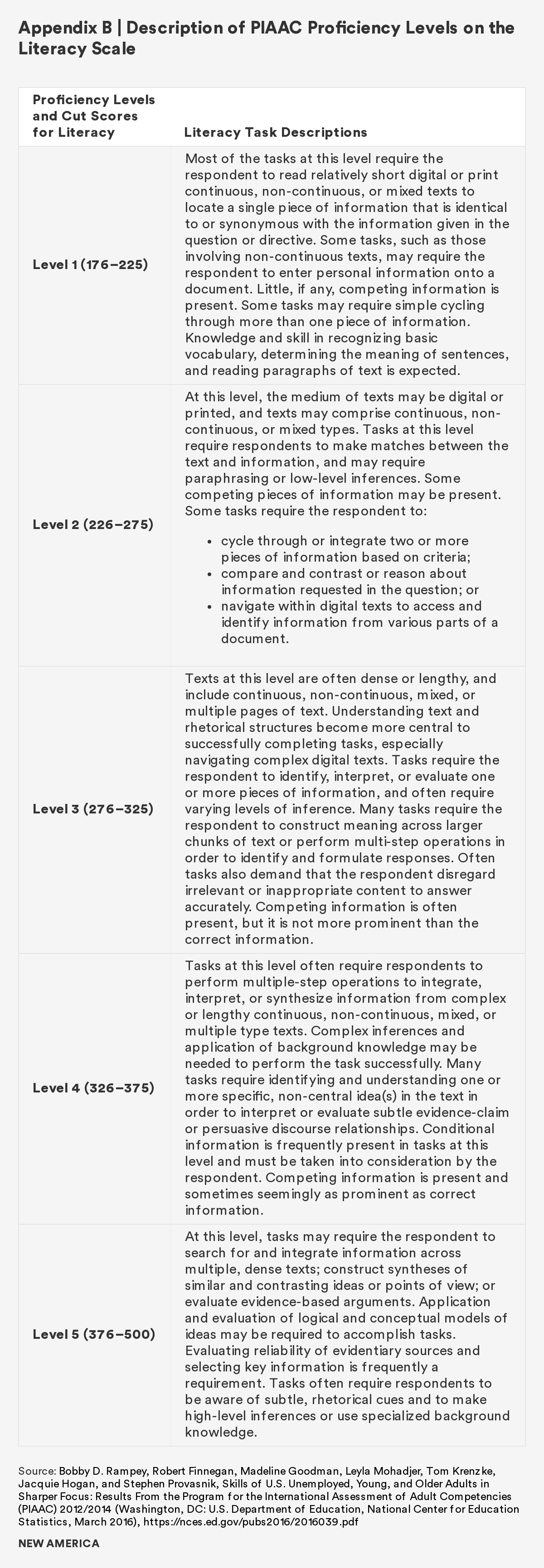
Citations
- New America Analysis of U.S. Department of Education, National Center for Education Statistics, U.S. Program for the International Assessment of Adult Competencies (PIAAC), U.S. National Supplement: Prison Study 2014, U.S. PIAAC 2012/2014 Household Survey (public use file).
- Zaid Jilani, “How Congress Killed One of the Few Lifelines for Former Prisoners and Why It’s Time to Bring It Back,” June 3, 2015, https://www.alternet.org/2015/06/how-congress-killed-one-few-lifelines-former-prisoners-and-why-its-time-bring-it-back/; and Abigail Strait and Susan Eaton, Post-Secondary Education for People in Prison, Social Justice Funders Opportunity Brief no. 1 (Waltham, MA: Sillerman Center, 2017), 1–8, https://heller.brandeis.edu/sillerman/pdfs/opportunity-briefs/post-secondary-education-people-in-prison.pdf
- Beyond the Box: Increasing Access to Higher Education for Justice-Involved Individuals (Washington, DC: U.S. Department of Education, 2016), https://www2.ed.gov/documents/beyond-the-box/guidance.pdf
- Federal Bureau of Prisons (website), “Inmate Custody & Care,” https://www.bop.gov/inmates/custody_and_care/
- Kritika Agarwal, “Inside Higher Education: College-in-Prison Programs Flourish but for How Long?” Perspectives on History, American Historical Association, January 1, 2018, https://www.historians.org/publications-and-directories/perspectives-on-history/january-2018/inside-higher-ed-college-in-prison-programs-flourish-but-for-how-long
- Nation Behind Bars: A Human Rights Solution (New York: Human Rights Watch, 2014), https://www.hrw.org/sites/default/files/related_material/2014_US_Nation_Behind_Bars_0.pdf
- Diana Ali, “Pell Grants for Prisoners: Considerations in the New Administration,” NASPA Student Affairs Administrators in Higher Education (website), September 22, 2017, https://www.naspa.org/rpi/posts/pell-grants-for-prisoners-considerations-in-the-new-administration
- Kritika Agarwal, “Inside Higher Education: College-in-Prison Programs Flourish but for How Long?” Perspectives on History, American Historical Association, January 1, 2018, https://www.historians.org/publications-and-directories/perspectives-on-history/january-2018/inside-higher-ed-college-in-prison-programs-flourish-but-for-how-long
- Lois M. Davis, Jennifer L. Steele, Robert Bozick, Malcolm V. Williams, Susan Turner, Jeremy N. V. Miles, Jessica Saunders, and Paul S. Steinberg, How Effective is Correctional Education, and Where Do We Go from Here? The Results of a Comprehensive Evaluation (Santa Monica, CA: RAND Corporation, 2014), https://www.rand.org/pubs/research_reports/RR564.html
- Nation Behind Bars: A Human Rights Solution (New York: Human Rights Watch, 2014), https://www.hrw.org/sites/default/files/related_material/2014_US_Nation_Behind_Bars_0.pdf
- Department of Justice Archives, Federal Bureau of Prisons, Federal Bureau of Prisons Education Program Assessment (Chicago, IL: Bronner Group, November 29, 2016), pp.i, https://www.justice.gov/archives/dag/page/file/914026/download
- Kritika Agarwal, “Inside Higher Education: College-in-Prison Programs Flourish but for How Long?” Perspectives on History, American Historical Association, January 1, 2018, https://www.historians.org/publications-and-directories/perspectives-on-history/january-2018/inside-higher-ed-college-in-prison-programs-flourish-but-for-how-long
- Jacquie Hogan, Nina Thornton, Lillian Diaz-Hoffmann, Leyla Mohadjer, Tom Krenzke, Jianzhu Li, Wendy VanDeKerckhove, Kentaro Yamamoto, and Lale Khorramdel, U.S. Program for the International Assessment of Adult Competencies (PIAAC) 2012/2014: Main Study and National Supplement Technical Report (Washington, DC: U.S. Department of Education, National Center for Education Statistics, September 2016), https://nces.ed.gov/pubs2016/2016036_rev.pdf
- John Sabatini, Understanding the Basic Reading Skills of U.S. Adults: Reading Components in the PIAAC Literacy Survey (Princeton, NJ: Educational Testing Service, 2015), https://www.ets.org/s/research/report/reading-skills/ets-adult-reading-skills-2015.pdf
- Nation Behind Bars: A Human Rights Solution (New York: Human Rights Watch, 2014), https://www.hrw.org/sites/default/files/related_material/2014_US_Nation_Behind_Bars_0.pdf ; and Abigail Strait and Susan Eaton, Post-Secondary Education for People in Prison, Social Justice Funders Opportunity Brief no. 1 (Waltham, MA: Sillerman Center, 2017), 1–8, https://heller.brandeis.edu/sillerman/pdfs/opportunity-briefs/post-secondary-education-people-in-prison.pdf
- Christina Reardon, “Formerly Incarcerated Individuals and the Challenges of Reentry,” Social Work Today 17, no. 6 (November 2017): 16; and Abigail Strait and Susan Eaton, Post-Secondary Education for People in Prison, Social Justice Funders Opportunity Brief no. 1 (Waltham, MA: Sillerman Center, 2017), 1–8, https://heller.brandeis.edu/sillerman/pdfs/opportunity-briefs/post-secondary-education-people-in-prison.pdf
- Department of Justice Archives, Federal Bureau of Prisons, Federal Bureau of Prisons Education Program Assessment (Chicago, IL: Bronner Group, November 29, 2016), pp.iii, https://www.justice.gov/archives/dag/page/file/914026/download
- Beyond the Box: Increasing Access to Higher Education for Justice-Involved Individuals (Washington, DC: U.S. Department of Education, 2016), https://www2.ed.gov/documents/beyond-the-box/guidance.pdf
- Federal Bureau of Prisons (website), “Inmate custody and care,” https://www.bop.gov/inmates/custody_and_care/
- Roger Jarjoura, “How Can We Slow Down Prison's Revolving Door?” Policy Center (blog), American Institutes for Research, July 2, 2019, https://www.air.org/resource/how-can-we-slow-down-prison-s-revolving-door
- Nation Behind Bars: A Human Rights Solution (New York: Human Rights Watch, 2014), https://www.hrw.org/sites/default/files/related_material/2014_US_Nation_Behind_Bars_0.pdf
- Michelle Alexander, The New Jim Crow: Mass Incarceration in the Age of Colorblindness (New York: The New Press, 2010); Lois M. Davis, Michelle A. Tolbert, and Mathew Mizel, Higher Education in Prison: Results from a National and Regional Landscape Scan, working paper (Santa Monica, CA: RAND, June 2017); and Christina Reardon, “Formerly Incarcerated Individuals and the Challenges of Reentry,” Social Work Today 17, no. 6 (November 2017): 16.
- Christina Reardon, “Formerly Incarcerated Individuals and the Challenges of Reentry,” Social Work Today 17, no. 6 (November 2017): 16.
- Grant Duwe, The Use and Impact of Correctional Programming for Inmates on Pre- and Post-Release Outcomes (Washington, DC: U.S. Department of Justice, June 2017).
- Christina Reardon, “Formerly Incarcerated Individuals and the Challenges of Reentry,” Social Work Today 17, no. 6 (November 2017): 16.
- Nation Behind Bars: A Human Rights Solution (New York: Human Rights Watch, 2014), https://www.hrw.org/sites/default/files/related_material/2014_US_Nation_Behind_Bars_0.pdf
- Christina Reardon, “Formerly Incarcerated Individuals and the Challenges of Reentry,” Social Work Today 17, no. 6 (November 2017): 16.
- Michelle Alexander, The New Jim Crow: Mass Incarceration in the Age of Colorblindness (New York: The New Press, 2010); and Christina Reardon, “Formerly Incarcerated Individuals and the Challenges of Reentry,” Social Work Today 17, no. 6 (November 2017): 16.
- Michelle Alexander, The New Jim Crow: Mass Incarceration in the Age of Colorblindness (New York: The New Press, 2010).
- Nation Behind Bars: A Human Rights Solution (New York: Human Rights Watch, 2014), https://www.hrw.org/sites/default/files/related_material/2014_US_Nation_Behind_Bars_0.pdf
- Federal Bureau of Prisons (website), “Historical Information: A Storied Past,” https://www.bop.gov/about/history/
- Federal Bureau of Prisons (website), “Historical Information: A Storied Past,” https://www.bop.gov/about/history/
- Michelle Alexander, The New Jim Crow: Mass Incarceration in the Age of Colorblindness (New York: The New Press, 2010).
- Ruth Delaney, Fred Patrick, and Alex Boldin, Unlocking Potential: Pathways from Prison to Postsecondary Education (New York: Vera Institute of Justice, May 2019).
- Ruth Delaney, Fred Patrick, and Alex Boldin, Unlocking Potential: Pathways from Prison to Postsecondary Education (New York: Vera Institute of Justice, May 2019).
- Michelle Alexander, The New Jim Crow: Mass Incarceration in the Age of Colorblindness (New York: The New Press, 2010).
- Ruth Delaney, Fred Patrick, and Alex Boldin, Unlocking Potential: Pathways from Prison to Postsecondary Education (New York: Vera Institute of Justice, May 2019). pp. 2.
- Nation Behind Bars: A Human Rights Solution (New York: Human Rights Watch, 2014), https://www.hrw.org/sites/default/files/related_material/2014_US_Nation_Behind_Bars_0.pdf
- Abigail Strait and Susan Eaton, Post-Secondary Education for People in Prison, Social Justice Funders Opportunity Brief no. 1 (Waltham, MA: Sillerman Center, 2017), 1–8, https://heller.brandeis.edu/sillerman/pdfs/opportunity-briefs/post-secondary-education-people-in-prison.pdf
- Christina Reardon, “Formerly Incarcerated Individuals and the Challenges of Reentry,” Social Work Today 17, no. 6 (November 2017): 16; and Beyond the Box: Increasing Access to Higher Education for Justice-Involved Individuals (Washington, DC: U.S. Department of Education, 2016), https://www2.ed.gov/documents/beyond-the-box/guidance.pdf
- Jamie Fellner, Punishment and Prejudice: Racial Disparities in the War on Drugs (New York: Human Rights Watch, May 2000)
- E. Ann Carson and William J. Sabol, “Prisoners in 2011,” Bulletin, U.S. Department of Justice, Bureau of Justice Statistics, December 2012, https://www.bjs.gov/content/pub/pdf/p11.pdf
- Donald Braman, Doing Time on the Outside: Incarceration and Family Life in Urban America (Ann Arbor: University of Michigan Press, 2004), 3, citing D.C. Department of Corrections data for 2000.
- Michelle Alexander, The New Jim Crow: Mass Incarceration in the Age of Colorblindness (New York: The New Press, 2010).
- Michelle Alexander, The New Jim Crow: Mass Incarceration in the Age of Colorblindness (New York: The New Press, 2010).
- Michelle Alexander, The New Jim Crow: Mass Incarceration in the Age of Colorblindness (New York: The New Press, 2010).
- Michelle Alexander, The New Jim Crow: Mass Incarceration in the Age of Colorblindness (New York: The New Press, 2010).
- Beyond the Box: Increasing Access to Higher Education for Justice-Involved Individuals (Washington, DC: U.S. Department of Education, 2016), https://www2.ed.gov/documents/beyond-the-box/guidance.pdf
- Abigail Strait and Susan Eaton, Post-Secondary Education for People in Prison, Social Justice Funders Opportunity Brief no. 1 (Waltham, MA: Sillerman Center, 2017), 1–8, https://heller.brandeis.edu/sillerman/pdfs/opportunity-briefs/post-secondary-education-people-in-prison.pdf
- Kritika Agarwal, “Inside Higher Education: College-in-Prison Programs Flourish but for How Long?” Perspectives on History, American Historical Association, January 1, 2018, https://www.historians.org/publications-and-directories/perspectives-on-history/january-2018/inside-higher-ed-college-in-prison-programs-flourish-but-for-how-long
- Diana Ali, “Pell Grants for Prisoners: Considerations in the New Administration,” NASPA Student Affairs Administrators in Higher Education (website), September 22, 2017, https://www.naspa.org/rpi/posts/pell-grants-for-prisoners-considerations-in-the-new-administration
- Institute for Higher Education Policy, “Pell Grants: Are Prisoners the Program’s Biggest Problem?” Policy Steps 1, no. 1 (Spring 1994).
- Gerard Robinson and Elizabeth English, The Second Chance Pell Pilot Program: A Historical Overview (Washington, DC: American Enterprise Institute, September 2017), https://www.aei.org/research-products/report/the-second-chance-pell-pilot-program-a-historical-overview/
- Institute for Higher Education Policy, “Pell Grants: Are Prisoners the Program’s Biggest Problem?” Policy Steps 1, no. 1 (Spring 1994).
- Kritika Agarwal, “Inside Higher Education: College-in-Prison Programs Flourish but for How Long?” Perspectives on History, American Historical Association, January 1, 2018, https://www.historians.org/publications-and-directories/perspectives-on-history/january-2018/inside-higher-ed-college-in-prison-programs-flourish-but-for-how-long
- Institute for Higher Education Policy, “Pell Grants: Are Prisoners the Program’s Biggest Problem?” Policy Steps 1, no. 1 (Spring 1994).
- Violent Crime Control and Law Enforcement Act of 1994, U.S. House, 103rd Congress, 2nd Session, H.R. 3355, http://www.congress.gov/bill/103rd
- Lois M. Davis, Jennifer L. Steele, Robert Bozick, Malcolm V. Williams, Susan Turner, Jeremy N. V. Miles, Jessica Saunders, and Paul S. Steinberg, How Effective is Correctional Education, and Where Do We Go from Here? The Results of a Comprehensive Evaluation (Santa Monica, CA: RAND Corporation, 2014), https://www.rand.org/pubs/research_reports/RR564.html
- Lois M. Davis, Jennifer L. Steele, Robert Bozick, Malcolm V. Williams, Susan Turner, Jeremy N. V. Miles, Jessica Saunders, and Paul S. Steinberg, How Effective is Correctional Education, and Where Do We Go from Here? The Results of a Comprehensive Evaluation (Santa Monica, CA: RAND Corporation, 2014), https://www.rand.org/pubs/research_reports/RR564.html
- Ruth Delaney, Fred Patrick, and Alex Boldin, Unlocking Potential: Pathways from Prison to Postsecondary Education (New York: Vera Institute of Justice, May 2019).
- Bradley D. Custer, “States—Not Just Congress—Should Unlock Student Financial Aid for People in Prison,” The Conversation, May 17, 2019, http://theconversation.com/states-not-just-congress-should-unlock-student-financial-aid-for-people-in-prison-117068
- Lois M. Davis, Michelle A. Tolbert, and Mathew Mizel, Higher Education in Prison: Results from a National and Regional Landscape Scan, working paper (Santa Monica, CA: RAND Corporation, June 2017).
- Lois M. Davis, Robert Bozick, Jennifer L. Steele, Jessica Saunders, and Jeremy N. V. Miles, Evaluating the Effectiveness of Correctional Education: A Meta-Analysis of Programs That Provide Education to Incarcerated Adults (Santa Monica, CA: RAND Corporation, 2013), https://www.rand.org/pubs/research_reports/RR266.html
- Kritika Agarwal, “Inside Higher Education: College-in-Prison Programs Flourish but for How Long?” Perspectives on History, American Historical Association, January 1, 2018, https://www.historians.org/publications-and-directories/perspectives-on-history/january-2018/inside-higher-ed-college-in-prison-programs-flourish-but-for-how-long ; Ellen C. Lagemann, Liberating Minds: The Case for College in Prison (New York: The New Press, 2016); and Abigail Strait and Susan Eaton, Post-Secondary Education for People in Prison, Social Justice Funders Opportunity Brief no. 1 (Waltham, MA: Sillerman Center, 2017), 1–8, https://heller.brandeis.edu/sillerman/pdfs/opportunity-briefs/post-secondary-education-people-in-prison.pdf
- Jinghong Cai, Anirudh V. S. Ruhil, and Dianne M. Gut, Prison-Based Education: Programs, Participation and Proficiency in Literacy/Numeracy (Washington, DC: American Institutes for Research, February 2019). pp.15,
- Beyond the Box: Increasing Access to Higher Education for Justice-Involved Individuals (Washington, DC: U.S. Department of Education, 2016), https://www2.ed.gov/documents/beyond-the-box/guidance.pdf
- Vera Institute of Justice, “Expanding Access to Postsecondary Education in Prison,” Fact Sheet, January 2017, https://www.vera.org/downloads/publications/postsecondary-education-in-prisonfactsheet-for-corrections-leaders.pdf
- Lois M. Davis, Michelle A. Tolbert, and Mathew Mizel, Higher Education in Prison: Results from a National and Regional Landscape Scan, working paper (Santa Monica, CA: RAND Corporation, June 2017).
- Lois M. Davis, Jennifer L. Steele, Robert Bozick, Malcolm V. Williams, Susan Turner, Jeremy N. V. Miles, Jessica Saunders, and Paul S. Steinberg, How Effective is Correctional Education, and Where Do We Go from Here? The Results of a Comprehensive Evaluation (Santa Monica, CA: RAND Corporation, 2014), https://www.rand.org/pubs/research_reports/RR564.html
- Patrick Oakford, Cara Brumfield, Casey Goldvale, Laura Tatum, Margaret diZerega, and Fred Patrick, Investing in futures: Economic & Fiscal Benefits of Postsecondary Education in Prison (New York: Vera Institute of Justice, January, 2019), https://www.vera.org/downloads/publications/investing-in-futures.pdf
- Erin L. Castro, Rebecca K. Hunter, Tara Hardison, Vanessa Johnson-Ojeda, and H. Suzuki, “The Landscape of Postsecondary Education in U.S. Prisons,” Research Collaborative on Higher Education in Prison, University of Utah, June, 2018, https://daqy2hvnfszx3.cloudfront.net/wp-content/uploads/sites/20/2018/02/15201351/RCHEP_June-2018_Research-Brief.pdf
- Kritika Agarwal, “Inside Higher Education: College-in-Prison Programs Flourish but for How Long?” Perspectives on History, American Historical Association, January 1, 2018, https://www.historians.org/publications-and-directories/perspectives-on-history/january-2018/inside-higher-ed-college-in-prison-programs-flourish-but-for-how-long
- Meagan Wilson, Rayane Alamuddin, and Danielle Cooper, Unbarring Access: A Landscape Review of Postsecondary Education in Prison and Its Pedagogical Supports (New York: Ithaka S+R, May 30, 2019), pp.8-9, https://sr.ithaka.org/publications/landscape-review-postsecondary-education-in-prison/
- See, for instance, the REAL Act of 2019 and the Expanding Educational Opportunities for Justice-Impacted Communities Act of 2019 (U.S. House. 116th Congress. 1st Session. H.R. 2168, REAL Act of 2019).
- Lois M. Davis, Michelle A. Tolbert, and Mathew Mizel, Higher Education in Prison: Results from a National and Regional Landscape Scan, working paper (Santa Monica, CA: RAND Corporation, June 2017).
- See David Whitman, The Cautionary Tale of Correspondence Schools (Washington, DC: New America, December 2018), https://www.newamerica.org/education-policy/reports/cautionary-tale-correspondence-schools/
- David A. Tomar, “Prison Education: Guide to College Degrees for Inmates and Ex-Offenders,” The Quad, https://thebestschools.org/magazine/prison-inmate-education-guide/
- Abigail Strait and Susan Eaton, Post-Secondary Education for People in Prison, Social Justice Funders Opportunity Brief no. 1 (Waltham, MA: Sillerman Center, 2017), 1–8, https://heller.brandeis.edu/sillerman/pdfs/opportunity-briefs/post-secondary-education-people-in-prison.pdf ; and Lois M. Davis, Michelle A. Tolbert, and Mathew Mizel, Higher Education in Prison: Results from a National and Regional Landscape Scan, working paper (Santa Monica, CA: RAND Corporation, June 2017).
- Lois M. Davis, Michelle A. Tolbert, and Mathew Mizel, Higher Education in Prison: Results from a National and Regional Landscape Scan, working paper (Santa Monica, CA: RAND Corporation, June 2017).
- Lois M. Davis, Michelle A. Tolbert, and Mathew Mizel, Higher Education in Prison: Results from a National and Regional Landscape Scan, working paper (Santa Monica, CA: RAND Corporation, June 2017); and National Institute of Corrections (website), “Provide Post Release Employment Services,” https://info.nicic.gov/cirs/node/40
- National Institute of Corrections (website), “Provide Post Release Employment Services,” https://info.nicic.gov/cirs/node/40
- Lois M. Davis, Robert Bozick, Jennifer L. Steele, Jessica Saunders, and Jeremy N. V. Miles, “Serving Time or Wasting Time? Correctional Education Programs Improve Job Prospects, Reduce Recidivism, and Save Taxpayer Dollars,” infographic, RAND Corporation, 2013, https://www.rand.org/pubs/infographics/IG113.html
- Department of Justice Archives, Federal Bureau of Prisons, Federal Bureau of Prisons Education Program Assessment (Chicago, IL: Bronner Group, November 29, 2016), https://www.justice.gov/archives/dag/page/file/914026/download
- James P. Lynch and William J. Sabol, Prisoner Reentry in Perspective, Crime Policy Report no. 3 (Washington, DC: The Urban Institute, September 2001).
- Michelle Tolbert, A Reentry Education Model: Supporting Education and Career Advancement for Low-Skill Individuals in Corrections (Washington, DC: U.S. Department of Education, 2012), https://www2.ed.gov/about/offices/list/ovae/pi/AdultEd/reentry-model.pdf
- Jinghong Cai, Anirudh V. S. Ruhil, and Dianne M. Gut, Prison-Based Education: Programs, Participation and Proficiency in Literacy/Numeracy (Washington, DC: American Institutes for Research, February 2019); Katie Landeros, “Incarcerated Adults in the United States,” infographic, American Institutes for Research, April 6, 2017, https://www.air.org/resource/infographic-incarcerated-adults-united-states ; Margaret Becker Patterson, Incarcerated Adults with Low Skills: Findings from the 2014 PIAAC Prison Study (Vienna, VA: Research Allies for Lifelong Learning, August 2018), https://static1.squarespace.com/static/51bb74b8e4b0139570ddf020/t/5babc9ea419202c3b360e221/1537985002744/2018_Patterson_Incarcerated%2bAdults%2bwith%2bLow%2bSkills_Final.pdf ;Bobby D. Rampey, Shelley Keiper, Leyla Mohadjer, Tom Krenzke, Jianzhu Li, Nina Thornton, and Jacquie Hogan, Highlights from the U.S. PIAAC Survey of Incarcerated Adults: Their Skills, Work Experience, Education, and Training: Program for the International Assessment of Adult Competencies: 2014 (NCES 2016-040) (Washington, DC: U.S. Department of Education, National Center for Education Statistics, November 2016), https://nces.ed.gov/pubs2016/2016040.pdf ; and John Sabatini, Understanding the Basic Reading Skills of U.S. Adults: Reading Components in the PIAAC Literacy Survey (Princeton, NJ: Educational Testing Service, 2015), https://www.ets.org/s/research/report/reading-skills/ets-adult-reading-skills-2015.pdf
- Jacquie Hogan, Nina Thornton, Lillian Diaz-Hoffmann, Leyla Mohadjer, Tom Krenzke, Jianzhu Li, Wendy VanDeKerckhove, Kentaro Yamamoto, and Lale Khorramdel, U.S. Program for the International Assessment of Adult Competencies (PIAAC) 2012/2014: Main Study and National Supplement Technical Report (Washington, DC: U.S. Department of Education, National Center for Education Statistics, September 2016), https://nces.ed.gov/pubs2016/2016036_rev.pdf
- Jacquie Hogan, Nina Thornton, Lillian Diaz-Hoffmann, Leyla Mohadjer, Tom Krenzke, Jianzhu Li, Wendy VanDeKerckhove, Kentaro Yamamoto, and Lale Khorramdel, U.S. Program for the International Assessment of Adult Competencies (PIAAC) 2012/2014: Main Study and National Supplement Technical Report (Washington, DC: U.S. Department of Education, National Center for Education Statistics, September 2016), https://nces.ed.gov/pubs2016/2016036_rev.pdf
- Refers to individuals who completed the survey that live in a household.
- Of the 1,319 incarcerated respondents, only 1,315 respondents of the incarcerated population completed the background questions. Four incarcerated adults were unable to complete the background questions because of an inability to communicate in English or Spanish or a mental disability. See Highlights from the U.S. PIAAC Survey of Incarcerated Adults: Their Skills, Work Experience, Education, and Training: Program for the International Assessment of Adult Competencies: 2014 (NCES 2016-040).
- Institute of Education Sciences, National Center for Education Statistics (website), “Program for the International Assessment of Adult Competencies (PIAAC): Prison Study Data Collection,” database,https://nces.ed.gov/surveys/piaac/prison.asp
- Institute of Education Sciences, National Center for Education Statistics (website), “Program for the International Assessment of Adult Competencies (PIAAC): What is PIAAC?” https://nces.ed.gov/surveys/piaac/
- The PIAAC survey defines literacy as the “ability to understand, evaluate, use, and engage with written text to participate in society, to achieve one’s goals and to develop one’s knowledge and potential.” See Institute of Education Sciences, National Center for Education Statistics (website), “Program for the International Assessment of Adult Competencies (PIAAC): Prison Study Data Collection,” database, https://nces.ed.gov/surveys/piaac/prison.asp
- Numeracy is defined as the “ability to access, use, interpret, and communicate” mathematically.” See Institute of Education Sciences, National Center for Education Statistics (website), “Program for the International Assessment of Adult Competencies (PIAAC): Prison Study Data Collection,” database, https://nces.ed.gov/surveys/piaac/prison.asp
- Institute of Education Sciences, National Center for Education Statistics (website), “Program for the International Assessment of Adult Competencies (PIAAC): Prison Study Data Collection,” database,https://nces.ed.gov/surveys/piaac/prison.asp
- Adults who did not complete additional education while incarcerated potentially include those who may have less than a high school equivalence, as well as adults who already completed a graduate degree prior to incarceration. See Highlights from the U.S. PIAAC Survey of Incarcerated Adults: Their Skills, Work Experience, Education, and Training: Program for the International Assessment of Adult Competencies: 2014 (NCES 2016-040).
- Due to the small sample size of adults completing additional education while incarcerated, the reentry status variable is collapsed into two categories for the remainder of the report.
- The analysis of this report does not attempt to explain why there is a difference in enrollment and completion rates across racial/ethnic groups.
- The job-training outlets available to incarcerated adults focus on providing specific workplace skills, such as learning Microsoft Word. The job-training outlets exclude prison jobs.
- The 2014 PIAAC Prison data only includes data on incarcerated adults who participate in job training. The data does not explicitly detail information on incarcerated adults’ who complete job training.
- A correlation analysis found that enrolling into a postsecondary degree or certificate program while incarcerated is statistically significantly associated with job-training participation.
- New America analysis with a bivariate logistic regression.
- New America analysis with a bivariate logistic regression.
- New America analysis with a bivariate logistic regression.
- Within the 2014 PIAAC Prison Survey, the variable to explain the barriers to enrolling in educational programs includes all correctional education programs (e.g., ABE, GED, certificates, etc.).
- The range excludes the 54 incarcerated adults who failed the core comprehension assessment. Those who fail the core comprehension assessment lack the basic cognitive skills to complete the literacy/numeracy skills assessment and were directed to the reading comprehension. These individuals were omitted from the range to avoid a skewed range of literacy scores.
- The range excludes the 54 incarcerated adults who failed the core comprehension assessment.
- New America analysis with an independent samples t-Test.
- New America analysis with an independent samples t-Test.
- Bobby D. Rampey, Robert Finnegan, Madeline Goodman, Leyla Mohadjer, Tom Krenzke, Jacquie Hogan, and Stephen Provasnik, Skills of U.S. Unemployed, Young, and Older Adults in Sharper Focus: Results From the Program for the International Assessment of Adult Competencies (PIAAC) 2012/2014 (Washington, DC: U.S. Department of Education, National Center for Education Statistics, March 2016), pp. B-3 – B-8. https://nces.ed.gov/pubs2016/2016039.pdf
- The table compares the distribution of Black and Hispanic respondents to the distribution of white individuals in each of the proficiency levels.
- New America analysis with an independent samples t-Test.
- New America analysis with an independent samples t-Test.
- New America analysis with an independent samples t-Test.
- Bobby D. Rampey, Robert Finnegan, Madeline Goodman, Leyla Mohadjer, Tom Krenzke, Jacquie Hogan, and Stephen Provasnik, Skills of U.S. Unemployed, Young, and Older Adults in Sharper Focus: Results From the Program for the International Assessment of Adult Competencies (PIAAC) 2012/2014 (Washington, DC: U.S. Department of Education, National Center for Education Statistics, March 2016), pp. B-3 – B-8. https://nces.ed.gov/pubs2016/2016039.pdf
- The table compares the distribution of Black and Hispanic respondents to the distribution of white individuals in each of the proficiency levels.
- New America analysis with an independent samples t-Test.
- New America analysis with an independent samples t-Test.
- New America analysis with an independent samples t-Test.
- New America analysis with logistic regression, holding race and age constant.
- New America analysis with linear regression, holding race and age constant.
- New America analysis with logistic regression, holding race and age constant.
- New America analysis with linear regression, holding race and age constant.
- New American analysis with logistic regression, holding race and age constant.
- New America analysis with linear regression, holding race and age constant.
- New American analysis with logistic regression, holding race and age constant.
- New America analysis with linear regression, holding race and age constant.
- Boris Granovskiy, Reauthorization of the Perkins Act in the 115th Congress: The Strengthening Career and Technical Education for the 21st Century Act (Washington, DC: Congressional Research Service, December 2018), https://fas.org/sgp/crs/misc/R45446.pdf
- For example, some states prohibit formerly incarcerated individuals from obtaining a professional/trade license in health care or becoming a barber.
- Lois M. Davis, Michelle A. Tolbert, and Mathew Mizel, Higher Education in Prison: Results from a National and Regional Landscape Scan, working paper (Santa Monica, CA: RAND Corporation, June 2017).
- MACRAO, Michigan Association of Collegiate Registrars and Admissions Officers (website), “Michigan Transfer Agreement (MTA) Frequently Asked Questions for Students,“ June 6, 2016, https://www.macrao.org/Publications/MTA%20Student%20FAQ.pdf
- Federal Bureau of Prisons (website), “Inmate Custody & Care,” https://www.bop.gov/inmates/custody_and_care/
- Gerard Robinson and Elizabeth English, The Second Chance Pell Pilot Program: A Historical Overview (Washington, DC: American Enterprise Institute, September 2017), https://www.aei.org/research-products/report/the-second-chance-pell-pilot-program-a-historical-overview/
- Michelle Alexander, The New Jim Crow: Mass Incarceration in the Age of Colorblindness (New York: The New Press, 2010).
- Ellen C. Lagemann, Liberating Minds: The Case for College in Prison (New York: The New Press, 2016).
- PIAAC Gateway (website), “U.S. PIAAC Survey of Incarcerated Adults Results,” November 2016, http://piaacgateway.com/prison-report/
- PIAAC data were collected in two phases. The first phase was conducted in 2012 when the adult household population was surveyed. In 2014, a second phase of PIAAC was conducted where there was an additional data collection effort to complement the household sample from the first phase, as a sample of the incarcerated population was also selected. The analysis presented in this report uses the combined data sets from both household samples (2012 and 2014) and the prison sample (2014).
- National Center for Education Statistics (website), “Prison Study Data Collection,” database,https://nces.ed.gov/surveys/piaac/prison.asp
- Bobby D. Rampey, Shelley Keiper, Leyla Mohadjer, Tom Krenzke, Jianzhu Li, Nina Thornton, and Jacquie Hogan, Highlights from the U.S. PIAAC Survey of Incarcerated Adults: Their Skills, Work Experience, Education, and Training: Program for the International Assessment of Adult Competencies: 2014 (NCES 2016-040) (Washington, DC: U.S. Department of Education, National Center for Education Statistics, November 2016), https://nces.ed.gov/pubs2016/2016040.pdf
- Bobby D. Rampey, Shelley Keiper, Leyla Mohadjer, Tom Krenzke, Jianzhu Li, Nina Thornton, and Jacquie Hogan, Highlights from the U.S. PIAAC Survey of Incarcerated Adults: Their Skills, Work Experience, Education, and Training: Program for the International Assessment of Adult Competencies: 2014 (NCES 2016-040) (Washington, DC: U.S. Department of Education, National Center for Education Statistics, November 2016), https://nces.ed.gov/pubs2016/2016040.pdf
Appendix C: Description of PIAAC Proficiency Levels on the Numeracy Scale
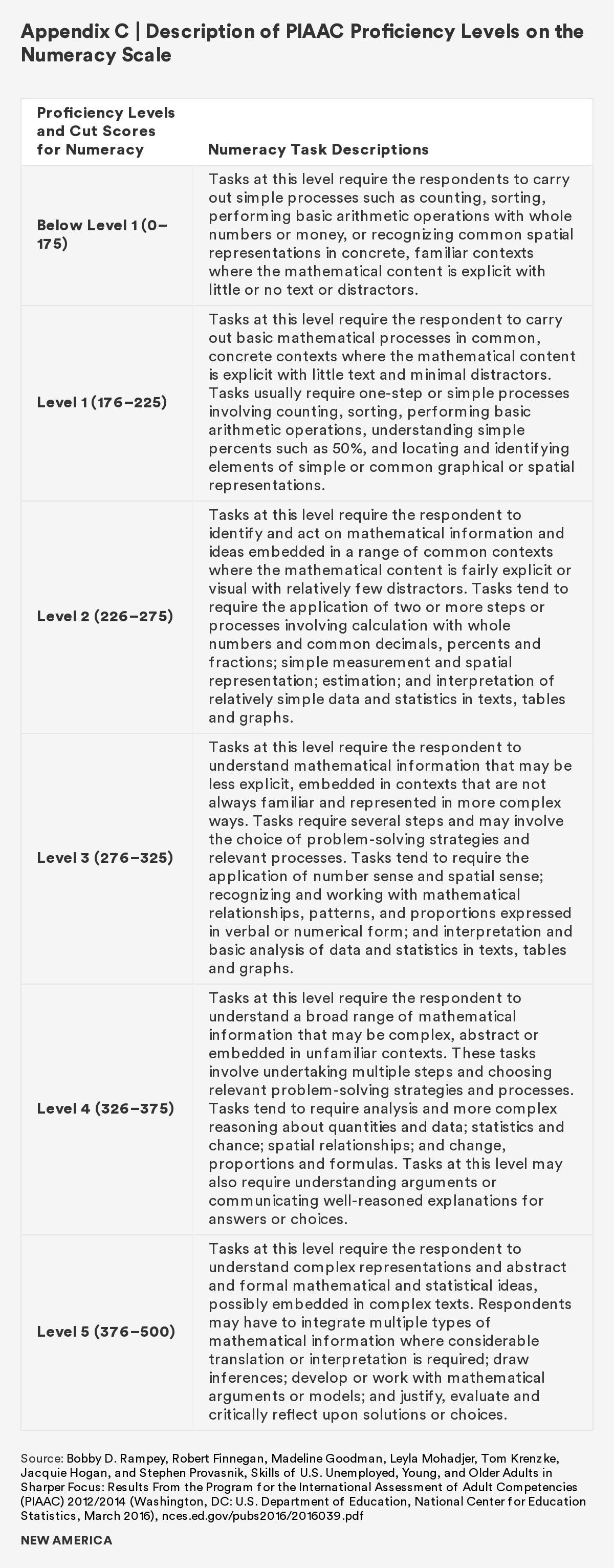
Citations
- New America Analysis of U.S. Department of Education, National Center for Education Statistics, U.S. Program for the International Assessment of Adult Competencies (PIAAC), U.S. National Supplement: Prison Study 2014, U.S. PIAAC 2012/2014 Household Survey (public use file).
- Zaid Jilani, “How Congress Killed One of the Few Lifelines for Former Prisoners and Why It’s Time to Bring It Back,” June 3, 2015, https://www.alternet.org/2015/06/how-congress-killed-one-few-lifelines-former-prisoners-and-why-its-time-bring-it-back/; and Abigail Strait and Susan Eaton, Post-Secondary Education for People in Prison, Social Justice Funders Opportunity Brief no. 1 (Waltham, MA: Sillerman Center, 2017), 1–8, https://heller.brandeis.edu/sillerman/pdfs/opportunity-briefs/post-secondary-education-people-in-prison.pdf
- Beyond the Box: Increasing Access to Higher Education for Justice-Involved Individuals (Washington, DC: U.S. Department of Education, 2016), https://www2.ed.gov/documents/beyond-the-box/guidance.pdf
- Federal Bureau of Prisons (website), “Inmate Custody & Care,” https://www.bop.gov/inmates/custody_and_care/
- Kritika Agarwal, “Inside Higher Education: College-in-Prison Programs Flourish but for How Long?” Perspectives on History, American Historical Association, January 1, 2018, https://www.historians.org/publications-and-directories/perspectives-on-history/january-2018/inside-higher-ed-college-in-prison-programs-flourish-but-for-how-long
- Nation Behind Bars: A Human Rights Solution (New York: Human Rights Watch, 2014), https://www.hrw.org/sites/default/files/related_material/2014_US_Nation_Behind_Bars_0.pdf
- Diana Ali, “Pell Grants for Prisoners: Considerations in the New Administration,” NASPA Student Affairs Administrators in Higher Education (website), September 22, 2017, https://www.naspa.org/rpi/posts/pell-grants-for-prisoners-considerations-in-the-new-administration
- Kritika Agarwal, “Inside Higher Education: College-in-Prison Programs Flourish but for How Long?” Perspectives on History, American Historical Association, January 1, 2018, https://www.historians.org/publications-and-directories/perspectives-on-history/january-2018/inside-higher-ed-college-in-prison-programs-flourish-but-for-how-long
- Lois M. Davis, Jennifer L. Steele, Robert Bozick, Malcolm V. Williams, Susan Turner, Jeremy N. V. Miles, Jessica Saunders, and Paul S. Steinberg, How Effective is Correctional Education, and Where Do We Go from Here? The Results of a Comprehensive Evaluation (Santa Monica, CA: RAND Corporation, 2014), https://www.rand.org/pubs/research_reports/RR564.html
- Nation Behind Bars: A Human Rights Solution (New York: Human Rights Watch, 2014), https://www.hrw.org/sites/default/files/related_material/2014_US_Nation_Behind_Bars_0.pdf
- Department of Justice Archives, Federal Bureau of Prisons, Federal Bureau of Prisons Education Program Assessment (Chicago, IL: Bronner Group, November 29, 2016), pp.i, https://www.justice.gov/archives/dag/page/file/914026/download
- Kritika Agarwal, “Inside Higher Education: College-in-Prison Programs Flourish but for How Long?” Perspectives on History, American Historical Association, January 1, 2018, https://www.historians.org/publications-and-directories/perspectives-on-history/january-2018/inside-higher-ed-college-in-prison-programs-flourish-but-for-how-long
- Jacquie Hogan, Nina Thornton, Lillian Diaz-Hoffmann, Leyla Mohadjer, Tom Krenzke, Jianzhu Li, Wendy VanDeKerckhove, Kentaro Yamamoto, and Lale Khorramdel, U.S. Program for the International Assessment of Adult Competencies (PIAAC) 2012/2014: Main Study and National Supplement Technical Report (Washington, DC: U.S. Department of Education, National Center for Education Statistics, September 2016), https://nces.ed.gov/pubs2016/2016036_rev.pdf
- John Sabatini, Understanding the Basic Reading Skills of U.S. Adults: Reading Components in the PIAAC Literacy Survey (Princeton, NJ: Educational Testing Service, 2015), https://www.ets.org/s/research/report/reading-skills/ets-adult-reading-skills-2015.pdf
- Nation Behind Bars: A Human Rights Solution (New York: Human Rights Watch, 2014), https://www.hrw.org/sites/default/files/related_material/2014_US_Nation_Behind_Bars_0.pdf ; and Abigail Strait and Susan Eaton, Post-Secondary Education for People in Prison, Social Justice Funders Opportunity Brief no. 1 (Waltham, MA: Sillerman Center, 2017), 1–8, https://heller.brandeis.edu/sillerman/pdfs/opportunity-briefs/post-secondary-education-people-in-prison.pdf
- Christina Reardon, “Formerly Incarcerated Individuals and the Challenges of Reentry,” Social Work Today 17, no. 6 (November 2017): 16; and Abigail Strait and Susan Eaton, Post-Secondary Education for People in Prison, Social Justice Funders Opportunity Brief no. 1 (Waltham, MA: Sillerman Center, 2017), 1–8, https://heller.brandeis.edu/sillerman/pdfs/opportunity-briefs/post-secondary-education-people-in-prison.pdf
- Department of Justice Archives, Federal Bureau of Prisons, Federal Bureau of Prisons Education Program Assessment (Chicago, IL: Bronner Group, November 29, 2016), pp.iii, https://www.justice.gov/archives/dag/page/file/914026/download
- Beyond the Box: Increasing Access to Higher Education for Justice-Involved Individuals (Washington, DC: U.S. Department of Education, 2016), https://www2.ed.gov/documents/beyond-the-box/guidance.pdf
- Federal Bureau of Prisons (website), “Inmate custody and care,” https://www.bop.gov/inmates/custody_and_care/
- Roger Jarjoura, “How Can We Slow Down Prison's Revolving Door?” Policy Center (blog), American Institutes for Research, July 2, 2019, https://www.air.org/resource/how-can-we-slow-down-prison-s-revolving-door
- Nation Behind Bars: A Human Rights Solution (New York: Human Rights Watch, 2014), https://www.hrw.org/sites/default/files/related_material/2014_US_Nation_Behind_Bars_0.pdf
- Michelle Alexander, The New Jim Crow: Mass Incarceration in the Age of Colorblindness (New York: The New Press, 2010); Lois M. Davis, Michelle A. Tolbert, and Mathew Mizel, Higher Education in Prison: Results from a National and Regional Landscape Scan, working paper (Santa Monica, CA: RAND, June 2017); and Christina Reardon, “Formerly Incarcerated Individuals and the Challenges of Reentry,” Social Work Today 17, no. 6 (November 2017): 16.
- Christina Reardon, “Formerly Incarcerated Individuals and the Challenges of Reentry,” Social Work Today 17, no. 6 (November 2017): 16.
- Grant Duwe, The Use and Impact of Correctional Programming for Inmates on Pre- and Post-Release Outcomes (Washington, DC: U.S. Department of Justice, June 2017).
- Christina Reardon, “Formerly Incarcerated Individuals and the Challenges of Reentry,” Social Work Today 17, no. 6 (November 2017): 16.
- Nation Behind Bars: A Human Rights Solution (New York: Human Rights Watch, 2014), https://www.hrw.org/sites/default/files/related_material/2014_US_Nation_Behind_Bars_0.pdf
- Christina Reardon, “Formerly Incarcerated Individuals and the Challenges of Reentry,” Social Work Today 17, no. 6 (November 2017): 16.
- Michelle Alexander, The New Jim Crow: Mass Incarceration in the Age of Colorblindness (New York: The New Press, 2010); and Christina Reardon, “Formerly Incarcerated Individuals and the Challenges of Reentry,” Social Work Today 17, no. 6 (November 2017): 16.
- Michelle Alexander, The New Jim Crow: Mass Incarceration in the Age of Colorblindness (New York: The New Press, 2010).
- Nation Behind Bars: A Human Rights Solution (New York: Human Rights Watch, 2014), https://www.hrw.org/sites/default/files/related_material/2014_US_Nation_Behind_Bars_0.pdf
- Federal Bureau of Prisons (website), “Historical Information: A Storied Past,” https://www.bop.gov/about/history/
- Federal Bureau of Prisons (website), “Historical Information: A Storied Past,” https://www.bop.gov/about/history/
- Michelle Alexander, The New Jim Crow: Mass Incarceration in the Age of Colorblindness (New York: The New Press, 2010).
- Ruth Delaney, Fred Patrick, and Alex Boldin, Unlocking Potential: Pathways from Prison to Postsecondary Education (New York: Vera Institute of Justice, May 2019).
- Ruth Delaney, Fred Patrick, and Alex Boldin, Unlocking Potential: Pathways from Prison to Postsecondary Education (New York: Vera Institute of Justice, May 2019).
- Michelle Alexander, The New Jim Crow: Mass Incarceration in the Age of Colorblindness (New York: The New Press, 2010).
- Ruth Delaney, Fred Patrick, and Alex Boldin, Unlocking Potential: Pathways from Prison to Postsecondary Education (New York: Vera Institute of Justice, May 2019). pp. 2.
- Nation Behind Bars: A Human Rights Solution (New York: Human Rights Watch, 2014), https://www.hrw.org/sites/default/files/related_material/2014_US_Nation_Behind_Bars_0.pdf
- Abigail Strait and Susan Eaton, Post-Secondary Education for People in Prison, Social Justice Funders Opportunity Brief no. 1 (Waltham, MA: Sillerman Center, 2017), 1–8, https://heller.brandeis.edu/sillerman/pdfs/opportunity-briefs/post-secondary-education-people-in-prison.pdf
- Christina Reardon, “Formerly Incarcerated Individuals and the Challenges of Reentry,” Social Work Today 17, no. 6 (November 2017): 16; and Beyond the Box: Increasing Access to Higher Education for Justice-Involved Individuals (Washington, DC: U.S. Department of Education, 2016), https://www2.ed.gov/documents/beyond-the-box/guidance.pdf
- Jamie Fellner, Punishment and Prejudice: Racial Disparities in the War on Drugs (New York: Human Rights Watch, May 2000)
- E. Ann Carson and William J. Sabol, “Prisoners in 2011,” Bulletin, U.S. Department of Justice, Bureau of Justice Statistics, December 2012, https://www.bjs.gov/content/pub/pdf/p11.pdf
- Donald Braman, Doing Time on the Outside: Incarceration and Family Life in Urban America (Ann Arbor: University of Michigan Press, 2004), 3, citing D.C. Department of Corrections data for 2000.
- Michelle Alexander, The New Jim Crow: Mass Incarceration in the Age of Colorblindness (New York: The New Press, 2010).
- Michelle Alexander, The New Jim Crow: Mass Incarceration in the Age of Colorblindness (New York: The New Press, 2010).
- Michelle Alexander, The New Jim Crow: Mass Incarceration in the Age of Colorblindness (New York: The New Press, 2010).
- Michelle Alexander, The New Jim Crow: Mass Incarceration in the Age of Colorblindness (New York: The New Press, 2010).
- Beyond the Box: Increasing Access to Higher Education for Justice-Involved Individuals (Washington, DC: U.S. Department of Education, 2016), https://www2.ed.gov/documents/beyond-the-box/guidance.pdf
- Abigail Strait and Susan Eaton, Post-Secondary Education for People in Prison, Social Justice Funders Opportunity Brief no. 1 (Waltham, MA: Sillerman Center, 2017), 1–8, https://heller.brandeis.edu/sillerman/pdfs/opportunity-briefs/post-secondary-education-people-in-prison.pdf
- Kritika Agarwal, “Inside Higher Education: College-in-Prison Programs Flourish but for How Long?” Perspectives on History, American Historical Association, January 1, 2018, https://www.historians.org/publications-and-directories/perspectives-on-history/january-2018/inside-higher-ed-college-in-prison-programs-flourish-but-for-how-long
- Diana Ali, “Pell Grants for Prisoners: Considerations in the New Administration,” NASPA Student Affairs Administrators in Higher Education (website), September 22, 2017, https://www.naspa.org/rpi/posts/pell-grants-for-prisoners-considerations-in-the-new-administration
- Institute for Higher Education Policy, “Pell Grants: Are Prisoners the Program’s Biggest Problem?” Policy Steps 1, no. 1 (Spring 1994).
- Gerard Robinson and Elizabeth English, The Second Chance Pell Pilot Program: A Historical Overview (Washington, DC: American Enterprise Institute, September 2017), https://www.aei.org/research-products/report/the-second-chance-pell-pilot-program-a-historical-overview/
- Institute for Higher Education Policy, “Pell Grants: Are Prisoners the Program’s Biggest Problem?” Policy Steps 1, no. 1 (Spring 1994).
- Kritika Agarwal, “Inside Higher Education: College-in-Prison Programs Flourish but for How Long?” Perspectives on History, American Historical Association, January 1, 2018, https://www.historians.org/publications-and-directories/perspectives-on-history/january-2018/inside-higher-ed-college-in-prison-programs-flourish-but-for-how-long
- Institute for Higher Education Policy, “Pell Grants: Are Prisoners the Program’s Biggest Problem?” Policy Steps 1, no. 1 (Spring 1994).
- Violent Crime Control and Law Enforcement Act of 1994, U.S. House, 103rd Congress, 2nd Session, H.R. 3355, http://www.congress.gov/bill/103rd
- Lois M. Davis, Jennifer L. Steele, Robert Bozick, Malcolm V. Williams, Susan Turner, Jeremy N. V. Miles, Jessica Saunders, and Paul S. Steinberg, How Effective is Correctional Education, and Where Do We Go from Here? The Results of a Comprehensive Evaluation (Santa Monica, CA: RAND Corporation, 2014), https://www.rand.org/pubs/research_reports/RR564.html
- Lois M. Davis, Jennifer L. Steele, Robert Bozick, Malcolm V. Williams, Susan Turner, Jeremy N. V. Miles, Jessica Saunders, and Paul S. Steinberg, How Effective is Correctional Education, and Where Do We Go from Here? The Results of a Comprehensive Evaluation (Santa Monica, CA: RAND Corporation, 2014), https://www.rand.org/pubs/research_reports/RR564.html
- Ruth Delaney, Fred Patrick, and Alex Boldin, Unlocking Potential: Pathways from Prison to Postsecondary Education (New York: Vera Institute of Justice, May 2019).
- Bradley D. Custer, “States—Not Just Congress—Should Unlock Student Financial Aid for People in Prison,” The Conversation, May 17, 2019, http://theconversation.com/states-not-just-congress-should-unlock-student-financial-aid-for-people-in-prison-117068
- Lois M. Davis, Michelle A. Tolbert, and Mathew Mizel, Higher Education in Prison: Results from a National and Regional Landscape Scan, working paper (Santa Monica, CA: RAND Corporation, June 2017).
- Lois M. Davis, Robert Bozick, Jennifer L. Steele, Jessica Saunders, and Jeremy N. V. Miles, Evaluating the Effectiveness of Correctional Education: A Meta-Analysis of Programs That Provide Education to Incarcerated Adults (Santa Monica, CA: RAND Corporation, 2013), https://www.rand.org/pubs/research_reports/RR266.html
- Kritika Agarwal, “Inside Higher Education: College-in-Prison Programs Flourish but for How Long?” Perspectives on History, American Historical Association, January 1, 2018, https://www.historians.org/publications-and-directories/perspectives-on-history/january-2018/inside-higher-ed-college-in-prison-programs-flourish-but-for-how-long ; Ellen C. Lagemann, Liberating Minds: The Case for College in Prison (New York: The New Press, 2016); and Abigail Strait and Susan Eaton, Post-Secondary Education for People in Prison, Social Justice Funders Opportunity Brief no. 1 (Waltham, MA: Sillerman Center, 2017), 1–8, https://heller.brandeis.edu/sillerman/pdfs/opportunity-briefs/post-secondary-education-people-in-prison.pdf
- Jinghong Cai, Anirudh V. S. Ruhil, and Dianne M. Gut, Prison-Based Education: Programs, Participation and Proficiency in Literacy/Numeracy (Washington, DC: American Institutes for Research, February 2019). pp.15,
- Beyond the Box: Increasing Access to Higher Education for Justice-Involved Individuals (Washington, DC: U.S. Department of Education, 2016), https://www2.ed.gov/documents/beyond-the-box/guidance.pdf
- Vera Institute of Justice, “Expanding Access to Postsecondary Education in Prison,” Fact Sheet, January 2017, https://www.vera.org/downloads/publications/postsecondary-education-in-prisonfactsheet-for-corrections-leaders.pdf
- Lois M. Davis, Michelle A. Tolbert, and Mathew Mizel, Higher Education in Prison: Results from a National and Regional Landscape Scan, working paper (Santa Monica, CA: RAND Corporation, June 2017).
- Lois M. Davis, Jennifer L. Steele, Robert Bozick, Malcolm V. Williams, Susan Turner, Jeremy N. V. Miles, Jessica Saunders, and Paul S. Steinberg, How Effective is Correctional Education, and Where Do We Go from Here? The Results of a Comprehensive Evaluation (Santa Monica, CA: RAND Corporation, 2014), https://www.rand.org/pubs/research_reports/RR564.html
- Patrick Oakford, Cara Brumfield, Casey Goldvale, Laura Tatum, Margaret diZerega, and Fred Patrick, Investing in futures: Economic & Fiscal Benefits of Postsecondary Education in Prison (New York: Vera Institute of Justice, January, 2019), https://www.vera.org/downloads/publications/investing-in-futures.pdf
- Erin L. Castro, Rebecca K. Hunter, Tara Hardison, Vanessa Johnson-Ojeda, and H. Suzuki, “The Landscape of Postsecondary Education in U.S. Prisons,” Research Collaborative on Higher Education in Prison, University of Utah, June, 2018, https://daqy2hvnfszx3.cloudfront.net/wp-content/uploads/sites/20/2018/02/15201351/RCHEP_June-2018_Research-Brief.pdf
- Kritika Agarwal, “Inside Higher Education: College-in-Prison Programs Flourish but for How Long?” Perspectives on History, American Historical Association, January 1, 2018, https://www.historians.org/publications-and-directories/perspectives-on-history/january-2018/inside-higher-ed-college-in-prison-programs-flourish-but-for-how-long
- Meagan Wilson, Rayane Alamuddin, and Danielle Cooper, Unbarring Access: A Landscape Review of Postsecondary Education in Prison and Its Pedagogical Supports (New York: Ithaka S+R, May 30, 2019), pp.8-9, https://sr.ithaka.org/publications/landscape-review-postsecondary-education-in-prison/
- See, for instance, the REAL Act of 2019 and the Expanding Educational Opportunities for Justice-Impacted Communities Act of 2019 (U.S. House. 116th Congress. 1st Session. H.R. 2168, REAL Act of 2019).
- Lois M. Davis, Michelle A. Tolbert, and Mathew Mizel, Higher Education in Prison: Results from a National and Regional Landscape Scan, working paper (Santa Monica, CA: RAND Corporation, June 2017).
- See David Whitman, The Cautionary Tale of Correspondence Schools (Washington, DC: New America, December 2018), https://www.newamerica.org/education-policy/reports/cautionary-tale-correspondence-schools/
- David A. Tomar, “Prison Education: Guide to College Degrees for Inmates and Ex-Offenders,” The Quad, https://thebestschools.org/magazine/prison-inmate-education-guide/
- Abigail Strait and Susan Eaton, Post-Secondary Education for People in Prison, Social Justice Funders Opportunity Brief no. 1 (Waltham, MA: Sillerman Center, 2017), 1–8, https://heller.brandeis.edu/sillerman/pdfs/opportunity-briefs/post-secondary-education-people-in-prison.pdf ; and Lois M. Davis, Michelle A. Tolbert, and Mathew Mizel, Higher Education in Prison: Results from a National and Regional Landscape Scan, working paper (Santa Monica, CA: RAND Corporation, June 2017).
- Lois M. Davis, Michelle A. Tolbert, and Mathew Mizel, Higher Education in Prison: Results from a National and Regional Landscape Scan, working paper (Santa Monica, CA: RAND Corporation, June 2017).
- Lois M. Davis, Michelle A. Tolbert, and Mathew Mizel, Higher Education in Prison: Results from a National and Regional Landscape Scan, working paper (Santa Monica, CA: RAND Corporation, June 2017); and National Institute of Corrections (website), “Provide Post Release Employment Services,” https://info.nicic.gov/cirs/node/40
- National Institute of Corrections (website), “Provide Post Release Employment Services,” https://info.nicic.gov/cirs/node/40
- Lois M. Davis, Robert Bozick, Jennifer L. Steele, Jessica Saunders, and Jeremy N. V. Miles, “Serving Time or Wasting Time? Correctional Education Programs Improve Job Prospects, Reduce Recidivism, and Save Taxpayer Dollars,” infographic, RAND Corporation, 2013, https://www.rand.org/pubs/infographics/IG113.html
- Department of Justice Archives, Federal Bureau of Prisons, Federal Bureau of Prisons Education Program Assessment (Chicago, IL: Bronner Group, November 29, 2016), https://www.justice.gov/archives/dag/page/file/914026/download
- James P. Lynch and William J. Sabol, Prisoner Reentry in Perspective, Crime Policy Report no. 3 (Washington, DC: The Urban Institute, September 2001).
- Michelle Tolbert, A Reentry Education Model: Supporting Education and Career Advancement for Low-Skill Individuals in Corrections (Washington, DC: U.S. Department of Education, 2012), https://www2.ed.gov/about/offices/list/ovae/pi/AdultEd/reentry-model.pdf
- Jinghong Cai, Anirudh V. S. Ruhil, and Dianne M. Gut, Prison-Based Education: Programs, Participation and Proficiency in Literacy/Numeracy (Washington, DC: American Institutes for Research, February 2019); Katie Landeros, “Incarcerated Adults in the United States,” infographic, American Institutes for Research, April 6, 2017, https://www.air.org/resource/infographic-incarcerated-adults-united-states ; Margaret Becker Patterson, Incarcerated Adults with Low Skills: Findings from the 2014 PIAAC Prison Study (Vienna, VA: Research Allies for Lifelong Learning, August 2018), https://static1.squarespace.com/static/51bb74b8e4b0139570ddf020/t/5babc9ea419202c3b360e221/1537985002744/2018_Patterson_Incarcerated%2bAdults%2bwith%2bLow%2bSkills_Final.pdf ;Bobby D. Rampey, Shelley Keiper, Leyla Mohadjer, Tom Krenzke, Jianzhu Li, Nina Thornton, and Jacquie Hogan, Highlights from the U.S. PIAAC Survey of Incarcerated Adults: Their Skills, Work Experience, Education, and Training: Program for the International Assessment of Adult Competencies: 2014 (NCES 2016-040) (Washington, DC: U.S. Department of Education, National Center for Education Statistics, November 2016), https://nces.ed.gov/pubs2016/2016040.pdf ; and John Sabatini, Understanding the Basic Reading Skills of U.S. Adults: Reading Components in the PIAAC Literacy Survey (Princeton, NJ: Educational Testing Service, 2015), https://www.ets.org/s/research/report/reading-skills/ets-adult-reading-skills-2015.pdf
- Jacquie Hogan, Nina Thornton, Lillian Diaz-Hoffmann, Leyla Mohadjer, Tom Krenzke, Jianzhu Li, Wendy VanDeKerckhove, Kentaro Yamamoto, and Lale Khorramdel, U.S. Program for the International Assessment of Adult Competencies (PIAAC) 2012/2014: Main Study and National Supplement Technical Report (Washington, DC: U.S. Department of Education, National Center for Education Statistics, September 2016), https://nces.ed.gov/pubs2016/2016036_rev.pdf
- Jacquie Hogan, Nina Thornton, Lillian Diaz-Hoffmann, Leyla Mohadjer, Tom Krenzke, Jianzhu Li, Wendy VanDeKerckhove, Kentaro Yamamoto, and Lale Khorramdel, U.S. Program for the International Assessment of Adult Competencies (PIAAC) 2012/2014: Main Study and National Supplement Technical Report (Washington, DC: U.S. Department of Education, National Center for Education Statistics, September 2016), https://nces.ed.gov/pubs2016/2016036_rev.pdf
- Refers to individuals who completed the survey that live in a household.
- Of the 1,319 incarcerated respondents, only 1,315 respondents of the incarcerated population completed the background questions. Four incarcerated adults were unable to complete the background questions because of an inability to communicate in English or Spanish or a mental disability. See Highlights from the U.S. PIAAC Survey of Incarcerated Adults: Their Skills, Work Experience, Education, and Training: Program for the International Assessment of Adult Competencies: 2014 (NCES 2016-040).
- Institute of Education Sciences, National Center for Education Statistics (website), “Program for the International Assessment of Adult Competencies (PIAAC): Prison Study Data Collection,” database,https://nces.ed.gov/surveys/piaac/prison.asp
- Institute of Education Sciences, National Center for Education Statistics (website), “Program for the International Assessment of Adult Competencies (PIAAC): What is PIAAC?” https://nces.ed.gov/surveys/piaac/
- The PIAAC survey defines literacy as the “ability to understand, evaluate, use, and engage with written text to participate in society, to achieve one’s goals and to develop one’s knowledge and potential.” See Institute of Education Sciences, National Center for Education Statistics (website), “Program for the International Assessment of Adult Competencies (PIAAC): Prison Study Data Collection,” database, https://nces.ed.gov/surveys/piaac/prison.asp
- Numeracy is defined as the “ability to access, use, interpret, and communicate” mathematically.” See Institute of Education Sciences, National Center for Education Statistics (website), “Program for the International Assessment of Adult Competencies (PIAAC): Prison Study Data Collection,” database, https://nces.ed.gov/surveys/piaac/prison.asp
- Institute of Education Sciences, National Center for Education Statistics (website), “Program for the International Assessment of Adult Competencies (PIAAC): Prison Study Data Collection,” database,https://nces.ed.gov/surveys/piaac/prison.asp
- Adults who did not complete additional education while incarcerated potentially include those who may have less than a high school equivalence, as well as adults who already completed a graduate degree prior to incarceration. See Highlights from the U.S. PIAAC Survey of Incarcerated Adults: Their Skills, Work Experience, Education, and Training: Program for the International Assessment of Adult Competencies: 2014 (NCES 2016-040).
- Due to the small sample size of adults completing additional education while incarcerated, the reentry status variable is collapsed into two categories for the remainder of the report.
- The analysis of this report does not attempt to explain why there is a difference in enrollment and completion rates across racial/ethnic groups.
- The job-training outlets available to incarcerated adults focus on providing specific workplace skills, such as learning Microsoft Word. The job-training outlets exclude prison jobs.
- The 2014 PIAAC Prison data only includes data on incarcerated adults who participate in job training. The data does not explicitly detail information on incarcerated adults’ who complete job training.
- A correlation analysis found that enrolling into a postsecondary degree or certificate program while incarcerated is statistically significantly associated with job-training participation.
- New America analysis with a bivariate logistic regression.
- New America analysis with a bivariate logistic regression.
- New America analysis with a bivariate logistic regression.
- Within the 2014 PIAAC Prison Survey, the variable to explain the barriers to enrolling in educational programs includes all correctional education programs (e.g., ABE, GED, certificates, etc.).
- The range excludes the 54 incarcerated adults who failed the core comprehension assessment. Those who fail the core comprehension assessment lack the basic cognitive skills to complete the literacy/numeracy skills assessment and were directed to the reading comprehension. These individuals were omitted from the range to avoid a skewed range of literacy scores.
- The range excludes the 54 incarcerated adults who failed the core comprehension assessment.
- New America analysis with an independent samples t-Test.
- New America analysis with an independent samples t-Test.
- Bobby D. Rampey, Robert Finnegan, Madeline Goodman, Leyla Mohadjer, Tom Krenzke, Jacquie Hogan, and Stephen Provasnik, Skills of U.S. Unemployed, Young, and Older Adults in Sharper Focus: Results From the Program for the International Assessment of Adult Competencies (PIAAC) 2012/2014 (Washington, DC: U.S. Department of Education, National Center for Education Statistics, March 2016), pp. B-3 – B-8. https://nces.ed.gov/pubs2016/2016039.pdf
- The table compares the distribution of Black and Hispanic respondents to the distribution of white individuals in each of the proficiency levels.
- New America analysis with an independent samples t-Test.
- New America analysis with an independent samples t-Test.
- New America analysis with an independent samples t-Test.
- Bobby D. Rampey, Robert Finnegan, Madeline Goodman, Leyla Mohadjer, Tom Krenzke, Jacquie Hogan, and Stephen Provasnik, Skills of U.S. Unemployed, Young, and Older Adults in Sharper Focus: Results From the Program for the International Assessment of Adult Competencies (PIAAC) 2012/2014 (Washington, DC: U.S. Department of Education, National Center for Education Statistics, March 2016), pp. B-3 – B-8. https://nces.ed.gov/pubs2016/2016039.pdf
- The table compares the distribution of Black and Hispanic respondents to the distribution of white individuals in each of the proficiency levels.
- New America analysis with an independent samples t-Test.
- New America analysis with an independent samples t-Test.
- New America analysis with an independent samples t-Test.
- New America analysis with logistic regression, holding race and age constant.
- New America analysis with linear regression, holding race and age constant.
- New America analysis with logistic regression, holding race and age constant.
- New America analysis with linear regression, holding race and age constant.
- New American analysis with logistic regression, holding race and age constant.
- New America analysis with linear regression, holding race and age constant.
- New American analysis with logistic regression, holding race and age constant.
- New America analysis with linear regression, holding race and age constant.
- Boris Granovskiy, Reauthorization of the Perkins Act in the 115th Congress: The Strengthening Career and Technical Education for the 21st Century Act (Washington, DC: Congressional Research Service, December 2018), https://fas.org/sgp/crs/misc/R45446.pdf
- For example, some states prohibit formerly incarcerated individuals from obtaining a professional/trade license in health care or becoming a barber.
- Lois M. Davis, Michelle A. Tolbert, and Mathew Mizel, Higher Education in Prison: Results from a National and Regional Landscape Scan, working paper (Santa Monica, CA: RAND Corporation, June 2017).
- MACRAO, Michigan Association of Collegiate Registrars and Admissions Officers (website), “Michigan Transfer Agreement (MTA) Frequently Asked Questions for Students,“ June 6, 2016, https://www.macrao.org/Publications/MTA%20Student%20FAQ.pdf
- Federal Bureau of Prisons (website), “Inmate Custody & Care,” https://www.bop.gov/inmates/custody_and_care/
- Gerard Robinson and Elizabeth English, The Second Chance Pell Pilot Program: A Historical Overview (Washington, DC: American Enterprise Institute, September 2017), https://www.aei.org/research-products/report/the-second-chance-pell-pilot-program-a-historical-overview/
- Michelle Alexander, The New Jim Crow: Mass Incarceration in the Age of Colorblindness (New York: The New Press, 2010).
- Ellen C. Lagemann, Liberating Minds: The Case for College in Prison (New York: The New Press, 2016).
- PIAAC Gateway (website), “U.S. PIAAC Survey of Incarcerated Adults Results,” November 2016, http://piaacgateway.com/prison-report/
- PIAAC data were collected in two phases. The first phase was conducted in 2012 when the adult household population was surveyed. In 2014, a second phase of PIAAC was conducted where there was an additional data collection effort to complement the household sample from the first phase, as a sample of the incarcerated population was also selected. The analysis presented in this report uses the combined data sets from both household samples (2012 and 2014) and the prison sample (2014).
- National Center for Education Statistics (website), “Prison Study Data Collection,” database,https://nces.ed.gov/surveys/piaac/prison.asp
- Bobby D. Rampey, Shelley Keiper, Leyla Mohadjer, Tom Krenzke, Jianzhu Li, Nina Thornton, and Jacquie Hogan, Highlights from the U.S. PIAAC Survey of Incarcerated Adults: Their Skills, Work Experience, Education, and Training: Program for the International Assessment of Adult Competencies: 2014 (NCES 2016-040) (Washington, DC: U.S. Department of Education, National Center for Education Statistics, November 2016), https://nces.ed.gov/pubs2016/2016040.pdf
- Bobby D. Rampey, Shelley Keiper, Leyla Mohadjer, Tom Krenzke, Jianzhu Li, Nina Thornton, and Jacquie Hogan, Highlights from the U.S. PIAAC Survey of Incarcerated Adults: Their Skills, Work Experience, Education, and Training: Program for the International Assessment of Adult Competencies: 2014 (NCES 2016-040) (Washington, DC: U.S. Department of Education, National Center for Education Statistics, November 2016), https://nces.ed.gov/pubs2016/2016040.pdf
- Executive Summary
- Introduction
- Mass Incarceration in the U.S.
- Congress Weighs In: Higher Education in Prison
- Research on Correctional Education
- Current Landscape of Higher Education & Job Training in Prison
- Study
- Results
- Discussion
- Policy Implications/Recommendations
- Conclusion
- Appendix A: Methodology
- Appendix B: Description of PIAAC Proficiency Levels on the Literacy Scale
- Appendix C: Description of PIAAC Proficiency Levels on the Numeracy Scale
More About the Author