A Chapter of: The Bermuda Triad
Shifting and Rebalancing the Roles of the Program Integrity Triad
Introduction
The American higher education system is among the most vaunted in the world. It provides some of the greatest opportunity and access to postsecondary education and boasts some of the globe’s most prestigious universities.1
But the U.S. also hosts thousands of poor- and under-performing colleges, where millions of students are paying—and often borrowing—a lot. Unfortunately, most students do not know that schools are underperforming until it is too late. The higher education industry has coasted on the reputation of our nation’s most prestigious schools. And while students who find themselves in debt with no degree or a dead-end credential may blame themselves, the truth is that the current system is largely to blame.
Nationally, only about 42 percent of students complete a four-year degree in four years—with rates that are much lower for Black (22 percent) and Hispanic (33 percent) students—and fewer than one in three complete a certificate or associate degree within one-and-a-half times the length of time it should take them.2 At hundreds of colleges, alumni who attended school using federal aid leave with typical earnings of less than $25,000, with many well below the average earnings of a worker with only a high school diploma.3 And over a million borrowers each year fall behind and default on their loans for the first time.4 Students who enroll in college may actually leave school worse off than they were before they started, often with debt and no degree or with a low-value credential that carries little value in the labor market.5 And in recent years, tens of thousands of students have seen their colleges close in the blink of an eye, with no warning and few options.6
Given these mediocre outcomes for millions of postsecondary students each year, it is reasonable to ask: Who is supposed to be protecting students and taxpayers?
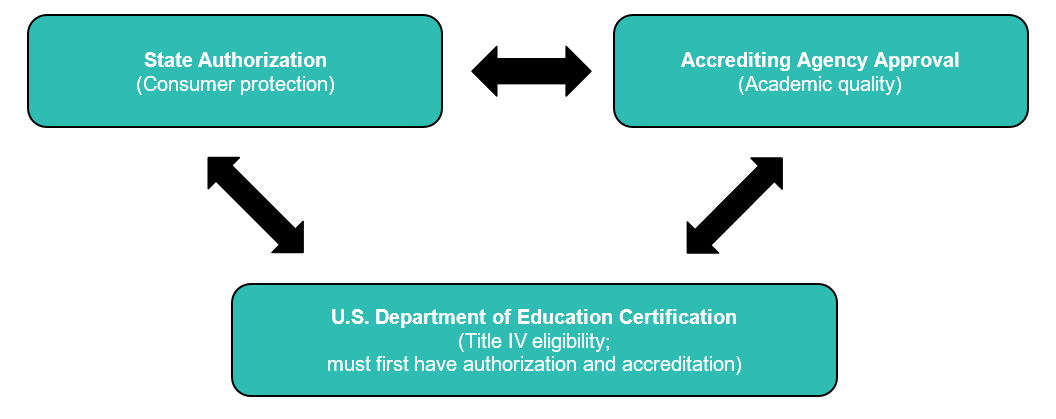
In such a diffuse, varied system, gatekeeping responsibilities are not simple. So Congress cobbled together a “program integrity triad” to share the responsibilities, pulling in existing entities—designed in a different time and for different purposes—to fill that role as it expanded federal dollars to more colleges (see Figure 1). In general, accrediting agencies are approved by the Education Department to bear responsibility for the academic quality of the colleges they accredit; the states are tasked with consumer protection; and the federal government, via the U.S. Department of Education, certifies institutions to be eligible for taxpayer-financed financial aid and oversees their administration of those funds. The Department also decides which accreditors meet federal standards. This system has scarcely evolved to address massive increases in the federal investment in higher education; huge increases in the number of Pell Grant recipients and student loan borrowers; and the development of new institutions, education providers, and delivery models entering the system.
Too often, the system of shared accountability devolves into a game of hot potato, with no one member of the triad willing to take serious action against an institution of higher education that falls short until other members of the triad have stepped up. With potentially severe consequences for a college—and its students—each member of the triad has a tendency to wait several beats too long before enforcing any severe action against a college, often no matter how poor the institution. And each piece of the triad is guilty of seeing institutions, not students and taxpayers, as the client. This imbues regulatory capture, in which regulators feel beholden to the interests of the industry they regulate, at every level of oversight.
Figure 1: Program Integrity Triad
This problem is not a recent development. In the culminating report of a series of hearings by Senator Sam Nunn (D-GA) ahead of the 1992 reauthorization of the Higher Education Act, the Subcommittee found that the triad “provides little or no assurance that schools are educating students efficiently and effectively.”7 The report also found that “the Department of Education had all but abdicated its responsibility to the students it is supposed to service and the taxpayers whose interests it is charged with protecting.”8 A later investigation led by Senator Tom Harkin (D-IA) confirmed the problems had continued, and even grown, especially in the for-profit sector, noting that “the ability of regulators to protect students, ensure academic quality, and safeguard State and Federal taxpayer dollars has been strained.”9
“Not It:” The Triad and Charlotte School of Law
An example helps to illustrate both the promise and the inherent tension of the program integrity triad. Charlotte School of Law (CSL) was founded in North Carolina in 2004, financed by a private equity firm and accredited by the American Bar Association in 2008. By 2016, the school enrolled some 700 students, offering high-priced law degrees that students could borrow for into the six figures from the U.S. Department of Education.10
But the degree was often not worth the cost for students. For graduates who took the bar exam for the first time in February 2016, barely one in three passed. At a faculty meeting, an assistant dean of the school said its bar pass rate would have been even worse if not for a scheme the school employed to pay students not to take the bar exam at all.11 Despite the accreditor taking note of declining student outcomes and other missed standards in January 2015 following a comprehensive review, the school remained accredited and continued to enroll students.
After two more years of non-compliance with accreditor standards and disturbingly bad outcomes for most students at the school, the Department finally took a rare action. In December 2016, the Education Department notified Charlotte School of Law it would not be recertified to participate in the federal student loan program based on its inability to meet the ABA’s standards.
The school asked that it be granted access to loans for at least another semester, setting up an institutional loan program to load students up with private loans in the interim. While the Department originally declined, the incoming Trump administration sent the school back some of the taxpayer-backed loan dollars after it had limped along on private loans for a few months. But despite modest sanctions from the accreditor and the Department’s complicated history with the school, it remained open.
Finally, in June 2017 (fully 18 months after the Department took action), the North Carolina state authorizer (the UNC Board of Governors) voted to place a long list of conditions on Charlotte School of Law’s license to operate in the state—requiring, among other things, approval from the accreditor (the ABA) and from the Education Department. The school missed the deadline for those approvals, rendering it automatically unauthorized to operate in North Carolina. Still, the school continued to tell students it would meet the requirements, and confusion reigned for nearly a week, before UNC clarified to the public that Charlotte School of Law had lost its authority to operate, effectively shutting it down.
The triad is supposed to ensure that multiple entities are keeping a close eye on colleges. But with Charlotte School of Law, this system became more of a “Bermuda triad,” with the mysterious disappearance of rigorous oversight of colleges that are known by all actors to be problems. While the entities in the triad should respect the decisions of other regulators in the system, in this case they saw a problematic institution and each pointed fingers, allowing other members of the triad to substitute for their own responsibilities. That Charlotte School of Law was able to continue teaching students for so long after problems were spotted and the institution failed to improve—and that it came so close to being permitted back into the federal financial aid system even after severe actions were taken—is deeply concerning.
Shifting and Rebalancing the Roles of the Triad
If Congress were designing a quality assurance system from scratch—one that recognized the huge and growing role that the federal government plays in higher education, the decreasing relative state investment, the changes in the types of students and the schools they go to, and the increased cost and risk of higher education when it is financed with student debt—it would undoubtedly be designed differently to avoid the kind of finger-pointing common among the triad.
"Oversight of colleges has fallen short, at the expense of millions of students."
But change is desperately needed. Oversight of colleges has fallen short, at the expense of millions of students. And the last 18 months have shown the U.S. Department of Education further back-tracking on what few protections do exist in the program integrity triad.12 Taken individually, any one of the Department’s current efforts to minimize responsibilities of states, accreditors, and the federal government might further weaken a leg of the program integrity triad. Taken together, the entire system will come crashing to the ground.
Summary of Recommendations
Accreditors
- Restore minimal oversight of accreditors through federal rules
- Hold accreditors accountable for fulfilling their responsibilities
- Set reasonable time frames for improvement and require accreditors to take action when they expire
- Give accreditors enhanced tools for accountability
- Make student outcomes central to what accreditors do and hold them to those standards
- Ensure accreditors are student-focused in their policies and actions
- Create more independence within accrediting bodies
- Increase transparency of accreditation documents
- Promote risk-based reviews of institutions and of accreditors
States
- Require states to do more than rubber stamp colleges
- Shift some responsibilities from accreditors to states
- Strengthen states’ roles in protecting consumers of higher education
- Collect and refer complaints as appropriate
- Subject online colleges to rigorous oversight
- Help states to triage the challenges in their states
- Provide data feedback reports to states on the outcomes of their institutions
- Provide coordinating grants to states to align oversight across federal programs
U.S. Department of Education
- Reform the structure of Federal Student Aid to promote heightened oversight
- Increase risk-based reviews of colleges
- Improve financial monitoring of private colleges
- Prevent colleges from dragging out closure at taxpayers’ expense
- Strengthen outcomes-based accountability
- Establish—and use—interim sanctions short of total loss of taxpayer financing
- Protect students from abusive recruiting practices
- Strengthen interactions among the members of the triad

Citations
- Education at a Glance: United States (Paris, France: Organisation for Economic Co-operation and Development, 2018), https://read.oecd-ilibrary.org/education/education-at-a-glance-2018/united-states_eag-2018-71-en#page1
- Institute of Education Sciences, National Center for Education Statistics (website), “Digest of Education Statistics,” Table 326.10, 2018, https://nces.ed.gov/programs/digest/d18/tables/dt18_326.10.asp?current=yes ; Institute of Education Sciences, National Center for Education Statistics (website), “Digest of Education Statistics,” Table 326.20, 2018, https://nces.ed.gov/programs/digest/d18/tables/dt18_326.20.asp?current=yes These graduation rates Include only first-time, full-time students.
- Authors’ analysis of data from the College Scorecard, available at collegescorecard.ed.gov/data
- Federal Student Aid (website), “Default Rates,” https://studentaid.ed.gov/sa/about/data-center/student/default
- Arne Duncan, “Toward a New Focus on Outcomes in Higher Education” (remarks at the University of Maryland–Baltimore County, Baltimore, MD, July 27, 2015), https://www.ed.gov/news/speeches/toward-new-focus-outcomes-higher-education ; and authors’ analysis of “Debt to Earnings Rate Data,” Federal Student Aid (website), 2017, https://studentaid.ed.gov/sa/about/data-center/school/ge
- See, for example, Corinthian Colleges, ITT Tech, Education Corporation of America, Dream Center Education Holdings, and others.
- Permanent Subcommittee on Investigations of the Committee on Governmental Affairs United States Senate, Abuses in Federal Student Aid Programs (Washington, DC: U.S. Congress, 1991), https://files.eric.ed.gov/fulltext/ED332631.pdf
- Ibid.
- Majority Committee of the Senate Health, Education, Labor, and Pensions Committee, For-Profit Higher Education: The Failure to Safeguard the Federal Investment and Ensure Student Success (Washington, DC: U.S. Congress, 2012), https://www.help.senate.gov/imo/media/for_profit_report/PartI-PartIII-SelectedAppendixes.pdf
- This section is adapted from two EdCentral New America blog posts: Clare McCann, “A Play-by-Play of Charlotte School of Law’s Closure,” August 23, 2017, https://www.newamerica.org/education-policy/edcentral/csl-part-one/ ; and Clare McCann, “Lessons for Higher Ed in Charlotte School of Law Closure,” August 23, 2017, https://www.newamerica.org/education-policy/edcentral/csl-part-two/
- Lisa Worf, “Recordings Shed Light on Charlotte School of Law’s Methods to Boost Bar Passage,” Charlotte Observer, January 25, 2017, https://www.charlotteobserver.com/news/local/article128623994.html
- Amy Laitinen and Clare McCann, “Comments on Proposed Accreditation and State Authorization Rules,” New America, July 12, 2019, https://www.newamerica.org/education-policy/public-comments/our-public-comments-us-department-education/comments-proposed-accreditation-and-state-authorization-rules/ ; and Clare McCann, “Comments on Proposed Gainful Employment Rule,” New America, September 13, 2018, https://www.newamerica.org/education-policy/public-comments/our-public-comments-us-department-education/comments-proposed-gainful-employment-rule/