Affording Leave: How Americans Get Pay When They Take Leave and How They Cover the Gaps
Taking leave from work can be challenging enough, but it often comes with economic strain. In our sample, even among people who are able to take leave from work without fear of job loss, a substantial portion must take this leave without full or often any pay.
58 percent of workers who took leave were able to get some pay; 35 percent said it was unpaid.
Just under six in 10 (58 percent) of those in the workforce who took leave were able to get at least some pay for the time they took off. These numbers reflect only those workers who were able to take leave from work; those who do not have access to paid leave often cannot afford to take time away from their jobs, and many other workers do not have job protection and risk losing their job if they take even unpaid leave.
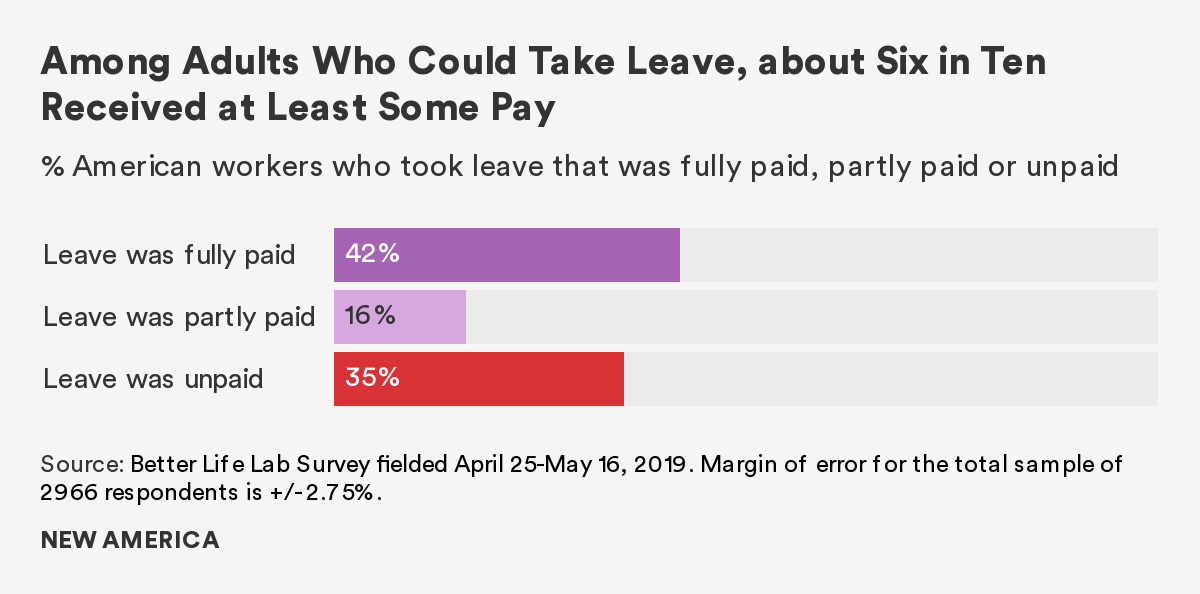
Among adults who have taken leave, 42 percent say their most recent leave to care for either a child or adult was fully paid, and 16 percent say it was partly paid. 35 percent say it was entirely unpaid.
Differences in access to leave often break across socioeconomic lines, with those with higher incomes and more education having greater access to paid leave, while those with lower incomes scrape by without pay. Those with a college degree were more likely to be fully paid for their leave (48 percent with a college degree versus 39 percent non-college), and Americans with a household income under $60,000 were more likely to be unpaid during their leave (44 percent versus 26 percent). The current system, which burdens those households most in need of every dollar of their income, and who have fewer resources to pay others to manage their family care needs, exacerbates inequality. Low-income families with access only to unpaid leave are often forced into a wrenching choice—care for loved ones or keep the family financially afloat.
Below we highlight what families in this situation do when they need to care for family and try to make ends meet.
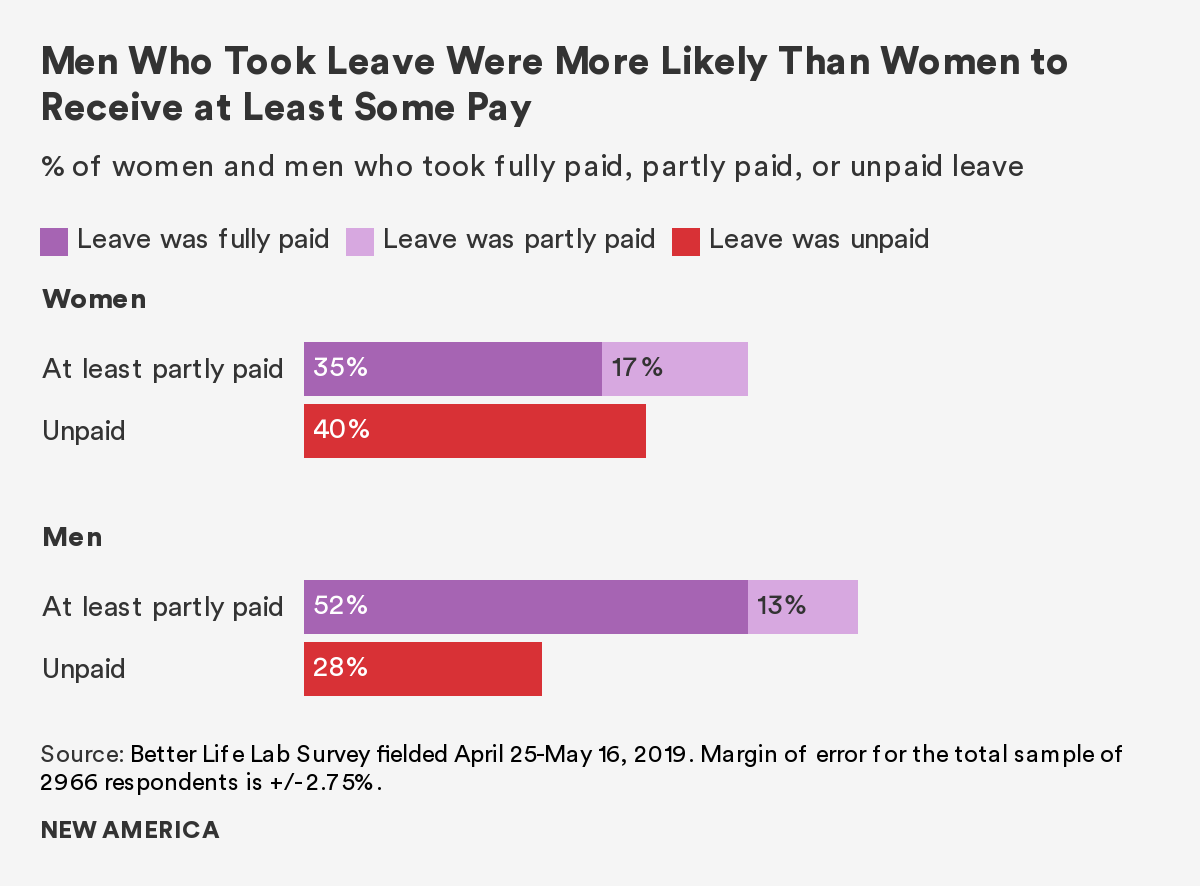
When they take leave, men, especially fathers, are more likely to be paid than women and mothers.
Men are less likely than women to take leave to care for a child or family member. Yet the men who took leave were more likely to say their leave was paid. More than six in 10 men (65 percent) who were able to take leave reported receiving some pay, compared with 53 percent of women who took leave. Among those men who were paid for leave, they were also much more likely than their female counterparts to say that leave was fully paid—52 percent of all men who took leave said their leave was fully paid, compared to just over a third (35 percent) of women. While just 28 percent of men who took leave said that leave was unpaid, 40 percent of women who took leave reported receiving no pay while off of work.
This finding is even starker when focused on fathers. Fathers who have taken leave from work to care for a child or an adult are substantially more likely to have had that leave paid, and fully paid, than mothers who took any kind of leave. Seven in 10 (71 percent) of fathers who took leave for any reason said it was paid to some degree, with 57 percent saying it was fully paid. In comparison, half (52 percent) of mothers who took leave said it was paid, and only a third (33 percent) reported that their leave was fully paid. Just 24 percent of fathers who took leave said they took unpaid leave, while 40 percent of mothers taking leave took it unpaid. Fathers are more likely to receive pay during their leave despite the fact that only mothers are able to use temporary disability insurance around childbirth, at least in some parts of the United States.
Among those men who were paid for leave, they were also much more likely than their female counterparts to say that leave was fully paid.
This finding may be the result of the different durations of leave that new parents take—research has found that the vast majority of fathers tend to take less than two weeks of leave, whereas women who can afford to do so take 10 to 12 weeks. The vacation or sick time a worker may have available can more easily cover the duration of leave that men typically take but is much more likely to run out when a mother or father takes a longer leave. This difference may help to explain the findings here and the BLS surveys.
The finding is also indicative of the pressure many men feel to provide for their families and how it shapes their identities—and structure their household finances—around being economic breadwinners. In order to ensure men can fully participate in the first months of a child’s life or take time away from work to care for loved ones, effective paid leave policies will need to include adequate wage replacement and job protection strategies, or men are unlikely to take it at all.
Our focus group research sheds light on these findings. For instance, 33-year-old father of four Russell A. was able to take a week off work following the birth of his youngest child, but noted that if he had not received pay during his time off, even a week would not have been possible for him financially. “The longest that I’ve taken was one week immediately following the birth of our one-year-old. I managed that okay, I just had to catch up on a bunch of work. But [at] the same time, I couldn’t take more time off because that would cause issues like an unbearable amount of catch up work as well as financial stress in general.”
Low-income workers are the least likely to get paid leave from work for care.
Low-income workers, who often have the least savings and who are the most likely to need every paycheck they earn to make ends meet, are the least likely to have access to paid leave. Among those workers able to take leave when they needed it, just 41 percent of workers in households earning less than $30,000 annually had leave that was partly or fully paid, compared with nearly three-quarters of the highest-earning workers—those earning $100,000 or more a year. Fully two-thirds (66 percent) of college degree holders who took leave got at least some pay for that time off of work, while 53 percent of those without a college degree who took leave got paid.
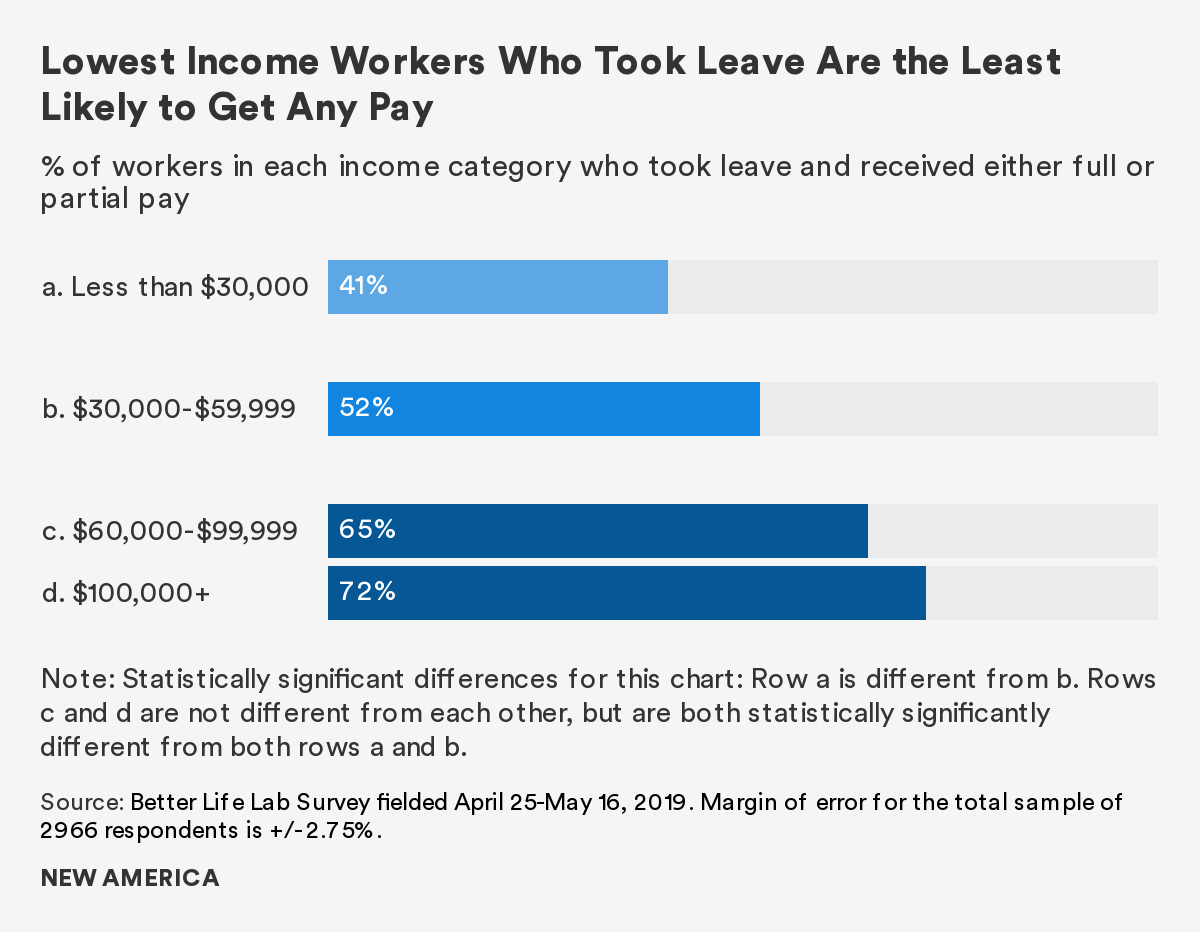
As we’ve seen consistently in the research, workers with college degrees and in higher earning households are more likely to get time off work that is at least partly, if not fully paid. These workers already have better access to all types of benefits like paid sick days, and paid vacations as well as employer-provided family and medical leave, all of which can be used to help pay for time off to care for others.
Covering the Cost of Leave
American families struggle to manage income shortfalls and hardship from unpaid and partly paid family and medical leave.
Millions of American families, even those ostensibly in the middle class, struggle to cover the costs of their lives. Many live paycheck to paycheck, and four in 10 American adults would have trouble finding $400 to cover an emergency expense.30 In our survey, American families who needed and were able to take leave—paid or unpaid—used a variety of strategies to make ends meet during the time they were off of work.
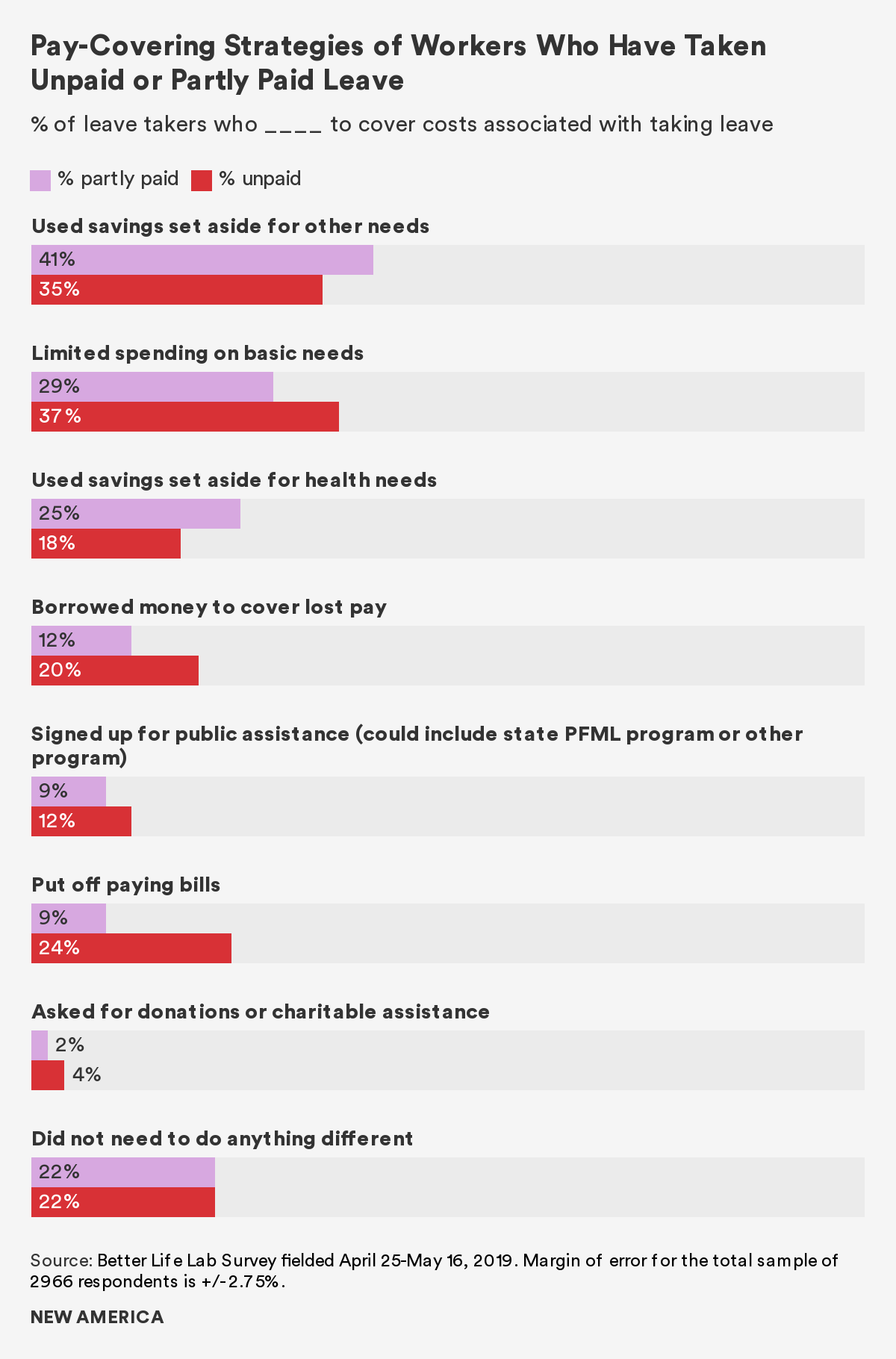
To cover the costs of this care, more than a third of Americans who were not fully paid for their leave had to use savings set aside for other uses or limit spending on basic needs. Just one in five said they were able to cover the costs of caregiving leave without making any sacrifices, trade-offs, or other changes to the family budget.
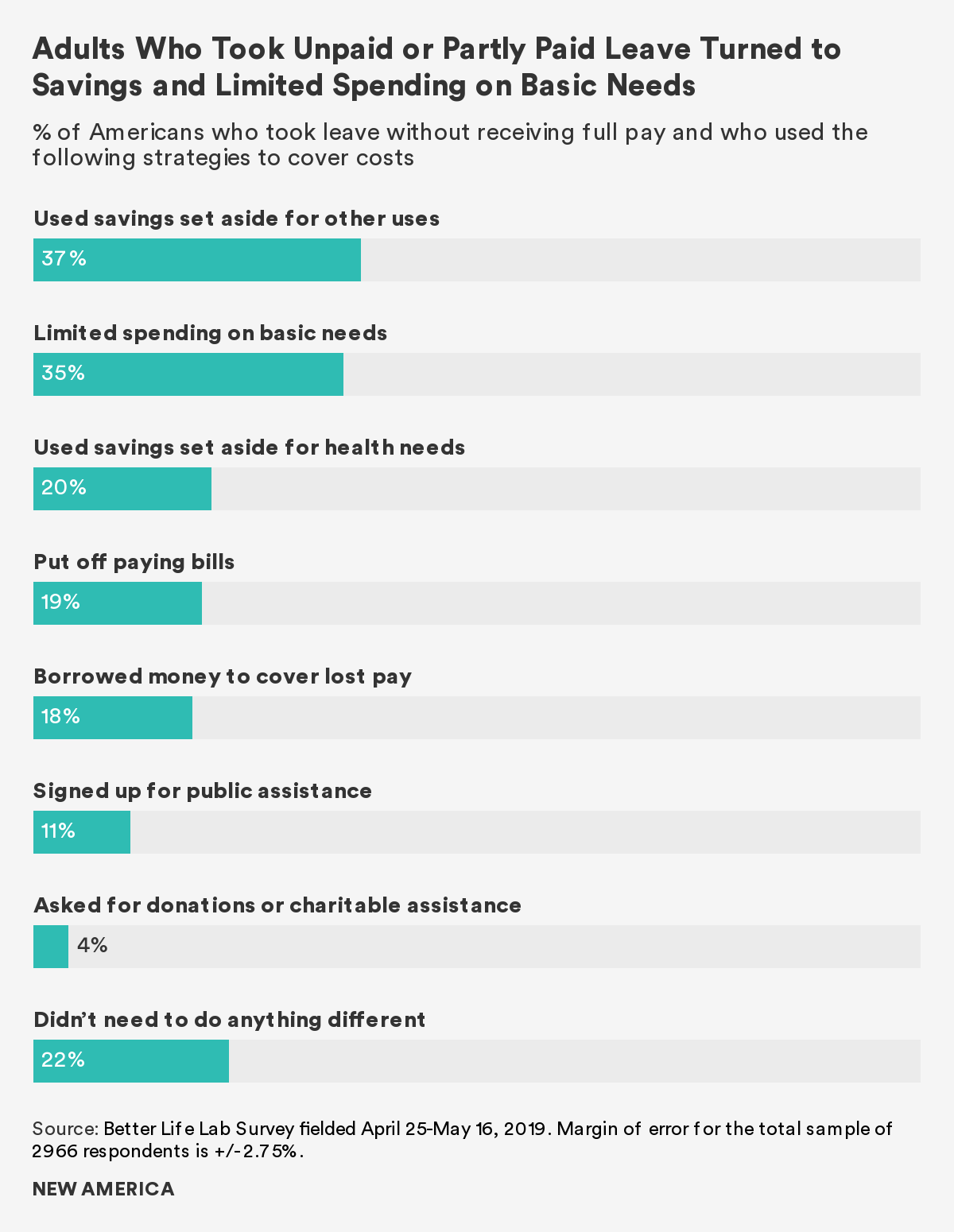
Workers who take unpaid leave have different coping strategies for managing the challenge of leave than their counterparts who are partly paid. While both groups deploy savings—either deliberately set aside for health issues or for other purposes—the unpaid workers are less likely to use savings, and much less likely to have or use health-related savings for their unpaid leaves. Workers who take leave without pay are much more likely to have to cut back on basic needs, borrow money to cover lost pay, and put off paying bills until they can get back to work.
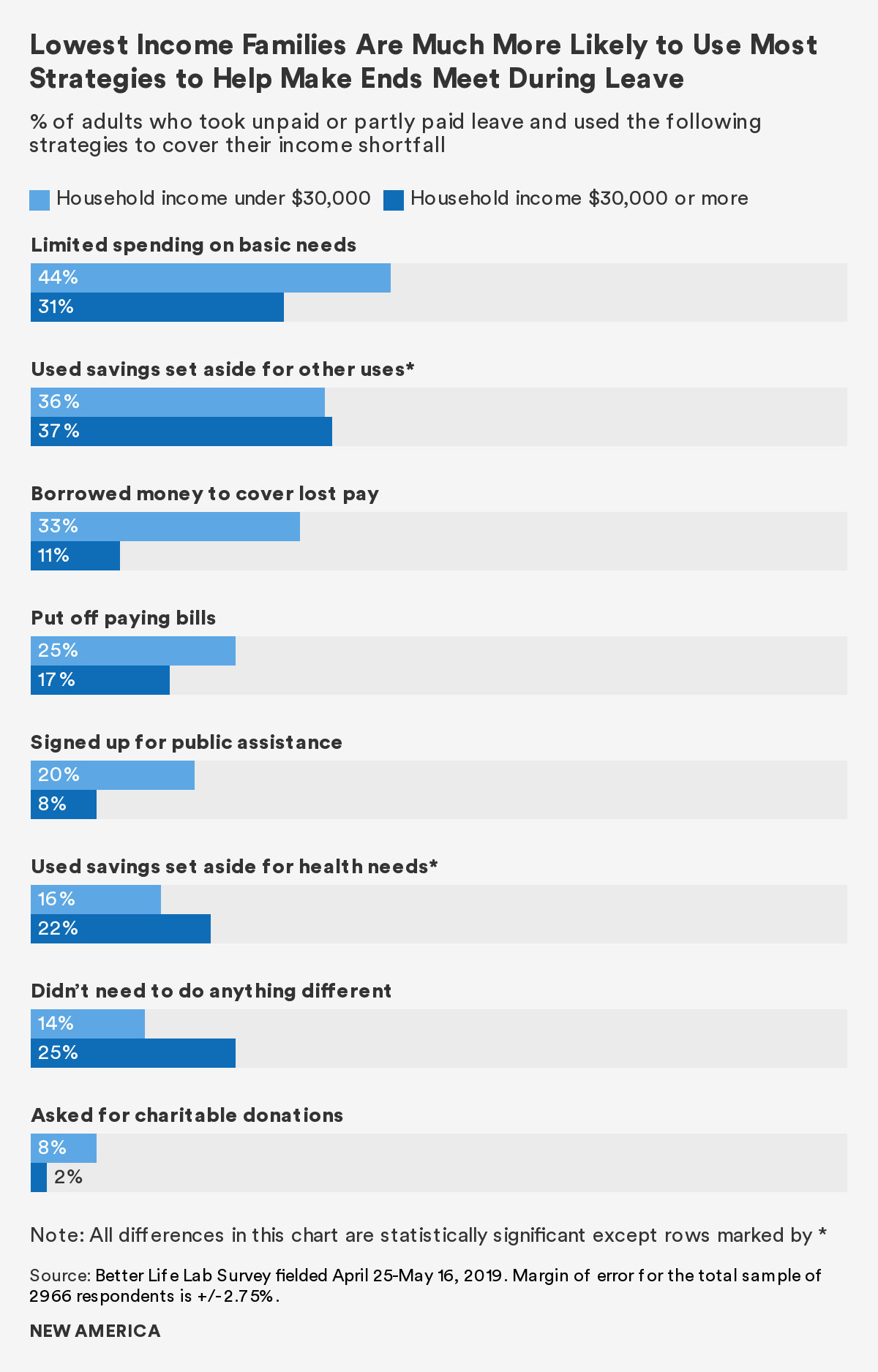
The lowest-income earners who took partly paid or unpaid leave—those who were able to take any leave at all—are more likely to deploy most of the strategies asked about in our study. They rely on limiting spending on basic needs (44 percent), borrowing money (33 percent), putting off paying bills (25 percent), signing up for public assistance (20 percent), and asking for donations or charitable assistance (8 percent). They are just as likely as higher earners who took partly or unpaid leave to rely on savings, even as they are less likely to have much, if any, money saved. Only 14 percent of the lowest-income households did not need to do anything different to manage leave, compared to 25 percent of those in households earning $30,000 or more and taking partly or unpaid leave.
Younger adults are more likely to need to use savings, borrow, limit spending, or access public assistance to cover the cost of taking partly or unpaid leave.
Regardless of whether or not they had fully, partly, or unpaid leave, individuals under 45 were significantly more likely to need to use savings, borrow money, limit spending, or sign up for public assistance to cover the cost of taking time off work than workers 45 and older—a reflection of the fact that these workers are less likely to have access to paid leave of any kind through an employer, generally earn less than older adults, may have high student debt burden, and have not had as long a time horizon to build up savings.
Workers who take leave without pay are much more likely to have to cut back on basic needs, borrow money, and put off paying bills until they can get back to work.
To manage the loss of pay during leave, women more often limit spending on basics.
There are few differences between men and women in how they say they manage lost pay. The exception: Women are more likely to report limiting spending on basic needs (29 percent of women versus 17 percent of men).
Parents taking leave for a birth differ from those taking leave for a sick child.
Parents of young children ages zero to eight and caregivers for children with greater than typical needs are more likely than others to borrow money to cover lost pay and to sign up for public assistance to help manage the gaps in pay caused by taking time to care. Parents of young children are also more likely to say they’ve used savings set aside for health needs to manage the costs of time off work—though caregivers for children with more than typical needs do not use this strategy more than others. Parents anticipating the birth of a child have a number of months to potentially plan and try to set aside money to cover the costs associated with leave and new children joining a household in general. Parents caring for a sick or injured child are often faced with an immediate, unplanned need for leave and attendant costs associated with the care of a sick, injured, or special-needs child, making saving in advance difficult if not impossible.
Half of employed survey respondents with access to paid family and medical leave through an employer say they didn’t need to do anything different to manage their finances when they took leave, but just roughly 3 in 10 of those without paid leave said the same.
Leave takers without access to paid family and medical leave are more likely to report that they limited spending on basic needs during their time away from work to care than those with access to paid leave. Three in 10 (30 percent) of those without paid leave said they limited spending on basic needs to cover the costs of leave, while just 18 percent of those with a paid leave benefit said the same.
Leave takers without paid family and medical leave access are also more likely than those with the benefit to say they raided their savings set aside for other reasons to make ends meet during leave—with 31 percent of those with leave reporting using other savings, compared with 21 percent of those with access to paid family leave.
Parents caring for a sick or injured child are often faced with an immediate, unplanned need for leave and attendant costs…making saving in advance difficult if not impossible.
Many parents cobble together ad hoc plans to find time and money for leave.
Parents in our focus groups spoke about the ways they were able to creatively cobble together paid leave through sick or vacation time if they were lucky enough to have it, or split days and hours at work to toggle between caregiving and work. For those with paid leave or who found a way to pay for leave without hardship, the relief and gratitude for having the time to care without substantial financial stress was notable.
“I only took a week and a half for each kid’s birth. I used vacation and sick time. That was all I was able to take. There were no financial issues. My boss has been understanding and flexible and I have been able to play a big part in raising my kids.” –Kyle C., 36 years old, manager at logistics company, father of two, Massachusetts.
“… my daughter was born seven weeks early, and was in the NICU for a month. After she was born, my wife remained in the hospital with complications for about a week. I took time off immediately after her birth, and then off and on half-days to spend time with her and my wife to make sure my son’s life wasn't disrupted too much. Luckily, the university I work at, and my boss, are flexible and understanding with our time. We have a pretty generous Family Care Leave, Personal Leave, and Annual Leave allowances. While taking as much time as I did drained my Annual Leave balance, I was ok not having a ton of remaining time left.” –Stefan B., 44 years old, academic adviser, father of two, Michigan.
Few men, however, shared stories like some of the more fortunate women in our study did, of having access to and being fully supported in taking paid family leave:
“I took maternity leave for all three children. I took 12 weeks each time. I was paid my full salary on leave and I am grateful for that.” –Lauren F., 37 years old, sales, mother of three, Arkansas.

Lifting the Barriers to Paid Family and Medical Leave for Men in the United States
- Summary of Findings
- Introduction
- What Americans Think about Why Men Do and Do Not Take Leave from Work to Care for Loved Ones
- Who Has Access to and Uses Family and Medical Leave from Work?
- Six in 10 Americans Anticipate Needing to Take Leave from Work in the Future
- Affording Leave: How Americans Get Pay When They Take Leave and How They Cover the Gaps
- Conclusion
- Methods
- Bibliography
Citations
- Consumer and Community Research Section, Report on the Economic Wellbeing of U.S. Households in 2018, (Washington, DC: Federal Reserve Board, 2019), https://www.federalreserve.gov/publications/files/2018-report-economic-well-being-us-households-201905.pdf