Six in 10 Americans Anticipate Needing to Take Leave from Work in the Future
In addition to asking respondents whether they had taken more than a few days off of work to care for a new child or a loved one, the survey also asked whether respondents anticipated needing leave to care for a child or adult in the future. Just over half—51 percent—of working Americans say they anticipate needing to take leave at some point in the future to care for an ill, disabled, or aging adult family member. Three in 10 (30 percent) anticipate needing leave to take care of a new child. Overall, 60 percent of working adults say they anticipate needing at least one of these types of leave in the future.
According to our survey, men anticipate needing leave at statistically similar rates as women, and the need for access to paid leave across gender will only grow in the coming years, with many respondents anticipating needing leave for either child or elder care, and some anticipating needing leaves for both.
60 percent of working adults say they anticipate needing at least one of these types of leave [to care for a child or adult] in the future.
Parental Leave
About a third (30 percent) of American workers say they will need to take leave to care for a new child in the future. Younger workers, Black and Hispanic workers, and workers earning less than $30,000 per year in household income are more likely than their counterparts to believe they’ll need to take leave to care for a new child in the future.
Men and women are equally likely (30 percent) to say they will likely need this type of leave in the future. However, men are more likely than women to say they are not too likely to need to take leave to care for a child (24 percent of men versus 16 percent of women), while women are more likely to say they are not at all likely to need this leave (53 percent versus 45 percent of men). In other words, women appear more confident about saying they definitely will not need leave for a child than men do.
Parents of young children ages zero to eight are also more likely than those who aren’t the parents of young children to say they believe they will need to take leave to care for a new child in the future—36 percent versus 15 percent, likely because they are more inclined to be considering or planning for more children than non-parents or parents without young children.
Family Leave
Half of the survey respondents who are currently in the workforce (51 percent) anticipate needing time off in the future to care for a sick, disabled, or elderly family member. Those in mid-life (30–59) are the most likely to say they are very or somewhat likely to need to take time off of work to care in the future. Fewer of those 60 and older say the same, most likely because many of them are, or anticipate being, retired in the near future, or perhaps because the older adults they would have cared for in the future have already passed away. College-educated workers are also a bit more likely than those without a college degree to say they believe they will need time off to care for a family member in the future (55 percent of college degree-holders versus 49 percent of non-college degree-holders).
There are no differences by gender, race or ethnicity in anticipating leave. There are very modest differences between the highest-income workers and middle-income workers.
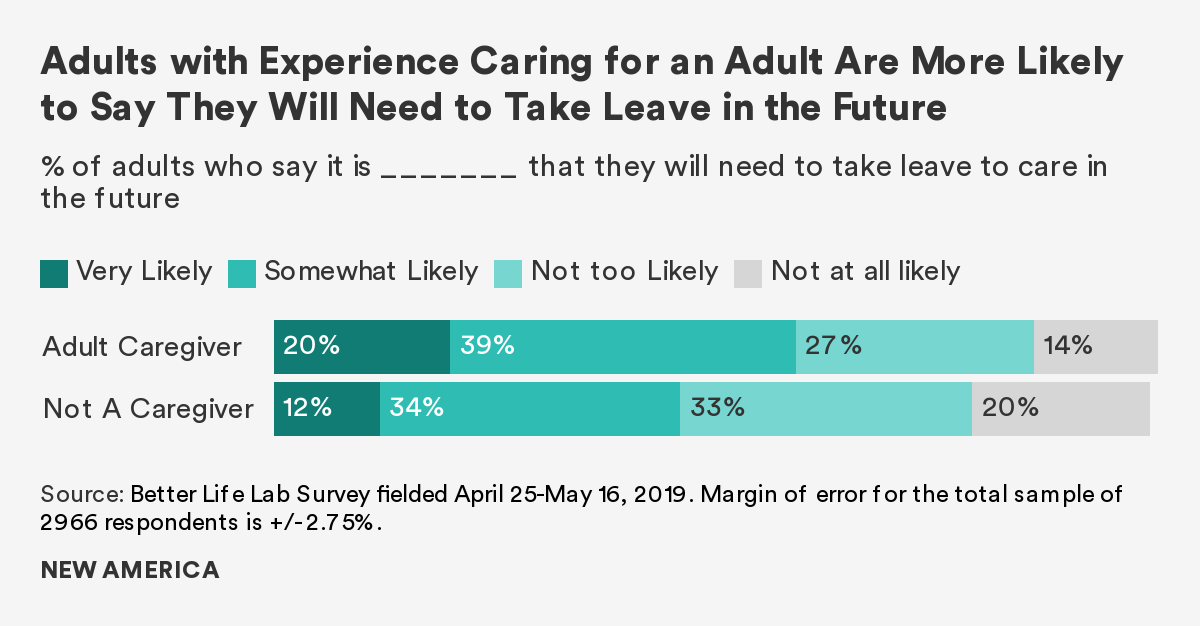
Unsurprisingly, those who are or have ever been caregivers are more likely than those without those responsibilities to say they anticipate needing to take leave in the future (59 percent versus 46 percent of non-caregivers).
Taking Multiple Leaves in the “Sandwich” Generation
Among our respondents, some have used or anticipate using leave for both a new child and for an ill, disabled, or elderly family member. Fourteen percent of survey respondents say they have ever taken leave of any kind, paid or unpaid, to care for both a new child and a sick family member. The number of multiple-use leave takers will likely grow. More than half (53 percent) of parents who have taken leave for the birth of a child anticipate needing to take leave to care for a family member in the future.
Other researchers have identified people juggling caregiving for both younger and older relatives at the same time as the “sandwich generation.” The sandwich generation is typically described as older Millennials and Generation X, those ages 30 to 60, who might have living elderly parents needing help while at the same time caring for children under age 18 in the home. The online focus groups surfaced several participants who were, by this definition, sandwiched. Take 39-year-old father-of-three Justin T., who participated in our online threaded discussion focusing on unpaid caregivers. Justin spends his days working as an online student adviser and his evenings caring for his aging father who struggles with mobility issues, among other challenges, all while juggling fatherhood and marriage.
Fourteen percent of survey respondents say they have ever taken leave of any kind, paid or unpaid, to care for both a new child and a sick family member.
The Better Life Lab survey cannot determine whether participants who reported taking leaves for multiple purposes took them in close proximity to one another and represented simultaneous caregiving burdens. But that so many respondents anticipate needing multiple leaves in their lifetimes indicates a large portion of American workers will, at some point in their lives, take part in both elder care and child care. Unsurprisingly, 30 to 44-year-olds were the age group most likely to anticipate needing leave for both taking care of a new child and taking care of an ill, disabled, or elderly family member. Adults 45–59 years old were the age group most likely to have used leave for both purposes at some point in the past.
Justin T., like other respondents from the research with multiple and multi-generational caregiving responsibilities, anticipated needing leave from work to care for his father. “I think I’ll need more than a few days off soon, and I think my family will be supportive,” he said.
Men and women express equal anticipated future need for time off work to care.
There are no significant differences between men and women when it comes to anticipating the need to take leave for both child care and elder care at some point, or having used leave for child care and having used leave for elder care.
One third (34 percent) of men with children, for instance, say they have taken leave to care for an ill, disabled, or elderly family member. Hispanic fathers are more likely than white fathers to say they have taken leave to care for an ill, disabled, or elderly family member (42 percent of Hispanic fathers versus 30 percent of white fathers).
Parents who have cared for children with more than typical needs29 are more likely than those who have not provided such care to report that they are “very likely” to need to take leave to care for a family member in the future (21 percent compared to 13 percent of those without these care responsibilities).
As the U.S. public collectively thinks about and innovates around new employer-offered, state-based, and federal paid family leave policies, understanding the full anticipated demand for different caregiving situations highlights both the important need these policies address and who they need to target. In other words, the changing demographics of the United States and increasing caregiving demands across the life cycle make clear that leave policies targeted only to mothers or parental caregiving will fall short. Further, policies designed to enable parents to take leave by drawing a benefit from Social Security in exchange for a later cut to retirement misses a large section of workers with adult family care responsibilities. It also fails to address the ways that caregiving, and the need to take unpaid leaves, already causes workers to cut back work hours, drop out of the workforce, or suffer penalties at work at a cost to retirement savings. While some Americans may never need to use leave, those with close family connections and active involvement in caregiving may need to use it multiple times over their lives for different people and in a variety of different caregiving situations. A federal paid leave policy centered around caregivers would account for multiple leave users and ensure that these involved caregivers are not penalized at work or in their financial security for shouldering this multifaceted caregiving responsibility.
Lifting the Barriers to Paid Family and Medical Leave for Men in the United States
- Summary of Findings
- Introduction
- What Americans Think about Why Men Do and Do Not Take Leave from Work to Care for Loved Ones
- Who Has Access to and Uses Family and Medical Leave from Work?
- Six in 10 Americans Anticipate Needing to Take Leave from Work in the Future
- Affording Leave: How Americans Get Pay When They Take Leave and How They Cover the Gaps
- Conclusion
- Methods
- Bibliography
Citations
- In our study, we identified a group of caregivers of sick or disabled children by asking the following question “Have you, personally, ever provided care to your child or any of your children (when they were under the age of 18) because of a medical, behavioral, or other condition or disability? This kind of care is more than the normal care required for a child of that age. This could include care for an ongoing medical condition, a serious short-term condition, emotional or behavioral problems, or developmental problems.