What Americans Think about Why Men Do and Do Not Take Leave from Work to Care for Loved Ones
We asked our sample of American adults what they believe motivates American men to take leave from work to care for children and family and what barriers keep them from doing so. In all, we found that economic factors, family attitudes and support, and workplace cultures and practices are key in driving both what motivates and what inhibits men from taking caregiving leaves. Americans overwhelmingly believe that men take caregiving leaves from work because it is morally the right thing to do.
American beliefs on these push-pull factors influencing men’s caregiving leave decisions and behavior fell into five main categories:
- Economic imperatives
- Workplace support and norms
- Family and community support and norms
- Moral imperatives and personal need
- Masculinity norms
Within each of these groupings, Americans had varying degrees of strength in their beliefs about how much each of these concepts helped or hindered men as they decided whether or not to take caregiving leave. The responses reveal a complicated and evolving portrait of attitudes toward men, masculine identity, work, and care.
The survey uncovered different beliefs and perceptions based on gender, age, income level, and race or ethnicity. For instance, while sharing similar views about the factors that motivate men to take leave, men and women diverge in their beliefs about what barriers keep men from taking leave, with more women believing that men do not wish to or think they don’t need to take on caregiving.
Americans overwhelmingly believe that men take caregiving leaves from work because it is morally the right thing to do.
Younger adults are more likely than older adults to believe that norms of masculinity push men away from taking leave, while having positive role models can influence men to take leave. Black and Hispanic Americans are more likely than white Americans to say that public figures taking caregiving leave is a major influence on men’s decisions and actions.
Economic Imperatives: Americans believe economic reasons exert the most pressure on men as they weigh whether or not they can take leave and for how long.
Seven in 10 Americans believe difficulty affording leave from work keeps men from taking it.
Overall, economic reasons top the list of reasons why men in the U.S. workforce don’t take leave when loved ones need care. The most common major reason why Americans think men don’t take leave to care is that they can’t afford to do so.
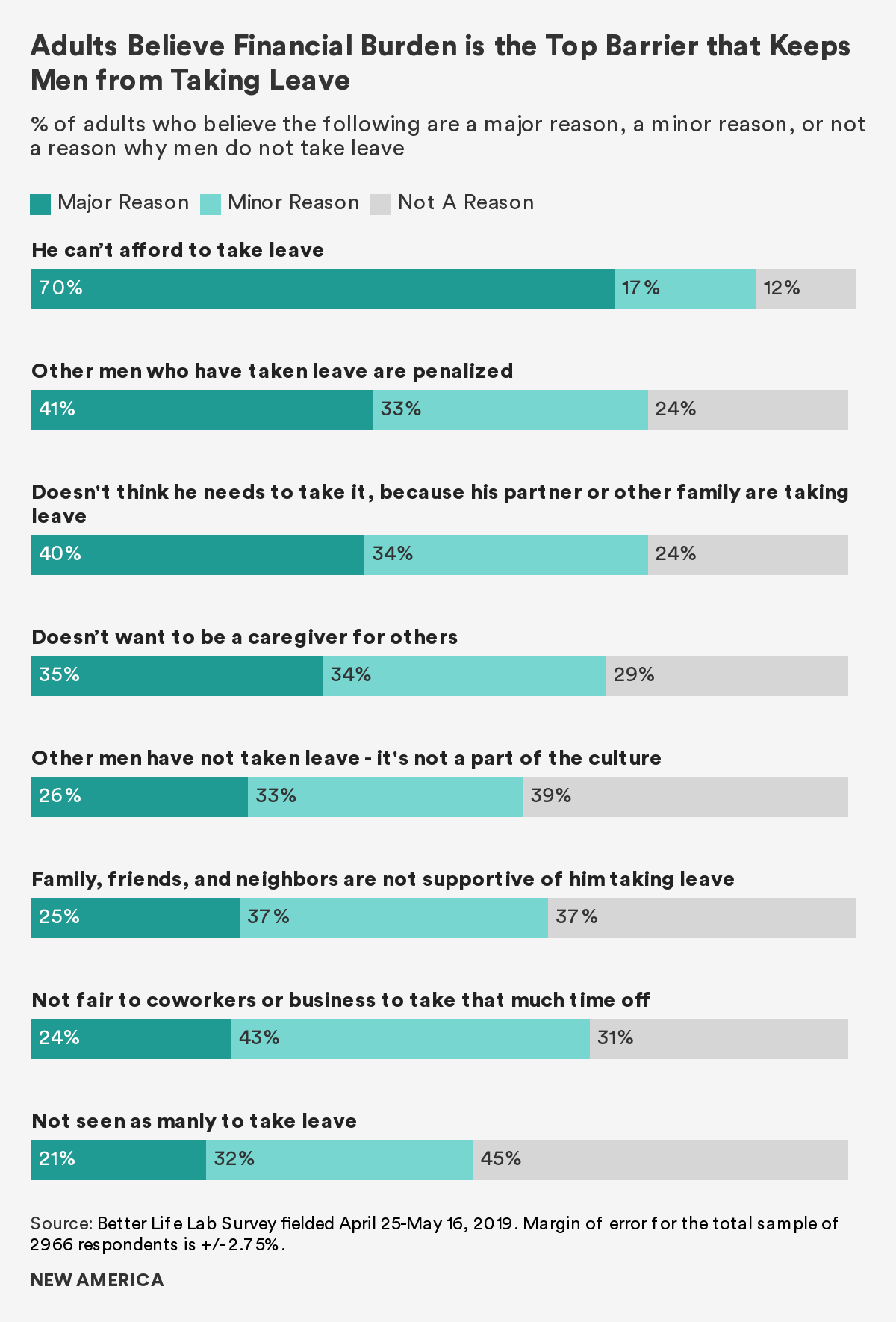
Many believe this economic factor is a powerful influence on men’s behavior—a solid majority of American adults (70 percent) say that not being able to afford to take leave from work is a major reason that men don’t take leave and another 17 percent say it’s a minor reason. Just 12 percent of Americans say ability to afford leave isn’t a reason why men take leave.
One of the fathers in our focus groups detailed his challenges trying to take leave to care for his infant while living paycheck to paycheck:
“I was only able to take three days off and [they] were unpaid. I wish men [would] also get maternity leave to spend time the first week or two at home with your newborn. At that time, I was living paycheck to paycheck barely making it, I had no choice but to get back to work. I wanted to stay home but I couldn’t afford it.” –Louis R., 37 years old, self-employed, financial coach, father of three, Florida
79 percent of adults say a partner’s need to keep working is a reason why men take leave.
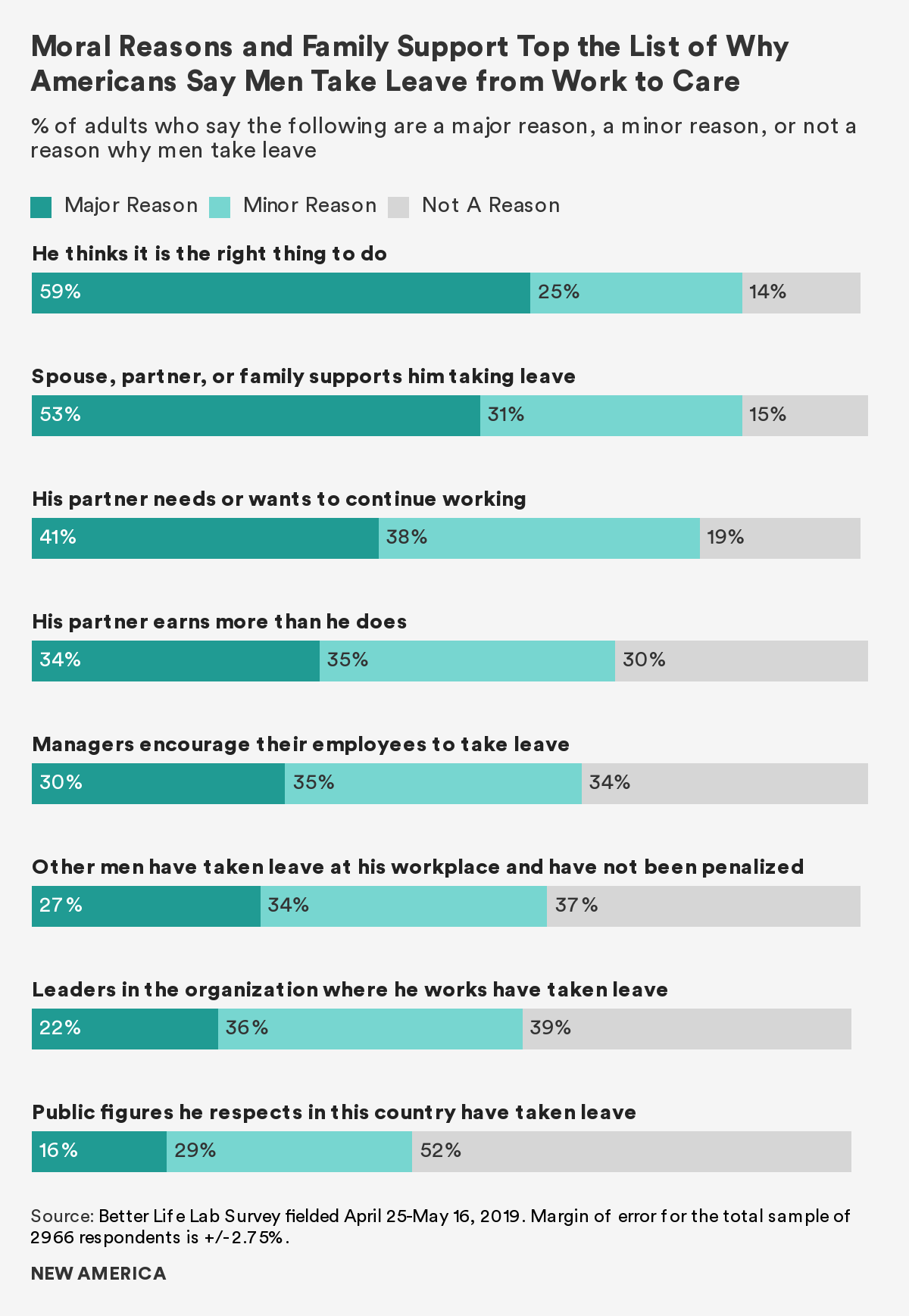
Often familial and economic imperatives for taking or not taking leave overlap. Americans think that a partner or spouse’s need and desire to keep working is an important factor in whether or not men take leave, with nearly eight in 10 Americans positing that a partner’s work needs could motivate a man to take leave from work. Two in five (41 percent) American adults say a man’s partner’s need or desire to continue working is a major reason why men take leave, another two in five (38 percent) say this is a minor reason, and 19 percent say this is not a reason.
His spouse or partner’s earnings may smooth the path for men to take leave.
On the flip side, 68 percent of Americans believe a man may be more likely to take leave from work to care if his partner or spouse earns more than he does. Americans are relatively evenly divided over how much of an impact they believe a spouse or partner’s earning has. About a third (34 percent) of Americans say that a man’s spouse or partner earning more than he does is a major reason why some men take leave to care for others. A similar 35 percent say this is a minor reason and another 30 percent say this is not a reason why men take leave from work to care.
41 percent of American adults say a man’s partner’s need or desire to continue working is a major reason why men take leave.
When asked their thoughts about a public paid family and medical leave policy, with public funds to help more families have access to and afford caregiving leave, one family caregiver, Cody F., responded: “I have a benefit like that. It is my own funds. But I support a public benefit like that. I think that would be totally fine. I would be supportive. It would not matter to me which gender. I would use it.” Another family caregiver, Justin T, said “Everyone would be able to focus on what’s most important. Taking care of those in need. This would really show America cares.”
Workplace Support and Norms: Workplaces, especially managers, and the norms they model and directly espouse, influence men’s leave taking behaviors.
The workplace is a critical site of influence around men and leave-taking. The workplace is where the benefit—if it exists—is managed and where its use is applauded or frowned upon, and where many of the perceived or real feared consequences of taking leave can play out. Americans believe that the impact of managers, and organizational leaders, and what they say or do is a powerful agent in shaping the behavior of men in the workplace.
In our qualitative discussions, many women felt it was easier for women to take caregiving leaves than men. “I think women may use it more because men would feel odd about using it due to stereotypes. Company culture may prevent people from using it. Even if the benefit is there, some managers frown upon the missed time,” said Margaret C., a 43-year-old caregiver to her mother.
30 percent of Americans said that managers encouraging their employees to take leave was a major reason why men take leave.
Support from managers and modeling by organizational leaders help motivate men to take leave.
Many Americans point to support from within the workplace as a reason why men take leave from work to care for others. Nearly two-thirds (65 percent) of Americans say that a manager’s encouragement is a reason men take leave from work to care for family and loved ones. A bit under a third (30 percent) of Americans said that managers encouraging their employees to take leave was a major reason why men take leave from their jobs for care.
Americans also believe the impact of public role models to be a real, if minor, reason why men take leave. However, adults are a bit more convinced of the impact of organizational leaders in modeling taking leave from work to care. Nearly six in 10 (59 percent) of Americans think that a reason why men take leave to care for loved ones is because leaders in the organization where he works have taken leave.
Professional penalties exert more pressure on men to forgo leave than lack of visible penalties serve as an encouragement.
Given the dependence of so many Americans on their paychecks, concerns about potential job loss or career damage are real concerns for all Americans needing to take leave. Many Americans point to cultural or professional penalties exacted on men who take leave as a deterrent to additional men taking time off of work to care, though they believe penalties for leave-taking are more powerful deterrents than lack of (visible) penalties are an incentive.
The penalties that men suffer—personal, professional, and economic—clearly deter other men from taking leave to care for loved ones when the need arises. Three-quarters (74 percent) of adults point to the penalties other men have suffered as a deterrent for men taking leave. Two in five (41 percent) adults say that a major reason men do not take leave when someone in their life needs care is that other men who have taken leave have been penalized for it. Another third (33 percent) say this is a minor reason and a quarter (24 percent) say this is not a reason.
The penalties that men suffer—personal, professional, and economic—clearly deter other men from taking leave to care for loved ones when the need arises.
And when a workplace does not penalize employees for taking leave, workers notice. Six in 10 (61 percent) Americans think that when other men take leave in a workplace and are not penalized as a result, it encourages men to take leave. One quarter (27 percent) of American adults think a lack of visible penalties to men who have taken leave in their workplace are a major reason why men take leave. A third (34 percent) believe this is a minor reason and 37 percent say this is not a reason.
Concern for coworkers and employers are barriers to men taking leave.
Another more minor economic and professional reason that Americans give to explain why men don’t take leave is that it isn’t fair to their coworkers or business to take that much time off. Americans are conscious of and concerned about the impact of leave on employers and coworkers, but are most likely to characterize it as a minor reason why men do not take leave. One quarter (24 percent) of adults say this is a major reason, and 43 percent point to it as a minor reason, with just three in 10 (31 percent) saying it’s not a reason why men do not take time off from work to care.
In the focus group conversations with a group of adult men from the general population, views on the availability of leave were mixed. Roughly half of the men said that taking time off would not be a major burden, or that their workplace would be understanding. About a third of men said that taking time off would be difficult to do.
Some Americans believe men don't take leave because it isn’t fair to their coworkers or business to take that much time off.
Many of the men in our focus groups said they would be understanding of coworkers of any gender who needed to take caregiving leave. Yet, similar to our survey findings, their views were slightly different when it came to thinking about their own caregiving leave. Many expressed concerns about burdening their coworkers and employers as they decided whether they could take leave and for how long. “I would worry, personally, about how my time away would affect the workload of my team,” said Nathan B., a 37-year-old consultant in Washington, D.C.
“I would have loved to have used it for the birth of our daughter. My family has a history of cancer and I absolutely would love to be able to have that time to take care of family members if and when it presented and not have to worry about my job or financial security. At the same time, I do feel that there may be some pressure from coworkers or society NOT to take these types of benefits. I wouldn’t want employees/employers thinking I don't care about my job or team members but again my job is not my most important role in life. Taking care of my family is the most important thing I do and am.” –Dave S., business executive, father of one, Pennsylvania.
A number of men in our focus group expressed real (and founded) concerns about the potential impact of their leave on their work and careers and the way those concerns kept them from taking leave or taking it for as long as they needed and wanted. Some even reported having to quit their positions in order to take the leave they wanted.
“I did take time to care for my son right when he was born. I felt that it was a really important process and I wanted to help my wife at the time and also get to know my new son… I did have to quit the job I was at to do so because they wouldn’t give me the time off.” –Blake K., 32 years old, executive director, single father of one, Colorado.
Other men describe the mix of professional expectations, concerns about being seen as a dedicated employee, and the risk of job loss as a part of their calculus around their leave-taking decisions.
“I would use it if available and I needed it. My only worry is with my long-term job, even if the policy allowed for it, would it be used against me during a down-size/layoffs?” said James B, a 48-year-old father of one who works as an analyst for a vehicle manufacturer in Michigan. “I would only be reluctant to use it if my company pressured me not to use it or if I would be giving up a significant career opportunity by being gone. However, my family comes first, and I would take care of them regardless of the ramifications.”
But some men said that they had confidence that their workplace would be accommodating or found that it was when they needed to take leave.
“My job would be accommodating if I needed it to be. The PTO and work from home policies are excellent.” –Darren S., 41 years old, manager for a human resources company, Georgia.
“My son was hospitalized from Sunday until Wednesday. I took that time off because I felt a paternal responsibility to be there with him the entire time. Financially, there were no issues. My work was understanding.” –Leonard G., 42 years old, project manager and part-time adjunct faculty; father of one, Texas.
Family Support and Norms: Family support, family needs, and supportive or unsupportive community norms influence whether men take leave from work to care.
Almost as critical as economic issues and the ability to afford leave is family and community support. Americans believe a supportive family and a community with role models of other men taking leave can potentially show a path for taking leave to men, and that the inverse—a family who is not supportive and norms that attack the masculinity of men taking leave—can hinder men from taking leave.
Spousal, partner, or family support is seen as critical in explaining why men take leave from work to care for others. Overall, 84 percent of Americans think support from a spouse, partner, or family is a reason why men take leave. More than half (53 percent) of American adults think that support from family is a major reason why men take leave, and another 31 percent said it was a minor reason why men take leave. “My family would support me, but I don’t think my job would be so understanding,” said Dante G., a 32-year-old father of two, in our focus group discussions.
Americans point to a lack of support and few models of other men taking leave as a minor reason why men do not take leave.
Conversely, a lack of support can be a barrier to men taking leave. Most Americans characterize lack of family support as a minor reason why men wouldn’t take leave. That comes in contrast to the strength of their belief in the power of positive family support that serves as an incentive for men to take leave. More than a third of adults say this is a minor reason or not a reason (both 37 percent) why men don’t take leave to care for others. Just a quarter (25 percent) of Americans say lack of family support for taking leave is a major reason why men don’t take leave.
Visible role models are seen as a minor reason why men take leave.
One school of thought suggests that if men had more visible role models demonstrating positive leave-taking that more men would be inspired and incentivized to take leave. While a little less than half of American adults think this is either a major or minor reason that men take leave, it was the reason with which the smallest share of respondents agreed. Just about half (45 percent) of American adults think that a (major or minor) reason that a man takes leave is because public figures a man respects have taken it, with a slight majority believing role modeling is not a reason why men take leave. More workplace-specific role-modeling of managers and/or coworkers is deemed more influential in shaping men’s behavior by Americans, as will be discussed more in our workplace section below.
Just about half of American adults think that a reason that a man takes leave is because public figures a man respects have taken it.
Lack of visible role models are seen as a minor reason for why men do not take leave for caregiving.
Americans also point to the absence of visible role models as a deterrent to men taking leave. About six in 10 adults say the lack of other men taking leave and it not being a part of the culture inhibits men from taking leave themselves. About a quarter (26 percent) of Americans say that other men not taking leave is a major reason why men don’t take leave when a care need arises. A third (33 percent) say is a minor reason, and about 2 in 5 (39 percent) say it’s not a reason.
Moral Imperatives and Personal Need: Moral imperatives, sense of responsibility, and need or desire to care shape whether men take leave.
84 percent of American adults say men take leave because it’s the right thing to do.
Beyond economic and family considerations, moral reasons and a personal sense of a need or desire to provide care are also seen as important reasons why men do and do not take leave. At the top of Americans’ list of reasons that motivate men to take leave to care for loved ones is that it is the right thing to do, with 84 percent of American adults saying this is a reason why men take leave to care. And Americans feel relatively strongly about it—nearly 6 in 10 (59 percent) of people say a moral imperative is a major reason men take leave.
In our focus group discussions, several men and women said they felt it was important for men not only to work, but also to have access to leave in order to care for their families. “I think family comes first. PERIOD! I think a job is a job, but nothing is more important than taking care of family whether it is a new baby or an elderly relative,” said James B, a 48-year-old father of one.
John Z., a 32-year-old father of two who participated in a discussion of fathers of young children, said, “Taking care of family is simply a high priority. It wouldn’t matter if this was a man or a woman. I think if I found out that someone had a sick family member that needed care, but that this person was neglecting them even though they had leave, that I would think less of that person.”
Dante G., a 32-year-old father of two, said the focus group discussion “made me realize that caregiving is very important and that society doesn’t put much value on it. They don’t seem to care. Also, companies really don’t care at all. The 12-week idea sounds like a great solution, which I doubt corporations will agree to.”
Masculinity Norms: Just about half of American adults say taking leave not being seen as “manly” keeps men from taking it.
Historically, from the time of the industrial revolution, notions of masculinity and caregiving haven’t been closely linked, with men expected to take on a more distant breadwinner role to fulfill their family responsibilities, rather than participate in hands-on direct care. As concepts of working and caregiving (and who performs each) change, American attitudes about the impact of norms around masculinity on the decision to take leave to care are beginning to shift. Our survey suggests Americans are divided about just how much they think these norms have changed. Slightly more than half of adults surveyed said that leave not being seen as manly was a reason that men did not take leave, though many of them said it was a minor reason (32 percent) rather than a major one (21 percent). Another 45 percent of adults say it is not a reason why men do not take leave. Men taking leave not being seen as manly was the reason with which the fewest respondents explained why men don’t take leave.
A father in one of our focus groups described some of the workplace and masculinity pressures he faced in taking and figuring out how to pay for unpaid leave.
“I took paternity leave from my job recently. Four months. I felt sort of frowned upon about it. As a man. Taking full paternity as a sales rep seemed weak. Also, financially I had saved up for it and made some money in the stock market, luckily.” –Peter H., 42 years old, father of two, lives with 79-year-old mother, New York.
Other men saw it differently. Andrew B., who regularly gives care to a family member said, “I see the world has changed to support men and women in taking time off.” And Malachi R., a 32-year-old caregiver to his father, said, “I believe it may be equal, at least at my workplace.”
Yet in the focus group of fathers of young children, while many felt that both men and women would benefit from paid caregiving leaves, many felt that it’s more acceptable for women to actually use them. “I think it would be close, but women would use it more—mostly because they see other women in the world and in history who served in this caregiver role. Some men are also embarrassed to take on this stereotyped caregiver role and may even get teased by friends and colleagues that it isn’t masculine. I would not care,” said Kyle C., a 36-year-old manager and father of two in Massachusetts.
Men taking leave not being seen as manly was the reason with which the fewest respondents explained why men don’t take leave
About three-quarters of American adults think that a reason men do not take leave is because they believe someone else in their family will cover the care.
Lack of a sense of need to take leave or a lack of desire to take leave was another common reason offered for why men don’t take leave. Three-quarters (75 percent) of American adults think a reason that men don’t take leave is because they don’t think they need to, because their partner or other family members are taking the leave. Two in five (40 percent) says this is a major reason, another 34 percent say this is a minor reason, and a quarter (24 percent) say this is not a reason why men don’t take leave when there is a need for care.
Seven in 10 Americans think men don’t take leave because they do not want to be caregivers.
Another key reason Americans identify for why men do not want to take time off from work is the belief that men do not want to be caregivers. Overall, 70 percent of adults think a reason why men do not take leave is because they do not want to be caregivers. A third (35 percent) say this is a major reason and another 34 percent say this lack of desire to be a caregiver is a minor reason why men do not take leave. One in three (29 percent) of American adults think this is not a reason.
70 percent of adults think a reason why men do not take leave is because they do not want to be caregivers.
Women and men don’t see eye-to-eye on what they believe bars men from taking leave.
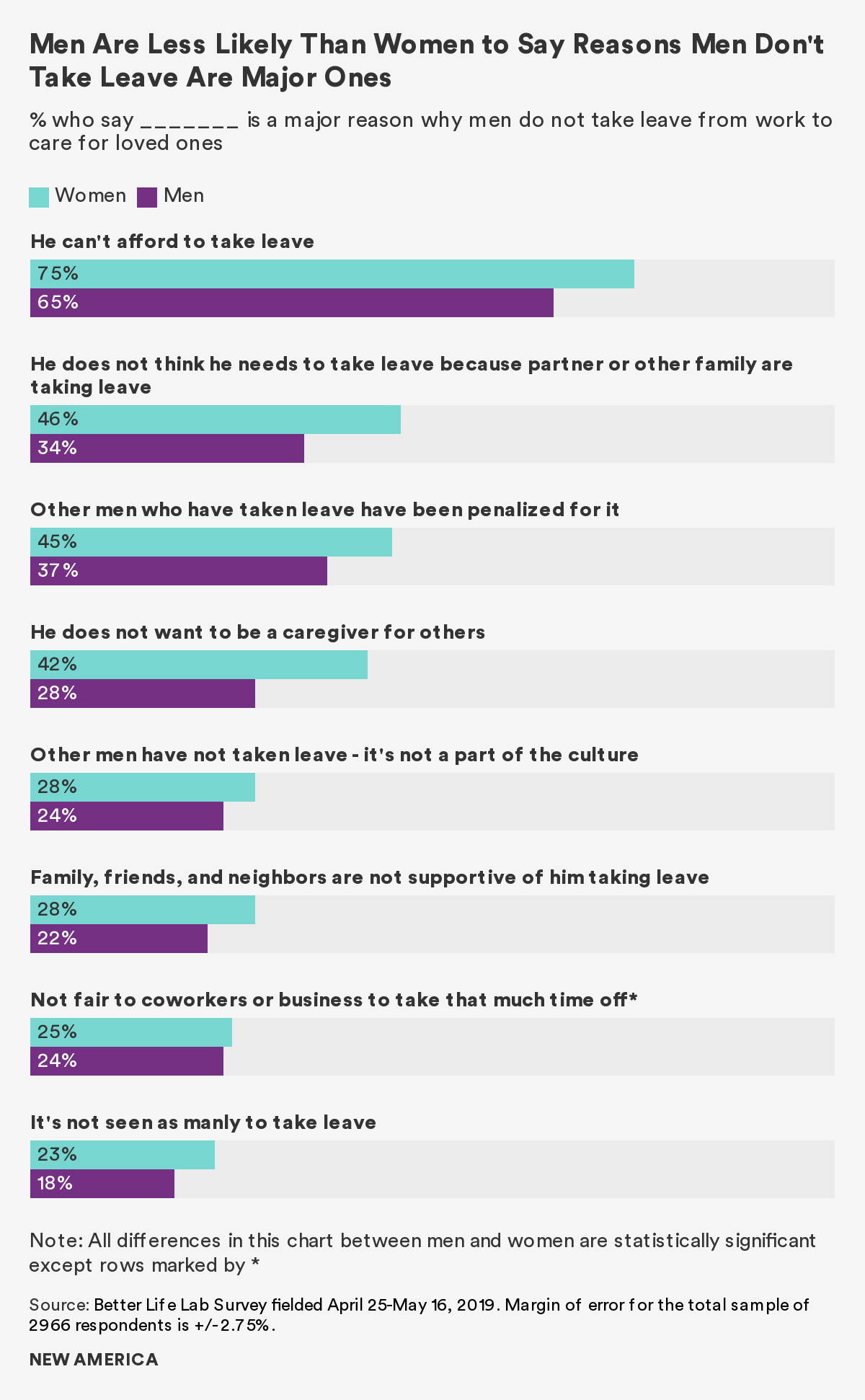
While women and men are generally in agreement about what helps motivate American men to take leave to care for loved ones, they do not share the same strength of beliefs about the barriers that keep men from leave. For all but one question, women are more likely than men to say that each of the possible reasons listed in our survey were major reasons men don’t take leave. Women were especially more likely to say that men not wanting to be caregivers shapes men’s caregiving decisions (42 percent of women versus 28 percent of men). Women are also more likely than men to think men believe they do not need to take leave because their partner or other family members will take leave instead—46 percent of women say this is a major reason compared with 34 percent of men. Men are more likely to believe that visible penalties against other men act as a more powerful deterrent than men not thinking they need to take leave because others in their family will manage care. Where do men and women agree about barriers to men taking leave? Both say concerns about fairness to coworkers and the business are an equal mix of major and minor reasons.
The women in our qualitative discussion groups said they saw men struggling with meeting society’s expectations that they be breadwinners devoted to work and providing for their families, with their needs or desires to take leave from work to be more actively involved in caregiving.
“I think women would use [paid leave] most. Men are expected to provide for the family.” –Linda C., 56 years old, local municipality worker, Connecticut.
Russell A., a 33-year-old father of four who participated in the fathers of young children discussion, like many other men in the group, said that women took priority, and needed longer leaves, particularly after the birth of a child. “I think it’s important for mothers to stay with their child for as long as possible and these days it seems that women often go back to work after just a couple of weeks after giving birth, which I think really sucks for their health (physical and emotional) and for the bond between mothers and their kids. But I also see men using much time provided by this benefit as well.”
Yet most of the women and many men in our focus groups supported the idea of gender neutral, or gender equal caregiving leaves. Their reasoning was often driven by a sense of fairness for men and their life experiences.
“I think it is unfair that men don’t get that time to bond as well as help their wives with a newborn. My husband was very helpful and was able to take a couple of weeks, but we both could have used more time together. I think everyone should take the max time allowed, if they are financially able. It is a fleeting moment in time, when you think about working 50 years, who gives a #$%^ about a couple of months.” –Lauren F., 37 years old, sales, mother of three, Arkansas.
“I would hope it would be used equally. Unfortunately, there is still a view by some that it is a woman’s responsibility to handle these matters. The barrier would be made by uneducated people with old-fashioned ideals. People who think men should work and women should take care of their families.” –Thomas H., 47 years old, sales, father of two, Minnesota.
Lower-income Americans have a different perspective on what does and does not motivate men to take leave.
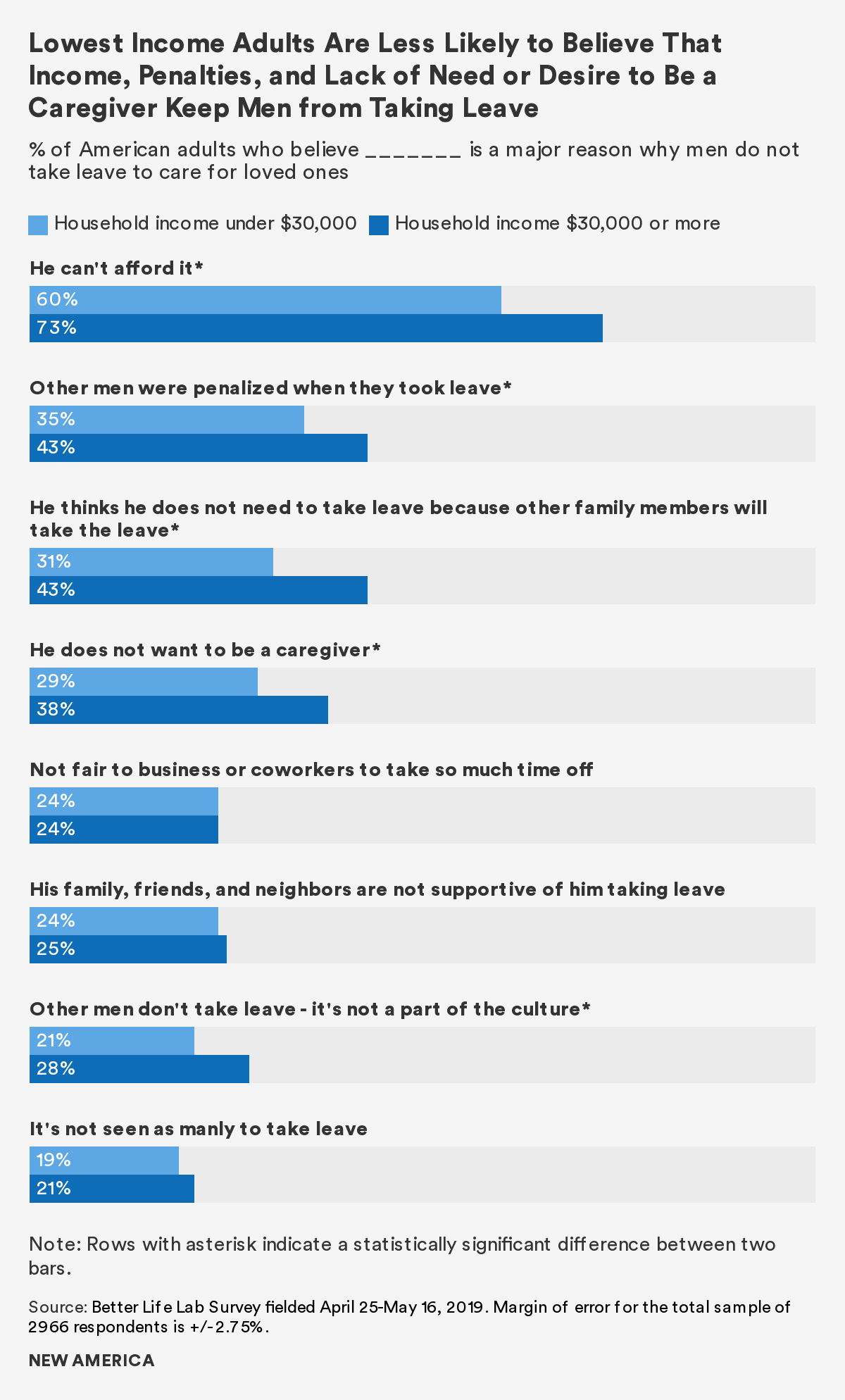
As we will detail later in the report, the lowest-income Americans face unique challenges in accessing leave from work, especially getting paid when they take that leave and being able to afford it when they don’t. Despite, or perhaps because of, their coping with these economic struggles, Americans in households earning less than $30,000 are less likely to see most issues as enticements to men or as barriers to men taking leave from work to care for loved ones.
Perhaps because they have already been forced to find ways to manage the financial and job-related headaches that accompany the need to provide care with few resources and little to no policy or workplace support, lower-income Americans are, surprisingly, less likely than higher-income individuals to say not being able to afford to take leave is a reason why men don’t take it. Nearly three-quarters (73 percent) of those earning more than $30,000 or more annually think ability to afford to take leave is a major reason why men don’t take leave, while just 60 percent of those earning less than $30,000 say the same.
The respondents from low-income households also do not agree with respondents from higher- income households that penalties, lack of desire to care, or thinking other family members will cover leave are major reasons why men do not take leave to care.
In our focus group discussions, one father of young children said that low-income families would benefit the most from a public or company-paid caregiving leave policy. “This policy would allow them extra time to remedy the situation instead of having to rely on the help of others,” said Stefan B. However, Martin L., a 42-year-old father of two, worried that those lower-wage workers would be fearful about taking caregiving leave. “I could see how unskilled labor may be a little frightful of using it, for fear of losing their jobs. There are plenty of labor laws that are ignored or bent.”
Authors' Note
Throughout the report, we use the terminology for racial categories used in the NORC survey panel. We do this to maintain clarity for readers and because other terminology for these classifications can change how respondents would self-identify, thus changing the accuracy of our findings. For instance, someone who identifies as Black in the NORC panel may not identify as African American. We have opted to remain consistent with the classifications in the NORC survey panel to ensure maximum accuracy between participants’ self-identification and our findings.
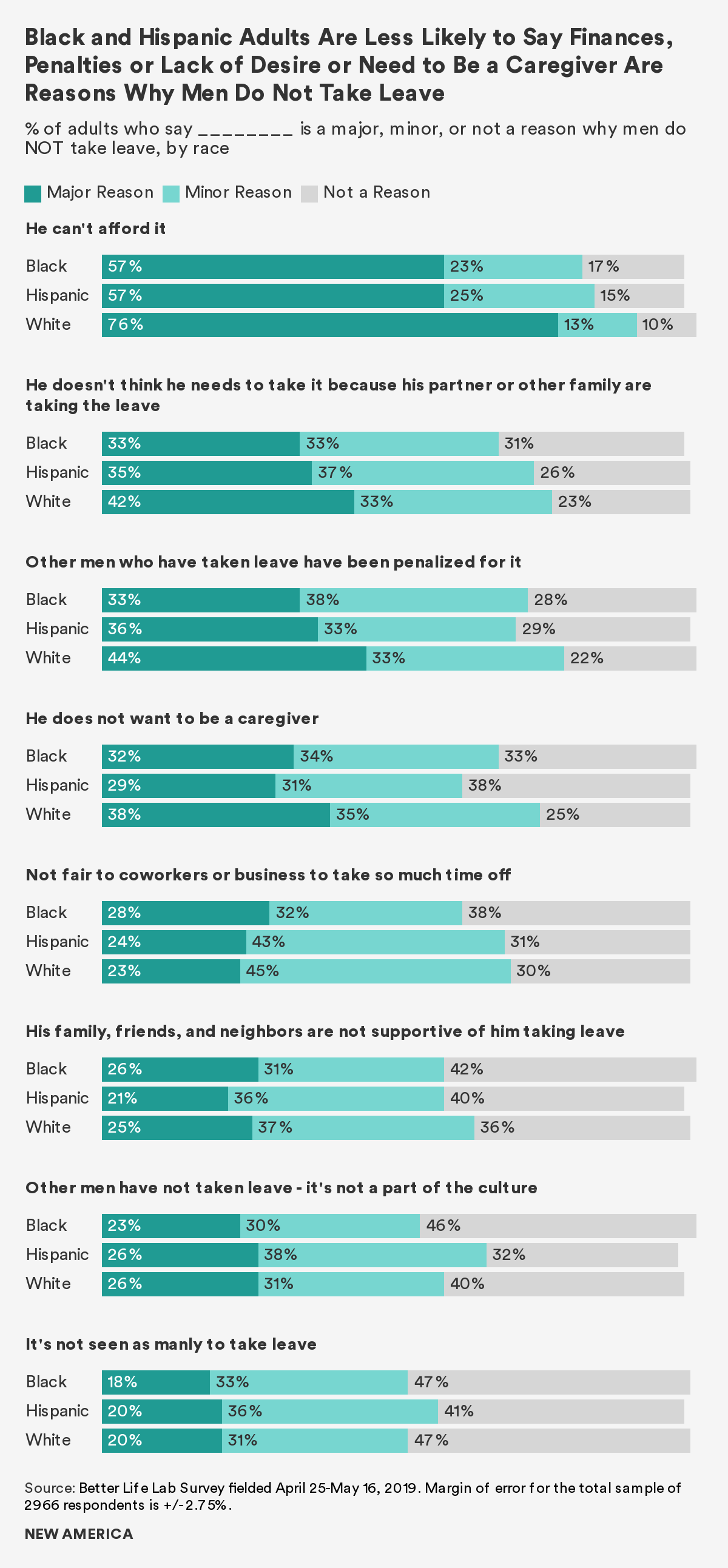
Black Americans and Hispanic Americans differ from white Americans in what they believe motivates men to take leave and bars them from taking it.
Overall, white Americans are more likely than Black or Hispanic Americans to say most of the reasons that potentially encourage men to take leave are major reasons, while Black and Hispanic adults are more skeptical of the impact of these issues and are more likely to say these are minor reasons if they are reasons at all.
Black Americans are more likely to see the power of role models.
Black (20 percent) and Hispanic (21 percent) Americans are more likely than white (15 percent) Americans to believe in the power of public figures modeling leave for men, and to say that it is a major reason why men might take leave.
Somewhat contradictorily, Black adults and white adults are more likely than Hispanic adults to say a lack of a culture of leave taking among other men is not a reason why men don’t take leave: Black adults (46 percent), white adults (40 percent), versus Hispanic adults (32 percent). This may indicate a distinction in beliefs among Hispanics in particular about the power of high-profile role models vs. the power of everyday peers on men's behavior.
Fairness to coworkers is more of a concern to Hispanic and white Americans.
White and Hispanic adults are more likely than Black adults to report that this is a minor reason why men do not take time off from work—with 45 percent of white adults and 43 percent of Hispanic adults saying it isn’t fair to businesses and coworkers to take that much time off, while 32 percent of Black adults say it’s a minor reason. Black adults are more likely than white adults to say it is not a reason (38 percent of Black adults versus 30 percent of white adults).
Younger adults are more concerned about norms of masculinity and the impact of role models than older adults.
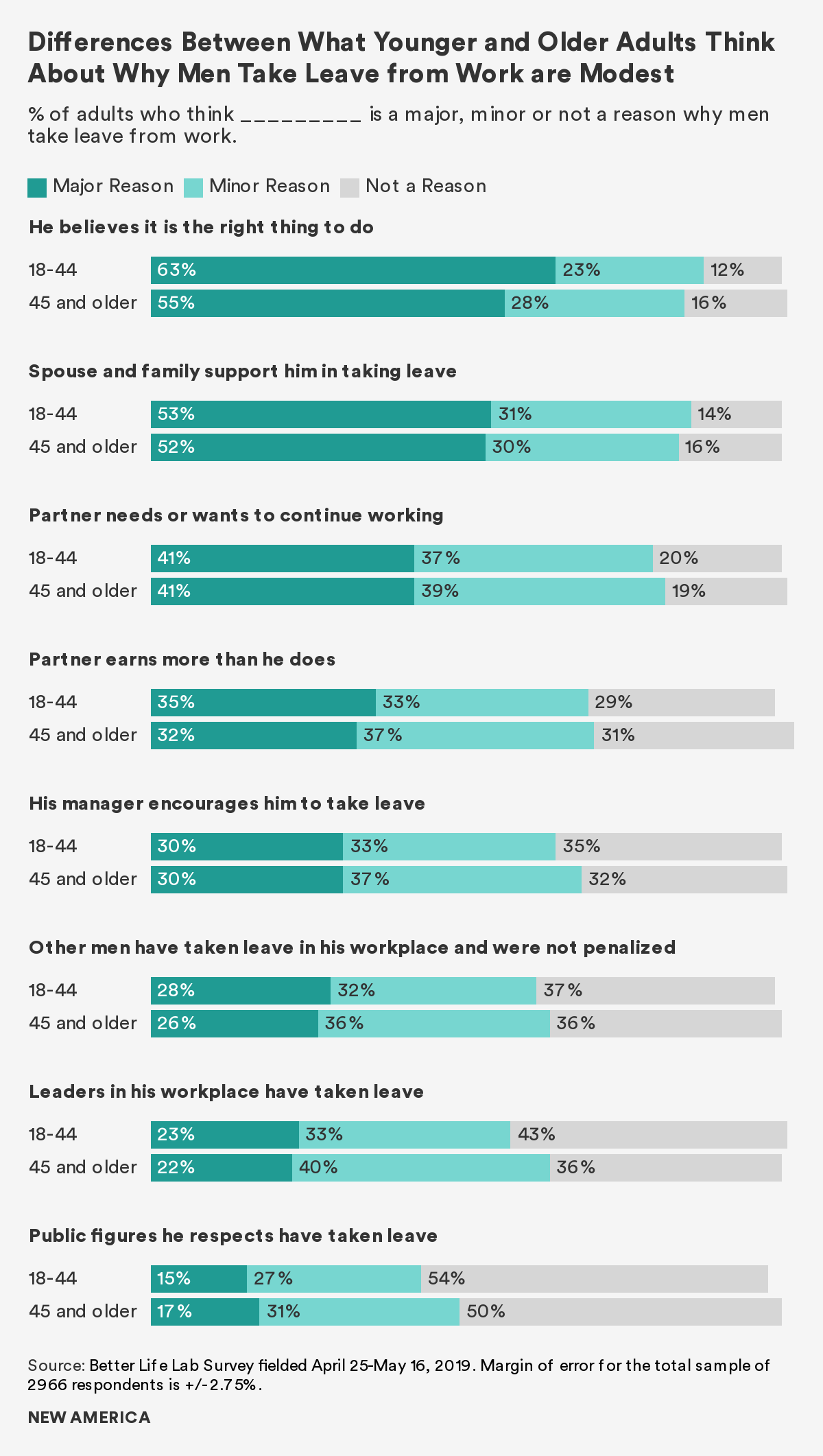
While younger and older adults mostly agree on what constitutes a major reason why men take leave, younger adults are more likely to say that most reasons are minor reasons, while older adults are more likely to say those same reasons do not influence men’s decisions around taking leave.
There are a few key differences in what younger and older Americans think serve as barriers to men taking leave.
Whether or not leave-taking is seen as manly and how that influences men’s leave-taking behavior reveals some differences between younger and older adults. Younger adults under 45 are more likely to see this as a major reason why men do not take leave (25 percent of adults under 45 compared with 18 percent of adults 45 and older). The youngest men are a bit more likely than older men to see this as a minor reason, while men 45 and older were more likely to say the manliness of leave is not a reason why men don’t take leave.
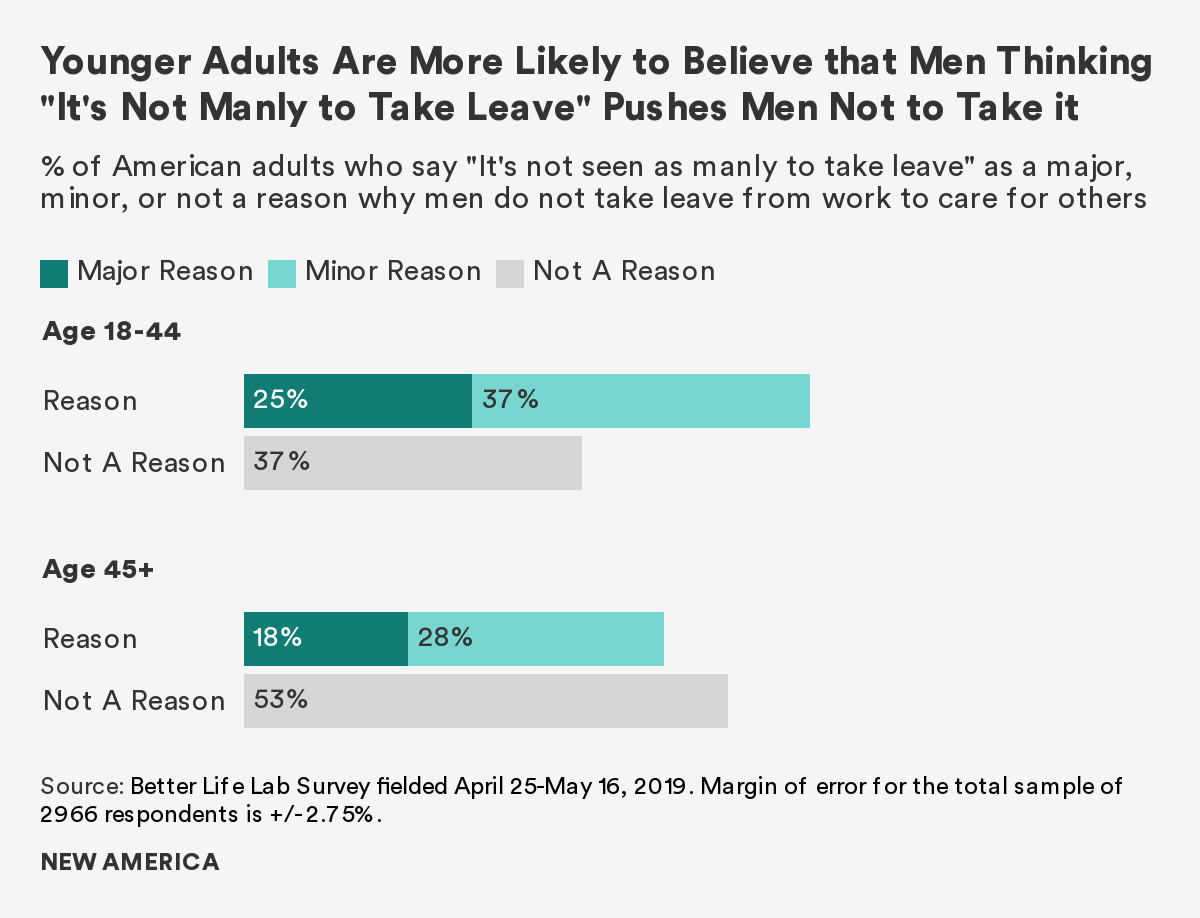
This finding is interesting and perplexing. On the one hand, it may signal a greater prevalence of more traditional gender ideals rather than egalitarian views among the younger adult cohort, something that a 2017 longitudinal analysis of high school seniors’ attitudes found.22 However, the finding does not necessarily mean that younger Americans themselves believe taking leave is not manly. It may signal that these young men are simply more likely to see these ideals as prevalent in society as a whole and as powerful in affecting behavior. The finding may also reflect young Americans’ life stage and lesser experience with thinking about or planning for caregiving, parenting, and other behaviors which have been shown to impact gender ideology.
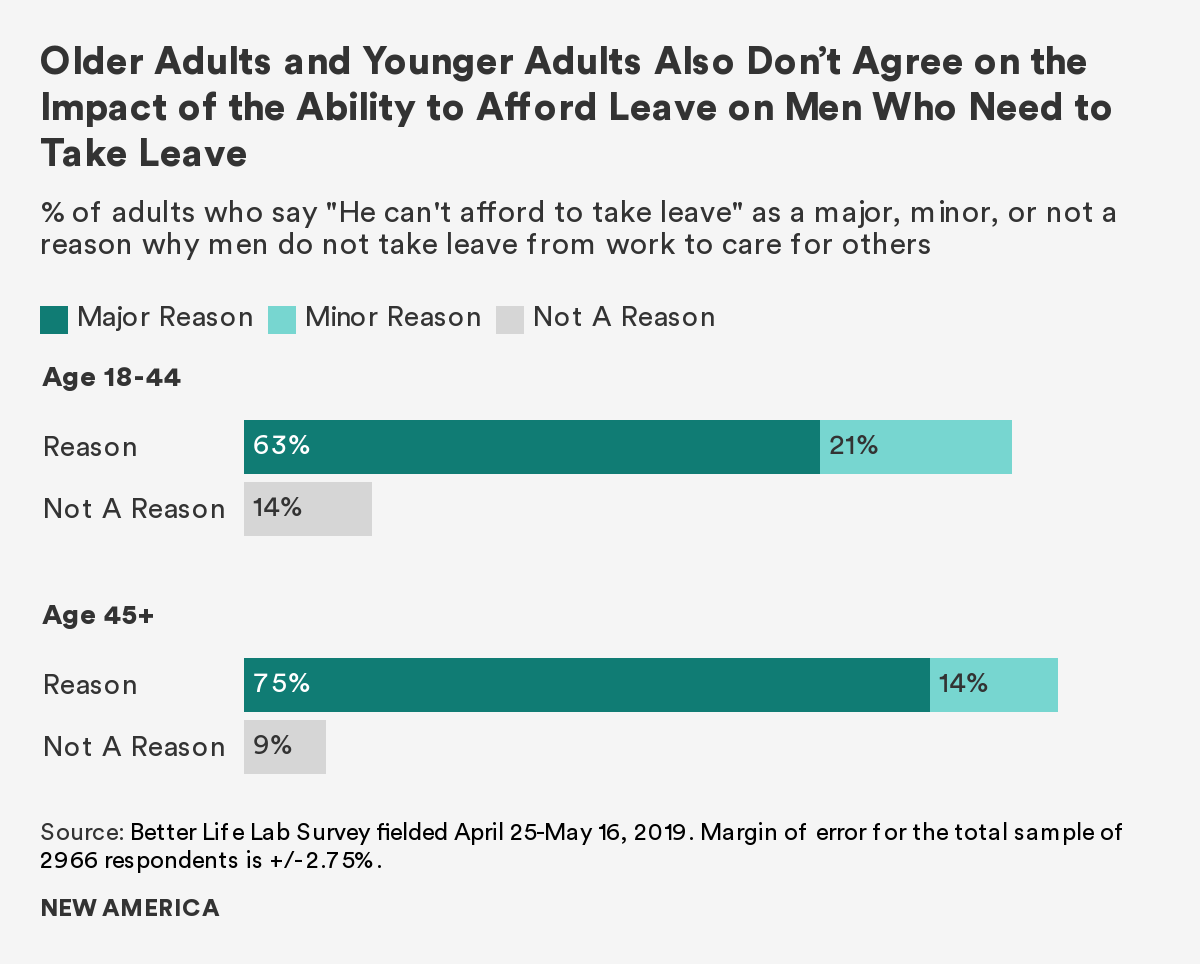
Older adults and younger adults also don’t agree on the impact of the ability to afford leave on men who need to take it—though more than half of both groups agree it is a major reason. Three quarters of adults 45 and older think an inability to afford to take leave is a major barrier to men’s use of leave from work, while 63 percent of adults 44 and younger believe it is a major reason.
Younger adults are more likely than older adults to say that role models are a minor reason why men take leave. Older adults are more likely to say that having role models isn’t a reason why men take leave from work.
Adults under 45 are more likely than older adults to say that other men not taking leave is a minor reason why men do not take leave themselves (37 percent of adults under 45 versus 29 percent of adults 45 and older). Older adults are most likely to say that lack of models is not a reason why men do not take leave. Similarly, younger adults (18–44) are more likely than those 45 and older to say that role modeling by workplace leaders is a minor reason why men take leave (40 percent of those 18–44 versus 33 percent of those 45 and older), while older adults are most likely to say it’s not a reason.

Lifting the Barriers to Paid Family and Medical Leave for Men in the United States
- Summary of Findings
- Introduction
- What Americans Think about Why Men Do and Do Not Take Leave from Work to Care for Loved Ones
- Who Has Access to and Uses Family and Medical Leave from Work?
- Six in 10 Americans Anticipate Needing to Take Leave from Work in the Future
- Affording Leave: How Americans Get Pay When They Take Leave and How They Cover the Gaps
- Conclusion
- Methods
- Bibliography
Citations
- David Cotter and Joanna Pepin, Trending Towards Traditionalism? Changes in Youths’ Gender Ideology, (Austin: Council of Contemporary Families, 2017), https://contemporaryfamilies.org/2-pepin-cotter-traditionalism