A Chapter of: The “Proxy War” Prism on Yemen
Introduction
On September 21, 2014 the Houthis, a Zaidi Shia military group, seized the Yemeni capital of Sanaa, sparking the latest round of internationalized conflict in Yemen. While the Houthis waged six battles against the Yemeni central government in the first decade of the twenty-first century, the effective takeover of Sanaa by the Houthis and their allies spawned a political and military crisis unparalleled since the 1960s. This crisis included the Houthi kidnapping of Yemeni President Abdo Rabbu Mansour Hadi’s chief of staff, Ahmed Awad bin Mubarak; the mass resignation of the Yemeni cabinet; the extended house arrest of Hadi himself; and Hadi’s subsequent declaration of war on the Houthis following his escape from Sanaa to Aden, which he then declared Yemen’s temporary capital.1
On March 26, 2015, the Saudi-led coalition began bombing sites in Yemen on the basis of an invitation from the internationally-recognized Yemeni government to aid the state in its fight against the Houthis.2 The invitation for intervention was warmly received, as it appealed to widespread Saudi- and Gulf-state anxiety regarding the Houthis’ relationship with Iran and their perceived role as Iranian proxies. The Saudi-led military coalition, therefore, quickly decided to intervene in Yemen under the framing of restoring the internationally recognized Yemeni government to power.
The warring parties and media coverage have largely cast the ensuing internationalized conflict as a proxy war, a “Saudi war on Yemen” or “Iranian … aggression” using the Houthis as “tools.”3 In this framework, the primary narrative of the conflict is a story of war between Arab states (mostly Saudi Arabia and the United Arab Emirates) and Iran, tied to broader regional tensions but fought by those states’ respective proxies.
Over the summer of 2019, the war in Yemen and its internationalization escalated. The separatist Southern Transitional Council (STC) took hold of Aden and southwestern Yemen.4 The Houthis took credit for a series of increasingly brazen drone attacks within the Saudi interior, most notably claiming credit for the September 14 strikes on the Saudi Aramco oil facilities in Abaqiq and Khurais that reportedly disrupted up to half of Saudi oil production.5 Given the widely-reported Iranian provision of drones to the Houthis, the target’s relevance to the Iranian-Saudi rivalry, and the Houthis’ claim of the attack, many initially described the strike as a Houthi attack on behalf of Iran. Yet, later reporting suggested the strike may not have come from Yemen at all but rather from militias in Iraq or from within Iran itself, illustrating the ways in which the proxy narrative of the Yemen war can separate from the facts of the conflict itself, all the while underlining Yemen’s increasing integration into regional battle fronts, if on a symbolic basis.6 France, Germany, and the United Kingdom joined the United States in ascribing responsibility to Iran, but left conclusions regarding the strikes’ specific origins vague.7 All the while, the peace process, led by UN Special Envoy Martin Griffiths, has continued to stall, with initial momentum from the December 2018 Stockholm Agreement all but dissipating.8
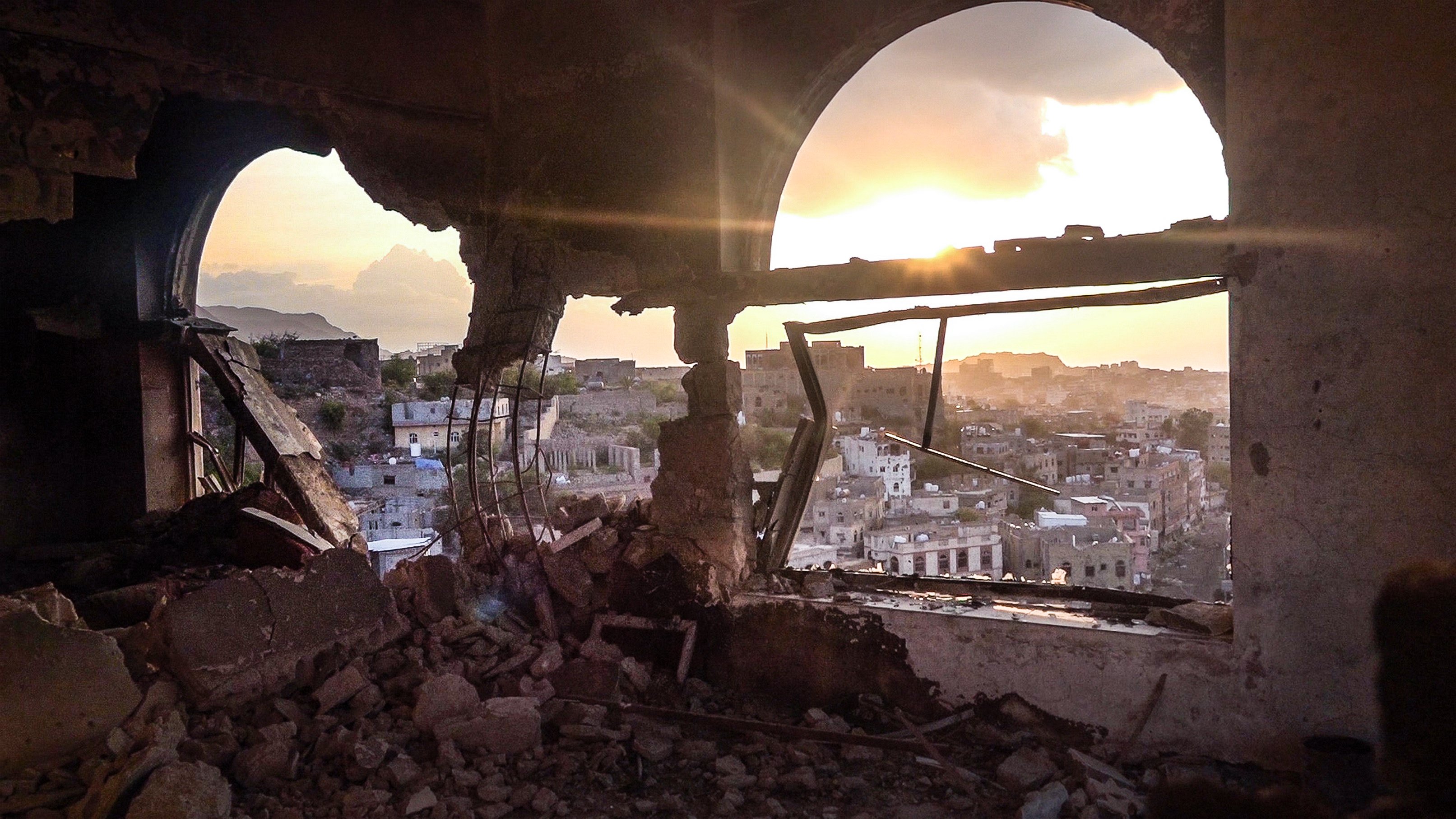
The narrative of a grand proxy war continues to hold sway, particularly in the wake of the attack on the Saudi Aramco oil facilities. Playing into the narrative can generate funds, recruits, and international public support for both the Saudi-led coalition and the Houthis. Yet, the character of the war in Taiz challenges representations of the Yemen war as primarily a clash between external states conducted via proxy agents. Yemen’s third largest city, Taiz, has been under effective siege by the Houthis since the conflict started. One of the most significant battlefields in the country, owing to its strategic importance as the gate between North and South Yemen, Taiz remains the scene of some of the war’s strongest and most devastating battles.
The battles and struggles within Taiz are not only between the Houthis and the rival Saudi- and Gulf-led coalition, but also within and across the coalition itself. Instead of a conflict between external states waged through well-controlled proxies, Taiz is the center of a militarized scrum between an amalgam of military and political factions, some of whom have proxy relationships with external powers.
Where they exist, proxy relationships are often weak and unstable, subject to the complex political dynamics of life in Taiz and in Yemen more broadly. The political party Islah, despite working with Saudi Arabia, retains substantial local roots in terms of financial and political support. Islah’s dominance over political and military life in Taiz and its ties to the Muslim Brotherhood has led the United Arab Emirates (UAE) to seek to counter its influence at the same time—often relying on other locally rooted political factions. The various military groups that make up the Saudi-led coalition are products of local, popular uprisings against the Houthis and, despite efforts to regularize them, they continue to operate with great de facto autonomy. In some cases, individuals like Abu Abbas have fueled their rise as independent power centers by playing different sponsors off of each other. The variety of sponsorship opportunities and local resources makes this a viable strategy even as it has opened space for proxy relationships outside of formal lines of command.
Nor is this a matter only for the coalition. The Houthis retain an identity deeply rooted in multiple rounds of warfare that predate the expanded relationship with Iran that has emerged over the course of the current war. The power of local politics to interrupt efforts at alliance formation involving both the Houthis and the coalition was demonstrated by the decision of General People’s Congress party leaders in Taiz to reject their now-deceased national leader’s decision to align with the Houthis, instead viewing the Houthis as an invading force.
The sponsorship that underlies these relationships takes many forms. Iran, Saudi Arabia, and the UAE alike have provided financial support to their allies, in some cases going as far as to pay fighters salaries and provide homes in their capitals for the leaders of allied military groups. The coalition has provided military and air support, coordination, and equipment, while Iran and its regional allies have provided the Houthis with access to a regional network and the resultant training and technological depth. It is difficult to assess what the war would look like without this support; regardless, the support has undeniably deepened various groups’ capacity and bolstered their ability to continue fighting.
These proxy relationships can benefit sponsors, particularly those whose strategies do not require substantial control over proxy agents’ more routine activity. The ambiguity—at least publicly—generated by Iran’s ties with the Houthis may even serve Iranian strategic purposes, regardless of the existence or level of control, when it comes to strikes alleged to have come from more tightly controlled Iranian forces like those on the Saudi Aramco facilities. The existence of such proxy relationships and strategies must be distinguished from narratives that view those relationships and strategies as defining either the identity and interests of the local parties to the conflict or the conflict as a whole.9
Yemen is strategically located, and the international and regional components of the conflict are important and worthy of analysis. However, true understanding of the conflict in Yemen can only be achieved through knowledge of the Yemeni forces on the ground, their reasons for fighting, and how their fight is reshaping the wider dynamics in the country.
Reading the Yemen war primarily through the lens of proxy warfare can fuel the conflict itself by playing into the strategic uses of the frame by various warring parties and by helping to internationalize the conflict. Ending the Yemen war will require recognizing and responding to the local interests at the root of the war, an effort made more difficult by the proxy war framework.
This report utilizes field research conducted in the Yemeni city of Taiz to illustrate the limitations of reducing the Yemen war to proxy competition between external powers. Research was conducted from April through July of 2019 using multiple field researchers. The researchers and their interviewees remain anonymous in this report out of concern for their safety in an ongoing conflict. Researchers were tasked with assessing the present situation in Taiz, gathering information through multiple interviews with fighters, political leaders, and local residents of Taiz (known as Taizis). Where not otherwise footnoted or common knowledge, all information herein is derived from these interviews.
The report is divided into six sections, including this one. The next section examines how the war came to Taiz, the development of both local and proxy competition in the war, and how multiple belligerents use the proxy narrative to support their war efforts despite maintaining local interests. Sections three through five examine the various forces active in Taiz and their tensions in more detail at the political, military, and governance levels, respectively. The sixth and concluding section draws lessons from the Yemen war’s manifestation in Taiz for Yemen more broadly and for the Greater Middle East and its periphery, which is wracked by proxy and civil wars characterized by similar dynamics. In addition, an appendix provides a detailed examination of the military groups involved in the Yemen war in Taiz.
Citations
- Helen Lackner, Yemen in Crisis: Autocracy, Neo-Liberalism and the Disintegration of a State (London: Saqi Books, 2017), 42–57.
- Joe Dyke, “Is the Saudi War on Yemen Legal?,” The New Humanitarian, April 16, 2019, http://www.thenewhumanitarian.org/analysis/2015/04/03/saudi-war-yemen-legal
- For a characteristic framing on the first end, see: Juan Cole, “Trump-Saudi War on Yemen Collapsing as Southern Separatists Take Aden,” Informed Comment, August 12, 2019, https://www.juancole.com/2019/08/collapsing-southern-separatists.html. For a characteristic framing on the second, see: Faith Salama, “Saudi Arabia Ups the Ante on Iran-Backed Houthis,” The Arab Weekly, June 16, 2019, https://thearabweekly.com/saudi-arabia-ups-ante-iran-backed-houthis
- Helen Lackner, “Yemen. A Misleading Withdrawal From the Emirates,” OrientXXI, August 26, 2019, https://orientxxi.info/magazine/the-yemen-war-impact-of-recent-developments
- Nada Altaher, Jennifer Hauser, and Ivana Kottasova, “Yemen’s Houthi Rebels Claim a ‘Large-Scale’ Drone Attack on Saudi Oil Facilities,” CNN, September 14, 2019, https://www.cnn.com/2019/09/14/middleeast/yemen-houthi-rebels-drone-attacks-saudi-aramco-intl/index.html
- Geoff Brumfiel, “What We Know About The Attack On Saudi Oil Facilities,” NPR, September 19, 2019, https://www.npr.org/2019/09/19/762065119/what-we-know-about-the-attack-on-saudi-oil-facilities
- John Irish and Kylie MacLellean, “European Powers Back U.S. in Blaming Iran for Saudi Oil Attack, Urge Broader Talks,” Reuters, September 23, 2019, https://www.reuters.com/article/us-usa-iran-un/european-powers-back-us-in-blaming-iran-for-saudi-oil-attack-urge-broader-talks-idUSKBN1W81TK
- “Briefing Security Council on Yemen, Special Envoy Warns Oil Facilities Attack Could Threaten Regional Stability, Calls for Inclusive Process to End Fighting,” United Nations, September 16, 2019, https://www.un.org/press/en/2019/sc13952.doc.htm
- See, for example, on the question of proxy relationships and different models of understanding proxy war and what constitutes a proxy: David Sterman, “How Do We Move Past Proxy Paralysis,” New America Weekly, March 7, 2019, https://www.newamerica.org/weekly/edition-239/redfine-proxy-warfare-strategy-identity/