The “Proxy War” Prism on Yemen
Abstract
Taiz, Yemen’s third most populous city, is engulfed by war, having emerged in early 2015 as the center of what many observers describe as a proxy war between the Saudi-led coalition and the Houthis, an armed Zaidi Shia revivalist movement with ties to Iran. Yet this lens can easily misrepresent the war and complicate efforts to resolve the conflict.
This report, part of a joint initiative on the Future of Proxy Warfare of New America’s International Security program and Arizona State University’s Center on the Future of War, draws upon field research in Taiz to uncover the local dynamics of the Yemen war that are often lost when it is portrayed as primarily a proxy war.
Acknowledgments
This paper would not be possible without the support of our colleagues at New America and Arizona State University and the funding of the Carnegie Corporation of New York. The authors would like to thank Gabrielle Hamilton Stowe for her research and editing of this paper, Mohamed al-Qadhi for providing useful feedback and our field researchers, who we unfortunately cannot name for security reasons, for providing us with data otherwise unobtainable.
Downloads
Executive Summary
Taiz, Yemen’s third most populous city and the capital of its largest governorate (province) of the same name, is engulfed by war. Long seen as the cultural heart of the country, Taiz emerged in early 2015 as the center of what many observers describe as a proxy war between the Saudi-led coalition and the Houthis, an armed Zaidi Shia revivalist movement with ties to Iran.
The current military situation in Taiz is a stalemate between the Houthis and a diverse, loosely formed coalition of anti-Houthi groups. Having surrounded and besieged the city of Taiz, the Houthis remain in control of most of its entrances and exits, controlling the passage of goods and people along with a strategically critical north-south gateway. The conflict in Taiz is emblematic of the way regional rivalries between Gulf States and Iran and hyperlocal competition for power and influence have played out and intersected across Yemen.
Foreign powers play an important role in the conflict by seeking to impose their own goals through sponsorship of armed factions and political groups. As a strategic location abutting Saudi Arabia’s southern border and the shipping lanes of the Red Sea, Yemen holds importance for several foreign powers’ regional agendas. This has led many commentators to analyze the conflict through the lens of proxy warfare.
Yet this lens can easily misrepresent the war as one in which Saudi Arabia, the Gulf States, and Iran move their proxies like chess pieces seeking comparative advantage, while also reducing the war as a whole to these movements. It is not only a matter of misdiagnosing the dynamics involved; framing the conflict as primarily a proxy war between Iran and Saudi Arabia complicates efforts to resolve the conflict. The framing provides strategic advantages for many of the belligerent parties who use it to fuel their war efforts. The narrative itself further internationalizes the conflict, obscuring the essential nature of the war in Yemen, which is at heart an internal Yemeni political conflict.
The internationalization of what was originally a domestic political struggle has made the conflict more complex, in turn making it more difficult to resolve, but it has not fundamentally altered the goals of the original domestic combatants. If the war is ever to end, the goals of Yemenis must be recognized for what they are, and elevated in importance above those of the international parties to the conflict.
Key Findings:
- Various military forces in Yemen use the proxy war frame as a propaganda tool to recruit and raise funds, but the day-to-day experience of the conflict is highly local. In many cases, rather than a top-down proxy relationship of control, local forces exercise substantial agency despite receiving sponsorship, pursuing their own interests and using foreign sponsorship opportunities for their own purposes.
- The complex web of forces and sponsorship opportunities has empowered individuals—in addition to groups—to act as major players in Yemen’s war. Abu al-Abbas, the leader of the Abu al-Abbas Brigades, for example, skillfully drew on Saudi, Emirati, local, and potentially al-Qaida support to drive his rise in influence.
- Though the Houthis have increasingly aligned with Iran, they continue to enmesh themselves in Yemen’s wider body politic. Prior to the current war, the Houthis waged six wars against the Yemeni government in the twenty-first century, during which there is little evidence of firm Iranian command and control. Iran’s reported provision of missiles and drones shapes the conflict, but its roots are local and would not disappear were Iran to fully abandon the Houthis.
- Foreign powers’ development of proxy relationships in the form of external sponsorship has made the conflict more complex and difficult to resolve via negotiations. Such foreign relationships have resulted in an interplay between an expanded and shifting set of local forces, national political factions, and international parties, each of which have their own interests and aims. This expanded set of armed and political groups fuels tensions and complicates efforts to end the violence through a negotiated settlement.
- Uncritical adoption of the proxy war narrative poses challenges for peacemakers and policymakers, increasing the risks of escalation and frustrating efforts at conflict resolution. The narrative obscures the true localized nature of the conflict and ignores the goals and ambitions of key domestic stakeholders.
- These wider divisions have dragged out the battle against the Houthis while providing growth opportunities to extremist groups like al-Qaida in the Arabian Peninsula (AQAP). Al-Qaida’s strength has diminished recently and its power should not be exaggerated, but the group stands to benefit from persistent conflict.
Introduction
On September 21, 2014 the Houthis, a Zaidi Shia military group, seized the Yemeni capital of Sanaa, sparking the latest round of internationalized conflict in Yemen. While the Houthis waged six battles against the Yemeni central government in the first decade of the twenty-first century, the effective takeover of Sanaa by the Houthis and their allies spawned a political and military crisis unparalleled since the 1960s. This crisis included the Houthi kidnapping of Yemeni President Abdo Rabbu Mansour Hadi’s chief of staff, Ahmed Awad bin Mubarak; the mass resignation of the Yemeni cabinet; the extended house arrest of Hadi himself; and Hadi’s subsequent declaration of war on the Houthis following his escape from Sanaa to Aden, which he then declared Yemen’s temporary capital.1
On March 26, 2015, the Saudi-led coalition began bombing sites in Yemen on the basis of an invitation from the internationally-recognized Yemeni government to aid the state in its fight against the Houthis.2 The invitation for intervention was warmly received, as it appealed to widespread Saudi- and Gulf-state anxiety regarding the Houthis’ relationship with Iran and their perceived role as Iranian proxies. The Saudi-led military coalition, therefore, quickly decided to intervene in Yemen under the framing of restoring the internationally recognized Yemeni government to power.
The warring parties and media coverage have largely cast the ensuing internationalized conflict as a proxy war, a “Saudi war on Yemen” or “Iranian … aggression” using the Houthis as “tools.”3 In this framework, the primary narrative of the conflict is a story of war between Arab states (mostly Saudi Arabia and the United Arab Emirates) and Iran, tied to broader regional tensions but fought by those states’ respective proxies.
Over the summer of 2019, the war in Yemen and its internationalization escalated. The separatist Southern Transitional Council (STC) took hold of Aden and southwestern Yemen.4 The Houthis took credit for a series of increasingly brazen drone attacks within the Saudi interior, most notably claiming credit for the September 14 strikes on the Saudi Aramco oil facilities in Abaqiq and Khurais that reportedly disrupted up to half of Saudi oil production.5 Given the widely-reported Iranian provision of drones to the Houthis, the target’s relevance to the Iranian-Saudi rivalry, and the Houthis’ claim of the attack, many initially described the strike as a Houthi attack on behalf of Iran. Yet, later reporting suggested the strike may not have come from Yemen at all but rather from militias in Iraq or from within Iran itself, illustrating the ways in which the proxy narrative of the Yemen war can separate from the facts of the conflict itself, all the while underlining Yemen’s increasing integration into regional battle fronts, if on a symbolic basis.6 France, Germany, and the United Kingdom joined the United States in ascribing responsibility to Iran, but left conclusions regarding the strikes’ specific origins vague.7 All the while, the peace process, led by UN Special Envoy Martin Griffiths, has continued to stall, with initial momentum from the December 2018 Stockholm Agreement all but dissipating.8
The narrative of a grand proxy war continues to hold sway, particularly in the wake of the attack on the Saudi Aramco oil facilities. Playing into the narrative can generate funds, recruits, and international public support for both the Saudi-led coalition and the Houthis. Yet, the character of the war in Taiz challenges representations of the Yemen war as primarily a clash between external states conducted via proxy agents. Yemen’s third largest city, Taiz, has been under effective siege by the Houthis since the conflict started. One of the most significant battlefields in the country, owing to its strategic importance as the gate between North and South Yemen, Taiz remains the scene of some of the war’s strongest and most devastating battles.
The battles and struggles within Taiz are not only between the Houthis and the rival Saudi- and Gulf-led coalition, but also within and across the coalition itself. Instead of a conflict between external states waged through well-controlled proxies, Taiz is the center of a militarized scrum between an amalgam of military and political factions, some of whom have proxy relationships with external powers.
Where they exist, proxy relationships are often weak and unstable, subject to the complex political dynamics of life in Taiz and in Yemen more broadly. The political party Islah, despite working with Saudi Arabia, retains substantial local roots in terms of financial and political support. Islah’s dominance over political and military life in Taiz and its ties to the Muslim Brotherhood has led the United Arab Emirates (UAE) to seek to counter its influence at the same time—often relying on other locally rooted political factions. The various military groups that make up the Saudi-led coalition are products of local, popular uprisings against the Houthis and, despite efforts to regularize them, they continue to operate with great de facto autonomy. In some cases, individuals like Abu Abbas have fueled their rise as independent power centers by playing different sponsors off of each other. The variety of sponsorship opportunities and local resources makes this a viable strategy even as it has opened space for proxy relationships outside of formal lines of command.
Nor is this a matter only for the coalition. The Houthis retain an identity deeply rooted in multiple rounds of warfare that predate the expanded relationship with Iran that has emerged over the course of the current war. The power of local politics to interrupt efforts at alliance formation involving both the Houthis and the coalition was demonstrated by the decision of General People’s Congress party leaders in Taiz to reject their now-deceased national leader’s decision to align with the Houthis, instead viewing the Houthis as an invading force.
The sponsorship that underlies these relationships takes many forms. Iran, Saudi Arabia, and the UAE alike have provided financial support to their allies, in some cases going as far as to pay fighters salaries and provide homes in their capitals for the leaders of allied military groups. The coalition has provided military and air support, coordination, and equipment, while Iran and its regional allies have provided the Houthis with access to a regional network and the resultant training and technological depth. It is difficult to assess what the war would look like without this support; regardless, the support has undeniably deepened various groups’ capacity and bolstered their ability to continue fighting.
These proxy relationships can benefit sponsors, particularly those whose strategies do not require substantial control over proxy agents’ more routine activity. The ambiguity—at least publicly—generated by Iran’s ties with the Houthis may even serve Iranian strategic purposes, regardless of the existence or level of control, when it comes to strikes alleged to have come from more tightly controlled Iranian forces like those on the Saudi Aramco facilities. The existence of such proxy relationships and strategies must be distinguished from narratives that view those relationships and strategies as defining either the identity and interests of the local parties to the conflict or the conflict as a whole.9
Yemen is strategically located, and the international and regional components of the conflict are important and worthy of analysis. However, true understanding of the conflict in Yemen can only be achieved through knowledge of the Yemeni forces on the ground, their reasons for fighting, and how their fight is reshaping the wider dynamics in the country.
Reading the Yemen war primarily through the lens of proxy warfare can fuel the conflict itself by playing into the strategic uses of the frame by various warring parties and by helping to internationalize the conflict. Ending the Yemen war will require recognizing and responding to the local interests at the root of the war, an effort made more difficult by the proxy war framework.
This report utilizes field research conducted in the Yemeni city of Taiz to illustrate the limitations of reducing the Yemen war to proxy competition between external powers. Research was conducted from April through July of 2019 using multiple field researchers. The researchers and their interviewees remain anonymous in this report out of concern for their safety in an ongoing conflict. Researchers were tasked with assessing the present situation in Taiz, gathering information through multiple interviews with fighters, political leaders, and local residents of Taiz (known as Taizis). Where not otherwise footnoted or common knowledge, all information herein is derived from these interviews.
The report is divided into six sections, including this one. The next section examines how the war came to Taiz, the development of both local and proxy competition in the war, and how multiple belligerents use the proxy narrative to support their war efforts despite maintaining local interests. Sections three through five examine the various forces active in Taiz and their tensions in more detail at the political, military, and governance levels, respectively. The sixth and concluding section draws lessons from the Yemen war’s manifestation in Taiz for Yemen more broadly and for the Greater Middle East and its periphery, which is wracked by proxy and civil wars characterized by similar dynamics. In addition, an appendix provides a detailed examination of the military groups involved in the Yemen war in Taiz.
Citations
- Helen Lackner, Yemen in Crisis: Autocracy, Neo-Liberalism and the Disintegration of a State (London: Saqi Books, 2017), 42–57.
- Joe Dyke, “Is the Saudi War on Yemen Legal?,” The New Humanitarian, April 16, 2019, http://www.thenewhumanitarian.org/analysis/2015/04/03/saudi-war-yemen-legal
- For a characteristic framing on the first end, see: Juan Cole, “Trump-Saudi War on Yemen Collapsing as Southern Separatists Take Aden,” Informed Comment, August 12, 2019, https://www.juancole.com/2019/08/collapsing-southern-separatists.html. For a characteristic framing on the second, see: Faith Salama, “Saudi Arabia Ups the Ante on Iran-Backed Houthis,” The Arab Weekly, June 16, 2019, https://thearabweekly.com/saudi-arabia-ups-ante-iran-backed-houthis
- Helen Lackner, “Yemen. A Misleading Withdrawal From the Emirates,” OrientXXI, August 26, 2019, https://orientxxi.info/magazine/the-yemen-war-impact-of-recent-developments
- Nada Altaher, Jennifer Hauser, and Ivana Kottasova, “Yemen’s Houthi Rebels Claim a ‘Large-Scale’ Drone Attack on Saudi Oil Facilities,” CNN, September 14, 2019, https://www.cnn.com/2019/09/14/middleeast/yemen-houthi-rebels-drone-attacks-saudi-aramco-intl/index.html
- Geoff Brumfiel, “What We Know About The Attack On Saudi Oil Facilities,” NPR, September 19, 2019, https://www.npr.org/2019/09/19/762065119/what-we-know-about-the-attack-on-saudi-oil-facilities
- John Irish and Kylie MacLellean, “European Powers Back U.S. in Blaming Iran for Saudi Oil Attack, Urge Broader Talks,” Reuters, September 23, 2019, https://www.reuters.com/article/us-usa-iran-un/european-powers-back-us-in-blaming-iran-for-saudi-oil-attack-urge-broader-talks-idUSKBN1W81TK
- “Briefing Security Council on Yemen, Special Envoy Warns Oil Facilities Attack Could Threaten Regional Stability, Calls for Inclusive Process to End Fighting,” United Nations, September 16, 2019, https://www.un.org/press/en/2019/sc13952.doc.htm
- See, for example, on the question of proxy relationships and different models of understanding proxy war and what constitutes a proxy: David Sterman, “How Do We Move Past Proxy Paralysis,” New America Weekly, March 7, 2019, https://www.newamerica.org/weekly/edition-239/redfine-proxy-warfare-strategy-identity/
War Comes to Taiz
The city of Taiz has historically played a key role in Yemen’s political life. Long considered the cultural capital of Yemen, Taiz has occupied this space for roughly a millennium.10 Historically, Taiz was described as the “Damascus of Yemen” for its impressive agricultural and academic production. A cosmopolitan urban center in the 1960s, Taiz provided refuge for southerners agitating against British colonial rule and Republican revolutionaries fighting to oust the Zaidi isolationist Imamate, rendering it a strategic urban space for leftist movements to exchange ideas.11 Home to much of Yemen’s educated class, Taiz often functioned as the urban fulcrum of opposition to the political elite based in Sanaa, Yemen’s capital. In the 1980s, Taiz played a key role in the advancement of negotiations between the north and south in the lead up to national unification.12 Taiz was also a focal point of Yemen’s 2011 Arab Spring, which resulted in the ouster of longtime President Ali Abdullah Saleh. During the Arab Spring (between 2011 and 2012), Taiz was described as the “heart of the revolution.”13


Given its historical importance, foreign powers competed for influence in Taiz prior to the Houthi seizure of Yemen’s capital, with Gulf States in particular funding political parties within the city. Qatar, a major international player in the lead up to the current conflict, provided significant financial backing of Islah (particularly during the 2011 Arab Spring) and continued to back the party after the revolution.14 Iran, for its part, launched an influence campaign—albeit largely on the political front—early on, building ties with some Taizis both directly and through Lebanese networks—particularly disaffected leftists—and even (according to interviews conducted for this report) in some cases literally sponsoring trips to Iran.15 All the while, Saudi Arabia and the UAE have maintained decades-old ties with Taiz, including through key political figures, business families, and social and political networks.
Socio-Economic and Humanitarian Conditions in Taiz:
The governorate of Taiz is in southwest Yemen, about 160 miles south of the national capital, Sanaa. Technically located in Yemen’s geographic south, the governorate and its main city were both part of the Yemen Arab Republic (YAR), also known as North Yemen. Taiz remains the third largest city in the country in terms of population size, although its population is estimated to have declined from 600,000 to 200,000 due to displacement.16 The population of Taiz city is majority Shafe’i Sunni, with a handful of Taizi families belonging to the Zaidi sect.17
Already the poorest country in the Arab world before the current war, today Yemen is in a state of economic crisis. Yemen’s GDP contracted by 39 percent since the end of 2014; 80 percent of the country currently relies on some form of aid to survive. 18 Historically a bastion of the middle class, Taiz is not an exception to this dire situation. The conflict has harmed a staggering 95 percent of Taizi businesses.19 Agriculture dominates the area’s economy, with a focus on the growth of crops such as grains, vegetables, and fruits, as well as livestock cultivation and fishing along the Red Sea coast.20 Taiz is also rich in minerals, including copper, nickel, cobalt, and platinum,21 and endowed with many important historic sites. 22 Despite these resources, Taiz’s economic outlook today is dismal.
Taiz is the native home of many of Yemen’s most important business dynasties, most notably the Hayel Saeed Anam family. Hayel Saeed began operating in Taiz in 1938; the business today, which focuses on manufacturing and imports and exports, is a global conglomerate generating $8 billion dollars in annual revenue.23 The Hayel Saeed family remains the largest employer in Taiz, and it continues to be active in philanthropy and social welfare projects throughout the city. Despite being forced to lay off 40 percent of its workforce and reduce the salaries of remaining employees, the company maintains its day-to-day operations, and has even persisted in paying the salaries of employees at its semi-operational factories.24 Still, the ongoing siege of the city and internal fighting has devastated the city’s industrial sector. Many factories are shuttered and many more are damaged or destroyed from the fighting. For many Taizis, armed groups present some of the only available jobs.
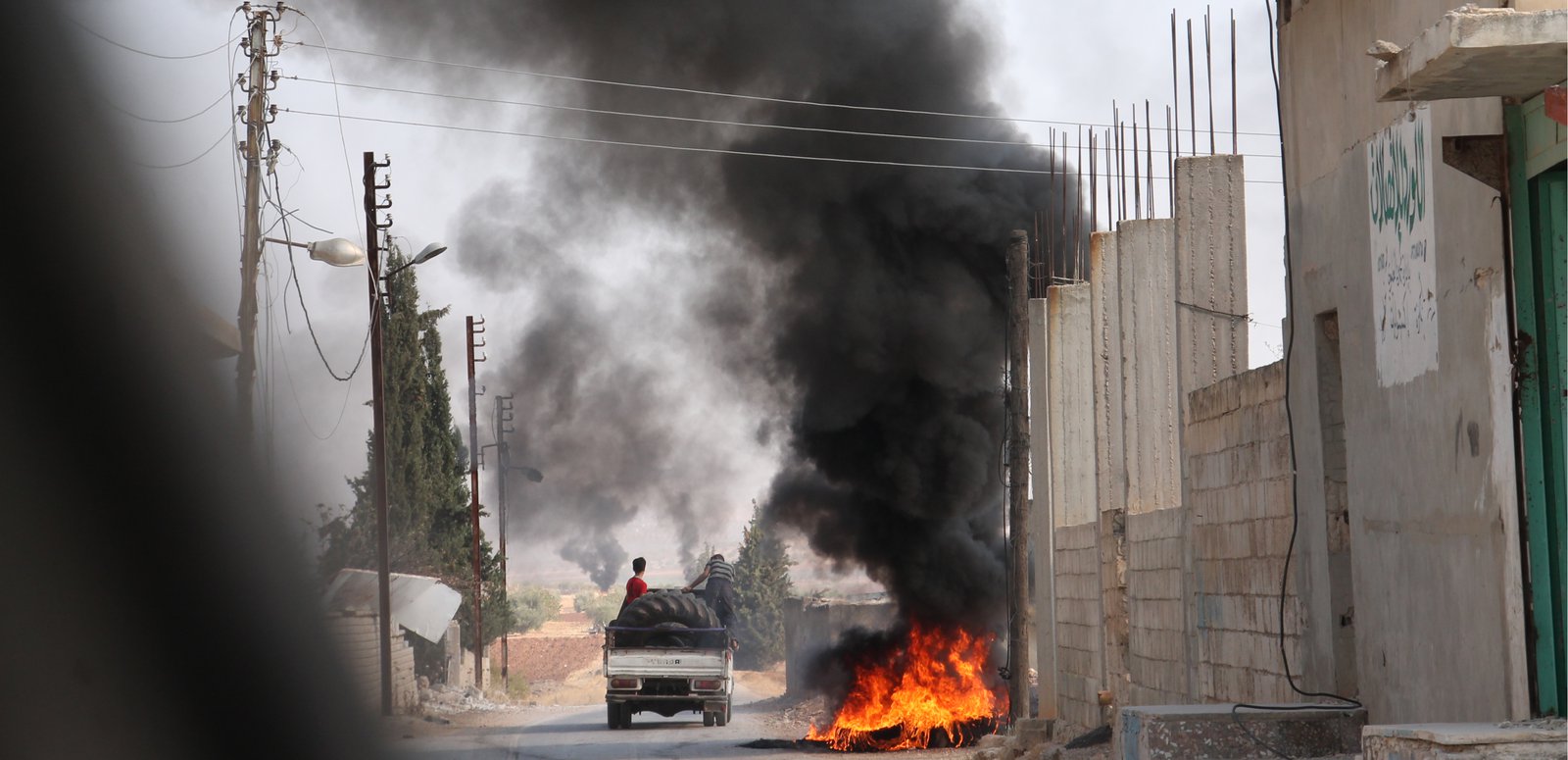
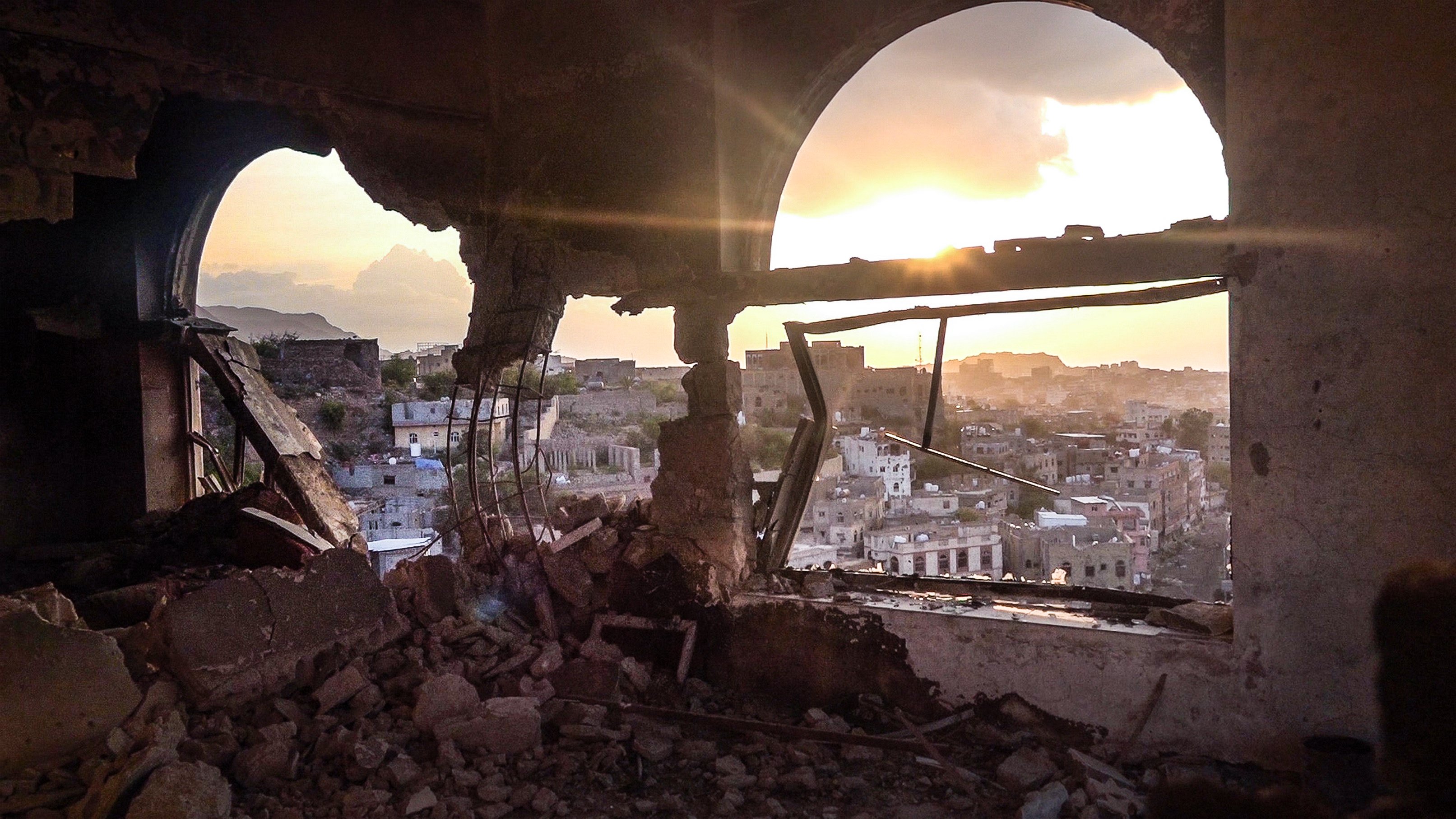
The humanitarian situation in Taiz is also dire, with locals struggling to access basic services such as healthcare and education—even access to clean drinking water is limited. The Houthi siege of Taiz and the ongoing shelling and sniping from outside of the city has hindered access to basic supplies, and complicated the activities and responses of civil society and relief organizations. This has also made the rebuilding and stabilization process in Taiz difficult. Many homes and shops remain abandoned out of fear of leftover explosive munitions or mines. Despite the ongoing destruction and danger, desperate civilians who fled Taiz are returning home from rural areas of temporary refuge. Today, what used to be a 15-minute trip to the east of the city takes about five hours due to the partial blockage of roads by the Houthis. Freight truck drivers attempting to transport their cargo to residents of the southern neighborhoods in Taiz are forced to use a long stretch of dry riverbed—a path inaccessible during the monsoon seasons while all other roads into the city traverse daunting, unpaved rigid hills.
Finally, the governorate has absorbed the lion’s share of the violence in Yemen. According to a June 2019 report by the Armed Conflict Location and Event Data Project (ACLED), Taiz has experienced the most conflict-related violence of any governorate in Yemen since the war began in 2015.25 From 2015-2019, more than 18,400 people have died in Taiz, including 2,300 civilians killed in violence that targeted them specifically as civilians.26 Significantly, these figures do not include the conflict-related deaths from cholera and other preventable diseases, which proliferated throughout the four and a half years of siege-related hardship. The death toll for the current war in Yemen stands at a staggering 100,000 deaths;27 Taiz makes up a fifth of the national death toll.28
The Houthi Incursion into Taiz
The Houthi rebel movement, whose political branch is called Ansarullah, seized the Yemeni capital on September 21, 2014. The capture of Sanaa was the culmination of decades of Houthi resentment toward the Yemeni government. Former President Ali Abdullah Saleh fought six wars with the Houthis throughout the 2000s.29 The collective result of these wars was the almost wholesale destruction of Saada, the historic capital of the Houthis’ native region, and the lingering resentment of the Houthis toward the government in Sanaa, which they accuse of withholding resources and targeting them unfairly.30 The Houthis largely draw their support from elements of Yemen’s Zaidi community. A branch of Shia Islam, the Zaidi community predominates in north Yemen, representing about one-third of the Yemeni population.
The collective result of these wars was the almost wholesale destruction of Saada and the lingering resentment of the Houthis toward the government in Sanaa.
Upon capturing Sanaa, the Houthis spread outward attempting to conquer the rest of the north, including Taiz.31 They also went south, fighting their way almost into Aden before finally being repelled by the Popular Resistance, a series of militias that organized to resist the Houthi advances. At that time, this resistance was an amorphous collection of armed groups that emerged organically to push back against armed militants flooding into their towns, although the Saudi- and Emirati-backed coalition moved quickly to organize and support groups resistant to the Houthis as they formally intervened in Yemen.32
The Houthi presence in Taiz, however, predated their takeover of Sanaa. The Houthis first moved to establish an open presence in Taiz during the 2011 Arab Spring-inspired protests, in which men and women across the Middle East took to the streets in mass demonstrations against decades of authoritarian governance.33 The protests, which began in Tunisia and soon embroiled the region, quickly reached Yemen, where demonstrators targeted longtime Yemeni President Ali Abdullah Saleh.34 Calling for expanded rights and services from the government, poverty reduction, and an end to state corruption, protestors also called for Saleh to cede power, which he did, finally, in February 2012.35
The Houthis were active in the Yemeni Arab Spring, initially making themselves known largely through the Steadfast Youth (Shabab Al-sumud), a Houthi-affiliated youth group prominent in protest encampments across the country. During this period, tensions between Houthi-affiliated figures and other political groups occasionally turned violent, mainly in the form of scuffles with those youths who supported Islah and those who supported the Houthis in protest squares across the country.36
There were deeply local aspects to the Houthis early political efforts in Taiz. According to interviews conducted by the authors, several prominent Taizis rose through the ranks of the Houthis’ power structure, most notably, Mahmoud Al-Guneid, a Taizi poet and political activist who eventually served as a Houthi leader. Al-Guneid was appointed as Director of the Presidential Office during the tenure of Saleh al-Samad37 from 2015 through 2018.38 Other figures who aligned with the Houthis include Sultan al-Samei, a socialist member of parliament, Salah al-Dakak, a prominent leftist activist and journalist, Talal Aqlan, who served as the Houthi-affiliated government’s acting prime minister, and Salim Mughalis, a member of the Houthis governing Supreme Political Council in Sanaa and delegate to UN-sponsored peace talks. Many of these figures, who hailed from leftist political streams, framed their alignment with the Houthis as an outgrowth of their frustration with Islah and other traditional power centers. Islah’s dominance over the transitional process that emerged in the wake of the Arab Spring was one reported factor in uniting the Houthis with some on the left, but some Yemeni political activists also suggested that leftist support might have been financially motivated.39
The Houthis took control of parts of the Al-Mokha district in the Taiz governorate as early as March 2015.40 In their campaign, the Houthis often joined forces with groups loyal to ousted former Yemeni President Ali Abdullah Saleh, owing to their mutual aims of pushing back against various figures aligned with the transitional government. On March 22, 2015, a joint Houthi-Saleh army swept into the Taiz governorate capturing military bases and strategic spaces around the city of Taiz, including the town of Al-Turbah, 50 miles southwest of Taiz city and 70 miles east of the port of Mokha on the Red Sea coast. Initially, the Houthis faced little organized military resistance from local Taizis, and the joint Houthi-Saleh forces moved quickly through the governorate, capturing the airport and the local Central Security Forces (CSF) base in the capital city.
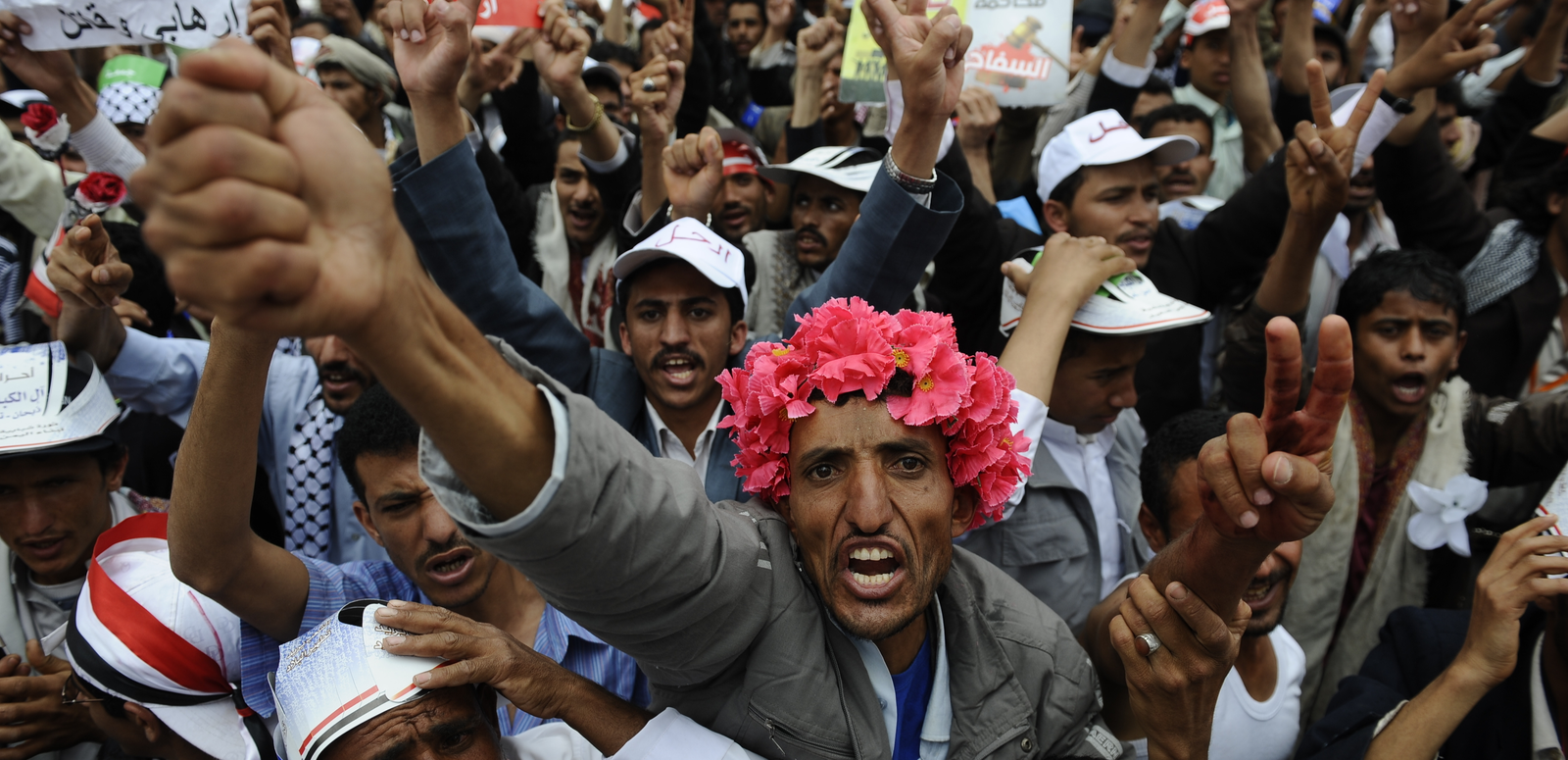
Local demonstrations against the Houthi incursion began almost immediately, with protests in Taiz and across Al-Turbah. Anti-Houthi demonstrators were met with violence, and were quickly suppressed where they occurred. On March 24, two days after the Houthis entered the Taiz governorate, six protesters were killed and dozens of others were wounded in Taiz and Al-Turbah.41 In reaction to the deaths, Taizi Governor Shawqi Hayel Saeed, grandson of Hayel Saeed Anam, Taiz’s wealthiest and most successful modern businessman, announced his intention to resign from office in protest against the security forces’ failure to implement his mandate and directives.42 Saeed was originally selected for this position because of his reputation as a capable technocrat and his family’s long history and influence in Taiz. However, his resignation announcement paved the way for a violent confrontation in the increasingly fractured city, spurring the wider conflagration that continues to embroil Taiz.
In response to Saeed’s resignation announcement, officers and members of the Thirty-Fifth Armored Brigade in Taiz, one of the most powerful military units in the city, declared their support for President Hadi. This announcement was prompted by then-Thirty-Fifth brigade head Major General Mansour Mohsen Mu’ajer’s alliance with the Houthis. General Mu’ajer handed over the Al-Arous air defense base on top of Jabal (mountain) Saber, and sent two battalions from the brigade to reinforce the joint Houthi-Saleh forces in their southern campaigns.43 The brigade camp is located to the west of the city of Taiz; the territory mandated under the control of the brigade radiates outward from the western entrance of Taiz to the port city of Al-Mokha near the Bab Al-Mandab Strait. Demonstrations denouncing the brigade’s anti-Houthi stance occurred at the city’s old airport, which was under the control of the Thirty-Fifth Brigade.
On April 2, 2015, President Hadi appointed General Adnan Al-Hammadi commander of the Thirty-Fifth Brigade.44 Al-Hammadi was later killed in Taiz on December 2, 2019, more than four years after his appointment. On April 9, 2019 President Hadi issued a decree appointing Brig. Gen. Sadiq Ali Sarhan commander of the Twenty-Second Armored Brigade, a move that was rejected by the brigade’s former commander, Hamoud Dahmash, who remained loyal to Saleh.45 On April 11, pro-Houthi and pro-Hadi soldiers dispersed throughout Taiz.46 On April 22, after 20 days of intense fighting, the Houthis captured the Thirty-Fifth Brigade headquarters at the old airport.47
In November 2015, seven months after he announced his intent to do so, Shawqi Hayel stepped down as governor of Taiz.48 This marked a watershed moment for Taiz; the end of technocratic governance and the disintegration of local authority.
The Saudi Coalition and the Proxy War Narrative
Shawqi Hayel’s resignation came only a few months after the official start of the Saudi-led coalition’s Operation Decisive Storm, which began on March 26, 2015.49 The war in Yemen became increasingly internationalized when the Saudi-led coalition officially began Operation Decisive Storm. The Saudi-led military operation aimed at ousting the Houthis and restoring Yemen’s internationally-recognized government to power. Decisive Storm was also framed by its proponents as pushing back against what they portrayed as an Iranian-backed threat to their national security. The UAE played a key role in the coalition from the beginning.
In the wake of the Saudi-led coalition’s military intervention in Yemen, the war has often been described as a proxy war between Iran and Saudi Arabia. This narrative takes different forms. Some cast the Houthis as proxies for Iran, while others frame the Yemenis fighting against the Houthis as mercenaries for Saudi Arabia or UAE.
Both narratives are oversimplifications. The Houthis are ultimately a locally-rooted group whose leadership’s decisions largely appear to be driven by Yemen-related concerns.50 Despite their local roots, the Houthis’ ties to Iran are undeniable. The group derives ideological influence from both the Iranians and Hezbollah, firmly placing itself in the so-called Resistance Axis, a transnational grouping allied with Iran and opposed to the hegemony of U.S. allies in the region.51 While the extent of Iran’s role in the war remains largely opaque, Western officials continue to highlight Iran’s deployment of ground advisors to Yemen, while UN expert reports point to Iranian technology transfers to the Houthis, particularly with regards to drone and missile technology.52 The Houthis receive logistical support from Iran, but this does not mean that they are a proxy over which Iran exercises substantial control. Despite shared ideological affinities, there is little evidence of firm Iranian command and control over the Houthis during the earlier rounds of warfare throughout the 2000s, though the relationship between Iran and the Houthis has clearly strengthened since the start of the war.53
Saudi Arabia has encouraged the grand proxy war narrative to garner both political and material support for its war efforts. By describing Iran’s involvement in Yemen as an existential threat to Saudi and regional security, Saudi Arabia has successfully persuaded Western governments of the necessity of its Yemen campaign, even in the face of declining international public support for the conflict.54 While the United States has scaled back its indirect involvement in the Saudi campaign—most visibly in November 2018, when it halted its mid-air refueling of Saudi military planes—the United States continues to provide weapons and logistical support to both the Saudis and their Emirati partners.55 The prevailing framing of the coalition is similarly reductionist. Houthi-aligned media often frames Yemeni soldiers fighting on the coalition’s side as mercenaries or extremists, often going so far as to portray them as traitors to Yemen.56
Saudi Arabia has encouraged the grand proxy war narrative to garner both political and material support for its war efforts.
For the Houthis, framing their battle as one against a foreign enemy has allowed the group to mobilize fighters, even as the battles are largely directed against fellow Yemenis. This messaging of the wider conflict as a “Saudi war in Yemen,” particularly in a significant portion of Western discourse, has also served to benefit the Houthis and their sympathizers, who have aimed to capitalize on some Western politicians’ and publics’ antipathy to Saudi Arabia—particularly after the death of Jamal Khashoggi—to generate international sympathy for their cause and opposition to Saudi Arabia’s military efforts.57
However, in the eyes of many Yemenis, not just in Taiz but also in areas like Marib and the formerly independent south, the Houthi incursion constituted a virtual invasion, leading them to frame their decision to take up arms in a locally rooted, defensive manner—regardless of whether they eventually linked up with powers outside of the country for financial and military support.58
Al-Qaida in turn benefits from both versions of the grand proxy warfare narrative. The group uses its propaganda to portray the war as defined by foreign intrusions, casting the Houthis as Shia tools of Iran and a reflection of a region-wide sectarian threat, while simultaneously mounting criticism of the UAE presence as a foreign tool of the United States.59 At the same time, al-Qaida seeks to burnish its ties to local tribes proclaiming its local rootedness, and when it has had success in Yemen, that success has largely come from its deft manipulation of local dynamics amidst the larger war.60
While a variety of local, national, and international actors invested in Taiz share an interest in battling the Houthis, there are differences at each level over how it should be done and who should be the force behind it.61 As the conflict and humanitarian crisis intensified, tensions over tactics and strategy broke out in the open, which in many ways reflected long-standing friction between political factions in Taiz.
Citations
- Taiz’s rise began in 1173 AD, with the arrival of Turan Shah, an emir of the Ayyubid dynasty. After the Ayubbids exited Yemen, the Rasulid Dynasty made the city its capital, from 1229 AD to 1454 AD. Taiz reached its civilizational height under the Rasulids, who developed a sophisticated administrative system, built fortresses and schools, and spread innovative agricultural techniques throughout the country, such as coffee production. In the 17th century, a maritime dispute with the Portuguese led the Ottomans to begin trading via the port of Al-Mokha instead of Aden. In 1918, after the collapse of the Ottoman empire, the Mutawakkilite Kingdom of Yemen selected Taiz as their capital until its overthrow in 1962. Historically characterized by its diversity and religious tolerance, Taiz was a notable center for Yemeni Jews for hundreds of years, beginning in 130 AD; the Shar’ab Assalam district boasted a vibrant and illustrious Jewish Quarter until the 1940s. Faisal Saeed Farea, Taiz: Faradat Al-Makan Wa ’adamat Al-Tarikh (Taiz: Al-Saeed Foundation for Sciences and Culture, 2012), 2.
- Prior to 1990, Yemen was divided into two countries, “North” Yemen with its capital in Sanaa, and “South” Yemen with its capital in Aden. The north was under the rule of the Zaidi imamate until its overthrow in the September 26th republican revolution in 1962; the south was ruled by the Marxist People’s Democratic Republic of Yemen (PDRY) following the withdrawal of the British in 1967. See: Noel Brehony, Yemen Divided: The Story of a Failed State in South Arabia, (London: I.B. Tauris, 2013).
- Charles Dunbar, “The Unification of Yemen: Process, Politics, and Prospects,” Middle East Journal 46, no. 3 (1992).
- Sasha Gordon, “Taiz: The Heart of Yemen’s Revolution,” Critical Threats Project, January 12, 2012, https://www.criticalthreats.org/analysis/taiz-the-heart-of-yemens-revolution
- Adam Baron, “Qatar’s Dispute with Neighbors Reverberates in Yemen,” The Arab Gulf States Institute in Washington, July 19, 2017, https://agsiw.org/qatars-dispute-with-neighbors-reverberates-in-yemen/ ; Peter Salisbury, “Yemen and the Saudi-Iranian ‘Cold War’” (Chatham House, February 2015), 10, https://www.chathamhouse.org/sites/default/files/field/field_document/20150218YemenIranSaudi.pdf
- In addition to evidence from our interviews in Taiz, this dynamic can be seen in Eric Schmitt and Robert F. Worth, “With Arms for Yemen Rebels, Iran Seeks Wider Mideast Role,” The New York Times, March 15, 2012, https://www.nytimes.com/2012/03/15/world/middleeast/aiding-yemen-rebels-iran-seeks-wider-mideast-role.html
- Nasser Al-Sakkaf, “In Taiz, Some Yemenis Choose War – and Home – over Displacement,” The New Humanitarian, July 16, 2019, https://www.thenewhumanitarian.org/news-feature/2019/07/16/taiz-yemen-war-displacement
- Maysaa Shuja al Deen, “The Endless Battle in Taiz,” Atlantic Council, April 26, 2017, https://www.atlanticcouncil.org/blogs/menasource/the-endless-battle-in-taiz/
- These were the last reliable figures and they are considered to be “anecdotal.” “Yemen Economic Monitoring Brief” (World Bank Group, Winter 2019), 1, http://documents.worldbank.org/curated/en/161721552490437049/pdf/135266-YemEconDevBrief-Winter-2019-English-12-Mar-19.pdf ; Patrick Wintour, “More than Half of $2.6bn Aid to Yemen Pledged by Countries Involved in War,” Guardian, February 26, 2019, https://www.theguardian.com/global-development/2019/feb/26/more-than-half-of-26bn-aid-to-yemen-pledged-by-countries-involved-in-war
- “Caught in the Middle: A Conflict Mapping of Taiz Governorate” (DeepRoot Consulting, 2018), 29, https://docs.wixstatic.com/ugd/df2b40_e6cbadad37b248b495c4c3634996b8aa.pdf
- “The Republic of Yemen: Unlocking the Potential for Economic Growth” (World Bank, October 2015), 84, http://documents.worldbank.org/curated/en/673781467997642839/pdf/102151-REVISED-box394829B-PUBLIC-Yemen-CEM-edited.pdf
- “Al-Mawarid Wa Foras Al-Istithmar Fi Mohafadhat Taiz,” National Information Center Presidency of Yemen, 2014, https://www.yemen-nic.info/gover/taiz/menwal/
- These sites include Al-Janad Mosque, Al-Qahira Citadel, and the Islamic schools such as Al-Modhafariah, Al-Ashrafiah and Al-Mu’tabiah.
- “In Yemen, A Different Kind of Battle: Getting People Trained and Finding Good Bureaucrats,” Knowledge@Wharton, September 18, 2012, https://knowledge.wharton.upenn.edu/article/in-yemen-a-different-kind-of-battle-getting-people-trained-and-finding-good-bureaucrats/
- “Caught in the Middle: A Conflict Mapping of Taiz Governorate,” 29.
- “ Yemen War Death Toll Exceeds 90,000 According to New ACLED Data for 2015” (ACLED, June 18, 2019), https://www.acleddata.com/wp-content/uploads/2019/06/ACLED_Yemen-2015-Data_6.2019-2.pdf
- “Yemen War Death Toll Exceeds 90,000.”
- Sam Jones and Matthias Sulz, “Press Release: Over 100,000 Reported Killed in Yemen War,” ACLED, October 31, 2019, https://www.acleddata.com/2019/10/31/press-release-over-100000-reported-killed-in-yemen-war/
- “Yemen War Death Toll Exceeds 90,000.”
- Barak A. Salmoni, Bryce Loidolt, and Madeleine Wells, Regime and Periphery in Northern Yemen: The Huthi Phenomenon (Santa Monica, CA: RAND, 2010), 1.
- Salmoni, Loidolt, and Wells, 114.
- Saeed Al-Batati and Kareem Fahim, “Rebels Seize Key Parts of Yemen’s Third-Largest City, Taiz,” The New York Times, March 22, 2015, https://www.nytimes.com/2015/03/23/world/middleeast/houthi-rebels-taiz-yemen.html
- Omar Said, “The View from Aden: A Shadow State between the Coalition and Civil War” (Arab Reform Initiative, April 19, 2019), https://www.arab-reform.net/publication/the-view-from-aden-a-shadow-state-between-the-coalition-and-civil-war/
- Helen Lackner, Yemen’s “Peaceful” Transition from Autocracy: Could It Have Succeeded? (International IDEA, 2016), 14.
- Lackner, 14.
- Lackner, 23.
- For general clashes, see: Laura Kasinof, “Yemeni City Feeds Unrest’s Roots,” The New York Times, February 25, 2011, https://www.nytimes.com/2011/02/26/world/middleeast/26yemen.html. For clashes between Islah-Houthi supporters, see: “Ishtibakat ’Anifah Bayn Al-Islah Wa Al-Huthiyein Fi Sahat Al-Hurryia,” Yemress, September 6, 2012, https://www.yemeress.com/saadahpress/5996
- Saleh Al-Samad served as President of ‘Yemen’s Supreme Political Council,’ which was the de facto executive body of the Houthis, until his death by a Saudi airstrike on April 19, 2018. Marwa Rashad and Sarah Dadouch, “Saudi-Led Air Strike Kills Top Houthi Official in Yemen,” Reuters, April 23, 2018, https://www.reuters.com/article/us-yemen-security-official/saudi-led-air-strike-kills-top-houthi-official-in-yemen-idUSKBN1HU28Z
- “Al-Juneid Yo’akid Hirs Al-Dawlah Wa Ihtimamiha Bi Ri’ayet Osar Al-Shuhada,” Al-Thawra, February 28, 2016, http://althawrah.ye/archives/380024
- Author’s interviews held with Yemeni political activists in Beirut and Sanaa over 2012 and 2013.
- Al-Batati and Fahim, “Rebels Seize Key Parts”
- Ahmed Al-Haj, “Shia Rebels Kill Six in Clashes with Thousands of Protesters in Yemen,” AP, March 24, 2015.
- Ibid.
- Saleh Al-Diwani, “27 Yom’an Min Tahajom Al-Inqlabiyeen Wa Tahqiq Agradh Al-Tahalof,” Al-Watan Online, March 26, 2016, https://www.alwatan.com.sa/article/295558/تكنولوجيا/27-يوما-تحجم-الانقلابيين-وتحقق-أغراض-التحالف
- Amr Al-Sabagh, “Ra’ees Al-Yemen Yo’aiyn Qa’id Jadid Lil Liwa 35,” DotMsr, April 2, 2015, http://www.dotmsr.com/news/196/247700/رئيس-اليمن-يعين-قائدا-جديدا-للواء-35-مدرع
- UNSCR, “7721st Meeting. Provisional Meeting, UN Doc S//PV.7721,” June 21, 2016, 5, https://www.securitycouncilreport.org/atf/cf/%7B65BFCF9B-6D27-4E9C-8CD3-CF6E4FF96FF9%7D/s_pv_7721.pdf See also, “Annual Report of the United Nations High Commissioner for Human Rights and Reports of the Office of the High Commissioner and the Secretary-General. A/HRC/39/43,” United Nations Human Rights Council, 2018, https://www.ohchr.org/Documents/Countries/YE/A_HRC_39_43_EN.docx
- This was confirmed in field research interviews; also see: “The Conflict in Yemen: April 2015” (Stratfor, April 30, 2015), https://worldview.stratfor.com/article/conflict-yemen-april-2015; “Al-Yaman Thobadt Al-Liwa 35 Ya’linon Ta’yeedihim Lilraees Hadi,” Al-Arabiya, March 27, 2015, https://www.alarabiya.net/ar/arab-and-world/yemen/2015/03/27/اليمن-ضباط-اللواء-35-يعلنون-تأييدهم-للرئيس-هادي
- “Houthis Take Control of Army Brigade in Yemen’s Taiz: Residents,” Reuters, April 22, 2015, https://www.reuters.com/article/us-yemen-security-taiz-idUSKBN0ND0QO20150422
- “Shawqi Hayel’ Yastaqil Niha’iyan Min Mansibeh,” Al-Ameen Press, November 16, 2015, https://alameenpress.info/print/5257
- Dan Roberts and Kareem Shaheen, “Saudi Arabia Launches Yemen Air Strikes as Alliance Builds Against Houthi Rebels,” Guardian, March 26, 2015, https://www.theguardian.com/world/2015/mar/26/saudi-arabia-begins-airstrikes-against-houthi-in-yemen
- Jodst Hiltermann and April Longley Alley, “The Houthis Are Not Hezbollah,” Foreign Policy, February 27, 2017, https://foreignpolicy.com/2017/02/27/the-houthis-are-not-hezbollah/
- For more on the Houthi-Iranian relationship, see: Thomas Juneau, “Iran’s Policy towards the Houthis in Yemen: A Limited Return on a Modest Investment,” International Affairs 92, no. 3 (May 2016): 647-63, https://doi.org/10.1111/1468-2346.12599
- Jon Gambrell, “AP Explains: How Yemen’s Rebels Increasingly Deploy Drones,” AP, May 14, 2019, https://www.apnews.com/02c0c90050ee4b21a408db483906971b
- Hiltermann and Alley, “The Houthis Are Not Hezbollah”; Elisabeth Kendall, “Iran’s Fingerprints in Yemen: Real or Imagined?” (Atlantic Council, October 19, 2017), https://www.atlanticcouncil.org/in-depth-research-reports/issue-brief/iran-s-fingerprints-in-yemen-real-or-imagined/
- Hiltermann and Alley, “The Houthis Are Not Hezbollah.”
- Wesley Morgan, “Pentagon: No More Refueling of Saudi Aircraft Bombing Yemen,” Politico, November 9, 2018, https://www.politico.com/story/2018/11/09/saudi-arabia-yemen-bombing-pentagon-refueling-982924
- This can be observed across Houthi media outlets see, for example: Honah AlMasirah, 2018, https://www.youtube.com/watch?v=6VhRE92bJP0. The narrative can also be seen in material from Houthi news agencies: “Update of Confrontations with US-Saudi Forces in Border Fronts, September 18th, 2019,” Almasirah Media Network, September 9, 2019, http://english.almasirah.net/details.php?es_id=8861
- Sarah Aziza, “Trump’s Veto on Yemen War Is a Sign That the Strongmen in the U.S. and Saudi Arabia Are Winning,” The Intercept, September 9, 2019, https://theintercept.com/2019/04/18/trump-veto-yemen-saudi-arabia-mbs
- Nadwa Al-Dawsari, “Yemen: A View from Marib,” Atlantic Council, May 1, 2015, https://www.atlanticcouncil.org/blogs/menasource/yemen-a-view-from-marib/
- Adam Baron, “The Gulf Country That Will Shape the Future of Yemen,” The Atlantic, September 22, 2018, https://www.theatlantic.com/international/archive/2018/09/yemen-mukalla-uae-al-qaeda/570943 ; “Yemen’s Al-Qaeda: Expanding the Base” (International Crisis Group, February 2, 2017), https://d2071andvip0wj.cloudfront.net/174-yemen-s-al-qaeda-expanding-the-base.pdf
- Kendall, “Iran’s Fingerprints in Yemen: Real or Imagined?”
- Mustafa Naji, “Yemen: Taiz, Martyred and Forgotten City,” OrientXXI, May 14, 2019, source
Political Groups in Taiz
In order to understand the conflict in Taiz, it is necessary to understand the political groups active in the city. The mainstream political groups in Taiz mirror those elsewhere in Yemen. Due in part to its educated middle class and history of opposition activity, Taiz’s political life has historically been more active than that of most other areas in Yemen.
Over the course of the war, the Islah party has arguably dominated politics in Taiz. Yet other political parties remain active in the governorate. These parties have at various times cooperated with Islah while at other times challenging it.
The key political groups in Taiz—namely, Islah, the General People’s Congress (GPC) party, the Nasserists, and the Socialists—have maintained their importance and locally rooted identities throughout the upheaval of the past five years. Far from political factions becoming mere pawns of foreign powers, political contestation rooted in local history is alive in the city and shapes the conflict. However, the conflict and its internationalization has also at times reshaped the roles of Taizi political parties with many gaining de facto military wings, becoming influenced by foreign powers, or some mix of the two.
Key Political Factions in Taiz and their Leaders
Yemeni Congregation for Reform (Islah)
President of the party in Taiz: Abdul Hafedh Al-Faqih
Military commander: Abdo Farhan Salem – known as Salem
The Nasserist Unionist People’s Organization or NUPO
Head of the party branch in Taiz: Adel Al-Aqibi
The General People’s Congress Party (GPC)
Head of Taiz branch (Pro Hadi): Sheikh Aref Gamel
The Yemeni Socialist Party (YSP)
Multiple leaders in Taiz: Mohamed Abudlaziz Al-Sinwi, Mohammed Abdulrahman Al-Samei, Abdulhakim Sharaf
Al-Rashad Union
Party representative in Taiz: Abdulhakim Aoun62
Islah: The Dominant Political Power in Taiz
Islah is one of the most important local political forces in Yemen in general and, currently, in Taiz in particular. A political party with a religious dimension, it is known for its association with the Muslim Brotherhood movement. Islah aligned with the ruling GPC party both in the run-up to and in the aftermath of the 1994 civil war, in part as a hedge against the Yemeni Socialist Party (YSP).63
After his government’s victory in 1994, Saleh distributed some ministries to Islah members, such as the Ministry of Education, and supported their opening of scientific institutes, which became centers of religious studies. Islah utilized the post-unification era of democratization, unification, and the creation of a multiparty system to become a formal and legal opposition party, and develop charitable organizations throughout the country while maintaining a close relationship with funders in the Gulf States, particularly Saudi Arabia.64 In 2003, fearful of Islah’s growing strength and influence, Saleh attempted to crack down on religious political parties, further prompting Islah to formally move to the opposition and join the Joint Meeting Parties (JMP), a coalition of Yemen’s establishment opposition parties.65
By 2011, Islah had expanded to become the largest opposition party in Taiz and the rest of the country.66 Islah possessed the ability and resources to quickly mobilize against the ruling forces, which proved essential during the Arab Spring. Islah had significant sway over Freedom Square, the center of the protests.67 When it was attacked, Islah and its allies held their own in violent confrontations against pro-Saleh forces.68
Islah had expanded to become the largest opposition party in Taiz and the rest of the country.
Up until 2015, Islah was able to benefit from its political organization and hierarchical military, as well as experience accrued from its participation in battles throughout various cycles of conflict.69 The power of Islah-aligned networks continues to grow politically and militarily in Taiz. Since 2015 Islah’s allies have had substantial influence on liberated areas of Taiz’s government, security services, and military brigades and units.
The Islah party is financed mainly through their financial capital, local economic projects, and funding from their international allies.70 The charitable trusts and other civil society organizations established during and after Islah’s alliance with Saleh generate income and goodwill for the party.71 Islah has retained its local political identity despite its interactions with foreign sponsors, thanks in part due to its rootedness in the Yemeni political fabric and access to diverse sources of funding beyond foreign sponsorship.
Yet Islah also maintains relationships with foreign powers. Despite Saudi Arabia’s antipathy to the Muslim Brotherhood (and many Islah members’ close relationship with Qatar),72 Riyadh has long maintained close relations with numerous figures in Islah and those affiliated with the party. Saudi Arabia took advantage of these relationships to bolster its fight against the Houthis in the lead up to Operation Decisive Storm. Many figures within Islah have benefitted from Saudi patronage, and many members of the party’s leadership currently reside in Riyadh, such as Islah’s Chairman Mohammed Abdullah al-Yadoumi.73
The official leader of Islah in Taiz today is Abdel-Hafedh Al-Faqih, although he is seen as possessing little decision-making power with regards to military files. The bulk of the key military figures within the network maintain lower profiles. Chief among them is the network’s top military commander, Salem, who is often cast as the de facto leader of Taiz by more vociferous critics of the Islah party. The general public first became aware of Salem’s true identity within Islah in February 2018, when the media publicized his appointment as an advisor to the Commander of the Taiz Military Axis.74
Currently, the city of Taiz is under the military control of pro-Islah security brigades and the political control of the Islah party. The Islah network has full control over government departments across sectors, and has generally succeeded in politically and militarily dominating the city. Many of Hadi’s associates connected to Islah leadership, such as General Ali Mohsen al-Ahmar, have a large say in top-down decision-making in collaborating with Islah-affiliated groups. After four years of war, Islah has managed to build significant sway over key state functions within Taiz. Salem and other Islah-aligned figures and businessmen have also made large financial investments in universities, schools, factories, and small companies throughout the city in order to shore up the position of the party and its allies.
Taizi Politics Beyond Islah
Islah is but one of many political parties operating in Taiz. Other parties, including the Nasserist NUPO, the formerly ruling GPC, the socialist YSP, and the Salafist Al Rashad Union, are active in Taiz and continue to alternatively compete and cooperate with Islah, in some cases developing close relationships with foreign sponsors, particularly the UAE given its wariness towards Islah.
The NUPO is an Arab nationalist and socialist Yemeni political party founded on December 25, 1965. It has been a part of the JMP75 since the JMP’s formation in 2002.76 The NUPO won one seat in the 1993 parliamentary elections and two seats in 1997.77
An opposition party in Taiz, NUPO is often cast as the second most powerful political party in the city after Islah. Among Yemeni political factions, the Nasserists were one of the most unequivocal in their opposition to the Houthi takeover of Sanaa.78 The Nasserist party is one of several leftist forces and parties that many residents of Taiz associated with in previous generations. But with time, and changing internal dynamics, more conservative factions such as the Islah Party have eclipsed the historically prominent leftist parties.
Today in Taiz, NUPO marginally shares power with Islah networks, with some important government positions being held by notable Nasserist figures. Figures from the NUPO in the government of Taiz include Rashid Al-Akhali, the deputy governor of Taiz, and Hussein Al-Maqtari, former head of the Cleaning and Improvement Fund. Although the party has no affiliated military groups or armed organizations, individuals affiliated with NUPO have joined and ascended the ranks of the army in Taiz.
The Nasserists remain poorly funded and dependent on internal sources of revenue. At the beginning of the war, they appeared to receive support from some of the coalition countries, particularly the UAE, but this support has been uneven. Today, NUPO is likely supported by businessmen affiliated directly with the party, although contacts in the city say it continues to engage in outreach to the UAE.
The General People's Congress party (GPC), founded in 1982 under Ali Abdullah Saleh, has historically been the ruling party in Yemen and the strongest political force in the country, though its power declined from 2011 through 2015. The GPC has rebounded recently due to the breakdown of the Houthi-Saleh relationship.
At the beginning of the war, much of the upper-level leadership of the GPC sided with President Ali Abdullah Saleh and accepted his formation of a strategic alliance with the Houthis.79 However, this differed across the country, including in Taiz, where many of the GPC’s local leadership viewed expelling the Houthis from the city as their immediate priority, leading to splits within the party.80 The split between many of the national GPC leaders and Taiz’s local GPC leadership over the question of allying with the Houthis illustrates the local roots of Yemeni politics and the ability of local interests to reshape political factions and interrupt efforts at alliance formation.
Sheikh Aref Gamel, the head of the GPC’s Taiz branch, is one of the leaders of the Popular Resistance who fought the Houthis in Taiz. Gamel led his forces to completely liberate the south of the city, including Jabal Saber, the first liberated district in Taiz. The ascent of the GPC in Taiz would have not been possible without their alliance and coordination with figures and factions loyal to Islah party networks. The split in the party posed challenges for many of its members. Some members of the GPC now reside in Cairo and do not want to be associated with any of the parties to the conflict.81 However, Gamel’s supporters praise him for his pragmatism and fighting prowess alike.
The ascent of the GPC in Taiz would have not been possible without their alliance and coordination with figures and factions loyal to Islah party networks.
Taiz natives have also been politically prominent in the GPC outside of the city. The current head of parliament, Sheikh Sultan al-Barakani, is an MP from Taiz and the longstanding head of the GPC’s bloc in parliament. Former Minister of Interior Rashad al-Alimi and former Taiz Governor Hamoud al-Sufi both continue to play key roles in decision-making in the governorate from afar, taking advantage of their long-standing relations with key stakeholders inside and outside of Yemen. While quiet for some time, the GPC has held public demonstrations in Taiz, underlining their aim of maintaining relevance in the city.
The YSP was once one of the major political parties in Yemen, although its influence has declined since its heyday in the 1970s. One of Yemen’s original socialist parties, the YSP originally formed as the Unified Political National Front Organization, which was a merger between three political movements that fought for independence from the British: Yemen's National Liberation Front of occupied South Yemen (NLF), the Democratic Union Party (Marxist), and the Popular Vanguard Party (Baathist).82 In 1978, it officially became the YSP.83 The party maintains an outsized presence abroad, where many of its various leaders have resided since 1994, after the North-South civil war, and (more recently) post-Arab Spring.84
After the National Dialogue Conference (NDC), an ambitious summit that was meant to be the cornerstone of Yemen’s post-Arab Spring transitional process, the YSP was delegated some positions within the local authority of Taiz. For example, Mohammed Abdulrahman Al-Samei was appointed director of finance and Najib Qahtan was appointed as the director of the Information Office. According to local sources, Qahtan has close ties with Islah networks, which has affected his influence within YSP leadership circles.85
As previously mentioned, the Houthis’ entry into Taiz was partly facilitated through the support of YSP figure Sultan al-Samei, whose relationship with the Houthis has grown increasingly complicated.86 A number of prominent Taizis who have aligned with the Houthis have socialist backgrounds, which stem in part from their antipathy to the Islah party.
Finally, Al-Rashad Union is a Yemeni political organization oriented towards Salafism and Islamism. The party issued its establishment announcement on March 14, 2012, and soon after received official permission to engage in political activity in Taiz.87 The party is currently headed by Mohammed Musa Al-Amiri; the secretary general is Abdul Wahab Al-Humayqani.
While Al-Rashad wields very little political power on the ground in Taiz, the party has successfully poached members from Islah groups who are attracted to the party’s religious dimension.
A deputy of the governorate, Dr. Abdul Hakim Aoun, was appointed as the Salafis' slot in the local government in Taiz, however, Abdulhakim Aoun is reportedly also affiliated with the Islah Party.88 The relationship between Aoun, Islah, and Al-Rashad Union underlines Islah’s coordination with—and continuing influence over—other political groups in the city.
Interaction Between Local Political and Military Competition and Foreign Sponsorship
Islah has maintained political and military dominance in Taiz over the course of the Yemen war. As noted above, this has resulted in many prior rivals having to accommodate the party. However, it has also led to blowback from rivals able to benefit from foreign sponsors wary of Islah’s Muslim Brotherhood ties. At the same time, political and military entrepreneurs taking advantage of hyperlocal facets of the war economy increasingly shape and challenge Islah’s power.
Apart from the Houthis themselves—and with the GPC party’s split into pro-Saleh and pro-coalition factions at the time—Islah’s affiliates and allies constituted the most organized and experienced fighting forces in the city. With Saleh’s eventual death at the hands of the Houthis, the GPC in Taiz was able to fully align itself with Islah and the coalition.
Military leaders who had broken with Saleh and backed key military leader Ali Mohsen al-Ahmar89 during the 2011 fighting—most notably, Sadiq Sarhan, Saleh Al-Thaneen, and Hameed Al-Qushaibi—aligned against the Houthis, in numerous cases cooperating with Islah paramilitary forces. Local social figures who led militias during that same period, most notably Hamoud al-Mekhlafi, were largely drawn from Islah as well.
Islah used organizational structures that it developed for its charitable, educational, and political outreach programs as the bedrock for organizing local resistance against the Houthis. The presence of many connected Taizi Islah supporters and allies in circles close to the internationally recognized government eased the process of obtaining military and financial support from the Yemeni government, while the disproportionate representation of Taizis amongst the Yemeni press corps granted a steady stream of media attention.
The 2016 exodus from Taiz of Hamoud Al-Mekhlafi, the first leader of the Popular Resistance there, deprived the city of a key figurehead and potentially unifying figure and exposed the realities of the divisions amongst coalition forces in Taiz. The reasons for his departure are described later in this report. It did little, however, to diminish the continuing influence of Islah’s networks in Taiz, which only solidified in the coming period, although power has shifted to less well-known figures on the ground.
Even so, Islah and its allies’ perceived dominance resulted in blowback from anti-Houthi forces in Taiz. Local powers, like the Nasserists and individuals such as Abu Al-Abbas and his eponymous brigade, who distrusted Islah or resented what they saw as Islah’s undue influence sought to shore up their own standing.90 Foreign powers—most notably, the UAE—which were anxious about the potential resurgence of Muslim Brotherhood ideologies in Yemen, eagerly built relationships with and bolstered these local forces within the wider framework of battling the Houthis.91 Local groups and individuals took advantage of the overarching regional narrative of a Gulf (particularly Emirati) conflict with the Muslim Brotherhood to fuel their own political ends.92 In turn, the UAE’s support for Islah opponents has generated greater anti-UAE feeling among some Islah-affiliated factions.
Meanwhile various smaller groups—or even individuals—have sought to control local funding streams and develop their own political and economic bases of support. Issues ranging from the collection of taxation to the manning of checkpoints became key focuses of political and military tension. While the wider ideological differences and geopolitical tensions apparent in foreign sponsor relations set out the kindling, it has consistently been these hyper-local issues that provide the match, spurring clashes between anti-Houthi armed groups. For example, in July 2018, there were a total of 48 revenue-generating checkpoints on the road between Taiz and Hayjaht Al-Abd (connecting south Taiz to the south of Yemen) controlled by either Islah affiliates or their opponents.93
Groups have also clashed and profited from the trade of qat, a mild narcotic leaf chewed across the country, and one of the few thriving industries in Yemen’s war-economy.94 In January 2019, fighters loyal to Ghazwan al-Mekhlafi, an unruly adolescent member of the Twenty-Second Brigade, fought with militias over control of qat taxation in the Qat market, in Al-Thawra neighborhood of Taiz.95 Ghazwan is related to Sadiq Sarhan, commander of the Twenty-Second Brigade, and hails from the same village as the famed Popular Resistance figure Hamoud Al-Mekhlafi.96
Since 2017, the internationally recognized Yemeni government has organized security campaigns to clear elements they described as being “outside” the law, using the local police and authorities to clear government buildings and institutions occupied or held by groups challenging the government’s authority. Many of these campaigns have proven unsuccessful. For instance, coalition fighters from the Thirty-Fifth Brigade ignored government orders to relinquish control of vital revenue-generating checkpoints around the southern entrance of Taiz.97 Most of these campaigns failed to progress due to infighting, the willful ignorance of government orders by certain militias, and the ability of these factions to act independently with impunity. The last of these security campaigns was launched in March 2019 by Governor Nabil Shamsan and has shown little success, as the local authorities struggle to come together under Hadi’s umbrella, often choosing to halt the campaigns to avoid a clash of interests between differing armed groups responsible for helping to keep the peace.98
Bouts of infighting between anti-Houthi armed groups have often ended in ceasefire agreements. For example, a truce committee under the auspices of Taiz Governor Nabil Shamsan reached an agreement with the Abu Al-Abbas Brigades to hand over wanted individuals and evacuate Abu Al-Abbas fighters from the residential neighborhoods in the Old City.99 Yet the wider structural issues encouraging and allowing for such clashes remain. Absent greater consolidation of power—whether in the hands of one group, which appears unlikely, or in the form of a more coherent and cooperative coalition of factions (a tall order) —a lasting accord is unlikely. This is particularly true given the enduring weakness of civilian government, a trend which appears to have continued under the current governor, Nabil Shamsan, regardless of his best intentions.
It remains far from certain that the groups in Taiz will agree and implement a durable cease of hostilities in the medium-term future, as the war has also become an enterprise in and of itself, infecting nearly all aspects of daily life in Taiz. Fighters are overwhelmingly reliant on their salaries, which has brought increasing leverage for military leaders and their funders at all levels. Even those not directly reliant on war-related monies cannot fully disentangle from the wider system.100 In this context, Taiz’s situation will likely continue to be shaped by local tensions and its war economy—which have seen power brokers clash over everything from weapons smuggling to checkpoint profiteering—as much if not more than by the grander proxy conflicts between external states or even by Yemen’s more traditional political divides.
Fighters are overwhelmingly reliant on their salaries, which has brought increasing leverage for military leaders and their funders at all levels.
Citations
- Aoun is supposedly a Rashad representative even though originally an Islah member, and serves as the city’s deputy governor. Al-Rashad does not have a strong military or political role in Taiz. As of 2015, Essa Al-Shawafi was the party’s representative in Taiz, but he has been invisible from the political scene since then.
- Lackner, Yemen in Crisis.
- Amr Hamzawy, “Between Government and Opposition: The Case of the Yemeni Congregation for Reform” (Carnegie Endowment for International Peace, November 2009), https://carnegieendowment.org/files/yemeni_congragation_reform.pdf
- Ibid.
- Gordon, “Taiz: The Heart of Yemen’s Revolution.”
- Gordon.
- “Yemeni Forces in Deadly Clash with Tribesmen,” Al Jazeera, December 2, 2011, https://www.aljazeera.com/news/middleeast/2011/12/2011121143513804349.html
- These conflicts include the 1994 war, the battles of 2011, the early confrontation in 2015 with the Houthis in the city, and its military alliance with the 35th Armored Brigade.
- Laurent Bonnefoy and Marine Poirier, “The Yemeni Congregation for Reform (Al-Islâh): The Difficult Process of Building a Project for Change,” in Returning to Political Parties?, ed. Myriam Catusse and Karam Karam (Presses de l’Ifpo, 2010), 61-99.
- Bonnefoy and Poirier.
- Salisbury, “Yemen and the Saudi-Iranian ‘Cold War’”; Baron, “Qatar’s Dispute with Neighbors Reverberates in Yemen.”
- These personalities have lived in Saudi Arabia since the onset of the military intervention. Other members of Islah’s leadership reside in Turkey. Egypt and Qatar.
- “Qa’id Al-Mujahideen Ila Al-Dhawo: Senario Aden Yahoom Fawq Taiz!,” Al-Arabi, February 21, 2018, https://www.al-arabi.com/Issues/20692
- The Joint Meeting Parties are a coalition of opposition forces including the Nasserists, Yemeni Socialist Party, and Islah and other blocs that was formed to counter the ruling party at the time, the GPC.
- Vincent Durac, “The Joint Meeting Parties and the Politics of Opposition in Yemen,” British Journal of Middle Eastern Studies 38, no. 3 (December 2011): 343-65.
- “The April 27, 2003 Parliamentary Elections in The Republic of Yemen” (National Democratic Institute, 2003), https://www.ndi.org/sites/default/files/1701_yem_elect-rep.pdf
- “Houthis Reject Doha Peace Talks,” ReliefWeb, March 26, 2015, https://reliefweb.int/report/yemen/houthis-reject-doha-peace-talks
- “Yemen’s Saleh Declares Alliance with Houthis,” Al Jazeera, May 11, 2015, https://www.aljazeera.com/news/2015/05/cloneofcloneofcloneofstrikes-yemen-saada-breach--150510143647004.html
- April Longley Alley, “Collapse of the Houthi-Saleh Alliance and the Future of Yemen’s War” (International Crisis Group, January 11, 2018), https://www.crisisgroup.org/middle-east-north-africa/gulf-and-arabian-peninsula/yemen/collapse-houthi-saleh-alliance-and-future-yemens-war
- Ibid.
- Brehony, Yemen Divided.
- Ibid.
- Stephen Day, “Yemen on the Brink: The Political Challenge of Yemen’s Southern Movement” (Carnegie Endowment for International Peace, March 2010), https://carnegieendowment.org/files/yemen_south_movement.pdf
- “Hizb Al-Islah Yokhatit Listikmal Ibtla’ Taiz,” Sahifat Al-Arab, March 18, 2019, https://alarab.co.uk/حزب-الإصلاح-يخطط-لاستكمال-ابتلاع-تعز
- “Sulan Al-Samei Yuhajim Al-Houthiyeen,” Almahrah Post, May 23, 2019, https://almahrahpost.com/news/10969#.XYNm6VVKiUk
- Judit Kuschnitzki, “Insight 116: Salafism in Yemen and the 2011 Uprising: A Religious Movement at the Crossroads of Continuous Quietism and Politicization,” National University of Singapore / Middle East Institute Singapore, November 17, 2014, https://mei.nus.edu.sg/publication/insight-116-salafism-in-yemen-and-the-2011-uprising-a-religious-movement-at-the-crossroads-of-continuous-quietism-and-politicization/
- “Taiz: I’lan Tahalof Al-Qiwa Al-Siyaseh Li Isnad Al-Shariya,” Al Islah Yemen, September 19, 2019, source
- Al-Ahmar is one of the most prominent military commanders in Yemen’s modern history. He is a leading member of Islah and the former General of the First Armoured Brigade pre-2014, which was a military brigade as strong as the Republican commanded by Saleh’s son, Ahmed. Al-Ahmar has close connections with Saudi Arabia and the tribes around northwestern Yemen, and is considered one of the strongest leaders during the Arab Spring who fought directly with Saleh at the time. See: Peter Salisbury, “Yemen’s Ali Mohsen Al-Ahmar: Last Sanhan Standing” (Arab Gulf States Institute in Washington, December 15, 2017), https://agsiw.org/yemens-ali-mohsen-al-ahmar-last-sanhan-standing/
- Sudarsan Raghavan, “The U.S. Put a Yemeni Warlord on a Terrorist List. One of Its Close Allies Is Still Arming Him,” Washington Post, December 29, 2018, https://www.washingtonpost.com/world/middle_east/the-us-put-a-yemeni-warlord-on-a-terrorist-list-one-of-its-close-allies-is-still-arming-him/2018/12/28/f3c4fb5b-f366-4570-b27b-75a3ed0f0f52_story.html
- Ibid.
- Eleonora Ardemagni, “The Yemen Element in the UAE’s Anti-Brotherhood Fight” (Carnegie Endowment for International Peace, July 2, 2019), https://carnegieendowment.org/sada/79423 ; “Former Yemen Allies Furious as UAE Assassination Campaign Exposed,” Middle East Eye, January 29, 2019, https://www.middleeasteye.net/news/former-yemen-allies-furious-uae-assassination-campaign-exposed
- “Tawjih Muhafedh Taiz Birafe Niqat Altaftish Bayn Taiz Wa Hayjat Alabd Khilal Asharat Ayam,” News Yemen, July 13, 2018, https://www.newsyemen.net/news32384.html
- “The Teen Warlord Who Runs Yemen’s Second City with Fear,” Middle East Eye, November 26, 2018, https://www.middleeasteye.net/news/teen-warlord-who-runs-yemens-second-city-fear
- Emad Al-Marshahi, “Clashes Erupt between Coalition’s Rival Militias in Taiz,” Uprising Today, January 6, 2019, https://www.uprising.today/clashes-erupt-between-coalitions-rival-militias-in-taiz.
- “Ghazwan Al-Mekhlafi: Qina’ Morahiq l‘Wajh’ Al-Islah,” News Yemen, December 2, 2018, http://newsyemen.news/news35967.html
- “Tawjih Muhafedh Taiz Birafe Niqat Altaftish Bayn Taiz Wa Hayjat Alabd Khilal Asharat Ayam.”
- “Taiz. Police Chief Survives an Assassination Attempt, Security Campaigns to Capture Remaining Defendants,” Debriefer, March 23, 2019, https://debriefer.net/en/news-7498.html
- “Crisis Group Yemen Update #8” (International Crisis Group, April 5, 2019), https://www.crisisgroup.org/middle-east-north-africa/gulf-and-arabian-peninsula/yemen/crisis-group-yemen-update-8
- Maged Sultan, Mareike Transfeld, and Kamal Muqbil, “Formalizing the Informal: State and Non-State Security Providers in Government Controlled Taiz City” (Yemen Polling Center, July 22, 2019), https://www.yemenpolling.org/formalizing_the_informal/
Local Military Forces in Taiz 2015-Present
The military forces battling the Houthis in Taiz illustrate the complexity of the Yemen war and the difficulty of encapsulating its dynamics within a grand proxy war framework that views sponsors as exerting substantial control over their proxies and views the conflict as defined by the aims of external sponsors.
Many of the armed groups active in Taiz initially emerged as irregular Popular Resistance forces operating outside of the government. External funding facilitated their activity, but often struggled to catch up with the actions of locally motivated groups.
Over the course of the war these forces have increasingly been brought, at least nominally, into the chain of command of the Yemeni government. The hierarchy of the military decision-making in the Yemeni government is as follows. Forces under the Yemeni army ostensibly fall under the leadership of Yemeni President Abdo Rabbu Hadi, then, Minister of Defense Mohamed al-Maqdashi, and finally, Armed Forces Chief of Staff Taher al-Aqill. Those in Taiz fall under the de jure leadership of the Fourth Military Region (one of four military regions in Yemen designated since 2013), which includes both Aden and Taiz. According to interviews with military figures, the process of absorbing these forces into the government military brigades began in July 2015.
However, the formalization of the Popular Resistance groups has not turned the Yemen war into a clash between unified military forces under the sway of foreign sponsors that can be understood primarily through a framework of proxy warfare. Despite formalization, the conflict remains locally rooted, and sponsors must contend with local loyalties and political competition.
Forces within the Yemeni army in Taiz have witnessed leadership changes as the central government, the Yemeni armed forces chain of command, various Yemeni political factions, and the coalition have sought to bolster their favored figures within Yemen’s military structure. External backers, including Saudi Arabia and the UAE, have played a role in this dynamic. However, this has often seen a degree of back and forth, with partnerships evolving due to differing internal and external dynamics.
Though the Yemeni government is often reduced to a proxy for the Gulf States, it actually has discretion over how Gulf support is distributed on the ground. Hadi’s government provides the salaries for soldiers in the Axis. Hadi’s government in turn receives financial support from the coalition countries, which it distributes to its military and political leaders on the ground, demonstrating the multi-level nature of its alliance with its Saudi backers.
While forces in Taiz have increasingly been brought nominally under the official chain of command, military leaders in Taiz have substantial autonomy from both their military superiors and coalition sponsors, owing in equal parts to the dispersed status of the Yemeni armed forces and the besieged nature of the city of Taiz. Both media reports and Taizis themselves frequently refer to brigades by their pre-reorganization name, continuing to view Popular Resistance groups that were ostensibly subsumed into the national army as still-discrete entities.
This dynamic is compounded by the interaction of internal party politics with foreign power sponsorship, particularly in the case of divides between Islah and its rivals. There are two broad military groupings in Taiz. The first, the Taiz Military Axis, is generally viewed by international observers as being aligned with Islah, and incorporates the bulk of the Popular Resistance groups. The second grouping, also aligned against the Houthis, consists of the Thirty-Fifth Brigade and the Abu al-Abbas Brigades.
The Thirty-Fifth Brigade and Abu al-Abbas have received UAE support in part to counter the strength of Islah, whose ties to the Muslim Brotherhood worry the Emiratis. In turn, this has pushed the traditional backers of Islah to increase support to their preferred agents. Both the Thirty-Fifth Brigade and the Abu Abbas Brigades—in contrast to the majority of the groups within the Taiz Military Axis—are seen by Taizis as primarily UAE-, rather than Saudi-, backed.
However, these alignments are often more ephemeral than they are represented as under the grand proxy war narrative. In reality, both groupings have benefitted from coalition funding, composed mostly of support from both the UAE and Saudi Arabia, at different points in time, underlining the dynamic nature of proxy-sponsor relationships in Yemen.
The military groupings are fluid in structure and the outlines of the groups are constantly mutable and evolving, with individuals and battalions merging with other battalions and brigades. On the ground, personal relationships, geography, and familial ties often have as much, if not more, to do with allegiance and alliance than ideology and geopolitics.
For example, on December 2, 2019, Adnan Al-Hammadi, the commander of Thirty-Fifth Brigade was killed in Taiz. As Afrah Nasser, a Human Rights Watch Yemen researcher, put it, the assassination "reflects the deepening fragmentation of power in [Taiz]."101 Two years prior to his death, Al-Hammadi told the journalist Abu Bakr Al-Shamahi that financial and military support intended to strengthen the military was diverted to other pro-government factions. According to Al-Shamahi, "Off camera [Al-Hammadi] said that the UAE had agreed to supply him with heavy weapons for a military offensive against the Houthis, but that [Islah] had prevented this from happening."102 In the wake of his assassination, attribution for which remains unclear, some have pointed the finger at Islah, illustrating the role of local political rivalries in the conflict and the Taizi understanding of it.
In addition to the two major military groupings, al-Qaida also maintains a latent presence in Taiz. Although its presence has diminished due to counterterrorism operations, it has not disappeared and has in the past demonstrated an ability to use the chaos of the war and the propaganda framings of proxy war to its advantage.
A detailed examination of these three military groupings, their local roots, and the complex interaction between local interests and external sponsors can be found in Appendix One.
Citations
- @Afrahnasser, “Tonight’s Assassination of a Senior Military Personnel in Taiz Reflects the Deepening Fragmentation of Power in the City #عدنان_الحمادي,” Tweet, Twitter, December 2, 2019, https://twitter.com/Afrahnasser/status/1201619550493663232
- @abubakrabdullah, “This Was Our December 2017 Interview with General Adnan Al-Hammadi, Who Was Killed Yesterday. He Complains That pro-Government Militias in Taiz Got More Support than His Forces, the Actual Yemeni Army.,” Tweet, Twitter, December 3, 2019, https://twitter.com/abubakrabdullah/status/1201940686192496645
Formal Governance Structures
Taiz has historically had a strong government, both on a governorate and local level. Though local governance has been challenged over the course of the conflict by both the influence of external sponsors and decentralization of power as a result of the war, local government retains much of its independent and locally rooted identity.
This legacy of strong governance has been used as an instrument by the government and its supporters in much of their rhetoric in the battle against the Houthis. Key allies and spokespeople for the government have framed their battle as one to restore the state in response to the Houthis’ takeover, focusing particularly on the restoration of the civilian governance.
This legacy of strong governance has been used as an instrument by the government and its supporters in much of their rhetoric…
On the ground, it has been more complicated, owing to the constellation of armed groups and foreign influence. The three governors who have served since the start of the conflict have all struggled to do their job amidst the insecurity and violence resulting from the ongoing war against the Houthis, but also from the competing armed groups, many of whom operate with relative autonomy de facto running the more lucrative governance roles themselves.
Since the resignation of Governor Shawqi Hayel Saeed in 2015, Taiz has seen three governors: Ali Al-Maamari, Amin Mahmoud, and currently, Governor Nabil Shamsan, all of whom hail from the GPC party.103 Nonetheless, owing to the city’s divided political affiliations, the rise of party-aligned militias and the wider divides of the conflict, Taiz’s governors ultimately have been forced to maintain consensus among the governorate’s various political and military factions.
Yemenis have tended to view Taiz’s governors within the prism of their ties to outside powers. Maamari, a native of Taiz, had previously distinguished himself as a member of parliament with his acerbic criticism of the Houthis and his resignation from the GPC in support of Yemen’s Arab Spring-inspired uprising in February 2011. Yet, he is often viewed in Yemeni political circles through his cooperation with Islah-affiliated figures in Taiz, and his critics often cast him as an undeclared member of the party (this information is based on interviews with Yemeni MPs and political figures who repeatedly highlighted this relationship). His successor, Amin Mahmoud, a former local government official who had spent most of the past decade in Canada, is viewed by interviewees through the prism of his cordial relations with the UAE, something in contrast with his predecessor, which raised the ire of many local backers of the Islah party.
According to close sources, Amin Mahmoud comes from an affluent family from Saber, and is married to one of the daughters of former Yemeni Vice President Judge Abdulkarim Al-Arashi; this displays how the element of social status is often used in appointing political figures.
Taizi governors found themselves deeply constrained and shaped by the local dynamics of the city. Maamari resigned in protest two years after taking office, complaining of the Central Bank in Aden’s refusal to pay salaries to his employees and claiming that he wasn’t given sufficient resources to carry out his job.104 Mahmoud, as local rumor has it, was sacked, not due to issues with his performance, but due to pressure from officials in the Islah party, who viewed him as a threat to their interests due to his perceived close relationship with the UAE. Under all governors, security concerns have meant limited accessibility, with many spending significant time abroad in Riyadh and Cairo or in the temporary capital of Aden.
As with Taiz’s larger political culture, Taiz’s governance structures have been challenged by increasingly hyper-local sources of authority empowered by the war economy and the government’s inability to project its power. Many state institutions across Taiz (including the police and security services, local courts, and public civil institutions) have been defunct since 2015, when Houthi shelling and coalition airstrikes battered the city. According to the Yemen Polling Center, an independent research organization, the role of tribal sheikhs and aqils, or neighborhood leaders,105 has increased in the absence of the state’s ability to provide security, as traditional governance figures have stepped in to fill the vacuum.106
As the war went on and the political and security vacuum widened across Yemen, local governing authorities and informal local authority brokers began operating more independently. Local authorities have become more isolated over time from what is happening elsewhere in the country and are more inclined to serve their personal agendas rather than those of the government. Today, they are often assisted in the pursuit of individual, localized ambitions by the foreign backers who make up the coalition. Support from international powers has led to an increase in the number of non-governmental groups exerting influence over local affairs, as well as growing groups of local players.
Four and a half years of intensifying conflict and insecurity at the national level has led to a general collapse in security. Local police forces and entire branches of the judiciary, which once helped to maintain a degree of order, can no longer guarantee a safe environment for local authorities to operate. At the same time, local councils across Yemen have lost much of their funding. In 2015, the internationally recognized government was forced to reduce funding to local councils due to conflict-related declines in oil and gas revenues.107 Additionally, the January 2018 budget exclusively allocated funds to pay the salaries of local authorities at the expense of 50 percent of the operating costs for the areas under their control.108
In the eyes of many of its backers, the battle for Taiz was about restoring and/or preserving state institutions and preventing the Houthis from consolidating control. Nonetheless, in many regards, the battle to restore the rule of the internationally recognized government has served to weaken formal governance structures even as it has facilitated the government’s return, something that has been fueled, in part, by foreign sponsorship of armed groups in the city. However, foreign sponsorship has not eliminated the relevance and power of local governing parties. Tensions are likely to continue to shape stabilization efforts in the city despite armed groups’ formal integration into the Yemeni armed forces’ chain of command.
Citations
- The timeline of governors in Taiz since 2015 is as follows: Shawqi Hayel Saeed: April 2012-November 2015; Ali Al-Maamari: January 2016-January 2018; Amin Mahmoud: January 2018-December 2018; Nabil Shamsan: December 2018-present.
- Emma Tveit, Miranda Morton, and Matthew Cassidy, “Gulf of Aden Security Review - September 26, 2017,” Critical Threats Project, September 26, 2017, https://www.criticalthreats.org/briefs/gulf-of-aden-security-review/gulf-of-aden-security-review-september-26-2017
- Literally: judicious, a name used to describe wise men and elders of local communities.
- Sultan, Transfeld, and Muqbil, “Formalizing the Informal: State and Non-State Security Providers in Government Controlled Taiz City.”
- Badr Basalmah, “Local Governance in Yemen: Challenges and Opportunities” (Berghof Foundation, 2018), 9, https://www.berghof-foundation.org/fileadmin/redaktion/Publications/Other_Resources/Berghof_Foundation_Yemen_locgov_Paper02LocalGovernance_WEB.pdf
- Basalmah, “Local Governance in Yemen: Challenges and Opportunities.”
Conclusion
The conflict in Taiz is ultimately rooted in decades, if not centuries, of history. The city—the ancestral home of much of Yemen’s educated middle and upper-middle class—has come to epitomize the country’s wider unrealized dreams and lost potential owing to misgovernment, underdevelopment, and corruption. The uprising of 2011 represented an opportunity to push back against this; Taizis took the lead in protests not just in Taiz, but in Sanaa itself. The collapse of the transitional period and the Houthis’ subsequent takeover of Sanaa (and attempted takeover of Taiz) has plunged Yemen and the city into a state of continuous conflict.
The battle between local tribal, social, religious, and military leaders and the Houthis for the city has left Taiz the most devastated front in Yemen’s ongoing war. Long-standing political and factional divides have been weaponized, in many cases transmuting partisan cleavages onto wider regional divides. As civilians are caught between belligerents, extremist groups thrive in the resulting insecurity.
The influence of foreign powers in Yemen has led many to frame the conflict as a proxy war between the Arab States (Saudi Arabia and the UAE) and Iran. It is certainly true that these foreign powers have cultivated proxy relationships with various military and political groups in Yemen. But on the ground, the complications are plainly obvious. Internal divides between political parties and branches of the military have spawned street wars and petty personal grievances fuel battles within the coalition. Above all, young men continue to find themselves in the line of fire, fighting to defend their city even as wider, more complicated agendas interfere.
The influence of foreign powers in Yemen has led many to frame the conflict as a proxy war between the Arab States and Iran.
Within this context, locally based individuals and networks have demonstrated their agency and ability to shape the conflict, playing foreign powers off of each other, using the very framing of proxy war for their own ends. Though increasingly challenged both by the internationalization of the conflict and the de-centralization—and in some cases, collapse of traditional forms of governance—Yemeni political and military forces continue to express locally-rooted identities and compete on that basis rather than becoming pawns of foreign powers.
While its success has so far been limited, the ability of al-Qaida in the Arabian Peninsula to use the mesh of competing military and political factions to strengthen itself, either through its own mobilization or by building connections with and inroads into other forces, is particularly concerning.
As tensions in southern Yemen—which have seen clashes between the UAE-backed, separatist Southern Transitional Council (STC) and Yemeni government—unfold and phenomenon like the splintering of the Syrian opposition demonstrate, local politics can often upend the plans of ostensibly more powerful external forces with major consequences. Reporting from cities like Taiz underlines the multiplicity of dynamics driving what are often seen as binary conflicts. As conflicts in other arenas, including the Syrian city of Raqqa, demonstrate, these divisions are not mere minutiae—jihadist groups have managed to successfully exploit competition between local parties to undermine their adversaries and expand their reach on the ground in conflict-wracked areas.109
Understanding—let alone working to help resolve or deescalate— the Yemen war and similar conflicts across the Greater Middle East requires embracing multiplicity, both within armed groups and with regards to the hierarchy of interests driving conflicts. It is a mistake to ignore the role of external powers and their proxy relationships in Yemen, but it is also a mistake to ascribe to those relationships primary explanatory power. At the end of the day, there will be no peace in Yemen until local interests of Yemenis are recognized and addressed. The war has relevance for regional proxy conflicts, but it is, indeed, a Yemeni war.
Citations
- See on Raqqa: Nate Rosenblatt and David Kilcullen, “How Raqqa Became the Capital of ISIS: A Proxy Warfare Case Study” (New America, July 25, 2019), https://www.newamerica.org/international-security/reports/how-raqqa-became-capital-isis/
Appendix 1: Detailed Summary of Armed Groups in Taiz
This appendix provides a detailed description of the various military groups involved in the Yemen war on the anti-Houthi side. The groups are broken down into the three main groupings: the Taiz Military Axis, armed groups outside the axis but part of the coalition, and al-Qaida. Within each large grouping, descriptions are provided of specific brigades that fall under the grouping, as well as of smaller units and groups that make up the brigades.
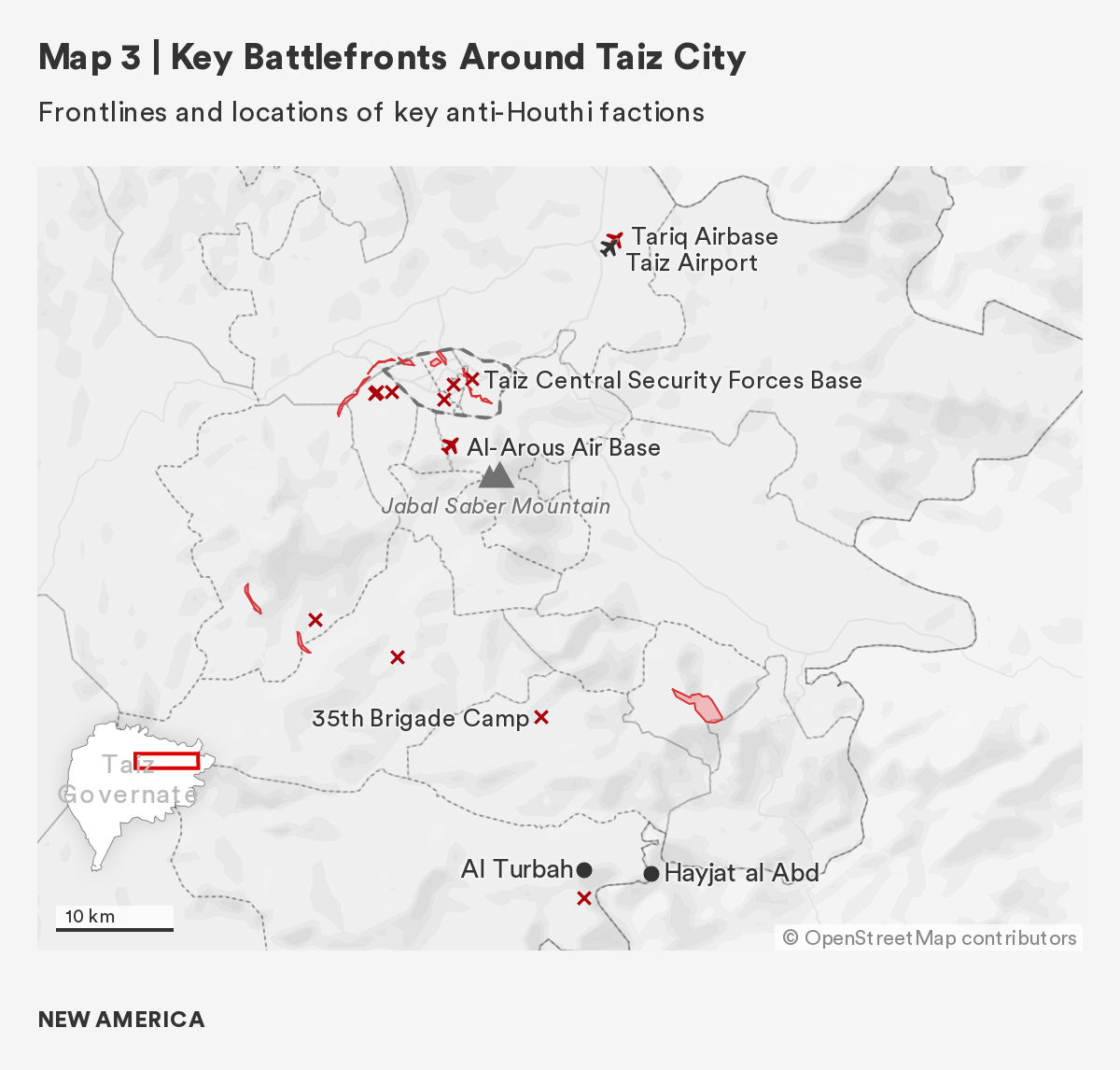
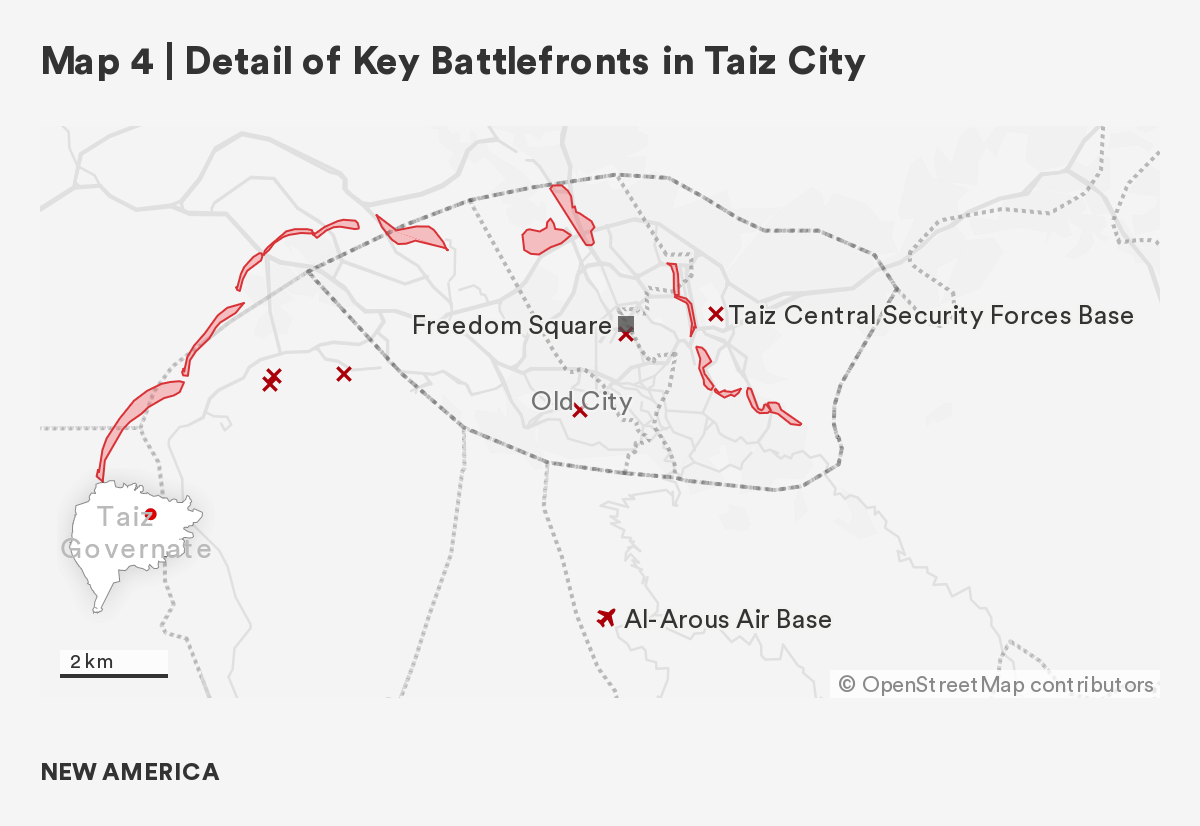
Taiz Military Axis
The leadership of the Taiz Military Axis, which is under the command of the Yemeni Army in Taiz, belongs to the Fourth Military Region. The first commander of the Axis was Brig. Gen. Yusuf Al-Sharaji, a military leader seen as close to the Islah Party, who was replaced in 2014 by Major General Khaled Fadel, who helped integrate various elements of the Popular Resistance (the bulk of which were allied with Islah) within the formal military structure.110 In December 2018, Fadel, despite being a member of the Islah party, was removed as part of a series of presidential decrees that led to his replacement by Major General Samir Sabri. The decrees also removed the governor of Taiz, Dr. Amin Mahmoud, due to fears that Mahmoud would threaten Hadi’s position by advancing UAE policy.111
Though understood to be one military grouping with ties to the Saudi-led coalition, the Taiz Military Alliance consists of a number of different brigades and groups that belie its representation as a stable force rather than a mutating set of individuals, networks, and brigades with their own local roots and identities. These constitutive parts are described below.
Twenty-Second Mechanized Infantry Brigade
The Twenty-Second Mechanized Infantry Brigade follows the Taiz Military Axis. Its commander, Major Sadiq Sarhan, is a veteran military figure and was one of the leaders of the First Armored Brigade before the current war. During the 2011 battles in Taiz, he mobilized fighters to stand against Saleh’s forces. Since the reorganization of the armed groups in Taiz and the incorporation of the popular resistance militia groups into the Yemeni armed forces, the Twenty-Second Brigade has incorporated four key groups, all of which are broadly seen by locals as belonging within Islah’s network.
Yahya Al-Raymi group:
Yahya Al-Raymi led fighters in the eastern front axis and the Republican Palace in May 2017.112 Al-Raymi is also a local Islah leader and former Quranic teacher. His fighters merged into the Twenty-Second Brigade in February 2017,113 and in 2018, the government replaced him with Ahmed Al-Baadani.114 Despite being sacked as leader of the brigade, Al-Raymi reportedly continues to lead battles in the eastern parts of the city under the official title of “Moral Guidance Officer” in the Taiz Military Axis. There are whispers that Al-Raymi is one of the Yemenis who returned to Yemen from fighting alongside the Mujahideen in Afghanistan. Although unsubstantiated, these rumors add to his mystique and credibility on the battlefield.
Wahib Al-Hawri group:
Wahib Al-Hawri is a local Islah leader and former military officer in the First Armored Brigade of Ali Muhsin. His group, which he named Brigade of the Storm, was officially active on the eastern front and fought in the axis of Hassanat near Thaabat, as well as in the north and west of the city. The Al-Hawri group was integrated into the forces of the Twenty-Second Brigade within the second sector in February 2017, alongside Al-Raymi’s fighters.
Nabil Al-Adimi group:
Nabil Al-Adimi is a commander of groups on the northern front, also known as the Zunoj Front.115 He also carries out offensive missions, including missions against the Houthis in different areas as a military commander, and is aligned with Islah.
Tawfiq Abdulmalik group:
A local Islah leader and a teacher, Tawfiq Abdulmalik led assaults on the eastern front axis near the school of Muhammad Ali Othman. In 2017, Abdulmalik was replaced by another commander, Mahfoudh Thabet often referred to as Sheikh Mahfoudh (also a local Islah leader). Their forces were jointly merged into the Twenty-Second Mechanized Infantry Brigade. Despite lacking an official military rank, Mahfoudh continues to play a significant role in leading the efforts in the eastern front via the Twenty-Second Brigade.
Seventeenth Infantry Brigade
The Seventeenth Infantry Brigade is another military brigade under the umbrella of the Taiz Military Axis. The commander of the brigade, Brig. Gen. Abdulrahman Thabet Al Shamsani, is a veteran army figure who has often had tense relations with the Islah military network despite frequently coordinating with it on the battlefield.116 Media reports alleged that Islah-allied elements attempted to assassinate Shamsani in November 2018.117 The brigade's operations are focused to the west of the city. Abdo Hamoud Al-Saghir, the commander of operations for the Seventeenth Brigade, is also the commander of the western battlefront.
The Seventeenth Brigade is ultimately a hybrid, pulling in both career military forces and irregular forces mobilized after the start of the Houthi siege in Taiz. The integration of these forces has helped Islah affiliates increase their sway in this area of the city. As with the Twenty-Second Brigade, incorporation of irregular forces has often been more symbolic than material. Fighters and civilians in Taiz speak of tensions between veteran and newer military leadership, as well as the resentment of what are seen as political interests by military brass.
Abdo Hamoud Al-Saghir group:
Abdo Hamoud Al-Saghir was a teacher and director of a public school in Taiz and served two terms as an Islah member in the local council of Al-Qahira. Al-Saghir was the first to lead the fighting west of the city of Taiz, and was considered the commander of the western front until his forces integrated into the Seventeenth Infantry Brigade. Following the integration, he was appointed commander of the brigade's operations and continues to command his followers.
The so-called Students’ Brigade, a group of university students who joined the popular resistance, also falls under the leadership of Abdo Hamoud Al-Saghir. The group continues to fight on the western front, and is also broadly viewed by Taizis as being composed largely of Islah sympathizers.
170th Air Defense Brigade
The 170th Air Defense Brigade is adjacent to the Tariq Air Base in Taiz as part of the Fourth Military Region Operations. President Hadi appointed Brig. Gen. Abdul Aziz Al-Majidi commander of the brigade in 2017.118 Al-Majidi is a veteran member of the YSP. During the conflict, he became closer to political figures from Islah, such as Thya Al-Haqq Al-Ahdal (a prominent Islah leader) and Salem. Abdul Aziz Al-Majidi’s ties to the YSP have often complicated his relations with Islah-affiliated figures, owing to the two party’s ideological differences. The 170th Air Brigade’s relevance has diminished due to its lack of bases in the north, and the fact that most of the command units are Islah affiliated, according to interviews conducted for this report.
Al-Hamza Brigade:
The Al-Hamza Brigade is the descendant of groups initially formed by Sheikh Hamoud Al-Mekhlafi, the original founder—and, according to his backers, still current leader—of the Popular Resistance. Sources on the ground reported that the Al-Hamza group merged with the 170th Air Defense Brigade under the command of Brig. Gen. Abdul Aziz Al-Majidi. Post-merger, Hamoud Al-Mekhlafi’s son Hamza was appointed within the 170th Brigade’s General Staff of the War,119 where his operational mandate is to oversee the northeastern fronts in Kalabah, Zahraa, and Fortieth Street.
In 2015, expanding his presence at the Central Security Forces headquarters and the district of Usaifra, Hamoud Al-Mekhlafi began training his militants to fight against the Houthis from the east of the city to the north. Although his resistance was small, it was one of the first to actively take to the streets against the Houthis. He is therefore hailed by many locals as the military leader and spiritual father of the anti-Houthi resistance in Taiz. In April 2016, Hamoud Al-Mekhlafi’s relations with both Hadi and the coalition frayed, owing in part to his personal frustration with what he perceived as their lackluster support for the battle in Taiz and their focus on fronts elsewhere.120 In 2016, Hamoud Al-Mekhlafi visited Marib, Shabwa, and Saudi Arabia to rally fighters and acquire weapons, ammunition, and money for the liberation campaign for Taiz.121 In retaliation for this and previous public criticism of its liberation efforts, the coalition pushed President Hadi to pressure Al-Mekhlafi to cease his political and military activities in Taiz and leave the city—all of which he did.
According to locals, Hamoud Al-Mekhalfi’s departure created a vacuum in Taiz that was partially filled by his son, Hamza, who took over his political and military responsibilities and maintained his relationships through the eponymous Hamza Brigades.
The Hamza brigade contains the remnants of Hamoud Al-Mekhlafi’s forces after his forced ouster from Taiz by Hadi and the coalition. The brigade is based at the front of the district of Kalabah, adjacent to the Central Security Forces camp. Today, many Taizis consider the Al-Hamza brigade an inactive group, due to its lack of progress or retreat from the territory it gained at the beginning of the war. While they have mobilized groups as reinforcements on other fronts, according to field observations, they remain near the battlefield without directly engaging in combat. The brigade employs a strategy to appear more directly engaged in the fighting than they actually are. The brigade possesses a large arsenal of equipment and weapons, but ultimately lacks the manpower to launch battlefield operations.
Fourth Infantry Mountain Brigade
According to interviews conducted for this report, the Fourth Infantry Mountain Brigade is a relatively new brigade established in 2018 by the leadership of the Taiz Military Axis to counter the UAE-backed Thirty-Fifth Brigade in Al-Turbah, Al-Hujariyah and other rural areas in the southwestern suburbs of the city of Taiz. According to these interviews, Hadi appointed Abu Bakr Al-Jabouli, an Islah ally, as the brigade’s commander (he is also an in-law of the former Taiz Military Axis commander, Khaled Fadel). The Yemeni government reportedly directed the Fourth infantry to a training camp in the Al-Masabih area near the town of Al-Turbah, which also received more than 300 recruits from within Taiz, apparently to prepare for confrontations with the Thirty-Fifth armored brigade.
In 2019, a turf war unfolded due to the Taiz Military Axis’s transfer of 500 members of the Thirty-Fifth Brigade to the Fourth Brigade in order to have more soldiers under the government’s control. However, confrontations between the two brigades swiftly ensued due to their collective refusal to accept the executive decisions of Hadi. A number of local contacts tied this to tensions between the Taiz Military Axis and the UAE, connecting it to the UAE’s support of Brig. Gen. Adnan Al-Hammadi in supplying armored vehicles to the Thirty-Fifth Brigade.
145th Infantry Brigade
A fairly new unit, the 145th Brigade falls under the direct leadership of the Taiz Military Axis. Its leader is the same as the leader of the Taiz Military Axis: Samir Al-Sabri. The brigade integrated the former Al-Sa'alik Brigade and other reserve battalions with the intention of unifying the security forces. The 145th is yet another brigade essentially operating under the control of Islah. Sources on the ground indicated that the brigade was preparing to support Hadi’s forces in Aden against the STC, but failed to mobilize.
Al-Sa'alik Brigade:
The Al-Sa’alik Brigade includes groups under the leadership of Azzam Al-Farhan, the son of Abdo Farhan (Salem), who has emerged as one of the most powerful figures in Taiz and an advisor to his father.122 The brigade’s name, which derives from local derogatory usage and means “mischievous outlaws,” was chosen by its young members and is meant to inspire fear on the battlefield. The Al-Sa’alik Brigade is a tactical group of former Popular Resistance fighters tasked with launching offensive attacks on various fronts. They continue to enjoy strong relations with Saudi Arabia, which has provided them with weaponry, including multiple armored vehicles—boldly emblazoned with the words “145th Brigade Command and Al-Sa’alik”—and modern equipment considered superior to that possessed by other groups. According to interviews, most of the members of this brigade are also the sons of Islah members who have previous combat experience. After their integration into the army, they became part of the 145th Brigade of the Taiz Military Axis, though they retain a significant amount of autonomy.
Fifth Brigade (Presidential Guard)
The Fifth Brigade sits under the umbrella of the Taiz Military Axis. The Fifth Brigade was created to formalize the Hasm Brigades as well as strengthen Hadi’s influence in Taiz. Adnan Ruzayq leads the collective brigade, whose work as part of the Presidential Guard directly involves it in confrontations with the Houthis. It maintains a number of sites in the western part of the city, including Al-Sayahi and Hadhran. Interviewees claimed that support for the Fifth Brigade comes directly from the office of the president, especially from Nasser Hadi, the president’s son, and the figure responsible for the Presidential Protection Forces. Reports based on interviews with fighters on the ground indicate that prior to the creation of this force, the Hasm Brigades received substantial support from the UAE.
Hasm Brigades:
Led by Salafist Adnan Ruzayq, a native of the southern governorate of Shabwa who grew up in Taiz, the Hasm Brigades are an armed group that came to prominence through its participation in the battles of Aden. After the liberation of Aden, the Hasm Brigades coordinated with one of the prominent field leaders in Taiz, Ammar Al-Jandabi. The transfer of Ruzayq’s weapons (used previously in Aden), made it possible for the brigade to quickly expand its activities in Taiz. The brigade has a strong record of participating in battles for the liberation of the city. Interviews confirm that Ruzayq merged his forces with those of the Taiz Military Axis, and in 2017, he was promoted to commander of the Fifth Presidential Guard, under the direct command of President Hadi. According to these interviews, Hadi chose Ruzayq mainly because of his good ties with Islah, which he maintains despite not personally being a member of the political party.
While Ruzayq maintains a firm relationship with the Islah networks, he is also known for adopting a balanced approach to adversaries. Ruzayq acted as an intermediary to help calm the situation between Islah and the Abu Al-Abbas Brigades in the city of Taiz during the fighting between the two groups throughout 2017.123 He has also been accused of having ties to al-Qaida;124 a number of fighters from Hasm, including Ammar al-Jundubi,125 are alleged members of the group.
Armed Groups Outside the Taiz Military Axis
While the bulk of armed groups in Taiz have been subsumed and incorporated into the Yemeni military via the Taiz Military Axis (and fall under the Fourth Military Region command of the Army), some have remained effectively outside of its chain of command. In other words, while they are officially and technically contained within the same structure, there is a de facto split between them. Chief among these armed groups operating outside of the Taiz Military Axis are the Thirty-Fifth Armored Brigade and the Abu Al-Abbas Brigades, which ostensibly have been integrated into the Thirty-Fifth Armored Brigade. Both of these forces are led by figures who view themselves as rivals to the wider Islah-aligned network; they have each benefited from support from both Saudi Arabia and the UAE, though in the wider public sphere, they are seen as being aligned with the UAE.
Thirty-Fifth Armored Brigade:
The Thirty-Fifth Armored Brigade announced its support for the internationally recognized government under the leadership of Brig. Gen. Adnan Al-Hammadi,126 alleged by Islah supporters in Taiz to be connected with Nasserist Party leader Abdullah Noman at the onset of the war. Locals mentioned that in response to the Thirty-Fifth Brigade’s declaration of support, the Houthis seized the brigade headquarters, displacing its soldiers, who fled to Al-Thabab district. There, the soldiers regrouped, and after several months returned to fight the Houthis across Taiz. The brigade opened new battlefronts against the Houthis and eventually regained control of several military sites. The Thirty-Fifth Brigade is now the most powerful military force in Al-Hujariyah, the western rural area of Taiz.
The brigade is officially under the Fourth Military Region, and the Hadi government pays the soldiers’ salaries. That being said, there are de facto divides that grant the brigade autonomy. There are sharp differences between the Thirty-Fifth Brigade and the military leadership structures of Islah. Many locals have accused Islah-affiliated officials of aiming to reduce the brigade’s power by redistributing members of the brigade to other military units more directly under Islah’s control within the Taiz Military Axis, something that, as of yet, has proven relatively unsuccessful.
The UAE, anxious about Islah’s dominance in Taiz, has sought to bolster the Thirty-Fifth Brigade, providing financial and military support to Brig. Gen. Adnan Al-Hammadi.127 The significant amount of armored vehicles and other military and financial resources provided by the UAE has allowed General Al Hammadi to expand his foothold in areas already under his control. Simultaneously, civilians in Taiz reported that the UAE has launched a surge of UAE Red Crescent Projects in these same brigade-controlled areas, aimed at winning the hearts and minds of locals.
Tensions between the Taiz Military Axis and Adnan Al-Hammadi have frequently surfaced. Most of this tension has played out across spaces in close proximity to both the Axis’ established military brigades and areas controlled by the Thirty-Fifth Brigade. In Al Turbah, for example, the Axis established the Fourth Mountain Infantry Brigade (Islah-backed) adjacent to the Thirty-Fifth Brigade. Reports of further confrontations between the two sides continue, including over the Thirty-Fifth Brigade’s detention of arms shipments bound for the Fourth Brigade.
These tensions led to occasional skirmishes beginning in 2017. Multiple attempts by the local authorities to unify the factions and reduce tensions have failed.128 In late 2018, representatives of the GPC, YSP, Islah and NUPO held a meeting in China and called on the military factions to implement Al-Khayami agreement (signed by the leadership of both the Axis and Thirty-Fifth Brigade) to dismantle the new posts and return occupied areas to a joint security committee.129 However, local civilians are doubtful that the agreement will ever be implemented.
On December 2, 2019, Al-Hammadi was killed in Taiz.. His death, amidst some unconfirmed rumors of Islah involvement, illustrates the continued fragmentation of the war in Taiz and the role of local politics.
Abu Al-Abbas Brigades
The Abu Al-Abbas Brigades are armed groups collectively led by Adel Abdo Farea Al-Thabhani, who calls himself Abu Al-Abbas (the father of Abbas). The brigades have ostensibly been integrated into the Thirty-Fifth Brigade. A 48-year-old local from the old city district of Taiz, Al-Abbas describes himself and his followers as Salafiis from Dammaj.130 However, local observers counter that as much as 90 percent of his armed forces are ordinary people. Moreover, they recall that he has also incorporated and aligned himself with a number of figures who were originally members of the GPC and historically felt animus toward Islah. Abu Al-Abbas's fighters were included in the Thirty-Fifth Armored Brigade when Yemen’s Popular Resistance was merged into the chain of command of the Yemeni military, but despite integration into the payroll, full structural command and control did not follow.
The rise of Abu Al-Abbas is emblematic of the means by which various, once unknown individuals have managed to rise to prominence during the conflict. Abu Al-Abbas began as a financial officer to a military leader named Abu Al-Sadouq.131 He used this position to build his own independent channels with funders, eventually forming an armed group and making the Old City his stronghold. Concentrating his forces on eastern areas of the city, Al-Abbas liberated much of city of Taiz from Houthi control. With the support of the coalition, Abu Al-Abbas seized many of the government institutions from the Houthis and their allies, in addition to garnering significant sway on financial channels to anti-Houthi armed groups in Taiz.
According to local contacts, Abu Al-Abbas’s fighters have benefitted from UAE support since 2015. This has often resulted in a difficult balancing act. In one telling event in November 2015, after receiving four armored vehicles from the UAE, Abbas festooned them with Emirati and Yemeni flags and paraded them around the city of Taiz. Al-Abbas’s flaunting of its relationship with the UAE angered Saudi leaders, who were also supporting Al-Abbas, and resented the absence of the Saudi flag. Attempting to diffuse the situation and demonstrate his loyalty to both sides. Al-Abbas again paraded the vehicles, this time with Saudi flags waving alongside those of the UAE.
According to interviews, Abu Al-Abbas seized sensitive institutions such as the buildings of the Political Security Organization, responsible for gathering intelligence led by military officers, and the Military Police base, a longstanding law-enforcement institution. By 2017 Abu Al-Abbas controlled much of the Old City, as well as economic institutions such as Yemen’s Tobacco and Matches Company, a major source of income for the state.
As Abu Al-Abbas’s strength grew, his relations with Islah networks deteriorated. Islah groups engaged in proxy battles with Abu Al-Abbas via affiliated parties, such as the 170th Brigade. Opponents of Abu Al-Abbas waged a media campaign against him; Islah continued to claim that he was a terrorist and spread rumors about underground prisons where he personally tortured and executed his opponents.132 Consistent negative media attention caused local and regional public opinion to turn against Al-Abbas.
In October 2017, the U.S. Treasury Department added a number of individuals and groups to the terrorist list, including Abu Al-Abbas or Adel Abdo Farea Al-Thabhani, who was accused of financing terrorist elements affiliated with al-Qaida.133 Abu Al-Abbas categorically denied the accusation, and blamed the United States’s decision on malign influence from Islah and Qatar. According to interviews, in the lead up to the terrorist listing, Saudi Arabia allegedly asked Abu Al-Abbas to leave Yemen and withdraw from the political and military scene (he refused).134
According to sources, in late 2017, rhetorical hostilities between Abu Al-Abbas and Islah simmered into armed conflict. By 2018, the conflict had intensified, with sporadic fighting radiating outward from the city center. Despite a tentative ceasefire, clashes between the two sides continued intermittently until the beginning of April 2019. These violent confrontations killed tens of civilians and fighters, paralyzing Taiz and further demoralizing its long-suffering population (the siege of the Old City, Abu Al-Abbas's stronghold, was particularly brutal). Although the pretext for ongoing hostilities changed by the day, the Taiz Military Axis ultimately sought to kick Abu Al-Abbas and his forces out of Taiz. After rounds of talks by meditative military committees and several orders from President Hadi, Abu Al-Abbas finally agreed to leave the city.
Al-Qaida in the Arabian Peninsula (AQAP) and Ansar al-Sharia
While the anti-Houthi coalition mostly consists of the two major alignments described above, a third force is also active in Taiz. Portrayals of Taiz as an extremist haven are exaggerated, but the conflict has—or at least had—proven a boon to AQAP’s presence in the city. The Yemen war marks the first time that AQAP has maintained an open presence in Taiz, where it took advantage of the wider dynamics of the conflict, positioning itself as an effective anti-Houthi fighting force.
Historically, while AQAP has recruited from disaffected urban youth in cities like Sanaa, Hudayda, Aden, and Taiz, the balance of their activity has been elsewhere in the country, mostly in more sparsely populated and isolated areas in governorates, like Marib, Abyan, and Shabwa.135 The rise of the Houthis—and the accompanying collapse of the state—allowed AQAP and its front group, Ansar al-Sharia, to capitalize on power vacuums across the country. They simultaneously cast themselves as vanguards of Sunni Islam in an aim to capitalize on anti-Houthi feeling and the accompanying rise in sectarian sentiment.136
According to locals, al-Qaida established a military presence in Taiz at the outset of the war, operating in now-defunct jails and military bases. At first, the al-Qaida presence on the battlefield in Taiz was scattered across different fronts. Diverse AQAP members and groups eventually united into one force: the Ahl Al-Sunnah Brigades, now known as the Ansar Al-Sharia of Taiz. The group soon began documenting and photographing their battles in Taiz. In early November 2015, they began to release videos of the so-called Ansar Al-Sharia in Taiz, highlighting their role in the two-year long battle for the neighborhood of al-Jahmaliya, a fight that also pulled in members of the Abu Al-Abbas Brigades.137
In an effort to win support, Ansar Al-Sharia launched a savvy digital media campaign, filming their battles with modern equipment such as Go-Pro cameras, which appealed to young followers. Other films they produced portrayed the Houthis as terrorists and Iranian stooges and contained distressing scenes of violence and brutality.138 Locals mentioned that they also launched a variety of recruitment operations, including distributing propaganda, a (short-lived) weekly newsletter, mobile recruitment centers and, in one case, a memorization competition.
However, under the governorship of Amin Mahmoud, security campaigns forced the militants to depart from Taiz and relinquish the areas under their control. Furthermore, AQAP’s activities in Taiz have appeared to decline following their loss of the Yemeni port city of Mukalla in April 2016; while Mukalla is distant from Taiz, it robbed the group of a safe haven, one that provided both financial resources and operational space.139 As with elsewhere in Yemen, AQAP also appears to have been forced to reduce their activities in Taiz owing to their loss of critical revenues from Mukalla. While local contacts say that AQAP-aligned fighters can still be found in Taiz, since the middle of 2018, they appear to have largely withdrawn from the city. This withdrawal does not entirely remove the possibility of al-Qaida sleeper cells, but it did eliminate the open presence of al-Qaida in Taiz, which locals previously observed riding around in marked vehicles distributing propaganda pamphlets.
While hardened al-Qaida and ISIS fighters have mostly fled Taiz (largely to the governorates of al-Bayda, Hadramout, Shabwa and Lahj), local sources say that other AQAP fighters have moved to an area near Jabal Habashi, al-Kadaha, and Al-Shuraja in Taiz’s rural west, where they continue to clash with Abu Al-Abbas fighters. Most notably, veteran AQAP leader Bilal Al-Wafi sought refuge in Al-Shuraja until his arrest on May 18, 2019 by the Seventeenth Brigade.140 Local Taizis who previously fought for extremist groups have largely either defected from these groups and gone into hiding or been arrested. This demonstrates the ephemeral nature of allegiances in the conflict: Many joined up with AQAP-aligned groups more for practical, rather than ideological, reasons.
Citations
- “Wazir Al-Difa’ Yuqil Qaid Al-Liwa 35,” Mareb Press, October 27, 2014, https://marebpress.net/news_details.php ; “Caught in the Middle: A Conflict Mapping of Taiz Governorate,” 20.
- “Caught in the Middle: A Conflict Mapping of Taiz Governorate,” 21; “Hadi Sacks Taiz Governor under Islah Pressure,” Aden Press, December 31, 2018, http://en.adenpress.news/news/2001
- “Colonel Al-Raimi Confirms the Liberation of the Republican Palace in Taiz,” SeptemberNet, June 13, 2017, https://en.26sepnews.net/2017/06/13/colonel-al-raimi-confirms-the-liberation-of-the-republic-palace-in-taiz
- “Qa’id Al-Mujahideen Ila Al-Dhawo: Senario Aden Yahoom Fawq Taiz!”
- Wi’am Al-Sufi, “Kaif Istaqbal Nashitoon Qarar Hadi,” Al-Mawqea Post, January 1, 2018, https://almawqeapost.net/news/37076 ; “Ta’arif Ala Jaysh Al-Doha Fi Taiz Wa Abraz Qit’atih Al-Askriyah,” Anba Yemeniah, September 18, 2018, http://yemeninews.net/show390379.html
- Wi’am Al-Sufi, “Qayid Aljabhat Alshamaliat Fi Taezin Yuakid ’Iihraz Almuqawamat Taqadumaan Kabiraan Ealaa Almlyshyat,” Al-Mawqea Post, June 10, 2016, https://almawqeapost.net/news.php?id=8734
- “17 Infantry Brigade Commander Survives Assassination Attempt at South Taiz,” Al Masdar Online, November 18, 2018, https://almasdaronline.com/article/17-infantry-brigade-commander-survives-assassination-attempt-at-south-taiz
- “Second ‘Hadi’ Forces Commander Survives An Assassination in Taiz Within 24 Hours,” Debriefer, November 18, 2018, https://debriefer.net/en/news-4774.html
- “Qarar Jamhowry Bitayeen ‘Almajidi’ Qayidaan Lilwa’ 170,” AlHarf28, February 20, 2018, 28, http://www.alharf28.com/p-2592
- “Akad Tawafuq Aljamie Alaa Taeyin Najl ,” Yemen Now, October 18, 2016, http://yemen-now.com/news1296550.html
- Wi’am Abdulmalik, “Ma Wara’ Tahrokat Al-Sheikh Al-Mekhlafi Tijah Marib Wa Al-Mamlakah?,” Al-Mawqea Post, April 3, 2016, https://almawqeapost.net/reports/6727
- Ibid.
- Hanan Al-Hakry, “Yemen: Blood and Fire in Taiz,” Ahram Online, March 28, 2019, http://english.ahram.org.eg/NewsContent/2/8/329013/World/Region/Yemen-Blood-and-fire-in-Taiz.aspx
- “Lajnat Wasata Tukhmid Ishti’al Al-Mowajahat Fi Taiz,” Asharq Al-Aswat, April 28, 2019, https://aawsat.com/home/article/1698596/لجنة-وساطة-تُخمِد-اشتعال-المواجهات-في-تعز
- Maggie Michael and Trish Wilson, “U.S.-backed coalition cuts deal with al Qaeda in Yemen,” AP, August 7, 2018, https://www.csmonitor.com/World/Middle-East/2018/0806/US-backed-coalition-cut-deals-with-Al-Qaeda-in-Yemen
- According to local sources, Amar Al-Jundubi attended Al-Eman University, a Sunni religious school founded by Abdulmajid Al-Zindani, a ‘Specially Designated Terrorist’ and cofounder of Islah. For more, see: Laura Kasinof and Scott Shane, “Radical Cleric Demands Ouster of Yemen Leader,” The New York Times, March 1, 2011, https://www.nytimes.com/2011/03/02/world/middleeast/02yemen.html
- “War in Yemen: Taiz on the Frontline,” The New Arab, April 20, 2015, https://www.alaraby.co.uk/english/politics/2015/4/20/war-in-yemen-taiz-on-the-frontline
- Fernando Carvajal, “Anatomy of Chaos: Yemen’s Taiz,” Gulf State Analytics, April 9, 2019, https://gulfstateanalytics.com/anatomy-of-chaos-yemens-taiz/
- “Ahzab Yemeniyah Tado’o Tanfeeth Itifaq Al-Khayami,” AlHarf28, November 26, 2018, http://www.alharf28.com/p-14658
- “Ahzab Yemeniyah Tado’o Tanfeeth Itifaq Al-Khayami.”
- Dammaj is a city home to Dar Al-Hadith, a Salafi school, that was besieged by the Houthis in 2011 and 2014 until the Salafi population was forced to leave after multiple ceasefire attempts, resulting in a Salafi exodus. Maysaa Shuja al Deen, “The Houthi-Tribal Conflict in Yemen,” Carnegie Endowment for International Peace, April 23, 2019, https://carnegieendowment.org/sada/78969
- Abdulhakim Hilal, “Fi Awal Hiwar Lah.. Al-Shaykh Al-Salafi ‘Abu Al-Sadouq’: ‘Abu Al-Abbas’ La Yomathilna,” Yemen Shabab Net, September 17, 2018, https://yemenshabab.net/interviews/39259
- “Maqabir Sirryah Tabi’ah Li’ Katayeb Abu Al-Abbas B’Taiz,” Al Jazeera, October 22, 2018, https://www.aljazeera.net/news/arabic/2018/10/22/تحقيق-الجزيرة-مقابر-سرية-تابعة-لكتائب-أبو-العباس-بتعز ; “Tensions Heighten between Pro-Hadi Groups in Yemen’s Taiz,” Middle East Eye, August 30, 2018, https://www.middleeasteye.net/news/tensions-heighten-between-pro-hadi-groups-yemens-taiz
- “Counter Terrorism Designations,” Office of Foreign Assets Control U.S. Department of the Treasury, October 25, 2017, https://www.treasury.gov/resource-center/sanctions/OFAC-Enforcement/Pages/20171025.aspx
- Raghavan, “The U.S. Put a Yemeni Warlord on a Terrorist List”; “Abu Al-Abbas Battalion Leave Taiz, End Infighting,” Debriefer, April 27, 2019, https://debriefer.net/en/news-8096.html
- Michael Horton, “Fighting the Long War: The Evolution of Al-Qaida in the Arabian Peninsula,” CTC Sentinel 10, no. 1 (2017).
- Ibid.
- Walid Al-Amri, “Al-Qaeda Yabith Tasjilat Hiya Al-Oula To’wathiq Hodhooroh Al-Qitaly Fi Taiz,” Khabar News Agency, November 11, 2015, https://www.khabaragency.net/news42182.html
- “Al-Yemen: Al Qaeda Tunshir Videohat Lihajamat Ala Qiyadat Houthiyeen Wa Tohatheraho,” CNN Arabic, August 7, 2016, https://arabic.cnn.com/middleeast/2014/09/15/yemen-qaeda-houthi
- Yara Bayoumi, Noah Browning, and Mohammed Ghobari, “Special Report - Al Qaeda Emerges Stronger and Richer from Yemen War,” Reuters, April 8, 2016, https://uk.reuters.com/article/uk-yemen-aqap-specialreport/special-report-al-qaeda-emerges-stronger-and-richer-from-yemen-war-idUKKCN0X50SM
- “Regional Overview - Middle East 29 January 2019,” ACLED, January 29, 2019, https://www.acleddata.com/2019/01/29/regional-overview-middle-east-29-january-2019/ ; “Yemen’s Government Forces Arrest Key Al-Qaida Leader,” AP, May 19, 2019, https://www.apnews.com/91fc48d39fed471a9ce0486482f54111
More About the Authors

Raiman Al-Hamdani
Adam Baron
Fellow, Future Security Program