A Chapter of: Trade 2020: What’s It All About?
Introduction & Trade Scorecard
What do labor rights, tax policy, clean air standards, or apprenticeship programs have to do with trade? How about immigration policy or the decision to use military force? In short, it depends who you ask. A surprising number of 2020 presidential campaigns are discussing one or more of these issues under the rubric of trade. Increasingly, trade and the range of proposals associated with it are a shorthand to translate intense policy debates about what kind of economy will serve U.S. interests best in the years ahead, how much government involvement is needed to get there, and how much global interconnection is the right amount for U.S. workers, communities and corporations into political terms. The New Models of Policy Change project, part of New America’s Political Reform program, built this scorecard to help track the issues and to better understand how candidates are drawing connections.
Economists define international trade as the exchange of goods and services between entities in different countries. But when analysts and journalists write about international trade, they also mean the set of economic agreements, institutions, and arrangements that govern how money, goods, and services—as well as the jobs and assets attached to them—move around the globe, and in and out of American communities.
When the American people talk about trade, on the other hand, evidence suggests that they are more often referring to the state of jobs, the economy, and even immigration and cultural diversity within communities, rather than to the international agreements and structures that govern trade. Since the aftermath of World War II, practitioners of American foreign policy and grand strategy have seen trade through yet another lens: as a means of creating ties that are valuable in and of themselves, regardless of what is traded and to whose advantage; building relationships; fostering interdependence; and making conflict less likely.
Over the decades since World War II, trade has periodically served as a flashpoint in U.S. presidential campaigns in combination with one or more of these issues. The 2020 campaign, however, has seen candidates using the umbrella of trade to offer proposals on everything from taxes and tariffs to climate change, and from supporting human rights abroad to reforming education and labor laws at home. Several candidates (and former candidates) have put forward detailed policy proposals that would transform the international economic system, in different directions.
At the same time, it has been challenging to pin down candidates on the key facets of trade policy as it currently exists, such as whether they would continue the tariffs put in place by President Trump. Candidates Gabbard, O’Rourke, Steyer, and Weld have said that they would roll back Trump’s tariffs upon taking office; Buttigieg and Yang have said that they would use the tariffs as leverage in trade negotiations. But Trump’s many other challengers, while criticizing the trade war, have not made their intentions regarding the tariffs clear. Similarly, while the two most recent trade deals undertaken by the United States—Trump’s renegotiation of the United States-Mexico-Canada Agreement (USMCA, formerly known as the North American Free Trade Agreement, or NAFTA), and the Trans-Pacific Partnership (TPP) that went into effect without the United States after Presidents Obama and Trump both declined to submit it for congressional approval—have been hotly debated, candidates have largely avoided taking clear positions on U.S. membership in either. (After the bipartisan House passage of USMCA in December 2019, only Sanders and Klobuchar commented on whether they would support the new version, with Sanders saying he would not, and Klobuchar saying she would.)
At the same time, some candidates have engaged in great depth on a range of issues which are either not often associated with trade policy in public debate or are highly technical and seldom raised in broader political debate.
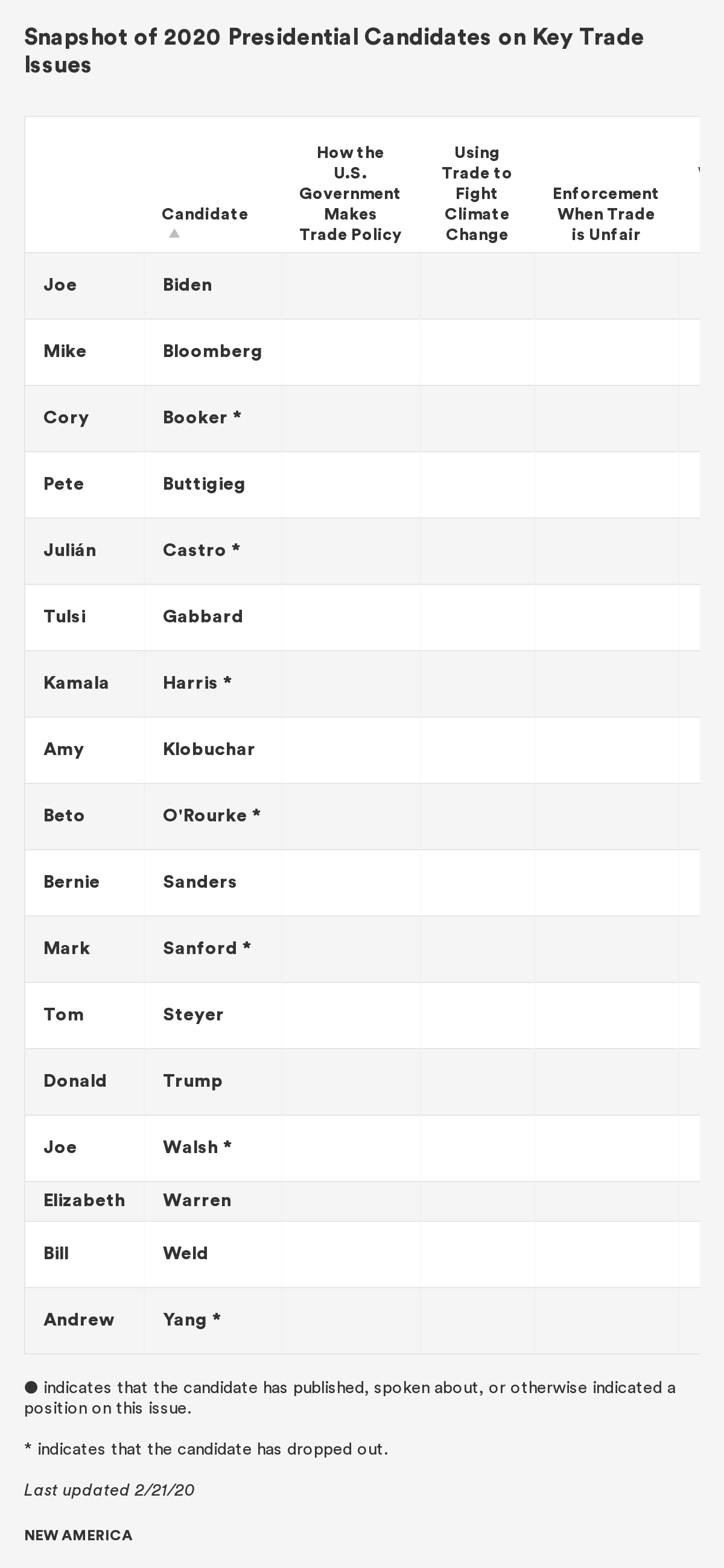
The political discourse is redefining what trade is and how it relates to national security and domestic policy in real time. New Models of Policy Change looks to define and clarify that shift by tracking how 2020 candidates are defining trade and what they are proposing. We have identified six policy areas where candidates are making wide-ranging policy proposals under the rubric of trade: how the U.S. government makes trade policy; using trade to fight climate change; enforcement when trade is unfair; linking trade to worker and other human rights; trade and national security; and trade and taxes.
Above we chart which candidates have engaged on which issues, with each issue linked to a short essay describing the range of candidates’ proposals and how they might play out. Together, they offer a picture of a set of disagreements about how, or even whether, the United States manages its economy at home and to what ends its government engages in the global economy. “Trade” is a narrow word to encompass such a fundamental and wide-ranging debate.
The candidates currently featured on the scorecard include the 12 Democratic candidates who qualified for the October 15th debate. While some have subsequently dropped out of the race, we have included them here to capture the full range of debate around trade. We also include the incumbent Republican, as well as 3 Republican primary candidates who in October were exceeding 1 percent in national polls.
Our analysis does not suggest endorsement, support of, or opposition to any candidate; it is simply a record of whether each candidate has addressed a particular issue. We will update these documents as the campaign continues.