Basic Water Usage (Jigjiga City)
In May 2019, members of WPS from the World Resources Institute traveled to Somali regional state in Ethiopia, along with partners from New America's Phase Zero project. With the help of a locally staffed charity, we sought to compare our conceptual framework with the ground truth of a place to which our model ascribed very high conflict risk. We also met with potential users of our tool from local and national governments as well as international organizations to solicit feedback on how they might make use of the tool.
We started our visit in Jigjiga, the capital of Somali region and the 10th-largest city in the country. Its roads were a whirl of trucks, cars, three-wheeled taxis, camels, and donkeys, its sidewalks packed with vendors, shoeshiners, plastic outdoor furniture, buskers, beggars, stalls, goats, and more. The strange juxtapositions of rapid development abounded: rough livestock pens built of unfinished stakes abutting small strip malls boasting hair transplant centers; the skyline of a construction boom along streets dotted with destitute women and children we were told were refugees.
In an interview at his office, Bashir Hasan Adal of the Regional Water Resource Development Bureau in Jigjiga was unambiguous about the role of water in the area: "Ultimately, water is the number one issue for communities. … In the Somali [region], the top priority is groundwater." There is large geological variation across the region when it comes to water, in terms of both availability and quality. Water levels, he continued, "can be a friction point interethnically, depending on the distribution in space [of water and infrastructure]." As for the consequences, "In border areas, when there is drought, people will fight to gain access to water resources by force."
The situation Adal described is not hypothetical. As noted by Mohamed Nur Isse, regional deputy head of the Disaster Prevention and Preparedness Bureau, Somali region contains hundreds of thousands of internally displaced persons17 "due to drought and lack of rainfall." As a whole, Ethiopia has an additional 3 million internally displaced persons due to domestic unrest—the highest national tally in the world.18 Additionally, Jigjiga alone hosts tens of thousands of refugees from the neighboring nation of Somalia.19 Internally displaced persons are typically eager to go back home, Isse noted, but those who are displaced because of conflict are not willing to return, despite the poor living conditions and social destabilization of the refugee camps, due to ongoing concerns for their safety.20
Among the local actors we interviewed, the importance of water to conflict was self-evident and uncontested: any understanding of local conflict drivers is incomplete without awareness of local water dynamics. More complicated is how someone outside the area can begin to understand these dynamics, as well as how someone who already knows something about these dynamics would quantify or communicate that information.
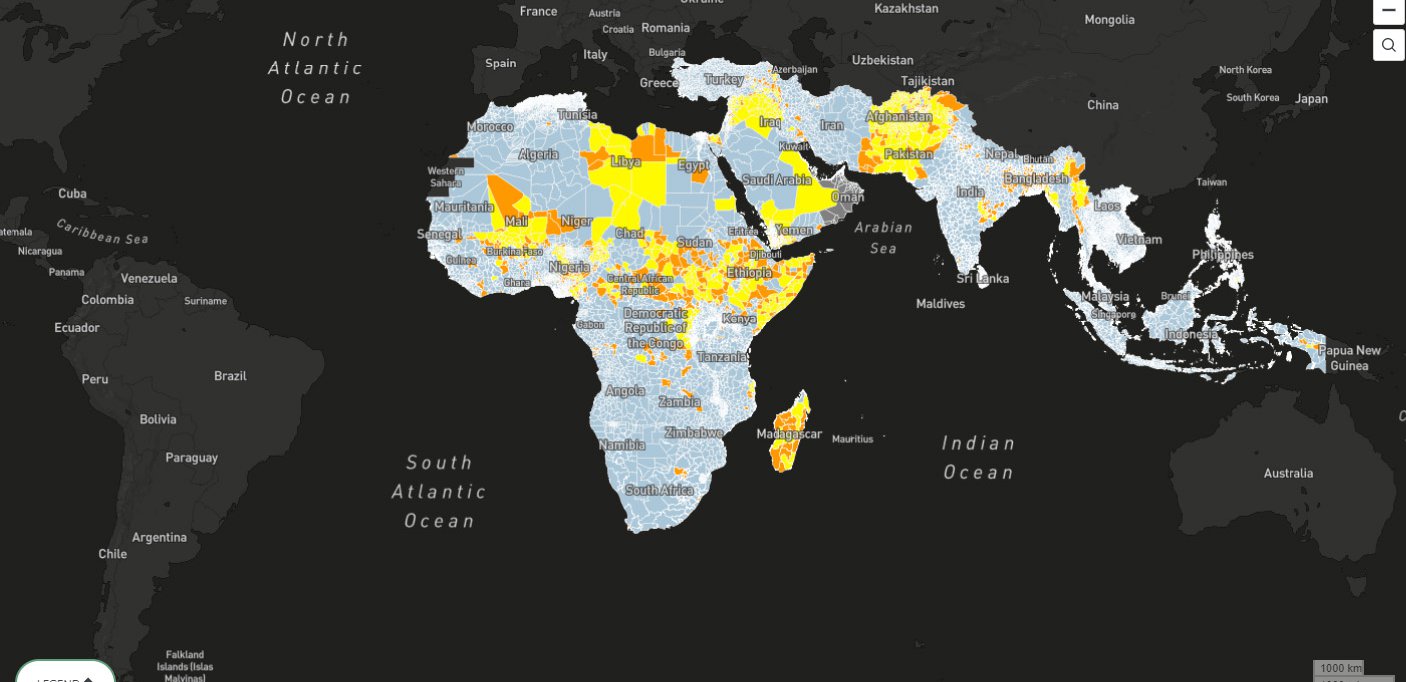
Technical, empirical means are one way to answer questions about the role of water in local conflict. For starters, researchers have developed spatially precise indicators that capture the water characteristics of an area. For example, baseline water stress represents "the ratio of total withdrawals to total renewable supply in a given area."21 The Water, Peace and Security model incorporates several such indicators,22 which have a measurable impact on its forecasts. The tool presents all of these in a simple visual format that allows any user to examine an area's fundamental exposure to water challenges.
Citations
- Internal Displacement Monitoring Centre, "Ethiopia." http://www.internal-displacement.org/countries/ethiopia
- Abdur Rahman Alfa Shaban, "Ethiopia Is Global Leader for Internally Displaced Persons —Report," Africanews, May 13, 2019. https://www.africanews.com/2019/05/13/ethiopia-is-global-leader-on-internally-displaced-persons-grid/
- UN High Commissioner for Refugees, Horn of Africa Somalia Situation, September 30, 2019. https://data2.unhcr.org/en/situations/horn/location/160
- Tom Wilson, "Ethnic Violence in Ethiopia Has Forced Nearly 3 Million People from Their Homes," Los Angeles Times, May 30, 2019. https://www.latimes.com/world/la-fg-ethiopia-ethnic-violence-millions-displaced-20190530-story.html; International Crisis Group, Managing Ethiopia's Unsettled Transition, February 21, 2019. https://www.crisisgroup.org/africa/horn-africa/ethiopia/269-managing-ethiopias-unsettled-transition
- World Resources Institute, "Water Stress by Country," December 2013. https://www.wri.org/resources/charts-graphs/water-stress-country
- Baseline water stress, seasonal variability, interannual variability.