

Amanda Lenhart
Deputy Director, Better Life Lab
The authors would like to thank our Better Life Lab colleagues Vicki Shabo and Jahdziah St. Julien for their feedback and work on this report, as well as Alison Yost, Samantha Webster and Naomi Morduch Toubman from New America Communications for their assistance. We would also like to thank Lake Research and American Viewpoint for their work on this survey and a special thanks for Catherine Beane at YWCA for coordinating and instigating this partnership.
In the past several decades, women in the United States have both increased their presence in the workforce while at the same time have maintained or even intensified the care they provide to others – young children and, increasingly, aging parents and loved ones. Women, on average, still spend far more time than men every day on household chores and caring for family members, as well as the largely invisible planning, logistics, organizing, and mental and emotional labor required to run a house and keep families together.
Ahead of the 2020 election season, we partnered with the YWCA to ask women how those family responsibilities impact their ability to keep their jobs or advance in the workplace and what they think would best help them manage work and care. The YWCA national survey, YWomenVote2020, oversamples women of color and young women, offering a unique opportunity to elevate the voices of women whose experiences and beliefs are often missing from survey research.
The poll found that about half of all women surveyed are worried about their ability to balance their work responsibilities with their personal or family needs. One in four women in America (26 percent) say that in the last year or two caregiving demands have had a negative impact on their ability to keep a job or advance in the workplace. The numbers tell a more sobering story when broken down by age and race or ethnicity.
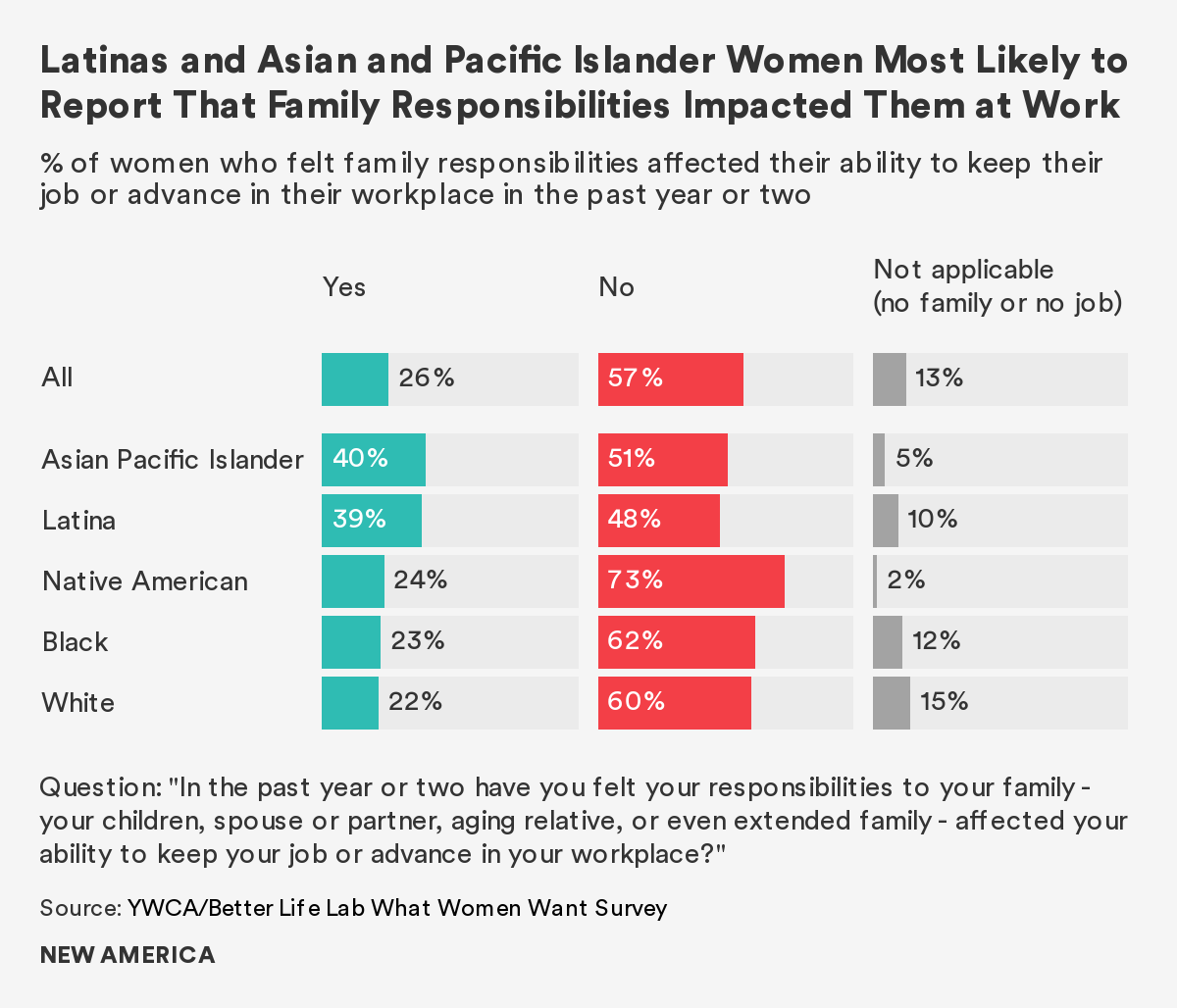
Forty percent of Asian women in America and 39 percent of Latinas said that their jobs or careers were disrupted by caregiving demands. Black women (23 percent), white women (22 percent), including white women without a college degree living in rural America (15 percent), reported the least work-care conflict. Low rates of reported disruption from Black women may be explained by the longer history of Black women’s involvement in paid work while raising families and lesser guilt over this dual commitment, as sociologist Dawn Marie Dow has recently found.
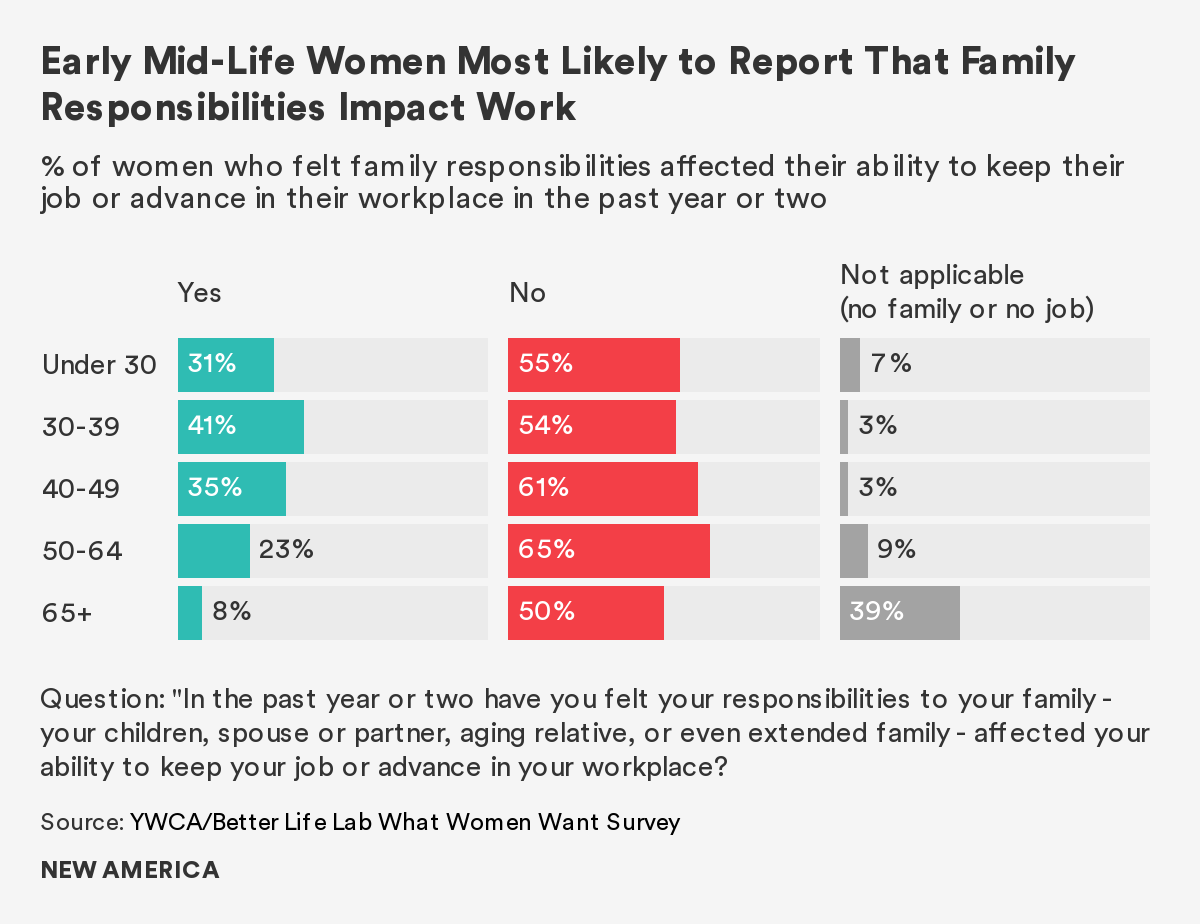
Women in their 30s and 40s, who are increasingly sandwiched between starting or raising a young family and caring for aging parents, feel the work-care squeeze most acutely. Forty-one percent of women in their 30s, and 35 percent of women in their 40s reported that their family responsibilities took a toll on their work in the last year or two.
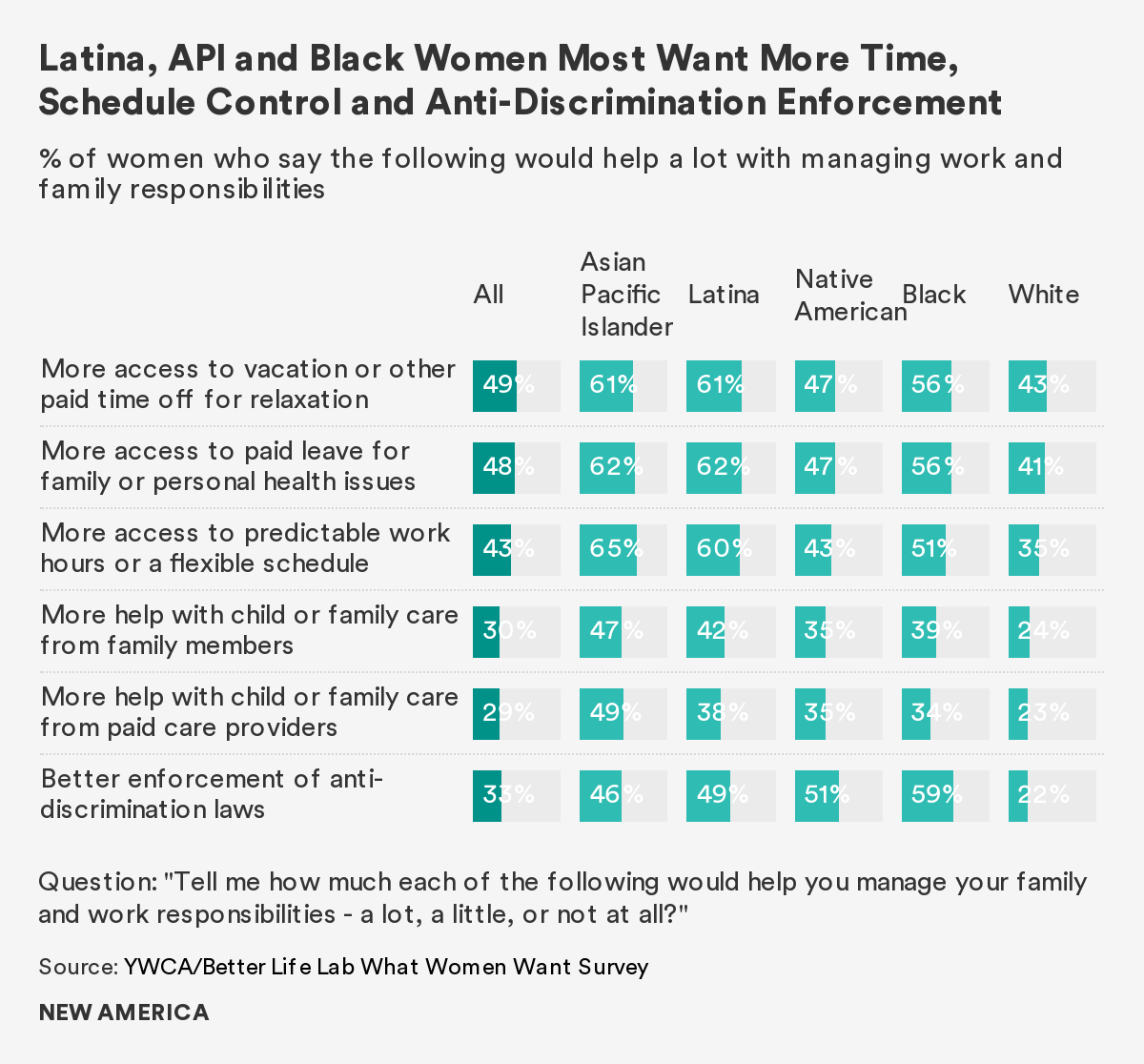
The poll also found that nearly half of all women said more paid time off would help manage work and care a lot. Forty-nine percent of the women surveyed said more access to paid vacation or other paid time off to rest and recover would help a lot in managing work and family responsibilities. Forty-eight percent said more access to paid leave for personal or family health issues would help a lot. And 43 percent said having more control over their work time, through more access to predictable work hours or a flexible schedule they have input into would help a lot in easing work-care conflict.
A majority of Latina and Asian women, and half of Black women say having more control over their time would help work-care balance a lot, as compared to less than half of Native American and white women.
Fewer women – about one-third of those surveyed – said having more help with child or family care from either family members or paid caregivers would help them manage their work and care responsibilities a lot. Nearly half of Asian women said more help from paid caregivers would help them a lot.
About one-third of all women surveyed said better enforcement of anti-discrimination laws would help a lot in combining work and care responsibilities. Larger shares of women of color say this would help the most, with Black women (59 percent) and Native American women (51 percent) reporting the highest shares, followed by Latina women (49 percent) and Asian women (46 percent).
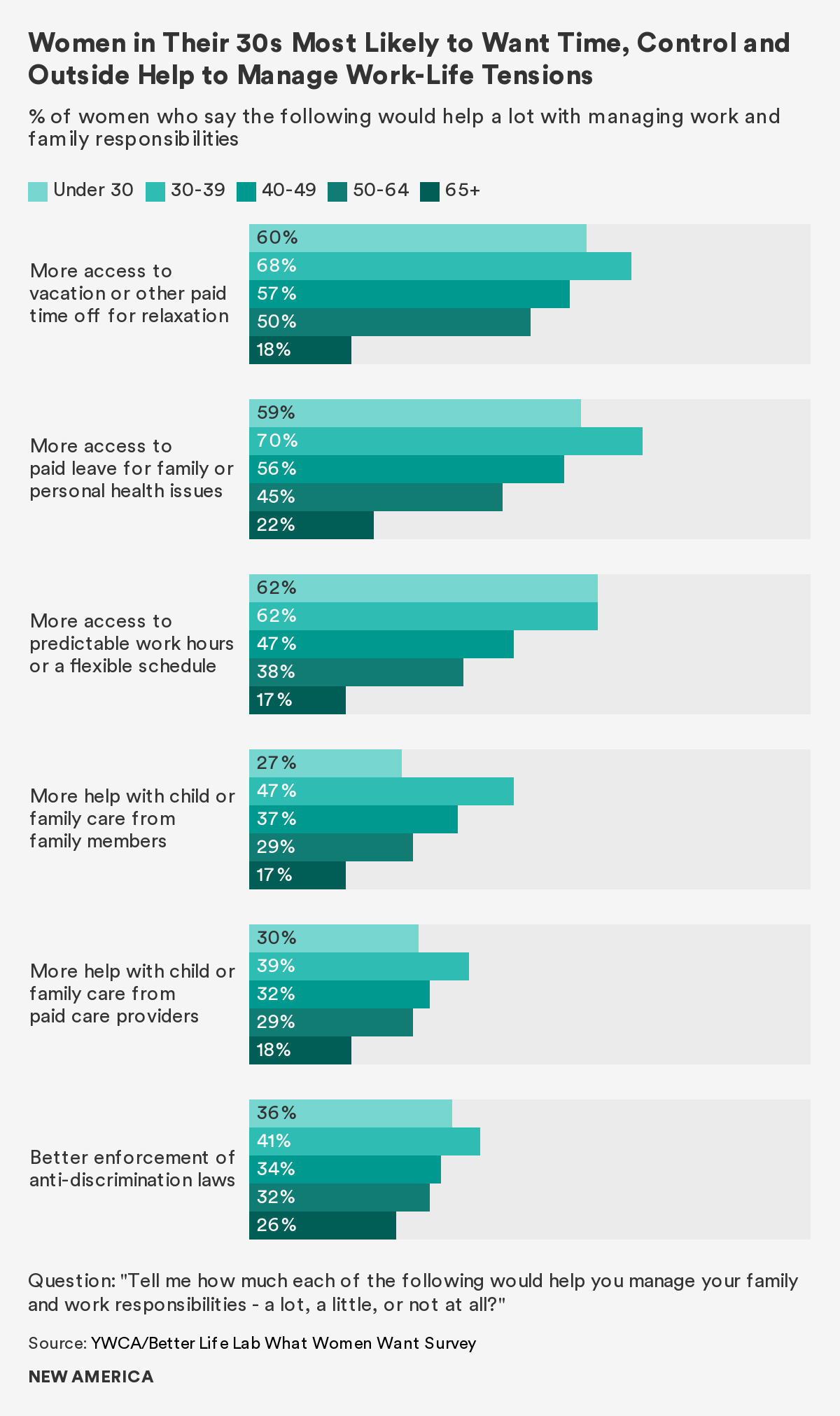
Young and middle-aged women resoundingly said more access to paid time off and control of their schedules would help a lot, with 70 percent of women in their 30s saying access to paid family leave would be most helpful, and 68 percent saying paid vacation time would help a lot. Sixty-two percent of women under 40 rated access to predictable and flexible schedules as something that would help them manage work and care demands a lot.
Women in their 30s were also more likely to report that better enforcement of anti-discrimination laws would help a lot in managing work and care concerns.
What do women want from lawmakers regarding family, caregiving, and the workplace? Here’s what the YWCA YWomenVote2020 survey found:
While 72 percent of white women said passing equal pay legislation is “very important,” women of color showed even greater intensity of support: 92 percent of Black women, followed by 86 percent of Asian women, 80 percent of Native American women and 75 percent of Latina women rated equal pay “very important.”
Eighty-seven percent of Black women and Asian women, the highest shares across racial or ethnic lines, said ensuring discrimimation-free workplaces is “very important.” Women over 65 showed the greatest support by age, with 82 percent saying ending discrimination in the workplace is “very important.”
Women in their 30s showed the most intense support for this policy, with 78 percent of women in their 30s and 76 percent of women under 30 saying paid family leave is “very important.” Democratic women also showed the most support, 83 percent, followed by Independent women, 70 percent, saying paid family leave is “very important.” And while a smaller share of Republican women (51 percent) said paid family leave is “very important,” a total of 76 percent rated it as “important.”
More than 80 percent of Black women, Latina women and Asian women said passing a national paid family leave program is “very important.”
Eighty-two percent of Black women rated investing in better child care as “very important.” And 69 percent of rural white, non-college educated women rated investing in child care as “very important,” higher than the overall average. Democratic women showed greater support for child care investments, with 76 percent saying it’s “very important,” followed by 72 percent of Independent women. Forty-five percent of Republican women rated investing in child care “very important,” yet a total of 72 percent said it’s “important.”
This data is based on a phone survey of 1,000 adult women conducted by Lake Research Partners and American Viewpoint from Sept. 5 – Sept. 14, 2019. The survey includes oversamples of 100 African American women, 100 Latina women, 100 Asian/Pacific Islander women, 100 Native American women, 100 Gen Z women, 100 Millennial women and 100 white rural women without a college degree.
The base sample was weighted slightly by region, age, race, party ID, and education to reflect the composition of the actual population nationwide; the Black oversample was weighted by region, age, and education; the Latina oversample was weighted by region; the Asian/Pacific Islander and American Indian/Alaska Native oversamples were weighted by region, age, and party ID; the Gen Z oversample was weighted by region, party ID, education, and race; the Millennial oversample was weighted by age, party ID, and education; and no weights were applied to the white non-college rural oversample. The oversamples were weighted down into the base to reflect their actual proportion of the population of adult women nationwide.
The margin of error is +/- 3.1 percent for the total sample and +/- 9.8 percent for the oversamples.
Deputy Director, Better Life Lab

Director, Better Life Lab

Senior Writer and Researcher, Better Life Lab