Issue Breakdowns
Adopt Ranked-Choice Voting
*indicates that the candidate has dropped out
Michael Bennet* ●
“Support for ranked choice voting — an innovative approach to reduce partisanship and increase choices for voters.”
Joe Biden
Unknown
Michael Bloomberg*
Unknown
Pete Buttigieg*
Unknown
John Delaney*
Unknown
Tulsi Gabbard* ○
“[Ranked-choice voting] can “make sure our voices are heard accurately and represented through our elections.”
Amy Klobuchar*
Unknown
Deval Patrick* ○
“#RankedChoiceVoting is a great innovation to bring more citizens into civic life. It’s just what democracy needs to stay fresh.”
Bernie Sanders* ●
“If we are believing in democracy and the right for people to have the freedom to cast their ballot and not have to choose the lesser of two evils, [ranked-choice voting] is something I support.”
Tom Steyer*
Unknown
Donald Trump
Unknown
Elizabeth Warren* ○
"there’s a lot to be said for [ranked choice voting]… Engaging more people, and saying, 'Okay, talk about your first choice and your second choice.’ That that might help us as a country get more people both running for office and engaged in those political campaigns.”
Joe Walsh*
Unknown
Bill Weld* ●
“I campaigned long and hard in the great state of Maine in 2016 for equal choice voting… because I think ranked-choice voting rewards intensity among other things.”
Andrew Yang* ●
“There are many alternative voting systems that are superior to plurality voting. We should move to a ranked-choice/single transferable vote voting system, a system that has recently been implemented in Maine and is being explored by many other localities.”
Expand voting rights
*indicates that the candidate has dropped out
Michael Bennet* ●
“Bold reforms to promote voting, including automatic voter registration, same-day voter registration, and expanded early voting.” Co-sponsored S.949 – For the People Act of 2019.
Joe Biden ●
“We’ve got to make it easier—not harder—for Americans to exercise their right to vote, regardless of their zip code or the color of their skin, and make sure we count every voter’s voice equally.”
Michael Bloomberg* ●
"…as president, I will support a new national Voting Rights Act that requires states to conduct automatic voter registration and adopt other reforms – like early voting – that improve access to the ballot in federal elections.”
Pete Buttigieg* ●
“The Douglass Plan proposes a 21st Century Voting Rights Act that will use every resource of the federal government to end all types of voter suppression, expand voting access, and create a democracy where the rights of each citizen no longer depend on the color of their skin, the community they live in, or for whom they want to vote.”
John Delaney* ●
“John supports the Voting Rights Advancement Act… also supports automatic voter registration and same day registration.”
Tulsi Gabbard* ●
“As your president, I will make it a priority to guarantee a government of, by, and for the people by… protecting voting rights for every American.” Co-sponsored H.R.1. – For the People Act of 2019.
Amy Klobuchar* ●
“As President, Amy will champion a voting rights and democracy reform package, including automatically registering every 18-year-old in this country to vote, banning states from purging voters from rolls for not voting in recent elections, putting same-day registration policies in place, and restoring the Voting Rights Act.” Co-sponsored S.949 – For the People Act of 2019.
Deval Patrick* ●
“The Justice Department in a Patrick administration will aggressively combat the vote suppression that has steadily and cynically choked off the fundamental act of citizenship. We would also explore ways to make voting easier: automatic or same day voter registration, early voting and voting by mail or online. We need to update the Voting Rights Act, and engage a joint state-federal effort to incentivize states to expand access to the ballot.”
Bernie Sanders* ●
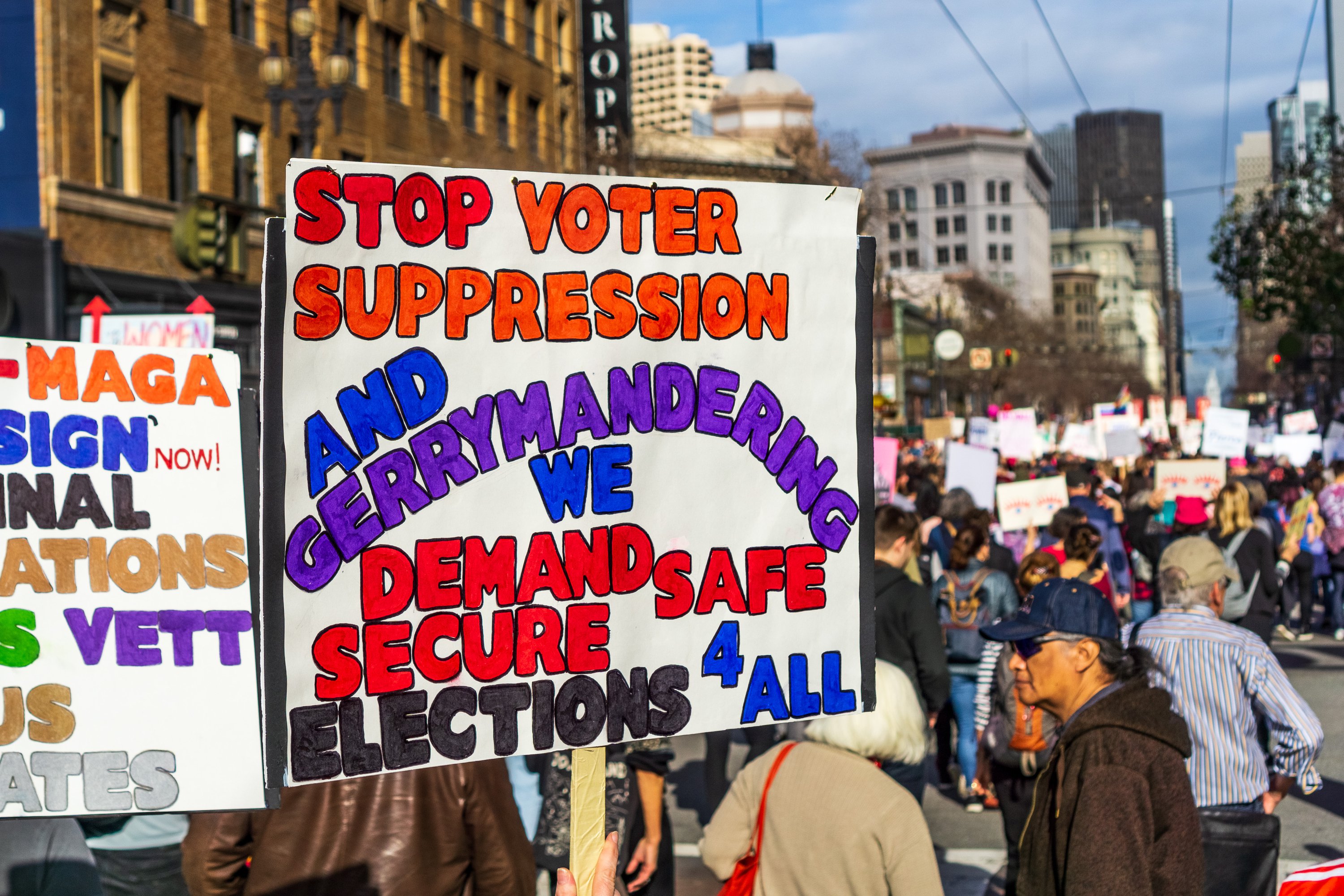
“Restore the Voting Right Act; End racist voter suppression and partisan gerrymandering; Make Election Day a national holiday; secure automatic voter registration; and guarantee the right to vote for every American over 18, including those Americans currently incarcerated and those disenfranchised by a felony conviction.” Co-sponsored S.949 – For the People Act of 2019.
Tom Steyer* ●
“Increase Voter Participation with a National Referendum; Initiate a Vote-At-Home System; Support Important Election Reform Legislation; Establish Independent Redistricting Commissions.” “H.R.1, the Voting Rights Advancement Act, and the Native American Voting Rights Act need to be signed into law immediately.”
Donald Trump ✕
Created through executive order the "Presidential Advisory Commission on Election Integrity." Supports voter-ID laws and voter purges and opposes same-day voter registration.
Elizabeth Warren* ●
“No more registration problems; No more voter purges; No more voting difficulties… I’m proposing a federal-state partnership so that states will have a strong financial incentive to follow these rules in their state and local elections as well — and to maximize voter turnout.” Co-sponsored S.949 – For the People Act of 2019.
Joe Walsh* ✕
Sponsored H.R. 6408: Federal Election Integrity Act of 2012, a federal
photo voter-ID law.
Bill Weld* ●
Supports federal regulations on voter purging; restoring the Voting Rights Act; vote-by-phone; restoring voting rights to felons after they’ve served their time, and some non-violent currently incarcerated people.
Andrew Yang* ●
“Combating voter suppression requires limiting voter roll purges, prohibiting voter ID laws, limiting last minute changes to polling locations, implementing automatic and same-day voter registration, accepting mail-in ballots, requiring early voting, and counting all provisional ballots… We will protect the integrity of our democratic process through the elimination of discriminatory laws and initiatives to increase voter participation across the board."
Reform the Electoral College
*indicates that the candidate has dropped out
Michael Bennet* ●
“The electoral college is outdated. Americans should directly elect our presidents.”
Joe Biden
Unknown
Michael Bloomberg* ✕
Bloomberg told the Washington Post he does not support eliminating the Electoral College in favor of the popular vote
Pete Buttigieg*●
“It’s simple: the candidate who gets the most votes should win. States don’t vote, people vote, and everyone’s vote should count exactly the same. The Electoral College has to go.” Supports National Popular Vote interstate compact until a constitutional amendment can be passed.
John Delaney* ✕
“If I was starting from scratch, yes, but trying to abolish the electoral college now is impractical.”
Tulsi Gabbard* ●
Supports reforming it or a system of proportional allocation of electors.
Amy Klobuchar* ○
Klobuchar told the Washington Post she is open to eliminating it.
Deval Patrick* ●
“The Electoral College is not democratic and, today, no longer reflects the popular will. Our leaders should be elected by a simple popular vote,” his democracy agenda said. “I will push for a Constitutional amendment to bring this about, and will support other efforts to assure that the popular vote determines the outcome through an interstate compact.”
Bernie Sanders* ●
“Abolish the Electoral College.”
Tom Steyer* ●
“I support eliminating the electoral college.”
Donald Trump ✕
“… the Cities would end up running the Country. Smaller States & the entire Midwest would end up losing all power – & we can’t let that happen. I used to like the idea of the Popular Vote but, now realize the Electoral College is far better for the U.S.A.”
Elizabeth Warren* ●
“It’s time to abolish the Electoral College and to have a national popular vote."
Joe Walsh*
Unknown
Bill Weld* ○
Not through a constitutional amendment but believes that a fair alternative would be for a “ 'proportional method of distributing Electors' based on the statewide vote, not by congressional district."
Andrew Yang* ●
“If we’re going to attempt to reform the electoral college, it would be better to focus on making electors determined on a proportional basis.”
Limit revolving door between government and lobbying
*indicates that the candidate has dropped out
Michael Bennet* ●
"Ban members of Congress from ever becoming lobbyists. Ban senior Congressional staff and cabinet officials from working as lobbyists in the particular areas they worked on for six years. Ban Congressional members and senior staff from ever representing foreign governments or foreign political parties. Close loopholes that allow individuals to operate as lobbyists without registering as one.” Sponsored the Close the Revolving Door Act of 2017.
Joe Biden ●
"Expand on and codify into law the Obama-Biden Administration ethics pledge. [It] will address not only the improper influence of lobbyists, but also any improper or inappropriate influence from personal, financial, and other interests – ensuring an extra layer of review and scrutiny whenever policy proposals or recommendations come from a conflicted source.”
Michael Bloomberg* ○
As Mayor of New York City, he “strengthened the New York City’s ethics and conflicts of interest laws and forced lobbyists to disclose their contacts with city officials."
Pete Buttigieg* ●
Buttigieg supports reforming rules on lawmakers becoming lobbyists, the restrictions in H.R. 1, and a ban on “golden parachutes" for executives who accept political appointments.
John Delaney* ●
“Delaney supports a five-year lobbying ban for former lawmakers," a spokesperson told The Hill. Co-sponsored the Stop the Revolving Door in Washington Act.
Tulsi Gabbard* ●
“The revolving door between politicians and lobbyists needs to close. I’ve been working on comprehensive legislation to do this. Until then, I’m all in on a clean bill focused on Members of Congress. Let’s make it happen.”
Amy Klobuchar* ●
Co-sponsored S.949 – For the People Act of 2019.
Deval Patrick* ●
“Return to the Obama Administration’s policy of forbidding lobbyists from entering government to regulate the very industries they had just lobbied for.”
Bernie Sanders* ●
“As president, Bernie will… Institute a lifetime lobbying ban for former members of Congress and senior staffers."
Tom Steyer* ○
"As president, Tom will enact comprehensive structural reform, so corporate lobbyists and special interests no longer control our democracy.”
Donald Trump ●
President Trump signed an executive order that placed a five-year ban on lobbying and a lifetime ban on lobbying for foreign countries for federal employees.
Elizabeth Warren* ●
Supports “ending lobbying as we know it by closing loopholes so everyone who lobbies must register, shining sunlight on their activities, banning foreign governments from hiring Washington lobbyists, and shutting down the ability of lobbyists to move freely in and out of government jobs.”
Joe Walsh*
Unknown
Bill Weld*
Unknown
Andrew Yang* ●
"Increase salaries for government officials who operate in a regulatory capacity to much higher levels, but ban them from receiving anything of value in exchange for advocating for a position (lobbying) to members of the federal government.”
Pass Constitutional Amendment on Money in Politics
*indicates that the candidate has dropped out
Michael Bennet* ●
Supports “a constitutional amendment to overturn Citizens United and new reforms to drive money out of politics.” Co-sponsored Democracy for All Amendment.
Joe Biden ●
“We need to… pass a constitutional amendment to overturn Citizens United to amplify the voices of individual Americans and ensure elected officials are working for the people.”
Michael Bloomberg* ○
"He'll work with Congress to overhaul the campaign finance system, stop pay-to-play, bring transparency to dark money, strengthen ethics and regulations around conflicts of interest.”
Pete Buttigieg* ●
“Overturn Citizens United and Buckley v. Valeo, if necessary by constitutional amendment… We also need to create common-sense campaign finance rules that clearly establish that corporations do not have the same political rights as people, and dollars cannot outvote human beings.”
John Delaney* ●
“Unlimited corporate money has made our democracy pay-to-play. John supports a constitutional amendment to overturn Citizens United.”
Tulsi Gabbard* ●
“Politicians and our democracy shouldn’t be beholden to big money and corporate interests. We must overturn Citizens United and ensure that our government is of, by, and for the people.”
Amy Klobuchar* ●
“She will lead the effort to pass a constitutional amendment to overturn Citizens United and get the dark money out of politics.”
Deval Patrick* ●
“Corporations are not people, and unlimited money on elections is not speech. In parallel with Constitutional changes, we will work with Congress to develop legislation to clarify that no corporation shall be deemed a ‘person’ for purposes of the First Amendment.”
Bernie Sanders* ●
"As president, Bernie will fight to… Pass a Constitutional Amendment that makes clear that money is not speech and corporations are not people.”
Tom Steyer* ●
“Corporations aren’t people, and they shouldn’t be controlling our politics. The Supreme Court decision in Citizens United must be overturned and the public financing of campaigns becomes the law of the land.”
Donald Trump
Unknown
Elizabeth Warren* ●
“But to truly end the corruption of our democracy, we must also pass a constitutional amendment to overturn the Supreme Court’s disastrous decisions in Citizens United and Buckley v. Valeo. A constitutional amendment will allow Congress to regulate election spending, establish public financing as the sole way to finance elections, and bring an end to the era of big money in politics.”
Joe Walsh*
Unknown
Bill Weld* ●
“Bill Weld is now the most prominent Republican candidate in favor of amending the Constitution in order to slow the torrent of big money in American politics.”
Andrew Yang* ●
“I will gladly push for a constitutional amendment to overturn Citizens United and return the American government to its people. We need to end Super PACs, drown out their influence, and stop pretending that corporations have equal rights to people.”
Expand Small-Donor Public Financing
*indicates that the candidate has dropped out
Michael Bennet* ●
“Create a voluntary small-donor matching system for federal elections to offset wealthy donors, paid for with a small surcharge on penalties for corporate and white-collar crime.”
Joe Biden ●
“Enact legislation to provide voluntary matching public funds for federal candidates receiving small dollar donations.”
Michael Bloomberg* ○
“Mike expanded public financing of elections in New York City by increasing the matching rate for small donations from $4 to $6, which meant that a $25 donation resulted in a $150 public match.”
Pete Buttigieg* ●
“It’s time to create a strong public financing system that matches small donors so average citizens can run for office funded by their communities, not big donors.”
John Delaney* ●
Co-sponsored H.R.20 – Government By the People Act of 2017, “To reform the financing of congressional elections by broadening participation by small dollar donors, and for other purposes.”
Tulsi Gabbard* ●
Co-sponsored H.R.20 – Government By the People Act of 2017, “To reform the financing of congressional elections by broadening participation by small dollar donors, and for other purposes.”
Amy Klobuchar* ●
Co-sponsored S.366, supporting matching fund for small donors, with debate requirements.
Deval Patrick* ●
“Create a federal program that matches small donations by American citizens with public funds to amplify the impact of small donors in elections. One path to getting there is to create a government fund that would match small donations to political campaigns at an eight to one ratio, modeled off of existing programs like that in New York City. The matching fund would be paid for by taxing the expenditures of corporate PACs.”
Bernie Sanders* ●
“Replace corporate funding and donations from millionaires and billionaires with public funding of elections that amplifies small-dollar donations.”
Tom Steyer* ●
Doesn’t say so explicitly, but pledges to sign H.R.1 into law “immediately.”
Donald Trump
Unknown
Elizabeth Warren* ●
Warren “would give a 6-1 match for small dollar contributions, less than $200. The program will be funded by penalties coming from corporate malfeasance and major tax crimes.”
Joe Walsh*
Unknown
Bill Weld*
Unknown
Andrew Yang* ●
“Every American gets $100 a year to give to candidates, use it or lose it. These Democracy Dollars would, by the sheer volume of the US population, drown out the influence of mega-donors.”
Eliminate the Filibuster
*indicates that the candidate has dropped out
Michael Bennet* ✕
Signed the 2017 letter supporting the 60-vote filibuster threshold.
Joe Biden ✕
“[I do] not support ending the filibuster.”
Michael Bloomberg*
Unknown
Pete Buttigieg* ●
“It will be time to put an end to the filibuster that has gotten in the way of so much good policy in this country."
John Delaney* ✕
“If we want to pass long-lasting, meaningful legislation, it should be done with a 60-vote majority.”
Tulsi Gabbard* ○
“That’s another one that is important for us to look at how we solve this or make changes that are not based on partisanship. Often it is the party that is in the minority that is calling for bringing about those changes and then once they get into the majority then they say no, absolutely not, we’re not going to change this.”
Amy Klobuchar* ○
Klobuchar was one of 61 senators to sign a letter supporting the 60-vote filibuster threshold in 2017, but told the Washington Post in 2019 that she was open to it.
Deval Patrick*
Unknown
Bernie Sanders* ○
“Once we have — and [I] believe it will be sooner than later — a Democratic majority that is prepared to take on the greed and the corruption of the fossil fuel industry and vote for these major reforms in the House and the Senate, we will pass them. That means enacting real filibuster reform, including the return to requiring a talking filibuster. It is not right that one senator can grind the entire legislative process to a halt.”
Tom Steyer* ●
Steyer told the Washington Post he supports eliminating the filibuster.
Donald Trump
Unknown
Elizabeth Warren* ●
“When Democrats have the White House again, if Mitch McConnell continues to put small-minded partisanship ahead of solving the massive problems facing our country, then we should get rid of the filibuster.”
Joe Walsh*
Unknown
Bill Weld*
Unknown
Andrew Yang* ●
“As President, I will: Get rid of the filibuster or Mitch McConnell (or, preferably, both). Promote an end to the current filibuster system used in the Senate, ending the requirement for a 60-vote cloture motion and replacing it with the traditional need to hold the floor.”
Reform the Supreme Court
*indicates that the candidate has dropped out
Michael Bennet* ○
“We are now in a situation where, at least for the immediate future and maybe forever, we are going to put people on the Court by the barest partisan majority. We will have to have a president and the Senate from the same party [for a nominee to be confirmed]. That is an incredible distortion in our system and it hasn’t been the way it’s worked until now. Term limits 'could be an answer to it.” Bennet is opposed to court “packing.”
Joe Biden ✕
“No, I’m not prepared to go on and try to pack the court, because we’ll live to rue that day.” His position on term limits for justices is unknown.
Michael Bloomberg* ✕
Bloomberg told the Washington Post he does not support “packing” the court. His position on term limits is unknown.
Pete Buttigieg* ●
“We need to reform the Supreme Court in a way that will strengthen its independence and restore the American people’s trust in it as a check to the Presidency and the Congress. One promising idea is to restructure the Court so that ten members are confirmed in the normal political fashion, with the other five promoted from the lower courts by unanimous agreement of the other ten. Others have proposed implementing term limits. As president, Pete will create a bipartisan reform commission for the purpose of recommending structural improvements to protect the Supreme Court from further politicization.”
John Delaney* ●
Supports an 18-year term limit for justices, but opposes packing the court.
Tulsi Gabbard* ✕
Gabbard told the Washington Post she does not support adding seats to the court. Her position on term limits for justices is unknown.
Amy Klobuchar* ○
“I am open to [adding seats to the Supreme Court]. It depends on what happens with the Senate if that’s realistic. My much more practical focus will be on immediately, when I become president, filling open judgeships.” Her position on term limits for justices is unknown.
Deval Patrick*
Unknown
Bernie Sanders* ○
“Once the process of packing the court starts, it could continue with each political party adding more judges when they have the power to do so.” On term limits, he said “I have to hear more discussion on this issue before commenting.” He has indicated openness to "rotating judges" from the Supreme Court to other federal courts.
Tom Steyer* ●
Steyer supports expanding the size of the Supreme Court and is open to term limits for the justices.
Donald Trump ✕
Trump said he “wouldn’t entertain that,” when asked about expanding the size of the court.
Elizabeth Warren* ○
“If Republicans are going to try to block us on key legislation or judges that we’re trying to move forward, then you better believe all the options are on the table.”
Joe Walsh*
Unknown
Bill Weld*
Unknown
Andrew Yang* ●
Yang “will propose a constitutional amendment 18-year term limits on Supreme Court Justices,with terms staggered so that there’s one retirement every other year (each President gets 2 appointments),” and “Allow for ‘off-cycle’ appointments, having the President ‘forfeit’ their next appointment to maintain parity.”