A Chapter of: Global Answers for Local Problems
Building Collaborative Government and Institutionalizing Civic Engagement
In contrast to traditional models of policymaking, collaborative governance offers an improved version of democracy that recognizes residents have lived experiences with local needs, concerns, and public policies—and that these experiences should combine with bureaucracy’s technical expertise to create better, more effective governing.20 When implemented, residents and public officials participate in real dialogue and engage in joint problem-solving beyond the all-too-typical versions of civic engagement that are, in reality, just one-time, citizen-as-consumer21 transactions. As a result, Brandeis University sociology professor Carmen Sirianni writes that the outcome of collaborative governance is policy design that can “‘empower, enlighten, and engage citizens in the process of self-government.’”22
Successful collaborative governance and civic engagement must begin with support from city leadership, and grow to create a new governing culture around civic engagement that includes buy-in from bureaucrats and front-line staff at all related agencies.
From this foundation, implementing collaborative governance models procedurally includes six ingredients, according to Matt Leighinger and Tina Nabatchi: links to decision makers, participant diversity, feedback, sustained community involvement, shared priorities and clear recommendations, and informed engagement.23 Such engagement can develop through strategies like social media aggregation, surveys and polls, focus groups, crowdsourcing and crowdfunding, online networks, mapping and writing platforms, collaborative planning processes, and public deliberation.
Then, in its implementation, collaborative governance must contain an ongoing process of identifying a challenge, deliberating public problems, sustaining participation, building trust, taking action, and showing impact. According to Cities of Service and previous New America research, another crucial requirement is that both residents and city staff have input in all steps of the process, from the identification of the problem to the strategy, implementation, and reflection phases. As a result, collaborative governance and the civic engagement process are not linear.
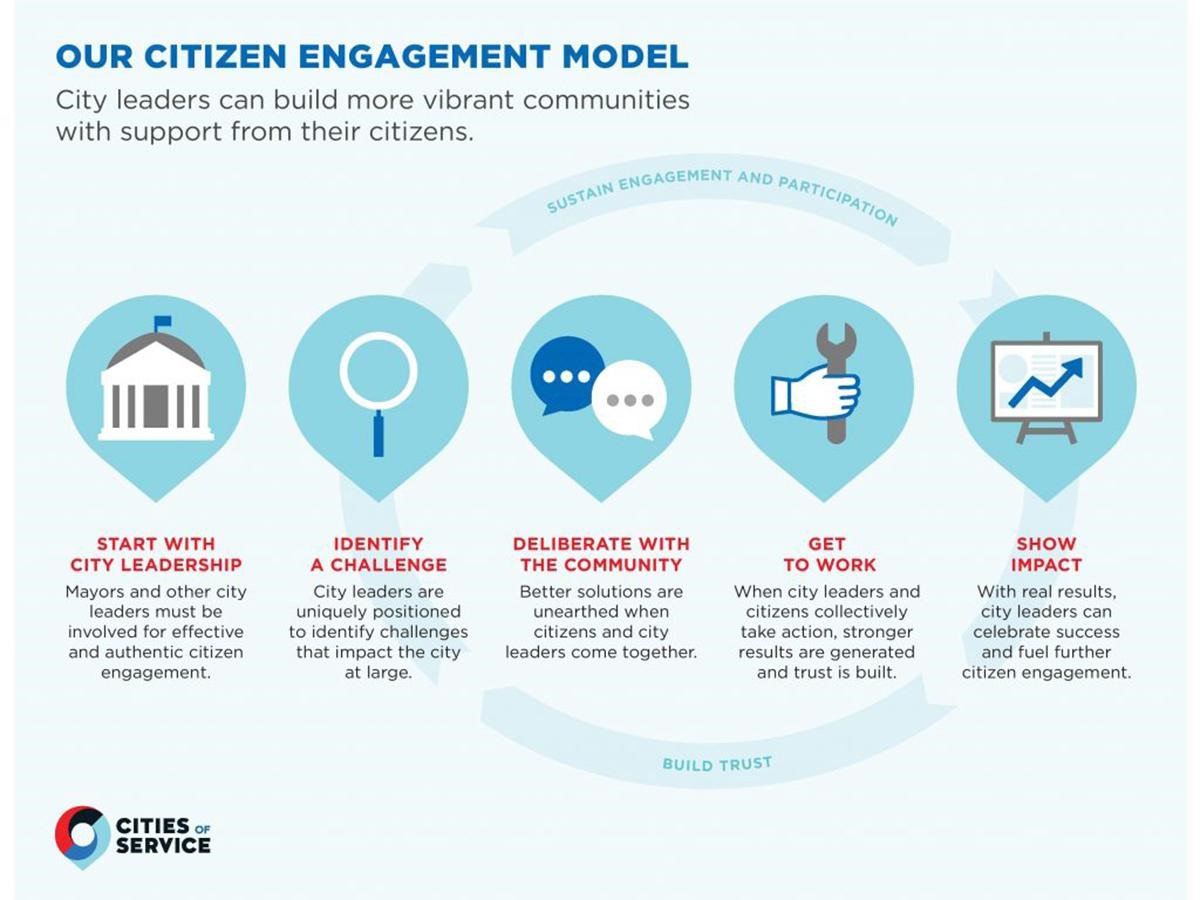
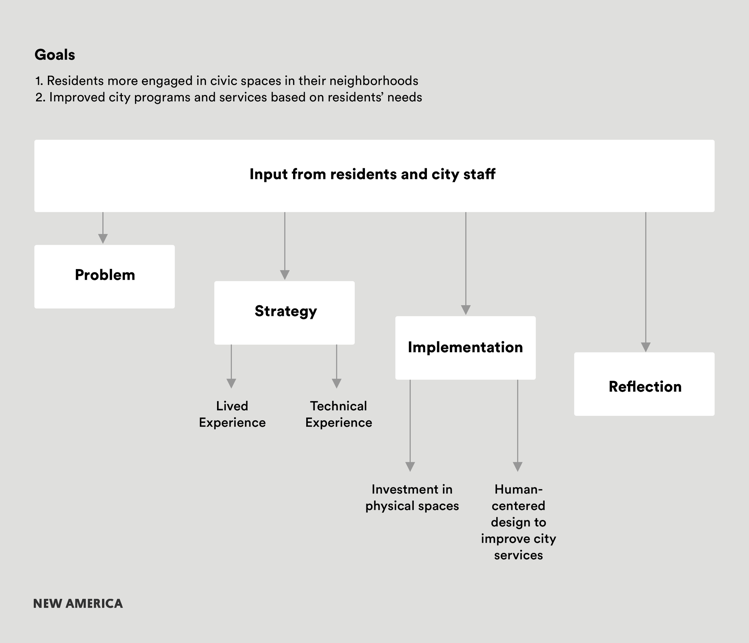
By including residents in every step of the policymaking process, collaborative governance models can help share the level of decision-making authority to include residents and traditionally excluded voices.
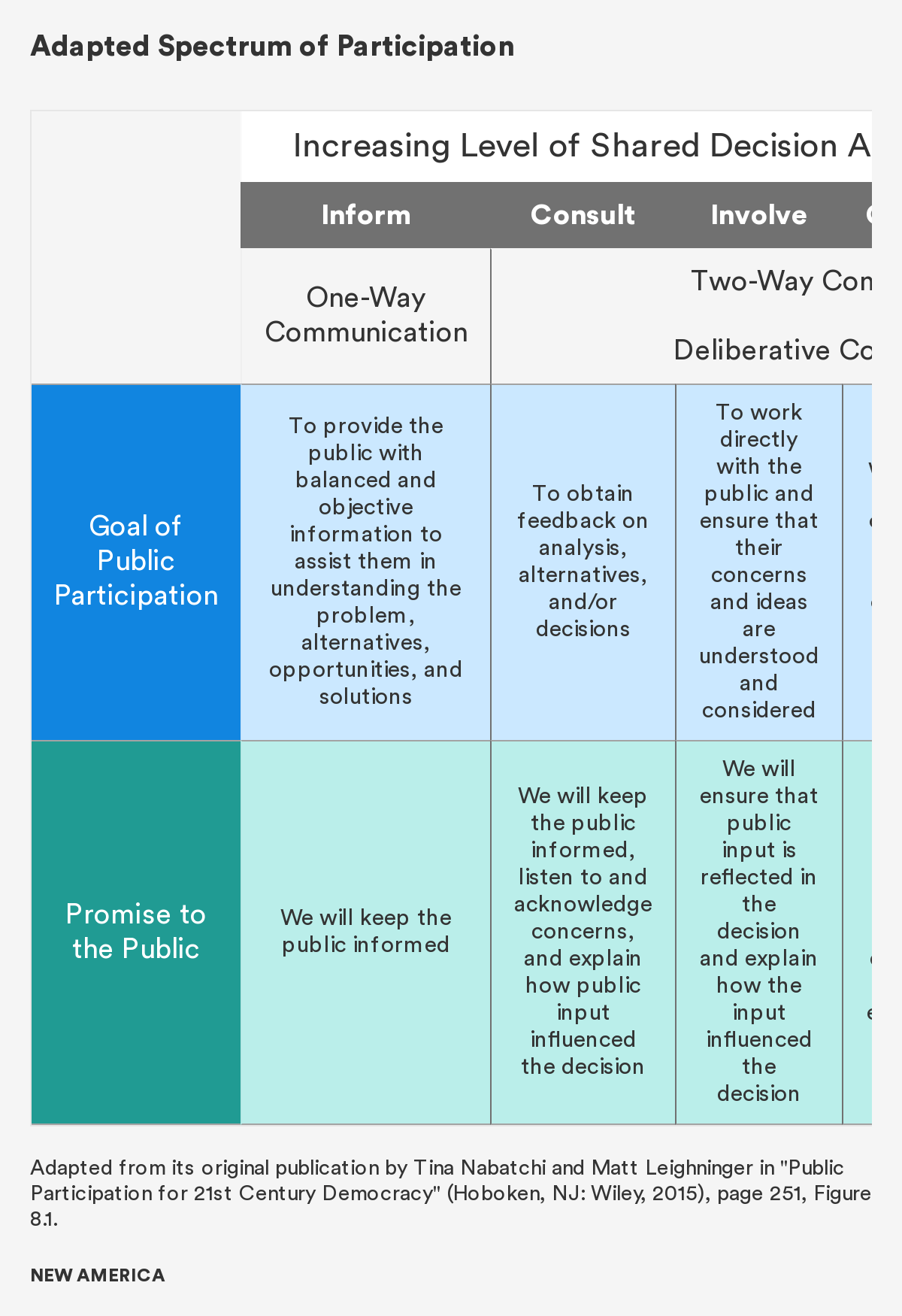
As Tina Nabatchi and Matt Leighninger show, public participation is most empowering when it involves two-way, deliberative communication, which can happen along a spectrum. Not all collaborative governance opportunities must take place at the empowerment stage of placing final decision-making power in the hands of the public—nor should they all be. However, Nabatchi and Leighninger’s chart showcases the range of collaborative governance possible.
Therefore, collaborative government models can be implemented at various scales, as small as one agency’s program. However, where collaborative government has proven most effective, transformative, and durable, it has depended on the creation of new governing institutions and roles.
Recently, mayoral offices across the globe have expanded to include new, experimental roles, from chief storytellers to chief innovation, technology, and data officers. Municipal governments are also developing new kinds of departments, with units like the Civic Engagement Commission in New York City and the Civic Imagination Office in Bologna, Italy. Similarly, governments in Detroit and Lansing, Michigan prioritized civic engagement by establishing a Department of Neighborhoods and Citizen Engagement, which holds civic convenings and trainings, and “connects civic organizations to resources.”24
Ultimately, these roles and structures aim to institutionalize a shared access to power between the residents and city leadership, structurally changing local government to include engagement by design. In addition, these structures actively bring residents, city staff, and officials out of their traditionally confined roles and empower them to think creatively and participate however they are able.
Beyond improving public-service delivery, collaborative government and civic engagement can also benefit city staff and residents in more personal ways. For city staff, it brings them closer and builds better relationships with the communities they’re serving. For residents, researcher Mark E. Warren has noted that increased civic engagement can result in attentiveness to the common good and concern for justice; tolerance of the views of others; trustworthiness; willingness to participate, deliberate, and listen; respect for the rule of law; and respect for the rights of others, to name but a few.25 Similarly, urban-level engagement builds social capital—the social relationships built within a community—for participants as residents work together to co- create, share, and develop public goods, deepening community ties.26

Global Answers for Local Problems
- Executive Summary
- The Promise of Participatory Democracy
- Cities as Centers of Challenge and Opportunity
- Building Collaborative Government and Institutionalizing Civic Engagement
- Identifying Levers of Power in Municipal Government
- Sharing Levers of Power in Municipal Government
- About this Study
- On the Ground Lessons from Engaged Cities
- Recommendations: Next Steps for Practitioners and Research
- Conclusion
Citations
- Polimédio, Souris, Russon Gilman, 2018.
- Hollie Russon Gilman, “Government as Government, not Business,” Stanford Social Innovation Review, October 5, 2017.
- Carmen Sirianni, Investing in Democracy: Engaging Citizens in Collaborative Governance, (Washington, D.C., Brookings Institution Press, 2009).
- Tina Nabatchi and Matt Leighninger, Public Participation for the 21st Century (Hoboken, NJ: Jossey-Bass, 2015),
- “Department of Neighborhoods and Citizen Engagement,” City of Lansing online.
- Mark E. Warren, Democracy and Association, (Princeton, N.J.: Princeton University Press, 2001), 73.; Archon Fung, “Associations and Democracy: Between Theories, Hopes, and Realities.” Annual Review of Sociology 29 (August 2003): 515–39.
- Robert, D. Putnam, Bowling Alone (New York City, NY: Simon & Schuster, 2000).; Desire Mpanje, Pat Gibbons, and Ronan McDermott. “Social capital in vulnerable urban settings: an analytical framework,” Journal of International Humanitarian Action 3, no. 4 (April 2018).