A Chapter of: Humanities+Tech
For the Future
The quotes, themes, and stories from all three events are evidence of just how much people want and need tools to tell their stories, communicate their values, identify and address gaps in who is included in decision-making, and make a positive difference in the world. Those tools certainly include communication technologies of all kinds, from pen on paper to video documentation of a person’s insights to the ability to share artwork across social media. We also want to acknowledge how other tools of the humanities helped generate these insights, whether through storytelling, analyzing and interpreting history, or considering the intersection of artisanship and economics.
Below are three actions that could take this work forward—both in the greater Pittsburgh region and in communities around the country and across the globe grappling with the tough questions and opportunities afforded by technological change.
- Continue to integrate the humanities in conversations about the impact of and design of technology. The Remake Learning Network provides an important platform for continuing to share ideas for two themes that emerged from the first event: lifting up youth voices and including more educators in the decision-making and design of technology. Next iterations might include yet more humanities activities, such as providing opportunities for participants to write and reflect on the impact of a particular technology from the present and the past, or describing a new app or tool they wished existed in the learning space today.
- Build on interest at the intersection of digital mapping, storytelling, and social studies. Educators wanted more details on how to use digital maps for particular lesson plans and in ways that are relevant to the standards and concepts they have to teach. Could educators join with mapping developers as well as education and history faculty at universities to form an affinity group that explores the topic further?
- 3. Consider new events and messages that highlight the work and stories of all kinds of people who make and create, recognizing that the label “maker” itself may feel limiting. On its face, one might assume that the word “maker” should easily apply to many different people and many different types of making, creating, crafting, and building. But participants at the third event in Morgantown raised concern that “maker” can quickly become defined by the most visible players (such as those who are white, male, and live in cities). Artisans and craftspeople do not necessarily identify as makers, but all need access to learn, validate, sell, and share work.
A Checklist for Hosting Your Own Humanities+Tech Discussions
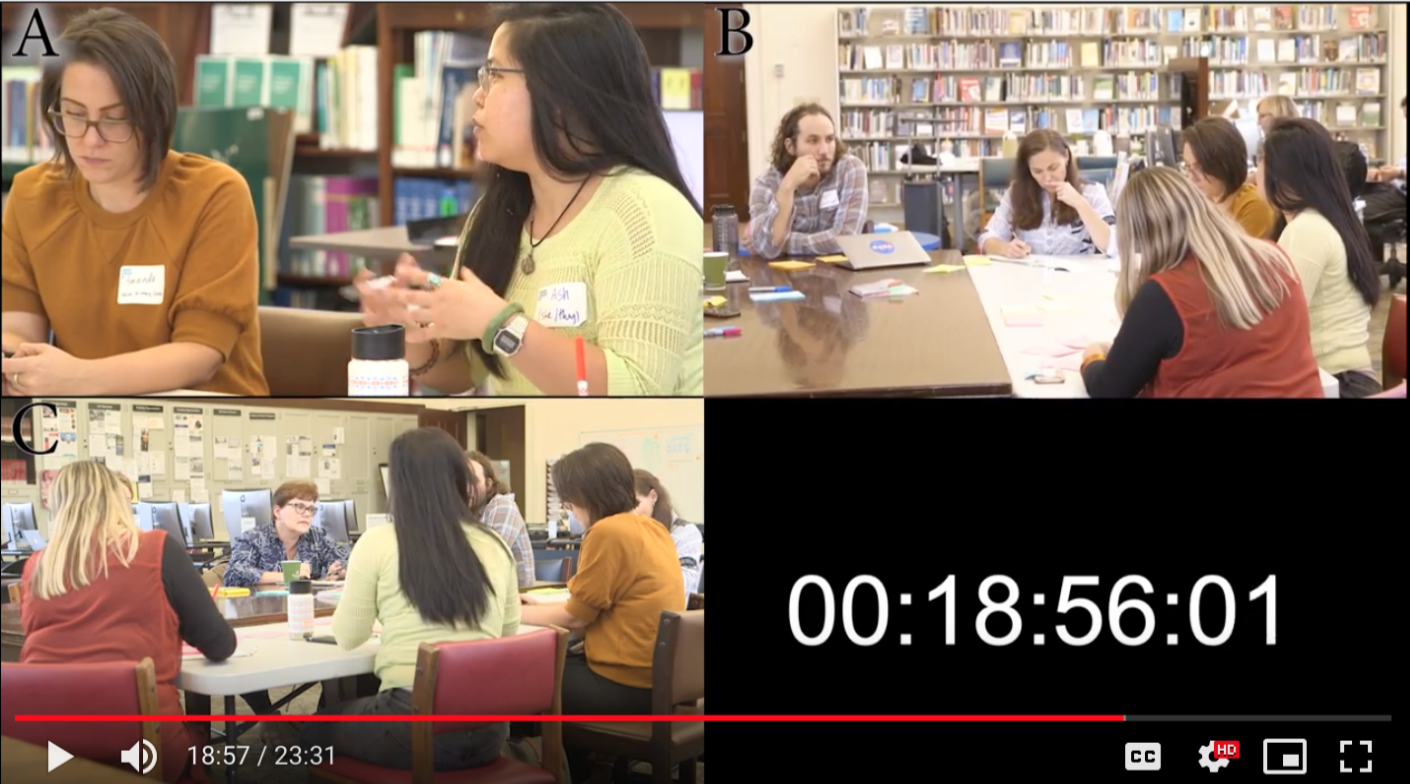
Humanities+Tech discussions can be as big or small as you want them to be. But holding events that require multiple thought partners is complex and requires a unified vision and commitment across organizations. The questions below come from New America’s experience hosting scores of events every year and are based in large part on lessons we learned producing these particular events in the Pittsburgh area.
- Where do you want to go and who is driving? Get leaders together to set goals and decide which organization will be the lead coordinator. If there is a desire in your community for a values-oriented discussion about technology, do planners have a fair representation of voices which express opportunity as well as concern? Are there debates afoot about what you want your school system or your community to look like in the future? Are there segments of society that are not often in the same room together? Why is that? Use those questions as a starting point. Determining early on what success looks like—whether it is engaging a diverse audience, uncovering scalable solutions, or elevating a particular idea—is essential to a robust conversation that satisfies all stakeholders.
- Are you able to conduct personal outreach? The most dynamic discussions come from varying viewpoints, but it can be challenging to get people from different realms into a room together. Even in the Humanities+Tech series, which had multiple partners, we found securing divergent and marginalized voices a challenge. For example, in the first event, a tech designer from CMU pointed out that although educators said they wanted more say in design decisions, “this whole meeting was designed towards educators and there were not as many designers present." Ask stakeholders whether they have the capacity to do personal outreach for future events, and make diverse representation—both with speakers and in the audience—a foundational group agreement. Consider how it could be useful to design the event to favor conversations between people with different or contrasting backgrounds. Making outreach a priority when goal-setting ensures that inclusivity remains a consistent and driving theme when designing the scope of the project and prevents redundancies by provoking cross-cutting conversations in safe environments.
- Do you have connections to humanities locales? Take an inventory of various learning centers in your community. Are you able to partner with humanities experts, docents, or storytellers at libraries, museums, or universities who could provide tools or artifacts (film reels, digitized photos, pieces of artwork) to spark discussions? Could you piggyback on or augment an already standing event or workshop with a Humanities+Tech lens? By tapping into existing institutions or initiatives, you increase the potential for substantive conversations and elevate the visibility and impact of programs in inventive ways.
- Can you design opportunities for participants to record reactions and ideas? One of the most successful aspects of the Pittsburgh Humanities+Tech events was the use of a “Chalk Talk” strategy. Borrowed from the Western Pennsylvania Writing Project (an arm of the National Writing Project), Chalk Talks encourage participants to ruminate on particular prompts (photos, quotations, etc.), both silently and in conversation with others, and to express top-of-mind thoughts by writing a few lines of response. For example, at the July 24 event, participants wrote items such as, “I see a lot of focus on the ‘risk’ of online spaces. What about the possibilities of taking transformative action?” and, “When profit is the motivation of AI systems, there is always an overlooking of what people actually need and/or want. We often strive for this idealistic win-win scenario, where companies can make a profit while improving society. However, I think that is a false premise.” Building in ample opportunities for attendees to participate and be heard fosters a shared ownership of the project’s outcomes and gives critical food for thought about future collaborations and community-informed solutions.
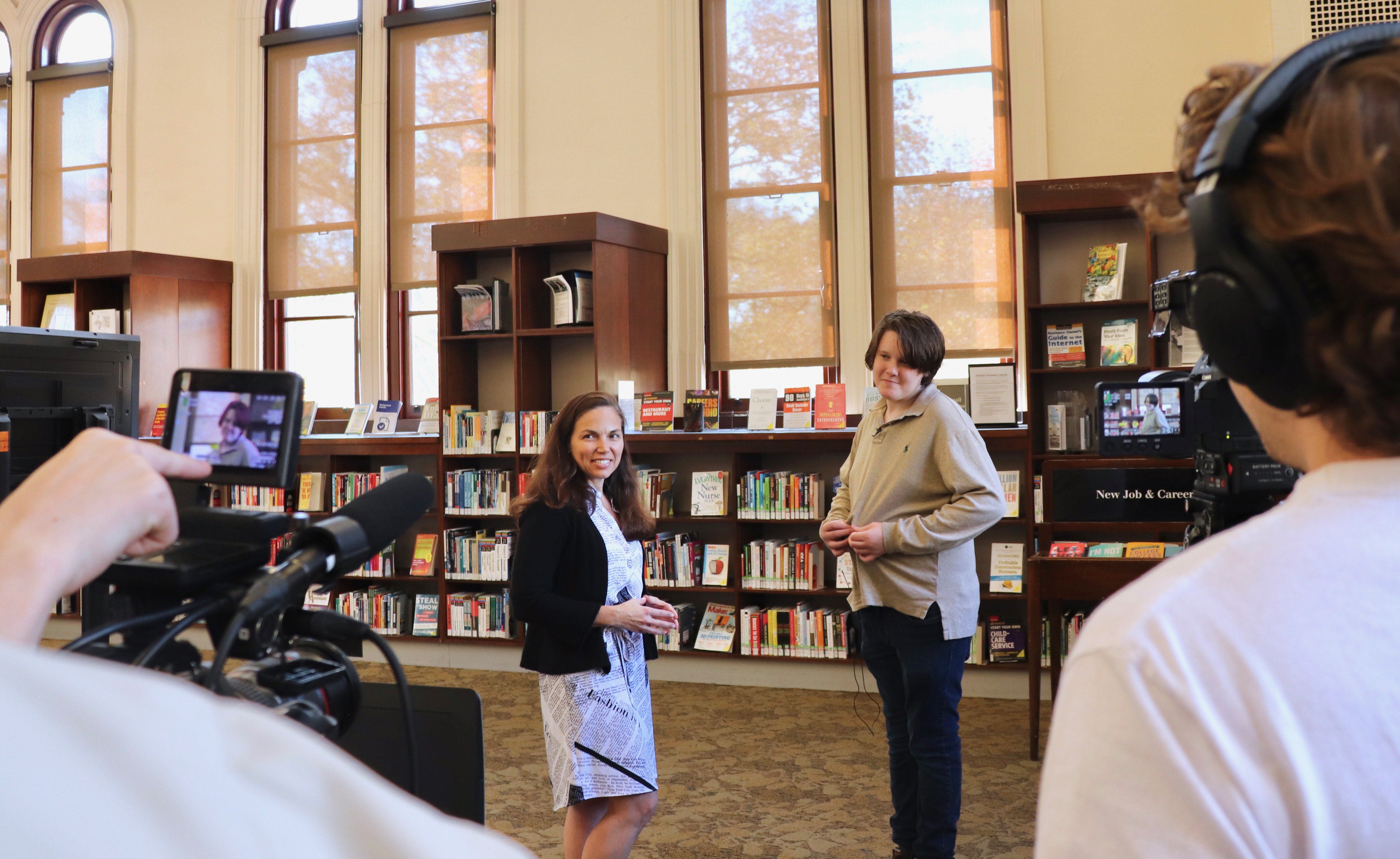
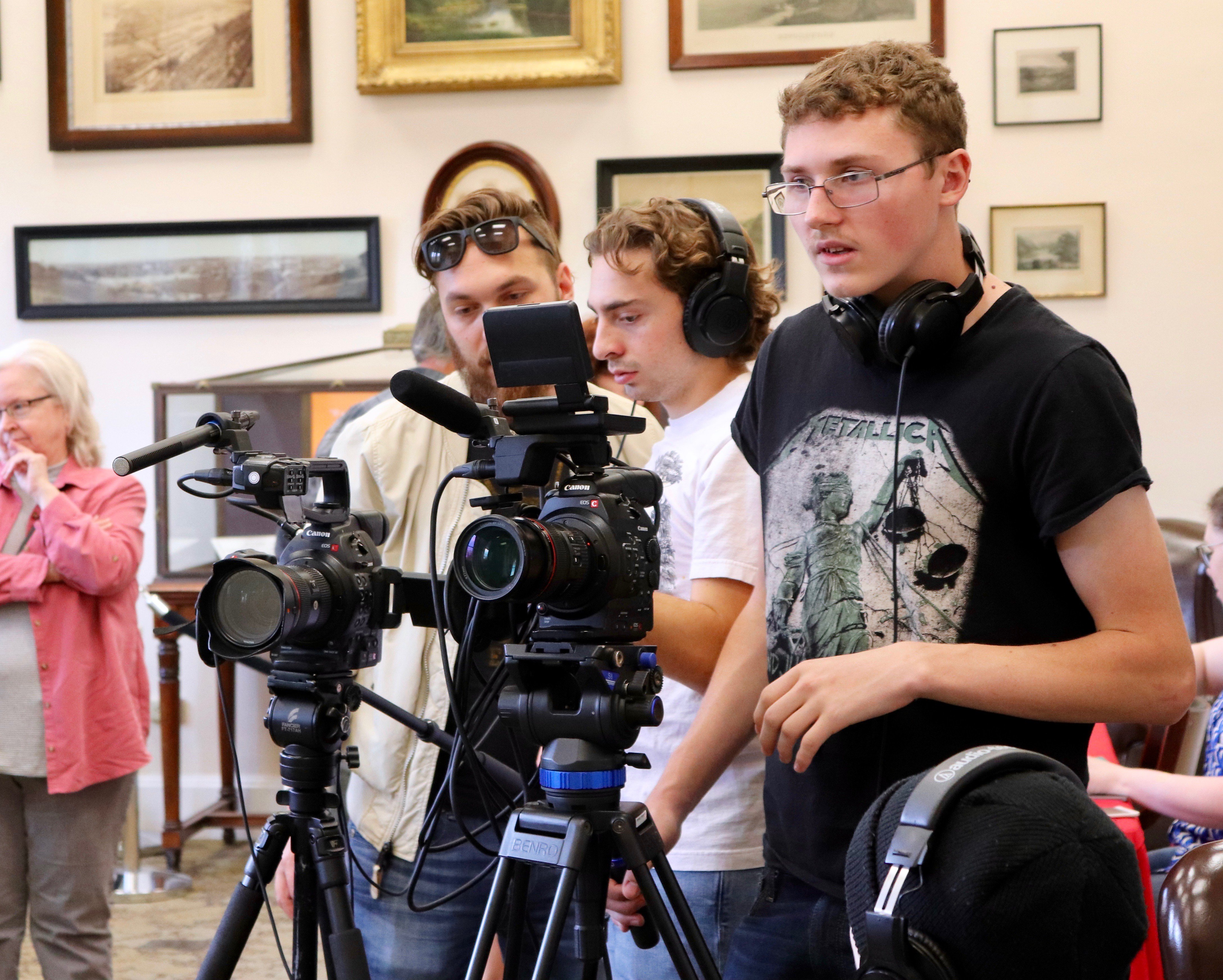
- Do you have a way to engage youth in the events? As young adults are interacting with the humanities and tech on a daily basis, understanding their perspective is a crucial piece of this conversation, and could be used for pioneering your event’s design and outputs, generating innovative ideas (when they are included as participants), or disseminating the discussion to their peers through social media or an educational project. The greater Pittsburgh area has the benefit of Steeltown Entertainment, a nonprofit that supports film and digital media arts by developing diverse content creators with training, mentoring, equipment, and networking opportunities. But even if your community does not have a Steeltown, there are opportunities to draw in youth and young adult participants by connecting with local high school and college film clubs, youth podcasting studios, or journalism courses. Engaging youth in this way not only gives them valuable experience in using digital media to document and record, but it also opens opportunities for older people to talk with younger people about their perspectives. Being part of these events also helps expose youth to current debates and helps them make their own connections to history, art, philosophy, and other humanities subjects. “We’re learning audio, how to record the audio, how to record on all sorts of cameras and how to set them up, and we’re also doing editing,” said Charles McDonald, a sophomore at Pittsburgh CAPA (Creative And Performing Arts) 6-12 School and student lead for the Steeltown crew. “You’re getting a lot of experience that you wouldn’t get otherwise.”